Tricarboxylic Acid Cycle

Learninsta presents the core concepts of Microbiology with high-quality research papers and topical review articles.

Tricarboxylic Acid Cycle

TCA cycle was first elucidated by Sir Hans Adolf Krebs, a German Biochemist in 1937. It is also known as Tricarboxylic acid cycle, Citric acid cycle or Amphibolic cycle. In prokaryotic cells, the citric acid cycle occurs in the cytoplasm; in eukaryotic cells it takes place in the matrix of the mitochondria.

The process oxidizes glucose derivatives, fatty acids, and amino acids to carbon dioxide (CO2) through a series of enzyme controlled steps. The purpose of the Krebs cycle is to collect high energy electrons from these fuels by oxidizing them, which are transported by activated electron carriers such as NADH and FADH2 to electron transport chain.

The Krebs cycle is also the source for the precursor of many other molecules and is therefore an amphibolic pathway (both anabolic and catabolic reactions take place in this cycle) and therefore, it can be used for both the synthesis and degradation of bio molecules.
Tricarboxylic Acid Cycle img 1

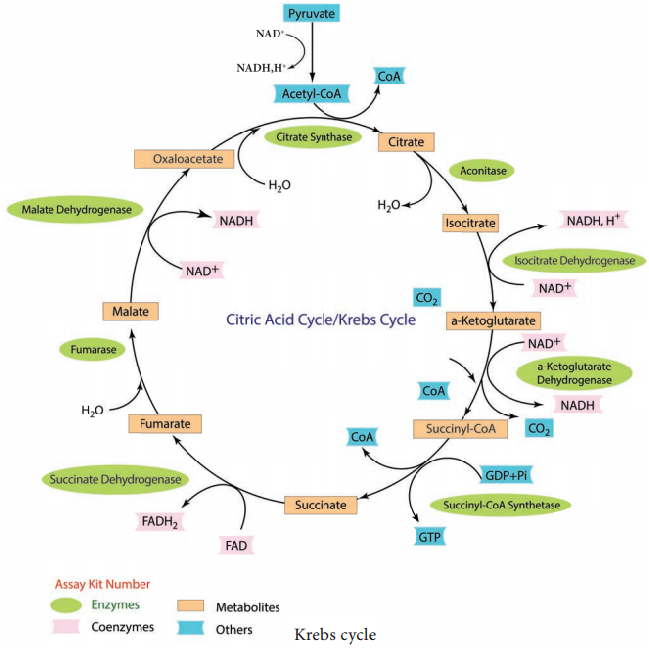
Pyruvate cannot enter the Krebs cycle directly. In a preparatory step, it must lose one molecule of CO2 and becomes a two-carbon compound. This process is called decarboxylation. The two-carbon compound, called acetyl group, attaches to coenzyme A through a high-energy bond, the resulting is a complex known as acetyl coenzyme (acetyl CoA).

During this reaction, pyruvic acid is also oxidized and NAD+ is reduced to NADH by pyruvate dehydrogenase complex (PDHC). This multi enzyme complex is responsible for the conversion of pyruvate to acetyl-coA. Therefore PDHC contribute to linking the Glycolysis pathway to the citric acid pathway.

The Krebs cycle generates a pool of chemical energy (ATP, NADH, and FADH2) from the oxidation of Pyruvic acid and it loses one carbon atom as CO2 and reduces NAD+ to NADH. The resulting two carbon acetyl molecule is joined to Co enzyme A. Acetyl CoA transfers its acetyl group to a 4C compound (oxaloactate) to make a 6C compound (Citrate) and the Coenzyme A is released which goes back to the link reaction to form another molecule of acetyl CoA. Oxaloacetate is both the first reactant and the product of the metabolic pathway (creating a loop).

After citrate has been formed, the cycle machinery continues through seven distinct enzyme catalyzed reactions that produce in order isocitrate, α – ketoglutarate, succinyl CoA, succinate, fumarate, malate and oxaloacetate.

At the end of Krebs cycle, each pyruvic acid produces 2 CO2, 1 ATP (substrate level phosphorylation), 3 NADH and 1 FADH2. Then NADH and FADH2 can be oxidized by electron transport chain to provide more ATPs.
Carbohydrate Catabolism

Learninsta presents the core concepts of Microbiology with high-quality research papers and topical review articles.

Carbohydrate Catabolism

Most microorganisms oxidize carbohydrates as their primary source of cellular energy. Carbohydrate catabolism is the breakdown of carbohydrate molecule to produce energy and is therefore of great importance in cell metabolism. Glucose is the most common carbohydrate energy source used by cells.

To produce energy from glucose, microorganism use two general processes namely Respiration and Fermentation.

Cellular Respiration

Respiration is defined as an ATP generating process in which organic molecules are oxidized and the final electron acceptor is an inorganic compound.

In aerobic respiration, the final electron acceptor is Oxygen and in anaerobic respiration the final electron acceptor is an inorganic molecule like NO3, SO42- other than Oxygen.

The aerobic respiration of glucose typically occurs in three principal stages. They are Glycolysis Krebs cycle
Electron transport chain.

Glycolysis

Glycolysis is the process of splitting of sugar molecule, where the glucose is enzymatically degraded to produce ATP. Glycolysis is the oxidation of glucose to pyruvic acid with simultaneous production of some ATP and energy containing NADH. It takes place in the cytoplasm of both prokaryotic and eukaryotic cells.
Glycolysis occurs in the extra mitochondrial part of the cell cytoplasm.

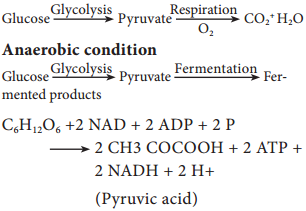
Glycolysis was discovered by Emden, Meyerhof and Parnas. So, this cycle is shortly termed as EMP pathway, in honour of these pioneer workers. This cycle occurs in animals, plants and large number of microorganisms. Glycolysis does not require oxygen, it can occur under aerobic or anaerobic condition. Glycolysis is a sequence of ten enzyme catalyzed reactions.

Aerobic condition

Carbohydrate Catabolism img 1

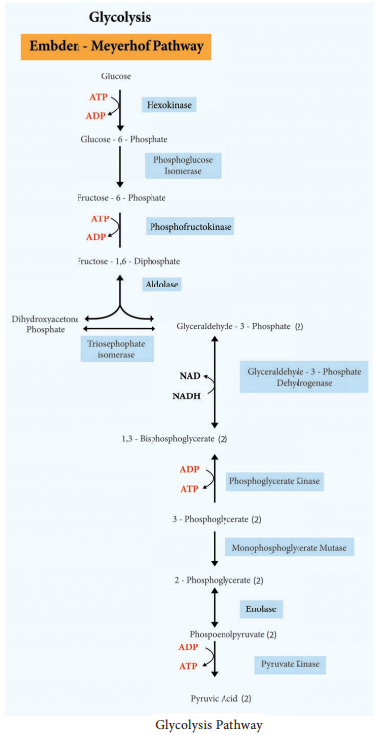
Since glucose is a six carbon molecule and pyruvate is a three carbon molecule, two molecules of pyruvate are produced for each molecule of glucose that enters Glycolysis. Net energy production from each glucose molecule is two ATP molecules The Glycolysis pathway consists of two phases. They are

  1. The preparatory/Investment phase, where ATP is consumed
  2. The pay off phase where ATP is produced (Figure 4.4).

Carbohydrate Catabolism img 2

1. In the preparatory stage, two molecules of ATP are utilized and then glucose is phosphorylated, restructured, and split into two 3 carbon compounds namely Glyceraldehyde-3-phosphate and Dihydroxyacetone phosphate.

2. In pay off phase or energy conserving stage, the two 3 carbon molecules are oxidized in several steps to 2 molecules of pyruvic acid and two molecules of NAD+ are reduced to NADH, thus four molecules of ATP are formed by substrate level phosphorylation.

Two molecules of ATP are needed to initiate Glycolysis and four molecules of ATP are generated at the end of the process. Therefore, the net gain of Glycolysis is two ATP for each molecule of glucose oxidized.

Alternatives to Glycolysis

Many bacteria have another pathway in addition to Glycolysis for the oxidation of glucose. Some of the common pathways that occur in most of the bacteria are

• Pentose phosphate pathway (PPP) or Hexose Mono Phosphate shunt
• Entner – Doudoroff Pathway

Generation of ATP

Learninsta presents the core concepts of Microbiology with high-quality research papers and topical review articles.

Generation of ATP

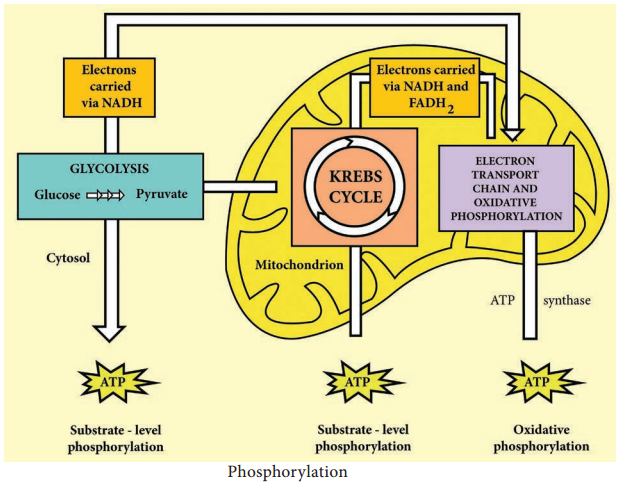
Much of energy released during oxidation reduction reaction is trapped within the cell by the formation of ATP. A phosphate group is added ADP with the input of energy to form ATP. The addition of a phosphate to a chemical compound is called phosphorylation. Organism uses three different mechanisms of phosphorylation to generate ATP from ADP.

Substrate Level Phosphorylation

It is a metabolic reaction that results in the formation of ATP or GTP by the direct transfer of a phosphoryl group to ADP or GDP from another phosphorylated compound.

Oxidative Phosphorylation

In this reaction, electrons are transferred from organic compounds to molecules of Oxygen (O2) or other inorganic molecules through a series of different electron carriers (Example: NAD+ and FAD). Then the electrons are passed through a series of different electron carriers to oxygen. The process of oxidative phosphorylation occurs during electron transport chain (Figure 4.3).
Generation of ATP img 1

Photophosphorylation

It occurs only in photosynthetic cells which contain light trapping pigments. Example: In photosynthesis, photosynthetic pigment, Chlorophyll is involved in the synthesis of organic molecules especially sugars, with the energy of light from the energy poor building blocks like Carbon dioxide and water. In phototropic bacteria (purple, green sulphur bacteria, Cyanobacteria), photosynthetic pigments bateriochlorophylls are involved in ATP production.

Energy of Chemical Reaction

Learninsta presents the core concepts of Microbiology with high-quality research papers and topical review articles.

Energy of Chemical Reaction

Light energy is trapped by phototrophs during photosynthesis, in which it is absorbed by bacteriochlorophyll and other pigments and converted to chemical energy for cellular work. The energy is required by the bacterium for synthesis of cell wall or membrane, synthesis of enzymes, cellular components, repair
mechanism, growth and reproduction.

Some change of energy occurs whenever bonds between atoms are formed or broken during chemical reactions. When a chemical bond is formed, energy is required. Such a chemical reaction which requires energy is called an endergonic reaction (energy is directed inward). When a bond is broken, energy is released. A chemical reaction that release energy is an exergonic reaction (energy is directed outward).

During chemical reaction energy is either released or absorbed and the quantum of energy liberated or taken up is useful energy and is referred to Free Energy Change (ΔG) of the reactions.

High Energy Phosphate

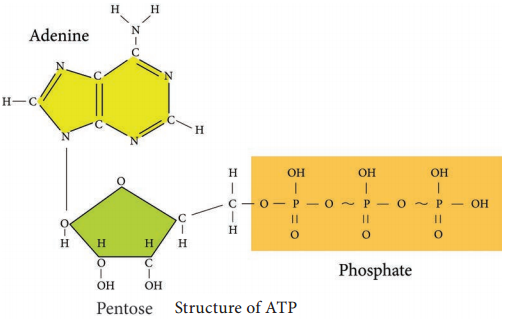
Adenosine Tri-Phosphate (ATP) is the principal energy carrying molecule of all cells and is indispensable to the life of the cell. It stores the energy released by some chemical reactions, and it provides the energy for reactions that require energy. ATP consists of an adenosine unit composed of adenine, ribose with three phosphate groups. In ATP and some other phosphorylated compounds, the outer two phosphate groups are joined by an anhydride bond.

Some of the other high energy nucleotides involved in biochemical processes are given in Table 4.1.

Table 4.1: High energy nucleotides involved in biosynthesis

Name of the Nucleotide

Biosynthesis

Uridine triphosphate (UTP)Polysaccharide
Cytidine triphosphate (CTP)Lipid
Guanidine triphosphate (GTP)Protein

Nutrients are broken from highly reduced compounds to highly oxidized compounds within the cells. Much of the energy released during oxidation reduction reactions is trapped within the cell by the formation of ATP. A phosphate group is added to ADP with the input of energy to form ATP.

ATP + H2O → ADP + pi(ΔG° = – 7.3 K cal/mol)
ATP + H2O → AMP + ppi(ΔG° = – 10.9 K cal/mol)

ATP is ideally suited for its role as an energy currency. It is formed in energy trapping and energy generating processes such as photosynthesis, fermentation, and aerobic respiration. In bacterial and archeal cells, most of the ATP is formed on the cell membrane, while in eukaryotes the reactions occur primarily in the
mitochondria (Figure 4.2).
Energy of Chemical Reaction img 1

Oxidation – Reduction Reactions

Oxidation is the removal of electrons (e) from an atom or molecule and is often an energy producing reaction. Reduction of a substrate refers to its gain or addition of one or more electrons to an atom or molecule. Oxidations and reduction are always coupled. In other words, each time one substance is oxidized, another is simultaneously reduced.
F2 + 2e → 2F
H2 + 2e → 2H+ + 2e
NAD+ + 2H+ + 2e ⇄ NADH + H+.

Microbial Metabolism

Learninsta presents the core concepts of Microbiology with high-quality research papers and topical review articles.

Microbial Metabolism

The term Metabolism refers to the sum of all bio chemical reactions that occur within a living cell. Chemical reaction either release energy or require energy. Metabolism can be viewed as an energy balancing act. It can be divided into two classes of chemical reactions namely Catabolism and Anabolism.

Catabolism:
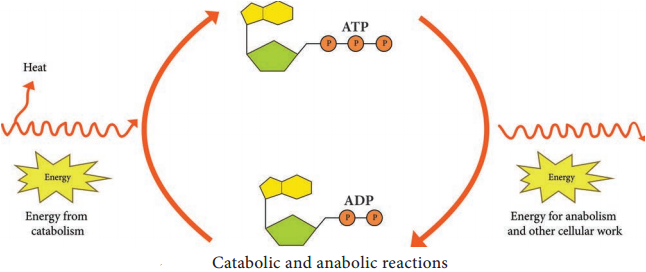
It is called catabolic or degradative reactions because complex organic compounds are broken down into simples ones. Catabolic reactions are generally hydrolytic reactions. It is enzyme regulated chemical reaction that release energy and they are exergonic. Example: Break down of sugar into Carbon dioxide and water in cells.

Anabolism:
It is called anabolic or biosynthetic reactions because complex organic molecules are formed from simples ones. Anabolic process often involves dehydration, are bio-synthetic reactions (Figure 4.1). It is enzyme regulated energy requiring reaction and they are endergonic. Examples: Formation of proteins from amino acids.
Microbial Metabolism img 1

Catabolic reactions furnish the energy needed to drive anabolic reactions. This coupling of energy requiring and energy releasing reactions is made possible through the molecule Adenosine tri-phosphate (ATP).