Physical World Class 11 Notes Physics Chapter 1

By going through these CBSE Class 11 Physics Notes Chapter 1 Physical World, students can recall all the concepts quickly.

Physical World Notes Class 11 Physics Chapter 1

→ Physics deals with nature and natural phenomenon.

→ Science is the knowledge acquired by man in an organised way.

→ The various steps involved in acquiring knowledge are:

  1. systematic observations
  2. reasoning
  3. model making
  4. a theoretical prediction.

→ The theory is the explanation of the behaviour of a physical system using a limited number of laws.

→ A theory is valid if it is able to explain satisfactorily most of the relevant measurements.

→ There is a certain amount of overlapping between Physics, Chemistry and Biology.

→ Advances in Physics are directly related to the advances in experimental observations.

→ Advances in Physics lead to the development of concepts.

→ A wide diversity in the physical world can be understood on the basis of a few concepts.

It is due to three reasons:
(a) Strict regularities and laws help in quantitative measurements.
(b) There is a small number of common and basic principles covering enormous diversities of scales of the phenomenon.
(c) It is easier to understand a phenomenon by separating important features from unimportant features.

→ The technological development of any society is very closely related to the application of Physics and other branches of science.

→ Measurements are the heart of Physics. In fact, Physics is also defined as the science of measurements.

→ Motion, energy, gravitation, properties of matter in bulk and their atomic origin, study of details of mechanical oscillations and waves, description of matter with a microscope all form a systematic study.

→ Science: An organised attempt of man to know and the knowledge he acquires is science.

→ Physics: It is the subject which deals with nature and natural phenomenon and their quantitative measurements.

→ Scientific method: Scientific method involves systematic observation, reasoning, model making and theoretical prediction altogether.

→ Theory: A scientific theory is the explanation of the natural phenomenon in terms of a limited number of laws.

→ Geocentric theory: It is a theory in which the earth is assumed to be at the centre of the universe.

→ Heliocentric theory: The sun is at the centre of the world consisting of Earth and other planets.

→ Corpuscular theory of light: Newton assumed light to be made up of corpuscles or particles.

→ Hydroelectric energy: Conversion of gravitational energy into ‘ electric energy through water.

→ Thermal power: Conversion of chemical energy of coal by burning it into electric energy.

→ Geothermal energy: It is the heat in the depth of the Earth.

→ Gravitational force: The force is an attraction between two masses is called the gravitational force. This force of attraction between the two bodies is directly proportional to the product of their masses and inversely proportional to the square of the distance between them. The constant of proportionality is called the Gravitational constant or constant of gravitation G.
F = G\(\frac{m_{1} m_{2}}{r^{3}}\)r̂
Its scalar form is F = G\(\frac{m_{1} m_{2}}{r^{2}}\)

→ Constant of gravitation ‘G’: It is equal to the force of attraction acting between two masses each of 1 kg placed 1 m apart in the air.

→ Electromagnetic force: The combined electrostatic and magnetic force between charged particles and magnetic poles is called electromagnetic force.

→ Nuclear or strong forces: The strong attractive forces between particles in a nucleus are called nuclear forces. This force can act within a distance of 10-15m. These forces are charge independent
i. e. even a proton attracts another proton.

→ Weak forces: The forces of interaction between elementary particles are weaker than the strong forces and these activities within a distance of about 10-12 m.
Microbial Genetics Transcription

Learninsta presents the core concepts of Microbiology with high-quality research papers and topical review articles.

Microbial Genetics Transcription

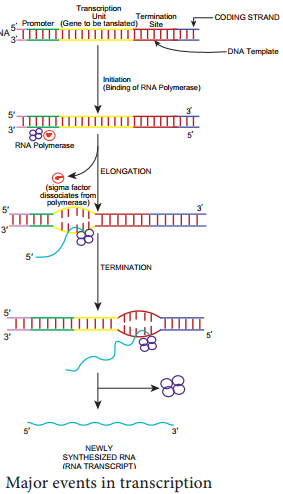
An important feature of RNA synthesis is that even though the DNA molecule being copied is double stranded, in any particular region of DNA only one strand serves as a template. The DNA strand copied into RNA molecule is called CODING OR SENSE STRAND. The synthesis of RNA consists of five discrete stage (Figure 12.2):
Microbial Genetics Transcription img 1

1. Promoter recognition:

RNA polymerase binds to DNA within a specific base sequence (20-200 bases long) called a promoter. The sequence TATAAT (or a nearly identical sequence) often called a pribnow box or – 10 region is found as part of all prokaryotic promoters.

The RNA polymerase of the bacterium E.coli consists of five protein subunits. Four of the subunits comprise the core enzyme (catalyzes the joining of the nucleoside triphosphates to the RNA) and fifth subunit, the σ subunit (required for promoter binding).

2. Local unwinding

Local unwinding of DNA occurs and RNA polymerase forms an open promoter complex.

3. Nucleoside Triphosphate

The first nucleoside triphosphate is placed at polymerization start site (near to the initial binding site) and synthesis begins.

4. RNA

RNA polymerase then moves along the DNA, adding ribonucleotides, to the growing RNA chain.

5. RNA polymerase

RNA polymerase reaches chain termination sequence and both the newly synthesized RNA and the polymerase are released. Two kinds of termination events are known those that are self – terminating (dependent on the base sequence only) and those that require the presence of the termination protein Rho.

Initiation of a second round of transcription need not await completion of the first, for the promoter becomes available once RNA polymerase has polymerized 50-60 nucleotides. In bacteria most mRNA molecules are degraded within a few minutes after synthesis. This degradation enables cells to dispense with molecules
that are no longer needed.

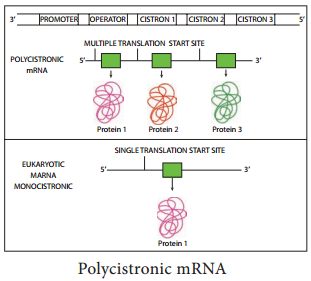
In prokaryotes mRNA molecules commonly contain information for the amino acid sequences of several different polypeptide chains. In this case, such a molecule is called polycistronic mRNA. Cistron is a term used to mean a base sequence encoding a single polypeptide chain.

The genes contained in polycistronic mRNA molecule (Figure 12.3) often encode the different portions of a metabolic pathway. For example, in E. coli the ten enzymes needed to synthesize histidine are encoded in one mRNA molecule.
Microbial Genetics Transcription img 2

In prokaryotes the immediate product of transcription (called the primary transcript) is mRNA, in contrast in eukaryotes the primary transcript must be converted to mRNA. This conversion called RNA processing consists of two types of events – modification of termini and excision of untranslated sequences (noncoding sequence or introns) embedded within coding sequences (exons).

Introns excision and the joining of exons to form an mRNA molecule is called RNA splicing. The introns are present in almost all eukaryotic transcripts but are rare in the free – living unicellular eukaryotes such as yeast. Some bacterial genes do contain introns.

Synthesis of rRNA and tRNA Ribosomal RNA and tRNA are also transcribed from genes. The production of these molecules is not as direct as synthesis of bacterial mRNA. The main difference is that these RNA molecules are excised from large primary transcripts. Highly specific RNA excise rRNA and tRNA from these large transcripts, and other enzymes produce the modified bases in tRNA.

Concept of Gene Microbial

Learninsta presents the core concepts of Microbiology with high-quality research papers and topical review articles.

Concept of Gene Microbial

The fundamental unit of information in living systems is the gene. Genome is the set of all genes and genetic signals of a cell. The information contained in genes is converted to molecules that determine the metabolism, structure and form of microorganisms.

Gene is expressed through a sequence of events. A gene can be defined biochemically as a segment of DNA (or, in a few cases, RNA) that encodes the information required to produce a functional biological product.

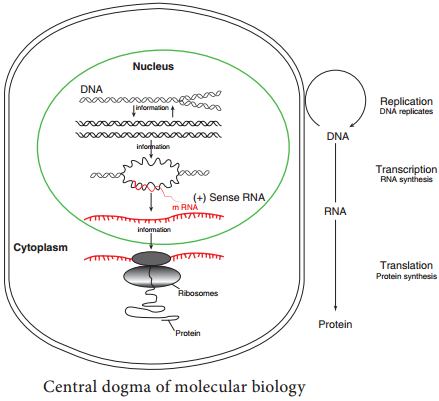
The final product is usually a protein. Not all genes are involved in protein synthesis; some code instead for rRNA and tRNA. The central dogma of molecular biology, comprises the three major processes (Figure 12.1). The first is replication, the copying of parental DNA to form daughter DNA molecules with identical nucleotide sequences. The information contained in the base sequence of DNA is copied into protein molecule through an RNA molecule.
Concept of Gene Microbial img 1

The second is transcription, production of mRNA from DNA. It is the process by which the segment corresponding to a particular gene is selected and an RNA molecule is synthesized. The third is translation, The production of an amino acid sequence from an RNA base sequence. The genetic message encoded in messenger RNA (mRNA) is translated on the ribosomes into a polypeptide with a particular sequence of amino acids. The order of amino acid in a polypeptide chain is determined by DNA base sequence.

Updated National Immunization Schedule Chart

Learninsta presents the core concepts of Microbiology with high-quality research papers and topical review articles.

Updated National Immunization Schedule Chart

Immunization/vaccination produce a response in the body that is similar to the body’s response to a natural infection (Table 11.4). Immunization or vaccines can therefore protect the body from a disease before the disease has a chance to cause illness. Immunization has helped to reduce the impact of communicable disease on health and well being.

Some diseases have been well controlled and other has been eliminated from some parts of the world because of vaccination. Stopping vaccination may lead to epidemic.

Table 11.4: National immunization schedule

Vaccine

Due age

Route

BCGAt birthIntra dermal
Hepatitis B-Birth doseAt birthIntra muscular
OPV-OAt birthOral
OPV 1, 2 & 3At 6 weeks, 10 weeks & 14 weeksOral
Pentavalent 1, 2 & 3 (Diphtheria + Pertuss is +
Tetanus + Hepatitis B + Hib)
At 6 weeks, 10 weeks & 14 weeksIntra muscular
Inactivated polio vaccineAt 6 & 14 weeksIntra muscular
Rotavirus (where applicable)At 6 weeks, 10 weeks & 14 weeksOral
Pneumococcal conjugate
vaccine (where applicable)
At 6 weeks & 14 weeks. At 9 completed months -boosterIntra muscular
Measles/Rubella 1st doseAt 9 completed months – 12 monthsSubcutaneous
DPT Booster-116–24 monthsIntra muscular
Measles/Rubella 2nd dose 16–29 monthsSubcutaneous
OPV Booster16–24 monthsOral
DPT Booster – 25–6 yearsIntra muscular
TT10 years & 16 yearsIntra muscular

proteins, antibodies and hormones. There are four kinds of ELISA assay tests. They are: Direct ELISA, Indirect ELISA, Sandwich ELISA and Competitive ELISA. Western blotting technique is used for the identification of particular protein from the mixture of proteins.

The most common protein sample used for Western blotting is cell lysate. Blotting refers to the transfer of the protein from the gel to the nitrocellulose paper by capillary action.

The substances causing allergic/hypersensitivity is known as allergens. Allergic rhinitis develops when the body’s immune system becomes sensitized and overreacts to something in the environment like pollen grains, strong odour of perfumes, dust etc.

Certain drugs such as penicillin, cephalosporin and streptomycin can absorb non-specifically to protein on surface of RBC forming complex similar to hapten-carrier complex.

Transfer of living cells, tissues or organs from one part of the body to another or from one individual to another is known as transplantation. The graft tissue antigens induce an immune response in the host. This type of immune response is called host versus graft reaction. The ultimate goal of any immunization program is the eradication of the disease.

Active natural immunization involves activation of immune system in the body to produce antibodies. It is achieved in both clinical and subclinical infections Immunization has helped to reduce the impact of communicable disease on health and well being.

Types of Immunization/Vaccination

Learninsta presents the core concepts of Microbiology with high-quality research papers and topical review articles.

Types of Immunization/Vaccination

Father of Immunology is Edward Jenner. He produced the vaccine for small pox from cow pox virus. Vaccine is a substance that is introduced into the body to prevent the disease produced by certain pathogens. Vaccines consist of dead pathogens or live but attenuated (artificially weakened) organisms.

Immunization programmes and the development of new vaccines play an important role in protecting individuals against illness. Vaccination works by safely exposing individuals to a specific pathogenic microbe, artificially increasing their immunity to it.

Vaccines are made from

  • Live micro-organisms that have been ‘treated’ so that they are weakened (attenuated) and are unable to cause disease.
  • Dead micro-organisms.
  • Some part or product of the microorganism that can produce an immune response.

Vaccine Types

Live attenuated vaccines:
These vaccines contain modified strains of a pathogen that have been weakened but are able to multiply within the body and remain antigenic enough to induce a strong immune response. Example: Oral Polio vaccine

Heterologous vaccine:
These are a group of live attenuated vaccines produced from the strains that are pathogenic in animals and not in humans. It is a vaccine that confers protective immunity against a pathogen that shares cross-reacting antigens with the microorganisms in the vaccine. Example: Cow pox virus that protects against small pox in humans.

Killed inactivated vaccines:
These groups of vaccine are produced either by killing or inactivating the bacteria or virus by chemical treatment or heat. Example; Polio virus.

Sub unit vaccine:
The antigenic determinant / epitope (the very specific part of the microbe) is used to prepare the vaccine.

DNA Vaccines:
When the genes for microbe’s antigens are introduced into the body some cells will take up the DNA. The DNA then instructs those cells to make the antigen molecules. The cells secrete the antigens and display them on their surfaces. The body’s own cells become vaccine generating factories.

Routes of Administration

  • Deep subcutaneous or intramuscular route – most vaccines
  • Oral route – Oral BCG vaccine
  • Intradermal route – BCG vaccine
  • Scarification – Small pox vaccine
  • Intranasal route – Live attenuated influenza virus

Types of Immunization

Immunization is of two types:

  1. Passive Immunization
  2. Active Immunization

1. Passive Immunization

  • Passive immunization is produced without challenging the immune system of the body. It is done by administration of serum or gamma globulins from a person who is already immunized to a non-immune person.
  • Passive immunization is the administration of preformed antibodies either intravenously or intramuscularly.
  • It is used to provide rapid protection in certain infections such as diphtheria or tetanus or in the event of accidental exposure to certain pathogens such as hepatitis B.
  • It is also used to provide protection in immune compromised individuals.

Passive natural immunization:

Acquired from the mother before and after birth. Before birth, immunity is transferred from mother to the fetus in the form of maternal antibodies through placenta. After birth, the antibodies (Ig A) are transferred through breast milk (Table 11.2).

Table 11.2: Passive Immunization

Infection

Source of Antiserum

Indications

TetanusImmune human; horsePost exposure (Plus vaccine)
DiptheriaHorsePost-exposure
Gas gangreneHorsePsot-exposure
BotulismHorsePost-exposure
Varicella-ZosterImmune humanPost-exposure in immunodeficiency
RabiesImmune humanPost exposure (Plus vaccine)
Hepatitis BImmune humanPost-exposure prophylaxis
Hepatisis APooled human IgProphylaxis
MeaslesImmune humanProphylaxis
SnakebiteHorsePost-bite
Some autoimmune diseasePooled human igAcute thrombocytopenia and neutropenia

Passive artificial immunization:

Developed by injecting previously prepared antibodies using serum from humans or animals. This type of immunity is useful for providing immediate protection against acute infections like tetanus, measles etc.

2. Active Immunization

Active immunization is the administration of vaccines containing microbial products with or without adjuvants in order to obtain long term immunological protection against the offending microbe.

At present the normal route of vaccination in most instances is either intramuscular or subcutaneous. Oral immunization is the method of choice for polio and Salmonella typhi vaccines. However, there is an increasing awareness that this route of immunization may be the best for most immunizations since nearly all infectious agents gain entrance through the mucosal surfaces.

Active natural immunization involves activation of immune system in the body to produce antibodies. It is achieved in both clinical and subclinical infections. Active artificial immunization is achieved by the administration of vaccines or toxoids.

Antigen preparations

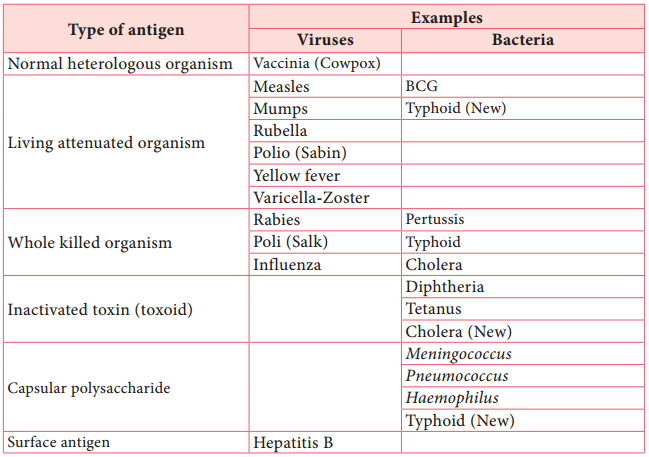
Most vaccines consist of attenuated organisms, killed organisms, inactivated toxins, or sub cellular fragments and more recently genes for antigens in viral ‘vectors’, and DNA itself. Thus, vaccines must be capable of targeting the immune system appropriately i.e. cellular/or humoral mechanisms (Table 11.3).
Table 11.3: Antigen Preparation Used in Vaccines.
Vaccination img 1

Adjuvants

Nonliving vaccines, especially those consisting of small molecules require the inclusion of agents to enhance their effectiveness.

These adjuvants include microbial, synthetic and endogenous preparations having adjuvant activity, but at present only aluminium or calcium salts are generally used in humans.

Adjuvants should enable antigens to be slowly released, preserve antigen integrity, target antigen presenting cells and induce cytotoxic lymphocytes.