Vegetative Propagation – Definition, Types, Examples & Explanations

Learninsta presents the core concepts of Biology with high-quality research papers and topical review articles.

Vegetative Propagation – Definition, Types, Examples & Explanations

Natural methods

Natural vegetative reproduction is a form of asexual reproduction in which a bud grows and develops into a new plant. The buds may be formed in organs such as root, stem and leaf. At some stage, the new plant gets detached from the parent plant and starts to develop into a new plant.

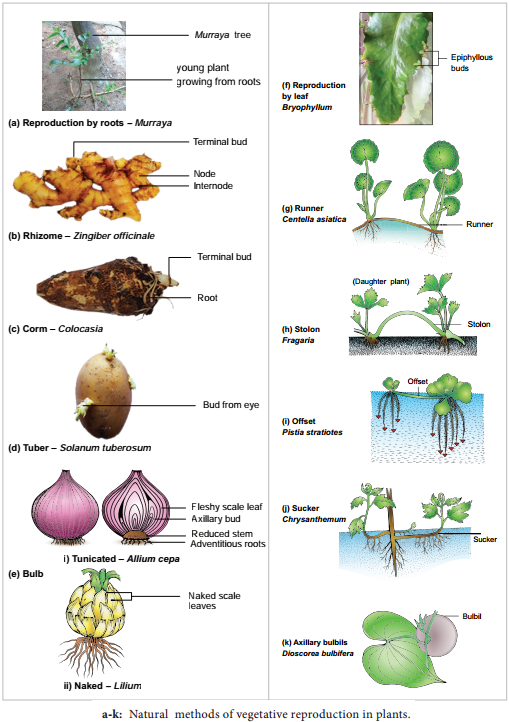
Some of the organs involved in the vegetative reproduction also serve as the organs of storage and perennation. The unit of reproductive structure used in propagation is called reproductive propagules or diaspores. Some of the organs that help in vegetative reproduction are given in Figure 1.1.
Vegetative Reproduction img 1

A. Vegetative reproduction in root

The roots of some plants develop vegetative or adventitious buds on them. Example Murraya, Dalbergia and Millingtonia. Some tuberous adventitious roots apart from developing buds also store food. Example Ipomoea batatus and Dahlia. Roots possessing buds become detached from the parent plant and grow into independent plant under suitable condition.

B. Vegetative reproduction in stem

From the Unit 3 of class XI (Vegetative morphology) you are familiar with the structure of various underground stem and sub aerial stem modifiations. Thse include rhizome (Musa paradisiaca, Zingiber offinale and Curcuma longa); corm (Amorphophallus and Colocasia); tuber (Solanum tuberosum); bulb (Allium cepa and Lilium) runner (Centella asiatica); stolon (Mentha, and Fragaria); offet (Pistia, and
Eichhornia); sucker (Chrysanthemum) and bulbils (Dioscorea and Agave). The axillary buds from the nodes of rhizome and eyes of tuber give rise to new plants.

C. Vegetative reproduction in leaf

In some plants adventitious buds are developed on their leaves. When they are detached from the parent plant they grow into new individual plants. Examples: Bryophyllum, Scilla, and Begonia. In Bryophyllum, the leaf is succulent and notched on its margin.

Adventious buds develop at these notches and are called epiphyllous buds. Thy develop into new plants forming a root system and become independent plants when the leaf gets decayed. Scilla is a bulbous plant and grows in sandy soils. The foliage leaves are long and narrow and epiphyllous buds develop at their tips. Thse buds develop into new plants when they touch the soil.

Advantages of natural vegetative reproduction

  • Only one parent is required for propagation.
  • The new individual plants produced are genetically identical.
  • In some plants, this enables to spread rapidly. Example: Spinifex
  • Horticulturists and farmers utilize these organs of natural vegetative reproduction for cultivation and to harvest plants in large scale.

Disadvantage of natural vegetative reproduction

New plants produced have no genetic variation.

Artificial Methods

Apart from the above mentioned natural methods of vegetative reproduction, a number of methods are used in agriculture and horticulture to propagate plants from their parts. Such methods are said to be artifiial propagation.

Some of the artifiial propagation methods have been used by man for a long time and are called conventional methods. Now-a-days, technology is being used for propagation to produce large number of plants in a short period of time. Such methods are said to be modern methods.

A. Conventional methods

The common methods of conventional propagation are cutting, grafting and layering.

a. Cutting:

It is the method of producing a new plant by cutting the plant parts such as root, stem and leaf from the parent plant. The cut part is placed in a suitable medium for growth. It produces root and grows into a new plant.

Depending upon the part used it is called as root cutting (Malus), stem cutting (Hibiscus, Bougainvillea and Moringa) and leaf cutting (Begonia, Bryophyllum). Stem cutting is widely used for propagation.

b. Graftng:

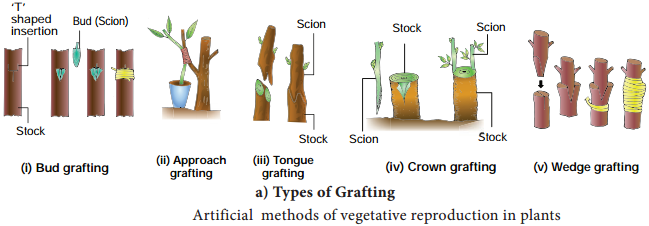
In this, parts of two different plants are joined so that they continue to grow as one plant. Of the two plants, the plant which is in contact with the soil is called stock and the plant used for graftng is called scion (Figure 1.2 a). Examples are Citrus, Mango and Apple.

There are different types of graftng based on the method of uniting the scion and stock. Thy are bud graftng, approach graftng, tongue graftng, crown graftng and wedge graftng.
Vegetative Reproduction img 2

(i) Bud graftng:

A T – shaped incision is made in the stock and the bark is lifted. The scion bud with little wood is placed in the incision beneath the bark and properly bandaged with a tape.

(ii) Approach graftng:

In this method both the scion and stock remain rooted. The stock is grown in a pot and it is brought close to the scion. Both of them should have the same thickness. A small slice is cut from both and the cut surfaces are brought near and tied together and held by a tape. After 1-4 weeks the tip of the stock and base of the scion are cut of and detached and grown in a separate pot.

(iii) Tongue grafting:

A scion and stock having the same thickness is cut obliquely and the scion is fi into the stock and bound with a tape.

(iv) Crown grafting:

When the stock is large in size scions are cut into wedge shape and are inserted on the slits or clefts of the stock and fixed in position using graft wax.

(v) Wedge grafting:

In this method a slit is made in the stock or the bark is cut. A twig of scion is inserted and tightly bound so that the cambium of the two is joined.

c. Layering:

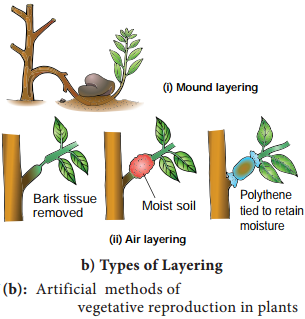
In this method, the stem of a parent plant is allowed to develop roots while still intact. When the root develops, the rooted part is cut and planted to grow as a new plant. Examples: Ixora and Jasminum. Mound layering and Air layering are few types of layering (Figure 1.2 b).
Vegetative Reproduction img 3

i. Mound layering:

The method is applied for the plants having flxible branches. The lower branch with leaves is bent to the ground and part of the stem is buried in the soil and tip of the branch is exposed above the soil. After the roots emerge from the part of the stem buried in the soil, a cut is made in parent plant so that
the buried part grow into a new plant.

ii. Air layering:

In this method the stem is girdled at nodal region and hormones are applied to this region which promotes rooting. The portion is covered with damp or moist soil using a polythene sheet. Roots emerge in these branches after 2-4 months. Such branches are removed from the parent plant and grown in a
separate pot or ground.

Advantages of conventional methods

  • The plants produced are genetically uniform.
  • Many plants can be produced quickly by this method.
  • Some plants produce little or no seeds; in others, the seeds produced do not germinate. In such cases, plants can be produced in a short period by this method.
  • Some plants can be propagated more economically by vegetative propagation. Example: Solanum tuberosum.
  • Two diffrent plants with desirable characters such as disease resistance and high yield can be grafted and grown as a new plant with the same desirable characters.

Disadvantages of conventional methods

  • Use of virus infected plants as parents produces viral infected new plants.
  • Vegetative structures used for propagation are bulky and so they are diffilt to handle and store.

Asexual Reproduction in Plants

Learninsta presents the core concepts of Biology with high-quality research papers and topical review articles.

Asexual Reproduction

The reproduction method which helps to perpetuate its own species without the involvement of gametes is referred to as asexual reproduction we know that reproduction is one of the attributes of living things and the diffrent types of reproduction have also been discussed.

Lower plants, fungi and animals show diffrent methods of asexual reproduction. Some of the methods include, formation of Conidia (Aspergillus and Penicillium); Budding (Yeast and Hydra); Fragmentation (Spirogyra); production of Gemma (Marchantia); Regeneration (Planaria) and Binary fision (Bacteria).

The individuals formed by this method is morphologically and genetically identical and are called clones.

Higher plants also reproduce asexually by diffrent methods which are given below:

Asexual reproduction is a type of reproduction that does not involve the fusion of gametes or change in the number of chromosomes. The offspring that arise by asexual reproduction from either unicellular or multicellular organisms inherit the full set of genes of their single parent.

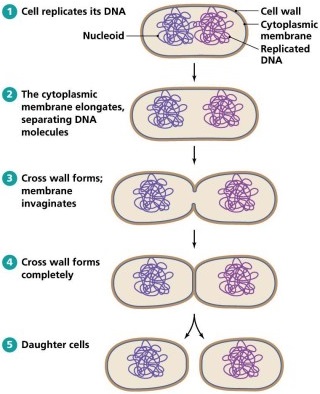
In asexual reproduction, an individual can reproduce without involvement with another individual of that species. The division of a bacterial cell into two daughter cells is an example of asexual reproduction.
Asexual Reproduction image 1

7 types of Asexual Reproduction

  • Budding: A form of asexual reproduction of yeast in which a new cell grows out of the body of a parent.
  • Vegetative Reproduction: Plants budding which creates a runner hich sends a clone.
  • Parthenogenesis
  • Binary Fission.
  • Regeneration.
  • Fragmentation.
  • Spores.

Gravitation Class 11 Notes Physics Chapter 8

By going through these CBSE Class 11 Physics Notes Chapter 8 Gravitation, students can recall all the concepts quickly.

Gravitation Notes Class 11 Physics Chapter 8

→ Gravitation is a central force.

→ It acts along the line joining the particles.

→ Gravitation is the weakest force in nature.

→ It is about 1038 times smaller than the nuclear force and 1036 times smaller than the electric force.

→ Gravitation is the conservative force.

→ Gravitation is caused by gravitational mass.

→ Gravitation acts in accordance with Newton’s third law of motion. That is F12 = – F21.

→ Gravitation is independent of the presence of the other bodies in the surroundings.

→ Acceleration due to gravity is 9.81 ms-2 on the surface of Earth.

→ Its value on the moon is about one-sixth of that on Earth.

→ Its value on Sun, Jupiter and Mercury is about 27 times, 2.5 times and 0.4 times that on the Earth. i.e. gmoon = ge/6. gsun = 27g, gmercury = 0.4g, gjupiter = 2.5g.

→ The value of g (acceleration due to gravity) does not depend upon the mass, shape or size of the falling body.

→ Inside the Earth, the value of g decreases linearly with distance from the centre of Earth.

→ Above the surface of Earth, the value of g varies inversely as the square of the distance from the centre of Earth.

→ The value of g decreases faster with altitude than with depth.

→ For small values of height (h), the value of g at a height ‘h’ is the same as the value of g at a depth d (= 2h).

→ Decrease in g at a height h = x (very near the Earth’s surface i.e. h << R) is twice as compared to the decrease in g at the same depth d = x.

→ g is maximum on Earth’s surface and decreases both when we go above or below the Earth’s surface.

→ The value of g is zero at the centre of Earth.

→ The rate of variation of g with height (near the surface of Earth, when h << R) is twice the rate of variation of g with depth i.e.
\(\frac{\Delta \mathrm{g}_{\mathrm{h}}}{\Delta \mathrm{h}}\) = 2 \(\frac{\Delta \mathrm{g}_{\mathrm{d}}}{\Delta \mathrm{d}}\)

→ With the increase in latitude, g decreases.

→ Its value at latitude Φ is given by
gΦ = gp – Rω2 cos2Φ

→ The decrease in ‘g’ with latitude is due to the rotation of Earth about its own axis.

→ The decrease in ‘g’ with latitude on rotation is because a part of the weight is used to provide centripetal force for the bodies rotating with the Earth.

→ The g is maximum at poles (gp) and minimum at the equator (ge).

→ gp = 9.81 ms-2, gc = 9.78 m-2.

→ The decrease in g from pole to equator is about 0.35%.

→ If the Earth stops rotating about its own axis, the value of g on the poles will remain unchanged but at the equator, it will increase by about 0.35%. If the rotational speed of Earth increases, the value of g decreases at all places on its surface except poles.

→ The gravitational pull of Earth is called true weight (wt) of the body i.e. Wt = mg.

→ The true weight of the body varies in the same manner as the /acceleration due to gravity i.e. it decreases with height above and depth below the Earth’s surface.

→ Also, Wt changes with latitude. Its value is maximum at the poles and minimum at the equator.

→ S.I. unit of weight is Newton (N) and it is often expressed in kilogram weight (kg wt) or kg f (kilogram-force).
i. e. 1 kg wt = 1 kg f = 9.8 N

→ The reaction of the surface on which a body lies is called apparent weight (Wa) of the body and ga = Wa/M is called apparent acceleration due to gravity.

→ If a body moves with acceleration a, then the apparent weight of the body of mass M is given by Wa = M|g – a| = apparent weight of the body when it falls with acceleration ‘a’ and it decreases.

→ When a body rises with acceleration, then Wa = M(g + a) i.e. it increases.

→ If the body is at rest or moving with uniform velocity, then Wa = Mg = true weight of the body.

→ For free-falling body, Wa = 0 (∵ a = g here).

→ The spring balance measures the apparent weight of the body.

→ The apparent weight provides restoring force to the simple pendulum i.e. the time period of the simple pendulum depends on the apparent value of the acceleration due to gravity i.e.
T = 2π\(\sqrt{\frac{l}{\mathrm{~g}_{\mathrm{a}}}}\)

→ In a freely falling system, the time period of a simple pendulum is infinity.

→ If a simple pendulum is suspended from the roof of an accelerating or retarding train, the time period is given by
T = 2π\(\sqrt{g^{2}+a^{2}}\)

→ The Earth is ellipsoid. It is flat at poles and bulges out at the equator. Consequently, the distance of the surface from the centre is more at the equator than on the poles. So gpole > gequator.

→ All bodies fall freely with the same acceleration = g.

→ The acceleration of the falling body does not depend on its mass.

→ If two bodies are dropped from the same height, they reach the ground at the same time with the same velocity.

→ If a body is thrown upward with velocity u from the top of a tower and another is thrown downward from the same point and with the same velocity, then both reach the ground with the same speed.

→ If a body is dropped from a height h, it reaches the ground with speed v = \(\sqrt{2 \mathrm{gh}}\) = gt. Time taken by it to reach the ground is t = \(\sqrt{\frac{2 h}{g}}\)

→ When a body is dropped, then initial velocity i.e. u = 0.

→ If a body is dropped from a certain height h, then the distance covered by it in nth second is \(\frac{1}{2}\) g(2n -1).

→ The greater the height of a satellite, the smaller is the orbital velocity. Work done to keep the satellite in orbit is zero.

→ When a body is at rest w.r.t. the Earth, its weight equals gravity and is known as its true or static weight.

→ The centripetal acceleration of the satellite = acceleration due to gravity.

→ Orbital velocity is independent of the mass of the satellite.

→ Orbital velocity depends on the mass of the planet as well as the radius of the orbit.

→ All communication satellites are geostationary satellites.

→ Escape velocity (Ve) from the surface of Earth = 11.2 km s-1.

→ The body does not return to the Earth when fired with Ve irrespective of the angle of projection.

→ When the velocity of the satellite increases, its kinetic energy increases and hence total energy becomes less negative i.e. the satellite begins to revolve in orbit of greater radius.

→ If the total energy of the satellite becomes +ve, the satellite escapes from the gravitational pull of the Earth.

→ When the satellite is taken to a greater height, the potential energy increases (becomes less negative) and the K.E. decreases.

→ For the orbiting satellite, the K.E. is less than the potential energy. When K.E. = P.E., the satellite escapes away from the gravitational pull of the Earth.

→ The escape velocity from the moon is 2.4 km s-1.

→ The ratio of the inertial mass to gravitational mass is one.

→ If the radius of a planet decreases by n% keeping mass constant, then g on its surface decreases by 2n%.

→ If the mass of a planet increases by m% keeping the radius constant, then g on its surface increases by m%.

→ If the density of the planet decreases by x% keeping the radius constant, the acceleration due to gravity decreases by x%.

→ The intensity of the gravitational field inside a shell is zero.

→ The weight of a body in a spherical cavity concentric with the Earth is zero.

→ Gravity holds the atmosphere around the Earth.

→ The reference frame attached to Earth is non-inertial because the Earth revolves about its own axis as well as about the Sun.

→ When a projectile is fired with a velocity less than the escape velocity, the sum of its gravitational potential energy and kinetic energy is negative.

→ If the Earth were at one fourth the present distance from Sun, the duration of the year will be one-eighth of the present year.

→ The tail of the comets points away from the Sun due to the radiation pressure of the Sun.

→ Even when the orbit of the satellite is elliptical, its plane of rotation passes through the centre of the Earth.

→ If a packet is just released from an artificial satellite, it does not fill the Earth. On the other hand, it will continue to orbit with the satellite.

→ Astronauts orbiting around the Earth cannot use a pendulum clock.

→ However, they can use a spring clock.

→ To the astronauts in space, the sky appears black due to the absence of the atmosphere above them.

→ The duration of the day from the moment the Sun is overhead today to the moment the Sun is overhead tomorrow is determined by the revolution of the Earth about its own axis as well as around the Sun.

→ If the ratio of the radii of two planets is r and the ratio of the acceleration due to gravity on their surface is ‘a’ then the ratio of escape velocities is \(\sqrt{ar}\).

→ Two satellites are orbiting in circular orbits of radii R1 and R2. Their orbital speeds are in the ratio: \(\frac{V_{1}}{V_{2}}=\left(\frac{R_{2}}{R_{1}}\right)^{\frac{1}{2}}\). It is independent of their masses.

→ An object will experience weightlessness at the equator if the angular speed of the Earth about its axis becomes more than (\(\frac{1}{800}\)) rad/s.

→ If a body is orbiting around the Earth then it will escape away if its velocity is increased by 41.8% or when its K.E. is doubled.

→ If the radius of Earth is doubled keeping mass unchanged, the escape \(\left(\frac{1}{\sqrt{2}}\right)\) times the present value.

→ Vo close to Earth’s surface = 7.9 km s-1.

→ The time period of the satellite very near the surface of Earth is about 107 minutes.

→ No energy is dissipated in keeping the satellite in orbit around a planet.

→ If a body falls freely from infinite height, then it reaches the surface of Earth with a velocity of 11.2 km s-1.

→ A body in a gravitational field has maximum binding energy when it is at rest.

→ Acceleration due to gravity: The acceleration with which bodies fall towards the Earth is called acceleration due to gravity.

→ Newton’s law of gravitation: It states that everybody in this universe attracts every other body with a force that is directly proportional to the product of their masses and inversely proportional to the square of the distance between their centres i.e.
F = \(\frac{\mathrm{Gm}_{1} \mathrm{~m}_{2}}{\mathrm{r}^{2}}\)

→ Gravitation: Force of attraction between any two bodies.

→ Gravity: Force of attraction between Earth and any other body.

→ Inertial mass: The resistance to the acceleration caused by a force is called inertial mass. It is the measure of its inertia in linear motion
i.e. m1 = \(\frac{\mathrm{F}}{\mathrm{a}}\)

→ Gravitational mass: The resistance to the acceleration caused by gravitational force i.e.
mg = \(\frac{\mathrm{F}}{\mathrm{g}}\)

→ Kepler gave threads of planetary motion.

→ Kepler’s 1st law of planetary motion: Every planet revolves around Sun in an elliptical orbit with Sun at one of its foci.

→ Second law: The radius vector joining the centre of Sun and planet sweeps out equal areas in equal intervals of time i.e. areal velocity of the planet around the Sun always remain constant.

→ Third law: The square of the time period T of revolution of a planet around the Sun is proportional to the cube of the semi-major axis R of its elliptical orbit i.e.
T2 ∝ R3

→ Satellite: It is a body that constantly revolves in an orbit around a body of relatively much larger size.

→ A geostationary satellite is a satellite that appears stationary to the observer on Earth. It is also called a geosynchronous satellite.

  • Its orbit is circular and in the equatorial plane of Earth.
  • Its time period = time period of rotation of the Earth about its own axis i.e. one day or 24h = 86400s.
  • Its height is 36000 km.
  • Its orbital velocity is about 3.08 km s-1.
  • Its angular velocity is equal and is in the same direction as that of Earth about its own axis.

→ Latitude at a place: Latitude at a place on the Earth’s surface is the angle at which the line joining the place to the centre of Earth makes with the equatorial plane. It is denoted by X.

→ At poles, X = 90°.

→ At equator, X = 0.

→ Polar satellites: They are positioned nearly 450 miles above the Earth. Polar satellites travel from pole to pole in nearly 102 minutes.

→ In each successive orbit, the satellite scans a strip of the area towards the West.

→ Orbital Velocity: It is the velocity required to put the satellite in a given orbit around a planet. It is denoted by V0.

→ Escape Velocity: It is the minimum velocity with which a body be thrown upwards so that it may just escape the gravitational pull of Earth or a given planet. It is denoted by Ve.

→ The intensity of Gravitational field at a point: It is the force experienced by a unit mass placed at that point.

→ The gravitational potential energy of a body at a point in a gravitational field is the amount of work done in bringing the body from infinity to that point without acceleration.

→ Gravitational Potential: It is the amount of work done in bringing a body of unit mass from infinity to that point without acceleration.

Important Formulae:
→ The universal force of gravitation,
F = \(\frac{\mathrm{Gm}_{1} \mathrm{~m}_{2}}{\mathrm{r}^{2}}\)

→ Invector from F = \(\frac{\mathrm{Gm}_{1} m_{2} \hat{r}}{r^{3}}\)

→ G = 6.67 × 10⁻¹¹ Nm2 kg-2.

→ Weight of the body, W = mg.

→ Mass of Earth, Me = \(\frac{\mathrm{g} \mathrm{R}_{\mathrm{e}}^{2}}{\mathrm{G}}\)

→ Gravitational mass, mg = \(\frac{\mathrm{F}}{\mathrm{g}}=\frac{\mathrm{GM}_{\mathrm{e}} \mathrm{m}_{\mathrm{g}}}{\mathrm{g} \mathrm{R}_{\mathrm{e}}^{2}}\)

→ Variation of g:

  1. At height h: gh = g\(\left(1+\frac{\mathrm{h}}{\mathrm{R}}\right)^{2}\) ≈ (1 – \(\frac{2 \mathrm{~h}}{\mathrm{R}}\))
  2. At depth d: gd = g(1 – \(\frac{\mathrm{d}}{\mathrm{R}}\))
  3. At latitude λ: gλ = g – Rω2cos2λ
    (a)At poles: λ = 90°, cosλ = 0 ∴ gλpole = g
    (b) At equator: λ = 0, cosλ = 1, ∴ gλ = g Rω2

→ gpole– gequator = Rω2

→ Gravitation field intensity: (I) = \(\frac{\mathrm{GM}}{\mathrm{R}^{2}}\)
or
|I| = g

→ Orbital velocity in orbit at a height h,
vo = \(\sqrt{\frac{\mathrm{gR}^{2}}{\mathrm{R}+\mathrm{h}}}=\sqrt{\frac{\mathrm{GM}}{\mathrm{R}+\mathrm{h}}}\)

→ If h = 0 i.e. close to Earth’s surface, vo = \(\sqrt{gR}\).

→ Time period of the satellite,
T = \(\frac{2 \pi(\mathrm{R}+\mathrm{h})}{\mathrm{v}_{0}}=\frac{2 \pi}{\mathrm{R}} \sqrt{\frac{(\mathrm{R}+\mathrm{h})^{3}}{\mathrm{~g}}}\)

→ Escape velocity, Ve = \(\sqrt{\frac{2 \mathrm{GM}}{\mathrm{R}}}=\sqrt{2 \mathrm{gR}}=\sqrt{2}\)Vo
= \(\sqrt{\frac{8}{3} \pi R^{3} G \rho}\)

→ Gravitational potential energy,
E = – \(\frac{\mathrm{GMm}}{\mathrm{r}}\)

→ Self energy of Earth = – \(\frac{3}{5} \frac{\mathrm{GM}^{2}}{\mathrm{R}}\)

→ Increase in gravitational RE. when the body is moved from surface of Earth to a height h,
ΔE = Eh – Ee
= – \(\frac{\mathrm{GMm}}{\mathrm{R}+\mathrm{h}}-\frac{\mathrm{GMm}}{\mathrm{R}}\)

= \(\frac{\text { GMmh }}{R(R+h)}\)

→ Gravitational potential, V = – \(\frac{\mathrm{GM}}{\mathrm{r}}\)

→ Time period of motion of the satellite:
T2 = \(\frac{4 \pi^{2}}{\mathrm{GM}_{\mathrm{E}}}\) r3 = \(\frac{4 \pi^{2}}{\mathrm{gR}_{\mathrm{E}}^{2}}\) r3

→ Angular velocity (ω) of a satellite in an orbit at a height h above Earth.
ω = \(\frac{2 \pi}{T}=\sqrt{\frac{G M}{(R+h)^{3}}}=\sqrt{\frac{g_{h}}{R+h}}\)

→ Shape of the orbit of a satellite having velocity v in the orbit:

  1. If v < vo, the satellite falls to the Earth following a spiral path.
  2. If v = vo, the satellite continues to move in orbit.
  3. If vo < v < ves, then the satellite moves in an elliptical orbit,
  4. If v = ves, then it escapes from Earth following a parabolic path,
  5. If v > ves, then the satellite “escapes from Earth following a hyperbolic path.

Systems of Particles and Rotational Motion Class 11 Notes Physics Chapter 7

By going through these CBSE Class 11 Physics Notes Chapter 7 Systems of Particles and Rotational Motion, students can recall all the concepts quickly.

Systems of Particles and Rotational Motion Notes Class 11 Physics Chapter 7

→ C.M. of a body or a system may or may not lie inside the body.

→ The momentum of the C.M. of the system remains constant if the external force acting on it is zero.

→ C.M. of the system moves with a constant velocity if the external force on the system is zero.

→ Only the angular component of the force gives rise to torque.

→ Both angular momentum and torque are vector quantities.

→ The rotatory cum translatory motion of a ring, disc, cylinder, spherical shell, or solid sphere on a surface is called rolling.

→ The axis of rotation of the rolling body is parallel to the plane on which it rolls.

→ When the angular speed of all the particles of the rolling body is the same, it is called rolling without slipping.

→ The linear speed of different particles is different, although the angular speed is the same for all the particles.

→ K.E. is the same for all bodies having the same m, R, and ω.

→ Total energy and rotational kinetic energy are maximum for the ring and minimum for the solid sphere.

→ For ring Kr = Kt, Kr = \(\frac{1}{2}\) Kt for disc, Kr = 66%Kt for spherical shell and for solid sphere Kr = 40% of Kt.

→ The body rolls down the inclined plane without slipping only when the coefficient of limiting friction (p) bears the following relation:
µ ≥ (\(\frac{\mathrm{K}^{2}}{\mathrm{~K}^{2}+\mathrm{R}^{2}}\)) tan θ

→ The relative values of p for rolling without slipping down the inclined plane are as follows :
μring > μshell > μdisc > μsolid sphere

→ When a body roll Is without slipping, no work is done against friction.

→ A body may roll with slipping if friction is less than a particular value and it may roll without slipping if the friction is sufficient.

→ M.I. is not a scalar quantity because for the same body its values are different for different orientations of the axis of rotation.

→ M.I. is defined w.r.t. the axis of rotation.

→ M.I. is not a vector quantity because the clockwise or anticlockwise direction is not associated with it.

→ The radius of gyration depends on the mass and the position of the axes of rotation.

→ M.I. depends on the position of the axis of rotation.

→ The theorem of ⊥ar axes is applicable to thin laminae like a sheet, disc, ring, etc.

→ The theorem of || axes is applicable to all types of bodies.

→ M.I. about the axis in a particular direction is least when the axis of rotation passes through the C.M.

→ A pair of equal and opposite forces with different lines of action is known as a couple.

→ A body may be in partial equilibrium i.e. it may be in translational. equilibrium and not in rotational equilibrium or vice-versa.

→ If the sum of forces is zero, it is said to be in translational equilibrium. 0 If the sum of moments of forces about C.G. is zero then it is said to be in rotational equilibrium.

Important Formulae:
→ Position vector of C.M. of a system of two particles is
Rcm = \(\frac{\mathrm{m}_{1} \mathbf{r}_{1}+\mathrm{m}_{2} \mathbf{r}_{2}}{\mathrm{~m}_{1}+\mathrm{m}_{2}}\)

→ Position vector of C.M of a system of two particles of equal masses is
Rcm = \(\frac{\mathbf{r}_{1}+\mathbf{r}_{2}}{2}\)

→ Torque acting on a particle is given by
τ = r × p

→ Angular momentum is given by
L = r × p
or
L = mv r = Iω = mr² ω

→ τ = \(\frac{\mathrm{dL}}{\mathrm{dt}}\)

→ τ = Iα

→ I1ω1 = I2ω2
or
\(\frac{I_{1}}{T_{1}}=\frac{I_{2}}{T_{2}}\)

→ K.E. of rotation, Kt = \(\frac{1}{2}\)Iω2

→ Power in rotational motion, P = τω

→ According to theorem of perpendicular axes,
Iz = Ix + Iy

→ According to theorem of || axes, 1 = Ic + mh2

→ K.E. of a body rolling down an inclined plane is given by
E = \(\frac{1}{2}\)mv2 + \(\frac{1}{2}\) Iω2 = Kt + Kr

→ \(\frac{K_{r}}{K_{t}}=\frac{\frac{1}{2} I \omega^{2}}{\frac{1}{2} m v^{2}}=\frac{\frac{1}{2} m K^{2} \omega^{2}}{\frac{1}{2} m v^{2}}\)

= \(\frac{\mathrm{K}^{2} \omega^{2}}{\mathrm{R}^{2} \omega^{2}}=\frac{K^{2}}{\mathrm{R}^{2}}\)

→ \(\frac{\mathrm{K}_{\mathrm{r}}}{\mathrm{E}}=\frac{\frac{1}{2} \mathrm{mK}^{2} \omega^{2}}{\frac{1}{2} \mathrm{~m}\left(\mathrm{R}^{2}+\mathrm{K}^{2}\right) \omega^{2}}=\frac{\mathrm{K}^{2}}{\mathrm{~K}^{2}+\mathrm{R}^{2}}\)

→ \(\frac{K_{t}}{E}=\frac{R^{2}}{R^{2}+K^{2}}\)

→ If inclined plane is smooth, then the body will slide down and on reaching the bottom, its sliding velocity (Vs) is given by
Vs = \(\sqrt{2 \mathrm{gh}}\) and acceleration is as = g sin θ.

→ For rough inclined plane :
Vr = \(\frac{\sqrt{2 \mathrm{gh}}}{\sqrt{1+\frac{\mathrm{K}^{2}}{\mathrm{R}^{2}}}}\)

→ The acceleration of the body rolling down the inclined plane is
ar = \(\frac{g \sin \theta}{\sqrt{1+\frac{K^{2}}{R^{2}}}}\)

→ Time taken to reach the bottom is ts = \(\sqrt{\frac{2 l}{a_{s}}}\) and tr = \(\sqrt{\frac{2 l}{a_{r}}}\)

→ If a particle of mass m is moving along a circular path of radius r with acceleration ‘a’, then
τ = mr² α
Where α = \(\frac{a}{r}\)

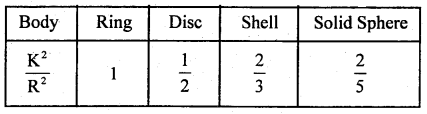
→ The value of \(\frac{\mathrm{K}^{2}}{\mathrm{R}^{2}}\) for different bodies are as follows:
Systems of Particles and Rotational Motion Class 11 Notes Physics 1

Work, Energy and Power Class 11 Notes Physics Chapter 6

By going through these CBSE Class 11 Physics Notes Chapter 6 Work, Energy and Power, students can recall all the concepts quickly.

Work, Energy and Power Notes Class 11 Physics Chapter 6

→ The total work done in the uniform speed of a body is zero i.e. if work is done is zero then the speed of the body is uniform.

→ In doing work in stretching or compressing a spring and by a falling body, the variable forces involved are restoring force and force of gravitation.

→ Work is done by a force on a body over a certain displacement.

→ The change in kinetic energy of an object is equal to the work done on it by the net force.

→ No work is done by the force if it acts perpendicular to the displacement of the body.

→ The total mechanical energy of a system is conserved if the forces doing work on it are conservative.

→ Energy can exist in various forms such as mechanical energy, heat energy, light energy, sound energy, etc.

→ The motion of a simple pendulum is an example of the conversion of P.E. into K.E. and vice-versa.

→ A body possesses chemical energy due to the chemical bonding of its atoms.

→ A body possesses heat energy due to the disorderly motion of its molecules.

→ The mass-energy equivalence formula describes energies to all masses (E = mc2) and masses to all energies (\(\frac{\mathrm{E}}{\mathrm{c}^{2}}\) = m)

→ The P.E. which an elevator loses in coming down from an upper story of the building to stop at the ground floor is used up to lift up the counter-poise weight.

→ When a very light body in motion collides with a heavy stationary body in an elastic collision, the lighter one rebounds back with the same speed without the heavy body being displaced.

→ When a body moving with some velocity undergoes elastic collision with another similar body at rest, then there is an exchange of their velocities after collision i.e. first one comes to rest and the second starts moving with the velocity of the first one.

→ 1 J = 107 erg.

→ Joule (J) and erg are the S.I. and C.G.S. units of work and energy. Energy is the capacity of the body to do the work.

→ The area under the force-displacement graph is equal to the work done.

→ Work done by the gravitational or electric force does not depend on the nature of the path followed.

→ It depends only on the initial and final positions of the path of the body.

→ Power is measured in horsepower (h.p.). It is the fps unit of power used in engineering.

→ 1 h.p. = 746 W.

→ Watt (W) is the S.I. unit of power.

→ The area under the force-velocity graph is equal to the power dissipated. Body or external agency dissipates power against friction.

→ If the rails are on a plane surface and there is no friction, the power dissipated by the engine is zero.

→ When a body moves along a circular path with constant speed, its kinetic energy remains constant.

→ K.E. of a body can’t change if the force acting on a body is perpendicular to the instantaneous velocity. ,

→ K.E. is always positive.

→ If a machine gun fires n bullets per second with kinetic energy K, then the power of the machine gun is P = nK.

→ The force required to hold the machine gun in the above case is
F = nv = n \(\sqrt{2 \mathrm{mK}}\)

→ When work is done on a body, it’s K.E. or P.E. increases.

→ When work is done by a body, its P.E. or K.E. decreases.

→ Mass and energy are interconvertible.

→ K.E. can change into P.E. and vice-versa.

→ One form of energy can be changed into other forms according to the law of conservation of energy.

→ When a body falls, its P.E. is converted into its K.E.

→ The collision generally occurs for every small interval of time.

→ Physical contact between the colliding bodies is not essential for the collision.

→ The mutual forces between the colliding bodies are action and reaction pair.

→ Momentum and total energy are conserved during elastic collisions.

→ The collision is said to be elastic when the K.E. is conserved.

→ Inelastic collisions the forces involved are conservative.

→ Elastic collisions, the K.E. or mechanical energy is not converted into any other form of energy.

→ Elastic collisions produce no sound or heat.

→ There is no difference between the elastic and perfectly elastic collisions.

→ In the elastic collisions, the relative velocity before the collision is equal to the relative velocity after collision i.e. u1 – u2 = v2 – v1.

→ The collision is said to be inelastic when the K.E. is not conserved.

→ Head-on collisions are called one-dimensional collisions.

→ When the momentum of a body increases by a factor n, then its K.E. is increased by a factor n2.

→ If the speed of a vehicle is made n-times then its stopping distance becomes n2 times.

→ Work: Work is said to be done if a force acting on a body displaces it by some distance along the line of action of the force.

→ Energy: It is defined as the capacity of a body to do work.

→ K.E.: It is defined as the energy possessed by a body due to its motion.

→ P.E.: It is defined as the energy possessed by a body due to its position or configuration.

→ Gravitational P.E.: It is defined as the energy possessed by a body due to its position above the surface of death.

→ Power: It is defined as the time rate of doing work.

→ Work-energy theorem: It states that the work is done by a force acting on a body is equal to the change in its K.E.

→ Law of conservation of energy: Total energy of the universe always remains constant.

→ Instantaneous Power: It is the limiting value of the average power of an agent in a small time interval tending to zero.

→ Mass-energy Equivalence: E = mc2.

→ Elastic collision: The collision is said to be elastic if both momentum and the K.E. of the system remain conserved.

→ Elastic collision in one dimension: The collision is said to be one-dimensional if the colliding bodies move along the same straight line after the collision.

→ In-elastic collision: It is defined as the collision in which K.E. does not remain conserved.

→ Transformation of energy: It is defined as the phenomena of change of energy from one form to the other.

→ Coefficient of restitution: It is defined as the ratio of the velocity of separation to the velocity of approach i.e.
e = \(\frac{v_{2}-v_{1}}{u_{1}-u_{2}}\)

→ Moderator: It is defined as a substance used in atomic reactors to slow down fast-moving neutrons to make them thermal neutrons. e.g. graphite and heavy water are moderators

→ 1 eV: It is defined as the energy acquired by an electron when a potential difference of 1 volt is applied
i. e. 1 eV = 1.6 × 10-19 c × 1 V
= 1.6 × 10⁻¹⁹ J

Important Formulae:
→ Work done by F in moving a body by S is
W = F . S = FS cos θ

→ P = \(\frac{W}{t}\)

→ Instantaneous power is P = F.v

→ K.E. = \(\frac{1}{2}\)mv2.

→ P.E. = mgh.

→ P.E. of a spring is given by = \(\frac{1}{2}\)kx2.
where k = force constant, x = displacement i.e. extension or compression produced in the spring. .

→ E = mc2.

→ Velocities of the two bodies after collisions are given by
v1 = \(\frac{m_{1}-\dot{m}_{2}}{m_{1}+m_{2}}\)u1 + \(\frac{2 m_{2}}{m_{1}+m_{2}}\)u2
and
v2 = \(\frac{m_{2}-\dot{m}_{1}}{m_{1}+m_{2}}\)u2 + \(\frac{2 m_{2}}{m_{1}+m_{2}}\)u1

→ Power of an engine pulling a train on rails having coefficient of friction p is given by:
P = μ mg v.
where μ = coefficient of friction.
m = mass of train,
v = velocity of train.

→ Power of engine on an inclined plane pulling the train up is
P = (μ cos θ + sin θ)mg v

→ And pulling down the inclined plane is
P = (μ cos θ – sin θ)mg v

→ Work against friction in above cases when the body moves down the inclined plane is W = m.g.(sin θ – μ cos θ)S

→ When body moves up the incline,
W = mg(μ cos θ + sin θ)S

→ % efficiency (n%) = \(\frac{\text { Poweroutput }}{\text { Powerinput }}\) × 100
= \(\frac{\text { Output energy }}{\text { Input energy }}\) × 100