Thermodynamics Class 11 Notes Physics Chapter 12

By going through these CBSE Class 11 Physics Notes Chapter 12 Thermodynamics, students can recall all the concepts quickly.

Thermodynamics Notes Class 11 Physics Chapter 12

→ A thermodynamic system is a collection of a large no. of atoms or molecules confined within the boundaries of a closed surface so that it has definite values of P, V, and T.

→ Work is done during expansion or contraction of the system and is given by dW = PdV where dV = change in volume at constant pressure P.

→ The temperature of the system decreases during expansion and increases during contraction.

→ The slope of the adiabatic curve is steeper than that of the isothermal curve.

→ Wiso > Wadia during expansion if the initial (Vt) and final (Vf) volumes are the same in both the cases.

→ Work done during isothermal compression is less than that during adiabatic compression if Vt and Vf are the same in both cases.

→ Δp = 0 in isobaric process and ΔV = 0 for an isochoric process.

→ Heat engines are devices that convert heat into work.

→ The refrigerator is regarded as a heat engine in the reverse direction.

→ 1 litre = 10-3 m3.

→ SI and G.G.S. unit of heat capacity is JK-1 and cal/°C respectively.

→ η of Carrot heat engine is independent of the nature of the working substance.

→ CP – CV is constant for all gases.

→ CP/CV is not constant for all gases.

→ CP/CV has different values for mono, di, and triatomic gases.

→ U for a system is the unique function of the state of the system i.e. U is a unique function of P, V, T.

→ The refrigerator absorbs heat from the cold reservoir and rejects the heat to the hot reservoir..

→ The liquid used as a working substance in the refrigerator is called refrigerant.

→ The most commonly used refrigerants are pheon (dichlorodifluoromethane), SO2 and ammonia.

→ Freon or SO2 are used in household refrigerators.

→ NH3 is used for large-scale refrigeration.

→ U for real gas depends on T and V i.e. U = f (T, V).

→ U for ideal gas depends only on T i.e. U = f (T).

→ For isothermal process, dU = 0 and dQ = dW.

→ For an adiabatic process, dQ = 0 and dU = – dW.

→ PVγ = constant for an adiabatic process.

→ Open system: The system which can exchange energy with the surroundings is called an open system.

→ Closed system: The system which cannot exchange energy with its surroundings is called a closed system.

→ The first law of thermodynamics: According to this law, the total energy of an isolated system remains the same. However, it can change the form, Mathematically,
ΔQ = ΔU + ΔW

where ΔQ = amount of heat supplied,
ΔU = change in the internal energy and
ΔW = the amount of work done by the system
ΔW = ΔQ – ΔU.

→ Zeroth law of thermodynamics: If two given bodies are in thermal equilibrium with a third body individually, then the given bodies will also be in thermal equilibrium with each other.

→ The second law of thermodynamics:

  1. It is impossible to get a continuous supply of work from a body by cooling it to a temperature lower than that of its surroundings.
  2. In other words, a perpetual motion of the second kind is impossible without doing anything else.
  3. It is impossible to make heat flow from a body at a lower temperature to a body at a higher temperature without doing any work.
  4. It is impossible to construct a device that can without other effect lift one object by extracting internal energy from another.

→ Isothermal process: The variation of P with V at T remaining constant is called the isothermal process.

→ Isobaric process: A process in which volume (V) and temperature (T) vary but the pressure (P) remains constant is known as the isobaric process.

→ Isochoric process: A process in which volume remains constant but P and T can change is known as the isochoric process.

→ Adiabatic process: A process in which the total heat content of the system (Q) remains conserved when it undergoes various changes is called an adiabatic process.

→ Indicator diagram: The graph between (P) and volume (V) of a thermodynamic system undergoing certain changes is called a P-V diagram or an indicator diagram as it is drawn with the help of a device called an indicator.

→ Non-cyclic process: A process in which a system after undergoing certain changes does not return to its initial state is called a non-cyclic process.

→ Cyclic process: A process in which a system after undergoing certain changes returns to its initial state is called a cyclic process.

→ External combustion engine: An engine in which fuel is burnt in a separate unit than the main engine is called an external combustion engine.

→ Internal combustion engine: An engine in which the fuel is burnt within the working cylinder of the engine is called an internal combustion engine.

→ Heat engine: A device that uses thermal energy to deliver mechanical energy is called a heat engine.

→ Heat reservoir: A source of heat at constant temperature is called a heat reservoir.

→ Heat sink: A sub-system of the engine in or out of it in which unspent heat is rejected at constant temperature for use is called a heat sink.

→ Working substance: A substance that receives some heat from a source and after converting a part of it into work rejects the remaining heat into the sink. Gas, steam are usual working substances in an engine.

→ Critical pressure: It is the pressure that is necessary to produce liquefaction at the critical temperature.

→ Critical volume: It is the volume of 1 mole of a gas at the critical temperature and critical pressure.

→ Real gas: The real gases are those in which the molecular energy is both kinetic and potential due to attraction between the molecules.

→ Ideal or perfect gas: A gas in which intermolecular attractive force is zero and energy of molecules is only kinetic are called ideal or perfect gases.

→ The internal energy of a perfect gas depends only on its temperature and not on its volume.

→ Phases: The existence of a substance in liquid, vapor, or solid-state are known as three phases of a substance on a given pressure-temperature graph.

→ Phase diagram: The way of showing different phases of substance on a pressure-temperature graph is known as a phase diagram.

→ Reversible process: A process is said to be reversible when the various stages of an operation to which it is subjected can be traversed back in the opposite direction in such a way that the substance passes through exactly the same conditions at every step in the reverse process as in the direct process.

→ Irreversible process: A process in which any one of the conditions stated for the reversible process is not fulfilled is called an irreversible process.

Important Formulae:
→ Equation of state for an ideal gas of μ moles is
PV = μRT

→ Equation of state for a real gas is
(P + \(\frac{\mathrm{a}}{\mathrm{V}^{2}}\))(V – b) = RT

→ Internal energy of the gas molecules is given by
U = KE. + P.E.

→ First law of thermodynamics is the law of conservation of energy and is mathematically expressed as
dQ = dU + dW
= dU + PdV.

→ Work done during isothermal and adiabatic processes are given by

  1. Wiso = 2.303 RT log10(\(\frac{\mathrm{V}_{2}}{\mathrm{~V}_{1}}\))
  2. Wadia = \(\frac{R}{\gamma-1}\)(T1 – T2)

→ Efficiency of heat engine is given by
η = \(\frac{\mathrm{W}}{\mathrm{Q}_{1}}=\frac{\mathrm{Q}_{1}-\mathrm{Q}_{2}}{\mathrm{Q}_{1}}\)

= 1 – \(\frac{\mathrm{Q}_{2}}{\mathrm{Q}_{1}}\) = 1 – \(\frac{\mathrm{T}_{2}}{\mathrm{T}_{1}}\)

where Q1 = heat absorbed from the source at temperature T1
Q2 = heat rejected to the sink at temperature T2.

→ P1V1 = P2V2 for an isothermal process.

→ P1V1r = P2V2r for an adiabatic process.

→ Coefficient of performance of refrigerator is given by
β = \(\frac{\text { Heat extracted from cold body }}{\text { Work doneon the refrigerant }}\)
= \(\frac{\mathrm{Q}_{2}}{\mathrm{~W}}=\frac{\mathrm{Q}_{2}}{\mathrm{Q}_{1}-\mathrm{Q}_{2}}\)

→ In a true camot cycle,
\(\frac{\mathrm{Q}_{2}}{\mathrm{Q}_{1}}=\frac{\mathrm{T}_{2}}{\mathrm{~T}_{1}}\)

∴ β = \(\frac{\mathrm{T}_{2}}{\mathrm{~T}_{1}-\mathrm{T}_{2}}\)

→ CP – CV = \(\frac{\mathrm{r}}{\mathrm{J}}\)

→ Work done is given by
dW = PdV(J) = \(\frac{\mathrm{PdV}}{4.2}\)cal.

→ Internal energy gained or lost by a perfect gas is
ΔU = n CVΔT.

→ For isochoric process,
ΔQ = n Cu ΔT.

→ For isobaric process,
ΔQ = n CP ΔT.
Thermal Properties of Matter Class 11 Notes Physics Chapter 11

By going through these CBSE Class 11 Physics Notes Chapter 11 Thermal Properties of Matter, students can recall all the concepts quickly.

Thermal Properties of Matter Notes Class 11 Physics Chapter 11

→ Heat is the thermal energy that transfers from a body at a higher temperature to the other body at a lower temperature.

→ Temperature is the property of a body that determines whether or not it is in thermal equilibrium with its surroundings.

→ Thermometry is the branch of heat that deals with the measurement of temperature.

→ S.I. Unit of coefficient of thermal expansion in K-1.

→ The volume of water decreases with the increase in temperature from 0°C to 4°C. It is called the anomalous expansion of water.

→ The density of water is maximum at 4°C and. its maximum value is 1 g cm-3 or 103 kg m-3.

→ Water (0° to 4°C) and silver iodide (80°C to 141°C) contract on heating.

→ Quartz, pyrex glass, fused silica and invar neither expand nor contract on heating.

→ On a freezing, the volume of ice becomes more than that of water in cold countries when the temperature goes below 0°C and thus the pipe expands and may burst.

→ The principle of Calorimetry is:
Heat gained = Heat lost.

→ A sensitive thermometer is one that shows a large change in the position of mercury meniscus for a small change in temperature.

→ The critical temperature is that temperature up to which gas can be liquified by applying pressure alone.

→ Vapour is a gas above the critical temperature and gas is a vapour below the critical temperature.

→ ΔC = ΔK.

→ In order to convert the temperature from one scale to another, the following relation is used :
\(\frac{\mathrm{C}-0}{100}=\frac{\mathrm{F}-32}{180}=\frac{\mathrm{R}-0}{80}=\frac{\mathrm{K}-273.15}{100}\)

→ Ideal gas equation is PV = nRT.

→ Heat Capacity = mC = W = water equivalent.

→ There are three modes of transfer of heat i.e. conduction, convection and radiation.

→ Radiation mode is the fastest mode of heat transfer.

→ A body that neither reflects nor transmits any heat radiation but absorbs all the radiation is called a perfectly black body.

→ Q = mL
where Q = quantity of heat required for a change from one state to another.
L = Latent heat, m = mass of substance.

→ Melting point is a characteristic of the substance and it also depends 7 on the pressure.

→ Skating is possible on snow due to the formation of water below the skates. It is formed due to the increase of pressure and it acts as a lubricant.

→ The change from solid-state to vapour state without passing through the liquid state is called sublimation and the substance is said to be sublime.

→ Solid CO2 is called dry ice and it sublimes.

→ During the sublimation process, both the solid and the vapour states of a substance coexist in thermal equilibrium.

→ Melting: The change of state from solid to liquid is called melting.

→ Fusion: The change of state from liquid to solid is called fusion.

→ Melting point: The melting point is the temperature at which the solid and the liquid states of the substance co-exist in thermal equilibrium with each other.

→ Regelation: Regelation is the process of refreezing.

→ Vaporisation: Change of state from liquid to vapour is called vaporisation.

→ Boiling point: Boiling point is the temperature at which the liquid and the vapour states of the substance co-exist in thermal equilibrium with each other.

→ Normal melting point: The melting point of a substance at standard atmospheric pressure is called its normal melting point.

→ Normal boiling point: The boiling point of a substance at standard atmospheric pressure is called its normal boiling point.

Important Formulae:
→ \(\frac{T}{T_{t r}}=\frac{P}{P_{t r}}\)

→ Change in length is given by
Δ l = lo α Δθ

→ Change in area is given by
Δ S = So β Δθ.

→ Change in volume is given by
ΔV = Vo Y Δθ.
lt = lo(1 + α Δθ).
St = So (1 + β Δθ).
Vt = Vo (1 + γ Δθ).
where α, β & γ are called coefficient of linear, superficial and volume expansion respectively.

→ Thermal conductivity of a composite rod made of two conductors. of equal lengths and joined in series is given by
K = \(\frac{2 \mathrm{~K}_{1} \mathrm{~K}_{2}}{\mathrm{~K}_{1}+\mathrm{K}_{2}}\)

→ Temperature of the interface connecting two rods of different lengths d1 and d2 is given by
To = \(\frac{\mathbf{K}_{1} \mathrm{~d}_{2} \theta_{1}+\mathrm{K}_{2} \mathrm{~d}_{1} \theta_{2}}{\mathbf{K}_{2} \mathrm{~d}_{1}+\mathrm{K}_{1} \mathrm{~d}_{2}}\)
and
To = \(\frac{\mathrm{K}_{1} \theta_{1}+\mathrm{K}_{2} \theta_{2}}{\mathrm{~K}_{1}+\mathrm{K}_{2}}\) if their lengths are equal i.e. if d1 = d2.

→ If areas of the cross-section are equal, Then
K = \(\frac{\mathrm{K}_{1}+\mathrm{K}_{2}}{2}\)

→ \(\frac{\text { Change in temperature }}{\text { Time }}\) = KΔθ
where Δθ = difference of average temperature and room temperature.

→ Specific heat capacity of a substance is given by
C = \(\frac{\Delta \mathrm{Q}}{\mathrm{M} \Delta \theta}\)
or
ΔQ = MCΔθ.

→ The relation between Kelvin temperature (T) and the celcius temperature tc is
T = tc + 273.15.

→ Resistance varies with temperature as:
Rt = Ro(l + α Δθ)
where Ro = resistance at 0°C
Rt = resistance at t°C
α = temperature coefficient of resistance
Δθ = change in temperature.

→ Q = mL, where L = latent heat.

→ Temperature difference Δ°F equivalent to Δ°C is
ΔF = \(\frac{9}{5}\) × ΔC

→ Temperature difference ΔK equivalent to ΔF is
ΔF = \(\frac{9}{5}\)ΔK.

→ TK = Tc + 273.15

Mechanical Properties of Fluids Class 11 Notes Physics Chapter 10

By going through these CBSE Class 11 Physics Notes Chapter 10 Mechanical Properties of Fluids, students can recall all the concepts quickly.

Mechanical Properties of Fluids Notes Class 11 Physics Chapter 10

→ Fluids are substances that can flow e.g. liquids and gases. Fluids don’t possess a definite shape.

→ When a liquid is in equilibrium, the force acting on its surface is perpendicular everywhere.

→ In a liquid, the pressure is the same at the same horizontal level.

→ The pressure at any point in the liquid depends on the depth (h). below the surface, the density of liquid and acceleration due to gravity.

→ Pressure is the same in all directions.

→ If two drops of the same volume but different densities are mixed together, then the density of the mixture is the arithmetic mean of their densities i.e. ρ = \(\frac{\rho_{1}+\rho_{2}}{2}\)

→ The upthrust on a body immersed in a liquid depends only on the volume of the body and is independent of the mass, density or shape of the body.

→ The weight of the plastic bag full of air is the same as that of the empty bag because the upthrust is equal to the weight of the air enclosed.

→ The wooden rod can’t float vertically in a pond of water because the centre of gravity lies above the metacentre.

→ The cross-section of the water stream from a tap decreases as it goes down in accordance with the equation of continuity.

→ The loss in weight of a body = Weight of the fluid displaced by the body.

→ Upthrust = Weight of the liquid displaced.

→ The floating body is in stable equilibrium when the metacentre is above the C.G. (C.G. is below the centre of buoyancy).

→ The floating body is in unstable equilibrium when the metacentre lies below the C.G. (i.e. C.G. is above the centre of buoyancy).

→ The floating body is in the neutral equilibrium when the C.G. coincides with the metacentre {i.e. C.G. coincides with the C.B.).

→ When a gale blows over a roof, the force on the roof is upwards.

→ If a beaker is filled with a liquid of density ρ up to height h, then the mean pressure on the walls of the beaker is \(\frac{\mathrm{h} \rho \mathrm{g}}{2}\)

→ The viscosity of liquids decreases with the rise in temperature i.e.
η ∝ \(\frac{1}{\sqrt{\mathrm{T}}}\)

→ The viscosity of gases increases with the rise in temperature i.e.
η ∝ \(\sqrt{T}\)

→ The streamlined or turbulent nature of flow depends on the velocity of flow of the liquid.

→ Streamline flow is also called laminar flow.

→ Reynolds number is low for liquids of higher viscosity.

→ NR < 2000 for streamline flow.

→ NR > 3000 for turbulent flow.

→ NR lies between 2000 and 3000 for unstable flow.

→ Viscosity is due to the transport of momentum.

→ Bernoulli’s theorem is based on the conservation of energy.

→ Bernoulli’s theorem is strictly applicable to non-viscous fluids.

→ Viscosity arises out of tangential dragging force acting on the fluid layer.

→ Grease is more viscous than honey.

→ The coefficient of viscosity is measured in Nm-2.

→ Stake’s law can be used to find the size of tiny spherical objects.

→ The flow of fluid under pressure may be zig-zag or in parallel layers of slow velocity in which the velocity vector is parallel at each point of the fluid.

→ The flow of fluid whose velocity varies from point to point is called turbulent flow.

→ The flow of fluid whose velocity at every point remains constant is called streamline flow.

→ For streamline flow, conservation of energy law-holds good and this law is known as Bernoulli’s Theorem.

→ A large number of phenomena like the flow of fluids through constructed pipes, the flight of planes, birds, burners, filter pumps and many other devices work on the principle of Bernoulli’s theorem.

→ The flow of fluids through pipes and capillaries is described by Poiseuille’s formula.

→ Pascal’s law accounts for the Principle of transmission of pressure in fluids.

→ The equation of continuity always holds good which is A1v1 = A2v2. . The force acting per unit length of the imaginary line drawn on the liquid surface parallel to the surface is called the force of surface tension.

→ Due to surface tension, free surfaces of fluids tend to have minimum surface and so, the liquid drops tend to be spherical and also bubbles are formed in such a film.

→ The free surface has surface energy per unit area equal to surface tension.

→ Free surfaces in tubes, pipes of negligible bore tend to be concave sides which forces the liquid to rise in the capillary.

→ There is the force of pressure inside a soap bubble equal to \(\frac{4 \mathrm{~T}}{\mathrm{R}}\) due to two surfaces in the bubble.

→ Practical use of surface tension made in the capillary rise of liquids f (rise of ink in fountain pen) and cleaning of other stains by detergents.

→ Molecular forces don’t obey the inverse square law.

→ Molecular forces are of electrical origin.

→ Work done in forming a soap bubble of radius R is 8πR2T, where T = surface tension.

→ The angle of contact increases with the rise in temperature and it decreases with the addition of soluble impurities.

→ The angle of contact is independent of the angle of inclination of the walls.

→ The materials used for waterproofing increase’s the angle of contact e as well as the surface tension.

→ Detergents decrease both the angle of contact as well as surface tension.

→ Surface tension does not depend on the area of the surface.

→ When there is no external force, the shape of a liquid is determined by the surface tension of the liquid.

→ Soap helps in better cleaning of clothes because it reduces the surface tension of the liquid.

→ A liquid having an obtuse angle of contact does not wet the walls of containing vessel.

→When force of adhesion is less than \(\frac{1}{\sqrt{2}}\) times the force of cohesion (FA < \(\frac{\mathrm{F}_{\mathrm{c}}}{\sqrt{2}}\)) the liquid does not wet the walls of vessel and meniscus is convex.

→ The height of a liquid column in a capillary tube is inversely proportional to acceleration due to gravity.

→ Energy is released when the liquid drops merge into each other to form a larger drop.

→ The liquid rises in a capillary tube when angle of contact is acute and FA > \(\frac{\mathrm{F}_{\mathrm{c}}}{\sqrt{2}}\)

→ The surface tension of molten cadmium increases with the increase in temperature.

→ Surface tension is numerically equal to surface energy.

→ Surface energy is the potential energy of the surface molecules per unit area.

→ The surface tension of lubricants, paints, antiseptics should below so that they may spread easily.

→ C.G.S. and S.L units of rare poise (dyne s cm-2 or g cm-1 s-1 ) and decompose (Nsm-2 or kg m-1 s-1) respectively.

→ 1 decapoise= 10 poise..

→ Thrust: It ¡s defined as the total force exerted by the fluid on any surface in contact.

→ Atmospheric Pressure: It is defined as the weight of a column of air of unit cross-sectional area extending from that point to the top of the atmosphere.
= 1.013 × 10⁵ Pa = 76cm of Hg column.

→ Gauge pressure: It is the difference between absolute pressure and atmospheric pressure.

→Archimede’s Principle: It states that when a body is dipped wholly or partially in a fluid, it loses its weight.

→Surface Tension: It is the property of the liquid by virtue of which the free surface of the liquid at rest tends to have minimum area and as such ft behaves like a stretched elastic membrane.

→ Poiseuille’s Formula: According to it, the volume of the fluids flowing through ¡h pipe-isdireçly pLoportona1 to the pressure difference across the ends of the pipe and fourth power of the radius, it is inversely proportional to the coefficient of viscosity and length of the pipe.
i.e. mathematically. V = \(\frac{\pi}{8} \frac{\mathrm{pr}^{4}}{\eta l}\)

→ 1 Torr: It is the pressure exerted by a mercury column of 1 mm in height.

→ Law of Floatation: It states that a body floats in a fluid if the weight of the fluid displaced by the immersed portion of the body is equal to the weight of the body.
i.e V1 ρ1 g =V2 ρ2 g
or
\(\frac{\rho_{1}}{\rho_{2}}=\frac{V_{2}}{V_{1}}\)
or
\(\frac{\text { density of solid }}{\text { density of liquid }}=\frac{\text { Volume of immersed part of solid }}{\text { Total volume of solid }}\)

→ Force of Cohesion: It is the force of attraction between the molecules of the same substance or the same kind.

→ Force of adhesion: It is the force of attraction between the molecules of different substances.

→ The angle of Contact: It is defined as the angle at which the tangent to the liquid surface at the point of contact makes with the solid surface inside the liquid.

→ Capillarity: It is the phenomenon of rising or fall of a liquid in a capillary tube.

→ Jurin’s Law: It states that the liquid rises more in a narrow tube and lesser in a wider tube.

→ Viscosity: It is the property of fluid layers to oppose the relative motion among them.

→ Coefficient of Viscosity: It is defined as the tangential force required per unit area of the fluid surface to maintain a unit velocity gradient between two adjacent layers.

→ Stoke’s Law: It states that the viscous drag on a spherical body of radius r moving with terminal velocity vT in a fluid of viscosity r| is given by F – 6πηrvT.

→ Central line: The line joining the C.G. and centre of buoyancy is called the Central line.

→ Metacentre: It is defined as the point where the vertical line through the centre of buoyancy intersects the central line.

→ Terminal Velocity: It is defined as the constant velocity attained by a spherical body falling through a viscous medium when the net force on it is zero.

→ Pascal’s Law: It states that in an enclosed fluid, the increased pressure is transmitted equally in all possible directions if the effect of gravity is neglected.

→ Streamline: It is defined as the path straight or curved, the tangent to which at any point gives the direction of flow of the liquid at ‘ that point.

→ Tube of flow: It is a bundle of streamlines having the same velocity of liquid elements over any cross-section perpendicular to the direction of flow.

→ Streamline flow: The flow of a liquid is said to streamline flow or steady flow if all its particles pass through a given point with the same velocity.

→ Turbulent flow: The flow of a liquid in which the velocity of all particles crossing a given point is not the same and the motion of fluid becomes disorderly is called turbulent flow,

→ Laminar flow: The flow is said to be laminar if the liquid flows over a horizontal surface in the form of layers of different velocities.

→ Critical velocity: It is defined as the maximum velocity of a liquid or fluid up to which the flow is streamlined and above which it is turbulent.

→ Reynolds’ number: It is a pure number that tells about the type of flow. It is the ratio of inertial force and the viscous force for a fluid in motion.

→ Equation of Continuity: It expresses the law of conservation of ‘ mass in fluid dynamics.
i. e. a1v1 =a2v2 .

→ Bernoulli’s Theorem: It states that the total energy (sum of pressure energy, K..E. and P.E.) per unit mass is always constant for an ideal fluid.
i.e. \(\frac{\mathrm{P}}{\mathrm{\rho}}\) + gh + \(\frac{1}{2}\) v2 = constant

→ Surface film: It is the topmost layer of the liquid at rest with a thickness equal to the molecular range.

Important Formulae:
→ Pressure is given by P = \(\frac{F}{A}\).

→ Pressure exerted by a liquid column.
P = hρg

→ Downward acceleration of a body falling down in a fluid
(i.e. effective value of g) is
a = (\(\frac{\text { density of body }-\text { density of fluid }}{\text { density of body }}\))g

→ Pascal’s law, \(\frac{\mathrm{F}_{1}}{\mathrm{a}_{1}}=\frac{\mathrm{F}_{2}}{\mathrm{a}_{2}}\) = Constant.

→ Surface tension, T = \(\frac{F}{l}=\frac{\text { Force }}{\text { Length }}\).

→ Excess of pressure inside an air bubble is
pi – po = \(\frac{2 \mathrm{~T}}{\mathrm{R}}\)

→ Excess of pressure inside a soap bubble is
pi – po = \(\frac{4 \mathrm{~T}}{\mathrm{R}}\)
And inside a liquid drop,
pi – po = \(\frac{2 \mathrm{~T}}{\mathrm{R}}\)

→ Ascent formula is h = \(\frac{2T cosθ}{rρg}\)

→ Shape of drops is decided by using
cos θ = \(\frac{\mathrm{T}_{\mathrm{SA}}-\mathrm{T}_{\mathrm{SL}}}{\mathrm{T}_{\mathrm{LA}}}\)

→ Viscous force is given by
F = – η A \(\frac{\mathrm{d} \mathrm{v}}{\mathrm{dx}}\)

→ Volume of liquid flowing per second is given by
V = \(\frac{\pi \mathrm{pr}^{4}}{8 \eta l}\)

→ Terminal velocity is given by
VT = \(\frac{2}{9} \frac{r^{2}}{\eta}\)(ρ – σ)g
where ρ = density of body
σ = density of liquid (fluid).

→ P + ρgh + \(\) ρv2 = constant.
If h = constant, Then
P1 + \(\) ρv12 = P2 + \(\) ρv22.

→ The weight of the aircraft is balanced by the upward lifting force due to pressure difference
Let mg = Δp × A
or
mg = \(\frac{1}{2}\) ρ(v12 – v22) × A.

→ Inertial force = (avρ)v = av2ρ

→ Viscous force = \(\frac{ηav}{D}\).

Mechanical Properties of Solids Class 11 Notes Physics Chapter 9

By going through these CBSE Class 11 Physics Notes Chapter 9 Mechanical Properties of Solids, students can recall all the concepts quickly.

Mechanical Properties of Solids Notes Class 11 Physics Chapter 9

→ Young’s modulus is defined only for solids.

→ Bulk modulus is defined for all types of materials solids, liquids, and gases.

→ Hook’s law is obeyed only for small values of strain (say of the order of 0.01).

→ Reciprocal the bulk modulus is called compressibility.

→ Within elastic limits, force constant for a spring is given by
k = \(\frac{\mathrm{YA}}{l}\)

→ Higher values of elasticity mean the greater force is required for producing a given change.

→ The deformation beyond the elastic limit is called plasticity.

→ The materials which don’t break well beyond the elastic limitary called ductile.

→ The materials which break as soon as stress exceeds the elastic limit are called brittle.

→ Rubber sustains elasticity even when stretched several times its length However it is not ductile. It breaks down as soon as the elastic limit is crossed.

→ Quartz is the best example of a perfectly elastic material.

→ Stress and pressure have the same units and dimensions, but the pressure is always normal to the surface while the stress may be parallel or perpendicular to the surface.

→ When a body is sheared two mutually perpendicular strains are produced which are called longitudinal strain and compressional strain. Both are of equal magnitude.

→ Thermal stress in a rod = Y ∝ Δθ. It is independent of the area of cross-section or length of wire.

→ Breaking force depends on the area of the cross-section of the wire. Breaking stress per unit area of cross-section is also called tensile strength of a wire.

→ Elastic after effect is a temporary absence of the elastic properties.

→ Temporary loss of elastic properties due to continuous use for a long time is called elastic fatigue.

→ Normal stress is also called tensile stress when the length of the body tends to increase.

→ Normal stress is also called compressional stress when the length of the body tends to decrease.

→ Tangential stress is also called shearing stress.

→ When the deforming force is inclined to the surface, both tangential stress, as well as normal stress, are produced.

→ Diamond and Carborundum are the nearest approaches to a rigid body. Elasticity is the property of non-rigid bodies.

→ A negative value of Poisson’s ratio means that if length increases then the radius decreases.

→ If a beam of rectangular cross-section is loaded its depression is inversely proportional to the cube of thickness of the beard.

→ If a beam of circular cross-section is loaded, its depression is -inversely proportional to the cube of the radius.

→ If we double the radius of a wire its breaking load becomes four times and the breaking stress remains unchanged.

→ S.I. unit of stress is Nm-2 or Pascal (Pa).

→ The strain has no unit.

→ Breaking stress is independent of the length of the wire.

→ When a beam is bent, both extensional as well as compressional strain is produced.

→ Y is infinity for a perfectly rigid body and zero for air.

→ K for a perfectly rigid body is infinity and its compressibility is zero.

→ The modulus of rigidity of water is zero.

→ Solids: They are defined as substances that have definite shape and volume and have close packing of molecules.

→ Compression Strain: The reduction in dimension to the original dimension is called compression strain.

→ Compression Stress: The force per unit area which reduces the dimension of the body is called compression stress. It is maximum stress which the body can withstand on or before breaking.

→ Brittle: The materials in which yield point and breaking points are very close are called brittle.

→ Compressibility: It is defined as the reciprocal bulk modulus of elasticity.

→ Elastic limit: It is defined as the maximum stress on the removal of which, the body regains its original configuration.

→ Modulus of elasticity: It is defined as the ratio of stress to strain.

Important Formulae:
→ Young’s Modulus is given by
Y = \(\frac{\mathrm{F} / \mathrm{A}}{\Delta \mathrm{L} / \mathrm{L}}=\frac{\mathrm{FL}}{\mathrm{A} \Delta \mathrm{L}}\)

→ Bulk Modulus is given by
K = \(\frac{\frac{p}{-\Delta V}}{V}=\frac{p V}{-\Delta V}=-\frac{F V}{A \Delta V}\)
when -ve sign shows that volume decreases when pressure is applied.

→ Compressibility = \(\frac{1}{K}=\frac{\Delta V}{p V}\)

→ Modulus of rigidity is given by
η = \(\frac{T}{\theta}=\frac{T}{\left(\frac{x}{L}\right)}=\frac{T L}{x}=\frac{F L}{A x}\) where T = \(\frac{F}{A}\) = tangential stress.

→ Work done per unit volume of wire = \(\frac{1}{2}\) stress × strain.

→ Work done to stretch a wire = \(\frac{1}{2}\) × stretching force × extension
= \(\frac{1}{2} \frac{\mathrm{YAl}^{2}}{\mathrm{~L}}\)
l = extension.

Sexual Reproduction in Plants

Learninsta presents the core concepts of Biology with high-quality research papers and topical review articles.

Sexual Reproduction

In previous classes reproduction in lower plants like algae and bryophytes was discussed in detail. Sexual reproduction involves the production and fusion of male and female gametes. The former is called gametogenesis and the latter is the process of fertilization. Let us recall the sexual reproduction in algae and bryophytes.

They reproduce by the production of gametes which may be motile or non motile depending upon the species. The gametic fusion is of three types (Isogamy, Anisogamy and Oogamy). In algae external fertilization takes place whereas in higher plants internal fertilization occurs.

Flower

A flower is viewed in multidimensional perspectives from time immemorial. It is an inspirational tool for the poets. It is a decorative material for all the celebrations. In Tamil literature the fie lands are denoted by different flowers. The flags of some countries are embedded with flowers. Flowers are used in the preparation of perfumes.

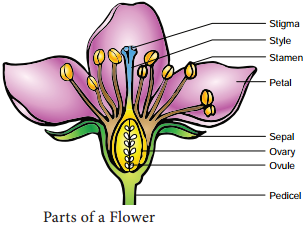
For a Morphologist, a flower is a highly condensed shoot meant for reproduction. As you have already learned about the parts of a flower in Unit II of Class XI, let us recall the parts of a flower. A Flower possesses four whorls – Calyx, Corolla, Androecium and Gynoecium.

Androecium and Gynoecium are essential organs (Figure 1.3). The process or changes involved in sexual reproduction of higher plants include three stages. They are Prefertilization, Fertilization and Post fertilization changes. Let us discuss these events in detail.
Sexual Reproduction img 1