Hydrocarbons Class 11 Notes Chemistry Chapter 13

By going through these CBSE Class 11 Chemistry Notes Chapter 13 Hydrocarbons, students can recall all the concepts quickly.

Hydrocarbons Notes Class 11 Chemistry Chapter 13

→ Classification-classification of hydrocarbons.

→ Alkanes-Nomenclature. isomerism, preparation, properties of alkanes, conformations.

→ Alkenes-structure of double bonds, Nomenclature, Isomerism, preparation and properties.

→ Alkynes-Nomenclature of isomerism, the structure of the triple bond, preparation & properties.

→ Aromatic hydrocarbons-Nomenclature & isomerism structure of benzene, Aromaticity, preparation & properties.

→ Directive influence of a functional group in mono-substituted benzene.

→ Carcinogenicity & Toxicity Benzene of polynuclear hydrocarbons.

→ Hydrocarbons: Hydrocarbons are the compounds of carbon & hydrogen only. Hydrocarbons are mainly obtained from coal & petroleum.

→ Petrochemical: Petrochemicals are the prominent starting material used for the manufacture of a large number of commercially important products.

→ L.P.G.: Liquified petroleum gas

→ C.N.G.: Compressed natural gas.

→ Classification of hydrocarbons: Saturated, unsaturated, cyclic (alicyclic) & Aromatic

→ Important reactions of Alkanes: Free radical substitution, combustion, oxidation & aromatization.

→ Alkenes & Alkynes: Undergo mainly addition reactions, (electrophilic additions).

→ Aromatic hydrocarbons: Despite having unsaturation undergo mainly electrophilic substitution reactions

→ Conformation Isomerism: Alkanes show conformational isomerism due to free rotation along with the C – C sigma bonds. Out of staggered of the eclipsed conformations of ethane, staggered conformations are more stable as hydrogen atoms are farthest apart.

→ Geometrical Isomerism: Alkanes exhibits geometrical isomerism (cis-trans) due to restricted rotation around the carbon-carbon double bond

→ Huckel Rule: Benzene of benzenoid compounds show aromatic character. Aromaticity, the property of being aromatic is possessed by compounds having specific electronic structure characterized by Huckel Rule (4n + 2) π electron rule.

→ Carcinogenic property: Some of the polynuclear hydrocarbons having fused benzene ring system have carcinogenic property.

→ Activation & deactivation of benzene ring: The nature of groups or substituents attached to the benzene ring is responsible for activation or deactivation of the benzene ring towards further electrophilic substitution and also for orientation of the incoming group.

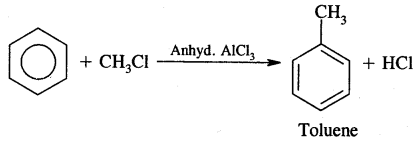
Friedel-crafts Reaction:
1. Friedel craft alkylation reaction
Hydrocarbons Class 11 Notes Chemistry 1
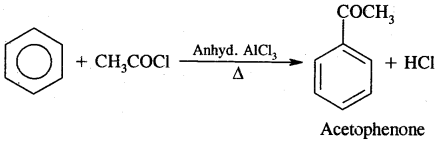
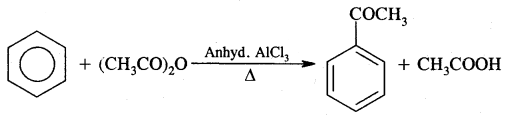
2. Friedel craft acylation reaction
Hydrocarbons Class 11 Notes Chemistry 2
Hydrocarbons Class 11 Notes Chemistry 3
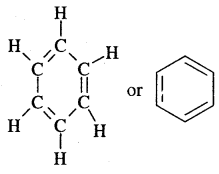
Structure of Benzene
Hydrocarbons Class 11 Notes Chemistry 4
Kekule’s Structure

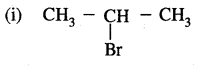
→ Markownikov Rule: The rule states that the negative part of the addendum gets attached to that carbon atom which possesses a lesser number of hydrogen atoms as:
CH3 – CH = CH2 + HBr →
Hydrocarbons Class 11 Notes Chemistry 5
2-Bromopropane (Main product)
(ii) CH3 CH2 CH2Br
1-Bromopropane (Minor product)

→ Lindlar’s Catalyst: Partially deactivated palletised charcoal is known as Lindlar’s Catalyst.

Chapter In Brief:
Hydrocarbons are the compounds of carbon and hydrogen only, Alkanes, Alkenes, alkynes, and aromatic compounds constitute hydrocarbons. Alkanes are saturated hydrocarbons containing carbon-carbon single bonds. Alkenes are unsaturated hydrocarbons containing at least one
Hydrocarbons Class 11 Notes Chemistry 6
double bonds, whereas alkynes are unsaturated hydrocarbons containing at least one — C ≡ C — triple bond.

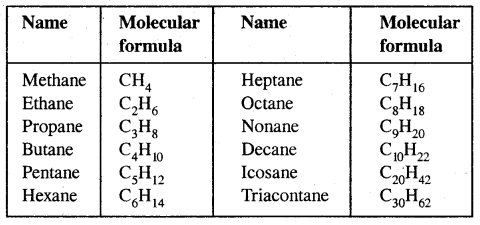
Alkanes: Earlier known as paraffin, the general formula of their homologous series is CnH2n+2.

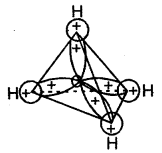
Methane, the first member is having a tetrahedral shape according to VSEPR Theory. It is multiplanar in which a carbon atom lies at the centre and four hydrogen atoms lie at the four corners of a regular tetrahedron. H-C-H bond angle is 109.5°. In alkenes, C-C and C-H bond lengths are 154 pm and 112 pm respectively. C-C and C – H bonds are formed by head-on the overlapping of sp3 hybrid orbitals of carbon and Is atomic orbitals of hydrogen atoms.
Hydrocarbons Class 11 Notes Chemistry 7
Nomenclature & Isomerism in Alkanes:
The first three members of the alkane family namely methane, ethane and propane have only one structure but higher alkanes can have more than one structure.
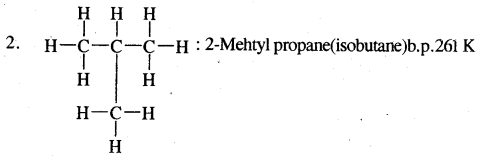
e.g. C4H10 have the following two structures

Hydrocarbons Class 11 Notes Chemistry 8
Hydrocarbons Class 11 Notes Chemistry 9
They are called Chain Isomers
Similarly, C5H12 have the following three structures
1. CH3-CH2-CH2-CH2-CH3
: Pentane (n-pentane) b.p. 309 K
2. Hydrocarbons Class 11 Notes Chemistry 10
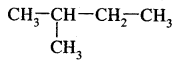
: 2-Methyl butane (isopentane) b.p 301K
3. Hydrocarbons Class 11 Notes Chemistry 11
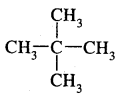
: Dimethylpropane (neopentane) b.p. 282 K.

1, 2, 3 are the chain isomers of pentane. They differ in their boiling points and other properties, though they have the same molecular formula. This difference in properties is due to the difference in their structures, they are termed Structural Isomers.

Preparation of Alkanes:
Petroleum and natural gas are the main sources of alkanes. However, alkanes can be prepared by the following methods.
1. From unsaturated hydrocarbon by hydrogenation.
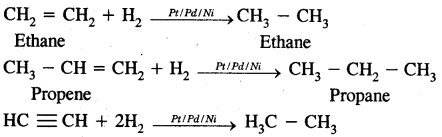
Hydrocarbons Class 11 Notes Chemistry 12
2. From alkyl halides:
1. Alkyl halides (except fluorides) on reduction with zinc and dilute hydrochloric acid give alkanes,
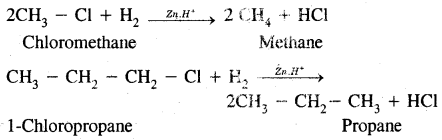
Hydrocarbons Class 11 Notes Chemistry 13
2. By Wurtz reaction: Alkyl halides on treatment with sodium in dry ether give higher alkanes. This method is used to prepare higher alkanes containing an even number of carbon atoms.
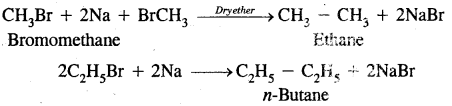
Hydrocarbons Class 11 Notes Chemistry 14
3. From carboxylic acids
1. Sodium salts of fatty acids on heating with soda-lime [a mixture of NaOH + CaO] give alkanes. The process is called decarboxylation [Removal of a molecule of CO2]
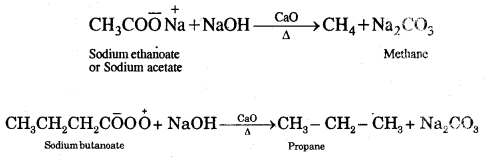
Hydrocarbons Class 11 Notes Chemistry 15
2. Kolbe’s electrolytic method: An aqueous solution of sodium or potassium salt of a carboxylic acid on electrolysis gives alkanes containing an even number of carbon atoms.

Hydrocarbons Class 11 Notes Chemistry 16
Properties Of Alkanes
(A) Physical Properties:

  1. Alkanes are almost non-polar due to the covalent nature of C-C and C—H bonds and due to very little difference of electronegativity between C and H atoms. Therefore, they are insoluble in water but soluble in organic solvents.
  2. Due to weak van der Waals forces, the first four members (from C1 to C4) are gases. The next thirteen (C5 to C17) are liquids and those containing 18 carbon atoms or more solids at 298 K.
  3. They are colourless and odourless.
  4. Their boiling points increase with the increase in molecular mass as shown in the table below.

Table: Variation of melting point and boiling point in alkanes
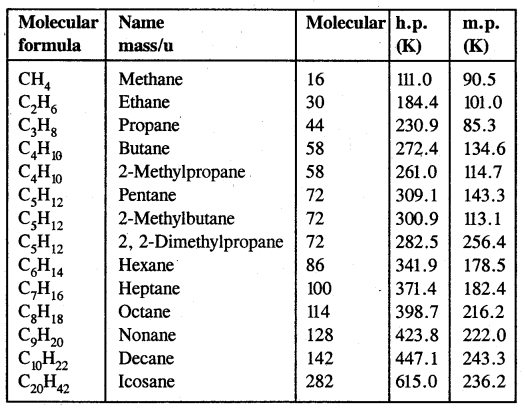
Hydrocarbons Class 11 Notes Chemistry 17
It is due to fact that intermolecular van der Waals forces increase with the increase in molecular size or surface area of the molecules. For example, among the isomeric pentanes.
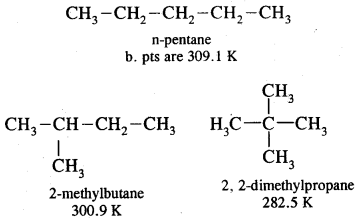
Hydrocarbons Class 11 Notes Chemistry 18
B. Pt of n-pentane is highest (309.1 K), whereas that of 2, 2- dimethyl propane is the lowest (282.5 K). With the increase in the number of branched chains, the molecule attains the shape of a sphere. This results in decreased surface area and hence weaker intermolecular van der Waals forces thus lowering the boiling points.

Chemical Properties Of Alkanes
1. Substitution Reaction: Halogenation
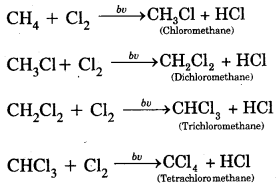
Hydrocarbons Class 11 Notes Chemistry 19
Order of reactivity of halogens is F2 > > Cl2 > Br2 > I2
Rate of replacement of hydrogens of alkanes is: 3° > 2° > 1°
Fluorination is too violent to be controlled.

Bromination is similar. Iodination is very slow and a reversible reaction. It can be carried out in the presence of some oxidising agents like HNO3 or HIO3.
CH4 + I2 ⇌ CH3I + HI
HIO3 + 5HI ⇌ 3I2 + 3H2O
Substitution of halogens in alkanes proceeds via a free-radical mechanism.

2. Combustion: Alkanes on heating in the presence of air or oxygen are completely oxidised to carbon dioxide and water with the evolution of a large amount of heat.
CH4(g) + 2O2 → CO2(g) + 2H2O (l); ΔcH°=- 890 kJ mol-1
C4H10(g) + 6\(\frac{1}{2}\)O2(g) → 4 CO2(g) + 5H2O (1); ΔcH° = -2876 kJ mol-1

Due to the evolution of large amount of heat during combustion, alkanes are used as fuels.
During incomplete combustion in insufficient supply of air or Oxygen, carbon black is formed.

Hydrocarbons Class 11 Notes Chemistry 20
3. Controlled Oxidation: In a regulated supply of air or oxygen at high pressure and in the presence of suitable catalysts, alkanes give a variety of oxidation products.
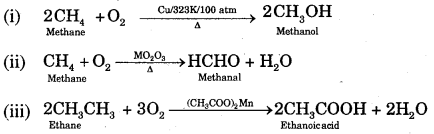
Hydrocarbons Class 11 Notes Chemistry 21
(iv) Ordinarily alkanes resist oxidation but alkanes having tertiary H atoms can be oxidised to corresponding alcohols by KMnO4.
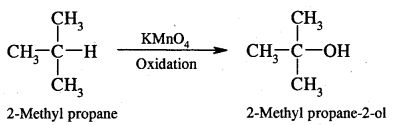
Hydrocarbons Class 11 Notes Chemistry 22
4. Isomerisation: n-Alkanes on heating in the presence of anhydrous aluminium chloride and hydrogen chloride gas isomerises to branched-chain alkanes.
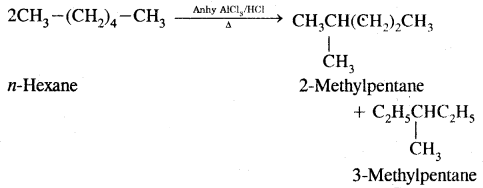
Hydrocarbons Class 11 Notes Chemistry 23
5. Aromatisation: n-alkanes having six or more C atoms on heating to 773 K at 10-20 atmospheric pressure in the presence of oxides of V, Mo or Cr supported over alumina gel dehydrogenated and cyclised to benzene and its homologues. This reaction is termed Aromatisation or reforming.
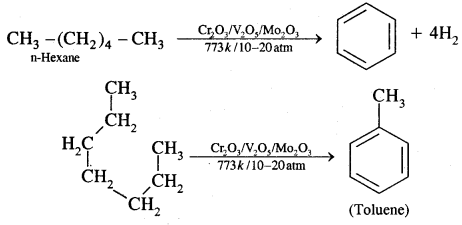
Hydrocarbons Class 11 Notes Chemistry 24
6. Reaction with steam
Hydrocarbons Class 11 Notes Chemistry 25
7. Pyrolysis: Higher alkanes on thermal decomposition give lower alkanes, & a mixture of alkanes. The process is also called Cracking.
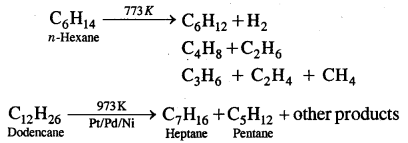
Hydrocarbons Class 11 Notes Chemistry 26
Conformations:
Alkanes contain C-C sigma (a) bonds. Free-rotation around C – C bond is possible. Such different Spatial, arrangement of atoms obtained by rotation around the C — C bond is called Conformations or Conformers or Rotamers.

Ethane (C2H6) has two major conformational isomers amongst several spatial arrangements differing from each other by a small energy barrier.

One is called eclipsed form which is less stable as it is associated with more energy [due to repulsion of electrons] and the other is called staggered form which is more stable as it is associated with lower energy. Any other intermediate confrontation is called a skew form.

Eclipsed and staggered forms of ethane (C2H5) can be represented by Sawhorse and Newman Projections as shown below of all the conformations of ethane.
1. Sawhorse Projections
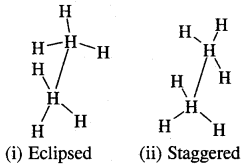
Hydrocarbons Class 11 Notes Chemistry 27
Sawhorse projections of change

2. Newman’s Projections
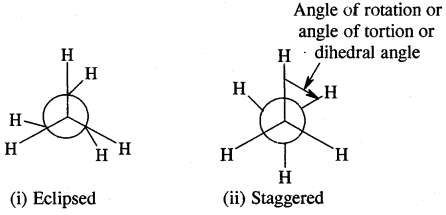
Hydrocarbons Class 11 Notes Chemistry 28
Newman projections of ethane

The staggered form has the least torsional strain and the eclipsed form the maximum torsional strain. The energy difference between the two extreme forms is of the order of 12.5 kJ mo-1 which is very small. These forms have not been separated.

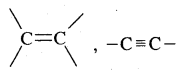
Alkenes. Alkenes are unsaturated hydrocarbons containing at least one
Hydrocarbons Class 11 Notes Chemistry 29
(double bond) or —C = C— (Triple bond)
They are also called Olefins. The general formula of alkenes is CnH2n.

Structure of Double Bond
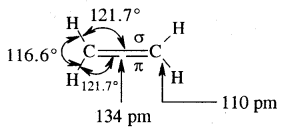
Cabon atoms constituting a double bond undergo sp2 hybridisation. The double bond contains one strong sigma (a) bond and one weak Pi (π) bond. The electrons of the π bond are delocalised and is thus a source of electrons. Any electrophile can come and attack it. That is why alkenes undergo electrophilic addition reactions.

The double bond is shorter in bond length (134 pm) than the C-C single bond (154 pm), π bond is a weaker bond due to poor overlapping between the two 2p orbitals. The strength of the double bond (bond enthalpy 681 kJ mol-1) is greater than that of a C—C single bond (bond enthalpy 348 kJ mol-1) in ethane.
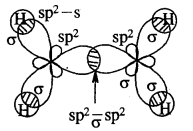
Hydrocarbons Class 11 Notes Chemistry 30
Orbital picture of ethene depicting bonds only
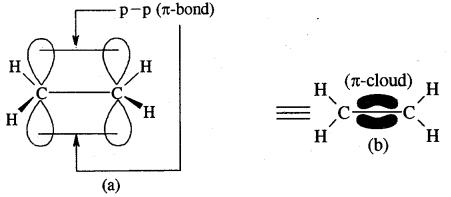
Hydrocarbons Class 11 Notes Chemistry 31
Hydrocarbons Class 11 Notes Chemistry 32
Original picture of ethene showing formation of (a) π-bond. (b) π-cloud and (c) bond angles and bond lengths

Nomenclature of Alkenes:
In the IUPAC system, the longest chain of carbon atoms containing the double bond is ‘selected’. The numbering of the chain is done from the end which is nearer to the double bond. The suffix ‘ene’ replace ‘ane’ of alkanes.

Put n = 2 in Cn H2n; C2H4 or H2C = CH2 is ethylene (common name) and ethene in IUPAC system.
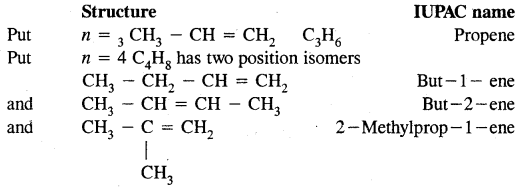
Hydrocarbons Class 11 Notes Chemistry 33

Isomerism in Alkenes
Alkenes show both structural isomerism and geometrical isomerism.
(a) Chain isomerism
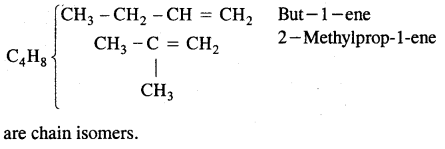
Hydrocarbons Class 11 Notes Chemistry 34
(b) Position isomerism
CH3 – CH2 – CH = CH2 But -1-ene
and CH3 – CH = CH – CH3 But-2-ene
are position isomers as they differ in the position of the functional group.

(c) Geometrical isomerism
Cxy = Cxy and Cxy type of alkenes show geometrical isomerism
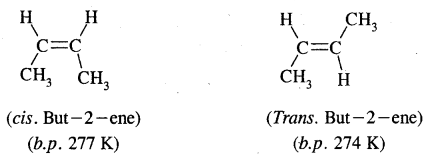
e.g. But-2-ene CH3 – CH = CH – CH3 exists in two forms- called geometrical or cis-trans isomers as shown below.
Hydrocarbons Class 11 Notes Chemistry 35
When the identical atoms or groups lie on the same side of the double bond it is called cis-isomer
When the identical atoms or groups lie on the opposite side of the double bond it is called trans-isomer.

The restricted rotation of atoms or groups around the doubly bonded carbon atoms gives rise to different geometries to such compounds. The stereoisomers of this type are called geometrical isomers.

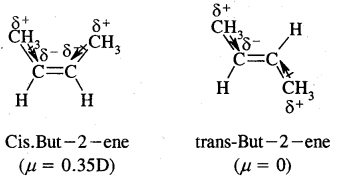
Due to different Spatial arrangements of atoms or groups, geometrical isomers differ in their properties like m.p., b.p., dipole moment, solubility etc.

Cis-form of but-2-ene is more polar than the transform. (Dipole moment) p of cis-form is 0.35 Debye whereas p of transform is almost zero, or trans-2-butene is non-polar. In the transform, two methyl groups being in opposite directions cancel polarities due to each C – CH3 bond.
Hydrocarbons Class 11 Notes Chemistry 36
In the case of solids, it is found that the trans isomer has higher m.p. than cis form. This is due to the better symmetry of the trans-isomers. Trans solids fit well into the crystal lattice.

Preparation 0f Alkenes
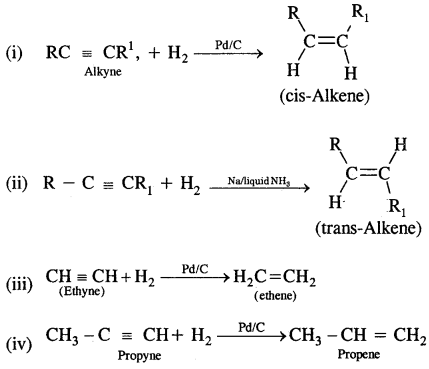
1. From Alkynes: Alkynes on partial reduction with a calculated amount of dihydrogen in the presence of partially deactivated palletised charcoal called Lindlar’s Catalyst to give cis-alkenes. However, alkynes on reduction with sodium in liquid ammonia form trans-alkenes.
Hydrocarbons Class 11 Notes Chemistry 37
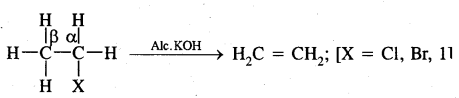
2. From Alkyl Halides: Alkyl halides on heating with alcoholic potash (potassium hydroxide dissolved in alcohol) undergo dehydrohalogenation to give alkenes. This is an example of a β-Elimination reaction.
Hydrocarbons Class 11 Notes Chemistry 38
For halogens, the rate of reaction is Iodine > bromine > chlorine while for alkyl groups, it is tert > sec > prim.

3. From vicinal dihalides: Vicinal (on two adjacent C atoms) dihalides on treatment with zinc undergo dehalogenation to give alkenes.
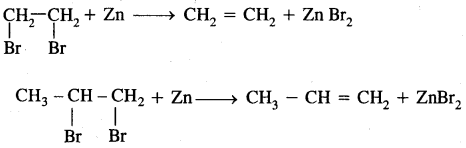
Hydrocarbons Class 11 Notes Chemistry 39
4. From the acidic dehydration of alcohols: Alcohols on heating with conc. H2SO4 lose a molecule of H2O (β-elimination reaction) to form an alkene.
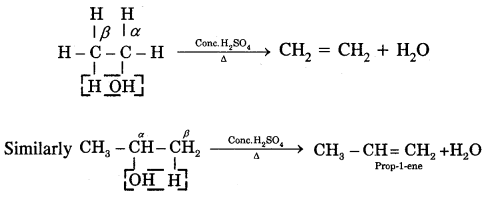
Hydrocarbons Class 11 Notes Chemistry 40
Properties of Alkenes:
Physical properties:

  1. The first three members are gases, the next 14 are liquids and the higher ones are solids.
  2. Except for ethene, which has a pleasant smell, all alkenes are odourless and colourless.
  3. They are insoluble in water but fairly soluble in non-polar solvents like benzene, petroleum, ether etc.
  4. They show a regular increase in b.p. with an increase in size [For every — CH2— group added b.p. increases by 20—30 K] Like alkanes, straight-chain alkenes have higher b.p. than isomeric branched ‘ alkenes.
  5. Like alkanes, alkenes are generally non-polar but certain, alkenes are weakly polar due to their unsymmetrical geometry.

Chemical Properties:
(a) Addition reactions:
1. Addition of H2 (catalytical hydrogenation)

Hydrocarbons Class 11 Notes Chemistry 41
2. Addition of halogens: [Electrophilic addition] Br2 is a reddish-orange liquid that adds to the unsaturated site to give a colourless product. This reaction is used as a test of unsaturation.
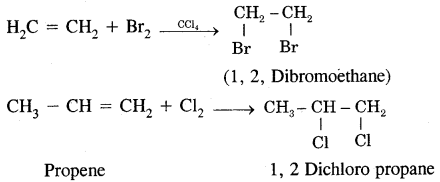
Hydrocarbons Class 11 Notes Chemistry 42
3. Addition of hydrogen halides
The order of reactivity is HI > HBr > HCl
CH2 = CH2 + H – Br → CH3 – CH2Br
Markovnikov Rule. [Addition of HX to unsymmetric alkenes] “The negative part of addendum (the molecule to be added) goes to that carbon atom of the unsymmetrical alkene which is attached to lesser number of carbon atoms”.
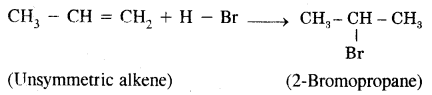
Hydrocarbons Class 11 Notes Chemistry 43
The modern version of Markovnikov Rule. The product is formed from the more stable carbocation.

Hydrocarbons Class 11 Notes Chemistry 44
The more stable carbocation [which predominates because it is former faster] reacts with Br- to form the product.
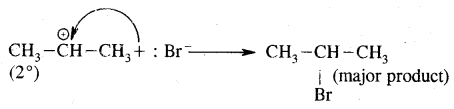
Hydrocarbons Class 11 Notes Chemistry 45
Anti-Markovnikov Addition or Peroxide/Kharash Effect

In the presence of peroxide, the addition of HBr to unsymmetrical alkenes like propene takes place contrary to the Markovnikov rule. This happens only with HBr but not with HCl and HI. This addition reaction was observed by M.S. Kharash and F.R. Mayo in 1933 at the University of Chicago. This reaction is known as peroxide or Kharash effect or addition effect or addition reaction anti to Markovnikov rule.

Hydrocarbons Class 11 Notes Chemistry 46
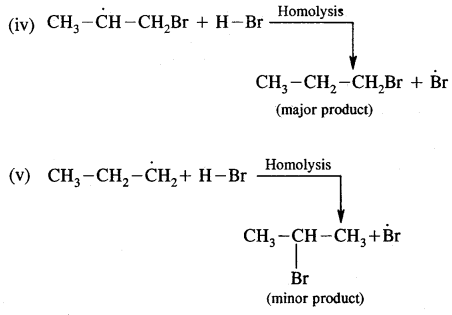
Mechanism: Peroxide effect proceeds via free radical chain mechanism as given below:
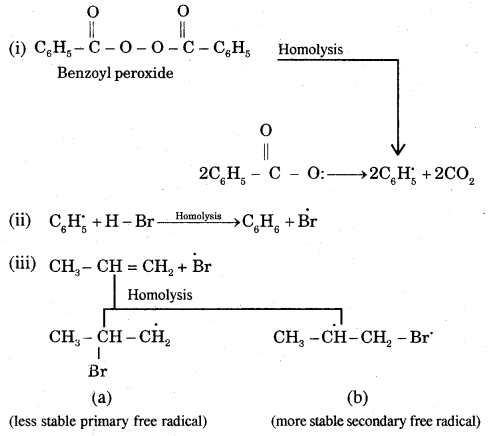
Hydrocarbons Class 11 Notes Chemistry 47
Hydrocarbons Class 11 Notes Chemistry 48
The secondary free radical obtained in the above mechanism (iii) is more stable than the primary. This explains the formation of 1 — bromopropane as the major product. It may be noted that the peroxide effect is not observed in addition to HCl and HI.

This may be due to the fact that the H – Cl bond being stronger (430.5 kJ mol-1) than H — Br bond (363.7 kJ mol-1), is not cleaved by the free radical, whereas the H – I bond is weaker (296.8 kJ mol-1) and iodine free radicals combine to form iodine molecules instead of an addition to the double bond.

4. Addition of sulphuric acid. Cold, concentrated sulphuric acid adds to alkenes in accordance with the Markovnikov rule as a result of electrophilic addition to form alkyl hydrogen sulphate.
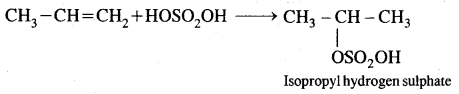
Hydrocarbons Class 11 Notes Chemistry 49
5. Addition of water. In the presence of a few drops of the cone. H2SO4, alkenes undergo hydration with water in accordance with the Markovinkov rule to form alcohols.
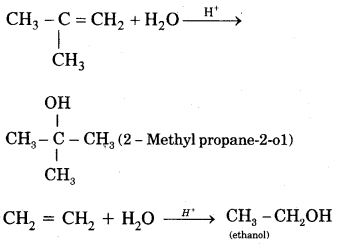
Hydrocarbons Class 11 Notes Chemistry 50
6. Oxidation: (a) Alkenes on reaction with cold, dilute, 1 % alkaline potassium permanganate (KMnO4) solution called Baeyer’s Reagent produce vicinal glycols. The colour of KMnO4 is discharged, It is also used as a test of unsaturation.
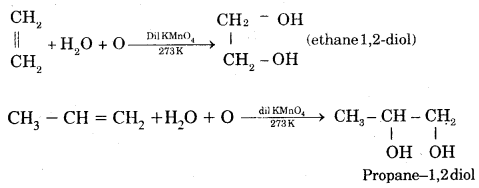
Hydrocarbons Class 11 Notes Chemistry 51
(b) Acidic KMn04 or acidic K2Cr2O7 oxidizes alkenes to ketones and/or acids depending upon the nature of the alkene and the experimental conditions
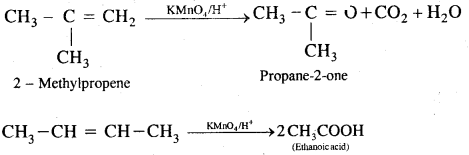
Hydrocarbons Class 11 Notes Chemistry 52
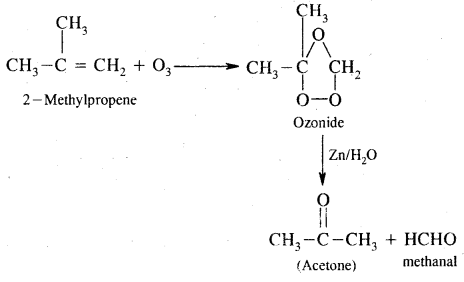
7. Ozonolysis. It involves the addition of O3 molecules to the alkene to form ozonide followed by cleavage by Zn/H2O to form aldehydes and ketones.
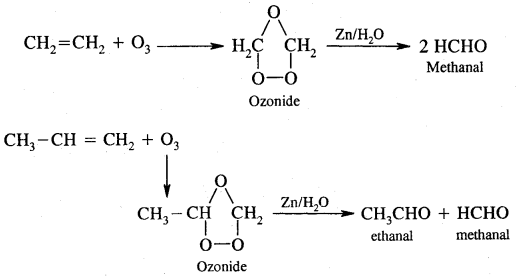
Hydrocarbons Class 11 Notes Chemistry 53
Hydrocarbons Class 11 Notes Chemistry 54
8. Polymerisation. When a large number of ethene molecules combine at high temperature, high pressure in the presence of a catalyst, Polythene is obtained.
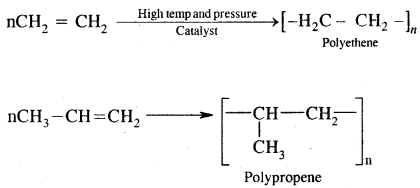
Hydrocarbons Class 11 Notes Chemistry 55
These polymers are of great use in the manufacture of plastic bags, squeeze bottles, toys, pipes radio and TV cabinets, milk crates, plastic buckets and other moulded articles.

Alkynes: Alkynes are unsaturated hydrocarbons containing at least one — C = C — triple bond.
General formula: CnH2n-2
Common & I.U.P.A.C. names of Alkynes
n = 2 C2H2 H – C ≡ C – H Acetylene Ethyne

n = 3 C3H4 CH3 — C ≡ CH MethylacetylenePropyne

n = 4 C4H6

  • CH3CH2C = CH Ethylacetylene But-l-yne
  • CH3 – C = C-CH3 Dimethylacetylene But-2-yne

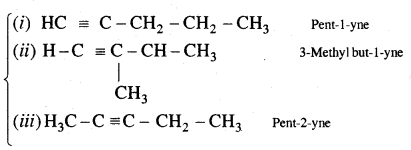
n = 5 C5H8
Hydrocarbons Class 11 Notes Chemistry 56
Structures (i) and (iii) are position isomers
Structures (i) and (ii) and (iii) are chain isomers
Structure of Triple Bond.

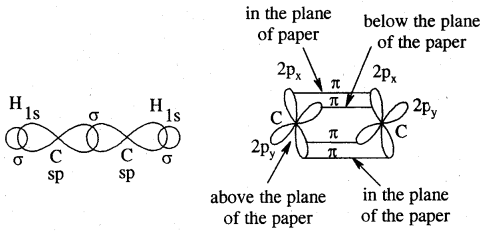
Each carbon atom of ethyne has two sp hybridized orbitals. Carbons-carbon sigma (a) bond is obtained by the head-on overlapping of the two sp hybridised orbitals of the two carbon atoms. The remaining sp hybridised orbitals of the two carbon atoms. The remaining sp hybridized orbital of each carbon atom undergoes overlapping along the internuclear axis with the Is orbital of each of the two hydrogen atoms forming two C — H sigma bonds. H – C—C bond angle is 180°.

Each carbon has two unhybridised p orbitals which are perpendicular to each other as well as to the plane of the C – C sigma bond. The 2p orbitals of one carbon atom are parallel to the 2p orbitals of the other carbon atom, which undergo lateral or sideways overlapping to form two pi (p) bonds between two carbon atoms. Thus ethyne molecule consists of one C — C s bond, two C >- Hs bonds and two C — C p bonds.

The strength of the C = C bond (bond enthalpy 823 kJ mol-1) is more than those of the C = C bond (bond enthalpy 681 kJ mol-1) and C – C bond (bond enthalpy 48 kJ mol-1). The C = C bond length is shorter (120 pm) than those of C = C (134 pm) and C – C) (154 pm). The electron cloud between two carbon atoms is cylindrically symmetrical about the internuclear axis. Thus ethyne is a linear molecule.
Hydrocarbons Class 11 Notes Chemistry 57
Orbital picture of ethyne showing (a) sigma overlaps (b) pi overlaps bond angles and bond lengths.

Preparation of Acetylene (Ethyne). Commercially, it is prepared by the action of water on calcium carbide.
CaC2 + 2H2O → Ca(OH)2 + C2H2 (Ethyne)

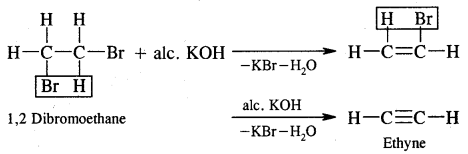
2. From Vicinal Dihalidies. Vicinal dihalides on treatment with alcoholic potassium hydroxide undergo dehydrohalogenation.
Hydrocarbons Class 11 Notes Chemistry 58

Properties of Alkynes:
Physical properties.

  1. First, three members are gases, the next eight are liquids and the higher ones are solids.
  2. All alkynes are colourless.
  3. Except for enthene which has a characteristic odour, others are odourless.
  4. Alkynes are weakly polar in nature.
  5. They are lighter than water and immiscible with water but soluble in organic solvents like ethers, benzene etc.
  6. Their m, p., b, p, and density increases with an increase in molar mass.

Chemical Properties: Alkynes show usual addition reactions, acidic reactions and polymerisation reaction.
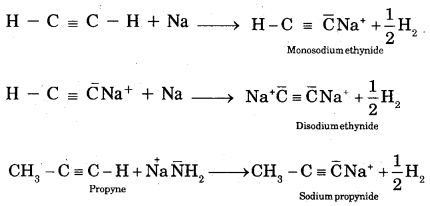
A. Acidic character of alkynes: Unlike alkenes, ethyne shows acidic reactions.
Hydrocarbons Class 11 Notes Chemistry 59
Alkanes, alkenes, and alkynes follow the following trend in their acidic behaviour.

  1. H – C ≡ C – H > CH2 = CH2 > CH3 – CH3
  2. H – C ≡ C – H > CH3 – C ≡ CH > > CH3 – C ≡ C – CH3

B. Addition reactions,
1. Addition of dihydrogen.
Alkynes contain a triple bond. Therefore, they add up two molecules of H2.
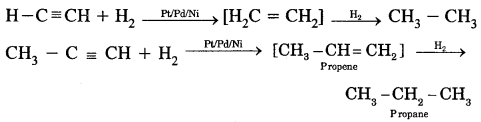
Hydrocarbons Class 11 Notes Chemistry 60
2. Addition of Halogens. When Br2 is added to alkynes, the reddish-orange colour of Br2 disappear. It is a test of unsaturation.

Hydrocarbons Class 11 Notes Chemistry 61
3. Addition of hydrogen halides [HCl, HBr, HI]
Two molecules get added to alkynes to form gem dihalides.

Hydrocarbons Class 11 Notes Chemistry 62
4. Addition of water
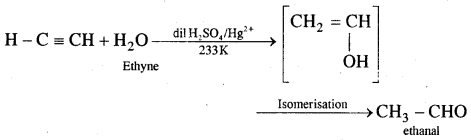
Hydrocarbons Class 11 Notes Chemistry 63
5. Polymerisation
Hydrocarbons Class 11 Notes Chemistry 64
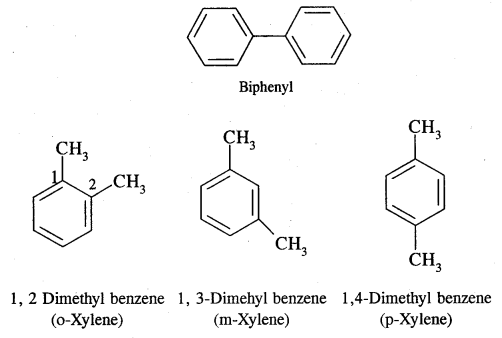
Aromatic Hydrocarbons or Arenes: Aromatic compounds containing benzene ring are known as Benzenoids and those not containing a benzene ring are called Non-Benzenoids. Some of the arenas are given below.
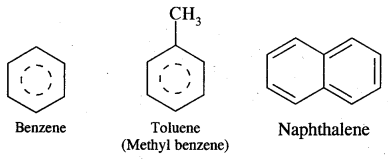
Hydrocarbons Class 11 Notes Chemistry 65
Hydrocarbons Class 11 Notes Chemistry 66
Where o = ortho (1,2)
m = meta (1, 3)
p = para (1, 4)

Structure of Benzene:

  1. Molecular formula C6H6 indicates that benzene is an unsaturated hydrocarbon.
  2. The unusual stability of benzene and no change of orange-red colour of Br2 in addition to benzene ruled out the open chain structure of benzene.
  3. It forms a triozonide which indicates the presence of three double bonds.
  4. Benzene produces one and only one monosubstituted derivative which indicates that all the six-carbon and six hydrogen atoms of benzene are identical.
  5. A. Kekule’ in 1865 proposed the cyclic structure for benzene with alternate single and double bonds in carbon atoms with each C atom carrying one hydrogen.
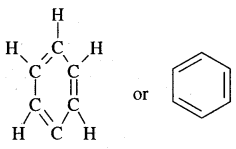
Hydrocarbons Class 11 Notes Chemistry 67
Kekule’ suggested the oscillating nature of double bonds.
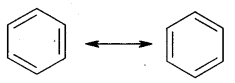
Hydrocarbons Class 11 Notes Chemistry 68
Resonance and Stability of Benzene
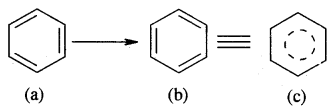
Benzene is a resonance hybrid of various, resonating structures. The two structures are given above by Kekule’ are the main contributing st; lectures. The hybrid structure is (c) is given below.
Hydrocarbons Class 11 Notes Chemistry 69
The circle represents the six electrons that are delocalised between the six carbon atoms of the benzene ring.

Orbital Picture of Benzene.
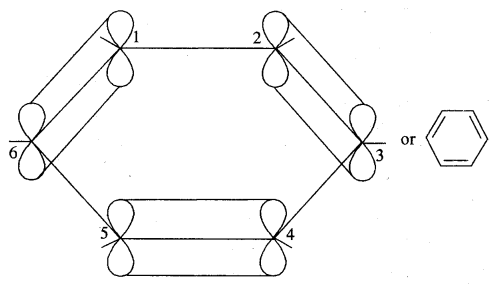
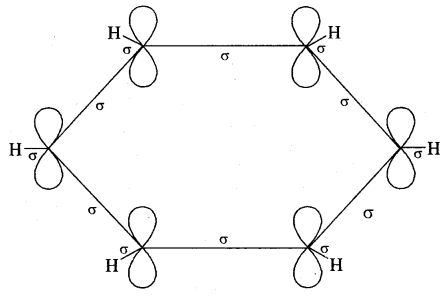
All the six carbon atoms of benzene are sp2 hybridised. Two of these three sp2 hybrid orbitals of each C atom overlap with sp2 hybrid orbitals of adjacent C atoms to form six C – C single bonds which are in the hexagonal plane. The remaining sp2 orbital of each C atom overlaps with the s-orbital of each hydrogen atom to form six C — H single sigma bonds. Each C atom is now left with one unhybridised p- orbital perpendicular to the plane of the ring as shown on the next page.
Hydrocarbons Class 11 Notes Chemistry 70
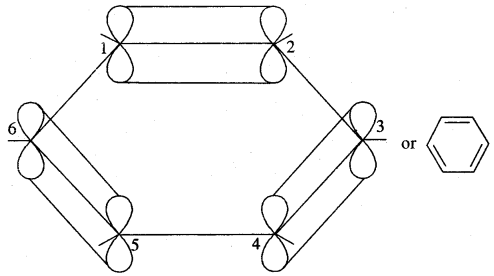
The unhybridised p orbital of carbon atoms is close enough to form π (Pi) bond by sidewise overlap. These overlaps can be of overlaps of p-orbitals of C1 — C2, C3 — C4, C5 – C6 or C3, C4 — C5, C6 – C1 respectively as shown in the following figures.
Hydrocarbons Class 11 Notes Chemistry 71
(a)
Hydrocarbons Class 11 Notes Chemistry 72
(b)
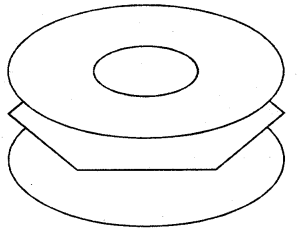
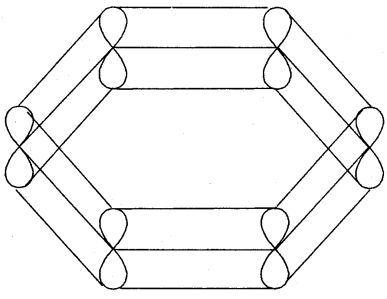
X-ray diffraction data reveals that benzene is a planar molecule. The six n electrons are delocalised and spread on the whole of the molecule: one half of the electron cloud above and the other half below the plane of the benzene ring. The presence of delocalised n electrons in benzene makes it more stable than the imaginary cyclohexatriene.
Hydrocarbons Class 11 Notes Chemistry 73
or
Hydrocarbons Class 11 Notes Chemistry 74
(Electron cloud)

If there were three single C – C bonds and three alternate C = C bonds present in benzene, the bond lengths should have been 154 pm and 134 pm respectively. In benzene there are neither C – C double bonds present as all the six C — C bonds in benzene are exactly alike and have a bond length of 139 pm. Thus the absence of pure double bonds in benzene accounts for the hesitation on the part of benzene to take part in additional reactions. Due to its extra stability, it prefers to show substitution reactions.

Aromaticity: Benzene is considered a parent aromatic compound. Now the name is applied to all the ring systems whether or not having benzene ring, possessing the following characteristics.

  1. It should be planar
  2. Complete delocalisation of % electrons in the ring.
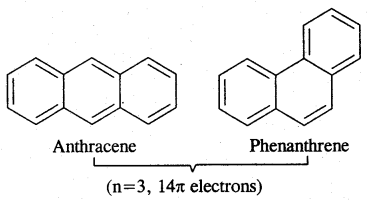
  3. Presence of (4n + 2) n electrons in the ring where n is an integer (n = 0, 1, 2). This is called Huckel Rule.
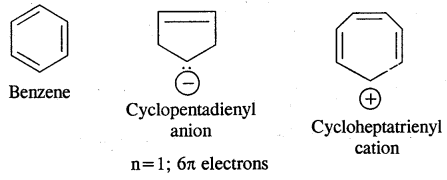
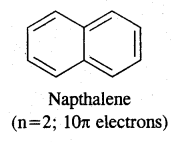
Hydrocarbons Class 11 Notes Chemistry 75
Hydrocarbons Class 11 Notes Chemistry 76
Hydrocarbons Class 11 Notes Chemistry 77
Preparation of Benzene
Benzene is commercially isolated from the ‘Light oil fraction’ of coal tar. However, it may be prepared in the laboratory by the following methods.
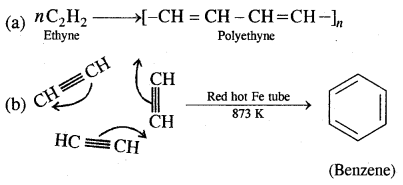
1. From ethyne
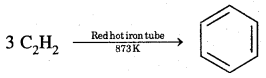
Hydrocarbons Class 11 Notes Chemistry 78
2. Decarboxylation of the aromatic acids Sodium salt of benzoic acid on heating with soda lime gives benzene.

Hydrocarbons Class 11 Notes Chemistry 79
3. Reduction of Phenol in the presence of zinc dust gives benzene
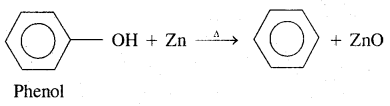
Hydrocarbons Class 11 Notes Chemistry 80
Properties of Benzene (Aromatic hydrocarbons)
Physical properties

  1. Aromatic hydrocarbons are non-polar.
  2. They are colourless liquids or solids with a characteristic aroma.
  3. Aromatic hydrocarbons are immiscible with water but are readily miscible with organic solvents.
  4. They burn with a sooty flame.

Chemical Properties
Arenes undergo electrophilic substitution reactions. However, under special conditions, they undergo addition and oxidation reactions.

Electrophilic Substitution Reactions of arenes are nitration, halogenations, sulphonation, Friedel Craft’s reactions.
In all these reactions, the attacking reagent is an electrophile E®.
1. Nitration.
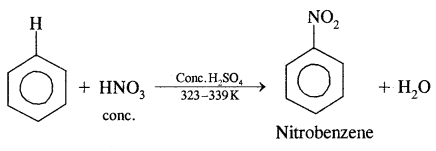
Hydrocarbons Class 11 Notes Chemistry 81
2. Halogenation: Arenes react with halogen in the presence of Lewis acids like FeCl3, FeBr3, or AlCl3 to yield halo arenes.

Order of reactivity of halogens is Cl2 > Br2 > I2.
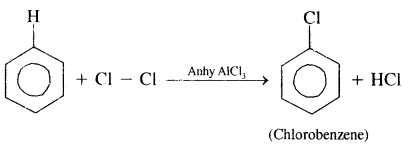
Hydrocarbons Class 11 Notes Chemistry 82
3. Sulphonation: Here H of the benzene ring is replaced by sulphonic group (— SO2 OH). It is carried out by heating benzene with fuming sulphuric acid (oleum).
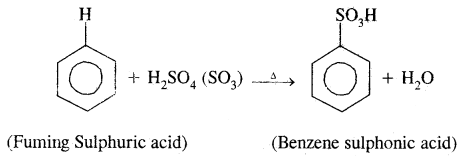
Hydrocarbons Class 11 Notes Chemistry 83
4. Friedel Craft’s Reaction:
(a) Alkylation: On reacting benzene with an alkyl halide in the presence of anhydrous Aluminium chloride, alkyl benzene is formed.
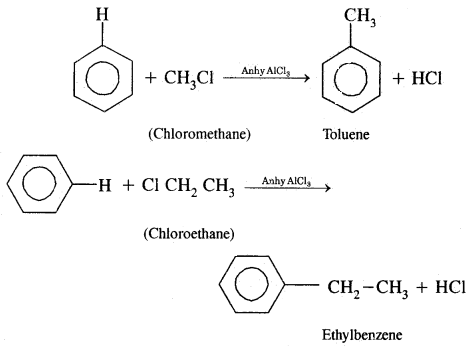
Hydrocarbons Class 11 Notes Chemistry 84
(B) Acylation: On treating benzene with an acyl chloride in the presence of Lewis acids (AlCl3) gives acyl benzene.
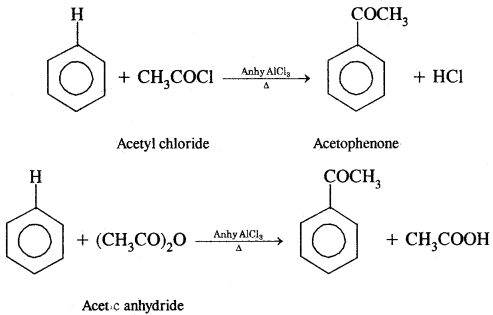
Hydrocarbons Class 11 Notes Chemistry 85
Mechanism of electrophilic substitution reactions: It involves three steps:

  1. Generation of an electrophile.
  2. Formation of a resonance-stabilised carbocation intermediate.
  3. Removal of proton H+ to form the product.

1. Generation of Eelecrophile (E+): In the above reactions electrophiles like Cl+ (chloronium ion) is generated during chlorination by reacting with any. AlCl3.
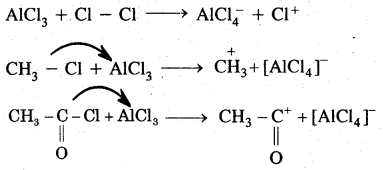
Hydrocarbons Class 11 Notes Chemistry 86
In the case of Nitration, NO2 (nitronium ion) is generated.
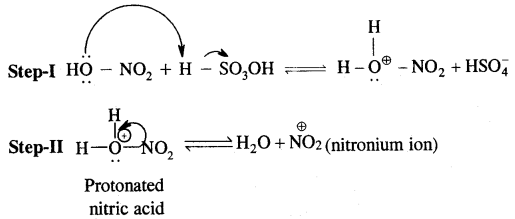
Hydrocarbons Class 11 Notes Chemistry 87
2. Formation of carbocation (arenium ion) results with one of the carbon getting sp3 hybridised on the attack of the electrophile (E)+
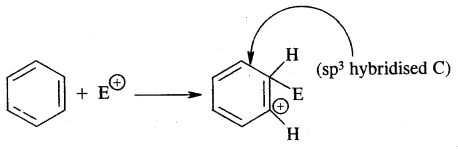
Hydrocarbons Class 11 Notes Chemistry 88
Sigma complex (arenium ion)
The intermediate arenium ion gets stabilised by resonance.
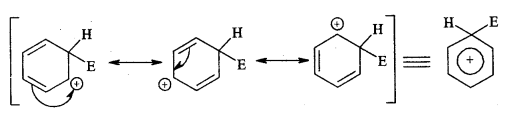
Hydrocarbons Class 11 Notes Chemistry 89
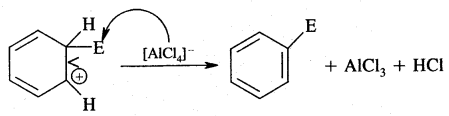
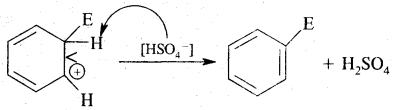
3. Removal of a proton (H+)
Hydrocarbons Class 11 Notes Chemistry 90
Hydrocarbons Class 11 Notes Chemistry 91
2. Addition reactions: Under drastic conditions of high temperature and or pressure in the presence in the presence of nickel catalyst, dihydrogen gets added to the benzene.
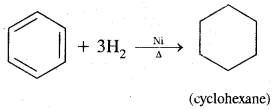
Hydrocarbons Class 11 Notes Chemistry 92
In the presence of ultraviolet light, three molecules of Cl2 get added to benzene to form Benzene hexachloride [BHC] C6H6C16 also called Gammaxene.
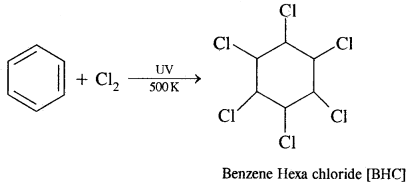
Hydrocarbons Class 11 Notes Chemistry 93
3. Oxidation by combustion: When heated in air, benzene burns with a sooty flame producing CO2 and H2O.
C6H6 + O2 → 6 CO2 + 3H2O
General combustion reaction for any hydrocarbon is
CxHy +(x + y/4)O2 → xCO2 + y/2H2O.

Directive Influence of a Functional Group in Monosubstituted Benzene
Ortho and para directing groups: The groups which direct the incoming group to ortho & para positions are called ortho & para directing groups. In phenol, for example, — OH (hydroxy) group attacked to benzene directs the new (or coming group) to ortho para positions as explained below:
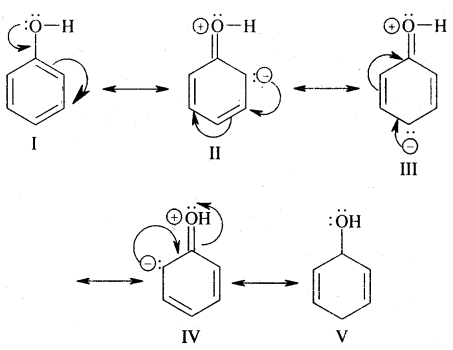
Hydrocarbons Class 11 Notes Chemistry 94
From the above structures, it is clear that electron density is more at ortho & para positions (structure II, III & IV) to the – OH group. Hence the coming electrophile will prefer to attack ortho & para position rather than meta. However due to the — I effect exerted by the — OH group, electron density at o—&p—position is slightly reduced. But overall, there is an increase of electron density ato-Scp- position. Hence the substituent at o—&p — positions to the -OH group.

Therefore, the -OH group is an activating group, as it activates the benzene ring for the attack of an electrophile. Other activating groups are NH2, -NHR, NHCOCH3, -OCH3, -CH3, -C2H5 etc.

Halogens are a class among themselves. They are deactivating and at the same time o—Scp — directing. Because of the, I effect, the overall electron density on benzene decreases. It makes further substitution difficult. However, due to resonance, the electron density on the o—& p — position is greater than at the meta position. Hence they are also o— & p — directing.

Meta-directing groups. The groups which when present in the benzene ring direct the incoming groups to meta position are called meta-directing groups. Some of the meta-directing groups are

Hydrocarbons Class 11 Notes Chemistry 95
(nitro group), for example, reduces the electron density in the benzene ring due to its — I effect. Nitrobenzene is a resonance hybrid of the following five canonical structures.
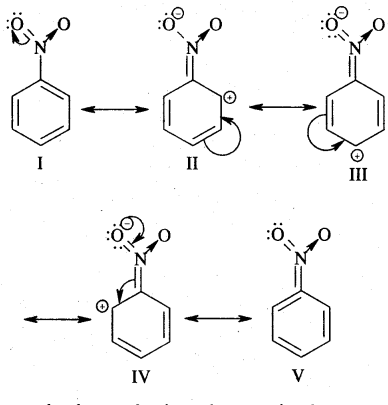
Hydrocarbons Class 11 Notes Chemistry 96
In this case, the electron density on the benzene ring decreases making further substitution difficult. Therefore these groups are called deactivating groups. The electron density on the o – and p – position is comparatively less than that at the meta position. Hence, the electrophile attacks on comparatively electron-rich meta position, resulting in meta-substitution.

Carcinogenicity and Toxicity:
Benzene and polynuclear hydrocarbons containing more than two fused benzene rings are toxic and said to possess cancer-producing (carcinogenic) property. They enter into the human body and undergo various biochemical reactions and finally damage DNA and cause cancer. Some of the carcinogenic hydrocarbons are given below. Such polynuclear hydrocarbons are formed on incomplete combustion of organic materials like tobacco coal and petroleum.
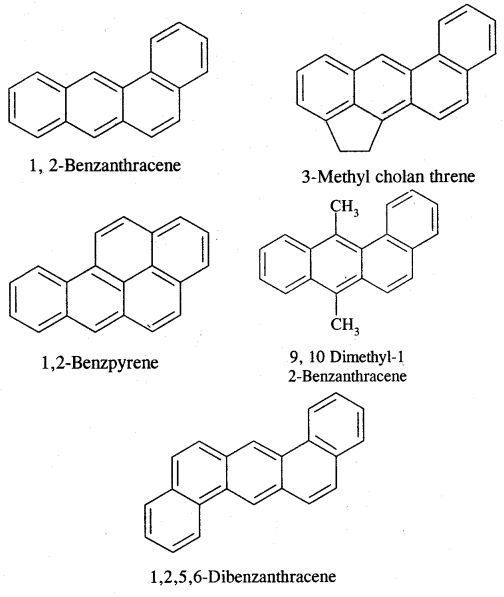
Hydrocarbons Class 11 Notes Chemistry 97

Organic Chemistry Some Basic Principles and Techniques Class 11 Notes Chemistry Chapter 12

By going through these CBSE Class 11 Chemistry Notes Chapter 12 Organic Chemistry Some Basic Principles and Techniques, students can recall all the concepts quickly.

Organic Chemistry Some Basic Principles and Techniques Notes Class 11 Chemistry Chapter 12

→ Carbon: Tetra valency of carbon, shape of organic compounds & characteristic features of π-bond.

→ Structural representation of organic compounds: Complete, condensed & bond line structural formulae.

→ A 3-dimensional representation of organic molecules & classification of organic compounds.

→ Acyclic or open chain compounds & Alicyclic or closed chain compounds or ring compounds & functional groups.

→ Homologous series, Nomenclature of organic compounds & I.U.P.A.C. nomenclature of alkanes.

→ Nomenclature of organic compounds having a functional group or groups & nomenclature of substituted benzene compounds.

→ Isomerism: Structural, chain, position, functional group isomerism, metamerism & stereoisomerism.
→ Fundamental concepts in organic reaction mechanism: Fission of a covalent bond, Nucleophiles & Electrophiles, Electron movement in organic reactions. Electron displacement effects in covalent bonds. Inductive effect, resonance structure & resonance effect.
→ Electromeric effect (E-effect), Hyperconjugation, types of organic reactions & mechanisms.

→ Methods of purification of organic compounds: Sublimation, crystallization, distillation, differential extraction, chromatography.

→ Qualitative analysis of organic compounds detection of C & H, N, S, halogens & for PO43-.

→ Quantitative analysis of organic compounds: Elemental detection in the form of a percentage, C, H, N-(Dumas method, Kjeldahl’s method), halogens, sulfur, phosphorus & oxygen.

→ Orbital hybridization concept: The nature of the covalent bonding in organic compounds can be described in terms of the orbitals hybridization concept.
Organic Chemistry Some Basic Principles and Techniques Class 11 Notes Chemistry 1
→ Three-dimensional representation of organic compounds: Three-dimensional representation of organic compounds on paper can be drawn by wedge & dash formula.

→ Functional group: A functional group is an atom or group of atoms bonded together in a unique fashion & which determines the physical & chemical properties of compounds.

→ I.U.P.A.C.: International union of pure & applied chemistry.

→ Organic reaction mechanism: Organic reaction mechanism concepts are based on the structure of the substrate molecule. Fission of a covalent bond, the attacking reagents, the electron displacement effects & the conditions of the reaction.

→ Cleavage of covalent bond: A covalent bond may be cleaved in a heterolytic or homolytic fashion. A Heterolytic cleavage yields carbocations or carbanions & a homolytic cleavage gives free radicals as reactive intermediates.

→ Nucleophile & Electrophile:

  • Nucleophile – Electron pair donor
  • Electrophile – Electron pair acceptor.

→ Organic reactions:

  1. Substitution reactions
  2. Addition reactions
  3. Elimination reactions
  4. Re-arrangement reactions

→ Methods of purifications of organic compounds:

  1. Sublimation
  2. Distillation &
  3. Differential extraction

→ Chromatography is a useful technique of separation, identification & purification of compounds. It is classified into two categories adsorption & partition chromatography. Lassaigne’s Test: N, S, halogens & phosphorus are detected by Lassaigne’s test.

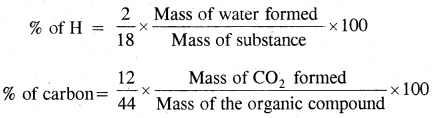
→ Estimation of C & H: Carbon & hydrogen are estimated by determining the amounts of CO2 & water produced. Estimation of Nitrogen: Nitrogen is estimated by Duma’s or Kjeldahl’s method.

→ Halogens Estimation: Halogens are estimated by various methods. Estimation of S & Phosphorus: S & P are estimated by oxidizing them to sulphuric & phosphoric acid respectively.

→ The percentage of oxygen: The percentage of oxygen is usually determined by subtracted (the sum of percentages of all other elements present in the compound) out of 100.

→ Retardation factor:
Rf = \(\frac{\text { Distance moved by the substance from base line }}{\text { Distance moved by solvent from base line }}\)
(a) Percentage of carbon = \(\frac{12 \times m_{1} \times 100}{44 \times m}\)
m1 = mass of CO2
m = mass of organic compound

(b) Percentage of Hydrogen = \(\frac{2 \times m_{1} \times 100}{18 \times m}\)
m1 = mass of H2O
m = mass of organic compound

(c) Percentage of nitrogen by Dumas method = \(\frac{28 \times V \times 100}{22400 \times m}\)
V = Volume of nitrogen m mass of organic compound

(d) Percentage of nitrogen by kJeldahl’s method = \(\frac{1.4 \times \mathrm{M} \times 2\left(\mathrm{~V}-\mathrm{V}_{1} / 2\right)}{m}\)
m mass of organic compound
M = Molarity of H2SO4 taken
V = Volume of H2SO4 of molarity-M
V1 = Volume of NaOH of molarity-M used for titration of excess of H2S04

(e) Percentage of halogens = \(\frac{\text { Atomic mass of }(\mathrm{X}) X m_{1} g \times 100}{\text { molecular mass of }(\mathrm{AgX}) X m}\)
m = mass of organic compound
m1 = mass of AgX formed
X = halogen atom

(f) Percentage of sulphur = \(\frac{32 \times m_{1} \times 100}{233 \times m}\)
m = mass of organic compound
m1 = mass of BaSO4 formed

(g) Percentage of Phosphorus:
If Phosphorus is estimated as Mg2P2O7
= \(\frac{62 \times m_{1} \times 100}{222 \times m}\)
m = mass of organic compound
m1 = mass of Mg2P2O7
222 = molar mass of Mg2P2O7

If Phosphorus is estimated as (NH4)3 PO4.12MoO3 then percentage of Phosphorus = \(\frac{31 \times m_{1} \times 100}{1877 \times m}\)
here m1 = mass of (NH4)3 PO4.12MoO3
1877 = molar mass of (NH4)3PO4.12MoO3

(h) Percentage of Oxygen:
= \(\frac{32 \times m_{1} \times 100}{44 \times m}\)
m = mass of organic compound
m1 = mass of carbondioxide

Chapter In Brief:
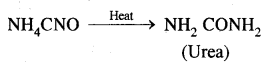
Berzelius, A Swedish chemist proposed that a Vital Force was responsible for the formation of organic compounds. F. Wohler gave a death blow to the Vital Force theory when he synthesized organic compound urea from an inorganic compound ammonium cyanate.
Organic Chemistry Some Basic Principles and Techniques Class 11 Notes Chemistry 2
Tetravalence of Carbon: Shapes of organic compounds: The formation of CH4, C2H6 is due to sp3 hybridization of C; formation of CH4 is on the basis of sp2 hybridization of C, and formation of C2H2 is on the basis of sp hybridization of C. The presence of double bond in H2C=CH2 and triple bond in HC = CH is due to the presence of one π and two π bonds respectively in them.
In H2C=CH2, rotation about C-C bond is hindered due to the presence of π bond between the two C atoms, sp3 hybridization gives rise to tetrahedral shape t

o CH4, sp2 hybridization gives rise to a trigonal planar arrangement to C2H4, and sp hybridization gives linear shape to C2H2. An sp3 hybrid orbital can overlap with Is orbital of hydrogen to give a C—H bond (sigma a single bond). Overlap of an sp2 orbital of one carbon with an sp2 orbital of another results in the formation of a carbon-carbon bond.
The unhybridized p-orbitals on two adjacent carbons can undergo lateral (side-by-side) overlap to give a pi (π) bond. Organic compounds can be represented by various structural formulas. The three-dimensional representation of organic compounds on paper can be drawn by the wedge and dash formula.

Organic compounds can be classified on the basis of their structure or the functional groups they contain. A functional group is an atom or group of atoms bonded together in a unique fashion which determines the physical and chemical properties of the compounds. The naming of the organic compounds is carried out by following a set of rules laid down by the International Union of Pure and Applied Chemistry (IUPAC). In IUPAC nomenclature, the names are correlated with the structure in such a way that the reader can deduce the structure from the name.

Structural Representations Of Organic Compounds:
Complete, condensed, and Bond-line structural formulae
Organic Chemistry Some Basic Principles and Techniques Class 11 Notes Chemistry 3
stand for the complete structural formulae of ethane, ethene ethyne, and methanol whereas CH3—CH33 (or C2H6), H2C=CH2 (or C2H4), HC ≡ CH (or C2H2), and CH3OH stand for their condensed structural formulae respectively.

Bond-line structural representation of 1,3 butadiene is
Organic Chemistry Some Basic Principles and Techniques Class 11 Notes Chemistry 4
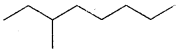
and that of 3-methyl octane is
Organic Chemistry Some Basic Principles and Techniques Class 11 Notes Chemistry 5
(its condensed formula is CH3CH2CH(CH3) (CH2)4CH3

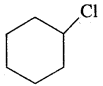
The bond-line structure of chlorocyclohexane is
Organic Chemistry Some Basic Principles and Techniques Class 11 Notes Chemistry 6

Three Dimensional Representation Of Organic Molecules:
The three-dimensional (3-D) structure of organic molecules can be represented on paper by using certain conventions.

For example by using solid
Organic Chemistry Some Basic Principles and Techniques Class 11 Notes Chemistry 7
and dashed
Organic Chemistry Some Basic Principles and Techniques Class 11 Notes Chemistry 8
wedge formula, the 3-D image of a molecule from a two-dimensional picture can be perceived. The solid wedge projects towards the observer and the dashed wedge projects away from the observer. The bonds lying in the plane of the paper are depicted by using a normal line (—)

The 3-D representation of CH4 is
Organic Chemistry Some Basic Principles and Techniques Class 11 Notes Chemistry 9
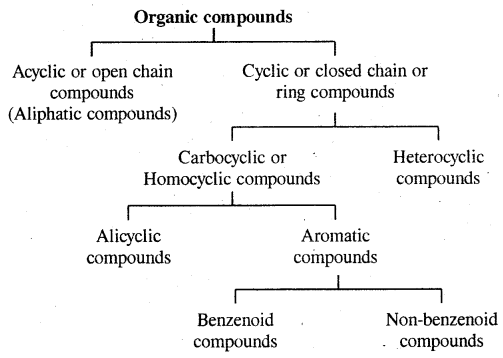
Classification of Organic Compounds:
Organic Chemistry Some Basic Principles and Techniques Class 11 Notes Chemistry 10
1. Acyclic or Open Chain Compounds: These compounds are also called aliphatic compounds and consist of straight or branched chain compounds.
Organic Chemistry Some Basic Principles and Techniques Class 11 Notes Chemistry 11
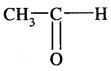
Organic Chemistry Some Basic Principles and Techniques Class 11 Notes Chemistry 12
is acetaldehyde and
Organic Chemistry Some Basic Principles and Techniques Class 11 Notes Chemistry 13
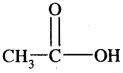
is acetic acid.

2. Alicyclic or Closed Chain or Ring Compounds:
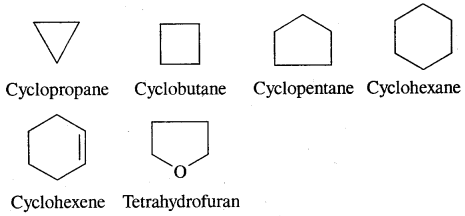
Some of the examples of alicyclic /closed chain or ring compounds are as follows:
Organic Chemistry Some Basic Principles and Techniques Class 11 Notes Chemistry 14
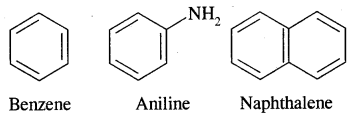
Aromatic Compounds: Benzenoid Aromatic Compounds:
Organic Chemistry Some Basic Principles and Techniques Class 11 Notes Chemistry 15
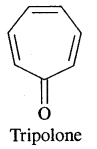
Non-Benzenoid Compounds
Organic Chemistry Some Basic Principles and Techniques Class 11 Notes Chemistry 16
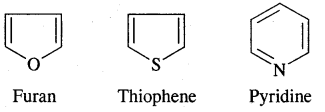
Hetero Cyclic Aromatic Compounds
Organic Chemistry Some Basic Principles and Techniques Class 11 Notes Chemistry 17
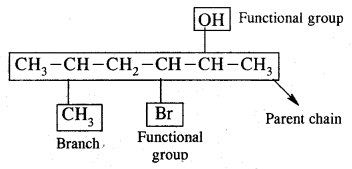
→ Functional Group:
The functional group may be defined as an atom or group of atoms joined in a specific manner that is responsible for the characteristic chemical properties of the organic compounds. The examples are hydroxyl group (-OH), aldehyde group (-CHO) and carboxylic acid group (—COOH), etc.

→ Homologous Series:
A group or a series of organic compounds each containing a characteristic functional group forms a homologous series and the member of the series are called homologs. The members of a homologous series can be represented by general molecular formula and the successive members differ from each other in the molecular formula by a — CH2 unit. There are a number of homologous series of organic compounds. Some of these are alkanes, alkenes, alkynes, alkyl halides, alkanols, alkanols, alkenones, alkanoic acids, amines, etc.

e.g. The general formula of alkanols is CnH2n+1-OH. Individual members of a homologous series are called Homologues.
CH3OH, C2H5OH, C3H7OH are homologs of the alkanol family.

→ Nomenclature of Organic Compounds:
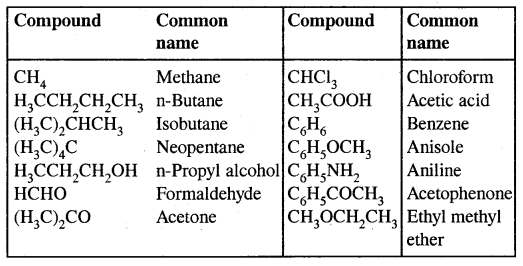
Earlier organic compounds were known by their common or trivial names. For example, HCOOH was called formic acid, CH3 CHO was called acetaldehyde, and so on.

→ The I.U.P.A.C System Of Nomenclature:
To systematize the naming of millions of organic compounds IUPAC (International Union Of Pure And Applied Chemistry) pattern of naming is adopted.

The I.U.P.A.C. System Of Nomenclature
Organic Chemistry Some Basic Principles and Techniques Class 11 Notes Chemistry 18
Organic Chemistry Some Basic Principles and Techniques Class 11 Notes Chemistry 19
Common or Trivial names of some organic compounds
Organic Chemistry Some Basic Principles and Techniques Class 11 Notes Chemistry 20
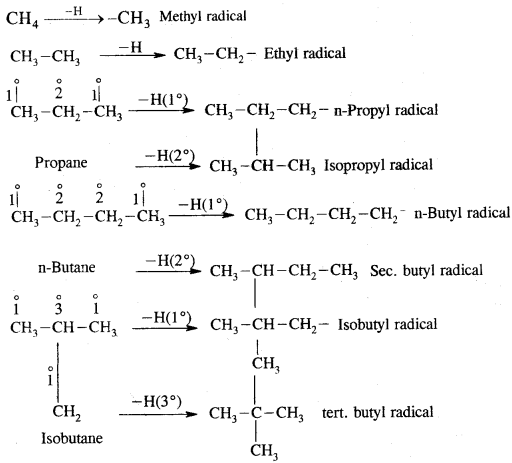
Alkyl, Radicals (R) CnH2n+1
Organic Chemistry Some Basic Principles and Techniques Class 11 Notes Chemistry 21
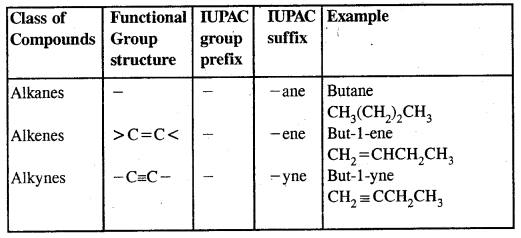
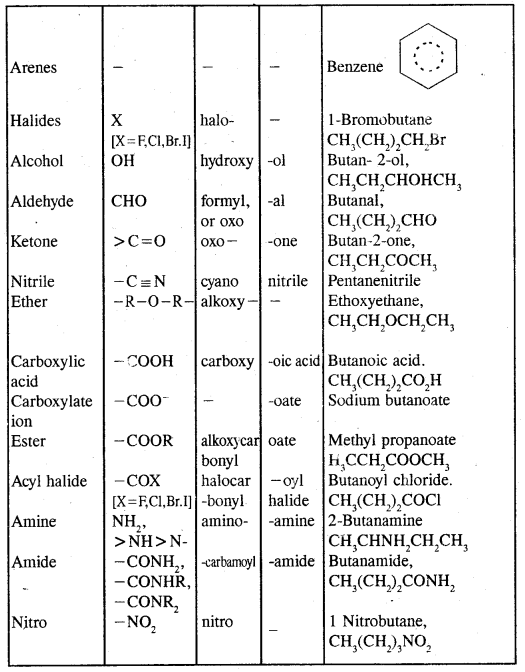
Table: Some functional Groups and classes of organic compounds:
Organic Chemistry Some Basic Principles and Techniques Class 11 Notes Chemistry 22
Organic Chemistry Some Basic Principles and Techniques Class 11 Notes Chemistry 23
Note: Students are advised to follow different rules and conventions as per the IUPAC system as given in the Textbook. In the case of polyfunctional compounds, one of the functional groups is chosen as the principal functional group and the compound is named on that basis.

The remaining functional groups which are subordinate functional groups are named as substituents using the appropriate prefixes. The choice of the principal functional group is made on the basis of the order of preference. The order of decreasing priority for the same functional groups is:
-COOH, -SO3H, -COOR (R = alkyl group)
-COCl, -CONH2, -C ≡ N, -CHO, > C = O, -OH, -NH2,
Organic Chemistry Some Basic Principles and Techniques Class 11 Notes Chemistry 24
The R, C6H5, halogens (F, Cl, Br, I), NO2, alkoxy (OR), etc. are always prefixed substituents.

For example:
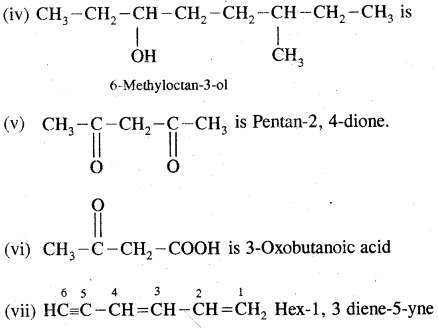
(i) HOCH2(CH2)3CH2COCH3 will be named as 7 hydroxyheptan- 2-one
(ii) Br CH2CH = CH2 is named as 3-Bromoprop-l-ene.
(iii) CH2 = CH-CH = CH2 is Buta-1, 3-diene.
Organic Chemistry Some Basic Principles and Techniques Class 11 Notes Chemistry 25
Problem:
Derive the structure of
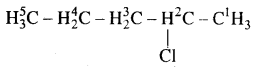
1. 2-chioropentane
Answer:
Organic Chemistry Some Basic Principles and Techniques Class 11 Notes Chemistry 26
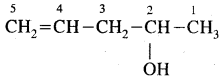
2. Pent-4-en-2-ol
Answer:
Organic Chemistry Some Basic Principles and Techniques Class 11 Notes Chemistry 27
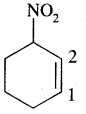
3. 3-Nitrocyclohexene
Answer:
Organic Chemistry Some Basic Principles and Techniques Class 11 Notes Chemistry 28
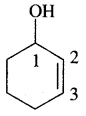
4. Cyclohex-2-en-l-ol
Answer:
Organic Chemistry Some Basic Principles and Techniques Class 11 Notes Chemistry 29
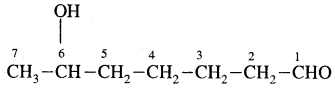
5. 6-Hydroxyheptanal
Answer:
Organic Chemistry Some Basic Principles and Techniques Class 11 Notes Chemistry 30
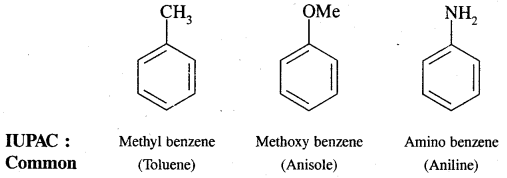
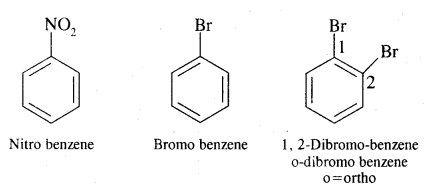
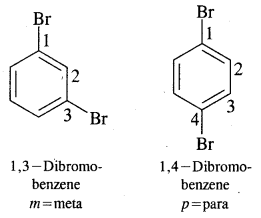
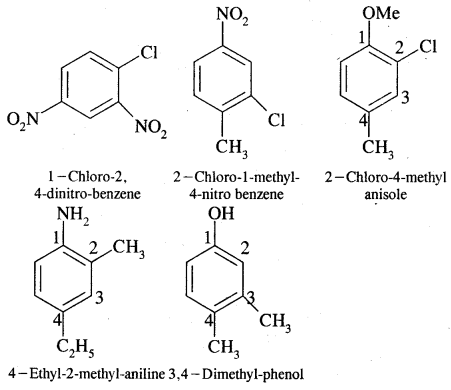
Nomenclature of Substituted Benzene Compounds:
Organic Chemistry Some Basic Principles and Techniques Class 11 Notes Chemistry 31
Organic Chemistry Some Basic Principles and Techniques Class 11 Notes Chemistry 32
Organic Chemistry Some Basic Principles and Techniques Class 11 Notes Chemistry 33
Organic Chemistry Some Basic Principles and Techniques Class 11 Notes Chemistry 34
Problem: Write the structural formula of
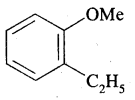
(a) o-Ethyl anisole
Answer:
Organic Chemistry Some Basic Principles and Techniques Class 11 Notes Chemistry 35
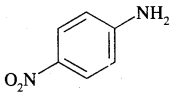
(b) p-Nitroaniline
Answer:
Organic Chemistry Some Basic Principles and Techniques Class 11 Notes Chemistry 36
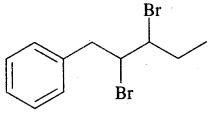
(c) 2, 3-dibromo-l-phenyl pentane
Answer:
Organic Chemistry Some Basic Principles and Techniques Class 11 Notes Chemistry 37
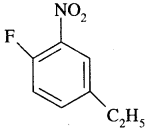
(d) 4-Ethyl-l-fluoro-2-nitrobenzene
Answer:
Organic Chemistry Some Basic Principles and Techniques Class 11 Notes Chemistry 38
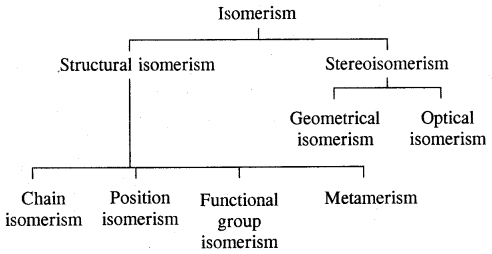
Isomerism: The phenomenon of the existence of two or more compounds possessing the same molecular
Organic Chemistry Some Basic Principles and Techniques Class 11 Notes Chemistry 39
formula but different properties is known as isomerism. Such compounds are called isomers. The above flow chart shows different types of isomerism.

Types of structural isomerism:
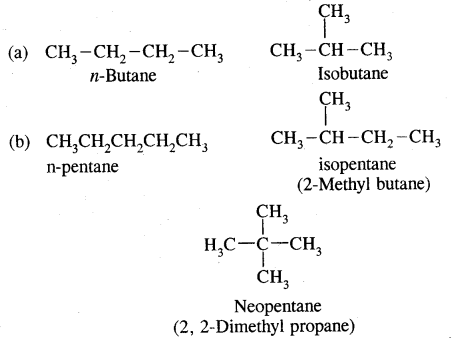
1. Chain isomerism: This type of isomerism is due to the difference in the nature of the carbon chain (i.e., straight or branched) which forms the nucleus of the molecule, e.g.,
Organic Chemistry Some Basic Principles and Techniques Class 11 Notes Chemistry 40
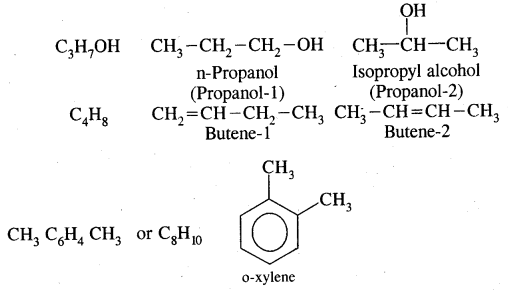
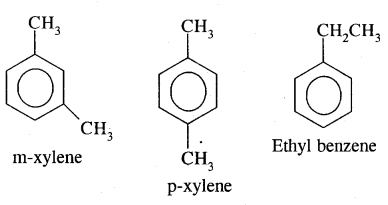
2. Position isomerism: It is due to the difference in the position of the substituent atom or group or an unsaturated linkage in the same carbon chain. Examples are
Organic Chemistry Some Basic Principles and Techniques Class 11 Notes Chemistry 41
Organic Chemistry Some Basic Principles and Techniques Class 11 Notes Chemistry 42
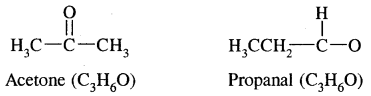
3. Functional isomerism: Two or more compounds having the same molecular formula but different functional groups are called functional isomers and this phenomenon is termed functional group isomerism. For example, the molecular formula C3H6O represents an aldehyde and a ketone.
Organic Chemistry Some Basic Principles and Techniques Class 11 Notes Chemistry 43
and C3H6O represents an ether and alcohol.
Organic Chemistry Some Basic Principles and Techniques Class 11 Notes Chemistry 44
4. Metamerism: It is due to the difference in nature of the alkyl group attached to the same functional group. This type of isomerism is shown by compounds of the same homologous series.
For example.
Organic Chemistry Some Basic Principles and Techniques Class 11 Notes Chemistry 45
II. Stereoisomers: Stereoisomers are compounds that have the same constitution and sequence of covalent bonds but differ in the relative positions of their atoms or groups in space.

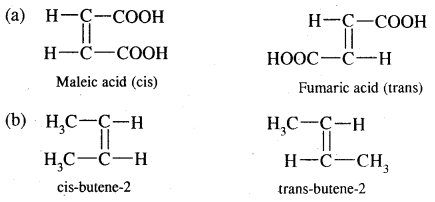
5. Geometrical isomerism: The isomers which possess the same structural formula but differ in the spatial arrangement of the groups around the double bond are known as geometrical isomers and the phenomenon is known as geometrical isomerism. This Isomerism is shown by alkenes or their derivatives. When the similar groups lie on the same side, it is the cis-isomer, while when the similar groups lie on opposite sides, the isomer is trans. For example
Organic Chemistry Some Basic Principles and Techniques Class 11 Notes Chemistry 46
Fundamental Concepts In Organic Reaction Mechanism:
In an organic reaction, the organic molecules (substrate) reacts with an appropriate attacking reagent and leads to the formation of one or more intermediates and finally product (s)

The general reaction is depicted as follows:
Organic Chemistry Some Basic Principles and Techniques Class 11 Notes Chemistry 47
The substrate is that reactant which supplies carbon to the new bond and the other reactant is called reagent. A sequential account of each step, details of electron movement, energetics during bond breaking and bond formation, and the details of timing, when a reactant is transformed into the product are referred to as Reaction Mechanism.

Fission of a Covalent Bond: It occurs in two ways.
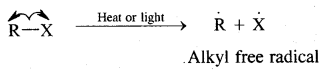
(A) Homolytical Fission/Cleavage or Homolysis
In such fission, each atom gets one electron of the shared pair of electrons.
Organic Chemistry Some Basic Principles and Techniques Class 11 Notes Chemistry 48
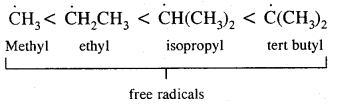
Alkyl radicals are classified as primary secondary or tertiary. Alkyl radical stability increases as we proceed from primary to tertiary. Organic reactions, which proceed by homolytic fission are called free radical or homopolar, or non-polar reactions.
Organic Chemistry Some Basic Principles and Techniques Class 11 Notes Chemistry 49
→ Heterolytical Fission/Cleavage or Heterolysis: The covalent bond breaks in such a way that the shared pair of electrons remains with one of the fragments
Organic Chemistry Some Basic Principles and Techniques Class 11 Notes Chemistry 50
The species that has a sextet at the carbon and is positively charged is called a Carbocation (or carbonium ion)
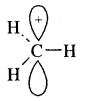
The shape of methyl carbocation C is sp2 hybridized and its shape is Trigonal Planar
Organic Chemistry Some Basic Principles and Techniques Class 11 Notes Chemistry 51
The observed order of carbocation stability is
Organic Chemistry Some Basic Principles and Techniques Class 11 Notes Chemistry 52
The fission can occur, the other way.
Organic Chemistry Some Basic Principles and Techniques Class 11 Notes Chemistry 53
: -CH3 is called a Carbanion. Such a carbon species carrying a negative charge is called a Carbanion. Their stability decreases as follows:
Organic Chemistry Some Basic Principles and Techniques Class 11 Notes Chemistry 54
Nucleophiles & Electrophiles:
(A) Nucleophile (Nu:): A reagent that is electron-rich and is in search of a relatively positive center is called a nucleophile. Example of nucleophiles are

Negatively charged reagents:
Organic Chemistry Some Basic Principles and Techniques Class 11 Notes Chemistry 55
(B) Electrophiles: A recent which is electron-deficient and is in search of electron-rick site is called an electrophile Positively charged electrophiles are: H+, H3O+, NO2+, R+, Br4
Neutral particles: BF3, AlCl3, SO3

Inductive Effect (I effect):
It is the process of displacement of electrons along the chain of carbon atoms due to the presence of a polar covalent bond at one end of the chain. This is a permanent effect. It is of two types:
(A) -I effect: When the atom or group of atoms of the polar covalent bond is more electronegative than C, it is said to show the -I effect.
Organic Chemistry Some Basic Principles and Techniques Class 11 Notes Chemistry 56
It is practically over after C2
The —I effect of some of the atoms or groups of atoms in decreasing order is
-NO2 > -CN > -COOH > -F > -Cl > -Br > -I

(B) + I effect: If the substituent attached to the end of the carbon chain is electron-donating, the effect is called + I effect.
Organic Chemistry Some Basic Principles and Techniques Class 11 Notes Chemistry 57
The + I effect of some of the atoms or groups of atoms in the decreasing order is
Organic Chemistry Some Basic Principles and Techniques Class 11 Notes Chemistry 58
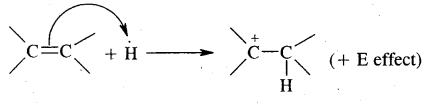
→ Electromeric Effect (E-effect): It involves the complete- transfer of electrons of multiple bonds (double or triple bond) to one of the bonded atoms (usually more electronegative) at the call of the attacking reagent. It vanishes the moment the attacking reagent is removed. It is a temporary effect.

It is also of two types – E and + E effect.
If the electrons of the bond are transferred to that atom of the double bond to which the reagent finally gets attached the effect is called the + E effect.
Organic Chemistry Some Basic Principles and Techniques Class 11 Notes Chemistry 59
If the electrons of the double bond are transferred to an atom of the double bond other than the one to which the reagent gets finally attached, the effect is called the — E effect.
Organic Chemistry Some Basic Principles and Techniques Class 11 Notes Chemistry 60
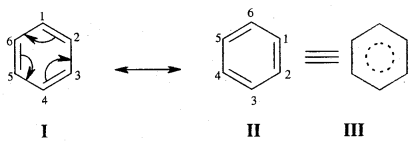
→ Resonance Or Mesomerism: The phenomenon of resonance is said to occur whenever for a molecule we can write two or more Lewis structures that differ in the positions of electrons but not in the relative position of atoms. The various Lewis structures are called responding/canonical/contributing structures. The actual structure of the molecule is not represented by any of the resonance structures but is a resonance hybrid of all these canonical structures.

The various resonance structures are separated by a double-headed arrow ↔ Benzene is a resonance hybrid of the two Kekule structures.
Organic Chemistry Some Basic Principles and Techniques Class 11 Notes Chemistry 61
Any of the two structures cannot explain all the properties of benzene. But the resonance hybrid which cannot be drawn on the paper and which is the actual structure of benzene will explain all the properties of benzene. For example, there are 3 double bonds and 3 single bonds (3 C = C and 3 C — C) in benzene corresponding to bond lengths of 1.34 Å and 1.54 Å respectively.

But as X-ray diffraction studies point out there are no single or double bonds in benzene and all the C—C bonds are having a bond length of 1.39 Å and are exactly equivalent. The resonance hybrid of benzene is generally shown by III.

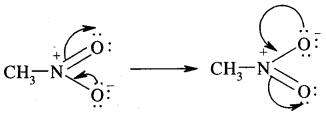
Another example of resonance is provided by CH3NO2 (nitromethane).
Organic Chemistry Some Basic Principles and Techniques Class 11 Notes Chemistry 62
Hyper Conjugation:
It is regarded as no bond resonance. Hyperconjugation is a general stabilizing interaction. It involves delocalization of an electron of C-H bond of an alkyl group directly attached to an atom of the unsaturated system; or to an atom with an unshared p orbital. The electrons of C—H a bond of the alkyl group enter into partial conjugation with the attached unsaturated system or with the unshared p orbital. Hyperconjugation is a permanent effect.

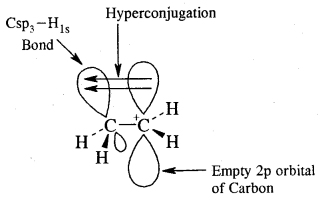
To understand the hyperconjugation effect, let us take an example of CH3+CH2 (ethyl cation) in which the positively charged carbon atom has an empty n orbital. One of the C-H CT bonds of the methyl group can align in the plane of this empty n orbital and the electrons constituting the C—H bond in-plane with this π orbital can then be delocalized into the empty π orbital as depicted in Fig.
Organic Chemistry Some Basic Principles and Techniques Class 11 Notes Chemistry 63
Orbital diagram showing hyperconjugation in ethyl cation

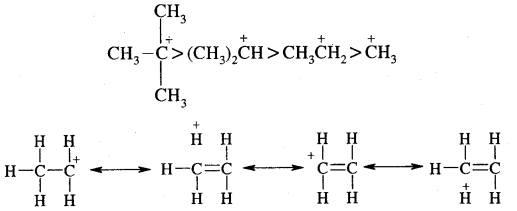
This type of overlap stabilizes the carbocation because electron density from the adjacent bond helps in dispersing the positive charge. In general, the greater the number of alkyl groups attached to a positively charged carbon atom, the greater is the hyperconjugation interaction and stabilization of the cation. Thus, we have the following relative stability of carbocations:
Organic Chemistry Some Basic Principles and Techniques Class 11 Notes Chemistry 64
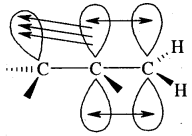
Hyperconjugation is also possible in alkenes and alkyl arenes. Delocalisation of electrons by hyperconjugation in the case of an alkene can be depicted as in Fig.(b)
Organic Chemistry Some Basic Principles and Techniques Class 11 Notes Chemistry 65
Orbital diagram showing hyperconjugation in propene

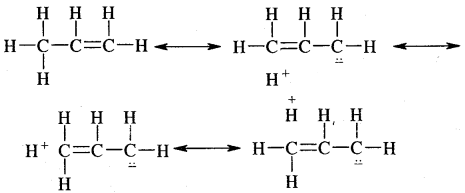
There are various ways of looking at the hyperconjugation effect. One of the ways is to regard the C-H bond as possessing partial ionic character due to resonance.
Organic Chemistry Some Basic Principles and Techniques Class 11 Notes Chemistry 66
Problem: Explain why (CH3)3C+ is more stable than CH3 CH2+ and CH3+ is the least stable cation.
Answer: Hyperconjugation interaction in (CH3)3C+ is greater than in CH3CH2+ as the (CH3)3C+ has nine C—H bonds. In CH3, vacant n orbital is perpendicular to the plane in which C-H bonds lie, hence cannot overlap with it. Thus CH3+ lacks hyper conjugative stability.

Types Of Organic Reactions:
1. Substitution Reactions
Organic Chemistry Some Basic Principles and Techniques Class 11 Notes Chemistry 67
2. Addition reactions
H2C = CH2 + HBr → CH3 – CH2Br

3. Elimination reactions
CH3—CHBr—CH3 + KOH → CH3-CH = CH2 + KBr + H2O

4. Rearrangement Reactions
Organic Chemistry Some Basic Principles and Techniques Class 11 Notes Chemistry 68
Methods Of Purification Of Organic Compounds:
The common techniques used for the purification of organic compounds are based on their nature and the impurity present in them. The methods are as follows.

  1. Sublimation
  2. Crystallization
  3. Distillation
  4. Differential extraction
  5. Chromatography

Finally, the purity of a compound is ascertained by determining its melting point or boiling point. Most of the pure compounds have sharp melting points and boiling points.

1. Sublimation: Some solid substances like camphor, naphthalene, etc. on heating change from solid to vapor state without passing through the liquid phase. The purification technique based on the above principle is known as sublimation and is used to separate sublimable compounds like benzoic acid from non-sublimable compounds like sodium chloride.

2. Crystallisation: It is based on the difference in the solubilities of the compound and the impurities in a suitable solvent. The impure compound is dissolved in a solvent in which it is sparingly soluble at room temperature but appreciably soluble at a higher temperature. The solution is concentrated by heating to get a nearly saturated solution. On cooling, crystals of the pure substance are removed by filtration.

3. Distillation: The process of distillation is carried out to separate

  • volatile liquids from non-volatile impurities and
  • liquids having sufficient differences in their boiling points.

Liquids having different boiling points vaporize at different temperatures. The vapors are cooled and get condensed into liquids. They are collected separately. CHCl3 (b.p. 334 K) and aniline (b.p. 457 K) are easily separated by this method.

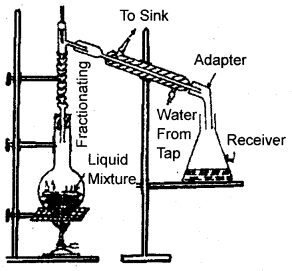
Fractional Distillation:
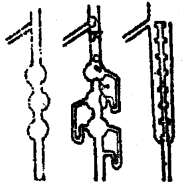
It is resorted to when the difference in boiling points of two liquids is not much. It is carried out through an a.fractionating column fitted over the mouth of the round bottom flask.

One of the technological applications of fractional distillation is to separate different fractions of crude oil in the petroleum industry.
Organic Chemistry Some Basic Principles and Techniques Class 11 Notes Chemistry 69
Fractional. Distillation

The vapors of the less volatile liquid condense into the liquid which returns to the flask. The more volatile fraction passes over to the other side, condenses in the water condenser, and is collected in the receiver. When one fraction is completely separated the temperature is raised and the receiver is changed. Now, the second less volatile fraction distills over. Thus the more volatile liquid distills afterward. This is highly successful if the difference in b.p. of two liquids is less than 10-15 K.
Organic Chemistry Some Basic Principles and Techniques Class 11 Notes Chemistry 70
Fractional. Distillation

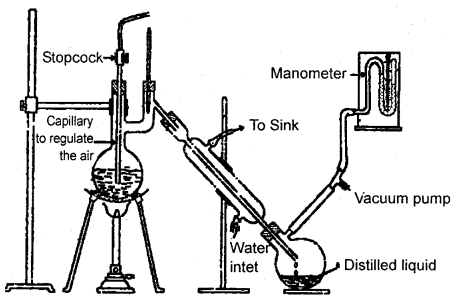
Distillation Under Reduced Pressure:
This method is applicable to purify liquids having very high boiling points and those, which decompose at or below their boiling points. Such liquid is are made to boil at a temperature lower than their normal boiling points by reducing the pressure on their surface. A liquid boils at a temperature at which its vapor pressure becomes equal to the external pressure. The flowsheet diagram for distillation under reduced pressure is shown below.
Organic Chemistry Some Basic Principles and Techniques Class 11 Notes Chemistry 71
Distillation under reduced pressure. A liquid boils at a temperature below its vapor pressure by reducing the pressure.

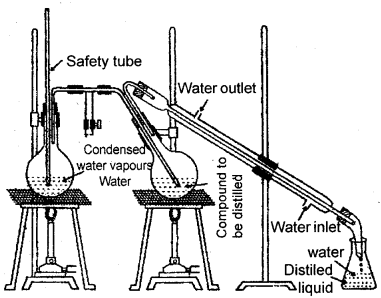
Steam Distillation:
This technique is applied to separate substances, which are steam, volatile, and are immiscible with water. In steam distillation, the steam generator is passed through a heated flask containing the liquid to be distilled. The mixture of steam and the volatile liquid is condensed and collected.

In steam distillation the liquid boils when the sum of the vapor pressures due to the organic liquid (p1) and that due to water (p2) become equal to the atmospheric pressure (p) i.e., p = p1 + p2 since p1 is lower than p, the organic liquid vapourised at a lower temperature than its b. pt. Thus if one of the substances in water and the other a water-insoluble substance such a mixture will boil close to but below 373 K. Aniline is separated from the aniline-water mixture by this method.
Organic Chemistry Some Basic Principles and Techniques Class 11 Notes Chemistry 72
Steam distillation. Steam volatile component volatilizes, the vapors condense in the condenser and the liquid collects in a conical flask.

Differential Extraction:
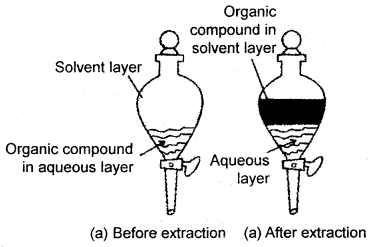
When an organic compound is present in an aqueous medium, it is separated by shaking with an organic solvent in which is more soluble than water. The organic solvent and the aqueous solution should be immiscible with each other so that they form two distinct layers which can be separated by the separatory funnel. The organic solvent is later removed by distillation or by evaporation to get back the compound.
Organic Chemistry Some Basic Principles and Techniques Class 11 Notes Chemistry 73
(a) Differential extraction. Extraction of the compound takes place based on the difference in solubility

Chromatography:
Chromatography is an important technique extensively used to separate mixtures into their components, purify compounds, and also test the purity of compounds. In this technique, the mixture of substances is applied into a stationary phase, which may be a solid or a liquid.

A pure solvent, a mixture of solvents, or a gas is allowed to move slowly over the stationary phase. The components of the mixture get gradually separated from one another. The moving phase is called the mobile phase.

Based on the principle involved, chromatography is classified into different categories. Two of these are:
(a) Adsorption chromatography and
(b) Partition chromatography,

(a) Adsorption Chromatography: Adsorption chromatography is based on the fact that different compounds are adsorbed on an adsorbent to different degrees. Commonly used adsorbents are silica gel and alumina. When a mobile phase is allowed to move over a stationary phase (adsorbent), the components of the mixture move by varying distances over the stationary phase.

Following are two main types of chromatography techniques based on the principle of differentials adsorption.
(a) Column chromatography and
(b) Thin layer chromatography

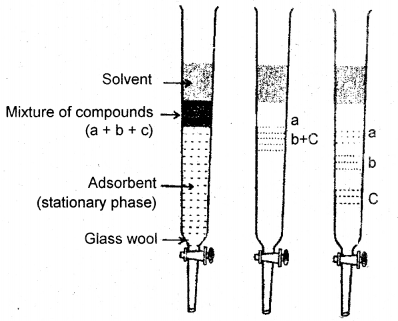
(a) Column Chromatography: Column chromatography involves the separation of a mixture over a column of adsorbent (stationary phase) packed in a glass tube. The mixture adsorbed on the adsorbent is placed on top of the adsorbent in the column. An appropriate element which is a liquid or a mixture of liquid is allowed to flow down the column slowly. Depending upon the degree to which the compounds are adsorbed, complete separation takes place. The most readily adsorbed substances are retained near the top and the others come down to various distances in the column.
Organic Chemistry Some Basic Principles and Techniques Class 11 Notes Chemistry 74
Column chromatography. Different stages of separation of components of a mixture

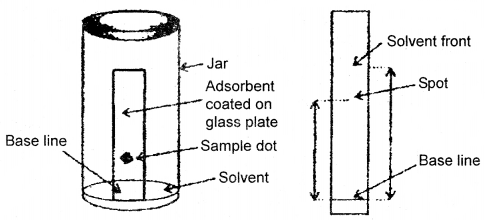
(b) Thin Layer Chromatography (TLC): Another type of adsorption chromatography, which involves the separation, of substances of a mixture over a thin layer of an adsorbent coated on a glass plate. A thin layer of an adsorbent (silica or alumina SiO2 or Al2O3 gel) is spread over a glass plate. The solution of the mixture to be separated is applied as a small spot about 2 cm above one end of the TLC plate. The glass plate is then placed in a closed jar containing the eluent (see fig. below).

As the eluent rises up the plate the components of the mixture move up along with the eluent to different distances depending on their degree of adsorption and separation takes place. The relative adsorption of each component is expressed in terms of its Retention Factor, i.e., Rf Value
Rf = \(\frac{\text { Distance moved by the substance from baseline }(x)}{\text { Distance moved by the solvent from baseline }(y)}\)
Organic Chemistry Some Basic Principles and Techniques Class 11 Notes Chemistry 75
(a) Thin layer chromatography,
(b) Developed chromatogram. Chromatogram being developed

The spots of colored compounds are visible on the TLC plate due to their original color. Fig. (b) on the previous page.

Partition Chromatography:
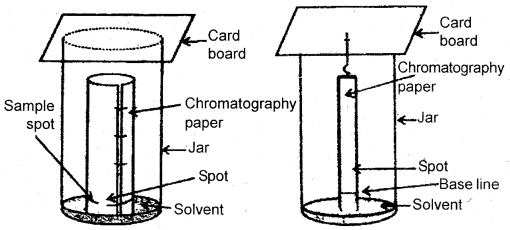
Paper chromatography is a type of partition chromatography. Water trapped in chromatography paper acts as a stationary phase. It is based on the principle of continuous differential partitioning of components of a mixture between stationary and mobile phases. A strip of paper spotted at the base with the solution of the mixture is suspended in a suitable solvent.

The solvent acts as the mobile phase rise up due to capillary action and flows over the spot. The paper selectively retains different components according to their differing partition in two phases. The paper strip so developed is called Chromatogram. The spots of the separated colored compounds are visible at different heights from the position of the initial spot on the chromatogram. The spots may be observed under U. V. light as discussed in TLC.
Organic Chemistry Some Basic Principles and Techniques Class 11 Notes Chemistry 76
Paper chromatography. Chromatography paper in two different shapes.

Qualitative Analysis Of Organic Compounds Detection Of Elements:
The elements present in the organic compound can be detected as follows:
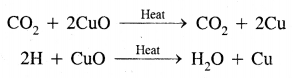
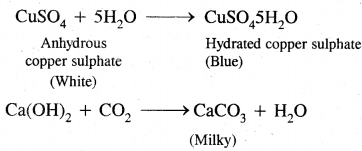
1. Carbon and hydrogen: The given organic compound is mixed with about double the amount of pure and dry copper oxide. The mixture is heated in a hard glass tube. The CO2 and H2O produced due to combustion are tested by lime water and anhydrous copper sulfate. The lime water will turn milky and copper sulfate will turn blue.
Organic Chemistry Some Basic Principles and Techniques Class 11 Notes Chemistry 77
Organic Chemistry Some Basic Principles and Techniques Class 11 Notes Chemistry 78
2. Nitrogen, can be detected as
1. Soda-lime test: When the organic compound is heated with soda lime in a test tube, the evolution of ammonia indicates nitrogen.
Organic Chemistry Some Basic Principles and Techniques Class 11 Notes Chemistry 79
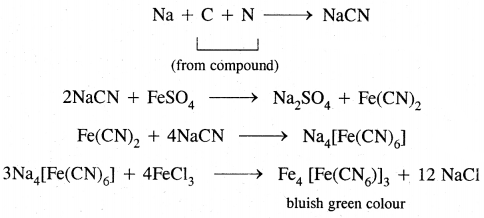
2. Lassaigne’s test: A small piece of dry sodium is heated gently in a fusion tube till it melts to a shining globule. Then a small amount of organic substance is added and the tube is heated to red hot. The red hot tube is plunged into distilled water contained in a china dish. The contents of the dish are boiled, cooled, and filtered. The filtrate is known as sodium extract or Lassaigne’s extract.

For the nitrogen test, the sodium extract is made alkaline with a few drops of dil. NaOH. Freshly prepared FeSO4 solution is added and the contents are warmed. Then a few drops of FeCl3 are added followed by acidification with cone. HCl or H2SO4. The appearance of bluish-green coloration indicates nitrogen.
Organic Chemistry Some Basic Principles and Techniques Class 11 Notes Chemistry 80
If the organic compound contains N and S together, sodium thiocyanate (Na CNS) may be formed with the sodium extract which gives blood-red coloration due to the formation of Fe(CNS)3,

Sulfur: To the sodium extract.
1. Add lead acetate: The formation of black precipitate confirms sulfur.
Organic Chemistry Some Basic Principles and Techniques Class 11 Notes Chemistry 81
2. To the other part of sodium extract add a few drops of sodium nitroprusside solution. The appearance of purple color indicates sulfur.
Organic Chemistry Some Basic Principles and Techniques Class 11 Notes Chemistry 82
Halogens:
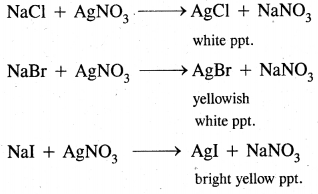
This test can also be done with sodium extract. The extract is boiled with a cone. HNO3 to expel the gases. It is then cooled and treated with silver nitrate solution. The formation of different colored precipitates confirms halogens.
Organic Chemistry Some Basic Principles and Techniques Class 11 Notes Chemistry 83
Quantitative Analysis:
1. Estimation of Carbon and Hydrogen: A known weight of the organic compound is heated with dry cupric oxide in the dry atmosphere free from CO2. The carbon and hydrogen present, in the organic compound, are oxidized to CO2 and water. The CO2 is absorbed in potash bulbs and water is absorbed in CaCl2 tubes. From the weights of CO2, and H2O form, the percentage of C and H are calculated as:
Organic Chemistry Some Basic Principles and Techniques Class 11 Notes Chemistry 84
2. Estimation Of Nitrogen: Nitrogen can be estimated by one of the following two methods.
1. Duma’s Method: A known weight of the given organic compound is heated with dry cupric oxide in a current of CO2. The N0 gas obtained is connected in Scliffs nitrometer at the prevailing temperature and pressure. Then, this volume of N, gas so collected is converted to volume at STP/NTP by using gas equation
P1V1/T1 = P2V2/T2
knowing 22.4 L of N2 gas at STP weight = 28.0 gm.

Weight and percentage of Nitrogen can be calculated
% of N = \(\frac{28}{22400} \times \frac{\text { Volume of } \mathrm{N} \text { at } \mathrm{STP} \text { in } \mathrm{mL}}{\text { Mass of compound }}\) × 100

2. Kjeldahl’s Method: This is a more convenient method for the estimation of N particularly in foods, fertilizers, drugs etc. This method is, however not applicable to compounds containing nitrogen in the ring (Pyridine, quinoline, etc.) and compounds containing N directly linked to an oxygen atom (eg. NO2) or another N atom. e.g. A Z O (—N = N—) compounds.

In this method, the given organic compound is treated with a cone. H2SO4 to couvert N into (NH4)2 SO4 the ammonium sulfate [(NH4)2SO4 is treated with 40% NaOH solution and the ammonia evolved is neutralized with an excess of a standard acid [known volume V of the acid taken. The excess of the residual acid is titrated with a standard solution of the alkali and the volume of the acid left unneutralized by ammonia (v ml) is noted.

∴ Volume of the acid neutraL ised by ammonia = (V – u) ml.
∴ % of N = \(\frac{1.4 \times N(V+v)}{W}\)
where N = Normality of acid taken
W = wt. of the organic compound.

Estimation Of Halogens: The given organic compound containing halogens is treated in Carius Method with fuming nitric acid in a long-necked Carius Tube and silver nitrate. The halogen present is converted into silver halide. From the weights of silver halide formed and the known weight of the organic compound taken, the percentage of halogen can be calculated.

% of halogen = \(\frac{\text { Atomic mass of halogen }}{108+\text { At. mass of halogen }}\) × \(\frac{\text { Mass of silver halide }}{\text { Mass of substance }}\) × 100

Estimation of Sulphur:
In the Carius method organic compound is treated with fuming HNO3 and S is precipitated as BaSO4 by the addition of BaCl2. From the wt. of BaS04 formed, the percentage of S can be calculated.
% of sulphur = \(\frac{32}{233} \times \frac{\text { Mass of } \mathrm{BaSO}_{4}}{\text { Mass of substance }}\) × 100

Estimation of Phosphorus:
In Carius method, P is quantitatively oxidized to H3PO4 by fuming HNO3 which is precipitated to Mg2P2O7. knowing the wt. of Mg2P2O7 and that of the organic compound, percentage of P can be determined
% of P = \(\frac{62}{222} \times \frac{\text { Mass of } \mathrm{Mg}_{2} \mathrm{P}_{2} \mathrm{O}_{7} \text { formed }}{\text { Mass of the substance }}\) × 100

Estimation of Oxygen:
There is no direct method available to estimate oxygen in the organic compound. The percentage of oxygen is usually found by subtracting the sum of the percentages of all elements present in the compound from 100.

Functions Of Ecosystem

Learninsta presents the core concepts of Biology with high-quality research papers and topical review articles.

Functions Of Ecosystem

The function of ecosystem include creation of energy creation, sharing of energy and cycling of materials between the living and nonliving components of an ecosystem. Before studying the productivity in any ecosystem, we should understand the essential role of sunlight used by producers of the first trophic level. The quantity of sunlight is directly proportional to the production of energy by plants.

Photosynthetically Active Radiation (PAR)

The amount of light available for photosynthesis of plants is called Photosynthetically Active Radiation (PAR) which is from of 400-700 nm in wave length. It is essential for photosynthesis and plant growth. PAR is not always constant because of clouds, tree shades, air, dust particles, seasons, latitudes and length of the daylight availability. Generally plants absorb more blue and red light for efficient photosynthesis.

Of the total sunlight, 34 percent that reaches the atmosphere is reflected back into the atmosphere, moreover 10% is held by ozone, water vapours and atmospheric gases and the remaining 56% reaches the earth’s surface. Out of this 56%, only 2 – 10% of the solar energy is used by green plants for photosynthesis while the remaining portion is dissipated as heat.

PAR is generally expressed in millimoles / square meter / second by using silicon photo voltic detectors which detect only 400 – 700 nm wavelength of light. PAR values range from 0 to 3000 millimoles / square meter / second.

At night PAR is zero and during midday in the summer, PAR oftn reaches 2000 – 3000 millimoles / square meter / second.

Productivity of an ecosystem

The rate of biomass production per unit area in a unit time is called productivity. It can be expressed in terms of gm / m2 / year or Kcal / m2 / year. It is classified as given below.

  1. Primary productivity
  2. Secondary productivity
  3. Community productivity

1. Primary productivity:

The chemical energy or organic matter generated by autotrophs during the process of photosynthesis and chemosynthesis is called primary productivity. It is the source of energy for all organisms, from bacteria to human.

a. Gross Primary Productivity (GPP)

The total amount of food energy or organic matter or biomass produced in an ecosystem by autotrophs through the process of photosynthesis is called gross primary productivity.

b. Net Primary Productivity (NPP)

The proportion of energy which remains after respiration loss in the plant is called net primary productivity. It is also called as apparent photosynthesis. This the difference between GPP and respiration is known as NPP.

NPP = GPP – Respiration

NPP of whole biosphere is estimated to be about 170 billion tons (dry weight) per year. Out of which NPP of oceanic producers is only 55 billion tons per year in unit time.

2. Secondary productivity

The amount of energy stored in the tissues of heterotrophs or consumers is called secondary productivity.

a. Gross secondary productivity

It is equivalent to the total amount of plant material is ingested by the herbivores minus the materials lost as faeces.

b. Net secondary productivity

Storage of energy or biomass by consumers per unit area per unit time, after respiratory loss is called net secondary productivity.

3. Community productivity

The rate of net synthesis of organic matter (biomass) by a group of plants per unit area per unit time is known as community productivity.

Factors affecting primary productivity

Primary productivity depends upon the plant species of an area, their photosynthetic capacity, availability of nutrients, solar radiation, precipitation, soil type, topographic factors (altitude, latitude, direction), and other environmental factors. It varies in different types of ecosystems.

Concept of trophic level in an ecosystem

(Greek word ‘trophic’ = to food or feeding)

A trophic level refers to the position of an organism in the food chain. The number of trophic levels is equal to the number of steps in the food chain. The green plants (producers) occupying the first trophic level (T1) are called producers. The energy produced by the producers is utilized by the plant eaters (herbivores) they are called primary consumers and occupy the second trophic level (T2).

Herbivores are eaten by carnivores, which occupy the third trophic level (T3). They are also called secondary consumers or primary carnivores. Carnivores are eaten by the other carnivores, which occupy the fourth trophic level (T4). They are called the tertiary consumers or secondary carnivores. Some organisms which eat both plants and animals are called as omnivores (Crow). Such organisms may occupy more than one trophic level in the food chain.
Functions Of Ecosystem img 1

Energy flow

The transfer of energy in an ecosystem between trophic levels can be termed as energy flow. It is the key function in an ecosystem. Part of the energy obtained from the sun by producers is transferred to consumers and decomposers through each trophic level, while some amount of energy is dissipated in the form of heat. Energy flow is always unidirectional in an ecosystem.
Functions Of Ecosystem img 2

Laws of thermodynamics

The storage and loss of energy in an ecosystem is based on two basic laws of thermo-dynamics.

(i) First law of thermodynamics

It states that energy can be transmitted from one system to another in various forms. Energy cannot be destroyed or created. But it can be transformed from one form to another. As a result, the quantity of energy present in the universe is constant.

Example:

In photosynthesis, the product of starch (chemical energy) is formed by the combination of reactants (chlorophyll, H2O, CO2). The energy stored in starch is acquired from the external sources (light energy) and so there is no gain or loss in total energy. Here light energy is converted into chemical energy.
Functions Of Ecosystem img 3
Light energy → chemical energy

(ii) Second law of thermodynamics

It states that energy transformation results in the reduction of the free energy of the system. Usually energy transformation cannot be 100% efficient. As energy is transferred from one organism to another in the form of food, a portion of it is stored as energy in living tissue, whereas a large part of energy is dissipated as heat through respiration. The transfer of energy is irreversible natural process. Example: Ten percent law

Ten percent law

This law was proposed by Lindeman (1942). It states that during transfer of food energy from one trophic level to other, only about 10% stored at every level and rest of them (90%) is lost in respiration, decomposition and in the form of heat. Hence, the law is called ten percent law. Example: It is shown that of the 1000 Joules of Solar energy trapped by producers. 100 Joules of energy is stored as chemical energy through photosynthesis.

The remaining 900 Joules would be lost in the environment. In the next trophic level herbivores, which feed on producers get only 10 Joules of energy and the remaining 90 Joules is lost in the environment.

Likewise, in the next trophic level, carnivores, which eat herbivores store only 1 Joule of energy and the remaining 9 Joules is dissipated. Finally, the carnivores are eaten by tertiary consumers which store only 0.1 Joule of energy and the remaining 0.9 Joule is lost in the environment. Thus, at the successive trophic level, only ten percent energy is stored.
Functions Of Ecosystem img 4

Food chain:

The movement of energy from producers upto top carnivores is known as food chain, i.e., in any food chain, energy flows from producers to primary consumers, then from primary consumers to secondary consumers, and finally secondary consumers to tertiary consumers. Hence, it shows linear network links. Generally, there are two types of food chain, (1) Grazing food chain and (2) Detritus food chain.

1. Grazing food chain:

Main source of energy for the grazing food chain is the Sun. It begins with the first link, producers (plants). The second link in the food chain is primary consumers (mouse) which get their food from producers. The third link in the food chain is secondary consumers (snake) which get their food from primary consumers. Fourth link in the food chain is tertiary consumers (eagle) which get their food from secondary consumers.
Functions Of Ecosystem img 5

2. Detritus food chain:

This type of food chain begins with dead organic matter which is an important source of energy. A large amount of organic matter is derived from the dead plants, animals and their excreta. This type of food chain is present in all ecosystems.

The transfer of energy from the dead organic matter, is transferred through a series of organisms called detritus consumers (detritivores) – small carnivores – large (top) carnivores with repeated eating and being eaten respectively. This is called the detritus food chain.
Functions Of Ecosystem img 5

Food Web
Functions Of Ecosystem img 6

The inter-locking pattern of a number of food chain form a web like arrangement called food web. It is the basic unit of an ecosystem, to maintain its stability in nature. Which is also called homeostasis. Example: In a grazing food chain of a grass land, in the absence of a rabbit, a mouse may also eat food grains. The mouse in turn may be eaten directly by a hawk or by a snake and the snake may be directly eaten by hawks.

Hence, this interlocking pattern of food chains is the food web and the species of an ecosystem may remain balanced to each other by some sort of natural check.

Signifiance of food web

  • • Food web is constructed to describe species interaction called direct interaction.
  • It can be used to illustrate indirect interactions among different species.
  • It can be used to study bottom-up or topdown control of community structure.
  • It can be used to reveal different patterns of energy transfer in terrestrial and aquatic ecosystems.

Ecological pyramids

Graphic representation of the trophic structure and function at successive trophic levels of an ecosystem is called ecological pyramids. The
concept of ecological pyramids was introduced by Charles Elton (1927). Thus they are also called as Eltonian pyramids.

There are three types:

  1. pyramid of number
  2. pyramid of biomass
  3. pyramid of energy.

1. Pyramid of number

A graphical representation of the number of organisms present at each successive trophic level in an ecosystem is called pyramids of number. There are three different shapes of pyramids upright, spindle and inverted.

There is a gradual decrease in the number of organisms in each trophic level from producers to primary consumers and then to secondary consumers, and finally to tertiary consumers. Therefore, pyramids of number in grassland and pond ecosystem are always upright.

In a forest ecosystem the pyramid of number is somewhat different in shape, it is because the base (T1) of the pyramid occupies large sized trees (Producer) which are lesser in number. Herbivores (T2) (Fruit eating birds, elephant, deer) occupying second trophic level, are more in number than the producers. In final trophic level (T4), tertiary consumers (lion) are lesser in number than the secondary consumer (T3) (fox
and snake). Therefore, the pyramid of number in forest ecosystem looks spindle shaped.

The pyramid of number in a parasite ecosystem is always inverted, because it starts with a single tree. Therefore there is gradual increase in the number of organisms in successive tropic levels from producer to tertiary consumers.
Functions Of Ecosystem img 7
Functions Of Ecosystem img 7a

2. Pyramid of biomass

A graphical representation of the amount of organic material (biomass) present at each successive trophic level in an ecosystem is called pyramid of biomass.

In grassland and forest ecosystems, there is a gradual decrease in biomass of organisms at successive trophic levels from producers to top carnivores (Tertiary consumer). Therefore, these two ecosystems show pyramids as upright pyramids of biomass.

However, in pond ecosystem, the bottom of the pyramid is occupied by the producers, which comprise very small organisms possessing the least biomass and so, the value gradually increases towards the tip of the pyramid. Therefore, the pyramid of biomass is always inverted in shape.

3. Pyramid of energy

A graphical representation of energy flow at each successive trophic level in an ecosystem is called pyramid of energy. The bottom of the pyramid of energy is occupied by the producers. There is a gradual decrease in energy transfer at successive tropic levels from producers to the upper levels. Threfore, the pyramid of energy is always upright.

Decomposition:

Decomposition is a process in which the detritus (dead plants, animals and their excreta) are breaken down in to simple organic matter by the decomposers. It is an essential process for recycling and balancing the nutrient pool in an ecosystem.

Nature of decomposition

The process of decomposition varies based on the nature of the organic compounds, i.e., some of the compounds like carbohydrate, fat and protein are decomposed rapidly than the cellulose, lignin, chitin, hair and bone.

Mechanism of decomposition

Decomposition is a step wise process of degradation mediated by enzymatic reactions. Detritus acts as a raw material for decomposition. It occurs in the following steps.
Functions Of Ecosystem img 8

a. Fragmentation – The breaking down of detritus into smaller particles by detritivores like bacteria, fungi and earth worm is known as fragmentation. These detritivores secrete certain substances to enhance the fragmentation process and increase the surface area of detritus particles.

b. Catabolism – The decomposers produce some extracellular enzymes in their surroundings to break down complex organic and inorganic compounds in to simpler ones. This is called catabolism

c. Leaching or Eluviation – The movement of decomposed, water soluble organic and inorganic compounds from the surface to the lower layer of soil or the carrying away of the same by water is called leaching or eluviation.

d. Humifiation – It is a process by which simplified detritus is changed into dark coloured amorphous substance called humus. It is highly resistant to microbial action, therefore decomposition is very slow. It is the reservoir of nutrients.

Mineralisation – Some microbes are involved in the release of inorganic nutrients from the humus of the soil, such process is called mineralisation.

Factors affecting decomposition

Decomposition is affcted by climatic factors like temperature, soil moisture, soil pH, oxygen and also the chemical quality of detritus.

Biogeochemical cycles (Nutrient cycles)

Exchange of nutrients between organisms and their environment is one of the essential aspects of an ecosystem. All organisms require nutrients for their growth, development, maintenance and reproduction. Circulation of nutrients within the ecosystem or biosphere is known as biogeochemical cycles and also called as ‘cycling of materials.’ There are two basic types,

  • Gaseous cycle – It includes atmospheric Oxygen, Carbon and Nitrogen cycles.
  • Sedimentary cycle – It includes the cycles of Phosphorus, Sulphur and Calcium Which are present as sediments of earth.
    Functions Of Ecosystem img 9

Many of the cycles mentioned above are studied by you in previous classes. Therefore, in this chapter, only the carbon and phosphorous cycles are explained.

Carbon cycle

The circulation of carbon between organisms and environment is known as the carbon cycle. Carbon is an inevitable part of all biomolecules and is substantially impacted by the change in global climate. Cycling of carbon between organisms and atmosphere is a consequence of two reciprocal processes of photosynthesis and respiration.

The releasing of carbon in the atmosphere increases due to burning of fossile fuels, deforestration, forest fire, volcanic eruption and decomposition of dead organic matters. The details of carbon cycle are given in the figure.

Phosphorus cycle

It is a type of sedimentary cycle. Already we know that phosphorus is found in the biomolecules like DNA, RNA, ATP, NADP and phospholipid molecules of living organisms. Phosphorus is not abundant in the biosphere, whereas a bulk quantity of phosphorus is present in rock deposits, marine sediments and guano.

It is released from these deposits by weathering process. After that, it circulates in lithosphere as well as hydrosphere. The producers absorb phosphorus in the form of phosphate ions, and then it is transferred to each trophic level of food chain through food.

Again death of the organisms and degradation by the action of decomposers, the phosphorus is released back into the lithosphere and hydrosphere to maintain phosphorus cycle.
Functions Of Ecosystem img 10

Types of ecosystem

Biosphere consists of diffrent types of ecosystems, which are as follows:
Functions Of Ecosystem img 11
Though there are many types of ecosystems as charted above. Only the pond ecosystem is detailed below.

Structure of Pond ecosystem

It is a classical example for natural, aquatic, freshwater, lentic type of ecosystem. It helps us to understand the structure and function of an ecosystem. When rain water gathers in a shallow area, gradually over a period of time, different kinds of organisms (microbes, plants, animals) become part of this ecosystem. This pond ecosystem is a self sustaining and self regulatory fresh water ecosystem, which shows a complex interaction between the abiotic and biotic components in it.
Functions Of Ecosystem img 12

Abiotic components

A pond ecosystem consists of dissolved inorganic (CO2, O2, Ca, N, Phosphate) and organic substances (amino acids and humic acid) formed from the dead organic matter. The function of pond ecosystem is regulated by few factors like the amount of light, temperature, pH value of water and other climatic conditions.

Biotic components

They constitute the producers, variety of consumers and decomposers (microorganisms).

a. Producers

A variety of phytoplanktons like Oscillatoria, Anabaena, Chlamydomonas, Pandorina, Eudorina, Volvox and Diatoms. Filamentous algae such as Ulothrix, Spirogyra, Cladophora and Oedogonium; flating plants Azolla, Salvia, Pistia, Wolff and Eichhornia; submerged plants Potamogeton and Phragmitis; rooted flating plants Nymphaea and Nelumbo; macrophytes like Typha and Ipomoea, constitute the major producers of a pond ecosystem.

b. Consumers

The animals represent the consumers of a pond ecosystem which include zooplanktons like Paramoecium and Daphnia (primary consumers); benthos (bottom living animals) like mollusces and annelids; secondary consumers like water beetles and frogs; and tertiary consumers (carnivores) like duck, crane and some top carnivores which include large fish, hawk, man, etc.

c. Decomposers

They are also called as microconsumers. They help to recycle the nutrients in the ecosystem. These are present in mud water and bottom of the ponds. Example: Bacteria and Fungi. Decomposers perform the process of decomposition in order to enrich the nutrients in the pond ecosystem. The cycling of nutrients between abiotic and biotic components is evident in the pond ecosystem, making itself self sufficient and self
regulating.
Functions Of Ecosystem img 13

Based on the factors like distance from the shore, penetration of light, depth of water, types of plants and animals, there may be three zones, littoral, limnetic and profundal. The littoral zone, which is closest to the shore with shallow water region, allows easy penetration of light. It is warm and occupied by rooted plant species. The limnetic zone refers the open water of the pond with an effective penetration of light and domination of planktons.

The deeper region of a pond below the limnetic zone is called profundal zone with no effective light penetration and predominance of heterotrophs. The bottom zone of a pond is termed benthic and is occupied by a community of organisms called benthos (usually decomposers). The primary productivity through photosynthesis of littoral and limnetic zone is more due to greater penetration of light than the profundal zone.

Ecosystem services (Benefits)

Ecosystem services are defined as the benefits that people derive from nature. Robert Constanza et al (1927) stated “Ecosystem services are the benefis provided to human, through the transformation of resources (or Environmental assets including land, water, vegetation and atmosphere) into a flow of essential goods and services”.

Study on ecosystem services acts as an effective tool for gaining knowledge on ecosystem benefis and their sustained use. Without such knowledge gain, the fate of any ecosystem will be at stake and the benefits they provide to us in future will become bleak.

How do anthropogenic activities affect ecosystem services?

Now, we all exploit the ecosystem more than that of our needs. The Millennium Ecosystem Assessment (2005) found that “over the past 50 years, humans have changed the ecosystem more rapidly and extensively than in any comparable period of time in human history, largely to meet rapidly growing demands for food, fresh water, medicine, timber, fier and fuel.”

The varieties of benefis obtained from the ecosystem are generally categorized into the following four types
Functions Of Ecosystem img 14

Generally the following human activities disturb or re-engineer an ecosystem every day.

  • Habitat destruction
  • Deforestation and over grazing
  • Erosion of soils
  • Introduction of non-native species
  • Over harvesting of plant material
  • Pollution of land, water and air
  • Run of pesticides, fertilizers and animal wastes

How to protect the ecosystem?

It is a practice of protecting ecosystem at individual, organisational and governmental levels for the benefis of both nature and humans. Theats to ecosystems are many, like adverse human activities, global warming, pollution, etc. Hence, if we change our everyday life style, we can help to protect the planet and its ecosystem. “If we fail to protect environment, we will fail to save posterity”.

Therefore, we have to practice the following in our day today life:

  • Buy and use only ecofriendly products and recycle them.
  • Grow more trees
  • Choose sustained farm products (vegetables, fruits, greens, etc.)
  • Reduce the use of natural resources.
  • Recycle the waste and reduce the amount of waste you produce.
  • Reduce consumption of water and electricity.
  • Reduce or eliminate the use of house-hold chemicals and pesticides.
  • Maintain your cars and vehicles properly. (In order to reduce carbon emission)
  • Create awareness and educate about ecosystem protection among your friends and family members.

Ecosystem Management

It is a process that integrates ecological, socio economic and institutional factors into a comprehensive strategy in order to sustain and enhance the quality of the ecosystem to meet current and future needs.

Ecosystem management emphasis on human role in judicious use of ecosystem and for sustained benefis through minimal human impacts on ecosystems. Environmental degradation and biodiversity loss will result in depletion of natural resources, ultimately affecting the existence of human.

Strategy of ecosystem management

  • It is used to maintain biodiversity of ecosystems.
  • It helps in indicating the damaged ecosystem (Some species indicate the health of the ecosystem: such species are called a flagship species).
  • It is used to recognize the inevitability of ecosystem change and plan accordingly.
  • It is one of the tools used for achieving sustainability of ecosystem through sustainable development programme (or projects).
  • It is also helpful in identifying ecosystems which are in need of rehabilitation.
  • It involves collaborative management with government agencies, local population, communities and NGO’s.
  • It is used to build the capacity of local institutions and community groups to assume responsibility for long term implementation of ecosystem management activities even after the completion of the project.

Structure Of Ecosystem

Learninsta presents the core concepts of Biology with high-quality research papers and topical review articles.

Structure Of Ecosystem

Ecosystem comprises of two major components. They are:

(i) Abiotic (non-living) components:

It includes climatic factors (air, water, sunlight, rainfall, temperature and humidity), edaphic factors (soil air, soil water and pH of soil), topography (latitude, altitude), organic components (carbohydrates, proteins, lipids and humic substances) and inorganic substances (C, H, O, N and P). Abiotic components play vital role in any ecosystem and hence the total inorganic substances present in any ecosystem at a given time is called standing quality (or) standing state.

(ii) Biotic (living) components:

It includes all living organisms like plants, animals, fungi and bacteria. They form the trophic structures of any ecosystem. On the basis of nutritional relationships, trophic levels of an ecosystem have two components.

  • autotrophic components and
  • heterotrophic components.

1. Autotrophic components:

Autotrophs are organisms which can manufacture the organic compounds from simple inorganic components through a process called photosynthesis. In most of the ecosystems, green plants are the autotrophs and are also called producers.

2. Heterotrophic components:

These organisms which consume the producers are called consumers and can be recognized into macro and micro consumers. Macroconsumers refer to herbivores, carnivores and omnivores (primary, secondary and tertiary consumers).

Microconsumers are called decomposers. Decomposers are organisms that decompose the dead plants and animals to release organic and inorganic nutrients into the environment which are again reused by plants. Example: Bacteria, Actinomycetes and Fungi.

The amount of living materials present in a population at any given time is known as standing crop, which may be expressed in terms of number or biomass per unit area. Biomass can be measured as fresh weight or dry weight or carbon weight of organisms. Biotic components are essential to construct the food chain, food web and ecological pyramids.

Dispersal of Seeds and Fruits

Learninsta presents the core concepts of Biology with high-quality research papers and topical review articles.

Dispersal of Seeds and Fruits

Both fruits and seeds possess attractive colour, odour, shape and taste needed for the dispersal by birds, mammals, reptiles, fish, ants and insects even earthworms. The seed consists of an embryo, stored food material and a protective covering called seed coat.

As seeds contain miniature but dormant future plants, their dispersal is an important criterion for distribution and establishment of plants over a wide geographical area. The dissemination of seeds and fruits to various distances from the parent plant is called seed and fruit dispersal.

It takes place with the help of ecological factors such as wind, water and animals. Seed dispersal is a regeneration process of plant populations and a common means of colonizing new areas to avoid seedling level competition and from natural enemies like herbivores, frugivores and pathogens.

Fruit maturation and seed dispersal is inflenced by many ecologically favourable conditions such as Season (Example: Summer), suitable environment, and seasonal availability of dispersal agents like birds, insects etc.

Seeds require agents for dispersal which are crucial in plant community dynamics in many ecosystems around the globe. They offer many benefis to communities such as food and nutrients, migration of seeds across habitats and helps spreading plant genetic diversity.

Dispersal by Wind (Anemochory)

The individual seeds or the whole fruit may be modified to help for the dispersal by wind. Wind dispersal of fruits and seeds is quite common in tall trees. The adaptation of the wind dispersed plants are

  • Minute seeds: Seeds are minute, very small, light and with inflted covering. Example: Orchids.
  • Wings: Seeds or whole fruits are flattened to form a wing. Examples: Maple, Gyrocarpus, Dipterocarpus and Terminalia
    Dispersal of Seeds and Fruits img 1

Feathery Appendages:

Seeds or fruits may have feathery appendages which greatly increase their buoyancy to disperse to high altitudes. Examples: Vernonia and Asclepias.

Censor mechanisms:

The fruits of many plants open in such a way that the seeds can escape only when the fruit is violently shaken by a strong wind. Examples: Aristolochia and Poppy

Dispersal by Water (Hydrochory)

Dispersal of seeds and fruits by water usually occurs in those plants which grow in or near water bodies. Adaptation of hydrochory are:-

  • Obconical receptacle with prominent air spaces. Example: Nelumbo.
  • Presence of firous mesocarp and light pericarp. Example: Coconut.
  • Seeds are light, small, provided with aril which encloses air.Example: Nymphaea.
  • The fruit may be inflted. Examples: Heritiera littoralis.
  • Seeds by themselves would not flat may be carried by water current. Example: Coconut
    Dispersal of Seeds and Fruits img 2

Dispersal by Animals (Zoochory)

Birds and mammals, including human beings play an effient and important role in the dispersal of fruit and seeds. They have the following devices.

(i) Hooked fruit:

The surface of the fruit or seeds have hooks,(Xanthium), barbs (Andropogon), spines (Aristida) by means of which they adhere to the body of animals or clothes of human beings and get dispersed.

(ii) Sticky fruits and seeds:

  • Some fruits have sticky glandular hairs by which they adhere to the fur of grazing animals. Example: Boerhaavia and Cleome.
  • Some fruits have viscid layer which adhere to the beak of the bird which eat them and when they rub them on to the branch of the tree, they disperse and germinate. Example: Cordia and Alangium

(iii) Fleshy fruits:

Some flshy fruits with conspicuous colours are dispersed by human beings to distant places after consumption. Example: Mango and Diplocyclos.
Dispersal of Seeds and Fruits img 3

Dispersal by Explosive Mechanism (Autochory)

Some fruits burst suddenly with a force enabling to throw seeds to a little distance away from the plant. Autochory shows the following adaptations.

Mere touch of some plants causes the ripened fruit to explode suddenly and seeds are thrown out with great force. Example: Impatiens (Balsam), Hura.

Some fruits when they come in contact with water particularly after a shower of rain, burst suddenly with a noise and scatter the seeds. Examples: Ruellia and Crossandra.

Certain long pods explode with a loud noise like cracker, scattering the seeds in all directions. Example: Bauhinia vahlii (Camel’s foot climber).

As the fruit matures, tissues around seeds are converted into a mucilaginous fluid, due to which a high turgor pressure develops inside the fruit which leads to the dispersal of seeds. Example: Ecballium elatrium (Squirting cucumber) Gyrocsrpus and Dipterocarpius.
Dispersal of Seeds and Fruits img 4

Human aided seed dispersal Seed Ball:

Seed ball is an ancient Japanese technique of encasing seeds in a mixture of clay and soil humus (also in cow dung) and scattering them on to suitable ground, not planting of trees manually. This method is suitable for barren and degraded lands for tree regeneration and vegetation before monsoon period where the suitable dispersal agents become rare.

Advantages of seed dispersal:

  • Seeds escape from mortality near the parent plants due to predation by animals or getting diseases and also avoiding competition.
  • Dispersal also gives a chance to occupy favourable sites for growth.
  • It is an important process in the movement of plant genes particularly this is the only method available for self-fertilized flowers and maternally transmitted genes in outcrossing plants.
  • Seed dispersal by animals help in conservation of many species even in human altered ecosystems.
  • Understanding of fruits and seed dispersal acts as a key for proper functioning and establishment of many ecosystems from deserts to evergreen forests and also for the maintenance of biodiversity conservation and restoration of ecosystems.