Ecological Adaptations | Hydrophytes | Xerophytes | Mesophytes | Epiphytes | Halophytes

Learninsta presents the core concepts of Biology with high-quality research papers and topical review articles.

Ecological Adaptations | Hydrophytes | Xerophytes | Mesophytes | Epiphytes | Halophytes

The modifications in the structure of organisms to survive successfully in an environment are called adaptations of organisms. Adaptations help the organisms to exist under the prevailing ecological habitat. Based on the habitats and the corresponding adaptations of plants, they are classified as hydrophytes, xerophytes, mesophytes, epiphytes and halophytes.

Hydrophytes

The plants which are living in water or wet places are called hydrophytes. According to their relation to water and air, they are subdivided into following categories:

  1. Free floating hydrophytes
  2. Rooted – floating hydrophytes
  3. Submerged floating hydrophytes
  4. Rooted – submerged hydrophytes
  5. Amphibious hydrophytes.

1. Free floating hydrophytes:

These plants float freely on the surface of water. They remain in contact with water and air, but not with soil. Examples: Eichhornia, Pistia and Wolffia (smallest flowering plant).

2. Rooted flating hydrophytes:

In these plants, the roots are field in mud, but their leaves and flowers are flating on the surface of water. These plants are in contact with soil, water and air. Examples: Nelumbo, Nymphaea, Potomogeton and Marsilea. Lotus seeds show highest longevity in plant kingdom.

3. Submerged flating hydrophytes:

These plants are completely submerged in water and not in contact with soil and air. Examples: Ceratophyllum and Utricularia.

4. Rooted – submerged hydrophytes:

These plants are completely submerged in water and rooted in soil and not in contact with air.
Examples: Hydrilla, Vallisneria and Isoetes.

5. Amphibious hydrophytes (Rooted emergent hydrophytes):

These plants are adapted to both aquatic and terrestrial modes of life. They grow in shallow water. Examples: Ranunculus, Typha and Sagittaria.
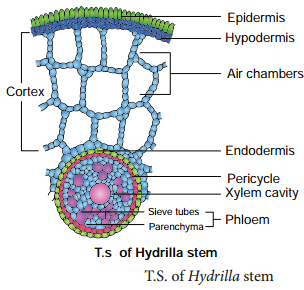
Ecological Adaptations img 1

Hygrophytes:

The plants which can grow in moist damp and shady places are called hygrophytes. Examples: Habenaria (Orchid), Mosses (Bryophytes), etc.

Morphological adaptations of Hydrophytes: In root

  • Roots are totally absent in Wolff and Salvinia or poorly developed in Hydrilla or well developed in Ranunculus.
  • The root caps are replaced by root pockets. Example: Eichhornia

In stem

  • The stem is long, slender, spongy and flexible in submerged forms.
  • In free flating forms the stem is thick, short stoloniferous and spongy; and in rooted floating forms, it is a rhizome.
  • Vegetative propagation is through runners, stolon, stem and root cuttings, tubers, dormant apices and offets.

In leaves

  • The leaves are thin, long and ribbon shaped in Vallisneria or long and linear in Potamogeton or finely dissected in Ceratophyllum.
  • The floating leaves are large and flat as in Nymphaea and Nelumbo. In Eichhornia and Trapa petioles become swollen and spongy.
  • In emergent forms, the leaves show heterophylly (Submerged leaves are dissected and aerial leaves are entire).

Example: Ranunculus, Limnophila heterophylla and Sagittaria

Anatomical adaptations

  • Cuticle is either completely absent or if present it is thin and poorly developed
  • Single layer of epidermis is present
  • Cortex is well developed with aerenchyma
  • Vascular tissues are poorly developed. In emergent forms vascular elements are well developed.
  • Mechanical tissues are generally absent except in some emergent forms. Pith cells are sclerenchymatous.
    Ecological Adaptations img 2

Physiological adaptations of Hydrophytes:

  • Hydrophytes have the ability to withstand anaerobic conditions.
  • They possess special aerating organs.

Xerophytes

The plants which are living in dry or xeric condition are known as Xerophytes. Xerophytic habitat can be of two different types. They are:

a. Physical dryness:

In these habitats, soil has a little amount of water due to the inability of the soil to hold water because of low rainfall.

b. Physiological dryness:

In these habitats, water is suffiently present but plants are unable to absorb it because of the absence of capillary spaces. Example: Plants in salty and acidic soil. Based on adaptive characters xerophytes are classified into three categories. They are Ephemerals, Succulents and Non succulent plants.

(i) Ephemerals:

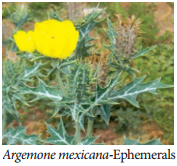
These are also called drought escapers or drought evaders. These plants complete their life cycle within a short period (single season). These are not true xerophytes. Examples: Argemone, Mollugo, Tribulus and Tephrosia.
Ecological Adaptations img 3

(ii) Succulents:

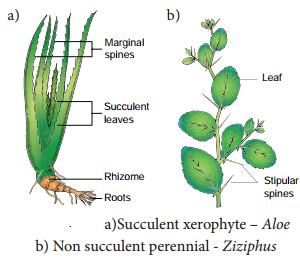
These are also called drought enduring plants. These plants store water in their plant parts during the dry period. These plants develop certain adaptive characters to resist extreme drought conditions. Examples: Opuntia, Aloe, Bryophyllum and Begonia.

(iii) Non succulents:

These are also called drought resistant plants (true xerophytes). They face both external and internal dryness. They have many adaptations to resist dry conditions. Examples: Casuarina, Nerium, Zizyphus and Acacia.
Ecological Adaptations img 4

Morphological Adaptations In root

  • Root system is well developed and is greater than that of shoot system.
  • Root hairs and root caps are also well developed.

In xerophytic plants with the leaves and stem are covered with hairs are called trichophyllous plants. Example: Cucurbits (Melothria and Mukia)

In stem

  • Stems are mostly hard and woody. They may be aerial or underground.
  • The stems and leaves are covered with wax coating or covered with dense hairs.
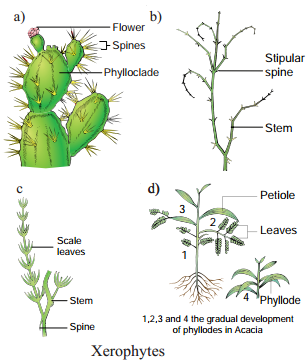
  • In some xerophytes all the internodes in the stem are modifid into a flashy leaf structure called phylloclades (Opuntia).
  • In some of the others single or occasionally two internodes modifid into flashy green structure called cladode (Asparagus).

In some the petiole is modifid into a flashy leaf like structure called phyllode (Acacia melanoxylon).
Ecological Adaptations img 5

In leaves

  • Leaves are generally leathery and shiny to reflect light and heat.
  • In some plants like Euphorbia, Acacia, Ziziphus and Capparis, the stipules are modified into spines.
  • The entire leaves are modifid into spines (Opuntia) or reduced to scales (Asparagus).

Anatomical adaptations

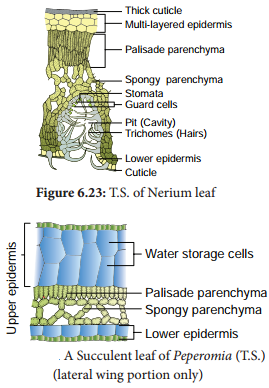
  • Presence of multilayered epidermis with heavy cuticle to prevent water loss due to transpiration.
  • Hypodermis is well developed with sclerenchymatous tissues.
  • Sunken stomata are present only in the lower epidermis with hairs in the sunken pits.
  • Scotoactive type of stomata found in succulent plants.
  • Vascular bundles are well developed with several layered bundle sheath.
  • Mesophyll is well diffrentiated into palisade and spongy parenchyma.
  • In succulents the stem possesses a water storage region.
    Ecological Adaptations img 6

Physiological adaptations

  • Most of the physiological processes are designed to reduce transpiration.
  • Life cycle is completed within a short period (Ephemerals).

Mesophytes

The plants which are living in moderate conditions (neither too wet nor too dry) are known as mesophytes. These are common land plants. Example: Maize and Hibiscus.

Morphological adaptations

  • Root system is well developed with root caps and root hairs.
  • Stems are generally aerial, stout and highly branched.
  • Leaves are generally large, broad, thin with different shapes.

Anatomical adaptations

  • Cuticle in aerial parts are moderately developed.
  • Epidermis is well developed and stomata are generally present on both the epidermis.
  • Mesophyll is well diffrentiated into palisade and spongy parenchyma.
  • Vascular and mechanical tissues are fairly developed and well diffrentiated.

Physiological adaptations

  • All physiological processes are normal.
  • Temporary wilting takes place at room temperature when there is water scarcity.

Tropophytes are plants which behave as xerophytes at summer and behave as mesophytes (or) hydrophytes during rainy season.

Epiphytes

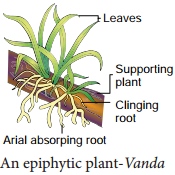
Epiphytes are plants which grow perched on other plants (Supporting plants). They use the supporting plants only as shelter and not for water or food supply. These epiphytes are commonly seen in tropical rain forests. Examples: Orchids, Lianas, Hanging Mosses and Money plant.

Morphological adaptations

  • Root system is extensively developed. These roots may be of two types. They are Clinging roots and Aerial roots. Clinging roots fix the epiphytes firmly on the surface of the supporting objects.
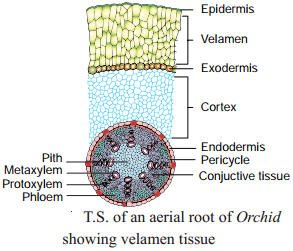
  • Aerial roots are green coloured roots which may hang downwardly and absorb moisture from the atmosphere with the help of a spongy tissue called velamen.
  • Stem of some epiphytes are succulent and develop pseudobulb or tuber.
  • Generally the leaves are lesser in number and may be fleshy and leathery.
  • Myrmecophily is a common occurrence in the epiphytic vegetation to prevent the predators.
  • The fruits and seeds are very small and usually dispersed by wind, insects and birds.

Anatomical adaptations

  • Multilayered epidermis is present. Inner to the velamen tissue, the peculiar exodermis layer is present.
  • Presence of thick cuticle and sunken stomata greatly reduces transpiration.
  • Succulent epiphytes contain well developed parenchymatous cells to store water.
    Ecological Adaptations img 7

Physiological adaptations

Special absorption processes of water by velamen tissue.

Halophytes

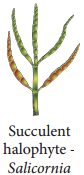
There are special type of Halophytic plants which grow on soils with high concentration of salts. Examples: Rhizophora, Sonneratia and Avicennia.

Halophytes are usually found near the seashores and Estuaries. The soils are physically wet but physiologically dry. As plants cannot use salt water directly they require filtration of salt using physiological processes. This vegetation is also known as mangrove forest and the plants are called mangroves.

Morphological adaptations

  • The temperate halophytes are herbaceous but the tropical halophytes are mostly bushy
  • In addition to the normal roots, many stilt roots are developed
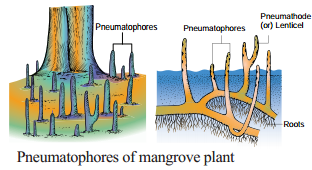
  • A special type of negatively geotropic roots called pneumatophores with pneumathodes to get sufficient aeration are also present. They are called breathing roots. Example: Avicennia
    Ecological Adaptations img 8
  • Presence of thick cuticle on the aerial parts of the plant body
  • Leaves are thick, entire, succulent and glossy. Some species are aphyllous (without leaves).
    Ecological Adaptations img 9
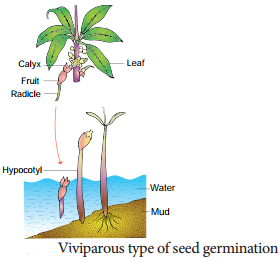
  • Viviparous mode of seed germination is found in halophytes
    Ecological Adaptations img 10

Anatomical adaptations

  • Epidermal cells of stem is heavy cutinized, almost squarish and are filled with oil and tannins.
  • ‘Star’ shaped sclereids and ‘H’ shaped heavy thickened spicules that provide mechanical strength to cortex are present in the stem.
  • The leaves may be dorsiventral or isobilateral with salt secreting glands.

Physiological adaptations

  • High osmotic pressure exists in some plants.
  • Seeds germinate in the fruits while on the mother plant (Vivipary).

Ecological Factors | Climatic Factors | Edaphic Factors | Topographic Factors | Biotic Factors

Learninsta presents the core concepts of Biology with high-quality research papers and topical review articles.

Ecological Factors | Climatic Factors | Edaphic Factors | Topographic Factors | Biotic Factors

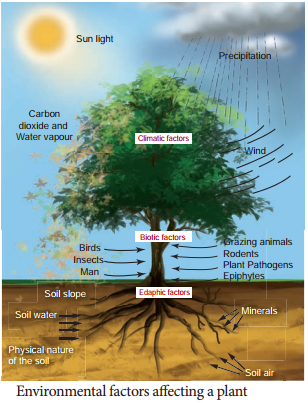
Many organisms, co-exist in an environment. The environment (surrounding) includes physical, chemical and biological components. When a component surrounding an organism affects the life of an organism, it becomes a factor.

All such factors together are called environmental factors or ecological factors. These factors can be classified into living (biotic) and non-living (abiotic) which make the environment of an organism. However the ecological factors are meaningfully grouped into four classes, which are as follows:

  • Climatic factors
  • Edaphic factors
  • Topographic factors
  • Biotic factors

We will discuss the above factors in a concise manner.

Climatic Factors

Climate is one of the important natural factors controlling the plant life. The climatic factors includes light, temperature, water, wind and fire.
Ecological Factors img 1

a. Light

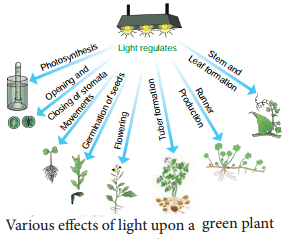
Light is a well known factor needed for the basic physiological processes of plants, such as photosynthesis, transpiration, seed germination and flowering. The portion of the sunlight which can be resolved by the human eye is called visible light.

The visible part of light is madeup of wavelength from about 400 nm (violet) to 700 nm (red). The rate of photosynthesis is maximum at blue (400 – 500 nm) and red (600 – 700 nm). The green (500 – 600 nm) wave length of spectrum is less strongly absorbed by plants.
Ecological Factors img 2

Based on the tolerance to intensities of light, the plants are divided into two types. They are:-

  • Heliophytes – Light loving plants. Example: Angiosperms.
  • Sciophytes – Shade loving plants. Example: Bryophytes and Pteridophytes.

b. Temperature

Temperature is one of the important factors which affect almost all the metabolic activities of an organism. Every physiological process in an organism requires an optimum temperature at which it shows the maximum metabolic rate. Three limits of temperature can be recognized for any organism. They are

  • Minimum temperature – Physiological activities are lowest.
  • Optimum temperature – Physiological activities are maximum.
  • Maximum temperature – Physiological activities will stop.

Based on the temperature prevailing in an area, Raunkiaer classified the world’s vegetation into the following four types. They are megatherms, mesotherms, microtherms and hekistotherms. In thermal springs and deep sea hydrothermal vents the average temperature exceed 100°c. Based on the range of thermal tolerance, organisms are divided into two types.

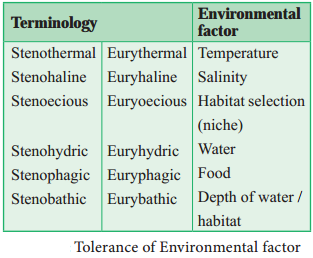
1. Eurythermal:

Organisms which can tolerate a wide range of temperature fluctuations.
Example: Zostera (A marine Angiosperm) and Artemisia tridentata.

2. Stenothermal:

Organisms which can tolerate only small range of temperature variations. Example: Mango and Palm (Terrestrial Angiosperms). Mango plant does not grow in temperate countries like Canada and Germany.

Thermal Stratifiation:

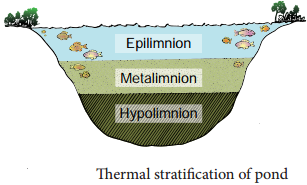
It is usually found in aquatic habitat. The change in the temperature profile with increasing depth in a water body is called thermal stratifiation. There are three levels of thermal stratifiations.
Ecological Factors img 3

  • Epilimnion – The upper layer of warmer water.
  • Metalimnion – The middle layer with a zone of gradual decrease in temperature.
  • Hypolimnion – The bottom layer of colder water.

Temperature based zonation

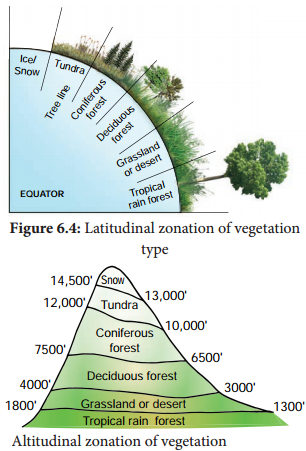
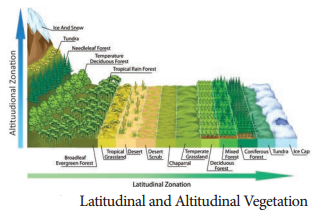
Variations in latitude and altitude do affect the temperature and the vegetation on the earth surface. The latitudinal and altitudinal zonation of vegetation is illustrated below:

Latitude:
Latitude is an angle which ranges from 0° at the equator to 90° at the place.

Altitude:
How high a place is located above the sea level is called the altitude of the place.
Ecological Factors img 4

Timber line/Tree line:
It is an imaginary line in a mountain or higher areas of land that marks the level above which trees do not grow. The altitudinal limit of normal tree growth is about 3000 to 4000m.

Effects of temperature

The following physiological processes are inflenced by temperature:

  • Temperature affcts the enzymatic action of all the bio-chemical reactions in a plant body.
  • It inflences CO2 and O2 solubility in the biological systems. Increases respiration and stimulates growth of seedlings.
  • Low temperature with high humidity can cause spread of diseases in plants.
  • The varying temperature with moisture determines the distribution of the vegetation types.

c. Water

Water is one of the most important climatic factors. It affects the vital processes of all living organisms. It is believed that even life had originated only in water during the evolution of Earth. Water covers more than 70% of the earth’s surface. In nature, water is available to plants in three ways. They are atmospheric moisture, precipitation and soil water.

The productivity and distribution of plants depend upon the availability of water. Further the quality of water is also important especially for the aquatic organisms. The total amount of water salinity in different water bodies are:

  • 5% in inland water (Fresh water)
  • 30 – 35% in sea water and
  • More than 100% in hypersaline water (Lagoons) Based on the range of tolerance of salinity, organisms are divided into two types.

1. Euryhaline:
Organisms which can live in water with wide range of salinity. Examples: Marine algae and marina angiosperms

2. Stenohaline:
Organisms which can withstand only small range of salinity. Example: Plants of estuaries.
Ecological Factors img 5

Examples of tolerance to toxicity

(i) Soyabean and tomato manage to tolerate presence of cadmium poisoning by isolating cadmium and storing into few group of cells and prevent cadmium affcting other cells.

(ii) Rice and Eichhornia (water hyacinth) tolerate cadmium by binding it to their proteins. These plants otherwise can also be used to remove cadmium from contaminated soil, this is known as Phytoremediation.

d. Wind

Air in motion is called wind. It is also a vital ecological factor. The atmospheric air contains a number of gases, particles and other constituents. The composition of gases in atmosphere is as follows: Nitrogen – 78% , Oxygen – 21%, Carbon-di-oxide – 0.03%, Argon and other gases – 0.93%. The other components of wind are water vapour, gaseous pollutants, dust, smoke particles, microorganisms, pollen grains, spores, etc. Anemometer is the instrument used to measure the speed of wind.

Effects of wind

  • Wind is an important factor for the formation of rain
  • Causes wave formation in lakes and ocean, promotes aeration of water
  • Strong wind causes soil erosion and reduces soil fertility
  • Increases the rate of transpiration
  • Helps in pollination in anemophilous plants
  • It also helps in dispersal of many fruits, seeds, spores, etc.
  • Strong wind may cause up-rooting of big trees
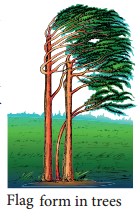
  • Unidirectional wind stimulates the development of flag forms in trees.
    Ecological Factors img 6

e. Fire

Fire is an exothermic factor caused due to the chemical process of combustion, releasing heat and light. It is mostly man-made and sometimes develops naturally due to the friction between the tree surfaces. Fire is generally divided into

  • Ground fie – Which is flameless and subterranean.
  • Surface fie – Which consumes the herbs and shrubs.
  • Crown fie – Which burns the forest canopy.

Effects of fie

  • Fire has a direct lethal effect on plants
  • Burning scars are the suitable places for the entry of parasitic fungi and insects
  • It brings out the alteration of light, rainfall, nutrient cycle, fertility of soil, pH, soil flora and fauna
  • Some fungi which grow in soil of burnt areas called pyrophilous. Example: Pyronema conflens.

Edaphic factors

Edaphic factors, the abiotic factors related to soil, include the physical and chemical composition of the soil formed in a particular area. The study of soils is called Pedology.

The soil

Soil is the weathered superfiial layer of the Earth in which plants can grow. It is a complex composite mass consisting of soil constituents, soil water, soil air and soil organisms, etc.

Soil formation

Soil originates from rocks and develops gradually at different rates, depending upon the ecological and climatic conditions. Soil formation is initiated by the weathering process. Biological weathering takes place when organisms like bacteria, fungi, lichens and plants help in the breakdown of rocks through the production of acids and certain chemical substances.

Soil types

Based on soil formation (pedogenesis), the soils are divided into

  • Residual soils – These are soils formed by weathering and pedogenesis of the rock.
  • Transported soils – These are transported by various agencies.

The important edaphic factors which affect vegetation are as follows:

1. Soil moisture:
Plants absorbs rain water and moisture directly from the air

2. Soil water:
Soil water is more important than any other ecological factors affecting the distribution of plants. Rain is the main source of soil water. Capillary water held between pore spaces of soil particles and angles between them is the most important form of water available to the plants.

3. Soil reactions:
Soil may be acidic or alkaline or neutral in their reaction. pH value of the soil solution determines the availability of plant nutrients. The best pH range of the soil for cultivation of crop plants is 5.5 to 6.8.

4. Soil nutrients:
Soil fertility and productivity is the ability of soil to provide all essential plant nutrients such as minerals and organic nutrients in the form of ions.

5. Soil temperature:
Soil temperature of an area plays an important role in determining the geographical distribution of plants. Low temperature reduces use of water and solute absorption by roots.

6. Soil atmosphere:
The spaces left between soil particles are called pore spaces which contains oxygen and carbon-di-oxide.

7. Soil organisms:
Many organisms existing in the soil like bacteria, fungi, algae, protozoans, nematodes, insects, earthworms, etc. are called soil organisms.
Ecological Factors img 7

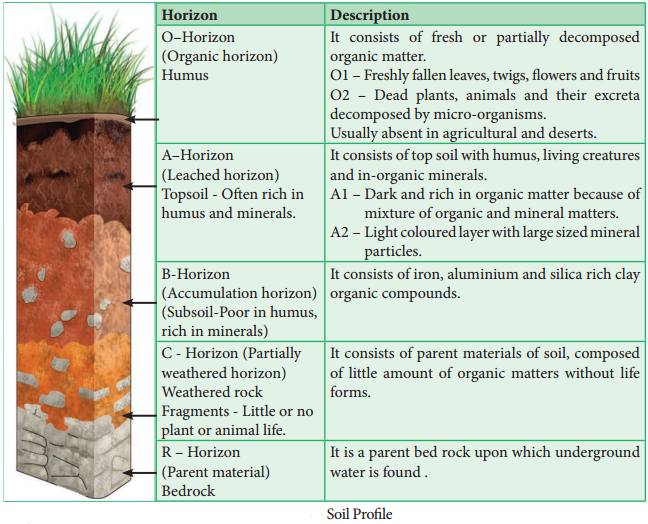
Soil Profie

Soil is commonly stratified into horizons at different depth. These layers differ in their physical, chemical and biological properties. This succession of super-imposed horizons is called soil profie.

Types of soil particles

Based on the relative proportion of soil particles, four types of soil are recognized.

Loamy soil is ideal soil for cultivation. It consists of 70% sand and 30% clay or silt or both. It ensures good retention and proper drainage of water. Th porosity of soil provides adequate aeration and allows the penetration of roots.

Based on the water retention, aeration and mineral contents of soil, the distribution of vegetation is divided into following types.

  • Halophytes: Plants living in saline soils
  • Psammophytes: Plants living in sandy soils
  • Lithophytes: Plants living on rocky surface
  • Chasmophytes: Plants living in rocky crevices
  • Cryptophytes: Plants living below the soil surface
  • Cryophytes: Plants living on surface of ice
  • Oxylophytes: Plants living in acidic soil
  • Calciphytes: Plants living in calcium rich alkaline soil

Topographic factors

The surface features of earth are called topography. Topographic influence on the climate of any area is determined by the interaction of solar radiation, temperature, humidity, rainfall, latitude and altitude. It affects the vegetation through climatic variations in small areas (micro climate) and even changes the soil conditions. Topographic factors include latitude, altitude, direction of mountain, steepness of mountain etc.

a. Latitudes and altitudes

Latitudes represent distance from the equator. Temperature values are maximum at the equator and decrease gradually towards poles. Different types of vegetation occur from equator to poles which are illustrated below.
Ecological Factors img 8

Height above the sea level forms the altitude. At high altitudes, the velocity of wind remains high, temperature and air pressure decrease while humidity and intensity of light increases. Due to these factors, vegetation at different altitudes varies, showing distinct zonation.

b. Direction of Mountain

North and south faces of mountain or hill possess different types of flra and fauna because they differ in their humidity, rainfall, light intensity, light duration and temperature regions.

Ecotone – The transition zone between two ecosystems.
Example: The border between forest and grassland.

Edge effect – Spices found in ecotone areas are unique due to the effect of the two habitats. This is called edge effect. Example: Owl in the ecotone area between forest and grassland.

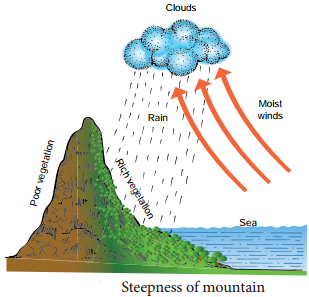
The two faces of the mountain or hill receive different amount of solar radiation, wind action and rain. Of these two faces, the windward region possesses good vegetation due to heavy rains and the leeward region possesses poor vegetation due to rain shadows (rain defit).

Similarly in the soil of aquatic bodies like ponds the center and edge possess different depth of water due to soil slope and different wave actions in the water body. Therefore, different parts of the same area may possess different species of organisms.

c. Steepness of the mountain

The steepness of the mountain or hill allows the rain to run off As a result the loss of water causes water deficit and quick erosion of the top soil resulting in poor vegetation. On the other hand, the plains and valley are rich in vegetation due to the slow drain of surface water and better retention of water in the soil.
Ecological Factors img 9

Biotic factors

The interactions among living organisms such as plants and animals are called biotic factors, which may cause marked effects upon vegetation. The effcts may be direct and indirect and modifies the environment. The plants mostly which lives together in a community and influence one another. Similarly, animals in association with plants also affect the plant life in one or several ways.

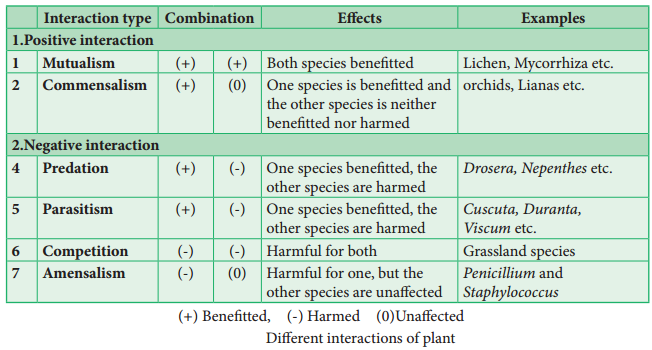
The different interactions among them can be classified into following two types they are positive interaction and negative interaction Positive interactions When one or both the participating species are benefied, it is positive interaction. Examples; Mutualism and Commensalism.

a. Mutualism:

It is an interaction between two species of organisms in which both are benefited from the obligate association. The following are common examples of mutualism.

Nitrogen fiation

Rhizobium (Bacterium) forms nodules in the roots of leguminous plants and lives symbiotically. The Rhizobium obtains food from leguminous plant and in turn fies atmospheric nitrogen into nitrate, making it available to host plants.

Other examples:

  • Water fern (Azolla) and Nitrogen fixing Cyanobacterium (Anabaena).
  • Anabaena present in coralloid roots of Cycas. (Gymnosperm)
  • Cyanobacterium (Nostoc) found in the thalloid body of Anthoceros. (Bryophytes)
  • Wasps present in fruits of fig.
  • Lichen is a mutual association of an alga and a fungus.
  • Roots of terrestrial plants and fungal hyphae – Mycorrhiza

b. Commensalism:

It is an interaction between two organisms in which one is benefitted and the other is neither benefited nor harmed. The species that derives benefit is called the commensal, while the other species is called the host. The common examples of commensalism are listed below:
Ecological Factors img 11

Epiphytes

The plants which are found growing on other plants without harming them are called epiphytes. They are commonly found in tropical rain forest.
Ecological Factors img 10

The epiphytic higher plant (Orchid) gets its nutrients and water from the atmosphere with the help of the hygroscopic roots which contain special type of spongy tissue called Velamen. It prepares its own food and does not depend on the host. Using the host plant only they support and does not harm it in any way.

  • Many orchids, ferns, lianas, hanging mosses, Peperomia, money plant and Usnea (Lichen) are some of the examples of epiphytes.
  • Spanish Moss – Tillandsia grows on the bark of Oak and Pine trees.

Negative interactions

When one of the interacting species is benefitted and the other is harmed, it is called negative interaction. Examples: predation, parasitism, competition and amensalism.

a. Predation:

It is an interaction between two species, one of which captures, kills and eats up the other. The species which kills is called a predator and the species which is killed is called a prey. The predator is benefitted while the prey is harmed.

Examples:

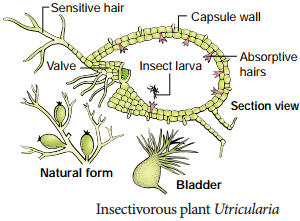
A number of plants like Drosera (Sun dew plant), Nepenthes (Pitcher Plant), Dionaea (Venus fly trap), Utricularia (Bladder wort) and Sarracenia are predators which consume insects and other small animals for their food as a source of nitrogen. They are also called as insectivorous plants.
Ecological Factors img 12

Many herbivores are predators. Cattles, Camels, Goats etc., frequently browse on the tender shoots of herbs, shrubs and trees. Generally annuals suffer more than the perennials. Grazing and browsing may cause remarkable changes in vegetation. Nearly 25 percent of all insects are known as phytophagous (feeds on plant sap and other parts of plant)

Many defense mechanisms are evolved to avoid their predations by plants. Examples: Calotropis produces highly poisonous cardiac glycosides, Tobacco produces nicotine, coffe plants produce caffine, Cinchona plant produces quinine. Throns of Bougainvillea, spines of Opuntia, and latex of cacti also protect them from predators.

b. Parasitism:

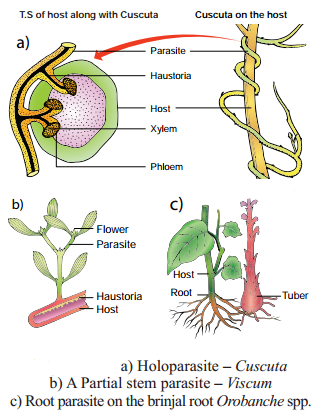
It is an interaction between two different species in which the smaller partner (parasite) obtains food from the larger partner (host or plant). So the parasitic species is benefied while the host species is harmed. Based on the host-parasite relationship, parasitism is classified into two types they are holoparasite and hemiparasite.

Holoparasites

The organisms which are dependent upon the host plants for their entire nutrition are called Holoparasites. They are also called total parasites.
Ecological Factors img 13

Examples:

  • Cuscuta is a total stem parasite of the host plant Acacia, Duranta and many other plants. Cuscuta even gets flower inducing hormone from its host plant.
  • Balanophora, Orobanche and Rafflia are the total root parasites found on higher plants.

Hemiparasites

The organisms which derive only water and minerals from their host plant while synthesizing their own food by photosynthesis are called Hemiparasites. They are also called partial parasites.

Examples:

  • Viscum and Loranthus are partial stem parasites.
  • Santalum (Sandal Wood) is a partial root parasite.

The parasitic plants produce the haustorial roots inside the host plant to absorb nutrients from the vascular tissues of host plants.

c. Competition:

It is an interaction between two organisms or species in which both the organisms or species are harmed. Competition is the severest in population that has irregular distribution. Competition is classified into intraspecific and interspecific.

1. Intraspecific competition:

It is an interaction between individuals of the same species. This competition is very severe because all the members of species have similar requirements of food, habitat, pollination etc. and they also have similar adaptations to fulfill their needs.

2. Interspecific competition:

It is an interaction between individuals of different species. In grassland, many species of grasses grow well as there is little competition when enough nutrients and water is available.

During drought shortage of water occurs. A life and death competition starts among the different species of grass lands. Survival in both these competitions is determined by the quantity of nutrients, availability of water and migration to new areas.

Different species of herbivores, larvae and grass hopper competing for fodder or forage plants. Trees, shrubs and herbs in a forest struggle for sunlight, water and nutrients and also for pollination and dispersal of fruits and seeds. The Utricularia (Bladderwort) competes with tiny fishes for small crustaceans and insects.

d. Amensalism:

It is an interspecific interaction in which one species is inhibited while the other species is neither benefited nor harmed. The inhibition is achieved by the secretion of certain chemicals called allelopathic substances. Amensalism is also called antibiosis.

  • Penicillium notatum produces penicillin to inhibit the growth of a variety of bacteria especially Staphylococcus.
  • Trichoderma inhibits the growth of fungus Aspergillus.
  • Roots and hulls of Black Walnut Juglans nigra secretes an alkaloid Juglone which inhibits the growth of seedlings of Apple, Tomato and Alfalfa around it.

Interspecific interactions / Co-evolutionary dynamics

i. Mimicry:

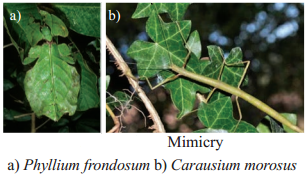
It is a phenomenon in which living organism modifis its form, appearance, structure or behaviour and looks like another living organism as a self defence and increases the chance of its survival. Floral mimicry is for usually inviting pollinators but animal mimicry is often protective. Mimicry is a result of evolutionary signifiance due to shape and sudden heritable mutation and preservation by natural selection.
Ecological Factors img 14

Example:

  • The plant, Ophrys an orchid, the flower looks like a female insect to attract the male insect to get pollinated by the male insect and it is otherwise called ‘floral mimicry’.
  • Carausium morosus – stick insect or walking stick. It is a protective mimicry.
  • Phyllium frondosum – leaf insect, another example of protective mimicry.

ii. Myrmecophily:

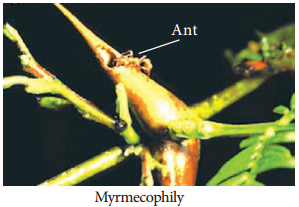
Sometimes, ants take their shelter on some trees such as Mango, Litchi, Jamun, Acacia etc. These ants act as body guards of the plants against any disturbing agent and the plants in turn provide food and shelter to these ants. This phenomenon is known as Myrmecophily. Example: Acacia and acacia ants.
Ecological Factors img 15

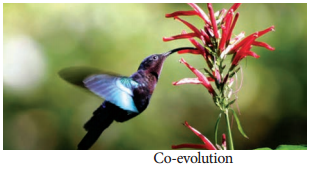
iii. Co-evolution:

The interaction between organisms, when continues for generations, involves reciprocal changes in genetic and morphological characters of both organisms. This type of evolution is called Co-evolution. It is a kind of co-adaptation and mutual change among interactive species. Examples:
Ecological Factors img 16

Corolla length and proboscis length of butterfles and moths (Habenaria and Moth).

  • Bird’s beak shape and flower shape and size.
  • More examples: Horn bills and birds of Scrub jungles, Slit size of pollinia of Apocynaceae members and leg size of insects.

The p-Block Elements Class 11 Notes Chemistry Chapter 11

By going through these CBSE Class 11 Chemistry Notes Chapter 11 The p-Block Elements, students can recall all the concepts quickly.

The p-Block Elements Notes Class 11 Chemistry Chapter 11

→ General trends in the chemistry of p-block elements.

→ Group-13 Elements: The Boron family-Electronic configuration, atomic radii, ionization, enthalpy, electro-negativity, physical & chemical properties.

→ Important trends & anomalous properties of boron

→ Important compounds of boron: Borax, orthoboric acid, diborane, uses of boron & aluminium & their compounds.

→ Group-14 Elements: The carbon family. Electronic configuration, covalent radius, ionization enthalpy, electronegativity, physical & chemical properties.

→ Important trends & anomalous behaviour of carbon.

→ Allotropes of carbon: Diamond, graphite & fullerenes & uses of carbon.

→ Important compounds of carbon & silicon: Carbon monoxide, carbon dioxide, silicon dioxide, silicones, silicates & zeolites.

→ P-BIock Elements: p-block of elements of the periodic table is unique in terms of having all types of elements-metals, non¬metals & metalloids. Group numbers ranging from 13-18.

→ Valence shell electronic configuration ns2.np1-6(Except for He).

→ pπ-pπ bonds and dπ – pπ or dπ-dπ bonds: The combined effect of size & availability of d-orbitals considerably influences the ability of these elements to form π-bonds. While the lighter elements form pπ-pπ bonds. The heavier ones form dπ-dπ bonds.

→ Electron deficiency in boron compounds: The availability of 3-valence electrons for covalent bond formation using four orbitals (2S, 2Px, 2Py & 2Pz.) leads to the so-called electron deficiency in boron compounds.

→ Boranes: Boron forms covalent molecular compounds with di-hydrogen as boranes. The simplest is diborane (B2H6).

→ Inert pair effect: Aluminium exhibits + 3 oxidation state. With heavier elements, the +1 oxidation state gets progressively stabilised on going down the group. This is a consequence of the so-called inert pair effect.

→ Catenation: The ability to form chains or rings not only with C – C single bonds but also with multiple bonds
(C = C or C ≡ C).

→ Allotropes of carbon: Three important allotropes of carbon are diamond, graphite & fullerenes.

→ Carbon monoxide: Carbon monoxide having lone pair of electrons on C forms metal carbonyls. It is deadly poisonous due to the higher stability of its haemoglobin complex as compared to that of the oxy-haemoglobin complex.

→ Carbon dioxide: Increased content of CO2 in the atmosphere due to combustion of fossil fuels & decomposition of limestone is feared to cause an increase in the greenhouse effect. This in turn raises the temperature of the atmosphere & causes serious complications.

→ Compounds of silicon: Silica, silicates & silicones are important compounds & find applications in industry & technology.

Chapter in Brief:
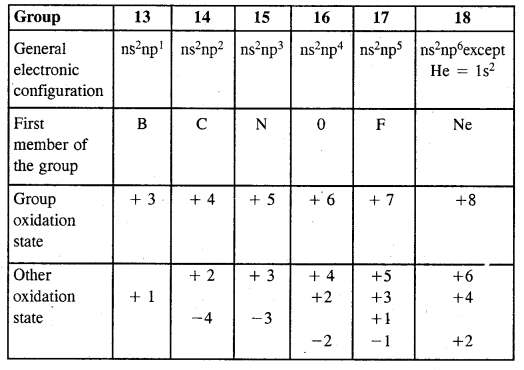
In the case of elements of p-block, the last electron enters a p-orbital. As p-subshell can hold a maximum of 6 electrons in px, py and pz atomic orbitals, p-block has 6 groups namely 13, 14, 15, 16, 17 and 18th groups. The valence shell electronic configuration is ns2 np1-6. In the case of the boron family (group 13), carbon family (group 14) and nitrogen family (group 15), the group oxidation states (the most stable oxidation states) are +3, +4 and +5 respectively for the lighter element an in the respective groups.

However, the oxidation state two until less than the group oxidation state becomes increasingly more stable for the heavier elements in each group. The occurrence of oxidation state two units less than the group’s oxidation state is due to the Inert Pair Effect.

General Electronic Configuration And Oxidation States Of P-Block Elements
The p-Block Elements Class 11 Notes Chemistry 1
Non-metals and metalloids exist only in the p-block. The non-metallic character of elements decreases down a particular group. In fact, the heaviest element in each group of the p-block is the most metallic in nature.

In general non-metals have higher ionisation enthalpies and higher electronegativities than metals. Hence in contrast to metals which readily form cations, non-metals readily form anions. The compounds formed by highly reactive non-metals like halogens with highly reactive metals like alkali metals are generally Ionic due to the large difference in their electronegativities.

On the other hand, compounds formed by non-metals themselves are largely covalent because of the small differences in their electronegativities. The change of non-metallic to metallic character can be best illustrated by the nature of oxides formed by them. The non-metallic oxides like CO2 and SiO2 are acidic or neutral whereas metallic oxides like CaO Na2O are basic.

The first member of the groups of p-block differs from the remaining members of their corresponding group in two major respects. First is the size and all other properties which depend on size. Thus, the lightest p-block elements show the same kind of differences as the lightest s-block elements, lithium and beryllium. The second important difference, which applies only to the p-block elements, arises from the effect of d-orbitals in the valence shell of heavier- elements (starting from the third period onwards) and their lack in second-period elements.

The second-period elements starting from boron are restricted to a maximum covalence of four (using 2s and three 2p orbitals). In contrast, the third-period element of a p-group with the electronic configuration 3s23pn has the vacant 3d orbitals lying between the 3p and the 4s levels of energy. Using these d-orbitals the third-period elements can expand their covalence above four. For example, while boron form only [BF4], aluminium gives [AlF6]3- ion. The presence of these d-orbitals influences the chemistry of the heavier elements in a number of other ways.

The combined effect of size and availability of d orbitals considerably influences the ability of these elements to form their bonds. The first member of a group differs from the heavier members in their ability to form pπ-pπ multiple bonds to itself (e.g., C = C, C ≡ C, N ≡ N) and to other second-row elements (e.g., C = 0, C = N, C ≡ N, N = 0). This type of π-bonding is not particularly strong for the heavier p-block elements. The heavier elements do form, n bonds but this involves d orbitals (dπ-pπ or dπ—dπ).

As the d orbitals are of higher energy than the p-orbitals, they contribute less to the overall stability of molecules than does pπ -pπ bonding of the second-row elements. However, the coordination number in species of heavier elements may be higher than for the first element in the same oxidation state. For example, in the +5 oxidation state both N and P form oxoanions:

NO3- (with π-bonding involving one nitrogen p-orbital ) and PO43- (four-coordination involving s,p and d orbitals contributing to the π-bonding).

Group 13 elements: The boron family
Boron, Aluminium, Gallium, Indium and Thallium are the elements present in group 13. Boron (B) is a typical non-metal. Aluminium is a metal. Gallium, indium and thallium are almost exclusively metallic in character.

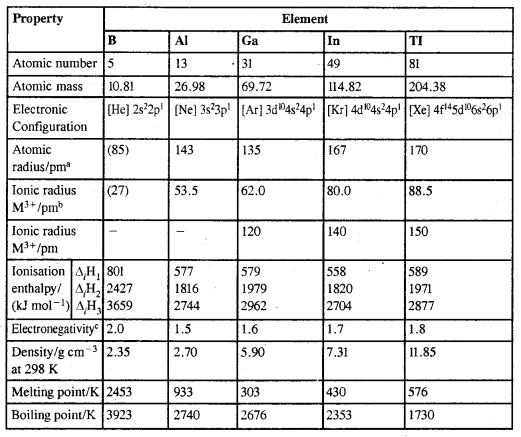
Atomic & Physical Properties of Group 13 Elements
The p-Block Elements Class 11 Notes Chemistry 2
The p-Block Elements Class 11 Notes Chemistry 3
aMetallic radius, b6-coordination, cPauling scale,

For M3+ (aq) + 3e → M(s)
eFor M+ (aq) + e → M(s).

1. Electronic Configuration: The outer electronic configuration of these elements is ns2np1

2. Atomic Radii: Generally atomic radii increase in going down the group. However atomic radius of Ga is less than that of Al, due to the poor screening effect of the inner d-electrons for the valence electrons from the increased nuclear charge in gallium.

3. Ionisation Enthalpy: IE of Al is less than that of B due to the increased size of Al.

4. Electronegativity: Electronegativity first decreases from B to Al and then increases marginally.

5. Physical Properties: Boron is non-metallic, extremely hard and black coloured solid. It exists in many allotropic forms. It has unusually high M.Pt. The rest of the members are soft metals with low M.Pt. and high electrical conductivity Gallium with M.Pt. of 303 K is a liquid during summer. The density of elements increases down the group.

6. Chemical Properties: Due to its small size the sum of its first three enthalpies is very high. Therefore B does not form +3 cations and forms only covalent bonds. Al due to its low I.E. forms Al3+ ions. In the heavier metals due to the inert pair effect, they exhibit an oxidation state of +1.

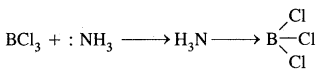
BF3 is an electron-deficient compound and acts as a Lewis acid by accepting a pair of electrons.
The p-Block Elements Class 11 Notes Chemistry 4
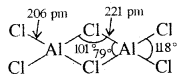
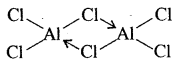
AlCl3 achieves stability by forming a dimer.
The p-Block Elements Class 11 Notes Chemistry 5
Trivalent covalent state compounds are hydrolysed by water to form tetrahedral [M(OH)4] species, the hybridisation state of M is sp3. AlCl3 in acidified aqueous state forms octahedral [Al(H2O)6]3+ ion. Al is in d2sp3 hybridisation.

1. Reactivity towards air: Boron is unreactive in crystalline form. A1 forms a very thin oxide layer on the surface which protects the metal from further attack. On heating B2O3 and Al2O3 are formed. With N2, they form nitrides at a higher temperature.
The p-Block Elements Class 11 Notes Chemistry 6
2. Reactivity towards acids and bases: B does not react. Al dissolves in dilute HCl and liberates H2 gas
2Al(s) + 6HCl(aq) → 2Al3+ (aq) + 6Cl(aq) + 3H2(g)
Cone. HNO3 renders A1 passive by forming a protective oxide layer on the surface.

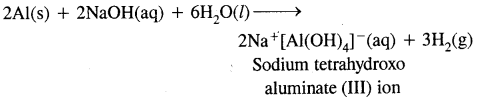
Al reacts with aq. alkalies and liberates H2 gas.
The p-Block Elements Class 11 Notes Chemistry 7
3. Reactivity towards halogens.
2E(s) + 3X2(g) → 2EX3(S) (X = F, Cl, Br, I)
E = B, Al, Ga, In.

Important Trends and Anomalous Properties of Boron:
1. The trihalides of all these elements are covalent in nature and hydrolysed by water
EX3 + 3H2O → E(OH)3 + 3HX

2. Monomeric trihalides, being electron deficient are strong LEWIS ACIDS.
The p-Block Elements Class 11 Notes Chemistry 8
3. Maximum covalency shown by boron is 4 because it cannot expand its octet beyond 4 due to the absence of d-orbitals. Due to the availability of d-orbitals with other metals, the maximum covalent can be expected beyond 4.

AlCl3 is dimerised to AlCl6
The p-Block Elements Class 11 Notes Chemistry 9
Some Important Compounds of Boron:
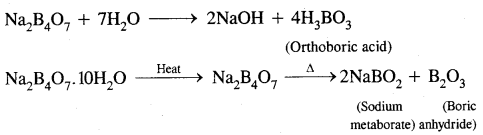
1. Borax: It is a white crystalline solid of formula Na2B4O7.10H2O, more appropriately Na2[B4O5(OH)4].8H2O. It dissolves in water to give an alkaline solution.
The p-Block Elements Class 11 Notes Chemistry 10
2. Orthoboric Acid: It is a white crystalline solid with soapy touch. Its formula is H3BO3. It is sparingly soluble in water but highly soluble in hot water.

Preparation:

  1. Na2B4O7 (Borax) + 2HCl + 5H2O → 2NaCl + 4B(OH)3 (Boric acid)
  2. It is formed by hydrolysis with water of BCl3:
    BCl3 + H2O(aq) → H3BO3 + 3HCl.

Structure: It has a layer structure in which planar BO3 units are joined by hydrogen bonds as shown in the figure below.

[Structure of boric apid H3BO3 dotted line represent hydrogen bonds.]
The p-Block Elements Class 11 Notes Chemistry 11

Properties of Boric Acid (H3BO3)

  1. It is a weak monobasic acid.
  2. It is not a protonic acid but acts as Lewis-acid by accepting electrons from a hydroxyl ion
    B(OH)3 + 2HOH → [B(OH)4]- + H3O+
  3. On heating above 370K, metaboric acid (HBO2) is formed which on further heating yields boric oxide (B2O3).
    The p-Block Elements Class 11 Notes Chemistry 12
    Diborane B2H6: It is the simplest of boron hydrides.

Preparation:
The p-Block Elements Class 11 Notes Chemistry 13
The p-Block Elements Class 11 Notes Chemistry 14
(iii) Industrially it is prepared by the reaction of BF3 on sodium hydride.
The p-Block Elements Class 11 Notes Chemistry 15
Properties of Diborane:
1. If is a colourless, highly toxic gas with a B.Pt. of 180 K.

2. It catches fire spontaneously upon exposure to air. Enormous energy is released during the reaction.
B2H6 + 3O2 → B2O3 + 3H2O; ΔCH° = -1976 kJ mol”1

3. Most of the higher boranes are highly flammable.

4. It is hydrolysed by water giving boric acid
B2H6(g) + 6H2O(l) → 2B(OH)3(aq) + 6H2O

5. Diborane undergoes cleavage reactions with Lewis bases to give borane adduct
B2H6 + 2NMe3 → 2BH3 . NMe3
B2H6 + 2CO → 2BH3 . CO
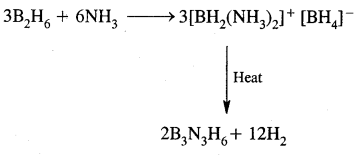
B2H6 + 2NH3 → B2H6.2NH3
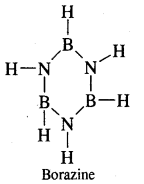
which is formulated as [BH2(NH3)2]+ [NH4] further heating gives [BH2(NH3)2]+ [BH4] , further heating gives Borazine or Borazole or Inorganic Benzene B3N3H6
The p-Block Elements Class 11 Notes Chemistry 16
The p-Block Elements Class 11 Notes Chemistry 17
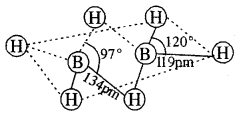
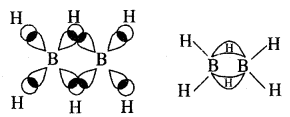
The structure of diborane is shown in Fig.(a) below. The four-terminal hydrogen atoms and the two boron atoms lie in one plane. Above and below this plane, there are two bridging hydrogen atoms. The four-terminal B—H bonds are regular two centre-two-electron bonds while the two bridge (B—H – B) bonds are different and can be described in terms of three centre-two electron bonds shown in Fig.(b)
The p-Block Elements Class 11 Notes Chemistry 18
(a) The strucwre of diborane, B2H6

Boron also forms a series of Hydridoborates; the most important one is the tetrahedral [BH4] ion. Tetrahydridoborates of several metals is known. Lithium and sodium Tetrahydridoborates is also known as Borohydrides are prepared by the reaction of metal hydrides with B2H6 in diethyl ether.
The p-Block Elements Class 11 Notes Chemistry 19
(b) Bonding in diborane. Each B atom uses sp3 hybrids for bonding.

Out of the four sp3 Iribrids on each B atom, one is without an electron shown with broken lines. The terminal B-H bonds are normal 2 centre-2 electron bonds but lie two bridge bonds are 3 centre-2 electron bonds. The 3 centres 2 electron bridge bonds are also referred to as banana bonds.

2MH + B2H6 → 2M+[BH4] ; M = Li or Na.
Both LiBH4 and NaBH4 are used as reducing agents in organic synthesis. They are starting materials for preparing other borohydrides.

Uses Of Boron & Aluminium And Their Compounds:
Boron is an extremely hard refractory solid of high melting point, low density and very low electrical conductivity find many applications. Boron fibres are used in making bullet-proof vest and light composite material for aircraft. The boron-10 (10B) isotope has a high ability to absorb neutrons and, therefore, metal borides are used in the nuclear industry as protective shields and control rods.

The main industrial application of borax and boric acid is in the manufacture of heat resistant glasses (e.g., Pyrex), glass-wool and fibreglass. Borax is also used as a flux for soldering metals, for heat, scratch and stain resistant glazed coating to earthenwares and as a constituent of medicinal soaps. An aqueous solution of orthoboric acid is generally used as a mild antiseptic.

Aluminium is a bright silvery-white metal, with high tensile strength. It has a high electrical and thermal conductivity. On a weight- to-weight basis, the electrical conductivity of aluminium is twice that of copper. Aluminium is used extensively in industry and everyday life.

It forms alloys with Cu, Mn, Mg, Si and Zn. Aluminium and its alloys can be given shapes of pipe, tubes, rods, wires, plates or foils and, therefore, find uses in packing, utensil making, construction, aeroplane and transportation industry. The use of aluminium and its compounds for domestic purposes is now reduced considerably because of its toxic nature.

Group 14 Elements: The Carbon Family
Carbon (C), silicon (Si), germanium (Ge), tin (Sn) and lead (Pb) are the members of group 14.
1. The valence shell electronic configuration of these elements is ns2np1.

2. Covalent Radius: There is a considerable increase in covalent radius from C to Si, thereafter from Si to Pb, a small increase in radius is observed. This is due to the presence of completely filled d and f-orbitals in heavier members.

Atomic And Physical Properties Of Group 14 Elements:
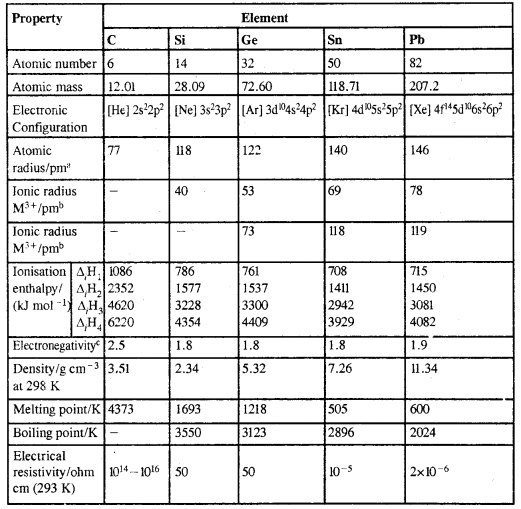
The p-Block Elements Class 11 Notes Chemistry 20
afor MIV oxidation state; b6-coordination, cPauling scale, d293 K; efor diamond; for graphite, density is 2.22; fβ-form (stable at room temperature)

3. Ionization Enthalpy: The first TE of group 14 members is higher than the corresponding members of group 13. It generally decreases from top to bottom. There is a small increase in the case of lead and it is due to the poor shielding effect of intervening d and f orbitals and the increase in the size of the atom.

4. Electronegativity: Due to the small size, the elements of this group are slightly more electronegative than group 13 elements. The electronegativity values for elements from Si to Pb are almost the same.

5. Physical Properties: All group 14 elements are solids, C and Si are non-metals, germanium (Ge) is a metalloid, whereas tin and lead are soft metals with low melting points. Melting points and boiling points of group 14 elements are much higher than those of the corresponding elements of the. group 13 elements.

6. Chemical Properties:
Oxidation states and trends in chemical reactivity: The common oxidation states shown by these elements are +4 and +2. Since the sum of four ionisation enthalpies is very high, compounds in the +4 oxidation state are generally covalent. The heavier members Ge, Sn and Pb, tendency to show an oxidation state of +2 increases due to the inert pair effect, i.e., the two electrons in ns2 orbital prefer to remain paired if we go down the group and do not participate in bond formation.

C & Si mostly show an oxidation state of + 4.

Ge shows a + 4 states in stable compounds and only a few compounds in a + 2 oxidation state.
Sn forms compounds in both oxidation state + 4 and + 2 (Sn in + 2 states is a reducing agent)

Lead compounds in the + 2 state are stable and in the + 4 states are strong oxidising agents.
Being electron-precise molecules, they are neither electron- acceptors nor electron-donors.

Although C cannot expand its octet beyond 4 due to the non-availability of d-orbitals, other elements of the group can do so, because of the presence of d-orbitals in them. CCl4 can’t undergo hydrolysis, whereas SiCl4 can do so due to the same reason.

For examples, the species like SiF5, SiF62-, GeCl62- and [Sn(OH)6]2- exist where the hybridisation of the central atom is sp2d3.
1. Reactivity towards oxygen: All members on heating in oxygen form oxides-MO and MO2. Oxides in a higher oxidation state are more acidic than in a lower oxidation state. CO is neutral, CO is acidic. The dioxides-CO2, SiO2, GeO2 are acidic, SnO2 and PbO2 are amphoteric. GeO is distinctly acidic, SnO and PbO are amphoteric.

2. Reactivity towards water:
C, Si, and Ge are not affected by water
The p-Block Elements Class 11 Notes Chemistry 21
Pb is not affected by water.

3. Reactivity towards halogens
M + X2 → MX2 M: Si, Ge, Sn, Pb
M + 2X2 → MX4 X: F, Cl, Br, I

Most MX4 are covalent M shows sp3 hybridisation and MX4 are tetrahedral in shape. SnF4 & PbF4 are ionic in nature. Pbl4 does not exist. Stability of MX2 increases down the group.

GeX4 is more stable than GeX2, whereas PbX2 is more stable than PbX4. Sid4 undergoes hydrolysis as shown below, but CCl4 cannot undergo hydrolysis because carbon cannot expand its covalence beyond four due to the absence of d-orbitals
The p-Block Elements Class 11 Notes Chemistry 22
Important Trends and Anomalous Behaviour of C:
Carbon (C) the first member of group 14 differs from its congeners due to

  1. Small size
  2. Higher ionisation enthalpy and higher electronegativity.
  3. Non-availability of d-orbitals.

In carbon, only s and p orbitals are available for bonding and, therefore, it can accommodate only four pairs of electrons around it. This would limit the maximum covalence to four whereas other members can expand their covalence due to the presence of d orbital.

Carbon also has a unique ability to form pπ-pπ multiple bonds with itself and with other atoms of small size and high electronegativity. Few examples of multiple bonding are: C = C, C ≡ C, C=0, C = S, and C = N. Heavier elements do not form pπ-pπ bonds because their atomic orbitals are too large and diffuse to have effective overlapping.

Carbon atoms have the tendency to link with one another through covalent bonds to form chain and rings. This property is called catenation. This is because C—C bonds are very strong. Down the group the size increases and electronegativity decreases, and, thereby, the tendency to show catenation decreases. This can be clearly seen from bond enthalpies values. The order of catenation is C >> Si > Ge = Sn. Lead does not show catenation.

BondBond enthalpy/kJ mol-1
C-C348
Si-Si297
Ge-Ge260
Sn-Sn240

Due to the property of catenation and pπ-pπ bonds formation, carbon is able to show allotropic forms.

Allotropes of Carbon:
Carbon exists in crystalline and amorphous forms. Diamond and graphite are two well-known crystalline forms of carbon. In 1985, the third form of C known as Fullerenes was discovered:
The p-Block Elements Class 11 Notes Chemistry 23
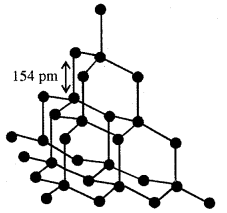
The structure of diamond

Carbon in diamond is sp3 hybridised. Diamond has a crystal lattice. The C—C bond length is 154 pm. The structure is a rigid three-dimensional network of carbon atoms. In this structure shown on the side, directional covalent bonds are present throughout the lattice.

It is very difficult to break extended covalent bonding and therefore diamond is the hardest substance on the earth. It is used as an abrasive for sharpening hand tools, in making dies and in the manufacture of tungsten filaments for electric light bulbs.

Graphite:
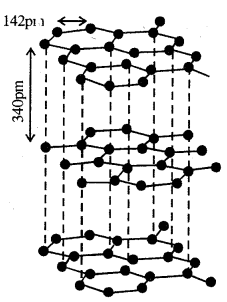
Graphite has a layered structure. Layers are held by van der Waals forces and the distance between the two layers is 340 pm. Each layer is composed of planar hexagonal rings of C atoms. C—C bond length within a layer is 142 pm. Here C undergoes sp2 hybridisation and makes three bonds with 3 neighbouring C atoms. The fourth electron forms a bond. The electrons are delocalised over the whole sheet.

These electrons in graphite are mobile and therefore, graphite conducts electricity- Graphite is very soft and is used as a dry lubricant in machines running at high temperature, where oil cannot be used as a lubricant.
The p-Block Elements Class 11 Notes Chemistry 24
Structure of graphite

Fullerenes:
Fullerenes are made by heating graphite in an electric arc in the presence of an inert gas such as helium or argon. The sooty material formed by the condensation of vapourised C60 small molecules consists up mainly of a smaller quantity of C70 and traces of fullerenes consisting of an even number of carbon atoms up to 350 or above. Fullerenes are the only pure forms of carbon because they have smooth structure without having “dangling” bonds.

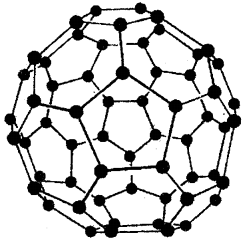
Fullerenes are cage-like molecules. the molecule has a shape like a soccer ball and is called Buckminster Fullerene. It contains twenty six-membered rings and twelve five-membered rings. A six-membered ring is fused with six or five-membered rings but a five-membered ring can only fuse with six-membered rings.

All the carbons atoms are equal and they undergo sp3 hybridisation. Each carbon atom forms three sigma bonds with the other three carbon atoms. The remaining electron at each carbon atom is delocalised in molecular orbitals which give an aromatic character to the molecule.

This ball-shaped molecule has 60 vertices and each one is occupied by one C atom and it contains both single and double bonds with C-C distances of 143.5 pm and 138.3 pm respectively. Spherical fullerenes are also called Bucky Balls
The p-Block Elements Class 11 Notes Chemistry 25
The structure of C 60, Buckminster fullerene. Note that molecule has the shape of a soccer ball (football)

Graphite is a thermodynamically most stable allotrope of carbon and therefore ΔfH° of graphite is taken as zero.

Uses of Carbon:

  1. Graphite fibres embedded in plastic material form high strength, lightweight composites which find wide applications.
  2. Being a good conductor, graphite is used as electrodes in batteries and in industrial electrolysis.
  3. Crucibles made of graphite are inert to dilute acids and alkalies.
  4. Graphite is used as a moderator in nuclear reactors to slow down the speed of fast-moving neutrons.
  5. Being highly porous activated charcoal is used in absorbing poisonous gases. It is also used in water filters to remove organic contaminators and in the air conditioning system to control odour.
  6. Carbon black is used as a black pigment in black ink and as filler in automobile tyres.
  7. Coke is used as a fuel and largely as a reducing agent in metallurgy.
  8. Diamond is a precious stone and used in jewellery. It is measured in carat (1 carat = 200 mg)

Some Important Compounds of Carbon and Silicon:

  • Oxides of Carbon: Two important oxides of C are carbon monoxide CO and carbon dioxide CO2.
  • Carbon Monoxide (CO): Direct oxidation of carbon in a limited supply of air or oxygen yields CO.

1. Lab. method: On a small scale CO is prepared by dehydration of formic acid with cone. H2SO4 at 373K
The p-Block Elements Class 11 Notes Chemistry 26
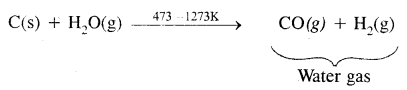
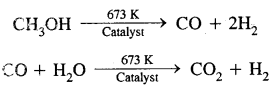
2. Commercial-scale: It is prepared commercially by the passage of steam over hot coke. The mixture of CO and H2 produced is called water-gas or synthesis gas
The p-Block Elements Class 11 Notes Chemistry 27
When air is used instead of steam a mixture of CO and N2 produced which is called producer gas.
The p-Block Elements Class 11 Notes Chemistry 28
Properties:

  1. It is a colourless odourless gas.
  2. It is almost insoluble in water;
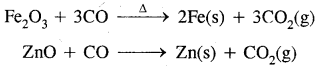
  3. It- is a powerful reducing agent and reduces all metal oxides other than those of alkali and alkaline earth metals, aluminium and a few transition elements.
    The p-Block Elements Class 11 Notes Chemistry 29
  4.  In C ≡ O: there is one sigma and two n bonds between C and oxygen. Because of the presence of a lone pair of electrons on C, the CO molecule acts as a donor and reacts with certain metals when heated to form metal carbonyls.
    The p-Block Elements Class 11 Notes Chemistry 30
  5. Due to its highly poisonous nature, CO forms a complex with haemoglobin which is about 300 times more stable than the oxygen complex. This prevents haemoglobin in the red blood corpuscles from carrying oxygen around the body and ultimately results in death.

Carbon Dioxide:
Methods of Preparation.

  1. Complete combustion of C and C containing fuels.
    The p-Block Elements Class 11 Notes Chemistry 31
  2. Lab. method
    CaCO3(s) + 2HCl(aq) → CaCl2(aq) + CO2(g) + H2O(l)
  3. Commercially, it is prepared by heating lime stone,
    The p-Block Elements Class 11 Notes Chemistry 32

Properties:

  1. It is colourless and odourless gas.
  2. It has low solubility in water. With water, it forms carbonic acid H2CO3 which is a weak dibasic acid.
    H2CO3+ H2O ⇌ HCO3 + H3O+
    HCO3+ H2O ⇌ CO32- + H3O+
  3. 2NaOH + CO2 → Na2CO3 + H2O
  4. Photosynthesis
    The p-Block Elements Class 11 Notes Chemistry 33
  5. Excess of CO2 in the atmosphere leads to the greenhouse effect which will raise the temperature of the atmosphere.
  6. CO2 in the solid state is called Dry ice which is used as a refrigerant for ice cream and frozen food.

Structure of CO2
C in CO2 undergoes sp hybridisation. Two sp hybridised orbitals of carbon atom overlap with two p orbitals of oxygen atoms to make two sigma bonds while the other two electrons of the carbon atom are involved in pπ-pπ bonding with an oxygen atom. This results in its linear shape [with both C-O bonds of equal length (115 pm)] with no dipole moment. The resonance structures are shown below:
The p-Block Elements Class 11 Notes Chemistry 34
Resonance structures of carbon dioxide

Silicon Dioxide SiO2
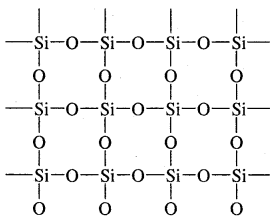
Silicon dioxide or silica along with silicates constitute 95 % of the earth’s crust. SiO2 is a covalent three-dimensional network solid in which each silicon atom is covalently bonded in a tetrahedral manner to four oxygen atoms. Each oxygen atom in turn covalently bonded to another silicon atoms as shown.
The p-Block Elements Class 11 Notes Chemistry 35
Three-dimensional structure of SiO

Properties:

  1. Silica in its normal state is almost non-reactive.
  2. It is attacked by HF and NaOH.
    SiO2 + 4HF → SiF4 + 2H2O
    SiO2 + 2NaOH → Na2SiO3 (Sodium silicate) + H2O

Uses: Silica gel is used as a drying agent, as a catalyst and in chromatography.

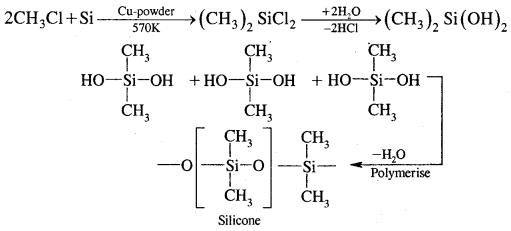
Silicones: They are a group of organosilicon polymers that have -R2SiO- as a repeating unit. They are prepared as follows:
The p-Block Elements Class 11 Notes Chemistry 36
industries for cracking of hydrocarbons and isomerisation, e.g., ZSM-5 (A type of zeolite) used to convert alcohols directly into gasoline. Hydrated zeolites are used as ion exchangers in softening hard water.

The s-Block Elements Class 11 Notes Chemistry Chapter 10

By going through these CBSE Class 11 Chemistry Notes Chapter 10 The s-Block Elements, students can recall all the concepts quickly.

The s-Block Elements Notes Class 11 Chemistry Chapter 10

→ Gp. 1 Elements: Alkaline metals Electronic configuration, Atomic & Ionic radii Ionization enthalpy, hydration enthalpy.

→ Physical & Chemical properties.

→ Uses of Alkali metals.

→ General characteristics of the compounds of alkali metals-halides, salts of oxo-acids.

→ Anomalous properties of Lithium Points of difference between Li & other alkali metals

→ Points of Similarities between Lithium & Magnesium.

→ Important compounds of Sodium: Sodium carbonate, sodium chloride, sodium hydroxide & sodium hydrogen carbonates.

→ Biological importance of sodium & potassium

→ Gp. 2 Elements: Alkaline Earth metals

→ electronic configuration, Atomic & Ionic radii, Ionization enthalpy, hydration enthalpy

→ Physical & chemical properties & use of alkaline earth metals.

→ General characteristics of compounds of alkaline earth metals- oxides & hydroxides.

→ Halides, salts of oxo-acids & carbonates.

→ Anomalous behaviour of Beryllium-Diagonal relationship between Beryllium & Aluminium.

→ Some important compounds of calcium: Calcium oxide, calcium hydroxide & calcium carbonate, calcium sulphate & cement.

→ Biological importance of Mg & ca.

→ S-block Elements: Group-1 (Alkali metals) & Group-2 (Alkaline earth metals) Their oxides & hydroxides are alkaline in nature.

→ Ionization Enthalpy: Decreases down the group.

→ Atomic & Ionic sizes: Increases down the group.

→ Diagonal Relationship: Li in group-1 & Be in group-2 shows similarities in properties to the second member of the next group. Such similarities are termed a diagonal relationship.

→ Castner-Kellner process: Sodium hydroxides are manufactured by this process.

→ Solvay process: Sodium carbonate is prepared by this process.

→ Plaster of Paris: CaSO4. \(\frac{1}{2}\) H2O

→ Portland cement: It is an important constructional material. It is manufactured by heating a pulverised mixture of limestone & clay in a rotatory kiln.

→ Importance of Sodium, Potassium, Magnesium & Calcium: Monovalent Na, K ion & divalent Mg, Ca ions are found in large proportions in Biological fluids. These ions perform important biological functions such as maintenance of unbalance & nerve impulse conduction.

“The s-block, elements are called lighter metals because of their low density.

There are two groups (1 and 2) that belong to the s-block. In these two groups of elements, the last electron enters the s-subshell of the valence shell of their atoms. They are all highly reactive metals. The elements of group 1 are called alkali metals and consist up of elements: lithium, sodium, potassium, rubidium caesium and francium. These are so-called because these metals in reaction with water form hydroxides which are strongly alkaline in nature. Their general electronic configuration is ns type.

The elements of Group 2 include beryllium, magnesium calcium, strontium, barium and radium. These elements (except beryllium) are commonly known as alkaline earth metals. These are so .called because their oxides and hydroxides are alkaline in nature and these metal oxides are found in the earth’s crust. Their general electronic configuration is ns type.

Electronic Configuration Of Alkali Metals:
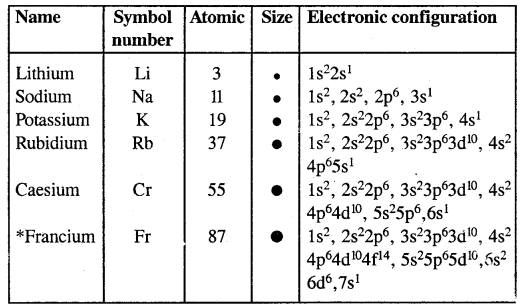
The s-Block Elements Class 11 Notes Chemistry 1
Francium is radioactive. Its largest-lived isotope 223 Fr has a half-life of only 21 minutes.

1. General characteristics of the alkali metals
(j) All the alkali metals have one valence electron ns1. This loosely held s-electron makes them the most electropositive metals which readily give M+ ions. Hence they are never found in a free state.
M → M+ + e-

Atomic and Ionic Radii
They have the largest sizes in a particular period in the periodic table. With the increase in atomic number, the atom becomes larger.

The monovalent ions (M+) are smaller than the parent atom, e.g.
Na+ → Na
K+ → K and so on

The atomic radii and ionic radii of alkali metals increase on moving down the group.
Li < Na < K < Rb < Cs and similarly
Li+ < Na+ < K+ < Rb+ < Cs+

Ionisation Enthalpies
Due to large sizes, the ionisation enthalpies of alkali metals are considerably low and decrease down the group from Li so Cs, because the effect of increasing size outweighs the increasing unclear charge.

Hydration Energy: The hydration enthalpies of alkali metal ions decrease with an increase in ionic sizes.
Li+ > Na+ > K+ > Rb+ > Cs+
Li+ ion has a maximum degree of hydration and for this reason, lithium salts are mostly hydrated e.g. LiCl.2H2O.

Physical Properties:
1. Physical Appearance: Alkali metals are silvery-white, soft and light metals.

2. Density: Because of their large size, these elements have low densities, which increases down the group from Li to Cs. However, potassium is lighter than sodium.

3. Melting points & boiling points: The melting and boiling points of the alkali metals are low indicating weak metallic bonding.

4. Flame colouration: The alkali metals and their salts impart characteristic colour to an oxidizing flame.” This is due to energy imparted to the loosely bound electron as a result of which it gets excited and jumps to higher energy levels. When the excited electron comes back to the ground state, there is the emission of radiation in the visible region.

The s-Block Elements Class 11 Notes Chemistry 2
Alkali metals can therefore be detected by their flame tests.

Chemical Properties Of Alkali Metals:
The alkali metals are highly reactive due to their large size and low ionisation enthalpy and reactivity increases down the group.
1. Reactivity towards air: The alkali metals tarnish in dry air due to the formation of an oxide which in turn reacts with moisture to form hydroxides. They burn vigorously in oxygen forming oxides. Li forms monoxide, sodium forms peroxide, the other metals form superoxides.
2Li + O2 → 2LiO (Oxide)
2Na + O2 → Na2O2 (peroxide)
M + O2 → MO2 (superoxide)
[M = K, Rb, Cs]

Lithium (Li) shows exceptional behaviour in reacting with the nitrogen of air directly to form die nitride Li3N as well.
6Li + N2 → 2Li3N (from the air)

Due to extreme reactivity, these metals are kept in kerosene oil.

2. Reactivity towards water:
2M + 2H2O → 2M+ + 2OH + H2
M = an alkali metal

Li reacts less vigorously with water. Other metals of the group react explosively with water. Reactivity increases down the group which is due to an increase in the electropositive character.

3. Reactivity towards hydrogen: Alkali metals react with hydrogen at about 673 K [Lithium at 1073 K] to form ionic hydrides which have high melting solids.
2M + H2 → 2M+H

They also react with proton donors such as alcohol, gaseous ammonia and alkynes.
2C2H5OH + 2M → 2C2H5OM + H2
CH = CH + Na → CH ≡ CNa+ + \(\frac{1}{2}\)H2(g)

4. Reactivity towards halogens: The alkali metals react readily with halogens to form ionic halides M+X. However, lithium halide is somewhat covalent because of polarisation (The distortion of the electron cloud of the anion by the cation is called polarisation)
2M + X2 → 2M+X Metallic (halide)

5. Solubility in liquid ammonia: All alkali metals are soluble in liquid ammonia. Dilute alkali metal-ammonia solution is blue in colour. With increasing concentration of metal in ammonia the blue colour starts changing to that of metallic copper after which a further amount of metal does not dissolve.

6. Reducing property (oxidation potentials): The tendency of an element to lose an electron is measured by its standard oxidation potential (E°), the more the value of E° of an element stronger will be its reducing character.
Since alkali metals have high values of E° these are powerful reducing agents and further lithium having the highest value is the strongest of them.

However, among the alkali metals, lithium although, has the highest ionization energy, yet is the strongest reducing agent. The greater reducing power of lithium is due to its larger heat of hydration which in turn is due to its small size.

7. Formation of alloys: The alkali metals form alloys amongst themselves as well as with other metals. The alkali metals dissolve readily in mercury forming amalgams. The process is highly exothermic.

General Characteristics Of The Compounds Of Alkali Metals:
(a) Oxides: Alkali metals when burnt in the air form oxides. The nature of oxides depends upon the nature of the alkali metal.

Under ordinary conditions, lithium forms the monoxide (Li2O), sodium forms the peroxide (Na2O2) and the other alkali metals form mainly superoxides (MO2) along with a small number of peroxides.

The increasing stability of the peroxide or superoxide, as the size of the metal ion increases, is due to the stabilization of large anions by larger cations through lattice energy effects. These oxides are easily hydrolysed by water to form the hydroxides according to the following reactions:
M2O + H2O → 2M+ + 2OH
M2O2 + 2H2O → 2M+ + 2OH + O2
2MO2 + 2H2O → 2M+ + 2OH + H2O2 + O2

The oxides and the peroxides are colourless, but the superoxides are yellow or orange coloured. The superoxides are also paramagnetic. Sodium peroxide is widely used as an oxidizing agent in inorganic chemistry.

(b) Hydroxides: Alkali metal hydroxides, MOH are prepared, by dissolving the corresponding oxide in water. Their solubility in the water further increases as we move down the group due to a decrease in lattice energy.

Properties:

  1. These are white crystalline solid, highly soluble in water and alcohols. Their solubility in the water further increases as we move down the group due to a decrease in lattice energy.
  2. Since alkali metals are highly electropositive, their hydroxides form the strongest bases known. They dissolve in water with the evolution of much heat to give a strongly alkaline solution.
  3. They melt without decomposition and are good conductors of electricity in the fused state.
  4. These are stable to heat and do not lose water even at red heat. The thermal stability increases on moving from Li to Cs. However, they sublime at about 400°C and the vapours mainly consists of dimers. (MOH)2.

(c) Halides: Alkali metal halides arc prepared by the direct combination of the element, M and halogens. They are normally represented by the formula MX and Cs and Rb, being of large size, also form Polyhalides, i.e. Csl3

Properties:

  1. All alkali halides except lithium fluoride are freely soluble in water (LiF is soluble in non-polar solvents).
  2. They have high melting and boiling points.
  3. Solubility of halides of alkaline metals: The solubility of alkali metal halides show a gradation. For example

    The s-Block Elements Class 11 Notes Chemistry 3
  4. They are good conductors of electricity infused state.
  5. They have an ionic crystal structure. However, lithium halides have a partly covalent character due to polarising power of Li+ ions.

(d) Carbonates and bicarbonates: All alkali metals from carbonates of the type M2CO3. Due to the high electropositive nature of the alkali metals, their carbonates (and also the bicarbonates) are highly stable to heat (however, lithium carbonate decomposes easily by heat. Further, as the electropositive character increases in moving down the group, the stability of carbonates (and bicarbonates) increases in the same order.

Both carbonates and bicarbonates are quite soluble in water and their solubility increases as we move down the group from Li to Cs. Since carbonates are salts of a weak acid (carbonic acid H2CO3), they are hydrolysed in water to give a basic solution.
2M+ + CO3 + H – OH = 2M+ + HCO32- + OH

Since the alkali metals are highly electropositive, these are the only elements that form stable solid carbonates. However, lithium due to its less electropositive nature does not form solid bicarbonate.

(e) Hydrides: Alkaline metals form hydrides of the type M+N. The presence of hydrogen as an anion in alkali metal hydrides is evidenced by the fact that on electrolysis hydrogen is liberated at the anode. The hydrides are not very stable. They react with water liberating hydrogen
LiH + H2O → LiOH + H2

These hydrides are, therefore, used as reducing agents. Lithium aluminium hydride, LiAlH4 is even a stronger reducing agent and is used in organic chemistry.

2. Anomalous properties of Lithium:
1. Points of difference between lithium and other Alkali Metals:
(a) Lithium is much harder, its m.p. and b.p. are higher than the other alkali metals.

(b) Lithium is the least reacting but the strongest reducing agent among all the alkali metals. On combustion in air, it forms mainly monoxide Li2O and the nitride, Li3N, unlike other alkali metals.

(c) LiCl is deliquescent and crystallizes as a hydrate, LiCl.2H2O whereas other alkali metal chlorides do not form hydrates. Lithium bicarbonate is not obtained in solid form while all other elements of this group form solid bicarbonate. Lithium unlike other alkali metals forms no acetylide on reaction with ethane.

(d) Lithium nitrate when heated gives lithium oxide Li2O whereas other alkali metal nitrates decompose to give the corresponding nitrite.
4LiNO3 → 2Li2O + 4NO2 + O2
4NaNO3 → 2NaNO2 + O2

(e) LiF and Li2O are comparatively much less soluble in water than the corresponding compounds of other alkali metals.

2. Points of similarities between Lithium and Magnesium
(a) Both lithium and magnesium are harder and lighter than other elements in their respective groups.
(b) Both Li and Mg react slowly with cold water. Their oxides and hydroxides are much less soluble and their hydroxides decompose on heating.
2LiOH → Li2O + H2O
Mg(OH)2 → MgO + H2O

(c) Both form nitrides by direct combination with N2.
6Li + N2 → 2Li3N
3Mg + N2 → Mg3N2

(d) Their oxides do not combine with an excess of O2 to give peroxide or superoxide.

(e) The carbonates of both decompose on heating to give oxide and CO2.
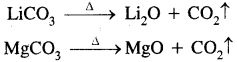
The s-Block Elements Class 11 Notes Chemistry 4
Solid bicarbonates are not formed by lithium and magnesium.

(f) Both LiCl and MgCL are soluble in ethanol.

(g) Both lithium perchlorate LiClO4 and magnesium perchlorate Mg(ClO4)2 are extremely soluble in ethanol.

(h) Both LiCl and MgCl2 are deliquescent and crystallise from aqueous solution as hydrates, LiCl.2H2O and MgCl2.8H2O.

Some Important Compounds Of Sodium:
1. Sodium carbonate (washing soda) Na2CO3.10H2O: Sodium carbonate is generally prepared by the Solvay process. In this process, the advantage is taken of the low solubility of sodium bicarbonate whereby it gets precipitated in the reaction of brine solution (sodium chloride) with ammonium bicarbonate. The latter is prepared by passing CO2 to a concentrated solution of sodium chloride saturated with ammonia.

Ammonium carbonate first formed changes to ammonium bicarbonate.
1. 2NH3 + H2O + CO2 → (NH4)2 CO3
2. (NH4)2CO3 + H2O + CO2 → 2NH4HCO3
3. NH4HCO3 + NaCl → NH4Cl + NaHCO3

Sodium bicarbonate crystal separates. These are heated to give sodium carbonate.

The s-Block Elements Class 11 Notes Chemistry 5
In this process, NH3 is recovered when the solution containing NH4Cl is treated with Ca(OH)2 Calcium chloride is obtained as a by-product.

5. 2NH4Cl + Ca(OH)2 → 2NH3 + CaCl2 + H2O

Properties of sodium carbonate

  1. It is a white crystalline solid which exists as decahydrate, Na2CO310H2O.
  2. It is readily soluble in water.
  3. On heating, the decahydrate loses its water of crystallisation to form monohydrate. Above 373 K, the monohydrate becomes completely anhydrous and changes to a white powder called soda ash.
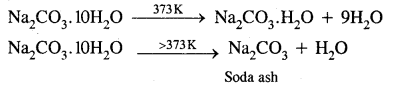
    The s-Block Elements Class 11 Notes Chemistry 6
  4. It gets hydrolysed by water to form an alkaline solution
    CO32- + H2O → HCO3 + OH

Uses of sodium carbonate

  1. It is used in water-softening, laundering and cleaning.
  2. It is used in the manufacture of glass, soap, borax and caustic soda.
  3. It is used in paper, paint and textile industries.
  4. It is an important laboratory reagent both in qualitative and quantitative analysis.

Sodium Chloride NaCl:
Crude sodium chloride present in seawater (2.7 to 2.9% salt) is generally obtained by evaporation. It contains Na2SO4 CaSO4, CaCl2 and MgCl2 as impurities. CaCl2 and MgCl, are undesirable impurities because they are deliquescent (absorb moisture easily from the atmosphere).

To obtain pure NaCl, the crude salt is dissolved in a minimum amount of water and filtered to remove insoluble impurities. The solution is then saturated with hydrogen chloride gas. Crystals of pure sodium chloride separate out. CaCl2, and MgCl2, being more soluble than NaCl remain in the solution.

Sodium chloride melts at 1081 K. It has a solubility of 36.Ogin 100g of water at 273K. The solubility does not increase appreciably with an increase in temperature.

Sodium Hydroxide (Caustic Soda) NaOH:
It is manufactured from the electrolysis of brine solution (an aqueous solution of NaCl) by Castner-Kellner cell. A mercury cathode and carbon anode are used.
Na+Cl (aq) → Na+(aq) + Cl (aq)
At cathode
The s-Block Elements Class 11 Notes Chemistry 7
At anode
Cl → \(\frac{1}{2}\) Cl2 + e

The amalgam on treatment with water gives sodium hydroxide and H2 gas.
2Na-amalgam + 2H2O → 2NaOH + 2Hg + H2

Properties

  1. It is a white translucent solid.
  2. Its M.Pt. is 591 K.
  3. It gives a strongly alkaline solution in water.
  4. Its crystals are deliquescent.
  5. NaOH solution formed at the surface reacts with CO2 from the atmosphere to form a crystal of Na2CO3.
    2NaOH + CO2 → Na2CO3 + H2O

Uses of sodium hydroxide:

  1. It is used in the manufacture of sodium metal, soap, rayon, paper, dyes and drugs.
  2. It is used in petroleum refining.
  3. Sodium hydroxide is used for mercerizing cotton to make cloth unshrinkable.
  4. It is used as a reagent in the laboratory.

Sodium Bicarbonate (Baking Soda) NaHCO3:
Preparation
Na2CO3 + H2O + CO2 → 2NaHCO3

Uses:

  • Sodium bicarbonate is a mild antiseptic for skin infections.
  • It is used in fire-extinguishers.
  • It is known as baking soda because it decomposes on heating to generate bubbles of CO2 (leaving holes in cakes or pastries and making them light and fluffy).

Biological Role Of Sodium & Potassium:
K+ ions and Na+ ions are present in the red blood cells. A 70 kg weighing man contains about 90g of Na and 170gof K. Sodium ions are found primarily on the outside of cells, is located in the blood plasma and in the interstitial fluid which surrounds the cells. These ions participate in the transmission of nerve signals in regulating the flow of water across cell membranes and in the transport of sugars and amino acids into cells.

Sodium and potassium which are chemically so alike, differ quantitatively in their ability to penetrate cell membranes, in their transport mechanisms and their efficiency to activate enzymes. Thus potassium ions are the most abundant cations within cell fluids, where they activate many enzymes, participate in the oxidation of glucose to produce ATP and with sodium, are responsible for the transmission of nerve; signals.

The ionic gradients of Na+ and K+ demonstrate that a discriminatory mechanism, called the sodium-potassium pump operate across the cell membranes which consumes more than one-third of the ATP used by a resting animal- about 15 kg per 21 h in a resting human.

Group-2 Elements: Alkaline Earth Metals: The group 2 elements comprise beryllium (Be), magnesium (Mg), calcium (Ca), strontium (Sr), Barium (Ba) and radium (Ra). They follow alkali metals in the periodic table. These (except Beryllium) are known as alkaline earth metals.
1. Atomic properties:
(a) Electronic configuration:
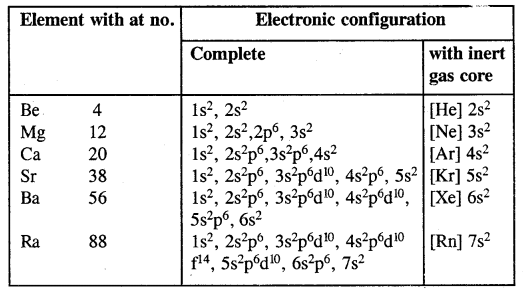
The s-Block Elements Class 11 Notes Chemistry 8
(b) Atomic and ionic sizes: The atomic and ionic radii of the alkaline earth metals are smaller than those of the alkaline metals in the corresponding periods. This is due to the increased nuclear charge in these elements.

(c) Ionization Enthalpies: The first ionization enthalpies of the alkaline earth metals are higher than those of Group 1 metals. The second ionization enthalpies of the alkaline earth metals are smaller than those of the corresponding alkali metals.

2. Physical properties of the alkaline earth metals:
(a) Physical appearance: These metals in general are silvery-white, lustrous and relatively soft, but harder than the alkali metals. Beryllium and magnesium appear to be somewhat greyish.

(b) Melting and boiling points: The fairly higher melting and boiling points of the alkaline earth metals compared to those of the corresponding alkali metals and attributed to their smaller sizes and presence of two valence electrons. The trend is, however, not systematic.

(c) Flame colour: Chlorides of alkaline earth metals, except that of Be and Mg, produce the characteristic colour of flame due to easy excitation of electrons to higher energy levels. Beryllium and magnesium atoms due to their small size, bind their electrons more strongly, i.e., their ionisation energies are high. Hence these possess high excitation energy and not excited by the energy of the flame to a higher energy state with a result no colour is produced in the flame.

(d) Electrical and thermal conductivities: These properties are characteristics of typical metals.

3. Chemical Reactivity:
(a) Action of air: Their less reactivity than the alkali metals is evident by the fact that they are only slowly oxidised on exposure to air. However, when burnt in the air, they form ionic oxides of the type MO, except Ba and Ra which give peroxides. Thus, the tendency of the metal to form higher oxides like peroxide increases on moving down the group. On ignition powdered Be burns to give BeO & Be3N2. Mg also burns with dazzling brilliance to give MgO and Mg3N2.

(b) Action of water: These metals react slowly with water liberating hydrogen and forming metal hydroxides, e.g.
Ca + 2H2O → Ca(OH)2 + H2
The reaction with water becomes increasingly vigorous on moving down the group.
Ba > Sr > Ca > Mg > Be (Reactivity with water)

The inertness of Be and Mg towards water is due to the formation of a protective thin layer of hydroxide on the surface of the metals.

(c) Action of hydrogen: All these elements, except beryllium, combine with hydrogen to form hydrides MH2, BeH2 is prepared indirectly.
2BeCl2 + LiAlH4 → 2BeH2 + LiCl + AlCl3

(d) Action of halogens: All these elements combine with halogens at elevated temperatures forming halides, MX2. Beryllium halides are covalent, while the rest are ionic. The solubility of halides (except fluoride) decreases on moving down the group.

The s-Block Elements Class 11 Notes Chemistry 9
(e) Action with nitrogen: All these elements burn in nitrogen forming nitrides, M3N2 which react with water to liberate ammonia.
3Ca + N2 → Ca3N2
Ca3N2 + 6H2O → 3Ca(OH)2 + 2NH3
The ease of formation of nitrides decreases on moving down the group.

(f) Action with acids: On account of their high oxidation potentials, they readily liberate hydrogen from dilute acids. For example.
Mg + 2HCl → MgCl2 + H2

The reactivity of alkaline earth metals increases on moving down the group. This is due to an increase in electropositive character from Be to Ba. Thus beryllium reacts very slowly, Mg reacts very rapidly while Ca, Sr and Ba react explosively.

(g) Formation of amalgam and alloys: They form an amalgam with mercury and alloys with other metals.

(h) Complex formation: Beryllium, due to its small size, forms a number of stable complexes, e.g., [BeF3], [BeF4]2-, [Be(H2O)]2+ etc.

(i) Reducing Character: They are strong reducing agents, Their reducing power is less than the corresponding alkali metals.

(j) Solubility in liquid ammonia: Alkaline earth metals dissolve in liquid ammonia giving coloured solutions. When the metal- ammonia solutions are evaporated, Hexammoniates M(NH3)6 are formed. The tendency for the formation of ammoniates decreases with an increase in the size of the metal atom, i.e., on moving down the group.
M + (x + y) NH3 → M(NH3)2+ + 2e (NH3)y

4. General characteristics of compounds of the alkaline earth metals:
(a) Oxides and Hydroxides: The alkaline earth metal oxides, MO are prepared either by heating the metal in oxygen or better by calcination of carbonates.
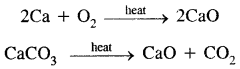
The s-Block Elements Class 11 Notes Chemistry 10
These are extremely stable, white crystalline solids. Except for BeO, all the alkaline earth oxides are ionic, in which doubly charged ions are packed in a NaCl-type of lattice leading to their high crystal lattice energy and hence high stability. However, beryllium oxide is covalent due to its small size and relatively large charge on the beryllium ion. The high melting point of BeO is due to its polymeric nature.

The heavier metal oxides react with water to form soluble hydroxides which are strong bases.
MO + H2O → M(OH)2 + heat [where M = Ca2+, Ba2+ or Sr2+)

The solubility of hydroxides of alkaline earth metals in water increases on moving down the group. This is due to the fact that with the increase in the size of the cation (down a group), the lattice energy- decreases more than the decrease in hydration energy.

Halides:
They are obtained:

  1. by heating the metal with halogens at high temperature or
  2. by treating, metal carbonates with dilute halogen acids.

Beryllium halides are covalent compounds due to their small size and relatively high charge of Be2+ ion causing high polarising power. Due to the covalent bonding beryllium chloride, shows the following anomalous characteristics.

  1. It has low melting and boiling points.
  2. It does not conduct electricity in the fused state.
  3. It is soluble in organic solvents such as ether.
  4. It is hygroscopic and fumes in the air due to hydrolysis
    BaCl2 + 2H2O → Be(OH)2 + 2HCl(g)
  5. It is electron-deficient and behaves as Lewis acid.
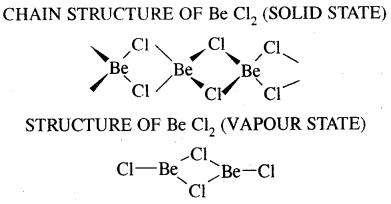
    The s-Block Elements Class 11 Notes Chemistry 11

The chlorides, fluorides, bromides and iodides of other alkaline earth metals are ionic solids and thus possess the following characteristics.

  1. The melting and boiling points are high.
  2. They conduct electricity in the molten state. Further, since the ionic character of the halides increases on moving down the group, the melting point and conductivity increase in the group from Mgd2 to BaCl2.
  3. They are “hygroscopic and readily form hydrates, e.g., MgCl2.6H2O, CaCl2.2H2O, BaCl2.2H2O.
  4. The halides (except fluorides) of the alkaline earth metals are soluble in water and their solubility decreases with an increasing atomic number of the metal due to a decrease in the hydration energy with the increasing size of the metal ion.

(c) Carbonates: The carbonates are invariable insoluble and therefore occur as solid rock materials in nature. However, the carbonates dissolve in water in the presence of carbon dioxide to give bicarbonates.

The s-Block Elements Class 11 Notes Chemistry 12
Most beryllium salts of strong oxo-acids crystallize as soluble hydrates. Beryllium carbonate is prone to hydrolysis and can be precipitated only in an atmosphere of carbon dioxide. The carbonates of magnesium and the other alkaline earth metals are all sparingly soluble in water, their thermal stability increases with increasing cationic size. Calcium carbonate finds use in the Solvay process for the manufacture of sodium carbonate in glassmaking and in cement manufacture.

(d) Sulphates: These can be prepared by dissolving the metal oxide in H2SO4.
MgO + H2SO4 → MgSO4 + H2O

The solubility of the sulphates of the alkaline earth metals decreases regularly on moving down the group. Thus beryllium sulphate is highly soluble in water, while barium and radium sulphates are practically insoluble.
The insolubility of barium sulphate is used for detecting an obstruction in the digestive system by the technique commonly known as barium meal.

The presence of BaSO4 in the stomach helps in getting X-ray pictures because of the great scattering power of heavy Ba2+ ions. Barium sulphate is also used as a white pigment.

(e) Nitrates: The nitrates are made by the dissolution of the carbonates in dilute nitric acid. Magnesium nitrate crystallizes with six molecules of water. Barium nitrate crystallizes as an anhydrous salt. All of them decompose on heating giving the oxide.
2M(NO3)2 → 2MO + 4NO2 + O2 (M = Be, Mg, Ca, Sr or Ba)

Strontium and barium nitrates are used in pyrotechnics for giving red and green flames.

Anomalous behaviour of Beryllium
The anomalous behaviour of beryllium is mainly died to its very small size and partly due to its high electronegativity. These two factors increase the polarising power [Ionic charge/ (ionic radii)2] of Be2+ ions to such extent that it becomes significantly equal to the polarising power of Al3+ ions.

Hence the two elements resemble (diagonal relationship) very much.
1. Both of them have the same value of electronegativity (1.5).

2. The standard oxidation potential of Be and Al are of the same order (Be = 1.69 V, Al = 1.7 V)

3. In nature both occur together in beryl, 3BeO, Al2O3, 6SiO2.

4. Due to its small size, beryllium has a high charge density and therefore, exhibits a strong tendency to form covalent compounds. Aluminium too has a strong tendency to form covalent compounds. Thus salts of both beryllium and aluminium have low m.p. are soluble in organic solvents and get hydrolysed by water.

Beryllium does show some tendency to form covalent compounds but other alkaline earth metals do not form covalent compounds.

5. Unlike other alkaline earth metals but like aluminium, beryllium is not easily affected by dry air.

6. Both (Be and Al) do not decompose water even on boiling; because of their weak electropositive character. Other alkaline earth » metals decompose even cold water evolving hydrogen.

7. Beryllium, like aluminium, reacts very slowly with dilute – mineral acids liberating hydrogen.
Be + 2HCl → BeCl2 + H2
2Al + 6HCl → 2AlCl3 + 3H2
Other alkaline earth metals react very readily with dilute acids.

8. The chlorides of both beryllium and aluminium have bridged chloride structures in the vapour phase.
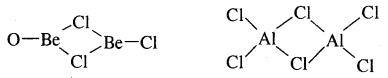
The s-Block Elements Class 11 Notes Chemistry 13
9. Salts of these, metals form hydrated ions e.g., [Be(OH2)4]3+ and [Al(OH2)6]3+ in aqueous solutions.

10. Beryllium and aluminium both react with caustic alkalies to form beryllate and aluminate respectively. Other alkaline earth metals do not react with caustic alkalies.

Some Important Compounds Of Calcium:
1. Calcium oxide (Quick lime), CaO: Preparation: By heating limestone at 1273 K

The s-Block Elements Class 11 Notes Chemistry 14
(a) The reaction is reversible and thus in order to assure the complete decomposition of CaCO3, carbon dioxide formed must be swept away by a current of air.

(b) Temperature should not be too high, because, at high temperature, clay (present as an impurity in limestone) will react with lime to form fusible silicates.

Properties:
1. Calcium oxide is a white amorphous substance.

2. When heated in an oxy-hydrogen flame, it gives an intense white light called limelight.

3. Action of water: On adding water, it gives a hissing sound and forms calcium hydroxide commonly known as slaked lime. The reaction is exothermic and known as slaking of lime.
CaO + H2O → Ca(OH)2 ΔH = – 64.5 kJ/mol

4. It reacts with SiO2 and P2O5 at high temperature forming calcium silicate, CaSiO3 and calcium phosphate; Ca3(PO4)2 respectively
6CaO + 3P2O5 → 2Ca3(PO4)2

5. With moist chlorine it forms bleaching powder, Ca(OCl)2. With moist CO2 it forms CaCO3 and with moist SO2 it forms CaSO3 and with moist HCl gas, it forms CaCl2. None of these gases will react when perfectly dried.

6. When heated with carbon at 2000°C, it forms calcium Carbide.

The s-Block Elements Class 11 Notes Chemistry 15
Uses of calcium oxide:
(a) It is used as a drying agent as such or as soda lime.
(b) Large quantities of quick-lime are used in the production of slaked lime.
(c) As a constituent of mortar, it is used on a very large scale in building constructions.

2. Calcium Hydroxide (Slaked lime), Ca(OH)2:
Preparation:

  1. By treating lime (quick lime) with water
    Ca O + H2O → Ca(OH)2
  2. By the action of caustic alkalies on a soluble calcium salt.

Properties:
(a) It is a white amorphous powder, only sparingly soluble in water. Its solubility decreases with the increase in temperature.

(b) When dried and heated to redness, it loses a molecule of water and converted into calcium oxide (lime).

(c) Action of CO2: Lime water is frequently used for the detection of C02 gas. C02 gas turns lime water milky due to the formation of CaC03.
Ca(OH)2 + CO2 → CaC03(s) + H2O
However, the precipitate disappears on prolonged treatment with C02 because of the conversion of CaS03 (insoluble) to calcium bicarbonate (soluble).

The s-Block Elements Class 11 Notes Chemistry 16
The above solution, if heated again gives turbidity. This is due to the decomposition of calcium bicarbonate to calcium carbonate,

The s-Block Elements Class 11 Notes Chemistry 17
(d) Milk of lime reacts with chlorine to form hypochlorite, a constituent of bleaching powder
2Ca(OH)2 + 2Cl2 → CaCl2 + Ca(ClO)2 + 2H2O

Uses of calcium hydroxide: Calcium hydroxide finds various uses:
(a) For absorbing acid gases
(b) For preparing ammonia from ammonium chloride
(c) In the production of mortar, a building material
(d) In glassmaking, tanning industry, for the preparation of bleaching powder and for purification of sugar.
(e) It is also used as a disinfectant
(f) As lime water in laboratories.

3. Plaster of Paris, CaSO4. \(\frac{1}{2}\) H2O
Preparation:
It is obtained when gypsum, CaSO4.2H2O is heated to 393 K
2(CaSO4.2H2O) → 2CaSO4.H2O + 3H2O

Properties:
1. It is a white powder.

2. It has a very remarkable property of setting into a hard mass on wetting with water. So, when water is added to Plaster of Paris, it sets into a hard mass in about half an hour. The setting of Plaster of Paris is due to its hydration to form crystals of gypsum which set to form a hard solid mass.
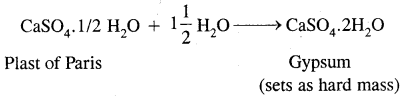
The s-Block Elements Class 11 Notes Chemistry 18
The setting of plaster of Paris is accompanied by a slight expansion in volume due to which it is used in making castes for statues, toys, etc.

Uses of Plaster of Paris:
(a) It finds extensive use in surgical bandages, in casting and moulding.
(b) It is also employed in dentistry, in ornamental work and for taking castes of statues and busts.

Properties:
(a) It is a white powder and exists in two crystalline forms: Calcite and aragonite.
(b) It is insoluble in water but dissolves in the presence of CO2 due to the formation of calcium bicarbonate.
CaCO3 + H2O + CO2 → Ca(HCO3)2

Uses:
(a) Limestone is used:

  • for the manufacture of the lime, element, washing soda and glass and
  • as a flux, since CaO obtained from its decomposition combines with silica to form calcium silicate, CaSiO3.

(b) Marble is used:

  • for building purposes and
  • in the laboratory for the production of CO2 gas.

(c) Chalk is used:

  • in paints (white ash) and distempers and
  • in the production of CO2 in the laboratory.

(d) Precipitated chalk is used:

  • in toothpaste and powders
  • in medicine for indigestion
  • in adhesives and in cosmetic powders and
  • to de-acidify wines.

4. Portland cement: It is made by heating a mixture of limestone (or chalk, shells etc.) with alumina silicates in carefully controlled amounts so as to give the approximate composition CaO 70%, SiO2 20%, Al2O3 5%, FeCO3 3%. The new minerals are ground to pass 300-mesh sieves and then heated in a rotary kiln to 1773 K to give sintered clinker. This is ground to 325 mesh sieve and mixed with 2-5% gypsum. An average-sized kiln can produce 1000-2000 tonnes of cement per day.

When mixed with water, the setting of cement takes place. Chemically, it is the hydration of the molecules of the constitutions and their rearrangement.

The adhesion of other particles to each other and to the embedded aggregates is responsible for the strength of the cement which is due, ultimately, to the formation of Si-O-Si-O bonds.

The purposes of adding gypsum are only to slow down the process of setting the cement so that it gets sufficiently hardened.

Concrete: It is a mixture of cement, sand, gravel (small pieces of stone) and the appropriate amount of water. When the cement concrete is filled in and around a wire-netting or skeleton of iron rods and allowed to set, the resulting structure is known as reinforced concrete (RCC).

Uses of cement: It is used in concrete and reinforces concrete, in plastering and in the construction of bridges, dams and buildings.

Biological Importance Of Magnesium & Calcium:
An adult body contains about 25g of Magnesium and 1200 g of calcium as compared with only 5g of iron and 0.06g of copper. The daily requirement in the human body has been estimated to be 200-300 mg.

All enzymes that utilize ATP in phosphate transfer require magnesium as the cofactor.

The main pigment for the absorption of light in plants for photosynthesis is green coloured chlorophyll which contains magnesium.

About 99% of body calcium is present in bones and teeth. It also plays important roles in neuromuscular function, interneuronal transmission, cell membrane integrity and blood coagulation. The calcium concentration in plasma is regulated at about 100 mg L-1. It is maintained by two hormones.

Calcitonin and parathyroid hormone. Bone is not an inert and unchanging substance but is continuously being solubilized and redeposited to the extent of 400 mg per day in man. All the calcium passes through the plasma.

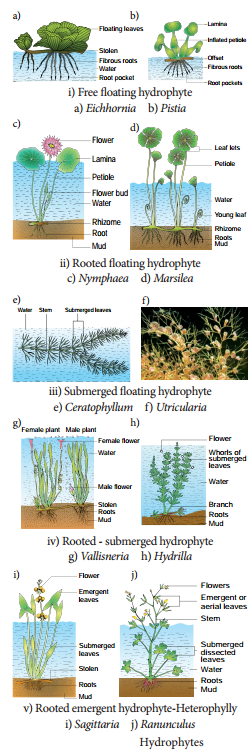
Hydrogen Class 11 Notes Chemistry Chapter 9

By going through these CBSE Class 11 Chemistry Notes Chapter 9 Hydrogen, students can recall all the concepts quickly.

Hydrogen Notes Class 11 Chemistry Chapter 9

→ Hydrogen: Hydrogen is the lightest atom with only one electron. Loss of this electron results in an elementary particle, the proton.

→ Isotopes of hydrogen: Protium (11H), Deuterium (D or 21H) & Tritium (T or 31H). Tritium is radioactive.

→ Water-Gas Shift Reaction: Dihydrogen is obtained on an industrial scale by this reaction.

→ Bond dissociation Enthalpy: Bond dissociation enthalpy of dihydrogen is (435.88 KJ mol-1) is highest for a single bond between two atoms of any elements.

→ Hydrides: Dihydrogen combines with almost all the elements under appropriate conditions to form hydrides. Three types of hydrides as Ionic or saline, covalent or molecular hydrides & metallic or non-stoichiometric hydrides.

→ Hydrogen Economy: The basic principle of a hydrogen economy is the transportation & storage of energy in the form of liquid or gaseous dihydrogen. In fact, it has promising potential for use as a non-polluting fuel of the near future.

→ Water: It is of great chemical & biological significance. Water molecule is highly polar in nature due to its bent structure. This property leads to hydrogen bonding which is maximum in ice & least in water vapor. Its property to dissolve many salts, particularly in large quantity makes it hard & hazardous for industrial use.

Temporary & permanent hardness can be removed by the use of, zeolites & synthetic ion exchangers.

→ Heavy water: D2O is manufactured by the electrolysis of normal water. It is essentially used as a moderator in nuclear reactors.

→ Hydrogen peroxide: H2O2 has an interesting non-polar Structure & widely used as an industrial bleach & in pharmaceutical & pollution control treatment of industrial & domestic effluents.

→ Dihydrogen: Isotopes -Protium, Deuterium & Tritium, No. of neutrons-NIL, One, & Two Tritium is radioactive

→ Water-Gas: Mixture of CO & H2.

→ Synthesis Gas or Syn Gas: When water gas is used for the synthesis of methanol & a no. of hydrocarbons. It is also called synthesis gas or syngas.

→ Coal Gasification: The process of producing syngas from coal is called coal gasification.

→ Uses of dihydrogen: In ammonia synthesis & in nitrogenous fertilizers & for preparing Vanaspati Ghee, manufacturing of organic chemical, particularly methanol; HCl & hydrides. Used as rocket fuel in space research. It does not produce any pollution & releases greater energy per unit mass of fuel in comparison to Gasoline & other fuels.

→ Hydrides: Three types of hydrides:

  1. Ionic or Saline
  2. Covalent or molecular
  3. metallic or interstitial

→ Molecular hydrides:

  1. Electron deficient
  2. Electron precise
  3. Electron rich

→ Water: Colourless & tasteless liquid. The unusual properties of water in the condensed phase (liquid & solid states) are due to the presence of extensive hydrogen bonding between water molecules.
Str. of the water molecule
Hydrogen Class 11 Notes Chemistry 1
→ Hard & Soft Water: The presence of Magnesium & Calcium salts in the form of hydrogen bicarbonates chloride & sulfate in water make water hard. Hard water does not give lather with soap. Water-free from soluble salts of calcium & magnesium is called Soft Water. It gives lather with soap easily.

→ Removal of Hardness of Water: Temporary hardness by boiling of water & by dark’s method. Permanent hardness by treatment with washing soda, Calgon’s method, ion exchange method & synthetic resins method.

→ Hydrogen-peroxide: Hydrogen peroxide is an important chemical used in the pollution control treatment of domestic & industrial effluents.
Hydrogen Class 11 Notes Chemistry 2
→ Storage of H2O2: H2O2 decomposes slowly on exposure to light. In presence of metal surfaces or traces of alkali (present in glass- containers), the following reaction is catalyzed.
2H2O2 (l) → 2H2O(l) + O2(g)

It is, therefore, stored in wax-lined glass or plastic vessels in dark. Urea can be added as a stabilizer. It is kept away from dust because dust can induce explosive decomposition of the compound.

→ Uses of H2O2:

  1. As a hair bleach & a mild disinfectant. It is sold in the market as Perhydrol.
  2. In manufacturing chemicals that are used in high-quality detergents.
  3. In the synthesis of hydroquinone, tartaric acid & incertain food products & in pharmaceuticals (cephalosporin), etc.
  4. It is also used in environmentally green chemistry.

→ Heavy Water: D2O uses as a moderator in nuclear reactors & can be prepared by exhaustive electrolysis of water.

→ Hydrogen Economy: Hydrogen economy is an alternative. The basic principle of a hydrogen economy is the transportation & storage of energy in the form of liquid or gaseous dihydrogen. Nowadays, it is also used in fuel cells for the generation of electric power. Position of Hydrogen in the periodic table

Hydrogen is the first element in the periodic table. Its atom has only one proton and one electron. In the elemental form, it exists as H2 and is called dihydrogen. The electronic configuration of hydrogen is Is1. Alkali metals have an electronic configuration of ns1 which is similar. On the other hand like halogens (electronic configuration ns2np5, of 17th group) it is short by one electron than the corresponding noble gas configuration of He-1s2. Hydrogen thus resembles both alkali metals as well as halogens.

But hydrogen also differs from alkali metals and halogens in some other respects. Thus it is unique in its behavior and is, therefore, best placed separately in the periodic table.

Occurrence of Dihydrogen (H2):
It is the most abundant element in the universe (70% of the total mass of the universe) and is the principal element in the solar atmosphere. However, due to its light nature, it is much less abundant (0.15% by mass) in the earth’s atmosphere. In the combined form, it constitutes 15.4% of the earth’s crust and the oceans. In the combined form, besides in water, it occurs in plants, and animal tissues, carbohydrates, proteins, hydrides including hydrocarbons.

Isotopes of Hydrogen:
Hydrogen has three isotopes: protium 11H, deuterium, 21H or D, and tritium, 31H or T.

They differ from one another in the number of neutrons. Ordinary hydrogen, protium has no neutrons, deuterium has one and tritium has two neutrons in the nucleus.

Tritium is radioactive and is present as 1 atom per 1018 atoms of protium. 21H or D is also known as heavy hydrogen.

Table: Physical properties of Dihydrogen and Dideuterium
Hydrogen Class 11 Notes Chemistry 3
Preparation of Dihydrogen

Laboratory Preparation of Dihydrogen H2
(a) By the action of acids on metals: Metals (like Li. Na, Ba, Mg, Al, Zn, Fe, etc.) placed above hydrogen in the electrochemical series; when reacted with acids like HCl or dil. H2SO4 evolves hydrogen gas. Reaction with Li, K, Na, Ba, and Ca is violent while reaction with Zn, Fe, Al, and Mg is smooth.
Zn + H2SO4 → ZnSO4 + H2 (lab. method)
Fe + 2HCl → FeCl2 + H2

(b) By the action of alkalies on amphoteric metals Zn, Al, Pb, Sn, As, Sb, etc.)
Zn + 2NaOH → Na2ZnO2 (Sodium zincate ) + H2
2Al + 2NaOH + 2H2O → 2NaAlO2 (Sodium aluminate) + 3H2
Sn + 2KOH + H2O → K2SnO3 (Potassium stannate) + 2H2

(c) By the action of water on active metals (metals placed above electrochemical series)
1. Active metals like Na, K react at room temperature.
2Na + 2H2O (cold) → 2NaOH + H2 (violent)
Ca + 2H2O (cold) → Ca(OH)2 + H2 (smooth)

2. Less active metals like Zn, Mg, Al liberate hydrogen only on heating.
Mg + 2H2O (hot) → Mg(OH)2 + H2

3. Metals like Fe, Co, Ni, Sn can react only by passing steam.
3Fe (red hot) + 4H2O (steam) → Fe3O4 + 4H2

(d) By the action of water on a metal hydride:
LiH + H2O → LiOH + H2
CaH2 + 2H2O → Ca(OH)2 + 2H2

Commercial production of Dihydrogen: The commonly used processes are:

Electrolysis of acidified water, using platinum electrodes, is employed for the bulk preparation of dihydrogen.
Hydrogen Class 11 Notes Chemistry 4
(a) Hydrogen of high purity (> 99.95%) is obtained by electrolysis warm aqueous barium hydroxide between nickel electrodes.

(b) Reaction of steam on hydrocarbons or coke at high temperatures in the presence of catalyst yields hydrogen gas.
Hydrogen Class 11 Notes Chemistry 5
Hydrogen Class 11 Notes Chemistry 6
CO is converted to CO2 bypassing the gas’s steam over an iron oxide or cobalt oxide catalyst at 673K resulting in the generation of more H2.

This is called the water-gas shift reaction.

(c) Relatively smaller quantities of dihydrogen (1-17 m3 h-1) are obtained by passing a 1.1 molar mixture of vaporized methanol and water over a “base-metal chromite” type catalyst at 673 K. The mixture of hydrogen and carbon monoxide obtained is made to react with steam to give CO2 and more hydrogen.
Hydrogen Class 11 Notes Chemistry 7
(d) It is also produced as a by-product of the brine electrolysis process for the manufacture of chlorine and sodium hydroxide. Presently-77% of the industrial hydrogen produced is from petrochemicals, 18% from coal, 4% from the electrolysis of aqueous solution, and 1 % from other sources.

Properties of Dihydrogen:
(a) Physical Properties:

  1. Hydrogen is colorless, odorless, and tasteless gas.
  2. It is the lightest element and also the lightest gas.
  3. It is sparingly soluble in water.
  4. Its critical temperature is very low (-236.9°C) at or below which can be liquefied by the application of suitable pressure. At -258.8°C it can be liquefied.
  5. Its molecule is diatomic, indicated by the ratio of its specific heats at constant pressure and constant volume (Cp/Cv = 1.40).
  6. It is adsorbed (occluded) by certain metals like Fe, Au, Pt, and Pd.

(b) Chemical properties:
1. Dihydrogen H2 combines with halogens (X2) to give hydrogen halides (HX). While the reaction with fluorine takes place even in the dark, with iodine a catalyst is required.
H2(g) + X2(g) → 2HX(g) (X = F, Cl, Br, I)

2. With dioxygen, dihydrogen forms water. The reaction is strongly exothermic
2H2(g) + O2(g) → 2H2O(1) ΔH° = -285.8 kJ mol-1

3. Reaction with dinitrogen it forms ammonia (NH3)
Hydrogen Class 11 Notes Chemistry 8
ΔH° = -92.6 kJ mol-1

4. Reaction with metals: With many metals, it combines at high temperatures to yield the corresponding hydrides.
H2(g) + 2M(g) → 2MH(s)
Where M is an alkali metal

5. Reaction with metal ions and metal oxides: It reduces
some metal ions in aqueous solution and oxides of metals (less active than iron) into corresponding metals.
H2(g) + Pd2+ (aq) → Pd(s) + 2H+(aq)
H2(g) + Cu2+ (aq) → Cu(s) + 2H+(aq)
in general: YH2(g) + MxOy(s) → xM(s) + yH2O(l)

Reaction with organic compounds: It reacts with many organic compounds in presence of catalysts to give useful hydrogenated products of commercial importance. For example;

  1. Hydrogenation of vegetable oils using nickel as catalyst gives edible fats (margarine and vanaspati ghee)
  2. Hydroformylation of olefins yields aldehydes which further undergo reduction to give alcohol.
    H2 + CO + RCH = CH2 → RCH2CH2CHO
    H2 + RCH2CH2CHO → RCH2CH2CH2OH

1. The largest single use of dihydrogen is in the synthesis of ammonia which is used in the manufacture of nitric acid and nitrogenous fertilizers.

2. Dihydrogen is used in the manufacture of vanaspati fat by the hydrogenation of polyunsaturated vegetable oils like soybean, cotton seeds, etc.
Hydrogen Class 11 Notes Chemistry 9
3. It is used in the manufacture of bulk organic chemicals, particularly methanol.
Hydrogen Class 11 Notes Chemistry 10
4. It is widely used for the manufacture of metal hydrides.

5. It is used for the preparation of hydrogen chloride, a highly useful chemical.

6. In metallurgical processes, it is used to reduce heavy metal oxides to metals.

7. Atomic hydrogen and oxy-hydrogen torches find a use for cutting and welding purposes. Atomic hydrogen atoms (produced by dissociation of dihydrogen with the help of an electric arc) are allowed to recombine on the surface to be welded to generate a temperature of 4000 K.

8. It is used as rocket fuel in space research.

9. Dihydrogen is used in fuel cells for generating electrical energy. It has many advantages over conventional fossil fuels and electric power. It does not produce any pollution and releases greater energy per unit mass of fuel in comparison to gasoline and other fuels.

Hydrides:
Dihydrogen under certain reaction conditions combines with almost all elements except noble gases to form binary compounds called hydrides expressed as EH [like MgH2] or EmHn (like B2H6).

They are of 3 types:

  1. Ionic or Saline or Salt-Like Hydrides
  2. Covalent or Molecular Hydrides
  3. Metallic or Non-Stoichiometric Hydrides

1. Ionic or Saline or Salt-Like Hydrides: Lighter metal hydrides like LiH, BeH, and MgH, have significant covalent character. Ionic hydrides like K+H. Na+H are crystalline, non-volatile, and non-conducting in solid-state. However, their melts conduct electricity and in electrolysis liberate dihydrogen gas at the anode which confirms the existence of H+ ions
Hydrogen Class 11 Notes Chemistry 11
They are generally formed by s-block elements which are highly electropositive in character. These hydrides are Stoichiometric. Saline hydrides react violently with water producing dihydrogen gas.
NaH(s) + H2O(aq) → NaOH(aq) + H2(g)

Lithium hydride is rather unreactive at a moderate temperature with O2 or Cl2. It is, therefore, used in the synthesis of other useful hydrides, e.g.
8 LiH + Al2Cl6 → 2LiAlH4 + 6 LiCl
2 LiH + B2H6 → 2LiBH4

2. Molecular hydrides/[Covalent Hydrides]: These are formed by elements of highly electronegative elements (viz non-metals) which share electron(s) with hydrogen. In most cases, bonds are covalent in character, although in some cases (eg HF) bond is partly ionic in character. These have molecular lattices. The molecules are held together by weak van der Waal’s forces. These hydrides are soft, have low m.p. and b.p. They have low electrical conductivity.
The stability decreases progressively down a group, e.g.
NH3 > PH3 > AsH3 > SbH3 > BiH3

In a period the stability increases with increasing electronegativity of the element forming the hydride.
e.g., CH4 < NH3 < H2O < HF

These become increasingly acidic in character on moving from left to right along a given row in the periodic table. Thus, while NH3 is a weak base, H2O is neutral and HF is acidic. Similarly, in the next row, while PH3 is a weak base, H2S is a weak acid and HCl is highly acidic.

These are used as reducing agents.
Molecular hydrides are further classified according to the relative numbers of electrons and bonds in their Lewis structure into:

  1. Electron-deficient,
  2. Electron-precise, and
  3. Electron-rich hydrides.

An electron-deficient hydride, as the name suggests, has too few electrons for writing its conventional Lewis structure. Diborane (B2H6) is an example. In fact, all elements of group 13 will form electron-deficient compounds. They act as Lewis acids i.e., electron acceptors.

Electron-precise compounds have the required number of electrons to write their conventional Lewis structures. All elements of group 14 form such compounds (e.g., CH4) which are tetrahedral in geometry.

Electron-rich hydrides have excess electrons which are present as lone pairs. Elements of groups 15-17 form such compounds. (NH3 has 1-one pair, H2O-2, and HF-3 lone pairs). They will behave as Lewis bases i.e., electron donors. The presence of lone pairs on highly electronegative atoms like N, O, and F in hydrides results in hydrogen bond formation between the molecules. This leads to the association of molecules.

3. Metallic or non-stoichiometric (or Interstitial) Hydrides:
These are formed by many (d-block or f-block elements. However, metals of groups 7, 8, and 9 do not form hydrides. These hydrides conduct heat and electricity. They are non-stoichiometric. Hydrogen atoms occupy interstitial places in the lattices of metals. They are reducing’ agents and give out hydrogen easily. Hydrogen in them is present in atomic form.

Water:
A major part of all living organisms is made up of water. The human body has about 85 % and some plants have as much as 95 % water. It is a crucial compound for the survival of all life forms.

Physical properties of water:
It is a tasteless and colorless liquid.
The molecular mass of H2O is = 18.0151 g mol-1
Melting point = 273.0 K
Boiling point = 373.0 K
enthalpy of formation = – 285.9 kJ mol-1
Enthalpy of fusion = 6.01 kJ mol+
Enthalpy of vaporisation (373 K) = 40.66 kJ mol-1
Density (at 298 K) = 1.00 g cm3.

The unusual properties of water in the condensed phase (liquid and solid states) are due to the presence of extensive hydrogen bonding between water molecules. It boils at a higher temperature than H2S or H2Se only because of hydrogen bonding.

Structure of Water:
In the gas phase, water is a bent molecule with a bond angle of 104.5° and an O-H bond length of 95.7 pm as shown in Fig (a). It is a highly polar molecule, (Fig.(b)). Its orbital overlap picture is shown in Fig. (c) In the liquid phase water molecules are associated together by hydrogen bonds.
Hydrogen Class 11 Notes Chemistry 12
(a) The bent structure of water;
(b) the water molecule as a dipole and
(C) the orbital overlap picture In water molecule.

Structure of Ice:
Ice has a highly ordered three-dimensional hydrogen-bonded structure as shown in Fig. Examination of ice crystals with x-rays shows that each oxygen atom is surrounded tetrahedrally by four other oxygen atoms at a distance of 276 pm.
Hydrogen Class 11 Notes Chemistry 13
The structure of Ice

Hydrogen bonding gives the ice a rather open type structure with wide holes. These holes can hold some other molecules of appropriate size interstitially.

Chemical Properties Of Water:
1. Amphoteric Nature: It has the ability to act as an acid as well as a base, i.e., it behaves as an amphoteric substance. In the Bronsted sense, it acts as an acid with NH3 and a base with H2S.
H2O(l) + NH3(aq) ⇌ NH+4 (aq) + OH(aq)
H2O(l) + H2S(aq) ⇌ H3O+ (aq) + HS (aq)

The auto-protolysis (self-ionization) of water takes place as follows:
Hydrogen Class 11 Notes Chemistry 14
2. Reduction Reaction:
2H2O(l) + 2Na(s) → 2NaOH(aq) + H2(g)

3. Oxidation Reaction:
2F2(g) + 2H2O(aq) → 4H+(aq) + 4F(aq) + O2

4. Hydrolysis Reaction:
P4O10(s) + 6H2O(l) → 4H3PO4(aq)
SiCl4(l) + 2H2O(l) → SiO2(s) + 4HCl(aq)
N3-(s) + 3H2O(l) → NH3(g) + 3OH(aq)

5. Hydrates Formation: From aqueous solutions, many salts can be crystallized as hydrated salts.

  1. Coordinated water e.g. [Cr(H2O)6]3+ 3Cl
  2. Interstitial water e.g. BaCl2.2H2O.
  3. Hydrogen bonded water e.g., [Cu(H2O)4]2+ SO4 H2O in CuSO4. 5H2O.

Hard and Soft Water:
The presence of calcium and magnesium salts in the form of hydrogen carbonate, chloride, and sulfate in water makes water Hard. Hard Water does not give lather with soap. Water-free from soluble salts of calcium and magnesium is called Soft Water. It gives lather with soap easily.

Hard water forms scum/precipitate with soap.
Hydrogen Class 11 Notes Chemistry 15
Disadvantages of using hard water

  1. It is unsuitable for laundry.
  2. It is harmful to boilers due to the deposition of salts as a scale on the walls of boilers. This reduces the efficiency of boilers.

There are two types of hardness:
(A) Temporary Hardness: It is due to the presence of the bicarbonates of calcium and magnesium, viz., Ca(HCO3)2 and Mg(HCO3)2

Temporary hardness can be removed by
1. Boiling
Hydrogen Class 11 Notes Chemistry 16
These precipitates are removed by filtration. The filtrate obtained is soft water.

2. Clark’s method: Lime water is added to hard water in Clark’s process to remove the precipitates of CaCO3 formed.
Ca(HCO3)2 + Ca(OH)2 → 2CaCO3↓ + 2H2O
Mg(HCO3)2 + 2Ca(OH)2 → 2CaCO3↓ + Mg(OH)2↓ + 2H2O

(B) Permanent Hardness: It is due to the presence of soluble salts of Mg and Ca in the form of chlorides and sulfates:
MgCl2, CaCl2, MgSO4, CaSO4. It can be removed by the following methods:
1. Treatment with washing soda (Na2CO3)
MCl2 + Na2CO3 → 4 MCO3↓ + 2NaCl
MSO4 + Na2CO3 → MCO3↓ + Na2SO4
M = Mg, Ca.
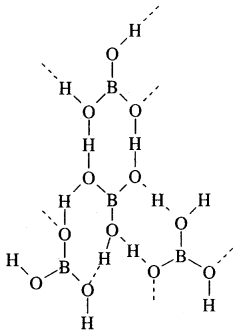
2. Calgon’s Method: Sodium hexametaphosphate Na6P60lg is commercially called Calgon. When added to hard water, the following reactions take place.

Na6P6O18 → 2Na+ + Na4P6O182-[M = Mg, Ca]
M2+ + Na4P6 O182- → [Na2MP6O18]2-
The complex anion is not harmful.

3. Permutit Method: Permutit is an artificial zeolite- chemically it is sodium orthosilicate (Na2Al2Si2O8. xH2O). Permutit removes cations like Ca2+, Mg2+, and Fe2+ and releases an equivalent number of Na+ ions. For simplicity, it can be written as Na Z. When added to water the following reaction takes place
2NaZ + M2+(aq) → MZ2(s) + 2Na+(aq); M = Mg, Ca

Permutit/zeolite is said to be exhausted when all the sodium in it is used up. It is regenerated when treating it with an aqueous sodium chloride solution.
MZ2(S) + 2NaCl(aq) → 2NaZ + MCl2(aq)

4. By the use of ion exchange resins (synthetic resins): This method removes all cations and anions present in water by means of ion-exchange resins. Water is first passed through cation exchange resins (giant organic molecules with-SO3H or —COOH groups), which remove the cations like Na+, Ca2+, Mg2+ and others by exchange with H+. The resulting water is now passed through anion exchange resins (giant organic molecules with — NH2 group) which remove the anions like Cl, SO4 and NO3 by exchange with OH.

Hydrogen Peroxide (H2O2):
It is an important chemical used in the pollution control treatment of domestic and industrial effluents.

Preparation:
1. By the reaction of sulphuric acid or phosphoric acid on hydrated barium peroxide (BaO2).
(a) BaO2.8H2O + H2SO4 → BaSO4(g) + H2O2 + 8H2O

Anhydrous barium peroxide does not react readily with sulphuric
acid because a coating of insoluble barium sulfate is formed on its surface which stops further action of the acid. Hence hydrated barium peroxide, BaO2,.8H2O must be used.

(b) 3BaO2 + 2H3PO4 → Ba3(PO4)2 + 3H2O2
Ba3(PO4)2 + 3H2SO4 → 2BaSO4(s) + 2H3PO4

Treatment with phosphoric acid is preferred to H2SO4 because soluble impurities like barium persulphate (from BaO2.8H2O+ H2SO4) tend to decompose H2O2 while H3PO4 acts as a preservative (negative catalyst for H2O2). Moreover, excess barium peroxide should be avoided as it tends to decompose H2O2.
BaO2 + H2O2 → BaO + H2O + O2

In both cases, BaSO4 is removed by filtration and hence more or less a fuse H2O2 solution is obtained by this method.
1. By adding the calculated quantity of sodium peroxide to a 20 % ice-cold sulphuric acid solution (Merck’s process):
Na2O2 + H2SO4 → Na2SO4 + H2O2

Sodium sulfate is removed by cooling when crystals of Na2SO4 10H2O separate out.
In this method, sulphuric acid can be replaced by NaH2PO4
Hydrogen Class 11 Notes Chemistry 17
Manufacture of Hydrogen peroxide:
1. By electrolysis of 50 % sulphuric acid to give Perdisulphuric acid (H2S2O8) which on distillation yields 30% solution of hydrogen peroxide.
2H2SO4 → 2H+ + 2HSO4

At cathode (Cu coil):
2H+ + 2e → 2H + H2

At anode (Pt)
2HSO4 → 2HSO4 + 2e
2HSO4 → H2S2O8 (Persulphuric acid)
H2S2O8 + 2H2O → 2H2SO4 + H2O2

Alternatively, electrolysis may be done with ammonium hydrogen sulfate (ammonium sulfate + H2SO4).
(NH4)2SO4 + H2SO4 → 2NH4HSO4
NH4HSO4 → H+ + NH4SO4

At cathode 2H+ + 2e → H2
At anode 2NH4SO4 → (NH4)2S2O8 + 2e

The ammonium persulphate formed is removed and quickly distilled with dil. H2SO4 under reduced pressure to give hydrogen peroxide.
Hydrogen Class 11 Notes Chemistry 18
2. By the auto-oxidation of 2-ethyl anthraquinone: In this process, the air is passed through a 10% solution of 2-ethyl anthraquinone in a mixture of benzene and higher alcohol.
Hydrogen Class 11 Notes Chemistry 19
The resulting 2-ethyl anthraquinone is then reduced by hydrogen in presence of palladium as a catalyst. Thus the continuity of the process is maintained and the process needs only H2, atmosphere 02, and water as the major raw materials.

Physical Properties of hydrogen peroxide:

  1. Pure hydrogen peroxide is a pale blue syrupy liquid.
  2. It is an unstable liquid and decomposes into water and oxygen either on standing or on heating.
  3. Hydrogen peroxide is diamagnetic.
  4. In the pure state, its dielectric constant is 93.7 which increases with dilution.
  5. It is more highly associated with hydrogen bonding than water.
  6. Pure hydrogen peroxide is weakly acidic in nature while its aqueous solution is neutral.

Chemical properties:
It acts as an oxidizing as well as a reducing agent in both acidic and alkaline media. Simple reactions are described below.
1. Oxidising action in acidic medium
2Fe2+(aq) + 2H+(aq) + H2O2(aq) → 2Fe3+(ag) + 2H2O(l)
PbS(s) + 4H2O2(aq) → PbSO4(s) + 4H2O(l)

2. Reducing action in acidic medium
2MnO4 + 6H+ + 5H2O2 → 2Mn2+ + 8H2O + 5O2
HOCl + H2O2 → H3O+ + Cl + O2

3. Oxidising action in basic medium
2Fe2+ + H2O2 → 2Fe3+ + 2OH
Mn2+ + H2O2 → Mn4+ + 2OH

4. Reducing action in basic medium
I2 + H2O2 + 2OH → 2I + 2H2O + O2
2MnO4 + 3H2O2 → 2MnO2 + 3O2 + 2H2O + 2OH

Storage of H2O2
H2O2 decomposes slowly on exposure to light.
2H2O2(l) → 2H2O(l) + O2(g)

In the presence of metal surfaces or traces of alkali (present in glass containers), the above reaction is catalyzed. It is, therefore, stored in wax-lined glass or plastic vessels in dark. Urea can be added as a stabilizer. It is kept away from dust because dust can induce explosive decomposition of a compound.

Structure of H2O2
Hydrogen peroxide molecule has a non-polar structure. The molecular dimensions in the gas phase and chemical phase are shown in Fig.
Hydrogen Class 11 Notes Chemistry 20
(a) H2O2 structure (gas phase) Dihedral angle 111.5° (b) H,0, (so, id phase at 110 K. The dihedral angle is reduced to 90.2°.

Uses Of Hydrogen Peroxide:

  1. In daily life, it is used as hair bleach and as a mild disinfectant. As an antiseptic, it is sold in the market as per hydro.
  2. It is used to manufacture chemicals like sodium perborate and per-carbonate, which are used in high-quality detergents.
  3. It is used in the synthesis of hydroquinone, tartaric acid, and certain food products and Pharmaceuticals (cephalosporin), etc.
  4. It is employed in the industries as a bleaching agent for textiles, paper pulp, leather, oils, fats, etc.
  5. Nowadays it is also used in Environmental (Green) Chemistry. For example, in pollution control treatment of domestic and industrial effluents, oxidation of cyanides, restoration of aerobic conditions to sewage wastes.

Heavy Water (D2O):
It is extensively used as a moderator in nuclear reactors and in exchange reactions for the study of reaction mechanisms. It was first prepared by Urey by the exhaustive electrolysis of water.

It is used for the preparation of other deuterium compounds. For example,
Hydrogen Class 11 Notes Chemistry 21
Volume Strength Of Hydrogen Peroxide:
H2O2 is miscible with water in all proportions and forms a hydrate H2O2.H2O (mp 221 K). A 30% solution of H2O2 is marketed as “100 Volume” hydrogen peroxide. It means that one milliliter of 30% H2O2 solution will give 100V of oxygen at STP. Commercially, it is marketed as 10V. It means it contains 3% H2O2.

Problem:
Calculate the strength of a 10 volume solution of hydrogen peroxide.
Answer:
10 volume solution of H2O2 means that 1L of this H2O2 will give 10L of oxygen at STP
2H2O2 (l) → O2(g) + H2O(l)
2 × 34 = 68g 22.4 L at STP
22.4 L of 02 at STP is produced from H2O2 = 68g

10 L of O2 at STP is produced from H2O2 = \(\frac{68 \times 10}{22.4}\)g
= 30.36g
Therefore, the strength of H2O2 in 10 volume H2O2 = 30.36g L-1.

Dihydrogen as a Fuel:
It releases large quantities of heat on combustion. On mass for mass basis H2(g) can release, more energy than petrol (about three times). Moreover, pollutants in the combustion of dihydrogen will be less than petrol. The only pollutant will be oxides of dinitrogen (due to the presence of dinitrogen as an impurity with dihydrogen).

This, of course, can be minimized by injecting a small amount of water into the cylinder to lower the temperature so that reaction between dinitrogen and dioxygen may not take place.

However, the mass of the containers in which dihydrogen will be kept must be taken into consideration, A cylinder of compressed dihydrogen weighs about 30 times as much as a tank of petrol containing the same amount of energy. Also, dihydrogen gas is converted into a liquid state by cooling to 20K.

This would require expensive insulated tanks. Tanks of metal alloy like NaNi5, Ti-TiH2, Mg-MgH2, etc. are in use of storage of dihydrogen in small quantities. These limitations have prompted researchers to search for alternative techniques to use dihydrogen in an efficient way.

In this view Hydrogen Economy is an alternative. The basic principle of a hydrogen economy is the transportation and storage of energy in the form of liquid or gaseous dihydrogen. The advantage of a hydrogen economy is that energy is transmitted in the form of dihydrogen and not as electric power.

It is for the first time in the history of India that a pilot project using dihydrogen as fuel was launched in Oct 2005 for running automobiles. Initially, 5 % dihydrogen has been mixed in CNG for use in four-wheeler vehicles. The percentage of dihydrogen would be gradually increased to reach the optimum level. Nowadays, it is also used in fuel cells for the generation of electric power.