Plant Growth and Development Class 11 Notes Biology Chapter 15

By going through these CBSE Class 11 Biology Notes Chapter 15 Plant Growth and Development, students can recall all the concepts quickly.

Plant Growth and Development Notes Class 11 Biology Chapter 15

→ Growth is one of the most conspicuous events in any living organism. It is an irreversible increase expressed in parameters such as sizes, area, length, height, volume, cell number, etc. It conspicuously involves increased protoplasmic materials.

→ In plants, meristems are the sites of growth. Root and shoot apical meristems sometimes along with intercalary meristem, contribute to the elongation growth of the plant axis.

→ Growth is indeterminate in higher plants. Following cell division in root and shoot apical meristem cells, the growth could be arithmetic or geometrical.

→ Growth may not be and generally is not sustained at a high rate throughout the life of cell/tissue/organ/organism.

→ One can define three principal phases of growth- the lag, log, and senescent phase.

→ When a cell loses the capacity to divide it leads to differentiation. Differentiation results in the development of structures that are commensurate with the function the cells finally have to perform.

→ General principles for differentiation for cells, tissues, and organs are similar.

→ A differentiated cell may differentiate and then redifferentiate.

→ Since differentiation in plants is open, the development could also be flexible, i.e, the development is the sum of growth and differentiation. Plant exhibit plasticity in development.

→ Plant growth and development are under the control of both intrinsic and extrinsic factors.

→ Intercellular intrinsic factors are the chemical substances, called plant growth regulators (PGR).

→ There are diverse groups of PGRs in plants, principally belonging to five groups: auxins, gibberellins, cytokinins, abscisic acid, and ethylene. These PGR’s are synthesized in various parts of the plant; they control different differentiation and developmental events.

→ Any PGR has diverse physiological effects on plants. Diverse PGRs also manifest similar effects. PGRs may act synergistically or antagonistically.

→ Plant growth and development are also affected by light, temperature, nutrition, oxygen status, gravity, and such external factors.

→ Flowering in some plants is induced only when exposed to a certain duration of photoperiod. Depending on the nature of photoperiod requirements, the plants are called short-day plants, long-day plants, and day-neutral plants.

→ Certain plants also need to be exposed to low temperatures so as to hasten to flower later in life. This treatment is known as vernalization

→ Vernalisation: Vernalisation is the low-temperature requirement of some plants for flowering. The cold treatment given to shoot tips or seeds is called vernalization.

→ Photoperiodism: Flowering in certain plants depends not only on a combination of light and dark exposures but also on their relative durations. This is termed photoperiodism.

→ Short-day plants/Long-day plants: The former group of plants is called short-day plants while the later ones are termed long-day plants.

→ Stress hormone: ABA stimulates the closure of stomata in the epidermis and increases the tolerance of plants to various kinds of stresses. Therefore, it is also called the stress hormone.

→ Apical dominance: In most higher plants, the growing apical bud inhibits the growth of the lateral (axillary) buds, a phenomenon called apical dominance.

→ Dedifferentiation: Plants show another interesting phenomenon. The living differentiated cells, that by now have lost the capacity to divide can regain the capacity of division under certain conditions. This phenomenon is termed dedifferentiation.

→ Differentiation: The cells derived from root apical and shoot-apical meristems and cambium differentiate and mature to perform specific functions. This act leading to maturation is termed differentiation.

→ Absolute growth rate: Measurement and the comparison of total growth per unit time is called the absolute growth rate.

→ Relative growth rate: The growth of the given system per unit time expressed on a common basis e.g. per unit initial parameter is called the relative growth rate.

→ The open form of growth: The cell(s) of such meristems have the capacity to divide and self-perpetuate. The product, however, soon loses the capacity to divide and such cells make up the plant body. This form of growth wherein new cells are always being added to the plant body by the activity of the meristem is called the open form of growth.

Respiration in Plants Class 11 Notes Biology Chapter 14

By going through these CBSE Class 11 Biology Notes Chapter 14 Respiration in Plants, students can recall all the concepts quickly.

Respiration in Plants Notes Class 11 Biology Chapter 14

→ Plants unlike animals have no special systems for breathing or gaseous exchange.

→ Stomata and lenticels allow gaseous exchange by diffusion. Almost all living cells in a plant have their surfaces exposed to air.

→ The breaking of C-C bonds of complex organic molecules by oxidation cells leading to the release of a lot of energy is called cellular respiration.

→ Glucose is the favored substrate for respiration. Fats and proteins can also be broken down to yield energy.

→ The initial stage of cellular respiration takes place in the cytoplasm.

→ Each glucose molecule is broken through a series of enzyme-catalyzed reactions into two molecules of pyruvic acid. This process is called glycolysis.

→ The fate of the pyruvate depends on the availability of oxygen and the organism.

→ Under anaerobic conditions, either lactic acid fermentation or alcohol fermentation occurs.

→ Fermentation takes place under anaerobic conditions in prokaryotes, unicellular eukaryotes, and germinating seeds.

→ In eukaryotic organisms in the presence of oxygen aerobic respiration occurs.

→ Pyruvic acid is transported into the mitochondria where it is converted into acetyl CoA with the release of CO2.

→ Acetyl CoA then enters the tricarboxylic acid pathway or Krebs cycle operating in the matrix of the mitochondria.

→ NADH++ H+ and FADH, are generated in the Krebs’ cycle.

→ The energy in these molecules as well as that in the NADH++H+ synthesized during glycolysis are used to synthesis ATP. This is accomplished through a system of electron carriers called the electron transport system (ETS) located on the inner membrane of the mitochondria.

→ The electrons as they move through the system release enough energy that is trapped to synthesize ATP. This is called oxidative phosphorylation. In this process 02 is the ultimate acceptor of electrons and it gets reduced water.

→ The respiratory pathway is an amphibolic pathway as it involves both anabolism and catabolism.

→ The respiratory quotient depends upon the type of respiratory substance used during respiration.

→ Respiration: The breaking of the C-C bonds of complex compounds through oxidation within the cells, leading to the release of a considerable amount of energy is called respiration.

→ Respiratory substrates: The compounds that are oxidized during this process are known as respiratory substrates.

→ Glycolysis: In any case, all living organisms retain the enzymatic machinery to partially oxidize glucose without the help of oxygen. This breakdown of glucose to pyruvic acid is called glycolysis

→ Aerobic respiration: Aerobic respiration is the process that leads to a complete oxid&tion of organic substances in the presence of oxygen, and releases CO2, water, and a large amount of energy present in the substrate.

→ Electron transport system (ETS): The metabolic pathway through which the electron passes from one carrier to another, is called the electron transport system.

→ Oxidative phosphorylation: Unlike photophosphorylation where it is the light energy that is utilized for the production of proton gradient required for phosphorylation, in respiration it is the energy of oxidation-reduction utilized for the same process. It is for this reason that the process is called oxidative phosphorylation.

→ Respiratory quotient: During aerobic respiration. O2 is consumed and CO2 is released. The ratio of the volume of CO2 evolved to the volume of O2 consumed in respiration is called the respiratory quotient (RQ) or respiratory ratio.

Photosynthesis in Higher Plants Class 11 Notes Biology Chapter 13

By going through these CBSE Class 11 Biology Notes Chapter 13 Photosynthesis in Higher Plants, students can recall all the concepts quickly.

Photosynthesis in Higher Plants Notes Class 11 Biology Chapter 13

→ Green plants make their own food by photosynthesis. During this process, carbon dioxide from the atmosphere is taken in by leaves through stomata and used for making carbohydrates, principally glucose and starch.

→ Photosynthesis takes place only in the green parts of the plants, mainly the leaves. Within the leaves, the mesophyll cells have a large number of chloroplasts that are responsible for CO2 fixation.

→ Within the chloroplasts, the membranes are sites, for the light reaction, while the chemosynthetic pathway occurs in the stroma.

→ Photosynthesis has two stages: the light reaction and the carbon fixing reactions.

→ In the light reaction, the light energy is absorbed by the pigments present in the antenna and funneled to special chlorophyll a molecule called reaction center chlorophylls.

→ There are two photosystems, PSI and PSII. PSI has a 700nm absorbing chlorophyll-a P700 molecule at its reaction center, while PSII has a P680 reaction center that absorbs red light at 680 nm.

→ After absorbing light, electrons are excited and transferred through PSII and PSI and finally to NAD forming NADH.

→ During this process, a proton gradient is created across the membrane of the thylakoid. The breakdown of the gradient due to the protons being moved through the F0 part of the ATP as the enzyme releases enough energy for the synthesis of ATP.

→ Splitting of water molecules is associated with PSII resulting in the release of O2, protons, and transfer of electrons to PSII.

→ In the carbon fixation cycle, CO2 is added by the enzyme Rubisco, which also catalyzes a wasteful oxygenation reaction in C3 plants: photorespiration.

→ Some tropical plants show a special type of photosynthesis called the C4 pathway. In these plants, the first product of CO2, a fixation that takes place in the mesophyll, is a 4 Carbon compound. In the bundle sheath cells, the Calvin pathway is carried out for the synthesis of carbohydrates.

→ The rate of photosynthesis is affected by light intensity, carbon dioxide concentration, temperature, availability of water, and plant factors

→ Action spectrum: A first action spectrum of photosynthesis was thus described. It resembles roughly the absorption spectra of chlorophyll (a) and (b).

→ Light reactions: The former set of reactions since they are light-dependent are called light reactions.

→ Dark reactions: The latter, though they are dependent on products of light reaction, that is ATP and NADPH, can theoretically take place in the dark and are called dark reactions.

→ Chlorophyll a: Chlorophyll a is the chief pigment associated with photosynthesis.

→ Accessory pigments: Other thylakoid pigments like chlorophyll b, xanthophylls, and carotenoids, are called accessory pigments.

→ Photosystem I (PSI) and photosystem II (PSII): The pigments are organized into two discrete photochemical light-harvesting complexes (LHC) called Photosystem I (PSI) and photosystem II (PSII).

→ Antennae: Each photosystem has all pigments (except one molecule of chlorophyll a) forming a light-harvesting system also called antennae.

→ P700 and P680: In PSI the reaction center chlorophyll a has an absorption peak at P700 nm hence is called P700 while in PSII it has absorption maxima at 680 nm, and is called P680.

→ Z scheme: The whole scheme of transfer of electrons, starting from the PSII, Uphill to the acceptor down to the electron transport chain to PSI excitation of electrons, transfer to another acceptor, and finally downhill to NADP causing it to be reduced to NADPH+ H+. This is called the Z scheme, due to its characteristic shape.

→ Photorespiration: C4 plants have a special type of leaf anatomy, they tolerate higher temperatures, they show a response to highlight intensities, they lack a process called photorespiration, and have greater productivity
of biomass.

→ Bundle sheath cells: The particularly large cells around the vascular bundles of the C4, pathway plants are called bundle sheath cells.

Mineral Nutrition Class 11 Notes Biology Chapter 12

By going through these CBSE Class 11 Biology Notes Chapter 12 Mineral Nutrition, students can recall all the concepts quickly.

Mineral Nutrition Notes Class 11 Biology Chapter 12

→ Plants obtain their inorganic nutrients from the air, water, and soil. Plants absorb a wide variety of mineral elements.

→ Not all the mineral elements that they absorb are required by plants. Out of the more than 105 elements discovered so far, less than 21 are essential and beneficial for normal plant growth and development.

→ The elements required in large quantities are called micronutrients while those required in fewer quantities or in the trace are termed as micro¬nutrients.

→ These elements are either essential constituents of proteins, carbohydrates. fats, nucleic acid, etc., and/or take part in various metabolic processes.

→ Deficiency of each of these essential elements may lead to symptoms called deficiency symptoms.

→ Chlorosis, necrosis, stunted growth, impaired cell division, etc. are some prominent deficiency symptoms.

→ Plants absorb minerals through roots by either passive or active processes. They are carried to all parts of the organism through xylem along with water transport.

→ Nitrogen is very essential for the sustenance of life.

→ Plants cannot use atmospheric nitrogen directly. But some of the plants, especially roots of legumes, can fix this atmospheric nitrogen into biologically usable forms.

→ Nitrogen fixation requires a strong reducing agent and energy in the form of ATP. N, fixation is accomplished with the help of nitrogen-fixing microbes, mainly Rhizobium.

→ The enzyme dinitrogenase which plays an important role in bio-logical N, fixation is very sensitive to oxygen.

→ Most of the processes take place in an anaerobic environment.

→ The energy, ATP. required is provided by the aerobic respiration of the host cells.

→ Ammonia produced following N. fixation is incorporated into amino acid as the amino group.

→ Transamination: It involves the transfer of an amino group from one amino acid to the keto group of a keto acid. Glutamic acid is the main amino acid from which the transfer of H2 the amino group takes place and other amino acids are formed through transamination. The enzyme transaminase catalyzes all such reactions.

→ Leghaemoglobin: The nodules have adaptations that ensure that the enzyme is protected from oxygen. To protect these enzymes, the nodule contains an oxygen scavenger called leghaemoglobin.

→ Nitrification: Ammonia is first oxidized to nitrite by the bacteria Nitrosomonas and/or Enterococcus. The nitrite is further oxidized to nitrate with the help of the bacterium Nitrobacter. These steps are called nitri¬fication.

→ Critical concentration: The concentration of the essential element below which plant growth is retarded is termed as critical concentration.

Conventional Plant Breeding Methods

Learninsta presents the core concepts of Biology with high-quality research papers and topical review articles.

Conventional Plant Breeding Methods

Conventional plant breeding methods resulting in hybrid varieties had a tremendous impact on agricultural productivity over the last decades. It develops new plant varieties by the process of selection and seeks to achieve expression of genetic material which is already present within the species. In this chapter we will discuss about some of the conventional methods of plant breeding.

Plant Introduction

Plant introduction may be defined as the introduction of genotypes from a place where it is normally grown to a new place or environment. Rice variety of IR8 introduced from Philippines and Wheat varieties of Sonora 63, Sonora 64 from Mexico.

The newly introduced plant has to adapt itself to the new environment. This adjustment or adaptation of the introduced plant in the changed environment is called acclimatization.

All the introductions must be free from presence of weeds, insects and disease causing organisms. This has to be carefully examined by the process called quarantine, a strict isolation imposed to prevent the spread of disease. Introduction may be classifid as Primary introduction and Secondary introduction.

1. Primary introduction:

When the introduced variety is well adapted to the new environment without any alternation to the original genotype.

2. Secondary introduction:

When the introduced variety is subjected to selection to isolate a superior variety and hybridized with a local variety to transfer one or a few characters to them. The botanical gardens in different parts of the world also played a significant role in plant introduction. Example: Tea varieties collected from China and North East India initially grown in Botanical Garden of Kolkata from which appropriate clones have selected and introduced to different parts of India.

Selection

Selection is the choice of certain individuals from a mixed population for a one or more desirable traits. Selection is the oldest and basic method of plant breeding. There are two main types of Selection.

(i) Natural Selection:

This is a rule in nature and results in evolution reflected in the Darwinian principle “survival of the fitest”. It takes longer time in bringing about desired variation.

(ii) Artifiial Selection:

It is a human involved process in having better crop from a mixed population where the individuals differ in character. The following are the three main types of artificial selection.

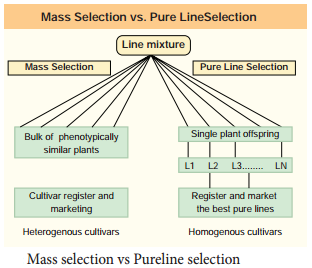
(a) Mass Selection:

In mass selection a large number of plants of similar phenotype or morphological characters are selected and their seeds are mixed together to constitute a new variety. The population obtained from the selected plants would be more uniform than the original population and are not individually tested.

After repeated selection for about five to six years, selected seeds are multiplied and distributed to the farmers. The only disadvantage of mass selection is that it is difficult to distinguish the hereditary variation from environmental variation.
Conventional Plant Breeding Methods img 1

(b) Pureline selection:

Johannsen in 1903 coined the word pureline. It is a collection of plants obtained as a result of repeated self-pollination from a single homozygous individual. Hence, a variety formed by this method shows more homozygosity with respect to all genes. The disadvantage of this type is that the new genotypes are never created and they are less adaptable and less stable to the environmental fluctuations.

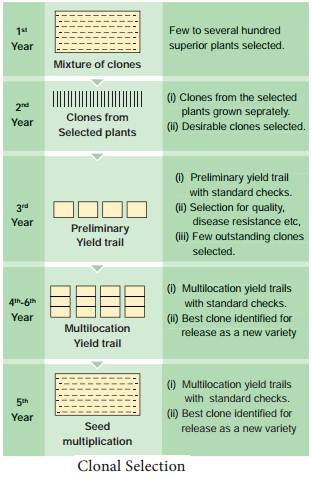
(c) Clonal Selection:

In asexually propagated crop, progenies derived from a plant resemble in genetic constitution with the parent plant as they are mitotically divided. Based on their phenotypic appearance, clonal selection is employed to select improved variety from a mixed population (clones). The selected plants are multiplied through vegetative propagation to give rise to a clone. The genotype of a clone remains unchanged for a long period of time.
Conventional Plant Breeding Methods img 2

Hybridization

Hybridization is the method of producing new crop varieties in which two or more plants of unlike genetically constitution is all crossed together that result in a progeny called hybrid. Hybridization offers improvement in crop and is the only effective means of combining together the desirable characters of two or more varieties or species. The first natural hybridization was observed by Cotton Mather in maize.

Steps in Hybridization

Steps involved in hybridization are as follows.

1. Selection of Parents:
Male and female plants of the desired characters are selected. Both should be tested for their homozygosity.

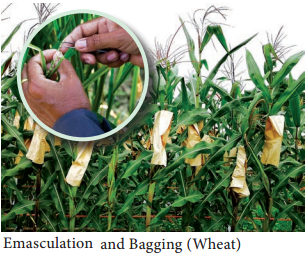
2. Emasculation:
It is a process of removal of anthers to prevent self pollination before dehiscence of anther.

3. Bagging:
The stigma of the flower is protected against any undesirable pollen grains, by covering it with a bag.
Conventional Plant Breeding Methods img 3

4. Crossing:
Transfer of pollen grains from selected male flwer to the stigma of the female emasculated flower.

5. Harvesting seeds and raising plants:
The pollination leads to fertilization and finally seed formation takes place. The seeds are grown into new generation which are called hybrids.

Types of Hybridization

According to the relationship between plants, the hybridization is divided into.

(i) Intravarietal hybridization:
The cross between the plants of same variety. Such crosses are useful only in self-pollinated crops.

(ii) Intervarietal hybridization:
The cross between the plants belonging to two different varieties of the same species and is also known as intraspecific hybridization. This technique has been the basis of improving self-pollinated as well as cross pollinated crops.

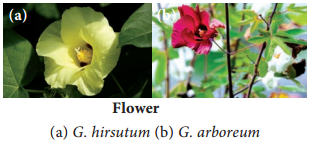
(iii) Interspecific hybridization:
The cross between the plants belonging to different species belonging to the same genus is also called intragenic hybridization. It is commonly used for transferring the genes of disease, insect, pest and drought resistance from one species to another. Example: Gossypium hirsutum x Gossypium arboreum – Deviraj.
Conventional Plant Breeding Methods img 4

(iv) Intergeneric hybridization:
The crosses are made between the plants belonging to two different genera. The disadvantages are hybrid sterility, time consuming and expensive procedure. Example: Raphanobrassica, Triticale. (Refer chapter 4 for detailed illustration).

Heterosis

Heterosis (hetero – different; sis – condition) G.H. Shull was the first scientist to use the term heterosis in 1912. The superiority of the F1 hybrid in performance over its parents is called heterosis or hybrid vigour. Vigour refers to increase in growth, yield, greater adaptability of resistance to diseases, pest and drought. Vegetative propagation is the best suited measure for maintaining hybrid vigour, since the desired characters are not lost and can persist over a period of time.

Many breeders believe that the magnitude of heterosis is directly related to the degree of genetic diversity between the two parents. Depending on the nature, origin, adaptability and reproducing ability heterosis can be classified as:

(i) Euheterosis:

This is the true heterosis which is inherited and is further classified as:

(a) Mutational Euheterosis:

Simplest type of euheterosis and results from the sheltering or eliminating of the deleterious, unfavourable often lethal, recessive, mutant genes by their adaptively superior dominant alleles in cross pollinated crops.

(b) Balanced Euheterosis:

Well balanced gene combination which is more adaptive to environmental conditions and agricultural usefulness.

(ii) Pseudoheterosis:

Also termed as luxuriance. Progeny possess superiority over parents in vegetative growth but not in yield and adaptation, usually sterile or poorly fertile.

Mutation Breeding

Muller and Stadler (1927 – 1928) coined the term mutation breeding. It represents a new method of conventional breeding procedures as they have the advantage of improving the defect without losing agronomic and quality character in agriculture and crop improvement.

Mutation means the sudden heritable changes in the genotype or phenotype of an organism. Gene mutations are of considerable importance in plant breeding as they provide essential inputs for evolution as well as for re-combination and selection.

It is the only method for improving seedless crops. Radiation such as UV short wave, X-ray, Alpha (α), Beta (β), Gamma waves and many chemicals such as cesium, EMS (ethyl methane sulfonate), nitromethylurea induce mutation to develop new varieties of crops. Example: Triple gene dwarf wheat with increase in yield and height. Atomita 2 – rice with salinity tolerance and pest resistance.

Polyploid Breeding

Majority of flowering plants are diploid (2n). The plants which possess more than two sets of chromosome are called polyploids. Polyploidy is a major force in the evolution of both wild and cultivated plants. Polyploidy often exhibits increased hybrid vigour, increased heterozygosity, increase tolerance to both biotic and abiotic stresses, buffering of deleterious mutations. In addition, polyploidy often results in reduced fertility due to meiotic error allowing the production of seedless varieties.

When chromosome number is doubled by itself in the same plant, is called autopolyploidy. Example: A triploid condition in sugarbeets, apples and pear has resulted in the increase in vigour and fruit size, large root size, large leaves, flower, more seeds and sugar content in them. It also resulted in seedless tomato, apple, watermelon and orange. Polyploidy can be induced by the use of colchicine to double the chromosome number.

Allopolyploids are produced by multiplication of chromosome sets that are initially derived from two different species. Example: Triticale (Triticum durum x secale cereale) Raphanobrassica (Brassica oleraceae x Raphanus sativus).

Green Revolution

Green revolution the term was coined by William S.Gaud in (1968). It is defined as the cumulative result of a series of research, development, innovation and technology transfer initiatives. Agricultural production (especially wheat and rice) manifolds worldwide particularly in the developing countries between the 1940’s and the late 1960’s.

The Green revolution or third Agricultural Revolution is the intensive plan of 1960’s to increase crop yield in developing countries by introducing the high yielding, resistant varieties, increased irrigation facilities, fertilizer application and better agricultural management.

In 1963 semi-dwarf wheat of Mexico was introduced from which India got fie prolonged strategies for breeding a wide range of high varieties like Sonora 64, Sonalika and Kalyansona possessing a broad spectrum of resistance to major biotic and abiotic condition.

Same as wheat M.S.Swaminathan produced the first semi-dwarf fertiliser responsive hybrid variety of rice TNI (Taichung Native-1) in 1956 from Taiwan. The derivatives were introduced in 1966. Later better yielding semi dwarf varieties of rice Jaya and Ratna developed in India.

Plant Breeding for Developing Resistance to diseases

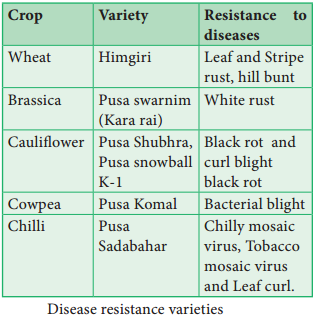
Some crop varieties bred by hybridization and selection, for disease resistance to fungi, bacteria and viral diseases are released (Table 9.1)
Conventional Plant Breeding Methods img 5

Resistance to yellow mosaic virus in bhindi (Abelmoschus escullentus) was transferred from a wild species and resulted in a new variety of A. Escullentus called Parbharni kranti.

Plant Breeding for Developing

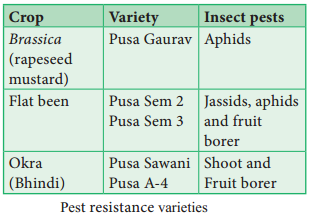
Resistance to Insect Pests Insect resistance in host crop plants may be due to morphological, biochemical or physiological characteristics. Hairy leaves in several plants are associated with resistance to insect pests.

Example:

Resistance to jassids in cotton and cereal leaf beetle in wheat. In wheat, solid stems lead to non-preference by the stem sawfly and smooth leaves and nectar-less cotton varieties do not attract bollworms. High aspartic acid, low nitrogen and sugar content in maize leads to resistance to maize stem borers.
Conventional Plant Breeding Methods img 6