Plant Breeding and Its Various Steps and Objectives

Learninsta presents the core concepts of Biology with high-quality research papers and topical review articles.

Plant Breeding and Its Various Steps and Objectives

Plant breeding is the science of improvement of crop varieties with higher yield, better quality, resistance to diseases and shorter durations which are suitable to particular environment. In other words, it is a purposeful manipulation of plant species in order to create desired genotype and phenotype for the benefit of humans.

In early days, plant breeding activities were based mainly on skills and ability of person involved. But as the principles of genetics and cytogenetics have elucidated breeding methods such as selection, introduction, hybridization, ploidy, mutation, tissue culture and biotechnology techniques were designed to develop improved crop varieties.

Objectives of Plant Breeding:

  • To increase yield, vigour and fertility of the crop
  • To increase tolerance to environmental condition, salinity, temperature and drought.
  • To prevent the premature falling of buds, fruits etc.
  • To improve synchronous maturity.
  • To develop resistance to pathogens and pests.
  • To develop photosensitive and thermos-sensitive varieties.

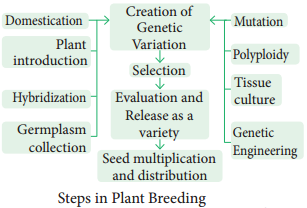
Steps in Plant Breeding:

The main steps in plant breeding are given below
Plant Breeding img 1

Transport in Plants Class 11 Notes Biology Chapter 11

By going through these CBSE Class 11 Biology Notes Chapter 11 Transport in Plants, students can recall all the concepts quickly.

Transport in Plants Notes Class 11 Biology Chapter 11

→ Plants obtain a variety of inorganic elements (ions) and salts from their surroundings especially from the air, water, and soil. The movement of these nutrients from the environment into the plant as well as from one plant cell to another plant cell essentially involves movement across a cell membrane.

→ Transport across cell membrane can be through diffusion, facilitated transport, or active transport.

→ Water and minerals absorbed by roots are transported by the xylem and the organic material synthesized in the leaves is transported to other parts of the plant through phloem.

→ Passive transport (diffusion, osmosis) and active transport are the two modes of nutrient transport across cell membranes in living organisms. In passive transport, by diffusion nutrients move across the membrane without any use of energy as it is always down the concentration gradient and hence entropy-driven. This diffusion of substances depends on their size, solubility in water or organic solvents.

→ Osmosis is the special type of diffusion of water across a semipermeable membrane which depends on pressure gradient and concentration gradient.

→ Inactive transport, energy in the form of ATP is utilized to pump molecules against a concentration gradient across membranes.

→ Water potential is the potential energy of water that helps in the movement of water. It is determined by solute potential and pressure potential.

→ The behavior of the cells depends on the surrounding solution. If the surrounding solution of the cell is hypertonic, it gets plasmolyzed. The absorption of water by seeds and dry wood takes place by a special type of diffusion called imbibition.

→ In higher plants, there is vascular system xylem and phloem responsible for translocation. Water minerals and food cannot be moved within the body of a plant by diffusion alone.

→ They are therefore transported by a mass flow system movement of substance in bulk from one point to another as a result of pressure differences between the two points.

→ Water absorbed by root hairs moves deeper into the root by two distinct pathways i.e. apoplast and symplast.

→ Various ions and water from soil can be transported up to a small height in stems by root pressure.

→ The transpiration pull model is the most acceptable to explain the transport of water. Transpiration is the loss of water in the form of vapors from the plant parts through stomata.

→ Temperature, light, humidity, wind speed, and a number of stomata affect the rate of transpiration. Excess water is also removed through the tips of leaves of plants by guttation.

→ Phloem is responsible for the transport of food (primarily) sucrose from the source to the sink.

→ The translocation in phloem is bi-directional; the source-sink relationship is variable. The translocation phloem is explained by the pressure-flow hypothesis.

→ Transpiration: Transpiration is the evaporative loss of water by the plants. It occurs mainly through the stomata in the leaves.

→ Guttation: Oozing of droplets along the leaf margin on the vein endings at night is called guttation.

→ Diffusion: Movement of molecules of a substance from its place of high concentration to its place of low concentration till equilibrium is reactions between the two regions.

→ Osmosis: Movement of water molecules from a dilute solution to a concentrated solution through a semi-permeable membrane.

→ Plasmolysis: Shrinkage of the protoplasm when the cell is placed in a hypertonic solution is called plasmolysis.

→ Root pressure: As various ions from the soil are actively transported into the root’s vascular tissue, water follows (its potential gradient) and increases the pressure inside the xylem. This positive pressure is called root pressure.

→ Carpathian strip: The endodermis, is impervious to water because of a band of suberised matrix called the Casparian strip.

→ Mycorrhiza: A mycorrhiza is a symbiotic association of a fungus with a root system.

→ Translocation: The bulk movement of substances through the conducting or vascular tissues of plants is called translocation.

→ Turgor pressure: Water diffuses into the cell causing the cytoplasm to build up a pressure against the wall, which is called turgor pressure.

→ Facilitated diffusion: Membrane proteins provide sides at which such molecules across the membrane. They do not set up a concentration gradient: a concentration gradient must already be present for molecules to diffuse even if facilitated by the proteins. This process is called facilitated diffusion.

Plant Breeding – History Of Agriculture

Learninsta presents the core concepts of Biology with high-quality research papers and topical review articles.

History Of Agriculture

There are unique opportunities that plant breeding and agriculture offer the historian of biology, and unique ways in which the historian of biology can inform the history of plant breeding and agriculture (Harwood, 2006. Phillips and Kingsland, 2015).

There are also of course questions and challenges that the study of agricultural sites share with the study of other biological sites, such as those in medicine (Wilmot 2007. Woods et al. 2018), the environment (Agar and Ward 2018), and non-agricultural industries (Bud 1993).

Indeed, in some instances the agricultural, medical, environmental, and biologically industrial will be one and the same. This is to say nothing of what agricultural sites share in common with histories of science beyond biology, but that is a broader discussion I can only mention in passing (Parolini 2015).

This chapter will first address what agriculture has in common with themes that cut across this handbook, before turning in Part 2 to issues, problems, and questions that stem from agriculture’s particular features, ending in Part 3 with paths for future work.

The chapter therefore treats the intersection of biology and agriculture as demanding its own integrated attention, the two parts making up a larger historiographical whole. There are a number of reasons to give agricultural sciences and technologies this kind of autonomy from the historiography of biology at large.
First, it reminds us to question the nature, direction, and extent of influence that biological science and agriculture have had on one another.

Second, it promotes a more symmetric understanding of the knowledges that have mattered for biological science and agriculture. This is particularly important because so much of the history of biological science in agriculture has been about establishing the authority of scientific expertise over agriculture, often in competition with other kinds of expertise distributed throughout farming.

If we did not approach agricultural contexts symmetrically we might end up recapitulating the very arguments we are meant to be analysing. Third, it establishes a healthier and more distant vantage point for the historian, keeping the existing historiography of biology at arms length, allowing us to better observe its deficiencies and assumptions.

Aside from giving autonomy to the agricultural in histories of biology, there is another broad historiographical point to make. Historians of biology and agriculture have to strike a balance between which historiographical lineage they dedicate their work to, or indeed, whether they see themselves contributing to both histories of biology and agriculture simultaneously.

In some respects this issue is itself unique to agriculture, for if we look at the other topics in this handbook only one or two other chapters are asked to compete with completely different sets of scholarly lineages in their telling, these including Tracy Teslo on Race and Ethnicity, Marsha Richmond on Women, and Ana Barahona on the transnational.

Yes, other kinds of historian and scholar may make important interventions on the history of eugenics, Darwinism, and biotechnology, but when it comes to these topics nobody is in a position to outbid the historian of biology.

Agriculture is different, both in content, thanks to the variety of experts that it enrols across a very wide range of potential specialist areas, and also in terms of the historiographical landscape in which it sits, because agriculture has indeed belonged to whole other kinds of historian, be they social historians, economic historians, or historians of agriculture and the environment.

Ultimately all my talk of ownership and bidding is petty, and of course even in those topics that seem primarily the concern of the historian of biology other historical traditions and branches of scholarship are constantly being drawn in.

What I mean to convey is that: historians of biology have been late to agriculture; their insights have not always been understood as relevant or complementary to the history of agriculture; historians of agriculture seem to be getting on all too well without the historian of biology; and that if the recent growth in interest amongst historians of science into the agricultural is to be maintained and consolidated then interdisciplinary awareness is essential.

Here historians of biology offer a suite of valuable opportunities for historians of agriculture, be it through all the techno-imagining that goes into broader agricultural debate, or the chance to rethink social and economic relations on the farm, the meanings embodied in agricultural spaces, organisms, and communal practices, or as Jonathan Harwood has so brilliantly shown, through the issue of global food security (Harwood 2012).

But agriculture also demands a sensitivity and humility from the historian of biology, to know when multiple epistemologies are in play, multiple historiographies, and therefore how to translate any new historical understanding into a form that matters for defined audiences. These audiences should include not only historians of science but also those working on and in agricultural industries.

Cell Cycle and Cell Division Class 11 Notes Biology Chapter 10

By going through these CBSE Class 11 Biology Notes Chapter 10 Cell Cycle and Cell Division, students can recall all the concepts quickly.

Cell Cycle and Cell Division Notes Class 11 Biology Chapter 10

→ According to the cell theory, cells arise from pre-existing cells. The process by which this occurs is called cell division.

→ Any sexually reproducing organism starts its life cycle from a single-celled zygote.

→ Cell division does not stop with the formation of the mature organism but continues throughout its life cycle.

→ The stages through which a cell passes from one division to the next are called the cell cycle.

→ The cell cycle is divided into two phases called

  1. interface a period of preparation for cells division, and
  2. Mitosis the actual period of cell division.

→ Interphase is further subdivided into G1, S1, and G2 G1 phase is the period when the cell grows and carries out normal metabolism.

→ Most of the organelle duplication also occurs during this phase.

→ S phase marks the phase of DNA replication and chromosome duplication. The G2 phase is the period of cytoplasmic growth.

→ Mitosis is also divided into four stages namely prophase, metaphase, anaphase, and telophase. Chromosome condensation occurs during prophase.

→ Simultaneously, the centrioles move to the opposite poles.

→ The nuclear envelope and the nucleolus disappear and the spindle fibers start appearing.

→ Metaphase is marked by the alignment of chromosomes at the equatorial plate.

→ During anaphase, the centromeres divide and the chromatids start moving towards two opposite poles.

→ Once the chromatids reach the two poles, the chromosomal elongation starts, nucleolus, and the nuclear membrane reappear.

→ This stage is called telophase.

→ Nuclear division is followed by the cytoplasmic division and is called cytokinesis

→ Mitosis thus is the equational division, in which the chromosome number of a parent is conserved in the daughter cell.

→ In contrast to mitosis, meiosis occurs in the diploid cells, which are destined to form gametes. It is called the reduction division since it reduces the chromosome number by half while making the gametes.

→ In sexual reproduction when the two gametes fuse the chromosome number is restored to the value in the parent cell.

→ Meiosis is devided into two phases-meiosis 1 and meiosis II. In the first meiotic division the homologous chromosomes pair to form bivalents, and undergo crossing over.

→ Meiosis I has long prophase, which is divided further into five phases. These are leptotene, zygotene, pachytene, diplotene and diakinesis.

→ During metaphase I the bivalents arrange an equatorial plate. This is followed by anaphase 1 in which homologous chromosomes move to opposite poles with both their chromatids.

→ Each pole receives half the chromosome number of the parent cell.

→ In telophase I the nuclear membrane and nucleolus reappear.

→ Meiosis II is similar to mitosis.

→ During anaphase II the sister chromatids separate. Thus at the end of meiosis four haploid cells are formed.

→ Equational division: M phase is the most dramatic period of the cell cycle, involving a major reorganization of virtually all cell components. Since the chromosome, number (ploidy) of parent and progeny cell is the same it is also called equational division.

→ Cytokinesis: Mitosis accomplishes the segregation of duplicated chromosomes into daughter nuclei (Karyokinesis), but the cell itself is divided into two daughter cells by a separate process called cytokinesis at the end of which cell division is complete.

→ Cell-plate: The formation of the new cell wall begins with the construction of a simple precursor, called the cell plate that represents the middle lamella between the walls of two adjacent cells.

→ Syncytium: In some organisms’ karyokinesis is not followed by cytokinesis as a result of which multinucleate condition arises which is called syncytium.

→ Meiosis: The specialized kind of cell division that reduces the chromosome number by half, resulting in the production of haploid daughter cells, is called meiosis.

→ Meiosis I and Meiosis II: Meiosis involves two sequential cycles to nuclear and cell division, called meiosis I and meiosis II but only a single cycle of DNA replication.

→ Synapsis: Zygotene is the second stage of prophase I during which certain chromosomes start pairing together and this process of association is called synapsis.

→ Synaptonemal complex: Electron complex structure called synaptonemal complex.

→ Bivalent: The complex formed by a pair of synapsed homologous chromosomes is called a bivalent or a tetrad.

→ Interkinesis: The stage between the two meiotic divisions is called interkinesis and is generally short-lived.

→ Crossing Over: Exchange of similar segments between non-sister chromatids of homologous chromosomes usually takes place during the Pachytene stage.

Biomolecules Class 11 Notes Biology Chapter 9

By going through these CBSE Class 11 Biology Notes Chapter 9 Biomolecules, students can recall all the concepts quickly.

Biomolecules Notes Class 11 Biology Chapter 9

→ Although there is a bewildering diversity of living organisms, their chemical composition and metabolic reactions appear to be remarkably similar.

→ The elemental composition of living tissues and non-living matter appear also to be similar when analyzed qualitatively.

→ The most abundant chemical in living organisms is water. There are thousands of small molecular weight (<1000Da) biomolecules.

→ Amino acids, monosaccharide and disaccharide sugars, fatty acids, glycerol, nucleotides, nucleosides, and nitrogen bases are some of the organic compounds seen in living organisms.

→ There are 21 types of amino acids and 5 types of nucleotides. Fats and oils are glycerides in which fatty acids are esterified to glycerol. Phospholipids contain, in addition, a phosphorylated nitrogenous compound.

→ Only three types of macromolecules i.e., proteins, nucleic acids, and polysaccharides are found in living systems.

→ Lipids, because of their association with membranes separate in the macromolecular fraction. Biomacromolecules are polymers. They are made of building blocks that are different. Proteins are heteropolymers made of amino acids.

→ Nucleic acids (RNA and DNA) are composed of nucleotides. Biomacromolecules have a hierarhy of structures i.e., primary, secondary, tertiary and quaternary structures.

→ Nucleic acids serve as genetic material. Polysaccharides are components of the celt wall in plants, fungi and also of the exoskeleton of arthropods.

→ They also are storage forms of energy (e.g. starch and glycogen.) Proteins serve a variety of cellular functions. Many of them are enzymes, some are antibodies, some are receptors, some are hormones and some others are structural proteins.

→ Collagen is the most abundant protein in the animal world and Rubisco is the most abundant protein in the whole biosphere.

→ Enzymes are proteins that catalyze biochemical reactions in the cells. Ribozymes are nucleic acids with catalytic power.

→ Proteinaceous enzymes exhibit substrate specificity, require optimum temperature and pH for maximal activity. They are denatured at high temperatures.

→ Enzymes lower the activation energy of reactions and enhance greatly the rate of the reactions.

→ Nucleic acids carry hereditary information and are passed on from parental generation to progeny.

→ Biomolecules: All the carbon compounds that we get from living tissues can be called ‘biomolecules’.

→ a-amino acids: Amino acids are organic compounds containing an amino group and an acidic group as substituents on the same carbon i.e., the a-carbon. Hence they are called a-amino acids.

→ Nucleosides: Some of these are nitrogen bases-adenine, guanine, cytosine, uracil, and thymine. When found attached to a sugar, they are called nucleosides.

→ Primary metabolites: In animal tissues, one notices the presence of all such categories of compounds. These are called primary metabolites.

→ Secondary metabolites: When one analyses plant, fungal and microbial cells, one would see thousands of compounds other than these called primary metabolites, e.g., alkaloids, flavonoids, rubber, essential oils, antibiotics, coloured pigments, scents, gums, spices. These are called ‘secondary metabolites.

→ Biomacromolecules: One, those which have molecular weights less than one thousand and are usually referred to as macromolecules or simply as biomolecules while those which are found in the acid-insoluble fraction are called macromolecules or as biomacromolecules.

→ Glycogen: Animals have another variant called glycogen.

→ Deoxyribonucleic acid/ Ribonucleic acid: A nucleic acid containing deoxyribose is called deoxyribonucleic acid (DNA) while that which contains ribose is called ribonucleic acid (RNA).

→ Quaternary structure: The manner in which these’ individual folded polypeptides or subunits are arranged with respect to each other is the architecture of a protein otherwise called the quaternary structure of a protein.

→ Phosphodiester: The bond between the phosphate and hydroxyl group of sugar is an ester bond. As there is one such ester bond on either side, it is called the phosphodiester bond.

→ Metabolic pathway: A multistep chemical reaction when each of the steps is catalyzed by the same enzyme complex or different enzymes is called a metabolic pathway.

→ Isomerases: Includes all enzymes catalyzing the interconversion of optical, geometric, or positional isomers.

→ Ligases: Enzymes catalyzing the linking together of 2 compounds e.g., enzymes that catalyze joining of C-O, C-S, C-N, PO, etc. bonds.

→ Substrate: The chemical which is converted into a product is called a ‘substrate’.

→ Inhibition/Inhibitor: When the binding of the chemical shuts off enzyme activity, the process is called inhibition and the chemical is called an inhibitor.