Dissolution of a Partnership Firm Class 12 Notes Accountancy Chapter 5

By going through these CBSE Class 12 Accountancy Notes Chapter 5 Dissolution of a Partnership Firm, students can recall all the concepts quickly.

Dissolution of a Partnership Firm Notes Class 12 Accountancy Chapter 5

The word Dissolution implies “the undoing or breaking of a bond tie”. In other words, dissolution implies that the existing state of arrangement is done away with. In terms of the partnership, dissolution means discontinuance of relationships amongst the partners.

But the dissolution of partnership and dissolution of a partnership firm are two different terms. As we know that the reconstitution of a partnership firm takes place on account of admission, retirement, or death of a partner. Here, the existing partnership is dissolved, but the firm may continue under the same name if the partners so decide. It means that it results in the dissolution of a partnership but not that of the firm.

The dissolution of a partnership does not lead to the dissolution of the firm since the two situations are different. In case of dissolution of the partnership, the firm continues, only the partnership relation is reconstituted, but in case of dissolution of the firm, not only partnership is dissolved but the firm also loses its existence, implying thereby that the firm ceases to operate as a partnership firm.

Dissolution of a Partnership:
If dissolution involves only the reconstitution of the firm and the business in partnership is continued in the same name after the dissolution of the partnership agreement, it is known as the ‘Dissolution of the Partnership’. It involves a change in the relationship between partners without affecting the continuity of business. Here, the firm is reconstituted without the dissolution of the Finn.

A partnership is dissolved by change of mutual contract in the following cases:

  1. Change in the existing profit sharing ratio among partners.
  2. Admission of a new partner.
  3. Retirement of a partner.
  4. Death of a partner (Section 42).
  5. Insolvency of a partner.
  6. Completion of the venture if the partnership is formed for that,
  7. Expiry of the period of the partnership, if the partnership is for a specific period.
  8. The merger of one partnership firm into another.

Dissolution of a Firm:
According to Section 39 of the Indian Partnership Act, 1932 dissolution of a partnership between all the partners of a firm is called the ‘dissolution of the firm’.

It refers to the winding up of the business in partnership. It involves a complete breakdown of relations among all the partners and is the dissolution of a partnership between all the partners of a firm. Here, in this situation, business is to be discontinued, it requires the realization of assets and settlement of liabilities.

Dissolution of a firm takes place in the following cases:
Dissolution by Agreement

  1. All the partners give consent to it; or
  2. As per the terms of the partnership agreement.

Compulsory Dissolution:

  1. Where all the partners or all expect one partner, become insolvent or insane rendering them incompetent to sign a contract; or
  2. When the business of the firm becomes illegal; or
  3. When some event has taken place which makes it unlawful for the partner to catty on the business of the firm in partnership.

On the Happening of Certain Contingencies

Subject to contract between the partners, a firm is dissolved:

  1. if constituted for a fixed term, by the expiry of that term; or
  2. if constituted to carry out one or more ventures, by the completion thereof; or
  3. where all the partners except one decided to retire from the firm; or
  4. where all the partners or all except one partner dies; or
  5. by the adjudication of a partner as an insolvent.

Dissolution by Notice:
In case of partnership at will, the firm may be dissolved if any of the partners give notice in writing to the other partners signifying his intention of seeking dissolution of the firm.

Dissolution by Court (Under Section 44):
At the suit of a partner, the court may order for dissolution of partnership firm on any of the following grounds:

  1. If a partner becomes insane; or
  2. When a partner becomes permanently incapable of performing his duties as a partner; or
  3. When a partner is guilty of misconduct that is likely to adversely affect the business of the firm; or
  4. When a partner deliberately and consistently commits a breach of agreements relating to the management of the firm; or
  5. When the partner transfer whole of his interest in the firm to a third party; or
  6. When the business of the firm cannot be carried on, except at a loss; or
  7. When the court, on any ground, regards dissolution to be just and equitable.

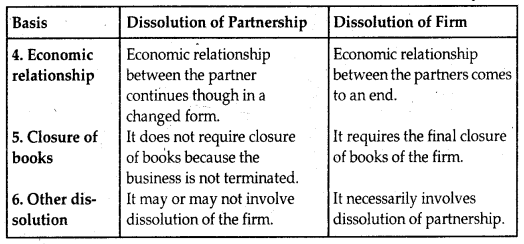
Difference between Dissolution of Partnership and Dissolution of Firm:
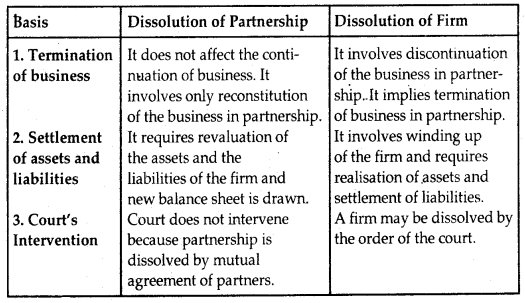
Dissolution of a Partnership Firm Class 12 Notes Accountancy 1
Dissolution of a Partnership Firm Class 12 Notes Accountancy 2
Settlement of Accounts
In case of dissolution of a firm, the firm ceases to conduct business and has to settle its accounts. For this purpose, it disposes of all its assets for satisfying all the claims against it. Section 48 of the Partnership Act provides the following rules for the settlement of accounts between the partners:
(a) Treatment of Losses
Losses, including deficiencies of capital, shall be paid:

  1. first out of profits,
  2. next out of the capital of partners, and
  3. lastly, if necessary, by the partners individually in their profits sharing ratio.

(b) Application of Assets
The assets of the firm, including any sum contributed by the partners to make up deficiencies’ of Capital, shall be applied in the following manner and order:

  1. In paying the debts of the firm to the third parties;
  2. In paying each partner proportionately what is due to him/ her from the firm for advances as distinguished from capital (i.e. partner’s loan);
  3. In paying to each partner proportionately what is due to him on account of capital; and
  4. The residue, if any, shall be divided among the partners in their profit-sharing ratio.

Thus, assets realized along with a contribution from the partner if required, are applied as follows:

  1. To pay outside liabilities. Debts with fixed charges are paid first, followed by debts with floating charges and then unsecured debts. Such as creditors, loans, bank overdraft, bills payable, etc.
  2. To pay loans and advances made by the partners to the firm (in case the balance amount is not adequate enough to pay off such loans and advances, they are to be paid proportionately).
  3. To settle capital accounts of the partners.

Private Debts and Firm’s Debts:
Where both the debts of the firm and private debts of a partner co-exist, the following rules, as stated in Section 49 of the Indian Partnership Act, 1932, shall apply:
(a) The property of the firm shall be applied first in the payment of debts of the firm and then the surplus if any shall be divided among the partners as per their claims, which can be utilized for payment of their private liabilities.

(b) The private property of any partner shall be applied first in payment of his private debts and the surplus, in any, may be utilized for payment of the firm’s debts, in case the firm’s liabilities exceed the firm’s assets. In nutshell, private property shall be first used to settle private debts and business property shall be first used to settle business debts, and the surplus if any, can be transferred.

Accounting Treatment:
Dissolution of the firm involves the realization of assets and settlement of liabilities and capital accounts. For this purpose, the following accounts are opened in the firm’s books:

  1. Realization Account.
  2. Partner’s Loan Account
  3. Partner’s Capital Account
  4. Bank or Cash Account

1. Realization Account:
A realization Account is opened on the dissolution of a firm. It is a nominal account. It shows the net result of realization of assets and settlement of liabilities.

For this purpose, the balances of assets and liabilities appearing in the ledger books are transferred to the realization account. It also records realized value of recorded as well as unrecorded assets. Similarly, payment for liabilities and unrecords liabilities are also recorded in the realization account.

It also recorded the realization expenses. The balance in this account is termed as profit or loss on realization which is transferred to partner’s, capital accounts in their profit sharing ratio. As the dissolution of a firm involves winding up of partnership business and requires final closure of books, the following steps are followed to record dissolution of the partnership firm:

→ Journal Entries:
1. For transfer of Assets
Realization A/c Dr.
To Sundry Assets (Individually) A/c [With a book value of individual asset]

All assets transferred to the realization account at their book value and its corresponding provisions or reserve appearing on the balance sheet are also transferred to the credit side of the realization account. Balance of cash, bank, and fictitious assets are not transferred to realization account.

2. For transfer of liabilities
Book value of all outside liabilities recorded in the books is transferred to realization account along with provisions against various assets.

Liabilities A/c (Individually) Dr.
To Realisation A/c [With a book value of Liabilities]

Note:
Partner’s capital account, accumulated profits, general reserves, reserve fund, partner’s loan are not transferred to realization account.

3. For Sale of Assets (recorded or unrecorded)
Bank/Cash A/c Dr.
To Realisation A/c [With the amount actually realized]

4. For an asset taken over by a partner
Partner’s Capital A/c Dr.
To Realisation A/c [ With the agreed take over the price of the assets]

5. For payment of liabilities
Realization A/c Dr.
To Bank/Cash A/c [With the amount actually paid]

6. For a liability which a partner takes responsibility to discharge
Realization A/c Dr.
To Partner’s Capital A/c [With the agreed value of liability taken over]

7. For transfer of assets to settle liabilities
If assets are transferred to settle the liability account (full and final settlement), then no separate journal entry is passed to record settlement of liability by transfer of assets. But if there is a difference, then we have to pass entry.

For example: If the creditor accepts an asset only as part of the payment of his dues, the entry will be made for cash payment. Creditors to whom Rs. 4,000 was due accepts typewriter worth Rs. 3,000 and Rs. 1,000 paid in cash, the following entry shall be made for the payment of Rs. 1,000 only.

Dissolution of a Partnership Firm Class 12 Notes Accountancy 3
If a creditor accepts an asset whose value is more than the amount due to him, he will pay cash to the firm for the difference for which the entry will be:
Bank A/c Dr.
To Realisation A/c

8. For payment of realization expenses;
(a) Expenses paid by the firm:
Realization A/c Dr.
To Bank/Cash A/c

(b) Expenses paid by a partner on behalf of the firm:
Realization A/c Dr.
To Pa liner’s Capital A/c

(c) When a partner has agreed to undertake the dissolution work for an agreed remuneration bear the realization expenses:
1. If payment of realization expenses is made by the firm:
Partner’s Capital A/c Dr.
To Bank/Cash A/c

2. If the partner himself pays the realization expenses:
[No Entry]

3. For agreed remuneration to such partner:
Realization A/c Dr.
To Partner’s Capital A/c

9. For the realization of any unrecorded assets including goodwill
Bank/Cash A/c Dr.
To Realisation A/c

10. For settlement of any unrecorded liability
Realization A/c Dr.
To Bank A/c

11. For transfer of profit and loss on realization
(a) In case of profit
Realization A/c Dr.
To Partner’s Capital A/c (Individually)

(b) In case of loss
Partner’s Capital A/c (Individually) Dr.
To Realisation A/c

Important:

  1. If nothing is mentioned regarding the sale value of intangible assets like goodwill, prepaid expenses, patents, etc., it is assumed that these are valueless.
  2. If nothing is mentioned regarding the sale value of tangible assets in the question, it is assumed that these are realized at their book value shown in the Balance Sheet.

→ Accounting Treatment of Reserve and Provisions:
1. If there exists a special reserve against any assets, it should be transferred to the credit side of the Realisation Account.
Provision for Depreciation A/c Dr.
Provision for Bad and Doubtful Debts Dr.
Investment Fluctuation Fund A/c Dr.
Life Policy Fund A/c Dr.
To Realisation A/c

→ These are not to be paid.
(a) Undistributed profits
General Reserve A/c Dr.
Reserve Fund A/c Dr.
Profit and Loss A/c (Credit Balance) Dr.
Workmen Compensation Fund A/c Dr.
To Partner’s Capital A/c (Individually)

(b) Undistributed losses
Partner’s Capital A/c (Individually) Dr.
To Profit and Loss A/c (Debit Balance)
To Advertisement Expenses A/c

2. Partner’s Loan Account:
When all the outside liabilities are paid in full, afterward this loan will be paid.
Partner’s Loan A/c Dr.
To Bank/Cash A/c

3. Partner’s Capital Accounts: After all the adjustments.
(a) If capital account showed debit balance:
Bank/Cash A/c Dr.
To Partner’s Capital A/c (Individually)
(For deficit amount of capital brought in cash by the partner)

(b) If capital account showed credit balance:
Partner’s Capital A/c Dr.
To Bank/Cash A/c (For final payment made to a partner)

4. Bank/Cash Account:
On the debit side of this account, entries as opening balance, sale of assets, and cash brought in by partners are shown and on the credit side, entries as cash payment for liabilities, expenses, and amount paid to partners are shown. If all the entries are correctly recorded, this account balances, and hence all accounts are closed.

Format of Realisation Account
Answer:
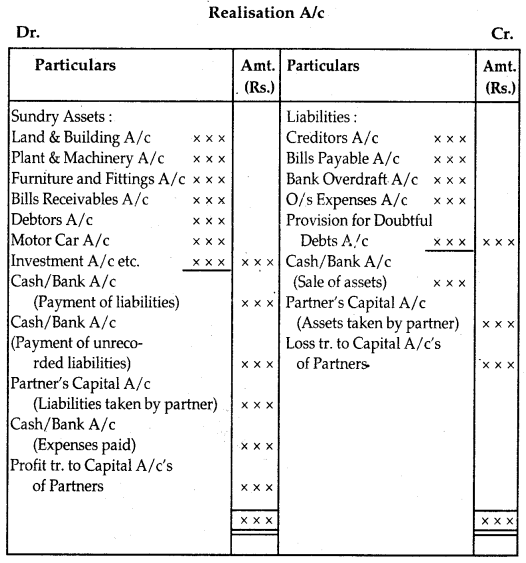
Dissolution of a Partnership Firm Class 12 Notes Accountancy 4

Reconstitution of Partnership Firm: Retirement/Death of a Partner Class 12 Notes Accountancy Chapter 4

By going through these CBSE Class 12 Accountancy Notes Chapter 4 Reconstitution of Partnership Firm: Retirement/Death of a Partner, students can recall all the concepts quickly.

Reconstitution of Partnership Firm: Retirement/Death of a Partner Notes Class 12 Accountancy Chapter 4

As we already knew that reconstitution of the partnership firm can also take place on the retirement of the partner or death of the partner. Here, the existing partnership deed comes to an end, and in its place, a new partnership deed comes into existence where remaining partners shall continue to do the business but on different terms and conditions. In both cases, i.e. on retirement or death of a partner, we are required to determine the sum due to the retiring partner or to the legal representatives of the deceased partner.

Retirement of a Partner:
A partner may retire from the partnership firm:

  1. with the consent of all other partners;
    or
  2. in case of retirement at will i.e. (partnership at will);
    or
  3. by giving notice in writing to all other partners by the retiring partner.

On retirement, the old partnership comes to an end arid a new one between the remaining partner1 comes into existence. However the partnership firm as such continues.

Amount due to Retiring Partner:

  1. Credit Balance of his Capital Account;
  2. Credit Balance of his Current Account (if any);
  3. His share of goodwill, accumulated profits, reserves etc.;
  4. His share in the profit on revaluation of assets and liabilities;
  5. His share of profit, interest on capital up to the date of retirement;
  6. Any salary/commission due to him.

The following deductions (if any) made from his share:

  1. Debit balance of the his-current account (if any);
  2. His share of Goodwill to be written off, accumulated losses;
  3. His share of loss on revaluation of assets and liabilities;
  4. His share of loss, drawing and interest on drawings up to the date of retirement.

The various accounting aspects involved in retirement or death are as follows:

  1. New profit sharing ratio
  2. Gaining ratio
  3. Goodwill Treatment
  4. Accumulated profit and losses -Distribution
  5. Profit and Loss till the date of retirement or death
  6. Adjustment of Capital
  7. Settlement of the amount due to retired /deceased partner.

New Profit Sharing Ratio:
The new profit sharing ratio is the ratio in which the remaining partners will share future profits after the retirement or death of any partners. In other words, the new profit sharing ratio of each remaining partner will be the sum total of his old share of profits in the firm and the portion of the retiring partner’s share of the profit acquired.

New Share of Partner = Old share + Acquired share from retiring/deceased partner.

(a) Nothing is mention about the new profit sharing ratio at the time of retirement:
If nothing is stated about the future ratio of the remaining partner, then their old ratio is considered as their new ratio. In other words, in the absence of any information regarding the profit-sharing ratio in which the remaining partner acquire the share of the retiring/deceased partner, then it is assumed that they will acquire it in the old profit sharing ratio and so the share the future profits in their old ratio.

For example, Kapil, Anu and Priti are partners in firm sharing profits and losses in the ratio 5: 3: 2. If Anu retires, then the new profit sharing ratio of Kapil and Priti will be 5: 2.

(b) Remaining partners acquire the share of retiring/deceased partner in the specified ratio:
If the remaining partners acquire the share of retiring/deceased partner in a specified ratio, other than their old ratio, then there is a need to compute a new profit sharing ratio among them. The new profit sharing ratio is equal to the sum total of their old ratio and the share acquired from the retiring/deceased partner.

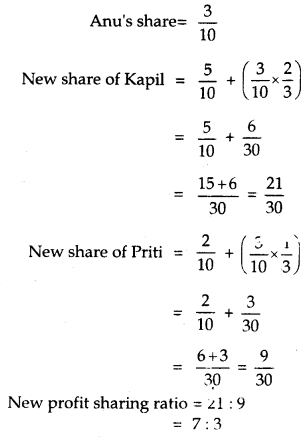
For example, Kapil, Anu and Priti are partners in firm sharing profits and losses in the ratio 5: 3: 2. If Anu retires from the firm and her share was acquired by Kapil and Priti in the ratio 2: 1. In that case, the new share of profit will be calculated as follows:

New share of remaining partner = Old share + Acquired share from the outgoing partner.
Reconstitution of Partnership Firm Retirement Death of a Partner Class 12 Notes Accountancy 1
(c) Remaining partners may agree on a particular new profit sharing ratio:
If the remaining partners decide a particular profit sharing ratio to share the future profits of the firm, in such a case the ratio so specified will be the new profit sharing ratio.

Gaining Ratio:
The ratio in which the continuing partners acquire the share of the retiring /deceased partner is called the gaining ratio.
(a) If nothing is mention in agreement:
If nothing is mention in the agreement about the gaining ratio, then it is assumed that the remaining partners acquire the share of the retiring/deceased partner in their old profit sharing ratio. In that case, the gaining ratio of the remaining partners will be the same as their old profit sharing ratio and there is no need to compute the gaining ratio.

(b) If a new profit sharing ratio is given:
If the new profit sharing ratio is given of the remaining partners then we have to compute the gaining ratio. In this case, the gaining ratio is calculated by deducting the old ratio from the new ratio.
Gaining ratio = New ratio – Old ratio

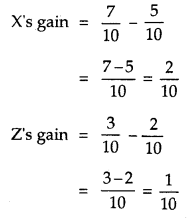
For example X, Y and Z are partners in a firm, sharing profits and losses in ratio 5:3:2. Y retires from the firm and X and Z decide to share future profits and losses in the ratio 7: 3. The gaining ratio will be calculated as follows:
Reconstitution of Partnership Firm Retirement Death of a Partner Class 12 Notes Accountancy 2
Treatment of Goodwill:
The outgoing partner is entitled to his share of goodwill at the time of retirement/death because the goodwill has been earned by the firm with the efforts of all the existing partners. Therefore, goodwill is valued as per the agreement, at the time of retirement/death.

Due to the retirement/death of any partner, the continuing partners make again because the future profit will be shared only between the continuing partners. Therefore, the continuing partners should compensate the retiring/deceased partner for his share of goodwill in the gaining ratio.

The accounting treatment for goodwill depends upon whether the goodwill already appears in the books of the firm or not.

When Goodwill does not Appear in the Books:
When Goodwill does not appear in the books of the firm, there are four following ways to compensate the retiring partner for his share of goodwill:
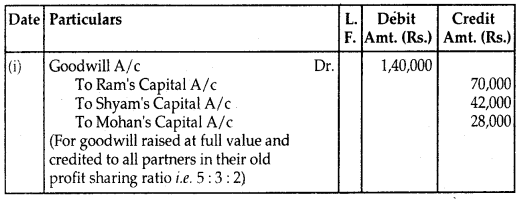
(a) Goodwill is raised at its full value and retained in the books:
Goodwill A/c Dr.
To All Partner’s Capital AJc’s
(including retiring/deceased partner)
(For the goodwill raised at its full value and credited to capital A/c’s of a ’1 partners in their old profit sharing ratio)
The full value of goodwill will appear in the new balance sheet.

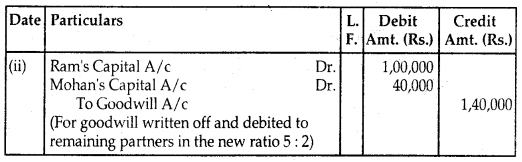
(b) Goodwill is raised at its full value and written off immediately:
If it is decided that the goodwill will not appear in the balance sheet of the reconstituted firm, then the following journal entries are required:
1. Goodwill A/c Dr.
To All Partner’s Capital A/c’s (For raising of Goodwill and credited to all partners capital A/c’s in their old profit sharing ratio)

2. Continuing Partner’s Capital A/c’s Dr.
To Goodwill A/c
(For written off goodwill between continuing partners in their new profit sharing ratio)

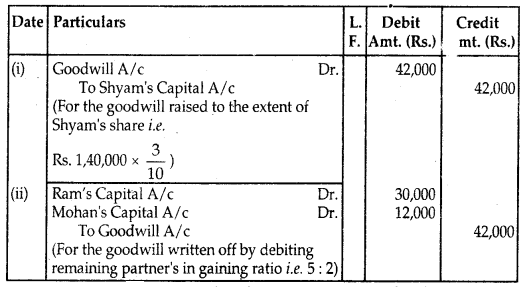
(c) Goodwill is raised to the extent of retired/deceased partner’s share and written off immediately:
1. Goodwill A/c Dr.
To Retiring/Deceased Partner’s Capital A/c (For the goodwill raised by share of outgoing partner)

2. Continuing Partner’s Capital AJc’s Dr.
To Goodwill A/c
(For the goodwill written off between the continuing partners in their gaining ratio)

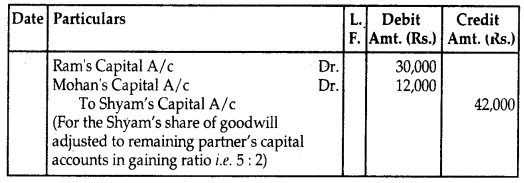
(d) No Goodwill account is raised at all in the firm’s books:
If the outgoing partner’s share of goodwill is adjusted in the capital accounts of the continuing partners without opening a goodwill account, the following entry will be required:

Continuing Partner’s Capital A/c’s Dr.
To Outgoing Partner’s Capital A/c (For the share of outgoing partner in the goodwill adjusted through capital accounts in the gaining ratio)

The following example clears the above accounting treatment of Goodwill at the time of retirement/death:
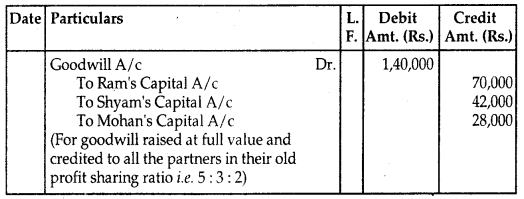
Ram, Shyam and Mohan are partners in firm sharing profits and losses in the ratio of 5: 3: 2. Shyam retires. The goodwill of the firm is valued at Rs. 1,40,000 and the remaining partner’s Ram and Mohan continue to share profits in the ratio of 5:2. The following journal entries passed under various alternatives shall be as follows:

If goodwill is raised at full value and retained in books:
Reconstitution of Partnership Firm Retirement Death of a Partner Class 12 Notes Accountancy 3
If goodwill is raised at full value and written off immediately:
Reconstitution of Partnership Firm Retirement Death of a Partner Class 12 Notes Accountancy 4
Reconstitution of Partnership Firm Retirement Death of a Partner Class 12 Notes Accountancy 5
If goodwill is raised to the extent of retiring partner’s share and written off immediately:
Reconstitution of Partnership Firm Retirement Death of a Partner Class 12 Notes Accountancy 6
No goodwill account is raised at all in the firm’s books:
Reconstitution of Partnership Firm Retirement Death of a Partner Class 12 Notes Accountancy 7
When Goodwill is already appearing in the books:
(a) If the value of goodwill appearing is equal to the current value of goodwill of the firm:
Normally, no adjustment is required if both the amounts are the same. Because goodwill stands credited in the accounts of all the partners including the retiring one.

(b) If the book value of goodwill is lower than its present value:
If the book value is less than the present value, the difference will be debited to the goodwill account and credited to the old partner’s capital accounts in their old profit sharing ratio.
Goodwill A/c Dr.
To All Partner’s Capital A/c’s (individually)
(For goodwill raised to its present value)

(c) If the book value of goodwill is more than the agreed or present value:
If the book value of goodwill is more than the present value, the difference will be debited to All partner’s capital accounts in their old profit sharing ratio and credited to the goodwill account.
All Partner’s Capital A/c’s (individually) Dr.
To Goodwill A/c
(For goodwill brought down to its present value)

Alternatively,
1. First, write off the existing goodwill that appears in the books:
All Partner’s Capital A/c’s (individually) Dr.
To Goodwill A/c
(For write off goodwill to all partners in old profit sharing ratio)

2. Adjust retiring partner’s share of goodwill through capital A/c’s
Remaining Partner’s Capital A/c’s Dr.
To Retiring/deceased Partner’s Capital A/c
(For goodwill share of retiring/deceased partner adjusted to remaining partner’s Capital A/c’s in their gaining ratio)

Hidden Goodwill:
If the firm has agreed to settle the retiring/deceased partner by paying him a lump sum, then the amount paid to him in excess of what is due to him based on the capital accounts balance after making all adjustments like accumulated profits and losses and revaluation profit or loss etc. shall be treated as his share of goodwill known as hidden goodwill.

Revaluation of Assets and Liabilities:
The retiring /deceased partner must be given a share of all profits that have arisen till his retirement/death and is made to bear his share of losses that have occurred till that period. This necessitates the revaluation of assets and liabilities. At the time of retirement/death of a partner, there may be some assets and liabilities which may not have been shown at their present values.

Not only that, there may be some unrecorded assets and liabilities which need to be brought into books. For this purpose, a revaluation account is opened, for the revaluation of assets and liabilities on the date of retirement/death of the partner. The journal entries to be passed for this purpose are as follows:

1. For increase in the value of assets:
Asset(s) AIc (individually) Dr.
To Revaluation A/c (For increase in the value of assets)

2. For decrease in the value of assets:
Revaluation A/c Dr.
To Assets A/c’s (individually)
(For decrease in the value of assets)

3. For increase in the number of liabilities:
Revaluation A/c Dr.
To Liabilities A/c’s (individually)
(for an increase in liabilities)

4. For decrease in the number of liabilities:
Liabilities A/c’s (individually) Dr.
To Revaluation A/c (For decrease in the liabilities)

5. For an unrecorded asset:
Assets A/c Dr.
To Revaluation A/c
(For unrecorded assets brought into books)

6. For an unrecorded liability:
Revaluation A/c Dr.
To Liability A/c
(For an unrecorded liability brought into books)

7. For the sale of an unrecorded asset:
Cash A/c Dr.
To Revaluation A/c (For the sale of unrecorded assets)

8. For payment of an unrecorded liability:
Revaluation A/c Dr.
To Cash A/c
(For the payment of an unrecorded*liability)

9. For-profit on revaluation:
Revaluation A/c Dr.
To All Partner’s Capital A/c’s (individually)
(For the distribution of profit on revaluation to all partners in their old profit sharing ratio)
Or

10. For Loss on revaluation:
All Partner’s Capital A/c’s (individually) Dr.
To Revaluation A/c
(For the distribution of losses on revaluation to all partners in their old profit sharing ratio)

Reserves and Accumulated Profits and Losses:
The retiring/deceased partner is also entitled to his/her share in the accumulated profits, general reserve, workmen compensation fund 1 etc. and is also liable to share the accumulated losses.

For this purpose the following journal entries are required:
1. For Transferring accumulated profits, General Reserves etc.
To All Partner’s Capital A/c’s (individually)
(For accumulated profits are transferred to all partner’s Capital A/c’s in their old profit sharing ratio)

2. For transfer of accumulated losses:
All Partner’s Capital A/c’s (individually) Dr.
To Profit and Loss A/c To Any Accumulated Loss A/c (For accumulated losses transferred to all partner’s Capital A/c’s in their old profit sharing ratio)

Settlement of Amount Due to Retiring Partner:
The retiring partner is entitled to the amount due to him. It is settled as per the terms of the partnership deed i.e. in lump sum immediately or in various instalments with or without interest as agreed or partly in cash immediately and partly in instalments.

In absence of any agreement, Section 37 of the Indian Partnership Act, 1932 is applicable, according to this, the retiring partner has an option to receive either interest 6% p.a. till the payment of his/her amount due or such share of profits which has been earned with his/her money i.e. based on the capital ratio. The necessary journal entries are as follows:
1. If payment (full) is made in cash:
Retiring Partner’s Capital A/c Dr.
To Cash/Bank A/c
(For the amount paid to retire partner)

2. If the amount due to retiring partner’s treated as loan:
Retiring Partner’s Capital A/c Dr.
To Retiring Partner’s Loan A/c (For the amount due to retiring partner transferred to his loan account)

3. When the amount due to retiring partner is partly paid in cash and the remaining amount treated as loan:
Retiring Partner’s Capital A/c Dr. (Total Amount Due)
To Cash/Bank A/c. (Amount paid)
To Retiring Partner’s Loaij A/c (Amount of loan) (For the amount due to retiring, partner; partly paid in cash and remaining transferred to his loan account)

4. When loan account is settled by paying in instalment includes principal and interest:
(a) For interest due on loan:
Interest on Loan A/c Dr.
To Retiring Partner’s Loan A/c
(For the interest due on the loan of retiring partner)

(b) For payment of instalment of the loan with interest:
Retiring Partner’s Loan A/c Dr.
To Cash/Bank A/c
(For the amount paid (Instalment + Interest) to retiring
partner)
These entries i.e. (a) and (b) repeated till the loan is paid off.

Adjustment of Partner’s Capital:
At the time of retirement or death of a partner, the remaining partners may decide to adjust their capital contribution in their new profit sharing ratio. The adjustment of the remaining partner’s capitals may involve any one of the following cases:
1. When the total capital of a new firm is specified.
Steps:
(a) Compute the new capitals of the remaining partners by dividing total capital in their new profit sharing ratio.

(b) Calculate the amount of adjusted old capital of the remaining partners after all adjustments regarding goodwill, accumulated profit and losses, profit or loss on revaluation etc.

(c) Find out the surplus or deficiency, as the case may be, in each
of the remaining partner’s capital account by comparing the new capital and the adjusted capital. ‘

(d) Adjust the surplus by paying cash to the concerned partner or by crediting his Current Account as agreed. Adjust the deficiency by asking the concerned partner to pay cash or by debiting his current account.

Journal Entries:
For excess capital withdrawn by the remaining partners:
Partner’s Capital A/c’s (individually) Dr.
To Cash/Bank A/c.

For the amount of capital to be brought in by the partners:
Cash/Bank A/c Dr.
To Partner’s Capital AJc’s (individually)
If the adjustment is made through the current account:

For excess capital:
Partner’s Capital A/c’s (individually) Dr.
To Partner’s Current A/c’s (individually)

For short capital:
Partner’s Current A/c’s /individually) Dr.
To Partner’s Capital A/c’s (individually)

2. When the total capital of the new firm is not specified:
Calculate the total capital of the new firm which will be equal to the aggregate of the adjusted old capitals of the continuing partners after all adjustments like goodwill, accumulated profits and losses, profit and losses on revaluation etc.
After calculating the total capital of the new firm, follow the same steps as discussed in case 1.

3. When the amount payable to retiring partner will be contributed by continuing partners in such a way that their capitals are adjusted proportionately to their new profit sharing ratio:

Calculate the total capital of the reconstituted firm by adding the adjusted old capitals of remaining partners and the cash to be brought in by continuing partners in order to make payment to the retiring/ deceased partner.
Then follow the same step we discussed in case 1.

Death of a Partner:
The accounting treatment in the event of the death of a partner is the same as that in the case of the retirement of a partner. Here, his claim is transferred to his executor’s account and settled in the same manner as that of the retired partner.

The only major difference between the retirement and death of a partner is that retirement normally takes place at the end of the accounting period whereas death may occur on any day. Therefore, in case of death, his claim shall also include his share of profit or loss, interest on capital, interest on drawings (if any), from the beginning of the year to the date of death.

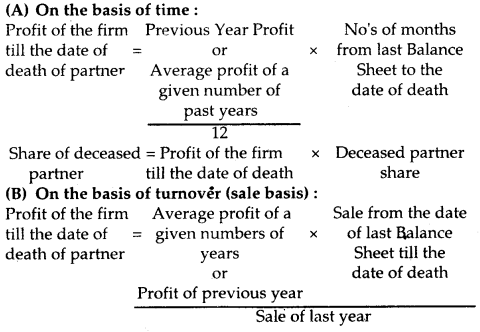
Calculation of profit for the intervening period:
Share of profit of a deceased partner
Reconstitution of Partnership Firm Retirement Death of a Partner Class 12 Notes Accountancy 8
Share of deceased partner = Profit of the firm till the date of death × Deceased partner share

Accounting Treatment of Outgoing Partner’s Share in Profit:
1. Through Profit and Loss Suspense Account
In case of Profit:
Profit and Loss Suspense A/c Dr.
To Deceased Partner’s Capital A/c (Share of profit for the intervening period)

In case of Loss:
Deceased Partner’s Capital A/c Dr.
To Profit and Loss Suspense A/c (Share of loss for the intervening period)

2. Through Capital Transfer In case of Profit:
Remaining Partner’s Capital A/c’s Dr.
To Deceased Partner’s Capital A/c In case of Loss:
Deceased Partner’s Capital A/c Dr.

To Remaining Partner’s Capital A/c’s The executors of deceased partner are entitled to the following:

  1. The credit balance of deceased partner’s capital account;
  2. His share of goodwill;
  3. His share of profit till the date of death;
  4. His share of profit on revaluation of assets and liabilities;
  5. His share of accumulated profits and reserves;
  6. His interest on capital if partnership deed provides till the date of death;
  7. His share of Joint Life Policy (if any);
  8. His salary and commission due (if any);

The following deduction has to made from above.

  1. His drawings, interest in drawings till the date of death;
  2. His share of loss till the date of death;
  3. His share of loss on revaluation of assets and liabilities. ,
  4. His share of the reduction in the value of goodwill (if any).

Payment to the executors:
1. When payment is made in full Executor’s A/c Dr.
To Bank A/c.

2. When payment is made in instalment The executor’s are entitled to interest when the payment is made in instalment. If the deed is silent about this, then 6% p.a. should be given as per Section 37 of the Indian Partnership Act, 1932.

When interest is due
Interest A/c Dr.
To Executor’s A/c

When instalment paid along with interest
Executor’s A/c Dr.
To Cash/Bank A/c

Entrepreneurial Botany

Learninsta presents the core concepts of Biology with high-quality research papers and topical review articles.

Entrepreneurial Botany

Entrepreneurial Botany is the study of how new businesses are created using plant resources as well as the actual process of starting a new business. An entrepreneur is someone who has an idea and who works to create a product or service that people will buy, by building an organization to support the sales. Entrepreneurship is now a popular topic for higher secondary students, with a focus on developing ideas to create new ventures among the young people.

Vast opportunities are there for the students of Botany. In the present scenario students should acquire ability to merge skills and knowledge in a meaningful way. Converting botanical knowledge into a business idea that can be put into practice for earning a livelihood is the much-needed training for the students.

Few examples for activities of entrepreneurship are Mushroom cultivation, Single cell protein (SCP) production, Seaweed liquid fertilizer, Organic farming, Terrarium, Bonsai and Cultivation of medicinal and aromatic plants. This part of the chapter is dealt about organic farming in brief.

Organic farming

Organic farming is an alternative agricultural system in which plants/crops are cultivated in natural ways by using biological inputs to maintain soil fertility and ecological balance thereby minimizing pollution and wastage. Indians were organic farmers by default until the green revolution came into practice.

Use of biofertilizers is one of the important components of integrated organic farm management, as they are cost effective and renewable source of plant nutrients to supplement the chemical fertilizers for sustainable agriculture. Several microorganisms and their association with crop plants are being exploited in the production of biofertilizers. Organic farming is thus considered as the movement directed towards the philosophy of Back to Nature.

I. Organic Pesticide

Pest like aphids, spider and mites can cause serious damage to flowers, fruits, and vegetables. These creatures attack the garden in swarms, and drain the life of the crop and often invite disease in the process. Many chemical pesticides prove unsafe for human and the environment. It turns fruits and vegetables unsafe for consumption. Thankfully, there are many homemade, organic options to turn to war against pests.

II. Bio-pest repellent

Botanical pest repellent and insecticide made with the dried leaves of Azadirachta indica

Preparation of Bio-pest repellent

  • Pluck leaves from the neem tree and chop the leaves fiely.
  • The chopped up leaves were put in a 50-liter container and fill to half with water; put the lid on and leave it for 3 days to brew.
  • Using another container, strain the mixture which has brewed for 3 days to remove the leaves, through fie mesh sieve. The fitrate can be sprayed on the plants to repel pests.
  • To make sure that the pest repellent sticks to the plants, add 100 ml of cooking oil and the same amount of soap water. (The role of the soap water is to break down the oil, and the role of the oil is to make it stick to the leaves).
  • The stewed leaves from the mixture can be used in the compost heap or around the base of the plants.

An Overview Of Medicinal Plants

Learninsta presents the core concepts of Biology with high-quality research papers and topical review articles.

An Overview Of Medicinal Plants

India is a treasure house of medicinal plants. They are linked to local heritage as well as to global-trade. All institutional systems in India primarily use medicinal plants as drug sources. At present, 90% collection of medicinal plants is from the non-cultivated sources.

Growing demand for herbal products has led to quantum jump in volume of plant materials traded within and across the countries. Increasing demand exerts a heavy strain on the existing resources. Now efforts are being made to introduce cultivation techniques of medicinal plants to the farmers.

Medicinal plants play a significant role in providing primary health care services to rural and tribal people. They serve as therapeutic agents as well as important raw materials for the manufacture of traditional and modern medicines.

Medicinally useful molecules obtained from plants that are marketed as drugs are called Biomedicines. Medicinal plants which are marketed as powders or in other modified forms are known as Botanical medicines.

Keezhanelli

Botanical name: Phyllanthus amarus
Family: Euphorbiaceae (Now in Phyllanthaceae)

Origin and Area of cultivation:

The plant is a native of Tropical American region and is naturalised in India and other tropical countries. It is not cultivated and is collected from moist places in plains. Phyllanthus maderspatensis is also commonly sold in the medicinal plant markets collected from non-forest are as keezhanelli.

Active principle:

Phyllanthin is the major chemical component.

Medicinal importance

Phyllanthus is a well-known hepato-protective plant generally used in Tamil Nadu for the treatment of Jaundice. Research carried out by Dr. S P Thagarajan and his team from University of Madras has scientifially proved that the extract of P. amarus is effective against hepatitis B virus.

Nilavembu

Botanical name: Andrographis paniculata
Family: Acanthaceae

Andrographis paniculata, known as the King of Bitters is traditionally used in Indian systems of medicines.

Active principle:

Andrographolides.

Medicinal importance:

Andrographis is a potent hepatoprotective and is widely used to treat liver disorders. Concoction of Andrographis paniculata and eight other herbs (Nilavembu Kudineer) is effectively used to treat malaria and dengue.
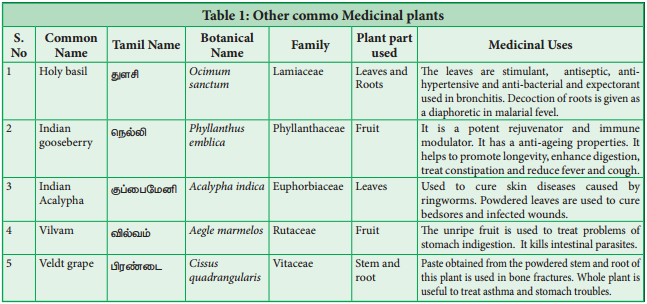
Medicinal Plants img 1

Psychoactive Drugs

In the above chapter you have learnt about plants that are used medicinally to treat various diseases. Phytochemicals / drugs from some of the plants alter an individual’s perceptions of mind by producing hallucination are known as psychoactive drugs. These drugs are used in all ancient culture especially by Shamans and by traditional healers. Here we focus on two such plants namely Poppy and Marijuana.

Opium poppy

Botanical name: Papaver somniferum
Family: Papaveraceae

Origin and Area of cultivation:

Opium poppy is native to South Eastern Europe and Western Asia. Madhya Pradesh, Rajasthan and Uttar Pradesh are the licenced states to cultivate opium poppy.

Opium is derived from the exudates of fruits of poppy plants. It was traditionally used to induce sleep and for relieving pain. Opium yields Morphine, a strong analgesic which is used in surgery. However, opium is an addiction forming drug.

Cannabis / Marijuana

Botanical name: Cannabis sativa
Family: Cannabiaceae

Origin and Area of Cultivation:

Marijuana is native to China. States such as Gujarat, Himachal Pradesh, Uttarkand, Uttarpradesh and Madhaya Pradesh have legally permitted to cultivate industrial hemp/Marijuana. The active principle in Marijuana is trans-tetrahydrocanabinal (THC). It possess a number of medicinal properties. It is an effective pain reliever and reduces hypertension.

THC is used in treating Glaucoma a condition in which pressure develops in the eyes. THC is also used in reducing nausea of cancer patients undergoing radiation and chemotherapy. THC provides relief to bronchial disorders, especially asthma as it dilates bronchial vessels.

Because of these medicinal properties, cultivation of cannabis is legalized in some countries. However, prolonged use causes addiction and has an effect on individual’s health and society. Hence most of the countries have banned its cultivation and use.
Medicinal Plants img 2

Traditional System Of Medicines

Learninsta presents the core concepts of Biology with high-quality research papers and topical review articles.

Traditional System Of Medicines

India has a rich medicinal heritage. A number of Traditional Systems of Medicine (TSM) are practiced in India some of which come from outside India. TSM in India can be broadly classified into institutionalized or documented and non-institutionalized or oral traditions. Institutionalized Indian systems include Siddha and Ayurveda which are practiced for about two thousand years.

These systems have prescribed texts in which the symptoms, disease diagnosis, drugs to cure, preparation of drugs, dosage and diet regimes, daily and seasonal regimens. Non – institutional systems, whereas, do not have such records and or practiced by rural and tribal peoples across India. The knowledge is mostly held in oral form. The TSM focus on healthy lifestyle and healthy diet for maintaining good health and disease reversal.

Siddha system of medicine

Siddha is the most popular, widely practiced and culturally accepted system in Tamil Nadu. It is based on the texts written by 18 Siddhars. There are different opinions on the constitution of 18 Siddhars. The Siddhars are not only from Tamil Nadu, but have also come from other countries. The entire knowledge is documented in the form of poems in Tamil.

Siddha is principally based on the Pancabuta philosophy. According to this system three humors namely Vatam, Pittam and Kapam that are responsible for the health of human beings and any disturbance in the equilibrium of these humors result in ill health. The drug sources of Siddha include plants, animal parts, marine products and minerals.

This system specializes in using minerals for preparing drugs with the long shelf-life. This system uses about 800 herbs as source of drugs. Great stress is laid on disease prevention, health promotion, rejuvenation and cure.

Ayurveda system of medicine Ayurveda supposed to have originated from Brahma. The core knowledge is documented by Charaka, Sushruta and Vagbhata in compendiums written by them. This system is also based on three humour principles namely, Vatha, Pitha and Kapha which would exist in equilibrium for a healthy living. This system Uses more of herbs and few animal parts as drug sources. Plant sources include a good proportion of Himalayan plants. The Ayurvedic Pharmacopoeia of India lists about 500 plants used as source of drugs.

Folk system of medicine

Folk systems survive as an oral tradition among innumerable rural and tribal communities of India. A consolidated study to document the plants used by ethnic communities was launched by the Ministry of Environment and Forests, Government of India in the form of All India Coordinated Research Project on Ethnobiology. As a result about 8000 plant species have been documented which are used for medicinal purposes. The efforts to document in several under-explored and unexplored pockets of India still continue.

Major tribal communities in Tamil Nadu who are known for their medicinal knowledge include Irulas, Malayalis, Kurumbas, Paliyans and Kaanis. Some of the important medicinal plants are discussed below.