Cosmetics | Aloe | Perfumes | Jasmine and Its Uses

Learninsta presents the core concepts of Biology with high-quality research papers and topical review articles.

Cosmetics | Aloe | Perfumes | Jasmine and Its Uses

Traditionally in Southern India, people have been using turmeric, green gram powder, henna, sigaikai and usilai for their skin and hair care. These were mostly home prepared products that are used for grooming. Today, cosmetics have a high commercial value and have become chemical based industrial products. Providing personal care services has become a major industry.

In recent years, people have realized the hazards of chemicalbased cosmetics and are turning back to natural products. In this chapter one of the major plants namely Aloe which is used in the cosmetic industries is discussed.

Aloe

Botanical name: Aloe vera
Family: Asphodelaceae (formerly Liliaceae)

Origin and Area of cultivation:

It is a native of Sudan. It is cultivated on a large scale in Rajasthan, Gujarat, Maharashtra, Andhra Pradesh and Tamil Nadu.
Cosmetics img 1

Uses

‘Aloin’ (a mixture of glucosides) and its gel are used as skin tonic. It has a cooling effect and moisturizing characteristics and hence used in preparation of creams, lotions, shampoos, shaving creams, after shave lotions and allied products.

It is used in gerontological applications for rejuvenation of aging skin. Products prepared from aloe leaves have multiple properties such as emollient, antibacterial, antioxidant, antifungal and antiseptic. Aloe vera gel is used in skin care cosmetics.

Perfumes

The word perfume is derived from the Latin word Per (through) and fumus (to smoke), meaning through smoke. It refers to the age-old tradition of burning scented woods at religious ceremonies.

In early days, when people were less conscious of personal hygiene, essential oils not only masked offensive odours, but also may have acted as antiseptics. Perfumes are added to baths and used for anointing the body.

Perfumes are manufactured from essential oil which are volatile and aromatic. Essential oils are found at different parts of the plant such as leaves, (curry leaf, mint), flowers (rose, jasmine), fruits (citrus, straw berry) and wood (sandal, eucalyptus).

Jasmine

Botanical name: Jasminum grandiflrum
Family: Oleaceae

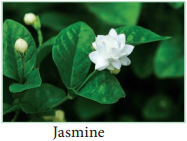
Jasmine, as a floral perfume, ranks next to the rose oil. Major species cultivated on the commercial scale is Jasminum grandiflorum, a native of the north-western Himalayas. In Tamil Nadu, the major jasmine cultivation centres are Madurai and Thvalai of Kanyakumari District.

The essential oil is present in the epidermal cells of the inner and outer surfaces of both the sepals and petals. One ton of Jasmine blossom yields about 2.5 to 3 kg of essential oil, comprising 0.25 to 3% of the weight of the fresh flower.
Cosmetics img 2

Uses

Jasmine flowers have been used since ancient times in India for worship, ceremonial purposes, incense and fumigants, as well as for making perfumed hair oils, cosmetics and soaps. Jasmine oil is an essential oil that is valued for its soothing, relaxing, antidepressant qualities.

Jasmine blends well with other perfumes. It is much used in modern perfumery and cosmetics and has become popular in air freshners, anti-perspirants, talcum powders, shampoos and deodorants.

Definition Of Dye | Henna and Its Uses

Learninsta presents the core concepts of Biology with high-quality research papers and topical review articles.

Definition Of Dye | Henna and Its Uses

The ability to perceive colour is a wonderful aspect of human eyes and dyes add colour to the goods we use. They have been in use since the ancient times.

The earliest authentic records of dyeing were found in the tomb painting of ancient Egypt. Colourings on mummy cements (wrapping) included saffon and indigo. They can also be seen in rock paintings in India.

Henna

Botanical name: Lawsonia inermis
Family: Lythraceae

Origin and Area of cultivation:

It is indigenous to North Africa and South-west Asia. It is grown mostly throughout India, especially in Gujarat, Madya Pradesh and Rajasthan.

Uses

An orange dye ‘Henna’ is obtained from the leaves and young shoots of Lawsonia inermis. The principal colouring matter of leaves ‘lacosone’ is harmless and causes no irritation to the skin. This dye has long been used to dye skin, hair and finger nails. It is used for colouring leather, for the tails of horses and in hair-dyes.
Dye img 1

Reconstitution of Partnership Firm: Admission of a Partner Class 12 Notes Accountancy Chapter 3

By going through these CBSE Class 12 Accountancy Notes Chapter 3 Reconstitution of Partnership Firm: Admission of a Partner, students can recall all the concepts quickly.

Reconstitution of Partnership Firm: Admission of a Partner Notes Class 12 Accountancy Chapter 3

As we know that Partnership is an agreement between the partners or members of the firm for sharing profits and losses of the business carried on by all or any of them acting for all. Any change in this agreement amounts to the reconstitution of the partnership firm.

A change in the agreement brings to an end the existing agreement and a new agreement comes into existence. This new agreement changes the relationship among the members or partners of the partnership firm. Hence, whenever there is a change in the partnership agreement, the firm continues but it amounts to the reconstitution of the partnership firm.

Modes of Reconstitution of the Partnership Firm:
Reconstitution of partnership firm usually takes place in any of the following situations:

  1. At the time of admission of a new partner;
  2. Change in the profit-sharing ratio of existing partners;
  3.  At the time of retirement of an existing partner;
  4. At the time of death of a partner;
  5. The amalgamation of two partnership firms.

Admission of a New Partner:
When a business enterprise requires additional capital or managerial help or both for the growth and expansion of the business it may admit a new partner to supplement its existing resources. So, admission of a new partner is required for the following reasons:

  1. Requirement of more capital for the expansion of the business.
  2. Need of a competent and experienced person for the efficient running of the business.
  3. To increase the goodwill of the business by taking a reputed and renowned person into the partnership.
  4. To encourage a capable employee by taking him into the partnership.

According to Sec. 31, Indian Partnership Act, 1932, a new partner can be admitted into the firm only with the consent of all the existing partners unless otherwise agreed upon. Admission of a new partner means reconstitution of the firm. It is so because the existing agreement comes to an end and a new agreement comes into effect.

A newly admitted partner acquire s two main rights in the firm:

  1. Right to share m the assets of the partnership firm, and
  2. Right to share in the profits of the partnership firm.

Section 31, Indian Partnership Act, 1932, further specifies that the new partner is not liable for any debts incurred by the firm before he became a partner. New partner, however, will become liable if:

  1. the reconstituted firm assumes the liabilities to pay the debt; and
  2. the creditors have agreed to accept the reconstituted firm as their debtors and discharge the old firm from liability.

A new partner brings an agreed amount of capital either in cash or in-kind and he also contributes some additional amount known as premium or goodwill. This is done primarily to compensate the existing partners for the loss of their share in the profits of the firms.

Adjustment at the Time of Admission of a New Partner:

  1. New profit sharing ratio;
  2. Sacrificing ratio;
  3. Valuation and adjustment of goodwill;
  4. Revaluation of assets and liabilities;
  5. Distribution of accumulated profits or losses or reserves; and
  6. Adjustment of partners capitals.

New Profit Sharing Ratio:
The ratio in which all partners including new partner share the future profits is called the new profit sharing ratio. In other words, on the admission of a new partner, the old partners sacrifice a share of their profits in favour of the new partner. On admission of a new partner, the profit-sharing ratio among the old partners will change keeping in view their respective contribution to the profit-sharing ratio of the incoming partner. Hence, there is a need to ascertain the new profit sharing ratio among all the partners.

The new partner may acquire his share from the old partners in any of the following situations:
1. If only the ratio of the new partner is given, then in the absence of any other agreement or information, it is assumed that the old partners will continue to share the remaining profits in the old ratio.
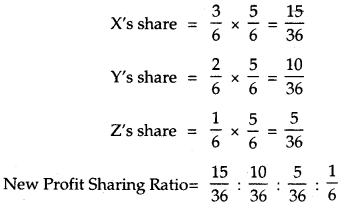
Example: X, Y.and Z are partners sharing profits in the ratio 3:2:1 respectively. A is admitted in the firm as a new partner with \(\frac{1}{6}\)th share. Find the new profit sharing ratio.
Answer:
Let total profit = 1
A’s share = \(\frac{1}{6}\)th
Remaining Profit = 1 – \(\frac{1}{6}\) = \(\frac{5}{6}\)
Old partners share this remaining profit in the old profit sharing
Reconstitution of Partnership Firm Admission of a Partner Class 12 Notes Accountancy 1
= \(\frac{15: 10: 5: 6}{36}\)
= 15: 10: 5: 6

2. If the new partner acquires his share of profit from the old partners equally. In that case, the new profit sharing ratio of the old partner will be calculated by deducting the sacrifice made by them from their existing share of profit.

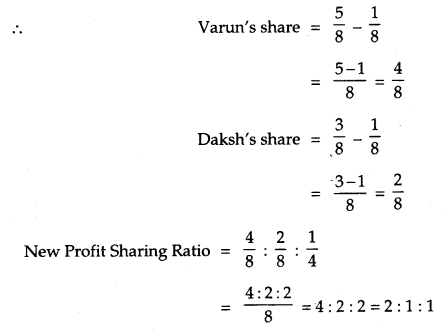
Example: Varun and Daksh are partners sharing profits and losses in the ratio 5:3. They admit Dhruv as a partner for \(\frac{1}{4}\)th share, which he acquires equally from Varun and Daksh. Calculate the new profit sharing ratio.
Answer:
Dhruv1s share = \(\frac{1}{4}\)
Share acquired by Dhruv from Varun = \(\frac{1}{4} \times \frac{1}{2}=\frac{1}{8}\)
Share acquired by Dhruv from Daksh = \(\frac{1}{4} \times \frac{1}{2}=\frac{1}{8}\)
Reconstitution of Partnership Firm Admission of a Partner Class 12 Notes Accountancy 2
3. In the new partner acquire his share of profit from the old partners in a particular ratio. In that case, the new profit sharing ratio of the old partners will be calculated by deducting the sacrifice made by them from their existing share of profit.

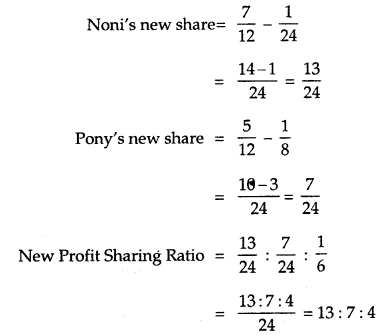
Example: Noni and Pony are partners, sharing profits in the ratio of 7:5. They admit Tony as new partner for \(\frac{1}{6}\)th share which he takes \(\frac{1}{24}\)th from Noni and \(\frac{1}{8}\)th from Pony. Calculate the new profit sharing ratio.
Answer:
Reconstitution of Partnership Firm Admission of a Partner Class 12 Notes Accountancy 3
4. If the old partners surrender a particular fraction of their share in favour of the new partner. In that case, the new partner’s share is calculated by adding the surrendered portion of the share by the old partners. Old partners’ share is calculated by deducting the surrendered portion from their old ratio.

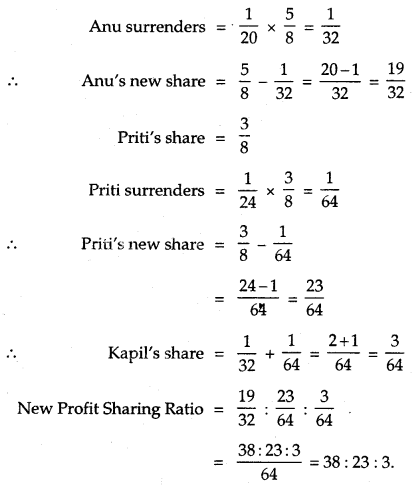
Example: Anu and Priti are partners in firm sharing profits in the ratio of 5:3. Anu surrenders \(\frac{1}{20}\)th of her share and Priti surrenders \(\frac{1}{24}\)th of her share in favour of Kapil, a new partner. Calculate the new profit sharing ratio.
Answer:
Anu’s share = \(\frac{5}{8}\)
Reconstitution of Partnership Firm Admission of a Partner Class 12 Notes Accountancy 4
5. If the new partner acquires his share of profit from only one partner. In that case, the new profit sharing ratio of the old partner will be calculated by deducting the sacrifice made by one partner from his existing ratio.

Example: Akshay and Anshul are partners in a firm sharing profits in a 4: 1 ratio. They admitted Shikha as a new partner for \(\frac{1}{4}\) share in the profits, which she acquired wholly from Akshay. Calculate the new profit sharing ratio.
Answer:
Akhay’s share = \(\frac{4}{5}\)
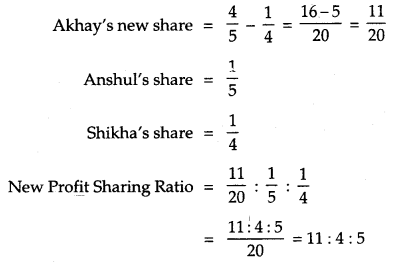
Reconstitution of Partnership Firm Admission of a Partner Class 12 Notes Accountancy 5
Sacrificing Ratio:
The ratio in which the old partners have agreed to sacrifice their shares in profit in favour of a new partner is called the sacrificing ratio. This ratio is calculated by taking out the difference between the old profit sharing ratio and the new profit sharing ratio.

Sacrificing Ratio = Old Ratio – New Ratio

Goodwill:
Goodwill is the value of the reputation of a firm in respect of the profits expected in future over and above the normal profits earned by other similar firms belonging to the same industry. In other words, a well-established business develops an advantage of good name, reputation and wide business connections. This helps the business to earn more profits as compared to newly set-up business. This advantage in monetary terms called ‘Goodwill’. It arises only if a firm is able to earn higher profits than normal.

“Goodwill is nothing more than the probability that old customers will resort to the old place.” – Lord Eldon

“The term goodwill is generally used to denote the benefit arising from connections and reputation.” -Lord Lindley

“Goodwill is a thing very easy to describe, very difficult to define. It is the benefit and advantage of the good name, reputation and connections of a business. It is the attractive force that brings in customers. It is one thing which distinguishes an old-established business from a new business at its first start.” -Lord Macnaghten

“Goodwill may be said to be that element arising from the reputation, connections or other advantages possessed by a business which enable it to earn greater profits than the return normally to be expected on the capital represented by the net tangible assets employed in the business.” – Spicer and Pegler

“When a man pays for goodwill, he pays for something which places him in the position of being able to earn more than he would be able to do by his own unaided efforts.” -Dicksee

Thus, goodwill can be defined as “the present value of a firm’s anticipated excess earnings “or as” the capitalised value attached to the differential profits capacity of a business.”

Characteristics of Goodwill:

  1. Goodwill is an intangible asset but not a fictitious asset;
  2. It is a valuable asset. Its value is dependent on the subjective judgement of the valuer.
  3. It helps in earning higher profits than normal.
  4. It is very difficult to place an exact value on goodwill. It is fluctuating from time to time due to changing circumstances of the business.
  5. Goodwill is an attractive force that brings in customers to the old place of business.
  6. Goodwill comes into existence due to various factors.

Factors Affecting the Value of Goodwill:
1. Nature of business: Company produces high value-added products or having stable demand in the market. Such a company will have more goodwill and is able to earn more profits.

2. Location: If a business is located in a favourable place, it will attract more customers and therefore will have more goodwill.

3. Efficient Management: Efficient Management brings high productivity and cost efficiency to the business which enables it to earn higher profits and thus more goodwill.

4. Market Situation: A firm under monopoly or limited competition enjoys high profits which leads to a higher value of goodwill.

5. Special Advantages: A firm enjoys a higher value of goodwill if it has special advantages like import licences, low rate and assured supply of power, long-term contracts for sale and for purchase, patents, trademarks etc.

6. Quality of Products: If the quality of products of the firm is good and regular, then it has more goodwill.

Need for Valuation of Goodwill:

  1. At the time of sale of a business;
  2. Change in the profit-sharing ratio amongst the existing partners;
  3. Admission of a new partner.
  4. Retirement of a partner;
  5. Death of a partner;
  6. Dissolution of a firm;
  7. The amalgamation of the partnership firm.

Methods of Valuation of Goodwill:
Goodwill is an intangible asset, so it is very difficult to calculate its exact value. There are various methods for the valuation of goodwill in the partnership, but the value of goodwill may differ in different methods. The method by which the value of goodwill is to be calculated may be specifically decided among all the partners.

The methods followed for valuing goodwill are:

  1. Average Profit Method
  2. Super Profit Method
  3. Capitalisation Method.

1. Average Profit Method:
Goodwill is calculated on the basis of the number of past years profits. In this method, the goodwill is valued at an agreed number of ‘years’ purchase of the average profits of the past few years.

Steps:

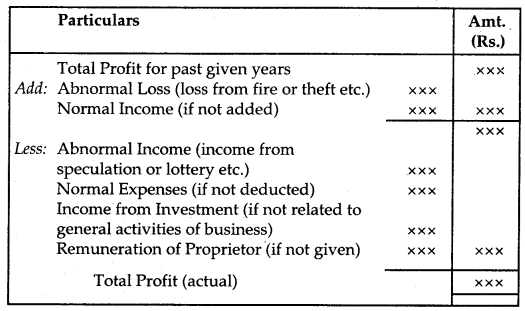
  1. Find the total profit of the past given years.
  2. Add ail Abnormal Losses like loss from fire or theft etc. and any Normal Income if not added before to the total profit of past given year.
  3. Then, subtract, Abnormal Income (income from speculation or lottery etc.), Normal Expenses (if not deducted), Income from investment (if not related to general activities of business) and remuneration of the proprietor (if not given), if any, from the total profit of past given years.
  4. After this, calculate the actual average profit by dividing the total profit by a number of years.
  5. Then multiply Average Profit by the numbers of year purchases to find out the value of goodwill.

In other words:
Reconstitution of Partnership Firm Admission of a Partner Class 12 Notes Accountancy 6
Actual Average Profit = \(\frac{\text { Total Profit }}{\text { No. of Years }}\)

Goodwill = Actual Average Profit × No. of Years Purchased
→ Weighted Average Profit Method
Sometimes, if there exists an increasing or decreasing trend, it is considered to be better to give a higher weightage to the profits to the recent years than those of the earlier years. This method is an extension of the average profit method.

Steps:

  1. Multiply each year’s profit to the weights assigned to each year respectively.
  2. Find the total of the product.
  3. Divide this product by total weights for ascertaining average profits.
  4. Average profits then multiplied with No. of years purchased to find the value of Goodwill.

2. Super Profit Method:
Under this method, goodwill is valued on the basis of excess profits earned by a firm in comparison to average profits earned by other firms. When a similar type of firm gets a return as a certain percentage of the capital employed, it is called ‘normal return’. The excess of actual profit over the normal profit is called ‘Super Profits’. To find out the value of goodwill, Super profit is multiplied by the agreed number of year’s purchase.

Steps:

  1. Calculate Actual Average Profit i.e. \(\left[\frac{\text { Total Profit }}{\text { No. of Years }}\right]\)
  2. Calculate Normal Profit i.e.
    = \(\text { Capital Employed } \times \frac{\text { NormalRate of Return }}{100}\)
    [Capital Employed = Total Assets – Outside Liabilities]
  3. Find Out Super Profits
    Super Profits = Actual Average Profit – Normal Profit
  4. Calculate the Value of Goodwill
    = Super profit × No. of years purchased

3. Capitalisation Methods:
(a) by capitalizing the average profits
(b) by capitalizing the super profits.

(a) Capitalisation of Actual Average Profit Method:
Steps:

  1. Calculate actual average profit: \(\left[\frac{\text { Total Profit }}{\text { No. of Years }}\right]\)
  2. Capitalize the average profit on the basis of the normal rate of return:
    The capitalised value of actual average profit
    = Actual Average Profit × \(\frac{100}{\text { Normal Rate of Return }}\)
  3. Find out the actual capital employed:
    Actual Capital Employed = Total Assets at their current value other than [Goodwill, Fictitious assets and non-trade investments] – Outside Liabilities.
  4. Compute the value of Goodwill:
    Goodwill = Capitalised value of actual average profit – Actual Capital Employed.

(b) Capitalisation of Super Profit Method:
Steps:

  1. Calculate Actual Capital Employed [same as above].
  2. Calculate Super Profit [same as under Super Profit Method].
  3. Multiply the Super Profit by the required rate of return multiplier:
    Goodwill = Super Profit × \(\frac{100}{\text { Normal Rate of Return }}\)

Treatment of Goodwill:
To compensate old partners for the loss (sacrifice) of their share in profits, the incoming partner, who acquire his share of profit from the old partners brings in some additional amount termed as a share of goodwill.
Goodwill, at the time of admission, can be treated in two ways:

  1. Premium Method
  2. Revaluation Method.

1. Premium Method:
The premium method is followed when the incoming partner pays his share of goodwill in cash. From the accounting point of view, the following are the different situations related to the treatment of goodwill:

(a) Goodwill (Premium) paid privately (directly to old partners)
[No entry is required]

(b) Goodwill (Premium) brought in cash through the firm
1. Cash A/c or Bank A/c Dr.
To Goodwill A/c
(For the amount of Goodwill brought by new partner)

2. Goodwill A/c Dr.
To Old Partner’s Capital A/c
(For the amount of Goodwill distributed among the old partners in their sacrificing ratio)

Alternatively:
1. Cash A/c or Bank A/c Dr.
To New Partner’s Capital A/c (For the amount of Goodwill brought b> a new partner)

2. New Partner’s Capital A/c Dr.
To Old Partner’s Capital A/c’s (For the amount of Goodwill distributed among the old partners in their sacrificing ratio)

3. If old partners withdrew goodwill (in full or in part) (if any)
Old Partner’s Capital A/c’s Dr.
To Cash A/c or Bank A/c
(For the amount of goodwill withdrawn by the old partners)

When goodwill already exists in books:
If the goodwill already exists in the books of firms and the incoming partner brings his share of goodwill in cash, then the goodwill appearing in the books will have to be written off.

Old Partner’s Capital A/c’s Dr.
To Goodwill A/c
(For Goodwill written-off in old ratio)

After the admission of the partner, all partners may decide to maintain the Goodwill Account in the books of accounts.
Goodwill A/c Dr.
To All Partner’s Capital A/c’s (For Goodwill raised in the new firm after admission of a new partner in new profit sharing ratio)

2. Revaluation Method:
If the incoming partner does not bring in his share of goodwill in cash, then this method is followed. In this case, the goodwill account is raised in the books of accounts. When goodwill account is to be raised in the books there are two possibilities:
(a) No goodwill appears in books at the time of admission.
(b) Goodwill already exists in books at the time of admission,

(a) No goodwill appears in the books:
Goodwill A/c Dr.
To Old Partner’s Capital A/c’s (For Goodwill raised at full value in the old ratio)
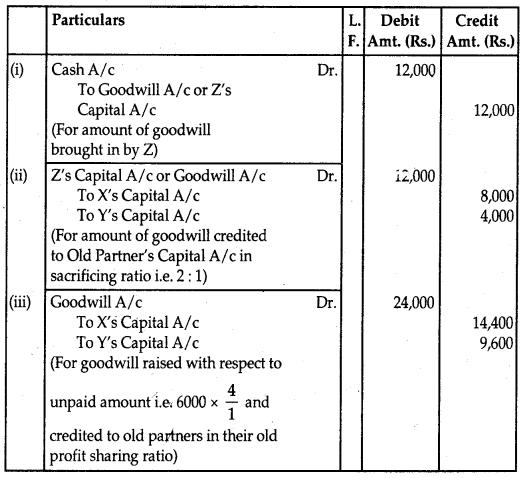
If the incoming partner brings in a part of his share of goodwill. In that case, after distributing the amount brought in for goodwill among the old partners in their sacrificing ratio, the goodwill account is raised in the books of accounts based on the portion of premium not brought by the incoming partner.
Example: X and Y are partners sharing profits in the ratio of 3: 2.

They admit Z as a new partner. \(\frac{1}{4}\)th share. The sacrificing ratio of X and Y is 2: 1. Z brings Rs. 12,000 as goodwill out of his share of Rs. 18,000. No goodwill account appears in the books of the firm.
Answer: Journal
Reconstitution of Partnership Firm Admission of a Partner Class 12 Notes Accountancy 7
(b) When goodwill already exists in the books
1. When the value of goodwill appearing in books is equal to the agreed value:
[No Entry is Required]

2. If the value of goodwill appearing in the books is less than the agreed value:
Goodwill A/c Dr.
To Old Partner’s Capital A/c’s (For Goodwill is raised to its agreed value)

3. If the value of goodwill appearing in the books is more than the agreed value:
Old Partner’s Capital A/c’s Dr.
To Goodwill A/c
(For Goodwill brought down to its agreed value)

→ If partners, after raising Goodwill in the books and making necessary adjustments decide that the goodwill should not appear in the firm’s balance sheet, then it has to be written off.
All Partners’ Capital A/c’s Dr.
To Goodwill A/c (For Goodwill written off)

→ Sometimes, the partners may decide not to show goodwill account anywhere in books.
New Partner’s Capital A/c Dr.
To Old Partner’s Capital A/c (For adjustment for New Partner’s Share of Goodwill)

Hidden or Inferred Goodwill:
1. To find out the total capital of the firm by new partner’s capital and his share of profit.
Example: New partner’s capital for \(\frac{1}{4}\)th share is Rs. 80,000, the entire capital of the new firm will be
80,000 × \(\frac{4}{1}\) = Rs. 3,20,000

2. To ascertain the existing total capital of the firm: We will have to ascertain the existing total capital of the new firm by adding the capital (of all partners, including new partner’s capital after adjustments, if any excluding goodwill)
→ If assets and liabilities are given:
Capital = Assets (at revalued figures) – Liabilities (at revalued figures)

3. Goodwill = Capital from (1) – Capital from (2)
Generally, this method is used, when the incoming partner does not bring his share of goodwill in cash. Here, we find out the total goodwill of the firm. After that, we can find out the new partner’s share of goodwill and treat accordingly.

Adjustment for Accumulated (Undistributed) Profits and Losses:
1. For Undistributed Profits, Reserves etc.
(For distribution of accumulated profits and reserves to old partners in old profit sharing ratio)
General Reserves A/c Dr.
Reserve fund A/c Dr.
Profit and Loss A/c Dr.
Workmen’s Compensation Fund A/c Dr.
To Old Partner’s Capital A/c’s
(For distribution of accumulated profits and reserves to old partners in old profit sharing ratio)

2. For Undistributed Losses:
Old Partner’s Capital A/c’s Dr.
To Profit and Loss A/c
(For distribution of accumulated losses to old partners in old profit sharing ratio)

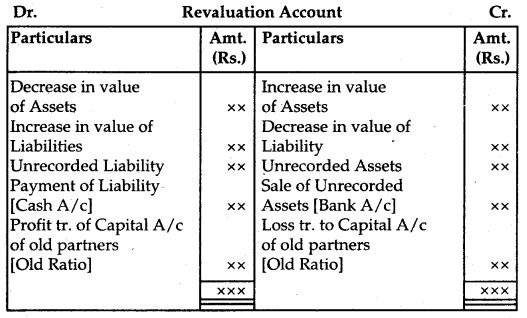
Revaluation of Assets and Reassessment of Liabilities: Revaluation of Assets and Reassessment of Liabilities is done with the help of ‘Revaluation Account’ or ‘Profit and Loss Adjustment Account’.

The journal entries recorded for revaluation of assets and reassessment of liabilities are following:
1. For increase in the value of an Assets
Assets A/c Dr.
To Revaluation A/c (Gain)

2. For decrease in the value of an Assets
Revaluation A/c Dr.
To Assets A/c (Loss)

3. For appreciation in the amount of Liability
Revaluation A/c Dr.
To Liability A/c (Loss)

4. For reduction in the amount of a Liability
Liability A/c Dr.
To Revaluation A/c (Gain)

5. For recording an unrecorded Assets
Unrecorded Assets A/c Dr.
To Revaluation A/c (Gain)

6. For recording an unrecorded Liability
Revaluation A/c Dr.
To Unrecorded Liability A/c (Loss)

7. For the sale of unrecorded Assets
Cash A/c or Bank A/c Dr.
To Revaluation A/c (Gain)

8. For payment of unrecorded Liability
Revaluation A/c Dr.
To Cash A/c or Bank A/c (Loss)

9. For transfer of gain on Revaluation if the credit balance
Revaluation A/c Dr.
To Old Partner’s Capital A/c’s (Old Ratio)

10. For transfer of loss on Revaluation if debit balance
Old Partner’s Capital A/c’s Dr.
To Revaluation A/c (Old Ratio)
Reconstitution of Partnership Firm Admission of a Partner Class 12 Notes Accountancy 8
Adjustment of Capitals:
1. When the new partner brings in proportionate capital OR On the basis of the old partner’s capital.
(a) Calculate the adjusted capital of old partners (after all adjustments)

(b) Total capital of the firm
= Combined Adjusted Capital × Reciprocal proportion of the share of old partners

(c) New Partner’s Capital
= Total Capital × Proportion of share of a new partner.

2. On the basis of the new partner’s capital:
(a) Total Capital of the firm = New Partner’s Capital × Reciprocal proportion of his share.
(b) Distribute Total Capital in New Profit Sharing Ratio.
(c) Calculate adjusted capital of old partners.
(d) Calculate the difference between New Capital and Adjusted Capital.

  1. If the debit side of the Capital Account is bigger then it means he has excess capital
    Partner’s ( capital Accounts Dr.
    To Cash A /c or Bank A/c or Current A/c
  2. If the credit side is bigger then it means that he has short capital
    Cash A/c or Bank A/c or Current A/c Dr.
    To Partner’s Capital A/cs

Change in Profit Sharing Ratio among the Existing Partners:
Sometimes the existing partners of the firm may decide to change their profit sharing ratio. In such a case, some partner will gain in future profits and some will lose. Here the gaining partners should compensate the losing partners unless otherwise agreed upon. In such a situation, first of all, the loss and gain in the value of goodwill (if any) will have to adjust.
1. Goodwill A/c Dr.
To Partner’s Capital A/c’s (For raising the amount of Goodwill in old ratio)

2. Partner’s Capital A/c’s Dr.
To Goodwill A/c
(For writing off the amount of Goodwill in New Profit sharing ratio)

Alternatively:
Gaining Partner’s Capital A/c’s Dr.
To Losing Partner’s Capital A/c’s (For adjustment due to change in profit sharing ratio)


Accounting for Partnership: Basic Concepts Class 12 Notes Accountancy Chapter 2

By going through these CBSE Class 12 Accountancy Notes Chapter 2 Accounting for Partnership: Basic Concepts, students can recall all the concepts quickly.

Accounting for Partnership: Basic Concepts Notes Class 12 Accountancy Chapter 2

Due to the limitation of sole-tradership regarding limited capital, limited managerial abilities, the low scale of business, involves more risk due to unlimited liability, tie need of partnership arises. A partnership is a relation of mutual trust and faith. There are certain peculiarities in ” the accounts of partnership firm than those are prepared in the sole tradership firm. The main peculiarities regarding the accounting of partnership firms are maintenance of the capital accounts of partners, distribution of profits to the partners, etc.

Meaning of Partnership:
The partnership is an agreement written/oral between two or more persons who have agreed to do some lawful business and to share profit ! or loss arising from the business.

According to the Indian Partnership Act, 1932, Section 4
“Partnership is the relation between persons who have agreed to share the profits of a business carried on by all or any of them acting for all.”

In partnership, two or more persons join hands to set up a business and share its profit and losses.

Persons who have entered into a partnership with one another are called individually partners and collectively ‘a firm’, and the name under which their business is carried on is called the ‘firm name’. A partnership firm is not a separate legal entity apart from the partners constituting it.

There must be a minimum of two persons to form a partnership firm, according to the Indian Partnership Act, 1932, but it does not specify the maximum number of partners. In this issue Section 11 of the Companies Act, 1956 limits the number of partners to 10 for a partnership carrying on banking business and 20 for a partnership carrying on any other type of business.

Features of Partnership
1. Two or More Persons: There must be a minimum of two persons to form a partnership firm, according to the Indian Partnership Act, 1932, but it does not specify the maximum number of partners. In this issue Section 11 of the Indian Companies Act, 1956 limits the number of partners to 10 (ten) for a partnership carrying on banking business and 20 (twenty) for a partnership carrying on any other type of business.

2. Agreement: Partnership comes into existence on account of an agreement among the partners, and not from status or operations of law. The agreement becomes the basis of the relationship between the partners. It may be written or oral. It may be for a fixed period or for a particular venture or at will.

3. Business: A partnership can be formed for the purpose of carrying on some lawful business with the intention of earning profits. Mere co-ownership of a property does not amount to a partnership.

4. Mutual Agency: The partnership business may be carried on by all the partners or any of them acting for all. This statement means that every partner is entitled to participate in the conduct of the affairs of its business and there exists a relationship of mutual agency between all the partners.

Partners are agents as well as principals for all other partners. Each partner can bind other partners by his acts and also is bound by the acts of other partners with regard to the business of the firm. Relationship of the mutual agency is so important feature of partnership that one can say that there would be no partnership if this feature is absent,

5. Sharing of Profit: The agreement between the partners must be to share the profits (or losses). Though the definition of partnership, according to Partnership Act, describes the partnership as the relationship between people who agree to share the profits of a business, the sharing of loss is implied. If some persons join hands for the purpose of some charitable activity, it will not be termed as a partnership.

6. Liability of Partnership: The liability of partnership is unlimited. Each partner is liable jointly with all the other partners and also individually to the third party for all the acts of the firm done while he is a partner.

Partnership Deed:
A partnership is formed by an agreement, it is essential that there must be some terms and conditions agreed upon by all the partners. These terms and conditions or Agreements may be written or oral. Though the Partnership Act does not expressly require that there should be an agreement in writing. But in order to avoid all misunderstandings and disputes, it is always the best course to have a written agreement duly signed and registered under the Act.

A document in writing which contains the terms of agreement for the partnership is called ‘Partnership Deed’. This document contains the details about all the aspects affecting the relationship between the partners including the objectives of the business, the contribution of capital by each partner, ratio in which the profit and losses will be shared by the partners, and entitlement of partners to interest on capital, interest on the loan, etc. The clauses of the partnership deed can be altered with the consent of all the partners.

Contents of Partnership Deed:

  1. Names and Addresses of the firm and its main business.
  2. Names and Addresses of all partners.
  3. Amount of capital contributed or to be contributed by each partner.
  4. The accounting period of the firm.
  5. Date of commencement of partnership firm.
  6. Rules regarding operations of a bank account.
  7. Profit and loss sharing ratio.
  8. Duration of partnership, if any.
  9. Rate of interest on capital, loan, drawings, etc.
  10. Salaries, commissions, etc., if payable to any partner(s).
  11. The rights, duties, and liabilities of each partner.
  12. Mode of auditor’s appointment, if any.
  13. Rules to be followed in case of admission, retirement, death of a partner.
  14. Rules to be followed in case of insolvency of one or more partners.
  15. Settlement of accounts on the dissolution of the firm.
  16. Rules for the settlement of disputes among the partners.
  17. Safe custody of the books of accounts and other documents of the firm.
  18. Any other matter relating to the conduct of business.

Provisions Relevant for (Affecting) Accounting of Partnership:
Normally, the partnership deed covers all matters relating to the mutual relationship of partners amongst themselves. But if the partnership silent on certain matters, or in the absence of any deed, the provisions of the Indian Partnership Act, 1932 shall apply.

The important provisions affecting partnership accounts are:

  1. Profit-Sharing Ratio: In absence of deed or agreement, according to the act, the profit-sharing ratio is equal i.e. the profit and loss of the firm are to be shared equally by the partners, irrespective of their capital contribution in the firm.
  2. Interest on Capital: No interest on capital shall be allowed to the partners. In case the deed provides for payment of interest on capital but does not specify the rate, the interest will be paid at the rate of 6% p.a., only from the profits of the firm. It is not payable if the firm incurs losses during the period.
  3. Interest on Drawings: No interest is to be charged on drawings.
  4. Interest on Loan, Advances: If any partner, apart from his capital, provides a loan to the firm, he is entitled to get interested at the rate of 6% per annum. Such interest shall be paid even if there a losses to the firm.
  5. Remuneration to Partners: No partner is entitled to any salary or commission for participating in the business of the firm.

Apart from the above, the Indian Partnership Act specifies that subject to a contract between the partners:

  • If a partner derives any profit for himself/herself from any transaction of the firm or from the use of the property or business connection of the firm or the firm name, he/ she shall account for the profit and pay it to the firm
  • If a partner carries on any business of the same nature as and competing with that of the firm, he/she shall account for and pay to the firm, all profit made by him/her in that business.

Maintenance of Capital Accounts of Partners:
There are two methods by which the capital accounts of partners are maintained. They are the following:
(a) Fixed Capital Method
(b) Fluctuating Capital Method

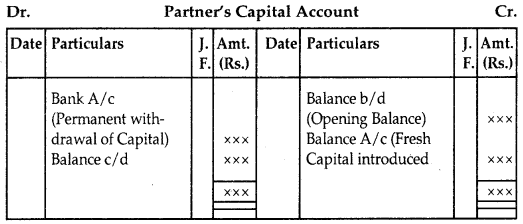
(a) Fixed Capital Method: Under the fixed capital method, the capitals of the partner shall remain fixed or unaltered unless some additional capital is introduced or some amount of capital is withdrawn with the consent of all the partners.

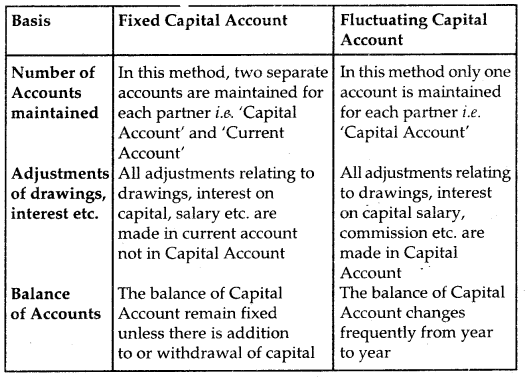
In this method, two accounts for each partner are to be maintained:

  1. Capital Account
  2. Current Account.

1. Capital Account: This account is credited with the amount of capital introduced by the partner. This account will continue to show the same balance from year to year unless some amount of capital is introduced or withdrawn. This account always appears on the liabilities side in the balance sheet.

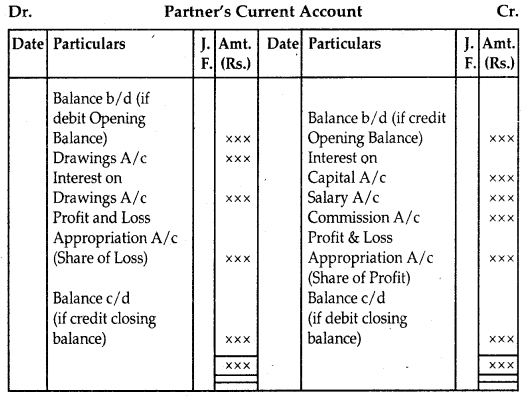
2. Current Account: All entries relating to drawings, interest on capital, interest on drawings, salary or commission, the share of profit or loss, etc. are made in this account. This account is debited with drawings, interest on drawings, the share of loss, etc. and credited with the interest on capital, salary, commission, the share of profit, etc. The balance of this account will fluctuate from year to year. If it has a credit balance then it will appear on the liabilities side of the Balance Sheet and if it has a debit balance then it will appear on the assets side of the Balance Sheet.

The format of the Capital Account and Current account are as follows:
Accounting for Partnership Basic Concepts Class 12 Notes Accountancy 1
Accounting for Partnership Basic Concepts Class 12 Notes Accountancy 2
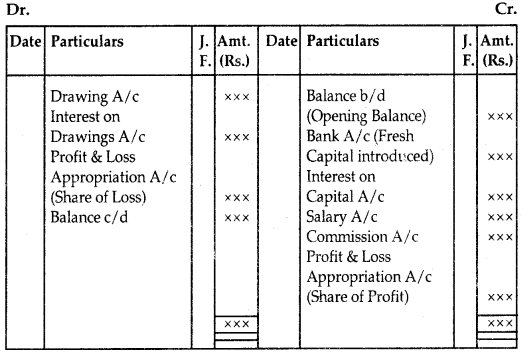
(b) Fluctuating Capital Method: Under this method, only one account i.e. Capital Account is maintained for each partner. All the entries relating to the interest on capital, salary, commission to partners, the share of profit and loss, drawings, interest on drawings, etc. are directly recorded in the capital accounts of the partners. The balance of this account fluctuates from year to year. The format of Fluctuating Capital Account is as follows:

Partner’s Capital Account
Accounting for Partnership Basic Concepts Class 12 Notes Accountancy 3
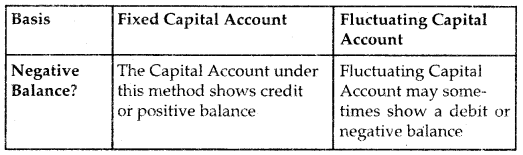
Difference between Fixed and Fluctuating Capital Accounts
Accounting for Partnership Basic Concepts Class 12 Notes Accountancy 4
Accounting for Partnership Basic Concepts Class 12 Notes Accountancy 5
Profit and Loss Appropriation Account:
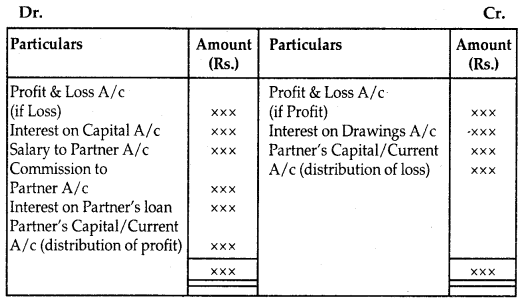
In partnership, net profit after adjustment of partner’s interest on capital, salary, and commission to partner’s, interest on drawings, etc. is distributed among the partners in the agreed profit sharing ratio. For this purpose, a separate account is prepared called Profit and Loss Appropriation Account.

It is merely an extension of the Profit and Loss Account. All adjustments in respect of partner’s commission and salary, interest on capital and on drawings, etc. are made through this account. It starts with the net profit/net loss as per the Profit and Loss Account is transferred to this account.

Journal Entries relating to Profit and Loss Appropriation Account:
1. Transfer of Net Profit/Net Loss as per Profit and Loss Account to Profit and Loss Appropriation Account:
(a) If Profit:
Profit and Loss A/c Dr.
To Profit and Loss App. A/c

(b) If Loss:
Profit and Loss App. A/c Dr.
To Profit and Loss A/c

2. Interest on Capital:
(a) For crediting interest on capital to partner’s Capital/Current
Account:
Interest on Capital A/c Dr.
To Partner’s Capital A/c or Current A/c (Individually)

(b) For transferring interest on Capital to Profit and Loss Appropriation A/c:
Profit and Loss App. A/c Dr
To Interest on Capital A/c OR

Only one entry may be passed in place of the above two entries:
Profit and Loss Appropriation A/c Dr.
To Partner’s Capital/Current A/c (Individually)

3. Interest on Drawings:
(a) For charging interest on drawings to partner’s Capital/ Current A/c:
Partners Capital/Current A/c (Individually) Dr.
To Interest on Drawings A/c

(b) For transferring interest on drawings to Profit and Loss Appropriation Account:
Interest on Drawings A/c Dr.
To Profit and Loss Appropriation A/c OR

Only one entry may be passed in place of the above two entries:
Partner’s Capital/Current A/c (Individually) Dr.
To Profit and Loss Appropriation A/c

4. Salary to Partner(s):
(a) For crediting partner’s salary’ to partner’s Capital/Current A/c:
Salary to Partner A/c Dr.
To Partner’s Capital /Current A/c (Individually)

(b) For transferring partner’s salary to Profit and Loss Appropriation A/c:
Profit and Loss Appropriation A/c Dr.
To Salary to Partner A/c OR

Only one entry may be passed in place of the above two entries:
Profit and Loss Appropriation A/c Dr.
To Partner’s Capital/Current A/c (Individually)

5. Commission to Partner(s):
(a) For crediting partner’s commission to partner’s Capital/ Current A/c:
Commission to Partner A/c Dr.
To Partner’s Capital/Current A/c (Individually)

(b) For transferring partner’s commission to Profit and Loss Appropriation A/c:
Profit and Loss Appropriation A/c Dr.
To Commission to Partner A/c OR

Only one entry may be passed in place of the above two entries:
Profit and Loss Appropriation A/c Dr.
To Partner’s Capital/Current A/c (Individually)

6. Share of Profit/Loss after adjustments:
(a) If Profit
Profit and Loss Appropriation A/c Dr.
To partner’s Capital/Current A/c (Individually)
OR
(b) If Loss:
Partner’s Capital/Current A/c (Individually) Dr. To Profit and Loss Appropriation A/c
Format of Profit and Loss Appropriation Account is given below:
Profit and Loss Appropriation Account
Accounting for Partnership Basic Concepts Class 12 Notes Accountancy 6
Interest on Capital:
Interest on Capital is generally provided for in two situations:

  1. When the partners contribute unequal amounts of capital but share profits equally.
  2. When the capital contribution is the same but profit sharing is unequal.
    Interest on Capital = Amount of Capital × \(\frac{\text { Rate }}{100}\) × Time

When there are both addition and withdrawal of capital by the partners during the financial year, the interest on capital can be calculated as:
1. On the opening balance of Capital A/c, interest is calculated for the whole year.
If the closing balance of the Capital A/c is given then we have to find the opening balance of Capital A/c:
Closing Capital + Drawings during the year + Interest on Drawing – Share of Profits – Salary to Partner – Commission
to Partner – Additional Capital = Opening Capital

2. On the additional capital brought in by any partner during the year, interest is calculated from the date of introduction of additional capital to the last day of the financial year

3. On the amount of capital withdrawn (other than usual drawings) during the year interest for the period from the date of withdrawal to the last day of the financial year is calculated and deducted from the total of the interest calculated under points (1) and (2) above.
Or
Drawing has been made then the amount deducted from the capital and interest is calculated on the balance amount.

The interest on capital is allowed only when there is profit during the financial year. No interest will be allowed on capital if the firm has incurred a net loss during the year. If the profit of the firm is less than the amount due to the partners as interest on capital, the payment of interest will be restricted to the number of profits. In other words, profit will be distributed in the ratio of interest on capital of each partner.

Interest on Drawings:
Drawings is the amount withdrawn, in cash or in-kind, for personal use by the partner(s). Interest on drawings is calculated with reference to the date of withdrawal.

The calculation of interest on drawings under different situations is shown as under:
(a) When Fixed Amount is Withdrawn Every Month/Quarter:
If the equal amount is withdrawn at equal intervals of times, interest on the drawing can be calculated by Monthly/Quarterly Drawing Methods. While calculating the time period, attention must be paid to whether the fixed amount was withdrawn on the first day (beginning) of the month, at the last day (end) of the month, middle of the month, at the beginning of the Quarter or at the end of Quarter. Depending upon the time period the interest on drawings can be calculated as follows:

When drawings are made:
1. At the beginning of each month of the financial year:
Interest on Drawings = Interest on Drawings = Total Drawings × \(\frac{\text { Rate }}{100} \times \frac{6^{1 / 2}}{12}\)
Here, time period is 6\(\frac{1}{2}\) months.

2. At the middle of each month of the financial year
Interest on Drawings = Total Drawings × \(\frac{\text { Rate }}{100} \times \frac{6}{12}\)
Here, time period is 6 months.

3. At the and of each month of the financial year:
Interest on Drawings = Total Drawings × \(\frac{\text { Rate }}{100} \times \frac{5^{1 / 2}}{12}\)
Here, time period is 5\(\frac{1}{2}\) months.

4. At the beginning of the eaclr quarter of the financial year:
Interest on Drawings = Total Drawings × \(\frac{\text { Rate }}{100} \times \frac{7^{1 / 2}}{12}\)
Here, time period is 7\(\frac{1}{2}\) months.

5. At the end of each quarter of the financial year:
Interest on Drawings = Total Drawings × \(\frac{\text { Rate }}{100} \times \frac{4^{1 / 2}}{12}\)
Here, time period is 4\(\frac{1}{2}\) months.

(b) When Varying Amounts are Withdrawn at Different Intervals: When the partners withdraw different amounts of money at different time intervals, the interest is calculated using the production method. In this method, each amount of drawing is multiplied by the number of days/months (from the date of drawings to the last date of the financial year) to find out the product and then all the products are totaled. Here, the total product and interest for 1 month at the given rate are calculated.

Interest on Drawings = Total Drawings × \(\frac{\text { Rate }}{100} \times \frac{1}{12}\)
or
\(\frac{1}{365}\)

(c) When Dates of Withdrawal are Not Specified: When the total amount withdrawn is given but the dates of withdrawals are not specified, then it is assumed that the amount was withdrawn evenly throughout the year. Here, the time period is taken 6 months.
Interest on Drawings = Total Drawings × \(\frac{\text { Rate }}{100} \times \frac{6}{12}\)

Guarantee of Profit to a Partner:
Sometimes a partner may be guaranteed a minimum amount of profit by one or some or by all the partners in the existing profit sharing ratio or some other agreed ratio. The minimum guaranteed amount shall be paid to a partner when his share of profit as per the profit-sharing ratio is less than the guaranteed amount.

The following steps may be followed in this case:

  1. Calculate the share of profit of the partner who has been guaranteed a minimum amount of profit as per profit sharing ratio. If this amount is more than or equal to the amount guaranteed, no adjustment is required.
  2. If the share of profit of that partner is less than the guaranteed amount, then we have to find out the difference between the guaranteed amount and the share of profit of that partner.
  3. Then, we add this difference to the share of the profit of the partner and deduct the difference from the share of profit of other partners or partner who has guaranteed the amount in the agreed ratio.

Past Adjustments:
Sometimes, after making of final accounts and the distribution of profits among the partners, a few omissions or errors in the recording of transactions or the preparation of summary statements are found. These errors or omissions need adjustments for correction of their impact.

This error or omissions may relate to:

  1. Interest on capital may have omitted or have been wrongly treated.
  2. Interest in drawings may have been omitted.
  3. Salary or commission payable has been omitted in the capital account of the partner.
  4. The profit-sharing ratio has been changed from the past.
  5. Interest in the partner’s loan has been omitted.

Instead of altering old accounts, necessary adjustments can be made either by:
(a) through ‘Profit and Loss Adjustment Account’
Or
(b) directly in the capital account of the concerned partners.

(a) Profit and Loss Adjustment Account:
1. For omission of Interest on Capital, Salaries to partner(s), Commission to partner, etc.
Profit and Loss Adjustment Account Dr.
To Partner’s Capital/Current A/c (Individually)

2. For omission of Interest on drawings etc
Partner’s Capital/Current A/c Dr.
To Profit and Loss Adjustment Account

3. Calculate the difference or balance of the Profit and Loss Adjustment Account and transfer it to the Capital/Current Accounts of partners in the profit-sharing ratio.
(a) If Profit (Credit balance):
Profit and Loss Adjustment A/c Dr.
To Partner’s Capital/Current A/c (Individually)
OR

(b) If Loss (Debit balance):
Partner’s Capital/Current A/c (Individually) Dr.
To Profit and Loss Adjustment A/c (b) Adjustment through a single entry or directly in the capital account of the concerned partner(s):

In this case, the following steps should be taken:

  1. Calculate amount which should have been credited to each partner’s Capital/Current Account by way of (Interest on Capital + Salaries to Partner(s) + Commission to Partner(s) – Interest on Drawings etc.)
  2. Distribute the amount calculated in step (1) in the current profit sharing ratio.
  3. Calculate the difference between the above two steps for each partner (1) – (2)
    (-) Excess or (+) Short

Pass the following Journal entry:
Excess having Partner’s Capital A/c Dr.
To Short Partner’s Capital A/c

Pulp Wood Definition and Its Manufacturing

Learninsta presents the core concepts of Biology with high-quality research papers and topical review articles.

Pulp Wood Definition and Its Manufacturing

The term paper is derived from the word ‘papyrus’ a plant (Cyperus papyrus) that was used by Egyptians to make paper-like materials. Paper production is a Chinese invention.

The Chinese discovered the paper that was prepared from the inner bark of paper mulberry in 105 A.D. For a long time, the art of paper making remained a monopoly of the Chinese until Arabs learned the technique and improved it around 750 A.D. Invention of printing increased the demand for paper.
Pulp Wood img 1

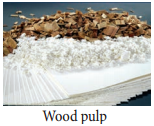
Manufacture of Wood pulp:

Wood is converted into pulp by mechanical, and chemical processes. Wood of Melia azadirachta, Neolamarkia chinensis, Casuarina spp, Eucalyptus spp are used for making paper pulp.