Sexual Reproduction | Parthenogenesis (Gr. Parthenos – virgin, Genesisproduce)

Learninsta presents the core concepts of Biology with high-quality research papers and topical review articles.

Sexual Reproduction | Parthenogenesis (Gr. Parthenos – virgin, Genesisproduce)

Sexual reproduction involves the fusion of male and female gametes to form a diploid zygote, which develops into a new organism. It leads to genetic variation. The types of sexual reproduction seen in animals are syngamy (fertilization) and conjugation. In syngamy, the fusion of two haploid gametes takes place to produce a diploid zygote. Depending upon the place where the fertilization takes place, it is of two types.

In external fertilization, the fusion of male and female gametes takes place outside the body of female organisms in the water medium. e.g. sponges, fishes and amphibians. In internal fertilization, the fusion of male and female gametes takes place within the body of female organisms. e.g. reptiles, aves and mammals.

Different kinds of syngamy (fertilization) are prevalent among living organisms.

(a) Autogamy:

The male and female gametes are produced by the same cell or same organism and both the gametes fuse together to form a zygote. e.g. Actinosphaerium and Paramecium.

(b) Exogamy:

The male and female gametes are produced by different parents and they fuse to form a zygote. So it is biparental. e.g. Human – dioecious or unisexual animal.

(c) Hologamy:

Lower organisms, sometimes the entire mature organisms do not form gametes but they themselves behave as gametes and the fusion of such mature individuals is known as hologamy e.g. Trichonympha.

(d) Paedogamy:

It is the sexual union of young individuals produced immediately after the division of the adult parent cell by mitosis.

(e) Merogamy:

The fusion of small sized and morphologically different gametes (merogametes) takes place.

(f) Isogamy:

The fusion of morphological and physiological identical gametes (isogametes) is called isogamy. e.g. Monocystis.

(g) Anisogamy:

The fusion of dissimilar gametes is called anisogamy (Gr. An-without; iso-equal; gam-marriage). Anisogamy occurs in higher animals but it is customary to use the term fertilization instead of anisogamy or syngamy. e.g. higher invertebrates and all vertebrates.

Conjugation is the temporary union of the two individuals of the same species. During their union both individuals, called the conjugants exchange certain amount of nuclear material (DNA) and then get separated. Conjugation is common among ciliates, e.g. Paramecium, Vorticella and bacteria (Prokaryotes).

Phases of life cycle:

Organisms have three phases – Juvenile phase, reproductive phase and senescent phase. Juvenile phase/vegetative phase is the period of growth between the birth of the individual upto reproductive maturity. During reproductive phase/ maturity phase the organisms reproduce and their offsprings
reach maturity period. On the basis of time, breeding animals are of two types: seasonal breeders and continuous breeders.

Seasonal breeders reproduce at particular period of the year such as frogs, lizards, most birds, deers etc., Continuous breeders continue to breed throughout their sexual maturity e.g. honey bees, poultry, rabbit etc., Senescent phase begins at the end of reproductive phase when degeneration sets in the structure and functioning of the body.

Parthenogenesis (Gr. Parthenos – virgin, Genesisproduce)

Development of an egg into a complete individual without fertilization is known as parthenogenesis. It was first discovered by Charles Bonnet in 1745. Parthenogenesis is of two main types namely, Natural Parthenogenesis and Artificial Parthenogenesis. In certain animals, parthenogenesis occurs regularly, constantly and naturally in their life cycle and is known as natural parthenogenesis.

Natural parthenogenesis may be of two types, viz., complete and incomplete. Complete parthenogenesis is the only form of reproduction in certain animals and there is no biparental sexual reproduction. There are no male organisms and so, such individuals are represented by females only.

Incomplete parthenogenesis is found in some animals in which both sexual reproduction and parthenogenesis occurs. e.g. In honeybees; fertilized eggs (zygotes) develop into queen and workers, whereas unfertilized eggs develop into drones (male).

In paedogenetic parthenogenesis (paedogenesis) the larvae produce a new generation of larvae by parthenogenesis. It occurs in the sporocysts and Redia larvae of liver fluke. It is also seen in the larvae of some insects. e.g. Gall fly. In artificial parthenogenesis, the unfertilized egg (ovum) is induced to develop into a complete individual by physical or chemical stimuli. e.g., Annelid and seaurchin eggs.

Asexual Reproduction in Organisms

Learninsta presents the core concepts of Biology with high-quality research papers and topical review articles.

Asexual Reproduction in Organisms

Asexual reproduction is wide spread among different organisms. It is common in members of Protista, Bacteria, Archaea and in multicellular organisms with relatively simple organisation. The offsprings show “uniparental inheritance” without any genetic variation. The different modes of asexual reproduction seen in animals are fission, budding, fragmentation and regeneration.

Fission is the division of the parent body into two or more identical daughter individuals. Five types of fission are seen in animals. They are binary fission, multiple fission, plasmotomy, strobilation and sporulation.

In binary fission, the parent organism divides into two halves and each half forms a daughter individual. The nucleus divides first amitotically or mitotically (karyokinesis), followed by the division of the cytoplasm (cytokinesis). The resultant offsprings are genetically identical to the parent. Depending on the plane of fission, binary fission is of the following types,

  • Simple irregular binary fission
  • Transverse binary fission
  • Longitudinal binary fission
  • Oblique binary fission

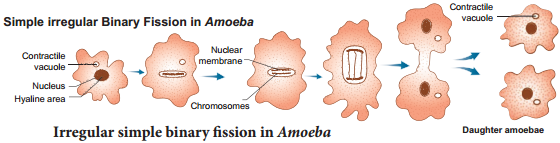
Simple irregular binary fission is seen in Amoeba like irregular shaped organisms (Fig. 1.1), where the plane of division is hard to observe. The contractile vacuoles cease to function and disappear. The nucleoli disintegrate and the nucleus divides mitotically. The cell then constricts in the middle, so the cytoplasm divides and forms two daughter cells.
Asexual Reproduction img 1

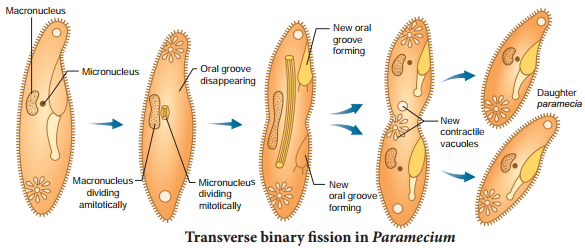
In transverse binary fission, the plane of the division runs along the transverse axis of the individual. e.g. Paramecium and Planaria. In Paramecium (Fig. 1.2) the macronucleus divides by amitosis and the micronucleus divides by mitosis.
Asexual Reproduction img 2

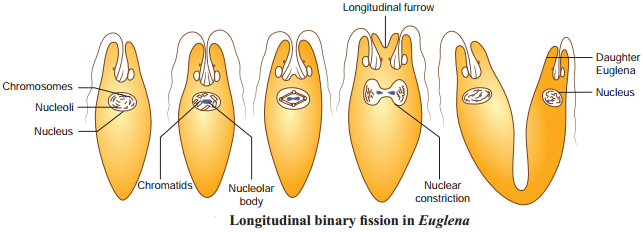
In longitudinal binary fision, the nucleus and the cytoplasm divides in the longitudinal axis of the organism (Fig 1.3). In flagellates, the flagellum is retained usually by one daughter cell. The basal granule is divided into two and the new basal granule forms a flagellum in the other daughter individual. e.g. Vorticella and Euglena.
Asexual Reproduction img 3

In oblique binary fission the plane of division is oblique. It is seen in dinoflagellates. e.g. Ceratium.

In multiple fission the parent body divides into many similar daughter cells simultaneously. First, the nucleus divides repeatedly without the division of the cytoplasm, later the cytoplasm divides into as many parts as that of nuclei.

Each cytoplasmic part encircles one daughter nucleus. This results in the formation of many smaller individuals from a single parent organism. If multiple fission produces four or many daughter individuals by equal cell division and the young ones do not separate until the process is complete, then this division is called repeated fission. e.g. Vorticella.

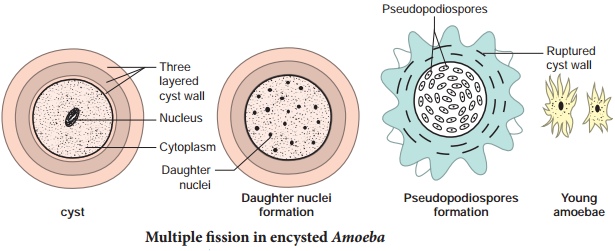
During unfavorable conditions (increase or decrease in temperature, scarcity of food) Amoeba withdraws its pseudopodia and secretes a three-layered, protective, chitinous cyst wall around it and becomes inactive (Fig. 1.4). This phenomenon is called encystment.

When conditions become favourable, the encysted Amoeba divides by multiple fission and produces many minute amoebae called pseudopodiospore or amoebulae. The cyst wall absorbs water and breaks off liberating the young pseudopodiospores, each with a fine pseudopodia. They feed and grow rapidly to
lead an independent life.
Asexual Reproduction img 4

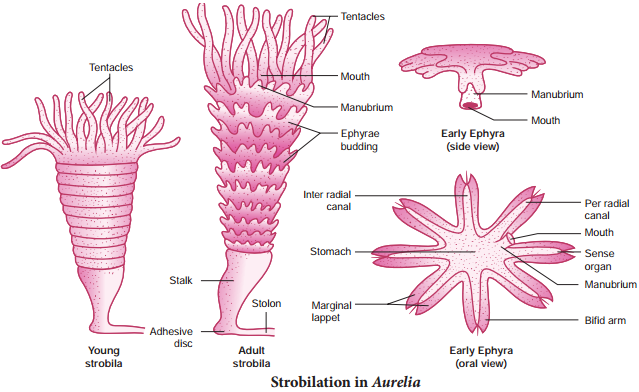
In some metazoan animals, a special type of transverse fission called strobilation occurs (Fig. 1.5). In the process of strobilation, several transverse fissions occur simultaneously giving rise to a number of individuals which often do not separate immediately from each other e.g. Aurelia.

Plasmotomy is the division of multinucleated parent into many multinucleate daughter individuals with the
division of nuclei. Nuclear division occurs later to maintain normal number of nuclei. Plasmotomy occurs in Opalina and Pelomyxa (Giant Amoeba).
Asexual Reproduction img 5

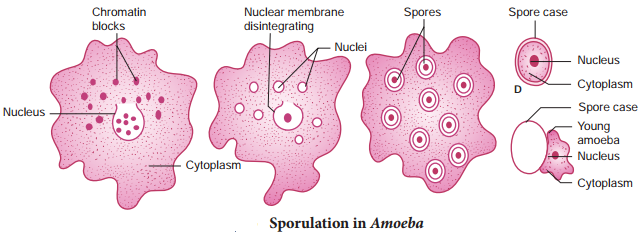
During unfavourable conditions Amoeba multiplies bysporulation without encystment. Nucleus breaks into several small fragments or chromatin blocks. Each fragment develops a nuclear membrane, becomes surrounded by cytoplasm and develops a spore-case around it (Fig. 1.6). When conditions become favourable, the parent body disintegrates and the spores are liberated, each hatching into a young amoeba.
Asexual Reproduction img 6

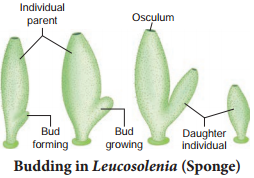
In budding, the parent body produces one or more buds and each bud grows into a young one. The buds separate from the parent to lead a normal life. In sponges, the buds constrict and detach from the parent body and the bud develops into a new sponge (Fig. 1.7).
Asexual Reproduction img 7

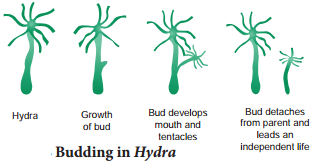
When buds are formed on the outer surface of the parent body, it is known as exogenous budding e.g. Hydra. In Hydra when food is plenty, the ectoderm cells increase and form a small elevation on the body surface (Fig. 1.8).

Ectoderm and endoderm are pushed out to form the bud. The bud contains an interior lumen in continuation with parent’s gastro-vascular cavity. The bud enlarges, develops a mouth and a circle of tentacles at its free end. When fully grown, the bud constricts at the base and finally separates from the parent body and leads an independent life.
Asexual Reproduction img 8

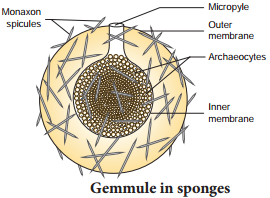
In Noctiluca, hundreds of buds are formed inside the cytoplasm and many remain within the body of the parent. This is called endogenous budding. In freshwater sponges and in some marine sponges a regular and peculiar mode of asexual reproduction occurs by internal buds called gemmules is seen (Fig. 1.9).

A completely grown gemmule is a hard ball, consisting of an internal mass of food-laden archaeocytes. During unfavourable conditions, the sponge disintegrates but the gemmule can withstand adverse conditions. When conditions become favourable, the gemmules begin to hatch.
Asexual Reproduction img 9

In fragmentation, the parent body breaks into fragments (pieces) and each of the fragment has the potential to develop into a new individual. Fragmentation or pedal laceration occurs in many genera of sea anemones. Lobes are constricted of from the pedal disc and each of the lobe grows mesenteries and tentacles to form a new sea anemone.

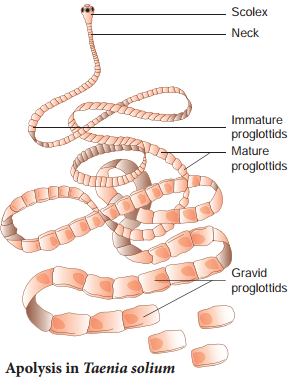
In the tapeworm, Taenia solium the gravid (ripe) proglottids are the oldest at the posterior end of the strobila (Fig. 1.10). The gravid proglottids are regularly cut of either singly or in groups from the posterior end by a process called apolysis. This is very significant since it helps in transferring the developed embryos from the primary host (man) to fid a secondary host (pig).
Asexual Reproduction img 10

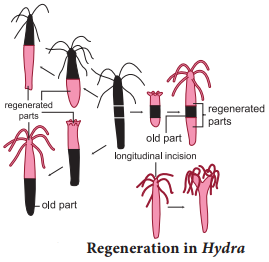
Regeneration is regrowth in the injured region. Regeneration was first studied in Hydra by Abraham Trembley in 1740. Regeneration is of two types, morphallaxis and epimorphosis. In morphallaxis the whole body grows from a small fragment e.g. Hydra and Planaria. When Hydra is accidentally cut into several pieces, each piece can regenerate the lost parts and develop into a whole new individual (Fig. 1.11).
Asexual Reproduction img 11

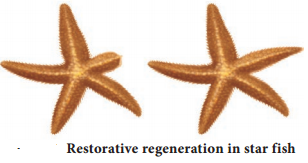
The parts usually retain their original polarity, with oral ends, by developing tentacles and aboral ends, by producing basal discs. Epimorphosis (Fig. 1.12) is the replacement of lost body parts. It is of two types, namely reparative and restorative regeneration. In reparative regeneration, only certain damaged tissue can be regenerated, e.g. human beings whereas in restorative regeneration severed body parts can develop. e.g. star fish, tail of wall lizard.
Asexual Reproduction img 12

Modes Of Reproduction

Learninsta presents the core concepts of Biology with high-quality research papers and topical review articles.

Modes Of Reproduction

All modes of reproduction have some basic features such as synthesis of RNA and proteins, replication of DNA, cell division and growth, formation of reproductive units and their fertilization to form new individuals.

Organisms exhibit two major modes of reproduction namely asexual and sexual reproduction. Reproduction by a single parent without the involvement of gamete formation is asexual reproduction and the offspring produced are genetically identical.

Asexual reproduction is usually by amitotic or mitotic division of the somatic (body) cells, hence is also known as somatogenic or blastogenic reproduction.

When two parents participate in the reproductive process involving two types of gametes (ova and sperm), it is called sexual reproduction.

Binary fission:
Single parent cell doubles its DNA, then divides into two cells.

Budding:
Small growth on surface of parent breaks off, resulting in the formation of two individuals.

Fragmentation:
Organisms break into two or more fragments that develop into a new individual.

Asexual and sexual reproduction, two methods of reproduction among animals, produce offspring that are clones or genetically unique. Sexual reproduction is a better mode of reproduction as compared to asexual reproduction because it involves meiosis and the fusion of male and female gametes.

Such a fusion involving two parents results in offspring which are not identical to the parents. There are two forms of reproduction: asexual and sexual. In asexual reproduction, an organism can reproduce without the involvement of another organism.

Asexual reproduction is not limited to single-celled organisms. By asexual reproduction, an organism creates a genetically similar or identical copy of itself. Reproduction is the process by which new individuals are produced by the parents. The process of reproduction ensures that a plant or animal species does not disappear from Earth. This process is very important in maintaining stability in the ecosystem and for the continuation of life on earth.

Issue and Redemption of Debentures Class 12 Notes Accountancy Chapter 7

By going through these CBSE Class 12 Accountancy Notes Chapter 7 Issue and Redemption of Debentures, students can recall all the concepts quickly.

Issue and Redemption of Debentures Notes Class 12 Accountancy Chapter 7

In today’s growing business equity sources of financing only are not sufficient to meet the ever-growing needs of corporate expansion and growth. As a result, the companies turn to raise long-term funds by issuing debentures. Debt financing not only helps in reducing the cost of capital but also helps in designing the appropriate capital structure for the company.

Meaning of Debenture: The term, ‘debenture’ has been derived from the Latin word “debre” which means “to borrow”. Thus, it is a written document acknowledging a debt under the common seal of the company and containing a contract for the repayment of the principal sum at a specified date and for the payment of interest (usually half-yearly) at a fixed rate percent until the principal sum is repaid.

→ “Debenture includes debenture stock, bonds and any other securities of a company whether constituting a charge on the assets of the company or not.”- Section 2(12) of the Companies Act, 1956

→ “A debenture is a document given by a company as evidence of a debt to the holder usually arising out of a loan and most commonly secured by a charge.”- Topham

→ “Debenture is a document under company’s seal which provides for the repayment of a principal sum and interest thereon at regular intervals which is usually secured, by a fixed or floating charge on the company’s property and which acknowledges loan of-a company.” – E. Thomas

→ “Debenture means a document which either creates a debt or acknowledges it and any document which fulfills either of these conditions.” -Chitty J.

Bond: Bond, like debenture, is an acknowledgment of debt issued under the seal of a company and signed by an authorized signatory.

Charge: It means securing the loan by encumbering a specific part of assets towards the loan. It means, if the company fails to meet its obligation, the lender can secure his payment from the assets mortgaged or in case of winding up of the company from the official liquidator.

The Companies Act, 1956) requires that all the charges be registered with the Registrar of Companies. Section 125 (4) of the Companies Act, 1956 requires that a charge when created on the following be got registered:

For the purpose of securing any issue of debentures.

  • On uncalled share capital of the company.
  • On calls made but not paid.
  • On any book debts of the company.
  • On any immovable property, wherever situated, or any interest therein.
  • On a ship or any share in the ship.
  • On goodwill, on a patent or a license under a patent, on a trademark or on the copyright or a license under copyright.

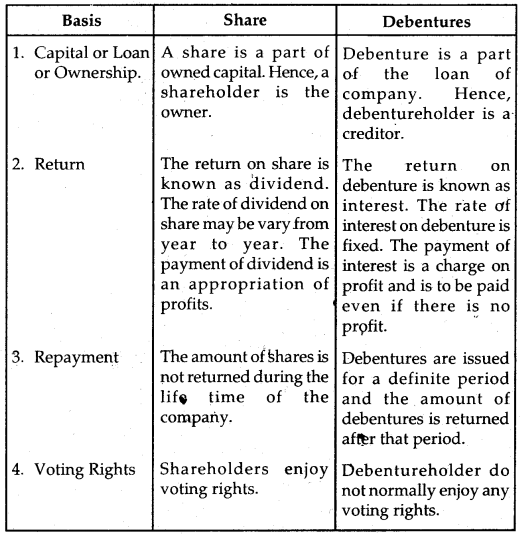
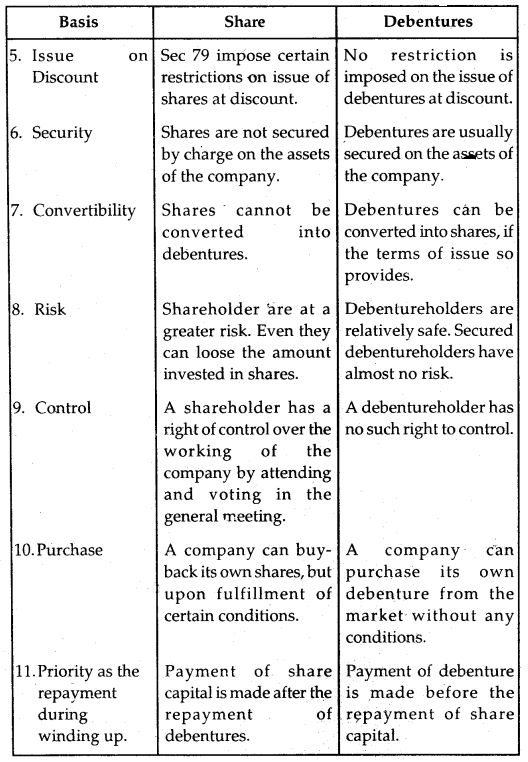
Difference Between Share and Debenture:
Issue and Redemption of Debentures Class 12 Notes Accountancy 1
Issue and Redemption of Debentures Class 12 Notes Accountancy 2
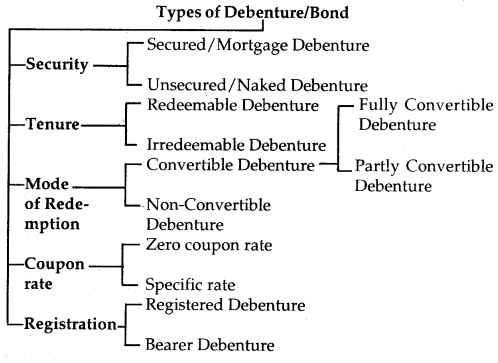
Types of Debentures:
1. Security point of view
(a) Secured/Mortgage Debentures: Secured Debentures are those which are secured either on a particular asset or on all the assets of the company in general.

(b) Unsecured/Naked Debentures: Unsecured Debentures do not have a specific charge on the assets of the company.
Issue and Redemption of Debentures Class 12 Notes Accountancy 3
2. Tenure point of view:
(a) Redeemable Debentures: Redeemable debentures are those that will be repaid by the company at the end of a specified period during the existence of the company.
(b) Irredeemable Debentures: Irredeemable debentures are those that are not repayable during the lifetime of the company.

3. Mode of Redemption point of view:
(a) Convertible Debentures: Convertible debentures are those the holder of which is given an option of
exchanging the amount of their debenture for equity shares after a specified period.

These are of two types:

  1. Fully Convertible Debentures (FCD) are those debentures where the whole amount is to be converted into equity shares.
  2. Partly Convertible Debentures (PCD) are those debentures where only a part of the amount of debenture is convertible into equity shares.

(b) Non-Convertible Debentures: The debentures which cannot be converted into shares or in any other securities are called non-convertible debentures.

4. Coupon Rate point of view:
(a) Zero Coupon Rate Debenture: These debentures do not carry a specific rate of interest.
(b) Specific Coupon Rate Debenture: These debentures are issued with a specified rate of interest, which may either be fixed and floating.

5. Registration point of view:
(a) Registered Debentures: Registered debentures are those which are payable to the persons whose name appears in the Register of Debenture holders. These can be transferred only by executing a transfer deed.
(b) Bearer Debentures: Bearer debentures are those which are payable to the bearer thereof. These can be transferred merely by delivery. Interest is paid to the persons who produced the interest coupon attached to such debenture.

Issue of Debentures: Debentures can be issued at par, at a premium, or at a discount. They can also be issued for consideration other than cash or as Collateral Security. Accounting treatment regarding the issue of debenture is done in the same manner as in the case of the issue of share. The only difference is that ‘Debenture’ in place of ‘Share’ and ‘Debenture A/e’ in place of ‘Share Capital A/c’ is substituted.

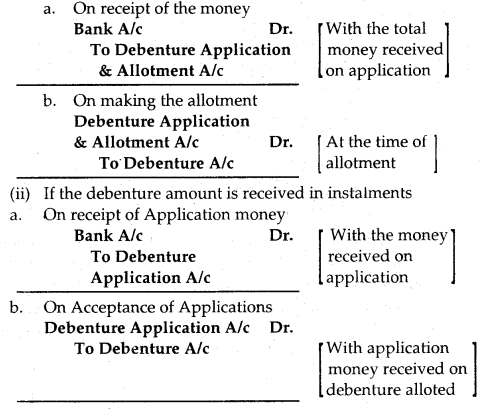
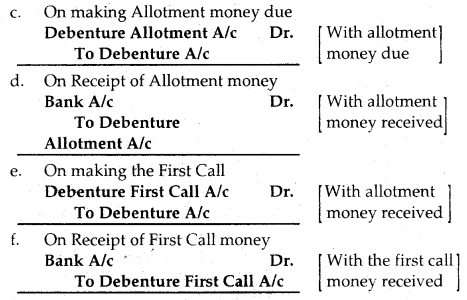
Issue of Debentures at Par: Debentures are said to have been issued at par when the issue price is equal to their face value.
1. If the debenture amount is received in one installment (lump sum).
Issue and Redemption of Debentures Class 12 Notes Accountancy 4
Issue and Redemption of Debentures Class 12 Notes Accountancy 5
Similar entries like e, f may be made for the second call and final call.

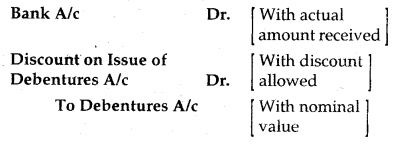
Issue of Debentures at a Discount: When the debentures are issued at less than the face value, it is said to be issued at discount. Discount on issue of debenture is a capital loss and is shown on the assets side of the Balance Sheet under the head “Miscellaneous Expenditure” till it is written off.

Accounting Treatment:
On the issue of debentures at a discount
Debenture Allotment A/c Dr.
Discount of Issue of Debenture A/c Dr.
To Debenture A/c

Issue of Debentures at Premium: A debenture is said to have been issued at a premium when the price charged is more than the face value of debenture. Premium on Issue of Debenture represents a capital receipt and should be transferred to Securities Premium A/c. It can be used for writing off capital losses and fictitious assets. This account is shown on the liabilities side of the Balance Sheet under the head of ‘Reserves & Surplus’.

Accounting Treatment:
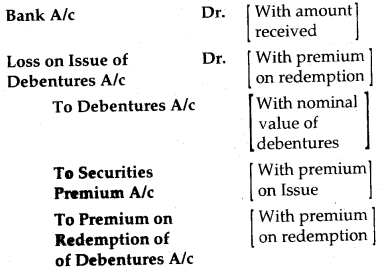
On Issue of Debenture at Premium
Debenture Allotment A/c Dr.
To Debenture A/c To Securities Premium A/c

Over Subscription: When the number of debentures applied for is more than the number of debentures offered to the public, the issue is said to be oversubscribed. The excess money received on oversubscription may be retained for adjustment towards allotment and respective calls when the amount is payable in Instalments or excess money will be refunded.

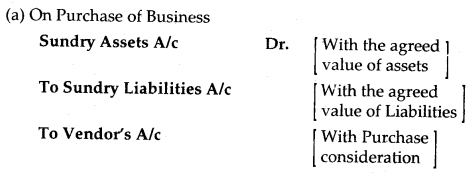
Issue of Debentures for Consideration Other than Cash: When the company purchases some assets (including services) and instead of making the payment to the supplier in the form of cash, issues its fully paid debentures, such issue of debentures is called the Issue of Debentures for Consideration Other than Cash. Such debentures can be issued at par, a premium, or at a discount.
Issue and Redemption of Debentures Class 12 Notes Accountancy 6
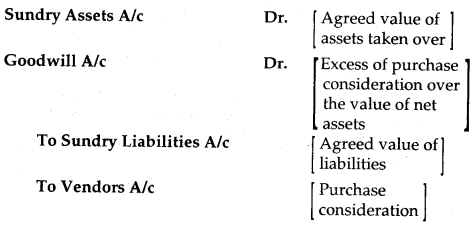
If the purchase consideration is greater than the value of the net assets acquired (i.e., the difference between the agreed value of the assets taken over and the agreed value of liabilities taken over), the difference is treated as a capital loss which should be debited to Goodwill A/c.
Issue and Redemption of Debentures Class 12 Notes Accountancy 7
Or
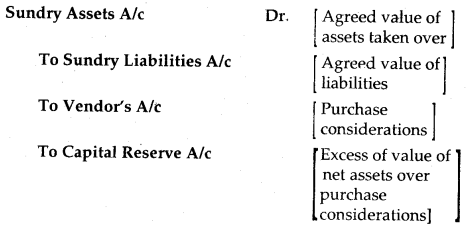
If the amount of the purchase consideration is lower than the value of the net assets acquired, the difference is treated as a capital profit which should be credited to Capital Reserve A/c.
Issue and Redemption of Debentures Class 12 Notes Accountancy 8
(b) On the issue of Debentures
1. At par
Vendor’s A/c Dr.
To Debentures A/c

2. At Premium
Vendor’s A/c Dr.
To Debentures A/c To Securities Premium A/c

3. At a Discount Vendor’s A/c
Discount on Issue of Debentures A/c

To Debentures A/c
No. of Debentures issued = \(\)\(\)

Issue Price of a Debenture:
Issue of Debentures as Collateral Security: When a company takes a loan from a bank or any other party and gives some additional security in the shape of debentures, the debentures are said to be issued as collateral security. In such a case, the lender has the absolute right over the debentures unless and until the loan is repaid. On repayment of the loan, the lender is legally bond to release the debenture forthwith.

In case the loan is not repaid by the company on the due date, the lender has the right to retain these debentures and realize them. The holder of such debentures is entitled to interest only on the amount of loan, but not on the debentures.

Debentures issued as collateral security can be dealt with in two ways in the books.
1. No accounting entry is required to be shown in the books at the time of issue of such debentures, but a footnote to the fact that the loan has been secured by the issue of debentures is appended.

2. If it is desired that such an issue of debentures is to be recorded in the books, the following entries are recorded:
(a) On the issue of Debentures as Collateral Security
Debentures Suspense A/c Dr.
To Debentures A/c

(b) On repayment of the loan
Debentures A/c Dr.

To Debentures Suspense A/c The net effect of the above two entries is nil.
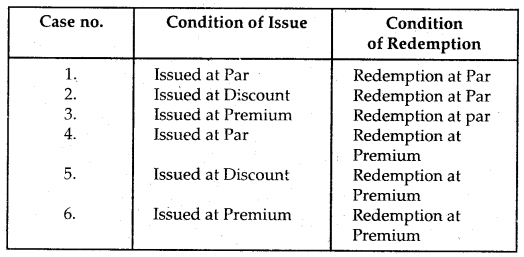
Issue of Debentures From Condition of Redemption Point of View: Redemption of debentures means discharge of liability on account of debentures by repayment made to the debenture holders. Depending upon the terms and conditions of issue and redemption of debentures, there may be the following six cases:
Issue and Redemption of Debentures Class 12 Notes Accountancy 9
Accounting Treatment:
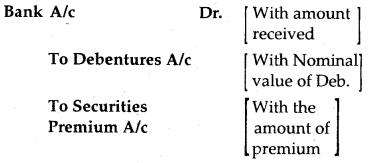
Case 1: Issue at Par and Redemption at Par
Issue and Redemption of Debentures Class 12 Notes Accountancy 10
Case 2: Issue at Discount and Redemption at Par
Issue and Redemption of Debentures Class 12 Notes Accountancy 11
Case 3: Issue at Premium and Redemption at Par.
Issue and Redemption of Debentures Class 12 Notes Accountancy 12
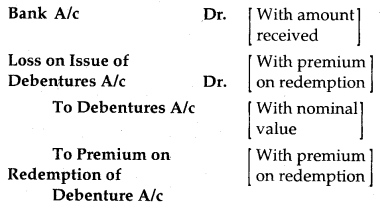
Case 4: Issue at Par and Redemption at Premium
Issue and Redemption of Debentures Class 12 Notes Accountancy 13
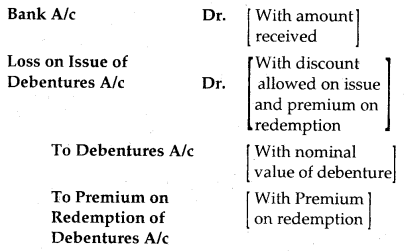
Case 5: Issue at Discount and Redemption at Premium
Issue and Redemption of Debentures Class 12 Notes Accountancy 14
Case 6: Issued at Premium and Redemption at Premium
Issue and Redemption of Debentures Class 12 Notes Accountancy 15
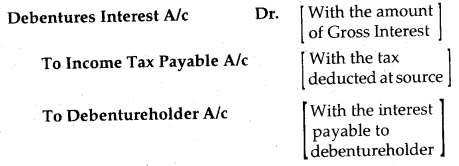
Interest on Debentures: Interest on debentures is a charge against the profits of the company and is payable irrespective of the fact whether there are profits or not. It is calculated on the face value of the debenture. According to Income-tax Act, 1961, the company must deduct income tax at the prescribed rate from the gross amount of interest payable on debenture before the annual amount is paid to debenture holders. Accounting Treatment:
1. For Interest due
Issue and Redemption of Debentures Class 12 Notes Accountancy 16
2. For Payment of Interest
Debentureholder A/c Dr.
To Bank A/c

3. On Closing of Debenture Interest A/c
Profit and Loss A/c Dr.
To Debenture Interest A/c

4. For Payment of Income Tax to Government
Income Tax Payable A/c Dr.
To Bank A/c

Writing off Discount/Loss on Issue of Debentures: The discount/ loss on the issue of debentures is a capital loss and therefore must be written off during the lifetime of debentures. The discount/loss on the issue of debentures is shown under the head “Miscellaneous Expenditure” on the assets side of the Balance Sheet. Section 78 of the Companies Act, 1956 permits the utilization of Securities Premium for writing off the discount/loss on the issue of the debenture.

Entry is following:
Security Premium A/c Dr.
To Discount/Loss on
Issue of Debenture A/c

In case there are no capital profits or if the capital profits are not adequate, the amount of such discount/loss can be written off by utilizing the revenue profits.

There are two methods, which can be used to write off the Discount/Loss on the issue of debentures:
(a) Fixed Installment Method: When the debentures are redeemed at the end of a specified period, the total amount of discount should be written off in equal installments of a fixed amount over the period.

(b) Fluctuating Installment Method: When debentures are repaid by annual drawings or installments, the discount is written off in the ratio of debentures outstanding before redemption. The amount of discount, in this method, goes on reducing every year as a greater amount is used in the initial years than the later years. This method is also known as the Reducing Instalment Method.

Section-II
Redemption of Debentures: Redemption of debentures means repayment of the loan due on debentures to debenture holders. According to Section 117 C (3) of the Companies Act 1956, the debentures should be redeemed in accordance with the terms and conditions of their issue/ offer documents. The date, the terms, and the conditions are generally stated in the debenture certificate itself or in the trust deed.

On the due date or happening of the circumstances so specified, the company becomes liable to pay the principal amount to the debenture holder. A company may purchase its own debenture which then stands canceled.

In other words, the redemption of debentures means repayment of the number of debentures by the company. There are three aspects that a company should bear in mind regarding redemption namely the time of redemption, the amount to pay, and the sources from which redemption will have to be carried out.

Methods of the Redemption of Debentures: The various methods of redemption of debentures are as under:

  1. Payment in Lump-Sum
  2. Payment in Instalments
  3. Purchase in Open Market
  4. Conversion of existing Debenture into Shares or New Debentures.

1. Payment in Lump Sum: It means debentures can be redeemed by paying the debenture holders in one lump sum at the expiry of the agreed time or earlier at the option of the company. In this case, the time of repayment is known in advance and thus the company can plan its financial resources accordingly.

2. Payment in Instalments: It means the redemption is made in annual installments. The amount of installment is worked out by dividing the total amount of debentures by the number of years it is to last. The number of debentures to be redeemed each year are selected by lottery. Thus, it is also known as drawing by lottery or draw of lots.

3. Purchase in Open Market: A company, if authorized by its Articles of Association, can purchase its own debenture in the open market. Debentures so purchased may be canceled and it means the debentures have been paid.

4. Conversion of Existing Debentures into Shares or New Debentures: It means the debenture holder can exchange their debenture either for shares or new debentures of the company and the debentures which carry such right are called convertible debentures.

Sources of funds for Redemption of Debentures: The redemption of debentures can be done either out of capital or out of profits.

(a) Redemption of Debenture out of Capital: In this case, profits of the company are not utilized for the redemption of debentures, so the assets of the company are reduced by the amount paid. Normally the profits are transferred to Debenture Redemption Reserve for redemption. In case no profits have been transferred to Debenture Redemption Reserve and debentures are redeemed on the due date, it is regarded as redemption out of the capital. It is, however, presumed that the company has adequate funds to redeem the debentures.

Accounting Treatment:
(a) If debentures are to be redeemed at par
1. On debentures becoming due
Debentures A/c Dr.
To Debenture- holder A/c

2. On Redemption Debentureholder A/c Dr.
To Bank A/c

(b) If debentures are to be redeemed at a premium
1. On debentures becoming due
Debentures A/c Dr.
Premium on Redemption of
Debenture A/c Dr.
To Debentureholder A/c

2. On Redemption Debentureholder A/c Dr.
To Bank A/c

(b) Redemption of Debentures out of Profits: Redemption of debentures out of profits means the amount equal to that utilized for repayment to debenture holders is transferred from Profit and Loss Appropriation A/c to a newly opened A/c called ‘Debenture Redemption Reserve A/c’ (DRR). The portion of the profits set aside may either be retained in the business or maybe invested.

The Companies Act (Amendment), 2000 has introduced Section 117 C which provides as under:
(a) Where company-issued debentures after the commencement of this act, it shall create a DRR for the redemption of such debentures, to which adequate amount shall be credited, from out of its profits every year until such debentures are redeemed.

(b) The amount credited to the DRR shall not be utilized by the company except for the purpose of the redemption of debentures.

SEBI’s Guidelines: Securities and Exchange Board of India (SEBI) has provided some guidelines for the redemption of debentures. The focal points of these guidelines are:

  1. Every company shall create a venture Redemption Reserve in case of issue of debenture redeemable after a period of more than 18 months from the date of issue.
  2. The creation of Debenture Redemption Reserve is obligatory only for non-convertible debentures and a non-convertible portion of partly convertible debentures.
  3. A company shall create a Debenture Redemption Reserve equivalent to at least 50% of the amount of debenture issue before starting the redemption of the debenture.
  4. Withdrawal from Debenture Redemption Reserve is permissible only after 10% of the debenture liability has already been reduced by the company.

Exemption: SEBI guidelines would not apply under the following situations:
(a) Infrastructure company (a company wholly Engaged in the business of developing, maintaining, and operating infrastructure facilities.)
(b) A company issuing debentures with a maturity period of not more than 18 months.

Clarifications regarding Debenture Redemption Reserve:
The Department of Company Affairs, Government of India, vide their circular No. 9/2002, dates 18.04.2002 has issued the following clarifications regarding the creation of Debenture Redemption Reserve (DRR):
(a) No DRR is required for debentures issued by All India Financial Institutions, by RBI and, Banking Companies for both public as well as privately placed debentures.
(b) No DRR is required in case of privately placed debentures.
(c) Section 117c will apply to debentures issued and pending to be redeemed and, therefore, DRR will also be created for debentures issued prior to 13.12.2000 and pending redemption.
(d) Section 117c will apply to the non-convertible portion of debentures issued whether they are fully or partly paid.

Journal Entries:

  1. Debenture A/c To Debentureholders A/c
  2. Debenture holder A/c To Bank A/c
  3. Profit and Loss Appropriation A/c To Debenture Redemption Reserve A/c

DRR A/c appears on the liability side of the Balance Sheet, under the head “Reserves and Surplus”. The balance in DRR A/c increases with each redemption. When all the debentures are redeemed, the DRR A/c is closed by transferring its balance to General Reserve A/c.

Redemption by Purchase in the Open Market: A company, if authorized by its Articles of Association, can redeem its own debenture by purchasing them in the open market.

If a company purchases its own debenture for the purpose of immediate cancellation, the purchase and cancellation of such debenture are called, redemption by purchase in the open market.

Advantages:

  1. A company can redeem the debentures at its convenience whenever it has surplus funds.
  2. A company can save money by purchasing its own debenture when they are available in the market at discount.

Accounting Treatment:
(In case of Profits)
(a) On purchase of own debentures for immediate cancellation.
Debenture A/c Dr.
To Bank A/c
To Profit on Cancellation of Debenture A/c

(b) On transfer of Profit on Redemption
Profit on Cancellation of Debenture A/c Dr.
To Capital Reserve A/c

(In case of Loss)
(a) On purchase of own debenture for immediate cancellation.
Debenture A/c Dr.
Loss on Cancellation
of Debenture A/c Dr.
To Bank A/c

(b) On transfer of Loss on Redemption
Profit and Loss A/c Dr.
To Loss on Cancellation of Debenture A/c

Redemption by Conversion: Sometimes, at the time of issue of debentures, a company gives the convertible debenture holders the privilege that they can get their debentures converted into shares or new debentures after the expiry of a specified period. Whenever debenture is redeemed by conversion, the debenture holders have to.; apply for the same. The new shares or debentures may be issued at par, discount, or a premium.

No DRR is required in case of convertible debentures because no funds are required for redemption.
If debentures to be converted were issued at discount, the issue price of the share must be equal to the amount actually received from debentures. If this rule is not followed, it would be a violation of section 79 of the Companies Act, 1956.

Accounting Treatment:
(i) For the amount due to debenture holders
(a) If Redemption at par
Debentures A/c Dr.
To Debentureholder A/c
Or
If Redemption at a premium
Debentures A/c Dr.
Securities Premium A/c Dr.
To Debentureholder A/c

(b) For discharging obligation by issuing shares or debentures
Debentureholder A/c Dr.
To Equity Share Capital
Or
To Debentures A/c (New)

If the new shares/debentures are issued at a premium, the Securities Premium A/c is credited or new shares/debentures are issued at a discount, the Discount on Issue of Shares/Debentures A/c is debited in the above-mentioned entry (b).

Sinking Fund Method: The amount required for the redemption of debentures is generally large and the date of redemption is known to the company. Thus, it is prudent for a company to make arrangements to ensure the availability of adequate funds for the redemption of debenture at the end of the stipulated period for which debentures are issued. Hence, it is better for the company to set aside every year a part of divisible profits and to invest the same outside the business in marketable securities.

This is done by creating a Sinking Fund. The company adopts the method of Debenture Redemption Sinking Fund. An appropriate amount calculated by referring to Sinking Fund Factors, depending upon the interest rate on investments and the number of years for which investments are made, is set aside.

Debenture Redemption Sinking Fund A/c will be created every year to provide means for the redemption of debentures. The company sets aside every year a certain sum of money out of its profits and invests the same along with the interest that may be earned on an investment. The investment is sold when debentures fall due for redemption. The amount available from the sale of investment is utilized for the redemption of debentures.

Accounting Treatment:
I. At the end of First Year
(a) For setting aside the amount out of Profit
Issue and Redemption of Debentures Class 12 Notes Accountancy 17
(b) For Investing the amount set aside
Issue and Redemption of Debentures Class 12 Notes Accountancy 18
II. At the end of the second year and subsequent years other than the last year.
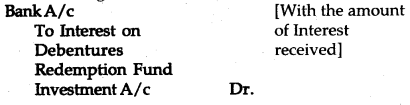
(a) For Receiving the Interest on Investments made
Issue and Redemption of Debentures Class 12 Notes Accountancy 19
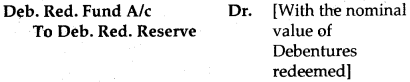
(b) For the transfer of Interest on Deb. Red. Fund Investment to DRF A/c
The interest of Deb. Red
Fund Investment A/c Dr.
To Debenture Redemption Fund A/c

(c) For Setting aside the number of profits
Profit and Loss Dr. [With the amount
Appropriation A/c of Profit set aside]
To Debenture Redemption FundA/c

(d) For Investing the amount set aside along with interest • received.
Deb. Red. Fund Investment A/c Dr.
ToBank A/c

III. At the end of last year
(a) For Receiving the Interest on Investment made
Bank A/c Dr.
To Interest on Deb. Red. Fund Investment A/c

(b) For the transfer of Interest on Deb. Red. Fund Investment to DRF A/c
Interest in Deb. Red.
Fund Investment A/c Dr.
To Deb. Red. Fund A/c

(c) For setting aside the number of profits
Profit & Loss
Appropriation A/c Dr.
To Deb. Red. Fund A/c

(d) For Realising the Investment made
Bank A/c Dr. [With the sale
To Deb. Red. Fund proceeds]
Investment A / c

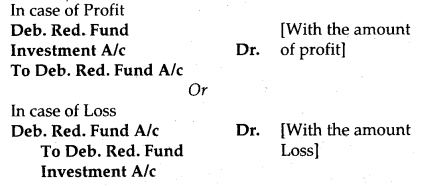
(e) For the transfer of profit/loss on realization of Deb. Red. Fund Investments
Issue and Redemption of Debentures Class 12 Notes Accountancy 20

(f) For the amount due to debenture holders
Debenture A/c Dr.
To Debentureholders A/c

(g) For redemption
Debenture holders A/c
To Bank A/c

(h) For the transfer of the balance, if any, Discount on Issue of Debentures A/c/Loss on Issue of Debenture A/c
Deb. Red. Fund. A/c Dr.
To Discount on Issue of Debentures A/c,
To Loss on Issue of Debentures A/c

1. For the transfer of an amount from the Deb. Red. Fund A/c to General Reserve:
(a) If some of the Debentures are redeemed
Issue and Redemption of Debentures Class 12 Notes Accountancy 21
(b) If all the Debentures are redeemed
Issue and Redemption of Debentures Class 12 Notes Accountancy 22

Accounting for Share Capital Class 12 Notes Accountancy Chapter 6

By going through these CBSE Class 12 Accountancy Notes Chapter 6 Accounting for Share Capital, students can recall all the concepts quickly.

Accounting for Share Capital Notes Class 12 Accountancy Chapter 6

With the expansion in the scale of operations, non-corporate forms of organizations, for example, sole proprietorship, partnership firms found themselves unequal to the tasks of meeting all the capital requirements of the present-day large-scale business operations. Thus, a relatively new form of the business organization came into vogue and this is called a Company.

Company:
A Company may be defined as an artificial person created by law, having a corporate and legal personality distinct and separate from its members, perpetual succession, and a common seal.

The word Company implies a group of people who voluntarily agree to form a company.
In the eyes of law ‘Company’ is termed as ‘Company’ which is formed and registered under any of the previous laws before the Indian Company Act 1956 or under this act.

“Company is an artificial person created by law having a separate legal entity with a perpetual succession and a common seal.” -L.H. Haney

“A corporation is an artificial being, invisible, intangible and existing only in the contemplation of law.” -Justice Marshall

“it is an association of persons who contribute money or money’s worth to a common stock and employ it for some common purpose.” -Justice Lindley

Features of a Company:

  1. It is a voluntary association of persons for profit.
  2. It is a separate legal entity i.e. Its legal existence is different from that of its member.
  3. The members have limited liability.
  4. It has perpetual succession.
  5. It has a common seal which signifies the sign of company.
  6. The shares of a public limited company can be freely transferable.
  7. It can enter into contracts and can enforce contractual rights against others. Similarly, the company can be sued by others if there is a breach of contract by the company.

Kinds of a Company:
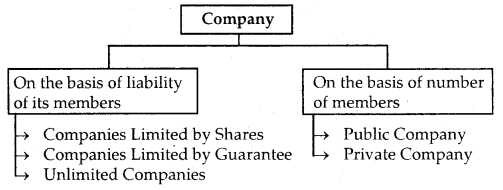
Accounting for Share Capital Class 12 Notes Accountancy 1
Companies Limited by Shares: In this case, the liability of the members is limited to the extent of the nominal value of shares held by them.

Companies Limited by Guarantee: In this case, the liability of its members is limited to the extent of the guarantee given by them in the event of the company being wound up.

Unlimited Companies: When there is no limit on the liability of its members, such Companies are called unlimited companies.

Public Company: A Public Company means a company that is not a Private Company.

Private Company: A Private Company is one which by its Articles of Association:

  1. Restricts the right to transfer its shares;
  2. Limits the number of its members to fifty;
  3. Prohibits any invitation to the public to subscribe for any shares in or debentures of the company.

Share Capital of a Company:
Every company should have capital in order to finance its activities. The company raises this capital by issue of share because it does not have capital of its own being an artificial person. Thus, the total capital of the company is divided into shares, therefore, it is called share capital.

Categories of Share Capital:
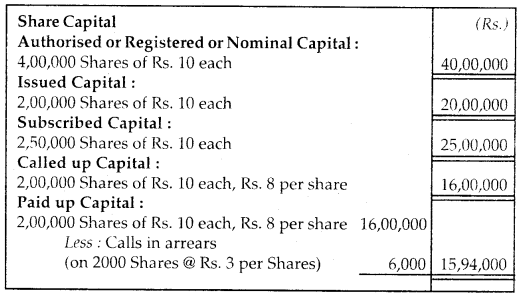
1. Authorised Capital: An Authorised Capital refers to that amount that is stated in the Memorandum of Association as the share capital of the company. It is the maximum amount with which the company is registered and which it is authorized to raise from the public by the issue of shares. The amount is also called the registered or nominal capital.

2. Issued Capital: It is the portion of authorized capital that is offered to the public for subscription and the remaining portion not yet offered to the public for subscription is called the unissued capital.

3. Subscribed Capital: It is that part of the issued capital which has been actually subscribed by the public. When the shares offered for public subscription were subscribed fully by the public, in such a case the issued capital and subscribed capital would be the same.

4. Called-up Capital: It is that part of the subscribed share capital which the company actually demands from the share-holders. The company may decide to call the entire amount or part of the face value of the shares.

5. Paid-up Capital: It means the total amount paid up or credited as paid upon the subscribed capital. Some of the shareholders may fail to pay the amount due from them on account of a call which is termed as ”call-in-arrears” or “unpaid capital”.

6. Uncalled Capital: That portion of the subscribed capital that has not been called up is called uncalled capital. The company may collect this amount at any time when it needs further funds.

7. Reserve Capital: Sometimes a company, by means of a special resolution, decides that a certain portion of its uncalled capital shall not be called up during its existence and it would be available in the event of winding up of the company. Such a portion of uncalled capital is termed as ‘reserve capital’.

Share Capital in the Balance Sheet of Company:
According to Schedule VI of the Companies Act, 1956 the information regarding Share Capital is to be shown in the following manner

Sunrise Company Ltd.
Balance Sheet as at…………
Accounting for Share Capital Class 12 Notes Accountancy 2
Shares of a Company:
The capital of a company is divided into a number of equal units. Each unit is called a share. The Companies Act 1956, defines a share as “a share in the share capital of the company. The person who contributes money through shares is called Shareholders.”

The company issues a certificate to every shareholder stating the number of shares he holds. The certificate is called a Share Certificate.

Classes of Shares:
According to the Indian Companies Act, 1956 a company can issue two types of shares:

  1. Preference Share
  2. Equity Share (formerly known as ordinary share)

1. Preference Share: According to Section 85 of the Companies Act, 1956 a preference share is one, which fulfills the following conditions:
(a) That it carries a preferential right to the dividend to be paid either as a fixed amount or an amount calculated by a fixed rate which may be either free of or subject to income tax; and
(b) That with respect to the capital it carries or will carry, on .the winding-up of the company, the right to the repayment of capital before anything is paid to equity shareholders.

2. Equity Share: According to Section 85 of the Companies Act, 1956, an equity share is a share that is not a preference share.
This share does not carry any preferential right or in other words, equity share is one that is entitled to dividend and repayment of capital after the claims of preference share are satisfied.

According to Section 86 (a), equity share capital may be:

  1. With voting right or
  2. With differential rights as to voting, dividend, or otherwise in accordance with such rules and subject to such condition as may be prescribed.

Issue of Share:
The shares of a company can be issued in two ways:

  1. for cash
  2. for consideration other than cash.

Issue of Share for cash
Steps for the issue of share for cash:
1. Issue of Prospectus: The company first issues the prospectus to the public. It contains complete information about the company and the manner in which share capital is to be collected from the prospective investors.

2. Receipt of Application: When a prospectus is issued to the public, prospective investors intending to subscribe to the share capital of the company would make an application along with the application money and deposit the same with schedule bank as specified in the prospectus.

3. Receipt of Minimum Subscription: The company has to get a minimum subscription. It is to be noted that the minimum subscription of the capital cannot be less than 90% of the issued amount according to SEBI (Disclosure and Investor Protection) Guidelines, 2000 [6.3.8.1 and 6.3.8.2]. If this condition is not satisfied, the company shall forthwith refund the entire subscription amount received.

If a delay occurs beyond 8 days from the date of closure o! subscription list, the company shall be liable to pay the amount with interest at the rate of 15% [Section 73 (2)]. Within 120 days from the date of the issue of the prospectus, if the company fails to receive the same within the said period, the company cannot proceed with the allotment of shares, and the application may be returned within 130 days of the date of issue of prospectus.

Allotment of Shares:
When a minimum subscription has been received, the company may proceed with the allotment of shares. When allotment is made, it results in a valid contract between the company and the applicants who now became the shareholders of the company.

Accounting Treatment of Issue of Shares
Issue of Shares at Par:
When shares are issued for an amount equal to the face value of a share, they are said to be issued at par.

The issue price of a share may be payable either in lump sum along with the application or in installments.

The amount of application money is fixed by the directors but, according to legal provisions, it can in no case be less than 5% of the face value of shares.

Accounting Treatment:
When Share Application money received along with the application:
BankA/c Dr.
To Share Application A/c [Total Amount received on, application]
(Amount received on the application for -Share Rs. -Per Share)

1. Transfer of Application money

Accounting for Share Capital Class 12 Notes Accountancy 3
[Application money on-Share allotted /transferred to Share Cap.]

2. Money refunded on rejected application

Accounting for Share Capital Class 12 Notes Accountancy 4
(Application money returned on rejected applications for-share)

3. Amount Due on Allotment

Accounting for Share Capital Class 12 Notes Accountancy 5

4. Adjustment of Excess Application money

Accounting for Share Capital Class 12 Notes Accountancy 6
(Application Amount on -Shares @ Rs. -per shares adjusted to the amount due on allotment.)

5.Receipt of Allotment Account
Bank A/c Dr.
To Share Allotment A/c
(Allotment money received on -Share @ Rs.-Per share)

Combined Account:
Sometimes a combined account for share application and share allotment is kept in the books of a company under the name Share Application and Allotment Account.
1. For Receipt of Application and Allotment
Bank A/c Dr.
To Share Application and Attotment A/c [Total Amount Received on Application]
(Money received on applications for shares @ Rs.-per share)

2. Transfer of Application money and Allotment Amount Due
Share App. and Allotment A/c Dr.
To Share Capital [No. of share Allotted × (Application money per share + Allotment Amount per share)]
(Transfer of application money to share capital for the amount due on allotment of shares @ Rs. – per share)

3. Money Refunded on Rejected Applications
Share App. and Allotment A/c Dr.
To Bank A/c [No. of share Rejected × App. money per share]
(Application money returned on the rejected application for….share)

4. Receipt of Balance Allotment money
Bank A/c Dr.
To Share Application and Allotment A/c
(Balance of Allotment money received)

Calls on Share: Two points are important regarding the Calls on shares.

  1. The call amount should not exceed 25% of the face value of shares.
  2. There must be an internal dynamics of keeping at least some months between the making of two calls unless otherwise provided by the Articles of Association of the company.

Accounting Treatment:
1. Call Amount Due

Accounting for Share Capital Class 12 Notes Accountancy 7
(Call money due on – Shares @ Rs. – per share)

2. Receipt of Call Amount
Bank A/c Dr.
To Share Call A/c
(Call money received)

Note: The name of the call viz. First, the second and final call is added between the words ‘share’ and ‘call’ in the entry depending upon the identity of the call made.

Calls-in-Arrears: When any shareholder fails to pay the amount due on allotment or on any of the calls, such amount is known as ‘Calls- in-Arrears / Unpaid Calls’.

Call in Arrears amount shows the debit balance and the same is shown as a deduction from the paid-up capital on the liabilities side of the Balance sheet.

Accounting Treatment:
Calls-in-Arrears A/c Dr.
To Share Allotment A/c To Share Call/Calls A/c
(Calls in Arrears brought into account)

The Articles of Association of a company usually empower the directors to charge interest at a stipulated rate on calls in arrears. In case the Articles are silent in this regard, the rule contained in Table A shall be applicable, which states that the interest at a rate not exceeding 5% p.a. shall have to be paid on all unpaid amounts on shares for the period intervening between the day fixed for payment and the time of actual payment thereon. On receipt of the call amount together with interest.

Bank A/c Dr.
To Calls-in-Arrears A/c
To Interest A/c

Calls-in- Advance:
Sometimes some shareholders pay a part or whole of the amount on the calls not yet made. Such amount received in advance from the shareholders is known as “Calls in Advance”. It may also happen in the case of partial allotment of shares when the full amount of application money paid is not adjusted to the allotment. The amount received will be adjusted towards the payment of calls as and when it becomes due.

Accounting Treatment:
A separate call in advance A/c is opened for its accounting treatment and the following entry will pass:
Bank A/c Dr.
To Call-in-Advance A/c
(Amount received on Call-in-Advance)

When call becomes actually due requiring adjustment of
Call- in-Advance’A/c:
Calls-in-Advance A/c Dr.
To Particular Call A/c [Call Amount due]
(Calls-in-advance adjusted with the call money due)

The credit balance of Calls-in-Advance A/c is shown separately on the liabilities side of the balance sheet under the heading ‘Share Capital’ but is not added to the amount of Paid Up Capital.

As calls in advance are a liability to the company and it is under an obligation if provided by the Articles of Association, to pay interest on such amount. In case, the articles are silent then Table ‘A’ shall be applicable, according to which interest @ 6% p.a. may be paid.

1. Interest due
Interest on Calls-in-Advance A/c Dr.
To Sundry Shareholder’s A/c [Amount of Interest due for payment]
(Interest due on Calls-in-Advance)

2. Payment of Interest
Sundry Shareholder’s A/c Dr.
To Bank A/c [Amount of Interest paid]
(Interest paid on Calls-in-Advance)

Oversubscription:
When Shares are issued to the public for subscription through the prospectus by well-managed and financially strong companies, it may happen that applications for more shares are received than the number of shares offered to the public, such a situation is said to be a case of oversubscription.

Alternative:

  1. They can accept some applications in full and totally reject the others.
  2. They can make a pro-rata distribution.
  3. They can adopt a combination of the above two alternatives.

Accounting Treatment:
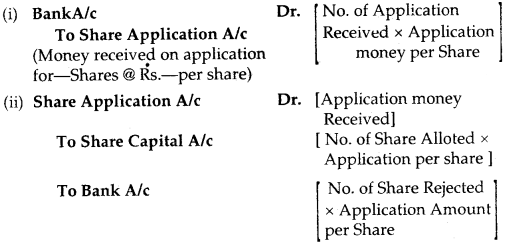
1. If the excess applicants are totally refused for allotment, the application money received on these shares’s refunded.
Accounting for Share Capital Class 12 Notes Accountancy 8
(Transfer of money on the application for Share allotted and money refunded on the application for Share rejected)

2. If the applicants are made partial allotment (or pro-rata allotment):
The directors can as well opt to make a proportionate distribution of shares available for allotment among the applicants of shares. The proportion is determined by the ratio which the number of shares to be allotted to bear to the number of shares applied for. This is called ‘pro-rata allotment.

Generally, excess application money received on these shares is adjusted towards the amount due on allotment or call.
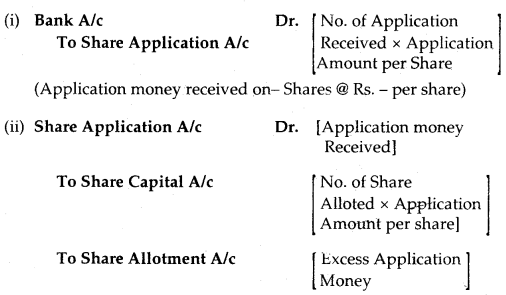
Accounting for Share Capital Class 12 Notes Accountancy 9
(Transfer of application money to share capital and excess application money credited to share allotment.)

Accounting for Share Capital Class 12 Notes Accountancy 10
(Amount due on the Attotment of – Share @ Rs. – Per Share)

Accounting for Share Capital Class 12 Notes Accountancy 11
(Allotment money received after adjusting the amount already received as excess application money)

3. This is a combination of two alternatives described above as thus:
(a) Application for some shares are rejected outright, and
(b) pro-rata allotment is made to the applicants of a remaining number of shares.

Thus, money on the rejected applications is refunded and excess application money due to pro-rata distribution is adjusted towards the amount due on the allotment of shares allotted.
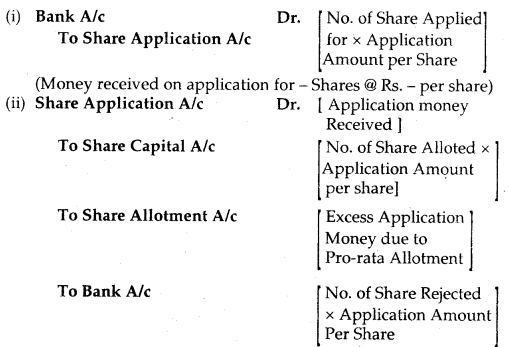
Accounting for Share Capital Class 12 Notes Accountancy 12
(Transfer of application money to share capital, excess application amount credited to share allotment and money refunded on rejected application)

Accounting for Share Capital Class 12 Notes Accountancy 13
(Amount due on the Allotment of — Share @ Rs. — Per Share)

Accounting for Share Capital Class 12 Notes Accountancy 14
(Allotment money received after adjusting the amount already received as excess application money)

Under Subscription:
In case applications for a lesser number of Shares have been received than that for which they have been invited by the company, it is called Under Subscription of shares. When an issue of shares is undersubscribed, the company can proceed with the allotment of shares, provided a minimum subscription is raised.

Issue of Shares at a Premium [Sec 781 When shares are issued at an amount more than the face value of a share, they are said to be issued at a premium. The difference between the issue price and the face value of the Share is called the premium.

Note: According to the Companies (Amendment) Act, 1999, the term, ‘Securities Premium’ is required to be used in place of ‘Share Premium’.

Under Section 78 of the Companies Act 1956, the amount o share premium may be used only for the following purposes:

  1. In writing off the preliminary expenses of the company.
  2. For writing off the expenses, commission, or discount allowed on the issue of shares or debentures of the company.
  3. For issuing fully paid bonus shares to the shareholders of the company.
  4. For providing for the premium payable on redemption of redeemable preference shares or debenture of the company.

When Shares are issued at a premium, the journal entries are as follows:
(a) Premium Amount called with Application money

Accounting for Share Capital Class 12 Notes Accountancy 15
(Money received on the application for— Shares @ Rs. — per share including premium)
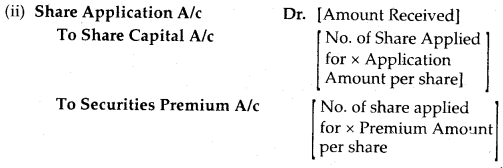
Accounting for Share Capital Class 12 Notes Accountancy 16
(Transfer of application money to share capital and premium accounts)

(b) Premium Amount called with Allotment money
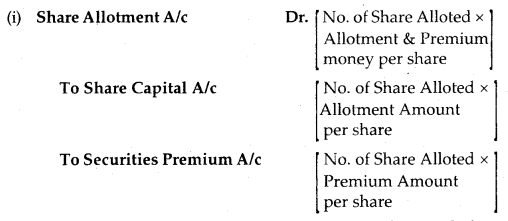
Accounting for Share Capital Class 12 Notes Accountancy 17
(Amount due on allotment of shares @ Rs. – per share including premium)
(ii) Bank A/c Dr.
To Share Allotment A/c
(Allotment money received including premium)

Issue of Shares at a Discount:
When a share is issued at a price that is less than its face value, it is said that it has been issued at a discount.

Normally, a company cannot issue its share at a discount. Share can be issued at a discount only when the following conditions gives in Section 79 of the Companies Act, 1956 are satisfied.
1. At least one year must have elapsed since the company became entitled to commence business. It means that a new company cannot issue shares at a discount at the very beginning.

2. The company has already issued such types of the share;

3. An ordinary resolution to issue the shares at a discount has been passed by the company in the General Meeting of shareholders and sanction of the Company Law Board has been obtained.

4. The resolution must specify the maximum rate of discount at which the share is to be issued but the rate of discount must not exceed 10% of the face value of the share, for more than this limit sanction of the Company Law Board is necessary.

5. The issue must be made within two months from the date of receiving the sanction of the Company Law Board. Generally, the amount of discount is recorded at the time of allotment. Therefore the following entry should be passed on attornment.
Share Allotment A/c Dr.
Share Discount A/c Dr.
To Share Capital A/c
(For the amount due on the allotment, excluding discount)

‘Discount on the Issue of Shares Account’, showing a debit balance, denotes a loss to the company, which is in the nature of capital loss. Therefore, the account is presented on the assets side of the company’s balance sheet under ‘Miscellaneous Expenditure’. It is written off by being charged straight-way to the Securities Premium A/c if any, and in its absence, by being gradually charged to the Profit and Loss A/c over a period of years.

Issue of Shares for Consideration other than cash:
If a company purchases some assets from vendors, in exchange it can issue fully paid shares to them whereby the latter agrees to accepts it. Thus, no cash is received for the issue of shares. These shares can also be issued either at par, at a premium, or at a discount. The number of shares to be issued will depend on the price at which shares are issued and the amount payable to the vendor. To find out the number of shares to be issued to the vendor will be calculated as follows:
No. of Shares to be issued = \(\frac{\text { Amount Payable }}{\text { Issue Price }}\)
(a) On purchase of assets:
Assets A/c Dr.
To Vendor’s A/c
(Assets Purchased)

(b) Shares can be issued to vendors in any manner out of the following:
1. At Par:
Vendor’s A/c Dr.
To Share Capital A/c

2. At Premium:
Vendor’s A/c Dr.
To Share Capital A/c
To Securities Premium A/c

3. At discount:
Vendor’s A/c Share Discount A/c
To Share Capital A/c

Forfeiture of Shares:
If a shareholder fails to pay allotment money or call money on his share as called upon by the company, his shares may be forfeited by giving due notice and following the procedure specified in the Articles of Association in this behalf. This is known as forfeiture of shares.

To forfeit a share means to cancel the allotment to the defaulting shareholders and to treat the amount already received thereon as forfeited to the company.

Accounting Treatment:
1. Forfeiture of Shares issued at par
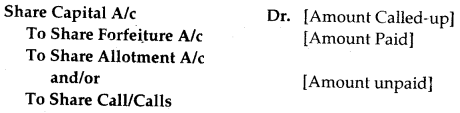
Accounting for Share Capital Class 12 Notes Accountancy 18
Note: In case’Calls-in-Arrears’ A /c is maintained by a company, ‘Call-in-Arrears’ A/c would be credited in the above instead of ‘Share Allotment’ and/or ‘Share Call or Calls’ A/c.

The balance on the Share Forfeited A/c is shown in addition to the total paid capital of the company under the heading ‘Share Capital’ on the liabilities side of the Balance Sheet till the forfeited shares are reissued.

2. Forfeiture of Shares issued at a Premium:
(a) If Premium has not been paid by the Shareholders:
Share Capital A/c Dr. (Amount Called up Premium)
Securities Premium A/c Dr. (Premium amount)

To Share Allotment A/c (Amount unpaid)
To Share Call/Calls A/c (Amount unpaid)
To Share Forfeiture A/c (Amount paid)
(For Share forfeited)

(b) If Premium has been paid by the shareholder:
Share Capital A/c Dr. (Amount Called up Premium)

To Share Allotment A/c Dr. (Premium amount)
To Share Call/Calls A/c (Amount unpaid)
To Share Forfeiture A/c (Amount paid)
(For Share forfeited)

3. Forfeiture of Shares issued at a discount:
Share Capital A/c Dr. (Amount Calledup + Discount)

To Discount on Issue of Share A/c (Discount on forfeited share)
To Share Allotment A/c (Amount unpaid)
To Share Call/Calls A/c (Amount unpaid)
To Share Forfeiture A/c (Amount paid)
(Forfeiture of Shares and discount on issue adjusted)

Re-Tissue of Forfeited Share:
The director of a company has the authority to re-issue the shares once forfeited. These forfeited shares are reissued at par, at a premium, or at a discount, the amount of the discount does not exceed the amount paid on such shares by the original shareholder but in case of shares originally issued at discount, the maximum permissible discount will be the amount paid on such shares by the original shareholder plus the amount of original discount.

Accounting Treatment:
1. For Forfeited Shares reissued at Par:
Bank A/c Dr.
To Share Capital A/c

2. For Forfeited Shares reissued at Premium:
Bank A/c Dr.
To Share Capital A/c
To Securities Premium A/c

3. For Forfeited Shares reissued at Discount:
Bank A/c Dr.
Share Forfeiture A/c Dr. (Discount Allowed)
To Share Capital A/c

Transfer:
When all forfeited shares have been reissued, the credit balance left on the Share Forfeiture A/c is transferred ta> Capital Reserve A/c
Share Forfeiture A/c Dr.
To Capital Reserve A/c

Buy-Back of Shares:
A company may buy its own shares from the market. This is called ‘buyback of shares’. Section 77 A of the Companies Act, 1956 provides such a facility to the companies and can buy its own shares from either of the following:

  1. Existing equity shareholders on a proportionate basis
  2. Open Market
  3. Odd lot shareholders
  4. Employees of the company.

Buyback of its own shares may be made out of:

  1. Free reserve of the company e.g. general reserve, reserve fund, Cr. balance of Profit & Loss A/c.
  2. From the proceeds of all earlier issues.
  3. From Securities Premium A/c.

Section 77 A of the Companies Act has laid down the following procedures for buy-back of share:

  1. Its Articles of Association authorize it to do so.
  2. A special resolution must be passed in the companies annual general body meeting.
  3. The buyback should not exceed 25% of the total paid-up capital and free reserve of the company.
  4. The debt-equity ratio should not be more than a ratio of 2: 1 after the buy-back.
  5. All the company’s shares are fully paid up.
  6. The buy-back of the shares should be completed within 12 months from the date passing the special resolution.
  7. The company should file a solvency declaration with the Registrar and SEBI which must be signed by at least two directors of the company.