Human Menstrual Cycle

Learninsta presents the core concepts of Biology with high-quality research papers and topical review articles.

Human Menstrual Cycle

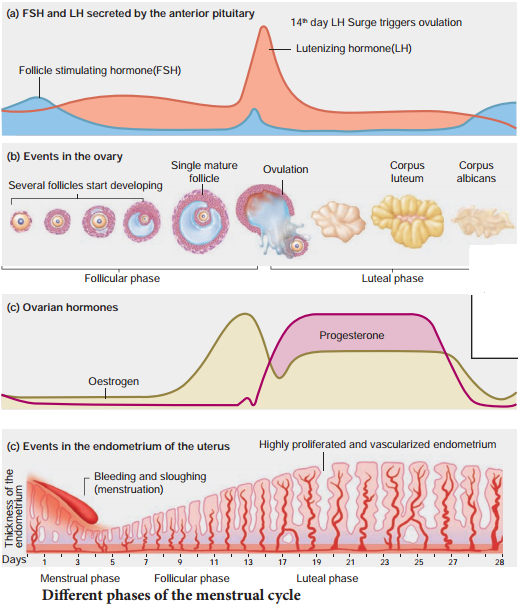
The menstrual or ovarian cycle occurs approximately once in every 28/29 days during the reproductive life of the female from menarche (puberty) to menopause except during pregnancy. The cycle of events starting from one menstrual period till the next one is called the menstrual cycle during which cyclic changes occurs in the endometrium every month. Cyclic menstruation is an indicator of normal reproductive phase (Fig. 2.9).
Menstrual Cycle img 1

Menstrual cycle comprises of the following phases

  1. Menstrual phase
  2. Follicular or proliferative phase
  3. Ovulatory phase
  4. Luteal or secretory phase

1. Menstrual phase

The cycle starts with the menstrual phase when menstrual flow occurs and lasts for 3-5 days. Menstrual flow is due to the breakdown of endometrial lining of the uterus, and its blood vessels due to decline in the level of progesterone and oestrogen. Menstruation occurs only if the released ovum is not fertilized. Absence of menstruation may be an indicator of pregnancy. However it could also be due to stress, hormonal disorder and anaemia.

2. Follicular or proliferative phase

The follicular phase extends from the 5th day of the cycle until the time of ovulation. During this phase, the primary follicle in the ovary grows to become a fully mature Graafin follicle and simultaneously, the endometrium regenerates through proliferation. These changes in the ovary and the uterus are induced by the secretion of gonadotropins like FSH and LH, which increase gradually during the follicular phase. It stimulates follicular development and secretion of oestrogen by the follicle cells.

3. Ovulatory phase

Both LH and FSH attain peak level in the middle of the cycle (about the 14th day). Maximum secretion of LH during the mid cycle called LH surge induces the rupture of the Graafin follicle and the release of the ovum (secondary oocyte) from the ovary wall into the peritoneal cavity. Ths process is called as ovulation.

4. Luteal or secretory phase

During luteal phase, the remaining part of the Graafin follicle is transformed into a transitory endocrine gland called corpus luteum. The corpus luteum secretes large amount of progesterone which is essential for the maintenance of the endometrium. If Fertilization takes place, it paves way for the implantation of the fertilized ovum. The uterine wall secretes nutritious fluid in the uterus for the foetus. So, this phase is also called as secretory phase. During pregnancy all events of menstrual cycle stop and there is no menstruation.

In the absence of Fertilization, the corpus luteum degenerates completely and leaves a scar tissue called corpus albicans. It also initiates the disintegration of the endometrium leading to menstruation, marking the next cycle.

Menstrual hygiene

Menstrual hygiene is vital for good health, well-being, dignity, empowerment and productivity of women. The impact of poor menstrual hygiene on girls is increased stress levels, fear and embarrassment during menstruation. This can keep girls inactive during such periods leading to absenteeism from school.

Clean and safe absorbable clothing materials, sanitary napkins, pads, tampons and menstrual cups have been identified as materials used to manage menstruation. Changing sanitary material 4-5 hours as per the requirement, provides comfort, cleanliness and protection from infections.

It also helps in enhancing the quality of life of women during this period. Used sanitary napkins should be wrapped in paper and disposed. It should not be thrown in open areas or drain pipe of toilets. Flushing of sanitary napkins in the drain pipes causes choking of the drainage line leading to water pollution.

Menopause

Menopause is the phase in a women’s life when ovulation and menstruation stops. The average age of menopause is 45-50 years. It indicates the permanent cessation of the primary functions of the ovaries.

Analysis of Financial Statements Class 12 Notes Accountancy Chapter 9

By going through these CBSE Class 12 Accountancy Notes Chapter 9 Analysis of Financial Statements, students can recall all the concepts quickly.

Analysis of Financial Statements Notes Class 12 Accountancy Chapter 9

Meaning of Financial Statement Analysis: The process of critical examination of the financial information contained in the financial statements in order to understand and make decisions regarding the operations of the firm is called the ‘Financial Statement Analysis’.

Basically, it is a study of the relationship among various financial facts and figures as given in a set of financial statements.

→ “Financial statement analysis is designed to indicate the strength and weaknesses of business undertaking through the establishment of certain crucial relationship by regrouping and analysis of figures contained in financial statements.” —J.N. Myres

→ “Financial statement analysis is a judgemental process which aims to estimate current and past financial position and the results of the operations of enterprises with the primary objective of determining the best possible estimated and predictions about future conditions.” —Bernstein

Thus, Analysis of Financial Statements is the process of identifying the financial strengths and weaknesses of the firm by properly establishing a relationship between the items of the Balance Sheet and Income Statement.

The term ‘Financial Analysis’ includes both ‘analysis and interpretation’. The term analysis means simplification of financial data by the methodical classification given in the financial statements. Interpretation means explaining the meaning and significance of the data so simplified.

Significance of Financial Analysis: As we know that Financial Analysis is the process of identifying the financial strengths and weaknesses of the firm by properly establishing relationships between the items of the Balance Sheet and the Profit and Loss Account.

It can be undertaken by the management of the firm, or by parties outside the firm like Creditors, Lenders, Investors, Unions, etc. The nature and technique used for analysis will differ depending on the interests of the analysis.

Financial Analysis is useful and significant to different users in the following way:
1. To The Finance Manager: Financial Analysis focuses on the facts and relationships related to managerial performance, corporate efficiency, financial strengths and weaknesses, and credit worthiness of the company. The Finance Manager has to make rational decisions for the firm, so he must be well equipped with the different tools for analysis. These tools help him in studying accounting data, so as to determine the continuity of the operating policies, the investment value of the business.

Credit rating and testing the efficiency of operations. The technique is equally important in the area of financial control, enabling the Finance Manager to make constant reviews of the actual financial operations of the firm as a whole and in part, to analyze the cause of major deviations, which result in corrective action wherever indicated.

2. To The Management: It is the responsibility of the management to see that the resources of the firm are used most efficiently and that the firm’s financial condition is sound.

Financial analysis helps the management in measuring the success or otherwise of the company’s operations, appraising the individual’s performance, and evaluating the system of internal control.

3. To The Trade Creditors: Trade Creditors are particularly interested in the firm’s ability to meet their claims over a very short period of time. Their analysis will, therefore, confine to the evaluation of the firm’s liquidity position.

4. To The Lenders: Lenders are mainly concerned with the firm’s long-term solvency and survival. They analyze the firm’s profitability over time, its ability to generate cash to be able to pay interest and repay principal, and the relationship between various sources of funds. They do analyze the historical financial statements as well as projected financial statements to make an analysis about its future solvency and profitability.

5. To The Investors: Investors who invested their money in the firm’s shares, are interested to know about the firm’s earnings. They mainly concentrate on the analysis of the firm’s present and future profitability. The investors evaluate the efficiency of the management and determine whether a change is needed or not. In large companies, the shareholder’s interest is limited to decide whether to buy, sell or hold the shares.

6. To The Labour Unions: They analyze the Financial Statements to assess whether the company is earning a fair rate of return on invested capital, whether it can presently afford a wage increase and whether it can absorb a wage increase through increased productivity or by rising the prices.

7. To the Economists, Government, etc.: The economists, researchers analyze the Financial Statements to study the present business and economic conditions. The Government agencies need financial analysis for price regulations, tax fixation, and another similar purpose.

Purpose or Objectives of Financial Statement Analysis: Financial Statement Analysis reveals important facts and relationships concerning the managerial performance and the efficiency of the firms. The main objectives of the analysis are to understand the information contained in financial statements with a view to knowing the weaknesses and strengths of the firms and making a forecast about the future prospects of the firm and thereby enabling the financial analysis to take different decisions regarding the operations of the firm.

The following are generally considered to be the objectives of analysis:

  1. To find out the financial stability and soundness of the business enterprises.
  2. To assess and evaluate the earning capacity of the business.
  3. To estimate and evaluate the Fixed Assets, Stock, etc. of the concern.
  4. To estimate and determine the possibilities of future growth of the business.
  5. To assess and evaluate the firm’s capacity and ability to repay short-term and long-term loans.
  6. To evaluate the administrative efficiency of the business enterprises.

Tools of Financial Analysis.

  1. Comparative Statement Analysis.
  2. Common Size Statement Analysis.
  3. Trend Analysis.
  4. Ratio Analysis.
  5. Cash Flow Analysis.

1. Comparative Statement Analysis: Comparative statements compares financial numbers at two points of time and helps in deriving meaningful conclusions regarding the changes in financial positions and operating results and to enable the reader to understand the significance of such changes.

Such comparison of Financial Statements is accomplished by setting up a Balance Sheet and Profit and Loss Account side by side and studying the changes that have occurred in the individual figure therein from year to year and over the years. Thus, Comparative Statements are those which summarise and present relating data for a number of years incorporating therein the changes in individuals items of Financial Statements. This analysis is also known as Florizontal Analysis.

2. Common Size Statement Analysis: These Statements indicate the relationship of different items of Financial Statements with some common item by expressing each item as a percentage of the common item. The percent thus calculated can be easily compared with the corresponding percentages of some other firms, as the number is brought to a common base. This analysis is also known as ‘Vertical Analysis’.

3. Trend Analysis: It is a technique of studying several Financial Statements over a series of years. Using the previous years’ data of a business enterprise, trend analysis can be done to observe the percentage changes over time in the selected data. Trend analysis is important because, with its long-run view, it may point to basic changes in the nature of the business. By looking at a trend in a particular ratio, one may find whether the ratio is falling, rising, or remaining relatively constant.

4. Ratio Analysis: Accounting ratios measure the comparative significance of the individual items of the income and position statements. It is possible to assess the profitability, solvency, and efficiency of an enterprise through the techniques of ratio analysis.

5. Cash Flow Analysis: It refers to the analysis of the actual movement of cash in and out of an organization. Cash Flow Statements is prepared to project the manner in which the cash received has been utilized during an accounting year. It is a statement, which shows the sources of cash receipts and also the purposes for which payments are made. Thus, it summarises the causes for the changes in the cash position of a business enterprise between the dates of two Balance Sheets.

Comparative Financial Statements Analysis: Financial Statements include Income Statements (Trading and Profit and Loss A/c) and Position Statement (Balance Sheet). The study of financial statements with a view to indicating the trend of the profitability, efficiency, and financial soundness of the business is known as a comparison of financial statements.

Purpose:

  1. To study the magnitude and direction of changes in the financial position and performance of the enterprise.
  2. To ascertain the strengths and weaknesses of the enterprise in terms of liquidity, solvency, and profitability.

Importance:

  1. Inter-period and/or inter-firm comparisons are very much facilitated by such comparative statements. t
  2. With the help of Comparative Statements, weakness in the operating cycle, financial health, etc. can be identified and suitable remedial steps may be taken.
  3. These statements highlight the trends in a number of accounting data relating to performance, efficiency, and financial position which are useful for future estimates.
  4. The Profit and Loss A/c of a business show the result of operation while a Comparative Balance Sheet shows the effect of operations on its assets and liabilities. Thus, the Comparative Balance Sheet contains a connecting link between Balance Sheet and Profit and Loss A/c.

Comparative Balance Sheet: In the comparative balance sheet, the items and data of balance sheets prepared at two different dates are presented in such a way that the changes in each item between two dates are easily found out and determined.

→ “Comparative balance sheet is the study of the trend of the same item, group of items and computed items in two or more balance sheets of the same business enterprise on different dates.”—Prof. Foulkes.

Comparative Profit and Loss Account: A comparative income statement is prepared to show the net profit or loss for a number of years in comparative form. A comparative study of Income Statements for more than one period may enable us to have definite knowledge about the progress of the business concern.

Steps:
The following steps may be followed to prepare the comparative statements:
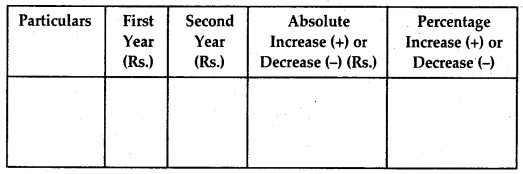
1. Draw a table with the five columns like;
Comparative Statement
Analysis of Financial Statements Class 12 Notes Accountancy 1
2. List out absolute figures in rupees at two different points of time.
3. Find out the change in absolute figures by subtracting the first year from the second year and indicate the change as an increase (+) or decrease (-).
4. Calculate the Percentage change as:
\(\frac{\text { SecondyearabsoluteFigure }}{\text { First year absoluteFigure }}\) × 100 – 100

Common-Size Financial Statement Analysis: Common-Size Statement also known as a component percentage statement, is a financial tool for studying the key changes and trends in the financial position (Balance Sheet) and financial result (Profit and Loss A/c) of a company.

These figures reported are converted into percentages of some common base. For example, total assets may be chosen as a measured size for the Balance Sheet and sales may act as a measured size for Profit and Loss A/c.

These statements are known as common size statements because all the figures are converted into a common size.

Purpose: An analysis of the common size statement will help better to understand the important changes which have occurred in the enterprise over a period of time. This analysis constitutes a vertical study within one column of the comparative statement therefore, it is also called vertical analysis.

Importance: An analysis of common size statement is of immense use which comparing business enterprise which differs substantially in size as it provides an insight into the structure of financial statements.

Common Size Balance Sheet
In Common Size Balance Sheet, each item of assets is shown as a percentage of total assets and each item of liability is shown as a percentage of total liabilities. The total of the assets and that of liabilities is taken as 100 percent and each item, appearing on the assets side as well as liabilities side is shown as the proportion of the total of 100. It is known as the Percentage Balance Sheet.

Common Size Income Statement: Income Statements are reduced to common size by expressing each item as a percentage of net sales. Thus the common size Income Statement captures the relationship between sales and expenses.

Steps:
The following steps may be followed to prepare the common size statements:
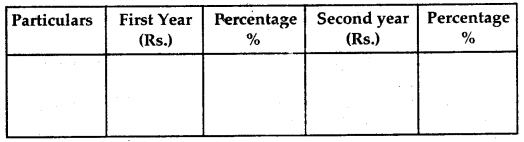
1. Draw a table with the five columns.
Common Size Statements
Analysis of Financial Statements Class 12 Notes Accountancy 2
2. List out absolute figures in rupees at two different points in time.
3. Choose a common base (as 100) for example, Sales revenue total may be taken as a base (100) in case of Profit and Loss A/c and total assets or total liabilities (100) in case of Balance Sheet.
4. Convert all items of Col. 2 and Col. 4 as a percentage of that total. Columns 3 and 5 portray these percentages.

The purpose of the common-size analysis is to know the importance of each item in the total. Hence, this analysis can be done for one year also.

Trend Analysis: The Financial Statements may be analyzed by computing trends emeries of information. Trend analysis determines the direction upwards or downwards and involves the computation of the percentage relationship that each item bears to the same item in the base year. In Trend Analysis, we would like to know the behavior of some item over the period, say during the last 5 years.

In other words, Comparative and Common Size Statements present the percentage of each item to the total sum. These percentages could be calculated for a number of successive years in order to understand the trend of the Financial Statement item and this analysis is called trend analysis.

The trend in general term signifies a Tendency. The review and appraisal of tendency in accounting data are nothing but trend analysis. It discloses the change in the financial and operating data between specific period and makes possible for the analyst to form an opinion as to whether favorable or unfavorable tendencies are reflected by the accounting data.

Purpose and Importance:
1. It helps in future forecasts of various items as the basis of data of the previous year.
2. In this method, mass complex accounting data are converted into % and presented in brief, so the direction of the business can be easily detected.
3. There is less chance of mistakes because changes in percentages can be compared to changes in absolute data.
4. It is a very easy method to calculate that even a layman can also use this method.

Procedure: Generally, the first or the last year is taken as the base year. The figure for the base year is taken as 100. The trend percentages are calculated in relation to this base year. Each year’s figure is divided by the base year figure.
Trend Percentage = \(\frac{\text { Present year value }}{\text { Base year value }}\) × 100

The base period should be carefully selected. The accounting procedures and conventions used for collecting data and preparation of Financial Statements should be similar, otherwise, the figures will not be compared.

Limitations of Financial Analysis
Though financial analysis is quite powerful in determining the financial strengths and weaknesses of a firm, the analysis is based on the information available in financial statements. As such, financial analysis also suffers from the serious limitations of financial statements.

Some other limitations of financial analysis are:

  1. It does not consider price level changes.
  2. It may be misleading an account of changes in accounting procedure followed by a firm.
  3. It is just a study of interim reports.
  4. Monetary information alone is considered in financial analysis while non-monetary factors are ignored.
  5. The financial statements are prepared on the basis of ongoing concepts as such, it does not give an exact position.

Financial Statements of a Company Class 12 Notes Accountancy Chapter 8

By going through these CBSE Class 12 Accountancy Notes Chapter 8 Financial Statements of a Company, students can recall all the concepts quickly.

Financial Statements of a Company Notes Class 12 Accountancy Chapter 8

Financial Statements are the end products of the accounting process. They are prepared following the consistent accounting concept principles, procedures and also tire legal environment in which the business organization operates. These statements are the outcome of % the summarizing process of accounting and are, therefore the sources of information/on the basis of which conclusions are drawn about the profitability and the financial position of a business enterprise.

Meaning of Financial Statements: Financial Statements are the summarized statements of accounting data produced at the end of the accounting process by an enterprise through which it communicates accounting information to the external users as well as internal users.

These are the basic and formal means through which the corporate management communicates financial information to various users. External user includes investors, tax-authorities, government, employees, etc.

Financial information, which is the information relating to the financial position of any firm, when presented in a concise and capsule form, is known as the financial statement.

“Financial Statements are prepared for the purpose of presenting a periodical review or report on progress made by the management and deal with the status of investment in the business and the results achieved during the period under review.”

—American Institute of Certified Public Accountants (AICPA)
“The end product of financial accounting in a set of financial statements prepared by the accounts of a business enterprise that purport to reveal the financial position of the enterprise, the result of its recent activities and an analysis of what has been done with earnings.” -Smith and Assume

“The Finacial Statements provide a summary of accounts of a business enterprise, the balance sheet reflecting the assets, liabilities, and capital as on a. certain date and the income statement showing the results of operations during a certain period.”. -John N. Myer

“Financial Statement, essentially, are interim reports presented annually and reflect a division of the life of an enterprise into more or less arbitrary accounting period more frequently a year.” -Anthony

Thus, Financial Statements are the final product of accounting work done during the accounting period which shows the financial position and result of business activities for that accounting period. In other words, Financial Statements are the end products of the accounting process. It may be defined as the reports prepared for the purpose of presenting a periodical review of the performance and the financial position of a business enterprise. Financial statements are the indicators of profitability and financial soundness of a corporate sector.

Nature of Financial Statements:
Viewpoints of the Professional Bodies and Researchers about the nature of Financial Statements:
According to the American Institute of Certified Public Accountants

(AICPA), “Financial statements are prepared for the purpose of presenting a periodical review of the report on progress by the management and deal with the status of investment in the business and the results achieved during the period under review. They reflect a combination of recorded facts, accounting principles and personal judgments.”

In the words of the American Accounting Association, “Every corporate statement should be based on accounting principles, which are sufficiently uniform, objectives and well understood to justify opinion as to the condition and progress of the business enterprise. Its basic assumption was that the purpose of periodic financial statements of a corporation is to furnish information that is necessary for the formation of dependable judgments.”

According to John. N. Mayer, “The financial statements are composed of data which are the result of a combination of

  1. Recorded facts concerning the business transactions;
  2. Conventions adopted to facilitate the accounting technique;
  3. Postulates or assumptions made; and
  4. Personal judgments used in the application of the conventions and postulates.”

The following points explain the nature of financial statements:
1. Recorded Facts: The basis of recording transactions in financial statements is the original cost or historical cost. The assets purchased at different times and at different prices are put together and shown at cost price. The financial statements do not show current financial conditions, as they are based on original costs not on replacement costs.

2. Accounting Conventions: For preparing financial statements, certain accounting conventions are followed. For example, the convention of valuing inventory at cost or market price, whichever is lower, is followed. Small items like pencils, pens, postage, stamps, etc. although assets in nature but treated as expenditure in the year in which they are purchased. The Stationery is valued at cost. The use of accounting conventions makes financial statements comparable, simple and realistic.

3. Postulates: Financial Statements are prepared on certain basic \ assumptions known as postulates such as going concern postulates, money-measurement postulate, realization postulate, etc. Going concern postulates assumes that the enterprise is run for a long time. Money FC measurement postulate assumes that the value of money will remain the same in different periods.

4. Personal Judgements: Under more than one circumstance, facts and figures presented through financial statements are based on personal opinion, estimates, and judgment. For example, depreciation is calculated with a written-down method or at the original cost.

Provisions for doubtful debts are made on estimates and personal judgments. Personal opinion, judgments, and estimates are made while preparing the financial statements to avoid any possibility of overstatement of assets and liabilities, income, and expenditure, keeping in mind the, convention of conservation.

Thus, Financial Statements are the summarized reports of recorded facts and are prepared following the accounting concepts, conventions, and requirements of law.

Objectives of Financial Statements
1. To provide information about economic resources and obligations of a business: Financial Statements are prepared to provide adequate, accurate, reliable, and periodical information to investors and other external parties regarding economic resources and obligations of a business firm.

2. To provide information about the earning capacity of the business: Financial Statements are prepared to provide the information about the earning capacity of the business, which can be very useful and important for decision-making purposes for internal as well as external users. They provide very useful financial information, which can be utilized to predict, compare and evaluate the firm’s earning capacity.

3. To provide information about cash flows: Financial Statements can also provide vital information useful to investors and creditors for predicting, comparing and evaluating, potential cash flows in terms of amount, timing, and related uncertainties.

4. To judge the effectiveness of management: With the help of financial statements, we can judge the management’s ability to utilize the resources of a business effectively.

5. Information about activities of business affecting the society: They have to report the activities of the business organization affecting the society, which can be determined and described or measured and which are important in its social environment.

6. Meeting the informational needs of users: These statements have to disclose, to the extent possible, other information related to the financial statements that are relevant to the needs of users of these statements.

7. Disclosing accounting policies: These reports have to provide the significant policies, concepts followed in the process of accounting, and changes are taken up in them during the year to understand these statements in a better way.

8. To provide information about solvency: Solvency determined the ability of a business concern to meet its short-term debt such as creditors, bills payable and -bank overdraft, etc., and long-term debts such as debentures, bank loans, etc. The financial statements of the firm provide information regarding the solvency of the firm.

9. Helps in comparison: With the help of information provided by the financial statements, comparison between the different firms made easy.

Types of Financial Statements: Financial Statements generally includes:

  1. Income Statement (or Profit & Loss Account)
  2. Position Statement (or Balance Sheet)

The statement, which takes care of matching revenue receipts with revenue payments (of nominal nature) is known as Income Statement.

Items of capital nature that have potential uses and future obligations known as assets and liabilities. The statement which shown total assets and liabilities is known as the position statement (or Balance Sheet).

These two basic statements are required for external reporting and also for the internal needs of the management. These two basic statements are supported by a number of schedules, annexures, supplementing the data contained in the balance sheet and income statement.

1. Balance Sheet: It is a component of a financial statement that shows the balance of liabilities, equities, and assets of a business entity as on a particular date. The balance sheet is not an account. Balance of liabilities, equities, and assets are not closed by transferring to Balance Sheet, balance of those accounts are simply carried forward to the next accounting period.

The balance sheet displays the liabilities, equities, and assets position generally at the end of the accounting period. It is a sheet of the balance of ledger accounts that are still open after the transfer of all nominal accounts to the Income Statement. The balance of all the personal and real accounts are grouped as assets and liabilities. Liabilities are shown on the left side of the Balance Sheet and Assets on the right side.

According to the American Institute of Public Accountants, Balance\ Sheet is “A tabular statement of summary of balance (debits and credits) carried forward after an actual and constructive closing of books of accounts and kept according to principles of accounting.”

→ “A business form showing what is owed and what the proprietor is forth is called a Balance Sheet.” —Karlson exi

→ “The Balance Sheet is a statement prepared with a view to measure the ICT financial position of a business on a certain fixed date.”—J. R. Batliboi side

→ “The Balance Sheet is a statement at a particular date showing on one (he trader’s property and possession and on the other hand the liabilities.” -A. Palmer

It is the report about the properties owned by the enterprise and the claims of the creditors and owner against these properties. Thus, a Balance Sheet is a statement prepared with a view to measure the exact financial position of a business on a certain date.

2. Income Statement or Profit and Loss Account: It is the accounting report, which summarizes the revenues expenses, and incomes, and the difference between them for a specified accounting period. An income statement gives a mathematical interpretation of policies, expenses, knowledge, foresight, and aggressiveness of the management of a business from the point of view of income, expenses, gross profit, operating profit, and net profit or loss.

As per the accounting concept of income, profit or loss is the difference between the realized revenues of the period and the related expired costs. Income measurement is based on concepts like going concerned, accounting period, realization, matching, and objectives evidence, etc. Normally accrual basis of accounting is followed in income measurement.

Uses and Importance of Financial Statements
Financial Statements, which are prepared to depict true relevant, easily understandable, comparable, analytically represented, and promptly presented financial position, help the user in their economic decisions.

The main uses and importance of financial statements are following:
1. Provide Information to Shareholders: Financial statements provide information about the management performance to the shareholders. Shareholders are the suppliers of the basic capital to run the concern and as such, they are very much interested in the well-being of the business.

They are interested to know the profitability and prospects of future growth of the business. They come to know about the financial position and operating results of the business through these financial statements only.

2. Basis for Fiscal Policies of the Government: Financial Statement provides the basis for fiscal policies of the Government. Financial Statement provides useful information to various government departments like Income Tax, Sale Tax, Excise duty, etc to determine the tax liability of the concern. So, on the basis of financial statements, the government determines tax policy, import-export policy, industry policy, etc.

3. Basis for Dividend Policies: The dividend policies of the corporate sector are linked with the government regulation and financial performance of the undertaking. Hence, financial statements form the basis for dividend policies of companies.

4. Basis for Granting of Credit: Corporate undertaking has to borrow funds from banks and other financial institutions for different purposes. All financial institutions which provide loan to the corporate undertaking are interested to know the profit earning capacity of the business and its long term solvency. They make decisions based on the financial performance of the undertaking. Thus financial statements form the basis for granting credit.

5. Guide to the Value of the Investment Already Made: Shareholders of companies are interested in knowing the status, safety, and return on their investment. They may also need the information to make decisions about the continuation or discontinuation of their investment in the business. Financial statements provide information to the shareholder in taking such important decisions.

6. Basis for Prospective Investors: In addition to the existing investor there may be people who may be interested in investing money in the company. But before doing that they would be interested to know the long-term and short-term solvency as well as the profitability of the concern. Financial statements provide adequate information to such potential investors to enable them to take the necessary decisions.

7. Aids Government in Policy Framework: Financial statements help Government to assess the role of corporate undertaking in the economic development of the country. It also assesses the economic situation of the country from these statements in terms of industrial production, employment, etc. These statements enable the government to know whether a business is following various rules and regulations or not. These statements also form the basis for framing and amending various laws for the regulation of the business.

8. Aids Trade Associations in Helping their Members: Trade Associations can judge, on the basis of financial statements the profitability of the business enterprises. They can compute as to how much bonus and increase in their wages are possible from the profits of the business concern. Trade unions negotiate the wages and salaries with the company, the financial statements reveal the financial soundness of the company and thus provide the basis to the trade unions to go in for negotiations.

9. Helps Stock Exchanges: Financial Statements help the stock exchanges to understand the extent of transparency in reporting on financial performance and enable them to call for the required information to protect the interest of investors. The financial statements enable the stockbrokers to judge the financial position of different concerns and take decisions about the price to be quoted.

10. Helps Trade Creditors: Trade creditors and suppliers of goods are interested in knowing the short-term solvency of the business. They are interested to know whether the business firm will be making payment on time or not. Financial statements provide adequate information to them to take the necessary decisions.

Limitations of Financial Statements
Financial Statements suffer from the following limitations.
1. Do not reflect the current situation: Financial Statements are prepared on the basis of historical cost and do not throw light on the current and present position of the business. The purchasing power of money is changing, the value of assets and liabilities shown in the financial statement does not reflect the current market situation. It does not indicate the current position of the business.

2. Dividends out of Capital: Net profit is ascertained on the basis of historical cost. If profits are adjusted to changing price levels, it may lead to loss and consequently, dividends may be paid out of capital.

3. Incomplete Information: Financial statements do not include all of the relevant information necessary for evaluating the status, progress, and future prospects of a business enterprise. The Balance Sheet does not disclose information relating to the loss of markets and cessation of agreements that have a vital bearing on the enterprise.

4. Assets may not realize: Some of the assets may not realize the stated value if the liquidation is forced on the company. Assets shown in the balance sheet reflect the merely unexpired or unamortized cost.

5. Different accounting policies: Various concepts and conventions of accounting affect the value of assets and liabilities as shown in the Balance Sheet and profit as shown by the Profit and Loss Account. For example, different firms may adopt different methods of stock valuation.

6. No Qualitative Information: The financial statements do not reflect complete information about the firm. Only that information, which can be expressed in monetary terms, is given. Qualitative information is however ignored like industrial relations, industrial climate, labor relations, etc.

7. No free from Bias: Financial statements are prepared on the basis of certain established concepts and conventions yet they are greatly affected by personal bias and personal judgment of various factors.

8. Aggregate Information: Financial Statements show aggregate information but not specific information. Hence they may not satisfy the user in decision making unless modified suitably.

9. Interim reports: Financial Statements are merely interim reports, not final reports. Profit and Loss Account discloses only interim profits but not final profits. Final profits can be known only when an enterprise is liquidated, assets are sold and liabilities are paid off.

10. Affected by window-dressing: Some business firms have given too much attention to decorate their financial statements in such a way that they fulfilled all the legal requirements and show the sound financial position of the firm. In fact, these statements may be far from the truth.
Financial Statements of a Company Class 12 Notes Accountancy 1
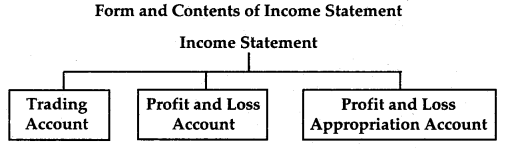
Income Statement may be divided into three components

  1. Trading Account → To show Gross Profit Earned or Gross Loss incurred.
  2. Profit and Loss Account → To show Net Profit earned or Net Loss incurred.
  3. Profit and Loss Appropriation Account → To show all appropriation from the current year and balance of profit or loss of last year and surplus or deficit at the end of the period.

Note: If the company is a manufacturing concern, apart from the above components manufacturing account is also required.

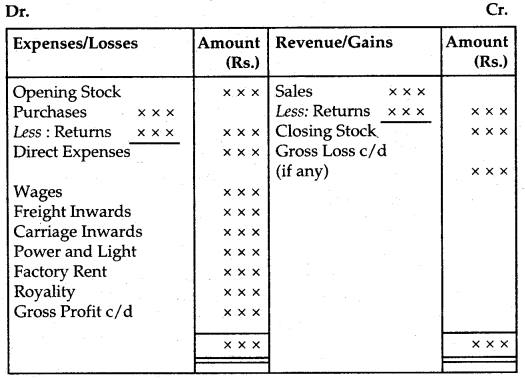
→ Trading Account: Trading Account is the first part of the financial statements. The trading account is designed to show the gross profit on the sale of goods. The trading account contains the transactions of the company relating to the commodities in which it deals, throughout the accounting period.

All expenses either related to purchasing of raw material or production are charged to the Trading A/c i.e. Debited to Trading A/c. It is prepared to find out Gross Profit or Gross Loss. If the sales are more than purchases and expenses the result is Gross Profit and vice versa. Its main components are sales, services rendered and cost of such sales or service rendered. A trading account provides the data for comparison, analysis, and planning for future growth.

Form of Trading Account
Trading Account of…………………. Co. Ltd.
for the year ended……………………..
Financial Statements of a Company Class 12 Notes Accountancy 2
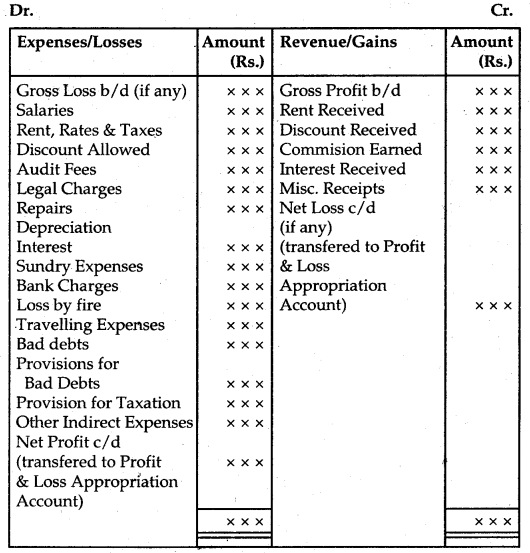
→ Profit and Loss Account: The profit and Loss Account is the second part of the financial statement. The company is more interested in knowing its net income or net profit, which increases its equity. Net profit represents the excess of gross profit plus other revenue income over indirect expenses.

The indirect expenses are not shown in Trading Account. On the debit side of the Profit and Loss Account, the indirect expenses are shown whereas on the credit side revenue incomes. If the debit side is less than of credit side, it would be net profit and if the credit side is less than of debit side it would be a net loss.

“A Profit and Loss account is an account into which all gains and losses are collected in order to ascertain the excess of gain over the losses or vice-versa.” -Prof. Carter

Form of Profit & Loss Account
Profit & Loss Account of………… Co. Ltd.
for the year ended…………………………..
Financial Statements of a Company Class 12 Notes Accountancy 3
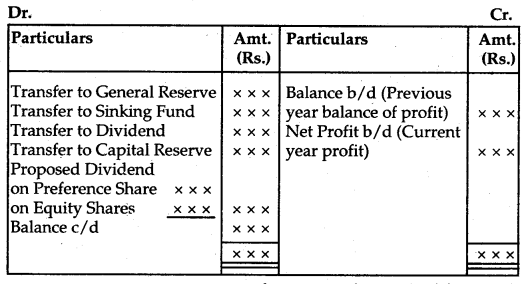
→ Profit and Loss Appropriation Account: The account which shows the disposition of profit is called the Profit and Loss Appropriation Account. The disposition of profit means the distribution of net profits by way of dividends, transfer of profits to various reserves, adjustment of arrears of depreciation, if any, bonus to shareholders, and so on.

Form of Profit and Loss Appropriation Account
Profit and Loss Appropriation Account of…………… Co. Ltd
for the year ending…………………………
Financial Statements of a Company Class 12 Notes Accountancy 4
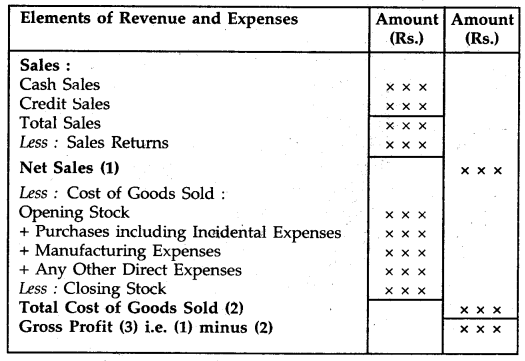
Income statements may also be presented in vertical form with detailed data. Verticle form income statements are suitable for further analysis and providing suitable data for decision making.

Form of Vertical Income Statement
Income Statement of……………………. Co. Ltd.
for the year ending……………………..
Financial Statements of a Company Class 12 Notes Accountancy 5
Financial Statements of a Company Class 12 Notes Accountancy 6
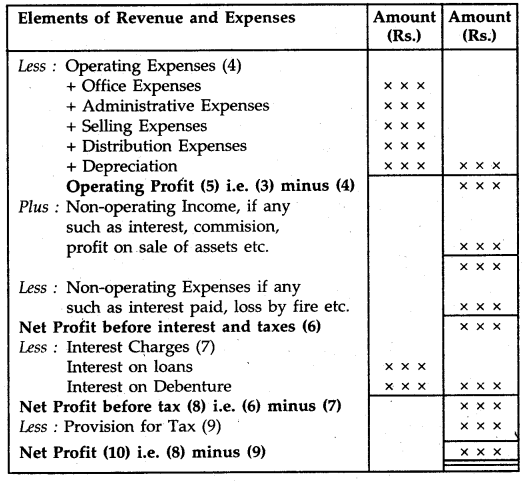
Process for Preparation of Income Statement:
The following process is to be followed for the preparation of the income statement (in T form):

  1. Preparation of trial balance on the basis of balances of all the accounts available in the ledgers of the concern.
  2. Recording all the revenue receipts appearing on the credit side of tire trial balance on the credit side of income statement after making suitable adjustments for revenues received in advance or revenues realized but not received etc.
  3. Recording all the revenue expenditure items that appeared on the debit side of the trial balance on the debit side of the income statement after making adjustments for outstanding, prepaid expenses, depreciation, provisions for bad debts, taxes, etc.
  4. Recording non-operating incomes and gains on the credit side of the income statement.
  5. Recording non-operating losses on the debit side of the income statement.
  6. Finding the difference between totals of credit items and totals of debit items.
  7. If the credit items are more than the debit items, it is known as net profit and vice versa.
  8. In India, the accounting year for preparing financial statements for companies is 1st April to 31st March (same as that of the financial year of the Government).

→ Form and Contents of Balance Sheet: A balance Sheet is a component of a financial statement that shows balances of liabilities, equities, and assets of a business entity as on a particular date. It is prepared with a view to measure the exact financial position of a business on a certain fixed date. It is usually prepared in horizontal T form. The assets are shown on the right-hand side and capital and liabilities are shown on the left-hand side. These can be arranged either on:
(a) Liquidity basis or on
(b) Permanency basis

(a) Liquidity Basis: According to this method an asset that is most easily convertible into cash such as cash in hand is written first and then will follow those assets which are comparatively less easily convertible so that the least liquid assets such as Goodwill are shown last.

In the same way, those liabilities which are to be paid at the earliest will be written first, in other words, current liabilities are written, first of all, then fixed or long-term liabilities, and lastly the equity of the owner.

(b) Permanency Basis: This method is just opposite to the first method. Assets that are most difficult to be converted into cash such as Goodwill are written first and the assets which are most liquid such as cash in hand are written last.

Those liabilities which are to be paid last will be written first. The owner equity is written, first of all, then long-term liabilities, and lastly the current liabilities.

The Companies Act adopted the permanency approach form in the preparation of the balance sheet. The registered companies are required to follow Part I of Schedule VI of the Companies Act, 1956 recording assets and liabilities in the tire balance sheet in a particular order. According to section 211 (i) of the Companies Act, the balance sheet shall be prepared in prescribed format from time to time, depict the true and fair view of financial position, and follow general instructions for the preparation of the balance sheet under the heading notes at the end of that part.

This format is not applicable to Banking and Insurance Companies. These companies follow the formats prescribed by their respective legislation.

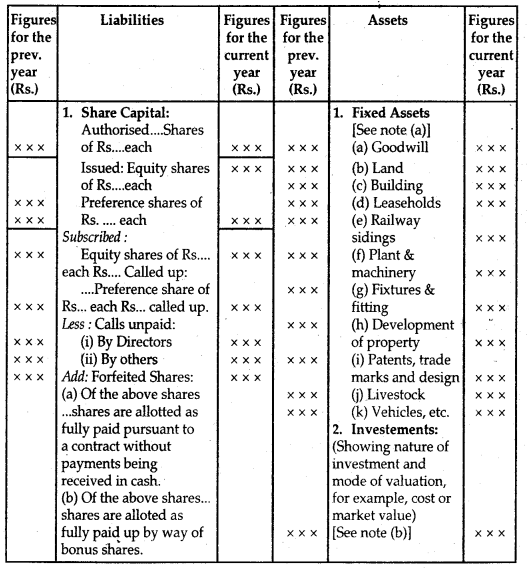
Horizontal Form Of Balance Sheet Schedule Vi, Part I (See Section 211)
A-Horizontal Form Of Balance Sheet Balance Sheet Of ……………………..
(Here enter the name of the company) as on (Here enter the date at which the balance sheet is made out)
Financial Statements of a Company Class 12 Notes Accountancy 7
Financial Statements of a Company Class 12 Notes Accountancy 8
Financial Statements of a Company Class 12 Notes Accountancy 9
Financial Statements of a Company Class 12 Notes Accountancy 10
Notes:
(a) Fixed assets are shown at original cost less total depreciation to date.
(b) Investments should be divided into two parts:

  • Quoted, and
  • unquoted. In the case of quoted investments market price must be disclosed.

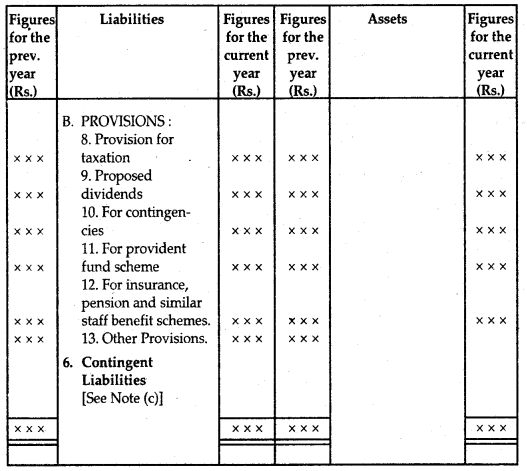
(c) Contingent liabilities are not included in the total of the liability side. Following are the usual types of contingent liabilities:

  1. Claim against the company not acknowledged as debt.
  2. Uncalled liability on shares partly paid.
  3. Arrears of fixed cumulative dividends.
  4. The estimated amount of contracts remaining to be executed on capital account and not provided for, ‘
  5. Other money for which the company is contingently liable.
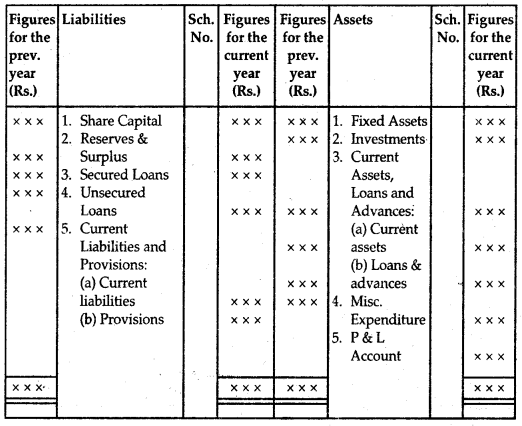
    The Balance Sheet can be prepared in the abridged form also which is shown below:

Abridged Balance Sheet
Form of Balance Sheet (Horizontal Form),
Balance Sheet of ……………..Co. Ltd.
as on……………..
Financial Statements of a Company Class 12 Notes Accountancy 11
Note: A footnote to the Balance sheet may be added to show separately the contingent liabilities.

Vertical Form of Balance Sheet Form of Balance Sheet (Vertical Form)
Balance Sheet of………………….. CO. LTD.
as on…………………….
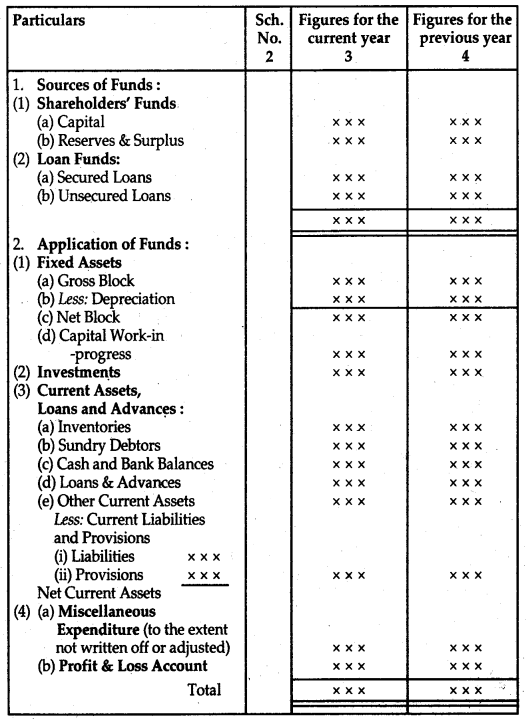
Financial Statements of a Company Class 12 Notes Accountancy 12
Note: Usually detail under each of the above items is given by way of a separate schedule. The number of the schedule incorporating the information is mentioned against the item in the column.

Explanation to Balance Sheet Items
Statutory Contents of Liabilities Side of Company’s Balance Sheet
1. Share Capital: It is the first item on the liabilities side of the balance sheet and shows details about the following:

  1. Authorized Capital
  2. Issued Capital
  3. Subscribed Capital.
  4. Called up Capital
  5. Paid-up Capital

In terms of the number of shares of each kind along with the nominal value. If forfeited shares are reissued then this amount is added to the paid-up capital.

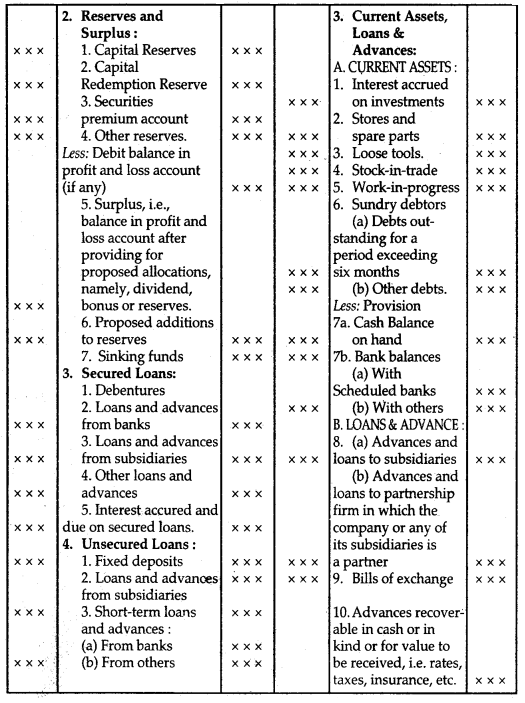
2. Reserves and Surplus: As per Schedule VI to the Companies Act, 1956, ‘Reserves and Surplus’ includes the following items:

  1. Capital Reserves
  2. Capital Redemption Reserves
  3. Share Premium Account or Securities Premium
  4. Other reserves
  5. Surplus
  6. Proposed Addition to reserves
  7. Sinking fund

These reserves may be classified broadly as revenue and capital reserves.

3. Secured Loans: If any company given security for the loan by a mortgage or charge on all or any of its property, the loan will be called ‘Secured Loans’. It includes:

  1. Debentures
  2. Loans and Advances from Banks
  3. Loans and Advances from subsidiaries
  4. Other Loans and Advances if any

Information regarding the nature of security given for each secured loan should be given along with the respective loans.

4. Unsecured Loans: Loans and advances for which no security is given are shown under this heading. This include:

  1. Fixed deposits
  2. Loans and Advances from Subsidiary Companies
  3. Loans and Advances from other sources.
  4. Short-term loans from banks and others.

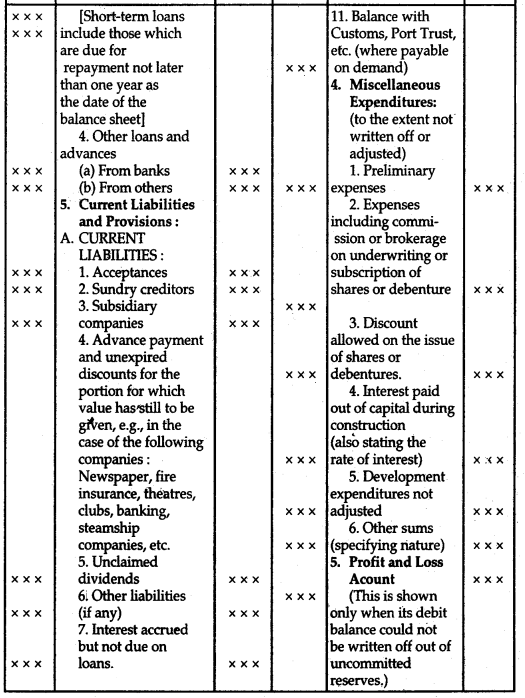
5. Current Liabilities and Provisions: Current Liabilities include:

  1. Acceptances (or Bills Payable)
  2. Sundry Creditors
  3. Advance Payments
  4. Un-expired Discounts
  5. Unclaimed dividends
  6. Accrued Interest but not paid
  7. Other liability (if any)

Provisions include:

  1. Provisions for taxation
  2. Proposed Dividend
  3. Provisions for Contingencies
  4. Provision for provident fund
  5. Provision for Pension
  6. Provision for Insurance
  7. Similar staff benefit schemes etc.
  8. Other provisions

Statutory Contents of Assets Side of Company’s Balance Sheet 1. Fixed Assets: These are those assets that are used for a long time in business to earn profit. They are acquired with an intention of using them in the main activity of the concern but not for resale.

It includes:

  • Goodwill
  • Land and Building
  • Leaseholds
  • Plant and Machinery
  • Furniture
  • Railway Lines
  • Patents etc.

These assets are shown at cost less depreciation till the date.

2. Investments: It includes

  1. Investment in Government Securities
  2. Investment in Trust securities
  3. In shares, debentures, bonds, etc.
  4. Investment in immovable property etc.

3. Current Assets, Loans, and Advances: Current Assets includes:

  1. Inventories
  2. Sundry Debtors
  3. Cash and Bank Balances
  4. Loose Tools
  5. Accrued Interest

Loans and Advances include:

  1. Loans and Advances to Subsidiary Company
  2. Bills of Exchange
  3. Balance with customs, port trust, etc.

4. Miscellaneous Expenditure: Expenditure, which is not debited to Profit and Loss Account fully and deferred for some years, is shown under this heading.

It includes:

  1. Preliminary Expenses
  2. Advertisement Expenditure
  3. Discount on issue of shares and debenture etc.

5. Profit and Loss Account: If there is any debit balance in the Profit and Loss Account, it will be shown as the assets side of the Balance Sheet.

Human Reproductive Gametogenesis

Learninsta presents the core concepts of Biology with high-quality research papers and topical review articles.

Human Reproductive Gametogenesis

Gametogenesis is the process of formation of gametes i.e., sperms and ovary from the primary sex organs in all sexually reproducing organisms. Meiosis plays the most significant role in the process of gametogenesis (Fig. 2.5).
Human Reproductive Gametogenesis img 1

Spermatogenesis

Spermatogenesis is the sequence of events in the seminiferous tubules of the testes that produce the male gametes, the sperms. During development, the primordial germ cells migrate into the testes and become immature germ cells called sperm mother cells or spermatogonia in the inner surfaces of the seminiferous tubules (Fig. 2.6 a).
Human Reproductive Gametogenesis img 2

The spermatogonia begin to undergo mitotic division at puberty and continue throughout life. In the first stage of spermatogenesis, the spermatogonia migrate among sertoli cells towards the central lumen of the seminiferous tubule and become modified and enlarged to form primary spermatocytes which are diploid with 23 pairs i.e., 46 chromosomes.

Some of the primary spermatocytes undergo first meiotic division to form two secondary spermatocytes which are haploid with 23 chromosomes each. The secondary spermatocytes undergo second meiotic division to produce four haploid spermatids. The spermatids are transformed into mature spermatozoa (sperms) by the process called spermiogenesis. Sperms are finally released into the cavity of seminiferous tubules by a process called spermiation.

The whole process of spermatogenesis takes about 64 days. At any given time, different regions of the seminiferous tubules contain spermatocytes in different stages of development (Fig. 2.6 b). The sperm production remains nearly constant at a rate of about 200 million sperms per day.
Human Reproductive Gametogenesis img 3

Spermatogenesis starts at the age of puberty and is initiated due to the increase in the release of Gonadotropin Releasing Hormone (GnRH) by the hypothalamus. GnRH acts on the anterior pituitary gland and stimulates the secretion of two gonadotropins namely Follicle Stimulating Hormone (FSH) and Lutenizing Hormone (LH).

FSH stimulates testicular growth and enhances the production of Androgen Binding Protein (ABP) by the sertoli cells and helps in the process of spermiogenesis. LH acts on the Leydig cells and stimulates the synthesis of testosterone which in turn stimulates the process of spermatogenesis.

Structure of human spermatozoan The human sperm is a microscopic, flagellated and motile gamete (Fig. 2.7). The whole body of the sperm is enveloped by plasma membrane and is composed of a head, neck and a tail. The head comprises of two parts namely acrosome and nucleus.

Acrosome is a small cap like pointed structure present at the tip of the nucleus and is formed mainly from the Golgi body of the spermatid. It contains hyaluronidase, a proteolytic enzyme, popularly known as sperm lysin which helps to penetrate the ovum during Fertilization. The nucleus is flat and oval. The neck is very short and is present between the head and the middle piece.

It contains the proximal centriole towards the nucleus which plays a role in the first division of the zygote and the distal centriole gives rise to the axial filament of the sperm. The middle piece possesses mitochondria spirally twisted around the axial filament called mitochondrial spiral or nebenkern. It produces energy in the form of ATP molecules for the movement of sperms. The tail is the longest part of the sperm and is slender and tapering.

It is formed of a central axial filament or axoneme and an outer protoplasmic sheath. The lashing movements of the tail push the sperm forward. The human male ejaculates about 200 to 300 million sperms during coitus. It is estimated that around 60 percent of sperms must have normal shape of which at least 40 per cent must show vigorous motility for normal fertility.
Human Reproductive Gametogenesis img 4

Oogenesis

Oogenesis is the process of development of the female gamete or ovum or egg in the ovaries. During foetal development, certain cells in the germinal epithelium of the foetal ovary divide by mitosis and produce millions of egg mother cells or oogonia.

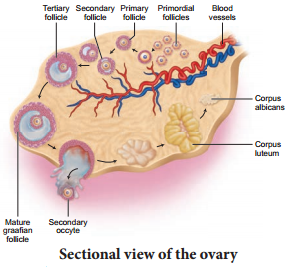
No more oogonia are formed or added after birth. The oogonial cells start dividing and enter into Prophase I of meiotic division I to form the primary oocytes which are temporarily arrested at this stage. The primary oocytes then get surrounded by a single layer of granulosa cells to form the primordial or primary follicles (Fig. 2.8 a). A large number of follicles degenerate during the period from birth to puberty, so at puberty only
60,000 to 80,000 follicles are lef in each ovary.
Human Reproductive Gametogenesis img 5

The primary follicle gets surrounded by many layers of granulosa cells and a new theca layer to form the secondary follicle. A fluid filed space, the antrum develops in the follicle and gets transformed into a tertiary follicle. The theca layer gets organized into an inner theca interna and an outer theca externa. At this time, the primary oocyte within the tertiary follicle grows in size and completes its first meiotic division and forms the secondary oocyte.

It is an unequal division resulting in the formation of a large haploid secondary oocyte and a first polar body. The first polar body disintegrates. During Fertilization, the secondary oocyte undergoes second meiotic
division and produces a large cell, the ovum and a second polar body.

The second polar body also degenerates. The tertiary follicle eventually becomes a mature follicle or Graafin follicle. If Fertilization does not take place, second meiotic division is never completed and the egg disintegrates. At the end of gametogenesis in females, each primary oocyte gives rise to only one haploid ovum.

Structure of ovum

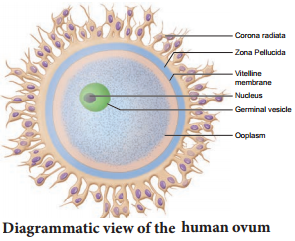
Human ovum is non-cleidoic, alecithal and microscopic in nature. (Fig. 2.8 (b)). Its cytoplasm called ooplasm contains a large nucleus called the germinal vesicle. The ovum is surrounded by three coverings namely an inner thin transparent vitelline membrane, middle thick zona pellucida and outer thick coat of follicular cells called corona radiata. Between the vitelline membrane and zona pellucida is a narrow perivitelline space.
Human Reproductive Gametogenesis img 6

Human Reproductive System

Learninsta presents the core concepts of Biology with high-quality research papers and topical review articles.

Human Reproductive System

These functions are carried out by the primary and accessory reproductive organs. The primary reproductive organs namely the ovary and testis are responsible for producing the ova and sperms respectively.

Hormones secreted by the pituitary gland and the gonads help in the development of the secondary sexual characteristics, maturation of the reproductive system and regulation of normal functioning of the reproductive system. The accessory organs help in transport and to sustain the gametes and to nurture the developing offspring.

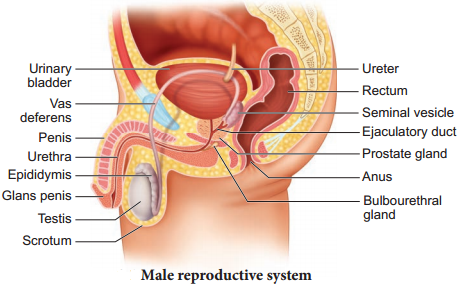
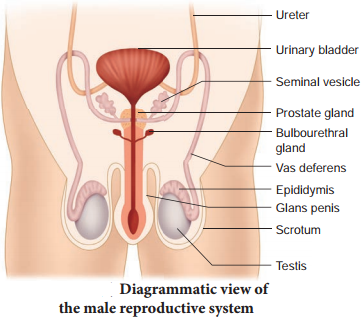
The male reproductive system comprises of a pair of testes, accessory ducts, glands and external genitalia (Fig. 2.1).
Human Reproductive System img 1

Testes are the primary male sex organs. They are a pair of ovoid bodies lying in the scrotum (Fig. 2.2 a). The scrotum is a sac of skin that hangs outside the abdominal cavity. Since viable sperms cannot be produced at normal body temperature, the scrotum is placed outside the abdominal cavity to provide a temperature 2-3°C lower than the normal internal body temperature. Thus, the scrotum acts as a thermoregulator for spermatogenesis.
Human Reproductive System img 2

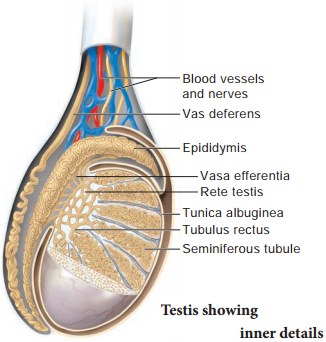
Each testis is covered by an outermost fibrous tunica albuginea and is divided by septa into about 200 – 250 lobules each containing 2-4 highly coiled testicular tubules or seminiferous tubules. These highly convoluted tubules which form 80 percent of the testicular substance are the sites for sperm production.

The stratified epithelium of the seminiferous tubule is made of two types of cells namely sertoli cells or nurse cells and spermatogonic cells or male germ cells. Sertoli cells are elongated and pyramidal and provide nourishment to the sperms till maturation. They also secrete inhibin, a hormone which is involved in the negative feedback control of sperm production. Spermatogonic cells divide meiotically and differentiate to produce spermatozoa.

Interstitial cells or Leydig cells are embedded in the soft connective tissue surrounding the seminiferous tubules. These cells are endocrine in nature and secrete androgens namely the testosterone hormone which initiates the process of spermatogenesis. These cells are endocrine in nature and are characteristic features of the testes of mammals. Other immunologically competent cells are also present.

The accessory ducts associated with the male reproductive system include rete testis, vasa efferentia, epididymis and vas deferens (Fig. 2.2 b). The seminiferous tubules of each lobule converge to form a tubulus rectus that conveys the sperms into the rete testis.

The rete testis is a tubular network on the posterior side of the testis. The sperms leave the rete testis and enter the epididymis through the vasa efferentia. The epididymis is a single highly coiled tube that temporarily stores the spermatozoa and they undergo physiological maturation and acquire increased motility and fertilizing capacity.

The epididymis leads to the vas deferens and joins the duct of the seminal vesicle to form the ejaculatory duct which passes through the prostate and opens into the urethra. The urethra is the terminal portion of the male reproductive system and is used to convey both urine and semen at different times. It originates from the urinary bladder and extends through the penis by an external opening called urethral meatus.

The accessory glands of the male reproductive system include the paired seminal vesicles and bulbourethral glands also called Cowper’s gland and a single prostate gland. The seminal vesicles secrete an alkaline flied called seminal plasma containing fructose sugar, ascorbic acid, prostaglandins and a coagulating enzyme called vesiculase which enhances sperm motility. The bulbourethral glands are inferior to the prostate and their secretions also help in the lubrication of the penis.

The prostate encircles the urethra and is just below the urinary bladder and secretes a slightly acidic fluid that contains citrate, several enzymes and prostate specifi antigens. Semen or seminal fluid is a milky white fluid which contains sperms and the seminal plasma (secreted from the seminal vesicles, prostate gland and the bulbourethal glands). The seminal fluid acts as a transport medium, provides nutrients, contains chemicals that protect and activate the sperms and also facilitate their movement.
Human Reproductive System img 3

The penis is the male external genitalia functioning as a copulatory organ. It is made of a special tissue that helps in the erection of penis to facilitate insemination. The enlarged end of the penis called glans penis is covered by a loose fold of skin called foreskin or prepuce.

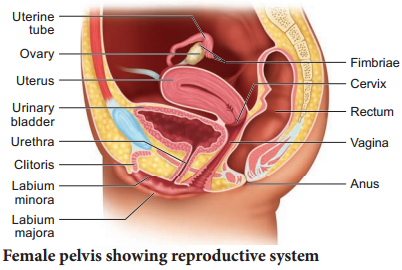
The female reproductive system is far more complex than the male because in addition to gamete formation, it has to nurture the developing foetus. The female reproductive system consists of a pair of ovaries along with a pair of oviducts, uterus, cervix, vagina and the external genitalia located in the pelvic region (Fig. 2.3 a). These parts along with the mammary glands are integrated structurally and functionally to support the process of ovulation, Fertilization, pregnancy, child birth and child care.

Ovaries are the primary female sex organs that produce the female gamete, ovum. The ovaries are located one on each side of the lower abdomen. The ovary is an elliptical structure about 2-4 cm long. Each ovary is covered by a thin cuboidal epithelium called the germinal epithelium which encloses the ovarian stroma.

The stroma is diffrentiated as the outer cortex and inner medulla. Below the germinal epithelium is a dense connective tissue, the tunica albuginea. The cortex appears dense and granular due to the presence of ovarian follicles in various stages of development. The medulla is a loose connective tissue with abundant blood vessels, lymphatic vessels and nerve fires. The ovary remains attached to the pelvic wall and the uterus by an ovarian ligament called mesovarium.

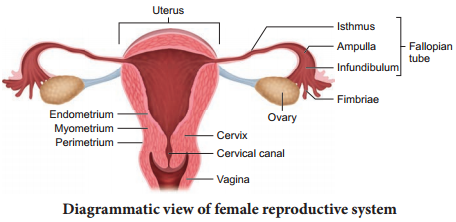
The fallopian tubes (uterine tubes or oviducts), uterus and vagina constitute the female accessory organs (Fig. 2.3 b). Each fallopian tube extends from the periphery of each ovary to the uterus. The proximal part of the fallopian tube bears a funnel shaped infundibulum.

The edges of the infundibulum have many finger like projections called fimbriae which help in collection of the ovum after ovulation. The infundibulum leads to a wider central portion called ampulla. The last part of the oviduct is the isthmus which is short and thick walled connecting the ampulla and infundibulum to the uterus.
Human Reproductive System img 5

The uterus or womb is a hollow, thick-walled, muscular, highly vascular and inverted pear shaped structure lying in the pelvic cavity between the urinary bladder and rectum. The major portion of the uterus is the body and the rounded region superior to it, is the fundus.

The uterus opens into the vagina through a narrow cervix. The cavity of the cervix called the cervical canal communicates with the vagina through the external orifie and with the uterus through the internal orifie. The cervical canal along with vagina forms the birth canal.

The wall of the uterus has three layers of tissues. The outermost thin membranous serous layer called the perimetrium, the middle thick muscular layer called myometrium and the inner glandular layer called endometrium. The endometrium undergoes cyclic changes during the menstrual cycle while myometrium exhibits strong contractions during parturition.

Vagina is a large fibromuscular tube that extends from the cervix to the exterior. It is the female organ of copulation. The female reproductive structures that lie external to the vagina are called as the external genitalia or vulva comprising of labia majora, labia minora, hymen and clitoris.

The Bartholin’s glands (also called greater vestibular glands) are located posterior to the left and right of the opening of the vagina. They secrete mucus to lubricate the vagina and are homologous to the bulbourethral glands of the male. The Skene’s glands are located on the anterior wall of the vagina and around the lower end of the urethra. They secrete a lubricating fluid and are homologous to the prostate gland of the males.

The external opening of the vagina is partially closed by a thin ring of tissue called the hymen. The hymen is often torn during the first coitus (physical union). However in some women it remains intact. It can be stretched or torn due to a sudden fall or jolt and also during strenuous physical activities such as cycling, horseback riding, etc., and therefore cannot be considered as an indicator of a woman’s virginity.

The mammary glands are modified sweat glands present in both sexes. It is rudimentary in the males and functional in the females. A pair of mammary glands is located in the thoracic region. It contains glandular tissue and variable quantities of fat with a median nipple surrounded by a pigmented area called the areola. Several sebaceous glands called the areolar glands are found on the surface and they reduce cracking of the skin of the nipple.

Internally each mammary gland consists of 2-25 lobes, separated by fat and connective tissues (Fig. 2.4). Each lobe is made up of lobules which contain acini or alveoli lined by epithelial cells. Cells of the alveoli secrete milk. The alveoli open into mammary tubules.

The tubules of each lobe join to form a mammary duct. Several mammary ducts join to form a wider mammary ampulla which is connected to the lactiferous duct in the nipple. Under the nipple, each lactiferous duct expands to form the lactiferous sinus which serves as a reservoir of milk. Each lactiferous duct opens separately by a minute pore on the surface of the nipple.
Human Reproductive System img 6

Normal development of the breast begins at puberty and progresses with changes during each menstrual cycle. In non-pregnant women, the glandular structure is largely underdeveloped and the breast size is largely due to amount of fat deposits. The size of the breast does not have an influence on the efficiency of lactation.