
Note Making Class 11 CBSE Format, Examples

Note Making Class 11

Note-making is an advanced writing skill which is gaining importance due to knowledge explosion. There is a need to remember at least the main points of any given subject. Making notes is a complex activity which combines several skills.

This grammar section explains English Grammar in a clear and simple way. There are example sentences to show how the language is used.

Students can also read NCERT Solutions for Class 11 English to get good marks in CBSE Board Exams.

Note Making Class 11 CBSE Format, Examples

I. How to make notes:

1. Read the passage carefully.

2. Give a heading to your work. The heading will be based on the following considerations.
(i) What is the main idea of the passage?
(ii) Frame a heading based on the main idea.
(iii) Write it in the middle of the page.

3. Give subheadings
(i) How has the main idea been presented and developed?
(ii) Are there two or three subordinate/associated ideas?
(iii) Frame subheadings based on these.

4. Points are to be noted under each subheading.

Are there further details or points of the subtitles that you wish to keep in these notes? These are called points. Points may have subpoints.

5. All subheadings should be at a uniform distance from the margin.
6. Indenting – Points should also be at the same distance away from the margin.
7. Do not write complete sentences.
8. Abbreviations should be used.

II. Help with abbreviations:

1. Use standard abbreviations and symbols as far as possible.

(i) Capitalise the first letters of the names of states, countries or organisations.
For example: UP, USA, UK and UNO.

(ii) Common abbreviations
Sc. (for science), Mr, Mrs, Dr, govt, BSc, etc.

(iii) Common symbols such as i.e., e.g., Rx, /, ∴ , +ve, -ve, → (leading to) ↑ (rising), ↓ (falling), =, >, <

(iv) Measurements and figures – 100″, 100′, 100 kg, 100 mm, 100 mL.

2. Make your own abbreviations.

(i) Keep the main sounds of the words: edn (education), progm. (programme).
(ii) It is a good practice to keep the first few and the last letters of the word such as education – edu’n, developing – dev’ing. Retain the suffix so that later when you are going over the notes, you may recall the full form of the word, for example: ed’nal (educational), prog’ve (progressive).

3. Take the following caution:

(i) Do not get overenthusiastic about abbreviations.
(ii) You should not abbreviate every word.
(iii) One abbreviation in one point is enough.
(iv) As a general rule, the heading should not be abbreviated.
(v) You may use abbreviations in subheadings.

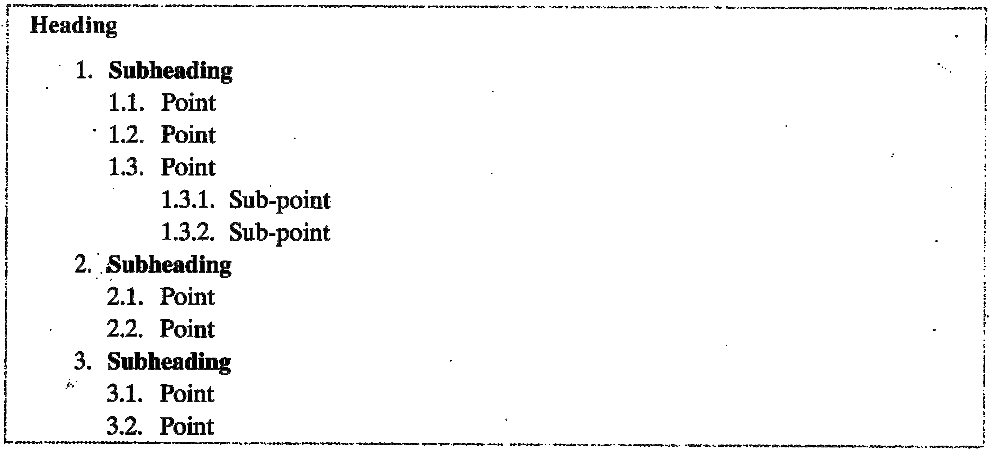
III. Your notes should look like this:

(i) Indenting is essential.
Note Making Class 11 1
Notice that indenting, i.e. shifting from the margin, has been used to clearly indicate subheadings, points and subpoints. Subheadings, though separated by points, occur below one another. Similarly, points and subpoints should also come below one another. Such use of indenting gives your notes a visual character. At a glance, you can see the main idea and its various aspects.

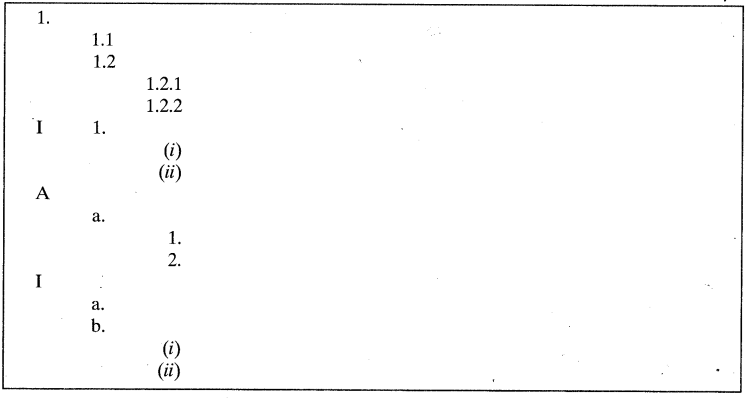
(ii) Numbering-You may follow any system but you should be consistent, that is, you should follow the same system throughout. Some examples are given below.
Note Making Class 11 2

IV. Abbreviations:

Note-making is an informal exercise as it is meant for your use only. You will not present a formal document in note form. Notes will be developed into a more formal piece of writing. Since notes are informal and are meant for your use only, you can abbreviate long words or use accepted abbreviations and symbols.

Writing a summary: The summary is an abstract of the passage. Expand your heading and subheadings and write down the ideas developed in the passage in the specified word limit.

1. Read the passage given below and answer the questions that follow: [NCT 2018]

1. Flexibility and mobility are essential not only to reduce the risk of injuries but to generally feel better. Living a nine to five desk life can be demanding on health and wellness. Here is how you can keep the most common problems at bay.

2. Even if you are not exercising you need to make sure that you maintain correct posture and sit at your desk in the right way. It is important that your chair is placed correctly and your legs are not left hanging. Proper alignment ensures that your neck and back are not strained. Exercises and abdominal crunches two to three times a week can strengthen the core. It will help take the pressure off your back and will make it easier to maintain good posture. Chairs with a back that support your upper back are preferable for those who work long hours in front of screens.

3. Constant typing, writing reports, and answering e-mails can exert your wrists leading to long-term damage. The frequency of your use and how you position your wrists at your keyboard can be a reason. The telltale signs of exertion would be a tingling sensation or numbness. One should not ignore initial signs. Make sure that you rest your wrist at regular intervals. To relieve tension quickly fold your hands in a NAMASTE in front of your chest with elbows moving out and lower your hands till you feel a good stretch in your wrists. Also rotating your fists inside and outside provides much relief to strained wrists.

4. Since those who work on desks spend a lot of time looking at a computer screen, they are at a risk of straining their eyes. This may also lead to dry eyes and fatigue. Poor eyesight is the result of continued and improper exposure to screens. Keeping the computer screen at an optimal distance helps a lot in minimising strain to eyes. The screen shouldn’t be too close or too far. To ease eye strain use good lighting and make it a point to look at a distance away from your screen every twenty to thirty minutes.

(a) On the basis of your reading of the above passage make notes on it using headings and subheadings.
Use recognisable abbreviations and a format you consider suitable. Also, supply a title to it.
(b) Write a summary of the passage in not more than 80 words using the notes made.
Answer:
(a) Health and Wellness for Desk users

1. Correct posture

1.1 Place chair correctly for neck and back
1.2 Don’t hang legs
1.3 Excises & abdominal crunches
1.4 Choose chairs with support from upper back

2. Maintaining wrist flexibility

2.1 Wrong position can cause wrist damage, cause tingling
2.2. Relax wrists reg’ly in Namaste position and stretch
2.3 Rotate wrists inside and outside.

3. Preventing eye strain

3.1 Eye strain can cause dry eyes and fatigue
3.2 Keep computer screen at an optimal distance to prevent poor eyesight
3.3 Use good light’g
3.4 Look at a distant spot every 20-30 minutes.

Key to the Abbreviations Used

1. corr’ly – correctly
2. ex’cises – exercises
3. abdom’l – abdominal
4. damg – damage
5. reg’ly – regularly
6. light’g – lighting

(b) Summary

Desk users are at risk of losing flexibility, mobility, and wellness due to long working hours. Good selection of office chairs and proper posture are essential for neck and back health. Damage to the wrists can be prevented by exercising them frequently. Eyes too are at a risk due to looking at the computer screen for long. Optimal distance from the screen will prevent fatigue, dry eyes and poor vision. Good lighting is essential. One should look away from the screen every 20-30 minutes.

2. Read the passage given below and answer the questions that follow: [NCT 2017]

1. Jahangir was born on 30 August 1569, to Akbar, the Mughal Emperor, and his Hindu wife, Jodha Bai. He was crowned on 24 October 1605. In the twenty-two years, he was Emperor, till his death on 28 October 1627, he had many battles to fight and many rebellions to suppress. But he always found time for his greatest hobby-the study of animals and plants. He was an avid bird watcher or an ornithologist as he would be called now, and a keen naturalist. The care and accuracy with which Jahangir described various characteristics of animals and birds, their geographical distribution and behaviour, would have done credit to a full-time naturalist. His observations are recorded in his memoirs, the Tuzuk-i-Jahangiri.

2. Jahangir had a small zoo and he would spend hours-sometimes days and nights together-on his observations. For the first time in the history- of ornithology, he noted how sarus cranes mate brood over their eggs in turn, and how chicks are hatched and taken care of. He also observed one human quality in this bird: the parents love not only their eggs and chicks but also each other.

3. The Emperor had several famous painters in his court. When he came across a rare animal, bird or plant, he would instruct an artist to draw it. The painter who excelled in this art was Ustad Mansur. For modern ornithologists, Jahangir’s collection of paintings provides a strikingly accurate description of the natural history of the day. Unfortunately, most of these paintings are no longer to be found in India. With the disintegration of the Mughal Empire, foreign adventures looted this treasure. Most of the paintings were thus lost.

4. In 1958, a Russian researcher, A Ivanoc, created a sensation when he discovered, a rare portrait of the dodo, a large non-flying pigeon-like bird, which became extinct about three centuries ago. This portrait was found in a collection of paintings at the Institute of Orientalists of Soviet Academy of Sciences. There was no way of identifying the painter, but the style, without doubt was that of Ustad Mansur. Now there is evidence to show that it was the portrait of Mauritian dodo that was presented to Emperor Jahangir around 1624. Over three centuries after their death, Jahangir and his dodo made a dramatic reappearance in the world of ornithology!

5. Jahangir also loved gardens, but his dissertations in botany and horticulture were mostly confined to how a lotus traps hornets or how saffron sprouts from soil. However, he was responsible for the cultivation of high altitude trees such as the cypress, juniper, pine and Javanse sandal in plains.

6. Jahangir had many other scientific interests. He once conducted an experiment to show that the air of Mahmudabad (in Gujrat) was healthier than that of Ahmedabad. He was fascinated by the movement of the stars and the planets and used to regularly record the occurrence of solar and lunar eclipses. When a comet made its appearance, he recorded the growth and decay of its tail.

(a) On the basis of your reading of the above passage, make notes on it in points. Also, suggest a suitable title.
(b) Write a summary of the passage in not more than 80 words using the notes made.
Answer:
(a) Emperor Jahangir: The Naturalist

1. An ornithologist & animal enthusiast
(i) described ch’stics distribution & behaviour of animals & birds
(ii) had a private zoo – observed sarus cranes’ behaviour as families

2. Documentation of observations
(i) rare animals, birds, plants were painted by skilled artists-Ustad Mansur, outstanding artist
(ii) recorded observations in autobiography ‘Tuzuk-i-Jahangir i’
(iii) Mughal paintings looted by foreign adven’rs.
(iv) Portrait of Mauritian Dodo (presented to Emperor Jahangir in 1624) found by Russian researcher A. Ivanoc in 1958

3. Other sci’fic interests

(i) wrote dissertations on botany, horticulture
(ii) cultiv’n of high altitude trees in plains
(iii) expts on air
(iv) movem’t of stars & planets, eclipses & comets

Key to abbreviations:

ch’stics – characteristics
adven’rs – adventurers
sc’fic – scientific
cultiv’n – cultivation
expts – experiments
move’mt – movement

(b) Summary

Emperor Jahangir was a keen naturalist. He loved to observe birds and animals and had the rare ones painted by skilled artists like Ustad Mansur. A portrait of an extinct Maurition Dodo was discovered by A. Ivanoc, a Russian researcher.

Jahangir had a small zoo, where he observed birds and animals, particularly sarus crane. He noted his observations on the behaviour and geographical distribution in his autobiography Tuzuk-i-Jahangiri.

Besides, he had an interest in horticulture, stars and planets, eclipses, and even in the purity of air in various cities.

3. Read the passage given below and answer the questions that follow: [NCT 2016]

Effective speaking depends on effective listening. It takes energy to concentrate on hearing and to concentrate on understanding what has been heard. Incompetent listeners fail in a number of ways. First, they may drift. Their attention drifts from what the speaker is saying. Second, they may counter. They find counter-arguments to whatever a speaker may be saying. Third, they compete. Then, they filter. They exclude from their understanding those parts of the message which do not readily fit with their own frame of reference. Finally, they react. They let personal feelings about the speaker or subject overside the significance of the message which is being sent.

What can a listener do to be more effective. The first key to effective listening is the art of concentration. If a listener positively wishes to concentrate on receiving a message, his chances of success are high!

It may need determination. Some speakers are difficult to follow either because of voice problems or because of the form in which they send a message. There is then a particular need for the determination of a listener to concentrate on what is being said.

Concentration is helped by alertness. Mental alertness is helped by physical alertness. It is not simply physical fitness but also positioning of the body, the limbs, and the head. Some people also find it helpful to their concentration if they hold the head slightly to one side. One useful way for achieving this is intensive notetaking, by trying to capture the critical headings and subheadings the speaker is referring to.

Note-taking has been recommended as an aid to the listener. It also helps the speaker. It gives him confidence when he sees that listeners are sufficiently interested to take notes, the patterns of eye contact when the note taker looks up can be very positive; and the speaker’s timing is aided he can see when a note-taker is writing hard and can then make effective use of pauses.

Posture too is important. Consider the impact made by a less competent listener who pushes his chair backward and slouches. An upright posture helps a listener’s concentration. At the same time, it is seen by the speaker to be a positive feature amongst his listeners. Effective listening skills . have an impact on both the listener and the speaker.

(a) On the basis of your reading of the above passage make notes on it using headings and subheadings. Use recognizable abbreviations wherever necessary and also suggest a suitable title.
(b) Write a summary of the passage in not more than 80 words using the notes.

Answer:
(a) Effective Listening Leads to Effective Speaking

1. Incompetent listening

(a) attention drifts
(b) lis’nr counters arguments and competes
(i) filters msgs
(ii) reacts to the msg

2. How to listen effectively

(a) concentration is needed
(i) alertness helps in concentration
(ii) physical fitness → mental alertness

(b) Note-tkg aids effective listening
(i) lis’nr tries to capture the main pts
(ii) note-tkg helps the spkr too

(c) Determination is needed to
(i) overcome voice and other pecul iarities
(ii) decipher the form of the msg

(d) Posture helps
(i) upright posture of lis’nr helps in concentration
(ii) helps the spkr

3. Conclusion

Effective listening impacts the lis’nr and the spkr

Key to abbreviations:

lis’nr – listener
msg – message
tkg – taking
pts – points
spkr – speaker

(b) Summary:

Good listening can aid the speaker and can lead to good speaking. Incompetent listeners disturb good speaking by countering the speaker or by competing with him.

For good listening concentration on receiving the message is needed. Determination to receive the message, mental alertness, and good posture help. Taking notes is also an aid to concentration and good listening.

Good listening helps the speaker through eye contact. An attentive posture of the listener increases the speaker’s confidence.

4. Read the passage carefully and answer the questions that follow: [NCT 2015]

1. Twenty-one-year-old Jyoti Amge, the smallest woman in the world, laughs easily and often. Perhaps, from a height of twenty-three inches, the world does look a bit funny.

Afflicted with achondroplasia, a form of pituitary dwarfism, 21-year-old Amge is a bit shorter than her two-year-old nephew and a lad taller than her framed Guinness certificate. In fact, Amge, the youngest of five, wasn’t even visible in her mother’s womb. The doctors thought she wasn’t alive and her mother Ranjana, who underwent a two-hour caesarian operation in her tenth month to birth her, welcomed her youngest as a blessing. In all of Amge’s birthday pictures in the album, her height is the same from age three to twenty-one. Kitted out in custom made frocks and bright red lipstick; with fancy beads lining her permed hair, the tiny Amge turned heads in Nagpur and became a hit with Hindi news channel crews that approached her for bytes, any excuse would do, even the elections. Apart from a cameo in a Mika Singh video, she appeared briefly on the reality show Big Boss 6.

“I have always wanted to be an actor,” says Amge. Amge was quick to say yes when the producers of ‘American Horror Story’ Freak Show contacted her. “They had seen my interview in a New York daily,” says Amge, who readily agreed to play the role of Ma Petite, the miniature sari- and-bindi-clad assistant of a woman.

“In spite of the name the show was not about freaks it was about compassion,” says Amge. “What makes the world so interesting in that we are different and some folks a little bit odd,” she said. Sadly, Amge’s own home country does not seem to respect differences. Amge’s brother complained that unlike the West where “people ask permission before clicking a photo,” Indians take her privacy for granted. People look at her like she’s a wonder, an ajooba and try to get too close to her. I have to shelter her like a body guard, adds Satish.

Amge’s family members now make up her entourage. They help Amge, who suffered an accident in Kashmir that severely fractured her left leg, with everything from braiding her hair to carrying her to the washbasin. Be it the nearby mall or a trip to China, one or more of them always accompany her.

(a) On the basis of your reading make notes on the above passage. Using abbreviations where necessary. Give a suitable title to your notes.
(b) Write the summary of the passage in your words. Don’t forget to write the title.

Answer:
(a) 1. Jyoti Amge: The smallest woman in the world.
(i) only 23″ tall at 21 years of age
(ii) dwarf due to achondroplasia
(iii) was not visible in her mother’s womb
(iv) same ht from 3 to 21 years.

2. Media exposure
(i) Jyoti a hit on a Hindi news chnl in Nagpur
(ii) cameo in a Mika Singh video and Big Boss 6
(iii) ‘American Horror Story’ a Freak Show of the US

3. No respect for privacy in Ind
(i) Ppl stare at her
(ii) Fml has to shelter her or accompany her.

Key to abbreviations:

ht – height
chnl – channel
Ind – India
ppl – people
fml – family

(b) Jyoti Amge: The Smallest Woman in the World

Jyoti Amge is twenty-one years old and only 23” tall. She is the world’s smallest woman. She did not gain height after three years of age due to achondroplasia. Jyoti caught the attention of a Hindi news channel in Nagpur. She featured briefly on a Mika Singh’s video and the reality show Big Boss 6. She played a role in the American Freak Show named American Horror
Story.

In India, however, Jyoti’s privacy is not respected. Her family remains close to her in order
to protect her.

5. Read the passage given below and answer the questions that follow: [NCT 2014]

1. Everyone needs a holiday, both to relax and to have a change of environment. The holidaymakers feel relaxed and refreshed at the end of the holiday and look forward to the resumption of their duties, be it at school, office, or factories, with renewed vigour. This is the reason why all establishments grant their employees annual leave. With the end of the academic year, the schools and universities grant their pupils a long holiday during mid-summer. This lasts until early September when the new school term starts. Of course, the parents will like to take advantage of this and take their leave to coincide with the children’s vacations. This has become a traditional holiday season in most European countries, particularly in England.

With the coming of August, the traditional holiday season in Britain reaches its peak point and most of the holiday resorts are packed to capacity. In order to avoid the crowd, some prefer to take their holiday a little earlier if facilities so warrant. Those who have already taken their holidays can console themselves not only with reflections on the happy days spent in the country, at the seaside or abroad but also with the thought that holiday expenses are over for the year and that by taking an earlier holiday they have missed the August rush.

The main thing, of course, is the weather and that would be hazardous to prophesy. But whatever the weather is like, the essence of a holiday for most is the carefree atmosphere in which it can be enjoyed. “Take all you need but leave your worries behind” is the sound advice for the holidaymaker. Private worries are not always easy to escape from. However, even the pessimist would admit that for the moment things appear brighter than they have been.

Holiday time is surely a time for shedding serious pre-occupations and seeking the pleasures that appeal to us. It is true that we may not always succeed in finding them, indeed there are people who maintain that the great thing about the holiday is that it gives you an ampler appreciation of home comforts – a view no doubt more widely held among the elderly than you.

(a) On the basis of your reading the above passage, make notes using headings and subheadings. Use recognizable abbreviations, wherever necessary. And also suggest a suitable title for it.
(b) Write a summary of the above passage in not more than 80 words using the notes made by you.
Answer:
(a) Importance of Holidays

1. Need for holidays
(i) holidays give relaxation to students and workers
(ii) establishments grant annual holidays
(iii) schools and univs give holidays mid-summer
(iv) Aug-Sept are holidays season in Europe, England

2. Aug-Sept peak holiday season
(i) resorts packed to capacity
(ii) some take early holidays in Aug.

3. Carefree atmosphere-the essence of holidays
(i) weather may be bad
(ii) private wor’s are difficult to forget
(iii) we shed wor’s during holidays
(iv) Holidays give us keener appr’cn of home comfort

Key to abbreviations:

Univs – universities
Aug – August
Sept – September
Wor’s – worries
Appr’cn – appreciation

(b) Holidays are important in our lives because they provide us with relaxation. All establishments and academic institutions grant holidays in summer. August and September are holiday seasons in Europe and England.

In August most holiday resorts in Britain are packed to capacity. Some people take their holidays a little early in order to avoid the crowds.

The most important thing is to have a carefree atmosphere even though private worries are difficult to get rid of. During holidays we acquire ampler appreciation of home comfort.

6. Read the passage given below and answer the questions that follow:

1. When planning to go on a vacation, the tendency is to make sure that the travel plans are hassle free, before stepping out of one’s doors. This involves booking by train, bus or even by air to one’s chosen destination. Yet the greatest holidays can be enjoyed by going on foot and I am not referring to trekking expeditions into the wilds. Any holiday can be made into a walking trip by opting out of a bus ride or a train journey or a taxi drop, by selecting to go on foot. Besides, walking is a great form of exercise and, above all, helps you to go deep into the local culture, the daily lives of people, their food and their music.

2. Walking helps you enhance the adventurous streak in you. If you are out on a beach holiday, instead of workouts at the gym, head out to the water for your exercise. Resort pools are a great way to have fun and stay fit and are suitable for all ages. Wake up early to start your day with a swim and you can also recruit family and friends to join in to make the activity even more interesting.

3. The best holiday destinations need not be those that the travel brochures advertise. It can be one of your own search, if you take advantage of what an area is known for and then set out to explore it on your own terms. Thus you can learn tai chi when on a trip to China or smarten up your dancing skills by trying out flamenco when in Spain.

4. In order to enjoy a walking holiday to the hilt, one needs to be physically in form. Thus one needs to keep a tab on one’s diet when on holiday. The travel brochures give you a choice of tried-out brands with a peppering of local options. But whatever be your choice, it is smart to stick to the rule book. In every place you are sure to find fresh and healthy high-protein, high- fibre options to fill you up. That will keep you away from opting for the high sugar, processed foods, and simple carbohydrates.

5. These simple rules would ensure that your walking holiday was not only enjoyable but one that left you feeling fully in command of your holiday mood and proved economical as you did not waste a single moment nursing an upset belly or a sluggish day or a boring ride across acres of , non-stimulating countryside, cooped in a taxi or jostling on a train.

(a) On the basis of your reading of the above passage, make notes on it, using headings and
subheadings. Use recognisable abbreviations (wherever necessary-minimum four) and a format you consider suitable. Also supply an appropriate title to it.
(b) Write a summary of the passage in about 80 words.

Answer:
(A) ‘Walking Holidays’
Notes:
1. Planning a vacation involves

1. making it hassle-free
2. bookings in advance
3. options of air, train, bus, taxi

2. Choice of a walking holiday

1. great form of exercise
2. allows going deep into local culture
3. selections of cuisine and music
4. explore area beyond travel brochure info.

3. Comb walking holiday with holiday choices

1. Beach holiday: workouts on beach
2. Resort holiday: early morning swim

4. Food intake on a walking holiday

1. necessity of keeping fit by choosing what to eat
2. high fibre, high prot options preferred
3. curbs opting for high sugar, simple carbs and processed food

5. Advs of food selections

1. feel fully in comd of your holiday
2. no time wasted over upset belly, or sluggish day
3. keeps off boring taxi rides across the non-stimulating countryside

Abbreviations used

info – information
carbs – carbohydrates
comd – command
combo – combining
prot – proteins
Advs – Advantages

(b) Summary

Conventional holiday planning involves making bookings by air, train or taxi. Yet the choice of a walking holiday allows opportunities of delving into local culture, exploring areas not included in travel brochures. Workouts on a beach for beach holidaymakers and use of a resort pool at resort destinations are the usual modes of exercise on a holiday. Walkers, though, need to keep an eye on dietary intakes, settling for high fibre, high protein options to ward off high sugar, simple carbohydrates, and processed foods. This regimen keeps walkers fully in command, minus upset Stomachs and boring taxi rides.

7. Read the passage given below and answer the questions that follow:

1. We are all now aware that some new scientific or technological advance, although useful, may have unpleasant side effects. More and more the tendency is to exert caution before committing the world to something that may not be reversible.

2. The trouble is, it’s not always easy to tell what the side effects will be. In 1846, Ascanio Sobrero produced the first nitroglycerine. Heated, a drop of it exploded shatteringly. The Italian chemist realised in horror its possible application to warfare and stopped his research at once. It didn’t help, of course. Others followed it up and other high explosives were indeed being used in warfare by the close of the nineteenth century.

3. Did that make high explosives entirely bad? In 1867, Alfred Nobel learned how to mix nitroglycerine with diatomaceous earth to produce a safer-to-handle mixture he called ‘dynamite’. With dynamite, earth could be moved at a rate far beyond that of pick and shovel and without brutalising men by hard labour. It was dynamite that helped forge the way for railways, that helped build dams, subways, foundations, bridges, and a thousand other grand-scale constructions of the industrial age.

4. A double-edged sword of good and evil has hung over human technology from the beginning. The invention of knives and spears increased man’s food supply-and improved the art of murder. The discovery of nuclear energy now places all the earth under the threat of destruction-yet it also offers the possibility of fusion power as an ultimate solution to men’s energy problems.

5. Or think back to the first successful vaccination in 1876 and the germ theory of disease in the 1860s. Do we view medical advance as dangerous to humanity, or refuse to take advantage of vaccines and antitoxins, of anesthesia and asepsis, of chemical specifics and antibiotics? And yet the side effects of the last century’s medical discoveries have done more to assure civilisation’s destruction than anything nuclear physicists have done. For, the population explosion today is caused not by any rise in average birth rate but by the sharp drop-thanks to medicine-in the death rate.

6. Does that mean science should have avoided improving man’s lot through medicine and kept mankind a short-lived race? Or does it mean we should use science to correct the possibly harmful side effects, devise methods that would make it simpler to reduce the birth rate and keep it matching the falling death rate? The latter, obviously.

7. About 8000 B.C., mankind invented agriculture. Again it made possible an increase in numbers. People had never eaten so well, but it meant they had to give up the free, nomadic life and remain bound to the soil. It meant hard labour. It meant banding together to fight off surrounding tribes who, still food gathering, might help themselves to your crops. It also meant the risk of crop failures.

8. Where irrigation was introduced to make harvest more dependable, it meant the formation of a large political unit, the social tyranny of a king, an aristocracy, a priesthood. And, even if the land grew prosperous and populous, any infectious disease that got started ran through the crowded population like wildfire. ’

9. Why not, then, go back to the wilder, freer ways of hunting and food gathering? Wouldn’t that mean less work and worry, less war, less pestilence?

10. But you can’t! Abandon agriculture and, out of every 10,000 people, only 100 survive. No, the problems to which agriculture gave rise could be solved only by moving forward with additional advances in technology-the use of oxen in place of men, horses in place of oxen, crop rotation, fertilisers, etc.

11. We’can save, conserve, cut out waste, but what we have, we must keep. The only solution, as always in the history of mankind, is to solve problems by still further advances in technology.

(a) Make notes on the passage in any suitable format using recognisable abbreviations, wherever necessary. Give a suitable title to your notes.
(b) Write a summary of the passage in about 80 words based on your notes.
Answer:
(A) Scientific Advancement-A Double-Edged Sword

1. Benefits of technology

1.1 Nitroglycerine explodes shatteringly
1.1.1 modified to dynamite used for earth mov’g
1.1.2 railws, dams, bridges became possible
1.1.3 substitute for manual labour-freed men from slavery
1.2. knives & spears increased man’s food supply
1.3. nuclear energy-sol’n to man’s energy probs
1.4. vaccination-freedom from disease
1.5. agriculture-inc. in numbers

2. Harmful effects
2.1. used in warfare
2.2. extremely destr’ve
2.3. improved art of murder
2.4. destruc’n of earth possible
2.5. popl’n increase
2.6. (a) possible crop failures
(b) banding together-wars to protect crops
(c) tyranny of kings, priesthood

3. Conclusion

3.1. Scientific advancement can’t be given up
3.2. Solve problems by still further advancement in technology.

Key to abbreviations:

mov’g – moving
railws – railways
sol’n – solution
inc – increase
destr’ve – destructive

(b) Summary

Scientific advancements, however beneficial, have some harmful side effects. We need to be cautious before introducing an advancement, the side effects of which may be irreversible. High explosives have immense destructive power but can be used for earthmoving and construction. Best of all, they free men of manual labour. Similarly, knives and spears and even nuclear energy have good as well as bad uses. Vaccinations controlled disease, but also caused the population explosion, similarly, agriculture and irrigation brought settled societies but also the tyranny of kings.

Whatever happens, we cannot give up scientific advancement. Rather, if science creates problems, we have to solve them with more scientific advancement.

8. Read the passage given below and answer the questions that follow:

1. It must have been a terrible experience. The earthquake began with strong side-to-side movements which knocked down any person who was standing. Then there were up-and-down movements, a vast rumbling and reverberating noise as of an artillery bombardment or a hundred aeroplanes in the sky, and whter gushed out in innumerable places out of huge fissures and craters and rose to about ten or twelve feet. All this probably lasted for three minutes or a little more, and then it died down; but those three minutes were terrible enough. It is not surprising that many persons who saw this happen imagined that this was the end of the world. In the cities, there was a noise of falling houses, and rushing of waters, and an atmosphere full of dust which made it impossible to see even a few yards. In the rural areas, there was not much dust and one could see a little farther, but there were no calm-eyed spectators. Those who survived lay flat on the ground or rolled about in an agony of terror.

2. The city of Monghyr was the last place in our tour. When we saw Monghyr and the absolute destruction of this rich city, we gasped and shivered at the horror of it.

3. All over the earthquake areas there was a very painful absence of self-help among the residents, both in the cities and villages. Probably, the middle classes in the cities were the worst offenders in this respect. They all waited for somebody to take action and help them, either the Government or the non-official relief agencies. Others who offered their services thought that the work meant ordering people about. Part of this feeling of helplessness was no doubt due to the nervous collapse brought about by the terror of the earthquake, and it must have gradually lessened.

4. In marked contrast with this was the energy and capacity of the large numbers of relief workers – who poured in from other parts of Bihar and other provinces. It was wonderful to see the spirit of efficient service of these young men and women and, in spite of the fact that a host of separate relief organisations were working, there was a great deal of co-operation between them.

5. Of all the non-official relief organisations, the Central Relief Committee, of which Rajendra Prasad was the head, was by far the most important. This was by no means a purely Congress organisation, and it developed into an all-India body representing various groups and the donors. It had, however, the great advantage of having the Congress organisation in the rural areas at its disposal.

6. The Relief Committee availed itself of this fine organisation to reach the peasantry. In the rural areas, no other agency, not even the Government, could be so helpful. And the head of both the Relief Committee and the Bihar Congress Organisation was Rajendra Babu, the unquestioned leader of Bihar. Looking like a peasant, a typical son of the soil of Bihar, he is not impressive at first sight, till one notices his keen frank eyes and his earnest look. One does not forget that look or those eyes, for through them truth looks at you and there is no doubting them. His outstanding ability, his perfect straightness, his energy, and his devotion to the cause of Indian freedom are qualities which have made him loved not only in his own province but throughout India. (Jawahar Lai Nehru)
(a) Make notes on the passage in any suitable format using recognisable abbreviations. Give a title to your notes.
(b) Write a summary of the passage in about 80 words based on your notes.
Answer:
(a) Earthquake in Bihar

1. The quake:
1.1 movem’ts – movem’ts knocked down people
1.2 reverberating noise
1.3 fissures and craters, water gushed out, dust in atmosphere
1.4 terbl. destruction in Monghyr

2. The victims:
2.1 painful absc. of self-help
2.2 waited for govt non-govt agencies to act
2.3 some only ordered others
2.4 quake generated helplessness, nervous collapse

3. Relief work:
3.1 wkrs from Bihar & other states energetic
3.2 cooperation between different teams
3.3 Central Relief Com’tee headed by Dr Rajendra Prasad
3.3.1 Congress organsn of rural areas at its disposal
3.3.2 most effective in rural areas

4. Rajendra Prasad-unquestioned leader of Bihar:

4.1 head of Bihar Congress & Relief Com’tee
4.2 peasant like looks not impressive
4.3 earnest, truthful
4.4 man of outstanding ability, integrity, devoted to the cause of freedom

Key to abbreviations:

movem’ts – movements
terbl. – terrible
absc. – absence
wkrs – workers
organsn – organisation
com’tee – committee

(b) Summary

When earthquake struck Bihar the earth moved sideways as well as up and down. People were knocked down. There was reverberating noise as well as fissures and craters. The destruction of Monghyr city was horrifying.

In all this destruction there was a painful absence of self-help. People only waited for government or non-government agencies to help or ordered other people.

In contrast, the young relief workers from Bihar and other places were full of energy and spirit of service. There was cooperation among various teams.

Of all the teams, Dr. Rajendra Prasad’s team was the most important. It had the support of the Congress Party in rural areas too. Rajendra Babu was the unquestioned leader of Bihar.

9. Read the passage given below and answer the questions that follow:

1. Leadership is very unique chemistry which happens when the best of everything gets together to create magic.

2. The New Testament says: “As Jesus passed on from there, he saw a man named Mathew sitting at the tax office and said to him, ‘Follow me.’ So he rose and followed him.” No questions, no arguments, no hesitation. What is that mysterious, intangible, electric elusive quality known as leadership?

3. The inevitable million-dollar question that keeps cropping up is “Are leaders born with a natural capability to lead or do they learn to do so?” And the surprising answer is-both. Organisational capabilities and individual brilliance are something they are born with. But fine points such as patience, humility, and appreciating opinion different from one’s own, are all acquired in time. As G.B. Shaw once remarked, “The golden rule is that there are no golden rules.” One can never pinpoint with absolute accuracy all the traits that a leader requires. They change from time to time and situation to situation.

4. The true qualities of a person emerge in the face of adversity. So is it with leaders? Look at any person who has the rare ability to lead, the first thing you find is how cool and self-composed he is even in times of crisis. In the midst of chaos, he sets out in right earnest setting things right, restoring normalcy, and soon things are back to normal.

5. A leader has to be a visionary; he must be able to draw inspiration from the past and envision a future brighter than the present, however difficult that might seem. He has to be very clear about the vision-what he is serving and the mission-what he must achieve.

6. Another distinguishing trait of leaders is their organisational ability, the ability to coordinate together individual efforts into a single one.

7. A leader has the capability of bringing out the best in the people he leads and cultivate a team spirit. He allows others to solve the problem rather than taking it on single-handedly. He has to communicate very well so as to gain the confidence of others so that they feel they are on the right track and then they would be ready to lay down their lives.

8. He has to be patient, to listen to others’ grievances, and hence half the battle is won.

9. A leader has to be a highly efficient manager as well as a coordinator. He might have to set an example before the rest. His individual work has to be flawless.

10. “A leader is a dealer in hope,” said Napoleon.

11. The success of leaders is finally measured not only in terms of how capable they appear, or how well they are able to perform as individuals but how successful they are in leading their team to perform.

12. A leader has the capacity and will to rally men and women to a common purpose.

(a) On the basis of your reading of the above passage, make notes on it, using headings and subheadings. Use recognisable abbreviations and give an appropriate title.
(b) Write a summary of the passage in about 80 words based on your notes.
Answer:
(a) Leaders And Leadership

1. Ldrs are born as well as dev.:
1.1 born ldrs have organiz’l capabilities & brilliance
1.2 acquired qualities-patience, humility, open mind

2. Qualities of a ldr

2.1 cool in adversity – restores normalcy in chaos
2.2 has a vision
2.3 organiser – can coordinate, effective manager
2.4 can bring out the best in people, patient

3. Conclusion-A good ldr successfully leads his team to perform to achieve a com’n purpose

Key to abbreviations
ldrs – leaders
dev. – developed
organiz’l – organizational
com’n – common

(b) Summary

Are leaders born to be leaders or do they develop into one? Surprisingly both. They have some inborn capabilities as brilliance, organizational abilities but they also develop some qualities like patience, humility, etc. These qualities of a person emerge in advertisity. A leader is cool even in the time of a crisis; he restores normalcy in chaos.

The leader has a vision. Inspired by the past, he has a vision for a bright future. A leader has great organizational ability. He can bring out the best in the people, cultivate team spirit, communicate well with people and gain their confidence. He is patient and listens to people. His own work is flawless. A good leader successfully leads his team to achieve a common purpose.

10. Read the passage given below and answer the questions that follow:

1. The nine-letter word “interview” can cause the most knowledgeable and strong people in the world to perspire. That may be one reason, political leaders and corporate giants normally do not agree for an interview. But the popular ones, or those who want to make an impact, willingly give interviews. In modern times, whether you like interview or not, your prospects depend on its success. So you must know what an interviewer expects from you.

2. First an academic question. What is an interview? It is a discussion in which an interviewer faces a candidate for a short while and asks questions to probe his knowledge and awareness on the subject. This is done to assess the personality of the interviewee. It is a very formal means of interaction with one person facing a group of persons, each of whom is a specialist in his or her field.

3. Knowledge is an important component of success in an interview. It has two aspects: range and depth. The former implies that you should know a lot beyond your own specialisation and the latter means an awareness of the various aspects of the topics under discussion. In-depth knowledge is gained through reading and listening. Listening is more important than reading. Be a keen listener, store major facts in your mind, and use them at the appropriate time.

4. Next comes appearance, which means your dress for the interview. You must be elegantly attired for the occasion. Wear a simple outfit that suits your physique and features. Women should wear sarees or any other sober dress. Casuals like kurta-pajama should not feature in your selection of dresses.

5. Conducting yourself in an apt way is equally significant. The way you move, sit on the chair, place your hands, and your briefcase, and talk to the members reflect your behaviour. Walking sloppily, talking loudly or inaudibly, getting irritated easily, and showing documents insistently are symptoms of bad behaviour. A better way is to enter the room smartly, move forward with dignity, greet the board, sit when asked to, and thank at the end before you leave.

6. Expression is the most important aspect of the interview. It conveys your views and opinions. For good expression, what you need is clarity of mind and speech. Show your balanced thinking to convey your views clearly.

7. Convey your views effectively. In an interview, you may be asked questions where you have to either agree or disagree. Whatever your approach, convince the board that it is unbiased. The board may not agree with your view. Even if you disagree, let not your face show it. Create an impact through your expressions. Give the impression of being a leader. Show that you can cooperate and get the cooperation that you can share views and get people to accept your authority to reach decisions, and implement them.

8. Finally, never consider yourself to be a perfect man. Being a human being makes you susceptible to flaws. However, try to conform to the highest standards and reach as close to perfection as possible.
(a) Make notes on the above passage in any suitable format. Use recognisable abbreviations
wherever necessary and give a title to the passage.
(b) Write a summary of the passage in about 80 words based on your notes.
Answer:
(a) Interview

1. What is an interview?
1.1 formal interaction between one person and a group of experts
1.2 candidate answers questions to show his k’ledge
1.3 panel of experts assesses the pers’lity of the interviewee

2. Knowledge aspect of interview
2.1 range-know beyond your spl’n
2.2 depth-awareness about various aspects
2.2.1 depth acquired by rdg and listng

3. Appearance aspect .
3.1 dress should be simple and elegant
3.2 conducting oneself, walk, talk is observed
3.3 expression-clarity of mind & speech-expression should create impact
3.3.1 show that you can lead

Key to abbreviations:

k’ledge – knowledge
pers’lity – personality
spl’n – specialisation
rdg – reading
listng – listening

(b) Summary

An interview usually causes nervousness, but most often, our prospects depend on its success. An interview is formal interaction between one person and a group of experts. The candidate answers questions to show his knowledge. The panel of experts assesses the personality of the interviewed person.

Knowledge is an important component of an interview. Your knowledge should have both range and depth. Your appearance too is important. Your dress should be neat and elegant. How you conduct yourself is observed. Most important is the expression of ideas and opinions.
Convey your thoughts effectively. Give the impression of being a leader.

11. Read the passage given below and answer the questions that follow:

1. Everyone knows that smoking and chewing tobacco is bad for health, yet 250 million people in India-almost one-fourth of the country’s population-consume some form of tobacco. “People think that they can give up tobacco use whenever they want, but it’s not that easy. Nicotine is an addictive drug,” former health minister Dr Ambumani Ramadoss told the Hindustan Times.

2. The World Health Organisation links smoking to 25 cancers-head and neck, urinary bladder, kidneys, cervix, pancreas and colon, to name just a few. Smoking is also a major risk factor for several other diseases such as chronic bronchitis, heart disease, stroke, impotence and premature death.

3. “Most people link smoking to cancers, but it is the biggest cause of heart disease. Smoking increases the risk of clot formation in the blood, which can block arteries and cause heart attack even in healthy people,” says Dr R.R. Kashiwal, Director, Cardiology, Escorts Heart Institute and Research Centre. “Lifestyle changes don’t help much if a person continues smoking,” he adds.

4. Smoking causes about 30 percent of all cancer deaths (including 90 percent of lung cancer deaths). According to the Indian Council of Medical Research, one million people die from tobacco use in India every year. Reducing tobacco use is naturally a big priority for the health minister.

5. Despite the cigarettes and other tobacco products (packaging and labelling) rules banning smoking in public places and sale to minors in India, the number of smokers is going up each year. “About ten million children under the age of 15 are addicted to tobacco in India,” says Ramadoss.

6. The WHO estimates that of every 1,000 tobacco users today, 500 will die of a tobacco-related disease, 250 of them in their middle age. The current tobacco consumption trend in India indicates a shoot up from 1.4 percent of deaths in 1990 to 13.3 per cent in 2020.

7. A proposal to carry graphic and direct health warnings such as “Tobacco Kills”-on all tobacco packages has been postponed indefinitely because of pressure from the food industry, which claims farmers and poor workers will lose jobs. But thousands of lives will be saved if the new warnings drive home the health hazards of tobacco use more effectively. “The statutory warning currently carried on tobacco products is in English, a language that a majority of the population cannot read or understand,” says Ramadoss, who will start a campaign to make workplaces smoke-free this year to protect non-smokers from second-hand smoke.

8. Most people would stop tobacco if they knew what goes into making a cigarette. It has formaldehyde, the chemical used to preserve animals in chemistry labs, cyanamide found in rat poison; and nicotine, which is a powerful insecticide. Studies have shown that bidis are even more harmful than cigarettes.

9. “Tobacco is the second biggest cause of death in the world and kills 5 million people-one in 10 adult deaths each year. If that is not reason enough to stop its use, I don’t know what is,” says Ramadoss.
(a) On the basis of your reading of the above passage, make notes on it, using headings and subheadings. Use recognisable abbreviations (minimum four) and give an appropriate title.
(b) Write a summary of the passage in about 80 words based on your notes.
Answer:

Tobacco Kills
1. Tobacco harms
1.1 chewing tobacco & smoking are harmful
1.2 tobacco is addictive
1.3 5 million deaths in a year

2. Diseases caused by tobacco
2.1 cancer of 25 kinds: million deaths in a year
2.2 heart disease
2.2.1 smkg causes clot form’n
2.2.2 art’ies blocked – heart disease

3. Tobacco addiction:

3.1 10 million addicts under 15 years
3.2 addiction needs to be controlled
3.3 warn’gs should be in a common language
3.4 public places should be smoke-free

4. Composition of tobacco:

4.1 made of deadly chemicals & poisons
4.1.1 formal’hyde used for preserving dead animals
4.1.2 cynanide – rat poison
4.1.3 nicotine – insecticide

Key to abbreviations:

smkg – smoking
form’n – formation
art’ies – arteries
warn’gs warnings
formal’hyde – formaldehyde

(b) Summary

250 million people in India use tobacco, knowing fully well that it is harmful. Nearly 5 milllion people die due to tobacco related diseases.

Tobacco causes 25 kinds of cancer leading to 1 million deaths. Smoking tobacco causes heart disease by blocking the arteries and helping clots to form in the blood. It causes stroke and impotence too.

Tobacco addiction is high among the young. Ten million addicts are under fifteen years of age. Tobacco deaths are likely to shoot up. Tobacco addiction needs to be controlled. Warnings regarding tobacco hazards should be in the commonly spoken language, not in English. Workplaces should be smoke-free.

Most people would not smoke if they knew what goes into the making of a cigarette. It has formaldehyde used for preserving dead animals, cyanide a poison, and nicotine an insecticide.

12. Read the passage given below and answer the questions that follow:

1. Conflict between people takes the forms of assertiveness, aggression, and violence. It is fuelled by many factors, including greed, selfishness, desire, jealousy, envy, fear, hate, and lust for power.

From the perspective of yogic philosophy, these “fuels” for conflict are all caused by a clouding of our perception, called avidya. Because of avidya, we do not recognise our true spiritual kinship with other people, and we are prone to experience those “fuels” of conflict.

2. These “fuels” are widely varied, but have one commonality; experience of any of these emotions or desires is done from an “I” perspective. People who feel these emotions want more (or less) of something for themselves, as compared to what they see in other people. These people do not identify with others, but feel separate from them, left out or isolated. Two powerful tools exist to reduce the effect of these “fuels” within ourselves: cultivating right attitude, and behaving in constructive ways.

3. Some of us feel envious or jealous when we see another who is happy, successful or content. We may feel disgusted or even hatred at the sight of a drifter or a drug addict. In this case, Patanjali’s Yoga Sutras prescribe a change in attitude towards other people, a change that will help us purify our minds and become more peaceful. To become more peaceful, we should practise being pleased when we see another who is happy. We should strive to be compassionate towards those in misery, and joyful to see virtue in another. In cultivating these attitudes, we become more accepting of the world and more peaceful towards others. Non-possessiveness can be practised, as can contentment.

4. Our behaviour-how we act-includes both how we treat others, and how we treat ourselves. To become satisfied in our lives and more peaceful in our treatment of others, we should practise non-violence, truthfulness, and non-stealing, three of the ‘yamas’ from Yoga Sutras. These qualities help us become happier in our lives and less aggressive towards others. Practising meditation is also known to reduce stress and increase happiness.

5. Some people do not want to be less aggressive or happier. They want more power and more control. They don’t want cooperation. They see themselves as separate from others, and responsible for their own success. Their world view assumes that they can and should decide what is proper and that others must conform to their desires. These people will not be swayed by arguments about the happiness that accrues after several years of meditation, or the peace to be found in recognising one’s true Self. They want results, and they want them now. Even these people can accept a yoga practice if it is presented to them in a way they value, which usually means, a ‘physical’ practice. ’

(a) On the basis of your reading of the above passage make notes on it using headings and subheadings. Use recognisable abbreviations, wherever necessary, and give it a suitable title.
(b) Write a summary of the passage in about 80 words based on your notes.
Answer:
(a) To Become Peaceful

1. Causes of conflict:
1.1 greed, selfishness, jeal’sy, fear, hate, lust for power
1.2 according to yoga-these are ‘fuels’
1.3 ‘fuels’ cloud perception-‘avidya’

2. The ‘I’ perspective:
2.1 common among all ‘fuels’
2.2 want things only for themselves
2.3 no ident’cn with others

3. Overcoming the ‘I’ perspective:
3.1. cultivating the ‘I’ not the right atti’de
3.1.1 be pleased for other’s happiness
3.1.2 be compassionate
3.1.3 non-poss’veness & contentment

3.2. behaving in constr’ve ways
3.2.1 non-violence, truthfulness & non-stealing-for others
3.2.2 for ourselves-be less aggressive, practise meditation

4. Yoga can help even those who want power.

Key to abbreviations:

jeal’sy – jealousy
poss’veness – possessiveness
ident’cn – indentification
atti’de – attitude
constr’ve – constructive

(b) Summary
Conflict causes people to be violent. The causes of conflict are jealousy, fear, hate, and lust for power. These are “fuel” and “avidya” in yogic language and cloud our perception.

The ‘fuels’ issue out of an “I” perspective. People want things only for themselves. The ‘I’ perspective can be controlled by (i) cultivating the right attitude, and (ii) behaving in the right way. We feel jealous if we find someone happy. Patanjali’s yoga sutra says we should cultivate the right attitude, be pleased at another’s happiness. We should practise non-violence, truthfulness and non-stealing. Even the aggressive can benefit by ‘yoga practice’.

NCERT Solutions for Class 12 Biology Chapter 4 Reproductive Health

NCERT Solutions for Class 12 Biology Chapter 4 Reproductive Health

These Solutions are part of NCERT Solutions for Class 12 Biology. Here we have given NCERT Solutions for Class 12 Biology Chapter 4 Reproductive Health

Question 1.
What do you think is the significance of reproductive health in a society?
Solution:
Significance of reproductive health in society are:

  • Control over the transmission of STDs.
  • Less death due to reproduction-related diseases like-AIDS, cancer of the reproductive tract.
  • Control in a population explosion.
  • Not only the reproductive health of men and women affects the health of the next generation.

Question 2.
Suggest the aspects of reproductive health which need to be given special attention in the present scenario.
Solution:
Providing medical facilities and care to the problems like menstrual irregularities, pregnancy related aspects, delivery, medical termination of pregnancy, STDs, birth control, infertility. Post-natal child maternal management is another important aspect of the reproductive and child health care programme.

Question 3.
Is sex education necessary in schools? Why?
Solution:
Yes, sex education is necessary for schools because:

  • It will provide proper information about reproductive organs, adolescence, safe, hygienic sexual practices, and Sexually Transmitted Diseases (STDs).
  • It will provide the right information to avoid myths and misconceptions about sex-related queries.

Question 4.
Do you think that reproductive health in our country has improved in the past 50 years? If yes, mention some such areas of improvement.
Solution:
The reproductive health in our country has improved in the last 50 years. Some areas of improvement are :

  • Massive child immunization.
  • Increasing use of contraceptives.
  • Better awareness about sex related matters.
  • Increased number of medically assisted deliveries and better post-natal care leading to decreased maternal and infant mortality rates.
  • Increased number of couples with small families.
  • Better detection and cure of STDs and overall increased medical facilities for all sex related problems.

Question 5.
What are the suggested reasons for the population explosion?
Solution:

  • Improved medical facilities
  • Decline in death rate, IMR, MMR
  • Slower decline in birth rate.
  • Longer life span.
  • Lack of 100% family planning and education among the village.

Question 6.
Is the use of contraceptives justified? Give reasons.
Solution:
Yes, the use of contraceptives is justified: To overcome the population growth rate, contraceptive methods are used. It will help in bringing birth rate down & subsequently curb population growth. With the rapid spread of HIV/ AIDS in the country, there is now a growing realization about the need to know about contraception & condoms.

Question 7.
Removal of gonads cannot be considered as a contraceptive option. Why?
Solution:
Removal of gonads not only stops the production of gametes but will also stop the secretions of various important hormones, which are important for bodily functions. This method is irreversible and thus, can not be considered as a contraceptive method.

Question 8.
Amniocentesis for sex determination is banned in our country. Is this ban necessary? Comment.
Solution:
Amniocentesis is a prenatal diagnostic technique to find out the genetic disorders and metabolic disorders of the foetus. Unfortunately, the useful technique of amnio-centesis had been misused to kill the normal female foetuses as it could help detect the sex of foetus also. Hence, this technique is now banned in our country. This ban is necessary as this technique was promoting female foeticide in our country.

Question 9.
Suggest some methods to assist infertile couples to have children.
Solution:
If the couples are enabled birth to the children and corrections are not possible, the couples could be assisted to have children through certain special techniques, commonly known as Assisted Reproductive Technologies (ART). Some methods are given as:

1. In Vitro Fertilization (IVF): In this method, ova from the female and the sperm from the male are collected and induced to form a zygote under simulated conditions in the laboratory. This process is called In Vitro Fertilization (IVF). Some method is given as follows:

  • Zygote Intrafallopian Transfer (ZIFT): The zygote or early embryo with up to 8 blastomeres is transferred into the fallopian tube.
  • Intra-Uterine Transfer (IUT): Embryo with more than 8 blastomeres is transferred into the uterus in females who cannot conceive embryos formed by the fusion of gametes in another female are transferred.
  • Test tube baby: In this method, ova from the donor (female) and sperm from the donor (male) are collected and are induced to form a zygote under simulated conditions in the laboratory. The zygote could then be transferred into the fallopian tube and embryos transferred into the uterus, to complete its further development. The child born from this method is called a test-tube baby.

2. Gamete Intra Fallopian Transfer (GIFT): It is the transfer of an ovum collected from a donor into the fallopian tube 8 another female who cannot produce one, but can provide a suitable environment for fertilization and further development of the embryo.

3. Intra Cytoplasmic Sperm Injection (ICSI) : It is a procedure to form an embryo HI* the laboratory by directly injecting the sperm into an ovum.

4. Artificial Insemination (AI): In this method, the semen collected either from the husband or a healthy donor is artificially introduced into the vegina or into the uterus (Intra Uterine Insemination, IUI). This technique is used in cases where the male is unable to inseminate sperms in the female reproductive tract or due to very low sperm counts in the ejaculation.

5. Host Mothering: In this process, the embryo is transferred from the biological mother to a surrogate mother. The embryo then develops till it is fully developed or partially developed. It is then transferred to the biological mother or into any other. This technique is useful for females in which embryo forms but is not able to develop.

Question 10.
What are the measures one has to take to prevent contracting STDs?
Solution:
Diseases or infections which are transmitted through sexual intercourse are collectively called sexually transmitted diseases (STDs) or reproductive tract infections (RT), e.g., gonorrhea, syphilis, genital herpes, AIDS, etc. The measures that one has to take to prevent from contracting STDs are:

  • Avoid sex with unknown partners/multiple partners.
  • use condoms during coitus.
  • In case of doubt, go to a qualified doctor for early detection and get complete treatment if diagnosed with the disease.

Question 11.
State True/False with an explanation.

  1. Abortions could happen spontaneously too.
  2. Infertility is defined as the inability to produce viable offspring and is always due to abnormalities/defects in the female partner.
  3. Complete lactation could help as a natural method of contraception.
  4. Creating awareness about sex related aspects is an effective method to improve the reproductive health of people.

Solution:

  1. True: One-third of all pregnancies abort spontaneously (called miscarriage) within four weeks of conception and abortion passes unrecognized with menses.
  2. False: Infertility is defined as the inability of the couple to produce viable offspring. It is due to abnormalities/defects in either male or female or both.
  3. True: Complete lactation is a natural method of contraception as during this period ovulation does not occur, but this is limited to a period of 6 months after parturition.
  4. True: Creating awareness in people about sex-related aspects like right information about reproductive organs, accessory organs of reproduction, safe and hygienic sexual practices, birth control methods, care of pregnant women, post-natal care of mother and child, etc., can help in improving the reproductive health of people.

Question 12.
State True/False with an explanation.
(a) Abortions could happen spontaneously too. (True/False)
Answer:
False, Abortion does not happen under normal conditions. It happens accidentally or under the will of Parents.

(b) Infertility is defined as the inability to produce a viable offspring and is always due to abnormalities/defects in the female partner. (True/False)
Answer:
False, Sterility always does not occur due to females sometimes. Males are also responsible for this.

(c) Complete lactation could help as a natural method of contraception. (True/False)
Answer:
True, the Menstrual cycle does not occur after parturition which can act as natural
contraception but this method is functional for a period of six months from parturition.

(d) Creating awareness about sex related aspects is an effective method to improve the reproductive health of dead people. (True/False)
Answer:
True, this creates better reproductive health among people.

We hope the NCERT Solutions for Class 12 Biology Chapter 4 Reproductive Health help you. If you have any query regarding NCERT Solutions for Class 12 Biology Chapter 4 Reproductive Health, drop a comment below and we will get back to you at the earliest.

NCERT Solutions for Class 11 English Hornbill Chapter 3 Discovering Tut: The Saga Continues

Here we are providing NCERT Solutions for Class 11 English Hornbill Chapter 3 Discovering Tut: The Saga Continues. Students can get Class 11 English Discovering Tut: The Saga Continues NCERT Solutions, Questions and Answers designed by subject expert teachers.

Discovering Tut: The Saga Continues NCERT Solutions for Class 11 English Hornbill Chapter 3

Discovering Tut: The Saga Continues NCERT Text Book Questions and Answers

Discovering Tut: The Saga Continues Understanding the text

Question 1.
Give reasons for the following.

(i) King Tut’s body has been subjected to repeated scrutiny.
Answer:
1. In 1922, Howard Carter, A British archaeologist, discovered Tut’s tomb and in the process, cut the body to remove it from the coffin.

2. In 1968, a professor of anatomy x-rayed the mummy. He discovered that Tut’s breastbone and front ribs were missing.

3. In January 2005, the mummy was taken out for a CT scan.
King Tut was just a teenager when he died. He was the last heir of a powerful family that had ruled Egypt for centuries. He was laid to rest, laden with large quantities of gold, and eventually forgotten.

It was when his tomb was discovered that the modem world wondered why he had died at such an early age. The possibility of him being murdered could not be ruled out.

(ii) How are Carter’s investigation was resented.
Answer:
Howard Carter was the British archaeologist who in 1922 discovered Tut’s tomb. His investigation was resented because Carter’s men removed the mummy’s head and cut off nearly every major joint to separate Tut from his adornments. They, then, reassembled the remains on a layer of sand in a wooden box and put him back.

(iii) Carter had to chisel away the solidified resins to raise the king’s remains.
Answer:
The solidified material had to be cut away from below the limbs and chest before it was possible to raise King Tut out. This had to be done because if Carter had not cut the mummy free, thieves would have evaded the guards and tom the mummy apart to remove the gold that was buried with Tut.

(iv) Tut’s body was buried along with gilded treasures.
Answer:
Tut’s body was buried along with gilded treasures that remain the richest royal collection ever found. The beautiful works of art in gold were buried with everyday things he would want in the afterlife: board games, a bronze razor, linen undergarments, cases of food and wine. The Egyptian royals believed that they could take their riches with them after death.

(v) The boy king changed his name from Tutankhaten to Tutankhamun.
Answer:
King Tutankhaten changed his name to Tutankhamun, which meant “living image of Amun”, to show that he meant to restore the old ways. This was because Amenhotep IV, his predecessor, promoted the worship of the Aten, the sun disk, changed his name to Akhenaten, or “servant of the Aten”. He shocked the country by attacking Amun, a major god, smashing his images and closing his temples.

Question 2.
(i) List the deeds that led Ray Johnson to describe Akhenaten as “wacky”.
Answer:
According to Ray Johnson, Akhenaten was crazy because he started one of the strangest periods in the history of ancient Egypt. He promoted the worship of the Aten, the sun disk, changed his name to Akhenaten, or “servant of the Aten”, and moved the religious capital from the old city of Thebes to the new city of Akhetaten, known now as Amama. He further shocked the country by attacking Amun, a major god, smashing his images and closing his temples.

(ii) What were the results of the CT scan?
Answer:
A CT machine scanned the mummy from head to toe and created 1,700 digital X-ray images in cross section. Tut’s head was scanned in 0.62 millimetre slices to register its complicated structures to probe the secrets of his death. The neck vertebrae, other images of a hand, several views of the rib cage, and a transection of the skull showed that there was nothing amiss in his death.

(iii) List the advances in technology that have improved forensic analysis.
Answer:
Today diagnostic imaging can be done with computed tomography, or CT, by which hundreds of X-rays in cross section are put together like slices of bread to create a three-dimensional virtual body.

(iv) Explain the statement, “King Tut is one of the first mummies to be scanned—in death, as in life… ”
Answer:
King Tut is one of the first mummies to be studied under a CT scan. In real life, he was the Pharaoh—the leader of his country. Hence both in life and death he moved majestically ahead of his countrymen.

Discovering Tut: The Saga Continues Talking about the text

Discuss the following in groups of two pairs, each pair in a group taking opposite points of view.

Question 1.
Scientific intervention is necessary to unearth buried mysteries.
Answer:
Necessary

  • Better tools for locating sites/information/life and death
  • Better equipment to study unearthed facts for example, murder/natural death
  • Evidence is evaluated scientifically
  • Helps in ending doubts/fallacies through improved equipment
  • Ends idle speculation through empirical proof

Unnecessary

  • Engineers and scientists from Japan have not been able to find out how pyramids were built (quarrying/ transporting/placing stone) despite recreating/studying available data
  • Scientific intervention destroys evidence at times
  • Scientific knowledge is biased starts with a hypothesis. Investigation that begins with a predetermined outcome and searches for evidence to prove a foregone conclusion, disregards other perspectives. Research showed, for example, that the fact that Tut died of head injury was false

Question 2.
Advanced technology gives us conclusive evidence of past events.
Answer:
Gives evidence

  • Recreates any event
  • Better equipment and tools help in better understanding of events and situations
  • Recreation and simulation of events helps in study
  • Processes like carbon-dating help fix events in a timeline
  • Technology like CT scans help in the study of unearthed material
  • Remove fallacious beliefs

Does not give conclusive evidence

  • Recreated events may not be authentic in context as information gaps may exist
  • Science deals with hardcore facts; there maybe external factors in history that are as yet unknown
  • Science judges and draws conclusions based on facts as they exist today; at times they may not be accurate in historical perspective
  • Sometimes theories propagated may not be actual facts, for example, the theory that Tut was murdered
  • Not an accurate determinant for human behaviour and other sociological facts

Question 3.
Traditions, rituals and funerary practices must be respected.
Answer:
Should be respected

  • They are based on beliefs people held dear and they should be respected
  • Disrespect to Amun the god most popular in ancient Egypt probably led to the downfall of Amonhotep IV
  • People do not like these beliefs questioned
  • These beliefs often prove to be scientifically beneficial
  • We do not have the right to disrespect views of others

Question 4.
Knowledge about the past is useful to complete our knowledge of the world we live in.
Answer:
Useful

  • Helps one to draw conclusions from the past events
  • Makes one’s life richer by giving meaning to the books one reads, the cities one visits or the music one hears
  • Broadens one’s outlook by presenting to one an admixture of races, a mingling of cultures and a spectacular drama of the making of the modem world out of diverse forces
  • Enables one to grasp one’s relationship with one’s past
  • Preserves the traditional and cultural values of a nation, and serves as a beacon of light, guiding society in confronting various crises
  • A bridge connecting the past with the present and pointing the road to the future

Not useful

  • History is layered, tribes came and went, kings, priests, religions and ideologies came and went, what spot of geography remained eternal, unnecessarily causes a divide
  • Politicians appeal (selectively) to history, to rouse the rabble, inflaming people to violence, and naturally, the other
  • Side will retaliate, justifying their equally murderous actions with their version of history

Discovering Tut: The Saga Continues Thinking about language

Question 1.
Read the following piece of information from The Encyclopedia of Language by David Crystal.
Answer:
Egyptian is now extinct: its history dates from before the third millennium B.C., preserved in many hieroglyphic inscriptions and papyrus manuscripts. Around the second century A.D., it developed into a language known as Coptic. Coptic may still have been used as late as the early nineteenth century and is still used as a religious language by Monophysite Christians in Egypt.

Question 2.
What do you think are the reasons for the extinction of languages?
Answer:

  • With increasing disuse, not because the peoples themselves, with their cultural traditions, have dwindled away, but because the language has been overwhelmed by a more dominant one.
  • A language needs a nation (in the broad sense of people conscious of a group identity) that sees it as ‘its own’failing this the language dies out
  • A language’s social status determines its life or death. If its speakers turn away more and more from using a language that is perceived as conferring real benefits in everyday life, it dies out
  • The introduction of a non-indigenous language that takes over all social functions
  • The disappearance of a population that speaks that language
  • Parents do not pass on a language to their children
  • Population dislocation or relocation due to events like war, famine, earthquakes
  • The emergence of a new world language
  • The emergence of supra linguistic functions like banking information in another language

Question 3.
Do you think it is important to preserve languages?
Answer:
Language diversity is essential to the human heritage. Each and every language embodies the unique cultural wisdom of a group of people. The loss of any language is thus a loss for all humanity. It is essential to preserve languages in order to preserve fundamental human rights, and for the protection of minority groups. Language is an important marker of identity. Even when speaking the same language, social groups differentiate themselves by their dialect or the way they talk.

So, language offers a way of stating a resistance to cultural homogenisation. A native language goes beyond differentiation. It represents a whole cultural history. The need to define one’s roots, especially in the face of what can look like foreign hegemony, is powerful. ‘Linguistic diversity’ is a benchmark of cultural diversity. The death of a language is symptomatic of cultural death: a way of life disappears with the death of a language. Language is a cultural resource, and must be transmitted to children.

Question 4.
In what ways do you think we could help prevent the extinction of languages and dialects?
Answer:
Although approximately 6,000 languages still exist, many are under threat. There is an imperative need for language documentation, new methods, new policy initiatives and safeguarding strategies to enhance the vitality of these languages. The cooperative efforts of language communities, language professionals, NGOs and governments will be indispensable in countering this threat.

There is a pressing need to build support for language communities in their efforts to establish meaningful new roles for their endangered languages. One important issue in preserving a language is how widely it is used in written form. Prerequisites for the written use of a language are orthography development, literature production, and the teaching of mother-tongue literacy.

Discovering Tut: The Saga Continues Working with words

Question 1.
Given below are some interesting combinations of words. Explain why they have been used together.
Answer:

  • ghostly dust devils – a dust devil is a whirlwind into which dust and debris gets caught up, making it visible and making it look like a ghost
  • desert sky – blank/lifeless sky
  • stunning artefacts – breathtakingly beautiful objects made by humans
  • funerary treasures – jewels or precious objects relating to or suitable for a burial or funeral
  • scientific detachment – methodical aloofness
  • dark-bellied clouds – dark, bulging clouds
  • casket grey – ash-coloured like a coffin
  • eternal brilliance – endless lustre/radiance
  • ritual resins – resins used in a system of rites
  • virtual body – figure of the body generated by the computer
  • The above descriptions are very vivid and make understanding/visualisation better.

Question 2.
Here are some commonly used medical terms. Find out their meanings.
(a) CT scan – A CT (computerised tomography) scanner is a medical imaging method employing tomography where digital geometry processing is used to generate a three-dimensional image of the internals of an object from a large series of two-dimensional X-ray images taken around a single axis of rotation.

(b) MRI – Magnetic Resonance Imaging (MRI) is a diagnostic medical imaging technique utilising the principles of nuclear magnetic resonance. MRI is viewed by many as the most versatile, powerful and sensitive diagnostic imaging modality available. Its medical importance can be summarised briefly as having the ability to non- invasively generate thin sections, functional images of any part of the body at any angle and direction in a relatively short period of time.

(c) tomography – production of body image; the technique of using ultrasound, gamma rays, or X-rays to produce a focussed image of the structures across a specific depth within the body, while blurring details at other depths

(d) autopsy – examination to find cause of death: the medical examination of a dead body in order to establish the cause and circumstances of death

(e) dialysis – medical filtering process: the process of filtering the accumulated waste products of metabolism from the blood of a patient whose kidneys are not functioning properly, using a kidney machine

(f) ECG – an electrocardiogram is a graphic produced by an electrocardiograph, which records the changes in the electrical current in the heart during heartbeats in the form of a continuous strip graph. The results of the ECG are used to tell whether the heart is performing normally or suffering from abnormalities.

(g) post mortem – examination made after death to determine the cause of death

(h) angiography – Angiography is the X-ray (radiographic) study of the blood vessels. Angiography is used to detect abnormalities, including narrowing or blockages in the blood vessels throughout the circulatory system and in some organs.

The procedure is commonly used to diagnose heart disease; to evaluate kidney function and detect kidney cysts or tumours; to map renal anatomy in transplant donors; to detect an abnormal bulge of an artery that can rupture leading to haemorrhage, tumour, blood clot, or abnormal tangles of arteries and veins in the brain; and to diagnose problems with the retina of the eye.

i) biopsy – removal of living tissue: the removal of a sample of tissue from a living person for laboratory examination

Discovering Tut: The Saga Continues Things to do

Question 1.
The constellation Orion is associated with the legend of Osiris, the god of the afterlife. Find out the astronomical
descriptions and legends associated with the following.
Answer:
(i) Ursa Major (Saptarishi mandala) – This is also known as the Great Bear, because of its shape, recognised early on by Romans and Native Americans. In Hindu mythology each of the stars represents one of the Saptarshis or seven sages.

(ii) Polaris (Dhruva tara) – Also known as the North star or pole star, the brightest star in the Ursa Minor constellation. In ancient Hindu literature Polaris was given the name Dhruva or immovable, fixed in one place.

(iii) Pegasus (Winged horse) – A bright constellation in the northern sky. Pegasus was depicted as a white winged stallion, one of the children of the Greek god Poseidon.

(iv) Sirius (Dog star) – From the ancient greek term for glowing, one of the brightest stars in the Earth’s night sky.
This is presented as Orion’s dog, who hunts for the Greek god Zeus.

(v) Gemini (Mithuna) – One of the zodiac constellations. The Latin word Gemini translates to twins, representing the pair Castor and Pollux, sons of the Spartan Queen Leda. Similarly, Mithuna in Indian astrology stands for couple or union.

Question 2.
Some of the leaves and flowers mentioned in the passage for adorning the dead are willow, olive, celery, lotus, cornflower. Which of these are common in our country?
Answer:
The Indian willow, lotus, and cornflower are found in several places across the country.

Question 3.
Name some leaves and flowers that are used as adornments in our country.
Answer:
Leaves used for adornment in India include mango leaves, banana leaves, tulsi leaves, banyan leaves, peepal tree leaves and so on. Flowers used for adornment include marigolds, roses, lotus flowers, jasmine flowers, hibiscus flowers and so on.

NCERT Solutions for Class 11 English Hornbill Chapter 4 Landscape of the Soul

Here we are providing NCERT Solutions for Class 11 English Hornbill Chapter 4 Landscape of the Soul. Students can get Class 11 English Landscape of the Soul NCERT Solutions, Questions and Answers designed by subject expert teachers.

Landscape of the Soul NCERT Solutions for Class 11 English Hornbill Chapter 4

Landscape of the Soul NCERT Text Book Questions and Answers

Landscape of the Soul Understanding the text

Question 1.
(i) Contrast the Chinese view of art with the European view with examples.
Answer:
In the Chinese view, art is a representation of the mind or the spirit, whereas in the European view, it is of the figure or the body. While Chinese paintings reveal the inner world, the European paintings lay emphasis on a true representation of the physical appearance of the subject.

The examples of paintings by Wu Daozi and Quinten Metsys are representative of this difference. The painting by Metsys is life-like. It is an exact representation of a fly. The painting of Daozi, on the other hand, is not only beautiful but alive too. It has a way within that only the painter is aware of.

(ii) Explain the concept of shanshul
Answer:
Shanshui expresses the Chinese view of art as a conceptual space. It literally means mountain-water, which, when used together, represent the word ‘landscape’. Mountain and water represent two complementary poles of an image. They are essentially Yang and Yin, two seemingly opposing forces complementing each other for a unified whole, the landscape. The mountain is Yang – stable, warm and dry in the sun, reaching vertically towards the sky, while the water is Yin – fluid, moist and cool, horizontal and resting on the earth.

Question 2.
(i) What do you understand by the terms ‘outsider art’ and ‘art brut’ or ‘raw art’?
Answer:
Outsider art is a term that describes artistic creations by someone who has no formal training to be an artist. However, they show unmistakable artistic talent and insight, and their work poses a stimulating contrast to the mainstream art. Art brut or raw art, a term used by the painter Jean Dubuffet, refers to art forms which are outside the conventions of the mainstream art world. They are in their raw state in respect of their cultural and artistic influences.

(ii) Who was the “untutored genius who created a paradise ” and what is the nature of his contribution to art?
Answer:
The untutored genius was Nek Chand Saini. He created a rock garden in Chandigarh. The garden is entirely sculpted with stones and recycled materials.

Landscape of the Soul Talking about the text 

Discuss the following statements in groups of four.

Question 1.
“The Emperor may rule over the territory he has conquered, but only the artist knows the way within.”
Answer:
The Tang Emperor Xuanzong may have commissioned Wu Daozi to create a great work of art. The Emperor wields power over his territory and wealth to control the lives of his people. However, the artist who creates a work of art understands his work in a manner that nobody can. In Wu Daozi’s case, we see that the Emperor cannot enter the work of art as Wu does, because despite all his power, he can never be a part of the space shared by Wu and his work of art. That relationship is too sacred and personal a space for anybody to enter.

Question 2.
“The landscape is an inner one, a spiritual and conceptual space.”
Answer:
This landscape is described by the article as Shanshui, which translates to mountain-water. Two different sides to an artwork, just like Yin and Yang. The mountain which reaches towards heaven and the water which treads across the earth. These two sides therefore also portray the spiritual which transcends into the heavenly, and the conceptual which wades through the earth. In this landscape the artist has been able to capture a scene not just as he would view it, but more than that, subjectively the multiple ways in which his mind would think about a landscape. He wants the viewer to be able to enter and understand his mind.

Landscape of the Soul Thinking about language

Question 1.
Find out the correlates of Yin and Yang in other cultures.
Answer:
In Christianity, this can be seen in the struggle between being heaven for those who repent of sin and hell for those who do not. In Vedanta philosophy in the Gita this can be seen in the division between Akshara, the invisible soul and the Kshara, the visible body. Similarly many other cultures have similar binaries between black and white, good and evil and so on.

Question 2.
What is the language spoken in Flanders?
Answer:
Although Flanders is in Belgium, the language primarily spoken in the region is Dutch.

Landscape of the Soul Working with words

I. The following common words are used in more than one sense.
panel , studio , brush , essence , material

Examine the following sets of sentences to find out what the words, ‘panel’ and ‘essence’ mean in different contexts.

Question 1.
(i) The masks from Bawa village in Mali look like long panels of decorated wood.
Answer:
A flat rectangular piece of wood

(ii) Judge H. Hobart Grooms told the jury panel he had heard the reports.
Answer:
A small group of people selected to pass a judgement

(iii) The panel is laying the groundwork for an international treaty.
Answer:
A small group of people selected to represent a larger group

(iv) The glass panels of the window were broken.
Answer:
A flat rectangular piece of glass, which is part of a window

(v) Through the many round tables, workshops and panel discussions, a consensus was reached.
Answer:
A small group of people that participates in a discussion amongst themselves

(vi) The sink in the hinged panel above the bunk drains into the head.
Answer:
A rectangular case used to keep something

Question 2.
(i) Their repetitive structure must have taught the people around the great composer the essence of music.
Answer:
What goes into composing music

(ii) Part of the answer is in the proposition; but the essence is in the meaning.
Answer:
The actual answer

(iii) The implications of these schools of thought are of practical essence for the teacher.
Answer:
Practically the most important aspect

(iv) They had added vanilla essence to the pudding.
Answer:
A strong liquid used to add flavour

II. Now find five sentences each for the rest of the words to show the different senses in which each of them is used.

Studio

  • I live in a studio apartment.
  • They hired a studio to record their music album.
  • That is one of the most famous studios because the biggest actors work for them.
  • Can we get a studio audience for the news channel’s evening show?
  • He owns a ballet studio on the other side of the city.

Material

  • This factory produces a lot of waste material.
  • Thankfully the storm did not cause any material damage in the town.
  • The material foundations of the building have been laid.
  • Do you have the material needed to make the dress?
  • He is very fond of material things, and therefore can never be trusted.

Brush

  • He needs to brush up on his knowledge of the subject.
  • I used to brush my shoes but then I could no longer find the time.
  • She needs a new brush to paint with.
  • He would brush past me every day on the metro because he was in such a hurry.

Noticing form

  • A classical Chinese landscape is not meant to reproduce an actual view, as would a Western figurative painting.
  • Whereas the European painter wants you to borrow his eyes and look at a particular landscape exactly as he saw it, from a specific angle, the Chinese painter does not choose a single viewpoint.
    The above two examples are ways in which contrast may be expressed. Combine the following sets of ideas to show the contrast between them.

Question 1.
(i) European art tries to achieve a perfect, illusionistic likeness
(ii) Asian art tries to capture the essence of inner life and spirit.
Answer:
European art tries to perfect the image of the world it captures, trying to be as close to real life as possible, whereas Asian art tries to go beyond the physical world to capture the subjective picture, as one’s inner life and spirit would see it.

Question 2.
(i) The Emperor commissions a painting and appreciates its outer appearance,
(ii) The artist reveals to him the true meaning of his work.
Answer:
While the Emperor pays for the artwork and appreciates the physical depiction that is portrayed, only the artist who carefully crafts the painting understands the true meaning of his work.

Question 3.
(i) The Emperor may rule over the territory he has conquered
(ii) The artist knows the way within.
Answer:
While the Emperor wields power to rule over his kingdom, only the artist understands the method he uses in his artwork, and how the work reflects the mysterious nature of the universe.

Landscape of the Soul Things to do

Question 1.
Find out about as many Indian schools of painting as you can. Write a short note on the distinctive features of each school.
Answer:
Mughal Painting: This began during the reign of Humayun, the 2nd Mughal emperor. This style of painting was influenced heavily by Persian art. Mughal painters used bright colours, focussed on the fine details of costumes and gold, and also captured scenes of wildlife and nature. Most portraits of famous courtiers and royalty had the subjects posing with particular gestures of hands and face. Considered the golden period for miniature painting in India.

Rajasthani Painting: This style of painting began under the Rajput emperors after the 17th century. This began after the relationship between the Mughal and the Rajasthani empires improved, leading to influence of Mughal painting on local artists. Most of the painters chose their subjects as scenes taken from Hindu religious poetry. Traditional painting on walls was replaced by miniature paintings.

Pahari Painting: Most of these painters practiced their art in places like Kashmir, Punjab, Uttar Pradesh and neighbouring territories. Here also a lot of bright colours were used, with themes that varied from focussing on nature to depicting the gracefulness of female subjects .

Bengal School of Art: A more recent school which began during the British Raj in the early 20 century. It was a part of the Indian nationalist movement, which sought to distinguish itself from art forms promoted in British art schools across India. Therefore the themes focussed on by painters were also those that may help promote Indian nationalism. Some other schools of art in Indian include Tribal painting, Kerala mural painting and so on.

Question 2.
Find out about experiments in recycling that help in environmental conservation.
Answer:
Some recent efforts to cut down on environmental pollution include the setting up of recycling centers to collect material that can be used again like tin cans, plastic bottles and containers, electronic equipment and waste paper. The setting up of trash bins to separate degradable and non-degradable waste has also helped reduce the amount of waste in garbage dumps. Further inventions like biodegradable bags and bottles, cars running on electricity or water instead of petrol, robots to sift through trash cans to utilise waste, and so on have helped the process of environmental conservation.

NCERT Solutions for Class 12 English Flamingo Chapter 2 Lost Spring

Here we are providing NCERT Solutions for Class 12 English Flamingo Chapter 2 Lost Spring. Students can get Class 12 English Lost Spring NCERT Solutions, Questions and Answers designed by subject expert teachers.

Lost Spring NCERT Solutions for Class 12 English Flamingo Chapter 2

Lost Spring NCERT Text Book Questions and Answers

Lost Spring Think as you read 

Question 1.
What is Saheb looking for in the garbage dumps? Where is he and where has he come from?
Answer:
Unlike his parents who sifted through the garbage dumps for their survival, Saheb took it to be a treasure trove, wondrous and magical. He sometimes chanced upon a coin and hoped of finding more. He lived in Seemapuri. His family had arrived from Bangladesh in 1971.

Question 2.
What explanations does the author offer for the children not wearing footwear?
Answer:
The author disagreed with the usual explanation that is offered for the children going barefoot as a part of tradition in India. She felt it was only an excuse for the lack of money. They could ill-afford shoes as they lived in “a perpetual state of poverty”.

Question 3.
Is Saheb happy working at the tea-stall? Explain.
Answer:
Saheb was secure working at a tea-stall where he received daily wages and was given regular meals. However, it can be guessed that he was unhappy as he does not answer the writer when asked if he was happy. The writer also noticed that his face no longer carried the carefree look. He looked burdened with responsibilities.

Question 4.
What makes the city of Firozabad famous?
Answer:
Firozabad was famous for its bangles. Most families in Firozabad were engaged in making bangles. It engaged most of the families in its central industry. They worked around furnaces, welding glass and making bangles.

Question 5.
Mention the hazards of working in the glass bangles industry?
Answer:
Bangles were manufactured in glass furnaces with high temperatures, in dingy cells without air or light. As a consequence, the children, who slogged away in cloistered rooms close to the hot furnaces, often lost the brightness of their eyes, even their vision.

Question 6.
How is Mukesh’s attitude to his situation different from that of his family?
Answer:
Mukesh’s father worked as a tailor and as a bangle maker. He passed on his bangle-making skill to his family.
However, Mukesh dreamt of becoming a car mechanic, and wanted to break away from the occupation his family had been involved in for generations.

Lost Spring Understanding the text

Question 1.
What could be some of the reasons for the migration of people from villages to cities?
Answer:
Although it is difficult for the people to relocate from villages to cities, migration of such a nature continues unabated. People migrate for various reasons. These could be:

  • de-fragmentation of land holdings
  • lack of job opportunities
  • lack of physical infrastructure no factories or other forms of employment, no medical support, no educational institutions, etc.
  • lack of public health amenities such as sewage, drainage, etc.
  • inability to deal with environmental hazards such as rains, storms, etc.
  • glamour of the city life lures youngsters
  • limited opportunities for progress
  • aspirations for a better lifestyle

Question 2.
Would you agree that promises made to the poor children are rarely kept? Why do you think this happens in the incidents narrated in the text?
Answer:
Promises made to the poor children are rarely kept. Promises are made both at the national and international levels to provide healthy lives, quality education, protection against abuse, exploitation and violence, and combating HIV or AIDS. Yet, it is estimated that 246 million children are engaged in child labour. Of those, almost 171 million work in hazardous conditions, such as in mines, with chemicals and pesticides in agriculture or with dangerous machinery.

In some sectors their presence is kept under wraps where they toil away as domestic servants in homes, and labouring behind the walls of workshops. Millions of girls work as domestic servants and as unpaid household help and are especially vulnerable to exploitation and abuse. As the world looks ahead to prosperity, many children barely have a future, trapped in the conditions of poverty, conflict, and a degraded environment.

Just like Saheb and Savita, their future continues to be bleak. The children become disillusioned and often turn cynical. This happens because of utter poverty and the failure of the government to provide social security to the people.

Question 3.
What forces conspire to keep the workers in the bangle industry of Firozabad in poverty?
Answer:
Despite a government ban on child labour, 20,000 children in Firozabad work in horrific conditions to support their poor families. The workers are exposed to hazards such as blindness, tuberculosis, bronchitis, etc. In spite of working in such hazardous conditions the children are underpaid.They are forced to lead this life of poverty, as bangle-making continues to be their only means of livelihood. They can barely afford two square meals a day. They lack money and enterprise to do anything except carry on the business of

making bangles. The young men follow in the path of their elders as the profession is carried from one generation to the next. Years of mind-numbing toil kills their drive and their ability to dream. They lack the education and awareness to organise themselves into a cooperative and escape the vicious circle created by middlemen. The fear of the police and lack of leadership keep them back They remain caught in a web of poverty, burdened by the stigma of caste. The bureaucrats and the politicians exploit them further.

Lost Spring Talking about the text

Question 1.
How, in your opinion, can Mukesh realise his dream?
Answer:
Mukesh, one of the many children in Firozabad, aspired to be a motor mechanic. His dreams were unlike those of his peers, who worked in bangle manufacturing units amidst appalling conditions. Most of the people there, caught in the vicious circle, were bom and died in the same miserable plight as their forefathers. Mukesh, however, dared to dream.

He was determined to go to a garage and learn how to become a garage mechanic. He realized that the garage was a long way from his home, yet he was resolute and decided to walk all his way there. He dreamt of driving cars that he saw hurtling down the streets of his town. His passion and perseverance would help him achieve his goal. Mukesh was able to dream of breaking away from tradition, and that was the first step towards the realisation of his dreams.

Question 2.
Mention the hazards of working in the glass bangle industry.
Answer:
Child labour gives rise to a situation where the children are forced to work in dangerous and unhealthy conditions that scar them physically, emotionally, and mentally for the rest of their lives. The glass and glassware industry in India is concentrated in Firozabad. These factories produce a number of glass items, such as bangles, chandeliers, wine glasses, beads, crockery, bulbs, and cut glass items. The industry employs about 8,000 to 50,000 children, some as young as eight years old. The factory floor is like an inferno, due to the intense heat, poor ventilation, broken glass, dangling electric wires, and lack of protective equipment.

Often, glass splinters injure the workers, and pieces of glass cut into the bare feet of children. The children bump into each other and may scorch their bodies. Children are seen walking barefoot over glass littered floors, some with scarred eyes and burnt scalps. Child workers in the glass factories in Firozabad suffer from mental regression, asthma, bronchitis, eye problems, liver ailments, skin bums, chronic anaemia, and tuberculosis. Studies conducted at the Maulana Azad Medical College, in New Delhi, show genetic damage in the body cells of the labourers who have worked close to furnace heat for three years or more.Children, working in factories, often suffer from emotional, mental, and psychological scars.

Question 3.
Why should child labour be eliminated and how?
Answer:
There are various harmful effects of child labour. These include:
(a) Economic exploitation: Children may only receive one quarter of adult wages.
(b) Long working hours: Some children are expected to work for excessive hours, often up to 12-16 hours per day.
(c) Loss of educational opportunities: Children, who work, either give up their school education or find that their educational performance declines because of their work.
(d) Physical harm: Working children experience physical harm in a number of ways in terms of:require concerted efforts from all sections of the society to make a dent in the problem. It can be eliminated by:

  • Increased risk of accidents
  • Risk of physical violence from people in authority
  • Theft is a risk faced by children who work as street vendors
  • Risk of illness from poor hygiene and exposure to bad weather
  • Harmful effects of chemicals

(e) Abuse and exploitation: It is essentially a socio-economic problem inextricably linked to poverty and illiteracy.
It will

  • Legislative action plan
  • Focusing general developmental programmes for benefitting child labour
  • Subsidising education
  • Providing basic necessities

Lost Spring Thinking about language

Question.
Carefully read the following phrases and sentences taken from the text and name the figures of speech used.
Answer:

  • Saheb-e-Alam which means the lord of the universe is directly in contrast to what Saheb was in reality. The figure of speech used – irony
  • “Drowned in an air of desolation”. The figure of speech used – hyperbole
  • “Seemapuri, a place on the periphery of Delhi yet miles away from it, metaphorically.” The figure of speech
    used –  metaphor/irony
  • “For the children it is wrapped in wonder; for the elders it is a means of survival.” The figure of speech
    used – contrast
  • “As her hands move mechanically like the tongs of a machine, I wonder if she knows the sanctity of the bangles she helps make.” The figure of speech used – simile
  • “She still has bangles on her wrist, but no light in her eyes.” The figure of speech used – paradox/contrast
  • “Few airplanes fly over Firozabad.” The figure of speech used – metaphor/sarcasm/contrast
  • “Web of poverty”, the figure of speech used – metaphor
  • “Scrounging for gold”, the figure of speech used – metonymy/hyperbole
  • “And survival in Seemapuri means rag-picking. Through the years, it has acquired the proportions of a fine art.” The figure of speech used – hyperbole/sarcasm
  • “The steel canister seems heavier than the plastic bag he would carry so lightly over his shoulders.” The figure of speech used – metaphor

Lost Spring Extra Questions and Answers

Lost Spring Short Answer Questions

Question 1.
Who was Saheb? Where was he and where had he come from? What did he look for in the garbage dumps?
Answer:
Saheb was a child who had been forced by circumstances to become a ragpicker. His family had migrated from the green fields of Dhaka, Bangladesh in 1971. They had been forced to move out because storms had swept away all they had. They had shifted to Delhi to make a living. They lived in the slums of Seemapuri. Each day the child went looking for money in garbage heaps.

Question 2.
Saheb was a victim of circumstances. Justify.
Answer:
Saheb had once lived in the green fields of Dhaka but the storms swept away their fields and homes. Consequently, he ended up in Delhi as a ragpicker. There was an inherent desire in him to attend school and study. This could not be fulfilled because of poverty. When Anees suggested that he go to school, he was excited and a few days later asked her if her school was ready.

Question 3.
Bring out the irony in Saheb’s name.
Answer:
Saheb’s name was “Saheb-e-Alam” Ironically, it meant, lord of the universe. But that was something he would never know. Even if he did, he would have found it hard to believe. He roamed the streets barefoot scrounging the garbage heaps, but hardly managed to get one full meal.

Question 4.
Explain: “Seemapuri, a place on the periphery of Delhi, yet miles away from it, metaphorically”.
Answer:
Geographically, Seemapuri is a place on the outskirts of Delhi. It housed migrants from Bangladesh, who earned their living as ragpickers. A run-down place that lacked amenities of sewage, drainage, or running water, it was unlike the life of glitter and glamour in Delhi. People in Delhi lived a luxurious life in contrast to the poverty prevailing in Seemapuri.

Question 5.
What does garbage mean to adults and the children in the slum?
Answer:
Garbage meant different things to the adults and to the children in the slum. To the adults in Seemapuri, rag¬picking meant survival. It had assumed proportions of fine art. On the other hand, to the children garbage was like a mysterious package. They scrounged through it to discover unknown valuables.

Question 6.
Saheb is resigned to his fate and does not covet for what he considers is beyond his means. Justify.
Answer:
Saheb, a poor ragpicker, had resigned himself to his fate. He knew the areas that were out of bounds for him. He used to stand by the fenced gate of the club and was content watching others play tennis. He ventured into the club, to swing when no one was around. He had accepted his place in the society where he had to subsist on the items discarded by the privileged—tennis shoes, shirt and shorts. He gladly accepted work at a tea stall although it robbed him of his freedom.

Question 7.
How was Mukesh different from Saheb?
Answer:
Saheb was more resigned to his fate and had given up the freedom he enjoyed as a ragpicker for a salaried job at a tea stall. On the other hand, Mukesh insisted on being his own master. He was determined to be a motor mechanic. He was not prepared to compromise his dreams and give in like Saheb. He had even chalked out a path to achieve his dreams.

Question 8.
What did most slum dwellers do for a living in Firozabad?
Answer:
Firozabad is known for its bangles; it is the centre of India’s glass-blowing industry. Many people are employed in this industry. Families have spent generations working around furnaces, welding glass and making bangles. Since child labour is cheap, this place has around twenty thousand children who work in the hot furnaces. These children often lose vision before they become adults because of the environment they work in.

Question 9.
Describe the scene in Mukesh’s house as viewed by the narrator.
Answer:
Mukesh was another young child who had been forced by poverty into child labour. He lived in a dilapidated shanty with garbage strewn around. His house was a half-built shack, thatched with dead grass and a wobbly iron door. When the narrator visited the place, she noticed a firewood stove with a large vessel of spinach leaves. She also noticed a frail very young woman cooking. Later she realized she was wife of Mukesh’s elder brother. The narrator also saw Mukesh’s grandmother and his father, who were weak having spent their . lives making bangles.

Question 10.
How do you know that everyone in Mukesh’s family had resigned to their fate?
Answer:
Like most people in Firozabad, Mukesh was bom in the caste of bangle makers. Mukesh’s father was a poor bangle maker who had worked hard, first as a tailor. But despite slogging all his life, he had not been able to renovate a house or educate his two sons. Hence he had no option but to pass on the art of making bangles to his sons. Mukesh’s grandmother was an old woman who had watched her husband go blind but she did not complain. She accepted it as her fate of her “god-given lineage”. It was only Mukesh who dreamt of breaking out and being a mechanic.

Question 11.
The future of the slum dwellers in Firozabad is as bleak as their present. Why does the writer feel so?
Answer:
The future of the slum dwellers in Firozabad was as bleak as their present. The families were trapped in poverty, a curse that continued for generations. They also faced the stigma of having been bom in a lower caste and were victimized by the inhuman sahukars, the middlemen, the policemen, the keepers of law, the bureaucrats and the politicians. With all forces working against them, they were unable to defy the norms.

Question 12.
Why didn’t the people in Firozabad organize themselves into a cooperative to fight the system?
Answer:
Despite being exploited, the people in Firozabad were unable to organize themselves into a cooperative to escape from being manipulated and fight the system. Had they organized themselves into cooperatives, they ran the risk of running into trouble with the authorities. Moreover, there was no leader among them who could lead them. They were trapped in the vicious cycle of poverty, indifference, greed and injustice.

Question 13.
Mukesh dreams of a different future. What does he dream of? How does he want to accomplish his dreams?
Answer:
Mukesh was bom in a family of poor slum dwellers. He has been taught to work in the glass factory but Mukesh did not want to follow the traditional profession. He dreamt of being a motor mechanic. He wanted to learn about cars and was determined to leam the skill in order to ensure for himself a better life.

Question 14.
Explain: Few airplanes fly over Firozabad.
Answer:
Mukesh wanted to be a motor mechanic and he was prepared to walk to the garage to leam. He never dreamt of flying a plane as to the slum dwellers in Firozabad, planes were a far-fetched reality. Because of the limited exposure in the slums of Firozabad, Mukesh dreamt within his means.

Lost Spring Long Answer Questions

Question 1.
Describe the miserable plight of the people in Seemapuri.
Answer:
Seemapuri was a locality on the outskirts of Delhi which housed unlawful residents who came from Bangladesh back in 1971. This area was a place where thousands of ragpickers lived. The people lived in structures of mud, with roofs of tin and tarpaulin. There was no sewage system, no drainage or running water. The migrant poor lived there for more than thirty years without an identity, without permits but with ration . cards that got their names on voters’ lists. The children in these slums grew up to become partners in survival as ragpickers. To them, garbage heaps were like gold mine that would ensure their daily bread and a roof over their heads.

Question 2.
“But promises like mine abound in every comer of his bleak world.” What does the writer mean?
Answer:
The narrator, Anees, met Saheb every morning looking for money in the garbage. Saheb confessed to the narrator that he scrounged the rubbish heaps as he had nothing better to do. He longed to go to school but there was not one in the neighbourhood. When Anees asked him half joking that if she started a school, would he join, he consented very gladly. In fact he was so enamoured with the idea that a few days later he asked her if her school was ready. Anees was embarrassed at having made a promise that she was not serious about. She felt that most people made promises to children like him that were never fulfilled.

Question 3.
What do people have to say about people walking barefoot? What is the writer’s opinion?
Answer:
The writer narrates an experience when she asked a child why they were barefoot. One replied that his mother did not bring them down from the shelf, while the other boy felt that he would throw them off anyway. Yet another boy expressed his desire for shoes. The writer recalled having seen children walking barefoot. She had been informed that people walked barefoot not because of lack of money but due to the tradition in India. She wondered if this was an excuse to explain away the perpetual poverty. She had also heard of a boy from Udipi, who prayed every morning for a pair of shoes.

Question 4.
Explain: The steel canister seems heavier than the plastic bag.
Answer:
The writer, one morning, saw Saheb on his way to the milk booth carrying a steel canister. He had relinquished his job as a ragpicker and had taken up employment in a tea stall for eight hundred rupees.His face had lost the carefree look when he roamed the streets like a vagabond. As a ragpicker he seemed carefree, constantly looking for things—“wrapped in wonder”.

At the tea stall he was now burdened with the responsibility of a job. He was literally and metaphorically fraught with the weight of the steel canister. The canister was heavier than the plastic bag that he carried “lightly over his shoulder”. The plastic bag was light because the bag gave him the freedom to lead a life that was not governed by adults. He was no longer the master of his own free will after he was burdened by the job at the tea stall.

Question 5.
Describe the poverty of living conditions of the people in Firozabad.
Answer:
Firozabad is a city known for bangles and glass industry. However the people working in the industry led a pitiable life. They lived in dilapidated, dingy houses in cloistered lanes that were foul smelling and clogged with garbage. Their homes were hovels with crumbling walls, shaky doors, no windows, and crowded with families of humans and animals living together.

Mukesh’s house was no better. It was a half-built shack. One part of the house was thatched with dead grass and it had a wobbly iron door. Most of the houses were similar dark huts. The children worked under flickering .oil lamps with their parents, welding pieces of coloured glass into circles of bangles. Their eyes were more adjusted to the dark than to the light outside. Hence, they often ended up losing their eyesight before they became adults. The people were exploited by sahukars, the middlemen, the policemen, the keepers of law, the bureaucrats and the politicians.

Question 6.
Describe the writer’s visit to Mukesh’s place.
Answer:
Anees visited Mukesh’s house in Firozabad, a place known for its glass industry. Mukesh was bom in the caste of bangle makers. Anees noticed a weak young woman, the wife of Mukesh’s elder brother, cooking . the evening meal for the whole family. She was very young but as the daughter-in-law of the house, was in charge of three men—her husband, Mukesh and their father.

Mukesh’s father was an impoverished bangle maker. He had worked hard, first as a tailor, then a bangle maker. Despite years of relentless labour, he had neither been able to renovate a house, nor send his two sons to school.Mukesh’s grandmother had watched her husband go blind with the dust from polishing the glass of bangles. But she had accepted it as her fate. She felt that “god-given lineage” could never be broken.

Question 7.
Mukesh is not like the others. His “dream(s) loom like a mirage amidst the dust of streets that fill his town Firozabad.” Justify.
Answer:
Mukesh was born in a family riddled with poverty. He and his family were leading a difficult life that was not uncommon to the people of that socio-economic strata. But that had not deterred his desire to lead a different life. Mukesh was determined to be his own master. He had decided to become a motor mechanic and was . determined to leam to drive a car.

When Anees heard of that, she felt that Mukesh’s dreams were like a mirage—unattainable because it was difficult for him to break out of the generations of bangle-making tradition. She was convinced it would be difficult for Mukesh to achieve his unconventional dream.

Question 8.
In your opinion, can Mukesh realize his dream?
Answer:
Yes, Mukesh could certainly achieve his dream as he dared to dream in the first place. He was unlike most people who spent their lives doing what their families had done for generations. Mukesh had a tangible plan in action to realize his dreams. He was determined to go to a garage and leam more about cars. Despite the fact that the garage was at a distance, he was resolute. “I will walk,” he said. His passion and perseverance would certainly help him achieve his goals.
OR
No, Mukesh will not be able to realize his dream because there were thousands of families trapped in poverty ‘ who face the stigma of caste system. To cap it all, they live with insensitive people who exploit the situation. The inhuman sahukars, the middlemen, policemen, the keepers of law, the bureaucrats and the politicians— all work against them. These poor people are unable to come out of their misery because they lack education or leadership. Mukesh’s dream will too die a death like many others of his station.

Lost Spring Value Based Question

Question 1.
What societal evils are depicted in the “Stories of Stolen Childhood”?
Answer:
Anees Jung voices her concern over the exploitation of children in hazardous jobs such as bangle making and rag-picking. Grinding poverty and thoughtless traditions result in the loss of childhood innocence and education. They are denied a life of dignity, having been born into and conditioned by a life of poverty.

The miserable plight of Saheb-e-Alam and Mukesh brings out the grinding poverty and traditions which condemn children to a life of exploitation. It also spells out the callousness of the society towards the underprivileged.

Saheb, a ragpicker, was a young boy who had been denied education and was engaged in ragpicking as a profession. Mukesh was a bangle maker, born into the bangle-making legacy of his poor family. He, however, nurtures dreams of becoming a motor mechanic someday. Through examples of these slum children, constricted by the narrow bounds of poverty and child labour, the author voices the relevant concerns of societal evils.