Seed Germination and Dormancy

Learninsta presents the core concepts of Biology with high-quality research papers and topical review articles.

Seed Germination and Dormancy

I. Seed Germination

The activation and growth of embryo from seed into seedling during favourable conditions is called seed germination.

1. Types of Germination

There are two methods of seed germination. Epigeal and hypogeal.

(i) Epigeal and Hypogeal

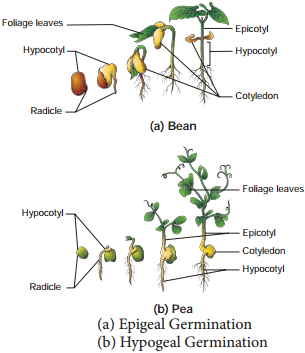
During epigeal germination cotyledons are pushed out of the soil. This happens due to the elongation of the hypocotyl. Example: Castor and Bean.

(ii) Hypogeal Germination

During hypogeal germination cotyledons remain below the soil due to rapid elongation of epicotyls (Figure 15.12). Example: Maize, Pea.
Seed Germination and Dormancy img 1

2. Factors Affecting Germination

Seed germination is directly affected by external and internal factors:

(i) External Factors

a. Water:
It activates the enzymes which digest the complex reserve foods of the seed. If the water content of the seed goes below a critical level, seeds fail to germinate.

b. Temperature:
Seeds fails to germinate at very low and high temperature. The optimum temperature is 25°C to 35°C for most tropic species.

c. Oxygen:
It is necessary for germination. Since aerobic respiration is a physiological requirement for germination most will germinate well in air containing 20% oxygen.

d. Light:
There are many seeds which respond to light for germination and these seeds said to be photoblastic.

e. Soil Conditions:
Germination of seed in its natural habit is influenced by soil conditions such as water holding capacity, mineral composition and aeration of the soil.

(ii) Internal Factors

a. Maturity of Embryo:
The seeds of some plants, when shed will contain immature embryo. Such seeds germinate only after maturation of embryo.

b. Viability:
Usually seeds remain viable or living only for a particular period. Viability of seeds range from a few days (Example: Oxalis) to more than hundred years. Maximum viability (1000 years) has been recorded in lotus seeds. Seeds germinate only within the period of viability.

c. Dormancy:
Seeds of many plants are dormant at the time of shedding. A detailed treatment is given below.

II. Seed Dormancy

The seeds of most plants germinate under favourable environmental conditions but some seeds do not germinate when suitable conditions like water, oxygen and favourable temperature are not available. Germination of such seeds may be delayed for days, months or years.

The condition of a seed when it fails to germinate even in suitable environmental condition is called seed dormancy. There are two main reasons for the development of dormancy: Imposed dormancy and innate dormancy. Imposed dormancy is due to low moisture and low temperature. Innate dormancy is related to the properties of seed itself.

1. Factors Causing Dormancy of Seeds:

  • Hard, tough seed coat causes barrier effect as impermeability of water, gas and restriction of the expansion of embryo prevents seed germination.
  • Many species of seeds produce imperfectly developed embryos called rudimentary embryos which promotes dormancy.
  • Lack of specific light requirement leads to seed dormancy.
  • A range of temperatures either higher or lower cause dormancy.
  • The presence of inhibitors like phenolic compounds which inhibits seed germination cause dormancy.

2. Methods of Breaking Dormancy:

The dormancy of seeds can be broken by different methods. These are:

(i) Scarification:
Mechanical and chemical treatments like cutting or chipping of hard tough seed coat and use of organic solvents to remove waxy or fatty compounds are called as Scarification.

(ii) Impaction:
In some seeds water and oxygen are unable to penetrate micropyle due to blockage by cork cells. These seeds are shaken vigorously to remove the plug which is called Impaction.

(iii) Stratification:
Seeds of rosaceous plants (Apple, Plum, Peach and Cherry) will not germinate until they have been exposed to well aerated, moist condition under low temperature (0°C to 10°C) for weeks to months. Such treatment is called Stratification.

(iv) Alternating Temperatures:
Germination of some seeds is strongly promoted by alternating daily temperatures. An alternation of low and high temperature improves the germination of seeds.

(v) Light:
The dormancy of photoblastic seeds can be broken by exposing them to red light.

Vernalization

Learninsta presents the core concepts of Biology with high-quality research papers and topical review articles.

Vernalization

Besides photoperiod certain plants require a low temperature exposure in their earlier stages for flowering. Many species of biennials and perennials are induced to flower by low temperature exposure (0°C to 5°C). This process is called Vernalization. The term Vernalization was first used by T. D. Lysenko (1938).

1. Mechanism of Vernalization:

Two main theories to explain the mechanism of vernalization are:

  1. Hypothesis of Phasic Development
  2. Hypothesis of Hormonal Involvement

1. Hypothesis of Phasic Development

According to Lysenko, development of an annual seed plant consists of two phases. First phase is thermostage, which is vegetative phase requiring low temperature and suitable moisture. Next phase is photo stage which requires high temperature for synthesis of florigen (flowering hormone).

2. Hypothesis of Hormonal Involvement

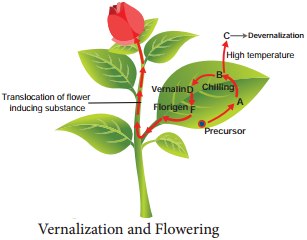
According to Purvis (1961), formation of a substance A from its precursor, is converted into B after chilling. The substance B is unstable. At suitable temperature B is converted into stable compound D called Vernalin. Vernalin is converted to F (Florigen). Florigen induces flower formation. At high temperature B is converted to C and devernalization occurs (Figure 15.11).
Vernalization img 1

Technique of Vernalization:

The seeds are first soaked in water and allowed to germinate at 10°C to 120°C. Then seeds are transferred to low temperature (3°C to 5°C) from few days to 30 days. Germinated seeds after this treatment are allowed to dry and then sown. The plants will show quick flowering when compared to untreated control plants.

3. Devernalization

Reversal of the effect of vernalization is called devernalization.

4. Practical Applications

  • Vernalization shortens the vegetative period and induces the plant to flower earlier.
  • It increases the cold resistance of the plants.
  • It increases the resistance of plants to fungal disease.
  • Plant breeding can be accelerated.

Vernalization (from Latin vernus, “of the spring”) is the induction of a plant’s flowering process by exposure to the prolonged cold of winter, or by an artificial equivalent. This ensures that reproductive development and seed production occurs in spring and winters, rather than in autumn.

Plants often flower in the spring, so, in practical terms, vernalization is the promotion of flowering in response to prolonged low temperatures. This response evolved in plants that adapted to regions where the winters are harsh and the growing season relatively short.

Some examples include beets, onions, winter wheat, cabbage, and turnips. In order to produce flowers and seeds, these plants have to go through a process called vernalization. Vernalization simply means that the plant has to experience a period of cold before it can produce flowers.

In laboratory experiments vernalization occurs at constant temperatures in growth rooms set to between 0 and around 15°C. But real winter temperatures are not constant, and daily fluctuations outside during day and night often exceed the difference in seasonal average temperatures.

Vernalization (from Latin vernus, “of the spring”) is the induction of a plant’s flowering process by exposure to the prolonged cold of winter, or by an artificial equivalent. Typical vernalization temperatures are between 1 and 7 degrees Celsius (34 and 45 degrees Fahrenheit).

Vernalization, the artificial exposure of plants (or seeds) to low temperatures in order to stimulate flowering or to enhance seed production. By partially germinating the seed and then chilling it to 0° C (32° F) until spring, it is possible to cause winter wheat to produce a crop in the same year.

Vernalization is the acquisition of a plant’s ability to flower in the spring by exposure to the prolonged cold of winter, or by an artificial equivalent. After vernalization, plants have acquired the ability to flower, but they may require additional seasonal cues or weeks of growth before they will actually flower.

The site that perceives the cold stimulus can be different in different plants. It could be the apical meristem in the shoots, the germinating seed or the vegetative parts such as leaves.

Many types of plants have vernalization requirements. Many fruit trees, including apples and peaches, require minimum chilling times each winter to produce a good crop. Too warm winters can damage the trees health or even kill them over time.

Winter wheat requires vernalization, a process where plants exposed to cold temperatures experience physiological changes. With wheat this means the plants will not flower until they have been exposed to cold temperatures. Varieties with a higher vernalization requirement need more exposure to cold temperatures.

In absence of cold treatment, accumulation of ent-kaurenoic acid in shoot tip occurs. Cold treatment followed by exposure to high temperatures convert it into GA9, which stimulates flowering response in plants. Thus, gibberellins can substitute the vernalization.

Gibberellins affect several reproductive processes in plants. They stimulate flowering, particularly in long-day plants. In addition, gibberellins substitute for the low temperature that biennials require before they begin flowering (vernalisation).

There are plants for which flowering is either quantitatively or qualitatively dependent on exposure to low temperature, this phenomenon is termed vernalisation. Vernalisation refers specially to the promotion of flowering by a period of low temperature.

NCERT Solutions for Class 12 English Vistas Chapter 6 On the face of It

Here we are providing NCERT Solutions for Class 12 English Vistas Chapter 6 On the face of It. Students can get Class 12 English On the face of It NCERT Solutions, Questions and Answers designed by subject expert teachers.

On the face of It NCERT Solutions for Class 12 English Vistas Chapter 6

On the face of It NCERT Text Book Questions and Answers

On the face of It Reading with insight

Question 1.
What is it that draws Derry towards Mr Lamb in spite of himself?
Answer:
Derry met Mr Lamb by chance. As he walked into Mr Lamb’s garden, his apprehensions were put to rest by the sensitive counselling he received. Derry, as a young boy with a burnt face, was subjected to alienation and pity.People felt that his face was “a terrible thing” and shunned him. Mr Lamb taught him how beauty was relative and individuality of each creation was to be treasured. He taught Derry to view things differently and taught him to embrace his flaw. He told Derry’ of a man who was afraid of everything and who shut himself up in a room, till a picture fell off the wall onto his head and killed him.

He told him not to hide behind his deformity. He gave Derry the conviction to achieve what he wanted out of life. Derry learnt to let go of his hatred that was eating him up from inside. When Derry defended Mr Lamb to his mother, he seemed to be overwhelmed and inspired by Mr Lamb’s ideas. He found in Mr Lamb someone who looked beyond his deformity and did not pity or fear him. Mr Lamb attracted Derry because he taught him the valuable lesson of not indulging in self-pity and of looking at the brighter side of things. He taught Derry, by his own example, to be unafraid and to face the world.

Question 2.
In which section of the play does Mr Lamb display signs of loneliness and disappointment? What are the ways in which Mr Lamb tries to overcome these feelings?
Answer:
Mr Lamb comes across as a lonely, but cheerful figure who wards off his loneliness by finding diversion in nature around him. He appears to be caught up in his own world—his garden. His leg was blown off years back and the kids called him “Lamey-Lamb” but he had learnt not to let that bother him. He lived alone in his house and spent his time watching, listening, and thinking. When Mr Lamb told Derry that he had lot of friends, Derry suspected him of lying and declared that he would probably die alone, unattended. Mr Lamb found solace in his bees and crab apples. When Derry talked of going back home, he wistfully remarked, “Once you get home, you’d never let yourself come back.”

He made an effort to befriend people, leaving the door open, and the window curtain-less. Mr Lamb tried to overcome his loneliness and did not seem overwhelmed by the same. He sat in the garden and listened to his bees singing and sat in the sun and read books. Unlike Derry, he complained little about being isolated, he found company in nature around him, content to marvel at their beauty, and the occasional visitors.

Question 3.
The actual pain or the inconvenience caused by a physical impairment is often less than the sense of alienation felt by the person with a disability. What is the kind of behaviour that the person expects from others?
Answer:
The right word for ‘physical impairment’ is ‘differently-abled’—a word framed to view people in a more sensitive manner. But, it is cruel that over 90 million physically-challenged children worldwide, of whom 36 million are in India,are being systemically excluded from mainstream education. Many of them are stereotyped frequently and also face alienation even within their own families.

They deserve to be understood and accepted as productive and effective citizens. Issues of physical accessibility are just the tip of the iceberg. Instead of questioning the need for civil rights for people with disabilities, we must question a society in which these rights are not the norm. The most important thing we can do is value the voice of the people with disabilities. History is fraught with well-meaning individuals who truly desired to assist people with disabilities, but in their haste to help, they neglected to empower these people to be their own advocates. We must allow people with disabilities to become the subjects rather than the objects of their own history.

Each of us must continually question our own presumptions and attitudes. We must be willing to give people with disabilities their rightful place at the conversation table and be willing to listen to their truth. Ostracising or offering them pity pushes them back to darkness. We should strive to bring them to light.

Question 4.
Will Derry get back to his seclusion or will Mr Lamb’s brief association effect a change in the kind of life he will lead in future?
Answer:
When Derry met Mr Lamb, he suffered from a deep-rooted complex and felt he had “the ugliest face”. Subjected to insensitive remarks and alienated from the natural course of life, he came to view himself as a hideous monster to be kept away from human company. Mr Lamb, in his sensitive dealings, almost healed Derry. He liberated him from his misery.

Mr Lamb exposed him to a new world where one’s physical attributes did not matter. He respected each creation’s individuality. He taught Derry beauty was relative, and inspired him to achieve what he wished for, in spite of his disability. The brief meeting left an indelible imprint on Derry’s young mind. For the first time Derry felt comfortable with himself.

He told his mother that he did not care what he looked like. He had learnt to accept himself. Though Derry returned to find Mr Lamb dead, he was unlikely to retreat into his cocoon of isolation. This encounter between them seemed to have a purpose of passing on Mr Lamb’s wisdom and sensitivity to Derry’s young understanding. He would most certainly carry on with Mr Lamb’s advice and inspiration.

On the face of It Extra Questions and Answers

On the face of It Short Answer Questions

Question 1.
What is the setting of the play?
Answer:
The setting of the play is Mr Lamb’s garden where there is the occasional sound of birdsong and of tree leaves rustling. Derry had jumped over the wall and walked slowly and tentatively through the long grass. He came round to a screen of bushes, where he encountered Mr Lamb, the owner of the house.

Question 2.
“I’m not afraid. People are afraid of me.” Why did Derry say this?
Answer:
Derry was made to feel isolated as people shunned him and kept away from him. He felt that since he had a scarred face, “a terrible thing”, people feared him. He admitted to being afraid and repulsed of his own self when he looked at himself in the mirror.

Question 3.
What did Derry feel about his face? Why?
Answer:
Derry told Lamb that his face had been burnt by acid. The acid ate his face and consequently ate away at his life. He felt “it won’t ever be any different”. He felt so because he has been shabbily treated by people around him. Even his family viewed him differently, with pity.

Question 4.
How did Mr Lamb react to Derry viewing himself differently?
Answer:
Mr Lamb explained to him that external appearance was inconsequential. He taught him to disregard accepted notions of beauty. A weed was considered redundant by everyone, but to Mr Lamb, weeds were a thing of beauty. He drew on the example to make Derry understand that beauty had alternate meanings.

Question 5.
How had Mr Lamb lost his leg? What was people’s reaction to it?
Answer:
One of Mr Lamb’s legs had been blown off, years back, when he was at war. People called him “Lamey- Lamb”. He admitted that it did not bother him anymore.

Question 6.
Why did Derry feel he was unlike the beast in the story ‘Beauty and the Beast’?
Answer:
Derry admitted that he had often been consoled by people who cited the example of the Beast, who was loved by Beauty in spite of his physical appearance. However, Derry received little consolation from the example of the Beast who was changed to a handsome prince following Beauty’s kiss. Derry regretted that he would have to live with his damaged face forever.

Question 7.
Narrate the example of the man who was afraid of everything, as narrated by Mr Lamb.
Answer:
Mr Lamb said there was a man—afraid of everything. He locked himself up in a room and never left it. He was afraid that a bus might run him over, or a man might breathe deadly germs onto him, or a donkey might kick him to death, or lightning might strike him down, or he might love a girl and the girl might leave him, or he might slip on a banana skin and fall. He locked himself up in his room and stayed there, till a picture fell off the wall on his head and killed him.

Question 8.
What was Lamb’s advice to Derry about “hating people”?
Answer:
When Derry said that he hated some people, Mr Lamb told him hating people did more harm than any bottle of acid. Whereas, acid only burnt his face, hating could bum him from inside.

Question 9.
What was Derry’s mother’s reaction to his meeting with Lamb?
Answer:
Derry’s mother was apprehensive of Mr Lamb, influenced as she was by what people thought of him. She had been warned by people to keep away from Mr Lamb. She stopped Derry from going back to Mr Lamb’s. But Derry was determined. He wanted to go back there and listen to things that mattered, things nobody else had ever said to him.

On the face of It Long Answer Questions

Question 1.
“Acid.. .ate my face up. It ate me up.” Describe the miseries suffered by Derry after the unfortunate incident he refers to.
Answer:
Derry’s face was badly scarred as he got burned with acid. He was deeply wounded by people’s behaviour.
He felt that though people pretended to be sympathetic, they were afraid of him because he had the ugliest face. Derry recalled how a woman had said that his face was “a terrible thing” and was “a face only a mother could love”. He had heard lots of things that were as hurtful. Moreover, he did not like people staring at him or being afraid of him. He remembered how only his mother had once kissed him, and that too, on the other side of his face. He felt that she too did it out of pity.

He had heard his parents wonder about what would happen to him when they died as it would be difficult for him to get on in the world with a face like his. He had heard a person say that people were better off with others like themselves, for example, blind people only ought to be with other blind people and idiot boys with idiot boys. Derry, too, preferred such a situation because people would then not stare at him. The attitude of people towards Derry reflects the callousness of the society towards the physically impaired.

Question 2.
Mr Lamb also displays signs of loneliness and disappointments. What are these? What are the ways in which Mr Lamb tries to overcome these feelings?
Answer:
Mr Lamb was called “Lamey-Lamb” as his leg was blown off years back in a bomb attack and he had a tin leg. He was very lonely and longed for company as he lived alone in his house. He welcomed Derry into his garden and tried to put his fears to rest. When Derry noticed that there were no curtains at the windows and inquired about it, Mr Lamb told him that it was so because he neither liked shutting things out, nor shutting them in, implying his openness of mind. He liked the light and the darkness, and also wanted to hear the wind.

These views were a manifestation of Mr Lamb’s desires. He wanted hundreds of friends to visit his house. This was also evident from the fact that he always left the gate open. He visualized people coming in and sitting in front of the fire in winter and kids coming for the apples and pears and for toffee that he made with honey. Mr Lamb felt that people “are never just nothing”. Like the open windows, Mr Lamb was always “waiting, watching and listening”.

Question 3.
How were Derry’s and Mr Lamb’s views different?
Answer:
Both Derry and Mr Lamb had a physical handicap. Derry had a face that was half burnt with acid while Mr Lamb’s leg had been blown off and had been replaced with a tin leg. That was where the similarity ended. Derry’s burnt face had scarred his soul. He was withdrawn and felt that people were afraid of him because he had the ugliest face. He felt that people pretended to be sympathetic when actually they were repulsed. They either ignored him or gave him curious looks, glances and questions. He feels awkward and abnormal.

He did not even like his mother to kiss him because she kissed the other side of his face and he felt she did so as she had to. This sense of isolation is heightened by the overprotective attitude of his mother, who tried to keep him isolated to protect him from getting hurt. As a result, he had no true friends. Derry believed that people such as him are better off with others like themselves to avoid being stared at.

On the other hand, Mr Lamb said that beauty was relative and he enjoyed everything God had made—even the weeds in the garden and the bees singing. He respected each creation’s individuality. He said that the world was as one looked at it. He did not care about physical attributes and said they were not important.

He felt that Derry had arms, legs, eyes, ears, tongue and a brain. He could get with his life, like everyone, or even better. He also said that hating people would do him more harm than any bottle of acid. It would burn away his inside. He clarified to Derry that people with the same deformity were also different. It was incorrect to judge people by what they looked like. One had to watch, listen, and think to notice the differences. Though Mr Lamb led a lonely life, he liked to think that the people who entered his garden were his friends. He avoided thinking of his isolation and tried to invite company by keeping the gate to his house open.

Question 4.
A positive attitude helps to tackle all difficulties in life. Elaborate with reference to Mr Lamb in the play “On the Face of It”.
Answer:
People with physical handicaps are aware of the fact that they are physically different from most others and that there are certain things they cannot do. They have poor self-esteem. They feel victimized, and fall into a vicious cycle of morbid sadness and intense anger at the world. They constantly feel that “nobody loves me or cares”. Being stigmatized worsens it.

In the story, we see Derry’s feeling of dejection after being treated with fear and horror. Derry finally leams to face his disability with courage only when Mr Lamb encourages him to have a positive attitude. This positive attitude makes one understanding, friendly towards life and people, provides confidence and ability to face the hardships of life and realize one’s potential. As a result, Derry, who has avoided company and has been afraid to meet people, decides to go to Mr Lamb’s house and meet him. He no longer wants to live in isolation.

NCERT Solutions for Class 11 English Hornbill Chapter 6 The Browning Version

Here we are providing NCERT Solutions for Class 11 English Hornbill Chapter 6 The Browning Version. Students can get Class 11 English The Browning Version NCERT Solutions, Questions and Answers designed by subject expert teachers.

The Browning Version NCERT Solutions for Class 11 English Hornbill Chapter 6

The Browning Version NCERT Text Book Questions and Answers

The Browning Version Understanding the text

Question 1.
Comment on the attitude shown by Taplow towards Crocker-Harris.
Answer:
Taplow has very more bitter feelings about his teacher Crocker-Harris. He is a student in the lower fifth grade and feels that he would specialise next term if he got his remove, of which he is uncertain as Mr Crocker-Harris doesn’t tell the students the results like the other teachers. As a rule, the class results should only be announced by the headmaster on the last day of term but Taplow feels that none other than Mr Crocker-Harris waits to inform students of their result. He is not interested in the Classical literature that is taught by Mr Crocker-Harris.

He feels science is more interesting than studying Classics such as The Agamemnon, which he calls “muck”. Moreover, he does not like the way it is taught to them. The Agamemnon had a lot of Greek words and Mr Crocker-Harris punished them for not getting them right.

Taplow feels more bitter as he had been given extra work to do for missing a day of school the previous week when he was ill. It was the last day of school and he wished to play golf instead. It was just on the previous day that Mr Crocker- Harris had told Taplow that he had got what he deserved. Taplow feels that Mr Harris might have given him lesser marks to make him do extra work. He adds that Mr Harris is “hardly human”. He also imitates his teacher.

When Frank suggests that Taplow could go and play golf, Taplow is shocked as nobody takes that kind of liberty with Mr Crocker-Harris. Taplow calls Mr Crocker-Harris, “the Crock”, and says that he is worse than a sadist. If he were a sadist, he wouldn’t be as frightening because he would then show he had some feelings. His inside, feels Taplow, is like a “shrivelled nut” and he seems to hate people who like him.

However, Taplow admits that despite everything Mr Crocker-Harris does, he still likes him. Although, he says that Mr Crocker-Harris feels uncomfortable about people liking him. He says once in class Mr Crocker-Harris made one of his classical jokes, and nobody laughed because nobody understood it. However Taplow knew that it was meant to be funny, so he laughed. Mr Crocker-Harris said that he was pleased with Taplow’s knowledge of Latin and wanted him to explain the joke to the rest of the class.

Question 2.
Does Frank seem to encourage Taplow’s comments on Crocker-Harris?
Answer:
Taplow comes to meet Mr Crocker-Harris when he meets Frank. From his conversation with Taplow, Frank realises that the boy does not like Mr Crocker-Harris. Frank then confirms with Taplow, “You sound a little bitter, Taplow.” He then pretends to console him by reasoning that he would get his remove the next day for taking on extra work. Taplow vents his dislike for Mr Harris and says that he is “hardly human”.

But after saying so, he apologises to Frank for talking too much. Frank pretends to be unhappy but asks Taplow to “repeat” what Mr Harris had said to him. Taplow imitates him. Frank pretends to look strict and asks him to be.quiet. He then asks Taplow at what time he was supposed to meet Mr Crocker-Harris. He then tells Taplow that Mr Crocker-Harris was already ten minutes late and suggests that Taplow could go and play golf.

Taplow is shocked and expresses his apprehension if Mr Crocker-Harris should know. Frank envies the effect Mr Crocker-Harris seems to have on boys in the class; they seem to be scared to death of him. Taplow confesses that Mr Crocker-Harris, unlike any other person, does not care for being liked. Frank attempts to instigate Taplow by deriding students for using the teacher’s need to be liked to their own advantage. Taplow remarks that a few teachers were sadists, and Mr Crocker-Harris was worse because he had no feelings.

When Taplow recounts the episode when he had laughed at Mr Crocker-Harris’s jokes, and Mr Crocker-Harris wanted ‘ him to explain it to the rest of the class, but Frank just laughs at that. He, thus, seems to enjoy the low opinion Taplow has of Mr Crocker-Harris.

Question 3.
What do you gather about Crocker-Harris from the play?
Answer:
Mr Crocker-Harris is an old Classics teacher at a British public school, where he’s been teaching for many years. He apparently wants the children to work hard at their lessons and it is for this reason that he has called Taplow to his office. Unfortunately, students do not like him and neither do they like his teaching methods. Taplow feels science is more interesting than studying Classics such as The Agamemnon, which he calls “muck”.

Moreover, he does not like the way it is taught to them. It has a lot of Greek words and Mr Crocker-Harris punishes them for not getting them right. Taplow feels Mr Harris might have given him lesser marks to make him do extra work. He adds that Mr Harris is “hardly human”. Thus underlining that Mr Harris has lost the student’s trust and respect.

He is a fastidious and a rule-bound person who is the only one who follows the rule of letting the headmaster announce the results on the last day of term.Taplow imitates Mr Crocker-Harris but all the same is frightened of letting Mr Harris know. The students seem to be scared to death of him. Calling Mr Crocker-Harris, the Crock, Taplow says that he is worse than a sadist as he shows no feelings.

He feels uncomfortable about people liking him. Mr Harris does not seem to respond to students who try to warm up to him. When Taplow laughed at his joke, Mr Crocker-Harris had wanted him to explain it to the rest of the class. The poor man is an unfortunate teacher.

The Browning Version Talking about the text

Discuss with your partners

Question 1.
Talking about teachers among friends.
(Answers will vary)

Question 2.
The manner you adopt when you talk about a teacher to other teachers.
(Answers will vary)

Question 3.
Reading plays is more interesting than studying science.
(Answers will vary)

The Browning Version Working with words

Question 1.
A sadist is a person who gets pleasure out of giving pain to others. Given below are some dictionary definitions of certain kinds of persons. Find out the words that fit these descriptions.
Answer:

  • A person who considers it very important that things should be correct or genuine, for example, in the use of language or in the arts: Perfectionist/Purist
  • A person who believes that war and violence are wrong and will not fight in a war: Pacifist
  • A person who believes that nothing really exists: Nihilist
  • A person who is always hopeful and expects the best in all things: Optimist
  • A person who follows generally accepted norms of behaviour: Conformist
  • A person who believes that material possessions are all that matter in life: Materialist

NCERT Solutions for Class 12 English Flamingo Chapter 8 Going Places

Here we are providing NCERT Solutions for Class 12 English Flamingo Chapter 8 Going Places. Students can get Class 12 English Going Places NCERT Solutions, Questions and Answers designed by subject expert teachers.

Going Places NCERT Solutions for Class 12 English Flamingo Chapter 8

Going Places NCERT Text Book Questions and Answers

Going Places Think as you read 

Question 1.
Where was it most likely that the two girls would find work after school?
Answer:
Jansie, being realistic, realized that both of them were likely to end up working for the biscuit factory. However, Sophie, who lived in a dream world, dreamt of starting a boutique, being an actress, or starting her career as a manager somewhere.

Question 2.
What were the options that Sophie was dreaming of? Why does Jansie discourage her from having such dreams?
Answer:
Sophie dreamt of starting a boutique with the money she would earn as a manager. She imagined herself as a fashion designer with the best shop in the city or of becoming an actress. She aspired after a career that would be considered “sophisticated”. Jansie was more practical and warned Sophie to come to terms with reality.

Question 3.
Why did Sophie w riggle when Geoff told her father that she had met Danny Casey?
Answer:
Sophie squirmed when Geoff told her father that she had met Danny Casey because she had lied about it. She felt uncomfortable about having lied to her brother, Geoff. She did not want her lies to be discovered.

Question 4.
Does Geoff believe what Sophie says about her meeting with Danny Casey?
Answer:
Geoff refused to believe Sophie but was later convinced on hearing the vivid description of their meeting. He told his dad and then Frank about the meeting.

Question 5.
Does her father believe her story?
Answer:
No, Sophie’s father did not believe her story. When Geoff told him about the meeting, he expressed disbelief. Her father warned her that she would talk herself “into a load of trouble”.

Question 6.
How does Sophie include her brother Geoff in her fantasy of her future?
Answer:
Sophie imagined her brother travelling to exotic and mysterious places and she craved to be taken along. She imagined a vast world that awaited her arrival. She saw herself riding there, behind Geoff. She imagined him wearing new, shining black leathers and she saw herself in a yellow dress with a kind of cape that flew out behind. She imagined being greeted to applause by the world.

Question 5.
Which country did Danny Casey play for?
Answer:
Danny Casey was a football player; he played for Ireland.

Question 6.
Why didn’t Sophie want Jansie to know about her story with Danny?
Answer:
Sophie expressed displeasure at Geoff telling Frank about how she had met the football star, Dafiny. Jansie, her friend, found out about the same from Frank. She felt that Geoff had betrayed her trust letting out their secret. She was also wary about the whole neighbourhood finding out about it from Jansie.

Question 7.
Did Sophie really meet Danny Casey?
Answer:
No, Sophie had not really met Danny Casey. Her father, who knew her well, realized that her story was a figment of her wild imagination. Sophie was in the habit of living in a world of fantasy that had no bearing with reality.

Question 8.
Which was the only occasion when she got to see Danny Casey in person?
Answer:
The only time she got to see Danny Casey was on Saturdays when she, along with her family, went to watch United at a match. They saw Casey play football.

Going Places Understanding the text

Question 1.
Sophie and Jansie were classmates and friends. What were the differences between them that show up in the story?
Answer:
Sophie and Jansie were classmates and friends. Yet, they were inherently different in their personalities. Sophie was a romantic, who seemed to have nothing much to do with the realistic world. Her ambitions and her ways to achieve them were unrealistic. Sophie dreamt of starting a boutique with the money she would earn as a manager. She dreamt about opening the best shop in the city or of becoming an actress.

Jansie was more practical and did not want Sophie to talk of such unrealistic ventures. She knew that both of them were destined to work at the biscuit factory. Sophie was childish and lived in a dream world where Danny, a football star, had met her and was likely to meet her yet again. Jansie disapproved of her telling such a story.

Question 2.
How would you describe the character and temperament of Sophie’s father?
Answer:
Sophie’s father was a hardworking man. He is described as a plump and a heavy-breathing man in a vest. His face was grubby and sweaty after the day’s hard work. When Geoff told him about Sophie’s meeting with Danny, he said nothing but looked at her disparagingly, knowing it to be untrue. When Sophie claimed that Danny had informed her that he was going to buy a shop, her father frowned knowingly. He dismissed Sophie’s claim as another of her “wild stories” and was afraid that she would talk herself “into a load of trouble”. This made her apprehensive of talking about such fantasies to him.

Her father, too, was a sports lover. This family of modest means depended on their only source of entertainment— watching football. They went to watch United play, each Saturday, as a “weekly pilgrimage”. As a sports enthusiast, he shouted encouragement to Danny and went to the pub to celebrate the sport team’s victory.

Question 3.
Why did Sophie like her brother Geoff more than any other person? From her perspective, what did he symbolise?
Answer:
Sophie liked her brother Geoff more than anyone else in the family. She confided in him and also idolised him. He was older, an apprentice mechanic, who travelled for his work to the other end of the city. She supposed that there were many more mysterious elements about him, than she knew of. He spoke little and she envied his silence. To her it seemed that when he was quiet, he travelled in his imagination to those places where she wanted to go. She suspected him of knowing interesting people and she longed to know them too.

She wanted to be closer to her brother and hoped that someday he might take her with him.Geoff symbolised freedom to Sophie’s limited experience. In her childish dreams, she imagined an exotic world beyond her knowledge, which awaited her arrival.

Question 4.
What socio-economic background did Sophie belong to? What are the indicators of her family’s financial status?
Answer:
Sophie belonged to a middle class socio-economic background. The reader receives the first hint from Jansie’s and Sophie’s conversation and how they were both earmarked for the biscuit factory. Jansie also prioritised buying a “decent house” to live in, if she was to come upon money. Sophie’s father’s appearance with dirt and sweat all over him after a day’s work, indicated that he was a hard-working man. She observed her mother stooping over the sink, her back bent from all the hard work.

The small room in which Sophie and her family lived was steamy from the stove and cluttered with the dirty washing piled up in the comer. Her brother Geoff was an apprentice mechanic, having left school. The humble status of Sophie’s family is brought out through the details worked into the story.

Going Places Talking about the text

Discuss in pairs.

Question 1.
Sophie’s dreams and disappointments are all in her mind. Discuss.
Answer:
Sophie’s views, her ambitions, her ideas about her brother Geoff s life, or her meeting with Danny, were all figments of her imagination. She was confident of becoming an actress and having a boutique on the side, though she neither had a decent house, nor any material comfort. The realistic view is reflected through Jansie who knew that they would both end up working in the biscuit factory.

Sophie imagined her brother, Geoff visiting places that she had never seen. She longed to be introduced to the vast world that she believed awaited her. She imagined herself riding there behind Geoff and being welcomed with thunderous applause.Sophie had never met Danny Casey, a sports star, but she told her family a concocted story of meeting. Her father recognised that it was one of her wild stories and was afraid that she would get herself into lot of trouble.She fantasised to such a level that her lies became a living reality and she went to wait for Danny to turn up. Even when she realized that Danny would not turn up to meet with her, she indulged in a similar fantasy.

Question 2.
It is natural for teenagers to have unrealistic dreams. What would you say are the benefits and disadvantages of such fantasising?
Answer:
Fantasy is the creative imagination or unrestrained fancy. Commonly known as daydreaming, this is a fairly common phenomenon—and though it is not harmful, it should not be indulged in excessively. In a world of fantasy, one can have whatever one likes, even things that he or she cannot have in reality. In other cases, the person sometimes becomes so obsessed with his own thoughts, that he is absolutely unconcerned about the happenings in the real environment around him. So, even though a person may be physically present at a certain place, he may be mentally absent and lose sight of everything around him. An example could be such students who find it difficult to grasp and retain concepts because they are daydreamers. On the other hand, Mark Twain too was a daydreamer.

Perhaps, the source of daydreaming may be the need to escape from unpleasant or stressful situations. A daydreamer would have sensitivity, depth and intelligence and hence should be given space and nurtured. But, it could also shut one out from reality. This is because the daydreamer, lost in thoughts, loses his bearings entirely and is oblivious to things around him. If a daydreamer happens to be on the road, this state of mind could prove dangerous, even fatal. Daydreaming can be very distracting. It affects one’s day-to-day work, and the person gets more and more absent- minded. After a point, he may start losing physical and social contact with his surroundings and become increasingly withdrawn.

Daydreaming has its advantages. Daydreaming fosters a child’s imagination, and enhances creativity. But, if one is a habitual daydreamer and tends to wander off a bit too often for comfort, it might be detrimental to how he comes to terms with the world around him.

Going Places Working with words

Notice the following expressions. The highlighted words are not used in a literal sense. Explain what they mean.

  • Words had to be prized out of him like stones out of a ground — it was difficult to get him to talk or to get information out of him
  • Sophie felt a tightening in her throat — tension or anxiety
  • If he keeps his head on his shoulders — thinks intelligently
  • On Saturday they made their weekly pilgrimage to the United — they went to the United dutifully, without fail and with a lot of devotion as one would go to a place of worship
  • She saw. him ghost past the lumbering defenders — she viewed a faint image of him as he flashed past the awkward or clumsy defenders

Going Places Thinking about language

Notice these words from the story:

  • chuffed’, meaning delighted or very pleased
  • ‘nosey’, meaning inquisitive
  • ‘gawky’, meaning awkward, ungainly

These are words that are used in an informal way in colloquial speech.

Make a list of ten other words of this kind.

  • row – a noisy quarrel or dispute
  • bad mouth – to insult
  • bell – to telephone
  • to belt – to hit
  • blast – enjoyable experience
  • blow one’s top – be very angry
  • daft – silly, foolish
  • dim – not intelligent
  • savvy – well informed
  • scaredy-cat – a person who is frightened

Going Places Extra Questions and Answers

Going Places Short Answer Questions

Question 1.
What was Sophie’s ambition? How did she plan to achieve it?
Answer:
Sophie was a romantic who was far removed from reality. She aspired to start a boutique after leaving school. She told her friend, Jansie, that to save money for the boutique she would work as a manager. She wanted a boutique like Mary Quant, a famous fashion designer. She also toyed with the idea of working as an actress and having a boutique on the side. She desired to have a career that was considered “sophisticated”.

Question 2.
Were Sophie’s ambitions were divorced from reality?
Answer:
Sophie was a schoolgirl—a teenager from a middle-class family. But she had exalted ambitions about starting a boutique or becoming an actress. Her dreams were divorced from reality. Her friend, Jansie, realized the irony of their situation and was realistic enough to know that they would end up working in a biscuit factory.

Question 3.
Sophie idolized her brother Geoff. Justify.
Answer:
Sophie’s brother, Geoff, had been three years out of school, an apprentice mechanic, who travelled to his work each day to the far side of the city. Sophie thought that Geoff lived the lives of her hopes and dreams that she wanted for her own self. She romanticized his life. She imagined that he visited faraway, exotic places and met interesting people. She wished to visit the places of her imagination and ride away with Geoff.

Question 4.
How did Sophie dream of herself in Geoff’s world?
Answer:
Sophie wished that her brother would take her to his world with him. She was conscious of a vast world that awaited her arrival. She saw herself riding there behind Geoff. She imagined him in new, shining black leather and herself in a yellow dress with a kind of cape that flowed out behind her. She imagined the world greeting them with wild applause.

Question 5.
What did Sophie tell Geoff about Danny Casey?
Answer:
Sophie told Geoff that she had met Danny Casey in the arcade. She told him how she was looking at the clothes in Royce’s window when Danny Casey came and stood beside her. She said that he had gentle, green eyes but was not very tall. She asked him for an autograph for little Derek, but neither of them had any paper or pen. She claimed that Danny had invited her to meet him next week.

Question 6.
What was her father’s reaction to her claim to have met Danny Casey?
Answer:
Geoff told his father that Sophie had met Danny Casey. Their father disbelieved Sophie’s claim; he looked at her with disdain. When she told her father that Danny said he was going to buy a shop, her father dismissed it as one of her wild stories. He felt that she would land herself into trouble because of her wild imagination.

Question 7.
What did Geoff warn Sophie about Danny?
Answer:
Geoff warned Sophie about how she was still in school, and Danny was likely to have lots of girls. Sophie tried to refute it, but Geoff insisted on how he knew better. When she told him that Danny was to meet her the following week, Geoff told her that Danny would never turn up.

Question 8.
Where did the family see Danny? What was Sophie’s reaction?
Answer:
Sophie, Derek, Geoff and their father went to watch United play on Saturday. It was a “weekly pilgrimage” for them. Sophie, her father and little Derek went down and sat near the goal while Geoff went higher up with his friends. They saw Danny score a goal, leading his team to victory. Sophie blushed with satisfaction as her hero won the match for them.

Question 9.
What was Sophie’s reaction when Jansie questioned her about Danny Casey?
Answer:
Sophie was upset when Jansie revealed that she had come to know about Sophie’s episode with Casey. She felt betrayed as Geoff had let out her secret. Jansie accused her of lying, but Sophie convinced her otherwise. However, she felt apprehensive that Jansie would spread the rumour around her neighbourhood.

Question 10.
Where did Sophie go to wait for Danny?
Answer:
After dark, Sophie walked by the canal, along a sheltered path lighted only by the glare of the lamps from the wharf across the water. It was a secluded place where she had often played as a child. She sat down on a wooden bench under a solitary elm, to wait for Danny Casey.

Question 11.
How did Sophie come to terms with the fact that Danny would not come?
Answer:
As Sophie waited for Danny to turn up, she even imagined him coming. But when some time had elapsed, she felt the pangs of doubt stirring inside her. She recalled that Geoff had said how he would never come. She waited and finally resigned herself to the truth that Danny would not come.

Question 12.
“I will have to live with this burden.” Why did Sophie feel this way?
Answer:
Sophie was a romantic. Like many other teenagers, she lived in her world of fantasy. She dreamt of Danny coming to meet her. Once Sophie realized that she had been deluding herself, she became sad and felt that it was a hard burden to carry. She was ashamed to face her brother, her family and her neighbours who would make fun of her whims.

Question 13.
“And she saw it all again…” What did Sophie see?
Answer:
Sophie saw a vision of meeting Danny Casey as she had imagined a week before. She visualized herself talking to him and asking for an autograph. She replayed the entire episode of a week before in her mind. To her, it was a lived reality. However, it was nothing but a figment of her imagination. The reader gets an insight into the dynamics of the situation. The cyclical narrative suggests that Sophie’s world was replete with her imagined reality.

Going Places Long Answer Questions

Question 1.
How did Sophie aspire to achieve her lofty ambitions? Why did they seem unrealistic to Jansie? How did her family react to her fantasies and ambitions?
Answer:
Sophie desired to set up a boutique after leaving school. She told her friend, Jansie, that to save that much money she would work as a manager. She wanted a boutique like Mary Quant. She wanted it to be one of its kind. She also contemplated working as an actress and having the boutique on the side.

Jansie, the grounded of the two, tried to reason with her saying that the boutique would require a lot of capital and nobody would employ her as a manager unless she had experience. Sophie’s father was disdainful of her behaviour. He felt that Sophie needed to keep her head on her shoulders. He dismissed her talk, knowing she lived in her own world of fantasy. He felt that she would land into trouble because of her immature talk.

Question 2.
Sophie’s fascination for Danny Casey stemmed from the fact that he had all that Sophie wanted for herself. Elaborate.
Answer:
Sophie desired an affluent and sophisticated lifestyle. She wished to save some money and start a boutique like Mary Quant had. Sophie’s fascination with Danny Casey stemmed from the fact that he had the lifestyle she aspired for. She dreamt of a world that awaited her arrival. Her fixation with fame and luxury is revealed as she fantasized about becoming an actress.

She weighed each of her unrealistic options as an avenue to fame, stardom and money. She hailed from a middle-class background, but dreamt of achieving fame and luxury, much beyond the humble reach of her station. Danny Casey represented an entry to such a lifestyle. Her infatuation had much more to do with her own ambition than any genuine adoration of Casey’s skills as a footballer.

Question 3.
Sophie is a middle-class girl who longs, like any other teenager, to reach out to the horizons. Justify.
Answer:
Sophie was a middle-class girl with lofty aspirations. To achieve a glamorous and sophisticated life, she wished to have a boutique after she finished school. Sophie was confident of saving the required amount of money by working as a manager. She also considered the idea of becoming an actress as there was real money in that, and having the boutique on the side. She longed to go with Geoff to places that she had never seen. These places held a lure for her because they were mysterious and distant.

She imagined herself riding there, behind Geoff. She pictured the world admiring and applauding her entry. Her infatuation with Danny Casey, a sports star, also stemmed from the fact that he was the epitome of glamour and sophistication. Like a regular teenager, she dreamt, uninhibited of her station and skills. Sophie was yet to experience the hardships of adult life, she was content to live in her world of fantasies where all was within her reach.

Going Places Value Based Question

Question 1.
Unrealistic dreams often lead to a great deal of unhappiness. Justify this on the basis of your reading of the story.
Answer:
Sophie who lived in the world of her dreams, found her reality quite suffocating. Sophie dreamt of owning a boutique one day or of being an actress or a fashion designer, but her friend Jansie believed that both of them were earmarked for the biscuit factory. Jansie, who was more realistic, tried to make Sophie accept the imminent reality, but Sophie continued with her make-believe ways. She imagined befriending Danny Casey, the sports star, only to be disillusioned.

She imagined that Danny had asked her to meet; she went there and waited for hours, believing that he would turn up. Sophie got sucked into the story of her own creation and began to believe that it was true. When Sophie realized that she had believed in a lie, her disappointment was painful and almost life-changing. She is seen moving from one dream to another in her mind. When the harsh reality stared her in the face, her disappointment was evident.