Advertisement Writing Class 12 Format, Examples

An Advertisement is a kind of public notice asking for or offering services or buying and selling property, goods, etc., or providing information about missing persons, pets, etc.

This grammar section explains English Grammar in a clear and simple way. There are example sentences to show how the language is used. NCERT Solutions for Class 12 English will help you to write better answers in your Class 12 exams. Because the Solutions are solved by subject matter experts.

Advertisement Writing Class 12 Format, Examples

Classified Advertisements: Classified advertisements are placed by individuals wishing to advertise the availability or need for goods and services. These ads, as the name implies, are grouped according to the product or service type. Classified advertisers are billed by the word or the line. As a result, classified ads are generally brief and descriptive.

Display Advertisements: Display advertisements appear in various sizes on most pages throughout the newspaper. They contain artwork and other information that informs the customer about a business, a product or a service. Display advertising can be sub-divided into local or retail and national advertising. Local or retail advertising emphasizes on merchandise, products or services available at stores or businesses in the community. National advertising consists of ads that generally promote countrywide operations such as those of a soap or a car.

Classified Advertisements
Every newspaper has a separate section for classified advertisements. These are divided into categories or classes according to their subject matter and the function they perform. Advertisements can be for vacant situations, sale and purchase of property or goods, to-let, educational institutions, missing persons/pets, lost and found, and travels and tours.

Classified advertisements are brief and to the point as the advertisers are charged per word or per column line or even per column centimetre. As a result, advertisers keep their classifieds brief by ignoring grammar, using certain words and phrases peculiar to classifieds and by using abbreviations. The reason for this is to convey more while paying less.

At times, classified advertisements do not mention the name or contact address or phone number of the advertiser but give a P.O. Box Number. Newspapers offer this facility to the advertiser to maintain secrecy.

Since the advertisement must catch the eye of the reader, it must be attractive. Every word must express an idea. However, brevity should not be at the cost of clarity.

The word limit for classified advertisements is 50 words.

Characteristics of a Classified Advertisement

The main characteristics of a classified advertisement are:

  • They are categorized into columns according to different classes.
  • They are brief and occupy less space.
  • They are economical.
  • They are written in short phrases and words.
  • The language is simple and concise, factual and formal.
  • There are no blocks or designs.

Important points

  1. The first one or two words of an advertisement may be written in capital letters.
  2. Marks will be deducted for exceeding the word limit.

Types of Classified Advertisements
There are various types of classified advertisements. These include:

1. Situations Vacant
The important points for this type of advertisement are:

  • preferably begin with ‘Wanted’ or ‘Required’
  • write the name of the organization
  • indicate the post and number of vacancies
  • state the essential qualifications and experience
  • give preferences, if any, such as age and gender of the candidate
  • other preferences/details are optional and can be included
  • state pay scale and perks (including opportunities for growth)
  • state mode of applying/interview procedure
  • give contact address and phone number of the advertiser

♦ Sample Advertisement:

Question 1.
Draft a display advertisement to promote the sale of new hair oil, The New Age Eiair Revitalizer Cream, for curing baldness and promoting hair growth, giving all the relevant details. (4 marks)
Answer:
Advertisement Writing Class 12 Format, Exampleshow to write advertisement in english class 12 img 1

Question 2.
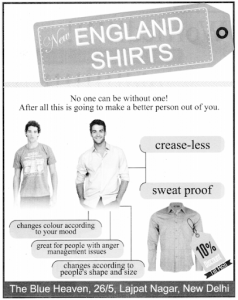
Draft a display advertisement to be published in a local daily, for the promotional sale of the NEW ENGLAND shirts launched by your company in not more than 50 words.(4 marks)
Answer:
Advertisement Writing Class 12

Question 3.
You are Manager, Infocom Network C-3 Main Shopping Center, Vasant Vihar, New Delhi. Draft an advertisement offering office furniture for sale. Give details. (4 marks) [CBSE Sample Paper 2016]
Answer:

For Sale

Fourteen chairs, ten desktop tables, ten file cabinets,special printer desk in perfect condition for sale.
The price is negotiable.

Contact person: Ramakant Misha, Phone: 9587290278
manager, Infocam Network
C-3 Main Shopping Center,
Vasant Vihar, New Delhi

Question 4.
Principal, Sunrise Global School, Agra requires a receptionist for her school. Draft a
suitable advertisement in about 50 words to be published in the classified columns of a national newspaper giving all the necessary details of qualifications and experience required in the receptionist. (4 marks) [CBSE Delhi 2016]
Answer:

Receptionist Wanted

Applications are invited by Sunrise Global School, Agra. Applicant should! be around 28 years of age, graduate, minimum of five years of working experience I conversant with the best practices of schools. Apply with full particulars and the emoluments expected within a week to Principal, Sunrise Global School, Agra-65. Phone: 040-234561.

Question 5.
You are Karan Kumar/Karuna Bajaj, a leading lawyer practising in Surat. You want to buy an independent house at City Light Road to be used as office-cum residence. Draft an advertisement in about 50 words for the classified columns of a local newspaper. You can be contacted at 45645678. (4 marks) [CBSE (AI) 2016]
Answer:

Wanted Independent House

Wanted an independent house as office-cum-residence, newly constructed, unfurnished/semi-furnished, east-facing, Vaastu compliant, preferably ground floor, minimum five rooms, two attached washrooms, in City Light Road. Should have regular water supply, covered parking space. Contact Person: Karuna Bajaj, Phone: 45645678.

Question 6.
You are Karan/Karuna of M 114, Mall Road, Delhi. You are a civil engineer and have recently returned from the UAE. You are looking for a suitable job in India. Draft an advertisement for the same in about 50 words. Give details of your qualifications, experience, nature of the job, and expected remuneration. (4 marks) [CBSE (AI) 2016]
Answer:

Situation Wanted

Wanted a job with a reputed construction company for a UAE returned civil \ engineer with more than 5 years of experience, B.Tiech (Civil Engineering) from Delhi! : College of Engineering. Worked for two years with Mahindra Group, New Delhi, and 3 years with ACL Limited, Dubai. For further details, contact:
Karan
M-114, Mall Road, Delhi
90432165

Question 7.
Your school, Akash Public School, Agra needs a canteen manager. On behalf of the Principal, write an advertisement in about 50 words to be published in the classified columns of a local daily. Mention the educational and professional qualifications, other qualities required in the manager, who to apply to, and the last date for the receipt of applications. (4 marks) [CBSE (AI) 2015]
Answer:

Required a Canteen Manager

Applications are invited for the post of Canteen Manager.
Applicant should be around 35 years of age, minimum, Class X pass, ten years of; i experience in running a school canteen. Apply within a week with full particulars and I ! emoluments expected, to the Principal, Akash Public School, 12, Besant Road, Agra.
The Principal
Akash Public School

Question 8.
You need to buy a flat. Draft a suitable advertisement in about 50 words to be published in the classified columns of a local newspaper giving all the necessary details of your requirement. You are Karan/Karuna, Ml 14, Mall Road, Delhi. (4 marks) [CBSE Delhi 2016]
Answer:

Wanted Flat

Wanted 2 BHK newly constructed, unfurnished/semi-furnished east-facing vastu compliant flat, preferably ground floor in North Delhi. Should have 24/7 water & electricity supply, covered parking space. Contact Person: Karan, Phone: 654322100.

Question 9.
You are Vikram/Sonia, a Hons graduate in history with specialisation in Medieval India. You are well acquainted with places of historical interest in Delhi, Agra, and Jaipur. You are looking for the job of a tourist guide. Write an advertisement in not more than 50 words for the ‘Situation Wanted’ column of a local newspaper. Your contact no. is 999751234. (4 marks) [CBSE (Delhi) 2017]
Answer:

Situation Wanted

A well-qualified, experienced Hons graduate in history, seeking a job as a tourist j guide; age – 28 years; hardworking, specialised in history of Medieval India, familiar: with places of historical interest in Delhi, Agra and Jaipur; good communication and interpersonal skills. Salary negotiable.
CONTACT: Sonia 999751234

Question 10.
You are the Dean, Admissions, MNT Professional College, Chandigarh. Draft an
advertisement in about 50 words giving information about admission to undergraduate courses offered by your college. Include all relevant details. (4 marks) [CBSE Sample Paper 2017]
Answer:

Educational
MNT Professional College, Chandigarh
Offers

B.Com, B. Tech, B.SC., B. Mus, B. Pharm & LLB.
Admissions On

  • Experience 8c Excellent Faculty
  • CBSE, Icse, Isc & All-State Boards
  • Candidates With Pass Certificates
  • Apply Immediately

Fee Concession & Exemption as Per Rules
Contact: Secretary Mnt Pc, Sector-12, Chandigarh
Phone: 1122538790

Question 11.
You are Vikram/Sonia, an electronic engineer who has recently returned from the US
and looking for a suitable job in the IT industry. Draft an advertisement in about 50 words for the Situation Wanted column of a national newspaper. Your contact number is 9193010203. (4 marks) [CBSE (AI) 2017]
Answer:

Situation Wanted

A well-qualified, experienced and expert electronics engineer recently returned from the US seeks a suitable job in a reputed IT company. M. Tech from the IIT Mumbai, age 35 years, experience 10 years, working with Webcom, London. Expected salary 85k per month.
Contact: Vikram 9193010203.

Question 12.
You are Arnit/Arnika. You want to sell your car as you are planning to but a new
one. Draft a suitable advertisement to be published in the vehicles column of a newspaper. (4 marks) [CBSE Sample Paper 2018]
Answer:

Car for Sale

Available for sale, black Honda City, model 2014, lineage 12 kmpl, 12,000 km driven, new seat covers, stereo fitted, non-accidental, single hand driven, fully insured, i complete documentation, pollution control certificate, affordable prices.

Question 13.
You are Harish/Harshita of 12, Seva Nagar, Pune. You want to sell your flat as you are shifting to another city for work. Draft a suitable advertisement in not more than 50 words to be published in ‘The Pune Times’ under the classified columns. (4 marks) [CBSE Paper 2018]
Answer:

For Sale

A 3 BHK, 1,500 sq. ft, on the ground floor, Savita Vihar, is available for outright sale. East facing, 3 balconies, water heater, a/c, 24*7 water and electricity. Parking for 2 cars, near schools, colleges, metro, taxi auto stand and Apollo hospital. Expected price 1.5 crores.

Question 14.
You are Principal of National Public School, Jaipur. You require a TGT (Maths) for your school. Draft a suitable advertisement in not more than 50 words for the ‘Situations Vacant’ column of ‘The National Times’ stating essential and desirable qualifications, experience, etc. of the candidates. You are Principal of National Public School, Jaipur. You require a TGT (Maths) for your school. Draft a suitable advertisement in not more than 50 words for the ‘Situation Vacant’ column of ‘The National Times’ stating essential and desirable qualifications, experience, etc. of the candidates. (4 marks) [CBSE Paper 2018]
Answer:

Situation Vacant

Required a well-qualified, Mathematics TGT for National Public School, Jaipur. Aged between 30-40, fluent in English, master’s degree in mathematics, minimum 5 years; experience, hard-working, well mannered, salary negotiable. Walk-in-interview at Principal office, National Public School, Jaipur on 23rd June 20XX.
Contact no: 9999- 8373- 99
Email address- [email protected]

NCERT Solutions for Class 12 English Flamingo Chapter 5 Indigo

Here we are providing NCERT Solutions for Class 12 English Flamingo Chapter 5 Indigo. Students can get Class 12 English Indigo NCERT Solutions, Questions and Answers designed by subject expert teachers.

Indigo NCERT Solutions for Class 12 English Flamingo Chapter 5

Indigo NCERT Text Book Questions and Answers

Indigo Think as you read 

Question 1.
Choose the correct options.
(a) Rajkumar Shukla was
(i) a sharecropper
(ii) a politician
(iii) a delegate
(iv) a landlord
Answer:
(i) a sharecropper

(b) Rajkumar Shukla was
(i) poor
(ii) physically strong
(iii) illiterate
(iv) poor
Answer:
(iii) illiterate

Question 2.
Why is Rajkumar Shukla described as being “resolute”?
Answer:
Rajkumar Shukla was a “resolute” man. He was determined to take Gandhi to Champaran, to champion the cause of the poor sharecroppers. When Gandhi said that he had a prior arrangement to go to Kanpur and to other parts of India, Shukla went everywhere with him. He also followed Gandhi to his ashram near Ahmedabad and stayed there for weeks and begged him to visit Champaran. Gandhi finally agreed to go with him, and asked him to take him to Champaran from Calcutta.

Question 3.
Why do you think the servants thought Gandhi to be another peasant?
Answer:
Shukla took Gandhi to the house of Rajendra Prasad who was out of town, but the servants knew of Shukla as a poor farmer. They, therefore, presumed Gandhi to be another peasant.

Question 4.
List the places that Gandhi visited between his first meeting with Shukla and his arrival at Champaran.
Answer:
Gandhi met Shukla in Lucknow. From there, Gandhi went to Kanpur and to other parts of India. Then Gandhi returned to his ashram near Ahmedabad. He later went to Calcutta and from there to Patna in Bihar. Gandhi then decided to go to Muzzafarpur, which was en route to Champaran, and finally to Champaran.

Question 5.
What did the peasants pay the British landlords as rent? What did the British subsequently want and why?
What would be the impact of synthetic indigo on the prices of natural indigo?
Answer:
Most of the cultivable land in the Champaran district was divided into large estates owned by Englishmen where Indian tenants worked. The chief commercial crop was indigo. The landlords forced the tenants to plant fifteen per cent of their land with indigo and give up the whole indigo harvest as rent. The landlords had learned how Germany had developed synthetic indigo. Thus, they forced the sharecroppers to sign agreements to pay them compensation to be released from the fifteen per cent arrangement.

The sharecroppers, who refused this arrangement, engaged lawyers, and to counter them, the landlords hired thugs. But, when the information about synthetic indigo reached the peasants who had signed the agreement, they wanted their money back.

Question 6.
The events in this part of the text illustrate Gandhi’s method of working. Can you identify some instances of this method and link them to his ideas of satyagraha and non-violence?
Answer:
Gandhi visited the secretary of the British landlords’ association to collect information about his cause of assisting the indigo sharecroppers. They refused to give information to an outsider but Gandhi stated emphatically that he was no outsider.

When the British official commissioner of the Tirhut division asked Gandhi to leave Tirhut, he refused. Even when the messenger served him with an official notice to quit Champaran, Gandhi signed a receipt for the notice and wrote on it that he would disobey the order. He disregarded the order to leave, “not for want of respect for lawful authority, but in obedience to the higher law of our being, the voice of conscience”.

He organised a gathering of peasants at Motihari, around the courthouse, which was the beginning of their liberation from fear of the British. Nevertheless, Gandhi cooperated with the officials to regulate the crowd. He was polite and friendly. He gave them concrete proof that their might could be challenged by Indians.

He inspired the lawyers to fight the injustice meted out to the sharecroppers. He organised them in pairs and formulated the order in which each pair was to court arrest. He demonstrated by his own example how peaceful protest and non-violence could be useful tools to achieve results. He used similar philosophy when he carried out satyagraha later in his political career.

Question 7.
Why did Gandhi agree to a settlement of 25 per cent refund to the farmers?
Answer:
After the inquiry committee report, the peasants expected the refund of the entire sum of money but Gandhi asked for only fifty per cent of the sum. However, when the representative of the planters offered to refund twenty-five per cent, Gandhi accepted it.

Gandhi felt that money was less important at that stage. What was more important was that for the first time, the landlords had been made to surrender their self-esteem. Moreover, the peasants realized that they had rights as citizens and the agitation taught them their first lesson in courage.

Question 8.
How did the episode change the plight of the peasants?
Answer:
The episode made the landlords surrender their self-esteem. Till then, the planters had behaved as lords, above the reach of law. The peasants were made to realise how they could fight for their rights. It liberated them from their fear of the British.

 Indigo Understanding the text

Question 1.
Why do you think Gandhi considered the Champaran episode to be a turning point in his life?
Answer:
Gandhi went to Champaran in 1917 and it was then that he decided on insisting that the British leave India. It was there that he raised his voice against the injustice of the landlord system in Bihar and also freed the peasants from their fear. First, he defied the secretary of the British landlords’ association, who refused to give information to an “outsider”. Next, he refused to leave Tirhut division in which the Champaran district lay despite being told to do so. He also arranged a gathering of peasants in huge numbers which was the beginning of their freedom from fear of the British.

The officials felt powerless without Gandhi’s cooperation. This was his proof that the power of the Englishmen could be challenged by the Indians.The peasants realized that they had rights and it was their first lesson in courage. Soon, within a few years, the British planters returned the estates to the peasants. This was the end of indigo sharecropping in India.

Through the Champaran incident, Gandhi declared for the first time that the British could not order Indians in their own country. He, through personal example, was able to motivate the masses into civil disobedience and teach them to be self-reliant.

Question 2.
How was Gandhi able to influence lawyers? Give instances.
Answer:
The Muzzafarpur lawyers called on Gandhi in Champaran to brief him about their cases and talked about the fees they charged the sharecroppers. Gandhi reprimanded the lawyers for charging the poor sharecroppers hefty sums of money. He also said that freedom from fear would help the sharecroppers more than merely taking such cases to court.

When Gandhi courted arrest, he assembled Rajendra Prasad, Brij Kishor Babu, Maulana Mazharul Hut and several other prominent lawyers from Bihar. He asked them what they would do if he was sentenced to prison. A senior lawyer replied that they had come to him for advise and help, and if he went to jail, there would be nobody to advise them. They felt that if Gandhi being a complete stranger was prepared to go to prison for the sake of the peasants, then it would be a shameful desertion if they, not only as residents of the adjoining districts but also as those who claimed to have served these peasants, should go home. They went back to Gandhi and told him they were ready to follow him into jail.

Question 3.
What was the attitude of the average Indian in smaller localities towards advocates of “home rule”?
Answer:
Gandhi, on his way to Champaran, decided to meet J B Kripalani of the Arts College in Muzzafarpur, whom he had seen at Tagore’s Shantiniketan school. The train reached there at midnight on 15 April 1917. Gandhi stayed there for two days in the home of Professor Malkani, a teacher in a government school. This was an extraordinary thing in those days. It was highly unlikely that a government professor would give shelter to a rebel like him, for fear of termination from service by the government. In smaller regions, the Indians were afraid to show compassion for the supporters of home-rule.

Question 4.
How do we know that ordinary people too contributed to the freedom movement?
Answer:
The author mentioned several ordinary people who contributed to the home-rule movement in different capacities.
On his way to Champaran, in Muzzafarpur, Gandhi stayed in Muzzafarpur for two days in the home of Professor Malkani, a teacher in a government school. For a government servant, Malkani, showed a great deal of courage by giving shelter to a person who was fighting for home-rule.

In Champaran, at the railway station, there was a crowd to greet Gandhi. Motihari was also teeming with peasants, though they did not know about Gandhi’s achievements. But, their gathering in huge numbers was the beginning of their freedom from fear of the British. This was the proof that the power of the British could be challenged by Indians. The lawyers, after meeting Gandhi, assured him that they would court arrest. Civil disobedience—a movement of the people—won for the first time in modem India.

Gandhi and the lawyers then conducted a detailed enquiry into the grievances of the farmers. They prepared cases for about ten thousand peasants and collected relevant documents. The masses helped Gandhi, who was not satisfied with only political or economic solutions. What concerned him was the cultural and social backwardness in Champaran. He requested teachers to educate the masses. Two young men Mahadev Desai and Narhari Parikh and their wives, volunteered to do this work. Several more including Devadas, Gandhi’s youngest son, joined in. Kasturba Gandhi, too, taught personal cleanliness and community sanitation. Volunteers from amongst the masses rendered unflinching support.

 Indigo Talking about the text

Discuss the following.

Question 1.
“Freedom from fear is more important than legal justice for the poor.” Do you think that the poor of India are free from fear after Independence?
Answer:
As the rich and well-heeled made preparations to ring in the new year in style across a new, shining India, a wave of revulsion swept through the country after the report of mass killings in a sleepy, poor housing area. This was in Nithari, no more than eighteen miles from the capital, Delhi, and in one of India’s most prosperous and upcoming districts, Noida. Violent death involving such larger numbers is not so rare in India, especially where the poor are concerned. Nithari provoked a different response, because this case illustrates best the most barbaric and basic truth about the Indian state.

The incident reveals how the country’s poor is still under the threat of injustice. It is one example of how the poor and weak have just no place in the Indian system. It also deeply concerns how the Indian media has been sucked into covering the relatively more mundane, but sensational issues. The media had heard of reports of children disappearing but no one took the trouble to take up the issue. The inefficiency of the police is just a cover- up as this could never have happened if the victims belonged to a rich or middle-class neighbourhood.

Speaking to a BBC Hindi service show, one of India’s most celebrated police officers, Kiran Bedi, said that the Nithari case was an example of how, for the common man in the country, there is no police or justice system. “The system needs to be completely overhauled and wide-ranging reforms are needed in the police structure,” she said.

But only police reforms are insufficient, the entire system and attitudes desperately need to be reformed. India’s economic prowess and potential is much talked about but can we say with the same degree of optimism that there will not be another Nithari, when India does realise its dreams?

Question 2.
The qualities of a good leader.
Answer:

  • Integrity
  • Self knowledge
  • Commitment
  • Consistency of purpose
  • Willingness to admit a mistake
  • Ability to listen
  • Openness to change
  • Decisiveness
  • Ability to go the extra mile
  • Enthusiasm
  • Awareness
  • Positive Communication
  • Dynamism
  • Impartial approach

 Indigo Working with words

Question 1.
List the words used in the text that are related to legal procedures.
For example: deposition
List other words that you know that fall into this category.
Answer:
The words used in the text that are related to legal procedures are:
proceedings, brief, cases, agreements, notice, summons, prosecutor, pleading, pronounce sentence, bail, court, reconvened, judgment, sentenced, entreaty, evidence, defenders, trial, deposition, etc.

Indigo Extra Questions and Answers

Indigo Short Answer Questions

Answer the following briefly.

Question 1.
When and where did Louis Fischer first meet Gandhi? What did they talk about?
Answer:
Louis Fischer served as a volunteer in the British Army between 1918 and 1920. He wrote a book on Gandhi named ‘The Life of Mahatma Gandhi’. He met Gandhi when he first visited him, in 1942, at his ashram in Sevagram, in central India. That was the time when Gandhi told him how he had decided to urge the departure of the British from India, in 1917.

Question 2.
Why was Gandhi in Lucknow in 1916? What happened there that was to change the course of Indian history?
Answer:
In December 1916, Gandhi had gone to the annual convention of the Indian National Congress in Lucknow, where there were 2,301 delegates and many visitors. There, he met with a poor peasant, Rajkumar Shukla from Champaran. Shukla pleaded with Gandhi to visit his hometown and brought to Gandhi’s notice the miserable plight of the indigo farmers. This fuelled his campaign in 1917 to drive out the British from India.

Question 3.
How did Rajkumar Shukla decide to meet Gandhi?
Answer:
Rajkumar Shukla was one of the many sharecroppers of Champaran. He was illiterate but resolute. He had been advised to go to the Congress session to complain to Gandhi about the injustice of the landlord system in Bihar. He was told that Gandhi could help them. He followed Gandhi through his travels and stayed with him in the ashram till Gandhi promised to accompany him for the cause of the poor peasants.

Question 4.
What episode in Patna showed Gandhi the existence of a rigid caste system?
Answer:
Shukla took Gandhi to Patna. He led him to the house of a lawyer, Rajendra Prasad, who was out of town, but the servants recognized Shukla as a poor indigo peasant. They let him and his companion, Gandhi, stay on his premises but forbade them to draw water from the well. They presumed Gandhi to be another peasant and treated him as an untouchable. Gandhi was made aware of the menace of the caste system.

Question 5.
What was Gandhi’s first step to help Rajkumar Shukla and the indigo sharecroppers?
Answer:
Gandhi decided, first, to go to Muzzafarpur en route to Champaran, to obtain more information about the prevailing conditions of the indigo sharecroppers. He, consequently, sent a telegram to Professor J.B. Kripalani of the Arts College in Muzzafarpur, whom he had seen at Tagore’s Shantiniketan school requesting a meeting.

Question 6.
Why was Gandhi’s stay with Professor Malkani an astonishing experience?
Answer:
Gandhi stayed for two days in the home of Professor Malkani, a teacher in a government school. It was unlikely for a government professor to provide shelter to a rebel like Gandhi for fear of termination from service by the government. In smaller localities, the Indians were afraid to show sympathy for the advocates of home-rule. Professor Malkani’s defiance to fall in line revealed his sympathy for the movement.

Question 7.
Why did Gandhi decide against taking the cases of the sharecroppers to the court of law?
Answer:
When Gandhi reached Muzzafarpur, the lawyers told him about their cases and revealed how they charged ‘ the peasants hefty sums of money as fees. Gandhi reprimanded the lawyers and discouraged them from charging the sharecroppers. He said taking such cases to the courts would do no good. He felt that because the peasants were so crushed and fear-stricken, the law courts were useless. The real relief to them would be to free them from fear.

Question 8.
How was Gandhi’s visit to Champaran viewed by the peasants?
Answer:
Gandhi decided to visit Muzzafarpur, en route to Champaran, to obtain more information about the situation at Champaran. The news of Gandhi’s arrival and his initiative spread through Muzzafarpur and reached Champaran. Though they did not know of Gandhi’s record in South Africa, they gathered in multitudes to see him. These sharecroppers from Champaran began arriving on foot to see the man who had come to champion their cause.

Question 9.
What was the problem of the sharecroppers in Champaran?
Answer:
Most of the agricultural land in the Champaran district was divided into large estates that were owned by Englishmen. They engaged Indian tenants to work on their lands. The landlords forced all tenants to plant . fifteen per cent of their holdings with indigo and surrender the entire indigo harvest as rent. With Germany developing synthetic indigo, the British duped the sharecroppers into entering an agreement where they were required to pay them compensation for being released from the fifteen per cent arrangement. Some peasants signed it, while others engaged lawyers to get their money back. The landlords hired thugs to fight them.

Question 10.
What was the stand of the Englishmen on indigo farming? What was the reaction of the peasants?
Answer:
The English landlords learned that Germany had developed synthetic indigo. They forced the sharecroppers to enter an agreement whereby they were required to pay them compensation for being released from the fifteen per cent arrangement. Many peasants signed it. Some of them resisted and engaged lawyers. The landlords hired thugs to get their way. When the information about synthetic indigo reached the peasants who had signed the agreement, they wanted their money back. They arranged for Gandhi to intervene on their behalf but he was met with resentment from the government who tried their best to dissuade him from taking up this cause, by forcing him to leave Champaran.

Question 11.
It was not easy for Gandhi to get information about the agreement with the peasants. Why?
Answer:
Gandhi first visited the secretary of the British landlords association to collect information about the agreement with the peasants, they refused to give information to an “outsider”. The British official commissioner of the Tirhut division, in which the Champaran district lay, bullied him, and advised him to leave Tirhut. Gandhi refused to leave.

Question 12.
What was the treatment meted out to Gandhi in Motihari? What was the reaction to Gandhi refusing to obey the order to quit Champaran?
Answer:
Gandhi was accompanied by several lawyers to Motihari. There he got news that a peasant had been maltreated in a nearby village. Gandhi decided to go and meet him, but on his way, the police ordered him to return to town and Gandhi agreed. He was then asked to quit Champaran but Gandhi declared that he would disobey the order.

Question 12.
On his refusal to quit Champaran, Gandhi received summons to appear in court the next day.
Answer:
He telegraphed Rajendra Prasad to come from Bihar with his influential friends. He sent instructions to the ashram. He wired a full report to the Viceroy. By morning, Motihari was full of peasants. They demonstrated around the courthouse when Gandhi was summoned to court. This was the beginning of their liberation from fear of the British. The officials felt powerless without Gandhi’s cooperation. Gandhi finally helped them regulate the crowd.

Question 13.
How did the gathering of peasants in Motihari help them tremendously?
Answer:
The peasants who had collected in Motihari did not know Gandhi’s achievements in South Africa. They knew that a Mahatma who wanted to help them was in trouble with the authorities. Their unplanned demonstration, in thousands, around the courthouse was the beginning of their freedom from fear of the British. Thus, Gandhi knew that this was a leap in the right direction and would go a long way in helping them achieve home-rule.

Question 14.
How did Gandhi’s non-cooperation affect the officials?
Answer:
The peasants demonstrated in large numbers to lend support to Gandhi outside the courthouse in Motihari. The officials felt helpless without Gandhi’s cooperation to bring the crowd under control. Gandhi cooperated with them and helped regulate the crowd. He was polite and friendly. He gave British proof of how they could be challenged by Indians. The government was bewildered. The authorities wished to consult their superiors.

Question 15.
What was Gandhi’s advice to the lawyers that made them champion peasants rights?
Answer:
The prominent lawyers told Gandhi that they had come to advise and help him. When Gandhi talked to them about the injustice to the sharecroppers, the lawyers realized that Gandhi was a complete stranger and yet he was prepared to go to prison for the peasants. On the other hand, if they, being residents of the adjoining districts, and having claimed to have served these peasants, should go home, it would be a shameful desertion. They promised to join in Gandhi’s efforts and follow him to jail to win the cause.

Question 16.
Why did Gandhi say, “The battle of Champaran is won”? Was it true?
Answer:
When the lawyers told Gandhi that they were ready to follow him into jail, Gandhi exclaimed that the battle of Champaran was won. He divided the group into pairs and decided the order in which each pair was to court arrest. Several days later, Gandhi received a written communication from the magistrate informing him that the case against him was to bedropped. This gave them their first victory against the injustice at Champaran.

Question 17.
Why did Gandhi compromise to break the deadlock between the sharecroppers and planters?
Answer:
The Lieutenant Governor appointed an official commission of enquiry into the indigo sharecroppers’ situation. Gandhi was the sole representative of the peasants. The sharecroppers thought Gandhi would ask for repayment of the money which the landlords had illegally extorted from them. However, he asked for only fifty per cent of the amount, but later agreed to a twenty-five per cent refund. He said that the refund was less important than the fact that the landlords had surrendered a part of the money and were brought down from their pedestal. The landlords were made to realize that they were not beyond the reach of law.

Question 18.
What were Gandhi’s chief concerns? How did he address them?
Answer:
Gandhi was keen to assist in the improvement of the cultural and social conditions of the villages. He appealed to teachers and other young people to act as volunteers. People were educated in personal cleanliness and community sanitation. He looked into the health conditions of the community and medicines were made available to the people.

Question 19.
Who helped Gandhi in his endeavour to uplift the backward people?
Answer:
Mahadev Desai and Narhari Parikh, two young men and their wives volunteered to serve the community of Champaran. Several others arrived from Bombay, Poona, and other distant parts of the land. Devadas, Gandhi’s youngest son, and his wife, Kasturba Gandhi, played a pivotal role in helping him fight backwardness. Primary schools were opened in six villages. Kasturba taught the ashram rules on personal cleanliness and community sanitation.

Question 20.
Why was the Champaran episode a turning point in Gandhi’s life?
Answer:
The Champaran episode was a turning point in Gandhi’s life. It was during his fight for justice for the Champaran peasants that he declared that the British could not order him about in his own country. It grew out of his attempt to alleviate the distress of large numbers of poor peasants. The Champaran episode made Gandhi launch a movement that finally drove out the British from India.

Question 21.
Gandhi was not a politician but his political principles were intertwined with the practical problems of the Indians. Justify.
Answer:
Gandhi’s political principle was aligned with the day-to-day problems of the masses. He was not loyal to his principles alone, he endeavoured to work towards the greater good of human beings. Champaran was a typical pattern of Gandhi’s politics. It did not begin as an act of defiance but as an effort to help the destitute.

Indigo Long Answer Questions

Question 1.
Rajkumar Shukla unwittingly played an important role in freeing the peasant community in India. Discuss.
Answer:
Rajkumar Shukla met Gandhi in December 1916, when he had gone to attend the annual convention of the Indian National Congress in Lucknow. He informed Gandhi about the injustice of the indigo sharecropping arrangement that preyed on the poor Champaran peasants. He informed him about the injustice of the landlord system in Bihar.

Though Rajkumar was illiterate, he was resolute to convince Gandhi to take up their cause. He accompanied Gandhi to Kanpur and other parts of India and to his ashram near Ahmedabad, and for weeks he never left Gandhi’s side. Finally, when Gandhi went to Calcutta, Rajkumar Shukla convinced him to visit Champaran.

Question 2.
Give a detailed account of the problem of sharecroppers in Champaran.
Answer:
In Champaran, most of the arable land was owned by Englishmen who had engaged Indian tenants to cultivate their lands. The landlords of the area compelled all tenants to plant fifteen per cent of their holdings with indigo, the chief commercial crop, and surrender the entire indigo harvest as rent. This was done by long-term contract. When the landlords learned that Germany had developed synthetic indigo, they forced the sharecroppers to enter into an agreement to rake in compensation to free them of their fifteen per cent arrangement. Many peasants signed it willingly. Those who resisted, engaged lawyers but the landlords hired thugs to beat them into accepting their terms. Meanwhile, the information about synthetic indigo reached the illiterate peasants, and they demanded their money back.

Question 3.
What was the first order of the British government that Gandhi refused to obey?
Answer:
In Bihar, to find out about the sharecropping arrangement, Gandhi first visited the secretary of the British
landlords’ association. The secretary refused to give information to an “outsider”. Next, the British commissioner of Tirhut asked him to leave Tirhut, which he did not. Instead, he proceeded to Motihari, accompanied by several lawyers. There he heard that a peasant had been maltreated in a nearby village. Gandhi decided to go and see him but he was interrupted by the police superintendent’s messenger who ordered him to return. Gandhi agreed but the messenger who drove him home served him with an official notice to quit Champaran immediately. Gandhi signed a receipt for the notice and wrote on it that he would disobey the order.

Question 4.
Why did the officials feel powerless without Gandhi’s cooperation? How did they react?
Answer:
When Gandhi was summoned to appear in court, he telegraphed Rajendra Prasad to come with his influential friends. The town of Motihari was filled with peasants, who had come because they had heard that the Mahatma, who wanted to help them, was in trouble with the authorities. The demonstration, in thousands, was the first step toward their liberation from fear. The officials felt powerless without Gandhi’s cooperation.

He helped them regulate the crowd. He proved that their might could be challenged by Indians. The government was taken aback and wanted to consult their superiors. The prosecutor requested the judge to postpone the trial but Gandhi protested against the delay. He read a statement stating that he was guilty of flouting the law but he expressed no regret for helping the cause of the poor peasants. He also refused to furnish bail and was eventually released without bail.

Question 5.
Civil disobedience had triumphed for the first time in modem India. When was it?
Answer:
Gandhi received summons to appear in court when he defied the order to leave Motihari. By morning, the peasants demonstrated to lend Gandhi support. Their spontaneous demonstration in thousands, around the courthouse was the beginning of their liberation from fear of the British. The officials were powerless and had to seek Gandhi’s help to regulate the crowd.

Several prominent lawyers from Bihar came to confer with Gandhi about his impending sentence. Gandhi convinced them to lend their voice and support to the sharecropping cause. The lawyers promised to follow Gandhi into jail. Gandhi viewed the support of the countrymen as true victory. A few days later, the case against Gandhi was dropped. Civil disobedience triumphed for the first time in modem India.

Question 6.
Cultural and social backwardness of the people was Gandhi’s chief concern. Explain.
Answer:
Gandhi was never satisfied with only political or economic solutions. He wanted to rectify the cultural and social backwardness in Champaran. He appealed for teachers and social workers to serve at Champaran.
Mahadev Desai and Narhari Parikh, two of Gandhi’s disciples, and their wives, volunteered for the work.
Several other arrived from Bombay, Poona and other distant parts of the land. Devadas, Gandhi’s youngest son, and Kasturba arrived from the ashram. Primary schools were opened in six villages. Kasturba taught the ashram rules on personal cleanliness and community sanitation. Gandhi also worked towards improving the health conditions and arranged for a doctor to volunteer his services for six months. Three medicines were made available to the poor farmers—castor oil, quinine, and sulphur ointment.

Indigo Value Based Questions

Question 1.
Gandhi compromised on the material terms because the peasants had gained what no money could buy. Explain.
Answer:
Gandhi was summoned to the offices of Sir Edward Gait, the Lieutenant Governor, with whom he had four interviews and an official commission of inquiry was ordered into the indigo sharecroppers’ situation. The commission that had Gandhi as the sole representative of the peasants, gathered a lot of evidence against the big planters, and they agreed to offer refunds to the peasants. The peasants expected repayment of the money in full but Gandhi asked for only fifty per cent. When the representative of the planters offered to refund twenty-five per cent, Gandhi agreed.

Gandhi realized that the monetary benefit that he achieved for the peasants in the way of the settlement was of less significance in comparison to the spirit of liberation they had gained. He explained that the amount of the refund was less important than the fact that the landlords had been forced to surrender a part of their money and bow down to law, bridging the divide between the landowners and the poor peasants.The peasants were made aware of their rights, their plights received a voice and they were consequently . liberated from their fear of the British.

Question 2.
“Self-reliance, Indian independence and help to sharecroppers were all bound together.” Justify.
Answer:
In Champaran, the landlords forced the peasants to enter into an arrangement to relieve them of the fifteen per cent sharecropping arrangement in return for compensation. The poor peasants were duped out of their money and they were demanding a refund. They appealed to Gandhi to fight for their cause. He resisted and was produced in a court in Motihari. Peasants flocked from around the area, and turned up in thousands to offer Gandhi their support. This planted the seeds of the first civil disobedience movement in India. Gandhi finally succeeded in making the British authorities order for reimbursement to the sharecroppers.

Though the peasants were compensated in part, they won against the system of landlord and the British government. It taught them an essential lesson in self-reliance and instilled them with courage to stand against injustice and British rule. The civil disobedience movement was the first of its kind in India, and paved way for the struggle to achieve Indian independence.

NCERT Solutions for Class 12 English Vistas Chapter 3 Journey to the end of the Earth

Here we are providing NCERT Solutions for Class 12 English Vistas Chapter 3 Journey to the end of the Earth. Students can get Class 12 English Journey to the end of the Earth NCERT Solutions, Questions and Answers designed by subject expert teachers.

Journey to the end of the Earth NCERT Solutions for Class 12 English Vistas Chapter 3

Journey to the end of the Earth NCERT Text Book Questions and Answers

Journey to the end of the Earth Reading with insight

Question 1.
How do geological phenomena help us to know about the history of humankind?
Answer:
Geological phenomena such as the drifting of land masses and their separating into countries help us to know about the history of humankind. A visit to Antarctica around which Gondwana once existed, is like going back to past as it gives us an understanding of evolution and extinction, ozone and carbon, where humankind came from, and where it is headed.

Question 2.
What are the indications for the future of humankind?
Answer:
All thoughtless activities of humankind such as increasing cities and megacities, cutting forests and turning those to concrete jungles, careless burning of fossil fuel, depleting ozone and increasing carbon dioxide, and global warming, melting ice caps and shields, our battle with other species for limited resources and other similar reckless activities point to a grim future for humankind. If concrete steps are not taken immediately, these drastic changes may lead to the end of the world.

Journey To The End Of The Earth Reading with Insight

Question 1.
‘The world’s geological history is trapped in Antarctica’. How is the study of this region useful to us?
Answer:
Antarctica holds half a million-year-old carbon track records in its layers of ice. It gives us an understanding of evolution and extinction, ozone and carbon. A visit to Antarctica, around which Gondwana once existed, is like going back to the past. Witnessing the geological phenomena, such as the drifting of land masses and their spreading into countries, help us to know about the history of humankind. These are visible signs of where humankind came from and it gives us a clear understanding of where human life is headed if we do not take care of the environment. Actually seeing with our own eyes all these changes, make us understand that global warming is a real threat.

Question 2.
What are Geoff Green’s reasons for including high school students in the Students on Ice Expedition?
Answer:
Geoff Green feels that students are the future generation of policy-makers. They should be provided an opportunity to have this life-changing experience at a young age in order to foster a new understanding and respect for our planet. It would help them to absorb, learn and act for the benefit of the planet. The youngsters still have the idealism to save the world and they need to understand that it belongs to them. So, to sensitize them, it is important to provide them the visible life changing experience.

Question 3.
‘Take care of the small things and the big things will take care of themselves.’ What is the relevance of the statement in the context of the Antarctica environment?
Ans. This statement means that if small things are taken care of, big things will take their own care. There are tall grasses, called phytoplankton, in the southern oceans that use the sun’s energy to assimilate • carbon and synthesize organic compounds by photosynthesis. Marine life and birds in the region sustain themselves on these tall grasses. Any disturbance in the environment in Antarctica might affect the activities of the phytoplankton, which, in turn, might affect the existence of the other life forms that depend on them. Small things like the phytoplankton are important in the food chain.

Question 4.
Why is Antarctica the place to go to understand the Earth’s present, past and future?
Answer:
The author states that to understand the earth’s present, past and future, Antarctica is the right place to go. Antarctica is relatively untouched in this respect as it has never had human population. It is relatively pristine. It holds in its ice cores half a million-year-old carbon records, trapped in the layers of ice. It embodies all that is pre-historic: cordilleran folds, pre-Cambrian granite shields ozone and carbon: evolution and extinction. The simple eco system and lack of biodiversity indicate how little changes in the environment can have big repercussions.

A visit to Antarctica and witnessing the geological phenomena, such as the drifting of land masses, glaciers receding and ice shelves collapsing makes us understand that global warming is a real threat. Hence, to study the earth’s past, present and future, these factors make Antarctica the best place to go.

Journey To The End Of The Earth Extra Questions and Answers

Journey To The End Of The Earth Short Answer Questions

Question 1.
When did the author start her journey to Antarctica and what had she to pass through?
Answer:
The author started her journey 13.09 degrees north of the Equator in Madras—she was on board a Russian research vessel—the Akademik Shokalskiy. She had to pass through nine time zones, six checkpoints, three bodies of water and at least as many ecospheres. After travelling over hundred hours in combination of a car, an aeroplane and a ship, she reached Antarctica.

Question 2.
What emotions did the author experience when she reached Antarctica at last?
Answer:
The author finally set foot on the Antarctica continent after travelling over 100 hours in combination of car, aeroplane and ship. Her first emotion on seeing the vast expansive white landscape and the blue horizon was of relief. She experienced the emotion of wonder at its immensity and isolation and its strange relationship with India.

Question 3.
How would you describe Gondwana?
Answer:
Gondwana was a giant amalgamated southern supercontinent, centering around present-day Antarctica. Humans had not arrived on the global scene. The climate was much warmer. There was a huge variety of flora and fauna. Gondwana thrived for 500 million years. When the age of the mammals got underway, the landmass was forced to separate into countries. Antarctica separated from the whole landmass shaping the globe as we know it today.

Question 4.
What is that thing that can happen in a million years and would be mind-boggling?
Answer:
The author says that in a million years India may push northwards, jamming against Asia. It will buckle its crust and form the Himalayas – South America may drift off to join North America. The Drake Passage may open up to create a cold circumpolar current. Antarctica may remain frigid, desolate and at the bottom of the world.

Question 5.
In what respect, Tishani Doshni’s encounter with Antarctica is a chilling prospect?
Answer:
The author remained there for two weeks. For a sun worshipper South Indian, being face to face with ninety per cent of earth’s total ice volume was a mind-boggling and chilling prospect. It was also a chilling experience for circulatory and metabolic functions and for imagination. It is like walking into a giant ping-pong ball with no human markers such as trees, billboards, and buildings.

Question 6.
What is the visual experience in Antarctica?
Answer:
In Antarctica the visual scale ranges from the microscopic to the mighty midgets and mites to blue whales and icebergs as big as countries. The writer refers to it as walking into a giant ping-pong ball devoid of any human markers, without trees, billboards, buildings. Days go on in 24 hours austral summer light. A ubiquitous silence, interrupted only by an occasional avalanche or calving ice sheet consecrates the place.

Question 7.
How, according to the author, has mankind etched its dominance over nature?
Answer:
According to the author, though civilizations have been around for barely a few seconds on the geological clock, yet they have created a ruckus by their various activities like exploiting the limited resources and careless burning of fossil fuels. In the short span of existence on the earth, they have already created a blanket of carbon dioxide and increased the average global temperature.

Question 8.
How has Antarctica sustained itself and managed to remain pristine?
Answer:
Antarctica, on account of being the coldest, windiest and driest continent in the world, has never sustained a human population and has thus managed to remain pristine. This has prevented man from being able to create ruckus in this part of the world by his thoughtless exploitation of the natural resources.

Question 9.
How is global temperature increasing? What are the immediate fears due to it?
Answer:
Global temperature is increasing due to the increasing burning of fossil fuels. It has now created a blanket of carbon dioxide around the world. This has given birth to questions like: Will the West Antarctica ice sheet melt entirely? Will the Gulf Stream Ocean current be disrupted? Will it be the end of the world as we know of? It may be. It may not be.

Question 10.
How is Antarctica a crucial element in the debate of climate change?
Answer:
Antarctica is a crucial element not because it has no human population but because it holds in its ice cores half a million year old carbon records. They are trapped in its layers of. ice. It will open up areas of knowledge about the past, present and future of the earth.

Question 11.
What are the reasons for the success of the Students on Ice programme?
Answer:
Sitting distant in the comfort zone of our houses, any talk about global warming looks so unreal and one can be unconcerned. But the visible experience of seeing glaciers retreating, ice caps melting and ice shelves collapsing makes one understand and realize what global warming is all about. The indications for the future of humankind become clear when one actually witnesses the geological phenomena.

Question 12.
The author says that her Antarctica experience was full of such epiphanies. What was that best epiphany that occurred there?
Answer:
The Akademik Shokalskiy got wedged into a thick white sheet of ice. The captain decided to turn around and asked the passengers to walk on the ocean. Underneath their feet they saw 180 metres of living, breathing salt water. Crab eater seals were stretching and sunning themselves on ice floes much like stray dogs under a banyan tree. It was a great epiphany, a revelation.

Question 13.
What is that beauty of balance that a trip to Antarctica unfolded to the author?
Answer:
The author was wonderstruck by the beauty of balance in play on our planet. Travelling across nine time zones, three bodies of water and as many ecospheres was an experience that unfolded a wide range of climate, geographical features, and flora and fauna. It was also a visible experience of the varied geographical phenomena.

Question 14.
Why does the author conclude the chapter by saying that a lot can happen in a million years, but what a difference a day makes?
Answer:
The author concludes the chapter by saying that much more can really happen in a million years as it happened in the case of Antarctica. But in this long period, changes even in a day make a great difference because global climate is changing. It is posing a threat to the beauty of balance on the earth.

Question 15.
What are phytoplanktons? What is their importance?
Answer:
Phytoplanktons, the grasses of the sea, are single-celled organisms living in the southern ocean. They nourish and sustain the entire ocean’s food chin, being first link in the food chain of ocean. Using sun’s energy, they assimilate carbon and synthesize organic compounds.
The diminishing number of these organisms due to the depletion of ozone layers affects other organisms of the ocean, finally leading to the extinction of life on earth.

Question 16.
Why does the author feel that the prognosis for the human beings is not healthy?
Answer:
The world is battling an ever increasing population, leading to burning of fossil fuels. This has created a blanket of carbon dioxide around the world thereby increasing global temperatures. All this is hazardous and life threatening for all flora and fauna. Hence the future of mankind in fact, all life on earth, is bleak. So, the author is correct in saying that the prognosis for man is not encouraging and healthy. . , j

Question 17.
Why is it necessary to remain fully equipped while walking on ice?
Answer:
While walking on ice, the troupe was fully kitted out in Gore-Tex (type of spiked boots that help in walking on ice) and glares. The spiked boots protect them from falling down on ice which might result in injury and the glares protect the eyes because the sunglasses can injure their eyes, particularly the ratina.

Question 18.
Do you think that programmes like the Students on Ice do more harm than good? Support your answer.
Answer:
I personally feel that such trips do more harm than good. We have ruined the earth as much as we could and as wide as we could go, because Antarctica was far away and extremely cold. But now we have so many reasons to go to this pristine continent. Let’s not encourage such trips. After all, what else do we have to learn about the earth than the fact that we have been running a business, not a service. Please spare Antarctica.

Student on Ice is an educational journey to Antarctica. It took high school students to Antarctica where they understood the seriousness of the threat that the end of the earth is quite near. By visiting Antarctica they would act their bit to save the planet from further deterioration. The educational youth of today is the hope for the earth and if they are more informed and more aware of the weakening strength of the earth, they will be able to steer the government machinery of their countries as they grow up.

Question 19.
Does the study of the lesson give you a feeling that man is his own great enemy?
Answer:
In his 12000-year-long stint on the earth so far man has caused untold harm to the planet, its environment and biodiversity. His activities in the name of development have spelt doom for the flora and fauna and his own existence is in danger. Man is to blame for all the havoc and ruckus created on earth. Thus it is quite right that man is his own great enemy.

Journey To The End Of The Earth Long Questions and Answers

Question 1.
What is the significance of the title ‘Journey to the End of the Earth’?
Answer:
The title ‘Journey to the End of the Earth’, has more than one meaning. It describes an educational journey to Antarctica undertaken by a group of high school students. To learn more about the real impact of global warming and future of the earth 52 students went to the coldest, driest, windiest continent in the world called Antarctica in Russian research vessel, the Akademik Shokalskiy.

The author calls it a journey to the end of the earth because it began 13:09 degrees North of Equator in Madras, involved crossing nine time zones, six checkpoints, three oceans and as many ecospheres. She travelled over 100 hours in combination of a car, an aeroplane and a ship. The journey being to the extreme south of the the earth, was really towards the end of it. Another meaning of this title is more significant as the warnings that Antarctica gives are shocking and much concerning the humanity and the millions of other species on the earth. The changes taking place in Antarctica are pointing a warning finger at the existence of of the earth; the earth is journeying to its end.

Question 2.
The author says, ‘It was nothing short of a revelation: everything does connect.’What does it mean?
Answer:
Antarctica is a perfect place to study how little changes in the environment can have big repercussions as far as Antarctica is concerned. Various human activities like exploiting the limited resources and careless burning of fossil fuel have already created a blanket of carbon dioxide, increased the average global temperatures and caused the retreating of glaciers, melting of ice caps and collapse of ice shelves as far as Antarctica. Global warming does not only change the geographical features, but also cause depletion in the ozone layer which will affect the activities of the phytoplanktons, the tall grasses which support the lives of marine animals and birds of the region. Hence, the author says everything does connect and all human activities are interlinked with the geological phenomena, whatever be the geological distance.

Question 3.
By whom and with what objective was Students on Ice programme started? How far has it achieved its goals?
Answer:
The Students on Ice programme was started by Canadian Geoff Green. He felt students are the future generation of policy-makers. They should be provided an opportunity to have this life¬changing experience at a young age in order to foster a new understanding and respect for our planet. It would help them to absorb, learn and, more importantly, act for the benefit of the planet.

Geoff Green was tired of taking celebrities and retired rich curiosity seekers who could only give back in a limited way. It means Geoff wanted something in return from his passengers to solve the problems relating to climate changes due to environmental pollution. It is difficult to imagine or be affected by the polar ice caps melting while sitting in our living rooms and so this visible life changing expence is important. Hence, this programme made the children learn that to save big things, small . things must be cared for.

Question 4.
What makes Antarctica an ideal subject of study?
Answer:
Antarctica is the only place in the world which has never sustained a human population. It thus remains relatively pristine in this respect. But, more importantly, it holds in its ice core, half a million- year-old carbon records trapped in its layers of life. Antarctica has a simple ecosystem and lack of biodiversity. It is, therefore, a perfect place to study how little changes in the environment can have big repercussions. Visiting Antarctica means knowing where we have come from and where we could possibly be heading. This place holds the key to know the geological evolution and it shall reveal the earth’s past, present and future.

Question 5.
The author states that her Antarctic experience was full of epiphanies, but the best occurred just short of the Antarctic Circle of 65-55 degrees south? Explain.
Answer:
Epiphanies is a Christian festival that celebrates the revelation or enlightenment. Here epiphanies are used metaphorically to suggest moments when the author suddenly becomes conscious of something that is very important to her.

The author experienced the rare of the rarest experiences there in Antarctica both in relation to beauty, wonder, and geological phenomena. Such masterly geological epiphany was experienced by her when the Akademik Shokalskiy got wedged into a thick white stretch of ice between the peninsula and Tadpole Island. The captain decided to turn around and asked the passengers to walk on the ocean. They kitted out in Gore-Tex and glares, walking on a white sheet of ice. Underneath their feet was a metre-thick ice pack. And underneath that, 180 metres of living breathing, saltwater lay before them. In the periphery, crabeater seals were stretching and sunning themselves on ice floes. They were doing so like stray clogs will do under the shade of a banyan tree. It was nothing short of revelation. The author saw in it that everything does indeed connect. This really proved to be the most wonderful experience of all experiences of Antarctica.

NCERT Solutions for Class 12 Biology Chapter 8 Human Health and Diseases

NCERT Solutions for Class 12 Biology Chapter 8 Human Health and Diseases

These Solutions are part of NCERT Solutions for Class 12 Biology. Here we have given NCERT Solutions for Class 12 Biology Chapter 8 Human Health and Diseases

Question 1.
What are the various public health measures, which you would suggest as a safeguard against infectious diseases?
Solution:
Prevention and control of infectious diseases

I. For water-borne diseases like typhoid, amoebiasis, etc.
Practice personal and public hygienic measures.

a. Personal hygienic measures

  • Keeping the body clean
  • Consumption of clean drinking water
  • Eating fresh food

b. Public hygienic measures

  • Proper disposal of waste and excreta
  • Periodic cleaning and disinfection of water reservoirs, pool, tank etc.

II. For air-borne diseases like common cold, pneumonia

  • Avoid close contact with infected persons.
  • Avoid the use of belongings of the infected persons.

III. For vector-borne diseases like malaria

  • Control and eliminate the vectors and their breeding places
  • Introducing larvivorous fishes like Gambusia in ponds that feed on the larvae of the mosquito
  • Avoid stagnation of water around the residential area.
  • Spraying of insecticides in ditches, drainage areas, etc.
  • Protection from a mosquito bite. Use mosquito nets in the doors and windows to prevent the entry of mosquitoes. It is very important in the light of recently widespread diseases like dengue fever, chikungunya etc.

The use of vaccines and immunization programmes has enabled us to eradicate smallpox. Diseases like polio, diphtheria, tetanus etc. have been controlled to an extent by the use of vaccines. Nowadays biotechnology is focussing on the preparation of newer and safer vaccines. A large number of antibiotics are available to treat many infectious diseases.

Question 2.
In which way has the study of biology helped us to control infectious diseases?
Solution:
Study of biology has helped us to know about causes of diseases, carriers of diseases (vectors), effects of diseases on different body functions and above all, means to control diseases. Our immune system plays a major role in preventing diseases.

Question 3.
How does the transmission of each of the following diseases take place ?

  1. Amoebiasis
  2. Malaria
  3. Ascariasis
  4. Pneumonia

Solution:

  1. Through contaminated food and water.
  2. Through Anopheles mosquito.
  3. Through contaminated food and water.
  4. By inhaling the droplets or aerosols released by infected persons.

Question 4.
What measure would you take to prevent water-borne diseases?
Solution:
Water-borne diseases can be prevented by drinking clean water. Water should be free from contamination, suspended and dissolved substances. If water is contaminated it should be boiled and filtered before drinking. Periodic cleaning and disinfection of water reservoirs, pools, and tanks should be done.

Question 5.
Discuss with your teacher what does ‘a suitable gene’ means, in the context of DNA vaccines.
Solution:
‘A suitable gene’ means the gene which is able to produce antigenic polypeptides of the pathogen in bacteria and yeast. Using recombinant DNA technology, it is possible to produce vaccines in large scale for immunisation. Hepatitis B vaccine is produced using this technology.

Question 6.
Name the primary and secondary lymphoid organs.
Solution:
Primary lymphoid organs are bone marrow and thymus. Secondary lymphoid organs are the spleen, lymph nodes, tonsils, Peyer’s patches of the small intestine, and mucosa-associated lymphoid tissues (MALT).

Question 7.
The following are some well-known abbreviations, which have been used in this chapter. Expand each one to its full form.

  1. MALT
  2. CMI
  3. AIDS
  4. NACO
  5. HIV

Solution:

  1. MALT – Mucosal-associated lymphoid tissue.
  2. CMI – Cell-Mediated Immunity
  3. AIDS – Acquired Immuno Deficiency Syndrome
  4. NACO – National AIDS Control Organisation
  5. HIV – Human immunodeficiency virus.

Question 8.
Differentiate the following and give examples of each.

  1. Innate and acquired immunity,
  2. Active and passive immunity

Solution:

  1. : Differences between innate and acquired immunity are as follows:
    NCERT Solutions for Class 12 Biology Chapter 8 Human Health and Diseases Q1.1
  2. Differences between active and passive immunity are as follows:
    NCERT Solutions for Class 12 Biology Chapter 8 Human Health and Diseases Q1.2

Question 9.
Draw a well-labeled diagram of an antibody molecule.
Solution:
NCERT Solutions for Class 12 Biology Chapter 8 Human Health and Diseases Q9.1

Question 10.
What are the various routes by which transmission of the human immunodeficiency virus takes place?
Solution:
Various routes of entry of ADDS virus are:

  • Sexual contact with the infected person.
  • Through placenta (from infected mother to foetus).
  • Transfusion of infected blood or blood products.
  • Sharing infected needles by drug abusers.

Question 11.
What is the mechanism by which the AIDS virus causes a deficiency of the immune system of the infected person?
Solution:
After getting into the body, the virus enters into the macrophages and converts its RNA genome into DNA with the help of a reverse transcriptase enzyme. The viral DNA takes and directs the infected cells to produce more virus particles i.e., the infected macrophages act like an HIV factory. Simultaneously, the HIV attack the T- lymphocytes and replicate and produce more viruses. Then they are released into the blood and attack other T-lymphocytes.

This will lead to a decrease in the number of T-lymphocytes and the patient begins to show the symptoms such as fever, diarrhea, weight loss etc. Subsequently, his immune system weakens and becomes more prone to infections of bacteria (like Mycobacterium), viruses, fungi and even parasites like Toxoplasma. Finally, he is unable to protect himself.

Question 12.
How is a cancerous cell different from a normal cell?
Solution:
Cancerous cell and normal cell are different in the following aspects:
NCERT Solutions for Class 12 Biology Chapter 8 Human Health and Diseases Q12.1
NCERT Solutions for Class 12 Biology Chapter 8 Human Health and Diseases Q12.2

Question 13.
Explain what is meant by metastasis.
Solution:
The rapid growth of cancerous tumour causes overcrowding and disruption of normal cells. It extends to neighbouring tissues. In the last stage, bits of tumour tissue break off and are carried by the circulating blood or lymphs to other parts of the body, where they invade new tissues and start new tumors called secondary tumors. This property is called metastasis. It is fated due to increasing interference with the body’s life processes.

Question 14.
List the harmful effects caused by alcohol/drug abuse.
Solution:
Harmful effects caused by alcohol/drug abuse are as follows:

  • Among youth there is drop in academic performance, lack of interest in personal hygiene, isolation, depression, fatigue, aggressive and rebellious behavior, deteriorating relationships with family and friends, loss of interest in hobbies, change in sleeping and eating habits, fluctuations in weight, appetite, etc.
  • Excessive dose of drugs leads to coma and death due to respiratory failure, heart failure or cerebral haemorrhage.
  • Abusers become mental and cause financial distress to their entire family and friends.
  • They may acquire serious infections like AIDS and hepatitis by taking drugs intravenously.
  • Intake of alcohol/drugs damages nervous system, liver (cirrhosis) and kidney.
  • Drug abuse adversely affects foetus in case of pregnancy, leading to Foetal Alcohol Syndrome (FAS).
  • Continuous use of narcotics and stimulants cause impotency and chromosomal aberrations.
  • Heavy drinking can cause an acute alcoholic myopathy characterised by painful and swollen muscles and high levels of serum creatine phosphokinase (CK). Chronic alcoholic men may show testicular atrophy with shrinkage of the seminiferous tubules and loss of sperm cells.
  • Heavy drinking causes acute and chronic pancreatitis.
  • Alcohol increases RBC size causing a mild anemia.
  • Legal problems occur, such as arrest by police for obtaining and keeping drugs unlawfully.

Question 15.
Do you think that friends can influence one to take alcohol/drugs? If yes, how can one protect himself/herself from such an influence?
Solution:
Yes. This can be avoided by

  • Choosing a good peer group.
  • Discussing ways and means to counteract the presence if any with family elders and teacher/counselors
  • Telling the program of an outing to family.
  • Keeping contact with family while outside the home.

Question 16.
Why is it that once a person starts taking alcohol or drugs, it is difficult to get rid of this habit? Discuss it with your teacher.
Solution:
Once a person starts taking alcohol or drugs, it is difficult to get rid of this habit because he becomes addicted to it. Addiction is a psychological attachment to certain effects such as euphoria and a temporary feeling of well-being. These drive people to consume drugs/alcohol even when these are not needed, or even when their use becomes self-destructive. With repeated use, the tolerance level of the receptors present in the body increases, which consequently leads to a higher dose of drugs/alcohol and addiction.

Thus, the addictive potential of drugs and alcohol pull the user into a vicious circle leading to their regular use from which he/she may not be able to get out.

Question 17.
In your view what motivates youngsters to take alcohol or drugs and how can this be avoided?
Solution:
There are many factors that motivate youngsters to take alcohol or drug. These include:

  • Choosing a good peer group.
  • Discussing ways and means to counteract the presence if any with family elders and teacher/counselors
  • Telling the programme of an outing to family.
  • Keeping contact with family while outside the home.

This can be avoided by the following measures:

  1. Education and counseling: Educating and counseling people to face problems and stresses, and to accept disappointments and failures as a part of life.
  2. Seeking help from parents and peers: Help from parents and peers should be sought immediately so that they can guide appropriately. Help may even be sought from close and trusted friends.
  3. Looking for danger signs: Alert parents and teachers to look for and identify the danger signs. Even friends, if they find someone using drugs or alcohol, should not hesitate to bring this to the notice of parents or teachers in the best interests of the person concerned.
  4. Seeking professional and medical help: Lots of help is available in the form of highly qualified psychologists, psychiatrists, and de-addiction and rehabilitation programmes to help individuals who have unfortunately got in the quagmire of drug/alcohol abuse.
  5. Cross-checking before prescribing and selling drugs: The physicians should prescribe the habituating drugs only to genuine persons and only for the essential duration. Pharmacists should not sell these drugs without the physician’s prescription.
  6. Discipline: Good nurturance with consistent discipline but without suffocating strictness reduces the risk of addictions.
  7. Communication: The child must be able to communicate with the parents seeking clarification of all doubts and discussing problems that arise in studies or develop in the class, with friends, siblings and others.
  8. Appreciation: For even the smallest achievement, good behavior and other activities, the child should be appreciated.
  9. Independent working: Giving responsibility to the child for small tasks and allowing him/her to perform independently. However, guidance should be provided where required.
  10. Avoid undue pressure: Every child has a specific personality with certain preferences and choices. They should be taken care of and respected. No child should be asked to perform beyond threshold limits whether in studies, sports or extracurricular activities.

We hope the NCERT Solutions for Class 12 Biology Chapter 8 Human Health and Diseases help you. If you have any query regarding NCERT Solutions for Class 12 Biology Chapter 8 Human Health and Diseases, drop a comment below and we will get back to you at the earliest.

NCERT Solutions for Class 11 English Hornbill Chapter 2 We’re Not Afraid to Die

Here we are providing NCERT Solutions for Class 11 English Hornbill Chapter 2 We’re Not Afraid to Die. Students can get Class 11 English We’re Not Afraid to Die NCERT Solutions, Questions and Answers designed by subject expert teachers.

We’re Not Afraid to Die… If We Can All Be Together NCERT Solutions for Class 11 English Hornbill Chapter 2

We’re Not Afraid to Die… If We Can All Be Together NCERT Text Book Questions and Answers

We’re Not Afraid to Die… If We Can All Be Together Understanding the text

Question 1.
List the steps taken by the captain
(i) to protect the ship when rough weather began.
(ii) to check the flooding of the water in the ship.
Answer:
(i) to protect the ship when rough weather began.
Answer:
The captain slowed the boat down, dropped the storm jib and lashed a heavy mooring rope in a loop across the stem. Then they double-lashed everything, went through their life raft drill, attached “lifelines, donned oilskins and life jackets and waited.”

(ii) to check the flooding of the water in the ship.
Answer:
As the water started accumulating in the ship, the captain did not dare to abandon the wheel to examine the waterlogging. When Mary informed him that the decks were smashed and the boat was full of water, he gave the wheel to Mary and made it to the hatch. Larry and Herb were pumping out the water frantically. He found a hammer, screws and canvas, and walked back to the deck with difficulty.

He made some repairs. He stretched the canvas and secured that the waterproof hatch covers across the gaping holes. Some water continued to stream below, but most of it was now being deflected over the side. But soon the hand pumps started to block up with the debris floating around the cabins and the electric pump short-circuited. He found the two spare hand pumps had been overboard. Then he took the electric pump and connected it to an out-pipe and managed to pump out the water.

Question 2.
Describe the mental condition of the voyagers on 4 and 5 January.
Answer:
After battling with the waves and continuously pumping out water for thirty-six hours, on 4 January, the voyagers managed to pump out almost all the water that had accumulated and had to keep pace with the water that was still coming in. Then they hoisted the storm jib and sailed towards where they thought the two islands were. It was then that they were relieved and ate their first meal in almost two days. But much to their disappointment, at 4 p.m. black clouds gathered behind them.

The wind was back to 40 knots and the sea was getting higher. The weather continued to get worse throughout the night, and by dawn on 5 January, the situation was again distressing. The author tried to comfort the children, who seemed to be resigned to their fate. He was resolute to fight the sea but by the evening, Mary and he sat together holding hands, as the water seeped in through the broken planks. Both of them felt that their end was very near.

Question 3.
Describe the shifts in the narration of the events as indicated in the three sections of the text. Give a subtitle to each section.
Answer:
The text has been divided into three sections. The narration shifts as the events unfold. The first section deals with the narrator’s desire to go sailing around the world, the preparations they made, the onset of the journey and the coming storm. In this section, the narrator sums up more than sixteen years of preparations and the first 3,500 kilometres of their journey in a few paragraphs.

The second section describes the storm and the damage caused to the boat by the storm. The narrator describes in detail the events of 2 January when their ship was buffeted by the storm. He mainly deals with the action taken to avert disaster. In the third section, the narrator steers the ship to safety at He Amsterdam.

In this section, he describes the events of two days and focuses on the emotions of the members of the family as the near-tragedy drew them closer together. The 1 st section can be subtitled .The sea voyage and its challenges, the 2nd – Damages caused by the storm, and the 3rd- Finding lie Amsterdam.

We’re Not Afraid to Die… If We Can All Be Together Talking about the text

Discuss the following questions with your partner.

Question 1.
What difference did you notice between the reaction of the adults and the children when faced with danger?
Answer:
When the adults were faced with danger, they were anxious and sought out ways of battling it. For instance, when they faced rough weather for the first time, they fastened everything, went through their life raff drill, attached lifelines, put on oilskins and life jackets. As the ship flooded with water, Mary panicked and the narrator put her at the wheel, struggled with tools till the ship was waterproof and the water had been bailed out.

They assessed the situation, tried to adopt the best possible strategy for coping with the situation but were often dejected. When the narrator was thrown overboard, he accepted death as inevitable. Similarly, when the motion of the ship brought more and more water in through the broken planks, Mary and the narrator sat holding hands as both felt the end was very near.

On the other hand, Sue hurt herself. Her head had swollen a lot, she had two huge black eyes, and a deep cut on her arm but this did not worry her. The situation worsened and when the author tried to comfort the children on 5 January, Jon said that they were not afraid of dying if the family could be together. due, who was injured, moved up to him and gave him a card she had made. It was a message to hope for the best. The probable reason for the difference in reaction is that the children did not realise the gravity of the situation, like the adults, or that they do not cling on to life like adults.

Question 2.
How does the story suggest that optimism helps to endure “the direst stress”?
Answer:
It was the sheer optimism of the narrator and the two men in the crew, Larry and Herb, that helped them carry on in the face of life-threatening dangers. They celebrated Christmas despite the gales. When the storm struck and the narrator was flung overboard, he did not give up hope but got back to the ship with his ribs cracked and his mouth filled with blood and broken teeth. He took the wheel and fought water that was getting into the ship.

This shows, they were not willing to give in to danger but were ready to battle it. They faced the extremely cold night, struggling to pump out water, find direction and also work the radio. With no response to their desperate calls for help because they were in a distant comer of the world, they were still optimistic about finding lie Amsterdam and steered the ship towards that direction. Their optimism paid off” and they came out of a stressful situation.

Question 3.
What lessons do we learn from such hazardous experiences when we are face-to-face with death?
Answer:
One learns to be:

  • optimistic.
  • cooperative.
  • a team player.
  • alert to make the best of what one has.
  • enduring.

Question 4.
Why do you think people undertake such adventurous expeditions in spite of the risks involved?
Answer:
A human being’s life has become monotonous and mechanical. This deprives us of two important ingredients of happiness spontaneity and variety. Mechanical regularity produces discontentment as it is devoid of joy. Spontaneity and variety are needs of our instinctive nature that can only be satisfied by such adventures. Adventurous expeditions and other high level sports or activities break the monotony of modem life and provide opportunities to test our survival skills.

We’re Not Afraid to Die… If We Can All Be Together Thinking about language

Question 1.
We have come across words like ‘gale’ and ‘storm’ in the account. Here are two more words for ‘storm’: typhoon, cyclone. How many words does your language have for ‘storm’?
(Answers will vary).

Question 2.
Here are the terms for different kinds of vessels: yacht, boat, canoe, ship, steamer, schooner. Think of similar terms in your language.
(Answers will vary).

Question 3.
‘Catamaran’ is a kind of a boat. Do you know which Indian language this word is derived from? Check the dictionary.
Answer:
The word was coined in the early seventeenth century. It is derived from the Tamil word kattumaram, that means ‘tied wood’. Catamaran is a name applied to any craft having twin hulls. Originally, it denoted a form of Sailing and paddling raft employed on the coasts of India. In a catamaran, two similar or identical hulls are joined parallel to each other at some distance apart by beams or a platform.

Such crafts were highly developed in the Hawaiian, Marquesas, Tuamotu islands and Tahiti. Some of these crafts had hulls of unequal length. In recent years, the sailing catamaran has again become popular. The advantage of the catamaran is that great stability can be combined with lightness and low water resistance. In recent years, a triple-hull craft called a trimaran has also been developed.

Question 4.
Have you heard any boatmen’s songs? What kind of emotions do these songs usually express?
Answer:
Some famous boatmen songs include “Drunken Sailor” which describes a group of boatmen pondering over what to do with a drunken sailor early in the morning. “A Hundred Years Ago” pokes fun at the simplicity and foolishness of people that lived a hundred years ago, who thought pigs could fly and the moon was made of cheese. Both these songs are part of the genre referred to as shanty which are songs sung by boatman to amuse themselves during their work. Therefore the tone and lyrics are usually light hearted and amusing.

(Answers will vary).

We’re Not Afraid to Die… If We Can All Be Together Working with words

Question 1.
The following words used in the text as ship terminology are also commonly used in another sense. In what contexts would you use the other meaning?
knot ,stern, boom, hatch, anchor
I. Knot:

  • object made by tying: a usually hard, lump-shaped object formed when a strand of something such as a string or rope is interlaced with itself or another strand and pulled tight .
  • way of tying: a way of joining or securing lengths of rope, thread, or other strands by tying the material
    together or around itself
  • tangled mass: a tightly tangled mass of strands that are hard to separate
  • tight group: a number of people or things grouped closely together
  • tense feeling: a feeling of tightness or anxiety, for example, a knot in my stomach
  • close emotional tie: a deep bond, especially marriage
  • decoration: a piece of material such as ribbon or braid tied in a knot or bow and used as a decoration
  • problem: a difficult or complex problem
  • lump on tree: a lump on a tree trunk or branch
  • hard patch on tree: a hard patch on a tree out of which a branch or stem grows
  • dark whorl in timber: a hard, dark-coloured patch in cut wood at a point where a branch or stem formerly grew out of the tree
  • lump in body: a node, ganglion, lump, or swelling in the body
  • unit of speed: a unit of measurement for the speed at which a ship or aircraft travels, equivalent to one nautical mile per hour, approximately 1.85 kph/1.15 statute mph, symbol: kn
  • an indicator measuring ship’s speed: a division on a log line used to calculate the speed of a ship

II. Stern:

  • strict: rigid, strict, and uncompromising
  • forbidding: grim, austere, or forbidding in appearance

III. Boom (verb)

  • make loud deep sound: to make a cold, deep reverberating sound
  • utter something loudly: to say something in a loud, deep voice
  • experience significant increase in trade: to experience a significant expansion of business and investment, either across an economy or in a specific market, for example, Business is booming.

(noun)

  • loud deep sound: a loud deep reverberating sound
  • deep loud bird or animal noise: a deep, loud cry made by some birds and animals.
  • significant increase in amount: a significant increase in the amount of something such as a population level, for example, a population boom
  • significant increase in business: a significant expansion of business and investment, either across an economy or in a specific market, for example, a boom in sales

IV. Hatch

  • type of door: a door cut into the floor or ceiling of something, especially on a boat or an aircraft. It is lifted to provide access to the area below or above it. A hatch may also provide access to an attic or cellar in a building.
  • small hole between two rooms: a small connecting hole in a wall between two rooms, or the small doors that cover this hole, for example, an escape hatch

V. Anchor (noun)

  • device to hold ship in place: a heavy, traditionally double-hooked device for keeping a ship or floating object in place
  • device keeping object in place: any device that keeps an object in place
  • something dependable: somebody or something that provides stability
  • presenter of news programme: a presenter on a news programme, providing a link between the studio and reporters based outside
  • somebody positioned last: the team member who is responsible for the last leg in a relay race or who is at the back in a tug of war
  • climber’s rope attachment: a point to which a climber’s rope is fixed, for example, on a rock face or in ice

(Verb)

  • hold something in place: to hold something securely in place
  • put down anchor: to moor a ship by lowering its anchor so that it remains stationary in a place
  • present news programme: to be the presenter on a news programme

Question 2.
The following three compound words end in -ship. What does each of them mean? airship flagship lightship
Answer:
I. airship – a large aircraft without wings, used especially in the past and consisting of a large bag filled with
gas which is lighter than air and powered by engines. Passengers were carried in an enclosed structure hanging  below.

II. flagship –
(a) most important of group: the most important or prestigious among a group of similar and related things

  • the flagship of the hotel chain
  • the company’s flagship hotel

(b) commanding ship: the ship from which the admiral or unit commander controls the operation of a fleet
(c) main commercial ship: the main ship in a commercial fleet

III. Lightship – ship functioning as lighthouse: a ship with a bright, flashing light that functions as a lighthouse, especially one that is anchored in a place where a permanent structure would be impracticable

Question 3.
The following are the meanings listed in the dictionary against the phrase ‘take on’. In which meaning is it used in the third paragraph of the account:
Answer:
take on something: to begin to have a particular quality or appearance; to assume something
take somebody on: to employ somebody; to engage somebody to accept somebody as one’s opponent in a game, contest or conflict
take somebody/something on: to decide to do something; to allow something/somebody to enter, for example, a bus, plane or ship; to take something/somebody on board.
In the third paragraph, it means ‘to employ’ or ‘to engage’.

We’re Not Afraid to Die… If We Can All Be Together Things to do 

bow  – cabin – rudder – cockpit – stern – boom – mainsail – mast
NCERT Solutions for Class 11 English Hornbill Chapter 2 We’re Not Afraid to Die

2. Here is some information downloaded from the Internet on lie Amsterdam. You can view images of the isle if you go online.

3. Locate lie Amsterdam on the world map.
(Refer to Oxford Atlas and look for lie Amsterdam.).