Extraction of Crude Metal

Find free online Chemistry Topics covering a broad range of concepts from research institutes around the world.

Extraction of Crude Metal

The extraction of crude metals from the concentrated ores is carried out in two steps namely

  1. Conversion of the ore into oxides of the metal of interest and
  2. Reduction of the metal oxides to elemental metals. In the concentrated ore, the metal exists in positive oxidation state and hence it is to be reduced to its elemental state.
  3. We can infer from the principles of thermodynamics, that the reduction of oxide is easier when compared to reduction of other compounds of metal and hence, before reduction, the ore is first converted into the oxide of metal of interest.
  4. Let us discuss some of the common methods used to convert the concentrated ore into the oxides of the metal of interest.

Conversion of Ores into Oxides

Roasting

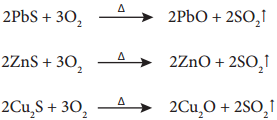
Roasting is the method, usually applied for the conversion of sulphide ores into their oxides. In this method, the concentrated ore is oxidised by heating it with excess of oxygen in a suitable furnace below the melting point of the metal.
Occurrence of Metals img 5

Roasting also removes impurities such as arsenic, sulphur, phosphorous by converting them into their volatile oxides.

For Example

4As + 3O2 → 2As2O3 ↑
S8 + 😯2 → 8SO2 ↑
P4 + 5O2 → P4O10 ↑

Calcination

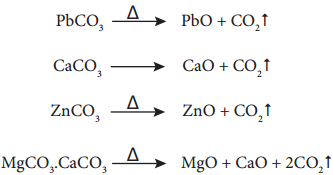
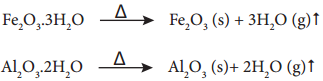
Calcination is the process in which the concentrated ore is strongly heated in the absence of air. During this process, the water of crystallisation present in the hydrated oxide escapes as moisture. Any organic matter (if present) also get expelled leaving behind a porous ore. This method can also be carried out with a limited supply of air.

For examples,
During calcination of carbonate ore, carbon dioxide is expelled
Occurrence of Metals img 6

During calcination of hydrated ore, the water of hydration is expelled as vapour
Occurrence of Metals img 7

Reduction of Metal Oxides

Metal oxide can be reduced to crude metal by using a suitable reducing agent like carbon, carbon monoxide, hydrogen, aluminium and other reactive metals such as sodium etc. The choice of reducing agent depends on the nature of the metal.

For example, carbon cannot be used as a reducing agent for the reactive metals such as sodium, potassium, aluminium etc. Similarly CO cannot be used to reduce oxides such as ZnO, Al2O3. Later in this, we study selection of suitable reducing agents by applying ellingham diagram.

Smelting

In this method, a flux (a chemical substance that forms an easily fusible slag with gangue) and a reducing agent such as carbon, carbon monoxide (or) aluminium is added to the concentrated ore and the mixture is melted by heating at an elevated temperature (above the melting point of the metal) in a smelting furnace. For example the oxide of iron can be reduced by carbon monoxide as follows.

Fe2O3(s) + 3CO (g) → 2Fe(s) + 3CO2(g)↑

In this extraction, a basic flux, limestone (CaO) is used. Since the silica gangue present in the ore is acidic in nature, the limestone combines with it to form calcium silicate (slag).

Occurrence of Metals img 8

In the extraction of copper from copper pyrites, the concentrated ore is heated in a reverberatory furnace after mixing with silica, an acidic flux. The ferrous oxide formed due to melting is basic in nature and it combines with silica to form ferrous silicate (slag). The remaining metal sulphides Cu2S and FeS are mutually soluble and form a copper matte.

2CuFeS2(s) + O2(g) → 2Cu2(l, s) + 2SO2 (g)
2Cu2O(l) + Cu2S (l) → 6Cu(l) + SO2(g)

The matte is separated from the slag and fed to the converting furnace. During conversion, the FeS present in the matte is first oxidised to FeO. This is removed by slag formation with silica. The remaining copper sulphide is further oxidised to its oxide which is subsequently converted to metallic copper as shown below.

2Cu2S (l, s) + 3O2 (g) → 2Cu2O (l, s) + 2SO2(g)
2Cu2O(l) + Cu2S (l) → 6Cu (l) + SO2 (g)

The metallic copper is solidified and it has blistered appearance due to evolution of SO2 gas formed in this process. This copper is called blistered copper.

Reduction By Carbon:

In this method the oxide ore of the metal is mixed with coal (coke) and heated strongly in a furnace (usually in a blast furnace). This process can be applied to the metals which do not form carbides with carbon at the reduction temperature.

Examples:

ZnO (s) + C (s) → Zn (s) + CO (g)↑
Mn3O4 (s) + 4C (s) → 3Mn (s) + 4CO (g)↑
Cr2O3 (s) + 3C (s) → 2Cr (s) + 3CO (g)↑

Reduction By Hydrogen:

This method can be applied to the oxides of the metals (Fe, Pb, Cu) having less electropositive character than hydrogen.

Ag2O (s) + H2 (g) → 2Ag (s) + H2O (l)
Fe3O4 (s) + 4H2 (g) → 3Fe (s) + 4H2O (l)

Nickel oxide can be reduced to nickel by using a mixture of hydrogen and carbon monoxide (water gas)

2NiO (s) + CO (g) + H2 (g) → 2Ni (s) + CO2 (g) + H2O (l)

Reduction By Metal:

Metallic oxides such as Cr2O3 can be reduced by an aluminothermic process. In this process, the metal oxide is mixed with aluminium powder and placed in a fire clay crucible. To initiate the reduction process, an ignition mixture (usually magnesium and barium peroxide) is used.

BaO2 + Mg → BaO + MgO

During the above reaction a large amount of heat is evolved (temperature up to 2400°C, is generated and the reaction enthalpy is : 852 kJ mol-1) which facilitates the reduction of Cr2O3 by aluminium power.

Active metals such as sodium, potassium and calcium can also be used to reduce the metal oxide

B2O3 + 6Na → 2B + 3Na2O
Rb2O3 + 3Mg → 2Rb + 3MgO
TiO2 + 2Mg → Ti + 2MgO

Occurrence of Metals img 9

Auto-Reduction:

Simple roasting of some of the ores give the crude metal. In such cases, the use of reducing agents is not necessary. For example, mercury is obtained by roasting of its ore cinnabar (HgS).

HgS (s) + O2 (g) → Hg (l) + SO2↑
Concentration Of Ores

Find free online Chemistry Topics covering a broad range of concepts from research institutes around the world.

Concentration Of Ores

Generally, the ores are associated with nonmetallic impurities, rocky materials and siliceous matter which are collectively known as gangue. The preliminary step in metallurgical process is removal of these impurities. This removal process is known as concentration of ore.

It increases the concentration of the metal of interest or its compound in the ore. Several methods are available for this process and the choice of method will depend on the nature of the ore, type of impurity and environmental factors. Some of the common methods of ore concentration are discussed below.

Gravity Separation or Hydraulic Wash

In this method, the ore having high specific gravity is separated from the gangue that has low specific gravity by simply washing with running water. Ore is crushed to a finely powdered form and treated with rapidly flowing current of water.

During this process the lighter gangue particles are washed away by the running water. This method is generally applied to concentrate the native ore such as gold and oxide ores such as haematite (Fe2O3), tin stone (SnO2) etc.

Froth Flotation

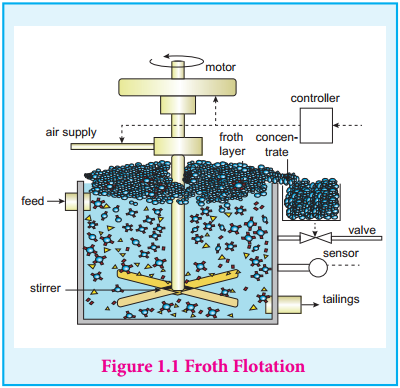
This method is commonly used to concentrate sulphide ores such as galena (PbS), zincblende (ZnS) etc. In this method, the metallic ore particles which are preferentially wetted by oil can be separated from gangue. In this method, the crushed ore is suspended in water and mixed with frothing agent such as pine oil, eucalyptus oil etc. A small quantity of sodium ethyl xanthate which acts as a collector is also added.

A froth is generated by blowing air through this mixture. The collector molecules attach to the ore particle and make them water repellent. As a result, ore particles, wetted by the oil, rise to the surface along with the froth. The froth is skimmed off and dried to recover the concentrated ore. The gangue particles that are preferentially wetted by water settle at the bottom.

When a sulphide ore of a metal of interest contains other metal sulphides as impurities, depressing agents such as sodium cyanide, sodium carbonate etc are used to selectively prevent other metal sulphides from coming to the froth. For example, when impurities such as ZnS is present in galena (PbS), sodium cyanide (NaCN) is added to depresses the flotation property of ZnS by forming a layer of zinc complex Na2[Zn(CN)4] on the surface of zinc sulphide.
Occurrence of Metals img 3

Leaching

This method is based on the solubility of the ore in a suitable solvent and the reactions in aqueous solution. In this method, the crushed ore is allowed to dissolve in a suitable solvent, the metal present in the ore is converted to its soluble salt or complex while the gangue remains insoluble. The following examples illustrate the leaching processes.

Cyanide Leaching

Let us consider the concentration of gold ore as an example. The crushed ore of gold is leached with aerated dilute solution of sodium cyanide. Gold is converted into a soluble cyanide complex. The gangue, aluminosilicate remains insoluble.

4Au (s) + 8CN (aq) + O2 (g) + 2H2O (l) → 4[Au(CN)2] (aq) + 4OH(aq)

Recovery of Metal of Interest from the Complex by Reduction:

Gold can be recovered by reacting the deoxygenated leached solution with zinc. In this process the gold is reduced to its elemental state (zero oxidation sate) and the process is called cementation.

Zn (s) + 2[Au(CN)2] (aq) → [Zn(CN)4]-2 (aq) + 2Au (s)

Ammonia Leaching

When a crushed ore containing nickel, copper and cobalt is treated with aqueous ammonia under suitable pressure, ammonia selectively leaches these metals by forming their soluble complexes viz. [Ni(NH3)6]2+, [Cu(NH3)4]2+, and [Co(NH3)5H2O]3+ respectively from the ore leaving behind the gangue, iron(III) oxides/hydroxides and aluminosilicate.

Alkali Leaching

In this method, the ore is treated with aqueous alkali to form a soluble complex. For example, bauxite, an important ore of aluminum is heated with a solution of sodium hydroxde or sodium carbonate in the temperature range 470 – 520 K at 35 atm to form soluble sodium meta-aluminate leaving behind the impurities, iron oxide and titanium oxide.

Al2O3(s) + 2NaOH(aq) + 3H2O(l) → 2Na[Al(OH)4] (aq)

The hot solution is decanted, cooled, and diluted. This solution is neutralised by passing CO2 gas, to the form hydrated Al2O3 precipitate.

2Na[Al(OH)4] (aq) + 2CO2(g) → Al2O3.3H2O(s) + 2NaHCO3(aq)
The precipitate is fitered of and heated around 1670 K to get pure alumina Al2O3.

Acid Leaching

Leaching of sulphide ores such as ZnS, PbS etc., can be done by treating them with hot aqueous sulphuric acid.

2ZnS (s) + 2H2SO4 (aq) + O2(g) → 2ZnSO4(aq) + 2S(s) + 2H2O

In this process the insoluble sulphide is converted into soluble sulphate and elemental sulphur.

Magnetic Separation

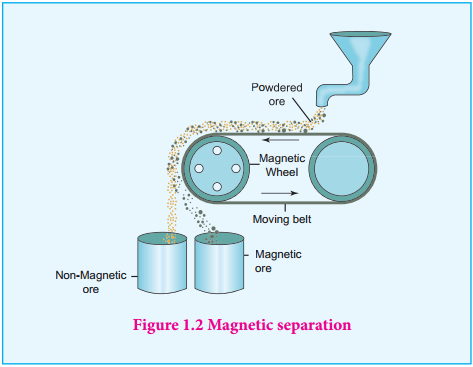
This method is applicable to ferromagnetic ores and it is based on the difference in the magnetic properties of the ore and the impurities. For example tin stone can be separated from the wolframite impurities which is magnetic. Similarly, ores such as chromite, pyrolusite having magnetic property can be removed from the non magnetic siliceous impurities.

The crushed ore is poured on to an electromagnetic separator consisting of a belt moving over two rollers of which one is magnetic. The magnetic part of the ore is attracted towards the magnet and falls as a heap close to the magnetic region while the nonmagnetic part falls away from it as shown in the figure 1.2.
Occurrence of Metals img 4

General Trends in Properties of P-Block Elements

Find free online Chemistry Topics covering a broad range of concepts from research institutes around the world.

General Trends In Properties Of P -Block Elements

We already learnt that the properties of elements largely depends on their electronic configuration, size,  ionisation enthalpy, electronegativity etc. Let us discuss the general trend in such properties of various p-block elements.

Electronic Configuration and Oxidation State:

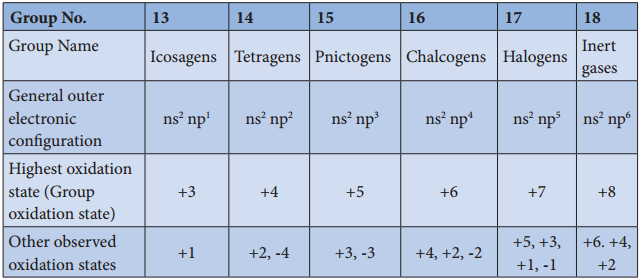
The p-block elements have a general electronic configuration of ns2, np1-6. The elements of each group have similar outer shell electronic configuration and differ only in the value of n (principal quantum number). The elements of group 18 (inert gases) have completely filled p orbitals, hence they are more stable and have least reactivity.

The elements of this block show variable oxidation state and their highest oxidation state (group oxidation state) is equal to the total number of valance electrons present in them. Unlike s-block elements which show only positive oxidation state, some of the p-block elements show negative oxidation states also.

The halogens have a strong tendency to gain an electron to give a stable halide ion with completely filled electronic configuration and hence – 1 oxidation state is more common in halogens. Similarly, the other elements belonging to pnictogen and chalcogen groups also show negative oxidation states.

General Electronic Configurations and Oxidation States of P-Block Elements

General Trends in Properties of P-Block Elements img 1

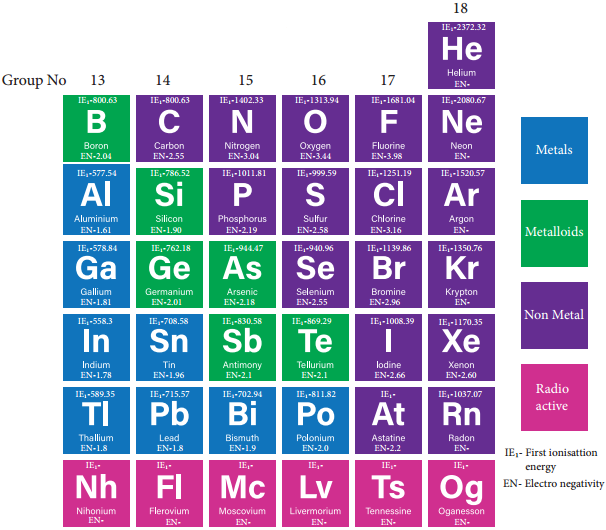
The tendency of an element to form a cation by loosing electrons is known as electropositive or metallic character. This character depends on the ionisation energy. Generally on descending a group the ionisation energy decreases and hence the metallic character increases.

Figure 2.1 P-Block Elements With Their Ionisation Enthalpies, Electronegativity and Metallic Nature.

General Trends in Properties of P-Block Elements img 2

In p-block, the elements present in lower left part are metals while the elements in the upper right part are non metals. Elements of group 13 have metallic character except the first element boron which is a metalloid, having properties intermediate between the metal and nonmetals. The atomic radius of boron is very small and it has relatively high nuclear charge and these properties are responsible for its nonmetallic character.

In the subsequent groups the non-metallic character increases. In group 14 elements, carbon is a nonmetal while silicon and germanium are metalloids. In group 15, nitrogen and phosphorus are non metals and arsenic & antimony are metalloids. In group 16, oxygen, sulphur and selenium are non metals and tellurium is a metalloid. All the elements of group 17 and 18 are non metals.

Ionisation Enthalpy:

We have already learnt that as we move down a group, generally there is a steady decrease in ionisation enthalpy of elements due to increase in their atomic radius. In p-block elements, there are some minor deviations to this general trend. In group 13, from boron to aluminium the ionisation enthalpy decreases as expected. But from aluminium to thallium there is only a marginal difference.

This is due to the presence of inner d and f-electrons which has poor shielding effect compared to s and p-electrons. As a result, the effective nuclear charge on the valance electrons increases. A similar trend is also observed in group 14.

The remaining groups (15 to 18) follow the general trend. In these groups, the ionisation enthalpy decreases, as we move down the group. Here, poor shielding effect of d- and f-electrons are overcome by the increased shielding effect of the additional p-electrons. The ionisation enthalpy of elements in successive groups is higher than the corresponding elements of the previous group as expected.

Electronegativity

As we move down the 13th group, the electronegativity first decreases from boron to aluminium and then marginally increases for Gallium, there after there is no appreciable change. Similar trend is also observed in 14th group as well. In other groups, as we move down the group, the electro negativity decreases. This observed trend can be correlated with their atomic radius.

Anomalous Properties of the First Elements:

In p-block elements, the first member of each group differs from the other elements of the corresponding group. The following factors are responsible for this anomalous behaviour.

  1. Small size of the first member
  2. High ionisation enthalpy and high electronegativity
  3. Absence of d orbitals in their valance shell

The first member of the group 13, boron is a metalloid while others are reactive metals. Moreover, boron shows diagonal relationship with silicon of group 14. The oxides of boron and silicon are similar in their acidic nature. Both boron and silicon form covalent hydrides that can be easily hydrolysed. Similarly, except boron trifluoride, halides of both elements are readily hydrolysed.

In group 14, the first element carbon is strictly a nonmetal while other elements are metalloids (silicon & germanium) or metals (tin & lead). Unlike other elements of the group carbon can form multiple bonds such as C=C, C=O etc. Carbon has a greater tendency to form a chain of bonds with itself or with other atoms which is known as catenation. There is considerable decrease in catenation property down the group (C>>Si>Ge≈Sn>Pb).

In group 15 also the first element nitrogen differs from the rest of the elements of the group. Like carbon, the nitrogen can from multiple bonds (N=N, C=N, N=O etc…). Nitrogen is a diatomic gas unlike the other members of the group. Similarly in group 16, the first element, oxygen also exists as a diatomic gas in that group. Due to its high electronegativity it forms hydrogen bonds.

The first element of group 17, flourine the most electronegative element, also behaves quiet differently compared to the rest of the members of group. Like oxygen it also forms hydrogen bonds. It shows only -1 oxidation state while the other halogens have +1, +3, +5 and +7 oxidation states in addition to -1 state. The flourine is the strongest oxidising agent and the most reactive element among the halogens.

Inert Pair Effect:

We have already learnt that the alkali and alkaline earth metals have an oxidation state of +1 and +2 respectively, corresponding to the total number of electrons present in them. Similarly, the elements of p block also show the oxidation states corresponding to the maximum number of valence electrons (group oxidation state).

In addition they also show variable oxidation state. In case of the heavier post-transition elements belonging to the groups (13 to 16), the most stable oxidation state is two less than the group oxidation state and there is a reluctance to exhibit the group oxidation state.

Let us consider group 13 elements. As we move from boron to heavier elements, there is an increasing tendency to have +1 oxidation state, rather than the group oxidation state, +3. For example Al+3 is more stable than Al+1 while Tl+1 is more stable than Tl+3. Aluminium (III) chloride is stable whereas thallium (III) chloride is highly unstable and disproportionates to thallium (I) chloride and chlorine gas.

This shows that in thallium the stable lower oxidation state corresponds to the loss of np electrons only and not ns electrons. Thus in heavier posttransition metals, the outer s electrons (ns) have a tendency to remain inert and show reluctance to take part in the bonding, which is known as inert pair effect. This effect is also observed in groups 14, 15 and 16.

Allotropism in P-Block Elements:

Some elements exist in more than one crystalline or molecular forms in the same physical state. For example, carbon exists as diamond and graphite. This phenomenon is called allotropism (in greek ‘allos’ means another and ‘trope’ means change) and the different forms of an element are called allotropes. Many p-block elements show allotropism and some of the common allotropes are listed in the table.

Table 2.2 : Some of common allotropes of p-block elements

Element

Most Common Allotropes

BoronAmorphous boron, α-rhombohedral boron, β-rhombohedral boron, γ-orthorhombic boron, α-tetragonal boron, β-tetragonal boron
CarbonDiamond, Graphite, Graphene, Fullerenes, Carbon nanotubes
SiliconAmorphous Silicon, Crystalline Silicon
Germaniumα-germanium, β-germanium
TinGrey tin, white tin, rhombic tin, sigma tin
PhosphorusWhite phosphorus, Red phosphorus, Scarlet phosphorus, Violet phosphorus, Black phosphorus.
ArsenicYellow arsenic, gray arsenic & Black arsenic
AnitimonyBlue-white antimony, Yellow, Black
OxygenDioxygen, ozone
SulphurRhombus sulphur, monoclinic sulphur
SeleniumRed selenium, Gray selenium, Black selenium, Monoclinic selenium
TelluriumAmorphous & Crystalline

Occurrence of Metals

Find free online Chemistry Topics covering a broad range of concepts from research institutes around the world.

Occurrence of Metals

In general, pure metals are shiny and malleable, however, most of them are found in nature as compounds with different properties. Metals having least chemical reactivity such as copper, silver, gold and platinum occur in significant amounts as native elements. Reactive metals such as alkali metals usually occurs in their combined state and are extracted using suitable metallurgical process.

Mineral and Ore

A naturally occurring substance obtained by mining which contains the metal in free state or in the form of compounds like oxides, sulphides etc is called a mineral. In most of the minerals, the metal of interest is present only in small amounts and some of them contains a reasonable percentage of metal. For example iron is present in around 800 minerals.

However, some of them such as hematite magnetite etc., containing high percentage of iron are commonly used for the extraction of iron. Such minerals that contains a high percentage of metal, from which it can be extracted conveniently and economically are called ores.

Hence all ores are minerals but all minerals are not ores. Let us consider another example, bauxite and china clay (Al2O3.2SiO2.2H2O). Both are minerals of aluminium. However, aluminium can be commercially extracted from bauxite while extraction from china clay is not a profitable one.

Hence the mineral, bauxite is an ore of aluminium while china clay is not. The extraction of a metal of interest from its ore consists of the following metallurgical processes.

  1. Concentration of the Ore
  2. Extraction of Crude Metal
  3. Ref Ning of Crude Metal

Occurrence of Metals img 1

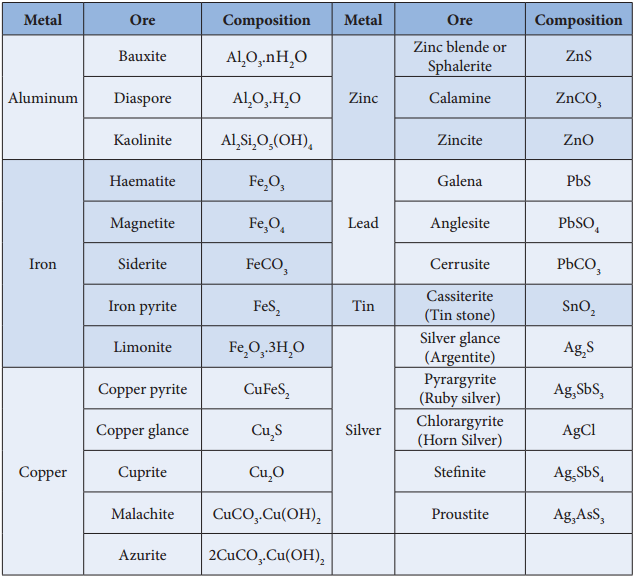
Table 1.1 List of some metals and their common ores with their chemical formula
Occurrence of Metals img 2

Senescene

Learninsta presents the core concepts of Biology with high-quality research papers and topical review articles.

Senescene

Plant life comprises some sequential events, viz: germination, juvenile stage, maturation, old age and death. Old age is called senescence in plants. Senescence refers to all collective, progressive and deteriorative processes which ultimately lead to complete loss of organization and function. Unlike animals, plants continuously form new organs and older organs undergo a highly regulated senescence program to maximize nutrient export.

1. Types of Senescence

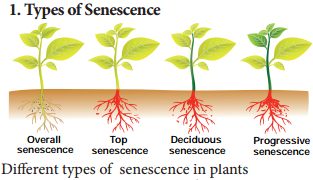
Leopold (1961) has recognised four types of senescence:

  • Overall Senescence
  • Top Senescence
  • Deciduous Senescence
  • Progressive Senescence

Overall Senescence:

This kind of senescence occurs in annual plants when entire plant gets affected and dies. Example: Wheat and Soybean. It also occurs in few perennials also. Example: Agave and Bamboo.

Top Senescence:

It occurs in aerial parts of plants. It is common in perennials, underground and root system remains viable. Example: Banana and Gladiolus.

Deciduous Senescence:

It is common in deciduous plants and occurs only in leaves of plants, bulk of the stem and root system remains alive. Example: Elm and Maple.

Progressive Senescence:

This kind of senescence is gradual. First it occurs in old leaves followed by new leaves then stem and finally root system. It is common in annuals (Figure 15.13).
Senescene img 1

2. Physiology of Senescence

  • Cells undergo changes in structure.
  • Vacuole of the cell acts as lysosome and secretes hydrolytic enzymes.
  • The starch content is decreased in the cells.
  • Photosynthesis is reduced due to loss of chlorophyll accompanied by synthesis and accumulation of anthocyanin pigments, therefore the leaf becomes red.
  • There is a marked decrease in protein content in the senescing organ.
  • RNA content of the leaf particularly rRNA level is decreased in the cells due to increased activity of the enzyme RNAase.
  • DNA molecules in senescencing leaves degenerate by the increased activity of enzyme DNAase.

3. Factors Affecting Senescence:

  • ABA and ethylene accelerate senescence while auxin and cytokinin retard senescence.
  • Nitrogen deficiency increases senescence whereas nitrogen supply retards senescence.
  • High temperature accelerates senescence but low temperature retards senescence.
  • Senescence is rapid in dark than in light.
  • Water stress leads to accumulation of ABA leading to senescence.

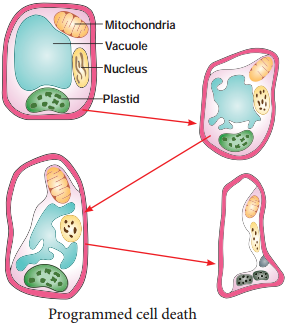
4. Programmed Cell Death (PCD)

Senescence is controlled by plants own genetic programme and death of the plant or plant part consequent to senescence is called Programmed Cell Death. In short senescence of an individual cell is called PCD. The proteolytic enzymes involving PCD in plants are phytaspases and in animals are caspases. The nutrients and other substrates from senescing cells and tissues are remobilized and reallocated to other parts of the plant that survives.

The protoplasts of developing xylem vessels and tracheids die and disappear at maturity to make them functionally efficient to conduct water for transport. In aquatic plants, aerenchyma is normally formed in different parts of the plant such as roots and stems which encloses large air spaces that are created through PCD. In the development of unisexual flowers, male and female flowers are present in earlier stages, but only one of these two completes its development while other aborts through PCD (Figure 15.14).

Senescene img 2

5. Abscission

Abscission is a physiological process of shedding of organs like leaves, flowers, fruits and seeds from the parent plant body. When these parts are removed the plant seals of its vascular system to prevent loss of water and nutrients. Final stage of senescence is abscission.

In temperate regions all the leaves of deciduous plants fall in autumn and give rise to naked appearance, then the new leaves are developed in the subsequent spring season. But in evergreen plants there is gradual abscission of leaves, the older leaves fall while new leaves are developed continuously throughout the year.

6. Morphological and Anatomical Changes During Abscission

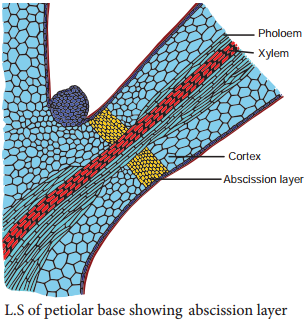
Leaf abscission takes place at the base of petiole which is marked internally by a distinct zone of few layers of thin walled cells arranged transversely. This zone is called abscission zone or abscission layer. An abscission layer is greenish-grey in colour and is formed by rows of cells of 2 to 15 cells thick.

The cells of abscission layer separate due to dissolution of middle lamella and primary wall of cells by the activity of enzymes pectinase and cellulase resulting in loosening of cells. Tyloses are also formed blocking the conducting vessels. Degrading of chlorophyll occur leading to the change in the colour of leaves, leaf detachment from the plant and leaf fall. After abscission, outer layer of cells becomes suberized by the development of periderm (Figure 15.15).

Senescene img 3

7. Hormones Influencing Abscission

All naturally occurring hormones influence the process of abscission. Auxins and cytokinins retard abscission, while abscisic acid (ABA) and ethylene induce it.

8. Significance of Abscission

  • Abscission separates dead parts of the plant, like old leaves and ripe fruits.
  • It helps in dispersal of fruits and continuing the life cycle of the plant.
  • Abscission of leaves in deciduous plants helps in water conservation during summer.
  • In lower plants, shedding of vegetative parts like gemmae or plantlets help in vegetative reproduction.