Acids and Bases

Find free online Chemistry Topics covering a broad range of concepts from research institutes around the world.

Acids and Bases

The term ‘acid’ is derived from the latin word ‘acidus’ meaning sour. We have already learnt in earlier classes that acid tastes sour, turns the blue litmus to red and reacts with metals such as zinc and produces hydrogen gas. Similarly base tastes bitter and turns the red litmus to blue.

These classical concepts are not adequate to explain the complete behaviour of acids and bases. So, the scientists developed the acid – base concept based on their behaviour.

Let us, learn the concept developed by scientists Arrhenius, Bronsted and Lowry and Lewis to describe the properties of acids and bases.

Arrhenius Concept

One of the earliest theories about acids and bases was proposed by swedish chemist Svante Arrhenius. According to him, an acid is a substance that dissociates to give hydrogen ions in water. For example, HCl, H2SO4 etc., are acids. Their dissociation in aqueous solution is expressed as

Acids and Bases img 1

The H+ ion in aqueous solution is highly hydrated and usually represented as H3O+, the simplest hydrate
of proton [H(H2O)]+. We use both H+ and H3O+ to mean the same.

Similarly a base is a substance that dissociates to give hydroxyl ions in water. For example, substances like NaOH, Ca(OH)2 etc., are bases.

Acids and Bases img 2

Limitations of Arrhenius Concept

  • Arrhenius theory does not explain the behaviour of acids and bases in non aqueous solvents such as acetone, Tetrahydrofuran etc.
  • This theory does not account for the basicity of the substances like ammonia (NH3) which do not possess hydroxyl group.

Lowry – Bronsted Theory (Proton Theory)

In 1923, Lowry and Bronsted suggested a more general definition of acids and bases. According to their concept, an acid is defined as a substance that has a tendency to donate a proton to another substance and base is a substance that has a tendency to accept a proton from other substance. In other words, an acid is a proton donor and a base is a proton acceptor.

When hydrogen chloride is dissolved in water, it donates a proton to the later. Thus, HCl behaves as an acid and H2O is base. The proton transfer from the acid to base can be represented as

HCl + H2O ⇄ H3O+ + Cl

When ammonia is dissolved in water, it accepts a proton from water. In this case, ammonia (NH3) acts as a base and H2O is acid. The reaction is represented as

H2O + NH3 ⇄ NH+4 + OH

Let us consider the reverse reaction in the following equilibrium

Acids and Bases img 3

H3O+ donates a proton to Cl to form HCl i.e., the products also behave as acid and base. In general,
Lowry – Bronsted (acid – base) reaction is represented as

Acid1 + Base2 ⇄ Acid2 + Base1

The species that remains after the donation of a proton is a base (Base1) and is called the conjugate base of the Bronsted acid (Acid1). In other words, chemical species that differ only by a proton are called conjugate acid – base pairs.
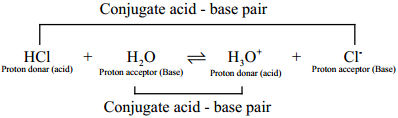
Acids and Bases img 4

HCl and Cl, H2O and H3O+ are two conjugate acid – base pairs, i.e; Cl is the conjugate base of the acid HCl. (or) HCl is conjugate acid of Cl. Similarly H3O+ is the conjugate acid of H2O.

Limitations of Lowry – Bronsted Theory

(i) Substances like BF3, AlCl3 etc., that do not donate protons are known to behave as acids.

Lewis Concept

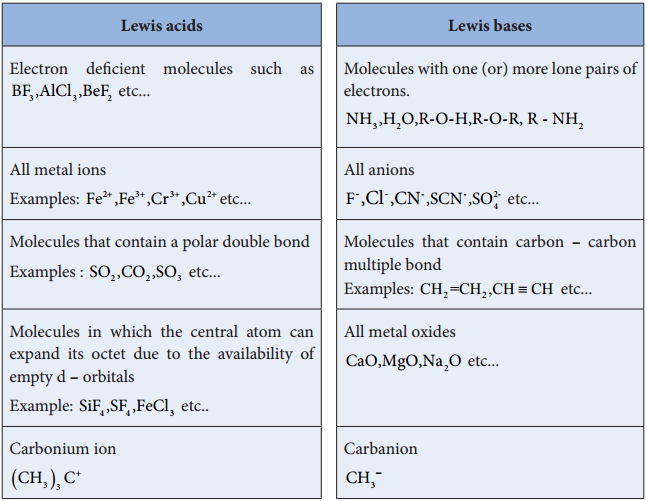
In 1923, Gilbert. N. Lewis proposed a more generalised concept of acids and bases. He considered the electron pair to define a species as an acid (or) a base. According to him, an acid is a species that accepts an electron pair while base is a species that donates an electron pair. We call such species as Lewis acids and bases.

A Lewis acid is a positive ion (or) an electron deficient molecule and a Lewis base is a anion (or) neutral molecule with at least one lone pair of electrons.

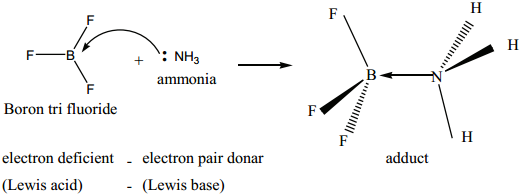
Les us consider the reaction between Boron tri flouride and ammonia.
Acids and Bases img 5

Here, boron has a vacant 2p orbital to accept the lone pair of electrons donated by ammonia to form a new coordinate covalent bond. We have already learnt that in coordination compounds, the Ligands act as a Lewis base and the central metal atom or ion that accepts a pair of electrons from the ligand behaves as a Lewis acid.
Acids and Bases img 6

Class 8 Civics Chapter 10 Extra Questions and Answers Law and Social Justice

Law and Social Justice Class 8 Civics Chapter 10 Extra Questions and Answers Social Science CBSE Pdf free download are part of Extra Questions for Class 8 Social Science. Here we have given NCERT Extra Questions for Class 8 Social Science SST Civics Chapter 10 Law and Social Justice.

You can also practice NCERT Solutions for Class 8 Civics Chapter 10 Questions and Answers on LearnInsta.com.

Class 8 Civics Chapter 10 Extra Questions and Answers Law and Social Justice

Law and Social Justice Class 8 Extra Questions and Answer Civics Chapter 10 Very Short Answers Type

Question 1.
When did the methyl-isocyanite (MIC) start to leak from the U.C. plant.
Answer:
At midnight on 2nd December 1984 methyl isocyanite (MIC) a highly poisonous gas started leaking from the U.C. plant.

Question 2.
How many people were dead within 3 days during Bhopal gas tragedy?
Answer:
Within three days, more than 8000 people were dead.

Question 3.
What is the full form of CNG?
Answer:
CNG – Compressed Natural Gas.

Question 4.
What is the duty of the government with regards to Article 21?
Answer:
Duty of government is to ensure that the Right to Life guranteed under Art 21 of the Constitution is not violated.

Question 5.
Where is West Virginia located?
Answer:
West Virginia is located in the U.S.A.

Question 6.
What was there for 12 million children in the 2001 census?
Answer:
According to the 2001 census, over 12 million children in India aged between 5 and 14 work in various occupations including hazardous ones.

Question 7.
What does the Right against Exploitation say?
Answer:
The Right against Exploitation says that no one can be forced to work for law wages or under bondage.

Question 8.
When does the Enforcement become even more important?
Answer:
Enforcement becomes even more important when the law seeks to protect the weak from the strong.

Question 9.
What role does the government have for the betterment of society?
Answer:
The government has the role of making ‘appropriate laws’ and also was to enforce the laws.

Question 10.
What type of laws can cause serious harm?
Answer:
Laws weak in nature and poorly enforced can cause serious harm.

Question 11.
What issues does the Bhopal tragedy brought to the forefront?
Answer:
Bhopal tragedy causing disaster has brought the environment issues to the forefront.

Question 12.
What does the government is supposed to ensure being law maker and enforcer?
Answer:
Being lawmaker and enforcer, the government is supposed to ensure that safety laws are implemented.

Law and Social Justice Class 8 Extra Questions and Answer Civics Chapter 10 Short Answers Type

Question 1.
With any example state that how markets everywhere tend to be exploitative of people? Answer:
Many of the people directly or indirectly involved in the production of the shirt – the small farmer producing cotton, the weavers of erode or the workers in the garment-exporting factory – faced exploitation or an unfair situation in the market. Markets everywhere tend to be exploitative of people – whether as worker, consumers or producers.

Question 2.
What does the law of minimum wages says?
Answer:
To ensure that workers are not underpaid, or paid fairly, there is a law on minimum wages, a worker is paid less than the minimum wage by the employer. The minimum wages are revised upwards every few years and law on minimum wages is meant to protect workers. *

Question 3.
How does the laws protect the interests of producers and consumers in the market?
Answer:
There are laws that protect the interest of producers and consumers in the market. The help ensure that the relations between these three parties – the workers, consumer and producers are governed in matter so that exploitation of any party could be avoided.

Question 4.
Who was Aziza sultan. What statement made by her?
Answer:
Aziza sultan was the survivor of the Bhopal gas tragedy. According to her the statements was: “At 12.30 am I woke to the sound of my baby coughing badly. In the half-light I saw that the room was tied with a white cloud. I here people shouting ‘run, run’. Then I started coughing, with each breath seeming as it I was breathing in fire. My eyes were burning”.

Question 5.
Who were the most exposed to poison gas of Bhopal gas tragedy?
Answer:
Most of those exposed to the poison gas came from poor, working-class, families, of which nearly 50,000 people are today too sick to work.

Law and Social Justice Class 8 Extra Questions and Answer Civics Chapter 10 Long Answers Type

Question 1.
How did the Indian government introduce new laws on the environment after the Bhopal disaster?
Answer:
The Bhopal disaster brought the issue of environment to the forefront thousands of persons who were not associated with the factory in any way were greatly affected because of the poisonous gases leaked from the plant. This made people realise that the existing laws, though weak, only covered the individual worker and not persons who might be injured due to industrial accidents.

In response to this pressure from environmental activists and others in the years following the Bhopal gas tragedy, the Indian government introduced new laws on the environment. Henceforth, the polluter was to be held accountable for the damage done to environment.

The environment is something that people over generations will share, and it could not be destroyed merely for industrial development. The courts also gave a number of judgment upholding the right to a healthy environment as intrinsic to the Fundamental Right to Life.

Factors Affecting the Reaction Rate

Find free online Chemistry Topics covering a broad range of concepts from research institutes around the world.

Factors Affecting the Reaction Rate

The rate of a reaction is affected by the following factors.

  1. Nature and State of the Reactant
  2. Concentration of the Reactant
  3. Surface Area of the Reactant
  4. Temperature of the Reaction
  5. Presence of a Catalyst

Nature and State of the Reactant:

We know that a chemical reaction involves breaking of certain existing bonds of the reactant and forming new bonds which lead to the product. The net energy involved in this process is dependent on the nature of the reactant and hence the rates are different for different reactants.

Let us compare the following two reactions that you carried out in volumetric analysis.

  1. Redox reaction between ferrous ammonium sulphate (FAS) and KMnO4
  2. Redox reaction between oxalic acid and KMnO4

The oxidation of oxalate ion by KMnO4 is relatively slow compared to the reaction between KMnO4 and Fe2+. In fact heating is required between KMnO4 and Oxolate ion and is carried out at around 60°C.

The physical state of the reactant also plays an important role to influence the rate of reactions. Gas phase reactions are faster as compared to the reactions involving solid or liquid reactants. For example, reaction of sodium metal with iodine vapours is faster than the reaction between solid sodium and solid iodine.

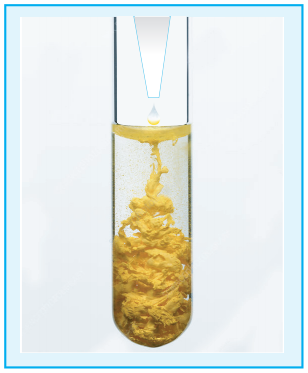
Let us consider another example that you carried out in inorganic qualitative analysis of lead salts. If you mix the aqueous solution of colorless potassium iodide with the colorless solution of lead nitrate, precipitation of yellow lead iodide take place instantaneously, whereas if you mix the solid lead nitrate with solid potassium iodide, yellow coloration will appear slowly.

Factors Affecting The Reaction Rate img 1

Concentration of the Reactants:

The rate of a reaction increases with the increase in the concentration of the reactants. The effect of concentration is explained on the basis of collision theory of reaction rates. According to this theory, the rate of a reaction depends upon the number of collisions between the reacting molecules. Higher the concentration, greater is the possibility for collision and hence the rate.

Effect of Surface Area of the Reactant:

In heterogeneous reactions, the surface areas of the solid reactants play an important role in deciding the rate. For a given mass of a reactant, when the particle size decreases surface area increases. Increase in surface area of reactant leads to more collisions per litre per second, and hence the rate of reaction is increased. For example, powdered calcium carbonate reacts much faster with dilute HCl than with the same mass of CaCO3 as marble.

Effect of Presence of Catalyst:

So far we have learnt, that rate of reaction can be increased to certain extent by increasing the concentration, temperature and surface area of the reactant. However significant changes in the reaction can be brought out by the addition of a substance called catalyst.

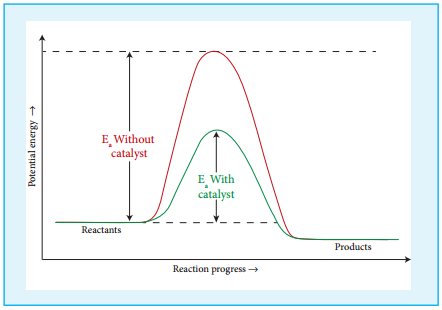
A catalyst is substance which alters the rate of a reaction without itself undergoing any permanent chemical change. They may participate in the reaction, but again regenerated at the end of the reaction. In the presence of a catalyst, the energy of activation is lowered and hence, greater number of molecules can cross the energy barrier and change over to products, thereby increasing the rate of the reaction.

Factors Affecting The Reaction Rate img 2

Arrhenius Equation – The Effect of Temperature on Reaction Rate

Find free online Chemistry Topics covering a broad range of concepts from research institutes around the world.

Arrhenius Equation – The Effect of Temperature on Reaction Rate

Generally, the rate of a reaction increase with increasing temperature. However, there are very few exceptions. The magnitude of this increase in rate is different for different reactions. As a rough rule, for many reactions near room temperature, reaction rate tends to double when the temperature is increased by 10°C.

A large number of reactions are known which do not take place at room temperature but occur readily at higher temperatures. Example: Reaction between H2 and O2 to form H2O takes place only when an electric spark is passed.

Arrhenius suggested that the rates of most reactions vary with temperature in such a way that the rate constant is directly proportional to e-(Ea/RT) and he proposed a relation between the rate constant and temperature.

k = Ae-(Ea/RT) …………. (1)

Where A the frequency factor,
R the gas constant,
Ea the activation energy of the reaction and,

T the absolute temperature (in K)

The frequency factor (A) is related to the frequency of collisions (number of collisions per second) between the reactant molecules. The factor A does not vary significantly with temperature and hence it may be taken as a constant.

Ea is the activation energy of the reaction, which Arrhenius considered as the minimum energy that a molecule must have to posses to react.

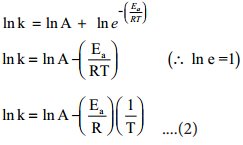
Taking logarithm on both side of the equation (1)

Arrhenius Equation - The Effect of Temperature on Reaction Rate img 1

y = c + mx

The above equation is of the form of a straight line y = mx + c.

A plot of ln k Vs 1/T gives a straight line with a negative slope – \(\frac{\mathrm{E}_{\mathrm{a}}}{\mathrm{R}}\) line with a negative slope –\(\frac{\mathrm{E}_{\mathrm{a}}}{\mathrm{R}}\). If the rate constant for a reaction at two different temperatures is known, we can calculate the activation energy as follows.

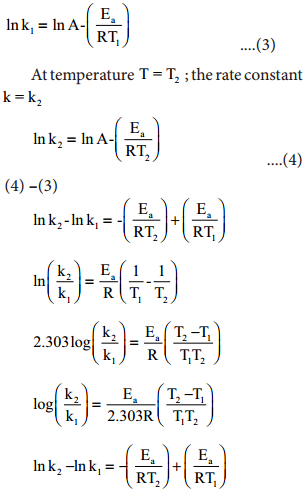
At temperature T = T1; the rate constant k = k1

Arrhenius Equation - The Effect of Temperature on Reaction Rate img 2

This equation can be used to caluculate Ea from rate constants K1 and k2 at temperatures
T1 and T2.

Example 1

The rate constant of a reaction at 400 and 200K are 0.04 and 0.02 s-1 respectively. Caluculate the value of activation energy.
Solution:
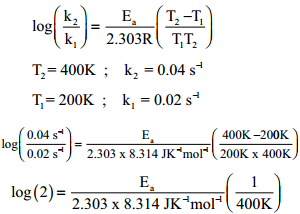
According to Arrhenius equation
Arrhenius Equation - The Effect of Temperature on Reaction Rate img 3
Ea = log(2) × 2.303 × 8.314 JK-1mol-1 × 400K
Ea = 2.305 J mol-1

Example 2

Rate constant k of a reaction varies with temperature T according to the following Arrhenius equation log k = log A – \(\frac{\mathrm{E}_{\mathrm{a}}}{2.303 \mathrm{R}}\)(\(\frac{1}{T}\)) Where Ea is the activation energy. When a graph is plotted for log K Vs \(\frac{1}{T}\) a straight line with a slope of – 4000k is obtained. Caluculate the activation energy.
Solution:
log k = logA – \(\frac{\mathrm{E}_{\mathrm{a}}}{2.303 \mathrm{R}}\)(\(\frac{1}{T}\))
y = c + mx
m = – \(\frac{\mathrm{E}_{\mathrm{a}}}{2.303 \mathrm{R}}\)
Ea = – 2.303 R m
Ea = – 2.303 × 8.314 JK-1 mol-1 × (-4000K)
Ea = 76, 589 J mol-1
Ea = 76.589 kJ mol-1

Collision Theory

Find free online Chemistry Topics covering a broad range of concepts from research institutes around the world.

Collision Theory

Collision Theory was proposed independently by Max Trautz in 1916 and William Lewis in 1918. This theory is based on the kinetic theory of gases. According to this theory, chemical reactions occur as a result of collisions between the reacting molecules. Let us understand this theory by considering the following reaction.

A2(g) + B2(g) → 2AB(g)

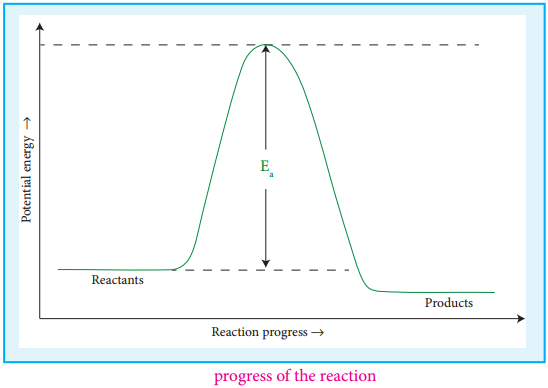
Fig 7.5 Progress of the Reaction

Collision Theory img 1

If we consider that, the reaction between A2 and B2 molecules proceeds through collisions between them, then the rate would be proportional to the number of collisions per second.

Rate ∝ number of molecules colliding per litre per second (collision rate)

The number of collisions is directly proportional to the concentration of both A2 and B2.

Collision rate ∝ [A2][B2]
Collision rate = Z [A2][B2]

Where, Z is a constant.

The collision rate in gases can be calculated from kinetic theory of gases. For a gas at room temperature (298K) and 1 atm pressure, each molecule undergoes approximately 109 collisions per second, i.e., 1 collision in 10-9 second.

Thus, if every collision resulted in reaction, the reaction would be complete in 10-9 second. In actual practice this does not happen. It implies that all collisions are not effective to lead to the reaction. In order to react, the colliding molecules must possess a minimum energy called activation energy. The molecules that collide with less energy than activation energy will remain intact and no reaction occurs.

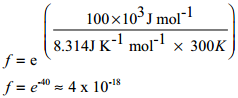
Fraction of effective collisions (f) is given by the following expression

f = e-Ea/RT

To understand the magnitude of collision factor (f), Let us calculate the collision factor (f) for a reaction having activation energy of 100 kJ mol-1 at 300K.

Collision Theory img 2

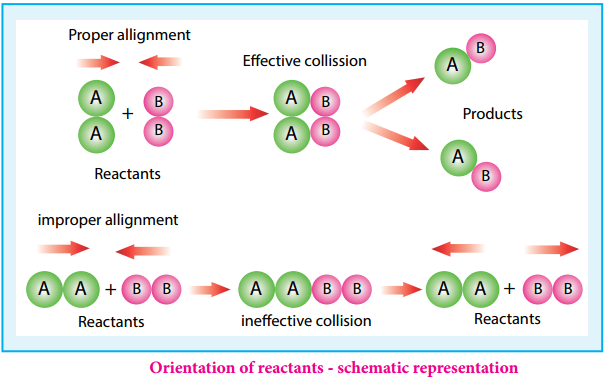
Thus, out of 1018 collisions only four collisions are sufficiently energetic to convert reactants to products. This fraction of collisions is further reduced due to orientation factor i.e., even if the reactant collide with sufficient energy, they will not react unless the orientation of the reactant molecules is suitable for the formation of the transition state.

Collision Theory img 3

The figure 7.6 illustrates the importance of proper alignment of molecules which leads to reaction. The fraction of effective collisions (f) having proper orientation is given by the steric factor p.

⇒ Rate = p × f × collision rate
i.e., Rate = p × e-Ea/RT × Z[A2][B2] ………….. (1)
As per the rate law,
Rate = k[A2][B2] ………….. (2)
Where k is the rate constant
On comparing equation (1) and (2), the rate constant k is
k = p Z e-Ea/RT