NCERT Solutions for Class 8 English Honeydew Chapter 2 The Tsunami

NCERT Solutions for Class 8 English Honeydew Chapter 2 The Tsunami are part of NCERT Solutions for Class 8 English. Here we have given NCERT Solutions for Class 8 English Honeydew Chapter 2 The Tsunami.

BoardCBSE
TextbookNCERT
ClassClass 8
SubjectEnglish
ChapterChapter 2
Chapter NameThe Tsunami
CategoryNCERT Solutions

NCERT Solutions for Class 8 English Honeydew Chapter 2 The Tsunami

IMPORTANT PASSAGES FOR COMPREHENSION

Read the following extracts and answer the questions that follow choosing the correct options from, among the given ones :

I. In the chaos and confusion, two of his children caught hold of the hands of their mother’s father and mother’s brother, and rushed in the opposite direction. He never saw them again. His wife was also swept away. Only the three other children who came with him were saved. – (Page 25)

Multiple Choice Questions
1. These lines have been taken from the lesson named
(a) Tsunami
(b) The best Christmas present in the world
(c) The Summit Within
(d) This is Jody’s Fawn.

2. Whose children were they
(a) Javed’s
(b) Ignesious
(c) Sanjeev’s
(d) Almas’s.

3. They ran in the opposite direction because of
(a) chaos
(b) Tsunami
(c) confusion
(d) his parents.

Answers
1. (a) Tsunami
2. (b) Ignesious’
3. (c) confusion

II. Almas Javed was ten years old. She was a student of Carmel Convent in Port Blair where her father had a petrol pump. Her mother Rahila’s home was in Nancowry island. The family had gone there to celebrate Christmas. (Page 26)

Questions
1. Who was Almas Javed ?
2. What was his father ?
3. Where had Javed’s family gone and why ?

Answers
1. Almas Javed was a ten year old student of Carmel Convent in Port Blair.
2. Javed’s father owned a petrol pump.
3. Javed’s family had gone to Andaman and Nicobar to celebrate Christmas.

III. “The water was swelling and kept coming in,” Penny Smith remembered. “The beach was getting smaller and smaller. I didn’t know what was happening.” (Page 27)

Multiple Choice Questions
1. The water referred to in the above lines is
(a) the boiling water in a pot
(b) the water of a river
(c) the sea water
(d) none of the above.

2. Penny Smith was
(a) an iron-smith
(b) Tilly’s mother
(c) a teacher
(d) an American woman.

3. Penny is describing a scene from
(a) India
(b) England
(c) America
(d) Thailand.

Answers
1. (c) the sea water
2. (b) Tilly’s mother
3. (d) Thailand.

IV. The family took refuge in the third floor of the hotel. The building withstood the surge of three tsunami waves. If they had stayed on the beach, they would not have been alive. (Page 28)

Questions
1. Which family is being talked of here ?
2. What was threatening their lives ?
3. Where were they before coming to this building ?

Answers
1. It was a family of Smiths.
2. Tsunami was threatening their lives.
3. They were at the sea-beach.

V. Many people believe that animals possess a sixth sense and know when the earth is going to shake. Some experts believe that animals’ more acute hearing helps them to hear or feel the earth’s vibration. They can sense an approaching disaster long before humans realise what’s going on. (Page 29)

Multiple Choice Questions
1. How many senses do the humans have ?
(a) seven
(b) eight
(c) four
(d) five.

2. Animals’ sense of hearing—as compared to human beings—is
(a) better
(b) worse
(c) same
(d) negligible.

3. The word ‘acute’ in the passage means
(a)sharp
(b) small
(c) good
(d) bad.

Answers
1. (d) five
2. (a) better
3. (a) sharp

TEXTUAL EXERCISES

BEFORE YOU READ (Page 24)
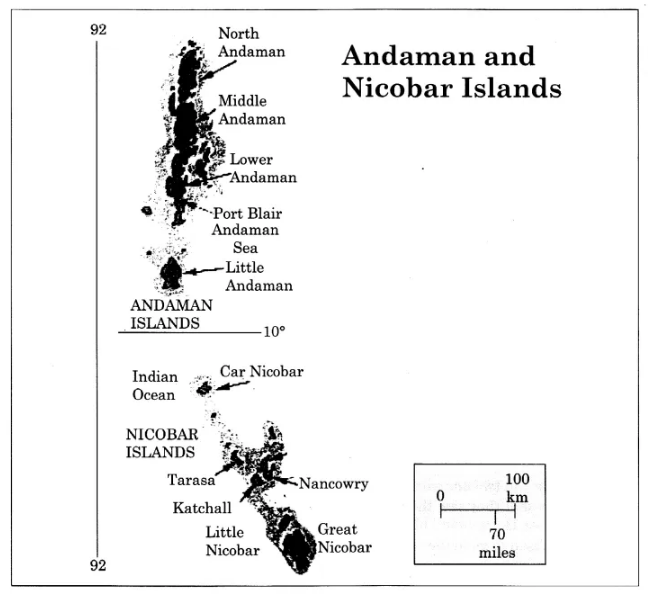
Look at the map of the Andaman and Nicobar islands given here.

Now read the sentences below. Rewrite the incorrect ones after correcting the mistakes.
1. Katchall is an island
2. It is part of the Andaman group of islands.
3. Nancowry is an island in the Nicobar group.
4. Katchall and Nancowry are more than a hundred miles apart. (Hint: the scale of the map is given.)
5. The Andaman and Nicobar Islands are to the west of India.
6. The Nicobar islands are to the north of the Andaman Islands.

Answers
1. It is correct statement.
2. It is part of Nicobar group of islands.
3. It is correct statement.
4. Katchall and Nancowry are less than a hundred miles apart.
5. The Andaman and Nicobar Islands are to the east of India.
6. The Nicobar Islands are to the south of the Andaman Islands.
NCERT Solutions for Class 8 English Honeydew Chapter 2 The Tsunami 24.1

COMPREHENSION CHECK (Page 27)
Say whether the following are True or False.
1. Ignesious lost his wife, two children, his father-in-law, and his brother-in-law in the tsunami.
2. Sanjeev made it to safety after the tsunami.
3. Meghna was saved by a relief helicopter.
4. Almas’s father realised that a tsunami was going to hit the island.
5. Her mother and aunts were washed away with the tree that they were holding on to.

Answers
1. True
2. False
3. False
4. True
5. True

COMPREHENSION CHECK (Pages 28-29)
Answer the following in a phrase or sentence.
1. Why did Tilly’s family come to Thailand ?
2. What were the warning signs that both Tilly and her mother saw ?
3. Do you think Tilly’s mother was alarmed by them ?
4. Where had Tilly seen the sea behaving in the same strange fashion ?
5. Where did the Smith family and the others on the beach go to escape from the tsunami ?
6. How do you think her geography teacher felt when he heard about what Tilly had done in Phuket ?

Answers
1. Tilly’s family came to Thailand to celebrate Christmas.
2. Both of them saw the sea rise and start to foam, bubble and form whirlpools.
3. No, Tilly’s mother was not alarmed by them.
4. In the video which her geography teacher had shown to the class.
5. They went to the third floor of the hotel to escape from the tsunami.
6. The geography teacher must have felt very pleased and satisfied.

COMPREHENSION CHECK (Page 30)
Answer using a phrase or a sentence.
1. In the tsunami 1,50,000 people died. How many animals died ?
2. How many people and animals died in Yala National Park ?
3. What do people say about the elephants of Yala National Park ?
4. What did the dogs in Galle do ?

Answers
1. Only a few.
2. 60 people and two animals.
3. They say that they saw them running from the beach. The elephants had sensed it an hour before the tsunami hit the coast.
4. They refused to go to the beach for their daily runs.

WORKING WITH THE TEXT (Page 30)
Discuss the following questions in class. Then write your own answers.

Question. 1.
When he felt the earthquake, do you think Ignesious immediately worried about a tsunami ? Give reasons for your answer. Which sentence in the text tells you that the Ignesious family did not have any time to discuss and plan their course of action after the tsunami struck ?

Answer:
No. When he felt the earthquake, Ignesious did not think about the tsunami. He thought only of the tremors. That was why he took his television off the table and put it on the ground. Ignesious family did not have any time to discuss and plan their course of action. That was why, there was only chaos and confusion. The following sentence tells it clearly.

“In the chaos and confusion, two of his children caught hold of the hands of their mother’s father and mother’s brother and rushed in the opposite directions.” (Page 14)

Question. 2.
Which words in the list below describe Sanjeev, in your opinion ?
(Look up the dictionary for words that you are not sure of.)

NCERT Solutions for Class 8 English Honeydew Chapter 2 The Tsunami 30.2
Use words from the list to complete the three sentences below.
(i) I don’t know if Sanjeev was cheerful,___or___
(ii) I think that he was very brave,__and___.
(iii) Sanjeev was not heartless,___or___.

Answer:
The words ‘brave’, ‘heroic’ and ‘selfless’ describe Sanjeev, as I feel.
(i) ambitious or brash
(ii) heroic and selfless
(iii) careless or humorous

Question. 3.
How are Meghna and Almas’s stories similar ?

Answer:
Meghna and Almas were both lucky survivors. Meghna was swept away with her parents and seventy seven other people. All but Meghna died. She floated on a wooden door for two days. Relief helicopters did not see her but a wave brought her back to the shore.

Similarly, all the members of the family of Almas Javed were swept away by the tsunami. She climbed a log of wood. She fainted but remained on it for a long time. She was ultimately saved.

Question. 4.
What are the different ways in which Tilly’s parents could have reacted to her behaviour ? What would you have done if you were in their place ?

Answer:
Instead of heeding to Tilly as they did, Tilly’s parents could have ignored her. Alternatively they could have scolded her and asked her to behave. In either case, they would have all died.

There is no doubt that they made the best move. In their place, I am afraid, I might not have been so wise. I might have asked her not to be panicky or make a scene.

Question. 5.
If Tilly’s award was to be shared, who do you think she should share it with—her parents or her geography teacher ?

Answer:
Tilly’s award should be shared with her geography teacher. It was because of him that Tilly could see the coming tsunami before anyone else.

Question. 6.
What are the two different ideas about why so few animals were killed in the tsunami ? Which idea do you find more believable ?

Answer:
The first idea is that the animals have a sixth sense. They know when the earth is going to shake. The second idea is that the animals have a more acute sense of hearing. This helps them to hear or feel the earth’s vibration. In this way they sense the coming disaster much before the human beings. So they run away to safer places.

To me the first idea seems more believable. It is so because many animals get an idea of the coming rains. Now rain has nothing to do with the sense of hearing. So it is more sensible to think that nature has provided them some sixth sense. This helps them get over the crises.

WORKING WITH LANGUAGE (Page 31)

Question 1.
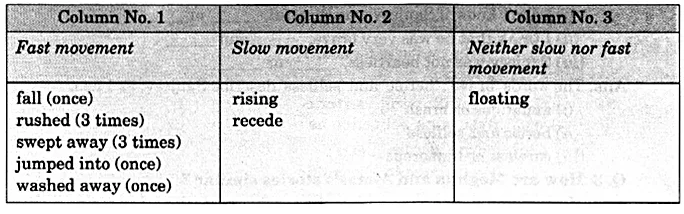
Go through Part-I carefully, and make a list of as many words as you can find that indicate movement of different kinds. (There is one word that occurs repeatedly—count how many times !) Put them into three categories.

  • fast movement
  • slow movement
  • neither slow nor fast

Can you explain why there are many words in one column and not in the others ?

Answer
NCERT Solutions for Class 8 English Honeydew Chapter 2 The Tsunami 31.1
There are more words in column no. 1. The reason is the description of tsunami. Tsunami swept away everything very fast. The other word is ‘rushed’. The people who wanted to escape tsunami had to move very fast. So their movement is described by the word ‘rush’.

Question 2.
Fill in the blanks in the sentences below (the verbs given in brackets will give you a clue).
(i) The earth trembled, but not many people felt the___. (tremble)
(ii) When the zoo was flooded, there was a lot of___and many animals escaped into the countryside, (confuse)
(iii) We heard with__that the lion had been recaptured, (relieve)
(iv) The zookeeper was stuck in a tree and his___was filmed by the TV crew, (rescue)
( v ) There was much__in the village when the snake charmer came visiting, (excite)

Answer
(i) tremors
(ii) confusion
(iii) relief
(iv) rescue
(v) excitement

3. Study the sentences in the columns A and B.
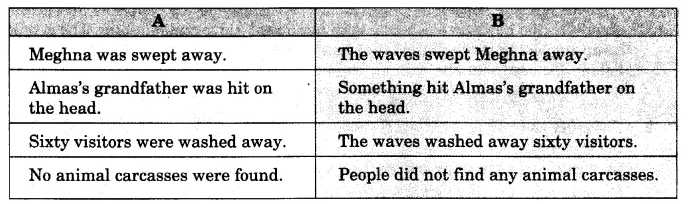
NCERT Solutions for Class 8 English Honeydew Chapter 2 The Tsunami 31.3
Compare the sentences in A to the ones in B. Who is the ‘doer’ of the action in every case ? Is the ‘doer’ mentioned in A, or in B ?

Notice the verbs in A : ‘was swept away’, ‘was hit’, ‘were washed away’, ‘were found’. They are in the passive form. The sentences are in the Passive Voice. In these sentences, the focus is not on the person who does the action. ,

In B, the ‘doer’ of the action is named. The verbs are in the active form. The sentences are in the Active Voice.

  • Say whether the following sentences are in the Active or the Passive voice. Write A or P after each sentence as shown in the first sentence.
    (i) Someone stole my bicycle. A
    (ii) The tyres were deflated by the traffic police. ___
    (iii) I found it last night in a ditch near my house.___
    (iv) It had been thrown there.___
    (v) My father gave it to the mechanic.___
    (vi) The mechanic repaired it for me.___

Answers
(ii) Passive Voice P
(iii) Active Voice A
(iv) Passive Voice P
(v) Active Voice A
(vi) Active Voice A

SPEAKING AND WRITING (Page 32)

Question 1.
Suppose you are one of the volunteers who went to the Andaman and Nicobar Islands for relief work after the Tsunami. You work in the relief camps, distributing food, water and medicine among the victims. You listen to the various stories of bravery of ordinary people even as they fight against odds to bring about some semblance of normalcy in their lives. You admire their grit and determination. Write a diary entry.
You may start in this way.
31 December, 2016
The killer Tsunami struck these islands five days ago. But the victims are being brought in even now. Each one has a story to tell…

Answer
… All of them rouse our pity. But a few inspire me too. There is an old woman of about 65. She has survived along with her 8 year-old granddaughter. The people in the camp suggest that the granddaughter be sent to an orphanage. The old lady refuses to listen. She says that she will not let her daughter go away from her. In fact she wants no charity. She is willing to do some useful work to help her granddaughter.

Question 2.
The story shows how a little girl saved the lives of many tourists when a tsunami struck the beach, thanks to the geography lesson that she had learnt at school. She remembered the visuals of a tsunami and warned her parents.

Do you remember any incident when something that you learnt in the classroom helped you in some way outside the classroom ?

Write your experiences in a paragraph of about 90-100 words or narrate it to the whole class like an anecdote.

Answer
The other day I was walking back from school. Suddenly my eyes fell on a cyclist. He seemed to be losing balance. Before I could think of helping him, he had somehow got down the cycle. However, he just left the cycle and lay on the side of the road. He was perspiring and breathing with difficulty. Soon a crowd gathered. I immediately remembered the lesson my biology teacher had taught me. I requested the people to stay away and sent one of them to call a doctor. In the meantime I fanned him to help him get a lot of fresh air. Then very tenderly, I massaged his heart. That was what my teacher had advised me to do. The man felt relief and was breathing easily when the doctor arrived.

We hope the NCERT Solutions for Class 8 English Honeydew Chapter 2 The Tsunami help you. If you have any query regarding NCERT Solutions for Class 8 English Honeydew Chapter 2 The Tsunami, drop a comment below and we will get back to you at the earliest.

NCERT Solutions for Class 8 English Honeydew Poem Chapter 2 Geography Lesson

NCERT Solutions for Class 8 English Honeydew Poem Chapter 2 Geography Lesson are part of NCERT Solutions for Class 8 English. Here we have given NCERT Solutions for Class 8 English Honeydew (Poem) Chapter 2 Geography Lesson.

BoardCBSE
TextbookNCERT
ClassClass 8
SubjectEnglish Honeydew (Poem)
ChapterChapter 2
Chapter NameGeography Lesson
CategoryNCERT Solutions

NCERT Solutions for Class 8 English Honeydew (Poem) Chapter 2 Geography Lesson

STANZAS FOR COMPREHENSION

I. When the jet sprang into the sky,
it was clear why the city
had developed the way it had,
seeing it scaled six inches to the mile. (Page 34)

NCERT Solutions for Class 8 English Honeydew Poem Chapter 2 Geography Lesson 1

हिंदी अनुवाद- जब जेट प्लेन तेज़ी से आसमान में उठा, कवि ने अपने नीचे की ओर देखा। वह समझ गया कि नगर क्यों बेतरतीव ढंग से विकसित हुआ था। उसे शहर बहुत छोटा लग रहा था। एक मील छः इंच के बराबर नज़र आता था।

Paraphrase. When the jet rose fast into the sky, the poet saw below him. He could understand why the city had grown into haphazard way. He saw the city look small. A mile of the ground looked as small as six inches.

Multiple Choice Questions
1. The “jet’ in the passage refers to :
(a) jet black
(b) jet engine
(c) jet liner
(d) jet stream.

2. The poet realised why
(a) he was in the sky
(b) the city had developed
(c) there were new ways in the city
(d) the city had taken the shape it had.

3. The city appeared from the sky
(a) very big
(b) very small
(c) very wide
(d) very beautiful.

4. The word ‘scaled’ in the passage means :
(a) measured
(b) spotted
(c) climbed
(d) like a scale.

Answers
1. (c) jet liner
2. (d) the city had taken the shape it had
3. (b) very small
4. (a) measured

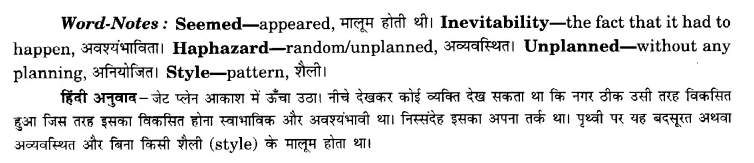
II. There seemed an inevitability
about what on ground had looked haphazard,
unplanned and without style
When the jet sprang into the sky. (Page 34)

NCERT Solutions for Class 8 English Honeydew Poem Chapter 2 Geography Lesson 2

Paraphrase. The jet went up into the sky. Looking below, one could see the inevitable way in which the city had developed. It certainly had a logic. On the earth it seemed ugly and without a method.

Questions
1. What did the poet see from the jet ?
2. What seemed inevitable ?
3. Why is logic not seen on the earth ?

Answers
1. From the jet the poet saw how his city had developed.
2. The way the city had developed seemed inevitable.
3. On the earth one cannot have the whole view. One can see only a part at a time. So the logic of geography is not seen on the earth.

III. When the jet reached ten thousand feet,
it was clear why the country
had cities where the rivers ran
and why the valleys were populated. (Page 34)

NCERT Solutions for Class 8 English Honeydew Poem Chapter 2 Geography Lesson 3

हिंदी अनुवाद-जेट-प्लेन आकाश में और ऊँचा दस हज़ार फीट तक गया। वहाँ से नीचे देश की ओर देखकर यह स्पष्ट रूप से समझा जा सकता था कि देश के नगर नदियों के किनारे क्यों विकसित हुए थे। ऐसा स्वाभाविक था क्योंकि मनुष्यों को जल की आवश्यकता होती है। उसी प्रकार उस ऊँचाई से कवि देख सका कि घाटियों में क्यों लोग बस गए थे।

Paraphrase. The jet plane went higher upto ten thousand feet in the sky. Looking below at the country, one could clearly see why the cities in the country had developed along the rivers. It was natural because people need water. In the same way from that height the poet could see why people had settled in valleys.

Multiple Choice Questions
1. From the height of ten thousand feet the poet was observing
(a) his city
(b) his country
(c) the earth
(d) the sky

2. The cities are developed
(a) in the open space
(b) on the hill-side
(c) by the river-side
(d) in the deserts.

3. The valleys are populated because
(a) the climate is good
(b) people love the hills
(c) the life is safe there
(d) the water is easily available.

4. The word ‘valley’ means the same as
(a) vale
(b) valet
(c) valour
(d) value.

Answers
1. (b) his country
2. (c) by the river-side
3. (d) the water is easily available
4. (a) vale

IV. The logic of geography,
that land and water attracted man
was clearly delineated
When the jet reached ten thousand feet. (Page 34)

NCERT Solutions for Class 8 English Honeydew Poem Chapter 2 Geography Lesson 4

हिंदी अनुवाद-जेट प्लेन में बैठकर 10 हजार फुट की ऊँचाई से कवि ने देश को देखा। उसे भूगोल के तर्क समझ आए। वह समझ गया कि लोग वहाँ जाकर बसे जहाँ भूमि और जल सहज उपलब्ध थे। यह पाठ स्पष्ट लिखा दिखाई देता था।

Paraphrase. From the height of ten thousand feet in the jet plane the poet observed the country. He understood the contentions of geography. It was that people settled where land and water were easily available. This lesson seemed clearly written.

Questions
1. What did the poet see from the height of ten thousand feet?
2. Where did man settle ?
3. Name the poet.
4. What does the word ‘delineated’ mean?

Answers
1. From the height of ten thousand feet man saw the logic of geography.
2. Man settled on the land which was close to the water.
3. The poet is “Zulfikar Ghose’.
4. The word ‘delineated’ means ‘drawn’.

V. When the jet rose six miles high,
it was clear the earth was round
and that it had more sea than land.
But it was difficult to understand (Pages 34–35)

NCERT Solutions for Class 8 English Honeydew Poem Chapter 2 Geography Lesson 5

हिंदी अनुवाद- कवि का जेट प्लेन आकाश में और ऊँचा उठा। यह ज़मीन से 6 मील ऊपर उठ गया। अब पृथ्वी गोल दिखाई देती थी जैसा कि उसने भूगोल में पढ़ा था। यह भी दिखाई दिया कि जल पृथ्वी के अधिक भाग को आच्छादित किए है। अतः समुद्र का क्षेत्रफल भूमि से अधिक था। पर कुछ ऐसा था जिसे वह समझ नहीं पाता था।

Paraphrase. The poet’s jet plane went higher into the sky. It rose six miles up the ground. Now the earth seemed round as he had learnt in geography. It was also shown that water covers the better part of the earth. So sea had an area larger than the land. However, there was something which he could not understand.

Multiple Choice Questions
1. The passage has been taken from :
(a) Geography Lesson
(b) The Ant and the Cricket
(c) The Last Bargains
(d) Macavity : The Mystery Cat.

2. From that height the poet saw that
(a) the earth is full of people
(b) the earth has hills and deserts
(c) the earth has much water
(d) the earth has much land.

3. From the height of the jet, the earth looked
(a) flat
(b) round
(c) rectangular
(d) triangular.

4. The noun form of ‘difficult is
(a) difference
(b) diffident
(c) diffract
(d) difficulty.

Answers
1. (a) Geography Lesson
2. (c) the earth has much water
3. (b) round
4. (d) difficulty

VI. that the men on the earth found
causes to hate each other, to build
walls across cities and to kill.
From that height, it was not clear why. (Page 35)

NCERT Solutions for Class 8 English Honeydew Poem Chapter 2 Geography Lesson 6

हिंदी अनुवाद-ऊपर आसमान में पहुँच कर कवि को भूगोल की बातें समझ आ गयीं। पर वह मानव की आपसी घृणा को नहीं समझ सका। वह नहीं समझ पाया कि क्यों उन्होंने एक-दूसरे से अलग रहने का निश्चय किया है। क्यों लोग एक-दूसरे को मारना चाहते हैं ? उस ऊँचाई पर यह एक ऐसी उलझन थी जिसे कवि सुलझा नहीं पाता था।

Paraphrase. From high in the sky, the poet understood logic of geography. However, he could not understand the logic of human hatred for each other. He could not understand why they have decided to live separately. Why are there walls across the cities ? Why do people want to kill each other ? It was one puzzle which the poet could not answer from that height.

Questions
1. What did the poet understand from ‘that height?
2. What did he not understand ?
3. What does the phrase ‘building walls’ mean?
4. Give the adjective form of ‘heighť.

Answers
1. From that height, the poet could understand how the cities developed.
2. The poet could not understand why people on the earth quarrelled. He could also not understand why they separate themselves from their fellow beings.
3. The phrase ‘building walls’ indicates man’s desire to segregate.
4. high.

TEXTUAL QUESTIONS

WORKING WITH THE POEM (Page 35)

Question. 1.
Find three or four phrases in stanzas one and two which are likely to occur in a geography lesson.

Answer:
The following phrases are likely to occur in a geography lesson :
(a) scaled six inches to the mile (stanza 1)
(b) why valleys were populated (stanza 2)
(c) land and water attracted man (stanza 2)
(d) clearly delineated (stanza 2)

Question. 2.
Seen from the window of an aeroplane, the city appears
(i) as haphazard as on ground.
(ii) as neat as a map.
(iii) as developed as necessary.
Mark the right answer.

Answer:
(iii) as developed as necessary

Question. 3.
Which of the following statements are examples of “the logic of geography.”
(i) There are cities where there are rivers.
(ii) Cities appear as they are not from six miles above the ground.
(iii) It is easy to understand why valleys are populated.
(iv) It is difficult to understand why humans hate and kill one another.
(v) The earth is round, and it has more sea than land.

Answer:
(i), (iii), and (v) are the correct statements.

Question. 4.
Mention two things that are
(i) clear from the height.
(ii) not clear from the height.

Answer:
(i) The earth is round and that it has more sea than land. These two things are clear from the height.
(ii) Men hate each other and build walls across the cities to kill each other. It is not clear why they do so.

We hope the NCERT Solutions for Class 8 English Honeydew Poem Chapter 2 Geography Lesson help you. If you have any query regarding NCERT Solutions for Class 8 English Honeydew Poem Chapter 2 Geography Lesson, drop a comment below and we will get back to you at the earliest.

NCERT Solutions for Class 8 English Honeydew Poem Chapter 1 The Ant and the Cricket

NCERT Solutions for Class 8 English Honeydew Poem Chapter 1 The Ant and the Cricket are part of NCERT Solutions for Class 8 English. Here we have given NCERT Solutions for Class 8 English Honeydew Poem Chapter 1 The Ant and the Cricket.

BoardCBSE
TextbookNCERT
ClassClass 8
SubjectEnglish Honeydew (Poem)
ChapterChapter 1
Chapter NameThe Ant and the Cricket
CategoryNCERT Solutions

NCERT Solutions for Class 8 English Honeydew (Poem) Chapter 1 The Ant and the Cricket

STANZAS FOR COMPREHENSION

Read the extracts given below and answer the questions that follow each :

I. A silly young cricket, accustomed to sing
Through the warm, sunny months of gay summer and spring,
Began to complain when he found that, at home,
His cupboard was empty, and winter was come. (Page 21)

NCERT Solutions for Class 8 English Honeydew Poem Chapter 1 The Ant and the Cricket 1
हिंदी अनुवाद-एक मूर्ख युवा झींगुर था। गर्मी और बसंत के धुपहले महीनों को गाते हुए बिता देना उसकी आदत थी। जब सर्दी का मौसम आया तो वह दु:खी हो उठा। खाने के लिए कुछ न था। घर पर उसका भंडार खाली था।

Paraphrase. Once there was a foolish young cricket. It was his habit to pass the sunny months of summer and spring in singing. When winter came, he began to grumble. There was nothing to eat. His cupboard at his home was empty.

Multiple Choice Questions
1. The passage is taken from
(a) Geography Lesson
(b) On the Grasshopper and Cricket
(c) The Ant and the Cricket
(d) The Duck and the Kangaroo.

2. The two qualities of the Cricket described here are
(a) foolish and a singer
(b) wise and a singer
(c) foolish and a writer
(d) intelligent and a speaker.

3. The weather in the poem is
(a) warm and gay
(b) cold and dry
(c) rainy and stormy
(d) hot and sunny.

4. ‘Accustomed to’ means
(a) happy
(b) unhappy
(c) used to
(d) irritated.

Answers
1. (c) The Ant and the Cricket
2. (a) foolish and a singer
3. (b) cold and dry
4. (c) used to

II. Not a crumb to be found
On the snow-covered ground;
Not a flower could he see,
Not a leaf on a tree.
“Oh! what will become,” says the cricket, “of me ?” (Page 21)

NCERT Solutions for Class 8 English Honeydew Poem Chapter 1 The Ant and the Cricket 2
हिंदी अनुवाद-झींगुर को सर्दी में भोजन नहीं मिला। हर जगह बर्फ ही बर्फ थी। न कोई फूल और न ही किसी पेड़ पर कोई पत्ती दिखाई देती थी। झींगुर चिंता में बोल उठा ‘मेरा क्या होगा ?’

Paraphrase. The cricket did not find any food in winter. There was ice everywhere. Neither a flower nor a leaf on a tree could be seen. The cricket wondered aloud what would become of him.

Questions
1. Who was looking for the crumbs ?
2. What did the Cricket usually do ?
3. Why was the Cricket worried ?

Answers
1. The Cricket was looking for the crumbs.
2. Usually the Cricket sang.
3. The Cricket was worried because he had no food.

III. At last by starvation and famine made bold,
All dripping with wet, and all trembling with cold,
Away he set off to a miserly ant,
To see if, to keep him alive, he would grant (Page 21)

NCERT Solutions for Class 8 English Honeydew Poem Chapter 1 The Ant and the Cricket 3
हिंदी अनुवाद-झींगुर मरने लगा। वह भूख से मर रहा था। अतः उसने हिम्मत जुटायी। वर्षा से भीगता और ठंड से कांपता वह एक कंजूस चींटी के पास पहुँचा। उसने जानना चाहा कि क्या चींटी जिंदा रहने में उसकी सहायता करेगी।

Paraphrase. The cricket came on the verge of death. He was dying of hunger. So he took courage. Wet with rain and shivering with cold, he went to a miserly ant. He wanted to know if the ant would help him keep alive.

Multiple Choice Questions
1. Who was suffering from starvation and famine ?
(a) the Ant
(b) the Cricket
(c) the poet
(d) a man.

2. Why was he dripping with wet ?
(a) It was raining hard.
(b) He had dived in a pond.
(c) He had no shelter.
(d) He had taken a bath.

3. What did he expect to get from the miserly ant ?
(a) good advice
(b) food
(c) shelter
(d) food and shelter.

4. What does the word ‘grant mean?
(a) kind
(b) generous
(c) take
(d) give.

Answers
1. (b) the Cricket
2. (c) He had no shelter
3. (d) food and shelter
4. (d) give

IV. Him shelter from rain,
And a mouthful of grain.
He wished only to borrow;
He’d repay it tomorrow;
If not, he must die of starvation and sorrow. (Page 21)

NCERT Solutions for Class 8 English Honeydew Poem Chapter 1 The Ant and the Cricket 4
हिंदी अनुवाद-झींगुर ने चींटी से निवेदन किया कि वह उसे वर्षा से बचाये। वह थोड़ा सा अन्न भी चाहता था। उसका इरादा था कि वह इस कर्ज को शीघ्र ही उतार देगा। वह बोला कि अगर चींटी ने दया नहीं की तो वह मर जायेगा।

Paraphrase. The cricket requested the ant to give him protection from rain. He also wanted a small quantity of food. His intention was to repay the debt soon. He said that if the ant was not kind, he would die.

Questions
1. Who is ‘him’ in the first line ?
2. What did he want?
3. From whom did he hope to borrow ?
4. Give the opposite of the word ‘borrow’.

Answers
1. ‘Him’ refers to the Cricket.
2. He wanted food and shelter.
3. He hoped to borrow from the ant.
4. lend.

V. Says the ant to the
cricket, “I’m your servant
and friend,
But we ants never
borrow; we ants never
lend.
But tell me, dear cricket,
did you lay nothing by
When the weather was
warm ?” Quoth the cricket,
“Not I! (Page 22)

NCERT Solutions for Class 8 English Honeydew Poem Chapter 1 The Ant and the Cricket 5
हिंदी अनुवाद- चींटी झींगुर से बोली, “मैं आपकी सेवक और मित्र हूँ। पर हमारा सिद्धांत है कि हम ने उधार देते हैं और न उधार लेते हैं। पर प्रिय झींगुर, क्या गर्मी के मौसम में तुमने सर्दी के लिए कुछ बचाकर नहीं रखा ?” झींगुर ने उत्तर दिया “नहीं।”

Paraphrase. The ant said to the cricket. “I am your servant and friend. However, it is our principle that we neither borrow nor lend. But, dear cricket, did you not save anything for the bad weather during the warm days ?” The cricket said that he didn’t.

Multiple Choice Questions
1. What do you think that of the ant’s behaviour ? What was it like?
(a) a servant
(b) a friend
(c) both
(d) neither

2. What do the ants not do according to the passage ?
(a) don’t borrow
(b) neither borrow nor lend
(c) don’t lend
(d) don’t help.

3. The ant scolded the Cricket because
(a) he never lent
(b) he never borrowed
(c) he never saved
(d) he was foolish.

4. The word ‘Quoth’ means
(a) wept
(b) laughed
(c) said
(d) asked.

Answers
1. (d) neither
2. (b) neither borrow nor lend
3. (c) he never saved
4. (c) said

VI. My heart , was so light
That I sang day and night,
For all nature looked gay.”
“You sang, Sir, you say ?
Go then,” says the ant, “and dance the winter away.” (Page 22)

NCERT Solutions for Class 8 English Honeydew Poem Chapter 1 The Ant and the Cricket 6
हिंदी अनुवाद-“मेरा दिल ऐसा खुश था कि मैं दिन-रात गाता ही रहा। सारी प्रकृति प्रसन्न दिखाई दे रही थी”, (झींगुर बोला)। चींटी ने कहा, “ श्रीमन्, अगर आपने गर्मियाँ गाकर बिता दीं, तो जाओ सर्दियँ नाच कर बिता दो।”

Paraphrase. “I felt so light at heart that I sang and sang all through the day and night. Every object of nature seemed very happy”, (said the cricket). The ant said, “Sir, if you passed the summer in singing, pass the winter in dancing”.

Questions
1. Whose heart was it ? How did it feel ?
2. What did he do ?
3. How was the weather ?
4. Who questions the wisdom of his action ?

Answers
1. It was Cricket’s heart. It felt very happy.
2. He sang day and night.
3. The weather was fine.
4. The ant questions the wisdom of his action.

VII. Thus ending, he hastily lifted the wicket,
And out of the door turned the poor little cricket.
Folks call this a fable. I’ll warrant it true :
Some crickets have four legs, and some have two.

NCERT Solutions for Class 8 English Honeydew Poem Chapter 1 The Ant and the Cricket 7
हिंदी अनुवाद-ऐसा कह कर चींटी ने दरवाजा बंद कर दिया। इस प्रकार बेचारा युवा झींगुर चींटी के घर के बाहर निकला। लोग कहते हैं कि यह एक नीति-कथा है। कवि का विश्वास है कि यह सच्ची बात है। वह कहता है कि संसार में दो पैरों वाले ऐसे लोग हैं जो कहानी के चार पैरों वाले युवा झींगुर की तरह व्यवहार करते हैं।

Paraphrase. So saying he (the ant) closed the door. So the poor young cricket came out of the ant’s house. People say that it’s a story with a moral. The poet believes it’s true. He says that there are people in the world who behave like that cricket of the story.

Multiple Choice Questions
1. Who lifted the wicket?
(a) the Ant
(b) the Cricket
(c) the poet
(d) a man.

2. Why did he lift the wicket?
(a) because it was so light.
(b) because he was tired.
(c) because he wanted his visitor to go.
(d) because it was cold.

3. What does the poet mean when he says that ‘some crickets have two legs’ ?
(a) These are some strange crickets with two legs.
(b) The poet dislikes all crickets.
(c) The poet is referring to people who do not save for a rainy day.
(d) All men are crickets with two legs.

4. The word ‘fable’ here means
(a) able
(b) poem
(c) epilogue
(d) story with a moral.

Answers
1. (a) the Ant
2. (c) because he wanted his visitor to go
3. (c) The poet is referring to people who do not save for a rainy day.
4. (d) story with a moral

TEXTUAL QUESTIONS

WORKING WITH THE POEM (Page 23)
Question. 1.
The cricket says, “Oh ! what will become of me ?” When does he say it, and why ?

Answer:
The cricket speaks these words on the arrival of winter. He says so because he finds that there is no food for him in his house.

Question. 2.
(i) Find in the poem the lines that mean the same as “Neither a borrower nor a lender be’ (Shakespeare).
(ii) What is your opinion of the ant’s principles ?

Answer:
(i) The line is :
“We ants never borrow ; we ants never lend.”
(ii) I do not agree with the ant’s principle. On the other hand, I believe that a friend in need is a friend indeed.

Question. 3.
The ant tells the cricket to “dance the winter away”. Do you think the word ‘dance’ is appropriate here ? If so, why ?

Answer:
Yes the word ‘dance’ is appropriate here. It is so because the cricket had spoken of his love of singing. Singing and dancing go together.

Question. 4.
(i) Which lines in the poem express the poet’s comment ? Read them aloud.
(ii) Write the comment in your own words.

Answer:
(i) The lines are :
“Folks call this a fable ; I’ll warrant it true.
Some crickets have four legs, and some have two.”

(ii) People say that this is a short story with a moral. However it is true. There are people in this world who spend all their earnings. They do not save anything for the future. In the moments of crisis or in their old age they come to grief. They find they have no money to depend upon. Such people, says the poet, are like the cricket of the story.

Question. 5.
If you know a fable in your own language, narrate it to your classmates.

Answer:
Once there was an old man. He had four sons. These sons always quarrelled with one another. So the old man was sad. When he was about to die, he called them all. He asked them to bring four sticks. Then he asked them to tie them in a bundle. After that he asked each of them to break the bundle. No one could do it. Then he untied the bundle and gave a stick to each of them. They easily broke them. Thus, the old man explained them the value of unity. He told his sons that if they remained united no one would ever harm them.

We hope the NCERT Solutions for Class 8 English Honeydew Poem Chapter 1 The Ant and the Cricket help you. If you have any query regarding NCERT Solutions for Class 8 English Honeydew Poem Chapter 1 The Ant and the Cricket, drop a comment below and we will get back to you at the earliest.

NCERT Solutions for Class 8 English Honeydew Chapter 10 The Great Stone Face II

NCERT Solutions for Class 8 English Honeydew Chapter 10 The Great Stone Face II are part of NCERT Solutions for Class 8 English. Here we have given NCERT Solutions for Class 8 English Honeydew Chapter 10 The Great Stone Face II.

BoardCBSE
TextbookNCERT
ClassClass 8
SubjectEnglish Honeydew
ChapterChapter 10
Chapter NameThe Great Stone Face II
CategoryNCERT Solutions

NCERT Solutions for Class 8 English Honeydew Chapter 10 The Great Stone Face II

IMPORTANT PASSAGES FOR COMPREHENSION

Read the following extracts and answer the questions that follow choosing the correct options among the given ones :

I. Unsought for, undesired, had come the fame which so many seek. He had become famous beyond the limits of the valley. College professors, and even the active men of cities, came from far to see and converse with Ernest, (Page 133)

Multiple Choice Questions
1. What is it that many seek ?
(a) health
(b) wealth
(c) fame
(d) love.

2. Ernest had become famous for his
(a) health
(b) wisdom
(c) wealth
(d) love.

3. The phrase ‘unsought for’ means
(a) hated
(b) undesired
(c) loved
(d) unasked.

Answers
1. (c) fame
2. (b) wisdom
3. (d) unasked

II. “Because,” replied Ernest, “all through life I have awaited the fulfillment of a prophecy, and when I read these poems, I hoped that it might be fulfilled in you.” (Page 134)

Multiple Choice Questions
1. Ernest was talking to
(a) his mother
(b) a poet
(c) a neighbour
(d) General Blood-and-Thunder.

2. The prophecy concerned
(a) himself
(b) his mother
(c) the poet
(d) The Great Stone Face.

3. Ernest had expected that the poet’s face would resemble
(a) his own face
(b) Gathergold
(c) The Great Stone Face
(d) his mother’s face.

Answers:
1. (b) a poet
2. (d) The Great Stone Face
3. (c) The Great Stone Face

III. The prophecy was fulfilled. But Ernest, having finished what he had to say, took the poet’s arm, and walked slowly homeward, still hoping that some wiser and better man than himself would by and by appear, bearing a resemblance to the Great Stone Face. (Page 136)

Multiple Choice Questions
1. The prophecy was fulfilled in
(a) the poet
(b) Ernest
(c) Gathergold
(d) General Blood-and-Thunder.

2. Ernest believed the prophecy
(a) was yet to be fulfilled
(b) was now fulfilled
(c) will never be fulfilled
(d) was fulfilled long ago.

3. The story is written by
(a) Nathaniel Hawthorne
(b) John Keats
(c) Ruskin Bond
(d) Zulfikar Ghose.

Answers
1. (b) Ernest
2. (a) was yet to be fulfilled
3. (a) Nathaniel Hawthorne

TEXTUAL EXERCISES

COMPREHENSION CHECK (Page 136)

Write ‘True’ or ‘False’ against each of the following statements.
1. Ernest’s words reminded people of the wise old sayings.___
2. Total strangers from far away, who visited Ernest in the valley, found his face familiar.___
3. The Great Stone Face confirmed Ernest’s view that the poet could be worthy of its like-ness. ___
4. When Ernest and the poet met, they respected and admired each other equally.___
5. The poet along with Ernest addressed the inhabitants of the valley.___
6. The poet realised that Ernest’s thoughts were far nobler than his own verses.___

Answers
1. True
2. True
3. False
4. True
5. False
6. True

WORKING WITH THE TEXT (Page 137)

Answer the following questions.
Question. 1.
How was Ernest different from others in the valley ?

Answer:
There were thousands of inhabitants in the valley. Ernest was good and simple hearted. He did noble deeds every day. He was a humble and thoughtful person. He had wise thoughts in his mind. He became famous throughout the world. In this way, he was different from others in the valley.

Question. 2.
Why did Ernest think the poet was like the Stone Face ?

Answer:
The poet wrote songs with lofty thoughts. While he was talking to Ernest, he looked wise, gentle and kind. Even the Great Stone Face appeared bending forward to listen to his talk. The Stone Face even looked kindly at the poet, though he was a complete stranger. Therefore, Ernest thought the poet was like the Stone Face.

Question. 3.
What did the poet himself say about his thoughts and poems ?

Answer:
The poet said that his thoughts contained the distant voice of a heavenly song. However, his life had been different from his poems. He himself lacked faith in his dreamy thoughts.

Question. 4.
What made the poet proclaim Ernest was the Stone Face ?

Answer:
Through Ernest’s speech, the poet judged his greatness. He felt that Ernest’s life and character were a nobler kind of poetry.

Moreover, Ernest’s white hair looked like the Great Stone Face surrounded by white clouds. Ernest’s face also assumed a grand expression. It moved the poet’s heart. It also made him proclaim Ernest as the Stone Face.

Question. 5.
Write ‘Ernest’ or ‘Poet’, against each statement below :
(i) There was a gap between his life and his words.
(ii) His words had the power of truth as they agreed with his thoughts.
(iii) His words were as soothing as a heavenly song but only as useful as a vague dream.
(iv) His thoughts were worthy.
(v) Whatever he said was truth itself.
(vi) His poems were noble.
(viii) His life was nobler than all the poems.
(viii) He lacked faith in his own thoughts.
(ix) His thoughts had power as they agreed with the life he lived.
(x) Greatness lies in truth. Truth is best expressed in one’s actions. He was truthful, therefore he was great.

Answer:
(i) Poet
(ii) Ernest
(iii) Poet
(iv) Poet
(v) Ernest
(vi) Poet
(vii) Ernest
(viii) Poet
(ix) Ernest
(x) Ernest.

Question. 6.
(i) Who, by common consent, turned out to be like the Great Stone Face ?
(ii) Did Ernest believe that the old prophecy had come true ? What did he say about it ?

Answer:
(i) By common consent, Ernest turned out to be like the Great Stone Face.
(ii) No, Ernest did not believe that the old prophecy had come true. He still hoped, that some day, some man, wiser and better than himself would appear. He would bear a likeness to the Great Stone Face.

WORKING WITH LANGUAGE (Page 137)
1. Mark the meaning that best fits the word or a phrase in the story.
(i) (sun) going down
(a) becoming smaller
(b) weakening
(c) setting

(ii) brightening
(a) making (it) look bright and cheerful
(b) lending (it) a special glow
(c) causing (it) to appear hopeful

(iii) spacious
(a) lonely and wild
(b) big and wide
(c) special and important

(iv) prophecy
(a) proverb
(b) prediction
(c) rumour

(v) marvellous
(a) wonderful
(b) surprising
(c) shocking

(vi) proclaim
(а) reveal
(b) declare
(c) shout

(vii) cease
(a) happen
(b) stop
(c) remain

(viii) (a night’s) shelter
(a) stay
(b) safety
(c) hospitality

(ix) gazed
(a) wandered about
(b) stared at
(c) thought of

(x) took on (an expression)
(a) challenged
(b) resembled
(c) assumed

Answers
(i) —> (c)
(ii) —> (b)
(iii) —> (b)
(iv) —> (b)
(v) —> (a)
(vi) —> (b)
(vii) —> (b)
(viii) —> (a)
(ix) —> (b)
(x) —> (c).

2. (i) Read the following sentences.
(a) I do hope I’ll live to see him.
(b) He will come! Fear not, Ernest; the man will come.
(c) Gathergold is arriving tomorrow, people said.
(d) Blood-and-Thunder starts his journey back to the valley next week, everyone proclaimed.
(e) The great man is going to spend his old age in his native town.

Notice that in the above sentences, verbs in bold type are in four different forms, denoting four important ways of expressing future time. None of these can be said to be exclusively used to show future time, though each is used to refer to some action in future.

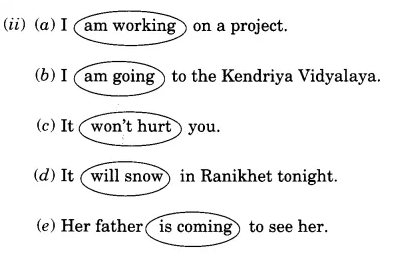
(ii) Which form of the verb is more natural in these sentences ? Encircle your choice.
(a) I’m not free this evening. I will work/am working on a project.
(b) Have you decided where you will go for your higher secondary ? Yes. I have. I will go/am going to the Kendriya Vidyalaya.
(c) Don’t worry about the dog. It won’t hurt/isn’t hurting you.
(d) The weatherman has predicted that it will snow/’I’ is snowing in Ranikhet tonight.
(e) Swapna can’t go out this evening. Her father will come/is coming to see her.

Answers
(i) Do yourself.
NCERT Solutions for Class 8 English Honeydew Chapter 10 The Great Stone Face II 137.2

Question 3.
(i) Complete these pieces of conversation using will or going to with the verbs given
(a) Rani : Why are you turning on the radio ?
Ravi : I___(listen) to the news.
(b) Rani : Oh, I can’t buy this book. I have no money.
Ravi : Don’t worry. I___(lend) you some.
(c) Rani : Look at those dark clouds.
Ravi : I think it__(rain).
(d) Rani : What shall we have for dinner ?
Ravi : I can’t decide.
Rani : Make up your mind.
Ravi : All right, then. We___(have) fried rice and dry beans.
(e) Rani : Why are you filling the kettle with water ?
Ravi : I___(make) coffee.
(f) Rani : We need some bread and butter for breakfast.
Ravi : All right. I___(go) to the bakery and get some.
(Before he goes out, Ravi talks to their father.)
Ravi : I__(get) some bread and butter. Do you want any thing from the bakery ?
Father : Yes, I want some salt biscuits.
Ravi : Fine, I___(get) you a packet.

(ii) Let pairs of children take turns to speak aloud the dialogues.

Answers
(i) (a) am going to listen
(b) will lend
(c) is going to
(d) will have
(e) am going to make
(f) will go, am going to get, will get

(ii) Do yourself.

SPEAKING AND WRITING
Question 1.
Each of the following words has the sound / f / as in feel. The words on the left have it initially. Those on the right have it finally. Speak each word clearly.
NCERT Solutions for Class 8 English Honeydew Chapter 10 The Great Stone Face II SW.1

Answer
Do yourself.

Question 2.
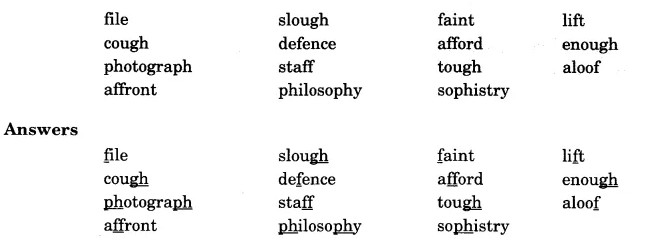
Underline the letter or letters representing / f / in each of the following words.
NCERT Solutions for Class 8 English Honeydew Chapter 10 The Great Stone Face II SW.2

Question 3.
Imagine that you are the poet. You have come to your native valley to meet a famous preacher called Ernest. Narrate the incident of your first meeting with him.

Answer
Meeting Ernest
It was a summer evening. I arrived at Ernest’s door. I found him reading a book. Between his readings, I found him looking lovingly at the Great Stone Face. I greeted him. Then I asked for a night’s shelter. He gladly agreed to grant me that. Then he said that the Great Stone Face was looking very hospitably at me.

I sat beside him. We talked for a long time. Never before, I had met so wise and gentle and kind a person. Then suddenly, he gazed into my eyes, called me gifted and asked who I was. I pointed to the book in his hand. I said that I was the one who wrote that book. I felt that he was now comparing my features to those of the Great Stone Face. It made him sad because he did not find the desired resemblance. I told him that I was not worthy of that likeness. Ernest asked, “Why not ?” I told him that my life did not correspond with my thoughts. Ernest’s eyes were full of tears.

At the hour of sunset, he took me to a place. Here he spoke to a group of neighbours in the open air. While listening to Ernest, I felt that I had before me the worthiest sage.

As I looked at the Great Stone Face. I couldn’t help shouting, “Behold ! Behold ! Ernest is himself the likeness of the Great Stone Face !”

All the people there looked and saw that what I said was true. The prophecy was fulfilled. Ernest however, was too humble to believe it.

Question 4.
(i) Put each of the following in the correct order to construct sentences.
• a resident of Noida near Delhi,/is visually impaired/George Abraham,
__________________________________________________
• confidence and competitive spirit/and infuses discipline among the participants/ It provides
__________________________________________________
• he has helped/The brain behind the World Cup Cricket,/the disabled to dream
__________________________________________________
• to the blind school in Delhi/It was a chance visit/that changed his life
___________________________________________________
• sport is a powerful tool/the disabled/He believes that/for rehabilitation of
___________________________________________________
(ii) Now rearrange the sentences above to construct a paragraph.
George Abraham,_____________________________________

Answers
(i) • George Abraham, a resident of Noida near Delhi, is visually impaired.
• It provides confidence and competitive spirit and infuses discipline among the participants.
• The brain behind the World Cup Cricket, he has helped the disabled to dream.
• It was a chance visit to the blind school in Delhi that changed his life.
• He believes that sport is a powerful tool for rehabilitation of the disabled.

(ii) George Abraham, a resident of Noida near Delhi, is visually impaired. The brain behind the World Cup Cricket, he has helped the disabled to dream. It was a chance visit to the blind school in Delhi that changed his life. He believes that sport is a powerful tool for rehabilitation of the disabled. It provides confidence and competitive spirit and infuses discipline among the participants.

We hope the NCERT Solutions for Class 8 English Honeydew Chapter 10 The Great Stone Face II help you. If you have any query regarding NCERT Solutions for Class 8 English Honeydew Chapter 10 The Great Stone Face II, drop a comment below and we will get back to you at the earliest.

NCERT Solutions for Class 8 English Honeydew Chapter 9 The Great Stone Face I

NCERT Solutions for Class 8 English Honeydew Chapter 9 The Great Stone Face I are part of NCERT Solutions for Class 8 English. Here we have given NCERT Solutions for Class 8 English Honeydew Chapter 9 The Great Stone Face I.

BoardCBSE
TextbookNCERT
ClassClass 8
SubjectEnglish Honeydew
ChapterChapter 9
Chapter NameThe Great Stone Face I
CategoryNCERT Solutions

NCERT Solutions for Class 8 English Honeydew Chapter 9 The Great Stone Face I

IMPORTANT PASSAGES FOR COMPREHENSION

Read the following extracts and answer the questions that follow choosing the correct options among the given ones :

I. “Mother,” said he, while the Great Face smiled on him, “I wish that it could speak, for it looks so very kindly that its voice must indeed be pleasant. If I ever see a man with such a face, I should love him very much.” (Page 125)

Multiple Choice Questions
1. Who is ‘he’ in these lines ?
(a) Ernest
(b) Gathergold
(c) General Blood-and-Thunder
(d) a poet.

2. That which is looking very kindly is
(a) Great stone Face
(b) the mother
(c) the poet
(d) Gathergold.

3. Ultimately there appears a man with such a face who is
(a) a poet
(b) Gathergold
(c) Ernest
(d) General Blood-and-Thunder.

Answers
1. (a) Ernest
2. (a) Great stone Face
3. (c) Ernest

II. Ernest had had no teacher, but the Great Stone Face became one to him. When the work of the day was over, he would gaze at it for hours, until he began to imagine that those vast features recognised him, and gave him a smile of kindness and encouragement. (Page 126)

Multiple Choice Questions
1. Ernest was now
(a) a child
(b) a youth
(c) an oldman
(d) a middle-aged man.

2. All Ernest’s education came from
(a) his mother
(b) a teacher
(c) Great Stone Face
(d) the society.

3. The Great Stone Face was able to
(a) feed Ernest
(b) look after Ernest
(c) talk to Ernest
(d) inspire and encourage Ernest.

Answers
1. (b)a youth
2. (c) Great Stone Face
3. (d) inspire and encourage Ernest

III. He attracted little notice from the inhabitants of the valley. They saw nothing remarkable in his way of life, except that, when the labour of the day was over, he still loved to gaze upon the Great Stone Face. Their idea was that this was a folly, but pardonable, because Ernest was industrious, kind and neighbourly. (Page 127)

Multiple Choice Questions
1. The inhabitants of the village
(a) took some notice of him
(b) took no notice of him
(c) sent him a notice
(d) got a notice from him.

2. The villagers pardoned his folly which was
(a) to take little notice
(b) to have nothing remarkable
(c) to labour all day
(d) to look upon the Great Stone Face.

3. The word ‘industrious’ means the same as
(a) the owner of an industry
(b) industrial
(c) hardworking
(d) ran an industry.

Answers :
1. (b) took no notice of him
2. (d) to look upon the Great Stone Face
3. (c) hardworking

IV. His wealth, which was the body and spirit of his existence, had disappeared before his death. Since the melting away of his gold, it had been generally agreed that there was no great likeness, after all, between the ruined merchant and the majestic face upon the mountain. (Page 128)

Multiple Choice Questions
1. This passage is about
(a) Gathergold
(b) Ernest
(c) General Blood-and-Thunder
(d) a poet.

2. The passage says there was no likeness between
(a) Gathergold and Ernest
(b) Gathergold and the Great Stone Face
(c) Ernest and Gathergold
(d) Blood-and-thunder and Ernest.

3. The melting away of gold means
(a) making a gold pot
(b) making goldcoins
(c) melting gold coins
(d) vanishing of wealth.

Answers:
1. (a) Gathergold
2. (b) Gathergold and the Great Stone Face
3. (d) vanishing of wealth

TEXTUAL EXERCISES

COMPREHENSION CHECK (Page 129)

Write ‘True’ or ‘False’ against each of the following statements.
1. The Great Stone Face stood near where Ernest and his mother lived. ___
2. One would clearly distinguish the features of the Stone Face only from a distance.___
3. Ernest loved his mother and helped her in her work. ___
4. Though not very rich, Gathergold was a skilful merchant. ___
5. Gathergold died in poverty and neglect. ____
6. The Great Stone Face seemed to suggest that Ernest should not fear the general. ___

Answers:
1. False
2. True
3. True
4. False
5. True
6. False

WORKING WITH THE TEXT (Page 130)

Answer the following questions.
Question. 1.
(i) What was the Great Stone Face ?
(ii) What did young Ernest wish when he gazed at it ?

Answer:
(i) The Great Stone Face was a work of nature. It was formed on the side of a mountain by huge rocks. They had been thrown together in such a position that they resembled a human face.

(ii) Young Ernest gazed at the Great Stone Face. It smiled on him. Ernest wished that it could speak because it looked very kindly. Its voice must be pleasant. He would love the man whoever bore such a face dearly.

Question. 2.
What was the story attributed to the Stone Face ?

Answer:
The story attributed to the Stone Face was that a special child should be born there. He would become the greatest and noblest person of his time. In manhood, his face would bear an exact likeness to the Great Stone Face.

Question. 3.
What gave the people of the valley the idea that the prophecy was about to come true for the first time ?

Answer:
There was a rumour in the valley that the great man resembling the Great Stone Face had appeared. A young man, named Gathergold had left the valley. He had grown a rich merchant by the time he became old. He had decided to return to his native valley. The rumour went that he had the living likeness of the Great Stone Face. It made the people of the valley think that the prophecy was about to come true.

Question. 4.
(i) Did Ernest see in Gathergold the likeness of the Stone Face ?
(ii) Who did he confide in and how was he proved right ?

Answer:
(i) No, Ernest did not see the likeness of the Stone Face in Gathergold.

(ii) Ernest confided in the valley, where the Stone Face was formed. He was proved right because Gathergold died after sometime. He was then a poor man. All the people, then, said that he had no likeness with the stone face.

Question. 5.
(i) What made people believe General Blood-and-Thunder was their man ?
(ii) Ernest compared the man’s face with the Stone Face. What did he conclude ?

Answer:
(i) General Blood-and-Thunder rose in position from a soldier. He desired to return to his native valley. The residents of the valley said that he bore the likeness of the Great Stone Face. His childhood friends also said that the General had always looked like the Stone Face. It made people believe ‘General Blood-and- Thunder’ was their man.

(ii) Ernest compared the face of Blood-and-Thunder with the Stone Face. He could not recognise any likeness between them. He concluded that the man, bearing likeness to the Stone Face had yet to come.

WORKING WITH LANGUAGE (Page 130)

Question 1.
Look at the following words.
like – likeness
punctual – punctuality
The words on the left are adjectives and those on the right are their noun forms.
Write the noun forms of the following words by adding -ness or -ity to them appropriately. Check the spelling of the new words.
(i) lofty ___
(ii) able ___
(iii) happy___
(iv) near ____
(v) noble ___
(vi) enormous ___
(vii) pleasant ___
(viii) dense ___
(ix) great ___
(x) stable ___

Answers:
(i) loftiness
(ii) ability
(iii) happiness
(iv) nearness
(v) nobility/nobleness
(vi) enormity
(vii) pleasure
(viii) density
(ix) greatness
(x) stability

Question 2.
Add -ly to each of the following adjectives, then use them to fill in the blanks.
NCERT Solutions for Class 8 English Honeydew Chapter 9 The Great Stone Face I 130.2
(i) Why didn’t you turn up at the meeting ? We all were___waiting for you.
(ii) ___write your name and address in capital letters.
(iii) I was___surprised to see him at the railway station. I thought he was not coming.
(iv) It is ___ believable that I am not responsible for this mess.
(v) He fell over the step and___broke his arm.

Answers
(i) Why didn’t you turn up at the meeting ? We all were eagerly waiting for you.
(ii) Kindly write your name and address in capital letters.
(iii) I was pleasantly surprised to see him at the railway station. I thought he was not coming.
(iv) It is perfectly believable that I am not responsible for this mess.
(v) He fell over the step and nearly broke his arm.

Question 3.
Complete each sentence below using the appropriate forms of the verbs in brackets.
(i) I___(phone) you when I___(get) home from school.
(ii,) Hurry up ! Madam___(be) annoyed if we___(be) late.
(iii) If it___(rain) today, we___(not) go to the play.
(iv) When you___(see) Mandal again, you___(not/recognise) him. He is growing a beard.
(v) We are off today. We ___(write) to you after we___(be) back.

Answers
(i) I phoned you when I got/had got home from school.
(ii) Hurry up! Madam will be annoyed if we are late.
(iii) If it rains today, we shall not go to the play.
(iv) When you see Mandal again, you will not recognise him. He is growing a beard.
(v) We are off today. We shall write to you after we are back.

SPEAKING AND WRITING (Page 131)
Question 1.
Imagine you are Ernest. Narrate the story that his mother told him.

Begin like this : My mother and I were sitting at the door of our cottage. We were looking at the Great Stone Face. I asked her if she had ever seen any one who looked like the Stone Face. Then she told me this story.

Answer:
… My mother said that there is an old prophecy. According to it we may one day come across a man with exactly such a face. A child would be born near here. He will become the greatest and noblest person of his time. In manhood, this man will wear exact resemblance to the Great Stone face. Some people believe in the prophecy, some don’t.

Question 2.
Imagine you are Gathergold. Write briefly the incident of your return to the valley.

Begin like this : My name is Gathergold. I left the valley of the Great Stone Face fifty years ago. I am now going back home. Will the people of the valley welcome me ? Do they know that I am very rich ?

Answer:
… Some selfish, greedy persons should certainly come forward to welcome me. I should be careful about it. They can cause me loss of money as well as respect.

We hope the NCERT Solutions for Class 8 English Honeydew Chapter 9 The Great Stone Face I help you. If you have any query regarding NCERT Solutions for Class 8 English Honeydew Chapter 9 The Great Stone Face I, drop a comment below and we will get back to you at the earliest.