Conjunctions Exercises for Class 9 CBSE With Answers

Conjunctions Exercises for Class 9

A conjunction is a word that joins words, phrases and sentences. They are called linkers or connectors also. Words such as ‘and’, ‘but’ and ‘or’ are conjunctions.

This grammar section explains English Grammar in a clear and simple way. There are example sentences to show how the language is used. You can also visit the most accurate and elaborate NCERT Solutions for Class 9 English. Every question of the textbook has been answered here.

Conjunctions Exercises for Class 9 CBSE With Answers Pdf

A conjunction is a part of speech that is used to connect words, phrases, clauses, or sentences. Conjunctions are considered to be invariable grammar particles, and they may or may not stand between items they conjoin.

Examples:
(A) 1. He typed the report and his friends took the notes.
2. I tried my best but couldn’t open the lock.
3. Will you finish it yourself or you need my help?

  • We use ‘and’ to join similar facts or statements.
  • We use ‘but’ to express contrast between two statements.
  • We use ‘or’ to express a choice between two alternatives.

(B) Conjunctions may be used in pairs as well.
Either-or-Either stand up or leave the class.
Neither-nor-He can play neither cricket nor basketball properly.
Whether-or-I do not know whether to believe you or not.
Both-and-Our teacher is both honest and hard-working.
Not only-but also-The child is not only naughty but destructive also.

Note : Such types of conjunctions are also called correlative conjunctions. These are used immediately before the words to be connected.

There are certain compound expressions also which can be sometimes used as connectors like even if, as though, so that, as well as, provided that, in order that, etc.
Examples:

  • She walks as if she were lame.
  • I will give you money provided that you promise to return it one time.
  • He is good-looking as well as well-mannered.

The conjunctions are of two types.
A. Co-ordinating Conjunctions
These types join clauses of equal rank.
Example

  • Finish the work or I will complain against you.

B. Subordinating Conjunctions
These types join a clause with another on which it depends for its complete meaning.
Example

  • We eat so that we may live.
  • If it rains, we shall cancel the program.

Conjunctions Exercises Solved Examples for Class 9 CBSE

Fill in the blanks with appropriate conjunctions.

Question 1.
(a) it was raining, the staff came late.
(b) Do not visit that place I ask you to.
(c) You will get the money ‘ou do as you are told.
(d) I work hard ¡ may fulfil my ambition.
(e) the children were sleeing, he mother finished cooking her food.
(f) pay the money face the music.
(g) He has not been keeping well he came to Delhi.
(h) He was punished he had disobeyed his teacher.
(j) She talks a lot is otherwise, a sincere girl.
(j) Our parents are loving caring.
Answer:
(a) As/Since/Because
(b) unless
(c) provided that
(d) so that
(e) While
(f) Either, or
(g) since
(h) because/as/for
(i) but
(j) both, and

Question 2.
(a) This iPad is expensive . very useful.
(b) My doggy (Frisky) is very cute intelligent.
(c) Teachers love Reshma she is very obedient.
(d) I informed my sister her coach.
(e) Strike the iron ¡t is hot.
(f) a borrower a lender be.
Answer:
(a) but
(b) and
(c) and
(d) both, and
(e) while
(f) Neither, nor

Question 3.
(a) you say it with so much conviction, I would like to believe you.
(b) My father was tired he could barely stand.
(c) He lost his balance fell off the bicycle.
Answer:
(a) Since
(b) so, that
(c) and

Question 4.
(a) I did not come to your party you did not invite me.
(b) She will not pay forced.
(e) I know him better you do.
Answer:
(a) because
(b) unless
(c) than

Question 5.
(a) We shall stay here you return.
(b) 11e felt sorry he had committed the mistake.
(c) Be careful you will fall.
(d) my mother’s father is at home.
Answer:
(a) until
(b) for
(c) otherwise
(d) Neither, nor

Letter Of Inquiry Class 10 CBSE Format, Topics, Examples, Samples

Letter Of Inquiry Class 10

Letter writing is an essential skill. Despite the prevalence of emails and text messages, everyone has to write letters at some point. Letters of complaint, job applications, thank you letters, letters requesting changes or – making suggestions – the list goes on and on. Encouraging children to write letters from an early age will improve their communication, social and handwriting skills, and teach them what they need to know about writing and structuring letters.

This grammar section explains English Grammar in a clear and simple way. There are example sentences to show how the language is used. NCERT Solutions for Class 10 English will help you to write better answers in your Class 10 exams. Because the Solutions are solved by subject matter experts.

Letter Of Inquiry Class 10 CBSE Format, Topics, Examples, Samples PDF

An inquiry letter is usually written to gain some information from the recipient. While writing an inquiry letter it is important to provide some information about yourself so that the recipient can authenticate the source of the inquiry.

Suggestions to write an inquiry letter:

  • Give a brief introduction about yourself. Your organisation.
  • Provide the details about the thing or subject of inquiry.
  • If you require a detailed information, write your questions accordingly.
  • If you require the information by a particular date, then do mention in the letter.
  • Thank them for their time and consideration at the end.

Format:

Address Given
Or
Examination Hall
Date
The Principal
Name of Institute
Address
Dear Sir/Madam
Subject: Inquiry regarding …………………….. .
Body of letterPara I – After reading your advertisement regarding …………………….. . I wish to make certain inquiries.Para II –

  • Duration of course
  • Fee structure
  • No. of students per batch
  • Transport facilities

Para III – I will be grateful if you could send me the brochure along with the enrolment form so that I could register in the course at the earliest.
Complimentary Close

Letter Of Inquiry Solved Question With Answers Class 10 CBSE

Question 1.
You are Anshul/Anshika, a student of class X and resident of 56 D, Ring Road, ITO, New Delhi, and wants to be a choreographer. Write a leter to the director, National Institute of Choreography, Noida, seeking information about their course, admission procedure, eligibility criteria and other necessary details.
Answer:
56 D, Ring Road, ITO
New Delhi 1100XX
1 July 20XX
The Director
National Institute of Choreography
Sector 16, Noida 102XXX

Dear Sir
Subject: Inquiry regarding course in choreography
Refer to your advertisement regarding the courses in choreography offered by your reputable institute, I want to state that I am currently in X class and preparing for my final exam. I am very much interested in dancing and want to take it as a career. I am also given to understand that this institute is by far the best so far as choreography is concerned and I would very much like to be part of it. Kindly send me the prospectus and the application form. I would be highly grateful if you could provide me with the following information:

  • The department and programme faculty
  • Funding opportunities
  • Scholarships available
  • Admission procedure
  • Eligibility criteria
  • Hostel facilities

Kindly send me, the brochure along with the enrolment form at the earliest so that I could register myself for the course.

Question 2.
Yours faithfully Anshika You are Rama/Ramesh of D–105, Lajpat Nagar, New Delhi. You want information about German Language Courses at German Embassy, Chankya Puri, New Delhi. Write a letter to the Director inquiring about the same.
Answer:
D–105, Lajpat Nagar
New Delhi 1100XX
12 August 20XX
The Director
German Embassy
Chankya Puri
New Delhi 1100XX

Dear Sir/Madam
Subject: Inquiry regarding German courses
I wish to make certain enquries about the German language courses offered by your institution. I have just completed class X and want to pursue my career in German. I would like to know the duration of the course, the fee structure and the transport facilities available. I have always had a flair for language and have wanted to be a multilingual.

Hence the desire to learn the German language. I will be grateful if you could send me the brochure along with the enrolment form enabling me to register myself for the course at the earliest. Please also find enclosed with the letter a draft of 200/– for the brochure. Any balance money shall be paid on receipt of the same.

Yours faithfully
Rama

Question 3.
You are interested in a short–term course in computer graphics during the holidays. Write a letter to the Director, Fortune Graphics Computers, inquiring about their short–term courses and asking for all the necessary details. You are Anuj/Anju of 28 A, Uttam Nagar, New Delhi.
Answer:
28 A, Uttam Nagar
New Delhi 1100XX
12 July 20XX
The Director
Fortune Graphics Computers
Laxmi Nagar
New Delhi 1100XX

Dear Sir/Madam
Subject: Inquiry about the short–term courses in computers
I came across your advertisement in the Times of India dated 11th July. I would like to know in detail about the courses offered by your institute. The advertisement was a comprehensive one and offered a variety of courses. Since it’s the age of technology, my interest is in line with it. I am a class X student and wish to pursue a course in computer graphics during the summer vacation after my board exams. Kindly send all necessary details, including the courses offered, its duration, fee structure, etc. at the above address. The payment for the brochure shall be made at the time of the delivery. Thanking you in anticipation.

Yours faithfully
Anuj

Question 4.
You are awaiting your class X results. Meanwhile you would like to do a short–term course in personality development. Write a letter to the Director, Personal Care, Pune, inquiring about the details about the course. You are Akash/Akansha of 250, Shivaji Road, Pune.
Answer:
250, Shivaji Road
Pune XXXXXX
10 June 20XX
The Director
Personal Care Pune XXXXXX

Dear Sir
Subject: Inquiry about short–term course in Personality Development
I came across your advertisement in the Hindustan Times dated 9th June. I would like to know in detail about the courses offered by your institute. I have always been interested in such programmes and look forward to learning from such useful programmes. I would like to add further for information that I am a class X student and wish to pursue a course in Personality Development in the summer vacation after my board exams. Kindly send me all the details, including the courses offered, the duration and the fee structure, at the address given above. The payment for the brochure shall be made at the time of the delivery.

Yours faithfully
Akash

Question 5.
You are Rahul/Renu of 97, Prashan Vihar, Saharanpur, Uttar Pradesh, studying at a coaching centre in Model Town, Delhi. You need accommodation for yourself. Write a letter to the Manager of Paying Guest Services, 108, students Complex, Model Town, Delhi, inquiring about the details such as the type of accommodation, monthly charges and other facilities.
Answer:
97, Prashant Vihar
Saharanpur
Uttar Pradesh XXXXXX
18 July 20XX
The Manager
108, Students Complex
Model Town
New Delhi 1100XX

Dear Sir
Subject: Inquiry about the accommodation
I came across your advertisement in the Indian Express dated 16th July and would like to know in detail about the accommodation offered by you. I have earlier too stayed at other paying guest accommodations and my track record can be verified from my previous owners. I am a resident of Saharanpur and studying in Delhi. I am preparing for CA. My coaching centre is in Model Town and I would like to be accommodated near it to save travel time. Kindly send me the details about the type of accommodation offered, monthly charges, facilities available like attached bathrooms and wi–fi facility, etc. Any other features that you think should be informed in advance, please do share. I assure you that the rental payments shall be made on time.

Thanking you.

Yours faithfully
Rahul

Question 6.
As a health conscious person, you noticed an advertisement in the newspaper on yoga classes in your neighbourhood. Write a letter to the organizers enquiring about the duration of the course and other relevant details. You are Swapna/Surendra of 60, RK Puram, New Delhi.
Answer:
60, RK Puram
New Delhi 1100XX
21 October 20XX
The Organizer
Yoga Point
RK Puram,
New Delhi 1100XX

Dear Sir
Subject: Inquiry about Yoga classes
I came across your advertisement in the Hindu dated 20th October. I would like to know the details about Yoga classes offered by you. I am a student of class X. I wish to pursue Yoga classes in the evening. As a health conscious person, I feel Yoga not only is an exercise of the body but it is also of the mind and soul. I am very keen to join these classes as this is the need of the ailing society today. Kindly send me the details, including the courses offered, their duration and the fee structure, at the address given above.

Thanking you in anticipation.

Yours faithfully
Swapna

Question 7.
You are David/Ronny of 305, B–block, New Ashok Nagar, Delhi. You need an accommodation at a hotel in Simla. Write a letter to the Manager of a hotel, enquiring about booking an accommodation.
Answer:
305, B–Block, New Ashok Nagar
Delhi
27 July 20XX
The Manager
Hill View Hotel
Simla

Dear Sir
Subject: Enquiry about the accommodation
My friend Ramanand stayed in your hotel for a week last year during the Diwali holidays. He highly recommended your hotel and raved about the excellent arrangements, the pick–ups, the food, etc. So, I write this to you as per his advice.

I have a plan to visit Simla with my parents and sisters this year from 4th October. I need two double bedrooms with attached baths for ten days.

Would you please let me know if such an accommodation is available during that period? Also please let me know the charges, and other terms and conditions.

On hearing from you, I shall remit you for advance booking and finalise my travel programme. Hope to hear from you.

Thanking you

Yours faithfully
David

Question 8.
You are interested to join a swimming club of repute in your town. Write a letter to the secretary, College Square Swimming Club, Kolkata, enquiring about the details about membership and other terms and conditions of the club. You are Monalisa of 143, Palm Avenue, Kolkata.
Answer:
143, Palm Avenue
Kolkata 700XXX
25 June 20XX
The Secretary
College Square Swimming Club
Kolkata 700XXX

Dear Sir
Subject: Inquiry about membership
I came across your advertisement in the Telegraph dated 24th June. I would like to know the details about the membership of your club. I have heard very good reports about the hygiene part of the pool and the swimming coaches who are extremely well–trained. All this has made me more determined to join you swimming club. I am studying in class X and wish to pursue swimming under a good coach. Kindly send me all the details about your swimming coaches, monthly charges, duration of training, etc., at the address given above.

Yours faithfully
Monalisa

Question 9.
You are Sonal/Rupa. You are interested to join a reputable film institute. Write a letter to the Director, Satyajit Ray, film Institute, Pune, enquiring about the details to pursue a short–term course in film–making.
Answer:
304 A, Uttam Nagar
New Delhi 1100XX
27 April 20XX
The Director Satyajit Ray
Film Institute Pune

Dear Sir
Subject: Inquiry regarding film–making courses
I came across an advertisement in The Times of India dated 26th April. I would like to know the details about the short–term courses offered by your institute. The institute enjoys the reputation of being the best in Pune. A lot of my seniors at school, who have joined your reputable institute, have already made a mark in the film industry.

I am a class X student. After completing my board exam, I wish to pursue short–term course in film. Kindly send me all the necessary details, including courses offered, duration, fee structure, etc. at the above address.

Thanking you

Yours faithfully
Sonal

Question 10.
As of the current IT scenario, You are interested to pursue a short–term BPO/KPO training course after your 10th exam. Write a letter to the Director, Virtue Training Center, Noida, enquiring about their short–term courses and all other necessary details. You are Rahul/Rajiv.
Answer:
54, Tagore Park
Delhi 1100XX
30 June 20XX
The Director
Virtue Training Center
Noida, UP

Dear Sir
Subject: Enquiry about BPO/KPO training course
I came across your advertisement in ‘The Hindu’ dated 29th June. I would like to know in detail about the courses offered by your institute. I am of the opinion that these courses will help me in the selection of my future career course too. A short–term course in BPO or KPO will be the threshold for the other business management courses. I am going to appear in class 10 this year. I wish to pursue BPO/KPO training course after the exam. Kindly send me all the necessary details, including fees, duration of training and its prospects, etc. at the above address.

Thanking you

Yours faithfully
Rahul

Preposition Exercises for Class 9 CBSE With Answers

Preposition Exercises for Class 9

A word that is placed before a noun or sometimes even a pronoun to show the relationship of the noun or pronoun to another word in the sentence is called a preposition. Words such as on, in, at, for, to are some examples of a preposition.

This grammar section explains English Grammar in a clear and simple way. There are example sentences to show how the language is used. You can also visit the most accurate and elaborate NCERT Solutions for Class 9 English. Every question of the textbook has been answered here.

Preposition Exercises for Class 9 CBSE With Answers Pdf

Preposition of Time

AT
It relates to a point of time.

  • I will meet you at lunch.
  • She gets up at 6 o’clock every day.
IN

  • It is used for a wider extent of space or time.
    We shifted to a new place in February.
    He was born in 1985.
  • It also shows future time; time starting from now.
    The meeting will begin in about fifteen minutes.
ON
‘On’ is used with days and dates.

  • I shall meet you on next Friday.
  • The examination will be hold on 15 September.
WITHIN
It denotes before the end of a period of time.

  • I shall complete my work within two hours.
  • He will be back within an hour.
    (Before the expiry of the time given)
BEFORE
It is used to express the period before a point of time.

  • Don’t worry. I will reach there before time.
  • You must give me a call before 6 p.m.
AFTER
It is used to express the period after a point of time.

  • I can not meet you after 4 o’clock.
  • She can meet me only after her mother has left for work.
UNTIL
It is used to express thfe duration of time up to a specific period.

  • My father can not leave office until his boss leaves.
  • I can not come until 6 o’clock.
DURING
It is used to express the interim period of two actions.

  • I am available during the lunch hour.
  • During that period, I was not at home.
FROM
‘From’ specifies the point in time at which a particular process, event or activity starts. It also expresses source.

  • I will be in the office from 6 to 8 p.m.
  • I received a gift from my friend.
SINCE
‘Since’ is used to suggest the point of time at which an auction started.

  • I have been waiting for you since 7 a.m.
  • She has been studying since morning.
FOR
‘For’ is used to suggest the period of time for which an action has been going on.

  • The meeting has been going on for close to two hours.
  • She has been reading the novel for almost two months now.

Prepositions of Place

AT
‘At’ suggests a certain place in a given area.

  • She stood at the end of the queue.
  • He stays at Rani Bagh.
ON
‘On’ suggests a specific place.

  • The notice was pasted on the display board.
  • The clothes are lying on the bed.
IN
‘In’ is used to express the specific space in an object/area.

  • There are a lot of animals in the zoo.
  • There is very little milk in the bottle.
BETWEEN
It is used for two persons, places or things.

  • The table is lying between the two chairs.
  • Divide the books between Mohan and Rakesh.
AMONG
‘Among’ is used for more than two persons or places.

  • The boys quarelled among themselves.
  • The shirt was lying among old clothes.
OVER/ABOVE
Both ‘over’ and ‘above’ have a similar meaning. They both mean “at a higher position than X”, but above usually refers to being directly (vertically) above you.

  • His head could be seen above the water.
  • The plane is flying above the clouds.
  • The fan is just over my head.
  • The birds are flying over the trees.
UNDER/BELOW
Both ‘under’ and ‘below’ have a similar meaning. They mean “at a lower level”. (There is something aboveil)

  • My shoes are under the bed.
  • There is a parking lot under the building.
  • During swimming, her body was below the water.
  • I had hidden my box below the almirah.

Note: Sometimes we use the word ‘underneath’ instead of ‘under’ and ‘beneath’ instead of ‘below’. There is no difference in meaning, only they are less commonly used these days.

IN FRONT OF
Expresses the front-facing.

  • She is waiting for me in front of the gate.
  • There is a car in front of the door.
BEHIND
It is the opposite of ‘in front of’. It means ‘at the back of something’.

  • He is waiting for me behind the gate.
  • Just behind the office, is the mall.
BESIDE
It means ‘by the side of’.

  • Come and sit beside me.
  • The chair is lying beside the bed.
BESIDES
It means ‘in addition to’.

  • I can’t do it alone, you will have to assign the work to someone else besides me.
  • He received a cash prize besides a certificate.
NEAR
It expresses closeness of two objects or places.

  • The bank is near the library.
  • My friend stays near my house.
OPPOSITE
It expresses the distance between two objects or places facing each other.

  • There is a bus stop opposite our house.
  • An eating joint has opened opposite the school.

Prepositions Showing Direction

TO

  • Yesterday, we went to see a movie.
  • A car took us to the station.
INTO
This word expresses motion inwards.

  • She went straight into the chamber.
  • The fisherman jumped into the river.
TOWARDS

  • They threw the ball towards me.
  • The thief ran towards the crossing.
ACROSS

  • She loves to swim across the river.
  • I had to meet my friend across the railway station.
PAST

  • He walked past me as if he didn’t know me.
  • Go past the flyover to reach the airport.
THROUGH

  • We have to go through the forest.
  • The parrot flew through the window.
UP

  • The shepherds walked up the hill.
  • I had to go up the stairs to reach the 2nd floor.
DOWN

  • My grandmother fell down the stairs and fractured her leg.
  • The monkey jumped down from the tree.
OFF

  • You are feeling sleepy. Do not fall off the bed.
  • The paint is coming off the wall.
ALONG

  • She went for a walk along the sea beach.
  • The procession was going along the road.
ROUND/AROUND

  • The animal was circling round the tree.
  • The company went round the whole city to advertise.
  • There was a gravel path around the statue.
OVER
It also expresses direction.

  • The plane flew over the hills.
  • The thief jumped over the wall in order to escape.
OUT OF

  • The teacher took the sweets out of the box.
  • The clothes were falling out of the suitcase.

Other Prepositions and their Uses

ABOUT
It suggests the subject of a conversation, a book or a talk, etc.

  • I was just discussing about the book, you have written.
  • This chapter is all about financial matters.
BY
It relates to the ‘agent’ or ‘doer’. It is also used with means of transport.

  • The man was bitten by a snake.
  • We will go by a taxi.
FOR
It is used to show purpose.

  • Let us go for a movie.
  • He has gone for a walk.
WITH
It is used to relate the instrument employed for doing something. WITH also suggests company and association.

  • He walks with the help of a stick.
  • She can write with both hands.
  • Rajesh is working with a famous director.
  • Remove these stains with a detergent.
OF
It suggests belonging and pertaining to some person or something.

  • One chapter of this book has not been done.
  • My mother often talks of her childhood friends.
AT
It is used in certain special expressions, at home, at least, at all costs, at a loss: etc.

  • I am not expecting anything from her at all.
  • Finish your meals at once, otherwise you will not be allowed to play.
UNDER
It is also used in these expressions: under the impression, under repair, under treatment etc.

  • I was always under the impression that she is a Chinese.
  • Under the rules, you can not be given any allowances.

List of Words Followed by Prepositions

Abide byCharge withConscious of
Absorb byCling toConsist of
Born ofCollide withContented with
Born toCompare toCure of
Bound forCompare withDeal in
Borrow fromComplain ofDeal with
Busy withComplain against, toDepend on
Call atCondemn toDeprive of
Call onConfidence inDesire for
Care forConfident ofDie of
Care ofCongratulate onDiffer from
Differ with Kind to Repent of
Different from Knock at Respect for
Disgusted with, at Known to Responsible to
Dismiss from Key to Satisfied with
Dispose of Lame of Search for
Due to Laugh at Send for
Eligible for Listen toShort of
Engage in Live onShock at
Engage to Long for Sick of
Enquire after Married to Similar to
Enquire of, about Marvel at Slow at
Enquire into Match for Slow of
Exclude from Negligent in Sorry for
Excel in Notorious for Succeed in
Familiar to Obedient to Stand by
Familiar with Object to Succeed to
Famous for Obliged to Suffer from
Feed on Occur to Superior to
Feel for Opposite to Sure of
Fond of Part from Surprised at
Free from Part with Sympathetic to
Full of Pity for Sympathize with
Glad at Pity on Sympathy for
Good at Pleased with Talk to
Grateful to Polite to Taste for
Grieve at Popular with Thankful to
Guard against Preferable to Tired of
Guilty of Prefer to Tired with
Honest in Pray to Trust in
Hope for Prepare for True to
Ignorant of Preside over Tyrannize over
Import from Prevent from Useful for
Indifferent to Prey to Useful to
Inferior to Pride in Warn of
Infested with Proud of Warn against
Inform of Quarrel with Want in
Injurious to Recover from Wish for
Insist on Reduce to Wonder at
Interest in Regard for Worthy of
Interfere with Related to Yearn for
Introduce to Relieve of Yield to
Invite to Rely on Zeal for
Jealous of Remember to
Junior to Remind of

Preposition Exercises Solved Examples for Class 9 CBSE

Question 1.
Fill in the blanks with correct prepositions.
(a) Sheeba was born ……………………. the year 1985.
(b) They are going to meet ……………………. lunch in the afternoon.
(c) Try not to compromise ……………………. your principles.
(d) My father is very fond ……………………. sweets.
(e) He has not yet recovered ……………………. his illness.
(f) He rules ……………………. a vast empire.
(g) I have not slept ……………………. yesterday.
(h) The man walked ……………………. the house.
(i) The sweets were distributed ……………………. the children at the party.
(j) Rajesh has returned almost ……………………. a month.
Answer:
(a) in
(b) at
(c) on
(d) of
(e) from
(f) over
(g) since
(h) around/towards
(i) among
(j) after

Question 2.
(a) Meenal has achieved a lot in her life but she cannot be given the credit (i) ……………………. all that she boasts (ii) …………………… .
(b) Sandwiches are snacks made (i) ……………………. bread and some filling (ii) ……………………. it.
(c) There is a playground (i) ……………………. our house where children play (ii) ……………………. the evening.
(d) The program begins (i) ……………………. an hour and I have to be there (ii) ……………………. 6 p.m.
(e) The class was divided (i) ……………………. two groups and each group had (ii) ……………………. vote a leader (iii) ……………………. themselves who would represent them (iv) ……………………. the class debate (v) the annual function.
(f) I reached the party (i) ……………………. time but there was nobody (ii) ……………………. welcome me.
(g) He agreed (i) ……………………. my proposal and also agreed (ii) ……………………. what I had said.
(h) (i) ……………………. displaying his presence of mind, he was able to kill the snake (ii) ……………………. an iron rod.
Answer:
(a) (i) for (ii) about
(b) (i) of (ii) in
(c) (i) near/ outside (ii) in
(d) (i) in (ii) by
(e) (i) into (ii) to (iii) for (iv) in (v) at
(f) (i) on (ii) to
(g) (i) to (ii) to/with
(h) (i) By (ii) with

Question 3.
(a) Raman fell (i) ……………………. the soft grass (iii) ……………………. his way back home (iv) ……………………. school (v) ……………………. 4 p.m.
(b) I would like (i) ……………………. help her (ii) ……………………. her studies as she has her test (iii) ……………………. Monday.
(c) He is the thief the police were looking …………………… .
(d) Cheating was being done …………………… the very nose of the invigilator.
(e) This is difficult work and is …………………… his capacity.
(f) He goes to his office (i) …………………… foot but sometimes goes (ii) …………………… cycle also.
(g) Make sure that when I return, the room is free …………………… dirt.
(h) Raj an fell straight (i) …………………… a ditch and could not get out (ii) …………………… it (iii) …………………… his own.
(i) The guests preferred vegetarian food (i) …………………… non-vegetarian food, so the cook prepared a dish made (ii) …………………… fresh vegetables (iii) …………………… aromatic spices.
(j) She went and sat (i) …………………… her grandmother (ii) …………………… listen (iii) …………………… a story.
Answer:
(a) (i) with (ii) on (iii) on
(b) (i) to (ii) in (iii) on
(c) for
(d) under
(e) beyond
(f) (i) on (ii) by
(g) of
(h) (i) into (ii) of (iii) on
(i) (i) to (ii) with (iii) in
(j) (i) beside (ii) to (iii) to

Clauses Exercises for Class 9 CBSE With Answers

Clauses Exercises for Class 9

A clause is a group of words that forms part of a sentence that has a subject and a finite verb of its own. For example. ‘
The teacher told him that he was late.

This sentence can be broken into two parts.

  • The teacher told him.
  • That he was late.

This grammar section explains English Grammar in a clear and simple way. There are example sentences to show how the language is used. You can also visit the most accurate and elaborate NCERT Solutions for Class 9 English. Every question of the textbook has been answered here.

Clauses Exercises With Answers for Class 9 CBSE

The answer lies in the sense that much like a phrase a clause is also a group of related words but the only difference being that a phrase lacks either a subject or a predicate.

A clause can be further classified into four types.
1. The main clause has a subject, a verb and forms a complete thought. They can stand on their own as a complete sentence.
Example:

  • Neha ate a lot of cookies.
  • ‘Neha ate a lot of cookies’ is an independent or main clause.
  • My cat likes fish.
  • If you look at the above two sentences, you will notice that there is a subject, a verb and the sentence forms a complete thought.

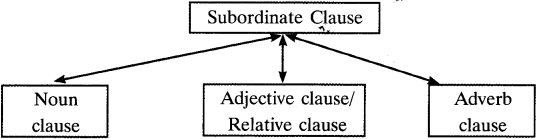
2. Subordinate or dependent clause is a type of clause that depends on the main clause for meaning,
Example:

  • [Neha ate a lot of cookies] – [after she watched the cooking show.]
    (Main clause) – (subordinate clause)

Types of subordinate clauses:
Clauses Exercises With Answers for Class 9 CBSE

Noun Clause

A subordinate clause that acts as a noun in a sentence is called a Noun clause.
Examples:

  • I told him that I would get his book.
  • Tell her what she wants to know.
  • I want to know if he is telling the truth.

The clauses underlined are all Noun Clauses.
Note: Noun clauses are generally introduced by

  • that
  • if/whether
  • wh-question words like who, why, what, etc.

Note: The examples cited below should be used as a guide to help children make their own examples.

Clauses for Class 9 CBSE Solved Exercise With Answers

Complete the following sentences by adding appropriate noun clauses.

Question 1.
Do you know ……………………………………?
Answer:
Do you know that he has a younger brother also.

Question 2.
I think ………………………………….. .
Answer:
I think that you have done a wonderful job.

Question 3.
Please tell me ………………………………….. .
Answer:
Please tell me if you need mv help.

Question 4.
Tell the police ………………………………….. .
Answer:
Tell the police how did you set the rifle.

Question 5.
The teacher said ………………………………….. .
Answer:
The teacher said that you must bring the books tomorrow.

Question 6.
Please see to it ………………………………….. .
Answer:
Please see to it that no door remains unlocked.

Question 7.
I came to know ………………………………….. .
Answer:
I came to know that she is suffering from a serious illness.

Question 8.
She told ………………………………….. .
Answer:
She told that she doesn’t want to be a part of the group.

Question 9.
Please pay attention to ………………………………….. .
Answer:
Please pay attention to what is being announced in the auditorium.

Question 10.
It was shocking news………………………………….. .
Answer:
It was shocking news that Rajan used to steal things in school.

Question 11.
Why she said this ……………………………………?
Answer:
Why she said this is not clear to me also.

Question 12.
It is quite obvious ………………………………….. .
Answer:
It is quite obvious that he is disinterested in this project.

Question 13.
My fear is ………………………………….. .
Answer:
My fear is that she will not be able to complete the race.

Question 14.
My mother asked me ………………………………….. .
Answer:
My mother asked me why couldn’t I help her in the kitchen.

Question 15.
You will have to pay for ………………………………….. .
Answer:
You will have to pay for what you do.

Question 16.
He wanted me to think ………………………………….. .
Answer:
He wanted me to think that he is a thorough gentleman.

Question 17.
was very clear to me ………………………………….. .
Answer:
How he wanted to go about the task was very clear to me.

Question 18.
The teacher was sure ………………………………….. .
Answer:
The teacher was sure that I was evading her question.

Question 19.
He said in the meeting ………………………………….. .
Answer:
He said in the meeting that punctuality should be followed every day.

Question 20.
The announcement was ………………………………….. .
Answer:
The announcement was that the Annual Day was to be celebrated soon.

Adjective/Relative Clause

A subordinate Adjective Clause is which qualifies a noun or a pronoun in the main clause and does the work of an adjective. It is also known as Relative Clause.
Examples:

  • The book that you are holding is a masterpiece.
  • The car which is steel grey in colour is mine.
  • I respect all those people who are knowledgeable.

The underlined clauses above are all Adjective Clauses.

Note: Adjective clauses are generally introduced by

  • relative pronouns like which, who, whom, that
  • relative adverbs ‘when’ and ‘where’

Clauses for Class 9 CBSE Solved Exercise With Answers

Complete the following sentences by using appropriate Adjective Clauses.

Question 1.
Somebody has stolen the diamond necklace ………………………………….. .
Answer:
Somebody has stolen the diamond necklace that was my anniversary gift.

Question 2.
Keep all the gifts which you consider ………………………………….. .
Answer:
Keep all the gifts which you consider precious in a safe place.

Question 3.
This is the book ………………………………….. .
Answer:
This is the book which had got lost.

Question 4.
Gone are the ………………………………….. days
Answer:
Gone are the days when children used to play outdoor games.

Complete the following sentences using appropriate relative clauses.

Question 5.
The music concert ………………………………….. is over.
Answer:
The music concert which started in the morning is over.

Question 6.
The boy ………………………………….. .
Answer:
The boy who got the prize is the head bov of the school.

Question 7.
My friend ………………………………….. is celebrating the day.
Answer:
My friend whose birthday falls in the next week is celebrating the day.

Question 8.
Is this the movie …………………………………..?
Answer:
Is this the movie which you were appreciating so much.

Question 9.
This is the trophy ………………………………….. .
Answer:
This is the trophy that I received on the Sports Day.

Question 10.
Have you met the person …………………………………..?
Answer:
Have you met the person who was distributing sweets.

Question 11.
This is the shirt ………………………………….. .
Answer:
This is the shirt which mv mother gifted me.

Question 12.
The house ………………………………….. has been demolished.
Answer:
The house which had developed cracks in the walls has been demolished.

Question 13.
This is the same excuse ………………………………….. .
Answer:
This is the same excuse that you come up with every time.

Question 14.
Is this the place …………………………………..?
Answer:
Is this the place where I was born.

Question 15.
The prisoner ………………………………….. has run away.
Answer:
The prisoner who had committed number of robberies has run away.

Question 16.
The gift ………………………………….. was a special one.
Answer:
The gift that my brother gave on Rakhee was a special one.

Question 17.
This is the dress ………………………………….. .
Answer:
This is the dress which I got made at a designer boutique.

Question 18.
He is the saint ………………………………….. .
Answer:
He is the saint who is also called the spiritual guru.

Question 19.
The old lady ………………………………….. is dead.
Answer:
The old lady who had been ailing for some time is dead.

Question 20.
The theatre ………………………………….. .
Answer:
The theatre which was in a dilapidated condition has been converted into a mall.

Adverb Clause

Question.
A Subordinate Adverb Clause is that which performs the function of an adverb in a sentence. Examples:
(a) Wait till I return.
(b) It is useless to argue as you will not understand.
(c) The suggestions were so good that I agreed immediately.

The underlined clauses, above are Adverb Clauses. Adverb Clauses are introduced to J?y the following subordinate conjunctions.
(i) Adverb clause of ‘Place’: Conjunctions where, wherever
(a) Wherever you may go, I shall be able to find you.
(b) The child will go where his mother goes.

(ii) Adverb clause of ‘Time’. Conjunctions: when, while, before, after, since, whenever, till, until as, as soon as, so long as
(a) The mother was cooking while the children were dancing.
(b) As soon as the robbers saw the police, they ran away.

(iii) Adverb clause of ‘contrast’. Conjunctions: although, even if, even though.
(a) He will not clear the exams, even if he works very hard.
(b) Although he is younger, he looks older.

(iv) Adverb clause of ‘Manner’. Conjunctions: as, as if, as though, as …. so
(a) She behaves as though she were a queen.
(b) Don’t treat me as if I am your servant.

(v) Adverb Clause of ‘Purpose’. Conjunctions: so that, in order that, lest.
(a) Work hard lest you should fail.
(b) The laborers worked hard so that they could earn a living.

(vi) Adverb clause of ‘Reason’. Conjunctions: Since, as, for, because.
(a) Since you were absent, your name is not in the list.
(b) He died because he lacked the will to survive.

(vii) Adverb clause of ‘Comparison’. Conjunctions: as, then.
(a) My mother is wiser than my father.
(b) He is not as tall as his friend.

(viii) Adverb clause of ‘Condition’. Conjunctions: if, unless, provided that, in case.
(a) If she extends an invitation, I will certainly go.
(b) I will sign the agreement provided you give me the cheque.

(ix) Adverb clause of ‘Extent’. Conjunctions: so far as, as far as.
(a) As far as my knowledge of him goes, he is a miser.
(b) So far as I am concerned. I am willing to contribute.

(x) Adverb clause of Result/Effect/Consequence. Conjunctions: so, so… that
(a) The beggar is so poor that he hardly gets anything to eat.
(b) He got up late, so he missed his school bus.

Clauses for Class 9 CBSE Solved Exercise With Answers

Complete the following sentences using appropriate relative clauses.

Question 1.
the students got up.
Answer:
As soon as the teacher entered the class, the students got up.

Question 2.
He gets lots of gifts
Answer:
He gets lots of gifts whenever he comes.

Question 3.
I didn’t wake you up
Answer:
I didn’t wake you up because you were looking tired.

Question 4.
We all must work hard
Answer:
We all must work hard in order to better our future.

Complete the following sentences using appropriate adverb clauses.

Question 5.
You may sit
Answer:
You may sit wherever you like.

Question 6.
He was punished
Answer:
He was punished because he did not follow the rules.

Question 7.
She was not rich
Answer:
She was not rich as could be seen from her clothes.

Question 8.
He worked so hard
Answer:
He worked so hard that he passed with flying colours.

Question 9.
Wait
Answer:
Wait till I give you a call.

Question 10.
You will pass with flying colours
Answer:
You will pass with flying colours if you burn the midnight oil.

Question 11.
one will have to hear the same story.
Answer:
We have told him not to repeat as, one will have to hear the same story.

Question 12.
she kept on reciting the same poem so many times.
Answer:
Although I told her to stop, she kept on reciting the same poem so many times.

Question 13.
She is more beautiful
Answer:
She is more beautiful than I had thought her to be.

Question 14.
I could hear her clearly
Answer:
I could hear her clearly since she was standing close to me.

Question 15.
she stayed at home.
Answer:
As it was raining, she stayed at home.

Question 16.
He behaved he was mad.
Answer:
He behaved as if he was mad.

Question 17.
We shall miss the train,
Answer:
We shall miss the train if we don’t rush.

Question 18.
you will not pass.
Answer:
Unless you work hard, you will not pass.

Question 19.
I am contented.
Answer:
As far as I am concerned, I am contented.

Question 20.
Nobody can become perfect
Answer:
Nobody can become perfect because it ¡s not possible.

Question 21.
I interviewed him
Answer:
I interviewed him so that I could publish it in the magazine.

Question 22.
He thought himself rich
Answer:
He thought himself rich because he had inherited a lot of property.

Question 23.
The passage ¡s so difficult
Answer:
The passage is so difficult that I needed my teacher’s help to explain it to me.

Question 24.
I shall stick to it.
Answer:
If I make a promise, I shall stick to it.

Question 25.
Choose the correct option for the sentences below.
(a) Waiting for the doctor, ____________________ [a big noise scared everybody, Dave read a magazine, the alarm went off]
(b) ___________________ in the jungle, George had to find the way out on his own. (having lost, lost, losing]
(c) _____________________ our pottery will last, for generations. [treating with care/you treat with care/treated with care]
(d) ____________________ a holiday, all the banks were closed. [having been/been! being]
(e) ____________________ for so long, he had lost all hope. [being unemployed/unemployed! having been unemployed]
Answer:
(a) Dave read a magazine.
(b) Having lost
(c) Treated with care
(d) Being
(e) Having been unemployed

Question 26.
Join the rolling sentences using a present-participle as given in the example.
Example:
We walked along the footpath. We saw an accident. Walking along the footpath, we saw ai accident. (Note: Out of the two actions, the one which takes place first is changed into present participle.)
(a) He stood by the side of a temple. He asked people to go in.
(b) She came out of the room. She greeted the visitors.
(c) He heard the news. He started crying.
(d) He found the lock broken. He rang up the Police.
(e) He felt sleepy. He went to bed.
Answer:
(a) Standing by the side of a temple, he asked people to go in.
(b) Coming out of the room, she greeted the visitors.
(c) Having heard the news, he started crying.
(d) Having found the lock broken, he rang up the police.
(e) Feeling sleepy, he went to bed.

Determiners Exercises for Class 11 CBSE With Answers

Determiners Class 11

Determiners are words which come before nouns. They contain several classes of words, including pronouns and adjectives. They determine or limit the noun by giving some additional information about it. Determiners show whether a noun refers to is a general or a specific object, person, or place. They indicate which or how many things the noun refers to. Determiners define or limit a noun to the singular or plural. They indicate the amount or quantity. Determiners and nouns together make noun phrases. They make noun phrases with adjectives too. Determiners may precede numerals too.

This grammar section explains English Grammar in a clear and simple way. There are example sentences to show how the language is used. Students can also read NCERT Solutions for Class 11 English to get good marks in CBSE Board Exams.

Determiners Exercises for Class 11 CBSE With Answers

Determiners do not describe a noun; they determine or point it out. Look at these:

  • the child
  • every boy
  • some politicians
  • his picture
  • my house
  • those trees
  • no politician
  • some people

The words in bold letters are determiners.

♦ Some Important Distinctions

Adjectives and Determiners:

An adjective is used to limit the application of a noun by describing it-by giving information about the size, colour, age and other qualities such as:
big cat, black dog, old man

A determiner is used to limit the application of a noun without describing it. We don’t know anything about the quality of the noun, such as this table, my room, many houses

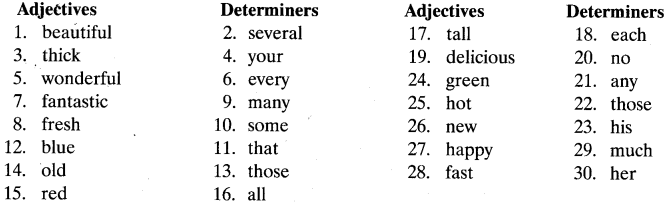
I. Study the noun phrases and identify the words that belong to the class of adjectives and those that belong to the class of determiners. List them as two groups below.

  1. beautiful garden
  2. several towns
  3. think notebooks
  4. your house
  5. wonderful roads
  6. Every Girl
  7. fantastic buildings
  8. fresh milk
  9. many buses
  10. some sugar
  11. that book
  12. blue sky
  13. those pencils
  14. old chair
  15. red rose
  16. all men
  17. tall trees
  18. each boy
  19. delicious food
  20. no work
  21. any bag
  22. those pens
  23. his bicycle
  24. green lawns
  25. hot tea
  26. new car
  27. happy men
  28. fast pitches
  29. much water
  30. her doll

Determiners Class 11 Format, Examples, Samples, Topics 1

♦ Kinds of Determiners:

These classes of words make up determiners:

  1. Articles (a, an, the)
  2. Demonstratives (this, that, these, those)
  3. Possessives (my, our, your, his, her, its, their)
  4. Distributives (either, neither, each, every)
  5. Determiners of quantity and number (some, any, much, several, little, less, enough, no)
    This class also includes – first, second, etc., many, either, neither, few, fewer.
  6. Interrogatives (what, which, whose, etc.)

Examples:

  1. Malabar is a beautiful region.
  2. Some students missed their class.
  3. Our children are well mannered.
  4. All winners of the awards were present?
  5. This book is too old.

1. Use of Articles:

A, AN

  1. A and An are used before countable nouns in the singular number, e.g. a question, an answer. A and An are used before a noun to show that it is not specific.
  2. A is used before consonant sounds, e.g. a boy, a house, a chair, a man, etc.
  3. A is used if a word is spelt with a vowel but has a consonant sound, a unit, a university. Here ‘u’ has the consonant sound of ‘y’.
  4. A is used in the following expressions:
    a pity, a pleasure, a rage, a toothache, a noise, at a loss, a loud voice, a headache, a shame, in a hurry, a bad cold, a nuisance, etc.
  5. An is used before a vowel sound, e.g. an eel, an elephant, etc.
  6. An is also used if the word is spelt with a consonant but has a vowel sound, e.g. an hour, an honourable man.

THE

1. The can be used with both countable and uncountable nouns.
It is used to show that the noun is specific, e.g. The first railway line in India was laid in Maharashtra. The phone is out of order.
The information I need is available on the net.
2. The is used with a noun that has already been mentioned,
e.g. I am looking for a student, (not specific)
This is the student I was looking for. (specific)
3. The is also used when a noun is preceded by a superlative adjective-the longest day.
4. The is used for nouns which are common to all people, e.g. the earth, the sun, the moon, the sky.
5. The is useci with uncountable nouns if indicating specifics, e.g. the water is clean, the milk has gone sour.
If an unspecific meaning is indicated, the is not used, e.g. Water is an important component of our food.
6. The is used when we refer to whole group of people-the Indians, the good, the bad.
7. The is used before mountain ranges, rivers, canals, oceans, deserts, holy books, etc e.g. the Bible, the Himalayas, the Ganges, the Pacific Ocean.
8. The is used before the names of newspapers, government departments, museums, libraries, e.g. the Ministry of Health, The Times of India.
9. The is not used before the names of persons, continents, cities, holidays, days of the week, months, subjects of study, etc. We cannot say the Obama, the Asia, the New Delhi, the February, etc.
10. No articles are needed with the names of diseases, names of meals, languages, names of days, etc.
e.g. It is wrong to say the malaria, the dinner,The Wednesday, etc.

II. Fill in the blanks using suitable determiners:

(a) (A/An/The) man went for
(b) (a/an/the) holiday to a place near
(c) (a/an/the) sea. He spent
(d) (every/all/some) his days watching the waves crash against the shore.

Answer:
(a) A
(b) a
(c) the
(d) all

2. Use of Demonstratives:

Demonstratives are pronouns which point out to something. However, when they are followed by nouns, they act as determiners.
this, that
these, those
Notice the difference in their use as pronouns and determiners.
e.g. I want this, (pronoun)
I want this book, (determiner because ‘this’ is followed by a noun.)
‘this’ and ‘that’ are singular,
e.g. this house, this card, that school, that child
‘these’ and ‘those’ are plural.
e.g. these children, these posters, those parents, those buildings.

III. Identify the demonstrative pronouns and the demonstrative determiners in the following sentences. Write against each sentence whether the underlined word is a pronoun (P) or a determiner (D).

  1. These are my cousins.
  2. I want only that and nothing else.
  3. Those birds are from Siberia.
  4. This is a dirty old trick.
  5. All these children are participating in the activity.
  6. I need these articles urgently.

Answer:

  1. These are my cousins. (P)
  2. I want only that and nothing else. (P)
  3. Those birds are from Siberia. (D)
  4. This is a dirty old trick. (P)
  5. All these children are participating in the activity. (D)
  6. I need these articles urgently. (D)

3. Use of Possessives:

Possessives are pronouns which indicate that a thing belongs to someone: mine, ours, yours, his, hers, its, theirs
e.g. This is mine and that is yours.
However, if the possessives are followed by nouns, they are possessive determiners,
e.g. his face, her smile, their happiness, my child, our house, your blessings

IV. Identify the possessive pronouns and the possessive determiners in the following sentences. Write against each sentence whether the underlined word is a pronoun (P) or a determiner (D).

  1. This book is his, not mine.
  2. My son is coming today.
  3. These flowers are ours.
  4. Those fruits are yours.
  5. His brother is going to the United States.
  6. Her smile is radiant.

Answer:

  1. This book is his, not mine. (P)
  2. My son is coming today. (D)
  3. These flowers are ours. (P)
  4. Those fruits are yours. (P)
  5. His brother is going to the USA. (D)
  6. Her smile is radiant. (D)

4. Use of Distributives:

Each, Every, All

Each and Every indicate single units in a group. Each refers to individual members of a small group, while every to members of a large group. Sometimes both each and every can be used, e.g. Each of his five brothers was learned.

Every Indian must vote.

Every/Each one was given aid.

All is used to indicate the whole group rather than its components, e.g. All the students of class XI A have passed.

2. Study the three sentences given below showing the use of each, every and all.
Children need proper education to become good citizens.
Each child needs proper education to become a good citizen.
Every child needs proper education to become a good citizen.
All children need proper education to become good citizens.

V. Write three sentences for each given sentence using distributive determiners as shown above. Pay particular attention to the desired focus.

(i) Questions should be answered.
(a) …………………………………………………………………..
(b) …………………………………………………………………..
(c) ……………………………………………………………………

(ii) Members must be graduates.
(a) …………………………………………………………………..
(b) …………………………………………………………………..
(c) ……………………………………………………………………

(iii) Villages must be connected by road.
(a) …………………………………………………………………..
(b) …………………………………………………………………..
(c) ……………………………………………………………………

(iv) Indian games deserve patronage.
(a) …………………………………………………………………..
(b) …………………………………………………………………..
(c) ……………………………………………………………………
Answer:

(i) (a) Each question should be answered.
(b) Every question should be answered.
(c) All questions should be answered.

(ii) (a) Each member must be a graduate.
(b) Every member must be a graduate.
(c) All members should be graduates.

(iii) (a) Each village must be connected by road.
(b) Every village must be connected by road.
(c) All villages must be connected by road.

(iv) (a) Each Indian game deserves patronage.
(b) Every Indian game deserves patronage.
(c) All Indian games deserve patronage.

Either, Neither

Either has two meanings:
(a) any one of the two different things or persons, e.g. You can choose either course.
(b) both – Prefects were lined up on either side of the entrance.
Neither is the opposite of either. It means not the one nor the other, e.g. Neither politician knew what he was promising.

VI. Fill in the blanks using ‘either’ or ‘neither’.

  1. either
  2. neither
  3. Neither
  4. either
  5. either
  6. Neither

5. Use Of Determiners of Quantity:

Many, Much, Some, Any
Many is used only with plural nouns and to show a large number.
Much is used with uncountable nouns indicating a large quantity.

FEW, A FEW, THE FEW
Few means very small numbers, not enough and below expectation. A few indicates some numbers. The few indicates very small specific numbers, e.g.
Few students are interested in learning languages.
A few students are good at English.
The few students who are good usually come from educated families.

VII. Write two sentences for each given sentence using determiners of quantity as shown above. Pay particular attention to the desired meaning. One has been done for you.
(i) Boys were able to speak good English.

(+) A few boys were able to speak good English.
(-) Few boys were able to speak good English.

(ii) My friends are good orators.
(+) ……………………………………………………………………
(-) …………………………………………………………………….

(iii) People are conscious of their duties.
(+) ……………………………………………………………………
(-) …………………………………………………………………….

(iv) Questions were asked after the lecture.
(+) ……………………………………………………………………
(-) …………………………………………………………………….

(v) Shopkeepers responded to the bandh call.
(+) ……………………………………………………………………
(-) …………………………………………………………………….

Answer:
(ii) (+)A few of my friends are good orators.
(-) Few of my friends are good orators.

(iii) (+) A few people are conscious of their duties.
(-) Few people are conscious of their duties.

(iv) (+) A few questions were asked after the lecture.
(-) Few questions were asked after the lecture.

(v) (+) A few shopkeepers responded to the bandh call.
(-) Few shopkeepers responded to the bandh call.

Little, A Little

Look at these two sentences.
We had little rain this year.
We had a little rain this year.
Little is used when the speaker wants to convey the meaning ‘not enough or below expectation’. Little expresses a negative meaning.
A little is used when the speaker wants to convey the meaning ‘a small amount but not much’. A little expresses a positive meaning.

VIII. Now, write two sentences for each given sentence as shown in the above examples. Pay particular attention to the desired meaning. One has been done for you.

(i) The aid reached the victims.
(+) A little aid reached the victims.
(-) Little aid reached the victims.

(ii) Work could be done in the project.
(+) …………………………………………………….
(-) ……………………………………………………..

(iii) Progress has been made under the poverty alleviation programme.
(+) ………………………………………………………………….
………………………………………………………………………..
(-) ………………………………………………………………….
………………………………………………………………………..

(iv) Improvement is visible in the working of the railways.
(+) ………………………………………………………………….
………………………………………………………………………..
(-) ………………………………………………………………….
………………………………………………………………………..

(v) Enthusiasm was shown by the masses.
(+) ………………………………………………………………….
(-) ………………………………………………………………….

Answer:
(ii) (+) A little work could be done in the project.
(-) Little work could be done in the project.

(iii) (+) A little progress has been made under the poverty alleviation programme.
(-) Little progress has been made under the poverty alleviation programme.

(iv) (+) A little improvement is visible in the working of the railways.
(-) Little improvement is visible in the working of the railways.

(v) (+) A little enthusiasm was shown by the masses.
(-) Little enthusiasm was shown by the masses.

SOME, ANY

Some and Any show not a very large quantity.
Some is used in affirmative sentences, e.g. There is some water in the pitcher.
Any is used in interrogative or negative sentences, e.g. Is there any water in the pitcher?
There isn’t any water in the pitcher.
Now, look at these sentences.

  • He hasn’t got any roses in his garden.
  • There isn’t any milk left in the jug.

Any is used in negative statements with countable plural nouns like roses and with uncountable nouns like milk.

Now, look at these sentences.

  • There were scarcely any spectators in the stadium.
  • There is hardly any sugar left in the pot.

Any is also used in positive statements which have words like scarcely and hardly because they express an underlying negative idea.
Look at these sentences.

• I have bought some stamps in case you need them.
• There is still some milk left in the jug.

Some is used in positive statements with countable plural nouns like stamps and with uncountable , nouns like milk.

IX. Now, fill in the blanks in the following sentences with ‘some’ or ‘any’ as needed.

  1. Our players missed very good chances of scoring.
  2. The country mustn’t tolerate anti-national activity.
  3. There isn’t sense in our waiting here.
  4. We must do serious thinking about it.
  5. There is hardly hope of his recovery.

Answer:

  1. some
  2. any
  3. any
  4. some
  5. any

Now, look at these sentences:

  • Do you own any land in this area?
  • Have you got any money?

Any is also used in general questions which are intended for getting information.

Now, look at these sentences:

  • Could you do some typing for me?
  • Would you like to have some more biscuits?

Some is also used in questions but only in those questions which suggest offers or requests.

X. Now, make questions using the given phrases and then answer them using ‘some’ and ‘any’. Pay attention to the desired meaning in the answer. One has been done for you.

(i) letters for me.
Are there any letters for me?
+ Yes, there are some letters for you.
– No, there aren’t any letters for you.

(ii) express buses for that town.
………………………………………………………………….
(+) ……………………………………………………
(-) …………………………………………………….

(iii) jobs that women can’t do.
……………………………………………………………………
(+) ……………………………………………………
(-) …………………………………………………….

(iv) evidence that the system works.
……………………………………………………………………
(+) ……………………………………………………
(-) …………………………………………………….

Answer:
(ii) Are there any express buses for that town?
(+) Yes, there are some express buses for that town.
(-) No, there aren’t any express buses for that town.

(iii) Are there any jobs that women can’t do?
(+) Yes, there are some jobs that women can’t do.
(-) No, there aren’t any jobs that women can’t do.

(iv) Is there any evidence that the system works?
(+) Yes, there is some evidence that the system works.
(-) No, there isn’t any evidence that the system works.

XI. Now, make a question using each of the given word groups to serve as offers or requests. The first one has been done for you.
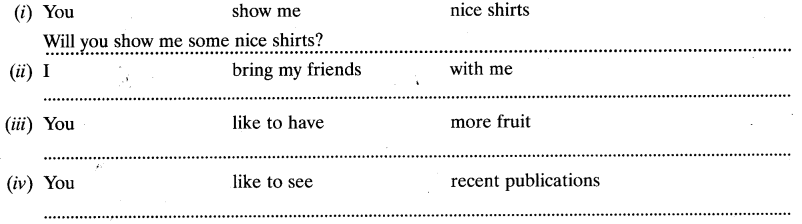
Determiners Class 11 Format, Examples, Samples, Topics 2
Answer:

  1. May I bring some of my friends with me?
  2. Would you like to have some more fruit?
  3. Would you like to see some recent publications?

6. Use of Interrogatives

Determiners that are used for framing questions are called interrogatives. ‘What’, ‘which’, ‘whose’, ‘how much’, ‘how many’ are interrogative determiners.

whose house, which city, how many rulers, how much water, what money

XII. Fill in the blanks by using suitable interrogatives.

  1. In …………….. book do we find the character Quasimodo?
  2. To ……………. notes are you referring?
  3. ……………….. baskets are meant for fruits?
  4. ………………. names have you given to the twins?
  5. ………………. students are there in the zonal football team?
  6. ………………… flour is needed to make a cake for ten people?
  7. ………………. books did you read during the summer vacation?
  8. ……………….. bat is heavier, Sachin’s or M.S. Dhoni’s?

Answer:

  1. which
  2. whose
  3. Which
  4. What
  5. How many
  6. How much
  7. Which
  8. Whose

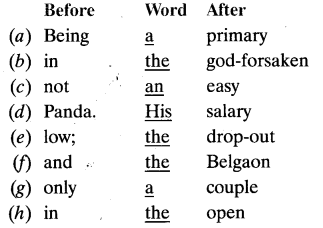
XIII. In the passage given below, one word has been omitted in each line. Write the missing word along with the word that comes before and the word that comes after against the correct blank number. Underline the word that forms your answer.

1. Being primary school teacher
in god-forsaken interiors of Odisha
is not easy job for Hrydaynath
Panda. Salary is ridiculously
low; drop-out rate is abnormally
high and Belgaon Asram school’s
infrastructure abysmal. There are only couple
of rooms and classes have to be held in open.
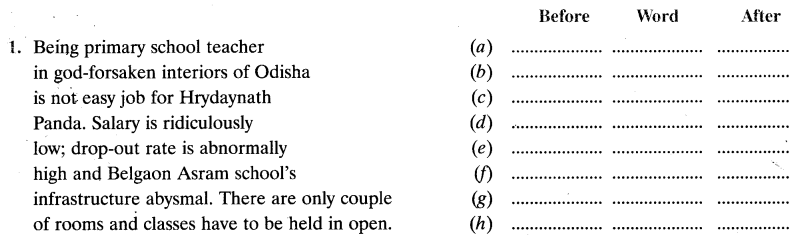
Determiners Class 11 Format, Examples, Samples, Topics 3
Answer:
Determiners Class 11 Format, Examples, Samples, Topics 4

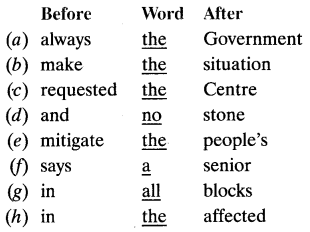
Question 2.
As always, Government is trying
to make situation look less grim.
“We have requested Centre for financial
help and stone will be left unturned
to mitigate people’s problems,”
says senior minister. Free
kitchens will be started in blocks
in affected areas.
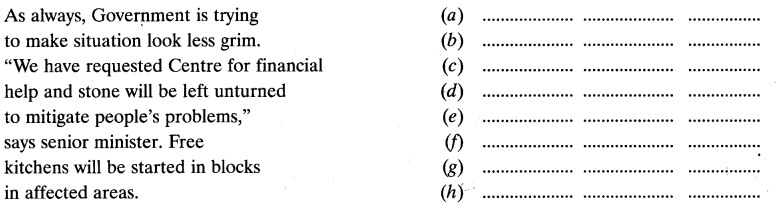
Determiners Class 11 Format, Examples, Samples, Topics 5
Answer:
Determiners Class 11 Format, Examples, Samples, Topics 6

XIV. Fill in the blanks with suitable determiners.

Two friends meet in their school canteen. They are going to have their lunch.

Namit: You can share (a) ………….. lunch and I’ll share yours.
Vipul: Oh, that’ll bejiice. I’ll have (b) …………. good things to eat.
Namit: I’m afraid. I don’t have much to eat. There are only two sandwiches and (c) ………….. apple. Here’s your sandwich. And you can take half (d) ………….. apple.
Vipul: Thanks. They look delicious. I have four poories and some pickles.
We can have two poories each. And we will order for (e) ……………………. drink. What would you
like, tea or coffee?
Namit: I’ll have tea.
Vipul: So shall I.

Answer:
(a) my
(b) some
(c) an
(d) the
(e) a

XV. Fill in the blanks with suitable determiners.

(a) ……………….. abbreviation is (b) ……………… shortened form of (c) ……………… word or a group of words.
It is used to save time and space. (d) ………………… abbreviations are also used while speaking. Most of
(ie) dictionaries include (f) ……………. list of commonly used abbreviations.
Answer:
(a) An
(b) the
(c) a
(d) Some
(e) the
(f) a

XVI. Complete the passage using determiners.

We only take (a) ……………… few seconds to pass through (b) ……………. earth’s atmosphere which is hardly thicker than (c) ……………. skin of (d) ………………. plum or (e) ……………… peach. As we pass through, we gradually leave behind particles of air, dust which scatter (f) …………….. sun’s light and
make the sky look blue.

Answer:
(a) a
(b) the
(c) the
(d) a
(e) a
(f) the

XVII. Complete the passage with suitable determiners.
My friend lived on (a) ……………. the first floor of (b) ……………. recently renovated old house on (c) ………….. river Beas. She was afraid of burglars and always locked up (d) ……………… house carefully before going to bed. She also took the precaution of looking under (e) …………….. bed to see if (f) …………….. burglar was hiding there.
Answer:
(a) the
(b) a
(c) the
(d) the
(e) the
(f) any

XVIII. Complete the following passage with suitable determiners.

I have met (a) ……………. people in my life but (b) …………… person who has influenced me (c) ………….. most is Mother Teresa. To me she has been (d) ……………. symbol of true religion, (e) people can do what she has done. If we adopt (f) …………….. ideology, the world would become a better place to live in.
Answer:

(a) many
(b) the
(c) the
(d) a
(e) Few
(f) her

XIX. Fill in the blanks with determiners.

(a) ………………. entire polling station seemed to be (b) ……………….. huge mass of humanity. It was (c) ……………….. public holiday, (d) …………….. old man insisted on talking to (e) ……………… polling officer. He refused to show (f) ……………… identity slip.

Answer:
(a) The
(b) a
(c) a
(e) the
(f) his

XX. Complete the following passage with suitable determiners.

Our principal is (a) …………… man of honesty and integrity. He does not accept (b) ……………. gifts from students, teachers or parents. On (c) ………………. occasion of (d) …………….. Children’s Day, he rewarded (e) …………….. students for (f) ……………….. honesty.

Answer:
(a) a
(b) any
(c) the
(d) the
(e) many
(f) their

XXI. Fill in the blanks with suitable determiners.

You’re going to take life away from (a) …………….. man with (b) …………… belief that you will give it
back. This is (c) ………………. enormous step, (d) …………….. precious life is at stake. You must perform to
the best of (e) …………… ability to save (f) ………………. the patient’s life.

Answer:
(a) a
(b) the
(c) an
(d) A
(e) your
(f) the

XXII. Fill in the blanks with suitable determiners.

John Boyd Dunlop did not have (a) ……………. sturdy health which (b) ……………… farmer requires. So his parents let him study for (c) ………………. another profession. Therefore, he chose veterinary medicine and took (d) ………………. diploma in it from Edinburgh.
Answer:

(a) the
(b) a
(c) some
(d) a

XXIII. Fill in the blanks using determiners.

(a) Doubt was not (i) ………….. new emotion. It was (ii) ……………. oldest enemy. Yet I had not expected it to come this way. I had become accustomed to (iii) ……………… presence in (iv) ………….. being.
(b) There are (i) …………… broken chairs in (ii) …………….. corner of (iii) …………….. room.
(c) There is (i) ……………… egg on this plate.
Answer:

(a) (i) a
(ii ) my
(iii) its
(iv) my

(b) (i) some
(ii) the
(iii) this

(c) (i) an