Class 6 Civics Chapter 4 Extra Questions and Answers Key Elements of a Democratic Government

Key Elements of a Democratic Government Class 6 Civics Chapter 4 Extra Questions and Answers Social Science CBSE Pdf free download are part of Extra Questions for Class 6 Social Science. Here we have given NCERT Extra Questions for Class 6 Social Science SST Civics Chapter 4 Key Elements of a Democratic Government.

You can also practice NCERT Solutions for Class 6 Civics Chapter 4 Questions and Answers on LearnInsta.com.

Class 6 Civics Chapter 4 Extra Questions and Answers Key Elements of a Democratic Government

Key Elements of a Democratic Government Class 6 Extra Questions and Answer Civics Chapter 4 Very Short Answers Type

Question 1.
What was the age of Maya Naidoo?
Answer:
She was 11 years old.

Question 2.
Where did Maya Naidoo live?
Answer:
She lived in the town of Johannesburg.

Question 3.
What was there in the box which Maya found?
Answer:
She found a scrapbook full of pictures and newspaper articles.

Question 4.
What do you understand about ‘apartheid’.
Answer:
Apartheid means separation or discrimination on the basis of race.

Question 5.
What do you mean by ‘Soweto’?
Answer:
This was a black township in the South Western Township which was called ‘Soweto’.

Question 6.
Name the races that live in South Africa.
Answer:
Races that live in South Africa are – Black people of South Africa, White who came from outside and Indians who came as labourers and traders.

Question 7.
Give the name of the party that fought against the apartheid system.
Answer:
The African National Congress.

Question 8.
Who was the leader of ‘The African National Congress’?
Answer:
Nelson Mandela.

Question 9.
When did South Africa become an Independent country?
Answer:
In 1994.

Question 10.
Who can resolve the conflicts?
Answer:
Government and its institutions can resolve the conflicts,

Question 11.
What is the time period of representatives in India?
Answer:
Most of the representatives are elected for the period of 5 years.

Question 12.
What is required to be done for getting another opportunity for representation?
Answer:
He/she will have to face election again.

Question 13.
Do people have right to criticize the government in democracy?
Answer:
Yes, public can criticize and ask the questions.

Question 14.
Which two states are part of Cauvery dispute?
Answer:
Karnataka and Tamil Nadu.

Question 15.
Name of dam made on the Cauvery River in Karnataka.
Answer:
Krishnasagar dam.

Question 16.
Name of dam made on the Cauvery River in Tamil Nadu.
Answer:
Mettur dam.

Question 17.
Are the laws of equality and justice useful for girls?
Answer:
Yes.

Key Elements of a Democratic Government Class 6 Extra Questions and Answer Civics Chapter 4 Short Answers Type

Question 1.
Why was the Hector Ndlovu shot?
Answer:
He had joined the protest against learning the Afrikaans language in school. This was the language that the white spoke. School students were forced to learn this language but they wanted to learn their own language, Zulu. The South African police beat up the protestors mercilessly and shot at the crowd and one bullet killed the Hector.

Question 2.
What options does the public have if they disagree from any decision of the government?
Answer:
If government takes any decision which is not in public interest can make a signature campaign; can protest through dharna, pradershan, rallies, strikes, social movements etc. In present time media is also important to attract the government towards public issues.

Question 3.
How the power of the government is limited?
Answer:
Government got its power from its public. They are responsible to the public. They face the election and get elected by the public through vote. Most of the representatives are elected for a period of five years.

After completion of time period they are required to face the election again. In this way, the power of the government is limited and for the continuation of government, they need sanction of public.

Question 4.
Write in brief about conflict of Cauvery dispute.
Answer:
Cauvery dispute is a very well known dispute between the States. This dispute is between Karnataka and Tamil Nadu. The water is stored in Krishnasagar dam in Karnataka and also in Mettur dam in Tamil Nadu. The water is used by both the states for various purposes including irrigation.

The dam situated in Tamil Nadu, can receive water only when water is released by Karnataka. Sometimes Karnataka released the water as per its requirement. This situation created a dispute between the both states. Time to time, the dispute has been settled by the River Tribunal as well as Supreme Court of India.

Key Elements of a Democratic Government Class 6 Extra Questions and Answer Civics Chapter 4 Long Answers Type

Question 1.
Explain in brief ‘apartheid laws’ in South Africa.
Answer:
South African people were divided on the basis of race-white, black, Indian and coloured races. Ac-cording to the law, these races were not allowed to mingle with each other, to live near each other or even to use common facilities. In South Africa, under the laws, hospitals, ambulance, trains, buses and even bus stops were also separate.

The facilities which were provided to the white people were well equipped and the best land was reserved for the white people. Non-whites were not allowed to vote. Black and coloured people were not considered to be equal to whites.

Question 2.
Write a short note on Nelson Mandela.
Answer:
Nelson Mandela was the leader of the African National Congress. It was a group of people who led the struggle against apartheid, and their most well-known leader was Mandela. In the leadership of Nelson Mandela, people fought against the apartheid system for several years. Finally, Nelson Mandela succeeded and South Africa became an independent country in 1994.

Question 3.
Why is it important to resolve the conflicts?
Answer:
Conflicts among the people of the society can arise an unrest. This unrest can take a form of violence in which life and property risk may arise. Conflicts occur when people of different cultures, religions, regions and economic backgrounds do not get along with each other or when some among them feel that they are being discriminated against.

So, control of societal as well as individual conflicts is essential. To prevent and control the conflicts, government makes rules and laws which are obligatory to all. For the purpose, the government has made police force and many institutions.

Question 4.
Describe some conflicts in our society and the role of the government in resolving them?
Answer:
Conflicts occur when people of different cultures, religions, regions, economic backgrounds do not get alongwith each other or when some among them feel that they are being discriminated against. People may use violent means to settle their differences.

This leads to fear and tension among others living in an area. The government is responsible for helping to resolve conflicts. Religious processions and celebrations can sometimes lead to conflicts.

Rivers too can become a source of conflicts between states. A river may begin in one state, flow through another and end in a third. The share of rivers water in different states may become an issue, such as dispute of Cauvery river.

In all the matters, concerned governments are responsible to settle the disputes. The government has Policing system, Court system. The governments play a great role in strengthening the institutions by way of providing sufficient infrastructure, funding etc.

Question 5.
Write a short note on equality and justice.
Answer:
One of the key ideas of a democratic government is its commitment to equality and justice. Equality and justice are inseparable. The earlier practice of untouchability is now banned by law.

This group of people were denied education, transport or medical facilities and even the chance to offer prayers. Dr Ambedkar was of the view that justice can only be achieved when people are treated equally.

The government also recognizes this and makes special provisions for groups within society that are unequal. Sometimes, the society does not value the girl and boy child equally and this is unjust. The government has also made special provisions for equality and justice to the girls.
Class 6 History Chapter 5 Extra Questions and Answers What Books and Burials Tell Us

What Books and Burials Tell Us Class 6 History Chapter 5 Extra Questions and Answers Social Science CBSE Pdf free download are part of Extra Questions for Class 6 Social Science. Here we have given NCERT Extra Questions for Class 6 Social Science SST History Chapter 5 What Books and Burials Tell Us.

You can also practice NCERT Solutions for Class 6 History Chapter 5 Questions and Answers on LearnInsta.com.

Class 6 History Chapter 5 Extra Questions and Answers What Books and Burials Tell Us

What Books and Burials Tell Us Class 6 Extra Questions and Answer History Chapter 5 Very Short Answers Type

Question 1.
When were Vedas composed?
Answer:
These were written about 3500 years ago.

Question 2.
Who composed hymns?
Answer:
Hymns were composed by sages who were also called ‘rishi’.

Question 3.
Who taught the students in the Vedic age?
Answer:
Priests taught the students in Vedic age.

Question 4.
Which family of languages consist of Sanskrit and Hindi?
Answer:
Under group of Indo-European.

Question 5.
Which family do Tamil, Telugu, Kannada and Malayalam belong?
Answer:
Austro-Asiatic family.

Question 6.
Which language family consists of English?
Answer:
Indo-European family.

Question 7.
When was the Rigveda written and printed?
Answer:
It was written and printed about 200 years ago only.

Question 8.
Which rivers were worshipped as goddesses?
Answer:
River Beas and Sutlej were worshipped as goddesses.

Question 9.
What was found in Kashmir related to Rigveda?
Answer:
A manuscript of the Rigveda was found on the birch bark in Kashmir.

Question 10.
Where is it preserved now?
Answer:
It is preserved now in a library at Pune, Maharashtra.

Question 11.
What were used in the offerings?
Answer:
Offerings include ghee, grain and in some cases animals.

Question 12.
Where did people discuss matters of war and peace?
Answer:
People met and discussed matters of war and peace in assemblies.

Question 13.
Who were the leaders?
Answer:
Leaders were often brave and skillful warriors.

Question 14.
Who performed various rituals?
Answer:
‘The priests’, sometimes called Brahmins, performed various rituals.

Question 15.
Who did not perform the sacrifices?
Answer:
Dasa and Dasi did not perform sacrifices.

Question 16.
When was burial site of ‘Inamgaon’ occupied?
Answer:
Burial site ‘Inamgaon’ was occupied between 3600-2700 years ago.

Question 17.
Where was ‘Inamgaon’ site situated?
Answer:
It is a site on the river Ghod, a tributary of the Bhima.

Question 18.
Who was Charaka ?
Answer:
Charak was a famous physician.

Question 19.
Name the book written by Charaka.
Answer:
The book written by Charaka is ‘Charaka Samhita’.

What Books and Burials Tell Us Class 6 Extra Questions and Answer History Chapter 5 Short Answers Type

Question 1.
What do you know about hymns?
Answer:
More than one thousand hymns were included in the Rigveda. These hymns are also called ‘sukta’ or ‘well-said’. These are in praise of various gods and goddesses.

Question 2.
How many types of Vedas are there? Give their names.
Answer:
There are four Vedas, these are:

  1. Rigveda
  2. Samaveda
  3. Yajurveda
  4. Atharvaveda.

Question 3.
How many gods are specifically important according to Rigveda?
Answer:
Three gods are specifically important:

  1. Agni: the god of fire
  2. Indra: a warrior god and
  3. Soma: a plant from which a special drink was prepared.

Question 4.
How many families are there in languages? Which family language represents the northeast? Answer:
There are three families of languages. The languages which are used in north-east are called Tibeto – Burman family.

Question 5.
In the Rigveda there are some dialogues between a sage and rivers. Give the name of sage and rivers.
Answer:
Some hymns of the Rigveda are in the form of dialogues between a sage and rivers. The name of the sage is Vishvamitra and two rivers are Beas and Sutlej.

Question 6.
For whom are the prayers in the Rigveda?
Answer:
In Rigveda, the prayers are for cattle, children especially for sons and for horses.

Question 7.
Why were the battles fought as per the Rigveda?
Answer:
During the Vedic age, the battles were fought for the land, water and to capture people.

Question 8.
Who kept the wealth?
Answer:
The wealth that was obtained from the war was kept by the leaders, some was given to the priests and the rest was distributed amongst the people.

Question 9.
What do you understand about ‘yajnas’?
Answer:
The word ‘yajnas’ means sacrifices in which offerings were made into the fire.

Question 10.
How were the people of Vedic age described?
Answer:
The people were described on the basis of work they did, the language they spoke, the place they belonged to, their family, their communities and cultural practices.

Question 11.
What were general people called?
Answer:
General people were called from two names -‘jana’ and ‘vish’. The word ‘jana’ is still used in Hindi and the word Vaishya’ comes from ‘vish’.

Question 12.
Who were the slaves?
Answer:
Dasa and Dasi were called slaves and they were often captured in wars. They were treated as the
property of owners.

Question 13.
What are called Black and Red Ware?
Answer:
Generally, the dead were buried with distinctive pots, which were called black and red ware.

Question 14.
What were the items generally found in burials? Make a list.
Answer:

  1. Pots
  2. Tools (iron and stone)
  3. Weapons (stone and iron)
  4. Horse equipment (iron)
  5. Ornaments (stone and gold)

Question 15.
Why were more than one skeleton found at the same burial?
Answer:
Sometimes, megaliths contain more than one skeleton. These indicate that people, perhaps belonging to the same family, were buried in the same place through portholes at different times.

Question 16.
Name the rivers mentioned in the Vedas.
Answer:
Indus, Beas, Sutlej, Sarasvati, Ganga and Yamuna have been mentioned in Vedas.

Question 17.
What do you understand about oracle bones?
Answer:
Oracle bones were used by the China for the writing purpose. These bones were used to predict the future.

What Books and Burials Tell Us Class 6 Extra Questions and Answer History Chapter 5 Long Answers Type

Question 1.
How were the rajas of the Vedic age different from others?
Answer:
Rajas were different from what we imagine them in present times. They did not have capital cities, palaces or armies, nor did they collect taxes, sons did not automatically succeed fathers as rajas. Rajas were chosen by the people because of their qualities such as bravery and skillful warriors.

Question 2.
How did the archaeologist conclude that there were some differences between status of buried people?
Answer:
On the basis of objects found with the burials, archaeologists has concluded differences between status of buried people. In Brahmagiri, they found a skeleton that was buried with 33 gold beads, 2 stone beads, 4 copper bangles, one conch shell. Whereas, other skeletons had only a few pots. These findings suggest that there were some differences in status amongst buried. Some were rich, others poor, some chiefs others followers.

Question 3.
What do you understand about megaliths?
Answer:
Stone boulders are known as megaliths and were used to mark burial sites. The practice of erecting megaliths began about 3000 years ago and was prevalent throughout the Deccan, south India, in north-east and Kashmir.

Question 4.
What were the common features in the burials?
Answer:
Generally, the dead were buried with distinctive pots. Also, the archaeologists found tools, ornaments and weapons of iron and sometimes, skeletons of horses, horse equipments and ornaments of stone and gold.

Question 5.
What are the difficulties to differentiate between both sexes through skeleton?
Answer:
After seeing the skeleton, it can be found out whether the dead is child or young, man or woman. But, there are some problems regarding the identification of the found skeleton that it is of a girl or boy or man or woman. It is not possible to find out on the ground of ornaments because often ornaments were worn by both men and women.

Question 6.
What is the better way to differentiate between skeleton of man and women?
Answer:
A better way of figuring out the sex of a skeleton is to look at the bone structure. The hip or the pelvic area of women is generally larger to enable child bearing. These distinctions are based on modem skeletal studies.

Map-Based Questions Class 6 History Chapter 5 What Books and Burials Tell Us

Question 1.
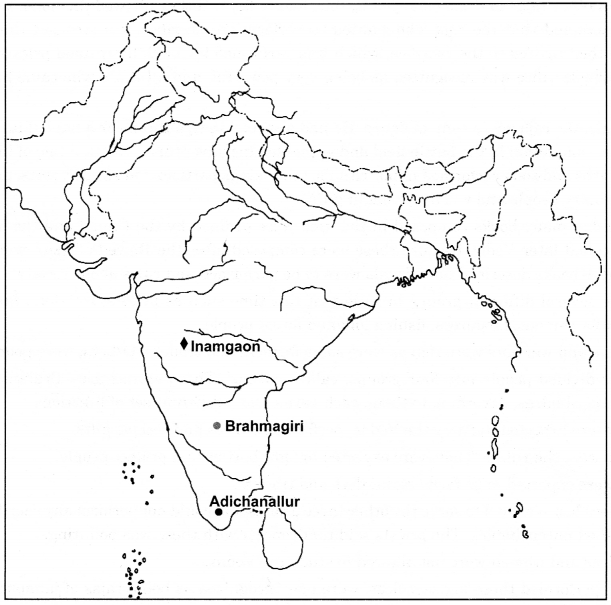
Find out Megalithic Sites in Indian map
(i) Inamgaon
(ii) Brahmagiri
(iii) Adichanallur
Answer:
Class 6 History Chapter 5 Extra Questions and Answers What Books and Burials Tell Us

Class 7 History Chapter 8 Extra Questions and Answers Devotional Paths to the Divine

Devotional Paths to the Divine Class 7 History Chapter 8 Extra Questions and Answers Social Science CBSE Pdf free download are part of Extra Questions for Class 7 Social Science. Here we have given NCERT Extra Questions for Class 7 Social Science SST History Chapter 8 Devotional Paths to the Divine.

You can also practice NCERT Solutions for Class 7 History Chapter 8 Questions and Answers on LearnInsta.com.

Class 7 History Chapter 8 Extra Questions and Answers Devotional Paths to the Divine

Devotional Paths to the Divine Class 7 Extra Questions and Answer History Chapter 8 Very Short Answers Type

Question 1.
How did the people worship their deity?
Answer:
People performed various kinds of bhakti and rituals of worship or singing bhajans, kirtans or qawwalis or even repeating the name of God in silence.

Question 2.
Why did the people turn towards teaching of Buddha and Jainas? ‘
Answer:
Many people turned to the teachings of the Buddha or the Jainas according to which it was possible to overcome social differences and break the cycle of rebirth through personal effort.

Question 3.
Which ideas were advocated in the Bhagavadgita?
Answer:
There was an idea of a Supreme God who could deliver humans from such bondage if approached with devotion (or bhakti). This idea, advocated in the Bhagavadgita, grew in popularity.

Question 4.
What is hagiography?
Answer:
Hagiography is the writing of saints’ lives.

Question 5.
What was the contribution of the Cholas and the Pandyas king in making links between the bhakti tradition and temple worship?
Answer:
The Chola and the Pandya kings built huge temples around many of the shrines visited by the saint – poets, strengthening the links between the bhakti tradition and temple worship.

Question 6.
What did Nathpanthis, Siddacharas and Yogis advocate for getting salvation?
Answer:
To achieve the salvation they advocated intense training of the mind and body through practices like yogasanas, breathing exercises and meditation.

Question 7.
What do you understand about dargah?
Answer:
Dargah is a place where the body of a Sufi saint is cremated. This became a place of pilgrimage where thousands of people of all faiths thronged.

Question 8.
Where did bhakti movement rise?
Answer:
Bhakti movement rose in North India.

Question 9.
What was the unique feature of most of the saints?
Answer:
The unique feature of most of the saints is that their works were composed in regional languages and could be sung. These transmitted orally by most deprived communities and women.

Question 10.
What did Tulsidas conceive?
Answer:
Tulsidas conceived of God in the form of Rama. He composed Ramcharitmanas which is a world-famous epic and is important both as an expression of his devotion and as a literary work.

Question 11.
Who was Surdas?
Answer:
Surdas was an ardent devotee of Krishna. He wrote many Chhanda and Dohas which have been compiled in the form of Sursagara, Sahitya Lahari and Surasaravali etc.

Devotional Paths to the Divine Class 7 Extra Questions and Answer History Chapter 8 Short Answers Type

Question 1.
Which was the widely accepted idea?
Answer:
The idea that all living things pass through countless cycles of birth and rebirth performing good deeds and bad came to be widely accepted. The belief that social privileges came from birth in a ‘noble’ family or a “high’ caste was the subject of many learned texts.

Question 2.
Who was Shankara and what was his thought?
Answer:
One of the most influential philosophers of India Shankara was bom in Kerala in the 8th century. He was an advocate of Advaita or the doctrine of the oneness of the individual soul and the Supreme God which is the Ultimate Reality. He taught that Brahman, the only or Ultimate Reality, was formless and without any attributes.

Question 3.
Who was Ramanuja? Describe.
Answer:
Ramanuja, bom in Tamil Nadu in the 11th century, was deeply influenced by the Alvars. Intense devotion to Vishnu was means of attaining salvation. He followed doctrine of Vishishtadvaita. His doctrine greatly inspired the new strand of bhakti which developed in north India subsequently.

Question 4.
What do you understand about Virashaiva movement?
Answer:
Virashaiva movement was initiated by Basavanna and his companions Allama Prabhu and Akkamahadevi in Karnataka in mid-12th century. They argued strongly for equality of all human beings, opposed Brahmanical ideas on caste and treatment of women. They were also against all forms of ritual and idol worship.

Question 5.
Who were Sufis? What did Sufis believe in?
Answer:
Sufis were Muslim mystics. They rejected outward religiosity and emphasized love and devotion to God and compassion towards all fellow human beings. Islam emphasizes monotheism (one God). It rejected idol worship and highlights into collective prayers. Sufis composed poems expressing their feelings and a rich literature in prose, including anecdotes and fables, developed around them.

Question 6.
Give the name of some Sufis.
Answer:
Ghazzali, Rumi and Sadi were the great Sufis in central Asia and in India there were Khwaja Muinuddin Chisti of Ajmer, Qutbuddin Bakhtiar Kaki of Delhi, Baba Farid of Punjab, Khwaja Nizamuddin Auliya of Delhi and Bandanawaz Gisudaraz of Gulbarga.

Question 7.
Describe, the main pillars of Islam.
Answer:
Main pillars of Islam are as under:

  1. Belief in one God and Muhammad as his prophet;
  2. Essential to perform five times Namaz;
  3. Give charity (Zakat) to the poor people (2.5% of the savings);
  4. Those who have wealth, should go to Haj atleast once in the life;
  5. Fasting in the month of Ramadan (Arabic month) for those who are healthy.

Devotional Paths to the Divine Class 7 Extra Questions and Answer History Chapter 8 Long Answers Type

Question 1.
Who wore Nayanars and Alvars?
Answer:
New religious movements, led by the Nayanars (saints devoted to Shiva) and Alvars (devoted to Vishnu) emerged between 7th to 9th centuries. Saints and followers of these religious movements had all castes including untouchable like the Pulaiyar and the Panars.

The Nayanars and Alvars went from place to place composing exquisite poems in praise of the deities enshrined in the villages they visited, and set them to music. There were 63 Nayanars, who belonged to different caste backgrounds such as potters, untouchable workers, peasants, hunters, soldiers, Brahmanas and chiefs. The best known among them were Appar, Sambandar, Sundarar and Manikkavasagar. There are two sets of compilations of their songs-Tevaram and Tiruvacakam.

There were 12 Alvars, who came from equally divergent backgrounds, the best known being Periyalvar, his daughter Andal. Tondaradippodi Alvar and Nammalvar. Their songs were compiled in the Divya Prabandham.

Question 2.
Give the names of saints of Maharashtra. What were their thoughts?
Answer:
Jnaneshwar, Namdev, Eknath, Tukaram, Sakhubai and the family of Chokhamela focused on the bhakti of Vitthala (a form of Vishnu). All these were saints of Maharashtra. They rejected all forms of ritualism, outward display of piety and social differences based on birth. Some saints belonged to lower:castes. The idea of renunciation was rejected and they preferred to live with their families.

Question 3.
Give names of some important saints of the bhakti movement. Describe any two of saints.
Answer:
Important saints of the bhakti movement are Kabir, Surdas, Tulsidas, Dadu Dayal, Ravidas, Mirabai, Baba Guru Nanak etc.
Kabir: Kabir was brought up in a family of Muslim julahas or weavers near the city of Benares. His ideas are found in the form of sakhis and pads. Kabir’s verses are also in the Guru Granth Sahib, Panch Vani and Bijak which is collection of Kabir’s verses.

Kabir’s teachings openly ridiculed all forms of ; external worship of both Brahmanical Hinduism and Islam, the pre-eminence of the priestly classes and the caste system. The language of his poetry was a form of spoken Hindi widely understood by ordinary people.

Baba Guru Nanak: Baba Guru Nanak bom at Talwandi (presently in Pakistan). He established a centre at Kartarpur (Dera Baba Nanak) on the bank of river Ravi. The sacred space thus created by Baba Gum Nanak was known as dharmsal. It is now known as Gurdwara.

Gum Angad compiled the compositions of Baba Gum Nanak, to which he added his own in a new script known as Gurmukhi. The three successors of Gum Angad also wrote under the name of “Nanak” and all of their compositions were compiled by Gum Aijan in 1604. Later, this holy scripture of the Sikhs called as Gum Granth Sahib. This was authenticated by Gum Gobind Singh.

Map-Based Questions Class 7 History Chapter 8 Devotional Paths to the Divine

Question 1.
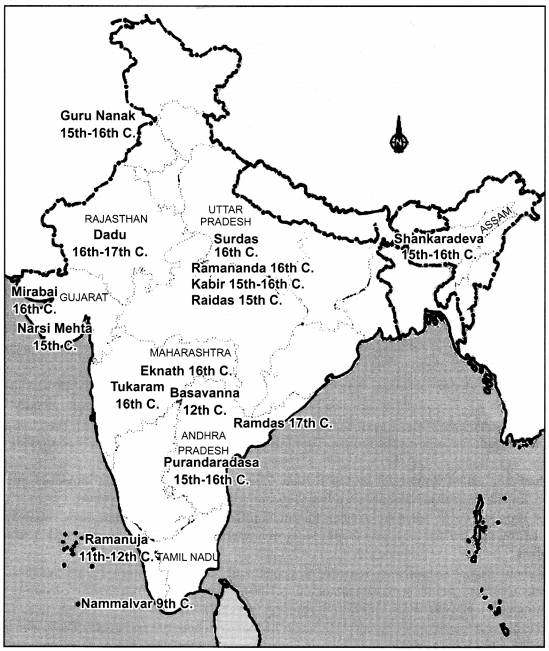
In the map of India represent places related to the following saints:

  1. Guru Nanak
  2. Dadu and Mirabai
  3. Shankaradeva
  4. Eknath, Tukaram
  5. Ramanuja, Nammalvar
  6. Basavanna, Ramdas, Purandaradasa
  7. Surdas, Tulsidas, Kabir, Raidas
  8. Narsi Mehta

Answer:

  1. Presently Pakistan
  2. Rajasthan
  3. Assam
  4. Maharashtra
  5. Tamil Nadu
  6. Andhra Pradesh
  7. Uttar Pradesh
  8. Gujarat

Class 7 History Chapter 8 Extra Questions and Answers Devotional Paths to the Divine

Class 7 Geography Chapter 9 Extra Questions and Answers Life in the Temperate Grasslands

Life in the Temperate Grasslands Class 7 Geography Chapter 9 Extra Questions and Answers Social Science CBSE Pdf free download are part of Extra Questions for Class 7 Social Science. Here we have given NCERT Extra Questions for Class 7 Social Science SST Geography Chapter 9 Life in the Temperate Grasslands.

You can also practice NCERT Solutions for Class 7 Geography Chapter 9 Questions and Answers on LearnInsta.com.

Class 7 Geography Chapter 9 Extra Questions and Answers Life in the Temperate Grasslands

Life in the Temperate Grasslands Class 7 Extra Questions and Answer Geography Chapter 9 Very Short Answers Type

Question 1.
Define the forest.
Answer:
Forest can be defined as the place where trees Eire the main type of vegetation.

Question 2.
What do you understand about grassland?
Answer:
Where grasses form the dominant type of plant life is called grassland.

Question 3.
How much part of the land is grassland?
Answer:
Grasslands make up almost a quarter of the total land surface.

Question 4.
What are the factors which affect the plants or grasses and determine its types?
Answer:
The types of plants or grasses are dependent on the climate and soil.

Question 5.
Name the two categories of world’s grasslands.
Answer:
The world’s grasslands can be divided into two broad categories—temperate and tropical regions grasslands.

Question 6.
In which part are the Prairies Mountains found?
Answer:
The prairies are bound by the Rocky Mountains in the West.

Question 7.
What is found in the eastern part of prairies?
Answer:
In the eastern part of prairies great lakes are found.

Question 8.
Where is river Mississippi?
Answer:
Mississippi river is in USA.

Question 9.
How is the annual rainfall in the Prairies?
Answer:
The annual rainfall is moderate and is ideal for the growth of grass.

Question 10.
Which trees are grown in the Prairies?
Answer:
Trees such as willows, alders and poplars are grown in the region.

Question 11.
What is‘ranches’?
Answer:
Large cattle farms are called ‘ranches’.

Question 12.
Name the animal which is most important in America.
Answer:
Bison or the American buffalo is the most important protected animal of this region.

Question 13.
Which animal of America is protected?
Answer:
Bison or the American buffalo is protected animal of this region

Question 14.
Why are the prairies known as “Granaries of the world” ?
Answer:
The Prairies are known as the “Granaries of the world,” because of the huge surplus of wheat
production.

Question 15.
Name the mineral deposits found in the prairies region.
Answer:
Large mineral deposits particularly coal and iron are found in this region.

Question 16.
Mention name of rivers which drain the region.
Answer:
The tributaries of rivers Orange and Limpopo drain the region.

Question 17.
Which types of vegetation is found in the velds?
Answer:
The vegetation cover is sparse. Grasses dominate the landscape. Red grass grows in bush velds. In the high velds acacia and maroola are seen to be growing.

Question 18.
Name the animals found in the velds region.
Answer:
The animals of the velds are primarily lions, leopards, cheetah and kudu.

Question 19.
Which crops are grown in the region of velds?
Answer:
In the velds region the main crops are maize, wheat, barley, oats and potato. Cash crops like tobacco, sugar cane and cotton are also grown.

Question 20.
Why is merino sheep popular?
Answer:
Merino sheep is a popular species because its wool is very warm and has a great demand in the world.

Question 21.
Name the city which is famous for diamond mines.
Answer:
Kimberley is famous for its diamond mines.

Question 22.
Which city is called Gold Capital of the world?
Answer:
Johannesburg is known as the golden capital of the world.

Question 23.
What are velds?
Answer:
The temperate grasslands of South Africa are called the velds.

Question 24.
Where does red grass grow?
Answer:
Red grass grows in bush velds.

Question 25.
What is Chinook?
Answer:
A hot wind that blows in winter is called Chinook.

Question 26.
What are prairies?
Answer:
The temperate grasslands of North America are known as the prairies.

Question 27.
What are the two categories of the world’s grasslands?
Answer:
The world’s grasslands are divided into two broad categories:
(i) Temperate region
(ii) Tropical region

Question 28.
Name the crops which are grown in the areas where rainfall is over 50 cm.
Answer:
Maize, potatoes, soyabean, cotton and alfa-alfa

Question 29.
What are Bison?
Answer:
Bison are the American buffalo.

Question 30.
What are the main crops grown in the velds?
Answer:
Maize, wheat, barley, oats and potato.

Question 31.
Name the cash crops grown in temperate grasslands of South Africa (velds).
Answer:
Tobacco, sugar cane and cotton.

Question 32.
Name the countries covered by prairies.
Answer:
The prairies cover parts of United States of America and parts of Canada.

Question 33.
Why does local wind ‘Chinook’ blow in the prairies?
Answer:
Due to the absence of the north-south barrier, a local wind ‘Chinook’ blows in the regions of prairies.

Question 34.
Name the tribes which live in the prairies.
Answer:
The Prairies were home of tribes like the Apache, the Crow, the Cree and the Pawnee.

Question 35.
Name the trees grown in the prairies.
Answer:
Wilders, Alders and Poplars

Question 36.
What is combine machine?
Answer:
Combine is a machine which can sow, plough and work as thresher all by itself.

Question 37.
Name some important cities in the American prairies.
Answer:
Chicago, Minneapolis, Indianapolis, Kansas and Denver.

Question 38.
Why are the soils not fertile in the velds?
Answer:
The soils are not fertile in the velds due to the presence of discontinuous grasses exposing barren surface.

Question 39.
Which tributaries drain the areas in the prairies?
Answer:
In the USA, the area is drained by the tributaries of Mississippi and the Canadian prairies are drained by the tributaries of Saskatchewan Rivers.

Life in the Temperate Grasslands Class 7 Extra Questions and Answer Geography Chapter 9 Short Answers Type

Question 1.
Describe climate of the prairies.
Answer:
The climate is of continental type with extreme temperatures. The summers are warm with temperatures of around 20°C, while in winter -20°C has been recorded in Winnipeg, Canada. In winters a thick blanket of snow covers this region.

Question 2.
Which are the suitable places for farming and name the major crops which are grown in that region.
Answer:
Places that receive rainfall of over 50 cm, are suitable for farming as the soil is fertile. The major crop of this area is maize, other crops including potatoes, soybean, cotton and alfa-alfa are also grown.

Question 3.
Which cattle are reared in the prairies?
Answer:
Prairies are suitable for cattle rearing. Bison or the American buffalo is the most important and protected animal of this region. The other animals found in this region are rabbits, coyotes, gophers and Prairie dog.

Question 4.
What do you understand about the velds? Describe briefly.
Answer:
The temperate grasslands of South Africa are called the velds. Velds are rolling plateaus with varying heights ranging from 600 m to 1100 m. It is bound by the Drakensburg Mountains on the east. To its west lies the Kalahari Desert. On the northeastern part, ‘high velds’ are located that attain a height of more than 1600 m, in some places.

Question 5.
What is the most important occupation of the people in the velds region?
Answer:
In the velds regions, sheep rearing is the most important occupation of the people. Sheep has given rise to the wool industry in the velds. Merino sheep is a popular species and its wool is very warm.

Question 6.
Which dairy products are famous in the velds region?
Answer:
Dairy farming is the next important occupation. Cattle are reared in the warmer and wetter regions and the dairy products like butter, cheese are produced for both domestic supply and also for export.

Question 7.
Why do the velds have rich reserve of minerals? Describe.
Answer:
The velds have rich reserve of minerals. Iron and steel industry has developed where coal and iron are present. Gold and diamond mining are major occupations of people of this region. Johannesburg is known for being the gold capital of the world. Kimberley is famous for its diamond mines. The mineral rich area has a well-developed network of transport.

Question 8.
Describe Chinook.
Answer:
Chinook is a hot wind that blows in winter and therefore raises the temperature in a short time. This increase in temperature results in the melting of snow and making pasture land available for grazing of animals.

Life in the Temperate Grasslands Class 7 Extra Questions and Answer Geography Chapter 9 Long Answers Type

Question 1.
Describe the major features of the prairies.
Answer:
The major features of the prairies are:

  1. These are the grasslands (temperate) of North America.
  2. These regions having flat, gently sloping or hilly land.
  3. These regions are almost treeless, but woodlands can be found near the low lying plains, flanking river valleys.
  4. Areas with 50cm rainfall with fertile soil grow maize, potatoes, soybeans, cotton and alfa-alfa.
  5. American buffalo is the most important animal of this region.

Question 2.
What do understand about Prairies? Describe briefly.
Answer:
The temperate grasslands of North America are known as the Prairies. It is a region of flat, gently sloping or hilly land. Tall grass, up to two metres high dominates the landscape. Most part of prairies is treeless. The prairies are bound by the Rocky Mountains in the West and the great lakes in the East.

Prairies cover parts of the United States of America and parts of Canada. In the USA, the area is drained by the tributaries of Mississippi and the Canadian prairies are drained by the tributaries of Saskatchewan Rivers.

The climate is of continental type with extreme temperatures. The summers are warm with temperatures of around 20°C, while in winter -20°C has been recorded in Winnipeg, Canada. In winters a thick blanket of snow covers this region. The annual rainfall is moderate and is ideal for the growth of grass. A local wind “Chinook” blows here. Prairies are practically tree-less.

Where water is available, trees such as willows, alders and poplars grow. Places that receive rainfall of over 50 cm, are suitable for farming as the soil is fertile. The major crop of this area is maize, other crops including potatoes, soybean, cotton and alfa-alfa are also grown.

Question 3.
Write a brief note on the climate of velds.
Answer:
The velds have a mild climate due to the influence of the Indian Ocean. Winters are cold and dry. Temperatures vary between 5°C and 10°C and July is the coldest month. Summers are short and warm. The velds receive rainfall mainly in the summer months from November to February. In the velds region the main crops are maize, wheat, barley, oats and potato. Cash crops like tobacco, sugar cane and cotton are also grown.

Map-Based Questions Class 7 Geography Chapter 9 Life in the Temperate Grasslands

Question 1.
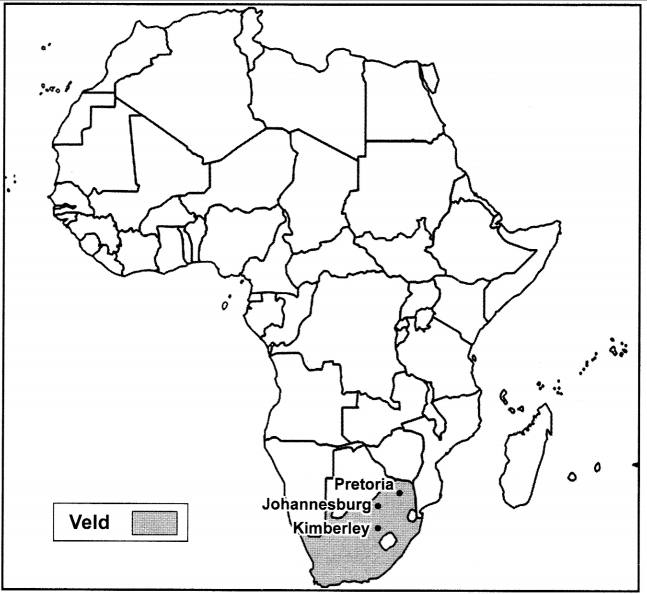
On an outline map of Africa, show the location of Velds.
Answer:
Class 7 Geography Chapter 9 Extra Questions and Answers Life in the Temperate Grassland

Hydrides

Find free online Chemistry Topics covering a broad range of concepts from research institutes around the world.

Hydrides

Hydrogen forms binary hydrides with many electropositive elements including metals and non-metals. It also forms ternary hydrides with two metals. E.g., LiBH4 and LiAlH4. The hydrides are classified as ionic, covalent and metallic hydrides according to the nature of bonding. Hydrides formed with elements having lower electronegativity than hydrogen are often ionic, whereas with elements having higher electronegativity than hydrogen form covalent hydrides.

Ionic (Saline) Hydrides:

These are hydrides composed of an electropositive metal, generally, an alkali or alkaline-earth metal, except beryllium and magnesium, formed by transfer of electrons from metal to hydrogen atoms. They can be prepared by the reaction of elements at about 400°C. These are salt-like, high-melting, white crystalline solids having hydride ions (H) and metal cations (Mn+).

2 Li + H2 → 2 LiH
2 Ca + 2H2 → 2 CaH2

Covalent (Molecular) Hydrides:

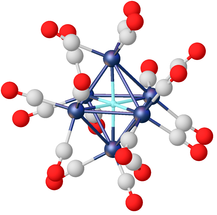
They are compounds in which hydrogen is attached to another element by sharing of electrons. The most common examples of covalent hydrides of non-metals are methane, ammonia, water and hydrogen chloride. Covalent hydrides are further divided into three categories, viz., electron precise (CH4, C2H6, SiH4, GeH4), electrondeficient (B2H6) and electron-rich hydrides (NH3, H2O). Since most of the covalent hydrides consist of discrete, small molecules that have relatively weak intermolecular forces, they are generally gases or volatile liquids.

Metallic (Interstitial) Hydrides:

Metallic hydrides are usually obtained by hydrogenation of metals and alloys in which hydrogen occupies the interstitial sites (voids). Hence, they are called interstitial hydrides; the hydrides show properties similar to parent metals and hence they are also known as metallic hydrides.

Most of the hydrides are non-stoichiometric with variable composition (TiH1.5-1.8 and PdH0.6-0.8), some are relatively light, inexpensive and thermally unstable which make them useful for hydrogen storage applications. Electropositive metals and some other metals form hydrides with the stoichiometry MH or sometimes MH2 (M = Ti, Zr, Hf, V, Zn).

Hydrides img 1