Class 6 History Chapter 9 Extra Questions and Answers Vital Villages, Thriving Towns

Vital Villages, Thriving Towns Class 6 History Chapter 9 Extra Questions and Answers Social Science CBSE Pdf free download are part of Extra Questions for Class 6 Social Science. Here we have given NCERT Extra Questions for Class 6 Social Science SST History Chapter 9 Vital Villages, Thriving Towns.

You can also practice NCERT Solutions for Class 6 History Chapter 9 Questions and Answers on LearnInsta.com.

Class 6 History Chapter 9 Extra Questions and Answers Vital Villages, Thriving Towns

Vital Villages, Thriving Towns Class 6 Extra Questions and Answer History Chapter 9 Very Short Answers Type

Question 1.
When did the use of iron began in the subcontinent?
Answer:
Evidence for the use of iron is found around 3000 years ago in the subcontinent.

Question 2.
Which iron tools were used earliest?
Answer:
Axes and ploughshare were used first of all.

Question 3.
What was the role played by ploughshare in the agriculture?
Answer:
This was useful for preparing agricultural fields.

Question 4.
Name the city where Sangam literature was composed.
Answer:
In Madurai.

Question 5.
What is ‘Jatakas’?
Answer:
Jatakas are stories, probably composed by ordinary people and then written down and preserved by Buddhist monks.

Question 6.
What do Jatakas tell us?
Answer:
Jatakas tell us moral stories.

Question 7.
Why were the coins called punch-marked?
Answer:
Because the designs were punched on the metals.

Question 8.
In which chapter of Arthashastra, rules for spinning and weaving have been mentioned?
Answer:
In chapter 8.

Question 9.
Where is Arikamedu site situated?
Answer:
Arikamedu site is situated in Puducherry. It was a coastal settlement.

Question 10.
What do you understand about ‘amphorae pottery’ found from the Arikamedu site?
Answer:
These are tall double-handled jars that contained liquids such as wine or oil.

Question 11.
What do you mean by ‘Arretine Ware’?
Answer:
Stamped red-glazed pottery was known as Arretine Ware. This was made by pressing wet clay into a stamped mould.

Question 12.
What is watched by Prabhakar?
Answer:
Prabhakar watched smiths at the local shop.

Question 13.
What helps in increasing the production of grains?
Answer:
Use of new tools and sufficient irrigation help in increasing the production.

Vital Villages, Thriving Towns Class 6 Extra Questions and Answer History Chapter 9 Short Answers Type

Question 1.
What were landowners, ordinary ploughmen and landless laborers called in Tamil Nadu?
Answer:
In the Tamil region, large landowners were called vellalar, ordinary ploughmen were called uzhavar and landless labourers including slaves were called kadaisiyar and adimai.

Question 2.
What were the largest landowner, independent farmers and landless people called in Northern India?
Answer:
In the northern part of the country, the largest landowner were called grama bhojaka, independent farmers were called grihapatis and landless people were called dasa karmakara.

Question 3.
Which occupations are covered under crafts works?
Answer:
Blacksmithing, pottery, carpentry, weaving, artisan, handicraft and all those work which are made with the creativity whether it is by hand or with the help of machines.

Question 4.
Why was Tamil literature called Sangam?
Answer:
The Tamil literature was called Sangam because it was composed and compiled in assemblies of poets that were held in the city of Madurai. The assemblies were earlier called Sangam. So, literature was called Sangam.

Question 5.
Name the objects found from Arikamedu site.
Answer:
The Objects found from Arikamedu site are:

  1. A massive brick structure which may have been a warehouse,
  2. Pottery such as amphorae and Arretine Ware.
  3. An another type of pottery which was made locally through Roman designs were used. Roman lamps, glassware and gems have also been found at the Arikamedu site.

Vital Villages, Thriving Towns Class 6 Extra Questions and Answer History Chapter 9 Long Answers Type

Question 1.
Why was Mathura an important city about 2500 years ago?
Answer:
It was an important city because it was located at the crossroads of two major routes of travel and trade. Northwest to East and from North to South. There were fortifications around the city and several shrines. Mathura was also a center where some extremely fine sculpture was produced.

Around 2000 years ago Mathura became the second capital of the Kushanas. Mathura was also a religious centre. There were Buddhist monasteries, Jaina shrines and it was an importan centre for the worship of Krishna.

Question 2.
What was recorded in inscriptions about the gifts and occupations in the early city Mathura? Answer:
It has been recorded in the inscriptions that gifts were made by the people to monasteries and shrines. These were made by kings and queens, officers, merchants and craft persons who lived in the city. Mathura was one of the centre of goldsmiths, blacksmiths, weavers, basket makers, garland makers, perfumers etc.

Question 3.
What do you understand about ‘shrenis’? How do these shrenis help to the craft persons and merchants?
Answer:
Many craft persons and merchants now formed associations known as ‘shrenis’. These shrenis of crafts persons provided training, procured raw material and distributed the finished product. The merchants of shrenis organized the trade.

These shrenis also served as banks where rich people deposited money and a part of the interest was returned or used to support religious institutions such as monasteries.

Question 4.
Describe rules for spinning and weaving as mentioned in Arthashastra.
Answer:
Rules for spinning and weaving have been mentioned in Arthashastra. As per Arthashastra:

  1. Spinning and weaving could be done in workshops under the supervision of a special official.
  2. Widows, young women who are differently-abled, nuns, mothers of courtesans, retired women, servants of the king, or retired people from temple service may be used for processing wool, bark, cotton, hemp and flax.
  3. Women who are not permitted to leave their homes can send maidservants to bring the raw material from the superintendent and take the finished work back to him.
  4. Women who can visit the workshop should go at dawn to give their work and receive their wages.
  5. The activities other than work, was punishable at the workplace.
  6. If a woman does not complete her work, she will have to pay a fine, and her thumbs can be cut off, etc.

Map-Based Questions Class 6 History Chapter 9 Vital Villages, Thriving Towns

Question 1.
Find out following in the map of India.
(a) Mathura
(b) Arikamedu
(c) Bharuch
Answer:
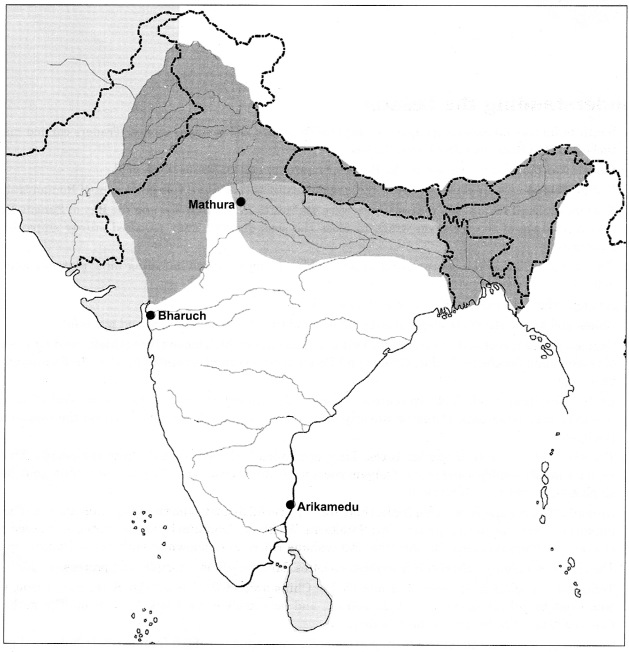
Class 6 History Chapter 9 Extra Questions and Answers Vital Villages, Thriving Towns

Class 7 History Chapter 7 Extra Questions and Answers Tribes, Nomads and Settled Communities

Tribes, Nomads and Settled Communities Class 7 History Chapter 7 Extra Questions and Answers Social Science CBSE Pdf free download are part of Extra Questions for Class 7 Social Science. Here we have given NCERT Extra Questions for Class 7 Social Science SST History Chapter 7 Tribes, Nomads and Settled Communities.

You can also practice NCERT Solutions for Class 7 History Chapter 7 Questions and Answers on LearnInsta.com.

Class 7 History Chapter 7 Extra Questions and Answers Tribes, Nomads and Settled Communities

Tribes, Nomads and Settled Communities Class 7 Extra Questions and Answer History Chapter 7 Very Short Answers Type

Question 1.
Name the activities which flourished in towns and villages?
Answer:
Arts, crafts and production activities flourished in towns and villages.

Question 2.
Why were social changes not same at all the places?
Answer:
Social change was not the same everywhere, because different kinds of societies evolved differently.

Question 3.
Under which rules was the society divided?
Answer:
Society was already divided according to the rules of vama.

Question 4.
Who prescribed the rules of varna?
Answer:
The rules of vama were prescribed by the Brahmanas.

Question 5.
What did the vama system resulted in? .
Answer:
From the vama system difference between the high and low, and between the rich and poor were increased.

Question 6.
Where did tribes live?
Answer:
Many tribes usually lived in forests, hills, deserts and places difficult to reach.

Question 7.
Name the tribes which used to live in Punjab?
Answer:
Khokhar tribes were lived in Punjab.

Question 8.
Which tribal communities lived in Multan and Sind?
Answer:
Langahs and Arghuns lived in Multan and Sind.

Question 9.
Which tribal community was found in north-west?
Answer:
Balochis were another large and powerful tribe in the north-west.

Question 10.
Name the tribe which lived in western Himalaya?
Answer:
In the western Himalaya lived the shepherd tribe of Gaddis.

Question 11.
In which part of the subcontinent did Nagas and Ahoms tribes live?
Answer:
In the north-eastern part of the subcontinent.

Question 12.
Name the most important trader nomads?
Answer:
The Banjaras were the most important trader nomads.

Question 13.
Name the tribal communities which emerged as new Rajput clans?
Answer:
The tribal communities which emerged as new Rajput clans were Hunas, Chandelas, Chalukyas and others.

Question 14.
What do you understand by word ‘tanda’?
Answer:
The Banjaras were the most important trader nomads. Their caravan was called tanda.

Question 15.
What was the occupation of pastoral tribes?
Answer:
The main occupation of pastoral tribes was cattle and horse rearing. They sold these animals to the prosperous people.

Question 16.
What was sold by the Petty Pedlars?
Answer:
Petty Pedlars travelled from village to village. They made and sold ropes, reeds, straw matting and coarse sacks.

Question 17.
What did the entertainers do for their livelihood?
Answer:
Some castes of tribes were entertainers who performed in different towns and villages for their livelihood.

Question 18.
What has been mentioned in Akbar Nama about the Gonds?
Answer:
In the Akbar Nama, it has been mentioned that the Gond kingdom of Garha Katanga had 70,000 villages.

Question 19.
Who were specialized artisans?
Answer:
Smiths, carpenters and masons were specialized artisans.

Question 20.
Name any two tribes which lived in the extreme South.
Answer:
Vetars and Maravars.

Question 21.
What are itinerant groups?
Answer:
Itinerant groups are craftspersons, pedlars and entertainers who travel from place to place practicing their different occupations.

Tribes, Nomads and Settled Communities Class 7 Extra Questions and Answer History Chapter 7 Very Short Answers Type

Question 1.
What are tribes?
Answer:
Tribes are the people who do not follow the social rules and rituals prescribed by the Brahmanas and nor were they divided into numerous unequal classes. Such societies are often called tribes.

Question 2.
How did tribes obtain their livelihood?
Answer:
Tribes obtained their livelihood from agriculture, herders. Some tribes were nomadic and moved from one place to another with their animals. They sell animal produces and buy
other things of their need.

Question 3.
How did tribal societies change?
Answer:
Caste-based and tribal societies also depended on each other for their diverse needs. This relationship, of conflict and dependence, gradually caused both societies to change.

Question 4.
How did the customs and traditions of tribes preserved?
Answer:
Mostly tribal people did not keep written records, but they preserved rich customs and oral traditions. These were passed down to each new generation.

Question 5.
How did Sultan Alaudddin Khalji used the Banjaras?
Answer:
Sultan Alauddin Khalji used the Banjaras to transport grain to the city markets. They also transported food grain for the Mughal army during military campaigns.

Question 6.
Give the name of different lineages which were powerful?
Answer:
Among the Kshatriyas, new Rajput clans became powerful by the 11th and 12th centuries. They belonged to different lineages, such as Hunas, Chandelas, Chalukyas and others. Some of these had been tribes earlier. Many of these clans came to be regarded as Rajputs.

Question 7.
Give a brief account of the Gonds tribes.
Answer:
The Gonds lived in a vast forested region called Gondwana. They practised shifting cultivation. They had many clans and each clan had its own raja or rai. In the Akbar Nama it has been mentioned that the Gond kingdom of Garha Katanga had 70,000 villages.

The kingdom was divided into garhs. This was further divided into units of 84 villages called chaurasi. The Chaurasi was subdivided into barhots which were made up of 12 villages each.

Question 8.
What do you understand by Shifting cultivation?
Answer:
In the Shifting cultivation trees and bushes in a forest area are first cut and burnt. The crop is sown in the ashes. When this land loses its fertility, another plot of land is cleared and planted in the same way.

Question 9.
What did Peter Mundy write about pastoral nomads?
Answer:
Peter Mundy wrote about pastoral nomads that they carried wheat, rice and even their wives and children with them. They buy grain from where it was cheaply available and sold it to places where they could earn profit.

Tribes, Nomads and Settled Communities Class 7 Extra Questions and Answer History Chapter 7 Long Answers Type

Question 1.
Describe Nomadic pastoralists and their different types.
Answer:
Nomads are wandering people. Many of them are pastoralists who roam from one pasture to another with their flocks and herds. They lived on milk and other pastoral products. They exchanged wool, ghee etc., for grain, cloth, utensils and other products. Many pastoral tribes reared and sold animals such as cattle and horses to the prosperous people.

The Banjaras were the most important trader nomads. Their caravan was called tanda. Sultan Alauddin Khalji used the Banjaras to transport grain to the city markets. They transported food grain for the Mughal army during military campaigns.

Different castes of petty pedlars also travelled from village to village. They made and sold ropes, reeds and straw matting and coarse sacks. Some castes were entertainers who performed in different towns and villages for their livelihood.

Question 2.
Give a brief account of different communities of tribes and their place of habitation.
Answer:
In Punjab, the Khokhar tribe was very influential during the 13th and 14th centuries. Langahs and Arghuns tribals dominated extensive regions in Multan and Sind. The Balochis were another large and powerful tribe in the north-west. They were divided into many smaller clans under different chiefs. In the western Himalaya lived the shepherd tribe of Gaddis.

The north-eastern part of the subcontinent too was entirely dominated by tribes-the Nagas, Ahoms and many others. In many areas of present-day Bihar and Jharkhand, Chero Chiefdoms had emerged by the 12th century.

The Mundas and Santals tribes lived in this region and also in Orissa and Bengal. Kolies, Berads and others belonged to Maharashtra highlands and Karnataka. Kolies also lived in many areas of Gujarat. In South, there were large tribal populations of Koragas, Vetars, Maravars and others.

The large tribes of Bhils were spread across western and central India. Many of them had become settled agriculturists and some even zamindars. The Gonds were found in great numbers across the present-day states of Chhattisgarh, Madhya Pradesh, Maharashtra and Andhra Pradesh.

Question 3.
Describe the tribes who were powerful.
Answer:
The area and influence of a tribe varied at different points of time. Some powerful tribes controlled large territories. In Punjab, the Khokhar tribe was very influential during the 13th & 14th centuries. Later, the Gakkhars became more important. Their chief, Kamal Khan Gakkhar was made a ‘mansabdar’ by Emperor Akbar.

In Multan and Sind, the Langahs and Arghuns dominated extensive regions. The Balochis were another large and powerful tribes in the north-west. In many areas of present-day Bihar and Jharkhand, Chero Chiefdoms had emerged by the 12th century.

Question 4.
Who were the Ahoms? Give brief information about the Ahoms.
Answer:
The Ahoms migrated to the Brahmaputra valley from Myanmar in the 13th century. During the 16th century they annexed the kingdoms of Chhutiyas and Koch-Hajo and subjugated many other tribes. The Ahoms built a large state and for this they used firearms and high quality gunpowder and cannons.

Almost all adult males served in the army during war. They were engaged in building dams, irrigation systems and other public works. The Ahoms also introduced new methods of rice cultivation. The Ahom society was divided into clans or khels and a Khel controlled over several villages.

Question 5.
State Ahoms faith in religion and their historical work.
Answer:
The Ahoms worshipped their own tribal gods however, the influence of Brahmanas increased. Temples, Brahmanas, poets and scholars were granted land by the king. In the reign of Sib Singh, Hinduism became the predominant religion, but the Ahom kings did not completely give up their traditional beliefs after adopting Hinduism. The Ahoms translated important works of Sanskrit into the local language which are counted as Historical works.

Map-Based Questions Class 7 History Chapter 7 Tribes, Nomads and Settled Communities

Question 1.
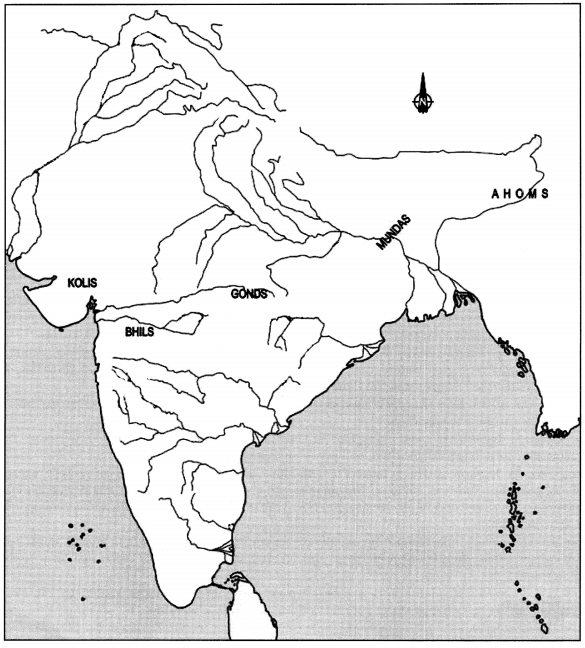
Plot the location of following tribes habitation:

  1. Ahoms
  2. Mundas
  3. Gonds
  4. Bhils
  5. Kolis

Answer:
Class 7 History Chapter 7 Extra Questions and Answers Tribes, Nomads and Settled Communities

Class 7 CIvics Chapter 5 Extra Questions and Answers Women Change The World

Women Change The World Class 7 Civics Chapter 5 Extra Questions and Answers Social Science CBSE Pdf free download are part of Extra Questions for Class 7 Social Science. Here we have given NCERT Extra Questions for Class 7 Social Science SST Civics Chapter 5 Women Change The World.

You can also practice NCERT Solutions for Class 7 Civics Chapter 5 Questions and Answers on LearnInsta.com.

Class 7 Civics Chapter 5 Extra Questions and Answers Women Change The World

Women Change The World Class 7 Extra Questions and Answer Civics Chapter 5 Very Short Answers Type

Question 1.
What do people believe about the women?
Answer:
Many people believe that women make better nurses because they are more patient and gentle. It is believed that science requires a technical mind and girls and women are not capable of dealing with technical things.

Question 2.
What was the main role recognized for girls?
Answer:
The main role of girls was recognized as kitchen work and marriage only.

Question 3.
What message do we get from the story of Laxmi Lakra?
Answer:
The story of Laxmi Lakra tells us that girls also can do every job and compete in the exam. The story encourages us all that girls should be given full opportunity in every field of life.

Question 4.
What did children do in the past?
Answer:
In the past, the skill of reading and writing was known to only a few. Most children learnt the work their families or elders did.

Question 5.
What role was played by the girls in the families of artisans?
Answer:
In the artisans families where traditional works such as skills like pottery, weaving and craft are undertaken, the contribution of daughters and women role is supportive. Gradually, the children also achieve the expertise in the traditional work.

Question 6.
What changes occurred in 19th century for girls’ education?
Answer:
In the nineteenth century, many new ideas about education and learning emerged, schools became more common and those whose ancestors never learnt reading and writing had started sending their children to school.

Question 7.
Name the important struggles under women movement activities.
Answer:
Campaigning, raising awareness, protesting, showing solidarity etc., are some of the important struggles under women movements’ activities.

Question 8.
Name the important part of the women’s movement.
Answer:
An important part of the women’s movement is fight against discrimination and violence including domestic and mental violence.

Question 9.
Give the name of book written by Ramabai.
Answer:
Pandita.

Question 10.
Why was Ramabai given the title ‘Pandita”?
Answer:
Ramabai was given the title Pandita because she could read and write Sanskrit. Those days such knowledge was not allowed.

Question 11.
What was achievement of Rokeya Sakhawat Hossain for the girls?
Answer:
Rokeya Sakhawat Hossain started a school for the girl which is functioning even today.

Women Change The World Class 7 Extra Questions and Answer Civics Chapter 5 Short Answers Type

Question 1.
What do you understand about stereotypes and how do it affect the girls?
Answer:
When we believe that people belonging to particular groups are bound to have certain fixed characteristics or can only do a certain type of work, is called stereotypes. Many people believe in stereotypes and do not provide education to the girls as they do to the boys. Due to the stereotypical thinking, in most families, once girls finish school, family member are encouraged to see marriage as their main aim in life.

Question 2.
Briefly describe the story of Laxmi Lakra.
Answer:
Laxmi Lakra was girl and also poor but she got diploma in electronics and then passed the railway board exam in first attempt. Her parents were not literate but they struggled and overcame many hardships to make sure their children got an education.

She studied hard and did well and then went on to get a diploma in electronics. Finally, Laxmi Lakra who belonged from a poor tribal family of Jharkhand became first engine driver in Northern Railways.

Question 3.
Write in brief struggle of Rashsundari Devi and her achievements.
Answer:
Rashsundari Devi was a housewife from a rich landlord’s family. At that time, it was believed that if woman will learn to read and write, she would bring bad luck to her husband and become a widow. About 200 years ago, at the age of 60, she wrote her autobiography in Bangla. Her book titled Amar Jiban is the first known autobiography written by an Indian woman.

Question 4.
What do you mean by Census?
Answer:
Census is undertaken once in every 10 years. The first census was undertaken in 1971. In the Census, many datas are accumulated such as number of people, number of male and female, number of school going boys and girls, their socio-economic condition etc. These numbers are gathered as a whole and various heads are published as a result. These data are used in the planning of government policies

Question 5.
In the field of education mention Muslims and Adivasi status in India.
Answer:
The 2001 census also found that Muslim girls are less likely, than Dalit and Adivasi girls, to complete primary school. There are several reasons why children from Dalit, Adivasi and Muslim communities leave school. Especially in rural and poor areas there may not even be proper schools or teachers who teach on a regular basis. Due to the transport unavailability, unable to bear the cost of educating all their children, boys may get preference in this situation.

Question 6.
Why do children leave the school? Give reasons.
Answer:
In India, children leave the school for various reasons. Some of them are:

  1. Many children leave school because they are discriminated by their teachers and classmates.
  2. Many places particularly in the rural areas availability of schools is not in the access of children.
  3. Many families are unable to teach all children due to the poverty.
  4. Some of them feel insecurity on the way to school particularly parents of girls etc.

Women Change The World Class 7 Extra Questions and Answer Civics Chapter 5 Long Answers Type

Question 1.
What was the result found in the census of 2001 about literacy?
Answer:
On the basis of data received from census, the literacy rate is determined. Census is undertaken once in 10 years. In the most recent census of 2001, these figures have grown to 76 percent for boys and men, and 54 percent for girls and women. It has been noticed that SC, ST and Adivasi backgrounds girls leave school at a rate that is higher than the category ‘All Girls’. However, this gap is reducing but has not gone away.

Question 2.
What was the role played by Women’s Movement in various spheres for women?
Answer:
There are other spheres such as – legal, violence and health, where the situation of women and girls has improved. These changes have not happened automatically. Women individually and collectively . have struggled to bring about these changes. This struggle is known as the Women’s Movement. Many men support the women’s movement.

Different strategies have been used to spread awareness, fight discrimination and seek justice. Efforts made by the women’s movement led the Supreme Court to formulate guidelines in 1997 to protect women against sexual harassment at the workplace and within educational institutions.

Question 3.
In what ways have women led their movement?
Answer:
Women’s movement have been led by following ways:

  1. Campaigning: Campaigning is one of the important ways that led the movement. It was initiated to fight discrimination and violence against women. These campaigns have also led to new laws being passed. A law was passed in 2006 against domestic violence on the women.
  2. Raising Awareness: An important part of the women’s movements’ work is to raise public awareness on women’s rights issues. Their messages have been spread through street plays, songs and public meetings.
  3. Protesting: Public rallies and demonstrations Eire a very powerful ways of drawing attention to injustices.
  4. Showing solidarity: The women’s movement is also about showing solidarity with other women and causes.

Class 6 History Chapter 1 Extra Questions and Answers What, Where, How and When?

What, Where, How and When? Class 6 History Chapter 1 Extra Questions and Answers Social Science CBSE Pdf free download are part of Extra Questions for Class 6 Social Science. Here we have given NCERT Extra Questions for Class 6 Social Science SST History Chapter 1 What, Where, How and When?.

You can also practice NCERT Solutions for Class 6 History Chapter 1 Questions and Answers on LearnInsta.com.

Class 6 History Chapter 1 Extra Questions and Answers What, Where, How and When?

What, Where, How and When? Class 6 Extra Questions and Answer History Chapter 1 Very Short Answers Type

Question 1.
How can we know about the past?
Answer:
By studying History, we can know about the past.

Question 2.
Where did people live in the early period?
Answer:
In the early period, people lived on the banks of the river Narmada for several hundred thousand years.

Question 3.
Who lived near the river Narmada?
Answer:
Gatherers lived near the river Narmada.

Question 4.
From where did gatherers get their food?
Answer:
Gatherers got their food by hunting and they collected roots, fruits and other forest produce for their food.

Question 5.
Where are the ‘Sulaiman’ and ‘Kirthar’ Hills located?
Answer:
The ‘Sulaiman’ and ‘Kirthar’ hills are located in the modern-day Pakistan.

Question 6.
Give the name of the crops which were grown about 8000 years ago.
Answer:
Wheat and barley were grown about 8000 years ago.

Question 7.
Give the name of places where wheat and barley grew about 8000 years ago?
Answer:
In Sulaiman and Kirthar hills, wheat and barley grew about 8000 years ago.

Question 8.
Which animals were reared by the early people?
Answer:
Sheep, goat and cattle.

Question 9.
Where are Garo hills are located?
Answer:
The Garo hills are located in the north-east of India.

Question 10.
Where are Vindhyas located?
Answer:
Vindhyas are located in Central India.

Question 11.
What was developed in Vindhyas and Garo hills?
Answer:
Agriculture was developed in Vindhyas and Garo hills.

Question 12.
Give the name of places where rice was first grown.
Answer:
The places where rice was first grown are to the north of the Vindhyas.

Question 13.
Is the river SON tributary of the river Ganga?
Answer:
Yes, the river SON is tributary of the river Ganga.

Question 14.
What was the south of the Ganga called?
Answer:
Magadha was called the part of south Ganga.

Question 15.
Why was Magadha famous?
Answer:
Magadha was famous because its rulers were powerful, and set up a large kingdom.

Question 16.
Which languages were used for writing manuscripts?
Answer:
Sanskrit, Prakrit, and Tamil languages were used for writing manuscripts.

Question 17.
Name two words we often used for our country.
Answer:
Two of the words we often use for our country are India and Bharat.

Question 18.
What do scripts consist of?
Answer:
Scripts consist of letters or signs.

Question 19.
Where is ‘Rosetta’ town located?
Answer:
In Egypt.

Question 20.
Where was the inscribed stone found?
Answer:
Inscribed stone was found in Rosetta, a town on north coast of Egypt.

Question 21.
In which languages and scripts were inscriptions written on inscribed stone which was found in Rosetta?
Answer:
Greek and two forms of Egyptian.

Question 22.
What are the occupations of the people in the Andaman Islands?
Answer:
The people of the Andaman Islands are engaged in fishing, hunting and collecting forest produce.

Question 23.
Name the things that archaeologists found during excavation.
Answer:
The archaeologists found tools, pots, weapons, pans, coins and ornaments during excavation.

Question 24.
What was the job of religious teachers?
Answer:
Religious teachers moved from one place to another to offer instruction and advice to the people who they met on the way.

What, Where, How and When? Class 6 Extra Questions and Answer History Chapter 1 Short Answers Type

Question 1.
Why is it important to know about the past?
Answer:
It is important to know the past because it tells us how people lived in that time, what they used to eat, wear, what kind of animals they had, how much civilization was developed, how they were living. Additionally, history also warns us not to repeat the mistakes and points out its consequences.

Question 2.
What are the sources to know the past?
Answer:
Sources are referred to the information found from manuscripts, inscriptions and archaeology. Once sources are found, learning about the past becomes an adventure, as we reconstruct it bit by bit. So, historians and archaeologists use sources like clues to find out about our pasts.

Question 3.
Who are archaeologists? What are the works of archaeologists?
Answer:
There were things that were used in the past. Those who study these objects are called archaeologists. They study the remains of buildings made of stones and bricks, paintings and sculptures. They also explore and excavate to find tools, coins etc.

Question 4.
Why is South Asia called subcontinent?
Answer:
South Asia is called a subcontinent because although it is smaller than a continent, it is very large, and is separated from the rest of Asia by seas, hills and mountains.

Question 5.
What were the problems faced by people while travelling from one part to another part of subcontinent?
Answer:
While people travelled from one part to another part of subcontinent, they had to face the hills and high mountains including the Himalayas, deserts, rivers and seas that made journey dangerous at times but never impossible.

Question 6.
‘Historians and Archaeologists are like detectives’. Explain.
Answer:
Whatever the sources founded from the inscriptions, manuscript, etc., historians and archaeologists study those sources or objects. This is like an adventure for them to find about the History on the basis of sources. Sources are like clues for them. They are like detectives who use all these sources like clues to discover about the past.

Question 7.
What do you know about ‘Bharata’?
Answer:
The name ‘Bharata’ was used for a group of people who lived in the north west and it is mentioned in the Rigveda, later it was used for the country. Rigveda is the earliest composition among all the Veda and it is written in Sanskrit.

What, Where, How and When? Class 6 Extra Questions and Answer History Chapter 1 Long Answers Type

Question 1.
How was our country named?
Answer:
The word India comes from the Indus called Sindhu in Sanskrit. The two words we generally use for our country are India and Bharat. About 2500 years ago, the Iranians and Greeks who came through the northwest were familiar with the Indus, called it the Hindos or the Indos. The land to the east of the river (i.e., the Indus) called India.

About 35000 years ago in Rigveda (the earliest composition in Sanskrit), the name Bharata was mentioned which was used by a group of people who lived in the north¬west. Later, it was used for the country.

Question 2.
What do you mean by decipherment? Give example.
Answer:
Inscriptions are written on hard surfaces. Many were written several hundreds of years ago. All inscriptions contain both scripts and languages. Languages which were used, as well as script have changed over time. Scholars understand the written words by the process of decipherment.

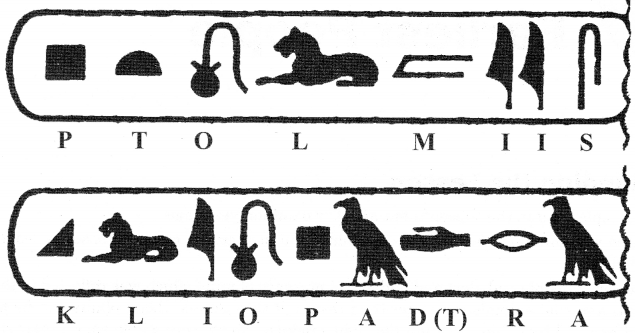
One of the most famous stories of decipherment comes from Egypt where there were kings and queens about 5000 years ago. An inscribed stone was found in Rosetta, which contained inscriptions in three different languages. Scholars were able to read the inscriptions by identifying the sounds for which the Egyptian letter stood. Eg. Lion stood for L, and a bird for A.

Question 3.
How is living of the present Indian tribals different from the villages?
Answer:
There are many places in India where tribals are living. These tribals are living just adjoining to the forest areas or in the forest. Presently, most of the tribals are living in the state of Madhya Pradesh, Odisha, Jharkhand, Chhattisgarh, Andaman and Nicobar etc. These communities are still depending on the natural resources. Gradually, they have been evolved in agricultural activities.

Apart from agriculture, their main livelihood is dependent on the rearing of cattles, hunting, fishing etc. They still like separation from the other population. Very rarely the children of tribals join school situated in the nearby area. They are almost unaware about the development of science and technology. Thus, we can say that the tribals are almost in the same condition since hundred of years.

In contrast, people of the Indian villages are enjoying many facilities such as schools, hospitals, roads, transport such as bikes, tractors, cars etc., agriculture with improved technology and now mobile has also reached Indian villages. Our villages are growing fast.

Question 4.
Define the terms:
(a) BC
(b) AD
(c) CE
(d) BCE
Answer:
(a) BC: the letter BC means Before Christ. Dates are generally counted (i.e., the day, the months and the years) from or assigned to the birth of Jesus Christ, the founder of Christianity. So 2000BC means 2000 years before the birth of the Jesus Christ. All dates before the birth of Jesus Christ are counted backwards and generally have the letter BC (Before Christ) added on.

(b) AD: we use AD before dates. This stands for two Latin words, “Anno Domini”, and means in the year of the Lord Jesus Christ.

(c) CE: sometimes, CE is used instead of AD. The letters CE stand for ‘Common Era’.

(d) BCE: sometimes BCE is used instead of BC. The letters BCE stand for ‘Before Common Era’.

Picture Based Questions Class 6 History Chapter 1 What, Where, How and When?

Question 1.
Look at the following picture given below and answer the following.
Class 6 History Chapter 1 Extra Questions and Answers What, Where, How and When 3
(a) What does the bird stand for?
(b) What does the lion stand for?
(c) Where was the inscribed stone found and what is the process of reading the letters, as describe above, called?
Answer:
(a) A bird is stood for the letter A.
(b) Lion is stood for the letter L.
(c) The stone was found in Rosetta, a town on the north coast of Egypt. The process is called decipherment.

Map Skills Class 6 History Chapter 1 What, Where, How and When?

Question 1.
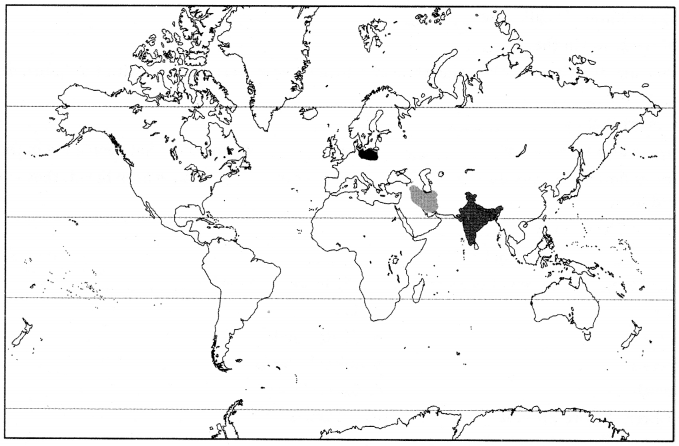
Locate the following on the world map.
(a) India
(b) Greek
(c) Iran
Answer:
Class 6 History Chapter 1 Extra Questions and Answers What, Where, How and When 1

Question 2.
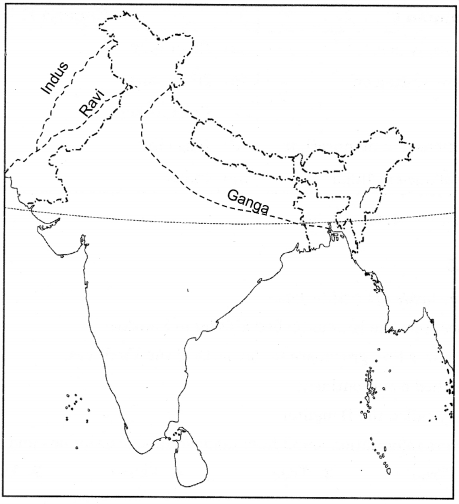
Locate the following on the map of India.
(a) Indus
(b) Ravi
(c) Ganga
Answer:
Class 6 History Chapter 1 Extra Questions and Answers What, Where, How and When 2

Class 6 History Chapter 2 Extra Questions and Answers On The Trial of the Earliest People

On The Trial of the Earliest People Class 6 History Chapter 2 Extra Questions and Answers Social Science CBSE Pdf free download are part of Extra Questions for Class 6 Social Science. Here we have given NCERT Extra Questions for Class 6 Social Science SST History Chapter 2 On The Trial of the Earliest People.

You can also practice NCERT Solutions for Class 6 History Chapter 2 Questions and Answers on LearnInsta.com.

Class 6 History Chapter 2 Extra Questions and Answers On The Trial of the Earliest People

On The Trial of the Earliest People Class 6 Extra Questions and Answer History Chapter 2 Very Short Answers Type

Question 1.
Where was Tushar going and for which purpose?
Answer:
Tushar was going from Delhi to Chennai for his cousin’s wedding.

Question 2.
When did the early people live in subcontinent?
Answer:
As early as 2 million years ago.

Question 3.
How did the early people get their food?
Answer:
They hunted animals, caught fishes and birds and gathered fruits, roots, nuts, seeds, leaves, stalks and eggs.

Question 4.
What were the main things by which tools were made up by the early people?
Answer:

  • stones
  • bones
  • wood

Question 5.
What do you understand by “Factory Site”?
Answer:
Places where stone was found and people made tools are called “Factory Site”.

Question 6.
What do you understand by “Habitation Site”?
Answer:
Places, where people lived, are called “Habitation Site”.

Question 7.
What do you understand by “Habitation-cum-factory” Site?
Answer:
Places where people lived as well as made tools are called “Habitation-cum-factory Site”.

Question 8.
Habitation Site ‘Bhimbetka” is presently situated in which State?
Answer:
In Madhya Pradesh.

Question 9.
Where did the early people live?
Answer:
They lived in caves and rock shelters.

Question 10.
Give the name of places where natural caves and rock shelters were found?
Answer:
In the Vindhyas and the Deccan Plateau near to the Narmada Valley.

Question 11.
Why did people chose to live in caves and shelters?
Answer:
Because these provided shelter from the rain, heat and wind.

Question 12.
Where has ash of fire been found?
Answer:
In Kumool caves.

Question 13.
What were the uses of fire?
Answer:
Fire was used to cook meat and scare away wild animals.

Question 14.
When did major changes occur in environment?
Answer:
Around 12,000 years ago.

Question 15.
What do you understand about “Mesolithic”?
Answer:
Mesolithic is middle stone. The time span of this period is about 12,000 years ago to about 10,000 years ago.

Question 16.
What do you understand about “Microliths”?
Answer:
During this period, stone tools found are generally tiny (small) and probably saws and sickles were used and their handles were made up of bone or wood.

Question 17.
Did the early people know the painting?
Answer:
Yes, they knew.

Question 18.
Where did they make the painting?
Answer:
They made the painting of the walls of caves.

Question 19.
Give best examples of places where these paintings found and what was made in the painting. Answer:
These paintings were found in Madhya Pradesh and were in southern Uttar Pradesh. Wild animals
were found in most of their paintings.

Question 20.
Evidence of Ostrich habitation in India was found in which period? Give name of the place. Answer:
In Palaeolithic period, the name of the place where Ostrich habitation was found is-Patne in
Maharashtra.

Question 21.
What were the things the tools were made up of in Hunsgi?
Answer:
The tools found in Hunsgi were made up of limestones.

On The Trial of the Earliest People Class 6 Extra Questions and Answer History Chapter 2 Short Answers Type

Question 1.
Mention the techniques that were used to make stone tools.
Answer:
It is found that the early people used tools which were made by following ways:
Stone on Stone technique: In this technique, one stone was made with the use of another stone. The stone which was to be developed as a tool was taken in the hand and another stone was used as a hammer. The stone used as a hammer was used to strike off flakes from the first stone. This process was repeated till the required shape was obtained.

Pressure flaking: In this technique, the stone or bone was put on a hard surface and hammer stone was used for flaking off stone or bone. By the removal of flakes, stone or bone became a tool.

Question 2.
What do you understand about “Palaeolithic”?
Answer:
The earliest period was called Palaeolithic. The word ‘palaeo’ is a Greek word which means ‘old’ and ‘lithos’ means ‘stone’. It means “Palaeolithic” is Old Stone. During this period, stone tools were used by the people and hence, this period is known as “Palaeolithic”. This period extends from 2 million years ago to about 12,000 years ago. This period is divided into Lower, Middle and Upper Palaeolithic. This covers 99% time of human history.

Question 3.
What were the reasons for hunter-gatherers to move from one place to another?
Answer:
The early people moved from one place to another place due to:

  1. Lack of plants and animals
  2. For following the movements of cattle
  3. Lack of seasonal fruits
  4. In search of water

Question 4.
What was result of changes in environment?
Answer:
The shifting of warm conditions led to development of grasslands. This in turn led to increase in wild animals who survived on grass. People started thinking about herding and rearing these animals. Fishing also started. Grain bearing grasses like wheat, barley and rice grew naturally in different parts of subcontinent.

Question 5.
Write about the painting done by the early people.
Answer:
The early man lived in caves. They formed paintings on the walls and the caves. These paintings were made up beautifully by using colours. Sometimes, the colours were made up of ochre or iron-ore and charcoal. Perhaps, these paintings were made on special occasions.

On The Trial of the Earliest People Class 6 Extra Questions and Answer History Chapter 2 Long Answers Type

Question 1.
What were the difficulties faced by hunter-gatherers?
Answer:
There were several animals that ran faster than man and many were stronger and thus, the early people needed to be alert, quick and have lots of presence of mind. Many plants and its products like fruits, nuts, roots were also dangerous. In the early period, they did not have sharp tools. The hunting tools were made up of stone and bones.

So, it was not easy to hunt the animals which ran faster. Likewise, use of unknown plants and its products was not safe. Gradually, one by one they would have learnt about the safe and unsafe plants. So, the difficulties were how to hunt the animals and birds and selection of non-poisonous plants and its products.

Question 2.
Write short note on:
(a) Factory Sites
(b) Habitation-cum factory site
(c) Habitation Sites
Answer:
(a) & (b) In the Stone age, the people were very much dependent on stone. They used stone for their tools. This way, the most important thing was stone for the people. They moved to the places where good quality and large quantity of stone was found. They used such places as factory and they made tools at such places, as per requirement.

Chips of waste stone were left behind at these sites. Such sites are called Factory Sites. Further, sometimes people lived here for a long time and used these sites or places as a habitation too and hence, it is called “Habitation-cum factory site”.

(c) Habitation Sites are those where people lived.

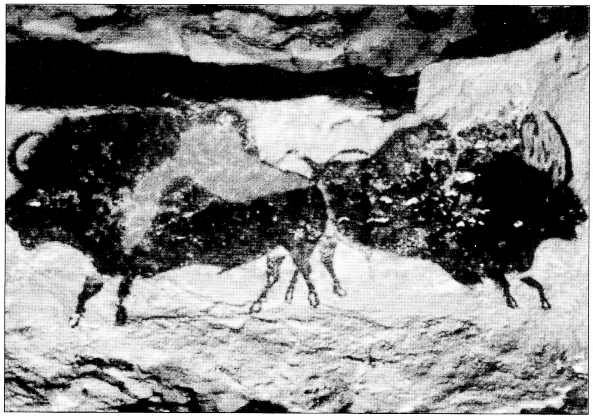
Picture Based Questions Class 6 History Chapter 2 On The Trial of the Earliest People

Look the picture and answer the following questions:
Class 6 History Chapter 2 Extra Questions and Answers On The Trial of the Earliest People 1
(a) In which country was this picture found?
(b) How many years old is this picture?
(c) The colors used in the picture are made up of?
Answer:
(a) This picture was found in France.
(b) About 20,000-10,000 years old.
(c) minerals like ochre or iron ore and charcoal.

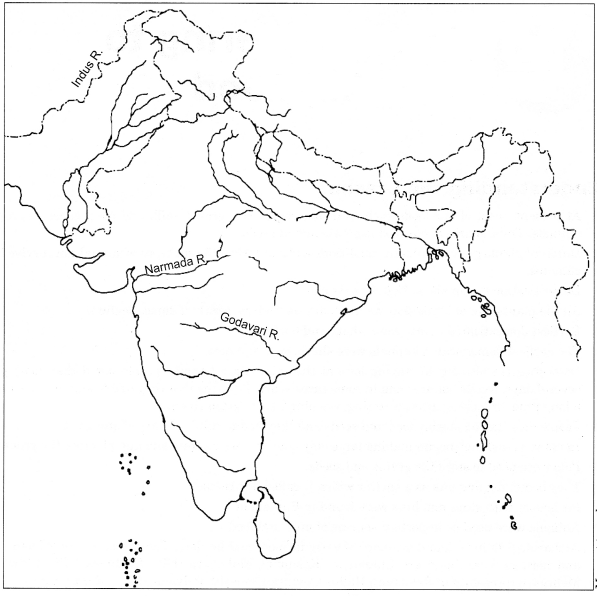
Map-Based Questions Class 6 History Chapter 2 On The Trial of the Earliest People

Find out following on Indian Map
(i) Indus River
(ii) Godavari
(iii) Narmada
Answer:
Class 6 History Chapter 2 Extra Questions and Answers On The Trial of the Earliest People 2