Class 8 Civics Chapter 4 Extra Questions and Answers Understanding Laws

Understanding Laws Class 8 Civics Chapter 4 Extra Questions and Answers Social Science CBSE Pdf free download are part of Extra Questions for Class 8 Social Science. Here we have given NCERT Extra Questions for Class 8 Social Science SST Civics Chapter 4 Understanding Laws.

You can also practice NCERT Solutions for Class 8 Civics Chapter 4 Questions and Answers on LearnInsta.com.

Class 8 Civics Chapter 4 Extra Questions and Answers Understanding Laws

Understanding Laws Class 8 Extra Questions and Answer Civics Chapter 4 Very Short Answers Type

Question 1.
In a democracy like ours what can a citizen do to reject the repressive laws framed by the Parliament?
Answer:
In a democracy like ours, citizens can express unwillingness for the reflection of the repressive laws.

Question 2.
Name the African American woman who played a key role in the starting of the Civil Right Movement.
Answer:
Rosa Parks was the African American women who Started the Civil Rights Movement.

Question 3.
What does the term Evolution refer to in general?
Answer:
Evolution refers to the process of development from a simple to a complex form and is often used to discuss the development of a species of plants and animals.

Question 4.
State the two examples of-Arbitrariness performed by the British.
Answer:
The two examples are:

  1. Sedition Act of 1870
  2. The Rowlatt Act.

Question 5.
When did the Jallianwala Bagh incident take place?
Answer:
This incident took place on 13th April 1919.

Question 6.
Name the two leaders arrested for the protests against the Rowlatt Act.
Answer:
The two leaders were Dr. Satyapal and Dr. Saifuddin Kitchlew.

Question 7.
What does the Hindu Succession Amendment Act 2005 say?
Answer:
According to this law, sons, daughter and their mother can get an equal share of family property.

Question 8.
What did the Rowlatt allow the Britishers to perform as arbitrariness?
Answer:
Rowlatt Act allowed the Britishers to imprison people without due trial.

Question 9.
In which year was the sedition Act was introduced?
Answer:
In 1870.

Question 10.
Who is known to be the incharge of making law?
Answer:
Parliament in incharge of making laws.

Question 11.
On what basis law cannot discriminate between persons?
Answer:
Law cannot discriminate between persons on the basis of their religion, caste and gender.

Question 12.
What was scenario of local laws in Ancient India?
Answer:
In Ancient India, there were innumerable and often overlapping local laws.

Question 13.
When does the system of law began to further evolve?
Answer:
System of law began to further evolve during colonial period.

Question 14.
Who is believed to be the introducer of the rule of law in India?
Answer:
It is believed that British colonials were the introducers of the Rule of law in India.

Question 15.
Who began to protest and criticize the arbitrary use of authority by the British?
Answer:
The Indian Nationalists began protesting and criticizing the arbitrary use of authority by the British.

Question 16.
According which new law sons, daughters and their mothers get an equal share of family property?
Answer:
Hindu Succession Act 2005.

Question 17.
When did standing committee submitted its recommendation for the implementation of Domestic violence Act?
Answer:
In May 2002.

Question 18.
In which year did the Rowlatt act came into effect?
Answer:
In 1919.

Question 19.
Define the term Repressive.
Answer:
It means to control severely in order to prevent free and natural development or expression.

Question 20.
What is meant by ‘criticise’?
Answer:
It means to find fault with or disapprove of a person or thing.

Understanding Laws Class 8 Extra Questions and Answer Civics Chapter 4 Short Answers Type

Question 1.
Define ‘Sedition’.
Answer:
This applies to anything that the government might consider as striating up resistance or rebellion against it. In such cases, government does not need absolute evidence in order to arrest persons. Under the sedition Act of 1870, the British had a very broad interpretation of what constituted sedition, and what this meant was that they could arrest and detain any person they would under this act.

Question 2.
Describe the incident that led to the of Civil Rights Movements and the Civil Rights Act in 1964 in the U.S.A.
Answer:
Rosa Parks an African – American woman refused to give up her seat on a bus to a white man on December 1,1955. She was protesting against the law on segregation that divided up all public spaces, including the streets, between the whites and the Africans – Americans.

Her refusal was a key event that marked the start of the Civil Rights Movement that led to the Civil Rights Act in 1964 prohibiting discrimination on the basis of race, religion or national origin in the U.S.A.

Question 3.
Why is it more important to refer women who face violence as survivors rather than as victims?
Answer:
Often women who face violence or are abused are seen as victims. But women struggle in several different ways to survive these situations. Therefore, it is move accurate to refer to them as survivors rather than as victims.

Question 4.
Describe the process after which Domestic Violence Act came into effect in 2006.
Answer:
In December 2002, the Standing Committee submitted its recommendations to the Rajya Sabha and these were also tabled in the Lok Sabha. The Committee’s report accepted most of the demands of the women’s, groups. Finally a new bill was reintroduced in Parliament in 2005. After being passed in both the house of the Parliament, it was sent to the president for his assent. The protection of women from Domestic violence came into effect in 2006.

Question 5.
How can we say that Parliament has an important role in making laws?
Answer:
The Parliament has an important role in making laws. There are many ways through which this takes place and it is often different groups in society that raise the need for a particular law. An important role of Parliament is to be sensitive to the problems faced by the people. The issues are brought to the attention of the Parliament and the issues to become law.

Understanding Laws Class 8 Extra Questions and Answer Civics Chapter 4 Long Answers Type

Question 1.
What do your understand by domestic violence? Explain how Domestic Violence Act 2005 helps in understanding the term ‘Domestic’ better.
Answer:
Domestic violence refers to the injury or harm caused by an adult male, usually the husband, against his wife. Injury might be caused by physically beating up the woman or by emotionally abusing her. Abuse of the women can also include verbal, sexual and economic abuse.

The protection of women from Domestic violence Act 2005 extend the understanding to the term ‘domestic’ to include all women who ‘live or have lived together in a shared household’ with the male member who is perpetrating the violence.

Question 2.
Starting from the Rowlatt Act to the Jallianwala Bagh massacre, briefly explain the events, also by mentioning the dates.
Answer:
The British passed the Rowlatt Act which allowed the British government to imprison people without due trial. Indian rationalists including Mahatma Gandhi were vehement in their opposition the Rowlatt Act. Despite the large number of protests, the Rowlatt Act came into effect on 10th march 1919.

In Punjab, protests against this act continued quite actively and on April 10 two leaders of the women, Dr. Satyapal and Dr. Saifuddin Kitchlew were arrested. To protest these arrests, a public meeting was held on 13th April at Jallianwala Bagh in Amritsar. General Dyer entered the park with his troops to fire. Several hundreds of people died in this gunfire and many more were wounded including women and children.
Class 8 Civics Chapter 9 Extra Questions and Answers Public Facilities

Public Facilities Class 8 Civics Chapter 9 Extra Questions and Answers Social Science CBSE Pdf free download are part of Extra Questions for Class 8 Social Science. Here we have given NCERT Extra Questions for Class 8 Social Science SST Civics Chapter 9 Public Facilities.

You can also practice NCERT Solutions for Class 8 Civics Chapter 9 Questions and Answers on LearnInsta.com.

Class 8 Civics Chapter 9 Extra Questions and Answers Public Facilities

Public Facilities Class 8 Extra Questions and Answer Civics Chapter 9 Very Short Answers Type

Question 1.
Where were Amu and Kumar travelling through?
Answer:
Amu and Kumar were travelling through Chennai in a bus.

Question 2.
What did Amu and Kumar observe while travelling through Chennai?
Answer:
They observed the water facilities are available in different parts of Chennai.

Question 3.
How is water essential?
Answer:
Water is essential for life and for good health.

Question 4.
Under which article does the Constitution of India recognize the Right to water?
Answer:
The Constitution of India recognises the right to water as being a part of the Right to Life under Article 21.

Question 5.
What did the judge direct the Mahbubnagar district collector?
Answer:
The judge directed the Mahbubnagar district collector to supply 25 litres of water to each person in
the village.

Question 6.
What are public facilities?
Answer:
Essential facilities that need to be provided for everyone like healthcare, sanitation, electricity, schools and colleges etc. that are also necessary are known as public facilities.

Is it available?How can it be improved?
WaterYesThe availability of water should also be at evening time.
ElectricityYesIn this regard people should be loyal to pay their bills on time and companies should arrange much more proper machinery to prevent load shedding types of problems.
RoadsYesSimilar to the main roads government should take responsibility of the streets too.
Public

Transport

YesMetro fair which has been hiked recently is very costly for some group of people and it should be cut.

Question 7.
Where is the government budget presented?
Answer:
The government budget being presented in the parliament.

Question 8.
What is meant by Basic Needs?
Answer:
Primary requirement of food, water, shelter, sanitation, healthcare and education necessary for survival.

Question 9.
What is often taken as a sign of failure of the government?
Answer:
The shortage of municipal water is often taken as a sign of failure of the government.

Question 10.
What is the quantity of water supply in India in an urban area?
Answer:
The supply of water per person in an urban area in India is about 135 litres per day.

Question 11.
Whom does the responsibility of water supply belongs to throughout the world.
Answer:
Throughout the world the water supply is responsibility and function of the government.

Question 12.
Define Basic Needs.
Answer:
The primary requirement of food, water, shelter, sanitation, healthcare and education necessary for survival are Basic Needs.

Question 13.
Where is the suburban railway’s located?
Answer:
In Mumbai.

Question 14.
Under which article of the Constitution is the Right to water is recognised?
Answer:
Under Article 21.

Question 15.
What is the most important form of public transport over long distances?
Answer:
The Railways.

Question 16.
At what percent the census 2001 put rural household electrification?
Answer:
As 44%.

Public Facilities Class 8 Extra Questions and Answer Civics Chapter 9 Short Answers Type

Question 1.
Why it is noticed that there are great inequalities in water use?
Answer:
It is fact that there is a great in-equalities in water use. Because the supply requirement of water in urban areas of India should be about 135 litres (About 7 Lac buckets) per day. It is said to be standard set by the urban water commission. But people living in slums gets availed with less than 20 litres a day per person. On the side as much as 1600 Litres (80 buckets) of water per day is supplied at the same time to luxury hotels.

Question 2.
What is the condition and statistics of water diseases in India?
Answer:
India has one of the largest number of cases of diseases such as diarrhoea, dysentery, cholera over 1600, Indians, most of them children below the age of five reportedly die everyday because of water disease in India.

Question 3.
What are the other public facilities other than water that are needed to be provided to everyone?
Answer:
Same as water there are other essential facilities that are needed to provided to everyone. For example, healthcare, sanitation, electricity, public transport, schools and colleges. These all are also known as public facilities.

Question 4.
Define Sanitation.
Answer:
Provision of facilities for the safe disposal of human urine and feces. This is done by construction of toilets and pipes to carry the sewage and treatment of waste water. This is necessary so as to avoid contamination.

Question 5.
How can it be said that the private companies which provide public facilities are not suitable for public actually?
Answer:
Though private companies provide the public facilities but they provide it with the purpose of profit making and they provide facilities at a price that only some people can afford. This facility not available to all at an affordable rate.

Public Facilities Class 8 Extra Questions and Answer Civics Chapter 9 Long Answers Type

Question 1.
What is the scenario, of public water supply in Porto Alegre? ’
Answer:
Porto Alegre is a city in Brazil. Though there are many poor people in this city, what is remarkable is that it has a far lower number of infant deaths as compared to most other cities of the world. The city’s, water department has achieved universal access to safe water and this is the main reason behind the lower number of infant deaths.

The average price of water, is kept low, and the poor are charged half basic rate. Whatever profit the department makes is used to improve the water supply. The working of the water department is transparent and people can have a direct say in deciding which projects the department should take up. Through a process of public meetings, people hear what the managers have to say and also vote on their priorities.

Class 8 Geography Chapter 6 Extra Questions and Answers Human Resource

Human Resource Class 8 Geography Chapter 6 Extra Questions and Answers Social Science CBSE Pdf free download are part of Extra Questions for Class 8 Social Science. Here we have given NCERT Extra Questions for Class 8 Social Science SST Geography Chapter 6 Human Resource.

You can also practice NCERT Solutions for Class 8 Geography Chapter 6 Questions and Answers on LearnInsta.com.

Class 8 Geography Chapter 6 Extra Questions and Answers Human Resource

Human Resource Class 8 Extra Questions and Answer Geography Chapter 6 Very Short Answers Type

Question 1.
What does the population pyramid tells about dependents of a country?
Answer:
Population pyramid tells us how many dependents are there in a country. There are two dependents – young and elderly dependents.

Question 2.
What could be an interesting way of studying the population composition of a country? Answer:
An interesting way of studying the population composition of a country is by looking at the population pyramid, also called an age-sex pyramid.

Question 3.
How crowded a country is, has little to do with its level of economic development. Give example to show its validity?
Answer:
For example, both Bangladesh and Japan are very densely populated but Japan is far more economically developed than Bangladesh. This is the perfect example for the above’s validity.

Question 4.
Define immigration.
Answer:
When a person enters a new country it is termed as immigration.

Question 5.
What does Emigrations mean?
Answer:
Emigration means when a person leaves a country.

Question 6.
What is the general trend of international migration?
Answer:
The general trend of international migration is from the less developed nations to the more developed nations in search of better employment opportunities.

Question 7.
Who are the Emigrants?
Answer:
The emigrants are the people who leave a country.

Question 8.
What is the meaning of population Density?
Answer:
Population density is the number of people living in a unit area of the earth’s surface.

Question 9.
Which is the ultimate resource?
Answer:
Human Resource.

Question 10.
Which of the two continents are there in which almost 3 quarters of world’s people live?
Answer:
Asia and Africa.

Question 11.
What does industrial area provide?
Answer:
It provides employment opportunities.

Question 12.
What is the most preferrable topography for humans?
Answer:
Plains

Question 13.
Which area of the world has sparse population when it comes to water availability?
Answer:
Deserts.

Question 14.
What led the people to settle in South Africa.
Answer:
Diamond mines of South Africa.

Question 15.
In which year the world’s population reached 3 billion?
Answer:
In 1959.

Question 16.
What was the world’s population in 1804?
Answer:
The world’s population reached one billion.

Question 17.
Why is the population growth slow in the countries like United Kingdom?
Answer:
Because of both low death and low birth rates.

Human Resource Class 8 Extra Questions and Answer Geography Chapter 6 Short Answers Type

Question 1.
What is meant by the term population density and what is the average density of population in whole world and in India?
Answer:
Population density is the number of people living in a unit area of the earth’s surface. It is normally expressed as per sq km. The average density of population in the whole world is 51 persons per sq km. and the average density of population in India is 382 persons sq km. South Central Asia has the highest density of population.

Question 2.
How can we say that people’s are the nation’s greatest resources and human resource is the ultimate resource?
Answer:
People are the nation’s greatest resources as nature’s bounty becomes significant only when people find it useful. It is people with their demands and abilities that turn, them into resources. Hence, human resource is the ultimate resource. Healthy, educated and motivated people develop resources as per their requirements.

Question 3.
What do you know about Human Resource Development (HRD) ministry under the government of India?
Answer:
The Government of India has a ministry of Human Resource Development. The Ministry was created in 1985 with an aim to develop people’s skills. This just shows how important people are as a resource for the country.

Question 4.
What do you mean by the pattern of population distribution? How is world population distributed?
Answer:
The way in which people are spread across the earth’s surface is known as the pattern of population distribution. More than 90% of the world’s population lives in about 30 per cent of the land’s surface. The distribution of world population is extremely uneven.

Question 5.
Define the following:

  1. Birthrate
  2. Death rate
  3. Migrations
  4. Life expectancy

Answer:

  1. Birth Rate: Births are usually measured using the birth rate, i.e. the number of live births per 1,000 people.
  2. Death Rate: Deaths are usually measured using the death rate, i.e. the number of deaths per 1,000 people.
  3. Migrations: It is the movement of people in and out of an area.
  4. Life expectancy: It is the number of years that an average person can expect to live.

Human Resource Class 8 Extra Questions and Answer Geography Chapter 6 Long Answers Type

Question 1.
Define population change. How do the following factors affect the distribution of population?
(i) Topography
(ii) Climate
(iii) Soil
(iv) Water
(v) Minerals.
Answer:
The population change refers to change in the number of people during a specific time. The world population has not been stable.
This is how the following factors affect the distribution of population.

  1. Topography: People always prefer to live on plains rather than mountains and plateaus because these areas are suitable for farming, manufacturing and service activities.
  2. Climate: People usually avoid extreme climates that are very hot or very cold.
  3. Soil: Fertile soils provide suitable land for agriculture. Fertile plains are densely populated around different parts of the world.
  4. Water: People prefer to live in the areas where freshwater is easily available. The river valleys of the world are densely populated while deserts have spare population.
  5. Minerals: Areas with mineral deposits are more populated.

Picture Based Questions Class 8 Geography Chapter 6 Human Resource

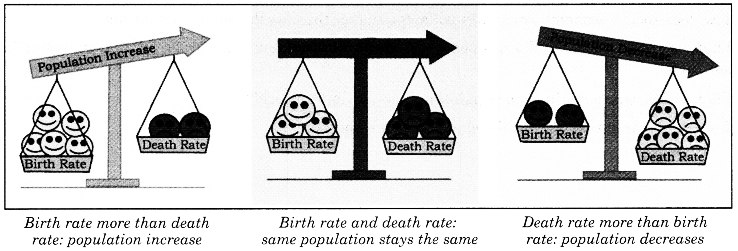
Look at the picture given below and answer the following questions:

Question 1.
Class 8 Geography Chapter 6 Extra Questions and Answers Human Resource 1
(i) When does the population increase?
(ii) When does the condition of steady population arise?
(iii) When does the population decrease?
Answer:
(i) When birth rate is more than death rate.
(ii) When birth rate and death rate both stay the same.
(iii) When death rate is more than birth date.

Map Skills Class 8 Geography Chapter 6 Human Resource

Question 1.
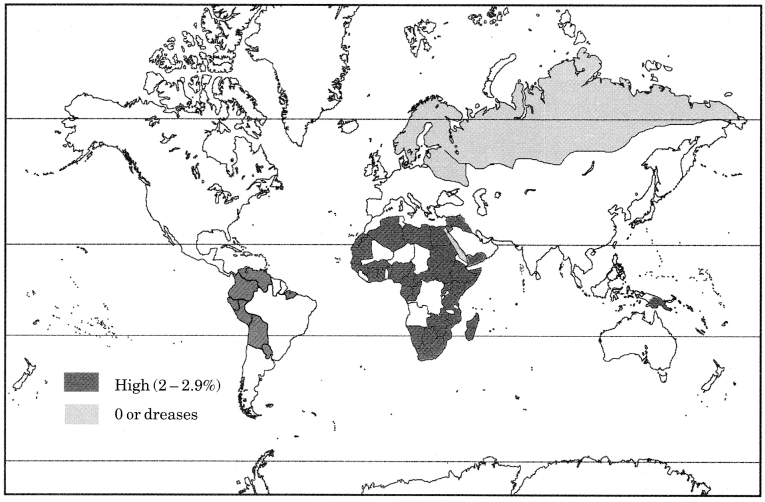
Mark the Annual rates if natural increase in the following colours.
(i) High (2 – 2.9%) – with red colour.
(ii) 0 or decreases – with green colour.
Answer:
Class 8 Geography Chapter 6 Extra Questions and Answers Human Resource 2

When People Rebel Class 8 Extra Questions Social Science History Chapter 5

When People Rebel Class 8 Extra Questions and Answers Social Science History Chapter 5 CBSE Pdf free download are part of Extra Questions for Class 8 Social Science. Here we have given NCERT Extra Questions for Class 8 Social Science SST History Chapter 5 When People Rebel.

You can also practice NCERT Solutions for Class 8 History Chapter 5 Questions and Answers on LearnInsta.com.

When People Rebel Class 8 Extra Questions and Answers Social Science History Chapter 5

When People Rebel Class 8 Extra Questions Very Short Answer Type

Question 1.
Who were the leaders from Bihar who joined the rebellion?
Answer:
Kunwar Singh, an old zamindar joined the rebellion from Bihar.

Question 2.
When did Bahadur Shah Zafar die?
Answer:
Bahadur Shah Zafar died in November 1862.

Question 3.
What did the new act in 1858 mention?
Answer:
The new act of 1858 transferred the power of the East India Company to the British Crown.

Question 4.
What was the proportion decided for the new recruitment process for soldiers adopted after 1857 revolt by the British.
Answer:
It was decided that the proportion of Indian soldiers in the army would be reduced and number of Europeans would be increased.

Question 5.
Who was highlighted from Faizabad during the Revolt of 1857?
Answer:
Ahmadullah Shah, a maulvi from Faizabad was highlighted during 1857 revolt.

Question 6.
What was decided about customary religious and social practices of the people in India by the British?
Answer:
The British decided to respect the customary religious and social practices of people in India.

Question 7.
What is the term Mutiny means?
Answer:
When soldiers as a group disobey their officer in the army, that situation is known as mutiny.

Question 8.
Who was the governor-general who decided that Bahadur Shah Zafar would be the last Mughal king?
Answer:
Governor-general Canning decided that Bahadur Shah Zafar would the last Mughal king.

Question 9.
What was the decision of the British after they regained control over India after 1857 revolt?
Answer:
The British had decided that they could not carry on ruling the land with the same policies any more.
So they decided to introduce several changes in their policies.

Question 10.
What was there for the ruling chief in the new policies adopted by the British after the Revolt in 1857 ended?
Answer:
The ruling chiefs of the country were assured about their territory that it would never be annexed in future, and were allowed to pass on their kingdoms to their heirs, including the adopted sons.

Question 11.
What did the British thought earlier about the rebel?
Answer:
They thought that the disturbance caused by the issue of the cartridges would die down. But nothing happened in the way British thought.

Question 12.
During period of time the erosion of powers of Nawabs and Rajas was noticed?
Answer:
During the mid 18th century noticed the erosion of powers of Nawabs and Rajas.

Question 13.
Why did the ruling families tried negotiations with the company?
Answer:
In manner to protect their interest the ruling families tried negotiations with the Company.

Question 14.
What action did Company took for ‘pleas urged by the ruling families?
Answer:
Company rejected their negotiation pleas.

Question 15.
What was another reason behind the angry of sepoys?
Sepoys reacted in angry to the conditions of countryside also.

When People Rebel Class 8 Extra Questions Short Answer Type

Question 1.
What was the condition after recapturing of Delhi by the British?
Answer:
The recapturing of Delhi did not mean that the rebellion died down, people still continued with the resistance and battle with the British. The British had to fight for two years in this manner to suppress the massive forces of popular rebellion.

Question 2.
What was the situation of the peasants and zamindars in the countryside?
Answer:
In the countryside, the peasants and the zamindars resented the high taxes and rigid methods of revenue collection. Many failed to pay back their loans to the moneylenders and gradually lost their lands they had tilled for generations.

Question 3.
Mention the reasons behind the discontent of the Indian sepoys employed in the Company?
Answer:
The reasons behind the discontent of Indian sepoy employed in the Company were:

  1. They were unhappy about the pay and allowances.
  2. The conditions of the services was not good for them.
  3. The religious belief were hurted.

Question 4.
What made the Indian rebelled against Britisher and how they all decided that British is the only enemy to them?
Answer:
Indians rebelled against the policies of British. They believed in common manner that they all have only an enemy and that is British. People started organism themselves, communication and taking initiatives and displaying confidences to them the situation around.

Question 5.
What was the reason behind the capture of Awadh by the Company?
Answer:
In 1856 the Awadh was taken over after the event of 1801 when subsidiary alliance was imposed on Awadh. And the territory was declared being misgoverned and British rule was imposed in order to ensure a proper administration.

When People Rebel Class 8 Extra Questions Long Answer Type

Question 1.
How did the Company plan to end the Mughal Dynasty?
Answer:
The Company began planning on how to end the Mughal dynasty in the following ways:

  1. The name of the Mughal kings was removed from the coins minted by the Company.
  2. In 1849, Governor-General Dalhousie announced that after the death of Bahadur Shah II, his family would be shifted out of Red Fort and given another place in Delhi to reside in.
  3. In 1856, Governor-General Canning decided that Bahadur Shah Zafar would be the last Mughal king and after his death none of his descendants would be recognized as the king.

Question 2.
What was the reason behind the discontent of Indian sepoys of the Company?
Answer:
The reason behind discontent of Indian sepoys were as follows:

  1. The Indian sepoys in the employment of the Company were unhappy about the pay, allowances and conditions of their services.
  2. New rules violated their religious sentiments and beliefs.
  3. It was believed during that time that by crossing the sea one looses his religion and caste.
  4. The sepoys were told to go Burma in 1824 by the sea route to fight for the Company and the sepoys refused to follow the order though they agreed to go through land route.
  5. The refusal resulted in punishment.
  6. The Company passed a law that stated that every new person who took up employment in the Company army had to agree to serve overseas if required.

Question 3.
What made the British believe that Indian society had to be reformed? What steps were taken to stop these?
Answer:
The British believed that the Indian society had to be reformed as there were still practices of sati in Indian society which made the British to pass laws to stop practice of sati and encourage remarriage of widows.

  1. For this, the British promoted English language education and allowed Christian missionaries to propagate and function freely in India.
  2. In 1850, new law was passed making conversion to Christianity easier.
  3. This is how they decided to stop all this.

Picture Based Questions Class 8 History Chapter 5 When People Rebel

Look at the picture given below and answer the following questions//:

Question 1.
What does the picture express.
Answer:
In picture the artist wants to show the might of the British soldiers who violently suppressed the rebels forces. Therefore, the picture expresses the British capturing the rebels.

Map Skills Class 8 History Chapter 5 When People Rebel

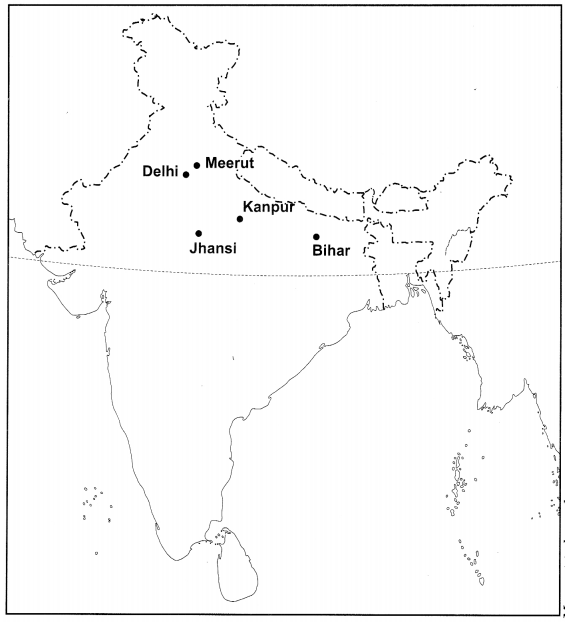
Question 1.
On an outline map of India represent the following centers of Revolts?
(i) Meerut
(ii) Delhi
(iii) Bihar
(iv) Kanpur
(v) Jhansi
Answer:
When People Rebel Class 8 Extra Questions Social Science History Chapter 5

Ruling the Countryside Class 8 Extra Questions Social Science History Chapter 3

Ruling the Countryside Class 8 Extra Questions and Answers Social Science History Chapter 3 CBSE Pdf free download are part of Extra Questions for Class 8 Social Science. Here we have given NCERT Extra Questions for Class 8 Social Science SST History Chapter 3 Ruling the Countryside.

You can also practice NCERT Solutions for Class 8 History Chapter 3 Questions and Answers on LearnInsta.com.

Ruling the Countryside Class 8 Extra Questions and Answers Social Science History Chapter 3

Ruling the Countryside Class 8 Extra Questions Very Short Answer Type

Question 1.
When did the Mughal emperor appoint the East India Company as the Diwan of Bengal?
Answer:
On 12th August 1765, the Mughal emperor appointed the East India Company as the Diwan of Bengal.

Question 2.
Which settlement was introduced during 1793?
Answer:
Permanent Settlement was introduced during 1793.

Question 3.
Who were appointed to collect rent and pay revenue to the Company during Permanent Settlement?
Answer:
Zamindars were appointed to collect rent and pay revenue to the Company during Permanent Settlement.

Question 4.
Who devised the system of Mahalwari?
Answer:
Holt Mackenzie devised the Mahalwari system.

Question 5.
What was the conclusion of Permanent Settlement at end?
Answer:
Permanent Settlement got failed.

Question 6.
Who initiated and developed the Ryotwari system?
Answer:
Captain Alexander Read initiated and Thomas Munro developed the Ryotwari system.

Question 7.
Name the two systems adopted for growing indigo by the cultivators.
Answer:
Nij and Ryoti were two systems adopted by the cultivators.

Question 8.
What is meant by Mahal?
Answer:
Mahal means village or groups of villages.

Question 9.
What was the aim of the Company after getting Diwani?
Answer:
After Diwani the Company aimed at administering the land and organising its revenue resources and this was done in way that could help the Company attaining enough revenue.

Question 10.
What was the difficult task for the Company to be done?
Answer:
The Company needed to pacify those who ruled the countryside in past. So it was difficult task to eliminate entirely the past rulers of the countryside of the Company.

Question 11.
What led to minimise the bringing of gold and silver by the Company for trade purpose in India?
Answer:
Revenue which was collected from Bengal was sufficient for the Company to purchase goods for exports so the Company started reducing getting gold and silvers for trade purpose.

Question 12.
What was the biggest drawback for zamindars in Permanent Settlement?
Answer:
Failure of payment of revenue resulting in loss of the zamindari was the biggest drawback which zamindars faced in Permanent Settlement.

Question 13.
At the time of introduction of permanent settlement who was the governor general of India.
Answer:
Charles Cornwallis.

Question 14.
Who was William Morris in the 19th century under British rule?
Answer:
William Morris was a famous poet and artist.

Question 15.
By whom was the Morris cotton print designed?
Answer:
By William Morris.

Question 16.
By whom was the ‘Kalamkari print’ was created?
Answer:
By the weavers of Andhra Pradesh Kalamkari print was created.

Question 17.
Define ‘Famine’.
Answer:
Extreme Scarcity of food is termed as Famine.

Question 18.
What was common in Kalamkari and Morris cotton print?
Answer:
In both a rich blue colour common by known as ‘Indigo’ was used.

Question 19.
Define the term ‘Indigo’.
Answer:
Indigo is a plant that produces the blue colour that is rich and is used as dye.

Question 20.
What is meant by ‘Vat’?
Answer:
A large tank or tube used to hold liquid, especially in industry.

Question 21.
Who were ‘Gomasthas’?
Answer:
The agents of Planters.

Question 22.
Who were the ‘Lathiyats’?
Answer:
Lath – weilding strong men maintained by the planters.

Question 23.
What the role played by women in the cultivation of Indigo?
Answer:
The role was to carry the Indigo plant to vats.

Ruling the Countryside Class 8 Extra Questions Short Answer Type

Question 1.
Define Mahalwari system in short.
Answer:

  1. Estimated revenue of each plot within village was added up to calculate revenue which each Mahal (village) had to pay.
  2. Revenue demand to be revised periodically.
  3. Headmen of Mahal given charge to collect revenue.
  4. This is what Mahalwari system was.

Question 2.
Where was the Indigo cultivated by the English and the French?
Answer:
The Indigo was cultivated by the English in Jamaica and French use to cultivate it in St. Dominque in the Caribbean Islands.

Question 3.
Define the following terms
(i) Plantation
(ii) Bigha
Answer:
Plantation is an Estate on which crops such as coffee, sugar and tobacco were grown.
Bigha: A measuring unit of land area varying locally.

Question 4.
Briefly describe the system of permanent settlement.
Answer:
Under this system Rajas and Taluqdars were recognized as Zamindars and they were asked to collect rent from the peasants and pay revenue to the Company. The amount that was to be paid was fixed permanently and was not to be increased or decreased in future.

Question 5.
What were the drawbacks of Nij cultivation?
Answer:
The drawbacks of Nij cultivation are:

  1. The planters found it difficult to expand the area under Nij cultivation.
  2. Labour force was not easily available.
  3. Nij cultivation on a large scale also required many ploughs and bullocks investing on purchase and maintenance of ploughs was a big problem.

Ruling the Countryside Class 8 Extra Questions Long Answer Type

Question 1.
Briefly explain two following questions.
(i) Explain the two system adopted for the cultivation of Indigo in India.
(ii) What did the British realise about the countryside?
Answer:
(i) The two systems adopted for the cultivation of indigo by cultivators were:

  1. Nij: In this process cultivators produced indigo on the lands which were under their control.
  2. Ryoti: The planters forced Ryots to sign contract, an agreement (i.e. Satta). They also pressurised village headmen to sign contract on behalf of Ryots. This is how the two processes of cultivation of Indigo took place.

(ii) The British realised that the countryside not only yielded revenue, it could also grow crops that Europe required.

  1. By the late 18th century the Company was trying expanding the cultivation of opium and indigo.
  2. Therefore the British persuaded and forced cultivators in various parts of India to produce other crops.

Question 2.
What was Munro system and what happened in conclusion after Munro system took over a wide area?
Answer:
In British territories of south, the new system that was devised came to be known as Ryotwar (or Ryotwari).

  1. Tried on small scale by Captain Alexander Read in some areas that were taken over by the Company after the wars with Tipu Sultan.
  2. Subsequently developed by Thomas Munro, this system was gradually extended all over south India.
  3. There was absence of zamindars in south.
  4. Therefore it was argued that it had to be made directly with the cultivators (Ryots) who had tilled the land for generations.
  5. Munro thought that the British should act as Paternal father figures to protect the ryots under the in charge.
  6. The conclusion was not well as driven by the desire to increase the income from land revenue, officials fixed too high revenue demand.
  7. Peasants failed to pay, ryots fled the countryside, the villages became deserted in many regions.
  8. Therefore, a complete failure of the Munro system also known as Ryotwari system happened during that time.

Picture Based Questions Class 8 History Chapter 3 Ruling the Countryside

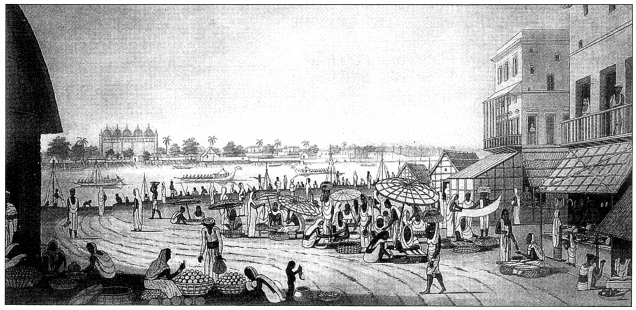
Look at the picture given below and answer the following questions:
Ruling the Countryside Class 8 Extra Questions Social Science History Chapter 3
Question:
1. What is observed in the picture above.
2. Who use to attend the weekly market.
Answer:
1. The picture describes a weekly market in Murshidabad, Bengal.
2. The weekly market was attended by peasants and artisans.