s-Block Elements

Find free online Chemistry Topics covering a broad range of concepts from research institutes around the world.

s-Block Elements

The elements belonging to the group 1 and 2 in the modern periodic table are called s-block elements. The elements belonging to these two groups are commonly known as alkali and alkaline earth metals respectively. In this unit, we study their properties, uses, important compounds and biological importance.

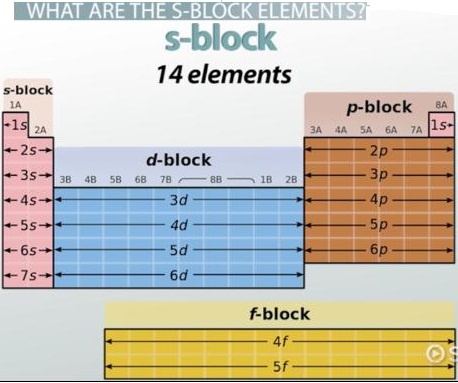
S-block comprises 14 elements namely hydrogen (H), lithium (Li), helium (He), sodium (Na), beryllium (Be), potassium (K), magnesium (Mg), rubidium (Rb), calcium (Ca), cesium (Cs), strontium (Sr), francium (Fr), barium (Ba), and radium (Ra).

s-block elements are the elements found in Group 1 and Group 2 on the periodic table. Group 1 are the alkali metals which have one valence electron. They have low ionization energies which makes them very reactive. Group 2 is the alkali earth metals which have two valence electrons, filling their s sublevel.

The s-block and p-block elements are so called because their valence electrons are in an s orbital or p orbital respectively. They are also called Typical Elements to distinguish them from the transition and inner transition series.

Elements in which all inner electron shells are completely filled, and the last electron enters the s-orbital of the outermost shell, are called s-block elements. Thus, for s-block elements, the differentiating electron enters the ns-orbital.

The s-block in the periodic table of elements occupies the alkali metals and alkaline earth metals, also known as groups 1 and 2. Helium is also part of the s block. The principal quantum number “n” fills the s orbital. There is a maximum of two electrons that can occupy the s orbital.

Physical properties of S-Block Elements

  1. Electronic Configuration.
  2. Large Atomic Radii.
  3. Large Ionic Radii.
  4. Low Ionization Enthalpy.
  5. Hydration Enthalpy.
  6. Unipositive ions.
  7. Metallic Character.
  8. Melting and Boiling Points.

The s block has two columns corresponding to one of the s orbitals holding a maximum of two electrons. The p block has six columns corresponding to the three p orbitals with two electrons each. The lettered group number of a main-group element is equal to the number of valence electrons for that element.

The s-block is on the left side of the conventional periodic table and is composed of elements from the first two columns plus one element in the rightmost column, the nonmetals hydrogen and helium and the alkali metals (in group 1) and alkaline earth metals (group 2). Their general valence configuration is ns1-2.

S Block Elements are a family of elements with similar characteristcs. S Block Elements include Alkali Metals. They include Lithium, Sodium, Potassium, Rubidium, Cesium, and Francium. They display many of the physical properties similar to metals.

As the s-orbital can accommodate only two electrons, two groups (1 & 2) belong to the s-block of the Periodic Table. Group 1 of the Periodic Table consists of the elements: lithium, sodium, potassium, rubidium, caesium and francium. They are collectively known as the alkali metals.

There can be two electrons in one orbital maximum. The s sublevel has just one orbital, so can contain 2 electrons max. The p sublevel has 3 orbitals, so can contain 6 electrons max. The d sublevel has 5 orbitals, so can contain 10 electrons max.

Recall that the four different sublevels each consist of a different number of orbitals. The s sublevel has one orbital, the p sublevel has three orbitals, the d sublevel has five orbitals, and the f sublevel has seven orbitals. In the first period, only the 1s sublevel is being filled.

s-Block Elements img 1

Hydrogen Bonding

Find free online Chemistry Topics covering a broad range of concepts from research institutes around the world.

Hydrogen Bonding

Hydrogen bonding is one of the most important natural phenomena occurring in chemical and biological sciences. These interactions play a major role in the structure of proteins and DNA. When a hydrogen atom (H) is covalently bonded to a highly electronegative atom such as flourine (F) or oxygen (O) or nitrogen (N), the bond is polarized.

Due to this effect, the polarized hydrogen atom is able to form a weak electrostatic interaction with another electronegative atom present in the vicinity. This interaction is called as a hydrogen bond (20-50 kJ mol-1) and is denoted by dotted lines (…).

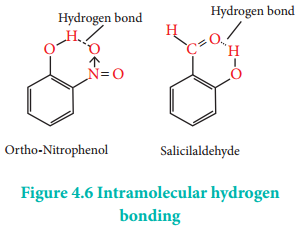
It is weaker than covalent bond (>100 kJ mol-1) but stronger than the van der Waals interaction (< 20 kJ mol-1). Hydrogen bond has profound effct on various physical properties including vapour pressure (H2O and H2S), boiling point, miscibility of liquids (H2O and C2H5OH), surface tension, densities, viscosity, heat of vapourization and fusion, etc. Hydrogen bonds can occur within a molecule (intramolecular hydrogen bonding) and between two molecules of the same type or different type (intermolecular hydrogen bonding).

Intramolecular Hydrogen Bond

Intramolecular hydrogen bonds are those which occur within a single molecule.

Hydrogen Bonding img 1

Intermolecular Hydrogen Bond

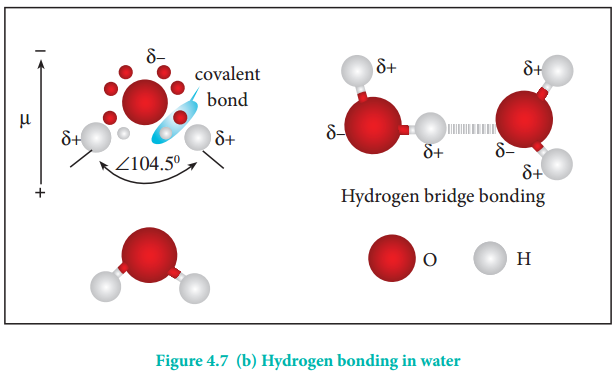
Intermolecular hydrogen bonds occur between two separate molecules. They can occur between any numbers of like or unlike molecules as long as hydrogen donors and acceptors are present in positions which enable the hydrogen bonding interactions. For example, intermolecular hydrogen bonds can occur between ammonia molecule themselves or between water molecules themselves or between ammonia and water.

Water molecules form strong hydrogen bonds with one another. For example, each water molecule is linked to four others through hydrogen bonds. The shorter distances (100 pm) correspond to covalent bonds (solid lines), and the longer distances (180 pm) correspond to hydrogen bonds (dotted lines).

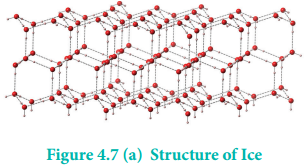
In ice, each atom is surrounded tetrahedrally by four water molecules through hydrogen bonds. That is, the presence of two hydrogen atoms and two lone pairs of electron on oxygen atoms in each water molecule allows formation of a three-dimensional structure. This arrangement creates an open structure, which accounts for the lower density of ice compared with water at 0°C. While in liquid water, unlike ice where hydrogen bonding occurs over a long-range, the strong hydrogen bonding prevails only in a short range and therefore the denser packing.

Hydrogen Bonding img 2

Hydrogen Bonding img 3

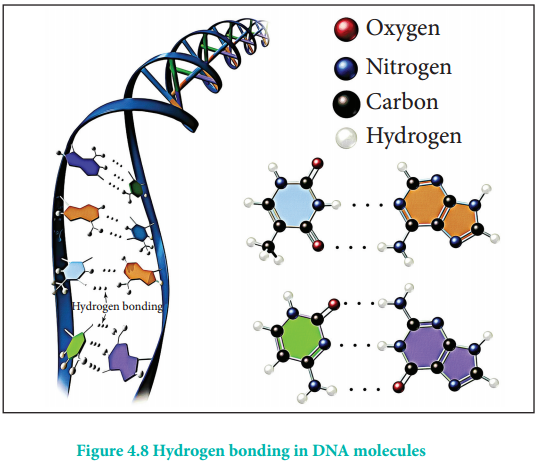
Hydrogen bond occurs not only in simple molecules but also in complex biomolecules such as proteins, and they are crucial for biological processes. For example, hydrogen bonds play an important role in the structure of deoxyribonucleic acid (DNA), since they hold together the two helical nucleic acid chains (strands).

Hydrogen Bonding img 4

Class 8 Civics Chapter 6 Extra Questions and Answers Understanding Our Criminal Justice System

Understanding Our Criminal Justice System Class 8 Civics Chapter 6 Extra Questions and Answers Social Science CBSE Pdf free download are part of Extra Questions for Class 8 Social Science. Here we have given NCERT Extra Questions for Class 8 Social Science SST Civics Chapter 6 Understanding Our Criminal Justice System.

You can also practice NCERT Solutions for Class 8 Civics Chapter 6 Questions and Answers on LearnInsta.com.

Class 8 Civics Chapter 6 Extra Questions and Answers Understanding Our Criminal Justice System

Understanding Our Criminal Justice System Class 8 Extra Questions and Answer Civics Chapter 6 Very Short Answers Type

Question 1.
Who has the legal right to get a free copy of the FIR from the police?
Answer:
The complainant also has a legal right to get a free copy of the FIR from the police.

Question 2.
When does the role of the prosecutor begin?
Answer:
The role of the prosecutor begins once the police has conducted the investigation and filed the charge sheet in the court.

Question 3.
When does the police begin their investigations into a crime?
Answer:
It is with the registration of an FIR that the police can begin their investigation into a crime.

Question 4.
What has been mentioned in the D.K. Basu guidelines about the friend and relative of the person arrested, detained or being interrogated?
Answer:
The person arrested, detained or being interrogated has a right to inform a relative, friend or well-wisher.

Question 5.
Mention the four key players in the criminal justice system?
Answer:
The four key players in the criminal justice system are the police, the Public Prosecutor, the defence lawyer and the judge.

Question 6.
Mention any one of the Fundamental Rights that Article 22 of the Constitution guarantees to every arrested person.
Answer:
The Right not to be ill treated or tortured during arrest or in custody.

Question 7.
What does the rule of law say?
Answer:
The rule of law says that every one is equal before the law. The words will not make much sense if every citizen were not guaranteed a fair trial by the Constitution.

Question 8.
What was the final verdict in Shanti’s case?
Answer:
In Shanti’s case, justice was finally done to her because she was given a fair trial.

Question 9.
By which part of justice system it is decided whether the accused person is guilty or not? Answer:
It is court of law that decides whether the accused person is guilty or not.

Question 10.
How many key players are in the criminal justice system?
Answer:
There are 4 key players.

Question 11.
What are 4 key players in the criminal justice system?
Answer:
The 4 key players are:

  1. The police
  2. The public prosecutor
  3. The defence lawyer
  4. The judge

Question 12.
What is one of the important function of police?
Answer:
One important function of the police is to investigate any complaint about the commission of a crime.

Question 13.
Mention any one Fundamental Right guaranteed in Article 22 and criminal law to every arrested person.
Answer:
The Right to be presented before a magistrate within 24 hrs of custody.

Question 14.
Name the guidelines laid down by the Supreme Court of India which had to be followed while the process of arrest, detention interrogation of any person?
Answer:
D.K. Basu guidelines.

Question 15.
On whose behalf does the prosecution must conduct the prosecution?
Answer:
On behalf of the state.

Question 16.
Where does the judge conducts the trial?
Answer:
The judge conduct the trial impartially and in an open court.

Question 17.
What does Accused means?
Answer:
This refers to the person who is tried by a court for a crime.

Question 18.
Define the term ‘offence’.
Answer:
It means that any act which is defined as crime by the law.

Understanding Our Criminal Justice System Class 8 Extra Questions and Answer Civics Chapter 6 Short Answers Type

Question 1.
What was the final judgment of the judge in Shanti’s case?
Answer:
In Shanti’s case, the judge hears the testimony of all the witnesses and acquitted Shanti of the charges of theft.

The judge also ordered the police to hand over the ? 10000 that the police had sealed. In her written judgment, the judge had made it a point to highlight S.I. Rao’s role in conducting a shoddy investigation that made Shanti spend time in jail.

Question 2.
What is there in the Fundamental Rights guaranteed in Article 22 of the Constitution.
Answer:
Article 22 of the Constitution and criminal law guarantee to every arrested person the following Fundamental Rights:

  1. The Right to be informed at the time of arrest of the offence for which the person is being arrested.
  2. The Right to be presented before a magistrate within 24 hrs of arrest.
  3. The Right not to be ill-treated or tortured during arrest or in custody.
  4. Confessions made in police custody cannot be used as evidence against the accused.
  5. A boy under 15 yrs of age and women cannot be called to the police station only for questioning.

Question 3.
What is the role of the judge in judiciary system?
Answer:
The judge is like an umpire in a game and conducts the trial impartially and in an open count. The judge hears all the witnesses and any other evidence presented by the prosecution and the defence. The judge decides whether the accused person is guilty or innocent on the basis of the evidence presented and in accordance with the law.

If the accused is convicted, then the judge pronounces the sentence. The judge may send the person to jail or impose a fine or both, depending on what the law prescribes.

Question 4.
Who is the Public Prosecutor and what is the role of the public prosecutor?
Answer:
In the court, it is the Public Prosecutor who represents the interests of the State. The role of the Prosecutor begins once the police has conducted the investigation and filed the chargesheet in the court. He/she has no role to play in the investigation.

The Prosecutor must conduct the prosecution on behalf of the State. As an officer of the court, it is his/her duty to act impartially and present the full and material facts, witnesses and evidence before the court to enable the court to decide the case.

Question 5.
What is FIR? Describe the process of an FIR?
Answer:
FIR is First Information Report. It is with the registration of an FIR that the police can begin their investigation into a crime. The law states that it is compulsory for an officer in charge of a police station to register an FIR whenever a person gives information about an cognizable offence. This information can be given to the police either orally or in writing.

The FIR usually mentions the date, time and place of the offence, details the basic facts of the offence, including a description of the events. If known, the identity of the accused person and witnesses is also mentioned. The FIR also states the name and address of the complainant.

Understanding Our Criminal Justice System Class 8 Extra Questions and Answer Civics Chapter 6 Long Answers Type

Question 1.
What is the D.K. Basu Guidelines and what it includes?
Answer:
The Supreme court of India has laid down specific requirements and procedures that the police and other agencies have to follow for the arrest, detention and interrogation of any person. These are known as the D.K. Basu Guidelines. These include:

  1. The police officials who carry out the arrest or interrogation should wear clear, accurate and visible identification and name tags with their designations.
  2. A memo of arrest should be prepared at the time of arrest and should include the time and date of arrest. It should also be attested by atleast one witness who could include a family member of the person arrested.
  3. The arrest memo should be counter-signed by the person arrests.
  4. The person arrested, detained or being interrogated has a right to inform a relative, friend or well-wisher.
  5. When a friend or relative lives outsides the district, the time, place of arrest and venue of custody must be notified by police within 8 to 12 hours after arrest.

Question 2.
What is the role of the police in investigating a crime? Explain briefly.
Answer:
One important function of the police is to investigate any complaint about the commission of a crime. An investigation includes recording statements of witnesses and collecting different kinds of evidence. On the basis of the investigation, the police are required to form an opinion.

If the police think that the evidence points to the guilt the accused person, then they file a charge sheet in the court. It is not the job of the police to decide whether a person is guilty on innocent, that is for the judge to decide.

The police investigations should always be conducted in accordance with law and with full respect for human rights. The Supreme Court has laid down guidelines that the police must follow at the time of arrest, detention and interrogation.

The police are not allowed to torture or beat or shoot anyone dining investigation. The police cannot inflict any form of punishment on a person even for petty offences.

Class 8 Civics Chapter 1 Extra Questions and Answers The Indian Constitution

The Indian Constitution Class 8 Civics Chapter 1 Extra Questions and Answers Social Science CBSE Pdf free download are part of Extra Questions for Class 8 Social Science. Here we have given NCERT Extra Questions for Class 8 Social Science SST Civics Chapter 1 The Indian Constitution.

You can also practice NCERT Solutions for Class 8 Civics Chapter 1 Questions and Answers on LearnInsta.com.

Class 8 Civics Chapter 1 Extra Questions and Answers The Indian Constitution

The Indian Constitution Class 8 Extra Questions and Answer Civics Chapter 1 Very Short Answers Type

Question 1.
What is a Constitution?
Answer:
A written document in which we find rules that are formulated through consensus is called a Constitution.

Question 2.
Is it necessary that all countries having a Constitution are democratic?
Answer:
No, it is not necessary that all countries having Constitution are democratic.

Question 3.
During which time period did the Constituent Assembly draft a Constitution for independent India?
Answer:
Between December 1946 and November 1949.

Question 4.
Define Right to Freedom of Religion.
Answer:
Religions to Freedom of Religion is provided to all citizens. Every person has the right to practise, profess and propagate the religion of his choice.

Question 5.
What is meant by the major change in the Constitution?
Answer:
The major change in the Constitution means a change in fundamental nature of the country.

Question 6.
Define the term Ideal.
Answer:
A goal or a principle in its most excellent or perfect form.

Question 7.
When did the Interim Constitution come into effect in Nepal?
Answer:
In Nepal, The Interim Constitution came in effect from 2007.

Question 8.
Name the 3 organs of state as per the separation of power done in Indian constitution.
Answer:
(i) The legislative
(ii) The Executive
(iii) The Judiciary

Question 9.
From what does the Fundamental Rights protects the citizens?
Answer:
The Fundamental Rights protect the citizens against any arbitrary exercise of power by the state.

Question 10.
What does a good constitution never allows any whims?
Answer:
A good constitution never allows any whims to change it basic structure.

Question 11.
Define Sovereign.
Answer:
Sovereign means possessing supreme or ultimate power.

Question 12.
What does legislative refers to?
Answer:
Legislative refers to the elected representatives.

Question 13.
Define Tyranny.
Answer:
The cruel and unjust use of power or authority.

Question 14.
What do you understand by the term Federation?
Answer:
Federation refers to the existence of more than one level of government in the country.

Question 15.
Which is known as the 3rd tier of the Government?
Answer:
Panchayati Raj is the 3rd tier of the government.

Question 16.
What does a secular state never officially promotes?
Answer:
A secular state is a state which never officially promotes any type of Religion as the state Religion.

Question 17.
When was constituent assembly was founded?
Answer:
Constituent assembly was founded in 1946.

Question 18.
In what sense Indian constitution defines the power of each government?
Answer:
The Indian constitution defines the power of each government at each level and at every tier.

Question 19.
In which Right does the Right to Equality is being guranted by the Indian constitution? Answer:
Right to equality is one of the Fundamental Right.

The Indian Constitution Class 8 Extra Questions and Answer Civics Chapter 1 Short Answers Type

Question 1.
How does the Constitution define the nature of a country’s political system?
Answer:
Question The Constitution defines the nature of a country’s political system. As in countries that have adopted a democratic form of government or polity, the Constitution plays a crucial role in laying out certain important guidelines that govern decision making within societies. Nepal’s earliest Constitution stated that the country was to be ruled by the king and his Council of Minister. This shows how the Constitution defines the political nature of a country.

Question 2.
How can we say that the Constitution saves us from ourselves?
Answer:
This can sound strange but this is true to say as this means that we might feel strongly about an issue that might go against larger interest and the Constitution helps us to guard against this.

Constitution also helps to protect us against certain decisions that we might take that could adversely effect on larger principle that the country relies in. Therefore a good Constitution does not allow these whims to change its basis structure.

Question 3.
What is meant by the concept of separation of power.
Answer:
According to the Constitution there are 3 organs of the state. There are the legislature, the Executive and the judiciary. In order prevent the misuse of power by any one branch of the state the Constitution says that each of these organs should exercise different powers. Through this, each organ acts as a check on the other organs of the state and this ensures the balance of power between all three.

Question 4.
Name the Fundamental Rights mentioned in the Indian Constitution.
Answer:
The Fundamental right in the Indian Constitution includes:

  1. Right of Equality
  2. Right to Freedom
  3. Right against Exploitation
  4. Right to Freedom of Religion
  5. Cultural and Educational Rights
  6. Right to Constitutional Remedies

Question 5.
What was the Indian National Movement?
Answer:
The Indian National Movement emerged the 19th Century India and saw 1000’s of men and women coming together to fight the British. The Indian National Movement has a series of activities whose ultimate aim was to end the British Rule from India.

Since its beginning Indian National Congress was an organization which played an important role in Indian National Movement. Mohandas Karamchand Gandhi, Pt. Jawahar Lai Nehru, Subhash Chandra Bose, Rabindranath Taroge, Bal Gangadhar Tilak etc. are some examples of the leaders who lead the movement time to time.

The Indian Constitution Class 8 Extra Questions and Answer Civics Chapter 1 Long Answers Type

Question 1.
Define Secularism and Separation of Power as the key feature of the Indian Constitution?
Answer:
Secularism: A secular state is one which does not officially promote any one religion as the state
religion. The Constitution plays crucial role in laying out the ideals that we would like all citizens of the country to adhere to.

Separation of Power:
According to the Constitution, there are 3 organs of the state. These are the legislature, the executive and the judiciary. The legislature refers to our elected representatives. The executive is a smaller group of people who are responsible for the implementation of the laws and running the government, the judiciary refers to the system of courts in this country.

In order to prevent the misuse of power by any one branch of the state, the Constitution says that each of these organs should exercise different powers. Each organ acts as a check on the other organs of the state through the separation of powers and this feature also ensures the balance of power between all three.

Question 2.
Describe how the Constitution helps serve as a set of rules and principles that all persons in a country can agree upon through the example of Nepal’.
Answer:
A Constitution helps serve as a set of rules and principles that all persons in a country can agree upon as the basis of the way in which they want the country to be governed. This includes not only the type of government but also an agreement on certain ideals that they all believe the country should uphold.

Examples of Nepal shows the meaning of the above concept.
Nepal is a country that borders India on the North. Until quite recently, Nepal was a monarchy. The previous Constitution of Nepal, adopted in 1990 reflected the fact that the final authority rested with the king.

A people’s movement in Nepal fought for several decades to establish democracy and in 2006 they finally succeeded in putting an end to the powers of the king. Now the people have to write a new Constitution to establish Nepal as a democracy.

The reasons that they do not want to continue with the previous Constitution is because it does not reflect the ideals of the country that they want Nepal to be and that the citizens have fought for.

Nepal by moving from monarchy to democratic government needs to change all its constitutive rules in order to usher in a new society. This is why the people of Nepal are in the process of writing a new Constitution for the country.

Picture Based Questions Class 8 Civics Chapter 1 The Indian Constitution

Look at the picture given below and answer the following questions:
Class 8 Civics Chapter 1 Extra Questions and Answers The Indian Constitution 1
Question:
1. What type of relation is in the figure signified amongst the member of the constituent assembly?
2. About whom does the above picture shows?
Answer:
1. There is shown an extraordinary sense of unity amongst the members of the constituent assembly.
2. It shows Sardar Vallabhbhai Patel, a prominent member of constituent assembly
Class 8 Civics Chapter 1 Extra Questions and Answers The Indian Constitution 2
Question:
1. Whom does the picture refers to?
2. What was the believe of Dr. Ambedkar about the scheduled castes?
Answer:
1. Baba Sahab Dr. Ambedkar is shown as the Father of Indian Constitution.
2. Dr. Ambedkar believed that his participation in the constituent assembly helped the scheduled castes get some safeguards in the draft constitution.
Class 8 Civics Chapter 1 Extra Questions and Answers The Indian Constitution 3
Question 1.
What does the picture shows?
Answer:
1. This shows about people standing in line to cast their votes.

Map Skills Class 8 Civics Chapter 1 The Indian Constitution

Look at the map given below and answer the following Questions

Question 1.
Mark the following in such a way by colouring them with your desired colour so that we all could easily differentiate their boundaries.
(i) India
(ii) Nepal
(iii) Bangladesh
Answer:
Class 8 Civics Chapter 1 Extra Questions and Answers The Indian Constitution 4

Class 8 Civics Chapter 7 Extra Questions and Answers Understanding Marginalisation

Understanding Marginalisation Class 8 Civics Chapter 7 Extra Questions and Answers Social Science CBSE Pdf free download are part of Extra Questions for Class 8 Social Science. Here we have given NCERT Extra Questions for Class 8 Social Science SST Civics Chapter 7 Understanding Marginalisation.

You can also practice NCERT Solutions for Class 8 Civics Chapter 7 Questions and Answers on LearnInsta.com.

Class 8 Civics Chapter 7 Extra Questions and Answers Understanding Marginalisation

Understanding Marginalisation Class 8 Extra Questions and Answer Civics Chapter 7 Very Short Answers Type

Question 1.
Where is Niyamgiri Hill located?
Answer:
The Niyamgiri Hill is located in Kalahandi district of Orissa.

Question 2.
How many national parks are there in India?
Answer:
There are 54 national parks in India.

Question 3.
How much area are the 54 national parks and 372 wildlife sanctuaries covering?
Answer:
They are covering around 1,09,652 S km.

Question 4.
Why did many Adivasis have migrated to cities?
Answer:
Many Adivasis have migrated to cities in search of work.

Question 5.
Where were the Adivasis employed in the cities?
Answer:
They were employed for very low wages in local industries or at building or construction sites.

Question 6.
Whom does the Constitution provide safeguards as part of our Fundamental Rights?
Answer:
The Constitution provides safeguard to religious and linguistic minorities as part of our Fundamental Right.

Question 7.
What does the term ‘Militarised’ mean?
Answer:
Militarised means an area where the presence of the armed forces is considerable.

Question 8.
Whom would you call ‘Malnourished’?
Answer:
A person who does not get adequate nutrition or food is malnourished.

Question 9.
What % of India’s population is adivasi.
Answer:
About 8%.

Question 10.
For what purposes the forest land that once belonged to adivasi got cleared.
Answer:
The purposes such as agriculture and industry the forest land got cleared.

Question 11.
What % of tribal groups in rural areas belongs to below poverty line (BPL)?
Answer:
45% of tribal groups in rural areas.

Question 12.
What % of tribal groups in urban areas belongs to BPL?
Answer:
35% of tribal groups in urban areas.

Question 13.
About how many tribal groups does exists in India?
Answer:
There are over 500 different Adivasi groups in India.

Question 14.
How are adivasi’s been portrayed?
Answer:
Adivasis are invariably portrayed in very stereotypical way.

Question 15.
What are considered as the absolute crucial to the development of all empires and settled civilisation in India?
Answer:
Forests were absolutely crucial to the development of all empires and settled civilisation in India.

Question 16.
How many National parks are there in India?
Answer:
In India there are 54 national parks.

Question 17.
How many wildlife sanctuaries are in India?
Answer:
There are 372 wildlife sanctuaries in India.

Question 18.
According to 2001 census what percent of Muslims of India’s population considered to be marginalised?
Answer:
13.4% Muslims.

Understanding Marginalisation Class 8 Extra Questions and Answer Civics Chapter 7 Short Answers Type

Question 1.
Define the term Ghettoisation. Who are Ghettos?
Answer:
A Ghetto is an area or locality that is populated largely by members, of a particular community. Ghettoisation refers to the process that leads to such a situation. This may occur due to various social, cultural and economic reasons.

Question 2.
What does 2001 census tells about Muslims?
Answer:
According to 2001 census, Muslims are 13.4% of India’s population and are considered to be a marginalised community in India today because in comparison to other communities they have over the years been deprived of the benefits of social and economic development. This
census also shows that literacy of Muslims is the lowest i.e., 59% among all religious groups.

Question 3.
What will happen if the culture of majority influences the way in which society and government might express themselves.
Answer:
In such cases size can be a disadvantage and lead to the marginalisation of the relatively smaller communities. Thus, safeguards are needed to protect minority communities against the possibility of being culturally dominated by the majority. They also protect them against any discrimination and disadvantages that they may face.

Question 4.
What will be the result if the Adivasis lose their rights over forest lands?
Answer:
Adivasis use around 10,000 plant species-approximately 8,000 species are used for medicinal purposes; 325 are used as pesticides; 425 as gums, resins and dyes; 550 as fibres; 3500 are edible. This entire knowledge system gets wiped out when Adivasis lose their rights over forest lands.

Question 5.
What is all happening in Niyamgiri hills of Orissa?
Answer:
Niyamgiri hill of Orissa is located in Kalahandi district. This area is in inhabitated by Dongarria Konds, an Adivasi community. A major aluminium company is planning to set up a mine and a refinery here which will displace this Adivasis community. They have strongly resisted this proposed development and have been joined by environmentalists as well. A case against the company is also pending in the Supreme Court.

Understanding Marginalisation Class 8 Extra Questions and Answer Civics Chapter 7 Long Answers Type

Question 1.
What does Sachar Committee report tell about the Muslims and how is economic and social marginalization experienced by Muslims has other dimensions as well?
Answer:
Recognizing that Muslims in India were lagging behind in terms of various development indicators, the government set up a high-level committee in 2005. The Committee was chaired by Justice Rajindar Sachar, The committee examined the social, economical and educational status of the Muslim community in India. The report discusses in detail the marginalization of this community.

It suggests that on a range of social, economic and educational indicators the situation of the Muslim community is comparable to that of other marginalized communities like Scheduled Castes and Scheduled Tribes. For example, according to the Report the average years of schooling for Muslim children between the age of 7-16 is much lower than that of other socio-religious communities.

Economic and social marginalization experienced by Muslims has other dimensions as well. Like other minorities, Muslim customs and practices are sometimes quite distinct from what is seen as the mainstream. Some not all – Muslims may wear a burqa, keeping a long beard wear a fez and these become ways to identify the Muslims.

Because of this, they tend to be identified differently and some people think that they are not like the ‘rest of us’. Often this becomes an excused to treat them unfairly, and discriminate against them.