NCERT Solutions for Class 9 Hindi Kshitij Chapter 2

NCERT Solutions for Class 9 Hindi Kshitij Chapter 2 ल्हासा की ओर

These Solutions are part of NCERT Solutions for Class 9 Hindi. Here we have given NCERT Solutions for Class 9 Hindi Kshitij Chapter 2 ल्हासा की ओर.

पाठ्य-पुस्तक के प्रश्न-अभ्यास

प्रश्न 1.
थोड्ला के पहले के आखिरी गाँव पहुंचने पर भिखमंगे के वेश में होने के बावजूद लेखक को ठहरने के लिए उचित स्थान मिला जबकि दूसरी यात्रा के समय भद्र वेश भी उन्हें उचित स्थान नहीं दिला सका। क्यों?
उत्तर:
भिखमंगे के वेश में भी लेखक थोङ्ला के पहले के आखिरी गाँव में पहुँचने पर इसलिए ठहरने का अच्छा स्थान पा गया क्योंकि उसके साथ सुमति थे। उस गाँव में सुमति के जानने वाले थे। दूसरी यात्रा के समय सभ्य लोगों की वेशभूषा में था परंतु वह रुकने की जगह इसलिए नहीं पा सका क्योंकि उस गाँव के लोगों के लिए वह अजनबी था। इसके अलावा शाम के समय छङ् पीकर मदहोश हुए लोगों ने उसकी बात पर ध्यान नहीं दिया।

Class 9 Hindi NCERT Solutions will help you to score more marks in your CBSE board Examination.

प्रश्न 2.
उस समय के तिब्बत में हथियार का कानून न रहने के कारण यात्रियों को किस प्रकार का भय बना रहता था? [Imp.][CBSE]
उत्तर:
उस समय तिब्बत में हथियार का कानून न होने के कारण यात्रियों को हमेशा अपने जान और माल का खतरा रहता था। वहाँ के लोग आत्मरक्षा के लिए खुलेआम हथियार लेकर घूमते रहते थे। वहाँ अनेक निर्जन स्थान थे, जहाँ डाकुओं को किसी का भय नहीं रहता था। ऐसे स्थानों पर पुलिस का भी प्रबंध नहीं होता था। ऐसे में डाकू यात्रियों की पहले हत्या करते थे, फिर उससे माल लूटते थे।

प्रश्न 3.
लेखक लङ्कोर के मार्ग में अपने साथियों से किस कारण पिछड़ गया? [CBSE]
उत्तर:
लेखक लङ्कोर के मार्ग में अपने साथियों से इसलिए पिछड़ गया क्योंकि-

  • उसका घोड़ा बहुत धीरे चल रहा था।
  • वह रास्ता भटककर गलत रास्ते पर चला गया फिर वापस आया।

प्रश्न 4.
लेखक ने शेकर विहार में सुमति को उनके यजमानों के पास जाने से रोका, परंतु दूसरी बार रोकने का प्रयास क्यों नहीं किया? [Imp.][CBSE]
उत्तर:
शेकर विहार में सुमति के बहुत से यजमान रहते थे, जिनके पास जाकर सुमति गंडा बाँटते थे। बोधगया से लाए गए इन गंडों को बाँटने में अधिक समय लगता था, इसलिए लेखक ने समुति को यजमानों के पास जाने से रोका।

दूसरी बार लेखक को शेकर विहार के एक मंदिर में बुद्ध वचन अनुवाद की 103 पोथियाँ मिल गई थीं। इन भारी-भरकम पोथियों के अध्ययन से ज्ञानार्जन के लिए समय की आवश्यकता थी। लेखक उस समय इनके अध्ययन में रम चुका था, इसलिए उसने दूसरी बार सुमति को रोकने का प्रयास नहीं किया।

प्रश्न 5.
अपनी यात्रा के दौरान लेखक को किन कठिनाइयों का सामना करना पड़ा? [CBSE]
उत्तर:
तिब्बत यात्रा के दौरान निम्नलिखित कठिनाइयों का सामना करना पड़ा-

  • उसे भिखमंगों के वेश में यात्रा करनी पड़ी।
  • उसे धूप में जलते हुए तथा सरदी सहते हुए यात्रा करनी पड़ी।
  • भरिया न मिलने पर उसे अपना सामान पीठ पर लादना पड़ा।
  • उसे धीमा चलने वाला घोड़ा मिला जिससे वह विलंब से पहुँचा।
  • वह सुमति के गुस्से का शिकार हुआ।
  • उसे डाँड़े पर अपनी जान हथेली पर रखकर यात्रा करनी पड़ी।

प्रश्न 6.
प्रस्तुत यात्रा-वृत्तांत के आधार पर बताइए कि उस समय का तिब्बती समाज कैसा था? [Imp.][CBSE]
उत्तर:
प्रस्तुत यात्रा-वृत्तांत के आधार पर उस समय के तिब्बती समाज के बारे में पता चलता है कि

  1. उस समय का तिब्बती समाज बहुत खुला था, जिसमें जाति-पाँति, छूआछूत, ऊँच-नीच जैसी बातें न थीं।
  2. महिलाएँ पर्दा नहीं करती थीं। वे अपरिचितों को भी चाय बनाकर दे दिया करती थीं।
  3. जान-पहचान के बिना लोग रात बिताने के लिए आश्रय नहीं देते थे।
  4.  समाज में मदिरा-पान (छंङ्) का रिवाज था।
  5. लोग धार्मिक प्रवृत्ति के तथा अंधविश्वासी थे जो गंडे के नाम पर साधारण कपड़ों के टुकड़ों पर भी विश्वास कर लेते थे।

प्रश्न 7.
‘मैं अब पुस्तकों के भीतर था।’ नीचे दिए गए विकल्पों में से कौन सा इस वाक्य का अर्थ बतलाता है
(क) लेखक पुस्तकें पढ़ने में रम गया।
(ख) लेखक पुस्तकों की शैल्फ के भीतर चला गया।
(ग) लेखक के चारों ओर पुस्तकें ही थीं।
(घ) पुस्तक में लेखक का परिचय और चित्र छपा था।
उत्तर:
लेखक पुस्तकें पढ़ने में रम गया।

रचना और अभिव्यक्ति

प्रश्न 8.
सुमति के यजमान और अन्य परिचित लोग लगभग हर गाँव में मिले। इस आधार पर आप सुमति के व्यक्तित्व की किन विशेषताओं का चित्रण कर सकते हैं? [CBSE]
उत्तर:
सुमति के यजमान और उनके परिचित हर गाँव में लेखक को मिले। इससे सुमति के व्यक्तित्व की अनेक विशेषताएँ प्रकट होती हैं; जैसे|

  1. सुमति मिलनसार एवं हँसमुख व्यक्ति थे, जो लोगों से समय-समय पर मिलते रहते थे।
  2.  सुमति उन लोगों के बीच धर्मगुरु के समान थे, जो उन्हें बोधगया से लाए गंडे दिया करते थे।
  3. सुमति समय के पाबंद थे। वे समय पर लेखक के न पहुँचने पर नाराज हो जाते
  4.  सुमति लालची स्वभाव के व्यक्ति थे। वे यजमानों में बोधगया में लाए गंडे समाप्त हो जाने पर साधारण कपड़े का गंडा उन्हें देकर धन प्राप्त करते थे।
  5.  सुमति बौद्ध धर्म में आस्था रखते थे तथा तिब्बत का अच्छा भौगोलिक ज्ञान रखते थे।
  6. वे आतिथ्य सत्कार में कुशल थे। उन्होंने लेखक को इंतजार करते हुए चाय को तीन बार गर्म किया।

प्रश्न 9.
हालाँकि उस वक्त मेरा भेष ऐसा नहीं था कि उन्हें कुछ भी खयाल करना चाहिए था।’
–उक्त कथन के अनुसार हमारे आचार-व्यवहार के तरीके वेशभूषा के आधार पर तय होते हैं। आपकी समझ से यह उचित है अथवा अनुचित, विचार व्यक्त करें।
उत्तर:
यह सही है कि वेशभूषा हमारे आचार-विचार के तय करने में महत्त्वपूर्ण भूमिका निभाते हैं। जिस व्यक्ति की वेशभूषा अच्छी होती है वह आदर का पात्र बन जाता है। इसके विपरीत खराब वेषभूषा हमें उपेक्षा का पात्र बना देती है। मेरे विचार से वेशभूषा के आधार पर हमारे आचार-विचार और व्यवहार का आँकलन नहीं किया जाता है। हमारे देश के ऋषि-मुनि और महापुरुषों ने सादा जीवन उच्च विचार को महत्त्व देते हुए अत्यंत साधारण वेशभूषा में रहकर उच्च कोटि का कार्य किया है। अच्छे पहनावे से ही कोई व्यक्ति महान नहीं बन जाता है।

प्रश्न 10.
यात्रा-वृत्तांत के आधार पर तिब्बत की भौगोलिक स्थिति का शब्द-चित्र प्रस्तुत करें। वहाँ की स्थिति आपके राज्य/शहर से किस प्रकार भिन्न है? [Imp.][CBSE]
उत्तर:
तिब्बत भारत के उत्तर में स्थित है जो नेपाल का पड़ोसी देश है। इसकी सीमा भारत और चीन से लगती है। यह समुद्रतल से सत्रह-अठारह हजार फीट ऊँचाई पर है। इस पहाड़ी प्रदेश के रास्ते बहुत ही ऊँचे-नीचे हैं। यहाँ पहाड़ों के मोड़ सुनसान और खतरनाक हैं। यहाँ दूर-दूर तक आबादी नहीं होती है।
यहाँ एक ओर हिमालय की ऊँची चोटियाँ हैं तो दूसरी ओर नंगे पहाड़ हैं। यहाँ की जलवायु भी अनुपम है। धूप वाले भाग में जहाँ तेज गर्मी पड़ती है वहीं छाया वाले भाग में खूब ठंडक होती है। थोला यहाँ का दुर्गम डाँड़ा है। तिी एक विशाल मैदानी भाग है, जिसके चारों ओर पहाड़ है। यहाँ बीच में एक पहाड़ी है, जिस पर देवालय स्थित है।

प्रश्न 11.
आपने भी किसी स्थान की यात्रा अवश्य की होगी? यात्रा के दौरान हुए अनुभवों को लिखकर प्रस्तुत करें।
उत्तर:
छात्र अपने अनुभव के आधार पर स्वयं लिखें।

प्रश्न 12.
यात्रा-वृत्तांत गद्य साहित्य की एक विधा है। आपकी इस पाठ्यपुस्तक में कौन-कौन सी विधाएँ हैं? प्रस्तुत विधा उनसे किन मायनों में अलग है?
उत्तर:
हमारी पाठ्यपुस्तक ‘क्षितिज’ भाग-1 में निम्नलिखित पाठ और विधाएँ हैं
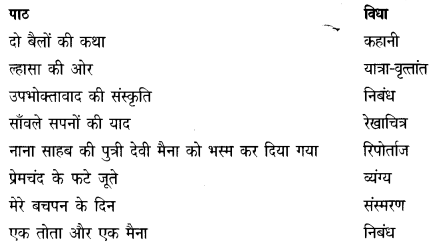
NCERT Solutions for Class 9 Hindi Kshitij Chapter 2 1
प्रस्तुत विधा (यात्रा-वृत्तांत) अन्य विधाओं-कहानी, संस्मरण, व्यंग्य, निबंध आदि से अलग है। इसमें लेखक ने यात्रा की समस्त वस्तुओं, व्यक्तियों तथा घटनाओं का वर्णन किया है। इससे तिब्बत का भौगोलिक परिदृश्य हमारी आँखों के सामने सजीव हो उठता। है। वहाँ के सुनसान इलाकों, पहाड़ी भागों के अलावा सामाजिक रीतिरिवाजों, भाषा एवं संस्कृति की जानकारी मिलती है। इस तरह यह अन्य विधाओं से अलग है।

भाषा-अध्ययन

प्रश्न 13.
किसी भी बात को अनेक प्रकार से कहा जा सकता है, जैसे सुबह होने से पहले हमें गाँव में थे। पौ फटने वाली थी कि हम गाँव में थे। तारों की छाँव रहते-रहते हम गाँव पहुँच गए। नीचे दिए गए वाक्य को अलग-अलग तरीके से लिखिए ‘जान नहीं पड़ता था कि घोड़ा आगे जा रहा है या पीछे।’
उत्तर:
इस वाक्य को इन तरीकों से लिखा जा सकता है-
इसका पता ही नहीं चल पा रहा था कि घोड़ा आगे जा रहा है या पीछे।
यह ज्ञान ही नहीं हो रहा था कि घोड़ा आगे जा रहा है या पीछे।
यह अनुमान लगाना कठिन हो रहा था कि घोड़ा आगे जा रहा है या पीछे।

प्रश्न 14.
ऐसे शब्द जो किसी ‘अंचल’ यानी क्षेत्र विशेष में प्रयुक्त होते हैं उन्हें आंचलिक शब्द कहा जाता है। प्रस्तुत पाठ में से आंचलिक शब्द ढूँढ़कर लिखिए।
उत्तर:
पाठ में आए हुए आंचलिक शब्द फरी-कलिङपोङ, चोड़ी, खोटी, राहदारी, छ, थोङ्ला, डांड़ा, कुची-कुची, लङ्कोर, कंडे, भीटा, थुक्पा, गाँव-गिराँव, भरिया, गंडा, तिी कन्जुर

प्रश्न 15.
पाठ में कागज़, अक्षर, मैदान के आगे क्रमशः मोटे, अच्छे और विशाल शब्दों का प्रयोग हुआ है। इन शब्दों : से उनकी विशेषता उभर कर आती है। पाठ में से कुछ ऐसे ही और शब्द छाँटिए जो किसी की विशेषता बता रहे हों।
उत्तर:
व्यापारिक, फौज़ी, चीनी, परिव्यक्त, निम्न, अपरिचित, टोंटीदार, विकट, निर्जन, अगला, नंगे, सर्वोच्च, रंग-बिरंगे, लाल, अच्छा, गरमागरम, लालच, पतला, तेज़, छोटे-छोटे आदि।

• यह यात्रा राहुल जी ने 1930 में की थी। आज के समय यदि तिब्बत की यात्रा की जाए तो राहुल जी की यात्रा से कैसे भिन्न होगी?
उत्तर:
आजकल काठमांडू से ल्हासा वायुयान द्वारा एक घण्टे में पहुँचा जा सकता है। -या काठमांडू से ल्हासा, जीप द्वारा लगभग 900 किलो मीटर की सड़क यात्रा द्वारा पहुँचा जा सकता है।

• क्या आपके किसी परिचित को घुमक्कड़ी/यायावरी का शौक है? उसके इस शौक का उसकी पढ़ाई/काम आदि पर क्या प्रभाव पड़ता होगा, लिखें।
उत्तर-
परीक्षोपयोगी नहीं।

• अपठित गद्यांश को पढ़कर दिए गए प्रश्नों के उत्तर दीजिए
आम दिनों में समुद्र किनारे के इलाके बेहद खूबसूरत लगते हैं। समुद्र लाखों लोगों को भोजन देता है और लाखों उससे
जुड़े दूसरे कारोबारों में लगे हैं। दिसंबर 2004 को सुनामी या समुद्री भूकंप से उठने वाली तूफ़ानी लहरों के प्रकोप ने एक बार फिर साबित कर दिया है कि कुदरत की यह देन सबसे बड़े विनाश का कारण भी बन सकती है।

प्रकृति कब अपने ही ताने-बाने को उलट कर रख देगी, कहना मुश्किल है। हम उसके बदलते मिज़ाज को उसका कोप कह लें या कुछ और, मगर यह अबूझ पहेली अकसर हमारे विश्वास के चीथड़े कर देती है और हमें यह अहसास करा जाती है कि हम एक कदम आगे नहीं, चार कदम पीछे हैं। एशिया के एक बड़े हिस्से में आने वाले उस भूकंप ने कई द्वीपों को इधर-उधर खिसकाकर एशिया का नक्शा ही बदल डाला। प्रकृति ने पहले भी अपनी ही दी हुई कई अद्भुत चीजें इनसान से वापस ले ली हैं जिसकी कसक अभी तक है।

दुख जीवन को माँजता है, उसे आगे बढ़ने का हुनर सिखाता है। वह हमारे जीवन में ग्रहण लाता है, ताकि हम पूरे प्रकाश की अहमियत जान सकें और रोशनी को बचाए रखने के लिए जतन करें। इस जतन से सभ्यता और संस्कृति का निर्माण होता है। सुनामी के कारण दक्षिण भारत और विश्व के अन्य देशों में जो पीड़ा हम देख रहे हैं, उसे निराशा के चश्मे से न देखें। ऐसे समय में भी मेघना, अरुण और मैगी जैसे बच्चे हमारे जीवन में जोश, उत्साह और शक्ति भर देते हैं। 13 वर्षीय मेघना और अरुण दो दिन अकेले खारे समुद्र में तैरते हुए जीव-जंतुओं से मुकाबला करते हुए किनारे आ लगे। इंडोनेशिया की रिजा।

पड़ोसी के दो बच्चों को पीठ पर लादकर पानी के बीच तैर रही थी कि एक विशालकाय साँप ने उसे किनारे का रास्ता दिखाया। मछुआरे की बेटी मैगी ने रविवार को समुद्र का भयंकर शोर सुना, उसकी शरारत को समझा, तुरंत अपना बेड़ा उठाया और अपने परिजनों को उस पर बिठा उतर आई समुद्र में, 41 लोगों को लेकर। महज 18 साल की यह जलपरी चल पड़ी पगलाए सागर से दो-दो हाथ करने। दस मीटर से ज्यादा ऊँची सुनामी लहरें जो कोई बाधा, रुकावट मानने को तैयार नहीं थीं, इस लड़की के बुलंद इरादों के सामने बौनी ही साबित हुईं।

जिस प्रकृति ने हमारे सामने भारी तबाही मचाई है, उसी ने हमें ऐसी ताकत और सूझ दे रखी है कि हम फिर से खड़े होते हैं और चुनौतियों से लड़ने का एक रास्ता ढूंढ निकालते हैं। इस त्रासदी से पीड़ित लोगों की सहायता के लिए जिस तरह पूरी दुनिया एकजुट हुई है, वह इस बात का सबूत है कि मानवता हार नहीं मानती।।

  1. कौन-सी आपदा को सुनामी कहा जाता है?
  2. ‘दुख जीवन को माँजता है, उसे आगे बढ़ने का हुनर सिखाता है’-आशय स्पष्ट कीजिए।
  3. मैगी, मेघना और अरुण ने सुनामी जैसी आपदा का सामना किस प्रकार किया?
  4. प्रस्तुत गद्यांश में ‘दृढ़ निश्चय’ और ‘महत्त्व’ के लिए किन शब्दों का प्रयोग हुआ है?
  5. इस गद्यांश के लिए एक शीर्षक ‘नाराज़ समुद्र’ हो सकता है। आप कोई अन्य शीर्षक दीजिए।

उत्तर-

1. समुद्र में आए भीषण भूकंप के कारण उठने वाली तूफानी लहरों को सुनामी आपदा कहा जाता है। इसके कारण समुद्र तथा आस-पास का भूगोल तक बदल जाता है।

2. दुख जीवन को और अधिक साफ-सुथरा बनाता है और प्रगति करने की कला सिखाता है। सूनामी को ही लें। इसके कारण भीषण तबाही हुई। अनेक लोग मर गए। संपत्ति स्वाहा हो गई। यह दुख तो आया। किंतु इसी दुख से सबक सीखकर हमने सुनामी से बचने के उपाय खोजे। उजड़े हुए गाँवों-नगरों को फिर से बसाया। यह नया निर्माण पुराने निर्माण से अच्छा, स्वच्छ और सुरक्षित होगा। इस प्रकार हम प्रगति की ओर ही बढे।

3. 13 वर्ष की मेघना और अरुण दो दिनों तक समुद्र में तैरते रहे। अनेक समुद्री जीवों ने उन्हें निगलने का प्रयास किया। किंतु वे सफलतापूर्वक किनारे आ लगे और सुरक्षित बच गए।
मैगी ने सुनामी की चुनौती को चुनौती दी। उसने 10 मीटर ऊँची लहरों के बीच अपना बेड़ा उतार दिया। उसमें अपने परिजनों को बिठाकर समुद्र की लहरों से संघर्ष करती रही। 18 साल की इस जलपरी ने सुनामी की लहरों को परास्त कर दिया।

4. ‘दृढ़ निश्चय’ के लिए बुलंद इरादे’ का प्रयोग हुआ है।
‘महत्त्व’ के लिए ‘अहमियत’ शब्द का प्रयोग हुआ है।

5. समुद्र की चुनौती अथवा सुनामी और हम।

Hope given NCERT Solutions for Class 9 Hindi Kshitij Chapter 2 are helpful to complete your homework.

If you have any doubts, please comment below. Learn Insta try to provide online tutoring for you.
 

NCERT Solutions for Class 8 English Honeydew Chapter 4 Bepin Choudhury’s Lapse of Memory

NCERT Solutions for Class 8 English Honeydew Chapter 4 Bepin Choudhury’s Lapse of Memory are part of NCERT Solutions for Class 8 English. Here we have given NCERT Solutions for Class 8 English Honeydew Chapter 4 Bepin Choudhury’s Lapse of Memory.

BoardCBSE
TextbookNCERT
ClassClass 8
SubjectEnglish
ChapterChapter 4
Chapter NameBepin Choudhury’s Lapse of Memory
CategoryNCERT Solutions

NCERT Solutions for Class 8 English Honeydew Chapter 4 Bepin Choudhury’s Lapse of Memory

IMPORTANT PASSAGES FOR COMPREHENSION

NCERT Solutions for Class 8 English Honeydew Chapter 4 will help you to score more marks in your CBSE board Examination.

Read the following extracts and answer the questions that follow choosing the correct options among the given ones :

I. “I don’t suppose you recognise me.”
“Have we met before ?” asked Bepin Babu.
The man looked greatly surprised. “We met every day for a whole week. I arranged for a car to take you to the Hudroo falls. (Page 60)

Multiple Choice Questions
1. “I” in the first sentence refers to
(a) Bepin Babu
(b) an actor
(c) Dinesh Mukerji
(d) Chuni Babu.

2. Hudroo falls are in
(a) Kolkata
(b) Mumbai
(c) Ranchi
(d) Delhi.

3. The man looked surprised because
(a) he was acting to convince Bepin Babu
(b) he was really surprised
(c) he felt he was being cheated
(d) he thought Bepin Babu was lying.

Answers
1. (b) an actor
2. (c) Ranchi
3. (a) he was acting to convince Bepin Babu

II. “What are you saying, Mr Choudhury ? You had a fall in Hudroo and cut your right knee. I brought you iodine. I had fixed up a car for you to go to Netarhat the next day, but you couldn’t because of the pain in the knee. Can’t you recall anything ? Someone else you know was also in Ranchi at that time. Mr Dinesh Mukerji. (Page 61)

Questions
1. Who is the speaker of these lines ?
2. Who was Dinesh Mukerji ?
3. Why was he not able to recall anything ?
4. Is the speaker telling the truth ?

Answers
1. Parmal Ghose is the speaker of these lines.
2. Dinesh Mukerji was known to Bepin Choudhury. He had become an accomplice of Chuni Babu.
3. He was not able to recall anything because he had never been to Ranchi.
4. No, the speaker is telling lies.

III. “Very strange. One evening I had tea with you in a veranda of your bungalow. You spoke about your family. You said you had no children, and that you had lost your wife ten years ago.” (Page 62)

Multiple Choice Questions
1. In fact it was not strange because
(a) the speaker was lying
(b) Bepin Babu had lost memory
(c) the speaker had some
(d) Bepin Babu was lying. misunderstanding

2. The facts about the family given here are
(a) right
(b) wrong
(c) some right and some wrong
(d) none of the above.

3. The man who had lost his wife was
(a) the speaker
(b) Bepin Babu
(c) Chuni Babu
(d) Dinesh Mukeiji.

Answers
1. (a) the speaker was lying
2. (a) right
3. (b) Bepin Babu

IV. But where was the need for proof? He himself was fully aware that he hadn’t been to Ranchi—and that was that.The river breeze was bracing, and yet a slight discomfort lingered in Bepin Babu’s mind. (Page 63)

Questions
1. Why was there no need for proof ?
2. Was Bepin Babu sure of what he said ?
3. What caused the discomfort in his mind ?
4. Write the word which is the opposite of ‘discomfort’.

Answers
1. There was no need for any proof because Bepin Babu had never been to Ranchi.
2. No, he wasn’t quite sure.
3. Parmal Ghose had caused the discomfort in his mind.
4. comfort.

V. Just before lunch Bepin Babu decided to ring up Dinesh Mukerji. It was better to settle the question over the phone ; at least the embarrassment on his face wouldn’t show. (Page 64)

Multiple Choice Questions
1. Dinesh Mukerji was
(a) Bepin Babu’s friend
(b) an accomplice of Chuni Babu
(c) a stranger to Bepin Babu
(d) a doctor.

2. Bepin Babu decided to ring up Dinesh Mukerji because
(a) he trusted Dinesh Mukerji
(b) Dinesh Mukerji was truthful
(c) the stranger had said that Dinesh
(d) none of the above, was with him

3. The word ‘embarrassment’ means the same as
(a) nervousness
(b) surprise
(c) anger
(d) peace.

Answers
1. (b) an accomplice of Chuni Babu
2. (c) the stranger had said that Dinesh was with him
3. (a) nervousness

VI. Bepin Babu slammed the receiver down and gripped his head with his hands. He felt his head swimming. A chill seemed to spread over his body. There were sandwiches in his tiffin box, but he didn’t eat them. He had lost his appetite! (Page 65)

Questions
1. What was the state of Bepin’s mind ?
2. What made him lose his appetite ?
3. Who was responsible for bringing Bepin Babu to this state ?
4. Find a word in the passage which means the same as ‘cold’.

Answers
1. Bepin was feeling headache.
2. A sense of depression made him lose his appetite.
3. Chuni Babu was responsible for bringing Bepin Babu to this state.
4. chill.

VII. “Listen, Chuni—I want to ask you something. You have a good memory, and you’ve been seeing me off and on for a long time. Just throw your mind back and tell me—did I go to Ranchi in’ 58 ?” (Page 66)

Multiple Choice Questions
1. Chuni was at the moment (towards Bepin Babu)
(a) kind
(b) helpful
(c) angry
(d) revengeful.

2. Chuni had been seeing the speaker for a long time because he was
(a) an old acquaintance
(b) an intimate friend
(c) in need of his help
(d) his old servant.

3. By this time the speaker had been to Ranchi
(a) once
(b) never
(c) twice
(d) thrice.

Answers
1. (d) revengeful
2. (c) in need of his help
3. (b) never

VIII. “I’ve been working too hard,” he said at last. That must be the reason. Must see about consulting a specialist.” (Page 67)

Questions
1. Who is the speaker of the above lines ?
2. Why does the speaker want to consult a doctor ?
3. Has he hit upon the right reason ?
4. Whom is he talking to ?

Answers
1. Bepin Babu is the speaker of the above lines.
2. The speaker thinks that there is something wrong with his memory. So he wants to consult a doctor.
3. No, he does not know the right reason.
4. He is talking to Chunilal.

IX. Bepin Babu felt somewhat better the next morning.
After breakfast, he rang up his office, gave some instructions and then procured a first class ticket for Ranchi for the same evening.

Multiple Choice Questions
1. Bepin Babu was feeling better after meeting
(a) Chuni Babu
(b) The doctor
(c) Sitaram
(d) Dinesh Mukeiji.

2. He was going to Ranchi
(a) as a tourist
(b) to meet a friend
(c) on his doctor’s advice
(d) on business.

3. The trip to Ranchi will
(a) worsen his condition
(b) help him recover
(c) soothe him
(d) not affect him at all.

Answers
1. (b) The doctor
2. (c) on his doctor’s advice
3. (a) worsen his condition

X. “The reason why I sent for you,” said Bepin Babu, “is that I have a pain in the hip from a fall I had in Ranchi. If you could prescribe a pain killer …” (Page 70)

Questions
1. Why had Bepin Babu sent for the doctor ?
2. Had Bepin Babu a fall in Ranchi ?
3. Name the author of the passage.

Answers
1. Bepin Babu had sent for the doctor because he thought he was losing his senses.
2. No, Bepin Babu had had no fall.
3. The name of the author is Satyajit Ray.

TEXTUAL EXERCISES

COMPREHENSION CHECK (Page 62)
1. Why did the man stare at Bepin Babu in disbelief ?
2. Where did Bepin Babu say he went in October ’58 ?
3. Mention any three (or more) things that Parimal Ghosh knew about Bepin Babu.

Answers
1. The man was an actor. His sole purpose was to convince Bepin Babu that he had lost his memory. To do so he told him that he had been to Ranchi for a week. When Bepin Babu said he hadn’t, he stared at him in disbelief. He succeeded in creating at least a doubt in the mind of Bepin Babu.

2. Bepin Babu said that in October ’58, he had gone to Kanpur.

3. Parimal Ghosh knew that Mrs Choudhury was dead. He knew that his only brother had died insane. He also knew that Bepin Babu carried a bag of books when he went for sight-seeing. He knew that Bepin Choudhury had no children.

COMPREHENSION CHECK (Page 65)
1. Why did Bepin Babu worry about what Parimal Ghosh had said ?
2. How did he try to decide who was right—his memory, or Parimal Ghosh ?
3. Why did Bepin Babu first hesitate to visit Mr Mukerji ? Why did he finally decide to phone him ?
4. What did Mr Mukerji say ? Did it comfort Bepin Babu, or add to his worries ?

Answers
1. Parimal Ghosh told Bepin Babu many intimate details of his life. Thus, it appeared that the man knew him well. There seemed no reason why he should tell a lie. Above all Parimal Ghosh, being an actor, played his part very well. He seemed to be a meek person speaking only what he knew. So Ghosh was successful in creating a doubt in the mind of Bepin Babu. Yet he could not recollect his Ranchi visit. So Bepin Babu was worried about what Parimal Ghosh had said. He wondered if he really had a lapse of memory.

2. To decide who was right, he thought of writing to his friend at Kanpur. Then he remem-bered that the man had left Kanpur several weeks before. At this he decided to confirm it with Mukerji. For Ghosh had said that Mukerji was also in Ranchi those days.

3. At first Bepin Babu hesitated to ring up Mr Mukerji. He knew the man was not well disposed towards him. He was afraid that Mr Mukerji would make him an object of ridicule. After all, he was asking about a trip which he had never undertaken. Bepin Babu was still fairly certain that he had not made the trip. However, when the doubt lingered on, he decided to settle the matter. So, he rang up Mr Mukerji.

4. Mr Mukerji confirmed that the trip was made. So instead of feeling comfortable, this added to his worries. Now there was real doubt in his mind that he had forgotten about the trip he had made.

COMPREHENSION CHECK (Page 68)
1. Who was Chunilal ? What did he want from Bepin Babu ?
2. Why was Dr Chandra puzzled ? What was unusual about Bepin Babu’s loss of memory ?

Answers
1. Chunilal had been at school with Bepin Babu. He had been passing through financial trouble those days. He had been coming to see Bepin Babu about a job. He wanted his help in getting that job.

2. Dr Chandra was puzzled because he had never dealt with a case like that of Bepin Babu. He knew that people lose their memory and forget about the past. The unusual thing about Bepin Babu’s loss of memory was that he remembered everything except one. This one thing was his supposed trip to Ranchi.

COMPREHENSION CHECK (Page 70)
1. Had Bepin Babu really lost his memory and forgotten all about a trip to Ranchi ?
2. Why do you think Chunilal did what he did ? Chunilal says he has no money; what is it that he does have ?

Answers
1. No. Bepin Babu had not lost his memory at all. In fact he had never made a trip to Ranchi. As such there was no question of forgetting it.

2. I think what Chunilal did was just a joke played on Bepin Babu. Actually Chunilal needed his help. But Bepin Babu had avoided him. So Chunilal played his trick to hurt him and to fool him. Chunilal had no money but he had wits. He used them.

WORKING WITH THE TEXT (Page 70)
Question. 1.
The author describes Bepin Babu as a serious and hardworking man. What evidence can you find in the story to support this ?

Answer:
We are told that on that particular day Bepin Babu could not carry on his work. He returned home early. It had happened for the first time in the 25 years of his service in that firm. We are told Bepin Babu had the reputation of a tireless conscientious worker. All this shows that he was a serious and hardworking man

Question. 2.
Why did Bepin Babu change his mind about meeting Chunilal ? What was the result of this meeting ? (Imp.)

Answer:
Bepin Babu had first refused to meet Chunilal. Then he suddenly felt that Chunilal could perhaps help him. Chunilal had been meeting him off and on. So he expected that if he ever made a trip to Ranchi Chunilal should know it. So he hurried down to see Chunilal.

Question. 3.
Bepin Babu lost consciousness at Hudroo Falls. What do you think was the reason for this ?

Answer:
Hudroo Falls was Bepin Babu’s last hope. He was told that he had slipped and injured his knee there. However, there too Bepin Babu could not recall his visit. After all how could he, when the visit was never made ? But the shock that he had lost his memory must have been too great to bear. It must have been this reason that he lost consciousness at Hudroo Falls.

Question. 4.
How do you think Bepin Babu react did when he found out that Chunilal had tricked him ?

Answer:
The first reaction of Bepin Babu must have been of great relief. He could now see that he had been merely tricked. He must have been happy that there was nothing really wrong with him.

There is a chance that he might have tried to be more social after that. He should have seen that the man who thinks only of himself is not liked.

WORKING WITH LANGUAGE (Page 71)
Question 1.
Look at these two sentences.

  • He had to buy at least five books to last him through the week.
  • Bepin had to ask Chuni to leave.

Had to is used to show that it was very important or necessary for Bepin Babu to do something. He had no choice. We can also use ‘have to’ / ‘has to’ in the same way.
Fill in the blanks below using ‘had to’ / ‘have to’ / ‘has to’.
(i) I___cut my hair every month.
(it) We___go for swimming lessons last year.
(iii) She___tell the principal the truth.
(iv) They___take the baby to the doctor.
(v) We___complain to the police about the noise.
(vi) Romit___finish his homework before he could come out to play.
(vii) I___repair my cycle yesterday.

Answers
(i) I have to cut my hair every month.
(ii) We had to go for swimming lessons last year.
(iii) She has to I had to tell the principal the truth.
(iv) They have to I had to take the baby to the doctor.
(v) We had to complain to the police about the noise.
(vi) Romit had to finish his homework before he could come out to play.
(vii) I had to repair my cycle yesterday.

Question 2.
Here are a few idioms that you will find in the story. Look for them in the dictionary, in the following way.
First, arrange them in the order in which you would find them in a dictionary.
(Clue : An idiom is usually listed under the first noun, verb, adjective or adverb in it. Ignore articles or prepositions in the idiom.)
To help you, we have put in bold the word under which you must look for the idiom in the dictionary.
(i) at/from close quarters (close : adjective)
(ii) break into a smile (break : verb; look under ‘break into something’)
(iii) carry on (carry: verb)
(iv) have a clean record (you may find related meanings under both these words)
(v) beat about the bush (verb)
Now refer to your dictionary and find out what they mean.

Answers
The order :
(i) beat about the bush
(ii) break into a smile
(iii) carry on
(iv) have a clean record
(v) from close quarters
Meaning:
(i) beat about the bush : not to talk in a straight forward manner
(ii) break into a smile : smile abruptly
(iii) carry on : continue
(iv) have a clean record: have a history without any mark of discreditable conduct
(v) from close quarters : from nearby

Question 3.
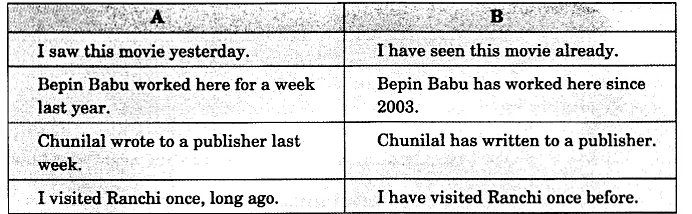
Study the sentences in the columns below.
NCERT Solutions for Class 8 English Honeydew Chapter 4 Bepin Choudhury’s Lapse of Memory 71.3
Compare the sentences in the two columns, especially the verb forms. Answer the following questions about each pair of sentences.
(i) Which column tells us that Bepin Babu is still working at the same place ?
(ii) Which column suggests that Chunilal is now uiaiting for a reply from the publisher ?
(iii) Which column suggests that the person still remembers the movie he saw ?
(iv) Which column suggests that the experience of visiting Ranchi is still fresh in the speaker’s mind ?

Answers
(i) B
(ii) B
(iii) B
(iv) B

Question 4.
Given below are jumbled sentences. Working in groups, rearrange the words in each sentence to form correct sentences.
You will find that each sentence contains an idiomatic expression that you have come across in the lesson. Underline the idiom and write down its meaning. Then use your dictionary to check the meaning.
One sentence has been worked out for you as an example.
Jumbled sentence : vanished/The car seemed to/into thin/have/air.
Ans. The car seemed to have vanished into thin air.
Idiom : vanished into thin air : disappeared or vanished in a mysterious way.
(i) Stop/and tell me/beating about/what you want/the bush
Ans :____
Idiom :____
(ii) don’t pay/if you/attention/you might/the wrong train/to the announcement/board
Ans :____
Idiom :____
(iii) The villagers/tried/the crime/on the young woman/to pin.
Ans :____
Idiom :____
(iv) Bepin Babu/orders to/telling people/under/loved/doctor’s/eat early/that he was.
Ans : ____
Idiom :____
(v) the students/The teacher/his eyebrows/when/said that/all their lessons/raised/they had revised.
Ans :____
Idiom :____

Answers
(i) Ans. Stop beating about the bush : and tell me what you want.
Idiom : Beating about the bush : avoiding talking about a subject directly.
(ii) Ans. If you don’t pay attention to the announcement, you might board the wrong train.
Idiom : Pay attention to : listen carefully/pay heed
(iii) Ans. The villagers tried to pin the crime on the young woman.
Idiom : Pin the crime on someone : Ascribe the blame or guilt for something on someone.
(iv) Ans. Bepin Babu loved telling people that he was under doctor’s orders to eat early.
Idiom : Under orders – under the instructions
(v) Ans. The teacher raised his eyebrows when the students said that they had revised all their lessons.
Idiom : Raised his eyebrows : showed his resentment.

SPEAKING AND WRITING (Page 73)
Question 1.
What do you think happened after Bepin Babu came to know the truth ? Was he angry with this friend for playing such a trick on him ? Or do you think he decided to help a friend in need ?

Answer
Bepin Babu’s first reaction must have been of relief that he was alright. He now knew that he had not really had any lapse of memory. Followed by this he must have felt angry with his friend Chunilal. After all Chunilal had played a practical joke on him. He had tricked him to the extent that he had lost all hope about his life.

However, Bepin Babu was a sensible man. He should have also thanked Chunilal for restoring his health. He should then have decided to help a needy friend.

Question 2.
Imagine you are Bepin Choudhury. You have received Chunilal’s letter and feel ashamed that you did not bother to help an old friend down on his luck. Now you want to do something for him. Write a letter to Chunilal promising to help him soon.
Or
A prank is a childish trick. Do you remember any incident when someone played a prank on you or your friends ? Describe the prank in a paragraph.

Answer
23 Neta Street
Kolkata
3 June, 2016
My dear Chunilal

Thank you for your letter dated 28th May. The words cannot express the relief that your letter has given. I have found a new lease of life. I dare say no doctor on earth can do what you have done for me. I can now understand your anger for not getting the help you expected from me.

Let me tell you one thing. I was never unwilling to help you. Actually I was not able to help you get that particular job. I had told you so. Anyway, I will do my best to find a suitable job for you now.

If possible, please come to me this week-end. We will sit together and think what can be done in this matter.
With regards
Yours sincerely
Bepin Choudhury
(BEPIN CHOUDHURY)

Or

It was Holi-eve last year. There was a telephonic message that my classmate Ramlala was dead. I couldn’t believe it. The caller had given her name as David. He said that he was Ramlala’s neighbour. I forgot to note his telephone number. I telephoned some others who were in the same class. All of them admitted having received a similar message. Next morning was Holi. I went to Ramlala’s place. I found a few other friends also there. Surprisingly, there was Ramlala too. I was as embarrassed as others. Some-one had played a prank on us on Holi.

We hope the NCERT Solutions for Class 8 English Honeydew Chapter 4 Bepin Choudhury’s Lapse of Memory help you. If you have any query regarding NCERT Solutions for Class 8 English Honeydew Chapter 4 Bepin Choudhury’s Lapse of Memory, drop a comment below and we will get back to you at the earliest.


NCERT Solutions for Class 9 Science Chapter 16 Floatation

NCERT Solutions for Class 9 Science Chapter 16 Floatation

These Solutions are part of NCERT Solutions for Class 9 Science. Here we have given NCERT Solutions for Class 9 Science Chapter 16 Floatation

More Resources

NCERT TEXT BOOK QUESTIONS

IN TEXT QUESTIONS

Question 1.
Why is it difficult to hold a school bag having a strap made of a thin and strong string ?
Answer:
It is painful to hold a heavy bag having strap made of a strong and thin string.
NCERT Solutions for Class 9 Science Chapter 16 Floatation image - 1
When we hold a heavy bag having strap made of a strong and thin string, then the area under the strap is small. Hence, large pressure is exerted by the strap on our fingers or shoulder. Due to this large pressure, the strap tends to cut the skin and hence pain is caused.

Floatation Class 9 NCERT Solutions will help you to score more marks in your CBSE board Examination.

Question 2.
What do you mean by buoyancy ? (CBSE 2011, 2012, 2016, 2017)
Answer:
The tendency of an object to float in a liquid or the power of liquid to make an object to float in it is called buoyancy.

Question 3.
Why does an object float or sink when placed on the surface of water ? (CBSE 2012)
Answer:
When an object is placed on the surface of water, two forces act on the object.

  1. The gravitational force in the downward direction and
  2. Upthrust of the water on the object.

When the gravitational force acting on the object is greater than the upthrust of the water, then the object sinks in water. On the other hand, if the upthrust of water on the object is greater than the gravitational force, then the object floats.

                                                                             Or

If density of an object is less than the density of water, it floats on the water. On the other hand, if density of the object is greater than the density of water, it sinks in water.

Question 4.
You have a bag of cotton and an iron bar, each indicating a mass of 100 kg when measured on a weighing machine. In reality, one is heavier than other. Can you say which one is heavier and why ?
(CBSE 2011)
Answer:
Iron bar is heavier than a bag of cotton. This is because iron bar experiences a less upward force i.e. upthrust than the bag of cotton.

NCERT CHAPTER END EXERCISE

Question 1.
In what direction does the buoyant force on an object immersed in a liquid act ?
Answer:
Buoyant force acts in the upward direction on an object immersed in a liquid.

Question 2.
Why does a block of plastic released under water come upto the surface of water ?(CBSE 2011, 2016)
Answer:
This is because upthrust or buoyant force acting on the block of plastic is greater than the gravitational force acting on the block in the downward direction.

Question 3.
The volume of 50 g of a substance is 20 cm3. If the density of water is 1 g cm-3, will the substance float or sink ? Justify your answer. (CBSE 2011, 2012)
Answer:
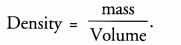
NCERT Solutions for Class 9 Science Chapter 16 Floatation image - 2
Since density of substance is more than the density of water, so the substance will sink.

Question 4.
The volume of a 500 g sealed packet is 350 cm3. Will the packet float or sink in water if density of water is 1 g cm-3 ? What wall be the mass of the water displaced by the packet ?
Answer:
NCERT Solutions for Class 9 Science Chapter 16 Floatation image - 3
Since the density of the packet is greater than the density of water, so the packet will sink.
Mass of water displaced= Volume of Packet x density of water = 350 x 1 = 350 g.

PRACTICAL SKILL BASED QUESTIONS

Question 1.
Write two main precautions to be taken to read the water level in the graduated cylinder. (CBSE 2015)
Answer:

  1. The cylinder must be placed on a flat surface in exactly vertical positoin.
  2. The level of eyes must be exactly at the level of lower end of the meniscus of water.

Question 2.
Write precuations to be taken to measure the weight of a body using a spring balance. (CBSE 2015)
Answer:

  1. The least count of the spring balance must be calculated.
  2. Zero error of the spring balance must be calculated and added or substracted from the observed value of the . weight of the body.
  3. The level of eyes must be exactly at the level of the pointer of the spring balance.

Question 3.
A 500 g mass body is immersed in two liquids X and Y in succession. The extent to which the body sinks in liquid Y is less than that in liquid X. From such observation, compare the densities of liquids X and Y. Justify your answer. (CBSE 2015)
Answer:
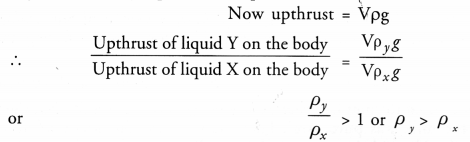
Weight of body immersed in liquid = Weight of body in air -upthrust of liquid on the body.
Since the extent to which the body sinks in liquid Y is less than that in liquid X, therefore, upthrust of liquid Y is greater than the upthrust of liquid X.
NCERT Solutions for Class 9 Science Chapter 16 Floatation image - 4
Thus, density of liquid Y is greater than the density of liquid X.

Question 4.
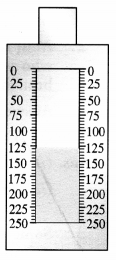
In a spring balance, the space between 0 to 25 g wt. is divided into 5 equal parts. Find its least count. What is the weight of the object in the diagram given below ? (CBSE 2015)
NCERT Solutions for Class 9 Science Chapter 16 Floatation image - 5
Answer:
5 divisions = 25 gwt
1 divisions = 5 gwt
Hence, least count of the spring balance = 5 gwt.
Weight of object in the diagram = 125 x 5 gwt = 625 g wt

Question 5.
While determining the density of a solid of weight 58 g wt, a student is provided with four different combinations of mesuring cylinder and spring balance as shown below :
The student should prefer to choose which combination and why ? (CBSE 2015)
Answer:
NCERT Solutions for Class 9 Science Chapter 16 Floatation image - 6
Density can be determined accurately if mass and volume of solid are measured accurately. Therefore, mass must be determined by a spring balance of minimum least count and volume must be determined by a measuring cylinder of minimum least count. Hence, student should prefer the combination 1.

Question 6.
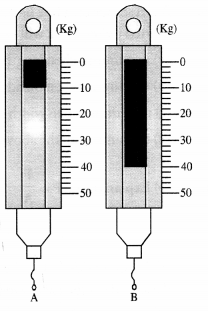
Observe the two spring balances shown in the figures given aside :

  1. What are the least count and range of the spring balances ?
  2. Find the weights of objects in the two spring balances. (CBSE 2015)
    NCERT Solutions for Class 9 Science Chapter 16 Floatation image - 7

Answer:

  1. In both spring balances, 5 divisions = 10 kg
    1 division = 2 kg
    Hence, least count of both spring balances = 2kg.
    Range of both spring balances = 0-50 kg
  2. Weight of object measured by spring balance A = 10 kg
    Weight of object measured by spring balance B = 40 kg
    A spring balance used for measuring mass of the cuboid has a least count of 2 gwt.

Question 7.
Two students using the same spring balance noted two different readings, 46 gwt and 47 gwt. Which reading is correct and why ? (CBSE 2015)
Answer:
The reading which is the multiple of least count (i.e. 2 gwt) is correct. Therefore, 46 gwt is the correct reading.

Question 8.
A 10 mL measuring cylinder has 100 divisions of equal spacing. Find the least count of the measuring cylinder.
Answer:
Least count of measuring cylinder = Value of 1 division marked on the cylinder 100 divisions =10 mL .

NCERT Solutions for Class 9 Science Chapter 16 Floatation image - 8
Therefore, least count of the measuring cylinder = 0.1 mL

Question 9.
In which of the two, glycerine or kerosene, the loss in weight of a solid when fully immersed in them will be more and why ? (CBSE 2017)
Answer:
The loss in weight of a solid in a liquid will be more if buoyant force acting on the solid in a liquid is more. The buoyant force is directly proportional to the density of the liquid. Since density of glycerine is more than the density of kerosene, therefore, the loss in weight of the solid in glycerine is more than in kerosene.

Question 10.
When a body is immersed in a liquid, name the two forces acting on it and state their direction of action.
Answer:

  1. Weight of the body in vertically downward direction.
  2. Buoyant force acting on the body due to the liquid in vertically upward direction.

Hope given NCERT Solutions for Class 9 Science Chapter 16 are helpful to complete your science homework.

If you have any doubts, please comment below. Learn Insta try to provide online science tutoring for you.

NCERT Solutions for Class 12 English Flamingo Chapter 3 Deep Water

Here we are providing NCERT Solutions for Class 12 English Flamingo Chapter 3 Deep Water. Students can get Class 12 English Deep Water NCERT Solutions, Questions and Answers designed by subject expert teachers.

Deep Water NCERT Solutions for Class 12 English Flamingo Chapter 3

Deep Water NCERT Text Book Questions and Answers

Deep Water Think as you read 

Question 1.
What was the “misadventure” that William Douglas speaks about?
Answer:
William Douglas’ traumatic experience in the sea, as a child, made him afraid of water. However, as he was learning to swim in the YMCA pool, he was thrown into the deep end by an older boy. The experience terrified him as he had almost drowned and finally lost consciousness before being hauled out of the water.

Deep Water NCERT Solutions will help you to score more marks in your CBSE board Examination.

Question 2.
What were the series of emotions and fears that Douglas experienced when he was thrown into the pool? What plans did he make to come to the surface?
Answer:
When Douglas was thrown into water, he landed in a sitting position, swallowed water, and went at once to the bottom. He was frightened, but planned to jump, as his feet touched the bottom, and bounce to the surface, and paddle to the edge of the pool. His repeated failed attempts left him terrified and exhausted, till he slipped into unconscious and was pulled out of the pool. The author went from fear to exhaustion and finally submission. He showed courage when he planned to reach the surface, however the repeated attempts drained his strength and he was gripped by terror. He eventually gave up and felt resigned before losing consciousness.

Question 3.
How did this experience affect him?
Answer:
The writer’s experience of near drowning affected him greatly. He felt weak and trembled on his way back home from the pool. He spent many more days in unrest. He never went back to the pool. He feared water and avoided it whenever he could.

Question 4.
Why was Douglas determined to get over his fear of water?
Answer:
Douglas was determined to get over his fear of water as he wished to get into the water of Cascades. He felt terrorised by the memories of the pool and regretted being deprived of the pleasures of fishing, canoeing, boating, and swimming.

Question 5.
How did the instructor “build a swimmer” out of Douglas?
Answer:
The instructor put a belt around Douglas to which a rope was attached. The rope went through a pulley fixed on an overhead cable. He held on to the end of the rope, and made Douglas swim for weeks. Three months later, he taught Douglas to exhale under water, and to raise his nose and inhale, and made him overcome his fear of putting his head under water. Next, the instructor held him at the side of the pool and made him kick with his legs. Gradually, after weeks of practice, his legs relaxed. When Douglas had perfected each hurdle, the instructed coordinated his efforts and gradually built a swimmer out of Douglas.

Question 6.
How did Douglas make sure that he conquered the old terror?
Answer:
To make sure he had conquered fear, Douglas went to Lake Wentworth in New Hampshire, dived in and swam two miles across the lake to Stamp Act Island. Only once when he was in the middle of the lake, did the terror return. But he confronted it and swam on. He also swam across Warm Lake to the other shore and back, to make sure that he had conquered his fear of water.

Deep Water Understanding the text

Question 1.
How does Douglas make clear to the reader the sense of panic that gripped him as he almost drowned? Describe the details that have made the description vivid.
Answer:
Douglas was pushed into the deep end of the YMCA swimming pool by a strong boy. He landed up in sitting position, swallowing water. He was frightened, but as he was going down to the bottom of the pool, he decided to make a big jump when his feet would hit the bottom of the pool, come up to the surface, lie flat, and paddle to the edge. But his fall seemed unending. The nine feet felt ninety to the little boy, and before his feet touched the bottom, his lungs were ready to burst.

As soon as his feet hit the bottom, he gathered all his strength and tried to spring upwards. Unlike what he had foreseen, he came up slowly. On opening his eyes, he saw nothing but water; he was terrified. There was nothing to hold on to and he felt suffocated. He tried to scream but no sound came. His eyes and nose came out of the water but his mouth was still under the surface. He thrashed at the surface of the water, but merely swallowed more water and choked. When he tried to bring his legs up, they hung like dead weights, refusing to move. He was pulled under water and once again he felt himself sinking back to the bottom of the pool. Breathless, he hit at the water with all his strength. His lungs and head ached and he began to feel dizzy.

He decided to jump when he hit the bottom. However it made no difference. He groped around for something and felt even more terrorized, with his limbs refusing to move. He finally gave up—his legs felt limp and blackness swept his brain. He felt neither anxiety nor fear. On the contrary, he felt quiet and peaceful, but drowsy, and was finally oblivious of everything around him. The writer makes the description vivid by giving graphic details of the situation and of his fear.

Question 2.
How did Douglas overcome his fear of water?
Answer:
Douglas overcame his fear of water through sheer determination. The experience he had, as a child of three or four, had left an indelible imprint on his mind. This was aggravated by the experience that he had when he was thrown into the pool. This made him stay away from water for many years. Later when he attempted to overcome his fear, his instructor taught him to swim, yet he felt terror-stricken when alone in the pool. He swam tirelessly up and down the length of the pool but he was not sure that the fear had left.

So he went to Lake Wentworth, in New Hampshire, and swam two miles across the lake to Stamp Act Island. Only once did he feel afraid, when he was in the middle of the lake, but he confronted it and swam on. To ascertain if he had overcome his fear completely, he went up to Meade Glacier, and swam across the Warm Lake. This assured him that he had accomplished his desire to overcome his fear of water.

Question 3.
Why does Douglas, as an adult, recount a childhood experience of terror and his conquering of it? What larger meaning does he draw from this experience?
Answer:
Douglas, as an adult, recounts his childhood experience of terror and how he conquered it. He recalled his ordeal as a child about how he almost drowned in a swimming pool. He narrated his journey, under his trainer, where he learnt to swim and finally how he swims across Warm Lake. The account does not attempt to glorify his accomplishment as a swimmer, but celebrates his efforts of conquering his fear of water.

The writer shares with his readers how the experience held a deep significance for him. He writes that he had experienced both the sensation of dying and the terror it produces. He came to realize the value of life through this incident. The account also sheds light on his take on adventure. Adventure calls on all the faculties of the mind and the spirit. It develops self-reliance and independence. Adventure is, however, enjoyed when one is rid of fear. Fear cripples an individual and limits one’s scope. One stays tethered by strings of doubt and indecision and has only a small and narrow world to explore. Douglas shared his experience as a useful lesson and called upon his readers to conquer their fears.

Deep Water Talking about the text

Question 1.
“All we have to fear is fear itself.” Have you ever had a fear that you have now overcome? Share your experience with others in the class.
Answer:
Answers will vary.

Question 2.
Find and narrate other stories about the conquest of fear and what people have said about courage. For example, you can recall Nelson Mandela’s struggle for freedom, his perseverance to achieve his mission, to liberate the oppressed, and the oppressor as depicted in his autobiography. The story “We’re Not Afraid To Die”, which you have read in Class XI, is an apt example of how courage and optimism helped a family survive under dire stress.
Answer:
She could easily be called the Helen Keller of our times. The darkness that surrounds her life has not prevented Bibi Mohammadi from spreading the light of education. At twenty six, Bibi, whose lower limbs are paralysed teaches more than 300 students at her school in Nathnagar, Bhagalpur.

Born in a poor family of weavers, Bibi cleared her intermediate examination—an achievement, considering that her six siblings failed. But, her achievement has not come easy. At school, she was the laughing stock and when other children jumped and ran about, she could only watch. In 1983, while she was still studying, she decided to start a school of her own with around 50 students. Now she teaches over 300 children in three shifts.

Keeping in view the poor economic condition of her locality, she charges a nominal fee of Rs 10 from each student. Interestingly, she is the lone teacher and manages all the classes single-handedly. With slippers in her hands, she crawls from one comer to the other of the dingy, thatched-roof classroom. What keeps her going are words of inspiration from Qari Saheb, the Imam of the Nathnagar mosque. He told her to continue with her education so that by teaching children she could become financially independent and not feel handicapped. Many such stories of Gandhi’s freedom straggle, Martin Luther King, and various everyday examples continue to inspire us.

Deep Water Extra Questions and Answers

Deep Water Short Answer Questions

Question 1.
Douglas’s first experience in water was not a happy incident. Why?
Answer:
Douglas’s first experience in water was very unhappy. It left an indelible imprint on his young mind. As a three or four-year-old, his father took him to the beach in California. As they were surfing, the waves pushed him down and swept over him. He felt buried in water and felt suffocated and frightened. All he could recall later was clinging to his father out of fear. The terror caused by the force of the waves resulted in fear and insecurity that he associated with water.

Question 2.
What were the writer’s complexes that he needed to overcome in order to learn swimming at the YMCA?
Answer:
The writer had developed a fear of water at an early age that was associated with the bitter memory of the Yakima River. He had gone surfing and had almost drowned in the river. Secondly, he hated walking naked into the pool with his bare skinny legs. To overcome this complex, he had to hold back his pride.

Question 3.
What was the writer’s misadventure in the pool at YMCA?
Answer:
The writer was still battling with his complexes in order to learn swimming when another misadventure befell him. He was sitting on the poolside waiting for others when a boy of about eighteen years old came up to him and asked him if he wanted to be “ducked”. Before the writer could react, the older boy picked him up and tossed him into the deep end of the pool.

Question 4.
Douglas had planned on coming out of the pool. Why did his plan fail him?
Answer:
When Douglas was pushed into the pool of water, he planned to jump to the surface and paddle to the edge of the pool. But before he touched bottom, he felt that his lungs were ready to burst. He tried to spring up, but came up slowly. He could see and feel nothing but water. He was too suffocated to scream for help as his mouth did not surface out of the water. As fear gripped him and his legs seemed paralyzed. His attempts to shoot up were thwarted and before he knew he was sinking back to the bottom.

Question 5.
How did Douglas feel when he sank into water the second time?
Answer:
Douglas was petrified of water and the fear worsened when he could not rise to the surface of water. His first attempt to rise was thwarted and he sank back to the bottom. He attempted again but felt a force pulling him under water. He seemed to sink down endlessly. He tried to open his eyes but saw nothing but water with a yellow glow. Fear gripped him and he could not shout out.

Question 6.
Why did his second attempt to come out of water fail?
Answer:
Douglas’ second attempt to come out of water failed although he sprang from the bottom and came up like a cork to the surface. He planned to lie flat on the water and strike out with his arms and thrash with his legs. Keeping that in mind he decided to jump when he hit the bottom. However when he attempted to jump, it made no difference. His helplessness made him shiver with fright. His limbs refused to move as if he was paralyzed, he tried in vain to call for help.

Question 7.
Where did Douglas find himself when he regained his memory?
Answer:
When Douglas’ repeated attempts to come out of water failed, he felt drowsy and lost consciousness. His next memory was of being carried. He got the feeling of floating in space and also felt tender arms lulling him to sleep.On regaining his consciousness, he found himself lying on the side of the pool on his stomach and vomiting. He recalled that the boy who threw him claimed that he was “only fooling”. He vividly heard someone giving instructions to carry him to the locker room.

Question 8.
How did the drowning experience affect Douglas?
Answer:
After the drowning experience, Douglas felt weak and was trembling as he walked home. That night he shook and cried in bed and could not eat. A haunting fear gripped his heart for days the slightest exertion upset him, made him unsteady in the knees and sick to his stomach. The experience affected him so adversely that he started dreading the sight of water and avoided it.

Question 9.
When did Douglas try to go into water again after the pool episode? What was the outcome?
Answer:
A few years after the misadventure in the pool, Douglas learnt of the waters of the Cascades. He tried to wade across the Tieton. He even attempted bathing in Warm Lake of the Goat Rocks. But all his attempts reminded him of the terrifying experience in the pool, and he would get paralyzed with fear.

Question 10.
How did the instructor “build a swimmer” out of Douglas?
Answer:
The instructor built a swimmer out of Douglas gradually. First he put a belt around him to which a rope was attached. The rope was hung through a pulley that ran on an overhead cable. He went into water holding on to one end of the rope. Three months later, the instructor taught Douglas to exhale under water. He also taught him to raise his head and inhale. The instructor taught him next to put his legs to use. With practice, he learned to coordinate his efforts and learnt to swim.

Question 11.
The instructor was satisfied but not the writer. Why?
Answer:
The instructor was satisfied with Douglas’ progress, but Douglas was still apprehensive about facing his fears alone. Although after about six months of training, the instructor felt he had succeeded in teaching Douglas the technique, Douglas felt differently. He wondered how he would react when alone in water. He, thus, attempted to swim alone but his old terror kept coming back. He decided to practise some more to overcome the fear.

Question 12.
How did Douglas make sure that he conquered the old terror?
Answer:
To conquer his old terror of water, Douglas went to Lake Wentworth in New Hampshire and swam for two miles across the lake to Stamp Act Island. He felt the old terror return but he confronted it and swam on. He practised the crawl, the breast stroke, side stroke, and back stroke. Then he swam across Warm Lake to the other shore and back. It was only then that he was sure of having conquered his fear of water.

Question 13.
What was the biggest lesson that the writer learnt during his swimming lessons?
Answer:
The biggest lesson that the writer learnt during his swimming lessons was the need to conquer his fear.
He learnt that in death there was peace but in terror there was the fear of death alone. The writer endorsed Roosevelt’s views: “All we have to fear is fear itself.” Being free from terror was being released.

Deep Water Long Answer Questions

Question 1.
Recount the experiences that made the writer terrified of water? How did he plan to overcome his fear?
Answer:
Two experiences made the writer terrified of water. As a child of three or four, he had gone with his father to a beach in California. They had been surfing and the waves knocked him down and swept over him.He remembered having felt buried in water and was gasping for breath. Later, when he was ten or eleven years old at the YMCA in Yakima, he was pushed into the pool by an older child. He had been saved from drowning but the experience had petrified him. The writer planned to overcome his fear by learning to swim in order to conquer his fear of water.

Question 2.
Why did Douglas’ second attempt to come out of the pool fail?
Answer:
Douglas’s second attempt to come out of the pool failed. As he sank to the bottom of the pool, the nine feet seemed like ninety. Before he touched the bottom of the pool, his lungs were ready to burst. Although Douglas mustered up all his strength and made a spring upwards, he came up slowly. On his way up, he saw nothing but dirty yellow water. He tried to latch on to something but he was surrounded by water. He felt suffocated and could not scream. As he reached up, his eyes and nose were out of the surface of water, but his mouth was still below the surface. His legs hung like dead weights and soon he sank back to the bottom of the pool.

Question 3.
When Douglas went down the third time, he could barely recall anything. What does he recall of the episode?
Answer:
When Douglas went down the third time, he remembered very little of it later. He saw nothing but dark water all around. It terrified him. Screams froze in his throat. He felt lifeless and the only sign of life was his beating heart and the pounding in his head. He was determined to push himself up when he hit the bottom but it made no difference.

He lost hope around that time. He shook and trembled with fright and his limbs were paralyzed. When he regained his consciousness next, he was lying on his stomach and vomiting. He overheard the boy who pushed him into the water claim that he was “only fooling.” Douglas also heard someone say that he had almost died. He was the carried into the locker room.

Question 4.
How did the instructor help Douglas learn swimming?
Answer:
Douglas’ instructor helped build him as into a swimmer. He did this bit by bit. Douglas practised with him five days a week, for an hour each day. Each day the instructor put a belt around his waist, attached to a rope that was strung through a pulley on an overhead cable. He held on to the end of the rope as Douglas swam. Initially, each time the instructor relaxed his hold, the old terror returned.

However, after three months the tension began to ease. The instructor also taught him to put his face under water and exhale, and to raise his nose and inhale till he had eventually learnt to put his head under water. His instructor held him at the side of the pool and had him kick with his legs. The stiffness of the legs gradually relaxed and finally he could command a use over them. Thus piece by piece, the instructor built him into a swimmer.

Question 5.
Why was Douglas not satisfied even after the instructor finished his job of teaching him to swim? How did he help himself?
Answer:
The instructor was satisfied once Douglas learnt to swim. But Douglas still had his apprehensions. He wondered if he would be terror-stricken when was alone in the pool. He tried swimming the length of the pool but was still terrified. He went to Lake Went worth in New Hampshire and also dived off a dock at Triggs Island. He swam two miles across the lake to Stamp Act Island; in the middle of the lake, he put his face under water. Although he was scared, he swam on. It was when he dived into the Warm Lake and was . able to swim across that he shouted with joy at having conquered his fear of water.

Deep Water Value Based Question

Question 1.
Often, the key to the cause of a certain fear or phobia is the same as the key to conquering it. How does the story “Deep Water” justify this?
Answer:
Douglas, the narrator, had been scared of water as a boy. As a child, he was terrified of getting into water. In his attempt to overcome his fear, he tried to learn swimming. At YMCA, he was hurled into the deepest part of the pool by a big strong boy. He was almost drowned, and thereafter he lived a life of overwhelming fear of water. He was so petrified that the sight of water made him sick. Consequently he lost out on various water sports such as fishing or canoeing. He decided to overcome the constricting dread and with grit and determination, he found an instructor who trained him to swim, bit by bit. He successfully overcame his fear and felt liberated. He put his grit and determination to test. The experience of overcoming his fear of water was life-changing for the narrator.

NCERT Solutions for Class 11 English Hornbill Chapter 1 The Portrait of a Lady

Here we are providing NCERT Solutions for Class 11 English Hornbill Chapter 1 The Portrait of a Lady. Students can get Class 11 English The Portrait of a Lady NCERT Solutions, Questions and Answers designed by subject expert teachers.

The Portrait of a Lady NCERT Solutions for Class 11 English Hornbill Chapter 1

The Portrait of a Lady NCERT Text Book Questions and Answers

The Portrait of a Lady Understanding the text

Mention

Question 1.
The three phases of the author’s relationship with his grandmother before he left the country to study abroad.
Answer:
The three phases of the author’s relationship with his grandmother before he left the country to study abroad were:
(a) Admiration and friendship – The author admired his grandmother and described her as the “winter landscape in the mountains, an expanse of pure white serenity breathing peace and contentment”. They were good friends. She woke him up in the morning and got him ready for school. She waited for him while he was in school and then walked him back.

(b) Growing distant – She could not accompany him to school as he went by the school bus. He was now in an English school, where they taught science. She could not understand English and did not believe in science. The fact that they were not taught about god made her unhappy. Khushwant Singh’s learning music in school made her unhappier as she felt it was not meant for gentle folk.

(c) Wide gulf – When he went to the university, he got a separate room and even the last link of a shared room was snapped. The grandmother kept to her spinning wheel, rarely talking to anyone.

NCERT Solutions for Class 11 English will help you to score more marks in your CBSE board Examination.

Question 2.
Three reasons why the author’s grandmother was disturbed when he started going to the city school.
Answer:
The three reasons why the author’s grandmother was disturbed when he started going to the city school were:

  • She did not believe in the things they taught at the English school.
  • She was distressed that they were not taught about God and the scriptures.
  • She was very disturbed about the fact that he was being given music lessons. To her, music was not the way of the gentle folk.

Question 3.
Three ways in which the author’s grandmother spent her days after he grew up.
Answer:
The three ways in which the author’s grandmother spent her days after he grew up were:

  • She was resigned to her loneliness and did not interact much with the author.
  • From sunrise to sunset she sat by her wheel, spinning and reciting prayers.
  • In the afternoon, she relaxed for a while to feed the sparrows.

Question 4.
The odd way in which the author’s grandmother behaved just before she died.
Answer:
Unlike the doctors who believed that she would recover, the grandmother knew that her end was near. She said, since only a few hours before the close of the last chapter of her life she had omitted to pray, she was not going to waste any more time talking to them. She ignored their protests. She lay peacefully in bed praying and telling her beads till her lips stopped moving and the rosary fell from her lifeless fingers.

Question 5.
The way in which the sparrows expressed their sorrow when the author’s grandmother died.
Answer:
When the grandmother died, thousands of sparrows collected and sat in the courtyard. There was no chirruping. When the author’s mother threw some bread for them, they took no notice of the bread. They were full of grief at her death and flew away quietly after the cremation. The breadcrumbs had to be swept away the next day.

The Portrait of a Lady Talking about the text 

Talk to your partner about the following.

Question 1.
The author’s grandmother was a religious person. What are the different ways in which we come to know this?
Answer:
The author recalls his grandmother as a very religious person. In his earliest memories he recalls her hobbling about the house telling the beads of her rosary. As she bathed him she said her morning prayer, hoping that he, too, would learn it. While he studied in school, she read scriptures inside the temple.

Once the author went to the university, and he and his grandmother drifted apart, she rarely left her spinning wheel to talk to anyone. From sunrise to sunset she sat by her wheel, spinning and reciting prayers. The author recalls that even during the last few hours she spent all her time praying.

Question 2.
Describe the changing relationship between the author and his grandmother. Did their feelings for each
other change?
Answer:
When the author was a young boy, his parents shifted to the city leaving him with his grandmother. They were good friends and spent all their time together. She woke him up each morning, bathed him, dressed him, plastered his wooden slate, gave him breakfast and walked him to school. While he sat in the veranda learning, the grandmother sat inside the temple reading scriptures.

When they had both finished, they would walk back together. But once in the city, there was a turning point in their friendship. The only thing that remained unchanged was their common bedroom. She could not accompany him to school as he went by the school bus. He now went to an English school, where they taught science.

She could not understand English and did not believe in science. The fact that they were not taught about god made her unhappy. His learning music in school made her feel worse. When he went to the university, he got a separate room and this snapped off their ties even further.

This was not deliberate but the demands of the situation had this effect on their relationship. However, their feelings for each other never changed. When the writer was going abroad, she went to the railway station to see him off but did not speak a word, she only kissed his forehead. The writer cherished this as their last physical contact as he was going away for five years. But when he returned, she was still there and was delighted to see him back.

In the evening she, for whom music had lewd associations, collected women from the neighbourhood and beat the drum and sang for hours of the homecoming of the warriors. For the first time, she missed her prayers to celebrate the author’s homecoming. The next day, she developed a mild fever and died; it was almost as if she had been waiting for the author’s return.

Question 3.
Would you agree that the author’s grandmother was a person strong in character? If yes, give instances
that show this.
Answer:
Khushwant Singh’s grandmother was a strong woman whom he loved and admired. When his parents went to the city, she took charge of him. In the city, although she disapproved of certain things that he was taught in school, she did not express it.

She had the inner strength to withdraw quietly. The writer also recalls, with pleasure, the moments when he was going abroad; she went to the railway station to see him off but did not talk or show any emotion.

Her lips moved in prayer and she kissed his forehead silently. The strength of her character was also evident during the last few days of her life. She knew that her end was near. She said that she was not going to waste any more time talking to anybody.

She ignored their protests and lay peacefully in bed praying and telling her beads till the last moment. A peaceful pallor spread on her face and they knew that she was dead.

Question 4.
Have you known someone like the author’s grandmother? Do you feel the same sense of loss with regard to someone whom you have loved and lost?
Answer:
The death of a grandparent is probably one of the worst things that can happen to you as a child. Facing death can be sad or frightening to anyone, but as a child, it seems all the more difficult to cope with all the pain, grief, and confusion. I experienced this as a child of six when I lost my grandfather. My parents, too, were undergoing a trauma but they were almost oblivious to my grief.

They did not realise that although I did not fully understand the finality of death, I felt miserable. I went through intense and confusing emotions. They felt I was too young to understand the finality of death. For me, first it was shock, then denial, as I couldn’t accept what had happened. Then I was angry, and finally sadness and depression engulfed me. I wanted to withdraw from the world, not wanting to see or speak to anyone, or do anything.

For days I wanted to look through his belongings. I would sit in his room for hours. Perhaps, subconsciously, it was my way of reaching out to him. There were times when I thought I would never enjoy life the same way again. Later, I learnt that this is a natural reaction after a loss. “Time is the best healer,” say people but I feel it only covers the -hurt. The loss of a dear one stays with you forever.

(Answers will vary).

The Portrait of a Lady Thinking about language

Question 1.
Which language do you think the author and his grandmother used while talking to each other?
Answer:
Punjabi – as the writer and his grandmother belonged to a Punjabi Sikh family. Moreover, they lived in a village.

Question 2.
Which language do you use to talk to elderly relatives in your family?
Answer:
Languages used in India by different families include Hindi, Odiya, Bhojpuri, Santhali, Tamil, Malayalam, Gujarati, Bengali, Assamese, Nagamese, Mizo, Nepali, amongst numerous other languages across the country. (Answers will vary).

Question 3.
How would you say ‘a dilapidated drum’ in your language?
(Answers will vary).

Question 4.
Can you think of a song or a poem in your language that talks of homecoming?
(Answers will vary).

The Portrait of a Lady Working with words

I. Notice the following uses of the word ‘tell’ in the text.

  • Her fingers were busy telling the beads of her rosary.
  • I would tell her English words and little things of Western science and learning.
  • At her age one could never tell.
  • She told us that her end was near.

Given below are four different senses of the word ‘tell’. Match the meanings to the uses listed above.

1. make something known to someone in spoken or written words
2. count while reciting
3. be sure
4. give information to somebody

  • Her fingers were busy telling the beads of her rosary –  count while reciting
  • I would tell her English words and little things of western science and learning – give information to somebody
  • At her age one could never tell –  be sure
  • She told us that her end was near – make something known to someone in spoken or written words

II. Notice the different senses of the word ‘take’.

  • to take to something: to begin to do something as a habit
  • to take ill: to suddenly become ill

Locate these phrases in the text and notice the way they are used.

  • There were no dogs in the streets and she took to feeding sparrows in the courtyard of our city house.
  • The next morning she was taken ill.

III. The word ‘hobble’ means to walk with difficulty because the legs and feet are in bad condition.

Tick the words in the box below that also refer to a manner of walking
NCERT Solutions for Class 11 English Hornbill Chapter 1 The Portrait of a Lady

  • shuffle – to walk dragging your feet
  • stride – pace, step
  • waddle – to walk with short steps while causing the body; to tilt slightly from one side to the other, especially because of having short legs and being overweight
  • swagger – strut, parade
  • trudge – plod, walk with difficulty

The Portrait of a Lady Things to do

Talk with your family members about elderly people who you have been intimately connected with and who are not there with you now. Write a short description of someone you liked a lot. (Answers will vary).