Here we are providing Class 12 Biology Important Extra Questions and Answers Chapter 4 Reproductive Health. Important Questions for Class 12 Biology are the best resource for students which helps in Class 12 board exams.
Class 12 Biology Chapter 4 Important Extra Questions Reproductive Health
Reproductive Health Important Extra Questions Very Short Answer Type
Question 1.
Expand STD and CDRI:
Answer:
STD: Sexually transmitted diseases.
CDRI: Central Drug Research Institute.
Question 2.
Comment on the RCH program of the government to improve the reproductive health of the people:
Answer:
Creating public awareness regarding reproduction-related aspects and providing facilities to build up a healthy society with an added emphasis on the health of mother and child are the basic aims of the RCH programs.
Question 3.
What is the significance of progesterone- estrogen combination as a contraceptive measure?
Answer:
Birth control pills like Mala-D and Saheli are commonly called combined pills as they have progesterone-estrogen combinations. These prevent ovulation from the ovaries. These also retard the entry of sperms in the uterus.
Question 4.
Males in whom testes fail to descend to the scrotum are generally infertile. Why?
Answer:
If the testes fail to descend to the scrotum, gametogenesis could be inhibited as the process of spermatogenesis requires a marginally lesser ambient temperature (2°C less) than that in the abdominal cavity.
Question 5.
Mention one positive and one negative application of amniocentesis. (CBSE 2010)
Answer:
- Positive application: To detect congenital defects or genetic disorders.
- Negative application: Sex determination leads to female foeticide.
Question 6.
Which age group has the highest infection rates of sexually transmitted infections (STIs) including HIV?
Answer:
Young people aged between 15 and 24 years.
Question 7.
Mention any two events that are inhibited by the intake of oral contraceptive pills to prevent pregnancy in humans: (CBSE 2009 (S))
Answer:
- Inhibition of ovulation.
- Inhibition of motility and secretory activity of oviducts.
Question 8.
After a successful in vitro fertilization, the fertilized egg begins to divide. Where is this egg transferred before it reaches the 8-cell stage and what is this technique named? (CBSE Sample Paper)
Answer:
- Fallopian tube.
- Zygote intrafallopian transfer (ZIFT).
Question 9.
Name two STDs that can be transmitted through contaminated blood. (CBSE 2009 (S))
Answer:
- AIDS
- Hepatitis-B.
Question 10.
List the main methods of birth control:
Answer:
- Mechanical methods
- Surgical methods
- Chemical and hormonal methods
- Natural methods of birth control.
Question 11.
What are the two factors which have raised life expectancy in developing countries?
Answer:
- The decline in death rate.
- Increase in longevity.
Question 12.
What are the causes of death of women between ages 15 and 19 years?
Answer:
Complications of pregnancy, childbirth, unsafe abortions.
Reproductive Health Important Extra Questions Short Answer Type
Question 1.
Define reproductive health. How does this affect society?
Answer:
Reproductive health means total well-being in all aspects of reproduction, i.e. physical, emotional, behavioral, and social. A society with people having physically and functionally normal reproductive organs and normal emotional and behavioral interactions among them in all sex-related aspects are called a reproductively healthy society.
Question 2.
What is the significance of reproductive health in a society?
Answer:
A reproductively healthy society survives in a normal way. Reproductive health ensures that all individuals in the reproductive age group are fertile and able to carry on the human race further. Individuals should be educated about reproduction-related aspects like controlled population, absence of sex-abuses, and sex-related crimes in the society and this will enable people to think and take up necessary steps to build up a society that is reproductively healthy.
Question 3.
Is sex education necessary in schools? If so why?
Answer:
Yes, sex education should be encouraged in schools to give the right information to the young minds to save them from myths and misconceptions about sex-related aspects. Proper information about reproductive organs, adolescence and related changes, safe and hygienic sexual practices, sexually transmitted diseases like AIDS, etc. would help people to lead a reproductively healthy life. Thus sex education is necessary to make society reproductively healthy.
Question 4.
What are the suggested reasons for the population explosion?
Answer:
The following are the suggested reasons for population explosion:
- the rapid decline in death rate.
- the decline in maternal mortality rate (MMR).
- the decline in infant mortality rate (IMR).
- increase in the number of people in reproducible age.
Question 5.
The present population growth rate in India is alarming. Suggest ways to check it.
Answer:
- Widespread information and materials for birth control.
- The spread of education facilities.
- Making young people career conscious.
- Providing vocational training for gainful employment.
- Raising marriage age.
Question 6.
Suggest the reproduction-related aspects in which counseling should be provided at the school level.
Answer:
Counseling should be provided to students about reproduction-related problems as:
- Students are experiencing physical, physiological, and psychological changes during adolescence.
- Students should be guided about the harms of early sex, hygiene of reproductive organs, and STDs.
Question 7.
Is the use of contraceptives justified? Give reasons.
Answer:
The use of contraceptives is justified because these methods prevent or delay pregnancy and in the long run, help to check the uncontrolled growth of the population and thereby reduce the ill effects of overpopulation on the reproductive health of the society.
Question 8.
Amniocentesis, the fetal sex determination test, is banned in our country. Is it necessary? Comment.
Answer:
Amniocentesis is a fetal sex determination test based upon the chromosomal pattern in the amniotic fluid surrounding the developing embryo. It should be legally banned throughout the country as such a ban shall check increasing female foeticide cases and maintain a normal sex ratio in the country.
Question 9.
Name the hormone composition of oral contraceptives used by a human female. Explain how does it act as a contraceptive? (CBSE 2009)
Answer:
- Progesterone or progesterone- estrogen combination is used as an oral contraceptive by human females.
- These pills inhibit ovulation as well as implantation. They also alter the quality of cervical mucus to prevent or retard entry of sperms.
Question 10.
What are the conditions in which medical termination of pregnancy is advised?
Answer:
- If pregnancy is likely to produce a congenitally malformed child.
- In case of rape.
- Contraceptive failure.
- Pregnancy is likely to harm the mother.
Question 11.
Comment on the essential features required for an ideal contraceptive.
Answer:
- User friendly, i.e. comfortable and easy to use.
- Without any side effects.
- Reversible.
- Completely effective against pregnancy.
Question 12.
All reproductive tract infections (RTIs) are STDs, but all STDs are not RTIs. Justify with an example:
Answer:
Among the common STDs gonorrhea, syphilis, genital herpes, chlamydiosis, hepatitis-B, AIDS, etc., hepatitis-B and AIDS are not infections of the reproductive organs, though their mode of transmission could be through sexual contact also. All other diseases are transmitted through sexual contact and are also infections of the reproductive tract.
Reproductive Health Important Extra Questions Long Answer Type
Question 1.
Suggest the aspects of reproductive health that need to be given special attention in the present scenario:
Answer:
Conferring upon the demands of the present situation of our country, the following aspects of reproductive health should be given special attention:
- Control of the human population.
- Creation of awareness about reproduction-related aspects among people including sex education to the students.
- Implementation of various action plans to attain reproductive health and building a reproductively healthy society.
- Continued research on reproduction-related areas.
- Providing medical assistance and care to people especially during pregnancy, delivery, STDs, abortions, contraception, menstrual problems, infertility, etc.
- Measures of birth control.
Question 2.
Briefly give an account of various intra-uterine contraceptive (IUD) measures. What are their advantages? How do they function?
Answer:
Different types of lUDs are presently available such as the non-medicated lUDs (e.g. Lippes loop), copper releasing IUDs (CUT, CU 7, Multiload 375), and the hormone-releasing ones (Progestasert, LNG-20). Functions. lUDs increase phagocytosis of sperms within the uterus and the Cu ions released by some suppress sperm motility and the fertilizing capacity of the sperms. The hormone-releasing lUDs, in addition, make the uterus unsuitable for implantation and the cervix hostile to the sperms. Advantages. LEDs are ideal contraceptives for females who want to delay pregnancy and/or space children. It is one of the most widely accepted methods of contraception in India.
Question 3.
What are the measures one has to take to prevent contracting STDs?
Answer:
STDs are sexually transmitted diseases that are transmitted from an infected person to a normal person through sexual intercourse. STDs are a major threat to a healthy society and can be prevented by adopting the following practices:
- Avoidance of sex with multiple partners.
- Avoidance of sex with unknown partners.
- Complete abstinence from sex with infected individuals.
- Use of condoms during sexual intercourse.
- In case of doubt, a qualified doctor should be consulted.
Question 4.
People of which age group are more vulnerable to the incidence of infection of STDs? Suggest three ways of preventing STDs.
Answer:
Though all persons are vulnerable to these infections, their incidence is reported to be very high among persons in the age group of 15-24 years.
Preventive measures:
- Avoid sex with unknown partners/ multiple partners.
- Always use condoms during coitus.
- In case of doubt, go to a qualified doctor for early detection and get it completely cured.
Question 5.
Removal of gonads cannot be considered a contraceptive option. Why?
Answer:
Removal of gonads cannot be considered as a contraception option because of the following reasons:
- It should not have side effects. Gonads also secrete hormones. Thus the other functions will be harmed.
- It should not interfere with sexual desire.
- It is an irreversible process. It will lead to infertility.
Question 6.
What are the various oral contraceptives used? How do they function? What is the advantage of Saheli?
Or
Why do some women use ‘Saheli’ pills? (CBSE2009)
Or
Name an oral pill used as a contraceptive by a human female. Explain how does it prevent pregnancy? (CBSE 2011)
Answer:
- Few oral contraceptives used are Mala D, Saheli, etc.
- Oral administration of small doses of either progestagens or progestagen- estrogen combinations is another contraceptive method used by females.
- They are used in the form of tablets and hence are popularly called the ‘pills’.
- Pills have to be taken daily for a period of 21 days starting preferably within the first five days of the menstrual cycle. After a gap of 7 days (during which menstruation occurs), it has to be repeated in the same pattern till the desired period of contraception.
- Functions. They inhibit ovulation and implantation as well as alter the quality of cervical mucus to prevent/ retard entry of sperms.
- Pills are very effective with lesser side effects and are well accepted by females.
Question 7.
A mother of a one-year-old daughter wanted to space her second child. Her doctor suggested Cu-T. Explain its contraceptive actions. (CBSE Delhi 2008)
Or
How does Cu-T act as an effective contraceptive for human females? (CBSE 2009, 2011)
Answer:
Role of Cu-T as the contraceptive:
- Copper-T increases phagocytosis of spermatozoa within the uterus.
- Copper ions released also suppress the motility of sperms as well as their fertilizing ability.
- It is a reversible technique and can be removed as and when required.
Question 8.
Name two hormones that are constituents of contraceptive pills. Why do they have high and effective contraceptive value? Name a commonly prescribed non¬steroidal oral pill: (CBSE Outside Delhi 2016)
Answer:
- Oral contraceptive pills contain progesterone alone or a combination of progesterone and estrogen hormones.
- Effective contraceptive pills:
(a) Inhibition of ovulation
(b) Inhibition of motility and secretory activity of fallopian tubes.
(c) Changes in the endometrium layer of the uterus make it unsuitable for implantation. - ‘Saheli’ contains a non-steroidal preparation called centchroman.
Question 9.
Suggest some methods to assist infertile couples to have children. (CBSE Delhi 2008 (S) Outside Delhi 2013)
Answer:
There are numerous assisted reproductive technologies (ART) available that can bless infertile couples with children.
They are:
- IVF: In Vitro Fertilisation (Test-tube babies).
- ET: Embryo Transfer
- ZIFT: Zygote Intra Fallopian transfer.
- GIFT: Gamete Intra Fallopian Transfer.
- ICSI: Intracytoplasmic sperm injection.
- IUI: Intrauterine Insemination.
Question 10.
(i) Name any two copper-releasing lUDs:
Answer:
Copper releasing lUDs.
(a) CuT,
(b) Cu7 and
(c) Multiload 375.
(ii) Explain how do they act as effective contraceptives in human females? (CBSE 2014, Sample Paper 2019-20)
Answer:
The action of copper-releasing lUDs.
(a) Increases phagocytosis of sperms within the uterus.
(b) Suppress sperm motility.
(c) Then lUDs also suppress fertilizing capacity of sperms.
Question 11.
Suggest and explain the assisted reproductive techniques which will help a couple to have children, where the female had a blockage in the fallopian tube and the male partner had a low sperm count. (CBSE Sample paper 2018-19) Answer:
1. Since the female partner is having a blockage in the fallopian tube, In Vitro fertilization, followed by embryo transfer (ET) will help her conceive. In this case, sperms from the male partner will be collected and injected into the ovum of the female partner to form a zygote under simulated conditions in the laboratory, and an embryo with more than 8 blastomeres will be transferred into the uterus IUT – intrauterine transfer, to complete its further development.
2. Since the male partner is suffering from low sperm count, and intracytoplasmic sperm injection technique should be used to directly inject sperm into the ovum.
Question 12.
List the objectives of Reproductive and Child Health Care Programmes (RCH):
Answer:
Objectives of RCH are as follows:
- Creating awareness about various reproduction-related problems.
- Providing facilities and support for building up a reproductively healthy society.
- Providing audiovisual and print media support to various government and non-government organizations.
- Educating the people and providing the right information to save them from myths and misconceptions.
- Providing proper education regarding reproductive organs, adolescence and related changes, safe and hygienic sexual practices.
- Providing information regarding the danger of sexually transmitted diseases, AIDS, etc.
Question 13.
Define population. What are the aims of the population study?
Answer:
The population is defined as the total number of individuals of a species present in a particular area. The members of a population have some common characteristics, share a common gene pool, and are capable of interbreeding among themselves to produce fertile offsprings. Aims of Population Study. An alarming rise in the human population has created many serious problems. Therefore, population education has been introduced into the school and college curricula.
Population education is aimed at making the students aware of the:
- consequences of uncontrolled population growth such as environmental pollution, depletion of natural resources, extinction of species, etc ;
- benefits of lowering population growth rate to the biosphere ;
- advantages of a small family to humans ;
- growth, distribution, and density of population ;
- relation of population to the standards of life.
Question 14.
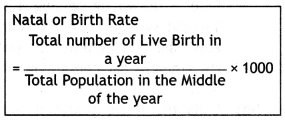
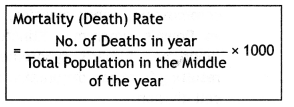
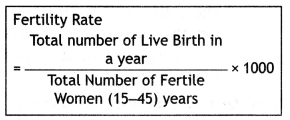
Define birth rate, death rate, and fertility rate.
Answer:
1. Birth or natality rate: It is generally expressed as the number of births per 1,000 individuals of a population per year. It increases the population size (total number of individuals of a population) and population density.
The national average birth rate in India is about 28.6 per 1,000 per year. Among Indian states, Kerala has the lowest birth rate of 18 per 1,000, while U.P. has the highest of 34.8 per 1,000.
2. Death or mortality rate: It is the opposite of the natality rate. It is commonly expressed as the number of deaths per 1,000 individuals of a population per year.
3. Fertility rate: It is the number of live births per unit time per unit number of fertile females. Fertility Rate
Question 15.
What is family planning? List the ways of family planning:
Answer:
Family planning: The main objective of family planning or family welfare program is to prevent the fertilization of the ovum by the male sperm and stop the increase in population growth by various methods, such as contraceptives, intrauterine devices, vasectomy, and tubectomy. The contraceptives (Anirudh) for males and intra-uterine devices, loop for females are used to avoid pregnancy.
Vasectomy is the method of sterilizing males by surgical operation of sperm duct or vas deferens. Tubectomy is the method of sterilizing females by the surgical operation of fallopian tubes. Whatever the method employed, it must take care of the health of the persons concerned.
Because of the family planning methods, the birth rate in India is reduced to some extent. The government gives incentives to those who adopt family planning.
Ways of family planning:
- Late marriage for young persons.
- Increase in the sources of recreation so as to divert the attention from sex.
- The couple should not mate between 8-18th days from the start of the menstrual cycle.
- Use of contraceptives.
- Sterilization.
- Use of drugs.
- Abortion.
- Restrict the family to two children.
Question 16.
Suggest the various measures of population control:
Answer:
Population control: Population explosion can be checked by two methods-population education and birth control.
A. Population education: The knowledge about the relationship of population size and the availability of resources for the welfare of the society is called population education.
- The students should be convinced about the relationship between overpopulation and unemployment.
- The citizens should be told how the large size of the population is eating away the resources of the state and the reasons for the limited availability of healthcare, education facilities, and other welfare schemes.
- People should be made aware of how a large number of children eat away the meager resources of the family with nothing left for bad days, how large families rely on indebtedness to meet emergencies, how child bread earners do not improve the conditions of the family, how uneducated children remain a burden on the society, etc. They should be convinced that a small family can live comfortably even with meager resources.
B. Birth control:
- Mass media of communication. Radio, television, newspapers, magazines, hoardings, and posters should be employed to spread the message of family planning and birth control and its advantages. The future of mankind depends on the stabilization of the human population at a level that ensures basic necessities of life, employment, and happiness,
- The law about marriageable age should be widely published and strictly enforced (21 years for boys and 18 years for girls). In developed countries, women marry at the age of 25-35 years.
- As far as possible, stress should be laid on raising the social status of women. Women having higher social status prefer smaller families. Such women generally marry late.
- Remove the superstitions and wrong beliefs in the society about a higher number of children being God’s gift connected with earthly or heavenly prosperity.
Question 17.
What is amniocentesis? Write its procedure and significance:
Answer:
Amniocentesis is a fetal sex determination test based upon the chromosomal pattern in the amniotic fluid surrounding the developing embryo. It should be legally banned throughout the country as such a ban shall check increasing female foeticide cases and maintain a normal sex ratio in the country.
Procedure:
- The fetus bathes in the amniotic fluid that fills the amniotic cavity. At an early stage of pregnancy (14th or 15th week), the location of the fetus and placenta is determined by sonography (use of high-frequency sound waves).
- Then a small amount of amniotic fluid is drawn by passing a special surgical syringe needle through the abdominal wall and uterine wall into the amniotic sac containing the amniotic fluid.
- Celts that have sloughed from the fetus’s skin or respiratory tract into the fluid are thus sucked into the syringe.
Significance:
- These cells can be examined for chromosomal abnormalities, such as Down’s syndrome, Klinefelter’s syndrome, Turner’s syndrome, etc resulting from non-disjunction during cell division.
- The cells can also be cultured and in about a fortnight enough cells become available for test. The cells and fluid are also tested for metabolic disorders such as phenylketonuria, sickle-cell anemia, etc.
Question 18.
Write a note on test-tube babies: (CBSE 2014)
Answer:
Test-Tube Babies: In some women normal conception is not possible because of blocked oviducts or spermicidal secretions in the vagina or the low sperm count of the husband. In such cases, her ovum is removed, fertilized by her husband’s sperm in a laboratory dish, checked that development has begun, and a morula (up to 32 cell stage) replaced or implanted in her uterus.
The entire operation is carried out under sterilized conditions. With proper medical care, she will give birth to a normal child on the completion of gestation. The baby produced in this manner (conceived out of and nursed in the uterus) is called a test-tube baby. The baby is not reared in the test tube. A scientific term for this procedure is in vitro (“in glass”) fertilization.
The success rate of the technique is less than 20%. To increase the chances of success, the prospective mother is given fertility drugs which cause many ovarian follicles to mature at the same time. This releases many eggs simultaneously, thereby increasing the chances of success.
A developing embryo can be inserted into the uterus of another female, called a surrogate mother, provided her hormones are in the proper phase of the reproductive cycle for implantation to occur.
Question 19.
Correct the following statements:
1. Surgical methods of contraception prevent gamete formation.
Answer:
Surgical methods of contraception block gamete transport and thereby prevent conception.
2. All sexually transmitted diseases are completely curable.
Answer:
Few sexually transmitted diseases are curable if detected at an early stage and some sexually transmitted diseases are not curable, e.g. AIDS.
3. Oral pills are very popular contraceptives among rural women.
Answer:
Oral pills are very popular contraceptives among educated urban women.
4. In E.T. techniques, embryos are always transferred into the uterus.
Answer:
In E.T. techniques, 8-celled embryos may be transferred into the fallopian tubes and more than 8-celled embryos are transferred into the uterus.
Question 20.
Reproductive and Child Healthcare (RCH) programs are currently in operation. One of the major tasks of these programs is to create awareness amongst people about the wide range of reproduction-related aspects. This is important and essential for building a reproductive health society.
1. “Providing sex education in schools is one of the ways to meet this goal.” Give four points in support of your opinion regarding this statement. (CBSE Delhi 2016)
Answer:
Sex education is important in schools:
(a) to provide the right information about myths and misconceptions.
(b) to create awareness about reproduction.
(c) to provide knowledge about the growth of reproductive organs and sexually transmitted diseases (STDs)
(d) to guide the students about social evils such as sex abuse, sex-related crimes, etc.
(ii) List any two indicators that indicate a reproductively healthy society.
Answer:
Indicators about a reproductively healthy society.
(a) Low infant mortality rate (IMR)
(b) Low maternal mortality rate (MMR)
- Increased number of couples with small families.
- Better detection and cure of STDs.
Question 21.
Give a brief account of Assisted Reproductive Technologies (ART). (CBSE Outside Delhi 2013, 2019)
Answer:
Where corrective treatments are not available, there are special techniques called Assisted Reproductive Technologies (ART) to help the couple produce children; they are as follows:
1. Test-Tube baby programs:
(a) In this method, ovum from the wife or a donor female and the sperms from the husband or a donor is allowed to fuse under simulated conditions (as that of the body) in the laboratory; it is called in vitro fertilization (IVF).
2. The zygote or early embryo is transferred into the uterus or fallopian tube for further development; this process is called Embryo Transfer (ET) and can be done in the following ways:
(a) The zygote or embryo up to eight blastomeres is transferred into the fallopian tube; it is called Zygote Intra Fallopian Transfer (ZIFT).
(b) Embryos with more than eight blastomeres are transferred into the uterus. It is called Intrauterine Transfer (IUT).
3. Gamete Intra Fallopian Transfer (GIFT): This method involves the transfer of an ovum collected from a donor female into another female, who cannot produce ova, but can provide suitable conditions for fertilization and further development of the fetus up to parturition.
4. Intra Cytoplasmic Sperm Injection (ICSI): In this method, the sperm is directly injected into the ovum to form an embryo in the laboratory, and then embryo transfer is carried out.
5. Artificial insemination:
(a) In this method, the semen collected from the husband or a healthy donor is artificially introduced into the vagina or into the uterus (intrauterine insemination).
(b) This method is used in cases where infertility is due to the inability of the male partner to inseminate the female or due to very low sperm counts in the ejaculates.
Question 22.
It is commonly observed that parents feel embarrassed to discuss freely with their adolescent children about sexuality and reproduction. The result of this parental inhibition is that the children go astray sometimes.
(i) Explain the reasons that you feel are behind such embarrassment amongst some parents to freely discuss such issues with their growing children.
Answer:
Parents feel embarrassed because of the following reasons:
(a) Indian society is not that broad-minded. So parents feel shy talking openly about these matters to their children.
(b) Improper communication and age gap are the reasons behind such embarrassment.
(ii) By taking one example of a local plant and animal, how would you help these parents to overcome such inhibitions about reproduction and sexuality? (CBSE Delhi 2017)
Answer:
Parents can take the example of China rose to explain the process of sexual reproduction. They can also take an example of the male honeybee and orchid Ophrys flower.
It is evident that sexual attraction is a natural phenomenon. The honeybee is attracted to an Ophrys flower and assumes its one petal as its female partner and pseudo copulate with it. So it is a natural phenomenon and parents should talk regarding this matter to their children.
Question 23.
(a) Explain one application of each one of the following:
(A) Amniocentesis:
Answer:
- Detection of a genetic disorder
- Detection of chromosomal disorder
- Sex determination
- Karyotyping (used for detecting chromosomal aberrations)
(B) Lactational amenorrhea:
Answer:
It is a kind of natural contraception to prevent pregnancy. When the women breastfeed regularly her menstrual cycle stops for some period and thus can’t have a baby.
(C) ZIFT:
Answer:
Application of ZIFT (Zygote Intrafallopian Transfer)- In vitro fertilization, the zygote or early embryos at eight blastomeres stage are transferred to the fallopian tale to complete its further development inside the body of the mother. Hence this method is very helpful for infertile couples.
(b) Prepare a poster for the school program depicting the objectives of the “Reproductive and Child Health Care Programme”. (CBSE Delhi 2019)
Answer:
Reproductive and Child Health Care:
Objectives of RCH:
- Creating awareness about various reproduction-related problems.
- Providing facilities and support for building up a reproductively healthy society.
- Providing audio-visual and print, media support, to various government and non-government organizations.
- Educating the people and providing the right information to save them from myths and misconceptions.
- Providing proper education regarding reproductive organs, adolescence and related changes, safe and hygienic sexual practices.
- Providing information regarding the danger of sexually transmitted diseases, AIDS, etc.
- Awareness regarding that gender selection and detection is punishable.
Example – Hum do hamare do, Beti bachao beti padhao, Do boond zindasi ke etc.