RS Aggarwal Class 8 Solutions Chapter 7 Factorisation Ex 7A

RS Aggarwal Class 8 Solutions Chapter 7 Factorisation Ex 7A

These Solutions are part of RS Aggarwal Solutions Class 8. Here we have given RS Aggarwal Solutions Class 8 Chapter 7 Factorisation Ex 7A.

Other Exercises

Factorize :

Question 1.
Solution:
(i) 12x + 15 = 3(4x + 5) {HCF of 12 and 15 = 3)
(ii) 14m – 21 = 7(2m – 3) {HCF of 14 and 21 = 7)
(iii) 9n – 12n2 = 3n(3 – 4n) Ans.{HCF of 9 and 12 = 3}

Question 2.
Solution:
(i) 16a2 – 24ab = 8a(2a – 3b) { HCF of 16 and 24 = 8)
(ii) 15ab2 – 20a2b = 5ab(3b – 4a) {HCF of 15 and 20 5}
(iii) 12x2y3 – 21x3y2= 3x2y2(4y – 7x) Ans. {HCF of 12 and 21 = 3)

Question 3.
Solution:
(i) 24x3 – 36x2y = 12x2(2x – 3y) {HCF of 24 and 36 = 12}
(ii) 10x3 – 15x2 = 5x2(2x – 3) {HCF of 10, 15 = 5}
(iii) 36x3y – 60x2y3z = 12x2y (3x – 5y2z) {HCF of 36 and 60 = 12}

Question 4.
Solution:
(i)9x3 – 6x2 + 12x
= 3x(3x2 – 2x + 4) {HCF of 9, 6, 12 = 3)
(ii)8x2 – 72xy + 12x
= 4x(2x – 18y + 3) (HCF of 8, 72, 124)
(iii)18a3b3 – 27a2b3 + 36a3b2
= 9a2b2(2ab – 3b + 4a) Ans.{HCF of 10, 27, 36 = 9)

Question 5.
Solution:
(i) 14x3 + 21x4y – 28x2y2
= 7x2 (2x + 3x2y – 4y2) {HCF of 14, 21 28 = 7)
(ii) – 5 – 10t + 20t2
= – 5(1 + 2t – 4t2) Ans. {HCF of 5, 10, 20=5)

Question 6.
Solution:
(i) x(x + 3) + 5(x + 3)
=(x + 3)(x + 5)
(ii) 5x(x – 4) – 7(x – 4)
= (x – 4) (5x – 7)
(iii) 2m (1 – n) + 3(1 – n)
= (1 – n) (2m + 3) Ans.

Question 7.
Solution:
6a(a – 2b) + 5b(a – 2b)
= (a – 2b) (6a + 5b) Ans.

Question 8.
Solution:
x3(2a – b) + x2(2a – b)
=x2(2a – b)(x + 1)Ans.

Question 9.
Solution:
9a(3a – 5b) – 12a2(3a – 5b)
= 3a (3a – 5b) (3 – 4a) Ans.

Question 10.
Solution:
(x + 5)2 – 4(x + 5)
= (x + 5)(x + 5 – 4)
=(x + 5)(x + 1)Ans.

Question 11.
Solution:
3(a – 2b)2 – 5 (a – 2b)
= (a – 2b) {3(a – 2b) – 5}
= (a – 2b) (3a – 6b – 5) Ans.

Question 12.
Solution:
2a + 6b – 3 (a + 3b)2
= 2(a + 3b) – 3(a + 3b)2
= (a + 3b){ 2 – 3 (a + 3b)}
= (a + 3b) (2 – 3a – 9b) Ans.

Question 13.
Solution:
16(2p – 3q)2 – 4 (2p – 3q)
= 4(2p – 3q) {4(2p – 3q) – 1}
= 4(2p – 3q) (8p – 12q – 1) Ans.

Question 14.
Solution:
x(a – 3) + y (3 – a)
= x(a – 3) – y(a – 3)
= (a – 3) (x – y) Ans.

Question 15.
Solution:
12(2x – 3y)2 – 16(3y – 2x)
= 12(2x – 3y)2 + 16(2x – 3y)
= 4(2x – 3y) {3(2x – 3y) + 4}
= 4(2x – 3y) (6x – 9y + 4) Ans.

Question 16.
Solution:
(x + y)(2x + 5) – (x + y)(x + 3)
= (x + y)(2 + 5 – x – 3)
= (x + y)(x + 2) Ans.

Question 17.
Solution:
ar + br + at + bt
= r(a + b) + t(a + b)
= (a + b) (r + t) Ans.

Question 18.
Solution:
x2 – ax – bx + ab
= x(x – a) – b(x – a)
= (x – a)(x – b)Ans.

Question 19.
Solution:
ab2 – bc2 – ab + c2
= ab2 – ab – bc2 + c2
= ab(b – 1) – c2(b – 1)
= (b – 1) (ab – c2) Ans.

Question 20.
Solution:
x2 – xz + xy – yz
= x(x – z) + y(x – z)
= (x – z)(x + y)Ans.

Question 21.
Solution:
6ab – b2 + 12ac – 2bc
6ab + 12ac – b2 – 2bc
= 6a(b + 2c) – b(b + 2c)
= (b + 2c) (6a – b) Ans.

Question 22.
Solution:
(x – 2y)2 + 4x – 8y
= (x – 2y)2 + 4(x – 2y)
= (x – 2y)(x – 2y + 4)Ans.

Question 23.
Solution:
y2 – xy(1 – x) – x3
y2 – xy + x2y – x2
= y(y – x) + x2 (y – x)
= (y – x)(y + x2)Ans.

Question 24.
Solution:
(ax + by)2 + (bx – ay)2
= a2x2 + b2y2 + 2abxy + b2x2 + a2y2 – 2abxy
= a2x2 + b2y2 + b2x2 + a2y2
= a2x2 + b2x2 + a2y2 + b2y2
= x2(a2 + b2) + y2(a2 + b2)
= (a2 + b2) (x2 + y2) Ans.

Question 25.
Solution:
ab2 + (a – 1)b – 1
= ab2 + ab – b – 1
= ab(b + 1) – 1(b + 1)
= (b + 1) (ab – 1) Ans.

Question 26.
Solution:
x3 – 3x2 + x – 3
= x2(x – 3) + 1(x – 3)
(x – 3)(x2 + 1)Ans.

Question 27.
Solution:
ab (x2 + y2) – xy (a2 + b2)
= abx2 + aby2 + xya2 – xyb2
= abx2 – xya2 – xyb2 + aby2
=ax(bx – ay) – by(bx – ay)
= (bx – ay) (ax – by) Ans.

Question 28.
Solution:
x2 – x (a + 2b) + 2ab
= x2 – xa – 2bx + 2ab
= x(x – a) – 2b(x – a)
= (x – a)(x – 2b)


Hope given RS Aggarwal Solutions Class 8 Chapter 7 Factorisation Ex 7A are helpful to complete your math homework.

If you have any doubts, please comment below. Learn Insta try to provide online math tutoring for you.

Value Based Questions in Science for Class 9 Chapter 13 Why Do we Fall Ill

Value Based Questions in Science for Class 9 Chapter 13 Why Do we Fall Ill

These Solutions are part of Value Based Questions in Science for Class 9. Here we have given Value Based Questions in Science for Class 9 Chapter 13 Why Do we Fall Ill

Question 1.
The number of dengue cases had increased in Pooja’s village in the last one year. She read in her text book that diseases like dengue spread through mosquitoes which breed in stagnant water. She immediately contacted her friends and decided to kill the mosquitoes in water bodies in the locality. They also took help of nearest municipal office. Answer the following questions based on above information.

  1. Which preventive measures do you suggest for prevention of such diseases caused by mosquitoes ? Mention any two measures,
  2. Which values are displayed by Pooja in taking initiative.
  3. Suggest one school activity for promoting such values in school students. (Sample Paper, 2012—13, CCE 2013)

Answer:

  1. Preventive Measures. Avoid collection of water in pits, ensure covering of drains, proper and regular disinfection, covering arms and legs as dengue mosquito is active during day, use of mosquito nets and repellents.
  2. Values,
    1. Pooja is conscious of her social responsiblity.
    2. She is doing community service,
    3. She is aware of healthy living, as well as environment protection.
  3. School Activity,
    1. Group discussion on the clean environment and preventive measures against mosquito bites.
    2. Organising debates and seminar on mosquito menace and community hygiene.
    3. Organising compaigns for creating awareness amongst masses on hygienic living and hygienic environment.

More Resources

Question 2.
Anish has the habit of throwing the household garbage in the drain outside her home. Her friend Smitha takes the domestic garbage to public garbage bin outside her street.

  1. Which act of garbage disposal, Anish’s or Smitha’s is correct ?
  2. What problems would the wrong habit create for the society ?
  3. How can the wrong habit be corrected ?

Answer:

  1. Anish’s habit of throwing garbage in the drain is wrong while that of Smitha is correct.
  2. Anish’s habit of passing garbage in the drain not only blocks the drain causing overflow of drain water, spread of filth resulting in spread of flies, mosquitoes and other creatures but also produces stink all around.
  3. The best method to correct Anish’s habit is that Smitha should talk to her and convince her that throwing garbage in the drain is not only harmful to her neighbours but also for her and her family.
    If she does not mend her ways, Smitha should approach Anish’s mother. Other members of the community can also join her in convincing Anish.

Question 3.
Anne came to classroom early, dragged her table and chair to a side of the room and sat there away from the rest of her classmates. In between she was putting handkerchief over her nose. Her friend Nancy asked her to lend a pen which she refused.

  1. What is the reason of her putting handkerchief over the nose ?
  2. Why did she sit separately away from her classmates ?
  3. Why did she refuse to given pen to Nancy ?

Answer:

  1. Anne must be suffering from common cold. By putting handkerchief over the nose, she was preventing the spread of cold virus through nasal droplets, wiping off the same in the process.
  2. Anne sat separately so that she does not transfer the cold virus to her classmates.
  3. Refusal to give her pen to Nancy is also due to her anxiety that articles contaminated by her do not transfer the disease to others. She is conscious of her social responsibility.

Question 4.

  1. Why are polio drops being administered to children below five years twice every year ?
  2. When was the last wild polio case reported in India ?
  3. Was there any other polio case ?

Answer:

  1. Polio drops are being given free to children below five years of age so that the virus of polio does not multiply in human beings and it is ultimately eradicated, as small pox has been from the world. The compaign will continue for some time more till there is no fresh case for a couple of years.
  2. The last wild type polio case was reported in India during January 2011.
  3. A vaccine derived polio case has been reported from Bengal during 2012.

Hope given Value Based Questions in Science for Class 9 Chapter 13 Why Do we Fall Ill are helpful to complete your science homework.

If you have any doubts, please comment below. Learn Insta try to provide online science tutoring for you.

RS Aggarwal Class 8 Solutions Chapter 6 Operations on Algebraic Expressions Ex 6E

RS Aggarwal Class 8 Solutions Chapter 6 Operations on Algebraic Expressions Ex 6E

These Solutions are part of RS Aggarwal Solutions Class 8. Here we have given RS Aggarwal Solutions Class 8 Chapter 6 Operations on Algebraic Expressions Ex 6E.

Other Exercises

Objective questions :
Tick the correct answer in each of the following :

Question 1.
Solution:
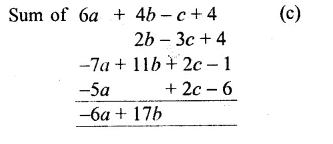
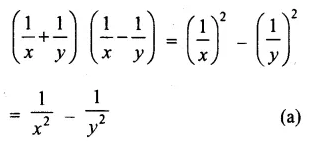
RS Aggarwal Class 8 Solutions Chapter 6 Operations on Algebraic Expressions Ex 6E 1.1

Question 2.
Solution:
(3q + 7p2 – 2r3 + 4) – (4p2 – 2q + 7r3 – 3)
= 3q + 7p2 – 2r3 + 4 – 4p2 + 2q – 7r3 + 3
= 5q + 3p2 – 9r3 + 7 = 3p2 + 5q – 9r3 + 7 (d)

Question 3.
Solution:
(x + 5) (x – 3) = x2 + (5 – 3) x + 5 X ( – 3)
= x2 + 2x – 15 (d)

Question 4.
Solution:
(2x + 3) (3x – 1)
= 6x2 – 2x + 9x – 3
= 6x2 + 7x – 3 (b)

Question 5.
Solution:
(x + 4) (x + 4)
= x2 + (4 + 4) x + 4 X 4
= x2 + 8x + 16 (c)

Question 6.
Solution:
(x – 6) (x – 6)
= x2 + ( – 6 – 6) x + ( – 6) ( – 6)
= x2 – 12x + 36 (d)

Question 7.
Solution:
(2x + 5) (2x – 5)
= (2x)2 – (5)2
= 4x2 – 25

Question 8.
Solution:
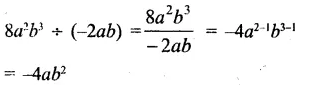
RS Aggarwal Class 8 Solutions Chapter 6 Operations on Algebraic Expressions Ex 6E 8.1

Question 9.
Solution:
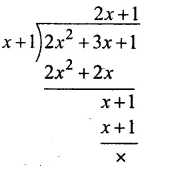
(2x2 + 3x + 1) ÷ (x + 1)
RS Aggarwal Class 8 Solutions Chapter 6 Operations on Algebraic Expressions Ex 6E 9.1
= 2x +1 (b)

Question 10.
Solution:
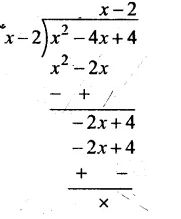
(x2 – 4x + 4) ÷ (x – 2)
RS Aggarwal Class 8 Solutions Chapter 6 Operations on Algebraic Expressions Ex 6E 10.1
= x – 2 (a)

Question 11.
Solution:
(a + 1) (a – 1) (a2 + 1)
= (a2 – 1) (a2 + 1)
= a4 (c)

Question 12.
Solution:
RS Aggarwal Class 8 Solutions Chapter 6 Operations on Algebraic Expressions Ex 6E 12.1

Question 13.
Solution:
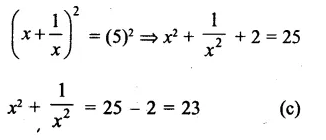
\(\left( { x }+\frac { 1 }{ { x } } \right) =5\)
Squaring on both sides
RS Aggarwal Class 8 Solutions Chapter 6 Operations on Algebraic Expressions Ex 6E 13.1

Question 14.
Solution:
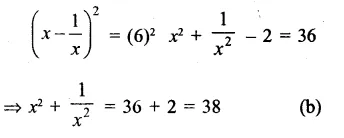
\(\left( { x }-\frac { 1 }{ { x } } \right) =6\)
Squaring on both sides
RS Aggarwal Class 8 Solutions Chapter 6 Operations on Algebraic Expressions Ex 6E 14.1

Question 15.
Solution:
(82)2 – (18)2
= (82 + 18) (82 – 18)
= 100 x 64
= 6400 (c)

Question 16.
Solution:
(197 x 203)
= (200 – 3) (200 + 3)
= (200)2 – (3)2
= 40000 – 9
= 39991 (a)

Question 17.
Solution:
a + b = 12, ab = 14
a2 + b2
= (a + b)2 – 2ab
= (12)2 – 2 x 14
= 144 – 28
= 16 (b)

Question 18.
Solution:
a – b = 7, ab = 9
a2 + b2
= (a – b)2 + 2ab
= (7)2 + 2 x 9
= 49 + 18
= 67 (a)

Question 19.
Solution:
x = 10
4x2 + 20x + 25
= (2x)2 + 2 x 2x x 5 + (5)2
= (2x + 5)2
= (2 x 10 + 5)
= (20 + 5)2
= (25)2
= 625 (c)

Hope given RS Aggarwal Solutions Class 8 Chapter 6 Operations on Algebraic Expressions Ex 6E are helpful to complete your math homework.

If you have any doubts, please comment below. Learn Insta try to provide online math tutoring for you.

HOTS Questions for Class 9 Science Chapter 13 Why Do we Fall Ill

HOTS Questions for Class 9 Science Chapter 13 Why Do we Fall Ill

These Solutions are part of HOTS Questions for Class 9 Science. Here we have given HOTS Questions for Class 9 Science Chapter 13 Why Do we Fall Ill

Question 1.
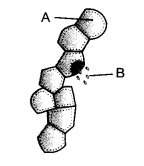
(a) Identify the figure.
HOTS Questions for Class 9 Science Chapter 13 Why Do we Fall Ill image - 1
(b) What do A and B depict.
Answer:
(a) Viral particles (as of SARS) coming out of host cells.
(b) A — host cell.
B — Virus.

More Resources

Question 2.
Name a disease in which
(a) Antiboitic has no role.
(b) Kissing does not spread the disease while sexual contact transfers the same.
(c) Mass scale immunisation is going on.
(d) Virus, bacterium and protozoan can be causal agent.
Answer:
(a) Malaria
(b) AIDS
(c) Polio
(d) Diarrhoea.

Question 3.
What is correct ? Give reason.
(a) A person strolling in the lawn of his house is relaxing or doing exercise.
(b) Wearing socks and full sleeves at night will prevent the attack from dengue.
(c) Regular use of ORS cures diarrhoea.
Answer:
(a) Strolling is no exercise as a person moves slowly. It is a way of relaxation where stress and strain can be relieved.
(b) No. Dengue is caused by bite of Aedes mosquito which is active during day time only.
(c) Yes, ORS prevents dehydration. Diarrhoea is generally cured automatically after 1-2 days because it is mostly viral infection.

Hope given HOTS Questions for Class 9 Science Chapter 13 Why Do we Fall Ill are helpful to complete your science homework.

If you have any doubts, please comment below. Learn Insta try to provide online science tutoring for you.

NCERT Solutions for Class 9 Science Chapter 13 Why Do we Fall Ill

NCERT Solutions for Class 9 Science Chapter 13 Why Do we Fall Ill

These Solutions are part of NCERT Solutions for Class 9 Science. Here we have given NCERT Solutions for Class 9 Science Chapter 13 Why Do we Fall Ill. LearnInsta.com provides you the Free PDF download of NCERT Solutions for Class 9 Science (Biology) Chapter 13 – Why Do We Fall ill solved by Expert Teachers as per NCERT (CBSE) Book guidelines. All Chapter 13 – Why Do We Fall ill Exercise Questions with Solutions to help you to revise complete Syllabus and Score More marks.

More Resources

NCERT TEXT BOOK QUESTIONS

IN TEXT QUESTIONS

Question 1.
State any two conditions essential for good health.

  1. Complete physical fitness free from any disease.
  2. Perfect mental (and social) well being.

Answer:
State any two conditions essential for being free of disease.

  1. Non-overcrowded living conditions, safe drinking water and clean environment.
  2. Balanced diet, personal hygiene, exercise and relaxation.

Question 2.
Are the answers to the above questions same or different ? Why ?
Answer:
Different: Health is a state of perfect physical, mental, and social well being of a person while disease is a state of disease or discomfort of the body or its part.

Question 3.
List any three reasons why you would think that you are sick and ought to see a doctor. If only one of these symptoms were present, would you still go to the doctor ? Why or why not ?
Answer:

  1. Cough, cold and fever. The sickness must be due to infection which requires proper diagnosis and treatment which only doctor can do.
  2. If only one symptom is present (say cough only or cold only) even then I will prefer to get treatment from the doctor because an untreated infection can spread and cause further damage to the body.

Question 4.
In which of the following case do you think the long term effects on your health are likely to be most unpleasant ?
Answer:
(a) If you get jaundice
(b) If you get lice
(c) If you get acne.
Jaundice. It is a severe disease which also takes several days to heal. During this period bile pigments collect at several places in the body and permanently damage some of them.

Question 5.
Why are we normally advised to take bland and nourishing food when we are sick ? (CCE 2011, 2012)
Answer:
It helps in strengthening of the immune system and provides nourishment to body which is being depleted by infectious agent.

Question 6.
What are the different means by which infectious diseases are spread ?
Answer:
By air directly or as droplets, e.g., cold.
By contaminated food and water, e.g., cholera.
By fomites or articles contaminated by the patient, e.g., chicken-pox.

Question 7.
Contagious diseases simply spread by contact.
Answer:
By sexual and blood contact in case of AIDS, syphilis and some other diseases.
By vectors and carriers, e.g., malaria by female Anopheles.

Question 8.
What precautions would you take in your school to reduce incidence of infectious diseases ?
Answer:

  1. Airy and well-spaced classrooms.
  2. Advising students falling sick not to come to school. If any such student does come, the same should be provided a separate bench.
  3. Ensuring safe drinking water.
  4. Cleanliness.
  5. Protection against flies and mosquitoes.
  6. Vaccination against diseases.
  7. Regular medical examination of students.

Question 9.
What is immunisation ?
Answer:
Development of immunity or resistance against a pathogen through vaccination is called immunisation.

Question 10.
What are the immunisation programmes available at our nearest health centre in your locality ?
Which of these diseases are two major health problems in your area ?
Answer:

NCERT Solutions for Class 9 Science Chapter 13 Why Do we Fall Ill image - 1
NCERT Solutions for Class 9 Science Chapter 13 Why Do we Fall Ill image - 2

NCERT CHAPTER END EXERCISES

Question 1.
How many times did you fall ill in the last one year ? What were the illnesses ?
(a) Think of one change you could make in your habits in order to avoid any of/most of the above illnesses.
(b) Think of one change you would wish for in your surroundings in order to avoid any of/most of the above illnesses.
Answer:
I suffered last year from cough and common cold (thrice), typhoid (once), malaria (once), loose motions (thrice)
(a) Change in Habits,

  1. I should not sit along with those persons who are suffering from cough and cold,
  2. I should take care of not eating unprotected food,
  3. I should protect myself from mosquito bites.

(b) Change in Surroundings. Sanitary conditions in and around my home should be improved. The drains should be regularly cleaned and kept covered.

Question 2.
A doctor/nurse/health worker is exposed to more sick people than others in the community. Find out how she avoids getting sick herself. (CCE 2012, 2013, 2017)
Answer:
Through

  1. vaccination against most of the common diseases,
  2. use of gloves,
  3. use of different dress or coat while visiting patients, and
  4. use of disposable syringes and needles.

Question 3.
Conduct a survey in your neighbourhood to find what the three most common diseases are. Suggest three steps that could be taken by your local authorities to bring down the incidence of these diseases.
Answer:
The three most common diseases in my neighbourhood are malaria, typhoid and diarrhoea. The diseases mostly spread through unhygienic surroundings. The authorities should take care of

  1. disposal of garbage,
  2. cleaning of drains with occasional spray of insecticides
  3. covering of drains and
  4. providing clean drinking water.

Question 4.
A baby is not able to tell his/her caretakers that he/she is sick. What would help us to find out
(a) that the baby is sick
(b) what the sickness is ?
Answer:

  1. Running fever
  2. Cold and cough
  3. Excessive crying
  4. Loose motions
  5. Non-intake of proper diet.

To find the sickness, the baby is taken to a doctor. The doctor is able to diagnose the disease with the help of stethoscope, palpation (feeling with hand), above symptoms and laboratory test.

Question 5.
Under which of the following conditions is a person most likely to fall sick ?
(a) When she is recovering from malaria.
(b) When she has recovered from malaria and is taking care of someone suffering from chicken-pox ?
(c) When she is on a four day fast after recovering from malaria and is taking care of someone suffering from chicken-pox. Why ?
Answer:
(c) Four day fast will make the person weak with reduced immunity. As a result the chances of picking up chicken-pox and falling sick would be more.

Question 6.
Under which of the following conditions are you most likely to fall sick ?
(a) When you are having examinations.
(b) When you have travelled by bus and train for two days.
(c) When your friend is suffering from measles. Why ?
Answer:
(c) Measles is an infectious viral disease of young children which spreads through nasal or throat discharge (droplet method, fomite and other contacts). Visiting such a friend is likely to provide infection.

SELECTION TYPE QUESTIONS

Alternate Response Type Questions
(True/False, Right/Wrong, Yes/No)

Question 1.
Health of an individual depends on the surroundings.
Question 2.
Gainful employment has no relation to individual health.
Question 3.
On the basis of symptoms, physicians look for signs of disease.
Question 4.
High blood pressure is an infectious disease.
Question 5.
Penicillin is effective against bacteria because it inhibits their wall formation.
Question 6.
In open spaces, air borne human diseases spread rapidly.
Question 7.
AIDS spreads through sex, blood to blood contact and from mother to child.
Question 8.
Personal hygiene is basic to prevent infectious diseases.

Matching Type Questions :

Question 9.
Match the contents of the columns I and II (single matching)
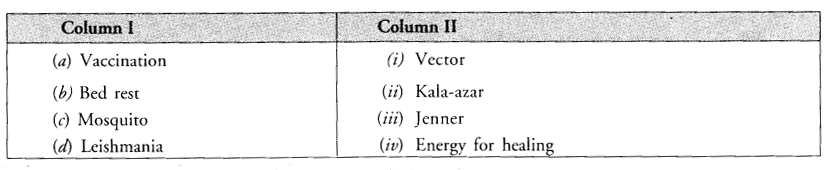
NCERT Solutions for Class 9 Science Chapter 13 Why Do we Fall Ill image - 3

Question 10.
Match the contents of columns I, II and III (double matching)
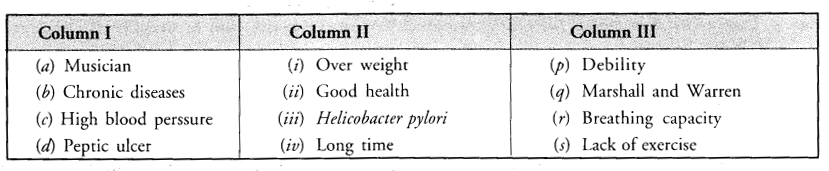
NCERT Solutions for Class 9 Science Chapter 13 Why Do we Fall Ill image - 4

Question 11.
Which type of pathogen(Viral-V, Bacteria-B, Protozoan-P) cause the following discases (key or Check List Items)
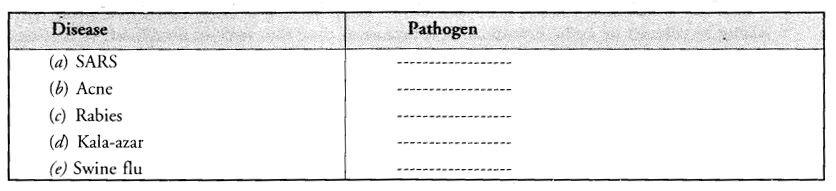
NCERT Solutions for Class 9 Science Chapter 13 Why Do we Fall Ill image - 5

Question 12.
Match the stimulus with Appropriate Response.
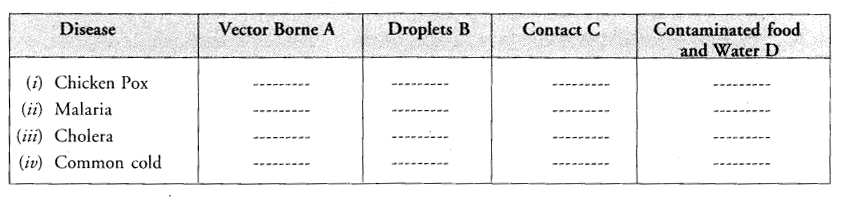
NCERT Solutions for Class 9 Science Chapter 13 Why Do we Fall Ill image - 6

Fill in the Blanks

Question 13. ………….. medicines are difficult to make as the pathogens have very few biochemical mechanisms of their own.
Question 14. In AIDS patients even small cold can become ……………. .
Question 15. Sleeping sickness is caused by …………. a protozoan.
Question 16. The two important contributory causes of diseases are ……………. and …………… make up.
Question 17. Health is the state of well being physically, ……………. and socially.

Answers:

NCERT Solutions for Class 9 Science Chapter 13 Why Do we Fall Ill image - 7

SOME TYPICAL QUESTIONS

Question 1.
Which parameters to health are difficult to measure ?
Answer:
Mental health and social well being.

Question 2.
Name the biologist who established that pathogen is a disease agent.
Answer:
Robert Koch.

Question 3.
Name the enzyme present in tears which prevents eye infections.
Answer:
Lysozyme.

Question 4.
What kills bacteria in our food in the mouth and stomach ?
Answer:
The enzyme lysozyme in saliva kills bacteria in food in our mouth, and in stomach HC1 of gastric juice kills the bacteria.

Question 5.
If a pregnant mother is suffering from AIDS, would her child get the disease via genes or placenta ?
Answer:
Placenta (Note : AIDS is not a genetic disease).

Question 6.
Why is it difficult to develop vaccines for some diseases ? (CCE 2011)
Answer:
It is difficult to develop vaccines against the diseases caused by viruses. Viruses are very specific to hosts. They have no metabolic machinery of their own. Viruses live and multiply only in the living cells. They cannot be cultured on artificial medium. It is because of these that vaccines are difficult to be prepared in such cases.

Question 7.
While going abroad, why is it essential to get vaccinated against certain diseases ?
Answer:
A person may be carrier of some disease. Such a person may take that particular disease to a foreign country. Therefore, all visitors to a foreign country are vaccinated against the disease which is not prevalent in that country.

Question 8.
Name such a vaccine which saves the life of babies from three diseases.
Answer:
D.P.T. is a vaccine which is three-in-one. Babies should be immunised within the first six weaks of birth D = Diphtheria, P= Pertussis (whooping cough), T = Tetanus.

Question 9.
Who discovered small pox vaccine ?
Answer:
Edward Jenner.

Question 10.
Define the word disease carrier.
Answer:
One who harbours germs of a disease but does not suffer from the disease is termed as carrier.

Question 11.
What are the common symptoms of infection ?
Answer:
In nearly all the infections of the human body, there is a rise in body temperature, an increased rate of heart beat, increased frequency of respiration, dry tongue, poor appetite, concentration of urine and changes in white blood cells circulating the blood.

NCERT Solutions for Class 9 Science Chapter 13 Why Do We Fall ill

Hope given NCERT Solutions for Class 9 Science Chapter 13 are helpful to complete your science homework.

If you have any doubts, please comment below. Learn Insta try to provide online science tutoring for you.