RD Sharma Class 8 Solutions Chapter 21 Mensuration II Ex 21.1

RD Sharma Class 8 Solutions Chapter 21 Mensuration II (Volumes and Surface Areas of a Cubiod and a Cube) Ex 21.1

These Solutions are part of RD Sharma Class 8 Solutions. Here we have given RD Sharma Class 8 Solutions Chapter 21 Mensuration II Ex 21.1

Other Exercises

Question 1.
Find the volume of a cuboid whose
(i) length = 12 cm, breadth = 8 cm, height = 6 cm
(ii) length = 1.2 m, breadth = 30 cm, height = 15 cm
(iii) length = 15 cm, breadth = 2.5 dm, height = 8 cm
RD Sharma Class 8 Solutions Chapter 21 Mensuration II Ex 21.1 1
Solution:
In a cuboid,
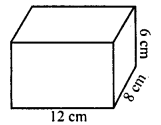
(i) Length (l) = 12 cm
Breadth (b) = 8 cm
Height (h) = 6 cm
∴ Volume = Ibh = 12 x 8 x 6 cm3 = 576 cm3
(ii) Length (l) = 1.2 m = 120 cm
breadth (6) = 30 cm
Height (h) = 15 cm
∴ Volume = Ibh = 120 x 30 x 15 cm3 = 54000 cm3
(iii) Length (l) = 15 cm
Breadth (b) = 2.5 dm = 25 cm
Height (h) = 8 cm
∴ Volume = Ibh
= 15 x 25 x 8 cm3 = 3000 cm2

Question 2.
Find the volume of the cube whose side is
(i) 4 cm
(ii) 8 cm
(iii) 1.5 dm
(iv) 1.2 m
(v) 25 mm.
Solution:
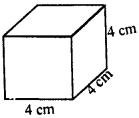
(i) Side of a cube (a) = 4 cm
∴ Volume = a3 = (4)3 cm3 = 4 x 4 x 4 = 64 cm3
RD Sharma Class 8 Solutions Chapter 21 Mensuration II Ex 21.1 2
(ii) Side of cube (a) = 8 cm
∴ Volume = a3 = (8)3 4 cm
= 8 x 8 x 8 cm3 = 512 cm3
(iii) Side of cube (a) = 1.5 dm = 15 cm
∴ Volume = a3 = (1.5)3 dm2 = (15)3 cm3
= 15 x 15 x 15 = 3375 cm3
(iv) Side of cube (a) = 1.2 m = 120 cm
∴ Volume = a3 = (120)3 cm3
= 120 x 120 x 120 = 1728000 cm3
(v) Side of cube (a) = 25 mm = 2.5 cm.
∴ Volume = a3 = (2.5)3 cm3
= 2.5 x 2.5 x 2.5 cm3 = 15.625 cm3

Question 3.
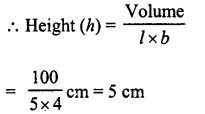
Find the height of a cuboid of volume 100 cm3 whose length and breadth are 5 cm and 4 cm respectively.
Solution:
Volume of a cuboid =100 cm3
Length (1) = 5 cm
and breadth (b) = 4 cm
RD Sharma Class 8 Solutions Chapter 21 Mensuration II Ex 21.1 3

Question 4.
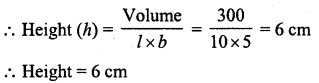
A cuboidal vessel is 10 cm long and 5 cm wide, how high it must be made to hold 300 cm3 of a liquid ?
Solution:
Volume of the liquid in the vessel = 300 cm3
Length (l)= 10 cm
Breadth (b) = 5 cm
RD Sharma Class 8 Solutions Chapter 21 Mensuration II Ex 21.1 4

Question 5.
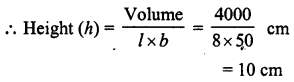
A milk container is 8 cm long and 50 cm wide. What should be its height so that it can hold 4 litres of milk ?
Solution:
Capacity of milk = 4 litres
∴ Volume of the container = 4 x 1000 cm3 = 4000 cm3
Length (l) = 8 cm
Width (b) = 50 cm
RD Sharma Class 8 Solutions Chapter 21 Mensuration II Ex 21.1 5

Question 6.
A cuboidal wooden block contains 36 cm3 wood. If it be 4 cm long and 3 cm wide, find its height.
Solution:
Volume of wooden cuboid block = 36 cm3
Length (l) = 4 cm
Breadth (b) = 3 cm

RD Sharma Class 8 Solutions Chapter 21 Mensuration II Ex 21.1 6

Question 7.
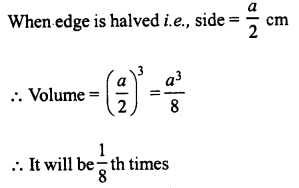
What will happen to the volume of a cube, if its edge is (i) halved (ii) trebled ?
Solution:
Let side of original cube = a cm
∴ Volume = a3 cm3
(i) In first case,
RD Sharma Class 8 Solutions Chapter 21 Mensuration II Ex 21.1 7
(ii) In second case, when side (edge) is trebled, then side = 3a
∴ Volume = (3a)3 = 27a3
∴ It will be 27 times

Question 8.
What will happen to the volume of a cuboid if its (i) Length is doubled, height is same and breadth is halved ? (ii) Length is doubled, height is doubled and breadth is same ?
Solution:
Let l, b and h be the length, breadth and height of the given cuboid respectively.
∴ Volume = lbh.
(i) Length is doubled = 21
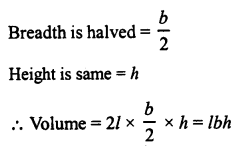
RD Sharma Class 8 Solutions Chapter 21 Mensuration II Ex 21.1 8
∴ The volume will be the same.
(ii) Length is doubled = 21
breadth is same = b height is doubled = 2h
∴ Volume = 2l x b x 2h = 4 lbh
∴ Volume will be 4 times

Question 9.
Three cuboids of dimensions 5 cm x 6 cm x 7 cm, 4 cm x 7 cm * 8 cm and 2 cm x 3 cm x 13 cm are melted and a cube is made. Find the side of cube.
Solution:
Dimensions of first cuboid = 5 cm x 6 cm x 7 cm
∴ Volume = 5 x 6 x 7 = 210 cm3
Dimensions of second cuboid = 4 cm x 7 cm x 8 cm
∴ Volume = 4x 7 x 8 = 224 cm3
Dimensions of third cuboid = 2 cm x 3 cm x 13 cm
∴ Volume = 2 x 3 x 13 = 78 cm3
Total volume of three cubes = 210 + 224 + 78 cm3 = 512 cm3
∴ Volume of cube = 512 cm3
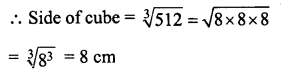
RD Sharma Class 8 Solutions Chapter 21 Mensuration II Ex 21.1 9

Question 10.
Find the weight of solid rectangular iron piece of size 50 cm x 40 cm x 10 cm, if 1 cm3 of iron weighs 8 gm.
Solution:
Dimension of cuboidal iron piece = 50 cm x 40 cm x 10 cm
∴ Volume = 50 x 40 x 10 = 20000 cm3
Weight of 1 cm3 = 8 gm
∴ Total weight of piece = 20000 x 8 gm
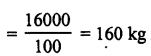
RD Sharma Class 8 Solutions Chapter 21 Mensuration II Ex 21.1 10

Question 11.
How many wooden cubical blocks of side 25 cm can be cut from a log of wood of size 3 m by 75 cm by 50 cm, assuming that there is no wastage ?
Solution:
Length of log (l) = 3 m = 300 cm.
Breadth (b) = 75 cm
and height (h) = 50 cm
∴ Volume of log = lbh = 300 x 75 x 50 cm3 = 1125000 cm3
Side of cubical block = 25 cm
∴ Volume of one block = a2 = 25 x 25 x 25 cm3 = 15625 cm3
∴ Number of blocks to be cut out
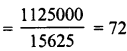
RD Sharma Class 8 Solutions Chapter 21 Mensuration II Ex 21.1 11

Question 12.
A cuboidal block of silver is 9 cm long, 4 cm broad and 3.5 cm in height. From it, beads of volume 1.5 cm2 each are to be made. Find the number of beads that can be made from the block ?
Solution:
Length of block (l) = 9 cm
Breadth (b) = 4 cm
and height (h) = 3.5 cm
∴ Volume = l x b x h = 9 x 4 x 3.5 cm3 = 126 cm3
Volume of one bead = 1.5 cm3
∴ Number of beads = \(\frac { 126 }{ 105 }\) = 84

Question 13.
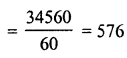
Find the number of cuboidal boxes measuring 2 cm by 3 cm by 10 cm which can be stored in a carton whose dimensions are 40 cm, 36 cm and 24 cm.
Solution:
Length of cuboidal box (l) = 2 cm
breadth (b) = 3 cm
and height (h) = 10 cm
∴ Volume = lx b x h = 2 x 3 x 10 = 60 cm3
Volume of carton = 40 x 36 x 24 cm3
= 34560 cm3
∴ Number of boxes to be height in the carton
RD Sharma Class 8 Solutions Chapter 21 Mensuration II Ex 21.1 12

Question 14.
A cuboidal block of solid iron has dimensions 50 cm, 45 cm and 34 cm. How many cuboids of size 5 cm by 3 cm by 2 cm can be obtained from the block ? Assume cutting causes no wastage.
Solution:
Dimensions of block = 50 cm, 45 cm, 34 cm
∴ Volume = 50 x 45 x 34 = 76500 cm3
Size of cuboid = 5 cm x 3 cm x 2 cm
∴ Volume of cuboid =  5 x 3 x 2 = 30 cm3

RD Sharma Class 8 Solutions Chapter 21 Mensuration II Ex 21.1 13

Question 15.
A cube A has side thrice as long as that of cube B ? What is the ratio of the volume of cube A to that of cube B ?
Solution:
Let side of cube B = a
Then Volume = a3
and side of cube A = 3a
Volume = (3a)3 = 3a x 3a x 2a = 27a3
∴ Ratio of volume’s A and B = 27a3 : a3
= 27 : 1

Question 16.
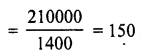
An ice-cream brick measures 20 cm by 10 cm by 7 cm. How many such bricks can be stored in a deep fridge whose inner dimensions are 100 cm by 50 cm by 42 cm ?
Solution:
Dimensions of ice cream brick = 20 cm x 10 cm x 7 cm
∴ Volume = 20 x 10 x 7 cm3 = 1400 cm3
Dimensions of inner of fridge = 100 cm x 50 cm x 42 cm = 210000 cm3
∴ Number of bricks to be kept in the fridge
RD Sharma Class 8 Solutions Chapter 21 Mensuration II Ex 21.1 14

Question 17.
Suppose that there are two cubes, having edges 2 cm and 4 cm, respectively. Find the volume V1 and V2 of the cubes and compare them.
Solution:
Side of first cube (a) = 2 cm
∴ Volume (V1) = a3 = (2) = 8 cm3
Similarly side of second cube = 4 cm
and volume (V2) = (4)3 = 64 cm3
Now V2 = 64 cm3 = 8 x 8 cm3
= 8 x V1
⇒ V2 = 8V1

Question 18.
A tea-packet measures 10 cm x 6 cm x 4 cm.How many such tea-packets can be placed in a cardboard box of dimensions 50 cm x 30 cm x 0.2 m ?
Solution:
Dimensions of tea-packet = 10cm x 6cm x 4 cm
∴ Volume =10 x 6 x 4 = 240 cm3
Dimensions of box = 50 cm x 30 cm x 0.2 m
= 50 cm x30 cm x20 cm
∴ Volume = 50 x 30 x 20 = 30000 cm3
∴ Number of tea-packets to be kept = \(\frac { 30000 }{ 240 }\)

Question 19.
The weight of a metal block of size 5 cm by 4 cm by 3 cm is 1 kg. Find the weight of a block of the same metal of size 15 cm by 8 cm by 3 cm.
Solution:
Dimensions of a metal block = 5 cm x 4 cm x 3 cm = 5 x 4 x 3 = 60 cm3
Dimensions of a second block = 15 cm x 8 cm x 3 cm = 15 x 8 x 3 = 360 cm3
But weight of first block = 1 kg
∴ Weight of second block
= \(\frac { 1 }{ 16 }\) x 360 = 6 kg

Question 20.
How many soap cakes can be placed in a box of size 56 cm x 0.4 m x 0.25 m, it the size of soap cake is 7 cm x 5 cm x 2.5 cm ?
Solution:
Size of box = 56 cm x 0.4 m x 0.25 m = 56 cm x 40 cm x 25 cm
∴ Volume = 56 x 40 x 25 cm3 = 56000 cm3
Size of a soap cake = 7 cm x 5 cm x 2.5 cm
∴ Volume = 7 x 5 x 2.5 cm3 = 87.5 cm3
∴ Number of cakes to be kept in the box
= \(\frac { 56000 }{ 87.5 }\) = 640

Question 21.
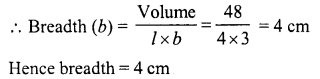
The volume of a cuboid box is 48 cm3. If its height and length are 3 cm and 4 cm respectively, find its breadth.
Solution:
Volume of cuboid box = 48 cm3
Length (l) = 4 cm
Height = (h) = 3 cm
RD Sharma Class 8 Solutions Chapter 21 Mensuration II Ex 21.1 15

Hope given RD Sharma Class 8 Solutions Chapter 21 Mensuration II Ex 21.1 are helpful to complete your math homework.

If you have any doubts, please comment below. Learn Insta try to provide online math tutoring for you.
RS Aggarwal Class 6 Solutions Chapter 4 Integers Ex 4B

RS Aggarwal Class 6 Solutions Chapter 4 Integers Ex 4B

These Solutions are part of RS Aggarwal Solutions Class 6. Here we have given RS Aggarwal Solutions Class 6 Chapter 4 Integers Ex 4B.

Other Exercises

Question 1.
Solution:
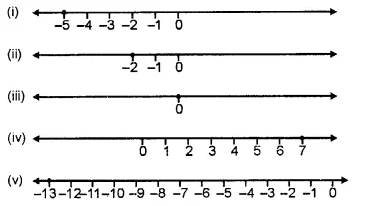
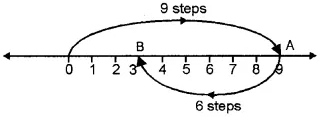
(i) On the number line we start from 0 and move 9 steps to the right to reach a point A. Now, starting from A, we move 6 steps to the left to reach a point B, as shown below :
RS Aggarwal Class 6 Solutions Chapter 4 Integers Ex 4B 1.1
Now, B represents the integer 3
9 + ( – 6) = 3
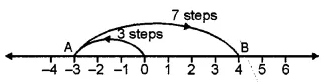
(ii) On the number line, we start from 0 and move 3 steps to the left to reach a point A. Now, starting from A, we move 7 steps to the right to reach a point B, as shown below :
RS Aggarwal Class 6 Solutions Chapter 4 Integers Ex 4B 1.2
And B represents the integer 4
( – 3) + 7 = 4
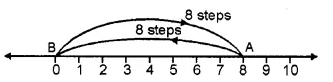
(iii) On the number line, we start from 0 and move 8 steps to the right to reach a point A. Now, starting from A, we move 8 steps to the left to reach a point B, as shown below :
RS Aggarwal Class 6 Solutions Chapter 4 Integers Ex 4B 1.3
And, B represents the integer 0.
8 + ( – 8) = 0
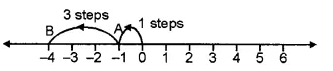
(iv) On the number line, we start from 0 and move 1 step the left to reach a point A. Now, starting from point A, we move 3 steps to the left to reach g. point B, as shown below :
RS Aggarwal Class 6 Solutions Chapter 4 Integers Ex 4B 1.4
And, B represents the integer – 4
( – 1) + ( – 3) = – 4.
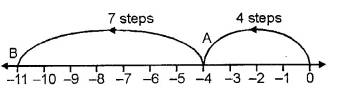
(v) On the number line, we start from 0 and move 4 steps to the left to reach a point A. Now, starting from point A, we move 7 steps to the left to reach a point B, as shown below :
RS Aggarwal Class 6 Solutions Chapter 4 Integers Ex 4B 1.5
And, B represents the integer -11.
( – 4) + ( – 7) = – 11
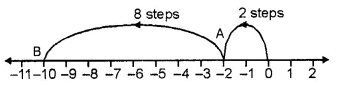
(vi) On the number line we start from 0 and move 2 steps to the left to reach a point A. Now, starting from A, we move 8 steps to the left to reach a point B, as shown below :
RS Aggarwal Class 6 Solutions Chapter 4 Integers Ex 4B 1.6
And, B represents the integer – 10
( – 2) + ( – 8) = – 10
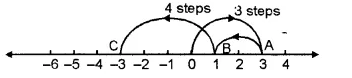
(vii) On the number line we start from 0 and move 3 steps to the right to reach a point A. Now, starting from A, we move 2 steps to the left to reach a point B and again starting from left to reach a point B and again starting from B, we move 4 steps to the left to reach a point C, as shown below :
RS Aggarwal Class 6 Solutions Chapter 4 Integers Ex 4B 1.7
And, C represents the integer – 3
3 + ( – 2) + ( – 4) = – 3
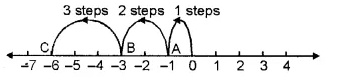
(viii) On the number line we start from 0 and move 1 step to the left to reach a point A. Now, starting from A, we move 2 steps to the left to reach a point B and again starting from B, we move 3 steps to the left to reach point C, as shown below :
RS Aggarwal Class 6 Solutions Chapter 4 Integers Ex 4B 1.8
And, C represents the integer – 6
( – 1) + ( – 2) + ( – 3) = – 6.
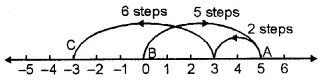
(ix) On the number line we start from 0 and move 5 steps to the right to reach a point A. Now, starting from A, we move 2 steps to the left to reach a point B and again starting from point B, we move 6 steps to the left to reach a point C, as shown below :
RS Aggarwal Class 6 Solutions Chapter 4 Integers Ex 4B 1.9
And, C represents the integer – 3.
5 + (- 2) + (- 6) = – 3

Question 2.
Solution:
(i) (- 3) + ( – 9) = – 12
(Using the rule for addition of integers having like signs)
(ii) ( – 7) + ( – 8) = – 15
(Using the rule for addition of integers having like signs)
(iii) ( – 9) + 16 = 7
(Using the rule for addition of integers having unlike signs)
(iv) ( – 13) + 25 = 12
(Using the rule for addition of integers having unlike signs)
(v) 8 + ( – 17) = – 9
(Using the rule for addition of integers having unlike signs)
(vi) 2 + ( – 12) = – 10
(Using the rule for addition of integers having unlike signs)

Question 3.
Solution:
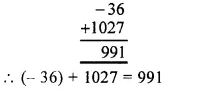
(i) Using the rule for addition of integers with like signs, we get:
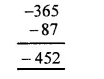
RS Aggarwal Class 6 Solutions Chapter 4 Integers Ex 4B 3.1
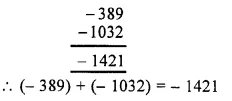
(ii) Using the rule for addition of integers with like signs, we get :
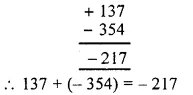
RS Aggarwal Class 6 Solutions Chapter 4 Integers Ex 4B 3.2
(iii) Using the rule for addition of integers with like signs, we get :
RS Aggarwal Class 6 Solutions Chapter 4 Integers Ex 4B 3.3
(iv) Using the rule for addition of integers with like signs, we get:
RS Aggarwal Class 6 Solutions Chapter 4 Integers Ex 4B 3.4

Question 4.
Solution:
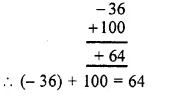
(i) Using the rule for addition of integers with unlike signs, we get:
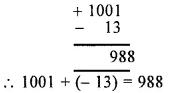
RS Aggarwal Class 6 Solutions Chapter 4 Integers Ex 4B 4.1
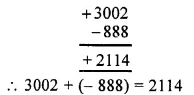
(ii) Using the rule for addition of integers with unlike signs, we get:
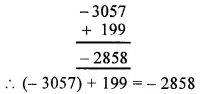
RS Aggarwal Class 6 Solutions Chapter 4 Integers Ex 4B 4.2
(iii) Using the rule for addition of integers with unlike signs, we have
RS Aggarwal Class 6 Solutions Chapter 4 Integers Ex 4B 4.3
(iv) Using the rule for addition of integers with unlike signs, we have
RS Aggarwal Class 6 Solutions Chapter 4 Integers Ex 4B 4.4

Question 5.
Solution:
(i) Using the rule for addition of integers with unlike signs, we get :
RS Aggarwal Class 6 Solutions Chapter 4 Integers Ex 4B 5.1
(ii) Using-the rule for addition of integers with unlike signs, we get
RS Aggarwal Class 6 Solutions Chapter 4 Integers Ex 4B 5.2
(iii) Using the rule for addition of integers with unlike signs, we get :
RS Aggarwal Class 6 Solutions Chapter 4 Integers Ex 4B 5.3
(iv) Using the rule for addition of integers with unlike signs, we get :
RS Aggarwal Class 6 Solutions Chapter 4 Integers Ex 4B 5.4
(v) Using the rule for addition of integers with like signs, we get:
RS Aggarwal Class 6 Solutions Chapter 4 Integers Ex 4B 5.5
(vi) Using the rule for addition of integers with unlike signs, we get :
RS Aggarwal Class 6 Solutions Chapter 4 Integers Ex 4B 5.6
(vii) Using the rule for addition of integers with unlike signs, we get :
RS Aggarwal Class 6 Solutions Chapter 4 Integers Ex 4B 5.7
(viii) We have, ( – 18) + 25 + ( – 37)
= [( – 18) + 25] + ( – 37)
= 7 + ( – 37)
= – 30
(ix) We have, – 312 + 39 + 192
= ( – 312) + (39 + 192)
= ( – 312) + 231
= – 81
(x) We have ( – 51) + ( – 203) + 36 + ( – 28)
= [( – 51) + ( – 203)] + [36 + ( – 28)]
= ( – 254) + 8
= – 246

Question 6.
Solution:
(i) The additive inverse of – 57 is 57
(ii) The additive inverse of 183 is – 183
(iii) The additive inverse of 0 is 0
(iv) The additive inverse of – 1001 is 1001
(v) The additive inverse of 2054 is – 2054

Question 7.
Solution:
(i) Successor of 201 = 201 + 1 = 202
(ii) Successor of 70 = 70 + 1 = 71
(iii) Successor of – 5 = – 5 + 1 = – 4
(iv) Successor of – 99 = – 99 + 1 = – 98
(v) Successor of – 500 = – 500 + 1 = – 499 Ans.

Question 8.
Solution:
(i) Predecessor of 120 = 120 – 1 = 119
(ii) Predecessor of 79 = 79 – 1 = 78
(iii) Predecessor of – 8 = – 8 – 1 = – 9
(iv) Predecessor of – 141 = – 141 – 1 = – 142
(v) Predecessor of – 300 = – 300 – 1 = – 301 Ans.

Question 9.
Solution:
(i) ( – 7) + ( – 9) + 12 + ( – 16)
= – 7 – 9 + 12 – 16
= – 7 – 9 – 16 + 12
= – 32 + 12
= – 20
(ii) 37 + ( – 23) + ( – 65) + 9 + ( – 12)
= 37 – 23 – 65 + 9 – 12
= 37 + 9 – 23 – 65 – 12
= 46 – 100
= – 54
(iii) ( – 145) + 79 + ( – 265) + ( – 41) + 2
= – 145 + 79 – 265 – 41 + 2
= 79 + 2 – 145 – 265 – 41
= 81 – 451
= – 370
(iv) 1056 + ( – 798) + ( – 38) + 44 + ( – 1)
= 1056 – 798 – 38 + 44 – 1
= 1056 + 44 – 798 – 38 – 1
= 1100 – 837
= 263 Ans.

Question 10.
Solution:
Distance travelled from Patna to its north = 60 km
Distance travelled from that place to south of it = 90 km
Distance of the final place to Patna = 60 – 90
= – 30 km
= 30 km south
Ans.

Question 11.
Solution:
Total amount of pencils purchased = Rs. 30 + Rs. 25
= Rs 55
Total amount of pens purchased = Rs. 90
Total cost price = Rs. 55 + Rs. 90
= Rs. 145
Total sale price of pencils and pens = Rs 20 + Rs. 70
= Rs. 90
Loss = cost price – selling price
= Rs. 145 – Rs. 90
= Rs. 55 Ans.

Question 12.
Solution:
(i) True.
(ii) False : As if positive integer is greater then it will be positive.
(iii) True : As ( – a + a = 0).
(iv) False : As the sum of three integers can be zero or non-zero.
(v) False : As | – 5 | = 5 and | – 3 | = 3 and 5 ≮ 3.
(vi) False : | 8 – 5 | = | 3 | = 3 and | 8 | + | – 5 | = 8 + 5 = 13.

Question 13.
Solution:
(i) a + 6 = 0
Subtracting 6 from both sides,
a + 6 – 6 = 0 – 6
=> a = – 6
a = – 6.
(ii) 5 + a = 0
Subtracting 5 from both sides,
5 + a – 5 = 0 – 5
=> a = – 5
a = – 5
(iii) a + ( – 4) = 0
Adding 4 to both sides,
a + ( – 4) + 4 = 0 + 4
=> a = 4
a = 4
(iv) – 8 + a = 0
Adding 8 to both sides,
– 8 + a + 8 = 0 + 8
=> a – 8
a = 8 Ans.

Hope given RS Aggarwal Solutions Class 6 Chapter 4 Integers Ex 4B are helpful to complete your math homework.

If you have any doubts, please comment below. Learn Insta try to provide online math tutoring for you.
RS Aggarwal Class 6 Solutions Chapter 4 Integers Ex 4A

RS Aggarwal Class 6 Solutions Chapter 4 Integers Ex 4A

These Solutions are part of RS Aggarwal Solutions Class 6. Here we have given RS Aggarwal Solutions Class 6 Chapter 4 Integers Ex 4A.

Other Exercises

Question 1.
Solution:
(i) A decrease of 8
(ii) A gain of Rs. 7
(iii) Loosing a weight of 5 kg
(iv) 10 km below sea level
(v) 5°C above the freezing point
(vi) A withdrawal of Rs. 100
(vii) Spending Rs. 500
(viii) Going 6 m to the west
(ix) – 24
(x) 34

Question 2.
Solution:
(i) + Rs. 600
(ii) – Rs. 800
(iii) – 7°C
(iv) – 9
(v) + 2 km
(vi) – 3 km
(vii) + Rs. 200
(viii) – Rs. 300

Question 3.
Solution:
RS Aggarwal Class 6 Solutions Chapter 4 Integers Ex 4A 3.1

Question 4.
Solution:
(i) 0
(ii) – 3
(iii) 2
(iv) 8
(v) – 365
(vi) 8

Question 5.
Solution:
(i) – 7
(ii) – 1
(iii) – 27
(iv) – 26
(v) – 603
(vi) – 777

Question 6.
Solution:
(i) The integers between 0 and 6 are
1, 2, 3, 4, 5.
(ii) The integers between – 5 and 0 are
– 4, – 3, – 2, – 1.
(iii) The integers between – 3 and 3 are
– 2, – 1, 0, 1, 2.
(iv) The integer between – 7 and – 5 is – 6.

Question 7.
Solution:
(i) 0 < 7
(ii) 0 > – 3
(iii) – 5 < – 2
(iv) – 15 < 13
(v) – 231 < – 132
(vi) – 6 < 6

Question 8.
Solution:
(i) – 7, – 2, 0, 5, 8
(ii) – 100, – 23, – 6, – 1, 0, 12
(iii) – 501, – 363, – 17, 15, 165
(iv) – 106, – 81, – 16, – 2, 0, 16, 21.

Question 9.
Solution:
(i) 36, 7, 0, – 3, – 9, – 132
(ii) 51, 0, – 2, – 8, – 53
(iii) 36, 0, – 5, – 71, – 81
(iv) 413, 102, – 7, – 365, – 515.

Question 10.
Solution:
(i) We want to write an integer 4 more than 6. So, we start from 6 and proceed 4 steps to the right to obtain 10, as shown below:
RS Aggarwal Class 6 Solutions Chapter 4 Integers Ex 4A 10.1
∴ 4 more than 6 is 10.
(ii) We want to write an integer 5 more than – 6. So, we start from – 6 and proceed 5 steps to the right to obtain – 1, as shown below :
RS Aggarwal Class 6 Solutions Chapter 4 Integers Ex 4A 10.2
∴ 5 more than – 6 is – 1.
(iii) We want to write an integer 6 less than 2. So we start from 2 and come back to the left by 6 steps to obtain – 4, as shown below:
RS Aggarwal Class 6 Solutions Chapter 4 Integers Ex 4A 10.3
∴ 6 less than 2 is – 4.
(iv) We want to write an integer 2 less than – 3. So we start from – 3 and come back to the left by 2 steps to obtain – 5, as shown below :
RS Aggarwal Class 6 Solutions Chapter 4 Integers Ex 4A 10.4
∴ 2 less than – 3 is – 5.

Question 11.
Solution:
(i) False, as zero is greater than every negative integer.
(ii) False, as zero is an integer.
(iii) True, as zero is neither positive nor negative.
(iv) False, as – 10 is to the left of – 6 on a number line.
(v) False, as absolute value of an integer is always equal to the integer.
(vi) True, as 0 is to right of every negative integer, on a number line.
(vii) False, as every natural number is positive. False, the successor is – 186
(viii) False, the predecessor is – 216

Question 12.
Solution:
(i) | – 9 | = 9
(ii) | 36 | = 36
(iii) | 0 | = 0
(iv) | 15 | = 15
(v) – | – 3 | = – 3
(vi) 7 + | – 3 | = 7 + 3 = 10
(vii) |7 – 4| = | 3 | = 3
(viii) 8 – | – 7| = 8 – 7 = 1

Question 13.
Solution:
The required integers are – 6, – 5, – 4, – 3, – 2.
The required integers are – 21, – 22, – 23, – 24, – 25.


Hope given RS Aggarwal Solutions Class 6 Chapter 4 Integers Ex 4A are helpful to complete your math homework.

If you have any doubts, please comment below. Learn Insta try to provide online math tutoring for you.
RS Aggarwal Class 6 Solutions Chapter 3 Whole Numbers Ex 3F

RS Aggarwal Class 6 Solutions Chapter 3 Whole Numbers Ex 3F

These Solutions are part of RS Aggarwal Solutions Class 6. Here we have given RS Aggarwal Solutions Class 6 Chapter 3 Whole Numbers Ex 3F.

Other Exercises

Objective questions
Mark against the correct answer in each of the following :

Question 1.
Solution:
The smallest whole number is 0 (b)

Question 2.
Solution:
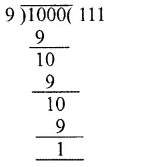
The least 4-digit number = 1000
On dividing 1000 by 9, we get
Remainder = 1
RS Aggarwal Class 6 Solutions Chapter 3 Whole Numbers Ex 3F 1.1
Least 4-digit number which is
Divisible by 9 = 1000 – 1 + 9
= 1000 + 8
= 1008 (d)

Question 3.
Solution:
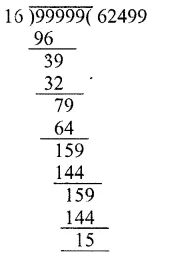
The largest 6-digit number = 999999
On dividing by 16, we get
Remainder =15
RS Aggarwal Class 6 Solutions Chapter 3 Whole Numbers Ex 3F 3.1
The greatest 6-digit number divisible by 16
= 999999 – 15
= 999984 (c)

Question 4.
Solution:
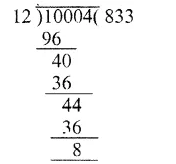
On dividing 10004 by 12, we get remainder = 8
RS Aggarwal Class 6 Solutions Chapter 3 Whole Numbers Ex 3F 4.1
8 is to be subtracted from 10004 (c)

Question 5.
Solution:
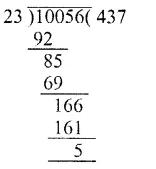
On dividing 10056 by 23 We get remainder =12
RS Aggarwal Class 6 Solutions Chapter 3 Whole Numbers Ex 3F 5.1
The least number to be added = 23 – 5
= 18 (b)

Question 6.
Solution:
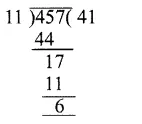
On dividing 457 by 11
We get remainder = 6
RS Aggarwal Class 6 Solutions Chapter 3 Whole Numbers Ex 3F 6.1
Which is greater than half of 11
The number nearest to 457 which is divisible 11 will be = 457 – 6 + 11
= 457 + 5
= 462 (d)

Question 7.
Solution:
Whole number between 1018 and 1203 are 1019 to 1202 are 1202 – 1018
= 184 (c)

Question 8.
Solution:
Divisor = 46
Quotient =11
Remainder =15
Number = Divisor x Quotient + Remainder
= 46 x 11 + 15
= 506 + 15
= 521 (b)

Question 9.
Solution:
Dividend = 199
Quotient =16
Remainder = 7
Divisor = \(\\ \frac { 199-7 }{ 16 } \) = \(\\ \frac { 192 }{ 16 } \)
= 12 (c)

Question 10.
Solution:
7589 – ? = 3434
Required number = 7589 – 3434
= 4155 (c)

Question 11.
Solution:
587 x 99 = 587 x (100 – 1)
= 587 x 100 – 587 x 1
= 58700 – 587
= 58113 (c)

Question 12.
Solution:
4 x 538 x 25 = 538 x 4 x 25
= 538 x 100
= 53800 (c)

Question 13.
Solution:
24679 x 92 + 24679 x 8
= 24679 x (92 + 8)
= 24679 x 100
= 2467900 (c)

Question 14.
Solution:
1625 x 1625 – 1625 x 625
= 1625 (1625 – 625)
= 1625 x 1000
= 1625000 (a)

Question 15.
Solution:
1568 x 185 – 1568 x 85
= 1568 (185 – 85)
= 1568 x 100
= 156800 (c)

Question 16.
Solution:
888 + 111 + 555 = 111 x ?
= 11 (8 + 7 + 5)
= 111 x 20 (c)

Question 17.
Solution:
The sum of two odd number is an even number (b)

Question 18.
Solution:
The product of two odd numbers is an odd number (a)

Question 19.
Solution:
If a is a whole number such that
a + a = a, then a = 0
as 0 + 0 = 0
None of these (d)

Question 20.
Solution:
The predecessor of 10000 is 10000 – 1
= 9999 (b)

Question 21.
Solution:
The successor of 1001 is 1001 + 1
= 1002 (b)

Question 22.
Solution:
The smallest even whole number is 2 (b)

Hope given RS Aggarwal Solutions Class 6 Chapter 3 Whole Numbers Ex 3F are helpful to complete your math homework.

If you have any doubts, please comment below. Learn Insta try to provide online math tutoring for you.
Value Based Questions in Science for Class 10 Chapter 6 Life Processes

Value Based Questions in Science for Class 10 Chapter 6 Life Processes

These Solutions are part of Value Based Questions in Science for Class 10. Here we have given Value Based Questions in Science for Class 10 Chapter 6 Life Processes

Question 1.
What do we get from environment and what do we give out to environment ? Should we degrade it ?
Answer:
We obtain nutrients, water and oxygen from the environment. In return we give out undigested materials, CO2 and waste products. Environment has been metabolising our wastes for regenerating nutrients and other materials required by us. However, we are producing so many articles for our use which are non-biodegradable. We also generate a lot more garbage, sewage, effluents, polluting gases and particulate matter than the capacity of the environment to metabolise them. They are becoming source of contaminations, infections and disorders. Therefore, we should take immediate measures to stop degrading our environment.

More Resources

Question 2.
Two processes are basic to life on earth. What are they ? How do these processes sustain life ?
Answer:
Photosynthesis and respiration are two processes that are basic to life on earth. Without them, life will disappear from earth. Photosynthesis traps solar energy, converts it into chemical energy and manufactures organic matter by reducing CO2. The organic matter produced in photosynthesis not only supports plants but all types of life, helping them in building their body and supplying energy.
Respiration is the process of release of energy from organic matter. This food or chemical energy is essential for maintenance, growth and working of the bodies of the living beings including the plants which trap solar energy.

Question 3.
Soil air is essential for growth and functioning of roots. However, roots do not have pores for exchange of gases. Explain.
Answer:
Roots require a lot of energy for active absorption of minerals and good growth so as to form new root hairs for continued absorption of water. This is possible only with the help of aerobic respiration for which good soil air is required. It should remain connected with atmospheric air for renewal. In soil, exchange of gases occurs at the surface of young roots through diffusion because the external walls of epiblema cells and root hairs are uncutinised. Therefore, despite the absence of pores, roots are always exchanging metabolic gases with the soil air.

Question 4.
In breathing, which ones are active and which ones are passive processes — expansion of thorax, passage of air from outside to lungs and exhalation.
Answer:

  1. Expansion of Thorax: It is an active process which involves contraction of phrenic and external intercostal muscles.
  2. Passage of Air from Outside into Lungs: It is a passive process which occurs due to development of negative pressure in the lungs when they expand with the expansion of thorax.
  3. Exhalation: It is a passive process which occurs due to relaxation of phrenic and external intercostal muscles resulting in contraction of thorax and hence lungs.

Hope given Value Based Questions in Science for Class 10 Chapter 6 Life Processes are helpful to complete your science homework.

If you have any doubts, please comment below. Learn Insta try to provide online science tutoring for you.