RS Aggarwal Class 6 Solutions Chapter 5 Fractions Ex 5C

RS Aggarwal Class 6 Solutions Chapter 5 Fractions Ex 5C

These Solutions are part of RS Aggarwal Solutions Class 6. Here we have given RS Aggarwal Solutions Class 6 Chapter 5 Fractions Ex 5C.

Other Exercises

Question 1.
Solution:
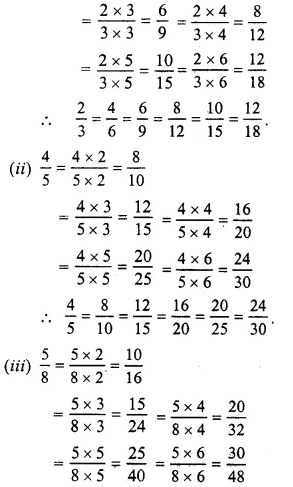
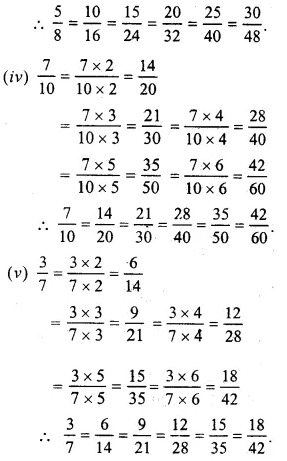
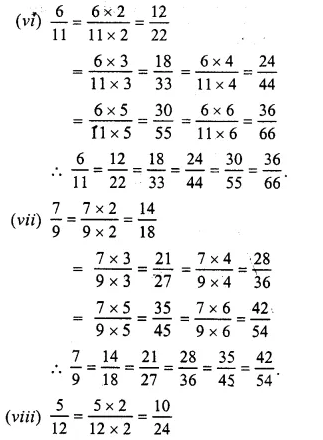
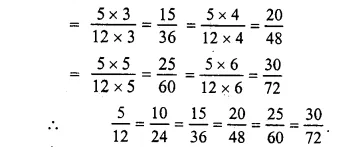
(i) \(\\ \frac { 2 }{ 3 } \)
= \(\\ \frac { 2X2 }{ 3X2 } \)
= \(\\ \frac { 4 }{ 6 } \)
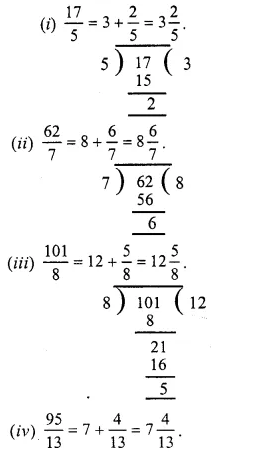
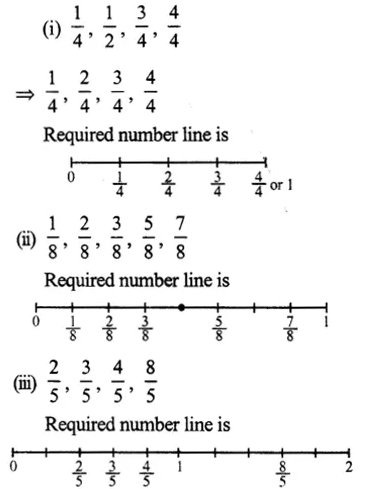
RS Aggarwal Class 6 Solutions Chapter 5 Fractions Ex 5C 1.1
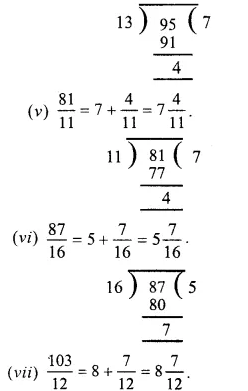
RS Aggarwal Class 6 Solutions Chapter 5 Fractions Ex 5C 1.2
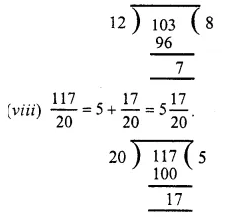
RS Aggarwal Class 6 Solutions Chapter 5 Fractions Ex 5C 1.3
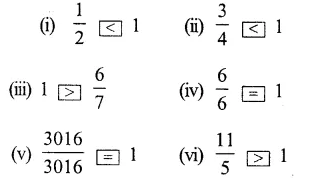
RS Aggarwal Class 6 Solutions Chapter 5 Fractions Ex 5C 1.4

Question 2.
Solution:
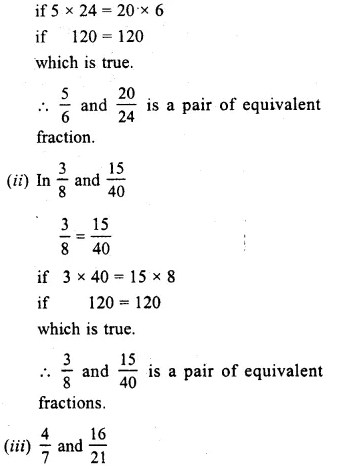
(i) In \(\\ \frac { 5 }{ 6 } \) and \(\\ \frac { 20 }{ 24 } \)
\(\\ \frac { 5 }{ 6 } \) = \(\\ \frac { 20 }{ 24 } \)
RS Aggarwal Class 6 Solutions Chapter 5 Fractions Ex 5C 2.1
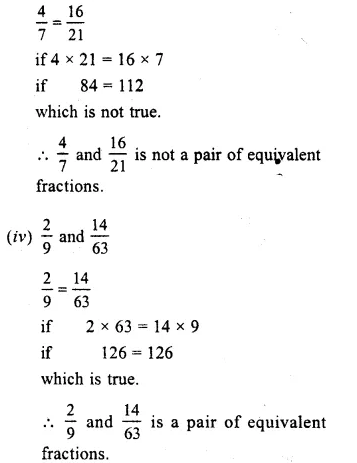
RS Aggarwal Class 6 Solutions Chapter 5 Fractions Ex 5C 2.2
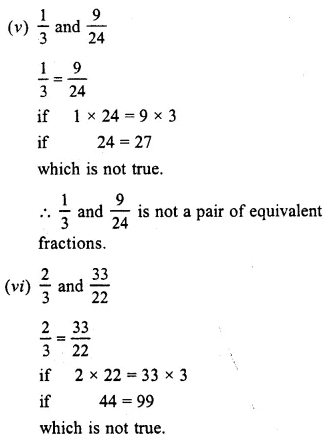
RS Aggarwal Class 6 Solutions Chapter 5 Fractions Ex 5C 2.3
RS Aggarwal Class 6 Solutions Chapter 5 Fractions Ex 5C 2.4

Question 3.
Solution:
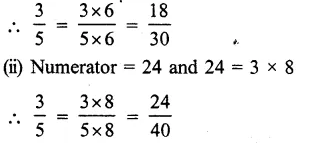
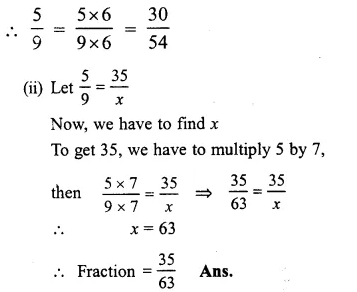
Equivalent fraction of \(\\ \frac { 3 }{ 5 } \) having
(i) Denominator = 30 and 30 = 5 x 6
RS Aggarwal Class 6 Solutions Chapter 5 Fractions Ex 5C 3.1

Question 4.
Solution:
(i) Denominator = 54, and 54 = 9 x 6
RS Aggarwal Class 6 Solutions Chapter 5 Fractions Ex 5C 4.1

Question 5.
Solution:
Equivalent fraction of \(\\ \frac { 6 }{ 11 } \) having
(i) Denominator = 77 and 77 = 11 = 7
\(\\ \frac { 6 }{ 11 } \)
= \(\\ \frac { 6X7 }{ 11X7 } \)
= \(\\ \frac { 42 }{ 77 } \)
(ii) Numerator = 60 and 60 = 6 x 10
\(\\ \frac { 6 }{ 11 } \)
= \(\\ \frac { 6X10 }{ 11X10 } \)
= \(\\ \frac { 60 }{ 110 } \)

Question 6.
Solution:
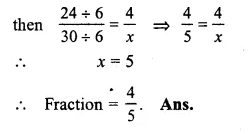
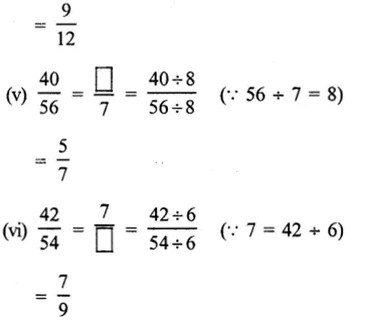
Let \(\\ \frac { 24 }{ 30 } \) = \(\\ \frac { 4 }{ x } \)
In order to get 4, divide 24 by 6,
RS Aggarwal Class 6 Solutions Chapter 5 Fractions Ex 5C 6.1

Question 7.
Solution:
Equivalent fraction of \(\\ \frac { 36 }{ 48 } \), with
(i) Numerator 9 and 9 = 36 + 4
\(\frac { 36 }{ 48 } =\frac { 36\div 4 }{ 48\div 4 } =\frac { 9 }{ 12 } \)
(ii) Denominator = 4 and 4 = 48 ÷ 12
\(\frac { 36 }{ 48 } =\frac { 36\div 12 }{ 48\div 12 } =\frac { 3 }{ 4 } \)

Question 8.
Solution:
Equivalent fraction of \(\\ \frac { 56 }{ 70 } \) with
(i) Numerator 4 and = 56 ÷ 14
\(\frac { 56 }{ 70 } =\frac { 56\div 14 }{ 70\div 14 } =\frac { 4 }{ 5 } \)
(ii) Denominator =10 and 10 = 70 ÷ 7
\(\frac { 56 }{ 70 } =\frac { 56\div 7 }{ 70\div 7 } =\frac { 8 }{ 10 } \)

Question 9.
Solution:
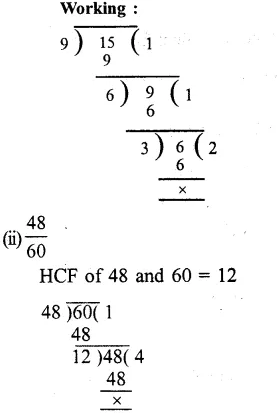
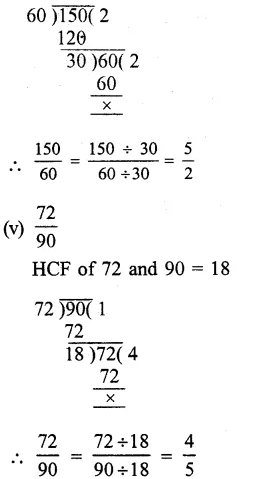
(i) In \(\\ \frac { 9 }{ 15 } \), HCF of 9 and 15 = 3
Now, dividing each term by 3, we get:
\(\frac { 9 }{ 15 } =\frac { 9\div 3 }{ 15\div 3 } =\frac { 3 }{ 5 } \)
RS Aggarwal Class 6 Solutions Chapter 5 Fractions Ex 5C 9.1
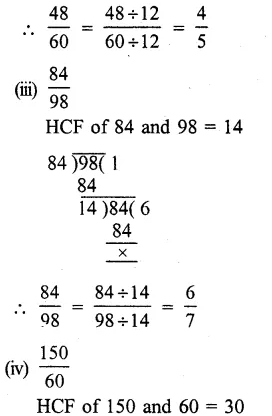
RS Aggarwal Class 6 Solutions Chapter 5 Fractions Ex 5C 9.2
RS Aggarwal Class 6 Solutions Chapter 5 Fractions Ex 5C 9.3

Question 10.
Solution:
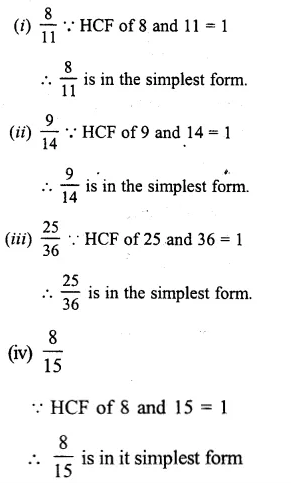
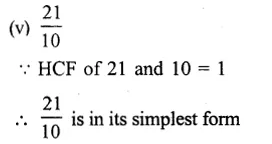
We know that a fraction is in its simplest form if its HCF of numerator and denominator is 1.
RS Aggarwal Class 6 Solutions Chapter 5 Fractions Ex 5C 10.1
RS Aggarwal Class 6 Solutions Chapter 5 Fractions Ex 5C 10.2

Question 11.
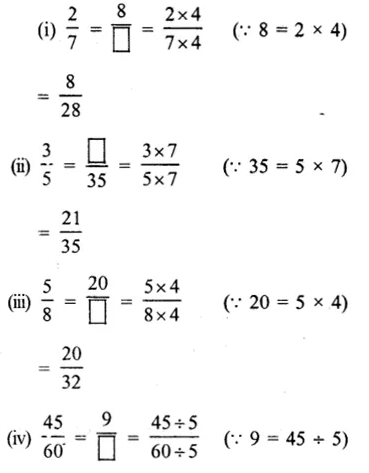
Solution:
RS Aggarwal Class 6 Solutions Chapter 5 Fractions Ex 5C 11.1
RS Aggarwal Class 6 Solutions Chapter 5 Fractions Ex 5C 11.2

Hope given RS Aggarwal Solutions Class 6 Chapter 5 Fractions Ex 5C are helpful to complete your math homework.

If you have any doubts, please comment below. Learn Insta try to provide online math tutoring for you.

RS Aggarwal Class 6 Solutions Chapter 5 Fractions Ex 5B

RS Aggarwal Class 6 Solutions Chapter 5 Fractions Ex 5B

These Solutions are part of RS Aggarwal Solutions Class 6. Here we have given RS Aggarwal Solutions Class 6 Chapter 5 Fractions Ex 5B.

Other Exercises

Question 1.
Solution:
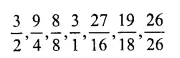
We know that, a fraction is proper if its denominator is greater than its numerator. Therefore,
\(\\ \frac { 1 }{ 2 } \), \(\\ \frac { 3 }{ 5 } \) and \(\\ \frac { 10 }{ 11 } \) are proper fractions. Ans.

Question 2.
Solution:
We know that a fraction is improper if its denominator is less than its numerator
Therefore,
RS Aggarwal Class 6 Solutions Chapter 5 Fractions Ex 5B 2.1
are improper fractions. Ans.

Question 3.
Solution:
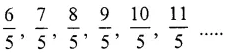
Six improper fractions with denominator 5 can be
RS Aggarwal Class 6 Solutions Chapter 5 Fractions Ex 5B 3.1

Question 4.
Solution:
Six improper fraction with denominator 13 can be
RS Aggarwal Class 6 Solutions Chapter 5 Fractions Ex 5B 4.1

Question 5.
Solution:
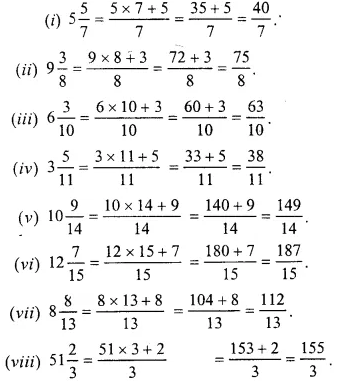
RS Aggarwal Class 6 Solutions Chapter 5 Fractions Ex 5B 5.1

Question 6.
Solution:
RS Aggarwal Class 6 Solutions Chapter 5 Fractions Ex 5B 6.1
RS Aggarwal Class 6 Solutions Chapter 5 Fractions Ex 5B 6.2
RS Aggarwal Class 6 Solutions Chapter 5 Fractions Ex 5B 6.3

Question 7.
Solution:
RS Aggarwal Class 6 Solutions Chapter 5 Fractions Ex 5B 7.1

Question 8.
Solution:
RS Aggarwal Class 6 Solutions Chapter 5 Fractions Ex 5B 8.1

Hope given RS Aggarwal Solutions Class 6 Chapter 5 Fractions Ex 5B are helpful to complete your math homework.

If you have any doubts, please comment below. Learn Insta try to provide online math tutoring for you.

RD Sharma Class 8 Solutions Chapter 21 Mensuration II Ex 21.3

RD Sharma Class 8 Solutions Chapter 21 Mensuration II Ex 21.3

These Solutions are part of RD Sharma Class 8 Solutions. Here we have given RD Sharma Class 8 Solutions Chapter 21 Mensuration II Ex 21.3

Other Exercises

Question 1.
Find the surface area of a cuboid whose :
(i) length = 10 cm, breadth = 12 cm and height = 14 cm
(ii) length = 6 dm, breadth = 8 dm, height = 10 dm
(iii) length = 2 m, breadth = 4 m and height = 5 m
(iv) length = 3.2 m, breadth = 30 dm, height = 250 cm.
Solution:
(i) Length of cuboid (l) = 10 cm
Breadth (b) = 12 cm
Height (h) = 14 cm
∴ Surface area = 2(1 × b + b × h + h × l)
= 2(10 x 12 + 12 x 14 + 14 x 10) cm2
= 2(120+ 168 + 140) cm2
= 2 x 428 = 856 cm2
(ii) Length of cuboid (l) = 6 dm
Breadth (b) = 8 dm
Height (h) = 10 dm
∴ Surface area = 2 ( l × b + b x h + h× l)
= 2(6 x 8 + 8 x 10 + 10 x 6) dm2
= 2(48 + 80 + 60) dm2 = 2 x 188 = 376 dm2
(iii) Length of cuboid (l) = 2 m
Breadth (b) = 4 m
Height (h) = 5 m
∴ Surface area = 2(l × b + b × h + h × l)
= 2(2 x 4 + 4 x 5 + 5 x 2) m2
= 2(8 + 20 + 10) m2 = 76 m2
(iv) Length of cuboid (l) = 3.2 m = 32 dm
Breadth (b) = 30 dm
Height (h) = 250 cm = 25 dm
∴ Surface area = 2(1 x b + b x h + h x l)
= 2(32 x 30 + 30 x 25 + 25 x 32) dm2
= 2(960 + 750 + 800) dm2
= 2 x 2510 = 5020 dm2

Question 2.
Find the surface area of a cube whose edge is
(i) 1.2 m
(ii) 27 cm
(iii) 3 cm
(iv) 6 m
(v) 2.1m
Solution:
(i) Edge of the cube (a) = 1.2 m
∴ Surface area = 6a2= 6 x (1,2)2 m2
= 6 x 1.44 = 8.64 m2
(ii) Edge of cube (a) = 27 cm
∴ Surface area = 6a2 = 6 x (27)2 m2
= 6 x 729 = 4374 m2
(iii) Edge of cube (a) = 3 cm
Surface area = 6a2 = 6 x (3)2 m2
= 6×9 cm2 = 54 cm2
(iv) Edge of cube (a) = 6 m
∴ Surface area = 6a2 = 6 x (6)2 m2
= 6 x 6 x 6 = 216 m2
(v) Edge of the cube (a) = 2.1 m
∴ Surface area = 6a2 = 6 x (2.1)2 m2
= 6 x 4.41 = 26.46 m2

Question 3.
A cuboidal box is 5 cm by 5 cm by 4 cm. Find its surface area.
Solution:
Length of cuboid box (l) = 5 cm
Breadth (b) = 5 cm
and height (h) = 4 cm
∴ Surface area = 2 (l x b + b x h + h x l)
= 2 (5 x 5 + 5 x 4 + 4 x 5) cm2
= 2 (25 + 20 + 20)
= 2 x 65 cm2
= 130 cm2

Question 4.
Find the surface area of a cube whose volume is :
(i) 343 m3
(ii) 216 dm3.
Solution:
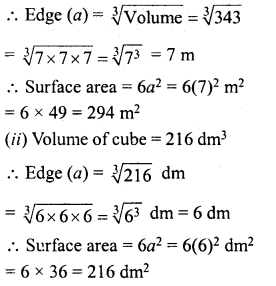
(i) Volume of a cube = 343 m3
RD Sharma Class 8 Solutions Chapter 21 Mensuration II Ex 21.3 1

Question 5.
Find the volume of a cube whose surface area is
(i) 96 cm2
(ii) 150 m2.
Solution:
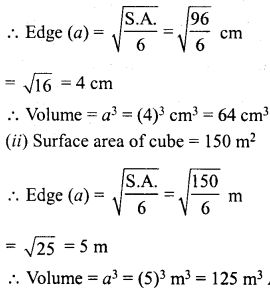
(i) Surface area of a cube = 96 cm2
RD Sharma Class 8 Solutions Chapter 21 Mensuration II Ex 21.3 2

Question 6.
The dimensions of a cuboid are in the ratio 5:3:1 and its total surface area is 414 m2. Find the dimensions.
Solution:
Ratio in .dimensions = 5 : 3 : 1
Let length (l) = 5x
breadth (b) = 3x
and height (h) = x
∴ Surface area = 2(1 x b + b x h + h x l)
= 2(5x x 3x + 3x x x + x x 5x)
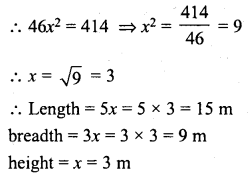
= 2(15×2 + 3×2 + 5×2) = 2 x 23×2 = 46×2
RD Sharma Class 8 Solutions Chapter 21 Mensuration II Ex 21.3 3

Question 7.
Find the area of the cardboard required to make a closed box of length 25 cm, 0.5 m and height 15 cm.
Solution:
Length of cardboard (l) = 25 cm
Breadth (b) = 0.5 m = 50 cm
Height (h)= 15 cm.
∴ Surface area of cardboard = 2 (l x b + b x h + h x l)
= 2(25 x 50 + 50 x 15 + 15 x 25) cm2
= 2(1250+ 750+ 375) cm2
= 2(2375)
= 4750 cm2

Question 8.
Find the surface area of a wooden box whose shape is of a cube and if the edge of the box is 12 cm.
Solution:
Edge of cubic wooden box = 12 cm
∴ Surface area = 6a2 = 6(12)2 cm2
= 6 x 144 = 864 cm2

Question 9.
The dimensions of an oil tin are 26 cm x 26 cm x 45 cm. Find the area of the tin sheet required for making 20 such tins. If 1 square metre of the tin sheet costs Rs 10, find the cost of the tin sheet used for these 20 tins.
Solution:
Length of tin (l) = 26 cm = 0.26 m
Breadth (b) = 26 cm = 0.26 m
Height (h) = 45 cm = 0.45 m
∴ Surface area = 2(l x b + b x h +h xl)
= 2(0.26 x 0.26 + 0.26 x 0.45 + 0.45 x 0.26) m2
= 2(0.0676 + 0.117 + 0.117) m2
= 2(0.3016) = 0.6032 m2
Sheet required for such 20 tins
= 0.6032 x 20= 12.064 m2
Cost of 1 m2 tin sheet = 10 m
∴ Total cost = Rs 12.064 x 10 = Rs 120.64
and area of sheet = 12.064 m2 = 120640 cm2

Question 10.
A classroom is 11 m long, 8 m wide and 5 m high. Find the sum of the areas of its floor and the four walls (including doors, windows etc.)
Solution:
Length of room (l) = 11 m
Width (b) = 8 m
and height (h) = 5 m
Area of floor = l x b = 11 x8 = 88m2
Area of four walls = 2 (l + b) x h
= 2(11 + 8) x 5 m2 = 2 x 19×5 = 190 m2
∴ Total area = 88 m2 + 190 m2 = 278 m2

Question 11.
A swimming pool is 20 m long, 15 m wide and 3 m deep. Find the cost of repairing the floor and wall at the rate of Rs 25 per square metre.
Solution:
Length of pool (l) = 20 m
Breadth (b) = 15 m
and Depth (h) = 3 m.
Area of floor = l x b = 20 x 15 = 300 m2
and area of its walls = 2(l + b) x h
= 2(20 + 15) x 3 = 2 x 35 x 3 m2 = 210 m2
∴ Total area = 300 + 210 = 510 m2
Rate of repairing it = Rs 25 per sq. metre
∴ Total cost = Rs 25 x 510 = Rs 12750

Question 12.
The perimeter of a floor of a room is 30 m and its height is 3 m. Find the area of four walls of the room.
Solution:
Perimeter of floor = 30 m
i.e. 2(1 + b) = 30 m
Height = 3 m
∴ Area of four walls = Perimeter x height = 30 x 3 = 90 m2

Question 13.
Show that the product of the areas of the floor and two adjacent walls of a cuboid is the square of its volume.
Solution:
Let length of the room = l
and breadth = b
and height = h
Volume = l x b x h
Area of floor = l x b = lb.
Area of two adjacent walls = hl x bh.
∴ Product of areas of floor and two adjacent walls of the room = lb (hi x bh)
= l2b2h2 = (l.b.h)2 = (Volume)2
Hence proved

Question 14.
The walls and ceiling of a room are to be plastered. The length, breadth and height of the room are 4.5, 3m and 350 cm, respectively. Find the cost of plastering at the rate of Rs 8 per square metre.
Solution:
Length of room (l) = 4.5 m
Width (b) = 3 m
and height (h) = 350 cm = 3.5 m
∴ Area of walls = 2(l + b) x h
= 2(4.5 + 3) x 3.5 m2 = 2 x 7.5 x 3.5 m2 = 52.5 m2
Area of ceiling = l x b = 4.5 x 3 = 13.5 m2
∴ Total area = 52.5 + 13.5 m2 = 66 m2
Rate of plastering = Rs 8 per sq. m
∴ Total cost = Rs 8 x 66 = Rs 528

Question 15.
A cuboid has total surface area of 50 m2 and lateral surface area its 30 m2. Find the area of its base.
Solution:
Total surface area of cuboid = 50 m2
Lateral surface area = 30 m2
∴ Area of floor and ceiling = 50 – 30 = 20 m2
But area of floor = area of ceiling
∴ Area of base (floor) = \(\frac { 20 }{ 2 }\) = 10 m2

Question 16.
A classroom is 7 m long, 6 m broad and 3.5 m high. Doors and windows occupy an area of 17 m2. What is the cost of white-washing the walls at the rate of Rs 1.50 per m2.
Solution:
Length of room (l) = 7 m
Breadth (b) = 6 m
and height (h) = 3.5 m
∴ Area of four walls = 2(1 + b) x h
= 2(7 + 6) x 3.5 m2 = 2 x 13 x 3.5 = 91 m2
Area of doors and windows = 17 m2
∴ Remaining area of walls = 91 – 17 = 74 m2
Rate of whitewashing = Rs 1.50 per m2
∴ Total cost = 74 x Rs 1.50 = Rs 111

Question 17.
The central hall of a school is 80 m long and 8 m high. It has 10 doors each of size 3 m x 1.5 m and 10 windows each of size 1.5 m x l m. If the cost of the white-washing the walls of the hall at the rate of Rs 1.20 per m2 is Rs 2385.60, find the breadth of the hall.
Solution:
Length of hall (l) = 80 m
Height (h) = 8 m
Size of each door = 3 m x 1.5 m
∴ Area of 10 doors = 3 x 1,5 x 10 m2
= 45 m2
A size of each windows = 1.5 m x 1 m
∴ Area of 10 windows = 1.5 m x 1 x 10= 15 m2
Total cost of whitewashing the walls = Rs 2385.60
Rate of whitewashing = Rs 1.20 per m2
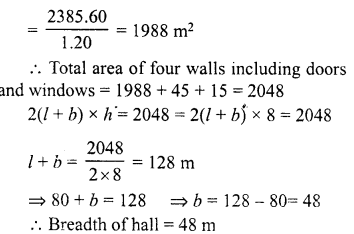
∴ Area of walls which are whitewashed
RD Sharma Class 8 Solutions Chapter 21 Mensuration II Ex 21.3 4

Hope given RD Sharma Class 8 Solutions Chapter 21 Mensuration II Ex 21.3 are helpful to complete your math homework.

If you have any doubts, please comment below. Learn Insta try to provide online math tutoring for you.

RS Aggarwal Class 6 Solutions Chapter 5 Fractions Ex 5A

RS Aggarwal Class 6 Solutions Chapter 5 Fractions Ex 5A

These Solutions are part of RS Aggarwal Solutions Class 6. Here we have given RS Aggarwal Solutions Class 6 Chapter 5 Fractions Ex 5A.

Other Exercises

Question 1.
Solution:
(i) \(\\ \frac { 3 }{ 4 } \)
(ii) \(\\ \frac { 1 }{ 4 } \)
(iii) \(\\ \frac { 2 }{ 3 } \)
(iv) \(\\ \frac { 3 }{ 10 } \)
(v) \(\\ \frac { 4 }{ 9 } \)
(vi) \(\\ \frac { 3 }{ 8 } \)

Question 2.
Solution:
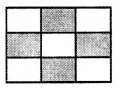
In the figure, \(\\ \frac { 4 }{ 9 } \) is shaded
RS Aggarwal Class 6 Solutions Chapter 5 Fractions Ex 5A 2.1

Question 3.
Solution:
In the figure, whole rectangle is not divided into four equal parts.

Question 4.
Solution:
(i) Three-fourths = \(\\ \frac { 3 }{ 4 } \)
(ii) Four-sevenths = \(\\ \frac { 4 }{ 7 } \)
(iii) Two-fifths = \(\\ \frac { 2 }{ 5 } \)
(iv) Three-tenths = \(\\ \frac { 3 }{ 10 } \)
(v) One-eighth = \(\\ \frac { 1 }{ 8 } \)
(vi) three-tenths = \(\\ \frac { 5 }{ 6 } \)
(vii) five-sixths = \(\\ \frac { 8 }{ 9 } \)
(vii) seven-twelfths = \(\\ \frac { 7 }{ 12 } \)

Question 5.
Solution:
(i) In \(\\ \frac { 4 }{ 9 } \), numerator is 4 and denominator is 9.
(ii) In \(\\ \frac { 6 }{ 11 } \), numerator is 6 and denominator is 11.
(iii) In \(\\ \frac { 8 }{ 15 } \), numerator is 8 and denominator is 15.
(iv) In \(\\ \frac { 12 }{ 17 } \), numerator is 12 and denominator is 17.
(v) \(\\ \frac { 5 }{ 1 } \) , numerator is 5 and denominator is 1.

Question 6.
Solution:
(z) Numerator = 3, Denominator = 8, then fraction = \(\\ \frac { 3 }{ 8 } \).
(ii) Numerator = 5, Denominator = 12, then fraction = \(\\ \frac { 5 }{ 12 } \)
(iii) Numerator = 7, Denominator = 16, then fraction = \(\\ \frac { 7 }{ 16 } \).
(iv) Numerator = 8, Denominator = 15, then fraction = \(\\ \frac { 8 }{ 15 } \)

Question 7.
Solution:
(i) \(\\ \frac { 2 }{ 3 } \) = two-thirds
(ii) \(\\ \frac { 4 }{ 9 } \) = four-ninths
(iii) \(\\ \frac { 2 }{ 5 } \) = two-fifths
(iv) \(\\ \frac { 7 }{ 10 } \) = seven-tenths
(v) \(\\ \frac { 1 }{ 3 } \) = one-thirds
(vi) \(\\ \frac { 3 }{ 4 } \) = three-fourth
(vii) \(\\ \frac { 3 }{ 8 } \) = three-eighths
(viii) \(\\ \frac { 9 }{ 14 } \) = nine-fourteenths
(ix) \(\\ \frac { 5 }{ 11 } \) = five-elevanths
(x) \(\\ \frac { 6 }{ 15 } \) = six-fifteenths

Question 8.
Solution:
24 minutes is the fraction of 1 hour i.e.,
60 minutes = \(\\ \frac { 24 }{ 60 } \)

Question 9.
Solution:
Natural number between 2 to 10 are 2, 3, 4, 5, 6, 7, 8, 9, 10 = 9
Out of these prime number are 2, 3, 5, 7 = 4
Fraction = \(\\ \frac { 4 }{ 9 } \)

Question 10.
Solution:
(i) \(\\ \frac { 2 }{ 3 } \) of 15 pens = \(\\ \frac { 2 }{ 3 } \) x 15 = 2 x 5 = 10 pens.
(ii) \(\\ \frac { 2 }{ 3 } \) of 27 balls = \(\\ \frac { 2 }{ 3 } \) x 27 = 2 x 9 = 18 balls.
(iii) \(\\ \frac { 2 }{ 3 } \) of 36 balloons = \(\\ \frac { 2 }{ 3 } \) x 36 = 2 x 12 = 24 balloons. Ans.

Question 11.
Solution:
(i) \(\\ \frac { 3 }{ 4 } \) of 16 cups = \(\\ \frac { 3 }{ 4 } \) x 16 = 3 x 4
= 12 cups.
(ii) \(\\ \frac { 3 }{ 4 } \) of 28 rackets = \(\\ \frac { 3 }{ 4 } \) x 28 = 3 x 7
= 21 rackets.
(iii) \(\\ \frac { 3 }{ 4 } \) of 32 books = \(\\ \frac { 3 }{ 4 } \) x 32 = 3 x 8
= 24 books. Ans.

Question 12.
Solution:
Total number of pencils Neelam has = 25
No. of pencils given to Meena
= \(\\ \frac { 4 }{ 5 } \) of 25
= \(\\ \frac { 4 }{ 5 } \) x 25 – 20
No. of pencils left with Neelam = 25 – 20 = 5

Question 13.
Solution:
(i) \(\\ \frac { 3 }{ 8 } \)
Take a line segment OA = one unit of length
Divide it into 8 equal parts and take 3 parts at P, then P represents \(\\ \frac { 3 }{ 8 } \).
RS Aggarwal Class 6 Solutions Chapter 5 Fractions Ex 5A 13.1
(ii) \(\\ \frac { 5 }{ 9 } \)
(a) Take a line segment OA = one unit of length.
(b) Divide it into nine equal parts and take 5 parts at P, then P represents \(\\ \frac { 5 }{ 9 } \).
RS Aggarwal Class 6 Solutions Chapter 5 Fractions Ex 5A 13.2
(iii) \(\\ \frac { 4 }{ 7 } \)
(a) Take a line segment OA = one unit of length.
(b) Divide it into 7 equal parts and take 4 parts at P then P represents \(\\ \frac { 4 }{ 7 } \).
RS Aggarwal Class 6 Solutions Chapter 5 Fractions Ex 5A 13.3
(iv) \(\\ \frac { 2 }{ 5 } \)
(a) Take a line segment OA = 1 unit of length.
(b) Divide it with 5 equal parts and take 2 parts and P then P represents \(\\ \frac { 2 }{ 5 } \).
RS Aggarwal Class 6 Solutions Chapter 5 Fractions Ex 5A 13.4
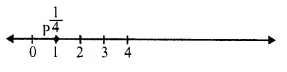
(v) \(\\ \frac { 1 }{ 4 } \)
(a) Take a line segment OA = 1 unit of length.
(b) Divide it with 4 equal parts and take 1 parts and P then P represents \(\\ \frac { 1 }{ 4 } \).
RS Aggarwal Class 6 Solutions Chapter 5 Fractions Ex 5A 13.5

Hope given RS Aggarwal Solutions Class 6 Chapter 5 Fractions Ex 5A are helpful to complete your math homework.

If you have any doubts, please comment below. Learn Insta try to provide online math tutoring for you.

RD Sharma Class 8 Solutions Chapter 21 Mensuration II Ex 21.2

RD Sharma Class 8 Solutions Chapter 21 Mensuration II Ex 21.2

These Solutions are part of RD Sharma Class 8 Solutions. Here we have given RD Sharma Class 8 Solutions Chapter 21 Mensuration II Ex 21.2

Other Exercises

Question 1.
Find the volume in cubic metres (cu.m) of each of the cuboids whose dimensions are :
(i) length = 12 cm, breadth = 10 m, height = 4.5 m
(ii) length = 4 m, breadth = 2.5 m, height = 50 cm
(iii) length = 10 m, breadth = 25 dm, height = 25 cm.
Solution:
(i) Length of cuboid (l) = 12 m
Breadth (b) = 10m
and height (h) = 4.5 m
∴Volume = l x b x h = 12 x 10 x 4.5 m3
= 540 m3
(ii) Length of cuboid (l) = 4 m
Breadth (b) = 2.5m
Height (h) = 50 cm = 0.5 m
∴ Volume = l x b x h = 4 x 2.5 x 0.5 = 5 m3
(iii) Length of cuboid (l) = 10 m
Breadth (b) = 25 dm = 2.5 m
Height (h) = 25 cm 0.25 m
∴ Volume = l x b x h = 10 x 2.5 x 0.25 m3 = 6.25 m3

Question 2.
Find the volume in cubic decimetre of each of the cubes whose side is
(i) 1.5 m
(it) 75 cm
(iii) 2 dm 5 cm
Solution:
(i) Side of cube (a) = 1.5 m
∴ Volume = a3 = (1.5)3 m3
= 1.5 x 1.5 x 1.5 m3 = 3.375 m3
= 3.375 x 1000 = 3375 dm3
(ii) Side of cube (a) = 75 cm = 7.5 dm
∴ Volume = a3 = (7.5)3 dm3
= 421.875 dm3
(iii) Side of cube (a) = 2 dm 5 cm = 2.5 dm
∴ Volume = (a)3 = (2.5)3 dm3
= 15.625 dm3

Question 3.
How much clay is dug out in digging a well measuring 3m by 2m by 5m?
Solution:
Length of well (l) = 3m
breadth (b) = 2 m
and height (depth) (h) = 5 m
Volume of earth dug out = l x b x h = 3 x 2 x 5 = 30m3

Question 4.
What will be the height of a cuboid of volume 168 m3, if the area of its base is 28 m2 ?
Solution:
Volume of a cuboid = 168 m3
Area of its base l.e., l x b = 28 m3

RD Sharma Class 8 Solutions Chapter 21 Mensuration II Ex 21.2 1

Question 5.
A tank is 8 m long, 6 m broad and 2 m high. How much water can it contain ?
Solution:
Length of tank (l) = 8 m
Breadth (b) = 6 m
Height (h) = 2 m
∴ Volume of water in the tank = l x b x h = 8 x 6 x 2 = 96 m3
= 96 x 1000 = 96000litres (∵1m3 = 1000litre)

Question 6.
The capacity of a certain cuboidal tank is 50000 litres of water. Find the breadth of the tank if its height and length are 10 m and 2.5 m respectively.
Solution:
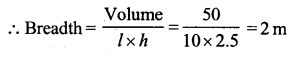
Capacity of water in the tank = 50000 litres
∴ Volume of water = 50000 x \(\frac { 1 }{ 1000 }\) = 50 m3 (1000 l = 1 m3)
Height of tank (h)= 10 m
and length (l) = 2.5 m
Volume 50
RD Sharma Class 8 Solutions Chapter 21 Mensuration II Ex 21.2 2

Question 7.
A rectangular diesel tanker is 2 m long, 2 m wide and 40 cm deep. How many litres of diesel can it hold ?
Solution:
Length of tanker (l) = 2 m
Breadth (b) = 2m
Depth (h) = 40 cm = 0.4 m
∴ Volume = l x bx h = 2 x 2 x 0.4=1.6m3
Quantity of diesel = 1.6 x 1000 litres (1 m3= 1000 l)
= 1600 litres

Question 8.
The length, breadth and height of a room are 5 m, 4.5 m and 3 m, respectively. Find the volume of the air it contains.
Solution:
Length of room (l) = 5 m
Breadth (6) = 4.5 m
and height (h) = 3 m
∴ Volume of air it contains
= l x b x h = 5 x 4.5 x 3 m3
= 67.5 m3

Question 9.
A water tank is 3 m long, 2 m broad and 1 m deep. How many litres of water can it hold ?
Solution:
Length of tank (l) = 3 m
Breadth (b) = 2 m
and depth (h) = 1 m
∴ Volume of tank = l x b x h
= 3 x 2 x 1 = 6 m3
∴ Quantity of water it can contains
= 6 x 1000 litres = 6000 litres (1 m3= 1000 litres)

Question 10.
How many planks each of which is 3 m long, 15 cm broad and 5 cm thick can be prepared from a wooden block 6 m long, 75 cm broad and 45 cm thick ?
Solution:
Length of wooden block (l) = 6 m
Width (b) = 75 cm = 0.75 m
Thickness (h) = 45 cm = 0.45 m
∴ Volume = l x b x h = 6 x 0.75 x 0.45 m3
Length of plank (l) = 3 m
Breadth (b) = 15 cm = 0.15 m
Thickness (h) = 5 cm = 0.05 m
∴ Volume = 3 x 0.15 x 0.05 m3
Number of planks
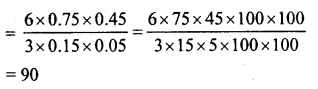
RD Sharma Class 8 Solutions Chapter 21 Mensuration II Ex 21.2 3

Question 11.
How many bricks each of size 25 cm x 10 cm x 8 cm will be required to build a wall 5 m long, 3 m high and 16 cm thick assuming that the volume of sand and cement used in the construction is negligible ?
Solution:
Size of one brick = 25 cm x 10 cm x 8 cm
∴ Volume of one brick = 25 x 10 x 8 cm3
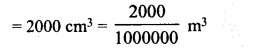
RD Sharma Class 8 Solutions Chapter 21 Mensuration II Ex 21.2 4
Length of wall (l) = 5 m
Width (b) = 0.16 m
Height (h) = 3 m
∴ Volume of wall = l x b x h
= 5 x 0.16 x 3 m3 = 2.4 m3
∴ Number of bricks required
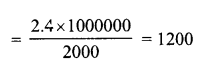
RD Sharma Class 8 Solutions Chapter 21 Mensuration II Ex 21.2 5

Question 12.
A village, having a population of 4000 requires 150 litres water per head per day. It has a tank which is 20 m long, 15 m broad and 6 m high. For how many days the water of this tank will last ?
Solution:
Total population of a village = 4000
Water required for each person for one day = 150 litres
∴ Water required for 4000 persons for one day = 150 x 4000 = 600000 litres
Length of tank (l) = 20 m
Breadth (b) = 15 m
Height (h) = 6 m
∴ Volume of tank = l x b x h = 20 x 15 x 6 m3 = 1800 m3
Capacity of water in the tank = 1800 x 1000 l= 1800000l (1 m3 = 1000 l)
∴ Number of days, the water will last
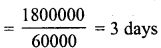
RD Sharma Class 8 Solutions Chapter 21 Mensuration II Ex 21.2 6

Question 13.
A rectangular field is 70 m long and 60 m broad. A well of dimensions 14 m x 8 m x 6 m is dug outside the field and the earth dugout from this well is spread evenly on the field. How much will the earth level rise ?
Solution:
Length of well (l) = 14 m
Breadth (A) = 8m
Depth (A) = 6m
∴ Volume of earth dugout = l x bx h
= 14 x 8 x 6 = 672 m3 Length of field = 70 m
and breadth = 60 m
Let h be the height of earth spread over
Then 70 x 60 x h = 672
⇒ h = \(\frac { 672 }{ 70×60 }\) = 0.16m
∴ Height of earth = 0.16 m = 16 cm

Question 14.
A swimming pool is 250 m long and 130 m wide. 3250 cubic metres of water is pumped into it. Find the rise in the level of water.
Solution:
Volume of water = 3250 m3
Length of pool (l) = 250 m
Breadth (b)= 130 m
∴ Height of water level

RD Sharma Class 8 Solutions Chapter 21 Mensuration II Ex 21.2 7

Question 15.
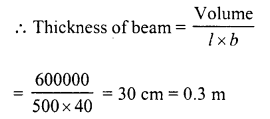
A beam 5 m long and 40 cm wide contains 0.6 cubic metres of wood. How thick is the beam?
Solution:
Volume of wood of the beam = 0.6 m3 = 600000
Length of beam (l) = 5 m = 500 cm
Breadth (b) = 40 cm
RD Sharma Class 8 Solutions Chapter 21 Mensuration II Ex 21.2 8

Question 16.
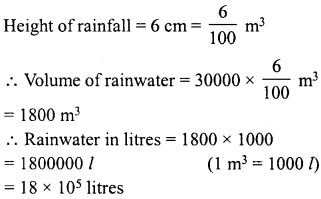
The rainfall on a certain day was 6 cm. How many litres of water fell on 3 hectares of field on that day ?
Solution:
Area of the field = 3 hectares
= 3 x 10000 square metres
= 30000 square metres
Height of rainfall = 6 cm = m3
RD Sharma Class 8 Solutions Chapter 21 Mensuration II Ex 21.2 9

Question 17.
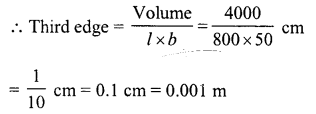
An 8 m long cuboidal beam of wood when sliced produces four thousand 1 cm cubes and there is no wastage of wood in this process. If one edge of the beam is 0.5 m, find the third edge.
Solution:
Length of cuboidal beam (l) = 8 m = 800 cm
Number of cubical sliced = 4000
Edge of each cube = 1 cm
Volume of beam = 4000 (1)3 cm3 = 4000 cm3
One edge of the beam = 0.5 m = 50 cm.
RD Sharma Class 8 Solutions Chapter 21 Mensuration II Ex 21.2 10

Question 18.
The dimensions of a metal block are 2.25 m by 1.5 m by 27 cm. It is melted and recast into cubes, each of the side 45 cm. How many cubes are formed ?
Solution:
Dimensions of metal block = 2.25 m x 1.5 m x 27 cm
∴ Volume = 2.25 x 1.5 x 0.27 m3
= 225 x 150 x 27 cm3 = 911250 cm3
Side of each cube (a) = 45 cm
∴ Volume of one cube = a3 = (45)3 cm3 = 91125 cm3
∴ Number of cubes = \(\frac { 911250 }{ 91125 }\) = 10

Question 19.
A solid rectangular piece of iron measures 6 m by 6 cm by 2 cm. Find the weight of this piece if 1 cm3 of iron weighs 8 gm.
Solution:
Dimensions of a piece of rectangular iron = 6m x 6cm x 2cm
∴ Volume = 600 x 6 x 2 cm3 = 7200 cm3
Weight of 1 cm3 = 8 gm
∴ Total weight of the piece = 7200 x 8 gm
= 57600 gm = \(\frac { 57600 }{ 1000 }\) kg = 57.6 kg

Question 20.
Fill in the blanks in each of the following so as to make the statement true :
(i) 1 m3 = ……… cm3
(ii) 1 litre = …….. cubic decimetre
(iii) 1 kl = …… m3
(iv) The volume of a cube of side 8 cm is …….. .
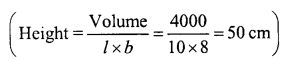
(v) The volume of wooden cuboid of length 10 cm and breadth 8 cm is 4000 cm3. The height of the cuboid is …….. cm
(vi) 1 cu.dm = …….. cu.mm
(vii) 1 cu.km = ……cu.m
(viii) 1 litre =…….. cu.cm
(ix) 1 ml = ……… cu.cm
(x) 1 kl = ……… cu.dm = ……. cu.cm.
Solution:
(i) 1 m3 = 1000000 or 10cm3
(ii) 1 litre = 1 cubic decimetre
(iii) 1 kl = 1 m3
(iv) The volume of a cube of side 8 cm is 512 cm3 (V = a3 = 8 x 8 x 8 = 512 cm3)
(v) The volume of a wooden cuboid of length 10 cm and breadth 8 cm is 4000 cm3. The height of the cuboid is 50 cm
RD Sharma Class 8 Solutions Chapter 21 Mensuration II Ex 21.2 11
(vi) 1 cu.dm = 1000000 cu mm = 106 cu.mm
(vii) 1 cu.km = 1000 x 1000 x 1000 cu.m = 109 cu.m
(viii) 1 litre = 1000 cu.cm = 103 cu.cm
(ix) 1 ml = 1 cu.cm
(x) 1 kl = 1000 cu.dm = 100 x 100 x 100 cu.cm = 106 cu.cm

Hope given RD Sharma Class 8 Solutions Chapter 21 Mensuration II Ex 21.2 are helpful to complete your math homework.

If you have any doubts, please comment below. Learn Insta try to provide online math tutoring for you.