RS Aggarwal Class 6 Solutions Chapter 5 Fractions Ex 5E

RS Aggarwal Class 6 Solutions Chapter 5 Fractions Ex 5E

These Solutions are part of RS Aggarwal Solutions Class 6. Here we have given RS Aggarwal Solutions Class 6 Chapter 5 Fractions Ex 5E.

Other Exercises

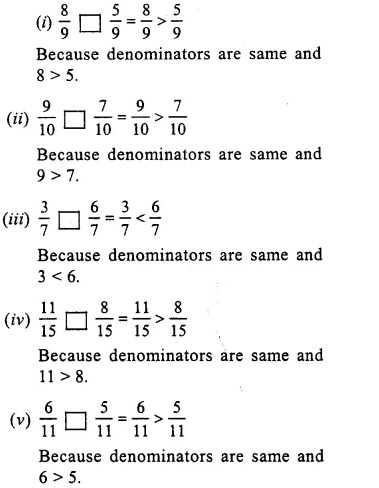
Find the sum :

Question 1.
Solution:
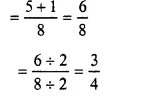
\(\frac { 5 }{ 8 } +\frac { 1 }{ 8 } \)
RS Aggarwal Class 6 Solutions Chapter 5 Fractions Ex 5E 1.1

Question 2.
Solution:
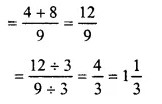
\(\frac { 4 }{ 9 } +\frac { 8 }{ 9 } \)
RS Aggarwal Class 6 Solutions Chapter 5 Fractions Ex 5E 2.1

Question 3.
Solution:
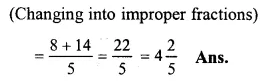
\(1\frac { 3 }{ 5 } +2\frac { 4 }{ 5 } \)
\(\frac { 8 }{ 5 } +\frac { 14 }{ 5 } \)
RS Aggarwal Class 6 Solutions Chapter 5 Fractions Ex 5E 3.1

Question 4.
Solution:
\(\frac { 2 }{ 5 } +\frac { 5 }{ 6 } \)
= \(\\ \frac { 4+15 }{ 18 } \) (LCM of 9 and 6 = 18)
= \(\\ \frac { 19 }{ 18 } \)
= \(1 \frac { 1 }{ 18 } \)

Question 5.
Solution:
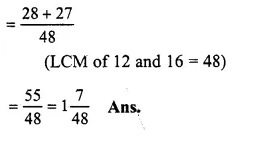
\(\frac { 7 }{ 12 } +\frac { 9 }{ 16 } \)
RS Aggarwal Class 6 Solutions Chapter 5 Fractions Ex 5E 5.1

Question 6.
Solution:
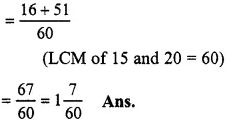
\(\frac { 4 }{ 15 } +\frac { 17 }{ 20 } \)
RS Aggarwal Class 6 Solutions Chapter 5 Fractions Ex 5E 6.1

Question 7.
Solution:
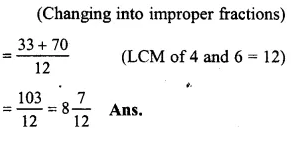
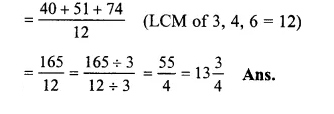
\(2\frac { 3 }{ 4 } +5\frac { 5 }{ 6 } \)
= \(\frac { 11 }{ 4 } +\frac { 35 }{ 6 } \)
RS Aggarwal Class 6 Solutions Chapter 5 Fractions Ex 5E 7.1

Question 8.
Solution:
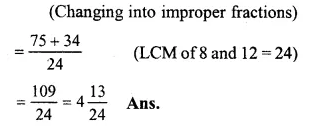
\(3\frac { 1 }{ 8 } +1\frac { 5 }{ 12 } \)
= \(\frac { 25 }{ 8 } +\frac { 17 }{ 12 } \)
RS Aggarwal Class 6 Solutions Chapter 5 Fractions Ex 5E 8.1

Question 9.
Solution:
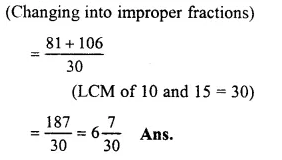
\(2\frac { 7 }{ 10 } +3\frac { 8 }{ 15 } \)
= \(\frac { 27 }{ 10 } +\frac { 53 }{ 15 } \)
RS Aggarwal Class 6 Solutions Chapter 5 Fractions Ex 5E 9.1

Question 10.
Solution:
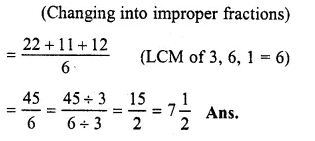
\(3\frac { 2 }{ 3 } +1\frac { 5 }{ 6 } +2 \)
\(\frac { 11 }{ 3 } +\frac { 11 }{ 6 } +\frac { 2 }{ 1 } \)
RS Aggarwal Class 6 Solutions Chapter 5 Fractions Ex 5E 10.1

Question 11.
Solution:
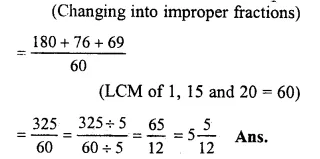
\(3+1\frac { 4 }{ 15 } +1\frac { 3 }{ 20 } \)
=\(\frac { 3 }{ 1 } +\frac { 19 }{ 15 } +\frac { 23 }{ 20 } \)
RS Aggarwal Class 6 Solutions Chapter 5 Fractions Ex 5E 11.1

Question 12.
Solution:
\( 3\frac { 1 }{ 3 } +4\frac { 1 }{ 4 } +6\frac { 1 }{ 6 } \)
\(\frac { 10 }{ 3 } +\frac { 17 }{ 4 } +\frac { 37 }{ 6 } \)
(changing into improper fractions)
RS Aggarwal Class 6 Solutions Chapter 5 Fractions Ex 5E 12.1

Question 13.
Solution:
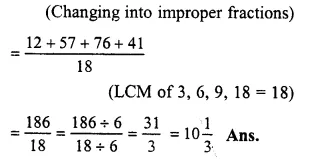
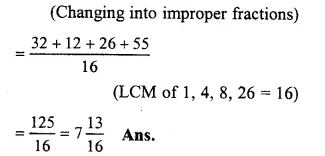
\(\frac { 2 }{ 3 } +3\frac { 1 }{ 6 } +4\frac { 2 }{ 9 } +2\frac { 5 }{ 18 } \)
\(\frac { 2 }{ 3 } +\frac { 19 }{ 6 } +\frac { 38 }{ 9 } +\frac { 41 }{ 18 } \)
RS Aggarwal Class 6 Solutions Chapter 5 Fractions Ex 5E 13.1

Question 14.
Solution:
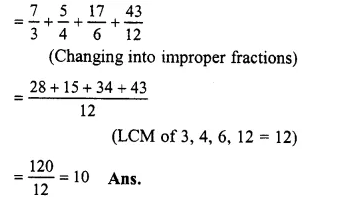
\(2\frac { 1 }{ 3 } +1\frac { 1 }{ 4 } +2\frac { 5 }{ 6 } +3\frac { 7 }{ 12 } \)
RS Aggarwal Class 6 Solutions Chapter 5 Fractions Ex 5E 14.1

Question 15.
Solution:
\(2+\frac { 3 }{ 4 } +1\frac { 5 }{ 6 } +3\frac { 7 }{ 16 } \)
\(\frac { 2 }{ 1 } +\frac { 3 }{ 4 } +\frac { 13 }{ 8 } +\frac { 55 }{ 16 } \)
RS Aggarwal Class 6 Solutions Chapter 5 Fractions Ex 5E 15.1

Question 16.
Solution:
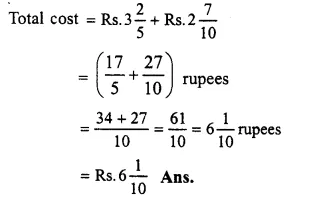
Cost of a pencil = Rs. \(3 \frac { 2 }{ 5 } \)
Cost of an eraser = Rs.\(2 \frac { 7 }{ 10 } \)
RS Aggarwal Class 6 Solutions Chapter 5 Fractions Ex 5E 16.1

Question 17.
Solution:
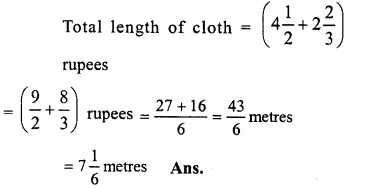
Length of cloth for kurta = \(4 \frac { 1 }{ 2 } \) metres
Length of cloth for pyjamas = \(2 \frac { 2 }{ 3 } \) metres
RS Aggarwal Class 6 Solutions Chapter 5 Fractions Ex 5E 17.1

Question 18.
Solution:
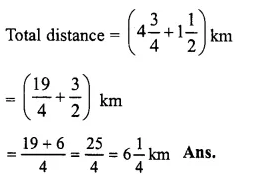
Distance travelled by Rickshaw = \(4 \frac { 3 }{ 4 } \) km
Distance travelled on foot = \(1 \frac { 1 }{ 2 } \) km
RS Aggarwal Class 6 Solutions Chapter 5 Fractions Ex 5E 18.1

Question 19.
Solution:
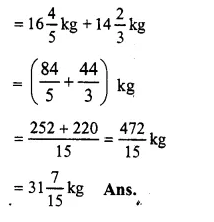
Weight of empty cylinder = \(16 \frac { 4 }{ 5 } \) kg
Weight of gas filled in it = \(14 \frac { 2 }{ 3 } \) kg
Total. weight of cylinder with gas
RS Aggarwal Class 6 Solutions Chapter 5 Fractions Ex 5E 19.1

Hope given RS Aggarwal Solutions Class 6 Chapter 5 Fractions Ex 5E are helpful to complete your math homework.

If you have any doubts, please comment below. Learn Insta try to provide online math tutoring for you.

NCERT Solutions for Class 10 Science Chapter 7 Control and Coordination

In this chapter 7 Control and Coordination, students will learn about the nervous system of animals, reflex actions, the human brain, how tissues are protected and how nervous tissues cause action, coordination in plants, hormones in animals.

NCERT Solutions for Class 10 Science Chapter 7 Control and Coordination

These Solutions are part of NCERT Solutions for Class 10 Science. Here we have given NCERT Solutions for Class 10 Science Chapter 7 Control and Coordination. Learn Insta provides you the Free PDF download of NCERT Solutions for Class 10 Science (Biology) Chapter 7 – Control and Coordination solved by Expert Teachers as per NCERT (CBSE) Book guidelines. All Chapter 7 – Control and Coordination Exercise Questions with Solutions to help you to revise complete Syllabus and Score More marks.

NCERT Questions

In Text Questions

Question 1.
What is the difference between reflex action and walking ?
Answer:

ReflexWalking/Voluntary
1.      Origin. Reflex action is inborn and present in an individual right from birth.

2.      Control. It is automatic. An individual cannot control it.

3.      Intensity. It cannot be changed.

4.      Value. It has survival and protective value.

It is acquired through learning.

It is under control of the will or brain.

It can be changed.

It has various functions, generally other than survival and protection.

More Resources

Question 2.
What happens at the synapse between two neurons ?
Answer:
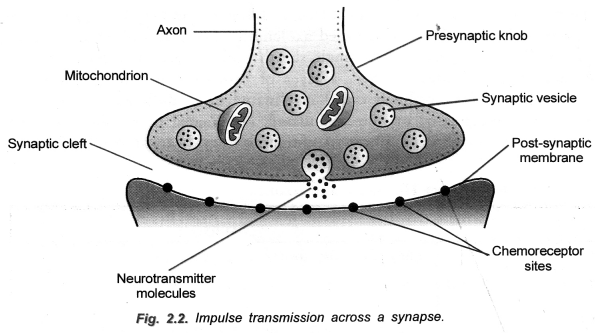
NCERT Solutions for Class 10 Science Chapter 7 Control and Coordination image - 1
At synapse, axon terminal is expanded to form presynaptic knob. The dendrite terminal that lies close to it is slightly broadened and depreseed to form post-synaptic depression. A fluid filled narrow space, called synaptic cleft, occurs between the two. When an impulse reaches the presynaptic knob, it stimulates the release of neurotransmitter into synaptic cleft. Neurotransmitter comes in contact with chemoreceptor sites of the membrane of postsynaptic depression. This generates an electrochemical signal or impulse in the dendrite part of second neuron.

Question 3.
Which part of brain maintains posture and equilibrium of the body ?
Answer:
Cerebellum.

Question 4.
How do we detect the smell of an agarbatti (incense stick) ?
Answer:
Burning of an agarbatti emits smoke having very large number of odorant molecules. They enter the nose along with inhaled air. The odorant molecules are trapped in mucus present over olfactory epithelium. Olfactory receptor cells have a number of non-motile olfactory hair containing special protein molecules. Contact between the two forms cyclic AMP that generates an impulse in the receptor cells. Nerve fibres coming out of the cells carry the information to olfactory bulbs which transmit the same to temporal lobes of cerebrum for interpretation.

Question 5.
What is the role of brain in reflex action ? (CCE 2010, 2015)
Answer:
It functions as a relay centre for transferring impulse from sensory to motor neurons in several reflex actions called cerebral reflexes, e.g, closure of eyes exposed to flash of light, salivation at the sight or smell of food. In spinal reflexes it acts as information collecting and evaluation centre without any direct involvement in reflex action.

Question 6.
What are plantohormones ?
Answer:
Phytohormones are chemical substances other than nutrients produced naturally in plants which regulate growth, development, differentiation and a number of physiological processes, e.g., auxin, gibberellins, abscisic acid, cytokinins.

Question 7.
How is movement of leaves of Sensitive Plant different from movement of shoot towards light ? (CCE 2015)
Answer:
Movement in the leaves of Sensitive Plant (Mimosa pudica) is haptonastic movement which occurs due to turgor changes in the cells of pulvinules and pulvinus. Movement of a shoot towards light is. phototropic movement that is caused by differential growth.

Question 8.
Give an example of a plant hormone that promotes growth ?
Answer:
Indole 3-acetic acid or IAA (auxin).

Question 9.
How do auxins promote the growth of a tendril around a support ? (CCE 2015)
Answer:
Less auxin occurs on the side of contact as compared to the free side. More growth occurs on the free side.
As a result of more growth on the free side, the tendril coils around the support.

Question 10.
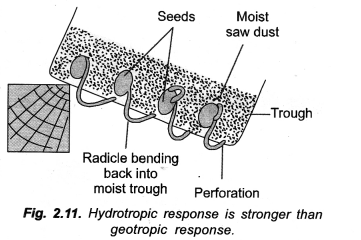
Design an experiment to demonstrate hydrotropism. (CBSE 2010, CCE 2011)
Answer:
Apparatus: Trough with perforated base, saw dust, water, seeds of Pea/Gram, wooden support.
Procedure: Take a trough with perforated base. Fill it with saw dust. Moisten the same. Sow several seeds of Pea or Gram. Place the trough in slanting position by means of a wooden block. Keep the saw dust moist by sprinkling water at intervals. Observe after 2-3 days.
Observation: As the radicles come out of the seeds, they are seen to move towards the perforations. They come out of the pores and hang downwardly for some time under the influence of gravity. However, after some growth they bend back and enter the perforations to reach moist saw dust in complete disregard of gravity (Fig. 2.11).
NCERT Solutions for Class 10 Science Chapter 7 Control and Coordination image - 2
Inference: Bending of radicles back into moist saw dust is hydrotropic movement. It occurs despite being against the force of gravity.

Question 11.
How does chemical coordination take place in animals ?
Answer:
In animals, chemical coordination is achieved through the agency of hormones which function as chemical messengers or informational molecules. Hormones are secreted by ductless glands in response to specific conditions or nervous stimulation. Timing and amount of a hormone released are regulated by feed-back mechanism. After a meal, sugar level of blood rises. It is detected by pancreas. Pancreas responds by producing hormone insulin from (3-cells of islets of Langerhans. Insulin causes glucose to be absorbed by all cells as well as get stored in liver and muscles in the form of glycogen. As the level of glucose falls in blood, insulin secretion is reduced.

Question 12.
Why is the use of iodised salt advisable ? (CCE 2011, 2015)
Answer:
Iodine is essential for synthesis of hormone thyroxine in thyroid gland. Thyroxine controls basal metabolic rate, physical activity, body temperature, heart beat, mental, physical and sexual development besides regulating carbohydrate, protein and fat metabolism. Deficiency of thyroxine disturbs metabolic, physical and mental activities besides causing disorders of simple goitre, cretinism and myxedema. Therefore, it is always advisable ^ to take iodised salt so that there is no deficiency of iodine.

Question 13.
How does our body respond when adrenaline is secreted into blood ?
Answer:
Adrenaline/emergency hormone/triple F hormone

  1. Reduces blood supply to peripheral blood vessels and gastrointestinal tract,
  2. More blood flows to skeletal and heart muscles.
  3. Increases breathing and gives more oxygen to muscles,
  4. Increases heart rate,
  5. Mobilises more glucose to muscles for higher activity.

Question 14.
Why are some patients of diabetes treated by giving injections of insulin ?
Answer:
Diabetes mellitus is of two types, insulin dependent and insulin independent. In insulin dependent diabetes, pancreas is unable to produce required quantity of insulin. As a result blood sugar continues to rise and part of sugar is excreted through urine resulting in diabetes. This is kept under check by regular injection of insulin. Availability of insulin will help the cells to take up glucose while liver and muscles are induced to store excess of glucose as glycogen.

NCERT Chapter End Exercises

Question 1.
Which of the following is a plant hormone ?
(A) Insulin
(B) Thyroxine
(C) Oestrogen
(D) Cytokinin.
Answer:
(D).

Question 2.
The gap between two neurons is called
(A) Dendrite
(B) Synapse
(C) Axon
(D) Impulse.
Answer:
(B).

Question 3.
The brain is responsible for
(A) Thinking
(B) Regulating the heart beat
(C) Balancing
(D) All the above.
Answer:
(D).

Question 4.
What is the function of receptors in our body ? Think of situation where receptors do not work properly. What problems are likely to arise ? (CCE 2011)
Answer:
Receptors are specialised cells, tissues, organs and nerve endings which are able to pick up specific stimuli, e.g., photoreceptors, gustatoreceptors, thermoreceptors, photoreceptors, statoreceptors, tangoreceptors, pain and pressure receptors. Receptors provide sensory input about external and internal environment. Without them, an animal will not able to observe, handle and taste food. It will not be aware of an approaching enemy. The animal may not be able to correct its position and fall down repeatedly if its statoreceptors are damaged. Therefore, the animal will not be able to perform the activities connected with the defective receptors.

Question 5.
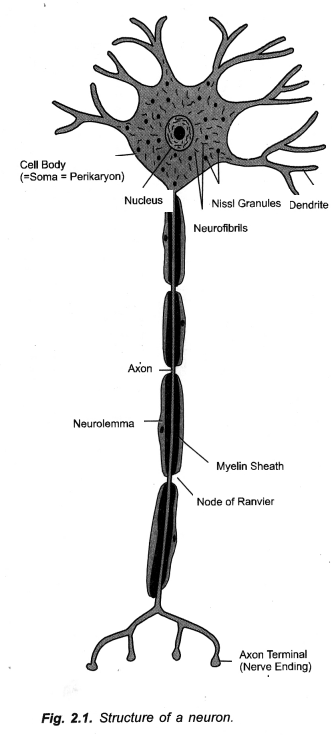
Draw the structure of a neuron and explain its functions. (CCE 2011, 2013)
Answer:
NCERT Solutions for Class 10 Science Chapter 7 Control and Coordination image - 3
Functions:

  1. Dendrites. Picking up sensations and transmitting the same to cell body.
  2. Cell Body,
    1. Sustaining structure and function of dendrites and axon,
    2. Functioning as passage¬way for transmission of sensation or impulse to axon.
  3. Axon. Carrying impulse to another neuron, muscle, gland and organ. A single impulse can be transmitted to several structures with the help of axon terminals.

Mechanism of Impulse Transmission:
Impulse is a self propagated electrical current that travels from one end to another of a neuron for the passage of a message.

The pathway is stimulus ——— >dendrite ——- > cell body ——- > axon——– > axon terminal ——– > passage of stimulus.

A stimulus received by a neuron travels through it in the form of an electrical disturbance. During rest the outer surface of a neuron is positively charged while the interior has negative charge. Stimulus causes opening of ion channels which makes the outer surface negatively charged while the interior becomes positively charged. This creates the impulse which moves forward. The posterior region returns to the condition of rest. At the end of the neuron, the impulse is passed on to the next neuron, an organ, muscle or gland in the form of a neurotransmitter. Neurotransmitter is a chemical secreted by axon terminal for transmission of impulse to the next neuron, muscle, gland or organ, e.g., acetylcholine, noradraneline, glutamic acid.

Question 6.
How does phototropism occur in plants ?
Answer:
It is directional growth movement of curvature which occurs in response to unidirectional exposure to light. The region of photoperception is sho.ot apex while the region of response is in the area of elongation. The light effective in phototropic response is blue light. The photoreceptor is a flavoprotein called phototropin. Leaves are essential for producing the response.
Stems generally bend towards the direction of light. They are positively phototropic. Leaves generally come to lie at right angles to light. They are diaphototropic. Roots are either neutral (non-phototropic) or negatively phototropic. Positively phototropic heads of Sunflower perform solar tracking as they move from east to west along the direction of sun.
Phototropic movement is generally caused by increased auxin on the dark side and lesser auxin on the illuminated side. It causes more growth on the dark side of stem causing it to bend towards the source of light. The opposite happens in root where less auxin stimulates growth while higher auxin inhibits growth.
In the plant growing in the open, sunlight is received from above. Auxin diffuses equally on all sides so that the stem does not bend but grows straight vertically.

Question 7.
Which signals will get disrupted in case of spinal cord injury ?
Answer:

  1. Sensory impulses from the area innervated by injured portion,
  2. Transmission of motor impulses through the injured portion,
  3. Reflex action in the area of injury. Sensations and movements are restricted.

Question 8.
How does chemical coordination occur in plants ?
Answer:
Plants produce a number of hormones which control and coordinate their functioning. Amount of hormone depends upon the environment and other stimuli. Its effect is also regulated by its antagonistic * hormone, e.g., auxin and abscisic acid. The effect is enhanced by synergic presence of another hormone, e.g., auxin and gibberellin.

Question 9.
What is the need for a system of control and coordination in an organism ?
Answer:
The body of a multicellular organism consists of a number of components and sub-components, each specialised to perform a particular fonction. However, all the components are not required to fonction all the time at the same speed. A system of controls is required to allow them to perform or not to perform, slow down or speed up their working. Further, most activities require the simultaneous or sequential functioning of a number of parts, stopping some and stimulating others. During feeding, eyes locate the food, nose registers its smell, hands pick up the food and take it to mouth, mouth opens to receive the food, teeth and muscles take part in its mastication and saliva moistens it. Tongue perceives its taste. It moves the food below the teeth. Later it pushes the crushed food into pharynx. All this is possible only through a system of coordination.

Question 10.
How are involuntary actions and reflex actions different from each other ?
Answer:
Refex actions are involuntary in nature which are carried out to meet emergencies. However, all involuntary actions are not reflex actions. They fulfill critical life processes, e.g., circulation of blood, movement of food in food pipe.

Question 11.
Compare and contrast nervous and hormonal mechanisms for control and coordination in animals.
Answer:
Nervous system controls and coordinates many body functions as it has a well spread network of neurons. Messages travel very fast, in the form of electrical impulses. However, it has limitations,

  1. Nerve impulses do not reach each and every cell of the body,
  2. The effect of nerve impulse is of short duration,
  3. Nerve impulses cannot pass continuously.

A small gap is required between two impulses. These short-comings are overcome in endocrine system. Here, the stimulated glandular cells secrete chemicals that diffuse throughout the body. Cells have receptors for picking up chemical information. The information can pass persistendy. The passage of information is, of course, slower. It, however, influences all the cells of the target. A multiple effect can also be produced. Adrenaline reduces blood supply to skin and digestive system but increases the same to skeletal or voluntary muscles. There is increase in breathing rate and heart beat. The body becomes ready to deal with an emergency. Further, endocrine system controls and coordinates many processes of the body where nervous system has no role, e.g., cell permeability, cell division, cell growth, cell differentiation, development of sex organs, secondary sex characters and several other activities. Any discrepancy can lead to a disorder, e.g, dwarfism and gigantism, hypothyroidism (simple goitre, cretinism, myxedema), hyperthyroidism (exophthalmia).

Question 12.
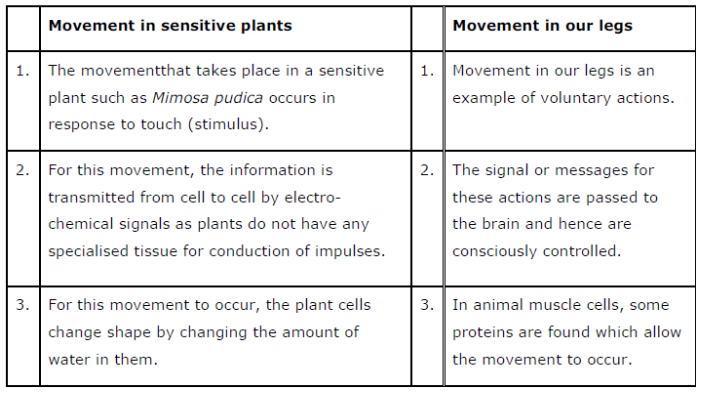
What is the difference between the manner in which movement in Sensitive Plant and movement in our legs takes places ?
Answer:
NCERT Solutions for Class 10 Science Chapter 7 Control and Coordination image - 4

Selection Type Questions

Alternate Response Type Questions
(True/False, Right(√)/Wrong (x), Yes/No)

Question 1.
Fore brain is centre of intelligence, control of movements, hearing, smell and sight.
Question 2.
Chewing cud is a movement of growth.
Question 3.
Immediate response to stimulus is shown by Mimosa pudica.
Question 4.
Rise in sugar level in blood stops secretion of insulin by pancreas.
Question 5.
Control and coordination are functions of nervous and endocrine systems.
Question 6.
Stems are positively geotropic while roots are negatively geotropic.
Question 7.
Major part of taste is smell.
Question 8.
I withdrew my hand back from hot plate reflexly.

Matching Type Questions

Question 9.
Match the articles in columns I and II (single matching) :

Column I

Column II

(a)   Cell growth

(b)   Wilting

(c)   Emergency

(d)    Electrical impulses

(i) Abscisic acid

(ii) Nerve conduction

(iii) Adrenaline

(iv) Auxin.

Question 10.
Match the contents of columns I, II and III (double matching) :

Column IColumn IIColumn III

(a)    Thyroid

(b)    Shoot tip

(c)     Receptor

(d)    Motor end plate

(i)     Reflex arc

(ii)  Neuromuscular junction

(iii) Thyroxine

(iv) Auxin

p.   Iodine

q.  Acetylcholine

r.  Apical dominance

s.  Effector

Question 11.
Name the control — voluntary (V), involuntary (I) and endocrine (E) in the following (Key or Check list Items) :
Action                                         Control
(i) Peristalsis                             ………………..
(ii) Lifting of arms                     ……………….
(iii) Growth                               ……………….
(iv) BMR                                   ………………..

Question 12.
Match each stimulus with appropriate response :

HormoneDwarfism
(A)
Cretinism
(B)
Pregnancy
(C)
Calcium level (D)Dilute urine (E)Mammary glands
(F)

(i) Thyroxine

(ii) Growth hormone

(iii) Parathormone

(iv)  Prolactin

(v)    Vasopressin

(vi)  Progesterone

Fill In the Blanks

Question 13. A ………………… mechanism regulates the action of hormones.
Question 14. An axon terminal passes the electrical stimulus to a dendrite of next neuron through …………………. reaction.
Question 15. Reflex arc formed in spinal cord also sends information input to ………………… .
Question 16. ……………………….. coordinates the activity of picking up pencil for writing.
Question 17. Positive geotropism of root is due to greater growth on ……………………… side as compared to ………………… side.

Answers:

NCERT Solutions for Class 10 Science Chapter 7 Control and Coordination image - 5

NCERT Solutions for Class 10 Science Chapter 7 – Control and Coordination

Hope given NCERT Solutions for Class 10 Science Chapter 7 are helpful to complete your science homework.

If you have any doubts, please comment below. Learn Insta try to provide online science tutoring for you.

CA Foundation Business Economics Study Material – Meaning and Types of Markets

CA Foundation Business Economics Study Material Chapter 4 Price Determination in Different Markets – Meaning and Types of Markets

MEANING OF MARKET

  • In ordinary language, a market refers to a place where the buyers and sellers of a commodity gather and strike bargains.
  • In economics, however, the term “Market” refers to a market for a commodity. E.g. Cloth market; furniture market; etc.
    According to Chapman, “the term market refers not necessarily to a place and always to a commodity and buyers and sellers who are in direct competition with one another”.
  • According to the French economist Cournot, “Market is not any particular place in which things are bought and sold, but the whole of any region in which buyers and sellers are in such free intercourse with each other that the prices of the same goods tend to equality easily and quickly”,

The above mentioned definitions reveals the following features of a market:

  1. A region. A market does not refer to a fixed place. It covers a region, which may be a town, state, country or even world.
  2. Existence of buyers and sellers. Market refers to the network of potential buyers and sellers who may be at different places.
  3. Existence of commodity or service. The exchange transactions between the buyers and sellers can take place only when there is a commodity or service to buy and sell.
  4. Bargaining for a price between potential buyers and sellers.
  5. Knowledge about market conditions. Buyers and sellers are aware of the prices offered or accepted by other buyers and sellers through any means of communication.
  6. One price for a commodity or service at a given time.

Classification of Market:

Markets may be classified on the basis of different criteria. In Economics, generally the classification is made as pointed out in the following chart—

CA Foundation Business Economics Study Material - Meaning and Types of Markets 1

TYPES OF MARKET STRUCTURES

Market can be classified on the basis of area, volume of business, time, status of sellers, regulation and control.
The main types of markets can be summed up as follows:

  1. Perfect Competition:
    • Perfect competition market is one where there are many sellers selling identical products to many buyers at a uniform.
  2. Monopoly:
    • Monopoly market structure is a market situation in which there is a single seller of a commodity selling to many buyers.
    • The commodity has no close substitutes available.
    • A monopolist therefore, has a considerable influence on the price and supply of his commodity.
  3. Monopolistic Competition:
    • Monopolistic competition is a market situation in which there are many sellers selling differentiated goods to many buyers.
  4. Oligopoly:
    Oligopoly is a market situation in which there are few sellers selling either homogeneous or differentiated goods.

Table: Features of major types of markets

PointsMarket Types
Perfect CompetitionMonopolyMonopolistic CompetitionOligopoly
i. Number of sellersManyOneManyFew
ii. ProductHomogeneousUnique having no substitutesDifferentiatedHomogeneous or Differentiated
iii. Selling CostNoNegligibleHighHigh
iv. Degree of control over priceNo Control. Price taker.Full control. Price makerLimited due to product differentiation.Limited
v. Demand (or AR) CurveHorizontal straight line parallel to x-axisDownward slopingDownward slopingIndeterminate
vi. Price elasticity of demandInfinite P = MCSmall P > MCLarge P > MCSmall

CONCEPTS OF TOTAL REVENUE, AVERAGE REVENUE AND MARGINAL REVENUE

Total Revenue: (TR)

  • Total revenue may be defined as the total amount of money received by the firm by selling a certain units of a commodity.
  • It is obtained by multiplying the price per unit of a commodity with the total number of units sold.
  • Total Revenue = Price per unit X Total No. of units sold
    TR = P X Q
  • E.g. A firm sells 100 units of a commodity @ ₹ 15 each, then its total revenue is ₹ 15 X 100 units = ₹ 1,500

Average Revenue: (AR)

  • Average revenue is the revenue per unit of the commodity sold.
  • It is simply the total revenue divided by the number of units of output sold.
    CA Foundation Business Economics Study Material - Meaning and Types of Markets 2
  • E.g. A firm earns total revenue of ₹ 2,000 by the sale of 100 units of a commodity, then its average revenue is ₹ 20 (₹ 2000 -MOO units)
  • By definition average revenue is the price per unit of output. To prove it
    CA Foundation Business Economics Study Material - Meaning and Types of Markets 3

Marginal Revenue (MR):

  • Marginal revenue refers to the addition to total revenue by selling one more unit of a commodity.
  • Marginal revenue may also be defined as the change in total revenue resulting from the sale of one more unit of a commodity
  • E.g. If a firm sells 100 units of a commodity @ ₹ 15 each, its TR is ₹ 1,500. Now, if it increases the sale by ten units i.e. it sells 110 units @ ₹ 14 each, its TR is ₹ 1,540. Thus,
    CA Foundation Business Economics Study Material - Meaning and Types of Markets 4
    Where
    ∆TR is the change in total revenue
    ∆Q is the change in the quantity sold
  • For one unit change – MRn = TRn – TRn-1
    Where
    MRn = Marginal Revenue from ‘n’ units
    TRn = Total Revenue of ‘n’ units
    TRn-1 = Total Revenue from ‘n-1’ units
    n = any give number

MARGINAL REVENUE, AVERAGE REVENUE, TOTAL REVENUE AND ELASTICITY OF DEMAND

The relationship between AR, MR and price elasticity of demand can be examined with the formula —
CA Foundation Business Economics Study Material - Meaning and Types of Markets 5
CA Foundation Business Economics Study Material - Meaning and Types of Markets 6
Figure: The relationship between AR, MR, TR & elasticity of demand.

The above figure reveals the following on a straight line demand curve (or AR curve):

  1. When e > 1, marginal revenue is positive and therefore total revenue is rising,
  2. When e = l, marginal revenue is zero and therefore total revenue is maximum, and
  3. When e < l, marginal revenue is negative and therefore total revenue is falling.

BEHAVIOURAL PRINCIPLES

Principle 1: A firm should not produce at all if its total revenue is either equal to or less than its total variable cost.
Principle 2: It will be profitable for the firm to expand output so long as marginal revenue is more than marginal cost till the point where marginal revenue equals marginal cost.
Also the marginal cost curve should cut its marginal revenue curve from below.


RS Aggarwal Class 6 Solutions Chapter 5 Fractions Ex 5D

RS Aggarwal Class 6 Solutions Chapter 5 Fractions Ex 5D

These Solutions are part of RS Aggarwal Solutions Class 6. Here we have given RS Aggarwal Solutions Class 6 Chapter 5 Fractions Ex 5D.

Other Exercises

Question 1.
Solution:
(i) Like fraction : Fractions having the same denominators are called like fractions. For examples:
\(\frac { 2 }{ 11 } ,\frac { 3 }{ 11 } ,\frac { 4 }{ 11 } ,\frac { 5 }{ 11 } ,\frac { 8 }{ 11 } \)
(ii) Unlike fraction : Fraction having the different denominators, are called unlike fractions. For examples:
\(\frac { 1 }{ 3 } ,\frac { 4 }{ 7 } ,\frac { 5 }{ 9 } ,\frac { 3 }{ 8 } ,\frac { 7 }{ 11 } \)

Question 2.
Solution:
We know that like fractions have same denominator
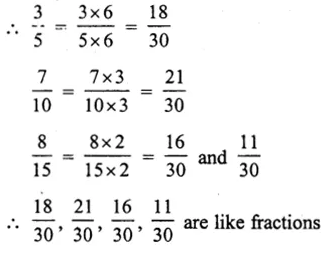
Now \(\frac { 3 }{ 5 } ,\frac { 7 }{ 10 } ,\frac { 8 }{ 15 } ,\frac { 11 }{ 30 } \)
LCM of 5, 10, 15 and 30 = 30
RS Aggarwal Class 6 Solutions Chapter 5 Fractions Ex 5D 2.1

Question 3.
Solution:
We know that like fraction have same denominators
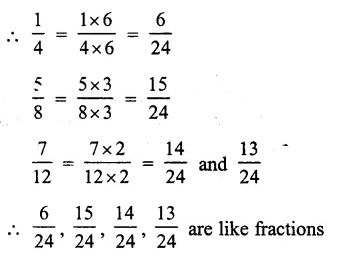
\(\frac { 1 }{ 4 } ,\frac { 5 }{ 8 } ,\frac { 7 }{ 12 } ,\frac { 13 }{ 24 } \)
LCM of 4, 8, 12, 24 = 24
RS Aggarwal Class 6 Solutions Chapter 5 Fractions Ex 5D 3.1

Question 4.
Solution:
RS Aggarwal Class 6 Solutions Chapter 5 Fractions Ex 5D 4.1
RS Aggarwal Class 6 Solutions Chapter 5 Fractions Ex 5D 4.2

Question 5.
Solution:
RS Aggarwal Class 6 Solutions Chapter 5 Fractions Ex 5D 5.1
RS Aggarwal Class 6 Solutions Chapter 5 Fractions Ex 5D 5.2

Compare the fractions given below :

Question 6.
Solution:
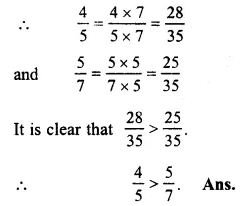
\(\frac { 4 }{ 5 } and\frac { 5 }{ 7 } \)
LCM of 5 and 7 = 35
RS Aggarwal Class 6 Solutions Chapter 5 Fractions Ex 5D 6.1

Question 7.
Solution:
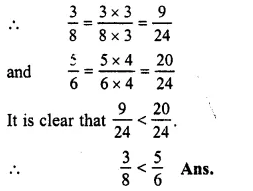
\(\frac { 3 }{ 8 } and\frac { 5 }{ 6 } \)
LCM of 8 and 6 = 24
RS Aggarwal Class 6 Solutions Chapter 5 Fractions Ex 5D 7.1

Question 8.
Solution:
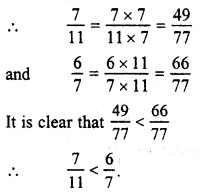
\(\frac { 7 }{ 11 } and\frac { 6 }{ 7 } \)
LCM of 11 and 7 = 77
RS Aggarwal Class 6 Solutions Chapter 5 Fractions Ex 5D 8.1

Question 9.
Solution:
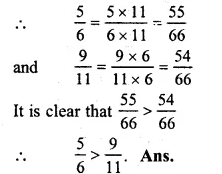
\(\frac { 5 }{ 6 } and\frac { 9 }{ 11 } \)
LCM of 6 and 11 = 66
RS Aggarwal Class 6 Solutions Chapter 5 Fractions Ex 5D 9.1

Question 10.
Solution:
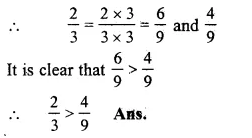
\(\frac { 2 }{ 3 } and\frac { 4 }{ 9 } \)
LCM of 3 and 9 = 9
RS Aggarwal Class 6 Solutions Chapter 5 Fractions Ex 5D 10.1

Question 11.
Solution:
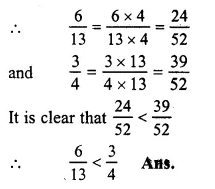
\(\frac { 6 }{ 13 } and\frac { 3 }{ 4 } \)
LCM of 13 and 4 = 52
RS Aggarwal Class 6 Solutions Chapter 5 Fractions Ex 5D 11.1

Question 12.
Solution:
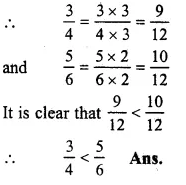
\(\frac { 3 }{ 4 } and\frac { 5 }{ 6 } \)
LCM of 4 and 6 = 12
RS Aggarwal Class 6 Solutions Chapter 5 Fractions Ex 5D 12.1

Question 13.
Solution:
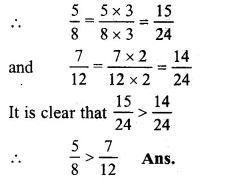
\(\frac { 5 }{ 8 } and\frac { 7 }{ 12 } \)
LCM of 8 and 12 = 24
RS Aggarwal Class 6 Solutions Chapter 5 Fractions Ex 5D 13.1

Question 14.
Solution:
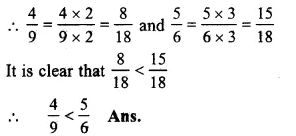
\(\frac { 4 }{ 9 } and\frac { 5 }{ 6 } \)
LCM of 9 and 6 = 18
RS Aggarwal Class 6 Solutions Chapter 5 Fractions Ex 5D 14.1

Question 15.
Solution:
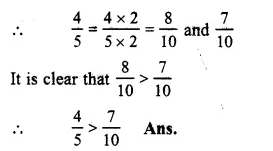
\(\frac { 4 }{ 5 } and\frac { 7 }{ 10 } \)
LCM of 5 and 10 = 10
RS Aggarwal Class 6 Solutions Chapter 5 Fractions Ex 5D 15.1

Question 16.
Solution:
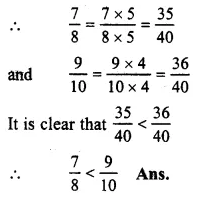
\(\frac { 7 }{ 8 } and\frac { 9 }{ 10 } \)
LCM of 8 and 10 = 40
RS Aggarwal Class 6 Solutions Chapter 5 Fractions Ex 5D 16.1

Question 17.
Solution:
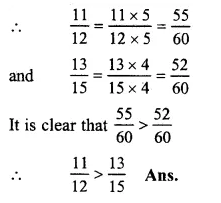
\(\frac { 11 }{ 12 } and\frac { 13 }{ 15 } \)
LCM of 12 and 15 = 60
RS Aggarwal Class 6 Solutions Chapter 5 Fractions Ex 5D 17.1

Question 18.
Solution:
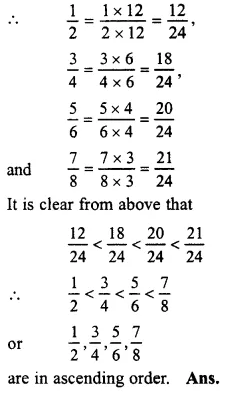
\(\frac { 1 }{ 2 } ,\frac { 3 }{ 4 } ,\frac { 5 }{ 6 } and\frac { 7 }{ 8 } \)
LCM of 2, 4, 6 and 8 = 24
RS Aggarwal Class 6 Solutions Chapter 5 Fractions Ex 5D 18.1

Question 19.
Solution:
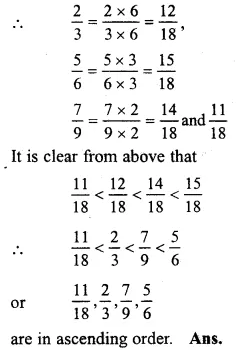
\(\frac { 2 }{ 3 } ,\frac { 5 }{ 6 } ,\frac { 7 }{ 9 } and\frac { 11 }{ 18 } \)
LCM of 3, 6, 9 and 18 = 18
RS Aggarwal Class 6 Solutions Chapter 5 Fractions Ex 5D 19.1

Question 20.
Solution:
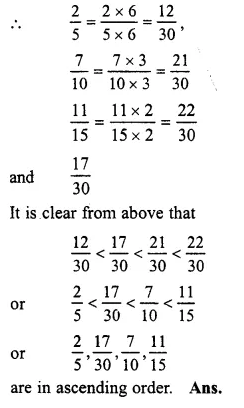
\(\frac { 2 }{ 5 } ,\frac { 7 }{ 10 } ,\frac { 11 }{ 15 } and\frac { 17 }{ 30 } \)
LCM of 5, 10, 15 and 30 = 30
RS Aggarwal Class 6 Solutions Chapter 5 Fractions Ex 5D 20.1

Question 21.
Solution:
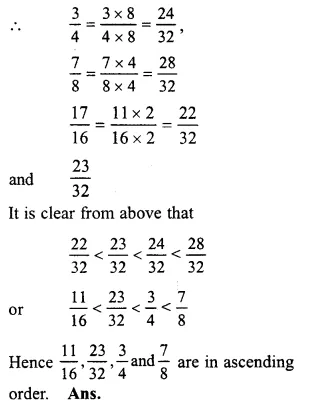
\(\frac { 3 }{ 4 } ,\frac { 7 }{ 8 } ,\frac { 11 }{ 16 } and\frac { 23 }{ 32 } \)
LCM of 4, 8, 16 and 32 = 32
RS Aggarwal Class 6 Solutions Chapter 5 Fractions Ex 5D 21.1

Arrange the following fractions in the descending order :

Question 22.
Solution:
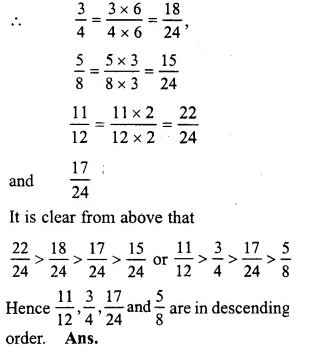
\(\frac { 3 }{ 4 } ,\frac { 5 }{ 8 } ,\frac { 11 }{ 12 } and\frac { 17 }{ 24 } \)
LCM of 4, 8, 12 and 24 = 24
RS Aggarwal Class 6 Solutions Chapter 5 Fractions Ex 5D 22.1

Question 23.
Solution:
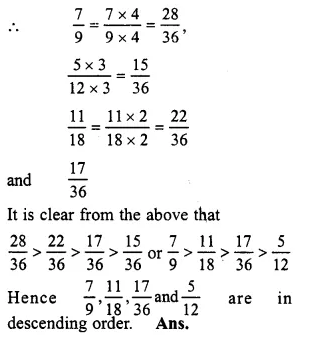
\(\frac { 7 }{ 9 } ,\frac { 5 }{ 12 } ,\frac { 11 }{ 18 } and\frac { 17 }{ 36 } \)
LCM of 9, 12, 18 and 36 = 36
RS Aggarwal Class 6 Solutions Chapter 5 Fractions Ex 5D 23.1

Question 24.
Solution:
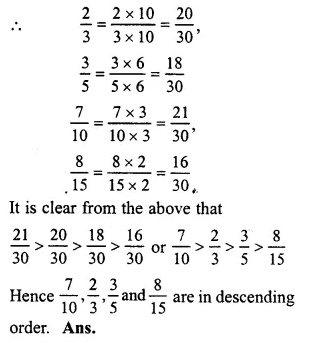
\(\frac { 2 }{ 3 } ,\frac { 3 }{ 5 } ,\frac { 7 }{ 10 } and\frac { 8 }{ 15 } \)
LCM of 3, 5, 10 and 15 = 30
RS Aggarwal Class 6 Solutions Chapter 5 Fractions Ex 5D 24.1

Question 25.
Solution:
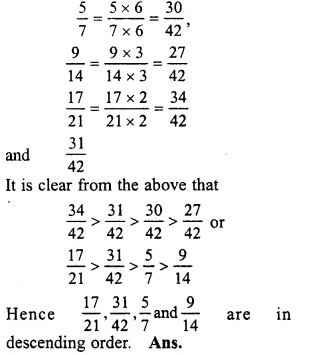
\(\frac { 5 }{ 7 } ,\frac { 9 }{ 14 } ,\frac { 17 }{ 21 } and\frac { 31 }{ 42 } \)
LCM of 7, 14, 21 and 42 = 42
RS Aggarwal Class 6 Solutions Chapter 5 Fractions Ex 5D 25.1

Question 26.
Solution:
∴ the numerators are equal
∴ The fraction having small denominator is greater than the fraction having large denominator
∴ In descending order, we can write
\(\frac { 1 }{ 12 } ,\frac { 1 }{ 23 } ,\frac { 1 }{ 7 } ,\frac { 1 }{ 9 } ,\frac { 1 }{ 17 } ,\frac { 1 }{ 50 } \)

Question 27.
Solution:
Here, the numerators of all fractions are equal
∴ The fraction having small denominator is greater than the fraction having large denominator
Now in descending order is
\(\frac { 3 }{ 4 } ,\frac { 3 }{ 5 } ,\frac { 3 }{ 7 } ,\frac { 3 }{ 11 } ,\frac { 3 }{ 13 } ,\frac { 3 }{ 17 } \)

Question 28.
Solution:
Lalita read 30 pages of a book containing 100 pages
She read \(\\ \frac { 30 }{ 100 } \) = \(\\ \frac { 3 }{ 10 } \) part of the book and Sarita read \(\\ \frac { 2 }{ 5 } \) of the book
Now in \(\\ \frac { 3 }{ 10 } \) and \(\\ \frac { 2 }{ 5 } \), LCM of 10, 5 = 10
\(\\ \frac { 3 }{ 10 } \) = \(\\ \frac { 3 }{ 10 } \)
\(\\ \frac { 2 }{ 5 } \) = \(\\ \frac { 2\times 2 }{ 5\times 2 } \) = \(\\ \frac { 4 }{ 10 } \)
From above, Sarita read more
as \(\\ \frac { 4 }{ 10 } \) or \(\frac { 2 }{ 5 } >\frac { 3 }{ 10 } \)

Question 29.
Solution:
Rafiq exercised for \(\\ \frac { 2 }{ 3 } \) hour and Rohit exercised for \(\\ \frac { 3 }{ 4 } \) hour
In \(\\ \frac { 2 }{ 3 } \) and \(\\ \frac { 3 }{ 4 } \), LCM of 3 and 4 = 12
\(\\ \frac { 2 }{ 3 } \) = \(\\ \frac { 2\times 4 }{ 3\times 4 } \) = \(\\ \frac { 8 }{ 12 } \)
\(\\ \frac { 3 }{ 4 } \) = \(\\ \frac { 3\times 3 }{ 4\times 3 } \) = \(\\ \frac { 9 }{ 12 } \)
\(\frac { 9 }{ 12 } >\frac { 8 }{ 12 } \)
=> \(\frac { 3 }{ 4 } >\frac { 2 }{ 3 } \)
∴ Rohit exercised more time

Question 30.
Solution:
In VI A, 20 student passed out of 25 or \(\\ \frac { 20 }{ 25 } \) or \(\\ \frac { 4 }{ 5 } \) students passed
But in VI B, 24 out of 30 passed 24 or \(\\ \frac { 24 }{ 30 } \) or \(\\ \frac { 4 }{ 5 } \) students passed
Now \(\\ \frac { 4 }{ 5 } \) = \(\\ \frac { 4 }{ 5 } \)
∴ Both sections gave same result

Hope given RS Aggarwal Solutions Class 6 Chapter 5 Fractions Ex 5D are helpful to complete your math homework.

If you have any doubts, please comment below. Learn Insta try to provide online math tutoring for you.

RD Sharma Class 8 Solutions Chapter 21 Mensuration II Ex 21.4

RD Sharma Class 8 Solutions Chapter 21 Mensuration II (Volumes and Surface Areas of a Cubiod and a Cube) Ex 21.4

These Solutions are part of RD Sharma Class 8 Solutions. Here we have given RD Sharma Class 8 Solutions Chapter 21 Mensuration II Ex 21.4
Other Exercises

Question 1.
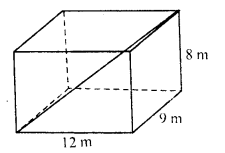
Find the length of the longest rod that can be placed in a room 12 m long, 9 m broad and 8 m high.
Solution:
Length of room (l) = 12m
Breadth (b) = 9 m
Height (h) = 8 m
RD Sharma Class 8 Solutions Chapter 21 Mensuration II Ex 21.4 1
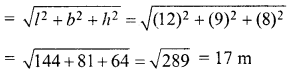
Longest rod to be kept in the room
RD Sharma Class 8 Solutions Chapter 21 Mensuration II Ex 21.4 2

Question 2.
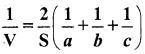
If V is the volume of the cuboid of dimensions a, b, c and S its the surface area then prove that
RD Sharma Class 8 Solutions Chapter 21 Mensuration II Ex 21.4 3
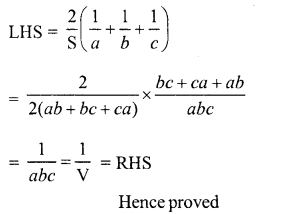
Solution:
∵ a, b, c are the dimensions of a cuboid
∴ Volume (V) = abc
Surface area (S) = 2(ab + bc + ca)
Now
RD Sharma Class 8 Solutions Chapter 21 Mensuration II Ex 21.4 4

Question 3.
The areas of three adjacent faces of a cuboid are .v, y and z. If the volume is V1 prove that V2 = xyz.
Solution:
Let length of cuboid = l
Breadth = b
and height = h
Volume = Ibh
∴ x = lb,y = bh and z = hl
Now x.y.z = lb.bh.hl
= l2 b2 h2 = (Ibh)2 = V2
∴ V2 = xyz Hence proved

Question 4.
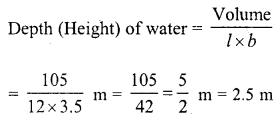
A rectangular water reservoir contains 105 m3 of water. Find the depth of the water in the reservoir if its base measures 12 m by 3.5 m.
Solution:
Volume of the water in reservoir = 105 m2
Length (l)= 12 m
and breadth (b) = 3.5 m
RD Sharma Class 8 Solutions Chapter 21 Mensuration II Ex 21.4 5

Question 5.
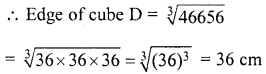
Cubes A, B, C having edges 18 cm, 24 cm and 30 cm respectively are melted and moulded into a new cube D. Find the edge of the bigger cube D.
Solution:
Edge of cube A = 18 cm
∴ Volume = a2 = (18)3 cm3 = 5832 cm3
Edge of cube B = 24 cm
∴ Volume = (24)3 = 13824 cm3
Edge of cube C = 30 cm
∴Volume = (30)3 = 27000 cm3
Volume of A, B, C cubes
= 5832+ 138-24+ 27000 = 46656 cm3
Volume of cube D = 46656 cm3
RD Sharma Class 8 Solutions Chapter 21 Mensuration II Ex 21.4 6

Question 6.
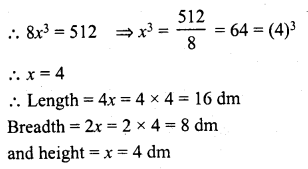
The breadth of a room is twice its height, one half of its length and the volume of the room is 512 cu.dm. Find its dimensions.
Solution:
Volume of room = 512 cu.dm
Let height of the room (h) = x
Then breadth (b) = 2x
and length (l) = 2x x 2 = 4x.
∴ Volume = l x b x h = 4x x 2x x x = 8×3
RD Sharma Class 8 Solutions Chapter 21 Mensuration II Ex 21.4 7

Question 7.
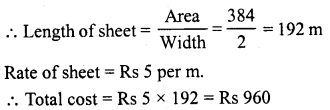
A closed iron tank 12 m long, 9 m wide and 4 m deep is to be made. Determine the cost of iron sheet used at the rate of Rs 5 per metre sheet, sheet being 2 m wide.
Solution:
Length of iron tank (l) = 12 m
Breadth (b) = 9 m
Depth (h) = 4 m
∴ Surface area of the tank = 2(l x b + b x h + h x l)
= 2(12 x 9 + 9 x 4 + 4 x 12) m2
= 2(108 + 36 + 48) = 2 x 192 m2
= 384 m2
Width of sheet used = 2 m
RD Sharma Class 8 Solutions Chapter 21 Mensuration II Ex 21.4 8

Question 8.
A tank open at the top is made of iron sheet 4 m wide. If the dimensions of the tank are 12 m x 8 m x 6 m, find the cost of iron sheet at Rs 17.50 per metre.
Solution:
Dimensions of the open iron tank = 12mx 8m.x 6m
∴ Surface area (without top)
= 2(1 x b) x h + lb
= 2(12 + 8) x 6+12 x 8m2
= 2 x 20 x 6 + 96 = 240 + 96 m2 = 336 m2
Width of sheet used = 4 m
∴ Length of sheet = \(\frac { Area }{ b }\) = \(\frac { 336 }{ 4 }\) m = 84 m b 4
Rate of sheet = Rs 17.50 per m.
∴ Total cost = Rs 17.50 x 84 = Rs 1470

Question 9.
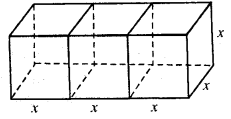
Three equal cubes are placed adjacently in a row. Find the ratio of the total surface area of the new cuboid to that of the sum of the surface areas of the three cubes.
Solution:
Let edge of each equal cubes = x
Then, surface area of one cube = 6x2
RD Sharma Class 8 Solutions Chapter 21 Mensuration II Ex 21.4 9
and surface area of three cubes = 3 x 6x2 = 18x2
By placing the cubes in a row,
The length of newly formed cuboid (l) = 3x
Breadth (b) = x
and height (h) = x
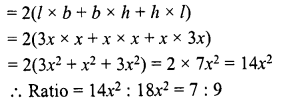
∴ Surface area of the cuboid so formed
RD Sharma Class 8 Solutions Chapter 21 Mensuration II Ex 21.4 10

Question 10.
The dimensions of a room are 12.5 m by 9 m by 7 m. There are 2 doors and 4 windows in the room; each door measures 2.5 m by 1.2 m and each window 1.5 m by 1 m. Find the cost of painting the walls at Rs 3.50 per square metre.
Solution:
Dimensions of a room = 12.5 m x 9 m x 7 m
∴ Total surface area of the walls = 2(1 + b) x h = 2(12.5 + 9) x 7 m2
= 2 x 21.5 x 7 = 301 0 m2
Area of 2 doors = 2 x (2.5 x 1.2) m2 = 2 x 3.00 = 6 m2
Area of 4 windows = 4 x (1.5 x 1) m2
4 x 1.5 = 6 m2
∴ Remaining area of the walls = 301 -(6 + 6) m2
= 301 – 12 = 289 m2
∴ Rate of painting the walls = Rs 3.50 per m2
∴ Total cost = Rs 3.50 x 289 = Rs 1011.50

Question 11.
A field is 150 m long and 100 m wide. A plot (outside the field) 50 m long and 30 m wide is dug to a depth of 8 m and the earth taken out from the plot is spread evenly in the field. By how much the level of field is raised ?
Solution:
Length of the plot (l) = 50 m
Width (b) = 30 m
and depth (h) = 8 m
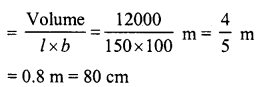
∴ Volume of the earth dug out = l x b x h = 50 x 30 x 8 = 12000 m3
Length of the field = 150 m
and breadth = 100 m
∴ Height of the earth spread out on the field
RD Sharma Class 8 Solutions Chapter 21 Mensuration II Ex 21.4 11

Question 12.
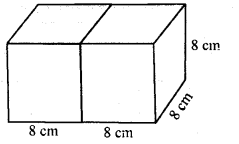
Two cubes, each of volume 512 cm3 are joined end to end, find the surface area of the resulting cuboid.
Solution:
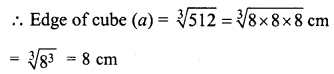
Volume of each cube = 512 cm3
RD Sharma Class 8 Solutions Chapter 21 Mensuration II Ex 21.4 12
Now by joining the two equal cubes of side 8 cm, the length of so formed cuboid (l)
= 2 x 8 = 16 cm
Breadth (b) = 8 cm
and height (h) = 8 cm
∴ Surface area = 2( l x b + b x h + h x l)
= 2(16 X 8 + 8 X 8 + 8X16) cm2
= 2(128 + 64 + 128) cm2
= 2 x 320 = 640 cm2
RD Sharma Class 8 Solutions Chapter 21 Mensuration II Ex 21.4 13

Question 13.
Three cubes whose edges measure 3 cm, 4 cm and 5 cm respectively are melted to form a new cube. Find the surface area of the new cube formed.
Solution:
Edge of first cube = 3 cm
∴ Volume = a3 = (3)3 27 cm3
Edge of second cube = 4 cm
∴Volume = a3 = (4)3 = 64 cm3
Edge of third cube = 5 cm
∴ Volume = a3 = (5)3 = 125 cm3
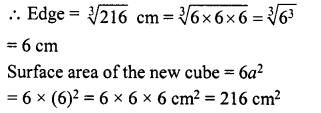
Volume of three cubes together = 27 + 64+ 125 = 216 cm3
∴ Volume of the new cube = 216 cm3
RD Sharma Class 8 Solutions Chapter 21 Mensuration II Ex 21.4 14

Question 14.
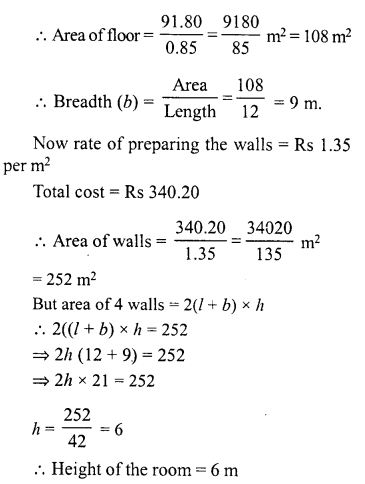
The cost of preparing the’walls of a room 12 m long at the rate of Rs 1.35 per square metre is Rs 340.20 and the cost of matting the floor at 85 paise per square metre is Rs 91.80. Find the height of the room.
Solution:
Length of the room (l) = 12 m
Rate of matting the floor = 85 paise per m2
Total cost of matting = Rs 91.80
RD Sharma Class 8 Solutions Chapter 21 Mensuration II Ex 21.4 15

Question 15.
The length of a hall is 18 m and width 12 m. The sum of the areas of the floor and the flat roof is equal to the sum of the areas of the four walls. Find the height of the wall.
Solution:
Length of hall (l) = 18 m
and breadth (b) = 12 m
∴ Area of floor = l x b = 18 x 12 = 216 m2
and area of roof = 216 m2
Total area of floor and roof
= (216 + 216) m2 = 432 m2
∴ Area of four walls = 432 m2
But area of 4 walls = 2(l + b) x h
∴ 2h (l + b) = 432
⇒ 2h (18 + 12) = 432
⇒ 2h x 30 = 432 432
⇒ h = \(\frac { 432 }{ 60 }\) = 7.2m
∴ Height of the wall = 7.2 m

Question 16.
A metal cube of edge 12 cm is melted and formed into three smaller cubes. If the edges of the two smaller cubes are 6 cm and 8 cm, find the edge of the third smaller cube.
Solution:
Edge of metal bigger cube = 12 cm
∴ Volume = (12)3 = 1728 cm3
∴ Sum of volumes of 3 smaller cubes = 1728 cm3
Edge of first smaller cube = 6 cm
∴ Volume = (6)3 = 216 cm3
Edge of second smaller cube = 8 cm
∴ Volume = (8)3 = 512 cm3
Sum of volumes of two smaller cubes = 216+ 512 = 728 cm3
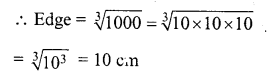
∴ Volume of third smaller cube = 1728-728 cm3 = 1000 cm3
RD Sharma Class 8 Solutions Chapter 21 Mensuration II Ex 21.4 16

Question 17.
The dimensions of a cinema hall are 100 m, 50 m and 18 m. How many persons can sit in the hall if each person requires 150 m3 of air ?
Solution:
Length of cinema hall (l) = 100 m
Breadth (b) = 50 m
and height (h) = 18 m
∴ Volume of air of the hall = l x b x h
= 100 x 50 x 18 m3
= 90000 m3
Each person requires air = 150 m3
∴ Number of persons = \(\frac { 90000 }{ 150 }\)= 600

Question 18.
The external dimensions of a closed wooden box are 48 cm, 36 cm, 30 cm. The box is made of 1.5 cm thick wood. How many bricks of size 6 cm x 3 cm x 0.75 cm can be put in this box ?
Solution:
Outer dimensions of a closed wooden box = 48 cm x 36 cm x 30 cm
Thickness of wood = 1.5 cm.
∴ Inner length (l) = 48 – 2 x 1.5 cm = 48 – 3 = 45 cm
Breadth(b) = 36-2 x 1.5 = 36-3 = 33 cm
Height (h) = 30 – 2 x 1.5 = 30 – 3 = 27 cm
∴ Volume of inner box = l x b x h = 45 x 33 x 27 cm3 = 40095 cm3
Volume of one brick of size 6 cm x 3 cm x 0.75 cm
= 6 x 3 x 0.75 = 6 x 3 x \(\frac { 3 }{ 4 }\) cm3 = \(\frac { 27 }{ 2 }\) cm3
∴ Number of bricks = \(\frac { 40095 x 2 }{ 27 }\)
= 1485 x 2 = 2970 bricks

Question 19.
The dimensions of a rectangular box are in the ratio of 2 : 3 : 4 and the difference between the cost of covering it with sheet of paper at the rates of Rs 8 and Rs 9.50 per m2 is Rs 1,248. Find the dimensions of the box.
Solution:
Ratio in the dimensions of a box =2:3:4
Difference in total cost = Rs 1,248
Difference in rates = Rs 9.50 – Rs 8 = Rs 1.50
Let length (l) = 2x
Then breadth (b) = 3x
and height (h) = 4x
∴ Surface area = 2 (l x b + b x h + h x l)
= 2(2x 3x  + 3x x 4x + 4x x 2x)
= 2(6x2 + 12x2 + 8 x2) = 2 x 26x2 = 52x2
First rate of paper = Rs 9.50 per m2
and second rate = 8.00 per m2
∴ First cost = Rs 52x2 x 9.50
and second cost = Rs 52x2 x 8
∴ 52x2 x 9.50 – 52x2 x 8= 1248
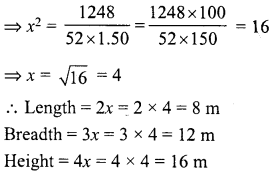
⇒ 52x2 (9.50 – 8) = 1248
⇒ 52x2(1.50) = 1248
RD Sharma Class 8 Solutions Chapter 21 Mensuration II Ex 21.4 17

Hope given RD Sharma Class 8 Solutions Chapter 21 Mensuration II Ex 21.4 are helpful to complete your math homework.

If you have any doubts, please comment below. Learn Insta try to provide online math tutoring for you.