Selina Concise Mathematics Class 10 ICSE Solutions Chapter 24 Measures of Central Tendency Ex 24B

Selina Concise Mathematics Class 10 ICSE Solutions Chapter 24 Measures of Central Tendency (Mean, Median, Quartiles and Mode) Ex 24B

These Solutions are part of Selina Concise Mathematics Class 10 ICSE Solutions. Here we have given Chapter 24 Measures of Central Tendency (Mean, Median, Quartiles and Mode) Ex 24B.

Other Exercises

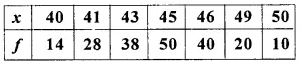
Question 1.
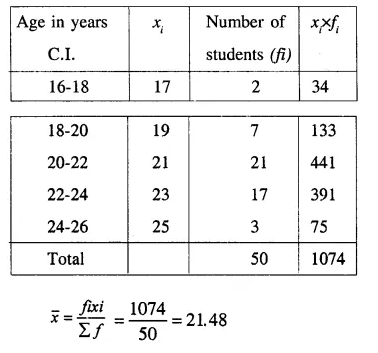
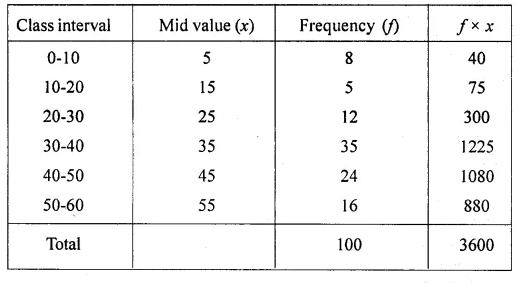
The following table gives the ages of 50 students of a class. Find the arithmetic mean of their ages.

Selina Concise Mathematics Class 10 ICSE Solutions Chapter 24 Measures of Central Tendency Ex 24B Q1.1
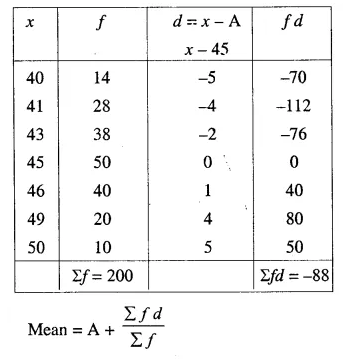
Solution:
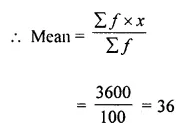
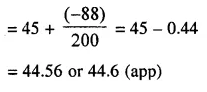
Selina Concise Mathematics Class 10 ICSE Solutions Chapter 24 Measures of Central Tendency Ex 24B Q1.2

Question 2.
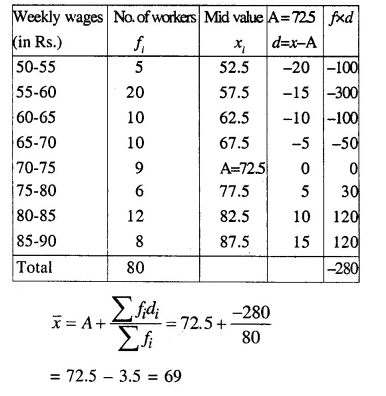
The following table gives the weekly wages of workers in a factory.
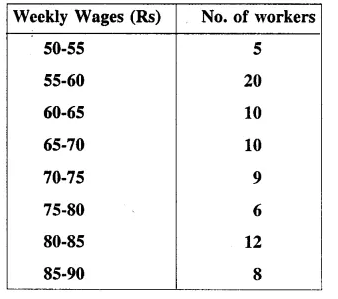
Selina Concise Mathematics Class 10 ICSE Solutions Chapter 24 Measures of Central Tendency Ex 24B Q2.1
Calculate the mean by using :
(i) Direct Method
(ii) Short-Cut Method
Solution:
(i) Direct Method:
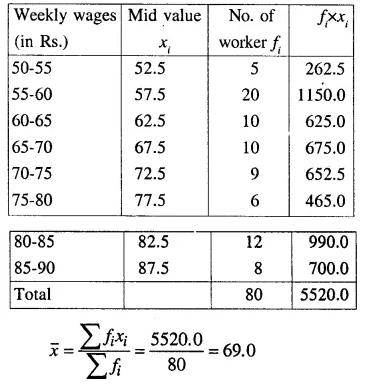
Selina Concise Mathematics Class 10 ICSE Solutions Chapter 24 Measures of Central Tendency Ex 24B Q2.2
(ii) Short cut method :
Selina Concise Mathematics Class 10 ICSE Solutions Chapter 24 Measures of Central Tendency Ex 24B Q2.3

Question 3.
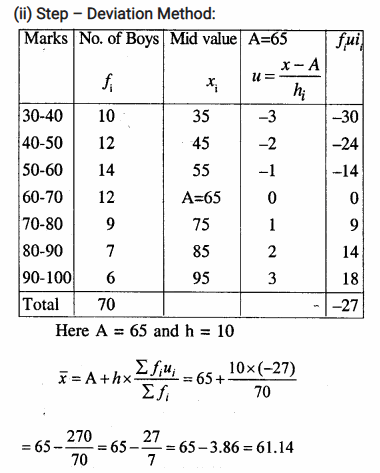
The following are the marks obtained by 70 boys in a class test :
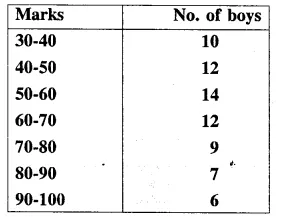
Selina Concise Mathematics Class 10 ICSE Solutions Chapter 24 Measures of Central Tendency Ex 24B Q3.1
Calculate the mean by :
(i) Short-Cut Method
(ii) Step-Deviation Method.
Solution:
(i) Short cut Method :
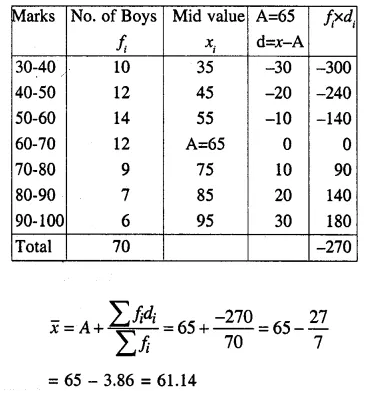
Selina Concise Mathematics Class 10 ICSE Solutions Chapter 24 Measures of Central Tendency Ex 24B Q3.2
(ii) Step – Deviation Method:
Selina Concise Mathematics Class 10 ICSE Solutions Chapter 24 Measures of Central Tendency Ex 24B Q3.3

Question 4.
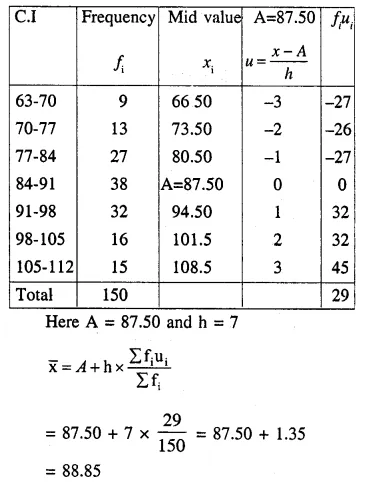
Find mean by ‘step-deviation method :

Selina Concise Mathematics Class 10 ICSE Solutions Chapter 24 Measures of Central Tendency Ex 24B Q4.1
Solution:
Selina Concise Mathematics Class 10 ICSE Solutions Chapter 24 Measures of Central Tendency Ex 24B Q4.2

Question 5.
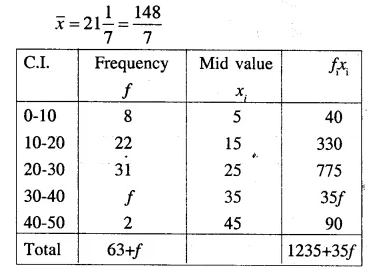
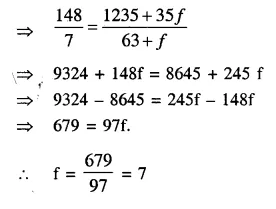
The mean of following frequency distribution is 21\(\frac { 1 }{ 7 }\) Find the value of ‘f ‘.

Selina Concise Mathematics Class 10 ICSE Solutions Chapter 24 Measures of Central Tendency Ex 24B Q5.1
Solution:
Selina Concise Mathematics Class 10 ICSE Solutions Chapter 24 Measures of Central Tendency Ex 24B Q5.2
Selina Concise Mathematics Class 10 ICSE Solutions Chapter 24 Measures of Central Tendency Ex 24B Q5.3

Question 6.
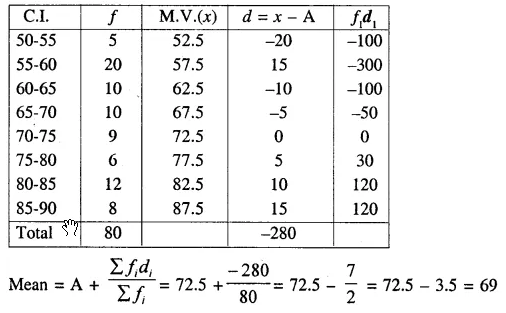
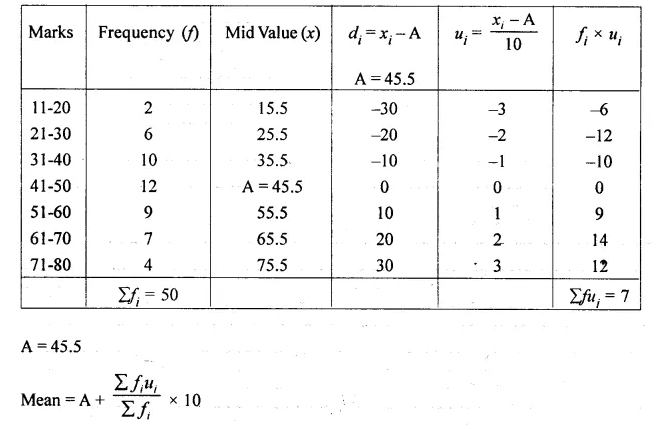
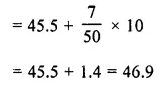
Using step-deviation method, calculate the mean marks of the following distribution.

Selina Concise Mathematics Class 10 ICSE Solutions Chapter 24 Measures of Central Tendency Ex 24B Q6.1
Solution:
Let Assumed mean = 72.5
Selina Concise Mathematics Class 10 ICSE Solutions Chapter 24 Measures of Central Tendency Ex 24B Q6.2

Question 7.
Using the information given in the adjoining histogram; calculate the mean.
Solution:
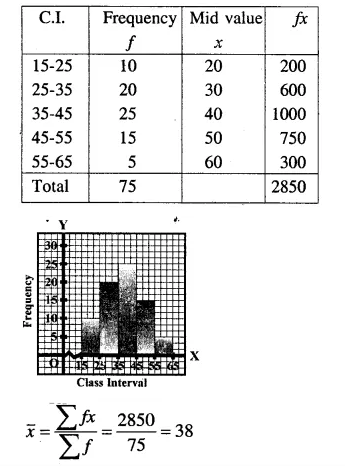
Selina Concise Mathematics Class 10 ICSE Solutions Chapter 24 Measures of Central Tendency Ex 24B Q7.1

Question 8.
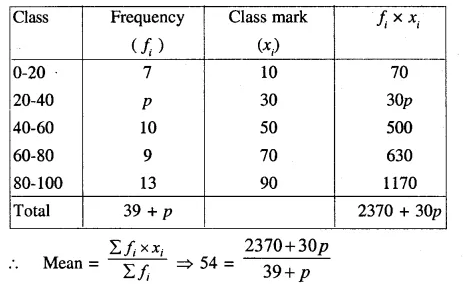
If the mean of the following observations is 54, find the value of p.

Selina Concise Mathematics Class 10 ICSE Solutions Chapter 24 Measures of Central Tendency Ex 24B Q8.1
Solution:
Mean = 54
Selina Concise Mathematics Class 10 ICSE Solutions Chapter 24 Measures of Central Tendency Ex 24B Q8.2
⇒ 2106 + 54p = 2370 + 30p
⇒ 54p – 30p = 2370 – 2106 ⇒ 24p = 264
p = \(\frac { 264 }{ 24 }\) = 11
Hence p = 11

Question 9.
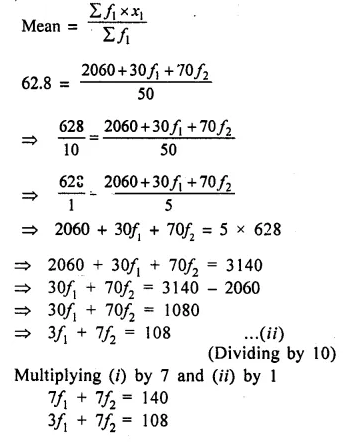
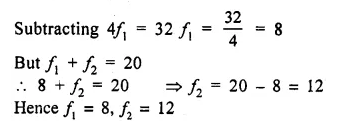
The mean of the following distribution is 62.8 and the sum of all the frequencies is 50. Find the missing frequencies f1 and f2.

Selina Concise Mathematics Class 10 ICSE Solutions Chapter 24 Measures of Central Tendency Ex 24B Q9.1
Solution:
Mean = 62.8
and sum of frequencies = 50
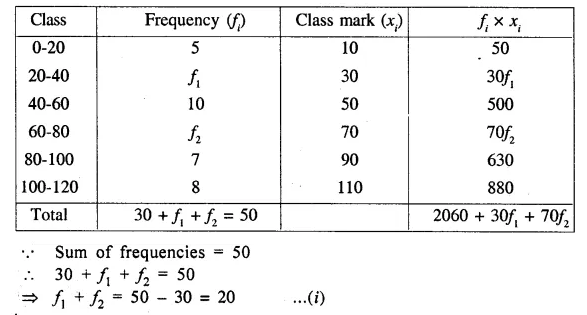
Selina Concise Mathematics Class 10 ICSE Solutions Chapter 24 Measures of Central Tendency Ex 24B Q9.2
Selina Concise Mathematics Class 10 ICSE Solutions Chapter 24 Measures of Central Tendency Ex 24B Q9.3
Selina Concise Mathematics Class 10 ICSE Solutions Chapter 24 Measures of Central Tendency Ex 24B Q9.4

Question 10.
Calculate the mean of the distribution given below using the short cut method.

Selina Concise Mathematics Class 10 ICSE Solutions Chapter 24 Measures of Central Tendency Ex 24B Q10.1
Solution:
Selina Concise Mathematics Class 10 ICSE Solutions Chapter 24 Measures of Central Tendency Ex 24B Q10.2
Selina Concise Mathematics Class 10 ICSE Solutions Chapter 24 Measures of Central Tendency Ex 24B Q10.3

Question 11.
Calculate the mean of the following distribution :

Selina Concise Mathematics Class 10 ICSE Solutions Chapter 24 Measures of Central Tendency Ex 24B Q11.1
Solution:
Selina Concise Mathematics Class 10 ICSE Solutions Chapter 24 Measures of Central Tendency Ex 24B Q11.2
Selina Concise Mathematics Class 10 ICSE Solutions Chapter 24 Measures of Central Tendency Ex 24B Q11.3

Hope given Selina Concise Mathematics Class 10 ICSE Solutions Chapter 24 Measures of Central Tendency Ex 24B are helpful to complete your math homework.

If you have any doubts, please comment below. Learn Insta try to provide online math tutoring for you.
Selina Concise Mathematics Class 10 ICSE Solutions Chapter 10 Arithmetic Progression Ex 10B

Selina Concise Mathematics Class 10 ICSE Solutions Chapter 10 Arithmetic Progression Ex 10B

These Solutions are part of Selina Concise Mathematics Class 10 ICSE Solutions. Here we have given Selina Concise Mathematics Class 10 ICSE Solutions Chapter 10 Arithmetic Progression Ex 10B

Other Exercises

Question 1.
In an A.P., ten times of its tenth term is equal to thirty times of its 30th term. Find its 40th term.
Solution:
In an A.P.
10T10 = 30T30
We know that,
If m times of mth term = n times of nth term
Then its (m + n)th term = 0
∴ 10T10 = 30T30
Then T10+30 = 0 or T40 = 0

Question 2.
How many two-digit numbers are divisible by 3 ?
Solution:
Two digits numbers are 10 to 99
and two digits numbers which are divisible
by 3 are 12, 15, 18, 21,….99
Here a = 12, d = 3 and l = 99
Now, Tn = l = a + (n – 1 )d
99 = 12 + (n – 1) x 3
=> 99 – 12 = 3(n – 1)
=> 87 = 3(n – 1)
=> \(\\ \frac { 87 }{ 3 } \) = n – 1
=> n – 1 = 29
n = 29 + 1 = 30
Number of two digit number divisible by 3 = 30

Question 3.
Which term of A.P. 5, 15, 25, will be 130 more than its 31st term?
Solution:
A.P. is 5, 15, 25,….
Let Tn = T31 + 130
In A.P. a = 5, d = 15 – 5 = 10
∴ Tn = a + 30d + 130 = 5 + 30 x 10 +130
= 5 + 300 + 130 = 435
∴ n + (n – 1)d = 435
=> 5 + (n – 1) x 10 = 435
=> (n – 1) x 10 = 435 – 5 = 430
n – 1 = \(\\ \frac { 430 }{ 10 } \) = 43
n = 43 + 1 = 44
∴ The required term is 44th.

Question 4.
Find the value of p, if x, 2x + p and 3x + 6 are in A.P.
Solution:
A.P. is x, 2x + p, 3x + 6
2x + p – x = 3x + 6 – 2x + p
x + p = x – p + 6
=>2p = 6
=>p = \(\\ \frac { 6 }{ 2 } \) = 3
Hence p = 3

Question 5.
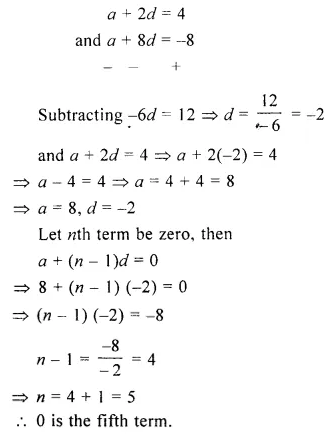
If the 3rd and the 9th terms of an arithmetic progression are 4 and – 8 respectively, which term of it is zero?
Solution:
In an A.P.
T3 = 4 and T9 = – 8
Let a be the first term and d be the common difference, then
Selina Concise Mathematics Class 10 ICSE Solutions Chapter 10 Arithmetic Progression Ex 10B Q5.1

Question 6.
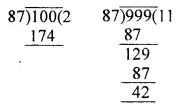
How many three-digit numbers ate divisible by 87 ?
Solution:
Three digits numbers are 100 to 999
Selina Concise Mathematics Class 10 ICSE Solutions Chapter 10 Arithmetic Progression Ex 10B Q6.1
999 – 42 = 957
Numbers divisible by 87 will be 174,….., 957
Let n be the number of required three digit number.
Here, a = 174 and d = 87
l = 957 = a + (n – l)d
= 174 + (n – 1) x 87
=> (n – 1) x 87 = 957 – 174 = 783
n – 1 = \(\\ \frac { 783 }{ 87 } \) = 9
n = 9 + 1 = 10
There are 10 such numbers.

Question 7.
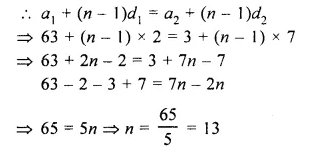
For what value of n, the nth term of A.P. 63, 65, 67,….. and nth term of A.P. 3, 10, 17,…… are equal to each other?
Solution:
We are given,
nth term of 63, 65, 67, …….
=> nth term of 3, 10, 17,…….
=> In first A.P., a1 = 63, d1 = 2
and in second A.P., a2 = 3, d2 = 1
Selina Concise Mathematics Class 10 ICSE Solutions Chapter 10 Arithmetic Progression Ex 10B Q7.1
∴ Required nth term will be 13th

Question 8.
Determine the A.P. whose 3rd term is 16 and the 7th term exceeds the 5th term by 12.
Solution:
T3 = 16, and T7 = T5 + 12
Let a be the first term and d be the common difference
T3 = a + 2d – 16 …(i)
T7 = T5 + 12
a + 6d = a + 4d + 12
=> 6d – 4d = 12 => 2d – 12
=> d = \(\\ \frac { 12 }{ 2 } \) = 6
and in (i),
a + 6 x 2 = 16
=> a + 12 = 16
=>a = 16 – 12 = 4
A.P. will be 4, 10, 16, 22,……

Question 9.
If numbers n – 2, 4n – 1 and 5n + 2 are in A.P., find the value of n and its next two terms.
Solution:
n – 2, 4n – 1 and 5n + 2 are in A.P.
(4n – 1) – (n – 2) = (5n + 2) – (4n – 1)
=> 4n – 1 – n + 2 = 5n + 2 – 4n + 1
=> 4n – n – 5n + 4n = 2 + 1 + 1 – 2
=>2n = 2 =>n = \(\\ \frac { 2 }{ 2 } \) = 1
4n – 1 = 4 x 1 – 1 = 4 – 1 = 3
n – 2 = 1 – 2 = – 1
and 5n + 2 = 5 x 1 + 2 = 5 + 2 = 7
A.P. is – 1, 3, 7, ……
and next 2 terms will 11, 15

Question 10.
Determine the value of k for which k2 + 4k + 8, 2k2 + 3k + 6 and 3k2 + 4k + 4 are in A.P.
Solution:
k2 + 4k+ 8, 2k2 + 3k + 6 and 3k2 + 4k + 4 are in A.P.
(2k2 + 3k + 6) – (k2 + 4k + 8)
= (3k2 + 4k + 4) – (2k2 + 3k + 6)
=> 2k2 + 3k + 6 – k2 – 4k – 8
= 3k2 + 4k + 4 – 2k2 – 3k – 6
=> k2 – k – 2 = k2 + k – 2
=> k2 – k – k2 – k = – 2 + 2
=> – 2k = 0
=> k = 0
Hence k = 0

Question 11.
If a, b and c are in A.P. show that :
(i) 4a, 4b and 4c are in A.P.
(ii) a + 4, b + 4 and c + 4 are in A.P.
Solution:
a, b, c are in A.P.
2b = a + c
(i) 4a, 4b and 4c are in A.P.
If 2(4b) = 4a + 4c
If 8b = 4a + 4c
If 2b = a + c which is given
(ii) a + 4, b + 4 and c + 4 are in A.P.
If 2(b + 4) = a + 4 + c + 4
If 2b + 8 = a + c + 8
If 2b = a + c which is given

Question 12.
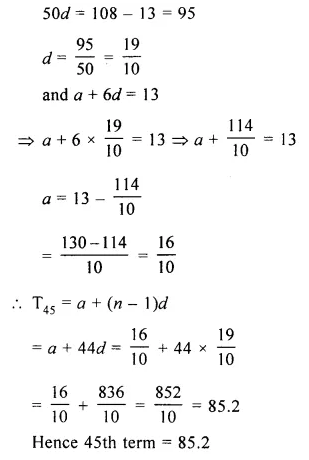
An A.P. consists of 57 terms of which 7th term is 13 and the last term is 108. Find the 45th term of this A.P.
Solution:
Number of terms in an A.P. = 57
T7 = 13, l= 108
To find T45
Let a be the first term and d be the common difference
=> a + 6d = 13 …(i)
a + (n – 1 )d= 108
=> a + (57 – 1 )d= 108
=> a + 56d = 108
Subtracting,
Selina Concise Mathematics Class 10 ICSE Solutions Chapter 10 Arithmetic Progression Ex 10B Q12.1

Question 13.
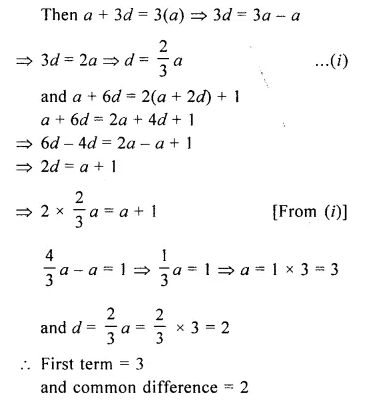
4th term of an A.P. is equal to 3 times its term and 7th term exceeds twice the 3rd term by 1. Find the first term and the common difference.
Solution:
In A.P
T4 = 3 x T1
T7 = 2 x T3 + 1
Let a be the first term and d be the common
difference
Selina Concise Mathematics Class 10 ICSE Solutions Chapter 10 Arithmetic Progression Ex 10B Q13.1

Question 14.
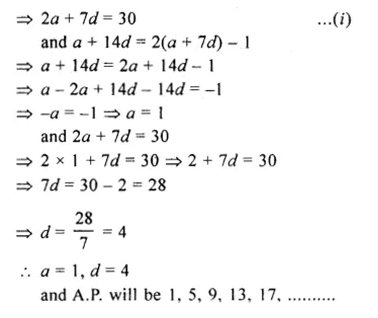
The sum of the 2nd term and the 7th term of an A.P. is 30. If its 15th term is 1 less than twice of its 8th term, find the A.P.
Solution:
In an A.P.
T2 + T7 = 30
T15 = 2T8 – 1
Let a be the first term and d be the common difference
a + d + a + 6d = 30
Selina Concise Mathematics Class 10 ICSE Solutions Chapter 10 Arithmetic Progression Ex 10B Q14.1

Question 15.
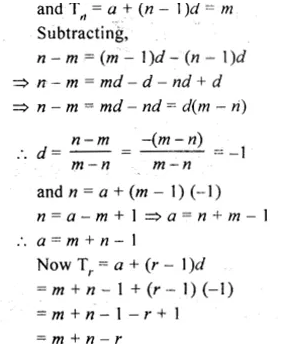
In an A.P., if mth term is n and nth term is m, show that its rth term is (m + n – r)
Solution:
In an A.P.
Tm = n and Tn = m
Let a be the first term and d be the common difference, then
Tm = a + (m – 1 )d = n
Selina Concise Mathematics Class 10 ICSE Solutions Chapter 10 Arithmetic Progression Ex 10B Q15.1

Question 16.
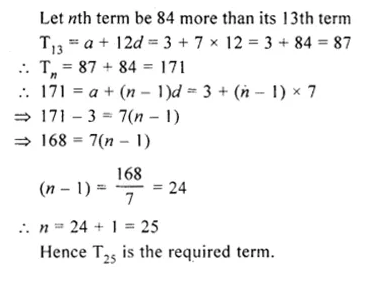
Which term of the A.P. 3, 10, 17,…..will be 84 more than its 13th term?
Solution:
A.P. is 3, 10, 17,….
Here, a = 2, d = 10 – 3 = 7
Selina Concise Mathematics Class 10 ICSE Solutions Chapter 10 Arithmetic Progression Ex 10B Q16.1

Hope given Selina Concise Mathematics Class 10 ICSE Solutions Chapter 10 Arithmetic Progression Ex 10B are helpful to complete your math homework.

If you have any doubts, please comment below. Learn Insta try to provide online math tutoring for you.
Selina Concise Mathematics Class 10 ICSE Solutions Chapter 24 Measures of Central Tendency Ex 24A

Selina Concise Mathematics Class 10 ICSE Solutions Chapter 24 Measures of Central Tendency (Mean, Median, Quartiles and Mode) Ex 24A

These Solutions are part of Selina Concise Mathematics Class 10 ICSE Solutions. Here we have given Chapter 24 Measures of Central Tendency (Mean, Median, Quartiles and Mode) Ex 24A.

Other Exercises

Question 1.
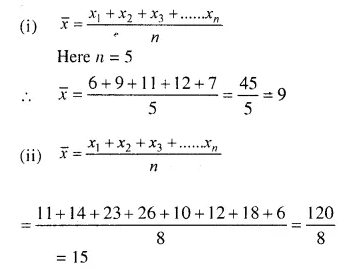
Find the mean of following set of numbers:
(i) 6, 9, 11, 12 and 7
(ii) 11, 14, 23, 26, 10, 12, 18 and 6.
Solution:
Selina Concise Mathematics Class 10 ICSE Solutions Chapter 24 Measures of Central Tendency Ex 24A Q1.1

Question 2.
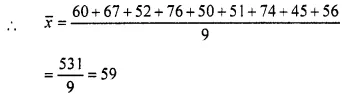
Marks obtained (in mathematics) by a students are given below :
60, 67, 52, 76, 50, 51, 74, 45 and 56
(a) Find the arithmetic mean
(b) If marks of each student be increased by 4;
what will be the new value of arithmetic mean.
Solution:
(a) Hence x = 9
Selina Concise Mathematics Class 10 ICSE Solutions Chapter 24 Measures of Central Tendency Ex 24A Q2.1
(b) If marks of each students be increased by 4 then new mean will be = 59 + 4 = 63

Question 3.
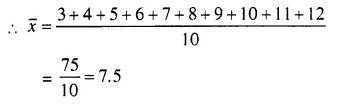
Find the mean of natural numbers from 3 to 12.
Solution:
Numbers betweeen 3 to 12 are 3, 4, 5, 6, 7, 8, 9, 10, 11, 12.
Here n = 10
Selina Concise Mathematics Class 10 ICSE Solutions Chapter 24 Measures of Central Tendency Ex 24A Q3.1

Question 4.
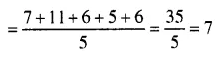
(a) Find the means of 7, 11, 6, 5 and 6. (b) If each number given in (a) is diminished by 2; find the new value of mean.
Solution:
(a) The mean of 7, 11, 6, 5 and 6.
Selina Concise Mathematics Class 10 ICSE Solutions Chapter 24 Measures of Central Tendency Ex 24A Q4.1
(b) If we subtract 2 from each number, then the mean will be 7 – 2 = 5

Question 5.
If the mean of 6, 4, 7, a and 10 is 8. Find the value of ‘a’.
Solution:
No. of terms = 5
Mean = 8
∴ Sum of number (Σxi) = 5 x 8 = 40 …(i)
But Σxi = 6 + 4 + 7 + a+10 = 27 + a ….(ii)
From (i) and (ii)
27 + a = 40 ⇒ a = 40 – 27
∴ a = 13

Question 6.
The mean of the number 6, y, 7, x and 14 is 8. Express y in terms of x.
Solution:
No. of terms = 5 and
mean = 8
∴ Sum of numbers (Σxi) = 5 x 8 = 40 ….(i)
But sum of numbers given = 6 + y + 7 + x + 14
= 21 + y + x + ….(ii)
From (i) and (ii)
27 + y + x = 40
⇒ y = 40 – 27 – x
⇒ y= 13 – x

Question 7.
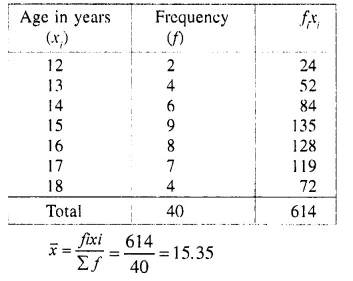
The ages of 40 students are given in the following table :
Selina Concise Mathematics Class 10 ICSE Solutions Chapter 24 Measures of Central Tendency Ex 24A Q7.1
Find the arithmetic mean.
Solution:
Selina Concise Mathematics Class 10 ICSE Solutions Chapter 24 Measures of Central Tendency Ex 24A Q7.2

Question 8.
If 69.5 is the mean of 72, 70, x, 62, 50, 71, 90, 64, 58 and 82, find the value of x.
Solution:
No. of terms = 10
Mean = 69.5
∴ Sum of numbers = 69,5 x 10 = 695 ….(i)
But sum of given number = 72 + 70 + x + 62 + 50 + 71 + 90 + 64 + 58 + 82 = 619+x ….(ii)
From (i) and (ii)
619 + x = 695
⇒ x = 695 – 619 = 76

Question 9.
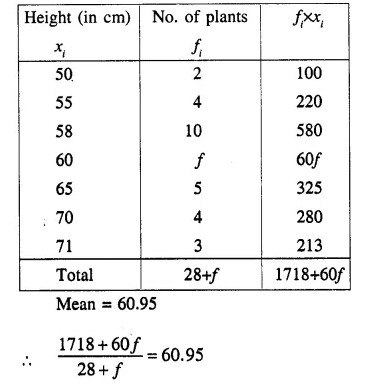
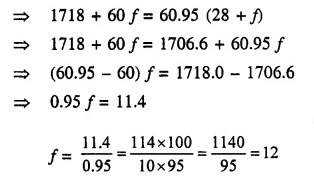
The following table gives the heights of plants in centimeter. If the mean height of plants is 60.95 cm; find the value of ‘f’.
Selina Concise Mathematics Class 10 ICSE Solutions Chapter 24 Measures of Central Tendency Ex 24A Q9.1
Solution:
Selina Concise Mathematics Class 10 ICSE Solutions Chapter 24 Measures of Central Tendency Ex 24A Q9.2
Selina Concise Mathematics Class 10 ICSE Solutions Chapter 24 Measures of Central Tendency Ex 24A Q9.3

Question 10.
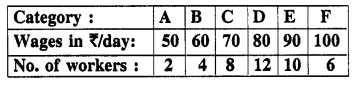
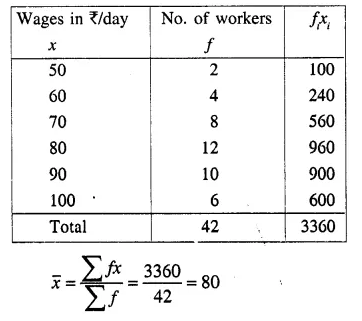
From the data given below, calculate the mean wage, correct to the nearest rupee.
Selina Concise Mathematics Class 10 ICSE Solutions Chapter 24 Measures of Central Tendency Ex 24A Q10.1
(i) If the number of workers in each category is doubled, what would be the new mean wage? [1995]
(ii) If the wages per day in each category are increased by 60%; what is the new mean wage?
(iii) If the number of workers in each category is doubled and the wages per day per worker are reduced by 40%. What would be the new mean wage?
Solution:
Selina Concise Mathematics Class 10 ICSE Solutions Chapter 24 Measures of Central Tendency Ex 24A Q10.2
(i) Mean remains the same if the number of workers in each catagory is doubled.
∴ Mean = 80.
(ii) Mean will be increased by 60% if the wages per day per worker is increased by 60%.
∴ New mean = 80 x \(\frac { 160 }{ 100 }\)= 128
(iii) No change in the mean if the number of worker is doubled but if wages per worker is reduced by 40%, then
New mean = 80 x \(\frac { 60 }{ 100 }\)= 48

Question 11.
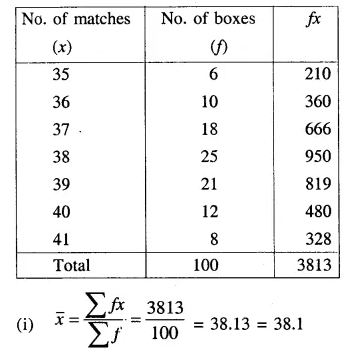
The contents of 100 match boxes were checked to determine the number of matches they contained.
Selina Concise Mathematics Class 10 ICSE Solutions Chapter 24 Measures of Central Tendency Ex 24A Q11.1
(i) Calculate, correct to one decimal place, the mean number of matches per box.
(ii) Determine how many extra matches would have to be added to the total contents of the 100 boxes to bring the mean up to exactly 39 matches. [1997]
Solution:
Selina Concise Mathematics Class 10 ICSE Solutions Chapter 24 Measures of Central Tendency Ex 24A Q11.2
(ii) In the second case,
New mean = 39 matches
∴ Total contents = 39 x 100 = 3900
But total no of matches already given = 3813
∴ Number of new matches to be added = 3900 – 3813 = 87

Question 12.
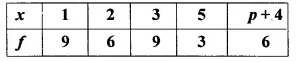
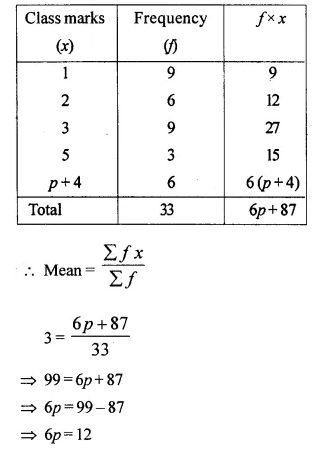
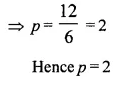
If the mean of the following distribution is 3, find the value of p.
Selina Concise Mathematics Class 10 ICSE Solutions Chapter 24 Measures of Central Tendency Ex 24A Q12.1
Solution:
Mean = 3
Selina Concise Mathematics Class 10 ICSE Solutions Chapter 24 Measures of Central Tendency Ex 24A Q12.2
Selina Concise Mathematics Class 10 ICSE Solutions Chapter 24 Measures of Central Tendency Ex 24A Q12.3

Question 13.
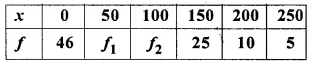
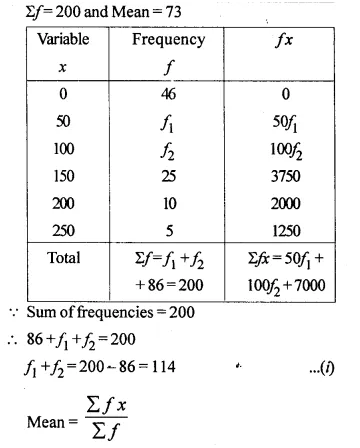
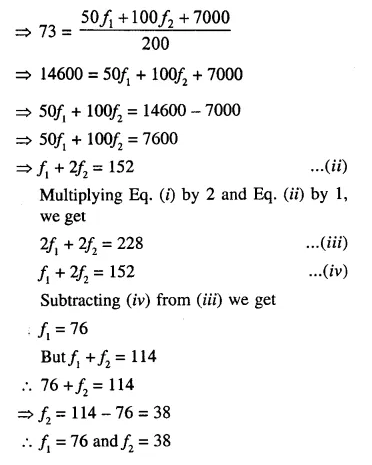
In the following table, Σf= 200 and mean = 73. Find the missing frequencies f1 and f2.
Selina Concise Mathematics Class 10 ICSE Solutions Chapter 24 Measures of Central Tendency Ex 24A Q13.1
Solution:
Selina Concise Mathematics Class 10 ICSE Solutions Chapter 24 Measures of Central Tendency Ex 24A Q13.2
Selina Concise Mathematics Class 10 ICSE Solutions Chapter 24 Measures of Central Tendency Ex 24A Q13.3

Question 14.
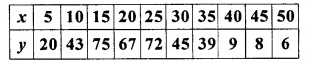
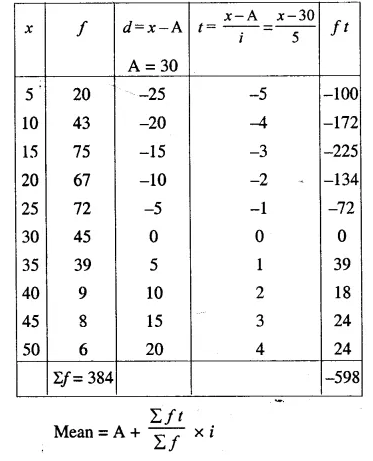
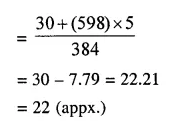
Find the arithmetic mean (correct to the nearest whole-number) by using step-deviation method.
Selina Concise Mathematics Class 10 ICSE Solutions Chapter 24 Measures of Central Tendency Ex 24A Q14.1
Solution:
Let the Assumed mean = 30
Selina Concise Mathematics Class 10 ICSE Solutions Chapter 24 Measures of Central Tendency Ex 24A Q14.2
Selina Concise Mathematics Class 10 ICSE Solutions Chapter 24 Measures of Central Tendency Ex 24A Q14.3

Question 15.
Find the mean (correct to one place of decimal) by using short-cut method.
Selina Concise Mathematics Class 10 ICSE Solutions Chapter 24 Measures of Central Tendency Ex 24A Q15.1
Solution:
Let the Assumed mean A = 45
Selina Concise Mathematics Class 10 ICSE Solutions Chapter 24 Measures of Central Tendency Ex 24A Q15.2
Selina Concise Mathematics Class 10 ICSE Solutions Chapter 24 Measures of Central Tendency Ex 24A Q15.3

Hope given Selina Concise Mathematics Class 10 ICSE Solutions Chapter 24 Measures of Central Tendency Ex 24A are helpful to complete your math homework.

If you have any doubts, please comment below. Learn Insta try to provide online math tutoring for you.
Selina Concise Mathematics Class 10 ICSE Solutions Chapter 10 Arithmetic Progression Ex 10A

Selina Concise Mathematics Class 10 ICSE Solutions Chapter 10 Arithmetic Progression Ex 10A

These Solutions are part of Selina Concise Mathematics Class 10 ICSE Solutions. Here we have given Selina Concise Mathematics Class 10 ICSE Solutions Chapter 10 Arithmetic Progression Ex 10A

Other Exercises

Question 1.
Which of the following sequences are in arithmetic progression?
(i) 2, 6, 10, 14, …….
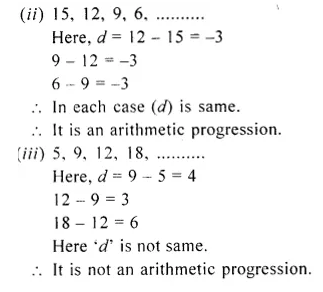
(ii) 15, 12, 9, 6,…….
(iii) 5, 9, 12, 18, ……
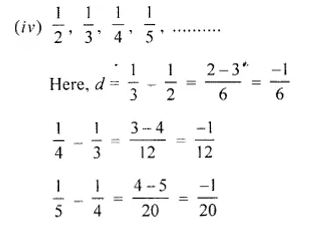
(iv) \(\frac { 1 }{ 2 } ,\frac { 1 }{ 3 } ,\frac { 1 }{ 4 } ,\frac { 1 }{ 5 } \),…..
Solution:
(i) 2, 6, 10, 14,
Here, d = 6 – 2 = 4
10 – 6 = 4
14 – 10 = 4
∴ In each case (d) is same.
∴It is an arithmetic progression.
Selina Concise Mathematics Class 10 ICSE Solutions Chapter 10 Arithmetic Progression Ex 10A Q1.1
Selina Concise Mathematics Class 10 ICSE Solutions Chapter 10 Arithmetic Progression Ex 10A Q1.2
∴d is not the same
∴It is not an arithmetic progression

Question 2.
The nth term of a sequence is (2n – 3), find its fifteenth term.
Solution:
Tn = 2n – 3
T15 = 2 x 15 – 3
= 30 – 3
= 27

Question 3.
If the pth term of an A.P. is (2p + 3); find the A.P.
Solution:
Tp = 2p + 3
T1 = 2 x 1 + 3 = 2 + 3 = 5
T2 = 2 x 2 + 3 = 4 + 3 = 7
T3 = 2 x 3 + 3 = 6 + 3 = 9
∴A.P. is 5, 7, 9,…..

Question 4.
Find the 24th term of the sequence : 12, 10, 8, 6,…….
Solution:
A.P. is 12, 10, 8, 6,……
Here a = 12, d = 10 – 12 = – 2
Tn = a + (n – 1)d
T24 = 12 + (24 – 1) x ( – 2)
= 12 + 23 x ( – 2)
= 12 – 46
= – 34

Question 5.
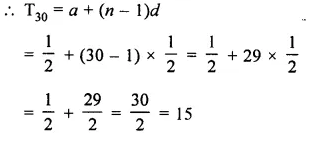
Find the 30th term of the sequence :
\(\\ \frac { 1 }{ 2 } \), 1, \(\\ \frac { 3 }{ 2 } \),….
Solution:
\(\\ \frac { 1 }{ 2 } \), 1, \(\\ \frac { 3 }{ 2 } \),….
Here a = \(\\ \frac { 1 }{ 2 } \), d = \(1- \frac { 1 }{ 2 } \)
\(\\ \frac { 1 }{ 2 } \)
Selina Concise Mathematics Class 10 ICSE Solutions Chapter 10 Arithmetic Progression Ex 10A Q5.1

Question 6.
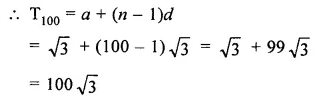
Find the 100th term of the sequence :
√3, 2√3, 3√3,….
Solution:
√3, 2√3, 3√3,….
Here a = √3, d = 2√3 – √3 = √3
Selina Concise Mathematics Class 10 ICSE Solutions Chapter 10 Arithmetic Progression Ex 10A Q6.1

Question 7.
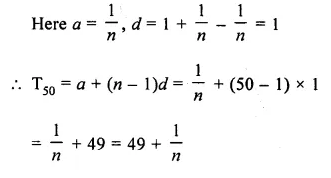
Find the 50th term of the sequence :
\(\\ \frac { 1 }{ n } \), \(\\ \frac { n+1 }{ n } \), \(\\ \frac { 2n+1 }{ n } \),……
Solution:
\(\\ \frac { 1 }{ n } \), \(\\ \frac { n+1 }{ n } \), \(\\ \frac { 2n+1 }{ n } \),……
=>\(\\ \frac { 1 }{ n } \), \(1+ \frac { 1 }{ n } \), \(2+ \frac { 1 }{ n } \),…..
Selina Concise Mathematics Class 10 ICSE Solutions Chapter 10 Arithmetic Progression Ex 10A Q7.1

Question 8.
Is 402 a term of the sequence :
8, 13, 18, 23,…?
Solution:
In sequence 8, 13, 18, 23,…..
a = 8 and d = 13 – 8 = 5
Let 402 be the nth term, then
402 = a + (n – 1)d = 8 + (n – 1) x 5
\(\\ \frac { 402-8 }{ 5 } \) = n – 1
=> \(\\ \frac { 394 }{ 5 } \) = n – 1
394 is not exactly divisible by 5,
∴ 402 is not its term.

Question 9.
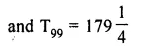
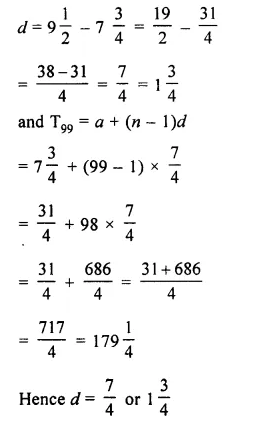
Find the common difference and 99th term of the arithmetic progression :
\(7 \frac { 3 }{ 4 } \), \(9 \frac { 1 }{ 2 } \), \(11 \frac { 1 }{ 4 } \),…..
Solution:
\(7 \frac { 3 }{ 4 } \), \(9 \frac { 1 }{ 2 } \), \(11 \frac { 1 }{ 4 } \),…..
here a = \(7 \frac { 3 }{ 4 } \)
= \(\\ \frac { 31 }{ 4 } \)
Selina Concise Mathematics Class 10 ICSE Solutions Chapter 10 Arithmetic Progression Ex 10A Q9.1
Selina Concise Mathematics Class 10 ICSE Solutions Chapter 10 Arithmetic Progression Ex 10A Q9.2

Question 10.
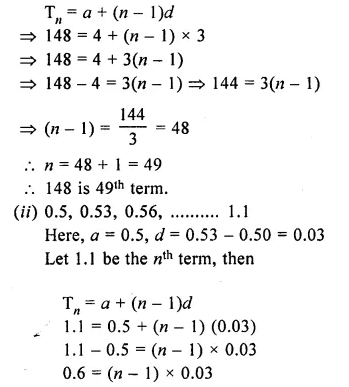
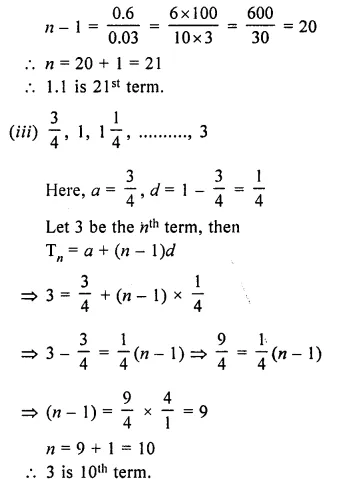
How many terms are there in the series:
(i) 4, 7, 10, 13,…..148 ?
(ii) 0.5, 0.53, 0.56,…..1.1 ?
(iii) \(\\ \frac { 3 }{ 4 } \), 1, \(1 \frac { 1 }{ 4 } \),….3 ?
Solution:
(i) 4, 7, 10, 13,…..148 ?
Here a = 4, d = 7 – 4
= 3
Let 148 be the nth term, then
Selina Concise Mathematics Class 10 ICSE Solutions Chapter 10 Arithmetic Progression Ex 10A Q10.1
Selina Concise Mathematics Class 10 ICSE Solutions Chapter 10 Arithmetic Progression Ex 10A Q10.2

Question 11.
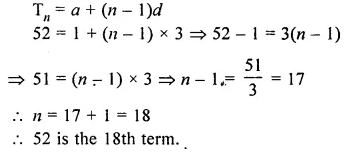
Which term of the A.P. 1 + 4 + 7 + 10 +……is 52 ?
Solution:
A.P. is 1, 4, 7, 10,……is 52
Here a = 1, d = 4 – 1 = 3
Let 52 be the nth term, then
Selina Concise Mathematics Class 10 ICSE Solutions Chapter 10 Arithmetic Progression Ex 10A Q11.1

Question 12.
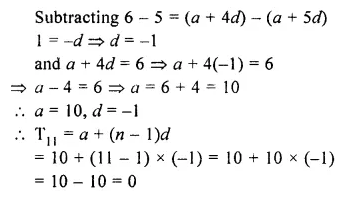
If 5th and 6th terms of an A.P. are respectively 6 and 5, find the 11th term of the A.P.
Solution:
5th term (T5) = 6
=> 6 = a + 4d
and T6 = 5
=> 5 = a + 5d
Selina Concise Mathematics Class 10 ICSE Solutions Chapter 10 Arithmetic Progression Ex 10A Q12.1

Question 13.
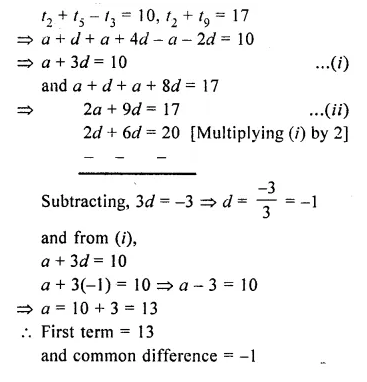
If tn represents nth term of an A.P., t2 + t5 – t3 = 10 and t2 + t9 = 17, find its first term and its common difference.
Solution:
Let first term of an A.P. be a
and common difference = d
Then Tn is the nth term
Selina Concise Mathematics Class 10 ICSE Solutions Chapter 10 Arithmetic Progression Ex 10A Q13.1

Question 14.
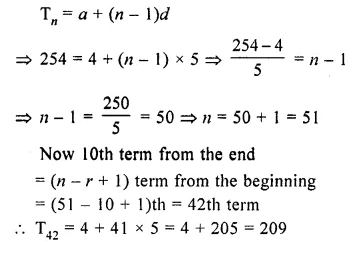
Find the 10th term from the end of the A.P. 4, 9, 14,…. 254.
Solution:
We know that rth term from the end
= (n – r + 1)th from the beginning
Here, a = A, d = 9 – 4 = 5,
nth term = 254
Selina Concise Mathematics Class 10 ICSE Solutions Chapter 10 Arithmetic Progression Ex 10A Q14.1

Question 15.
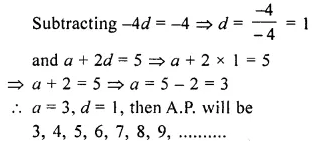
Determine the arithmetic progression whose 3rd term is 5 and 7th term is 9.
Solution:
Let a be the first term and d be the common difference, then
T3 = a + 2d – 5
T7 = a + 6d = 9
Selina Concise Mathematics Class 10 ICSE Solutions Chapter 10 Arithmetic Progression Ex 10A Q15.1

Question 16.
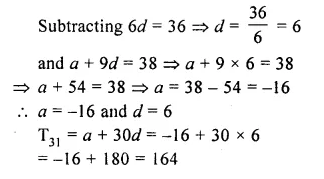
Find the 31st term of an A.P. whose 10th term is 38 and 16th term is 74.
Solution:
Let a be the first term and d be the common difference, then
T10 = a + 9d =38
and T16 = a + 15d = 74
Selina Concise Mathematics Class 10 ICSE Solutions Chapter 10 Arithmetic Progression Ex 10A Q16.1

Question 17.
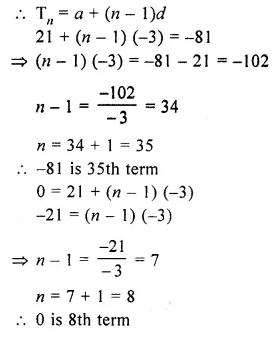
Which term of the series :
21, 18, 15, is – 81 ?
Can any term of this series be zero ? If yes, find the number of term.
Solution:
21, 18, 15, 1….. – 81
Here a = 21,d = 18 – 21 = – 3,
nth term = – 81
Selina Concise Mathematics Class 10 ICSE Solutions Chapter 10 Arithmetic Progression Ex 10A Q17.1

Question 18.
An A.P. consists of 60 terms. If the first and the last terms be 7 and 125 respectively, find the 31st term.
Solution:
Given : An A.P. consists of 60 terms
a = 7
and a60 = 125
=> a + (60 – 1 )d = 125
=> 7 + 59 d = 125
=> 59d= 125 – 7
=> d = \(\\ \frac { 118 }{ 59 } \) = 2
now, a31 = a + (n – 1)d
= 7 + (31 – 1) x 2
= 7 + 30 x 2
= 67

Question 19.
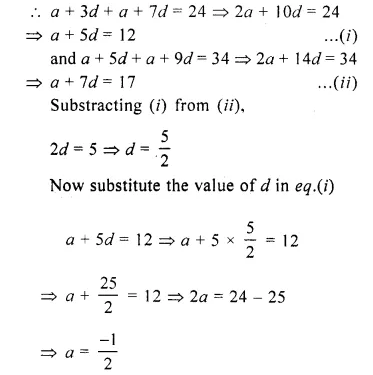
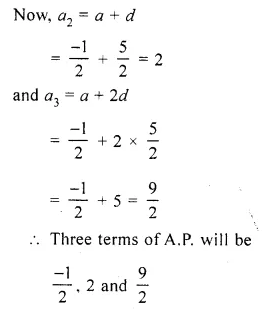
The sum of the 4th and the 8th terms of an A.P. is 24 and the sum of the sixth term and the tenth term is 34. Find the first three terms of the A.P.
Solution:
In an A.P.
T4 + T8 = 24
T6 + T10 =34
Let a be the first term and d be the common difference
Selina Concise Mathematics Class 10 ICSE Solutions Chapter 10 Arithmetic Progression Ex 10A Q19.1
Selina Concise Mathematics Class 10 ICSE Solutions Chapter 10 Arithmetic Progression Ex 10A Q19.2

Question 20.
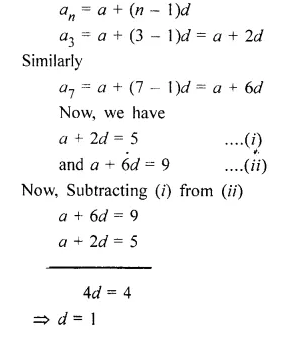
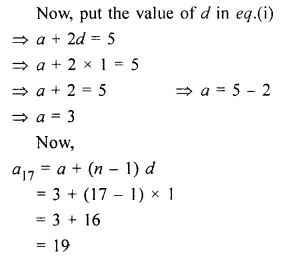
If the third term of an A.P. is 5 and the seventh terms is 9, find the 17th term
Solution:
Let the first term of an A.P. = a
and the common difference of the given A.P. = d
As, we know that,
Selina Concise Mathematics Class 10 ICSE Solutions Chapter 10 Arithmetic Progression Ex 10A Q20.1
Selina Concise Mathematics Class 10 ICSE Solutions Chapter 10 Arithmetic Progression Ex 10A Q20.2

Hope given Selina Concise Mathematics Class 10 ICSE Solutions Chapter 10 Arithmetic Progression Ex 10A are helpful to complete your math homework.

If you have any doubts, please comment below. Learn Insta try to provide online math tutoring for you.
NCERT Exemplar Solutions for Class 10 Science Chapter 16 Management of Natural Resources

NCERT Exemplar Solutions for Class 10 Science Chapter 16 Management of Natural Resources

These Solutions are part of NCERT Exemplar Solutions for Class 10 Science. Here we have given NCERT Exemplar Solutions for Class 10 Science Chapter 16 Management of Natural Resources
NCERT Exemplar Solutions for Class 10 Science Chapter 16 Short Answer Questions

Question 1.
Prepare a list of items that you use daily in the school. Identify from the list five such items that can be recycled.
Answer:
Items. Rexin bag, steel lunch box, steel spoon, steel compass, steel dividers, paper, plastic box, pen, pencil, blade, eraser, handkerchief.
Recycleable Items. Steel lunch box, steel spoon, steel compass, steel dividers, blade, paper, plastic box.

More Resources

Question 2.
List the advantages associated with water harvesting at the community level. (CCE 2012)
Answer:
Water harvesting at the community level is capturing, collection and storage of rain water and surface run off for filling either small water bodies or recharging ground water. This is carried out through water shed management, check dams, earthen dams, roof top harvesting and filter wells in flood drains.
Benefits:

  1. It ensures water availability in non-rainy season,
  2. It reduces the chances of flooding during rainy season,
  3. Ground water level does not fall as it is regularly recharged,
  4. Ground water recharge is the best form of water harvesting as the water is filtered and free from contaminations. It also does not evaporate,
  5. Water becomes available for drinking as well as irrigation.

Question 3.
In a village in Karnataka people started cultivating crops all around a lake which was always filled with water. They added fertilizers to their field in order to enhance the yield. Soon they discovered that the water body was completely covered with green floating plants and fishes started dying in large numbers.
Analyse the situation and give reasons for excessive growth of plants and death of the fish in the lake.
Answer:
Fertilizer rich run off from fields must have passed into the lake. It caused nutrient enrichment of lake water. The result is excessive growth of algae and other aquatic plants which float on the water surface and produce water bloom. Old dead plants produce a lot of organic matter. The submerged plants are also killed due to shading. BOD of water increases. As more and more oxygen is consumed by decomposers little is left for respiration of aquatic animals. Therefore, fish begin to die. The phenomenon of nutrient enrichment of water body that causes formation of water bloom and subsequent killing of aquatic life is called eutrophication.

Question 4.
What measures would you take to conserve electricity in your house ? (CCE 2012)
Answer:

  1. Judicious use of electricity by switching off lights and electrical appliances not required,
  2. Replacement of incandescent bulbs with fluorescent, compact fluorescent ones and LED bulbs.
  3. Replacement of electricity or gas operated geysers with solar water heaters,
  4. Replacement of electricity generating sets with solar light,
  5. Having more natural light and ventilation with design supporting warming during winters and cooling during summer.

Question 5.
Although coal and petroleum are produced by degradation of biomass, yet we need to conserve them. Why ? (CCE 2012)
Answer:
Coal and petroleum have been produced from large amounts of biomass entrapped inside the earth under high temperature, pressure and anaerobic conditions. Such a situation develops only rarely like big upheavals on earth. At present no more coal or petroleum is being formed. All that is available has been formed millions of years ago. Being rich source of energy, coal and petroleum are being consumed in ever increasing amount in industry, transport, kitchens, etc. If the trend continues, soon they will be exhausted. Therefore, they must be conserved by developing more efficient machines, hybrid engines and using hydrogen as a fuel.

Question 6.
Suggest a few measures for controlling carbon dioxide levels in the atmosphere.
Answer:

  1. Increasing Vegetation Cover. It will increase utilisation of atmospheric CO2 in photosynthesis.
  2. Seeding of Oceans With Phytoplankton. Increased photosynthetic activity of oceans will result in decreasing CO2 concentration.
  3. Carbonation. CO2 released during combustion should not be allowed to pass into atmosphere. Instead, it can be changed into carbonates.
  4. Alternate Sources of Energy. Instead of fossil fuels, hydrogen fuel and solar energy should be used.
  5. Burning of Litter. Litter and crop residue should not be burnt but instead converted into manure.

Question 7.
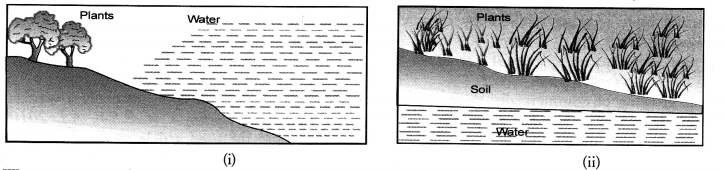
(a) Locate and name the water reservoirs in figures (i) and (ii).
(b) Which has advantage over the other and why ?
NCERT Exemplar Solutions for Class 10 Science Chapter 16 Management of Natural Resources image - 1
Answer:
(a) Water reservoir in figure (i) is pond while it is underground water body (ground water) in figure (ii).
(b) Ground water is more advantageous than pond water.
For Benefits: 

  1. Prevents flooding,
  2. Checks soil erosion.
  3. Retains water underground and prevents drought,
  4. Increases life of downstream reservoirs and dams,
  5. Higher biomass production and income of water shed community,
  6. Maintenance of ecological balance.

NCERT Exemplar Solutions for Class 10 Science Chapter 16 Long Answer Questions

Question 8.
In the context of conservation of natural resources, explain the terms reduce, recycle and reuse. From among the materials that we use in daily life, identify two materials for each category.
Answer:
Three Rs — reduce, recycle and reuse.

  1. Reduce: It is to reduce consumption by preventing wastage.
    1. Switching off unnecessary lights, fans and other electrical appliances,
    2. Repair of leaky taps.
    3. Reducing food wastage,
    4. Walking down to nearby market instead of using vehicle.
  2. Recycle: Separation of recyclable wastes from non-recyclable wastes. The former are taken by rag pickers for sending them to industries involved in recycling, e.g., paper, plastic, metal, glass.
  3. Reuse: Carry bags, packing material, plastic containers and other reusable articles should not be thrown away if the same are uncontaminated. For example, plastic bottles and jars containing various food items brought from market can be washed and used for storing things in the kitchen.

Question 9.
Prepare a list of five activities that you perform daily in which natural resources can be conserved or energy utilisation can be minimised.
Answer:

  1. Judicious use of electricity by switching off lights and electrical appliances not required,
  2. Replacement of incandescent bulbs with fluorescent, compact fluorescent ones and LED bulbs.
  3. Replacement of electricity or gas operated geysers with solar water heaters,
  4. Replacement of electricity generating sets with solar light,
  5. Having more natural light and ventilation with design supporting warming during winters and cooling during summer,
  6. Reducing wastage of water, food and other articles.
  7. Separation of recyclable waste from non-cyclable waste prior to disposal.
  8. Increasing reuse of containers,
  9. Using cloth bags instead of polythene, plastic or paper bags.

Question 10.
Is water conservation necessary ? Give reasons.
Answer:

  1. Distribution of fresh water is highly uneven. Large tracts are deficient in rain as well as ground water,
  2. At most places more water is withdrawn from reservoir and underground source than their recharging
  3. Requirement in urban and industrial areas is nearly always higher than the availability,
  4. Further demand for water is rising by 4 – 8% annually in all fields, whether agriculture, industry or domestic use.

Therefore, water conservation is necessary. Wastage of the resource should be prevented. Waste water should be recycled. Water harvesting involving recharging of ground water should be practised.

Question 11.
Suggest a few useful ways of utilising waste water.
Answer:
Waste or used water can also become a resource.

  1. Treated municipal water can be poured in irrigation channels for supply to crop fields,
  2. Treated waste water can be used in urban areas for watering gardens, lawns and washing vehicles,
  3. Industries can treat their waste water and recycle the same,
  4. Waste water passed into ponds recharges the ground water,
  5. Sewage sludge, separated from waste water is a source of manure, compost and biogas.

Question 12.
What is the importance of forests as a resource ?
Answer:
Economic Reasons:

  1. Food: Tribals obtain most of their food requirements from the forests, e.g., fruits, tubers, fleshy roots, leaves.
  2. Nuts: Pine Nut (Chilgoza), Almond, Walnut and Cashewnut are obtained from forests trees.
  3. Spices: Cardamom, Cinnamon, Nutmeg and Cloves are spices obtained from forest plants.
  4. Commercial Products: A number of forest products are of commercial importance, g., rubber, resin, tannins, tendu, lac, cork, camphor, essential oils, soap pod and drugs.
  5. Fuel Wood: Nearly two billion persons depend upon forests for fuel wood.
  6. Timber: Wood for the manufacture of furniture, household fitments and several other articles mostly comes from forests. Bamboo is called poorman’s timber as it is used in thatching huts, preparing baskets and a number of other articles including furniture.
  7. Paper: It is prepared from cellulose rich plants like bamboos, Boswellia, Eucalyptus, grasses and several

Protective Functions:                                                                                  i

  1. Forests provide shelter to wild animals. Over 40 million tribals and villagers live in forests.
  2. Plant roots hold the soil firmly. Vegetation protects the soil from action of wind and water. Forests, therefore, protect the soil from erosion and landslides.
  3. Pollution. Forests reduce atmospheric pollution by absorbing gases, collecting suspended particles and reducing noise.

Regulative Functions:

  1. Absorption and Retention of Water. Forests reduce run off, hold water like a sponge and allow slow percolation to form perennial springs and rivulets.
  2. Forests increase atmospheric humidity, increase frequency of rainfall and moderate temperature.
  3. Atmospheric Gases. Forests absorb large quantity^ of C02 from the atmosphere, reducing the threat of global warming. They also release a lot of oxygen.

Question 13.
Why are Arabari forests of Bengal known to be good example of conserved forests.
Answer:
Regeneration of Sal Forests — An Example of People’s Participation in the Management of Forests Despite best efforts, the West Bengal Forest Department could not revive the degraded Sal forests of Southwestern districts of the state. Excessive surveillance and policing of the degraded forests not only alienated the people but also resulted in frequent clashes between villagers and forest officials. This also fueled the militant peasant movement led by Naxalites. Realising the failure, the forest department revised its strategy in 1972. It allowed forest officer A.K. Banerjee of Arabari forest range of Midnapore to involve villagers in regeneration of 1272 hectares of badly degraded Sal forest. Banerjee provided employment to villagers in silviculture (cultivation of trees) and harvesting, 25% of final harvest and allowed collection of fuel wood as well as fodder at nominal fee. By 1983, the Arabari forest had been revived and was then valued at 12-5 crores.

Hope given NCERT Exemplar Solutions for Class 10 Science Chapter 16 Management of Natural Resources are helpful to complete your science homework.

If you have any doubts, please comment below. Learn Insta try to provide online science tutoring for you.