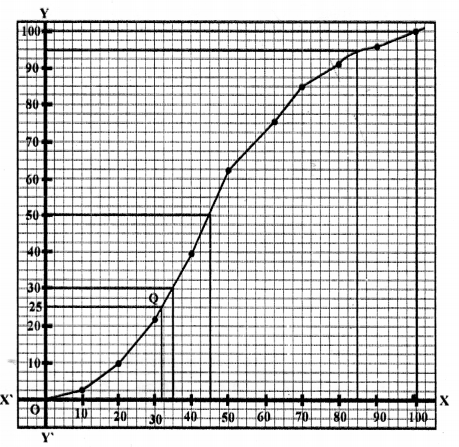
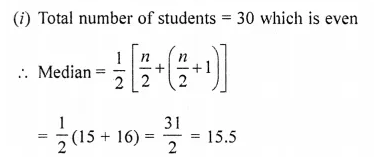
Selina Concise Mathematics Class 10 ICSE Solutions Chapter 11 Geometric Progression Ex 11D

Selina Concise Mathematics Class 10 ICSE Solutions Chapter 11 Geometric Progression Ex 11D

These Solutions are part of Selina Concise Mathematics Class 10 ICSE Solutions. Here we have given Selina Concise Mathematics Class 10 ICSE Solutions Chapter 11 Geometric Progression Ex 11D

Other Exercises

Question 1.
Find the sum of G.P. :
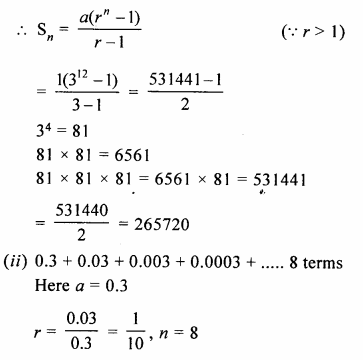
(i) 1 + 3 + 9 + 27 +….to 12 terms.
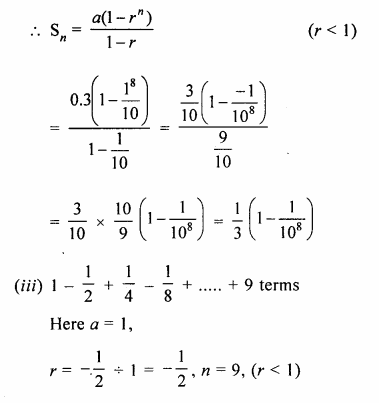
(ii) 0.3 + 0.03 + 0.003 + 0.0003 +….to 8 terms.
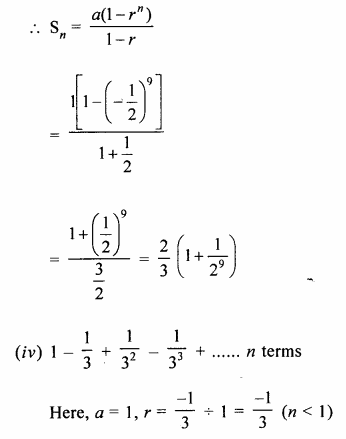
(iii) \(1-\frac { 1 }{ 2 } +\frac { 1 }{ 4 } -\frac { 1 }{ 8 } ….to\quad 9\quad terms\)
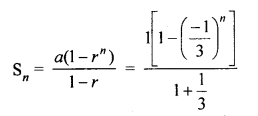
(iv) \(1-\frac { 1 }{ 3 } +\frac { 1 }{ { 3 }^{ 2 } } -\frac { 1 }{ { 3 }^{ 3 } } ….to\quad n\quad terms \)
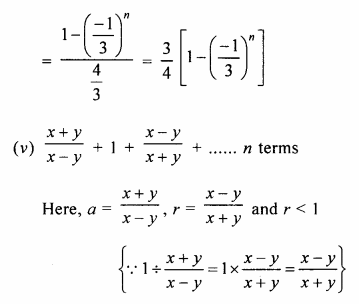
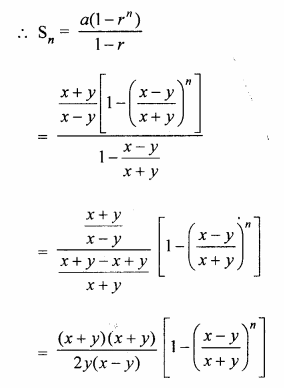
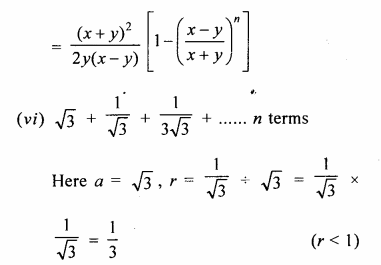
(v) \(\frac { x+y }{ x-y } +1+\frac { x-y }{ x+y } +….upto\quad n\quad terms\)
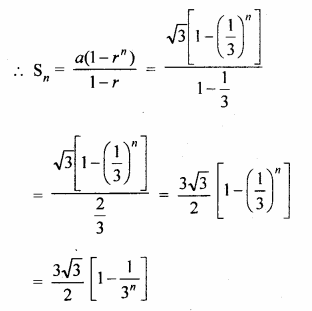
(vi) \(\sqrt { 3 } +\frac { 1 }{ \sqrt { 3 } } +\frac { 1 }{ 3\sqrt { 3 } } +….to\quad n\quad terms\)
Solution:
(i) 1 + 3 + 9 + 27 +….to 12 terms.
Here a = 1, r = 3 and n = 12
Selina Concise Mathematics Class 10 ICSE Solutions Chapter 11 Geometric Progression Ex 11D Q1.1
Selina Concise Mathematics Class 10 ICSE Solutions Chapter 11 Geometric Progression Ex 11D Q1.2
Selina Concise Mathematics Class 10 ICSE Solutions Chapter 11 Geometric Progression Ex 11D Q1.3
Selina Concise Mathematics Class 10 ICSE Solutions Chapter 11 Geometric Progression Ex 11D Q1.4
Selina Concise Mathematics Class 10 ICSE Solutions Chapter 11 Geometric Progression Ex 11D Q1.5
Selina Concise Mathematics Class 10 ICSE Solutions Chapter 11 Geometric Progression Ex 11D Q1.6
Selina Concise Mathematics Class 10 ICSE Solutions Chapter 11 Geometric Progression Ex 11D Q1.7
Selina Concise Mathematics Class 10 ICSE Solutions Chapter 11 Geometric Progression Ex 11D Q1.8

Question 2.
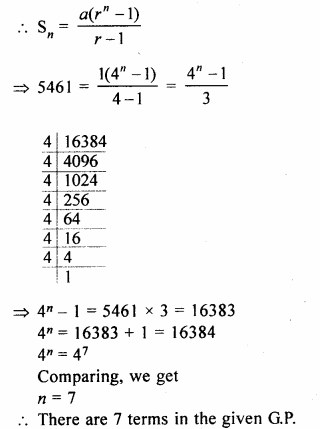
How many terms of the geometric progression 1 + 4 + 16 + 64 +…. must be added to get sum equal to 5461 ?
Solution:
Sn = 5461 and G.P. is
1 + 4 + 16 + 64 +…..
Here, a = 1, r = 4 (r > 1)
Selina Concise Mathematics Class 10 ICSE Solutions Chapter 11 Geometric Progression Ex 11D Q2.1

Question 3.
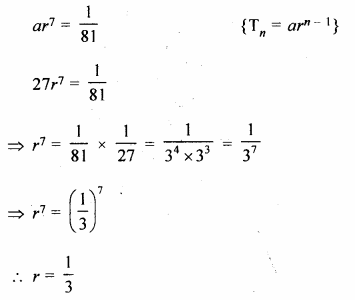
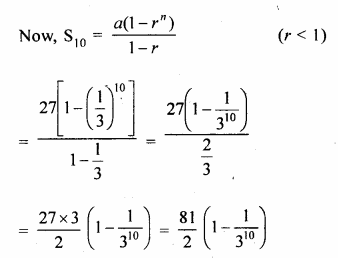
The first term of a G.P. is 27 and its 8th term is \(\\ \frac { 1 }{ 81 } \). Find the sum of its first 10 terms.
Solution:
First term of a G.P (a) = 27
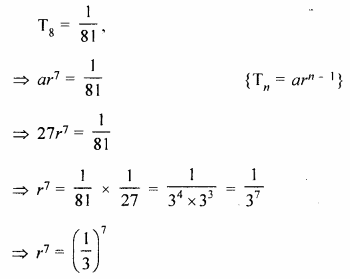
T8 = \(\\ \frac { 1 }{ 81 } \), n = 10
a = 27
Selina Concise Mathematics Class 10 ICSE Solutions Chapter 11 Geometric Progression Ex 11D Q3.1
Selina Concise Mathematics Class 10 ICSE Solutions Chapter 11 Geometric Progression Ex 11D Q3.2

Question 4.
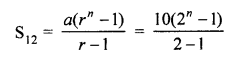
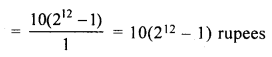
A boy spends Rs 10 on first day, Rs 20 on second day, Rs 40 on third day and so on. Find how much, in all, will he spend in 12 days?
Solution:
A boy spends Rs 10 on first day,
Rs 20 on second day
Rs 40 on third day and so on
G.P. is 10 + 20 + 40 +…. 12 terms
Here a = 10, r = 2 and n = 12 (r > 1)
Selina Concise Mathematics Class 10 ICSE Solutions Chapter 11 Geometric Progression Ex 11D Q4.1
Selina Concise Mathematics Class 10 ICSE Solutions Chapter 11 Geometric Progression Ex 11D Q4.2

Question 5.
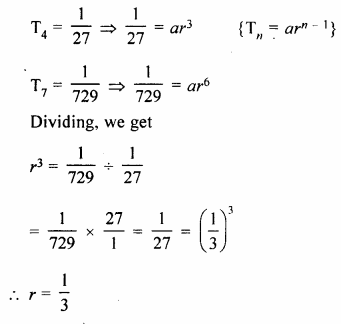
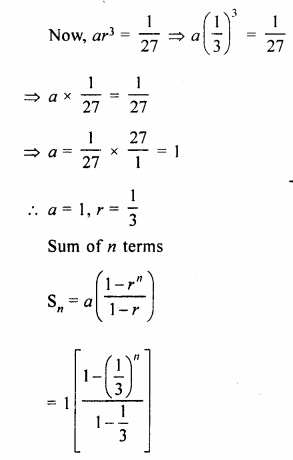
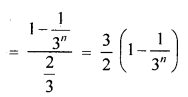
The 4th and the 7th terms of a G.P. are \(\\ \frac { 1 }{ 27 } \) and \(\\ \frac { 1 }{ 729 } \) respectively. Find the sum of n terms of this G.P.
Solution:
In a G.P.
T4 = \(\\ \frac { 1 }{ 27 } \)
Selina Concise Mathematics Class 10 ICSE Solutions Chapter 11 Geometric Progression Ex 11D Q5.1
Selina Concise Mathematics Class 10 ICSE Solutions Chapter 11 Geometric Progression Ex 11D Q5.2
Selina Concise Mathematics Class 10 ICSE Solutions Chapter 11 Geometric Progression Ex 11D Q5.3

Question 6.
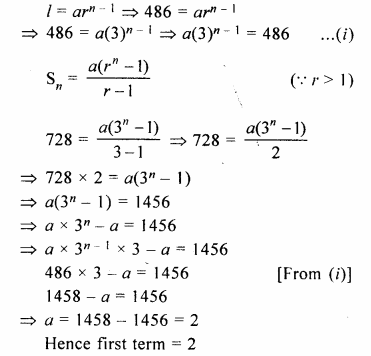
A geometric progression has common ratio = 3 and last term = 486. If the sum of its terms is 728 ; find its first term.
Solution:
In a G.P.
Common ratio (r) = 3
Last term (l) = 486
Sum of its terms (Sn) = 728
Let a be the first term, then
Selina Concise Mathematics Class 10 ICSE Solutions Chapter 11 Geometric Progression Ex 11D Q6.1

Question 7.
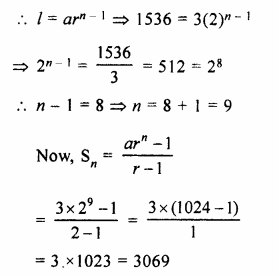
Find the sum of G.P. : 3, 6, 12, …… 1536.
Solution:
G.P. is 3, 6, 12,….1536
Here a = 3, r = \(\\ \frac { 6 }{ 3 } \) = 2
Selina Concise Mathematics Class 10 ICSE Solutions Chapter 11 Geometric Progression Ex 11D Q7.1
Selina Concise Mathematics Class 10 ICSE Solutions Chapter 11 Geometric Progression Ex 11D Q7.2

Question 8.
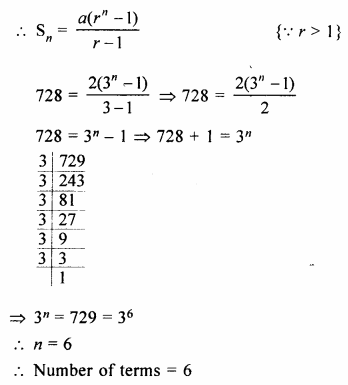
How many terms of the series 2 + 6 + 18 +…. must be taken to make the sum equal to 728 ?
Solution:
G.P. is 2 + 6 + 18 +….
Here a = 2, r = \(\\ \frac { 6 }{ 2 } \) = 3, Sn = 728
Selina Concise Mathematics Class 10 ICSE Solutions Chapter 11 Geometric Progression Ex 11D Q8.1

Question 9.
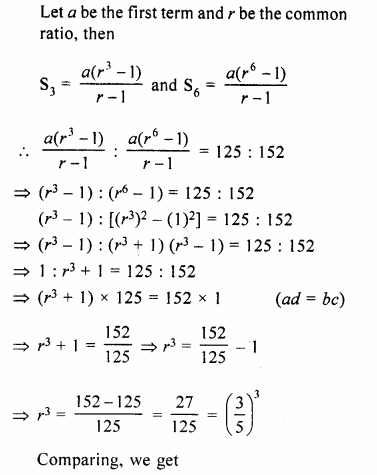
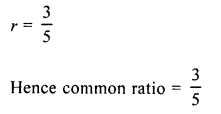
In a G.P., the ratio between the sum of first three terms and that of the first six terms is 125 : 152. Find its common ratio.
Solution:
In a G.P.
Sum of first 3 terms : Sum of 6 terms = 125 : 152
Selina Concise Mathematics Class 10 ICSE Solutions Chapter 11 Geometric Progression Ex 11D Q9.1
Selina Concise Mathematics Class 10 ICSE Solutions Chapter 11 Geometric Progression Ex 11D Q9.2

Question 10.
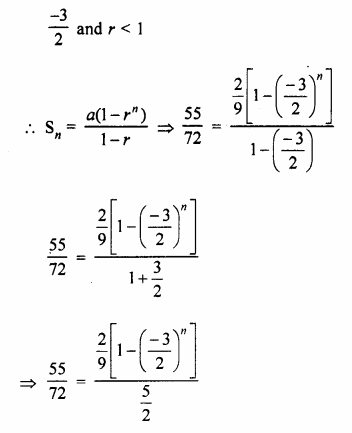
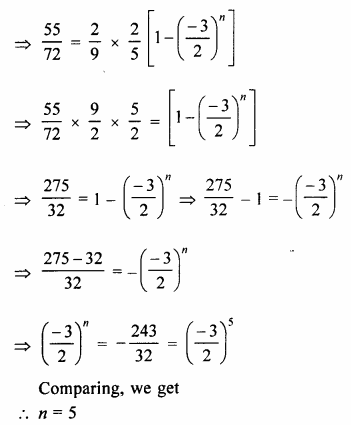
Find how many terms of G.P.\(\frac { 2 }{ 9 } -\frac { 1 }{ 3 } +\frac { 1 }{ 2 } \)… must be added to get the sum equal to \(\\ \frac { 55 }{ 72 } \) ?
Solution:
\(\frac { 2 }{ 9 } -\frac { 1 }{ 3 } +\frac { 1 }{ 2 } \)…
Let n terms be added
Now,Sn = \(\\ \frac { 55 }{ 72 } \)
Selina Concise Mathematics Class 10 ICSE Solutions Chapter 11 Geometric Progression Ex 11D Q10.1
Selina Concise Mathematics Class 10 ICSE Solutions Chapter 11 Geometric Progression Ex 11D Q10.2
Selina Concise Mathematics Class 10 ICSE Solutions Chapter 11 Geometric Progression Ex 11D Q10.3
Selina Concise Mathematics Class 10 ICSE Solutions Chapter 11 Geometric Progression Ex 11D Q10.4

Question 11.
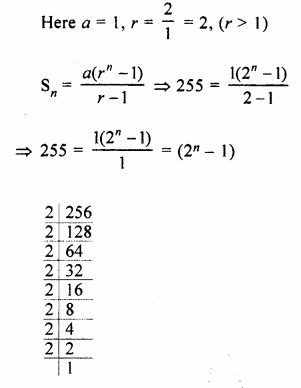
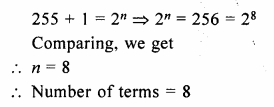
If the sum of 1 + 2 + 22 +…..+ 2n – 1 is 255, find the value of n.
Solution:
1 + 2 + 22 +…..+ 2n – 1 = 255
Selina Concise Mathematics Class 10 ICSE Solutions Chapter 11 Geometric Progression Ex 11D Q11.1
Selina Concise Mathematics Class 10 ICSE Solutions Chapter 11 Geometric Progression Ex 11D Q11.2

Question 12.
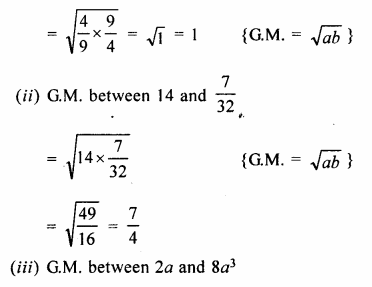
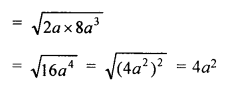
Find the geometric mean between :
(i) \(\\ \frac { 4 }{ 9 } \) and \(\\ \frac { 9 }{ 4 } \)
(ii) 14 and \(\\ \frac { 7 }{ 32 } \)
(iii) 2a and 8a3
Solution:
(i) G.M between \(\\ \frac { 4 }{ 9 } \) and \(\\ \frac { 9 }{ 4 } \)
Selina Concise Mathematics Class 10 ICSE Solutions Chapter 11 Geometric Progression Ex 11D Q12.1
Selina Concise Mathematics Class 10 ICSE Solutions Chapter 11 Geometric Progression Ex 11D Q12.2

Question 13.
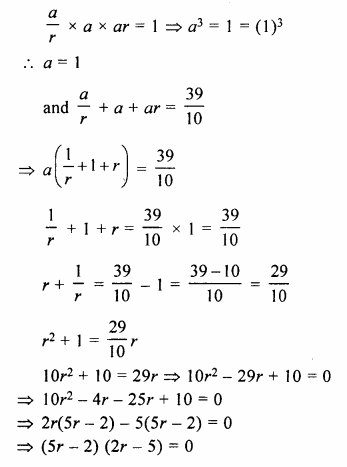
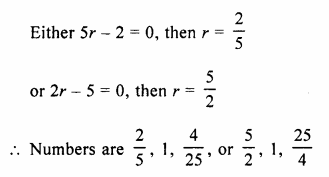
The sum of three numbers in G.P. is \(\\ \frac { 39 }{ 10 } \) and their product is 1. Find the numbers.
Solution:
Sum of three numbers in G.P. = \(\\ \frac { 39 }{ 10 } \)
and their product = 1
Let number be \(\\ \frac { a }{ r } \), a, ar, then
Selina Concise Mathematics Class 10 ICSE Solutions Chapter 11 Geometric Progression Ex 11D Q13.1
Selina Concise Mathematics Class 10 ICSE Solutions Chapter 11 Geometric Progression Ex 11D Q13.2

Question 14.
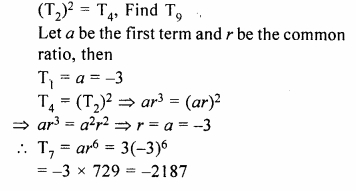
The first term of a G.P. is – 3 and the square of the second term is equal to its 4th term. Find its 7th term.
Solution:
In G.P.
T1 = – 3
Selina Concise Mathematics Class 10 ICSE Solutions Chapter 11 Geometric Progression Ex 11D Q14.1

Question 15.
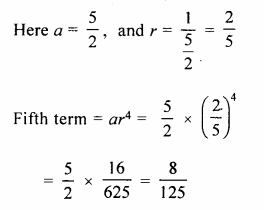
Find the 5th term of the G.P. \(\\ \frac { 5 }{ 2 } \), 1,…..
Solution:
Given G.P is \(\\ \frac { 5 }{ 2 } \), 1,…..
Selina Concise Mathematics Class 10 ICSE Solutions Chapter 11 Geometric Progression Ex 11D Q15.1

Question 16.
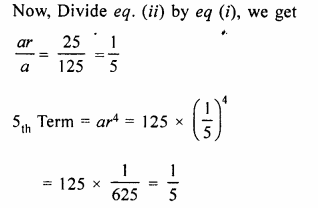
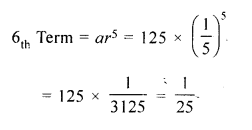
The first two terms of a G.P. are 125 and 25 respectively. Find the 5th and the 6th terms of the G.P.
Solution:
Given, First term = a = 125….(i)
and Second term = ar = 25…..(ii)
Now, Divide eq. (ii) by eq (i), we get
Selina Concise Mathematics Class 10 ICSE Solutions Chapter 11 Geometric Progression Ex 11D Q16.1
Selina Concise Mathematics Class 10 ICSE Solutions Chapter 11 Geometric Progression Ex 11D Q16.2

Question 17.
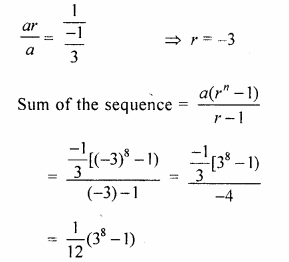
Find the sum of the sequence \(– \frac { 1 }{ 3 } \), 1, – 3, 9,….upto 8 terms.
Solution:
Here, First Term, a = \(– \frac { 1 }{ 3 } \)…(i)
and Second Term, ar = 1 …(ii)
Dividing eq. (i) by eq. (ii), we get
Selina Concise Mathematics Class 10 ICSE Solutions Chapter 11 Geometric Progression Ex 11D Q17.1

Question 18.
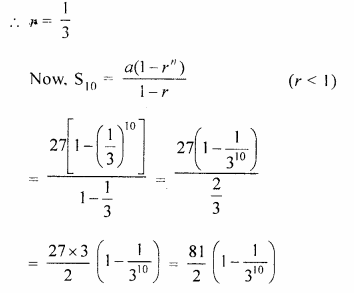
The first term of a G.P. in 27. If the 8th term be \(\\ \frac { 1 }{ 81 } \), what will be the sum of 10 terms ?
Solution:
Given, First term (a) = 27, n = 10
Selina Concise Mathematics Class 10 ICSE Solutions Chapter 11 Geometric Progression Ex 11D Q18.1
Selina Concise Mathematics Class 10 ICSE Solutions Chapter 11 Geometric Progression Ex 11D Q18.2

Question 19.
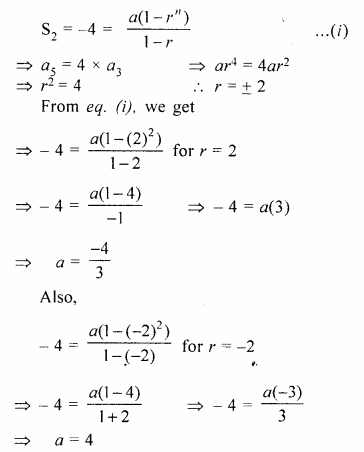
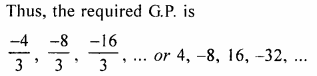
Find a G.P. for which the sum of first two terms is – 4 and the fifth term is 4 times the third term.
Solution:
Let a be the first term and r be the common ratio of the G.P.
According to the given conditions,
Selina Concise Mathematics Class 10 ICSE Solutions Chapter 11 Geometric Progression Ex 11D Q19.1
Selina Concise Mathematics Class 10 ICSE Solutions Chapter 11 Geometric Progression Ex 11D Q19.2

Hope given Selina Concise Mathematics Class 10 ICSE Solutions Chapter 11 Geometric Progression Ex 11D are helpful to complete your math homework.

If you have any doubts, please comment below. Learn Insta try to provide online math tutoring for you.

Selina Concise Mathematics Class 10 ICSE Solutions Chapter 23 Graphical Representation Ex 23

Selina Concise Mathematics Class 10 ICSE Solutions Chapter 23 Graphical Representation (Histograms, Frequency Polygon and Ogives) Ex 23

These Solutions are part of Selina Concise Mathematics Class 10 ICSE Solutions. Here we have given Chapter 23 Graphical Representation (Histograms, Frequency Polygon and Ogives) Ex 23.

Question 1.
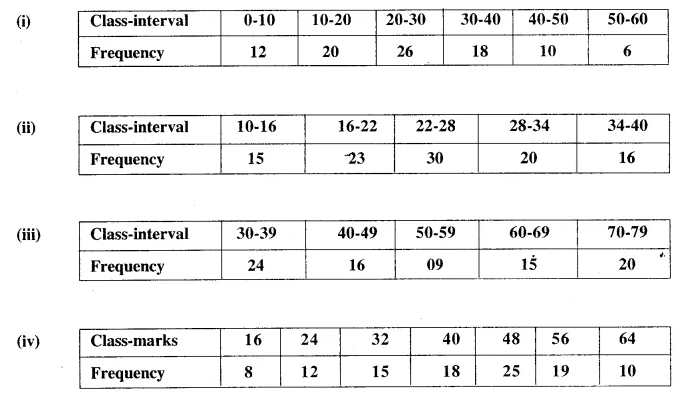
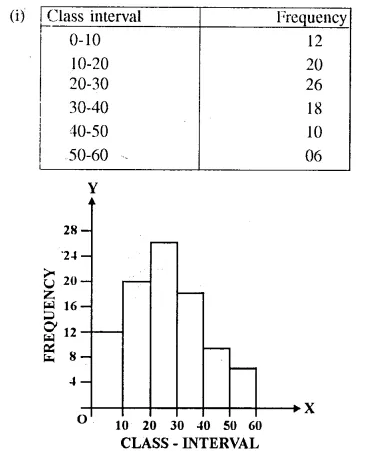
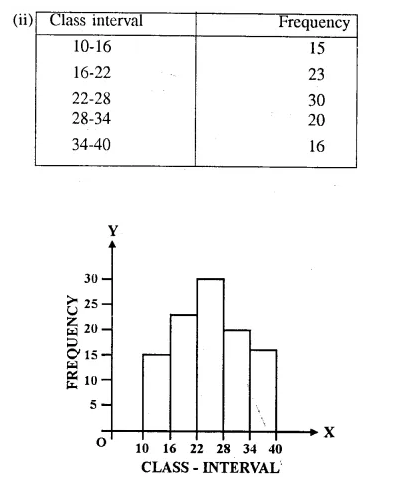
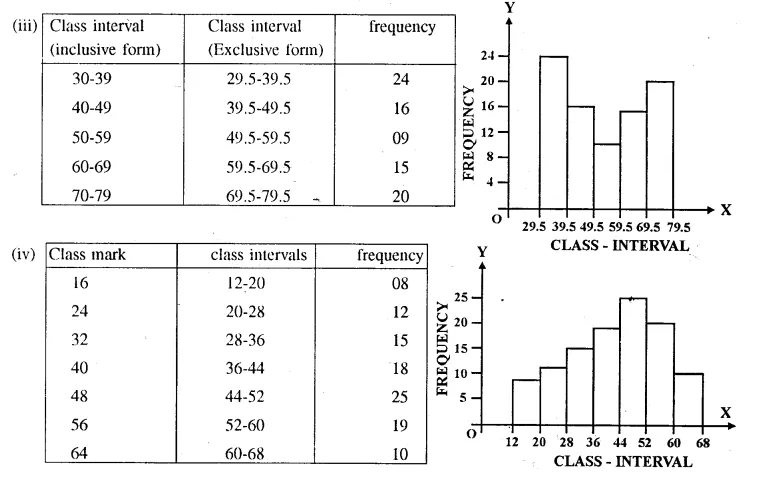
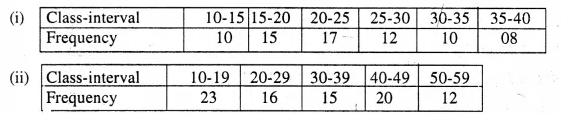
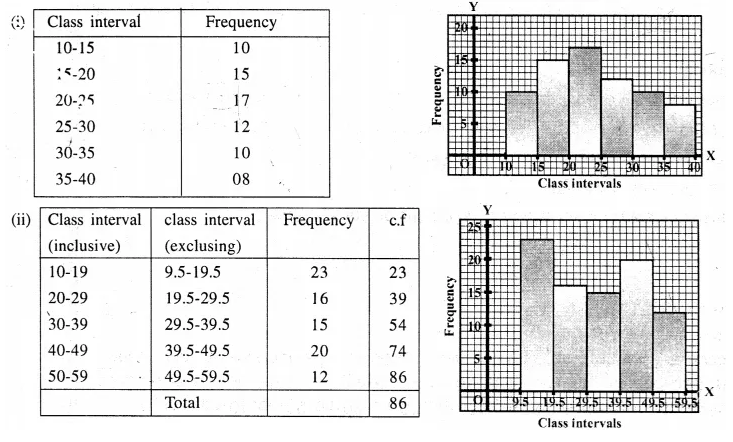
Draw histograms for the following distributions :
Selina Concise Mathematics Class 10 ICSE Solutions Chapter 23 Graphical Representation Ex 23 Q1.1
Solution:
Selina Concise Mathematics Class 10 ICSE Solutions Chapter 23 Graphical Representation Ex 23 Q1.2
Selina Concise Mathematics Class 10 ICSE Solutions Chapter 23 Graphical Representation Ex 23 Q1.3
Selina Concise Mathematics Class 10 ICSE Solutions Chapter 23 Graphical Representation Ex 23 Q1.4

Question 2.
Draw a cumulative frequency curve (ogive) for each of the following distributions
Selina Concise Mathematics Class 10 ICSE Solutions Chapter 23 Graphical Representation Ex 23 Q2.1
Solution:
Selina Concise Mathematics Class 10 ICSE Solutions Chapter 23 Graphical Representation Ex 23 Q2.2

Question 3.
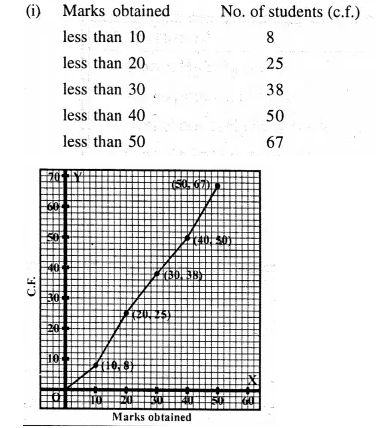
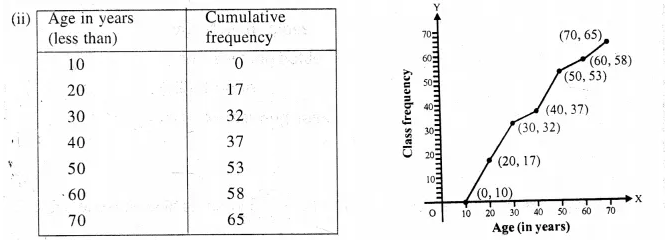
Draw an ogive for each of the following distributions :
Selina Concise Mathematics Class 10 ICSE Solutions Chapter 23 Graphical Representation Ex 23 Q3.1
Solution:
Selina Concise Mathematics Class 10 ICSE Solutions Chapter 23 Graphical Representation Ex 23 Q3.2
Now plotting the points (10, 8), (20, 25), (30, 38), (40, 50) and (50, 67) on the graph and join them with free hand to obtain an ogive as shown in the graph.
Selina Concise Mathematics Class 10 ICSE Solutions Chapter 23 Graphical Representation Ex 23 Q3.3
Now plot the points (10, 0), (20, 17), (30, 32), (40, 37), (50, 53), (60, 58) and (70, 65) on the graph and join them with free hand to get an ogive as shown in the graph.

Question 4.
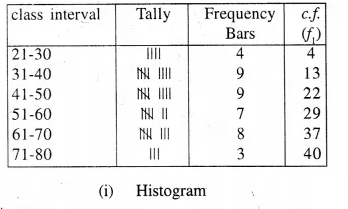
Construct a frequency distribution table for the numbers given below, using the class intervals 21-30,31-40…. etc.
75, 67, 57, 50, 26, 33, 44, 58, 67,75, 78, 43, 41, 31, 21, 32, 40, 62, 54, 69, 48, 47,51,38, 39,43,61, 63, 68, 53, 56, 49, 59, 37, 40, 68, 23, 28, 36 and 47.
Use the table obtained to draw:
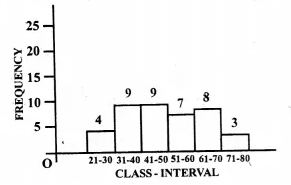
(i) a histogram
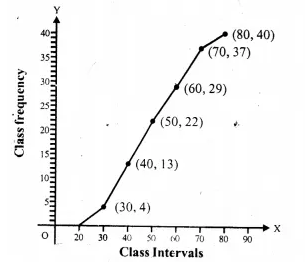
(ii) an ogive
Solution:
Selina Concise Mathematics Class 10 ICSE Solutions Chapter 23 Graphical Representation Ex 23 Q4.1
Selina Concise Mathematics Class 10 ICSE Solutions Chapter 23 Graphical Representation Ex 23 Q4.2
Selina Concise Mathematics Class 10 ICSE Solutions Chapter 23 Graphical Representation Ex 23 Q4.3
(ii) Ogive :
We plot the points (30, 4), (40, 13), (50, 22), (60, 29); (70, 37) and (80, 40) on the graph and join them in free hand to obtain an ogive.

Question 5.
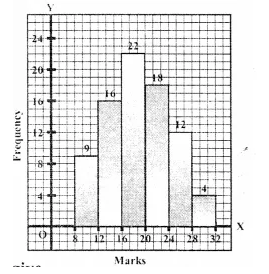
(a) Use the information given in the adjoining histogram to c construct a f frequency table.
(b)Use this table to construct an ogive.
Selina Concise Mathematics Class 10 ICSE Solutions Chapter 23 Graphical Representation Ex 23 Q5.1
Solution:
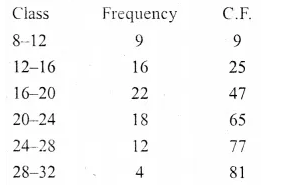
From the histogram given, the required frequency table will be as given below.
Selina Concise Mathematics Class 10 ICSE Solutions Chapter 23 Graphical Representation Ex 23 Q5.2
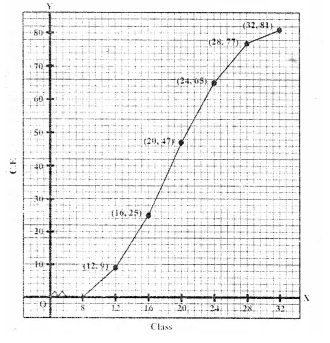
Plot the points (12, 9), (16, 25), (20, 47), (24, 65), (28, 77), (32, 81) on the graph and join them with free hand to get an ogive as shown.
Selina Concise Mathematics Class 10 ICSE Solutions Chapter 23 Graphical Representation Ex 23 Q5.3

Question 6.
Selina Concise Mathematics Class 10 ICSE Solutions Chapter 23 Graphical Representation Ex 23 Q6.1
(a) From the distribution given above, construct a frequency table, (b) Use the table obtained in part (a) to draw :
(i) a histogram
(ii) an ogive.
Solution:
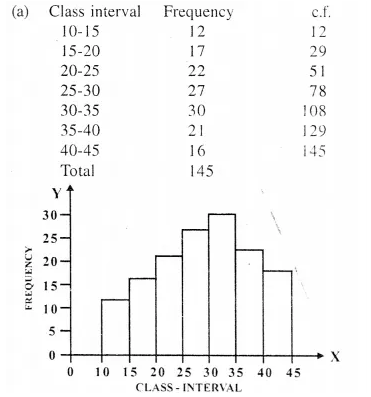
Difference in consecutive class marks. = 17.5 – 12.5 = 5
∴ first class interval will be : 10-15 and so on
Selina Concise Mathematics Class 10 ICSE Solutions Chapter 23 Graphical Representation Ex 23 Q6.2
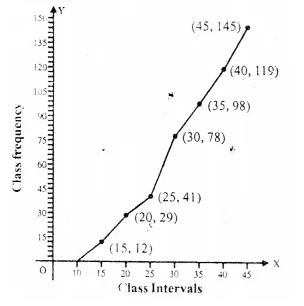
(ii) We plot the point (15. 12), (20. 29), (25. 51), (30, 78). (35, 108), (40. 129) and (45, 145) on the graph and join them in free hand to obtain the ogive.
Selina Concise Mathematics Class 10 ICSE Solutions Chapter 23 Graphical Representation Ex 23 Q6.3

Question 7.
Use graph paper for this question.
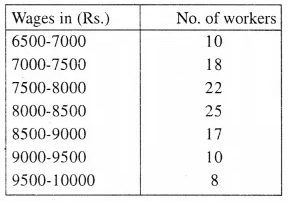
The table given beiow shows the monthly wages of some factory workers.
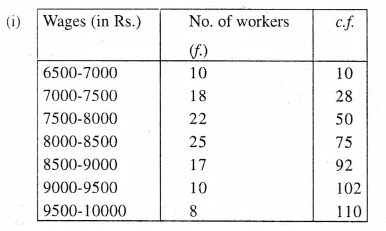
(i) Using the table calculate the cumulative frequencies of workers.
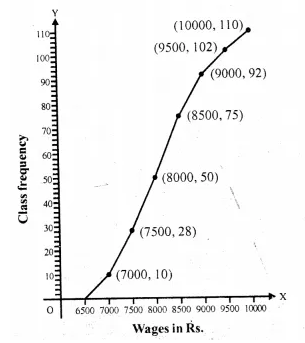
(ii) Draw the cumulative frequency curve.
Use 2 cm = Rs. 500, starting the origin at Rs. 6500 on x-axis, and 2 cm = 10 workers on the y-axis
Selina Concise Mathematics Class 10 ICSE Solutions Chapter 23 Graphical Representation Ex 23 Q7.1
Solution:
Selina Concise Mathematics Class 10 ICSE Solutions Chapter 23 Graphical Representation Ex 23 Q7.2
Selina Concise Mathematics Class 10 ICSE Solutions Chapter 23 Graphical Representation Ex 23 Q7.3
(ii) We plot the points (7000, 10), (7500, 28), (8000, 50), (8500, 75), (9000, 92) (9500, 102) and (10000, 110) on the graph and join them in free hand to obtain an ogive.

Question 8.
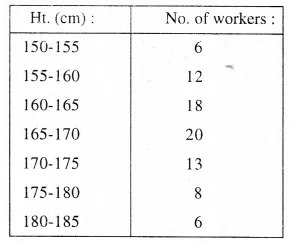
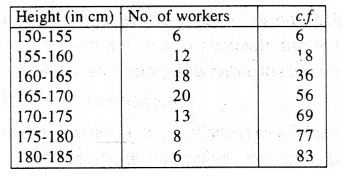
The following table shows the distribution of the heights of a group of factory workers :
Selina Concise Mathematics Class 10 ICSE Solutions Chapter 23 Graphical Representation Ex 23 Q8.1
(i) Determine the cumulative frequencies.
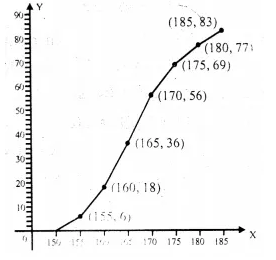
(ii) Draw the ‘less than’ cumulative frequency curve on a graph paper. Use 2 cm = 5cm height on one axis and 2 cm = 10 workers on the other.
Solution:
Selina Concise Mathematics Class 10 ICSE Solutions Chapter 23 Graphical Representation Ex 23 Q8.2
Selina Concise Mathematics Class 10 ICSE Solutions Chapter 23 Graphical Representation Ex 23 Q8.3
We plot points (155, 6), (160, 18), (165, 36),
(170, 56), (175, 69), (180, 77) and (185, 83) on the graph and join them in free hand to obtain an ogive.

Question 9.
Construct a frequency distribution table for each of the following distributions :
Selina Concise Mathematics Class 10 ICSE Solutions Chapter 23 Graphical Representation Ex 23 Q9.1
Solution:
Selina Concise Mathematics Class 10 ICSE Solutions Chapter 23 Graphical Representation Ex 23 Q9.2

Hope given Selina Concise Mathematics Class 10 ICSE Solutions Chapter 23 Graphical Representation Ex 23  are helpful to you.

If you have any doubts, please comment below. We try to provide online math tutoring for you.

NCERT Exemplar Solutions for Class 10 Science Chapter 12 Electricity

NCERT Exemplar Solutions for Class 10 Science Chapter 12 Electricity

These Solutions are part of NCERT Exemplar Solutions for Class 10 Science. Here we have given NCERT Exemplar Solutions for Class 10 Science Chapter 12 Electricity

Question 1.
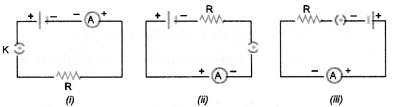
A cell, a resistor, a key and ammeter are arranged as shown in the circuit diagrams of the figure given below. The current recorded in the ammeter will be
NCERT Exemplar Solutions for Class 10 Science Chapter 12 Electricity image - 1
(a) maximum in (i)
(b) maximum in (ii)
(c) maximum in (iii)
(d) the same in all the cases.
Answer:
(d).
Explanation : Same current flows through every part of the circuit having resistance connected in series to a cell or battery.

More Resources

Question 2.
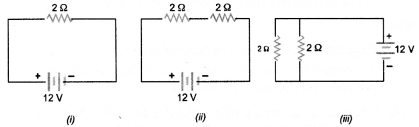
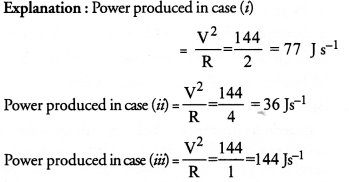
In the following circuits shown in figure, power produced in the resistor or combination of resistors connected to a 12V battery will be
NCERT Exemplar Solutions for Class 10 Science Chapter 12 Electricity image - 2
(a) same in all cases
(b) minimum in case (i)
(c) maximum in case (ii)
(d) maximum in case (iii)
Answer:
(d).
NCERT Exemplar Solutions for Class 10 Science Chapter 12 Electricity image - 3

Question 3.
Electrical resistivity of a given metallic wire depends upon
(a) its length
(b) its thickness
(c) its shape
(d) nature of material.
Answer:
(d).
Explanation : Resistivity of a given metallic wire does not depend on its dimensions and shape but depends on the nature of the material of the wire.

Question 4.
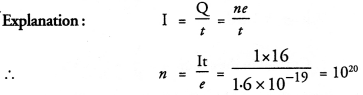
A current of 1A is drawn by a filament of an electric bulb. Number of electrons passing through a cross-section of the filament in 16 seconds would be roughly
(a) 1020
(b) 1016
(c) 1018
(d) 1023
Answer:
(a).
NCERT Exemplar Solutions for Class 10 Science Chapter 12 Electricity image - 4

Question 5.
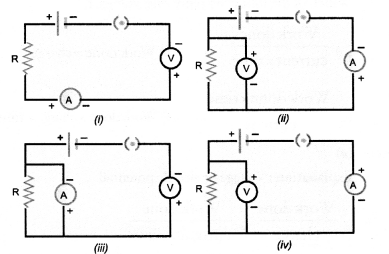
Identify the circuit (Figure) in which electrical components have been properly connected.
NCERT Exemplar Solutions for Class 10 Science Chapter 12 Electricity image - 5
(a) (i)
(b) (ii)
(c) (iii)
(d) (iv)
(CBSE 2010)
Answer:
(b).
Explanation : Voltmeter is always connected in parallel and ammeter is connected in series in an electric circuit. Moreover, positive terminals of voltmeter and ammeter are connected with the +ve terminal of a cell or battery and negative terminals of voltmeter and ammeter are connected with -ve terminal of a cell or battery.

Question 6.
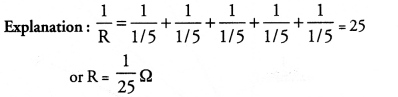
What is the maximum resistance which can be made using five resistors each 1/5 Ω ?
(a) 10 Ω
(b) 10 Ω
(c) 5 Ω
(d) I Ω (CBSE 2010)
Answer:
(d).
NCERT Exemplar Solutions for Class 10 Science Chapter 12 Electricity image - 6

Question 7.
What is the minimum resistance which can be made using 1 five resistors each of 1/5 Ω ?
NCERT Exemplar Solutions for Class 10 Science Chapter 12 Electricity image - 7
Answer:
(d).
NCERT Exemplar Solutions for Class 10 Science Chapter 12 Electricity image - 8

Question 8.
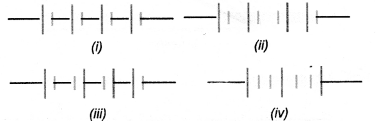
The proper representation of series combination of cells obtaining maximum potential is
NCERT Exemplar Solutions for Class 10 Science Chapter 12 Electricity image - 9
(a) (i)
(b) (ii)
(c) (iii)
(d) (iv)
(CBSE 2011,2012)
Answer:
(d).
Explanation : Cells are connected in series if -ve terminal of one cell is connected to the +ve terminal of other cell.

Question 9.
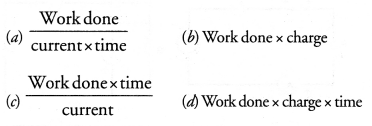
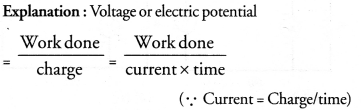
Which of the following represents voltage ?
NCERT Exemplar Solutions for Class 10 Science Chapter 12 Electricity image - 10
Answer:
(a).
NCERT Exemplar Solutions for Class 10 Science Chapter 12 Electricity image - 11

Question 10.
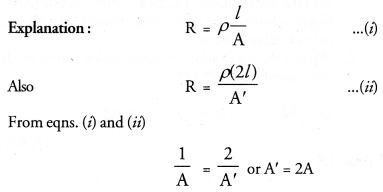
A cylindrical conductor of length l and uniform area of cross-section A has resistance R. Another conductor of length 2l and resistance R of the same material has area of cross-section.
(a) A/2
(b) 3A/2
(c) 2A
(d) 3A
Answer:
(c).
NCERT Exemplar Solutions for Class 10 Science Chapter 12 Electricity image - 12

Question 11.
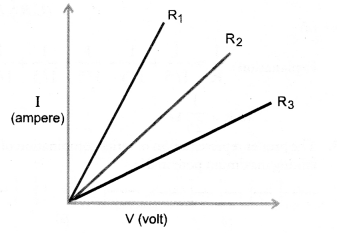
A student carries out an experiment and plots the V—I graph of three samples of nichrome wire with resistances R1, R2 and R3 respectively as shown in figure. Which of the following is true ?
(a) R1 = R2 = R3
(b) R1 > R2 > R3
(c) R3 > R2 > R1
(d) R2 > R3 > R1
NCERT Exemplar Solutions for Class 10 Science Chapter 12 Electricity image - 14
Answer:
(c).
NCERT Exemplar Solutions for Class 10 Science Chapter 12 Electricity image - 15

Question 12.
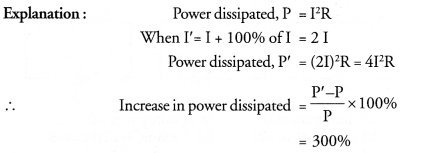
If the current I through a resistor is increased by 100% (assume that temperature remains unchanged), the increase in power dissipated will be
(a) 100 %
(b) 200%
(c) 300%
(d) 400%
Answer:
(c).
NCERT Exemplar Solutions for Class 10 Science Chapter 12 Electricity image - 16

Question 13.
The resistivity does not change if
(a) the material is changed
(b) the temperature is changed
(c) the shape of the resistor is changed
(d) both material and temperature are changed.
Answer:
(c).
Explanation : Resistivity of material does not depend on its di¬mensions and shape. However, resistivity depends upon the tem¬perature and the nature of material.

Question 14.
In an electrical circuit, three incandescent bulbs A, B and C of rating 40 W, 60 W and 100 W respectively are connected in parallel to an electric source. Which of the following is likely to happen regarding their brightness ?
(a) Brightness of bulb A will be maximum
(b) Brightness of bulb B will be more than that of A
(c) Brightness of bulb C will be less than that of B
(d) Brightness of all the bulbs will be same
Answer:
(b).
Explanation : Brightness of bulb depends upon the heat produced per second. Since resistance of bulb is inversely proportional to the power, so resistance of bulb A is more than that of B and resistance of bulb B is more than that of C. Heat produced per second = V2/R
where V is same for all bubls.
Therefore, brightness of bulb B is more than that of A.

Question 15.
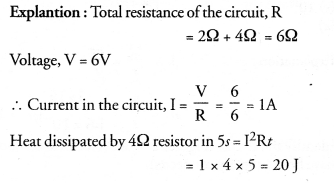
In an electrical circuit two resistors of 2Ω and 4Ω respectively are connected in series to a 6V battery. The heat dissipated by 4Ω resistor in 5 s will be
(a) 5 J
(b) 10 J
(c) 20 J
(d) 30 J
Answer:
(c).
NCERT Exemplar Solutions for Class 10 Science Chapter 12 Electricity image - 17

Question 16.
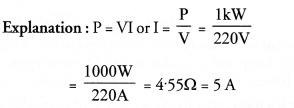
An electric kettle consumes 1 kW of electric power when operated at 220 V. A fuse wire of what rating must be used for it ?
(a) 1 A
(b) 2 A
(c) 4 A
(d) 5 A
Answer:
(d).
NCERT Exemplar Solutions for Class 10 Science Chapter 12 Electricity image - 18

Question 17.
Two resistors of resistance 2Ω and 4Ω when connected to a battery will have
(a) same current flowing through them when connected in parallel
(b) same current flowing through them when connected in series.
(c) same potential difference across them when connected in series
(d) different potential difference across them when connected in parallel
Answer:
(b)
Explanation : Resistors are said to be connected in series if same current flows through them as series combination has a single path for the flow of current. Resistors are said to be connected in parallel if potential difference across them is

Question 18.
Unit of electric power may also be expressed as
(a) Volt ampere
(b) kilowatt hour
(c) watt second
(d) joule second
Answer:
(a).
Explanation : P = VI.

Question 19.
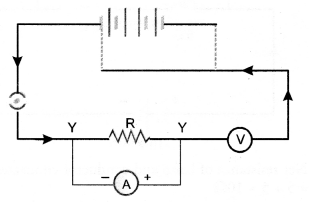
A child has drawn the electric circuit to study Ohm’s law as shown in figure. His teacher told that the circuit diagram needs correction. Study the circuit and redraw it after making all corrections.
NCERT Exemplar Solutions for Class 10 Science Chapter 12 Electricity image - 19
Answer:
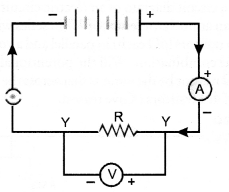
Ammeter is connected in series in an electric circuit and volt¬meter is connected in parallel to the resistor R. Positive terminals of ammeter and voltmeter are connected with the positive terminal of battery and negative terminals of ammeter and voltmeter are connected with the negative terminal of the battery. The correct circuit is shown below.
NCERT Exemplar Solutions for Class 10 Science Chapter 12 Electricity image - 20

Question 20.
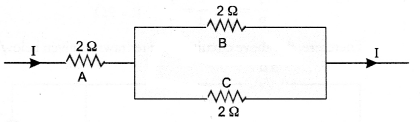
Three 20 resistors, A, B and C are connected as shown in figure. Each of them dissipates energy that can withstand a maximum power of 18W without melting. Find the maximum current that can flow through three resistors.
(CBSE, 2010)
NCERT Exemplar Solutions for Class 10 Science Chapter 12 Electricity image - 21
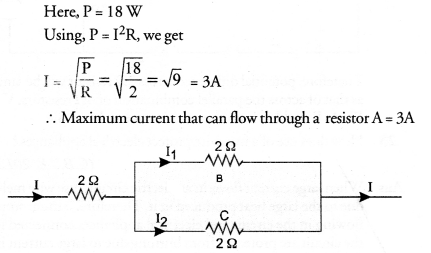
Answer:
NCERT Exemplar Solutions for Class 10 Science Chapter 12 Electricity image - 22
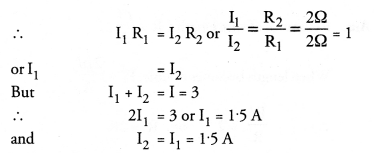
Since resistors B and C are connected in parallel, so potential difference across B and C is same. Let I1, be the current flowing through resistor.B and I2 be the current flowing through resistor C
NCERT Exemplar Solutions for Class 10 Science Chapter 12 Electricity image - 23

Question 21.
Should the resistance of an ammeter be low or high ? Give reason.
Answer:
Ammeter is connected in series in an electric circuit to measure electric current. If its resistance is high, then the net resistance of the electric circuit will increase and hence current in the electric circuit will decrease. Hence, ammeter will not read the actual value of the current in the circuit. If resistance of the ammeter is low, then the net resistance of the circuit will not be effected much. Hence, the current in the circuit is not affected. Ideal ammeter has zero resistance.

Question 22.
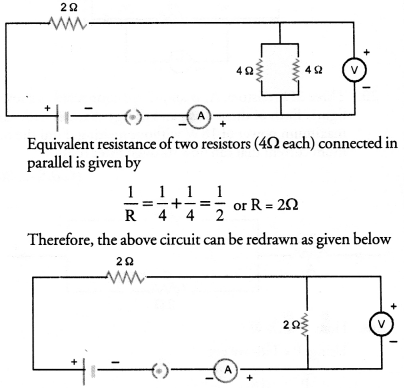
Draw a circuit diagram of an electric circuit containing a cell, a key, an ammeter, a reistor of 2Ω in series with a combination of two resistors (4Ω each) in parallel and a voltmeter across the energy. 1 kWh = 1000 Watt x 3600 s parallel combination. Will the potentional difference across the 2Ω resistor be the same as that across the parallel combination of 4Ω resistors ? Give reason.
Answer:
NCERT Exemplar Solutions for Class 10 Science Chapter 12 Electricity image - 24
Therefore, potential difference across 2Ω resistor will be same ; as that of across the parallel combination of 4Ω resistors. V = IR.
As R and I in both the cases is same so V = same.

Question 23.
How does use of a fuse wire protect electrical appliances ?
(CBSE 2012)
Answer:
When large current flows in an electric circuit, fuse wire melts due to the large heat produced in it. Therefore, current stops flowing in the circuit and electrical appliances connected in the circuit are protected from burning due to large current in j the circuit.

Question 24.
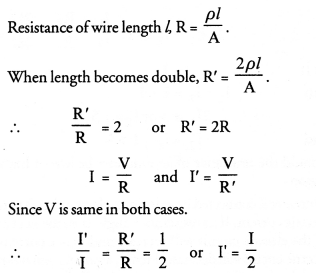
In a series electrical circuit comprising a resistor made up of a metallic wire, the ammeter reads 5A. The reading of ammeter decreases to half when the length of the wire is doubled. Why ?
Answer:
NCERT Exemplar Solutions for Class 10 Science Chapter 12 Electricity image - 25

Question 25.
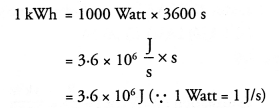
What is the commercial unit of electrical energy ? Represent it in terms of joule.
Answer:
kilowatt hour (kWh) is the commercial unit of electrical energy.
NCERT Exemplar Solutions for Class 10 Science Chapter 12 Electricity image - 26

Question 26.
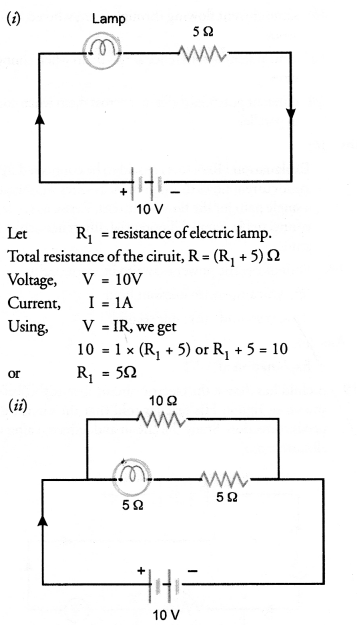
A current of 1 ampere flows in a series circuit containing an electric lamp and a conductor of 5Ω when connected to a 10V battery. Calculate the resistance of the electric lamp.
Now if a resistance of 10Ω is connected in parallel with this series combination, what change (if any) in current flowing through 5Ω condcutor and potentional difference across the lamp will take place ? Give reason. Draw circuit diagram.
(CBSE 2010)
Answer:
NCERT Exemplar Solutions for Class 10 Science Chapter 12 Electricity image - 27
Net resistance of lamp and conductor connected in series = 5 + 5 = 10Ω
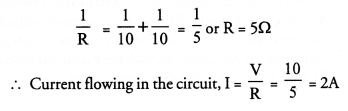
Net resistance of the combination oflamp and conductor and resistance 10Ω connected in parallel,
NCERT Exemplar Solutions for Class 10 Science Chapter 12 Electricity image - 28
It means 1A current will flow through 10Ω resistance and 1A current will flow through the lamp and conductor of 5Ω resistance. Hence, there is no change in the current through 5Ω conductor.
Now potential difference across the lamp in case (i)
V = IR = 1 x 5 = 5V
Potential difference across the lamp in case (ii)
V = IR = 1 x 5 = 5V
Hence, there is no change in the potential difference across the lamp.

Question 27.
Why is parallel arrangement used in domestic wiring ?
(CBSE 2012)
Answer:

  1. If any one of the electric devices in parallel fuses, then the working of other devices will not be affected.
  2. When different devices are connected in parallel, they draw the current as per their requirement and hence they work properly.

Question 28.
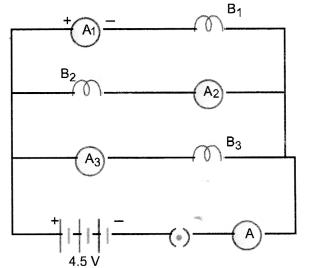
B1, B2 and B3 are three identical bulbs connected as shown in figure. When all the three bulbs glow, a current of 3A is recorded by the ammeter A.

  1. What happenes to the glow of other bulbs when the bulb B1 gets fused ?
  2. What happens to the reading of A1, A2, A3 and A when the bulb B2 gets fused ?
  3. How much power is dissipated in the circuit when all the three bulbs glow together ?
    NCERT Exemplar Solutions for Class 10 Science Chapter 12 Electricity image - 29

Answer:

  1. The glow of bulb depends upon the energy disspated per second i.e. P =V2/R.
    Since V and R of both the bulbs B2 and B3 remain the same even if bulb B, gets fused so glow of B2 and B3 remain the same.
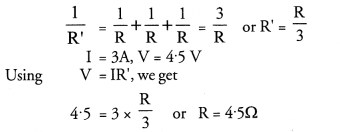
  2. Since bulbs are identical, so their resistance is equal (i.e. resistance of each bulb = R ohm).
    When all bulbs glow, net resistnace of the circuit is given by
    NCERT Exemplar Solutions for Class 10 Science Chapter 12 Electricity image - 30
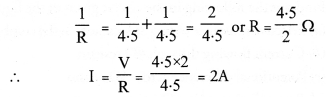
    When B2 gets fused, only two bulbs B1 and B2 in parallel are in the circuit.
    .’. Net resistance of the circuit is given by
    NCERT Exemplar Solutions for Class 10 Science Chapter 12 Electricity image - 31
    Thus, reading of ammeter A = 2A
    Since B1 and B3 are in parallel and have same resistance, so 2A current will be equally distributed between B1 and B3. Therefore, reading of ammeter A1 = 1A Reading of ammeter A3 = 1A Circuit containing B2 is broken, so no current flows through this circuit. Hence reading of ammeter A2 = zero.
  3. Power dissipated in the circuit,
    P =V x I
    = 4.5 x 3 = 13.5 W

Question 29.
Three incandescent bulbs of 100W each are connected in series in an electric circuit. In another circuit, another set of three bulbs of the same voltage are connected in parallel to the same source.
(a) Will the bulb in the two circuits glow with the same brightness ? Justify your answer.
(b) Now let one bulb in both the circuits get fused. Will the rest of the bulbs continue to glow in each circuit ? Give reason.
(CBSE 2012)
Answer:
(a) Power dissipated in a circuit = V2/R. Since resistance of the circuit containing bulbs connected in series is more than the resistnace of the circuit containing bulbs in parallel, therefore, power dissipated in parallel combination is more than that in series combination. Hence, bulbs connected in parallel will glow more brightly.
(b) In series combination, there is only one path for the flow of current. So when one bulb gets fused, circuit is broken and hence the bulbs stop glowing.
In parallel combination, each bulb has its own path for the flow of current. So when one bulb gets fused, other bulbs will continue to glow as the current is flowing in the circuits of these bulbs.

Question 30.
State Ohms law. How can it be verified experimentally ? Does it hold good under all conditions ? Comment.
(CBSE 2010)
Answer:
For Ohm’s law: Ohm’s law states that the electric current flowing through a conductor is directly proportional to the potential difference across the ends of the conductor, provided the temperature and . other physical conditions of the conductor remain the same.
For experimental verification: Verify Ohm’s law
Apparatus : A conductor of resistance R, an ammeter, a voltmeter, a battery, a variable resistance (or rheostat used to change the current in the circuit), connecting wires, a key and sand paper.
Procedure:

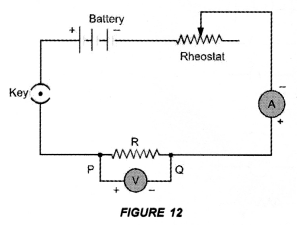
    1. Connect the various components as shown in figure 12.
      NCERT Exemplar Solutions for Class 10 Science Chapter 12 Electricity image - 32
    2. Close the key, so that current begins to flow in the circuit.
    3. Note down the potential difference (V) across the conductor PQ of resistance R shown by the voltmeter and the corresponding current (I) shown by the ammeter.
    4. Now move the knob of rheostat so that the current in the circuit increases.
    5. Again note down the potential difference (V) across the conductor PQ of resistance R in the voltmeter and current in the circuit shown by ammeter.
    6. Repeat the experiment at least five times by increasing the current in the circuit by moving the knob of the rheostat in steps.

Observations:

S.No

Potential Difference
 (V)
Current
(I)

V/I

1.

2.

3.

4.

5.

6.

7.

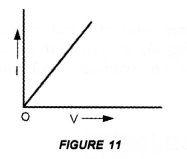
Plot a graph between V and I by taking V along X-axis and I along Y-axis. We get a straight line passing through origin as shown in figure 11.
NCERT Exemplar Solutions for Class 10 Science Chapter 12 Electricity image - 33
Conclusion: From the graph between V and I, we conclude that I x V, which is Ohm’s law. Hence Ohm’s law is verified experimentally.
Precautions: While verifying Ohm’s law experimentally, the following precautions should be taken :

  1. Current should not be allowed to pass through the circuit continuously for a long time, which may cause the increase in temperature of the conductor. Therefore, the plug of the key must be taken out every time after noting the readings of ammeter and voltmeter.
  2. Connections should be tight.
  3. The conductor used in the experiment should be such that its resistance is not changed with increase in temperature of the conductor.

Ohm’s law holds good if the temperature of the conductor remains the same.

Question 31.
What is electrical resistivity of a material ? What is its unit ?
Describe an experiment to study the factors on which the resistance of conducting wire depends. (CBSE 2012)
Answer:
For Electrical resistivity: Electrical resistivity of a material is defined as the resistance of an object (made of the material) of unit length and unit area of cross-section.
Unit of electrical resistivity is ohm-metre.
For experiment:
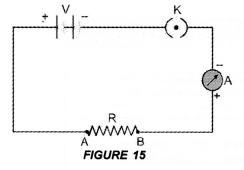
Connect the various electrical components as shown in figure 15.
NCERT Exemplar Solutions for Class 10 Science Chapter 12 Electricity image - 34

  1. Dependence of length of a conductor: 
    Take a copper wire of length l and connect it between the terminals A and B. Note the reading of ammeter. Now take another copper wire of same area of cross-section but of length 2l. Connect it between the terminals A and B by disconnecting the previous wire. Again, note the reading of ammeter. It will be found that the reading of ammeter (i.e., electric current) in the second case is half of the reading of ammeter in the first case. Since R = V/I, so resistance of second wire is double than the resistance of the first wire. Thus, resistance of a conductor is directly proportional to the length of the conductor,
    i.e      resistance ∝ length of the conductor
    Thus, more is the length of a conductor, more is its resistance.
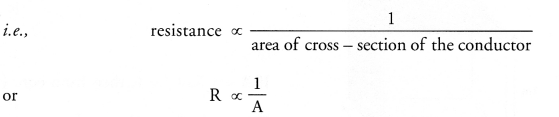
    Thus, the resistance of’a conductor is ‘inversely proportional to the area of cross -section of the conductor.
  2. Dependence on area of cross-section of a conductor:
    Now take two copper wires of same length but of different area of cross-sections. Let area of cross-section of first wire is more than the area of cross-section of the second wire. Connect first wire between the terminals A and B in the circuit shown in figure 15. Note the reading of ammeter. Now disconnect the first wire and connect the second wire between the terminals A and B. Again note the reading of the ammeter. It will be found that the reading of ammeter (i.e. electric current) is more when first wire (i.e. thick wire) is connected between A and B than the reading of the ammeter when second wire (i.e. thin wire) is connected between the terminals A and B.
    NCERT Exemplar Solutions for Class 10 Science Chapter 12 Electricity image - 35
    Thus, the resistance of a thin wire is more than the resistance of a thick wire.
  3. Effect of the Nature of material:
    Take two identical wires, one of copper and other of aluminium. Connect the copper wire between the terminals A and B. Note the reading of ammeter. Now, connect the aluminium wire between the terminals A and B. Again note the reading of ammeter. It is found that the reading of ammeter when copper wire is connected in the circuit is more than the reading of the ammeter when aluminium wire is connected in the circuit.
    Therefore, resistance of copper wire is less than the resistance of aluminium wire. Hence, resistance of a wire or a conductor depends upon the nature of the material of the conductor.
  4. Effect of temperature of conductor:
    If the temperature of a metallic conductor connected in the circuit increases, its resistance increases.
    Thus, factors on which resistance of a conductor depends are :

    1. its length,
    2. its area of cross-section,
    3. the nature of its material and
    4. its temperature.

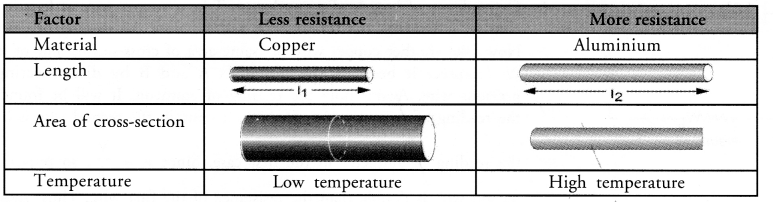
The various factors affecting resistance of a conductor are given in table 1.
Table 1. Factors affecting resistance of a conductor:
NCERT Exemplar Solutions for Class 10 Science Chapter 12 Electricity image - 36

Question 32.
How will you infer with the help of an experiment that the same current flows through every part of the circuit containing three resistances in series connected to a battery ?
Answer:
Perform an activity to show that in series combination of resistors, same current flows through each resistor.

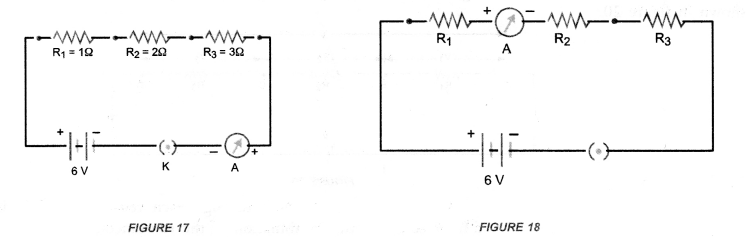
  1. Connect three resistors of resistances R1 = 1Ω, R2 = 2Ω and R3 = 3Ω in series. (C.B.S.E. 2014)
  2. Connect the series combination of resistors with a battery of 6 V, a plug key K and an ammeter A as shown in figure 17.
  3. Note the reading of ammeter after plugging the key. Let it be I.
    NCERT Exemplar Solutions for Class 10 Science Chapter 12 Electricity image - 37
  4. Now disconnect ammeter and connect it in between the resistors R1 and R2 as shown in figure 18.
  5. Again plug the key and note the reading of ammeter. It is found that again it is I.
  6. Now disconnect the ammeter and connect it in between the resistors R2 and R3.
  7. Plug the key and note the reading of ammeter. Again it is found to be I.

Conclusion : Same amount of current flows through each resistor or element connected in series combination.

Question 33.
How will you conclude that the same potential difference (Voltage) exists across three resistors connected in parallel arrangement to a battery ?
Answer:
Perform an activity to investigate the relation between potential difference across parallel combination of resistors and the potential difference across each individual resistors,

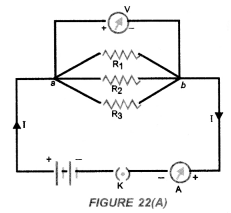
  1. Connect three resistors of resistances R1, R2 and R3 in parallel. One end of each resistor is joined at a common point ‘a’ and the other end of each resistor is connected at another common point ‘b’.
  2. Connect the parallel combination of resistors with a battery, a plug key K and an ammeter A as shown in figure 22(A).
    NCERT Exemplar Solutions for Class 10 Science Chapter 12 Electricity image - 38
  3. Now connect a voltmeter across the parallel combination of resistors between a and b points.
  4. Note the reading of voltmeter. Let it be V. This is the potential difference across the parallel combination of resistors.
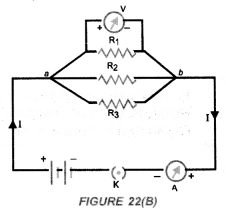
  5. Now, disconnect the voltmeter and connect it across R1 as shown in figure 22(B).
    NCERT Exemplar Solutions for Class 10 Science Chapter 12 Electricity image - 39
  6. Note the reading of voltmeter. It is found to be V.
  7. Disconnect the voltmeter and connect it across R2. Note the reading of voltmeter. It is found to be V.
  8. Again disconnect the voltmeter and connect it across R3. Note the reading of voltmeter. It is found to be V.

Conclusion : When resistors are connected in parallel to each other, potential difference across each resistor is equal to the potential difference across the parallel combination of resistors.

Question 34.
What is Joule’s heating effect ? How can it be demonstrated experimentally ? List its four applications in daily life.
(CBSE 2012)
Answer:
Joule’s law can be stated as : The amount of heat produced in a conductor is
(i) directly proportional to the square of the electric current flowing through it.
This is                  H ∝ I2                                                           –
(ii) directly proportional to the resistance of the conductor or resistor.
That is,                H ∝ R                                          ‘
(iii) directly proportional to the time for which the electric current flows through the conductor or resistor.
That is,               H ∝ t
Combining (i), (ii) and (iii), we get H ∝ I2 Rt.
or         H = KI2Rt, where K is constant of proportionality
If          K = 1, then H = I2Rt joule
This is known as Joule’s law of heating.
Four Applications:

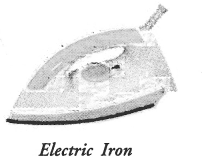
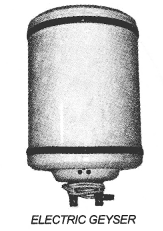
  1. When electric appliances like electric heater, electric iron and water heater etc. are connected to the main supply of electricity, these appliances become hot but the connecting wires remain cold.
    We know, heat produced is directly proportional to the resistance of the material through which current flows. The element of electric heater is made of nichrome. Since, resistance of nichrome is high, so a large amount of heat is produced in the element of the electric heater. Thus, filament of electric heater becomes red hot. However, heat produced in connecting wires made of copper or aluminium is very small and hence they are not heated up.
    NCERT Exemplar Solutions for Class 10 Science Chapter 12 Electricity image - 40
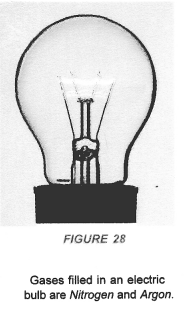
  2. Filament of an electric bulb is made of a thin wire of tungsten. The melting point of filament is high i.e., about 3380 °C. The filament of the bulb is enclosed in a glass envelope fixed over an insulated support as shown in figure 28. The glass envelope of electric bulb is filled with inactive gases like nitrogen and argon to increase the life of the tungsten filament.
    Since resistance of thin filament is very high, so a large heat is produced as the electric current flows through the filament. Due to this large amount of heat produced, filament of the bulb becomes white hot. Hence, the filament of the bulb emits light and heat.
    NCERT Exemplar Solutions for Class 10 Science Chapter 12 Electricity image - 41
  3. Electric fuse is a safety device connected in series with the electric circuit. Electric fuse is a wire made of a material whose melting point is very low. Examples of the materials of making fuse wire are copper or tin-lead alloy. When large current flows through a circuit and hence through a fuse wire, a large amount of heat is produced. Due to this large amount of heat, the fuse wire melts and the circuit is broken so that current stops flowing in the circuit. This saves the electric circuit from burning due to the passage of large current through it.
    NCERT Exemplar Solutions for Class 10 Science Chapter 12 Electricity image - 42

Question 35.
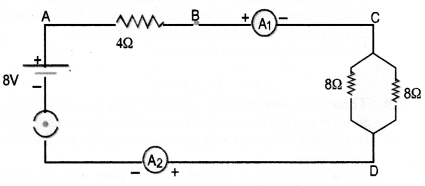
Find out the following in the circuit given in the figure.
NCERT Exemplar Solutions for Class 10 Science Chapter 12 Electricity image - 43
(a) Effective resistance of two 8Ω resistors in the combination.
(b) Current flowing through 40 resistor
(c) Potentional difference across 40 resistor
(d) Power dissipated in 4Ω resistor
(e) Difference in ammeter readings, if any.
(CBSE 2010,2012)
Answer:
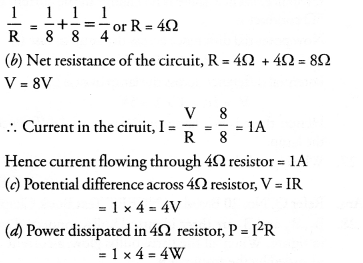
(a) Two 80 resistors are in parallel, so their effective resistance is given by
NCERT Exemplar Solutions for Class 10 Science Chapter 12 Electricity image - 44
(e) Since same current flows through every part in a series circuit and both the ammeters are connected in series, so there will be no difference in ammeter readings.

Hope given NCERT Exemplar Solutions for Class 10 Science Chapter 12 Electricity are helpful to complete your science homework.

If you have any doubts, please comment below. Learn Insta try to provide online science tutoring for you.

Selina Concise Mathematics Class 10 ICSE Solutions Chapter 11 Geometric Progression Ex 11C

Selina Concise Mathematics Class 10 ICSE Solutions Chapter 11 Geometric Progression Ex 11C

These Solutions are part of Selina Concise Mathematics Class 10 ICSE Solutions. Here we have given Selina Concise Mathematics Class 10 ICSE Solutions Chapter 11 Geometric Progression Ex 11C

Other Exercises

Question 1.
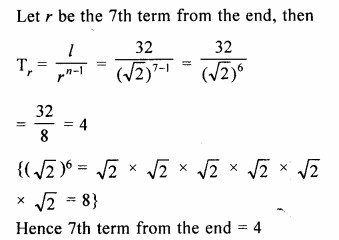
Find the seventh term from the end of the series :
√2, 2, 2√2,……32
Solution:
√2, 2, 2√2,……32
Here a = √2
r = \(\frac { 2 }{ \surd 2 } =\surd 2\)
and l =32
Selina Concise Mathematics Class 10 ICSE Solutions Chapter 11 Geometric Progression Ex 11C Q1.1

Question 2.
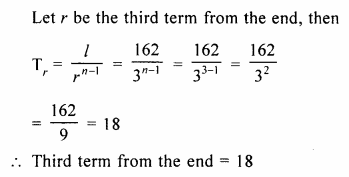
Find the third term from the end of the GP.
\(\frac { 2 }{ 27 } ,\frac { 2 }{ 9 } ,\frac { 2 }{ 3 } ,….162\)
Solution:
G.P is \(\frac { 2 }{ 27 } ,\frac { 2 }{ 9 } ,\frac { 2 }{ 3 } ,….162\)
a = \(\\ \frac { 2 }{ 27 } \)
r = \(\frac { 2 }{ 9 } \div \frac { 2 }{ 27 } \)
= \(\frac { 2 }{ 9 } \times \frac { 27 }{ 2 } \)
= 3
l = 162
Selina Concise Mathematics Class 10 ICSE Solutions Chapter 11 Geometric Progression Ex 11C Q2.1

Question 3.
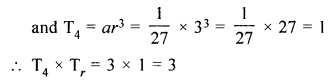
For the G.P. \(\frac { 1 }{ 27 } ,\frac { 1 }{ 9 } ,\frac { 1 }{ 3 } …..81\)
find the product of fourth term from the beginning and the fourth term from the end.
Solution:
\(\frac { 1 }{ 27 } ,\frac { 1 }{ 9 } ,\frac { 1 }{ 3 } …..81\)
a = \(\\ \frac { 2 }{ 27 } \)
r = \(\frac { 1 }{ 9 } \div \frac { 1 }{ 27 } \)
= \(\frac { 1 }{ 9 } \times \frac { 27 }{ 1 } \)
= 3
Selina Concise Mathematics Class 10 ICSE Solutions Chapter 11 Geometric Progression Ex 11C Q3.1

Question 4.
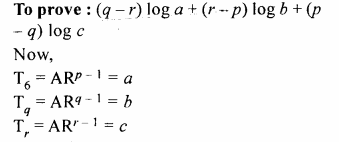
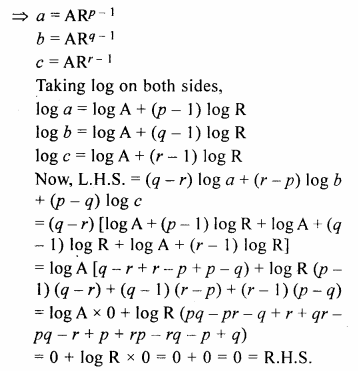
If for a G.P., pth, qth and rth terms are a, b and c respectively ;
prove that :
{q – r) log a + (r – p) log b + (p – q) log c = 0
Solution:
In a G.P
Tp = a,
Tq = b,
Tr = c
Selina Concise Mathematics Class 10 ICSE Solutions Chapter 11 Geometric Progression Ex 11C Q4.1
Selina Concise Mathematics Class 10 ICSE Solutions Chapter 11 Geometric Progression Ex 11C Q4.2

Question 5.
If a, b and c in G.P., prove that : log an, log bn and log cn are in A.P.
Solution:
a, b, c are in G.P.
Let A and R be the first term and common ratio respectively.
Therefore,
a = A
b = AR
c = AR2
log a = log A
log b = log AR = log A + log R
log c = log AR2 = log A + 2log R
log a, log b and log c are in A.P.
If 2log b = log a + log c
If 2[logA + logR] = log A + log A + 2log R
If 2log A + 2log R = 2log A + 2log R
which is true.
Hence log a, log b and log c are in A.P.

Question 6.
If each term of a G.P. is raised to the power x, show that the resulting sequence is also a G.P.
Solution:
Let a, b, c are in G.P.
Then b2 = ac …(i)
Now ax, bx + cx will be in G.P. if (bx)2 = ax.cx
=> (bx)2 = ax.cx
=>(b2)= (ac)x
Hence ax, bx, cx are in G.P. (∴ b2 = ac)
Hence proved.

Question 7.
If a, b and c are in A.P. a, x, b are in G.P. whereas b, y and c are also in G.P. Show that : x2, b2, y2 are in A.P.
Solution:
2 b = a + c _(i)
a, x, b are in G.P.
x2 = ab _(ii)
and b, y, c in G.P.
y2 = bc _(iii)
Now x2 + y2 = ab + bc
= b(a + c)
= b x 2b [from(i)]
= 2 b2
Hence x2, b2, y2 are in G.P.

Question 8.
If a, b, c are in G.P. and a, x, b, y, c are in A.P., prove that :
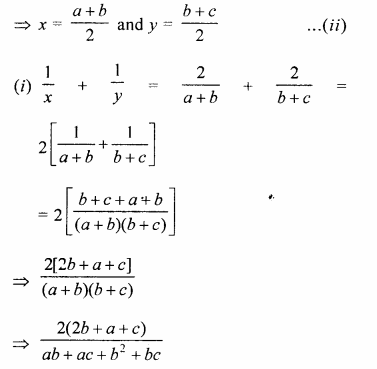
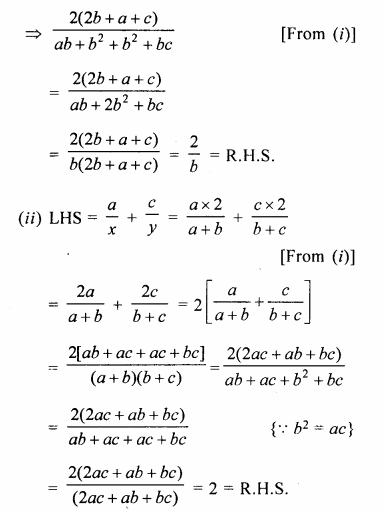
(i)\(\frac { 1 }{ x } +\frac { 1 }{ y } =\frac { 2 }{ b } \)
(ii)\(\frac { a }{ x } +\frac { c }{ y } =2\)
Solution:
a, b, c are in G.P.
b2 = ac
a, x, b, y, c are in A.P.
2x = a + b and 2y = b + c
Selina Concise Mathematics Class 10 ICSE Solutions Chapter 11 Geometric Progression Ex 11C Q8.1
Selina Concise Mathematics Class 10 ICSE Solutions Chapter 11 Geometric Progression Ex 11C Q8.2

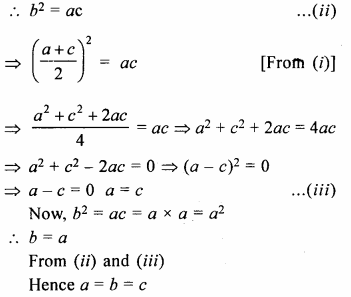
Question 9.
If a, b and c are in A.P. and also in G.P., show that: a = b = c.
Solution:
a, b, c are in A.R
2 b = a + c ….(i)
Again, a, b, c are in G.P.
Selina Concise Mathematics Class 10 ICSE Solutions Chapter 11 Geometric Progression Ex 11C Q9.1

Hope given Selina Concise Mathematics Class 10 ICSE Solutions Chapter 11 Geometric Progression Ex 11C are helpful to complete your math homework.

If you have any doubts, please comment below. Learn Insta try to provide online math tutoring for you.

Selina Concise Mathematics Class 10 ICSE Solutions Chapter 24 Measures of Central Tendency Ex 24E

Selina Concise Mathematics Class 10 ICSE Solutions Chapter 24 Measures of Central Tendency (Mean, Median, Quartiles and Mode) Ex 24E

These Solutions are part of Selina Concise Mathematics Class 10 ICSE Solutions. Here we have given Chapter 24 Measures of Central Tendency (Mean, Median, Quartiles and Mode) Ex 24E.

Other Exercises

Question 1.
The following distribution represents the height of 160 students of a school

Selina Concise Mathematics Class 10 ICSE Solutions Chapter 24 Measures of Central Tendency Ex 24E Q1.1
Draw an ogive for the given distribution taking 2 cm = 5 cm of height on one axis and 2 cm = 20 students on the other axis. Using the graph, determine :
(i) The median height.
(ii) The inter quartile range.
(iii) The number of students whose height is above 172 cm
Solution:
The cumulative frequency table may be prepared as follows :
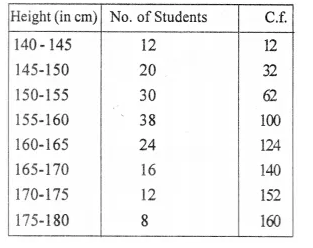
Selina Concise Mathematics Class 10 ICSE Solutions Chapter 24 Measures of Central Tendency Ex 24E Q1.2
Selina Concise Mathematics Class 10 ICSE Solutions Chapter 24 Measures of Central Tendency Ex 24E Q1.3
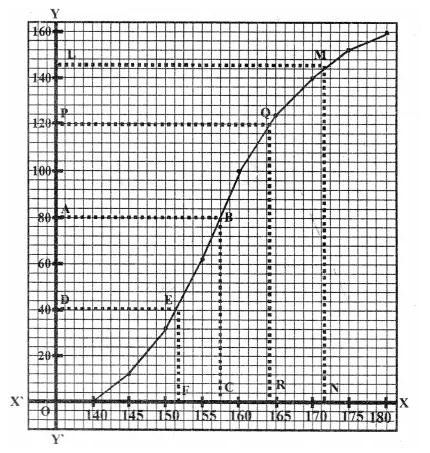
Now, we take height along x-axis and number of students along the y-axis. Now, plot the point (145, 12), (150, 32), (155, 62), (160, 100), (165, 124), (170, 140), (175, 152) and (180, 160). On the graph paper and join them with free hand.
(i) Here N = 160 ⇒ \(\frac { N }{ 2 }\) = 80
Which is even now take a point A on the y-axis representing 80. Through A draw horizontal line meeting the ogive at B. From B, draw BC ⊥ x-axis, meeting the x-axis at C.
The abscissa of C is 157.5 So, median = 157.5 cm
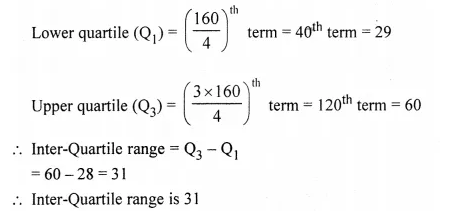
(ii) Proceeding in the same way as we have done in above, we have, Q1 = 152 and Q3 = 164
So, inter quartile range = Q3 – Q1 = 164 – 152 = 12 cm
(iii) From the ogive, we see that the number of students whose height is less than 172 is 145.
No. of students whose height is above 172 cm = 160 – 145 = 15

Question 2.
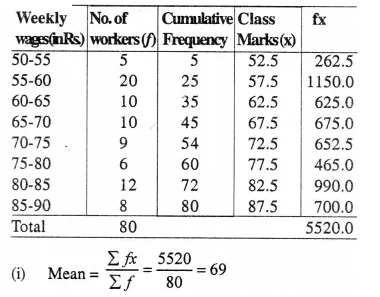
The following table gives the weekly wages of workers in a factory.

Selina Concise Mathematics Class 10 ICSE Solutions Chapter 24 Measures of Central Tendency Ex 24E Q2.1
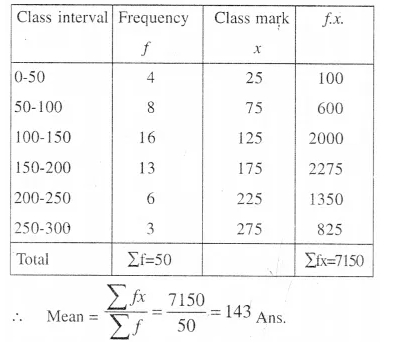
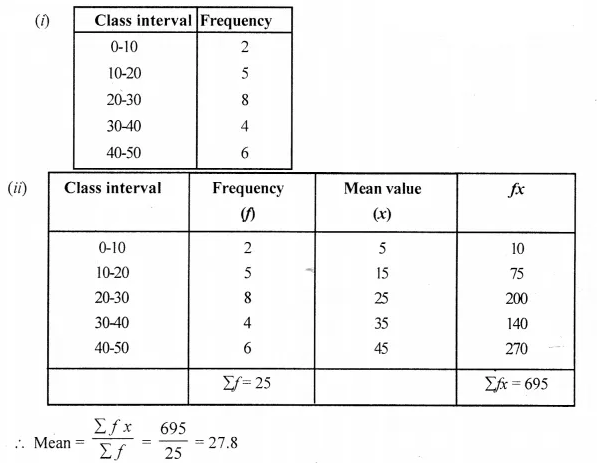
Calculate : (i) the mean, (ii) the modal class, (iii) the number of workers getting weekly w ages below Rs. 80 and (iv) the number of workers get¬ting Rs 65 or more but less than Rs. 85 as weekly wages. [2002]
Solution:
Selina Concise Mathematics Class 10 ICSE Solutions Chapter 24 Measures of Central Tendency Ex 24E Q2.2
(ii) Modal class 55-60 (It has maximum frequency)
(iii) No. of workers getting wages below Rs. 80 = 60
(iv) No. of worker getting Rs. 65 is more but less than 85 as weekly wages = 37

Question 3.
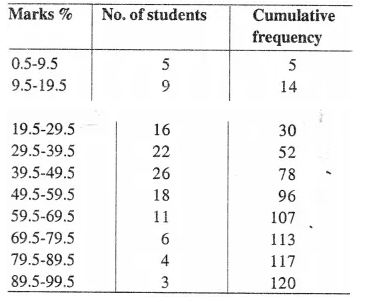
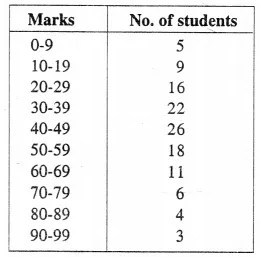
Draw an ogive for the data given below and from the graph determine :
(i) the median marks,
(ii) the number of students who obtained more than 75% marks ?
Selina Concise Mathematics Class 10 ICSE Solutions Chapter 24 Measures of Central Tendency Ex 24E Q3.1
Selina Concise Mathematics Class 10 ICSE Solutions Chapter 24 Measures of Central Tendency Ex 24E Q3.2
Selina Concise Mathematics Class 10 ICSE Solutions Chapter 24 Measures of Central Tendency Ex 24E Q3.3
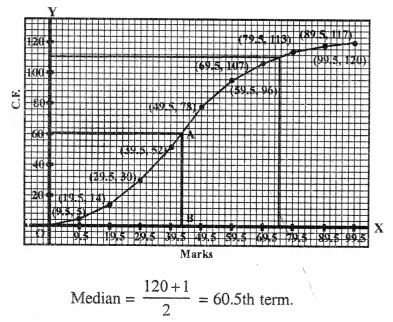
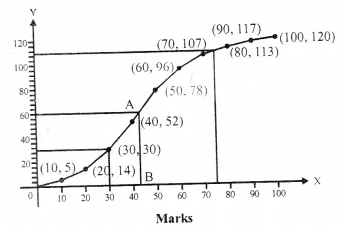
Through 60.5 th marks, draw a line segment parallel to x-axis which meets the curve at A.
From A, draw a line segment perpendicular to, x-axis meeting at B.
∴ B is the median = 43 (approx.)
No. of students who obtained upto 75% marks in the test =111
∴ No. of students who obtained more than 75% = 120- 111 =9

Question 4.
The mean of 1, 7, 5, 3, 4, and 4 is m. The numbers 3,2,4,2,3,3 and p have mean m-1 and median q. Find p and q.
Solution:
Mean of 1,7, 5, 3,4, and 4 = \(\frac { 24 }{ 6 }\) =4
∴ m = 4.
Now mean of 3,2,4,2,3,3 and p = m- 1= 4- 1 = 3
i.e. 17+p = 3xn when n =7
17 + p = 3×7 = 21
⇒ p = 21 – 17 = 4
Median of 3, 2,4,2, 3, 3 and 3 is q
Arranging in ascending order, 2,2, 3,3,3,3,4,4
Mean = 4th terms is 3.
∴ q = 3

P.Q.
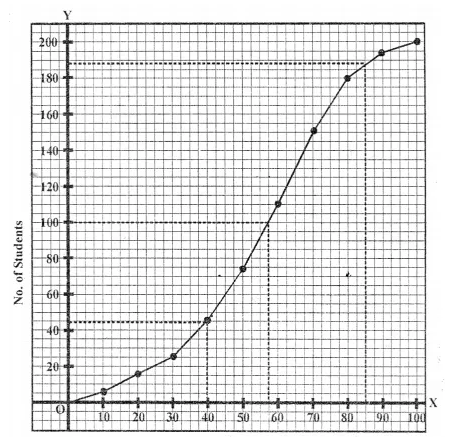
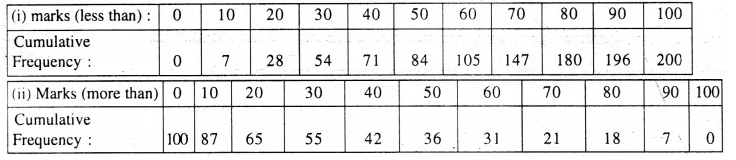
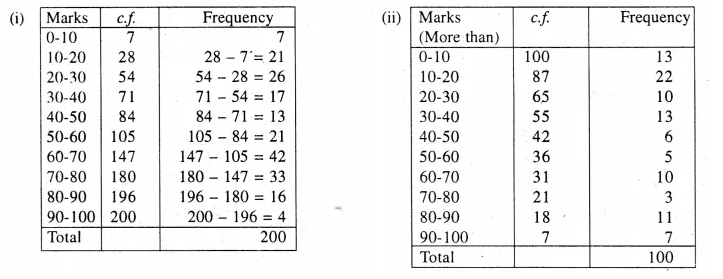
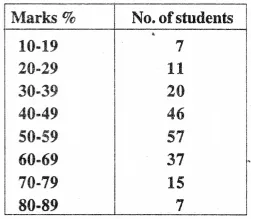
The marks of 200 students in a test were recorded as follows :
Selina Concise Mathematics Class 10 ICSE Solutions Chapter 24 Measures of Central Tendency Ex 24E Qp1.1
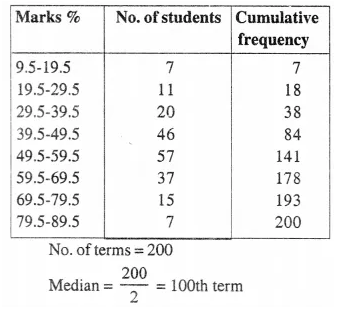
Construct the cumulative frequency table. Draw an ogive and use it to find :
(i) the median and
(ii) the number of students who score more than 35 % marks.
Solution:
Selina Concise Mathematics Class 10 ICSE Solutions Chapter 24 Measures of Central Tendency Ex 24E Qp1.2
Through 100 th scores, draw a line segment parallel to x-axis which meets the curve at A. From A, draw a line segment perpendicular to it which meets at B.
∴ Median = 52.5
No. of students who score more than 35% marks.
= 200 – 28 = 172
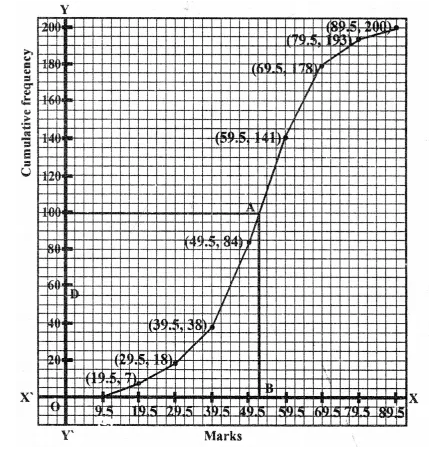
Selina Concise Mathematics Class 10 ICSE Solutions Chapter 24 Measures of Central Tendency Ex 24E Qp1.3

Question 5.
In a malaria epidemic, the number of cases diagnosed were as follows :
Date (July) 1 2 3 4 5 6 7 8 9 10 11 12 Number 5 12 20 27 46 30 31 18 11 5 0 1 On what days does the mode, the upper and lower quartiles occur ?
Solution:
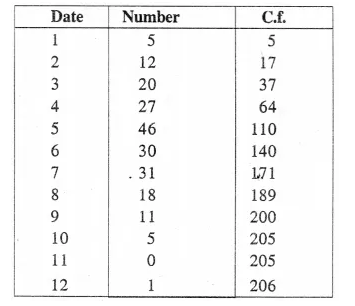
Selina Concise Mathematics Class 10 ICSE Solutions Chapter 24 Measures of Central Tendency Ex 24E Q5.1
(i) Mode = 5th July (because it has the maximum frequencies i,e. 46)

Question 6.
The incomes of the parents of 100 students in a class in a certain university are tabulated below :
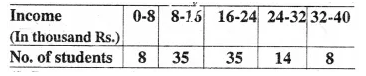
Selina Concise Mathematics Class 10 ICSE Solutions Chapter 24 Measures of Central Tendency Ex 24E Q6.1
(i) Draw a cumulative frequency curve to estimate the median income.
(ii) If 15 % of the students ae given freeships on the basis of the income of their parents, find the annual income of parents, below which the freeships will be awarded.
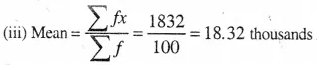
(iii) Calculate the Arithmetic mean.
Solution:
(Cummulative Frequancy table)
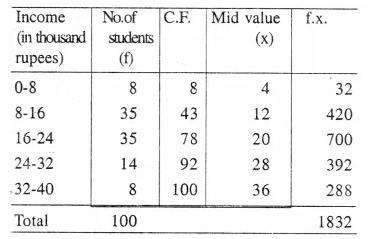
Selina Concise Mathematics Class 10 ICSE Solutions Chapter 24 Measures of Central Tendency Ex 24E Q6.2
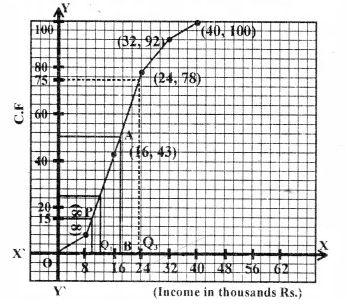
(i) No. of terms= 100
∴ Mean = \(\frac { 100 }{ 2 }\) = 50th term
Through 50 mark, draw a line segment parallel to x-axis which meets the curve at A. From A, draw a perpendicular to x-axis meeting it at B, B is the median.
∴ B = 17.6 thousands
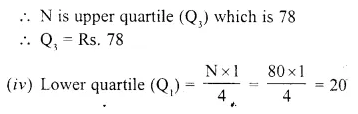
(ii) Upper quartile = 100 x \(\frac { 3 }{ 4 }\) = 75th term
From the Curve Q3 = 23.2
(iii) Lower-quartile = 100 x \(\frac { 1 }{ 4 }\)=25th term
From the curve Q1 = 12.8
∴ Inter-quartile range = Q3– Q1 = 23.2 – 12.8
= 10.4 thousands
(iv) 15% of 100 students = \(\frac { 100 x 15 }{ 100 }\) = 15
From C.F. 15, draw a horizontal line which intersects the curve at P. From P, draw a perpendicular to x-axis meeting it at 11.2
∴ Freeship to parents = Rs. 11.2 thousands upto
the income of Rs. 11.2 thousands
Selina Concise Mathematics Class 10 ICSE Solutions Chapter 24 Measures of Central Tendency Ex 24E Q6.3
Selina Concise Mathematics Class 10 ICSE Solutions Chapter 24 Measures of Central Tendency Ex 24E Q6.4

Question 7.
The marks of 20 students in a test were as follows : 2, 6, 8, 9, 10, 11, 11, 12, 13, 13, 14, 14, 15, 15, 15, 16, 16, 18, 19 and 20. Calculate-
(i) the mean
(ii) the median
(iii) the mode. [2002]
Solution:
Arranging in ascending order,
2, 6, 8, 9, 10, 11, 11, 12, 13, 13, 14, 14, 15, 15, 15, 15, 16, 16, 18, 19, 20
No. of terms = 20
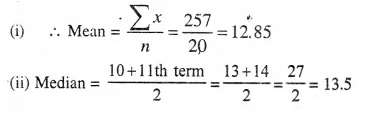
Ix = 2 + 6 + 8 + 9+ 10+ 11 + 11 + 12+ 13 + 13 + 14 + 14 + 14 + 15 + 15 + 15 + 16 + 16 + 18 +
19 + 20 = 257
Selina Concise Mathematics Class 10 ICSE Solutions Chapter 24 Measures of Central Tendency Ex 24E Q7.1
(iii) Mode = 15 (as it has maximum frequency i.e. it has 3)

Question 8.
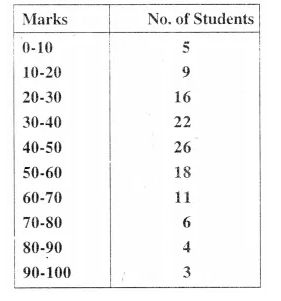
The marks obtained by 120 students in a Mathematics test are given below:
Selina Concise Mathematics Class 10 ICSE Solutions Chapter 24 Measures of Central Tendency Ex 24E Q8.1
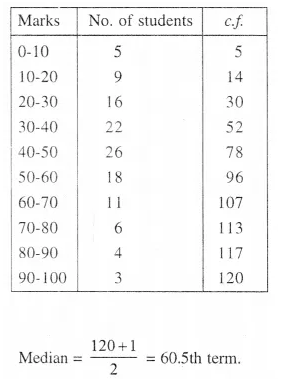
Draw an ogive for the given distribution on a graph sheet. Use a suitable scale for your ogive. Use your ogive to estimate :
(i) the median
(ii) the number of students who obtained more than 75% marks in a test ?
(iii) the number of students who did not pass in the test if the pass percentage was 40. [2002]
(iv) the lower quartile
Solution:
Selina Concise Mathematics Class 10 ICSE Solutions Chapter 24 Measures of Central Tendency Ex 24E Q8.2
Selina Concise Mathematics Class 10 ICSE Solutions Chapter 24 Measures of Central Tendency Ex 24E Q8.3
Lower Quartile (Q1)
∴ \(\frac { N }{ 4 }\)  = \(\frac { 120 }{ 4 }\)  = 30
From a point B (30) on v-axis, draw a line parallel to x- axis meeting the curve at Q and from Q Draw a line parallel to .Y-axis meeting it at 30.
∴ Lower quartile = 30
Through 60.5th marks, draw a line segment parallel to x-axis which meets the curve at A. From A, draw a line segment perpendicular to, x-axis meeting at B.
∴ B is the median = 43 (approx.)
No. of students who obtained upto 75% marks in the test = 110
∴ No. of students who obtained more than 75% = 120- 110 = 10
No. of students who obtained less than 40% marks in the test = 52 (∴ in the graph x = 40, y = 52)

P.Q.
Find the mean for the following frequency distribution: [2003]
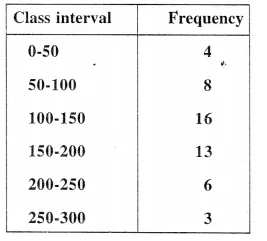
Selina Concise Mathematics Class 10 ICSE Solutions Chapter 24 Measures of Central Tendency Ex 24E Qp2.1
Solution:
Selina Concise Mathematics Class 10 ICSE Solutions Chapter 24 Measures of Central Tendency Ex 24E Qp2.2

P.Q.
Draw a histogram and hence estimate the mode for the following frequency distribution: [2003]

Selina Concise Mathematics Class 10 ICSE Solutions Chapter 24 Measures of Central Tendency Ex 24E Qp3.1
Solution:
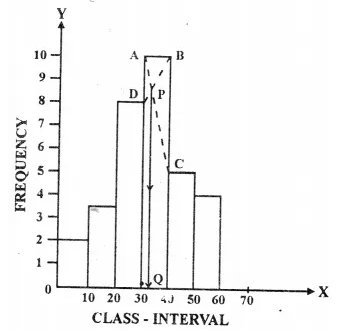
(i) Draw the histogram.
Selina Concise Mathematics Class 10 ICSE Solutions Chapter 24 Measures of Central Tendency Ex 24E Qp3.2
(ii) In the highest rectangle which represents the modal class draw two lines points AC and BD intersecting at P.
(iii) From P, draw a perpendicular to x-axis meeting at Q.
(iv) value of Q is the mode which is = 23

P.Q.
For die following set of data find the median :
10, 75, 3, 81, 17, 27, 4, 48, 12, 47, 9 and 15.
Solution:
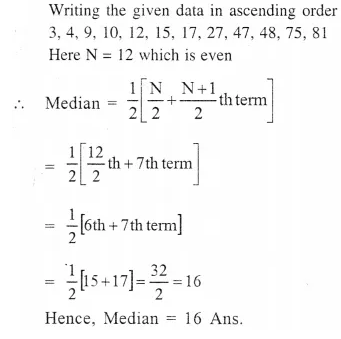
Selina Concise Mathematics Class 10 ICSE Solutions Chapter 24 Measures of Central Tendency Ex 24E Q4.1

P.Q.
For the following frequency distribution draw a histogram. Hence, calculate the mode.

Selina Concise Mathematics Class 10 ICSE Solutions Chapter 24 Measures of Central Tendency Ex 24E Qp5.1
Solution:
Histogram :
(i) Draw a histogram and make the upper corner of the rectangle
(ii) With maximum frequency A and B. Also upper corners of the two other rectangles as C and D which are the next and to maximum rectangle.
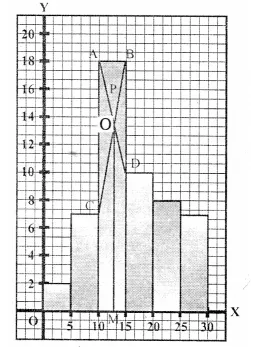
Selina Concise Mathematics Class 10 ICSE Solutions Chapter 24 Measures of Central Tendency Ex 24E Qp5.2
(iii) Join AD and BC which intersect at P.
(iv) From P, draw PM ⊥ X – axis
OM = 13
Hence mode = 13

Question 9.
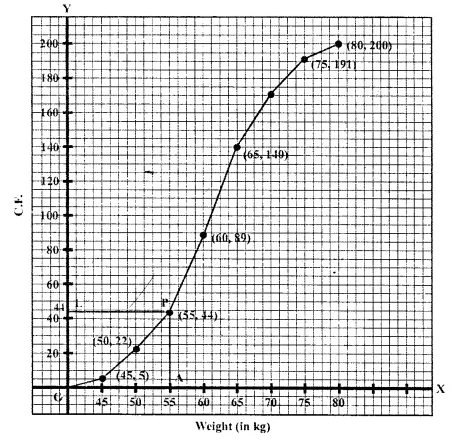
Using a graph paper, draw an Ogive for the following distribution which shows a record of the weight in kilograms of 200 students.

Selina Concise Mathematics Class 10 ICSE Solutions Chapter 24 Measures of Central Tendency Ex 24E Q9.1
Use your Ogive to estimate the following :
(i) The percentage of students weighing 55 kg or more,
(ii) The weight above which the heaviest 30% of the students fall.
(iii) The number of students who are (a) under-weight and (b) over-weight, if 55.70 kg is considered as standard weight. (2005)
Solution:
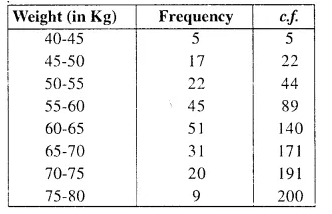
Selina Concise Mathematics Class 10 ICSE Solutions Chapter 24 Measures of Central Tendency Ex 24E Q9.2
Plot the points (45. 5), (50, 22), (55, 44). (60, 89), (65, 140), (70, 171), (75, 191) and (80, 200) on the graph and join them in free hand to get an ogive as shown.
Selina Concise Mathematics Class 10 ICSE Solutions Chapter 24 Measures of Central Tendency Ex 24E Q9.3
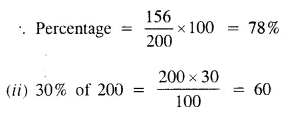
(i) From the graph, number of students weighing 55 kg or more = 200 – 44 = 156
Selina Concise Mathematics Class 10 ICSE Solutions Chapter 24 Measures of Central Tendency Ex 24E Q9.4
∴ Heaviest 60 students in weight = 9 + 20 + 31 = 60 (From the graph, the required weight is 65 kg or more but less than 80 kg)
(iii) Total number of students who are (i) under weight = 47 and (ii) over weight = 152 (∴ Standard weight is 55.70 kg)

P.Q.
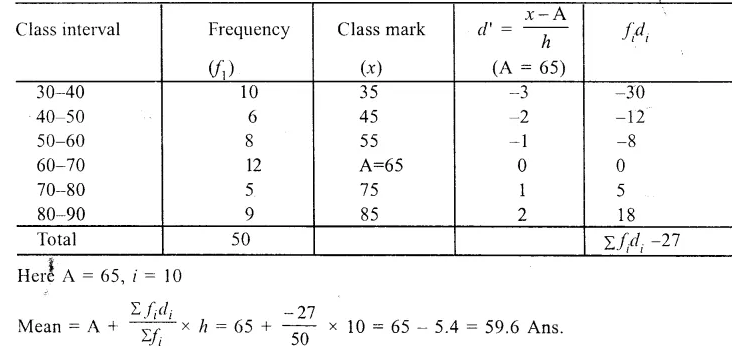
Using step deviation method, find the mean of the following distribution.

Selina Concise Mathematics Class 10 ICSE Solutions Chapter 24 Measures of Central Tendency Ex 24E Qp6.1
Solution:
Selina Concise Mathematics Class 10 ICSE Solutions Chapter 24 Measures of Central Tendency Ex 24E Qp6.2

P.Q.
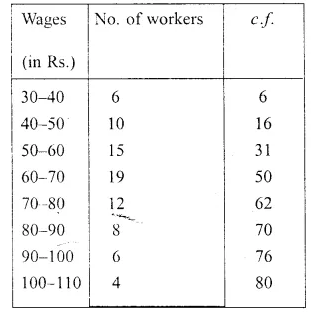
The daily wages of 80 workers in a building project are given below :

Selina Concise Mathematics Class 10 ICSE Solutions Chapter 24 Measures of Central Tendency Ex 24E Qp7.1
Using graph paper, draw an Ogive for the above distribution.
Use your Ogive to estimate : (i)the median wages of the workers.
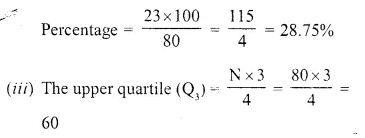
(ii) the percentage of workers who earn more than Rs. 75 day.
(iii) the upper quartile wage of the workers.
(iv) the lower quartile wage of the workers.
(v) Inter quartile range.
Solution:
Selina Concise Mathematics Class 10 ICSE Solutions Chapter 24 Measures of Central Tendency Ex 24E Qp7.2
Selina Concise Mathematics Class 10 ICSE Solutions Chapter 24 Measures of Central Tendency Ex 24E Qp7.3
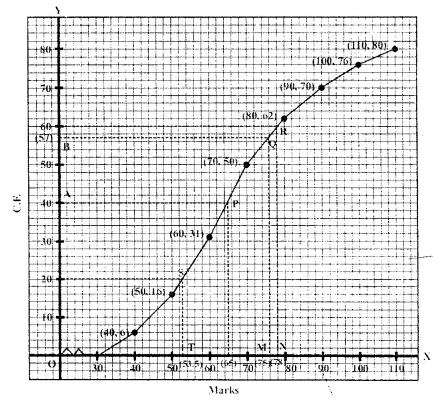
Now plot the points (40, 6), (50, 16), (60, 31), (70, 50), (80, 62), (90, 70) (100, 76). and (110, 80) on the graph and join them with free hand to get an ogive as shown.
(i) Median : \(\frac { N }{ 2 }\) = \(\frac { 80 }{ 2 }\) = 40
From 40 on y-axis, draw a line parallel to x- axis meeting the curve at P. From P, draw PL ⊥ x-axis
Then L is the median which is 65
∴ Median = Rs. 65
(ii) No. of workers earning more than Rs. 75 per day
From 75 on v-axis, draw a perpendicular meeting the curved at Q and from Q( draw a line parallel to x-axis which meet y-axis at B which is 57
∴No. of workers getting more than Rs. 75 per day = 80 – 57 = 23
Selina Concise Mathematics Class 10 ICSE Solutions Chapter 24 Measures of Central Tendency Ex 24E Qp7.4
From 60 on y-axis, draw- a line parallel to x- axis which meets the curve at R. From R, draw a perpendicular on x-axis meeting it at N.
Selina Concise Mathematics Class 10 ICSE Solutions Chapter 24 Measures of Central Tendency Ex 24E Qp7.5
From 20 on y-axis, draw a line parallel to x- axis meeting the curve at S. From S, draw a perpendicular on x-axis meeting it at T.
T is the lower quartile (Q1) which is 53.5
∴ Q1 = Rs. 53.50
(v) Inter quartile range = Q3 – Q1 = Rs. 78-53.50 = Rs. 24.50

Question 10.
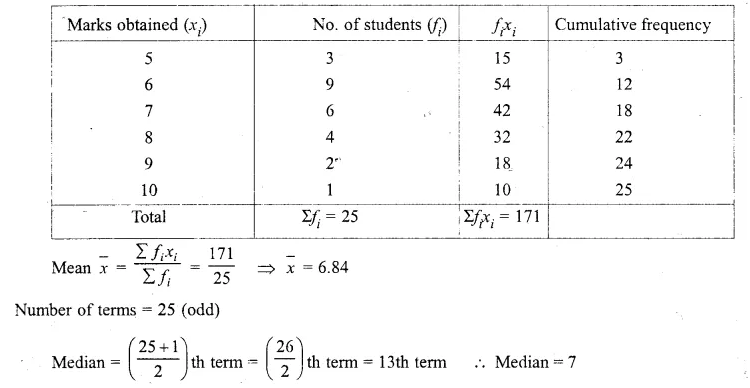
The distribution given below shows the marks obtained by 25 students in an aptitude test. Find the mean, median and mode of the distribution.

Selina Concise Mathematics Class 10 ICSE Solutions Chapter 24 Measures of Central Tendency Ex 24E Q10.1
Solution:
Selina Concise Mathematics Class 10 ICSE Solutions Chapter 24 Measures of Central Tendency Ex 24E Q10.2
Mode = Marks with maximum frequency is 6 ∴ Mode = 6

Question 11.
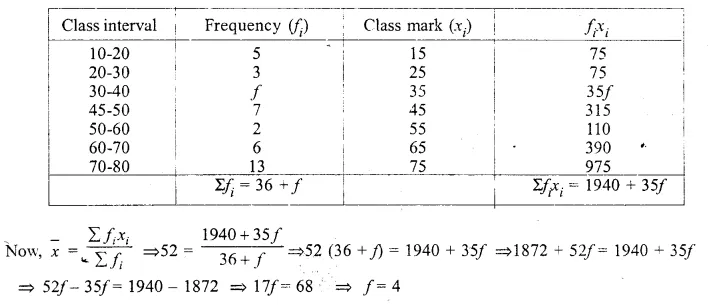
The mean of the following distribution is 52 and the frequency of class interval 30-40 is Find ‘f’ .Find ‘ f ‘.

Selina Concise Mathematics Class 10 ICSE Solutions Chapter 24 Measures of Central Tendency Ex 24E Q11.1
Solution:
Selina Concise Mathematics Class 10 ICSE Solutions Chapter 24 Measures of Central Tendency Ex 24E Q11.2

Question 12.
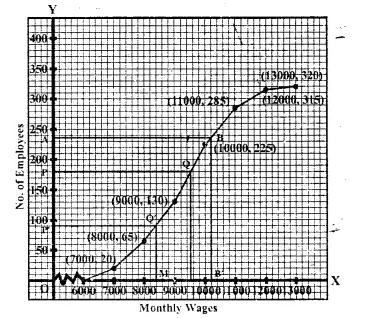
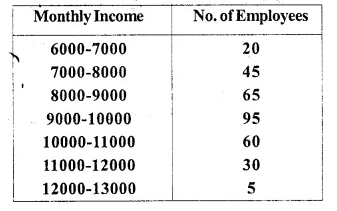
The monthly income of a group of 320 employees in a company is given below:
Selina Concise Mathematics Class 10 ICSE Solutions Chapter 24 Measures of Central Tendency Ex 24E Q12.1
Draw an ogive of the given distribution on a graph sheet taking 2 cm = Rs. 1000 on one axis and 2 cm= 50 employees on the other axis.
From the graph determine
(i)the median wage
(ii)the number of employees whose income is below Rs. 8500.
(iii)If the salary of a senior employee is above Rs. 11,500, find the number of senior employees in the company.
(iv) the upper quartile.
Solution:
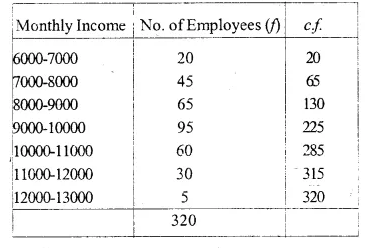
Selina Concise Mathematics Class 10 ICSE Solutions Chapter 24 Measures of Central Tendency Ex 24E Q12.2
Selina Concise Mathematics Class 10 ICSE Solutions Chapter 24 Measures of Central Tendency Ex 24E Q12.3
(i)For median wage, Take OP =\(\frac { 320 }{ 2 }\) =160 on y-axis, Draw a line PQ || x-axis and from Q,
draw QM ⊥ x-axis, abcissa of M point is 9400 ⇒ Median = Rs. 9400
(ii) Take OM’ = 8500 on.t-axis. Draw Q’M’|| toy-axis and P’Q’ || X-axis
Where ordinate of P’ is 92.5
There are approximately 93 employees whose monthly wage is below Rs. 8500
(iii) There are approximately 18 employees whose salary is above Rs. 11500.
(iv) Upper quartile
Mark a point A ony-axis on \(\frac { 3N }{ 4 }\) = \(\frac { 3 x 320 }{ 4 }\)= 240 and draw a line AB || X-axis, then draw BB’
⊥ x-axis abscissa of B’ is upper quartile i.e., Rs. 10250.

Question 13.
A Mathematics aptitude test of 50 students was recorded as follows :

Selina Concise Mathematics Class 10 ICSE Solutions Chapter 24 Measures of Central Tendency Ex 24E Q13.1
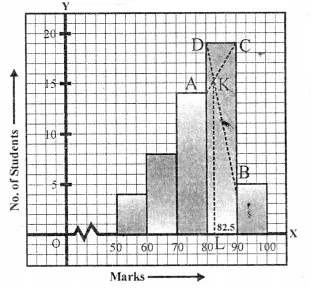
Draw a histogram for the above data using a graph paper and locate the mode.
Solution:
Selina Concise Mathematics Class 10 ICSE Solutions Chapter 24 Measures of Central Tendency Ex 24E Q13.2
1. Draw the histogram with given data.
2. Inside the highest rectangle which represents the maximum frequency (or modal class), draw two lines AC and BD diagonally from the upper comer C and D or adjacent rectangle which intersect at K.
3. Draw KL ⊥ X-axis.
Value ofL is the mode which is 82.5 (approx).

Question 14.
Marks obtained by 200 students in an examination are given below :

Selina Concise Mathematics Class 10 ICSE Solutions Chapter 24 Measures of Central Tendency Ex 24E Q14.1
Draw an ogive for the given distribution taking 2 cm = 10 marks on one axis and 2 cm = 20 students on the other axis. Using the graph, determine
(i) The median marks.
(ii) The number of students who failed if minimum marks required to pass is 40.
(iii) If scoring 85 and more marks is considered as grade one, find the number of students who secured grade one in the examination.
Solution:
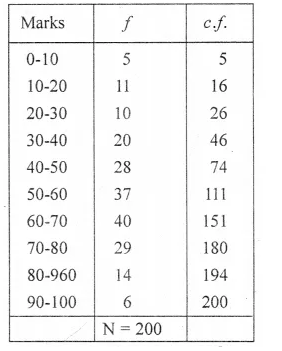
Selina Concise Mathematics Class 10 ICSE Solutions Chapter 24 Measures of Central Tendency Ex 24E Q14.2
Selina Concise Mathematics Class 10 ICSE Solutions Chapter 24 Measures of Central Tendency Ex 24E Q14.3
(i) Median is 57.
(ii)44 students failed.
(iii) No. of students who secured grade one = 200 – 188 = 12

Question 15.
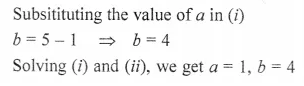
Marks obtained by 40 students in a short assessment are given below, where a and ft are two missing data.

Selina Concise Mathematics Class 10 ICSE Solutions Chapter 24 Measures of Central Tendency Ex 24E Q15.1
If the mean of the distribution is 7.2, find a and b.
Solution:
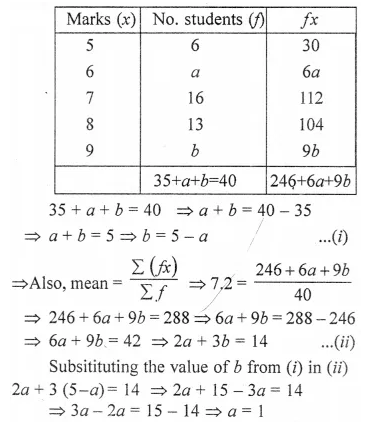
Selina Concise Mathematics Class 10 ICSE Solutions Chapter 24 Measures of Central Tendency Ex 24E Q15.2
Selina Concise Mathematics Class 10 ICSE Solutions Chapter 24 Measures of Central Tendency Ex 24E Q15.3

Question 16.
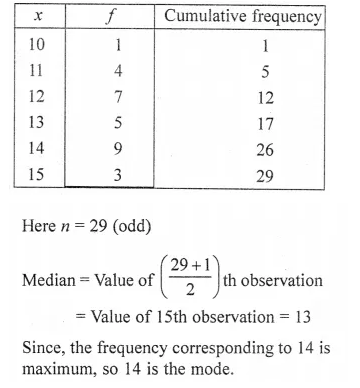
Find the mode and median of the following frequency distribution :
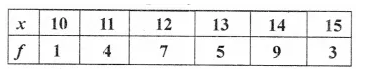
Selina Concise Mathematics Class 10 ICSE Solutions Chapter 24 Measures of Central Tendency Ex 24E Q16.1
Solution:
Selina Concise Mathematics Class 10 ICSE Solutions Chapter 24 Measures of Central Tendency Ex 24E Q16.2

Question 17.
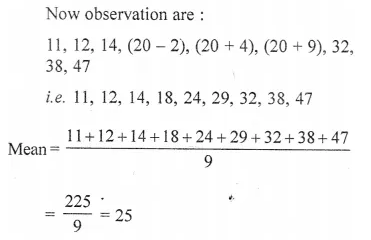
The median of the following observations 11, 12, 14, (x – 2), (x + 4), (x + 9), 32, 38, 47 arranged in ascending order is 24. Find the value of x and hence find the mean.
Solution:
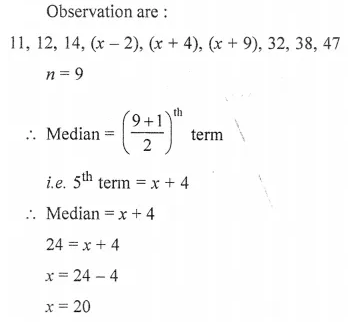
Selina Concise Mathematics Class 10 ICSE Solutions Chapter 24 Measures of Central Tendency Ex 24E Q17.1
Selina Concise Mathematics Class 10 ICSE Solutions Chapter 24 Measures of Central Tendency Ex 24E Q17.2

Question 18.
The numbers 6, 8, 10, 12, 13 and x are arranged in an ascending order. If the mean of the observations is equal to the median, find the value of x. (2014)
Solution:
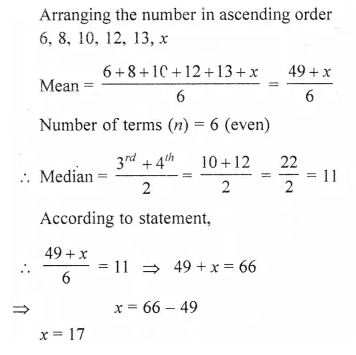
Selina Concise Mathematics Class 10 ICSE Solutions Chapter 24 Measures of Central Tendency Ex 24E Q18.1

Question 19.
(Use a graph paper for this question.) The daily pocket expenses of 200 students in a school are given below:
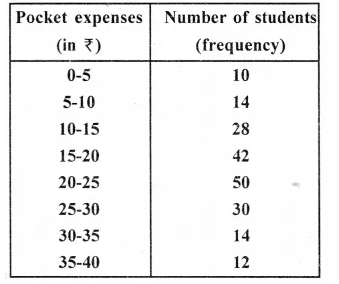
Selina Concise Mathematics Class 10 ICSE Solutions Chapter 24 Measures of Central Tendency Ex 24E Q19.1
Draw a histogram representing the above distribution and estimate the mode from the graph. (2014)
Solution:
Steps of construction :
(i) Draw a line BC = 6.5 cm.
(ii) Centre B and C draw arcs AB = 5.5 cm and AC = 5 cm
(iii) Join AB and AC, ABC is the required triangle,
(iv) Draw the angle bisetors of B and C. Let these bisectors meet at O.
(v) Taking O as centre. Draw a incircle which touches all the sides of the ∆ ABC.
(vi) From O draw a perpendicular to side BC which cut at N.
(vii) Measure ON which is required radius of the incircle.
ON = 1.5 cm
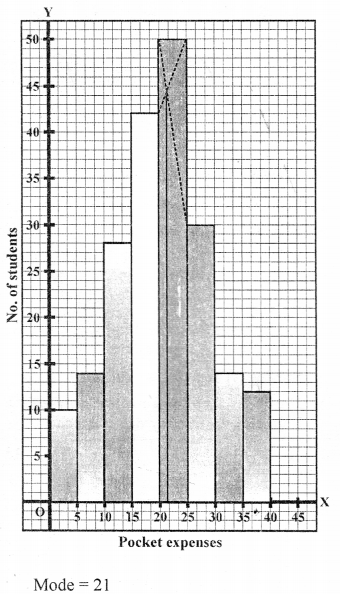
Selina Concise Mathematics Class 10 ICSE Solutions Chapter 24 Measures of Central Tendency Ex 24E Q19.2

Question 20.
The marks obtained by 100 students in a Mathematics test are given below :

Selina Concise Mathematics Class 10 ICSE Solutions Chapter 24 Measures of Central Tendency Ex 24E Q20.1
Draw an ogive for the given distribution on a graph sheet.
Use a scale of 2 cm 10 units on both axes).
Use the ogive to estimate the:
(i) median.
(ii) lower quartile.
(iii) number of students who obtained more than 85% marks in the test.
(iv) number of students failed, If the pass percentage was 35. (2014)
Solution:
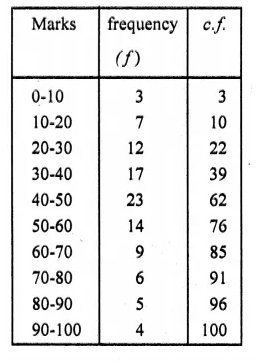
Selina Concise Mathematics Class 10 ICSE Solutions Chapter 24 Measures of Central Tendency Ex 24E Q20.2
Selina Concise Mathematics Class 10 ICSE Solutions Chapter 24 Measures of Central Tendency Ex 24E Q20.3
N= 100
Median = \(\frac { 100 }{ 2 }\) = 50th term Median = 45
(ii) Lower quartile : (Q1)
N = 100
⇒ \(\frac { N }{ 4 }\) = \(\frac { 100 }{ 4 }\) = 25
∴ Q1 = 32
(iii) Mo. of students with 85% less = 94
∴ More than 85% marks = 100 94 6
(iv) Number of students who did not pass = 30

Question 21.
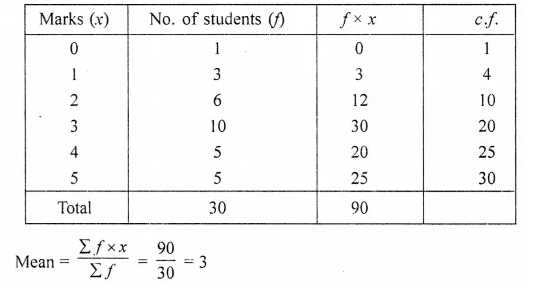
The marks obtained by 30 students in a eiass assessment of 5 marks is given below :

Selina Concise Mathematics Class 10 ICSE Solutions Chapter 24 Measures of Central Tendency Ex 24E Q21.1
Calculate the mean, median and mode of the above distribution. (2015)
Solution:
Selina Concise Mathematics Class 10 ICSE Solutions Chapter 24 Measures of Central Tendency Ex 24E Q21.2
Selina Concise Mathematics Class 10 ICSE Solutions Chapter 24 Measures of Central Tendency Ex 24E Q21.3
Which is between 10 and 20
∴ Median = 3
(ii) Mode frequency of 3 is the greatest
∴ Mode = 3

Question 22.
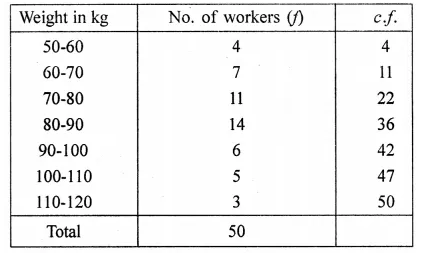
The weight of 50 workers is given below :

Selina Concise Mathematics Class 10 ICSE Solutions Chapter 24 Measures of Central Tendency Ex 24E Q22.1
Draw an ogive of the given distribution using a graph sheet. Take 2 cm = 10 kg on one axis and 2 cm = 5 workers along the other axis. Use the ogive drawn to estimate the following:
(i) the upper and lower quartiles.
(ii) if weighing 95 Kg and above is considered overweight, find the number of workers who are overweight. (2015)
Solution:
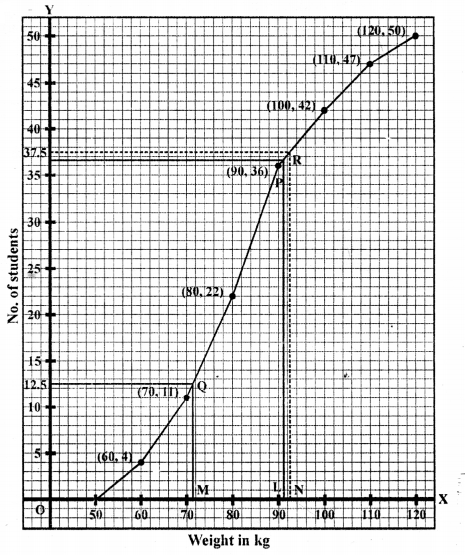
Plot the points (60, 4), (70, 11), (80, 22), (90, 36), (100, 42) (110, 47) and (120, 50) on the graph and join them in order with free hand.
This is the required ogive
Selina Concise Mathematics Class 10 ICSE Solutions Chapter 24 Measures of Central Tendency Ex 24E Q22.2
Selina Concise Mathematics Class 10 ICSE Solutions Chapter 24 Measures of Central Tendency Ex 24E Q22.3
(i) Upper Quartile = \(\frac { 50 x 3 }{ 4 }\) th term = \(\frac { 150 }{ 4 }\) th = -37.5th term
Lower Quartile = \(\frac { 50 }{ 4 }\) th = 12.5th term
Upper quartile is 42 kg and lower quartile is 72 kg.
(ii) 95 kg and above are over weight
∴ No. of over weight students are 50 – 39 = 11 students.

Question 23.
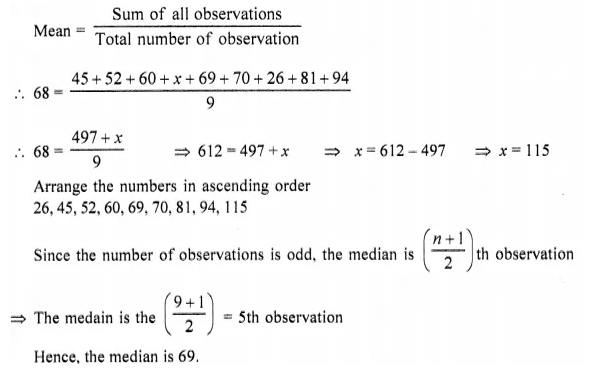
The mean of following number is 68. Find the value of ‘x’. 45, 52, 60, x, 69, 70, 26, 81 and 94. Hence estimate the median. (2016)
Solution:
Selina Concise Mathematics Class 10 ICSE Solutions Chapter 24 Measures of Central Tendency Ex 24E Q23.1

Question 24.
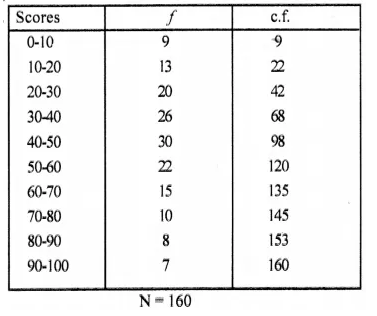
The table shows the distribution of the scores obtained by 160 shooters in a shooting competition. Use a graph sheet and draw an ogive for the distribution. (Take 2 cm = 10 scores on the X-axis and 2 cm = 20 shooters on the Y-axis). (2016)

Selina Concise Mathematics Class 10 ICSE Solutions Chapter 24 Measures of Central Tendency Ex 24E Q24.1
Use your graph to estimate the following :
(i) The median.
(ii) The interquartile range.
(iii) The number of shooters who obtained a score of more than 85%.
Solution:
Selina Concise Mathematics Class 10 ICSE Solutions Chapter 24 Measures of Central Tendency Ex 24E Q24.2
Selina Concise Mathematics Class 10 ICSE Solutions Chapter 24 Measures of Central Tendency Ex 24E Q24.3
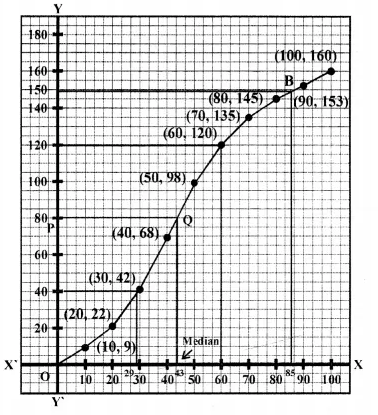
Through mark 80 on y-axis, draw a horizontal line which meets the ogive drawn at point Q.
Through Q, draw a vertical line which meets the x-axis at the mark of 43(app.).
∴ Median = 43
(ii) Since the number of terms = 160

Selina Concise Mathematics Class 10 ICSE Solutions Chapter 24 Measures of Central Tendency Ex 24E Q24.4
Selina Concise Mathematics Class 10 ICSE Solutions Chapter 24 Measures of Central Tendency Ex 24E Q24.5
(iii) Since 85% scores = 85% of 100 = 85
Through mark for 85 on x-axis, draw a vertical line which meets the ogive drawn at point B.
Through the point B, draw a horizontal line which meets thej-axis at the mark of 148 = 160- 148= 12
So, the number of shooters who obtained more than 85% score is 12.

Question 25.
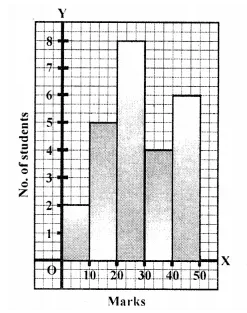
The histogram below represents the scores obtained by 25 students in a Mathematics mental test. Use the data to :
(i) Frame a frequency distribution table
(ii) To calculate mean
(iii) To determine the Modal class
Selina Concise Mathematics Class 10 ICSE Solutions Chapter 24 Measures of Central Tendency Ex 24E Q25.1
Solution:
Selina Concise Mathematics Class 10 ICSE Solutions Chapter 24 Measures of Central Tendency Ex 24E Q25.2
(iii) Here the maximum class frequency is 8, and the class corresponding to this frequency is 20-30. So, the modal class is 20-30.
Hope given Selina Concise Mathematics Class 10 ICSE Solutions Chapter 24 Measures of Central Tendency Ex 24E  are helpful to complete your math homework.

If you have any doubts, please comment below. Learn Insta try to provide online math tutoring for you.