RD Sharma Class 8 Solutions Chapter 5 Playing With Numbers Ex 5.3

RD Sharma Class 8 Solutions Chapter 5 Playing With Numbers Ex 5.3

These Solutions are part of RD Sharma Class 8 Solutions. Here we have given RD Sharma Class 8 Solutions Chapter 5 Playing With Numbers Ex 5.3

Other Exercises

Solve each of the following cryptarithms.
Question 1.
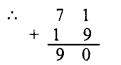
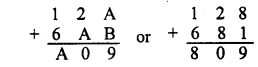
RD Sharma Class 8 Solutions Chapter 5 Playing With Numbers Ex 5.3 1
Solution:
RD Sharma Class 8 Solutions Chapter 5 Playing With Numbers Ex 5.3 2
Values of A and B be from 0 to 9 In ten’s digit 3 + A = 9
∴ A = 6 or less.
∴ 7 + B = A = 6 or less
∴ 7 + 9 or 8 = 16 or 15
∴ But it is two digit number
B = 8
Then A = 5
RD Sharma Class 8 Solutions Chapter 5 Playing With Numbers Ex 5.3 3

Question 2.
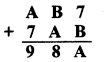
RD Sharma Class 8 Solutions Chapter 5 Playing With Numbers Ex 5.3 4
Solution:
Values of A and B can be between 0 and 9
In tens digit, A + 3 = 9
∴ A = 9 – 3 = 6 or less than 6
In ones unit B + 7 = A = 6or less
∴ 7 + 9 or 8 = 16 or 15
But it is two digit number
∴ B = 8 and
∴ A = 5
RD Sharma Class 8 Solutions Chapter 5 Playing With Numbers Ex 5.3 5

Question 3.
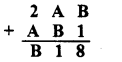
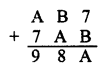
RD Sharma Class 8 Solutions Chapter 5 Playing With Numbers Ex 5.3 6
Solution:
RD Sharma Class 8 Solutions Chapter 5 Playing With Numbers Ex 5.3 7
Value of A and B can be between 0 and 9 In units place.
1+B = 0 ⇒1+B = 10
∴ B = 10 – 1 = 9
and in tens place
1 + A + 1 = B ⇒ A + 2 = 9
⇒ A = 9 – 2 = 7
RD Sharma Class 8 Solutions Chapter 5 Playing With Numbers Ex 5.3 8

Question 4.
RD Sharma Class 8 Solutions Chapter 5 Playing With Numbers Ex 5.3 9
Solution:
Values of A and.B can be between 0 and 9
In units place, B+1 = 8 ⇒ B = 8-1=7
In tens place A + B= 1 or A + B = 11
⇒ A + 7 = 11 ⇒ A =11-7 = 4

Question 5.
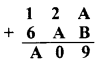
RD Sharma Class 8 Solutions Chapter 5 Playing With Numbers Ex 5.3 10
Solution:
RD Sharma Class 8 Solutions Chapter 5 Playing With Numbers Ex 5.3 11
Values of A and B can be between 0 and 9
In tens place, 2 + A = 0 or 2 + A=10
A = 10-2 = 8
In units place, A + B = 9
⇒ 8 + B = 9 ⇒ B = 9- 8 = 1
RD Sharma Class 8 Solutions Chapter 5 Playing With Numbers Ex 5.3 12

Question 6.
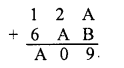
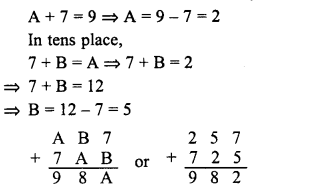
RD Sharma Class 8 Solutions Chapter 5 Playing With Numbers Ex 5.3 13
Solution:
RD Sharma Class 8 Solutions Chapter 5 Playing With Numbers Ex 5.3 14
Values of A and B can be between 0 and 9
In hundreds place,
RD Sharma Class 8 Solutions Chapter 5 Playing With Numbers Ex 5.3 15

Question 7.
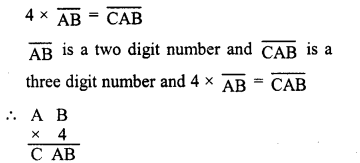
Show that cryptarithm 4 x \(\overline { AB } =\overline { CAB }\) does not have any solution.
Solution:
RD Sharma Class 8 Solutions Chapter 5 Playing With Numbers Ex 5.3 16
It means that 4 x B is a numebr whose units digit is B
Clearly, there is no such digit
Hence the given cryptarithm has no solution.

Hope given RD Sharma Class 8 Solutions Chapter 5 Playing With Numbers Ex 5.3 are helpful to complete your math homework.

If you have any doubts, please comment below. Learn Insta try to provide online math tutoring for you.

CA Foundation Business Economics Study Material – Oligopoly

CA Foundation Business Economics Study Material Chapter 4 Price Determination in Different Markets – Oligopoly

OLIGOPOLY

Introduction:

  • ‘Oligo’ means few and ‘Poly’ means seller. Thus, oligopoly refers to the market structure where there are few sellers or firms.
  • They produce and sell such goods which are either differentiated or homogeneous products.
  • Oligopoly is an important form of imperfect/competition.
  • E.g.- Cold drinks industry; automobile industry; Idea; Airtel. Hutch, BSNL mobile services in Nagpur; tea industry; etc.

Types of Oligopoly:

  • Pure or perfect oligopoly occurs when the product is homogeneous in nature, e.g. Aluminum industry.
  • Differentiated or imperfect oligopoly where products are differentiated. E.g. toilet products.
  • Open oligopoly where new firms can enter the market and compete with already existing firm.
  • Closed oligopoly where entry of new firm is restricted.
  • Collusive oligopoly when some firms come together with some common understanding and act in collusion with each other in fixing price and output.
  • Competitive oligopoly where there is no understanding or collusion among the firms.
  • Partial oligopoly where the industry is dominated by one large firm which is looked upon by other firms as the leader of the group. The dominating firm will be the price leader.
  • Full oligopoly where there is absence of price leadership.
  • Syndicated oligopoly where the firms sell their products through a centralized syndicate.
  • Organized oligopoly where the firms organize themselves into a central association for fixing prices, output, quotas, etc.

Characteristics of Oligopoly Market:

Following are the special features of oligopoly market:

1. Interdependence

  • In an oligopoly market, there is interdependence among firms.
  • A firm cannot take independent price and output decisions.
  • This is because each firm treats other firms as rivals.
  • Therefore, it has to consider the possible reaction to its rivals price-output decisions.

2. Importance of advertising and selling costs

  • Due to interdependence, the various firms have to use aggressive and defensive marketing tools to achieve larger market share.
  • For this the firms spend heavily on advertisement, publicity, sales promotion, etc. to attract large number of customers.
  • Firms avoid price-wars but are engaged in non-price competition. E.g.- free set of tea mugs with a packet of Duncan’s Double Diamond Tea.

3. Indeterminate Demand Curve

  • The nature and position of the demand curve of the oligopoly firm cannot be determined.
  • This is because it cannot predict its sales correctly due to indeterminate reaction patterns of rival firms.
  • Demand curve goes on shifting as rivals too change their prices in reaction to price changes by the firm.

4. Group behaviour

  • The theory of oligopoly is a theory of group behaviour.
  • The members of the group may agree to pull together to promote their mutual interest or fight for individual interests or to follow the group leader or not.
  • Thus the behaviour of the members is very uncertain.

Price and output decisions in an Oligopolistic Market:

As seen earlier, an oligopolistic firm does not know how rival firms react to each other decisions. Therefore, it has to be very careful when it makes decision about its price. Rival firms retaliate to price change by an oligopolistic firm. Hence, its demand curve indeterminate. Price and output cannot be fixed. Some of the important oligopoly models are:

  1. Some economists assume that oligopolistic firms make their decisions independently. Therefore, the demand curve becomes definite and hence equilibrium level of output can be determined.
  2. Some believe that oligopolistic can predict the reaction of rivals on the basis of which he makes decisions about price and quantity.
  3. Cornet considers OUTPUT is the firm’s controlled variable and not price.
  4. In a model given by Stackelberg, the leader firm commits to an output before all other firms. The rest of firms follow it and choose their own level of output.
  5. Bertrand model states PRICE is the control variable for firms and therefore each firm sets the price independently.
  6. In order to pursue common interests, oligopolistic enter into enter into agreement and jointly act as monopoly to fix quantity and price.

Price Leadership:

A large or dominant firm may be surrounded by many small firms. The dominant firm takes the lead to set the price taking into account of the small firms. Dominant firm may adopt any one of the following strategies—

  1. ‘Live and let live’ strategy where dominant firm accepts the presence of small firms and set the price. This is called price-leadership,
  2. In another strategy, the price leader sets the price in such a way that it allows some profits to the follower firms.
  3. Barometric price leadership where an old, experienced, respectful, largest acts as a leader and sets the price. It makes changes in price which are beneficial from all firm’s and industry’s view point. Price charged by leader is accepted by follower firms.

Kinked Demand Curve:

  • In many oligopolistic industries there is price rigidity or stability.
  • The prices remains sticky or inflexible for a long time.
  • Oligopolists do not change the price even if economic conditions change.
  • Out of many theories explaining price rigidity, the theory of kinked demand curve hypothesis given by American economist Paul M. Sweezy is most popular.
  • According to kinked demand curve 4 hypothesis, the demand curve faced by an oligopolist have a ‘Kink’ at the prevailing price level.
  • A kink is formed at the prevailing price because —
    – the portion of the demand curve above the prevailing price is elastic, and
    – the portion of the demand curve below the prevailing price is inelastic

Consider the following figure.
CA Foundation Business Economics Study Material Oligopoly 1

  • In the fig., OP is the prevailing price at which the firm is producing and selling OQ output.
  • At prevailing price OP, the upper portion of demand curve dK is elastic and lower portion of demand curve KD is inelastic.
  • This difference in elasticities is due to the assumption of particular reactions by kinked demand curve theory.

The assumed reaction pattern are –

  1. If the oligopolist raises the price above the prevailing price OP, he fears that none of his rivals will follow him.
    – Therefore, he will loose customers to them and there will be substantial fall in his sales.
    – Thus, the demand with respect to price rise above the prevailing price is highly elastic as indicated by the upper portion of demand curve dK.
    – The oligopolist will therefore, stick to the prevailing prices.
  2. If the oligopolist reduces the price below the prevailing price OP to increase his sales, his rivals too will quickly reduce the price.
    – This is because the rivals fear that their customers will get diverted to price cutting oligopolist’s product.
    – Thus, the price cutting oligopolist will not be able to increase his sales very much.
    – Hence, the demand with respect to price reduction below the prevailing price is inelastic as indicated by the lower portion of demand curve KD.
    – The oligopolist will therefore, stick to the prevailing prices.
    – Each oligopolist will, thus, stick to the prevailing price realising no gain in changing the price.
    – A kink will, therefore, be formed at the prevailing price which remains rigid or sticky or stable at this level.

Other Important Market Forms:

  1. Duopoly in which there are only TWO firms in the market. It is subset of oligopoly.
  2. Monopoly is a market where there is a single buyer. It is generally in factor market.
  3. Oligopsony market where there are small number of large buyers in factor market.
  4. Bilateral monopoly market where there is a single buyer and a single seller. It is mix of monopoly and monopsony markets

RD Sharma Class 8 Solutions Chapter 5 Playing With Numbers Ex 5.2

RD Sharma Class 8 Solutions Chapter 5 Playing With Numbers Ex 5.2

These Solutions are part of RD Sharma Class 8 Solutions. Here we have given RD Sharma Class 8 Solutions Chapter 5 Playing With Numbers Ex 5.2

Other Exercises

Question 1.
Given that the number  \(\overline{35 a 64}\) is divisible by 3, where a is a digit, what are the possible volues of a ?
Solution:
The number \(\overline{35 a 64}\) is divisible by 3
∵The sum of its digits will also be divisible by 3
∴ 3 + 5 + a + b + 4 is divisible by 3
⇒ 18 + a is divisible by 3
⇒ a is divisible by 3 (∵ 18 is divisible by 3)
∴ Values of a can be, 0, 3, 6, 9

Question 2.
If x is a digit such that the number \(\overline { 18×71 }\) is divisible by 3,’ find possible values of x.
Solution:
∵ The number \(\overline { 18×71 }\)
is divisible by 3
∴ The sum of its digits will also be divisible by 3
⇒ l + 8+ x + 7 + 1 is divisible by 3
⇒ 17 + x is divisible by 3
The sum greater than 17, can be 18, 21, 24, 27…………
∴ x can be 1, 4, 7 which are divisible by 3.

Question 3.
If is a digit of the number \(\overline { 66784x }\) such that it is divisible by 9, find the possible values of x.
Solution:
∵ The number 66784 x is divisible by 9
∴ The sum of its digits will also be divisible by 9
⇒ 6+6+7+8+4+x is divisible by 9
⇒ 31 + x is divisible by 9
Sum greater than 31, are 36, 45, 54………
which are divisible by 9
∴ Values of x can be 5 on 9
∴ x = 5

Question 4.
Given that the number \(\overline { 67 y 19 }\) is divisible by 9, where y is a digit, what are the possible values of y ?
Solution:
∵ The number \(\overline { 67 y 19 }\) is divisible by 9
∴The sum of its digits will also be divisible by 9
⇒ 6 + 7+ y+ 1+ 9 is divisible by 9
⇒ 23 + y is divisible by 9
∴ The numbers greater than 23 are 27, 36, 45,……..
Which are divisible by 9
∴y = A

Question 5.
If \(\overline { 3 x 2 }\) is a multiple of 11, where .v is a digit, what is the value of * ?
Solution:
∵ The number \(\overline { 3 x 2 }\) is multiple of 11
∴ It is divisible by 11
∴ Difference of the sum of its alternate digits is zero or multiple of 11
∴ Difference of (2 + 3) and * is zero or multiple of 11
⇒ If x – (2 + 3) = 0 ⇒ x-5 = 0
Then x = 5

Question 6.
If \(\overline { 98125 x 2 }\) is a number with x as its tens digits such that it is divisible by 4. Find all the possible values of x.
Solution:
∵ The number \(\overline { 98125 x 2 }\) is divisible by 4
∴ The number formed by tens digit and units digit will also be divisible by 4
∴ \(\overline { x2 }\) is divisible by 4
∴ Possible number can be 12, 32, 52, 72, 92
∴ Value of x will be 1,3, 5, 7, 9

Question 7.
If x denotes the digit at hundreds place of the number \(\overline { 67 x 19 }\) such that the
number is divisible by 11. Find all possible values of x.
Solution:
∵ The number \(\overline { 67 x 19 }\) is divisible by 11
∴ The difference of the sums its alternate digits will be 0 or divisible by 11
∴ Difference of (9 + x + 6) and (1 + 7) is zero or divisible by 11
⇒ 15+x-8 = 0, or multiple of 11,
7 + x = 0 ⇒ x = -7, which is not possible
∴ 7 + x = 11, 7 + x = 22 etc.
⇒ x=11-7 = 4, x = 22 – 7
⇒ x = 15 which is not a digit
∴ x = 4

Question 8.
Find the remainder when 981547 is divided by 5. Do this without doing actual division.
Solution:
A number is divisible by 5 if its units digit is 0 or 5
But in number 981547, units digit is 7
∴ Dividing the number by 5,
Then remainder will be 7 – 5 = 2

Question 9.
Find the remainder when 51439786 is divided by 3. Do this without performing actual division.
Solution:
In the number 51439786, sum of digits is 5 + 1+ 4 + 3 + 9 + 7 + 8 + 6 = 43 and the given number is divided by 3.
∴ The sum of digits must by divisible by 3
∴ Dividing 43 by 3, the remainder will be = 1
Hence remainder = 1

Question 10.
Find the remainder, without performing actual division when 798 is divided by 11.
Solution:
Let n = 798 = a multiple of 11 + [7 + 8 – 9] 798 = a multiple of 11 + 6
∴ Remainder = 6

Question 11.
Without performing actual division, find the remainder when 928174653 is divided by 11.
Solution:
Let n = 928174653
= A multiple of 11+(9 + 8 + 7 + 6 + 3)-(2 + 1+4 + 5)
= A multiple of 11 + 33 – 12
= A multiple of 11 + 21
= A multiple of 11 + 11 + 10
= A multiple of 11 + 10
∴ Remainder =10

Question 12.
Given an example of a number which is divisible by :
(i) 2 but not by 4.
(ii) 3 but not by 6.
(iii) 4 but not by 8.
(iv) both 4 and 8 but not 32.
Solution:
(i) 2 but not by 4
A number is divisible by 2 if units do given is even but it is divisible by 4 if the number formed by tens digit and ones digit is divisible by 4.
∴ The number can be 222, 342 etc.
(ii) 3 but not by 6
A number is divisible by 3 if the sum of its digits is divisible by 3
But a number is divisible by 6, if it is divided by 2 and 3 both
∴ The numbers can be 333, 201 etc.
(iii) 4 but not by 8
A number is divisible by 4 if the number formed by the tens digit and ones digit is divisible by 4 but a number is divisible by 8, if the number formed by hundreds digit, tens digit and ones digit is divisible by 8.
∴ The number can be 244, 1356 etc.
(iv) Both 4 and 8 but not by 32
A number in which the number formed by the hundreds, tens and one’s digit, is divisible by 8 is divisible by 8. It will also divisible by 4 also.
But a number when is divisible by, 4 and 8 both is not necessarily divisible by 32 e.g., 328, 5400 etc.

Question 13.
Which of the following statements are true ?
(i) If a number is divisible by 3, it must be divisible by 9.
(ii) If a number is divisible by 9, it must be divisible by 3.
(iii) If a number is divisible by 4, it must be divisible by 8.
(iv) If a number is divisible by 8, it must be divisible by 4.
(v) A number is divisible by 18, if it is divisible by both 3 and 6.
(vi) If a number is divisible by both 9 and 10, it must be divisible by 90.
(vii) If a number exactly divides the sum of two numbers, it must exactly divide the numbers separately.
(viii) If a number divides three numbers exactly, it must divide their sum exactly.
(ix) If two numbers are co-priirie, at least one of them must be a prime number.
(x) The sum of two consecutive odd numbers is always divisible by 4.
Solution:
(i) False, it is not necessarily that it must divide by 9.
(ii) Trae.
(iii) False, it is not necessarily that it must divide by 8.
(iv) True.
(v) False, it must be divisible by 9 and 2 both.
(vi) True.
(vii) False, it is not necessarily.
(viii)True.
(ix) False. It is not necessarily.
(x) True.

Hope given RD Sharma Class 8 Solutions Chapter 5 Playing With Numbers Ex 5.2 are helpful to complete your math homework.

If you have any doubts, please comment below. Learn Insta try to provide online math tutoring for you.

RS Aggarwal Class 6 Solutions Chapter 7 Decimals Ex 7B

RS Aggarwal Class 6 Solutions Chapter 7 Decimals Ex 7B

These Solutions are part of RS Aggarwal Solutions Class 6. Here we have given RS Aggarwal Solutions Class 6 Chapter 7 Decimals Ex 7B.

Other Exercises

Convert each of the following into a fraction in its simplest form :

Question 1.
Solution:
.9 = \(\\ \frac { 9 }{ 10 } \)

Question 2.
Solution:
0.6
= \(\\ \frac { 6 }{ 10 } \)
= \(\frac { 6\div 2 }{ 10\div 2 }\)
= \(\\ \frac { 3 }{ 5 } \)
(Dividing by 2, the HCF of 6, 10)

Question 3.
Solution:
.08
= \(\\ \frac { 8 }{ 100 } \)
= \(\frac { 8\div 4 }{ 100\div 4 }\)
= \(\\ \frac { 2 }{ 25 } \)
(Dividing by 4, the HCF of 7, 100)

Question 4.
Solution:
0.15
= \(\\ \frac { 15 }{ 100 } \)
= \(\frac { 15\div 5 }{ 100\div 5 }\)
= \(\\ \frac { 3 }{ 20 } \)
(Dividing by 5, the HCF of 15, 100)

Question 5.
Solution:
0.48
= \(\\ \frac { 48 }{ 100 } \)
= \(\frac { 48\div 4 }{ 100\div 4 }\)
= \(\\ \frac { 12 }{ 25 } \)
(Dividing by 4, the HCF of 48, 100)

Question 6.
Solution:
0.53
= \(\\ \frac { 53 }{ 1000 } \)

Question 7.
Solution:
= \(\\ \frac { 125 }{ 1000 } \)
= \(\frac { 125\div 125 }{ 1000\div 125 }\)
= \(\\ \frac { 1 }{ 8 } \)
(Dividing by 125, the HCF of 125, 1000)

Question 8.
Solution:
.224
= \(\\ \frac { 224 }{ 1000 } \)
= \(\frac { 224\div 8 }{ 1000\div 8 }\)
= \(\\ \frac { 28 }{ 125 } \)
(Dividing by 8, the HCF of 224, 1000)

Convert each of the following as a mixed fraction

Question 9.
Solution:
6.4
= \(\\ \frac { 64 }{ 10 } \)
= \(\frac { 64\div 2 }{ 10\div 2 }\)
= \(\\ \frac { 32 }{ 6 } \)
= \(6 \frac { 2 }{ 5 } \)
(Dividing by 2, the HCF of 64, 10)

Question 10.
Solution:
16.5
= \(\\ \frac { 165 }{ 10 } \)
= \(\frac { 165\div 5 }{ 10\div 5 }\)
= \(\\ \frac { 33 }{ 2 } \)
= \(16 \frac { 1 }{ 2 } \)
(Dividing by 5, the HCF of 165, 10)

Question 11.
Solution:
8.36
= \(\\ \frac { 836 }{ 100 } \)
= \(\frac { 836\div 4 }{ 100\div 4 }\)
= \(\\ \frac { 209 }{ 25 } \)
= \(8 \frac { 9 }{ 25 } \)
(Dividing by 4, the HCF of 836, 100)

Question 12.
Solution:
4.275
= \(\\ \frac { 4275 }{ 1000 } \)
= \(\frac { 4275\div 25 }{ 1000\div 25 }\)
= \(\\ \frac { 171 }{ 40 } \)
= \(4 \frac { 11 }{ 40 } \)
(Dividing by 25 )

Question 13.
Solution:
25.06
= \(\\ \frac { 2506 }{ 100 } \)
= \(\frac { 2506\div 2 }{ 100\div 2 }\)
= \(\\ \frac { 1253 }{ 50 } \)
= \(25 \frac { 3 }{ 50 } \)
(Dividing by 2 )

Question 14.
Solution:
7.004
= \(\\ \frac { 7004 }{ 1000 } \)
= \(\frac { 7004\div 4 }{ 1000\div 4 }\)
= \(\\ \frac { 1751 }{ 250 } \)
= \(7 \frac { 1 }{ 250 } \)
(Dividing by 4)

Question 15.
Solution:
2.052
= \(\\ \frac { 2052 }{ 1000 } \)
= \(\frac { 2052\div 4 }{ 1000\div 4 }\)
= \(\\ \frac { 513 }{ 250 } \)
= \(2 \frac { 13 }{ 250 } \)
(Dividing by 4)

Question 16.
Solution:
3.108
= \(\\ \frac { 3108 }{ 1000 } \)
= \(\frac { 3108\div 4 }{ 1000\div 4 }\)
= \(\\ \frac { 777 }{ 250 } \)
= \(3 \frac { 27 }{ 250 } \)
(Dividing by 4)

Question 17.
Solution:
\(\\ \frac { 23 }{ 10 } \)
= 2.3
RS Aggarwal Class 6 Solutions Chapter 7 Decimals Ex 7B Q17.1

Question 18.
Solution:
\(\\ \frac { 167 }{ 100 } \)
= 1.67
RS Aggarwal Class 6 Solutions Chapter 7 Decimals Ex 7B Q18.1

Question 19.
Solution:
\(\\ \frac { 1589 }{ 100 } \)
= 15.89
RS Aggarwal Class 6 Solutions Chapter 7 Decimals Ex 7B Q19.1

Question 20.
Solution:
\(\\ \frac { 5413 }{ 1000 } \)
= 5.413
RS Aggarwal Class 6 Solutions Chapter 7 Decimals Ex 7B Q20.1

Question 21.
Solution:
\(\\ \frac { 21415 }{ 1000 } \)
= 21.415
RS Aggarwal Class 6 Solutions Chapter 7 Decimals Ex 7B Q21.1

Question 22.
Solution:
\(\\ \frac { 25 }{ 4 } \)
= 6.25
RS Aggarwal Class 6 Solutions Chapter 7 Decimals Ex 7B Q22.1

Question 23.
Solution:
\(3 \frac { 3 }{ 5 } \)
= \(\\ \frac { 3\times 5+3 }{ 5 } \)
= \(\\ \frac { 15+3 }{ 5 } \)
= \(\\ \frac { 18 }{ 5 } \)
= 3.6
RS Aggarwal Class 6 Solutions Chapter 7 Decimals Ex 7B Q23.1

Question 24.
Solution:
\(1 \frac { 4 }{ 25 } \)
= \(\\ \frac { 1\times 25+4 }{ 25 } \)
= \(\\ \frac { 25+4 }{ 25 } \)
= \(\\ \frac { 29 }{ 25 } \)
= 1.16
RS Aggarwal Class 6 Solutions Chapter 7 Decimals Ex 7B Q24.1

Question 25.
Solution:
\(5 \frac { 17 }{ 50 } \)
= \(\\ \frac { 5\times 50+17 }{ 50 } \)
= \(\\ \frac { 250+17 }{ 50 } \)
= \(\\ \frac { 267 }{ 50 } \)
= 5.34
RS Aggarwal Class 6 Solutions Chapter 7 Decimals Ex 7B Q25.1

Question 26.
Solution:
\(12 \frac { 3 }{ 8 } \)
= \(\\ \frac { 12\times 8+3 }{ 8 } \)
= \(\\ \frac { 96+3 }{ 8 } \)
= \(\\ \frac { 99 }{ 8 } \)
= 12.375
RS Aggarwal Class 6 Solutions Chapter 7 Decimals Ex 7B Q26.1

Question 27.
Solution:
\(2 \frac { 19 }{ 40 } \)
= \(\\ \frac { 2\times 40+19 }{ 40 } \)
= \(\\ \frac { 80+19 }{ 40 } \)
= \(\\ \frac { 99 }{ 40 } \)
= 2.475
RS Aggarwal Class 6 Solutions Chapter 7 Decimals Ex 7B Q27.1

Question 28.
Solution:
\(\\ \frac { 19 }{ 20 } \)
= 0.95
RS Aggarwal Class 6 Solutions Chapter 7 Decimals Ex 7B Q28.1

Question 29.
Solution:
\(\\ \frac { 37 }{ 50 } \)
= 0.74
RS Aggarwal Class 6 Solutions Chapter 7 Decimals Ex 7B Q29.1

Question 30.
Solution:
\(\\ \frac { 107 }{ 250 } \)
= 0.428
RS Aggarwal Class 6 Solutions Chapter 7 Decimals Ex 7B Q30.1

Question 31.
Solution:
\(\\ \frac { 3 }{ 40 } \)
= 0.075
RS Aggarwal Class 6 Solutions Chapter 7 Decimals Ex 7B Q31.1

Question 32.
Solution:
\(\\ \frac { 7 }{ 8 } \)
= 0.875
RS Aggarwal Class 6 Solutions Chapter 7 Decimals Ex 7B Q32.1

Question 33.
Solution:
(i) 8 kg 640 g in kilograms
= \(8 \frac { 640 }{ 1000 } \) kg
= 8.640kg
(ii) 9 kg 37 g in kilograms
= \(9 \frac { 37 }{ 1000 } \) kg
= 9.037 kg.
(iii) 6 kg 8 g in kilograms
= \(6 \frac { 8 }{ 1000 } \) kg
= 6.008 kg Ans.

Question 34.
Solution:
(i) 4 km 365 m in kilometres
= \(4 \frac { 365 }{ 1000 } \) km
= 4.365 km
(ii) 5 km 87 m in kilometres
RS Aggarwal Class 6 Solutions Chapter 7 Decimals Ex 7B Q34.1

Question 35.
Solution:
(i) 15 kg 850 g in kilograms
= \(15 \frac { 850 }{ 1000 } \) kg
= 15.850 kg
RS Aggarwal Class 6 Solutions Chapter 7 Decimals Ex 7B Q35.1

Question 36.
Solution:
(i) Rs. 18 and 25 paise in rupees
= \(18 \frac { 25 }{ 100 } \)
= 18.25 rupees
RS Aggarwal Class 6 Solutions Chapter 7 Decimals Ex 7B Q36.1

Hope given RS Aggarwal Solutions Class 6 Chapter 7 Decimals Ex 7B are helpful to complete your math homework.

If you have any doubts, please comment below. Learn Insta try to provide online math tutoring for you.

CA Foundation Business Economics Study Material – Imperfect Competition : Monopolistic Competition

CA Foundation Business Economics Study Material Chapter 4 Price Determination in Different Markets – Imperfect Competition : Monopolistic Competition

IMPERFECT COMPETITION : MONOPOLISTIC COMPETITION

Introduction

  • We have studied two models that represent the two extremes of market structures namely perfect competition and monopoly.
  • The two extremes of market structures are not seen in real world.
  • In reality we find only imperfect competition which fall between the two extremes of perfect competition and monopoly.
  • The two main forms of imperfect competition are —
    – Monopolistic Competition and
    – Oligopoly

Meaning and features of Monopolistic Competition

  • As the name implies, monopolistic competition is a blend of competitive market and monopoly elements.
  • There is competition because of large number of firms with easy entry into the industry selling similar product.
  • The monopoly element is due to the fact that firms produce differentiated products. The products are similar but not identical.
  • This gives an individual firm some degree of monopoly of its own differentiated product.
  • E.g. MIT and APTECH supply similar products, but not identical.
  • Similarly, bathing soaps, detergents, shoes, shampoos, tooth pastes, mineral water, fitness and health centers, readymade garments, etc. all operate in a monopolistic competitive market.

The characteristics of monopolistic competitive market can be summed up as follows:

  1. Large number of buyers and sellers
    • There are large number of firms.
      – So each individual firms can not influence the market.
      – Each individual firm share relatively small fraction of the total market.
    • The number of buyers is also very large and so single buyer cannot influence the market by demanding more or less.
  2. Product Differentiation
    • The product produced by various firms are not identical but are somewhat different from each other but are close substitutes of each other.
    • Therefore, the products are differentiated by brand names. E.g. – Colgate, Close-Up, Pepsodent, etc.
    • Brand loyalty of customers gives rise to an element of monopoly to the firm.
  3. Freedom of entry and exit
    • New firms are free to enter into the market and existing firms are free to quit the market.
  4. Non-Price Competition
    • Firms under monopolistic competitive market do not compete with each other on the basis of price of product.
    • They compete with each other through advertisements, better product development, better after sales services, etc.
    • Thus, firms incur heavy expenditure on publicity advertisement, etc.

Short Run Equilibrium of a Firm in Monopolistic Competition. (Price-Output Equilibrium)

  • Each firm in a monopolistic competitive market is a price maker and determines the price of its own product.
  • As many close substitutes for the product are available in the market, the demand curve (average revenue curve) for the product of individual firm is relatively more elastic.

The conditions of equilibrium of a firm are same as they are in perfect competition and monopoly i.e.

  1. MR = MC, and
  2. MC curve cuts the MR curve from below.

The following figures show the equilibrium conditions and price-output determination of a firm under monopolistic competition.

When a firm in a monopolistic competition is in the short run equilibrium, it may find itself in the following situations —

  1. Firm will earn SUPER NORMAL PROFITS if its AR > AC;
  2. Firm will earn NORMAL PROFITS if its AR = AC; and
  3. Firm will suffer LOSSES if its AR < AC

1. Super Normal Profits (AR > AC):
CA Foundation Business Economics Study Material Imperfect Competition Monopolistic Competition 1
CA Foundation Business Economics Study Material Imperfect Competition Monopolistic Competition 2
The firm will earn NORMAL PROFITS if AC curve is tangent to AR curve i.e. when AR=AC

2. Losses (AR < AC):
CA Foundation Business Economics Study Material Imperfect Competition Monopolistic Competition 3

The firm may continue to produce even if incurring losses if its AR ≥ AVC.

Long Run Equilibrium of a Firm in Monopolistic Competition

  • If the firms in a monopolistic competitive market earn super normal profits, it attracts new firms to enter the industry.
  • With the entry of new firms market will be shared by more firms.
  • As a result, profits per firm will go on falling.
  • This will go on till super normal profits are wiped out and all the firms earn only normal profits.

CA Foundation Business Economics Study Material Imperfect Competition Monopolistic Competition 4

  • In the long run firms in a monopolistic competitive market just earn NORMAL PROFITS.
  • Firms operate at sub-optimal level as shown by point ‘R’ where the falling portion AC curve is tangent to AR curve.
  • In other words firms do not operate at the minimum point of LAC curve ‘L’.
  • Therefore, production capacity equal to QQ, remains idle or unused called excess capacity.
  • This implies that in monopolistic competitive market —
  • Firms are not of optimum size and each firm has excess production capacity
  • The firm can expand its output from Q to Q, and reduce its average cost.
  • But it will not do so because to sell more it will have to reduce its average revenue even more than average costs.
  • Hence, firms will operate at sub-optimal level only in the long run.