RS Aggarwal Class 6 Solutions Chapter 7 Decimals Ex 7C

RS Aggarwal Class 6 Solutions Chapter 7 Decimals Ex 7C

These Solutions are part of RS Aggarwal Solutions Class 6. Here we have given RS Aggarwal Solutions Class 6 Chapter 7 Decimals Ex 7C.

Other Exercises

Add the following decimals :

Question 1.
Solution:
9.6, 14.8, 37 and 5.9
Converting these decimals into like decimals and then adding 9.6 + 14.8 + 37.0 + 5.9
= 67.3 Ans.
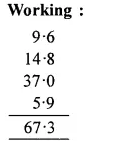
Working :
RS Aggarwal Class 6 Solutions Chapter 7 Decimals Ex 7C Q1.1

Question 2.
Solution:
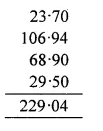
23.7, 106.94, 68.9 and 29.5
Converting them into like decimals and then adding
23.70 + 106.94 + 68.90 + 29.50
= 229.04 Ans.
Working :
RS Aggarwal Class 6 Solutions Chapter 7 Decimals Ex 7C Q2.1

Question 3.
Solution:
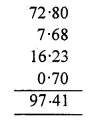
72.8, 7.68, 16.23 and 0.7
Converting them into like decimals and then adding
72.80 + 7.68 + 16.23 + 0.70
= 97.41 Ans.
Working :
RS Aggarwal Class 6 Solutions Chapter 7 Decimals Ex 7C Q3.1

Question 4.
Solution:
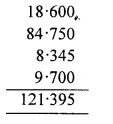
18.6, 84.75, 8.345 and 9.7
Converting them into like decimals and then adding
18.600 + 84.750 + 8.345 + 9.700
= 121.395 Ans.
Working :
RS Aggarwal Class 6 Solutions Chapter 7 Decimals Ex 7C Q4.1

Question 5.
Solution:
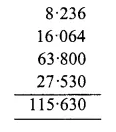
8.236, 16.064, 63.8 and 27.53
Converting them into like decimals and then adding
8.236 + 16.064 + 63.800 + 27.530
= 115.630 Ans.
Working :
RS Aggarwal Class 6 Solutions Chapter 7 Decimals Ex 7C Q5.1

Question 6.
Solution:
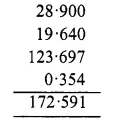
28.9, 19.64, 123.697 and 0.354
Converting them into like decimals and then adding
28.900 + 19.640 + 123.697 + 0.354
= 172.591 Ans.
Working :
RS Aggarwal Class 6 Solutions Chapter 7 Decimals Ex 7C Q6.1

Question 7.
Solution:
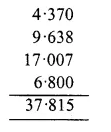
4.37, 9.638, 17.007 and 6.8
Converting them into like decimals and then adding
4. 370 + 9.638 + 17.007 + 6.800
= 37.815 Ans.
Working :
RS Aggarwal Class 6 Solutions Chapter 7 Decimals Ex 7C Q7.1

Question 8.
Solution:
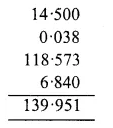
14.5, 0.038, 118.573 and 6.84
Converting them into like decimals and then adding
14.500 + 0.038 + 118.573 + 6.840
= 139.951 Ans.
Working :
RS Aggarwal Class 6 Solutions Chapter 7 Decimals Ex 7C Q8.1

Question 9.
Solution:
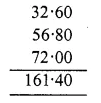
Earning for the first day = 32.60 rupees
Earning for the second day = 56.80 rupees
Earning for the third day = 72 rupees
Total earning = Rs. 32.60 + Rs. 56.80 + Rs. 72
= Rs. 161.40 Ans.
Working
RS Aggarwal Class 6 Solutions Chapter 7 Decimals Ex 7C Q9.1

Question 10.
Solution:
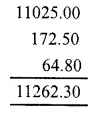
Cost of almirah = Rs. 11025
Cartage = Rs. 172.50
Cost on repair = Rs. 64.80
Total cost = Rs. 11025 + Rs. 172.50 + Rs. 64.80
= Rs. 11262.30 Ans.
Working :
RS Aggarwal Class 6 Solutions Chapter 7 Decimals Ex 7C Q10.1

Question 11.
Solution:
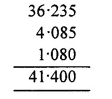
Distance covered by taxi = 36 km 235 m
= 36.235 km
Distance covered by Rickshaw = 4 km 85 m
= 4.085 km
and distance covered on foot
= 1 km 80 m
= 1.080 m
Total distance covered = 36.235 km + 4.085 km + 1.080 km
= 41.400 km
= 41 km 400 m Ans.
Working :
RS Aggarwal Class 6 Solutions Chapter 7 Decimals Ex 7C Q11.1

Question 12.
Solution:
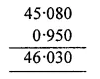
Weight of sugar in a bag = 45 kg 80 g
= 45.080 kg
Mass (weight) of empty bag = 950 g
= 0.950 kg
Total weight of the bag with sugar = 45 kg 80 g + 950 g
= 45.080 kg + 0.950 kg
= 46.030 kg
= 46 kg 30 g Ans.
Working :
RS Aggarwal Class 6 Solutions Chapter 7 Decimals Ex 7C Q12.1

Question 13.
Solution:
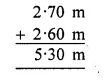
Length of cloth for shirt = 2 m 70 cm
= 2.70 m
Length of cloth for pyjamas = 2 m 60 cm
= 2.60 m
Total length of cloth = 2.70 m + 2.60 m
= 5.30 m
= 5 m 30 cm Ans.
Working :
RS Aggarwal Class 6 Solutions Chapter 7 Decimals Ex 7C Q13.1

Question 14.
Solution:
Cloth of salwar = 2 m 5 cm = 2.05 m
Cloth for shirt = 3 m 35 cm = 3.35 m
Total length of cloth = 2.05 m + 3.35 m
= 5.4.0 m
= 5 m 40 cm Ans.
Working :
RS Aggarwal Class 6 Solutions Chapter 7 Decimals Ex 7C Q14.1

Hope given RS Aggarwal Solutions Class 6 Chapter 7 Decimals Ex 7C are helpful to complete your math homework.

If you have any doubts, please comment below. Learn Insta try to provide online math tutoring for you.

CA Foundation Business Economics Study Material – Concepts of Product

CA Foundation Business Economics Study Material Chapter 3 Theory of Production and Cost – Concepts of Product

Product i.e. output refers to the volume of goods produced by a firm in a particular period of time.
There are three concepts relating to the physical production by factors namely-

  1. Total Product (TP),
  2. Average Product (AP), and
  3. Marginal Product (MP).

1. Total Product (TP):

  • The total output produced by all the factors per unit of time is called total product.
  • Total product increases with an increase in the variable factor input.
  • Column Nos. (1) and (2) of the following table shows a total product schedule.

2. Average Product (AP):

  • The. average product means the total product per unit of a variable factor.
  • In other words, it is the total product divided by the number of units of a variable factor.<CA Foundation Business Economics Study Material Concepts of Product 1
  • Column No. (3) of the following table shows the average product of variable factor.

3. Marginal Product (MP):

  • The marginal product means addition made to total product by the use of an extra unit of variable factor.
  • It may be stated as-
    MPn = TPn – TPn-1
    where,
    MPn = Marginal product when ‘n ’ units of variable factors are used
    TP = Total Product
    n = number of units of variable factors used.
  • Marginal Product may also be defined as the change in total output due to use of additional unit of variable factor
    CA Foundation Business Economics Study Material Concepts of Product 2
    Where –
    Δ = a small change Column No. (4) of the following table shows the marginal product schedule.

Table: Product Schedule

Units of VariableTotal Product (TP) factor E.g. LABOURAverage Product (AP)Marginal Product (MP)
1101010
2301520
3602030
4802020
5901810
690150
78512.1-5

Average product and Marginal product are related to one another.

(i) – When average product of the variable factor is rising, marginal product of the variable factor is more than its average product.
– So when average product curve is rising, the marginal product curve will lie somewhere above it.

(ii) – When average product of the variable factor is falling, marginal product of the variable factor is less than its average product.
– So when average product curve is falling, the marginal product curve will lie somewhere below it.

(iii) – When average product of the variable factor is maximum and constant, marginal product is equal to average product.
– In other words, the marginal product curve cuts the average product curve at its maximum point.

NCERT Exemplar Solutions for Class 10 Science Chapter 8 How do Organisms Reproduce?

NCERT Exemplar Solutions for Class 10 Science Chapter 8 How do Organisms Reproduce?

These Solutions are part of NCERT Exemplar Solutions for Class 10 Science. Here we have given NCERT Exemplar Solutions for Class 10 Science Chapter 8 How do Organisms Reproduce?

NCERT Exemplar Solutions for Class 10 Science Chapter 8 Short Answer Questions

Question 1.
In a bisexual flower, inspite of the young stamens being removed artificially, the flower produces fruit. Provide a suitable explanation for the above situation.
Answer:
The open flowers are generally cross pollinated. Removal of stamens of a bisexual flower will not affect pollination of its intact pistil and formation of fruit.

More Resources

Question 2.
Can you consider cell division as a type of reproduction in unicellular organisms ? Give one reason.
Answer:
Yes. Cell division in a unicellular organism which produces two d&ughter cells, actually forms two daughter individuals.

Question 3.
What is a clone ? Why do offspring formed by asexual reproduction exhibit remarkable similarity ?
Answer:
Clone is an exact genetic replica of another individual. All the offspring formed from a parent through asexual reproduction are clones of one another as well as their parent. The remarkable similarity of asexually produced daughter individuals is due to genetic similarity as they possess exact copies of DNA of their parent.

Question 4.
Explain how, offspring and parents of organisms reproducing sexually have the same number of chromosomes/DNAs.
(CCE 2014, CBSE Delhi 2017)
Answer:
The parents are diploid (2n) as each of them has two sets of chromosomes (DNAs). They form haploid (In) male and female gametes through the process of meiosis. The haploid gametes have one set of chromosomes (DNAs). During fertilization, one male gamete fuses with one female gamete. It restores the diploid (2n) chromosome/DNA number in the offspring that is formed from fusion product or zygote (2n).

Question 5.
Colonies of yeast fail to multiply in water but multiply in sugar solution. Give one reason for this.
Answer:
Yeast is heterotrophic. It obtains its nourishment from outside. Plain water cannot provide nourishment to yeast while sugar solution can do so. Therefore, Yeast multiplies in sugar solution and not in plain water.

Question 6.
Why does Bread Mould grow profusely on a moist slice of bread rather than on a dry slice of bread ?
Answer:
Growth of Bread Mould requires both water and nutrients. Dry slice of bread contains nutrients but no water. Therefore, Bread Mould does not grow over it. Moist slice possesses both water and nutrients. Hence, Bread Mould grows over it.

Question 7.
Give two reasons for the appearance of variations among the progeny formed by sexual reproduction.
Answer:
Variations appear in the progeny of sexually reproducing organisms due to

  1. Random separation and coming together of chromosomes during gamete formation and gamete fusion
  2. Crossing over and mutations.
  3. Coming together of chromosomes of the parents.

Question 8.
Would a Planaria cut vertically into two halves regenerate into two individuals ?
Answer:
Yes. Each piece of Planaria is able to grow the missing parts and form the complete organism.

Question 9.
Correlate the number of chromosomes with the size of the organism and answer the following questions :
(a) Do larger organisms have more number of chromosomes/cell ?
(b) Can organism with fewer chromosomes reproduce more easily than organism with more number of chromosomes ?
(c) More the number of chromosomes/cell, greater is the DNA content. Justify.
Answer:
(a) No. There is no correlation between chromosome number and size of the individual.
(b) No. Chromosome number does not affect reproduction.
(c) Yes. Each chromosome represents a single duplex of DNA. More chromosomes means more DNA.

Question 10.
In Tobacco, male gametes have 24 chromosomes.
(a) What is the number of chromosomes in the female gamete ?
(b) What is the number of chromosomes in the zygote ?
Answer:
(a) 24
(b) 48.

Question 11.
Why cannot fertilization take place in flowers if pollination does not occur ?
Answer:
Pollination is essential for bringing the male gametes. In the absence of pollination, there will be no male gamete to perform fertilization.

Question 12.
Is the chromosome number of zygote, emboryonal cells and adult of a particular organism always constant ? How is the constancy maintained in these three stages ?
Answer:
Zygote is the first diploid structure. It undergoes mitotic divisions to form embryonal cells. Embryonal cells further divide by mitosis to form the adult. Mitosis maintains the same chromosome number in the daughter cells.

Question 13.
Where is the zygote located in the flower after fertilization ?
Answer:
Zygote is the fertilized oosphere which occurs in the embryo sac present inside an ovule located in the ovary part of the pistil.

Question 14.
Reproduction is linked to stability of population of a species. Justify the statement.
Answer:
Reproduction maintains the size and composition of population of a species by regularly adding new individuals for replacing the ones getting killed due to ageing, disease or predation. It also adds variations that allow the individuals to adapt to changing environment.

Question 15.
How are general growth and sexual maturation different from each other ?
Answer:
General growth is the growth of an individual in size, height, shape, weight, etc. Sexual maturation is a set of changes in body of an individual that enable one to take part in reproduction, e.g., maturation of gonads, genitalia and other accessory structures. In human beings, beginning of sexual maturation is indicated by puberty changes like cracking of voice, new hair pattern, development of breast in female, etc.

Question 16.
Trace the path of sperm during ejaculation and mention the glands and their function associated with the male reproductive system.
Answer:
Ejaculated sperms are the ones which are stored in epididymes. They are formed regularly in seminiferous tubules from where they pass through vasa efferentia into epididymes. At the time of ejaculation, the sperms are first pushed through vasa deferentia, enter ejaculatory duct where they receive secretion of seminal vesicles and then urinogenital duct where the secretion of prostate gland is poured to form semen. The urinogenital duct is lubricated by secretion of a pair of Cowper’s glands (bulbourethral glands).
Secretion of Seminal Vesicles. Nourishment, activation and providing fluid medium for sperm transport.
Secretion of Prostates Gland. Motility of Sperms.

Question 17.
What changes are observed in the uterus if fertilization does not occur ? (CBSE Delhi 2017)
Answer:
Glands present in the mucosa of uterine endometrium begin to degenerate. This sloughs off the endometrial lining, releasing a lot of mucus and blood. It is called menstruation. Menstruation lasts for 3-5 days.

Question 18.
What changes are observed in the uterus subsequent to implantation of young embryo ? (CBSE Delhi 2017)
Answer:
Endometrium thickens, becomes glandular and highly vascular. The contact region between embryo and uterine wall grows into placenta. Placenta helps the embryo in obtaining nourishment and oxygen from blood sinuses of the uterus. It also helps in transfer of wastes from embryo to the blood of the mother.

Question 19.
What are the benefits of using mechanical barriers during sexual act ?
Answer:

  1. Prevention of Pregnancy : Mechanical barriers (e.g., Condoms, diaphragms) prevent the passage of sperms into the genital tract of the female. Consequently, pregnancy does not occur.
  2. Non-transmission of Infections: There is no transfer of venereal diseases from the infected partner to the non-infected partner.

Question 20.
In the female reproductive system, name the parts that are involved in
(a) Production of egg.
(b) Site of fertilization
(c) Site of implantation
(d) Entry of sperms.
Answer:
(a) Production of Egg: Ovary
(b) Site of Fertilization: Ampulla part of fallopian tube.
(c) Site of Implantation: Uterus.
(d) Entry of Sperms: Vagina.

Question 21.
What would be the ratio of chromosome number between an egg and its zygote ? How is the sperm genetically different from the egg ?
Answer:
Chromosome Number in Egg and Zygote. 1 : 2
Genetic Difference between Sperm and Egg. Sperms are genetically of two types, X-containing and Y-containing. Eggs are always of one type, X-containing.

NCERT Exemplar Solutions for Class 10 Science Chapter 8 Long Answer Questions

Question 22.
Why are budding, fragmentation and regeneration all considered as asexual types of reproduction ? With neat diagrams, explain the process of regeneration in Planaria.
Answer:
(a) Asexual Reproduction: Budding, fragmentation and regeneration are all considered to be modes of asexual reproduction as they involve formation of new individuals from single parents without fertilization or fusion of gametes.
(b) Regeneration in Planaria:
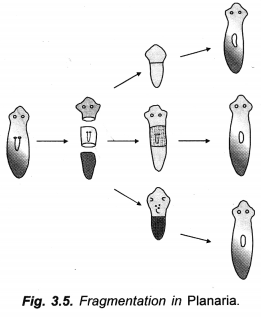
NCERT Exemplar Solutions for Class 10 Science Chapter 8 How do Organisms Reproduce image - 1

Question 23.
Write two points of differences between asexual and sexual types of reproduction. Describe why variations are observed in the offspring formed by sexual reproduction.
Answer:
(a) Differences between Asexual and Sexual Reproduction

Asexual ReproductionSexual Reproduction
1. Parents: It is monoparental.It is generally biparental
2. Meiosis: Meiosis does not occur during asexual reproduction. There are no gametes and no fertilization.Meiosis occurs. Gametes are formed and fertilization occurs in sexual reproduction.
Ex. Binary fission in Amoeba, Budding in YeastEx. Offspring in Wheat, Human.

(b) Development of Variation in Sexual Reproduction:
Sexual reproduction produces a number of variations in the population due to

  1. Chance separation of chromosomes at the time of meiosis.
  2. Crossing over during meiosis.
  3. Chance combination of chromosomes during fertilization. It produces a unique combination of variations already accumulated by each individual in its DNA obtained from its parents,
  4. Mutations or defective DNA replication.

Question 24.
Distinguish between pollination and fertilization. Mention the site and product of fertilization in a flower. Draw a neat, labelled diagram of a pistil showing pollen tube growth and its entry into the ovule.
Answer:
(a) Differences between Pollination and Fertilization

PollinationFertilization
1. Definition: It is transfer of pollen grains from anther to the stigma of a flower.

2. Step: Pollination precedes fertilization.

3. Purpose: It carries the male gamete producing pollen grains to the female sex organ.

4.  Process: Pollination is a physical process.

5. Occurrence: It occurs only in seed plants.

It is the fusion of male and female gametes.

Fertilization occurs only after pollination when the pollen grain has germinated and male gametes are carried into ovule.

It actually brings about fusion of gametes.

Fertilization is a physico-chemical (biological) process.

It occurs in both plants and animals of various types.

(b)

  1. Site of Fertilization. Embryo sac in ovule.
  2. Product of Fertilization. Zygote, Primary endosperm cell.

(c)
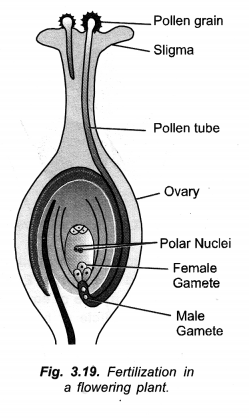
NCERT Exemplar Solutions for Class 10 Science Chapter 8 How do Organisms Reproduce image - 2

Question 25.
Distinguish between a gamete and zygote. Explain their roles in sexual reproduction.
Answer:
Differences between Gamete and Zygote

GameteZygote
1. Nature: It is sex or germ cell that takes part in fertilization.It is a product of fertilization.
2. Types: There are two types of gametes, male and female.Zygote is of one type.
3. Chromosome Number: A gamete has haploid or In chromosome number.Zygote has diploid or 2n chromosome number.
4. Characteristics: A gamete carries characteristics of only one parent.It carries characteristics of both the parents.
5. Generation: Gamete is the last cell of its generation.It is the first cell of new generation.

Role of Gamete. Gamete is sex or germ cell which is specialized to take part in sexual reproduction. There are two types of gametes, male and female. Each of them carries one set of chromosomes which are randomly obtained from its parent. Fusion of male gamete with a female gamete produces a zygote.
Role of Zygote. It is the first’cell of new generation. Zygote develops into embryo that later forms the new individual.

Question 26.
Draw the diagram of a flower and label the four whorls. Write the names of gamete producing organs in the flower.
Answer:
(a)
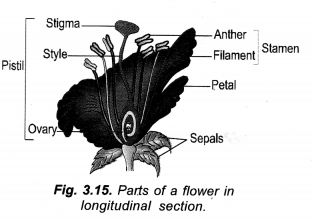
NCERT Exemplar Solutions for Class 10 Science Chapter 8 How do Organisms Reproduce image - 3
(b) Male Gamete Forming Part. Pollen grain, produced in anther of stamen.
Female Gamete Forming Part. Embryo sac developed inside ovule of ovary part of pistil.

Question 27.
What is placenta ? Mention its role during pregnancy. (CCE 2011, 2014)
Answer:
Placenta: It is a special double layered, spongy tissue connection between the foetus and uternine wall found in pregnant females. It has finger-like outgrowths or villi which are in contact with blood sinuses present in the uterine wall.
Role:

  1. Attachment: Placenta attaches the foetus to uterine wall.
  2. Villi: Placenta has finger-like outgrowths or villi which develop a large surface area for fixation and absorption.
  3. Nutrients: Placenta picks up nutrients from mother’s blood and passes it to the blood of the foetus.
  4. Waste Products: Waste products produced by the foetus passes out through the placenta into mother’s blood.
  5. Gases: Foetus obtains oxygen supply from mother’s blood and eliminates carbon dioxide through placenta.

Question 28.
What are the various ways to avoid pregnancy ? Elaborate any one method.
Answer:
(a) Methods to Avoid Pregnancy: Prevention of pregnancy is called contraception. The techniques used in preventing the occurrence of pregnancy are called contraceptive devices.
(b) Mechanical Barrier Methods of Contraception:

  1. Mechanical Barriers like condoms, cervical cap, diaphragm.
  2. Oral Contraceptives or oral pills like Mala D, Saheli
  3. Intrauterine Contraceptive Devices (IUCD) like loop, bow, Cu-T.
  4. Surgical Methods like vasectomy in males and tubectomy in females.

Question 29.
Flow does fertilization take place ? Fertilization occurs once in a month. Comment.
Answer:
In human beings, fertilization is internal. It can occur within 2-3 days of ovulation (between 14th and 16th day of menstrual cycle). Fertilization generally takes place in ampulla (ampulla-isthmus border) part of fallopian tube where ovum rests for several hours after entry into oviduct. The sperms have to reach there. Sperms deposited in the vagina reach there partly by their own movement and partly by local movements of reproductive tract. Both sperms and eggs are viable for 24-48 hours. A sperm reaching the surface of ovum, dissolves its covering and passes its head and middle part into it. It results in fertilization and formation of zygote.
Fertilization only once in a Month. A single ovum is released by female roughly in the middle of menstrual cycle which has a span of 4 weeks. Therefore, fertilization can occur only once in a month.

Question 30.
Reproduction is essentially a phenomenon that is not for survival of individual but for the stability of a species. Justify. Reproduction is not essential for survival of the individual.
Answer:
Survival of the individual depends upon input of nutrients and energy and elimination of wastes. Reproduction has ho role in these. It is, however, essential for the stability and survival of the species. Reproduction takes part in
(a) Perpetuation of Species: Perpetuation or continuation of species.
(b) Replacement: Replacement of dead individuals and maintaining the organisation in population.
(c) Population Characteristics:

  1. Education: There is an inverse ratio between education and population growth.
  2. Population Education: It is imparting knowledge to public about the effects of excessive population, advantages of small families and means to achieve it.
  3. Marriageable Age: Number of births is reduced if young persons marry late. Gainful employment and higher social status of women also reduce birth rate.

(d) Variations:
Variations are differences found in morphological, physiological and other traits of individuals belonging to the same organism, race or family. They develop due to

  1. Faulty DNA replication
  2. Crossing over
  3. Chance separation of chromosomes during meiosis and chance combination during fertilization. Variations are highly important.

(e) Absence of Variations: Due to absence of variations, asexually reproduced organisms are unable to adapt themselves to changes in the environment.

Question 31.
Describe sexually transmitted diseases and mention the ways to prevent them.
Answer:
It is a group of infections caused by different types of pathogens that are transmitted by sexual contact between a healthy person and an infected person. The sexually transmitted diseases are also called venereal diseases (VDs). Some 30 different types of STDs are known.

  1. It is caused by bacterium Neisseria gonorrhoeae. Gonorrhoea spreads through sexual contact, common toilets and under clothes. Incubation period is 2-5 days. Bacterium resides in genital tubes. It causes pus containing discharge, pain around genitalia and burning sensation during urination. Effective medicine is ampicillin.
  2. The disease is caused by corkscrew like bacterium Treponema pallidum. It spreads through sexual contact and from mother to infants. Incubation periods is 3-5 weeks, Painless ulcer on genitalia and swelling of lymph glands occur in first stage. In second stage skin lesions, rashes and hair loss occur. Tertiary stage is characterised by chronic ulcers and damage to vital organs. Effective medicine is tetracycline.
  3. Genital Warts: The disease is due to Human Papilloma virus (HPV). Hard benign outgrowths called warts appear over external genitalia and perianal area. In women infection may enter vagina and cervix causing acute pain. Cryosurgery and Podophyllum preparations are effective.
  4. AIDS (Acquired Immune Deficiency Syndrome): It is caused by human immunodeficiency virus or HIV. The virus is transmitted through sexual contact, blood contact (as using common needles, syringes, razors, transfusion) and placenta (mother to foetus). Incubation period is generally 27-28 months but symptoms may appear early. Count of T-helper cells becomes low, 200/ml or less. There is headache, rashes, nausea, pharyngitis and fever. Immunity is drastically reduced so that many infections (opportunistic infections) begin to appear. A proper treatment has not yet been discovered. ART (antiretrovirus treatment) is given to patients to reduce the effect of infection.

Hope given NCERT Exemplar Solutions for Class 10 Science Chapter 8 How do Organisms Reproduce? are helpful to complete your science homework.

If you have any doubts, please comment below. Learn Insta try to provide online science tutoring for you.

RD Sharma Class 8 Solutions Chapter 6 Algebraic Expressions and Identities Ex 6.3

RD Sharma Class 8 Solutions Chapter 6 Algebraic Expressions and Identities Ex 6.3

These Solutions are part of RD Sharma Class 8 Solutions. Here we have given RD Sharma Class 8 Solutions Chapter 6 Algebraic Expressions and Identities Ex 6.3

Other Exercises

Find each of the following products (1-8)
Question 1.
5x2 x 4x3
Solution:
5x2 x 4x3 = 5 x 4 x x2 x x3
= 20x2 + 3 = 20xs

Question 2.
3a2 x 4b4
Solution:
-3a2 x 4b4 = -3 x 4 x a2b4
= -12a2b4

Question 3.
(-5xy) x (-3x2yz)
Solution:
(-5xy) x (-3x2yz)
= (-5) x (-3)xy x x2yz
= 15x1 + 2xy1+ 1z= 15x3y2z

Question 4.
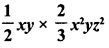
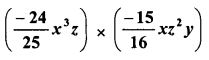
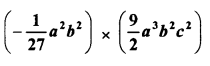
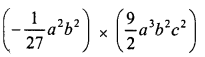
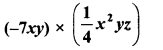
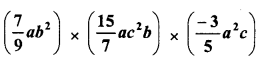
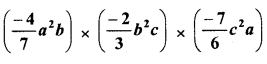
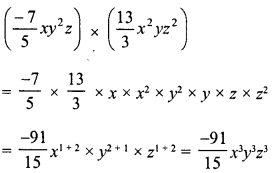
RD Sharma Class 8 Solutions Chapter 6 Algebraic Expressions and Identities Ex 6.3 1
Solution:
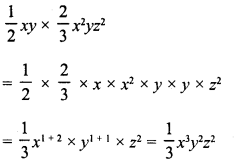
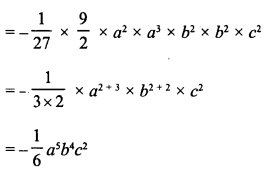
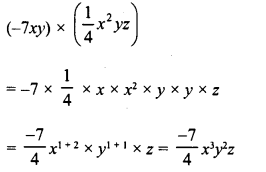
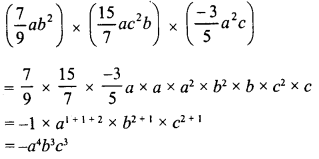
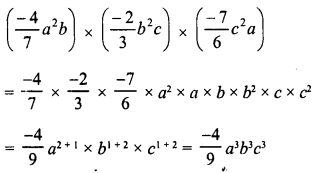
RD Sharma Class 8 Solutions Chapter 6 Algebraic Expressions and Identities Ex 6.3 2
RD Sharma Class 8 Solutions Chapter 6 Algebraic Expressions and Identities Ex 6.3 3

Question 5.
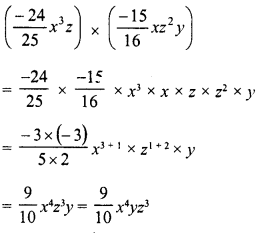
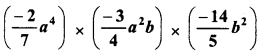
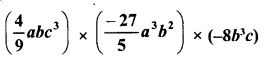
RD Sharma Class 8 Solutions Chapter 6 Algebraic Expressions and Identities Ex 6.3 4
Solution:
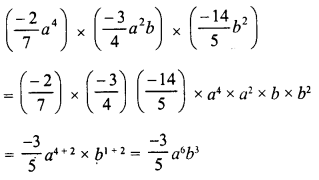
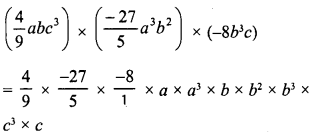
RD Sharma Class 8 Solutions Chapter 6 Algebraic Expressions and Identities Ex 6.3 5

Question 6.
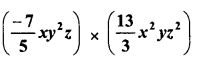
RD Sharma Class 8 Solutions Chapter 6 Algebraic Expressions and Identities Ex 6.3 6
Solution:

Question 7.
RD Sharma Class 8 Solutions Chapter 6 Algebraic Expressions and Identities Ex 6.3 7
Solution:
RD Sharma Class 8 Solutions Chapter 6 Algebraic Expressions and Identities Ex 6.3 8
RD Sharma Class 8 Solutions Chapter 6 Algebraic Expressions and Identities Ex 6.3 9

Question 8.
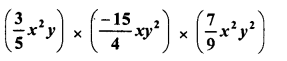
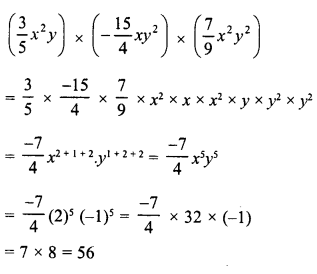
RD Sharma Class 8 Solutions Chapter 6 Algebraic Expressions and Identities Ex 6.3 10
Solution:
RD Sharma Class 8 Solutions Chapter 6 Algebraic Expressions and Identities Ex 6.3 11

Find each of the following products : (9-17)

Question 9.
(7ab) x (-5ab2c) x (6abc2)
Solution:
(7ab) x (-5ab2c) x (6abc2)
= 7 x (-5) x 6 x a x a x a x b x b2 x b x c x c2
=-210 x a1+1+1 x b1+2+1x c1+2
=-210 x a3b4c3

Question 10.
(-5a) x (-10a2) x (-2a3)
Solution:
(-5a) x (-10a2) x (-2a3)
= (-5) (-10) (-2) x a x a2 x a3
= -100a1 + 2 + 3 = -100a6

Question 11.
(-4x2) x (-6xy2) x (-3yz2)
Solution:
(-4x2) x (-6xy2) x (-3yz2)
= (-4) x (-6) x (-3) x2 x x x y2 x y xz2
= -72x2+1 x y2+1 x z2
= 72x3y3z3

Question 12.
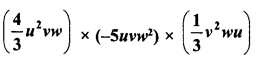
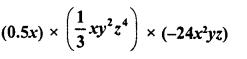
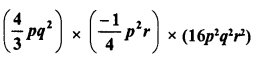
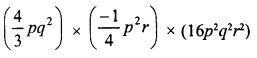
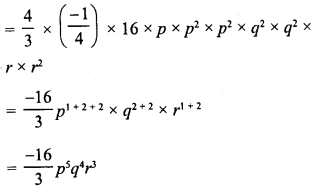
RD Sharma Class 8 Solutions Chapter 6 Algebraic Expressions and Identities Ex 6.3 12
Solution:
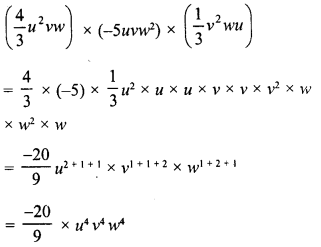
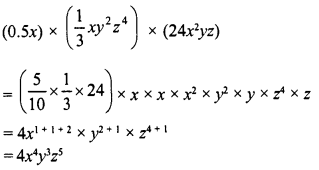
RD Sharma Class 8 Solutions Chapter 6 Algebraic Expressions and Identities Ex 6.3 13

Question 13.
RD Sharma Class 8 Solutions Chapter 6 Algebraic Expressions and Identities Ex 6.3 14
Solution:
RD Sharma Class 8 Solutions Chapter 6 Algebraic Expressions and Identities Ex 6.3 15

Question 14.
RD Sharma Class 8 Solutions Chapter 6 Algebraic Expressions and Identities Ex 6.3 16
Solution:
RD Sharma Class 8 Solutions Chapter 6 Algebraic Expressions and Identities Ex 6.3 17

Question 15.
RD Sharma Class 8 Solutions Chapter 6 Algebraic Expressions and Identities Ex 6.3 18
Solution:
RD Sharma Class 8 Solutions Chapter 6 Algebraic Expressions and Identities Ex 6.3 19

Question 16.
RD Sharma Class 8 Solutions Chapter 6 Algebraic Expressions and Identities Ex 6.3 20
Solution:
RD Sharma Class 8 Solutions Chapter 6 Algebraic Expressions and Identities Ex 6.3 21
RD Sharma Class 8 Solutions Chapter 6 Algebraic Expressions and Identities Ex 6.3 22

Question 17.
(2.3xy) x (0.1x) x (0.16)
Solution:
(2.3xy) x (0.1x) x (0.16)
= 2.3 x 0.1 x 0.16 x x x x x y
= 0.0368x1 +1 x y = 0.0368x2y

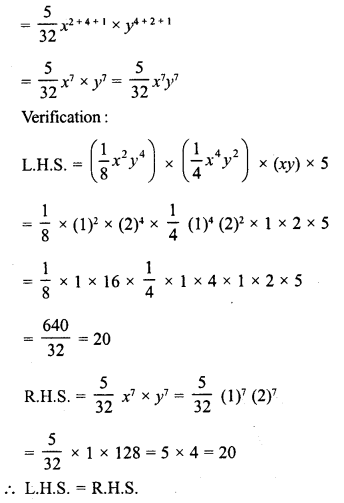
Express each of the following products as a monomials and verify the result in each case for x = 1 : (18 -26)

Question 18.
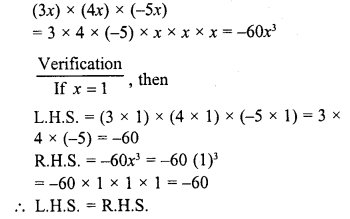
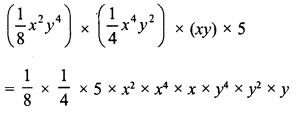
(3x) x (4x) x (-5x)
Solution:
RD Sharma Class 8 Solutions Chapter 6 Algebraic Expressions and Identities Ex 6.3 23

Question 19.
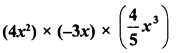
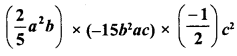
RD Sharma Class 8 Solutions Chapter 6 Algebraic Expressions and Identities Ex 6.3 24
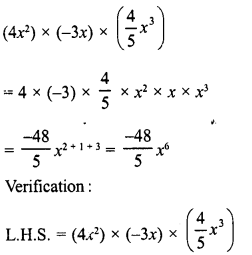
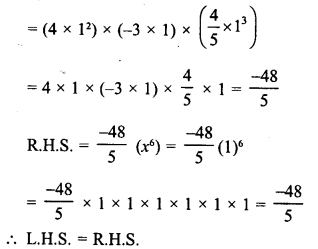
Solution:
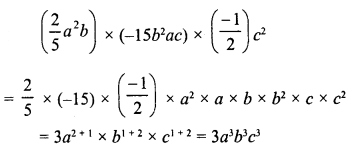
RD Sharma Class 8 Solutions Chapter 6 Algebraic Expressions and Identities Ex 6.3 25
RD Sharma Class 8 Solutions Chapter 6 Algebraic Expressions and Identities Ex 6.3 26

Question 20.
(5x4) x (x2)3 x (2x)2
Solution:
(5x4) x (x2)3 x (2x)2
= 5x4 x x2 x 3 x 2x x 2x
= 5x4 * x6 x 4x2 = 5 x 4 x x4 + 6 + 2
= 20x12
Verification:
L.H.S. = (5x4) x (x2)3 x (2x)2
= 5 x (1)4 x [(1)2]3 x (2 x 1)2
= 5 x 1 x (1)2 x 3x (2)2
= 5 x 16 x 22 = 5 x 1 x 4 = 20
R.H.S. = 20x12 = 20 (1)12 = 20 x 1 = 20
∴ L.H.S. = R.H.S.

Question 21.
(x2)3 x (2x) x (-4x) x 5
Solution:
(x2)3 x (2x) x (-4x) x (5)
= x2 x 3 X 2x X (-4x) X 5
= x6 x 2x x (-4x) x 5 = 2 x (-4) x 5x6+1 +1
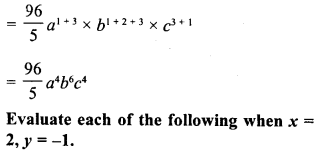
= -40x8
Verification
L.H.S. = (x2)3 x (2x) x (-4x) x (5)
= (12)3 x (2 x 1) x (-4 x 1) x 5
= 1x 2 x (- 4) x 5 = 16 x 2 x (-4) x 5
= 1 x 2 x (-4) x 5 = -40
R.H.S. = -40x8 = -40 x (1)8
= -40 x 1 = -40
∴ L.H.S. = R.H.S.

Question 22.
Write down the product of -8x2y6 and – 20xy Verify the product for x = 2.5, y = 1.
Solution:
Product of -8x2y6 and -20xy
= (-8x2y6) x (-20xy)
= -8 x (-20) x2 x x x y6 x y = 160x2 + 1 x y6 + 1
= 160x3y3
Verification.
L.H.S. = (-8x2y6) x (-20xy)
= -8 x (2.5)2 x (1) x (-20 x 2.5 x 1)
= -8 x 6.25 x 1 x -20 x 2.5
= (-50) x (-50) = 2500
R.H.S. = 160 x = 160 (2.5)3 x (1)7
= 160 x 15.625 x 1 =2500
∴ L.H.S. = R.H.S.

Question 23.
Evaluate : (3.2x6y3) x (2.1x2y2) when x = 1 and y = 0.5.
Solution:
3.2x6y3 x 2.1x2y2
= 3.2 x 2.1 x x6+2 x y3+2
= 6.72x8y5 = 6.72 x (1)8 x (0.5)5
= 6.72 x 1 x 0.03125
= 0.21

Question 24.
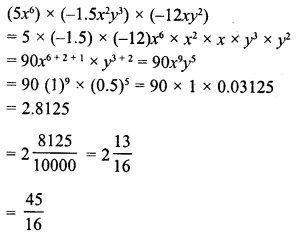
Find the value of (5x6) x (-1.5x2y3) x (-12xy2) when x = 1, y = 0.5.
Solution:
RD Sharma Class 8 Solutions Chapter 6 Algebraic Expressions and Identities Ex 6.3 27

Question 25.
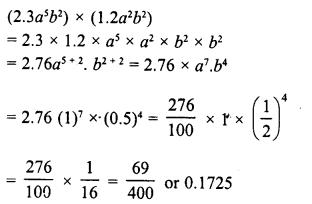
Evaluate : (2.3a5b2) x (1.2a2b2) when a = 1, b = 0.5.
Solution:
RD Sharma Class 8 Solutions Chapter 6 Algebraic Expressions and Identities Ex 6.3 28

Question 26.
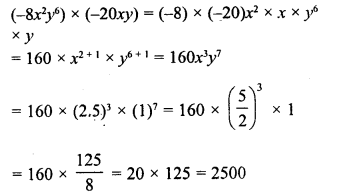
Evaluate : (-8x2y6) x (-20xy) for x = 2.5 and y = 1.
Solution:
RD Sharma Class 8 Solutions Chapter 6 Algebraic Expressions and Identities Ex 6.3 29

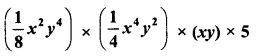
Express each of the following products as a monomials and verify the result for x = 1,y = 2: (27-31)

Question 27.
(-xy3) x (yx3) x (xy)
Solution:
(-xy3) x (yx3) x (xy)
= -x x xx x x yx y x y = -x1 + 3 + 1 x y3 + 1 + = -x5y5
Verification:
L.H.S. = (-xy3) x (yx3) x (xy)
= (-1 x 23) x [2 x (1)3] x (1 X 2)
= (-1 x 8) x (2 x 1) x (1 x 2)
= -8 x 2 x 2 = -32
R.H.S. =-x5y5  = -(1)5 (2)5
= -1 x 32 =-32
∴ L.H.S. = R.H.S.

Question 28.
RD Sharma Class 8 Solutions Chapter 6 Algebraic Expressions and Identities Ex 6.3 30
Solution:
RD Sharma Class 8 Solutions Chapter 6 Algebraic Expressions and Identities Ex 6.3 31
RD Sharma Class 8 Solutions Chapter 6 Algebraic Expressions and Identities Ex 6.3 32

Question 29.
RD Sharma Class 8 Solutions Chapter 6 Algebraic Expressions and Identities Ex 6.3 33
Solution:
RD Sharma Class 8 Solutions Chapter 6 Algebraic Expressions and Identities Ex 6.3 34

Question 30.
RD Sharma Class 8 Solutions Chapter 6 Algebraic Expressions and Identities Ex 6.3 35
Solution:
RD Sharma Class 8 Solutions Chapter 6 Algebraic Expressions and Identities Ex 6.3 36

Question 31.
RD Sharma Class 8 Solutions Chapter 6 Algebraic Expressions and Identities Ex 6.3 37
Solution:
RD Sharma Class 8 Solutions Chapter 6 Algebraic Expressions and Identities Ex 6.3 38
RD Sharma Class 8 Solutions Chapter 6 Algebraic Expressions and Identities Ex 6.3 39

Question 32.
RD Sharma Class 8 Solutions Chapter 6 Algebraic Expressions and Identities Ex 6.3 40
Solution:
RD Sharma Class 8 Solutions Chapter 6 Algebraic Expressions and Identities Ex 6.3 41
RD Sharma Class 8 Solutions Chapter 6 Algebraic Expressions and Identities Ex 6.3 42

Question 33.
RD Sharma Class 8 Solutions Chapter 6 Algebraic Expressions and Identities Ex 6.3 43
Solution:
RD Sharma Class 8 Solutions Chapter 6 Algebraic Expressions and Identities Ex 6.3 44

Hope given RD Sharma Class 8 Solutions Chapter 6 Algebraic Expressions and Identities Ex 6.3 are helpful to complete your math homework.

If you have any doubts, please comment below. Learn Insta try to provide online math tutoring for you.
CA Foundation Business Economics Study Material – Fixed Inputs (Fixed Factors) and Variable Inputs (Variable Factors)

CA Foundation Business Economics Study Material Chapter 3 Theory of Production and Cost – Fixed Inputs and Variable Inputs

Fixed Inputs (Fixed Factors) and Variable Inputs (Variable Factors)

ComparisonFixed InputsVariable Inputs
(i) Meaning
  • The factors which cannot be easily and quickly changed and require long time to make adjustment in them with the changes in the level of output are called fixed inputs or fixed factors of production.
  • In other words, factor inputs whose quantity does not vary from day-to-day are called as fixed inputs.
  • The factors which can be easily and quickly changed and readily adjusted with the changes in the level of output are called variable inputs or variable factors of production.
  • In other words, factor inputs whose quantity may vary from day-to-day are called as variable inputs.
(ii) Examples
  • Examples of fixed inputs – buildings, machinery, plant, top management, etc.
  • It requires long time to make variations in them.
  • E.g. To construct a new factory building with a larger area and capacity.
  • Examples of variable inputs – ordinary labour, raw-material, power, fuel chemicals, etc.
  • It can be readily changed.
(iii) Relation with Output
  • Fixed inputs do not vary with the level of output.
  • Its quantity remains the same, whether the output is more or less or zero in SHORT RUN
  • Variable inputs vary directly with the level of output.
  • Such factors are required more, when output is more; less, when output is less and zero, when output is zero in SHORT RUN.
(iv) Cost
  • The cost of the fixed inputs is called FIXED COST.
  • In the short run the firm has to bear the fixed cost even if the output is zero.
  • Since the quantity of fixed inputs remains the same, fixed cost remains the same whatever be the level of output.
  • The cost of the variable inputs is called VARIABLE COST.
  • Since variable inputs vary directly with the level of output, variable costs are also positively related with output. If output is zero, variable cost is also zero.
  • If output is increased variable cost also increases and vice-versa.

Short Run (Short Period) & Long Run (Long Period)

ComparisonShort RunLong Run
(i) Meaning
  • The short run is defined as the period of time in which some factors of production or at least one factor is fixed i.e. does not vary with output.
  • Thus, in the short period some factors are FIXED FACTORS E.g. Factory building, machinery, management, etc. and some are VARIABLE FACTORS E.g. Labour, raw-material, power, fuel, etc.
  • The long run is defined as the period of time in which all factors may vary.
  • In the long run, all factors become variable and so there is no distinction between fixed and variable factors.
(ii) Scale of Production OR Size of the Firm
  • In the short run, the output is produced with a GIVEN SCALE OF PRODUCTION i.e. the size of plant or firm (and so the production capacity) remains unchanged.
  • Hence, production can be increased or decreased only by changing the amount of variable factors.
  • In the long run, the output is produced with the CHANGE IN THE SCALE OF PRODUCTION i.e. the size of plant or firm can be increased (and so the pro­duction capacity).
  • Hence, production can be increased by varying all factors i.e. fixed factors (of short period) as well as variable factors.
(iii) Produc­tion Law
  • The production function which is studied in the short run period is called as the Law of Variable Proportions.
  • The production function which is stud­ied in the long run period is called as the Law of Returns to Scale.
(iv) Decisions about Change in factors
  • The decisions to change the amount of variable factors (like raw material, labour, etc.) are taken very frequently depending upon changes in demand of the commod­ity.
  • Hence, short run is the ‘ACTUAL PRO­DUCTION PERIOD’ during which some factors are fixed while some are variable.
  • Thus, firms operate in the short run period.
  • The decisions to change the amount of fixed factors i.e. scale of production or to close down the firm are taken only once in a while.
  • Hence, long run is the ‘PLANNING PERIOD’.
  • Thus, firms plan in the long run period.
(v) Nature of Supply
  • In the short run period, supply can be adjusted upto a limited extent as per changes in demand.
  • In other words, supply is relatively inelastic.
  • In the long run period, supply can be fully adjusted as per changes in demand.
  • In other words, supply is relatively elastic.
(vi) Nature of Cost
  • In short run period, cost is classified as FIXED COST and VARIABLE COST.
  • Fixed cost is the cost of fixed inputs and Variable cost is the cost of variable inputs.
  • Fixed cost is the main feature of short run period
  • In long run period ALL COSTS ARE VARIABLE.
  • Variable cost is the main feature of long run period.
(vii) Effect on Price
  • In short-run, the price determination of a commodity is more influenced by –
    (a) The demand forces than supply forces because supply in short-run is rela­tively inelastic, and
    (b) The UTILITY of the commodity.
  • The short-run price is called SUB-NOR­MAL PRICE
  • In long-run, the price determination of a commodity is more influenced by-
    (a) The supply forces than demand forces because supply in long-run is relatively elastic, and
    (b) The COST OF PRODUCTION of the commodity.
  • The long-run price is called NORMAL PRICE.
(viii) Average Cost Curve
  • The short-run average cost curve is ‘U’ shaped.
  • Its U-shape is explained with the Law of Variable Proportions.
  • The long-run average cost curve is also U shaped.
  • But its U- shape is not as prominent as short-run average cost curve.
  • Its U-shape is explained with the Law of Returns to Scale.
  • Long-run average cost curve is also called ‘PLANNING CURVE’ and ‘ENVELOPE CURVE’.
(ix) Profit of FirmsIn the short-run period –

  • The firms under perfect competition on being at equilibrium may earn normal profits, super normal profits or incur losses;
  • The monopoly firm on being at equi­librium may earn normal profits, super normal profits or incur losses;
  • The firms under monopolistic competi­tion on being at equilibrium may earn normal profits, super normal profits or incur losses.
In the long run period-

  • The firms under perfect competi­tion earn only NORMAL PROFITS and operate at optimum level.
  • The monopoly firm can earn SUPER NORMAL PROFITS and operate at sub-optimum level.
  • The firms under monopolistic competition earn only NORMAL PROFITS and operate at sub-opti­mum level.