Amanda Extra Questions and Answers Class 10 English First Flight

Here we are providing Amanda Extra Questions and Answers Class 10 English First Flight, Extra Questions for Class 10 English was designed by subject expert teachers.

Amanda Extra Questions and Answers Class 10 English First Flight

Amanda Extra Questions and Answers Short Answer Type

Question 1.
What does the poet ask Amanda not to do in the poem” ‘Amanda’?
Answer:
The poet advises Amanda not to bite her nails, not to hunch her shoulders and not to eat chocolate. She advises her to sit straight and take care of her acne. She further advises her to keep herself clean.

Question 2.
In which way does Amanda imagine herself to be mermaid? .
Answer:
Mermaid is believed to be a creature with a woman’s head and body, and a fish’s tail instead of legs.
Amanda imagines herself or wishes to be free like a mermaid, which is moving slowly in a state of bliss in the sea, which is green like an emerald.

Question 3.
What instructions were given to Amanda about her homework, room and shoes?
Answer:
Amanda had been commanded or advised to finish her homework and keep her room neat and clean. She is also instructed to clean her shoes.

Question 4.
How and why does Amanda say that she is an orphan?
Answer:
Amanda seems to be fed up with continuous instructions and naggings. She is feeling that her freedom is curtailed. So, she imagines herself to be an orphan street child who leaves imprints caused on the soft dust by her bare feet. She feels that silences is golden or precious and freedom is sweet.

Question 5.
What impression do you form about Amanda, after reading the poem ‘Ama ida’?
Answer:
Amanda feels suffocated because she is controlled and instructed not to do one thing or the other. She feels that her freedom is curtailed. But Amanda wishes to be free to live in her own world. She is a very sensitive girl who indulges in daydreaming quiet often. She highly values silence and freedom.

Question 6.
What type of life does Amanda wish for?
Answer:
Amanda feels that her freedom has been curtailed. She is leading a controlled life under constant nagging. She wishes for a life free from all the restrictions. She wants to lead a life like a fairy, a mermaid or an orphan. Like a mermaid she wants to drifts blissfully. For, silence is golden and freedom is sweet.

Question 7.
I am an orphan, roaming the street.
Is Amanda an orphan? If not, why does she say so?
Answer:
No, Amanda is not an orphan. There are many restrictions on her. She does not like this life. She wants freedom. She feels that there is no one to understand her feelings. She is all alone. This is the reason she says that she is an orphan.

Question 8.
Don’t eat that chocolate Amanda!
Remember your acne, Amanda!
Why is Amanda forbidden to eat chocolate?
Answer:
Amanda is a little child who wants freedom from all restrictions of life. She loves to eat chocolate but she is forbidden to eat them as these will affect her health adversely. She is advised to take care of her acne.

Question 9.
Will you please look at me when I’m speaking to you,
Who do you think is speaking to Amanda?
Answer:
The poet is speaking to Amanda. She had put many restrictions on her. She advises her to take care of her health and acne. She is advised to follow a controlled and disciplined life.

Question 10.
life in a tower is tranquil and rare;
I’ll certainly never let down my bright hair’.
Why does the poet say that life in a tower is tranquil and rare? Whose life is he talking about?
Answer:
The poet feels that life in a tower is peaceful and full of freedom because there is no one to nag you. She is talking about Rapunzel who lives in a peaceful tower.

Question 11.
Why does Amanda imagine to be
(i) a Mermaid (ii) an orphan, and (iii) Rapunzel,
What does it show about her?
Answer:
(i) Amanda imagines herself to be a mermaid so that she may drift in the silent sea and enjoy the loneliness and peace there. She yearns for freedom.

(ii) She wishes to be an orphan so that she may play bare feet in the dust without receiving several instructions or scolding. She wishes for her independence and freedom.

(iii) Amanda is fascinated by the lonely and tranquil life of Rapunzel in a closed tower. She wishes for such a life so that her nagging mother may not reach there. Here also, she yearns for her freedom from nagging.

Question 12.
“Don’t bite your nails, Amanda!
Don’t hunch your shoulders, Amanda!”
Amanda’s parents were over anxious about her. She often found their instructions very stifling. Reading the poem and based on Amanda’s experience, write a paragraph on the topic “Should parents be allowed to control children?”
Answer:
It goes without saying that no child can survive the early years of its life without the care and protection of its parents. But some parents are so over protective and over anxious about their children that they don’t let their children live in peace. They don’t allow them to explore and find out things on their own. Such parents kill the child’s initiative in learning. These parents always boss around and irritate their children.

They don’t trust their child’s capability to do things independently. However, the parents may control the children and guide them as long as it is necessary. Equipped with knowledge and confidence they will be able to face the world boldly. Gradually the child should be allowed to grow on its own and be responsible for its actions. When parents give freedom to their children they gain confidence and learn to do things in a better way.

Question 13.
If it fact that every person including a young child has his/her own individuality and personality. It is not necessary that the child will see the world according to the direction of his/her parents. Based on the reading the poem “Amanda” write a paragraph on: Should children be given freedom”.
Answer:
Growing up is a phase which requires a lot of space. A single child in his teens would feel more claustrophobic than four kids in the same family. The reason being parents of a single child tend to be more protective and possessive. What they fail to understand is that without sufficient space to grow the child will only end up disliking his/her parents. Freedom is necessary in any relationship.

A child should be allowed to choose his hobbies, to learn what he pleases, to play with kids of his age. In the present times, where nothing is safe and none can be trusted, jJarents are only dissuaded from sending their kids out to play. It is only through these activities can a child learn to socialize and understand values. Therefore, parents should give enough freedom for the child to grow but also make sure that the child is not led away by material needs.

Question 14.
Childhood blooms and bounces with the wind of innocence and fanciful fantasy. Any kind of outside or forceful restriction is completely unbearable to a child. If he is nagged or scolded, he may feel alienated and withdrawn. But nagging is not a good option. In the context of the poem “Amanda”, write a paragraph on “effects of parental nagging”.
Answer:
Nagging is never a good option. Parents have a tendency to nag their children, especially regarding their studies. But nagging never helps. When a parent keeps on ranting to the child to study, the child will only grow averse to studying. It will create resentment between the child and the parent.

After a while a point will be reached where the child will simply stop listening to the parent. It also makes the child feel controlled. Parents keep repeating what is to be done, how it is to be done, etc. over and over again, always supervising. This will create stress for the child and make him/her uncomfortable. Hence, parents should indulge in looking at the brighter side and praise their kids’ accomplishments and avoid pointing out the weaknesses.

Question 15.
It is said that excess of everything is bad. Excess of parental love may make a cjiild pampered , in the same way excess of nagging may throw a child into negativity. These statements are seen justified to some extent in the poem ‘Amanda’. Explain.
Answer:
None can refute the pious role of parents or elders or teachers in the proper grooming and holistic development of a child. Parent’s personality resonates and reflects through the behaviours and personality of a child. Parents do every possible thing, they can do, to shape the character and habits of their child. But sometimes, in course of nurturing the kid, the parents cross the limits unknowingly.

They became either overcaring or over protective or over anxious. They forget the fact that, when a matured mind cannot tolerate excess of do’s and don’ts, how can they expect it from a child who is totally unaware of the worries and cares of the world. To a child the world means a world of imagination fancy and fairy.

If being nagged repeatedly she may form negative opinions about his/her mother and father. The same thing we find in the poem ‘Amanda’. Amanda is a girl of around 8-11 year of age who lives in her own fairy land. She does not appreciate the constant scolding or nagging of her father/mother.

She feels that her freedom is punctuated. So, she instead of following the instructions, remains wandering in her own world of imagination. Excess of nagging has resulted into negativity as Amanda considers herself orphan. She sulks. She avoids eye to eye contact. Hence, parents must understand the line of boundary and act.

Question 16.
How old do you think Amanda is? How do you know this?
Answer:
Amanda is a teenager. This is the age when a child wants to have freedom. Teenagers do not like nagging and want to have free life. The poet advises Amanda to take care of her acne which commonly appears on the face of a teenager.

Question 17.
Who do you think is speaking to her?
Answer:
Her mother is speaking to her.

Question 18.
Why are stanzas—2, 4 and 6 given in parenthesis?
Answer:
The stanzas 2, 4 and 6 are given in parenthesis because they are the thoughts of the child in between the instructions that she is being given by her mother, which are given in stanzas! 3 and 5. The scolding by the mother and the child’s thoughts are placed in alternate stanzas by the poetess.

Question 19.
Who is speaker in stanzas 2, 4 and 6? Do you think this speaker is listening to speaker in stanza 1, 3, 5 and 7?
Answer:
In stanzas 2, 4 and 6, the speaker is the child Amanda?.No, she is not listening to her mother who is speaking in stanza 1, 3,5 and 7. She is lost in her own thoughts and does not listen to what is being said to her.

Question 20.
What could Amanda do if she were a mermaid?
Answer:
If Amanda were a mermaid, then she would drift slowly in a languid emerald sea. She would be the sole inhabitant of relaxed green sea and would move slowly on it.

Question 21.
Is Amanda an orphan? Why does she say so?
Answer:
No, Amanda is not an orphan. She says so because she wants to be alone and enjoy being herself she wants to roam around in the street alone and pattern dust with her barefeet. She finds silence ‘golden’ and freedom ‘sweet’. It is for this reason that she calls herself an orphan.

Question 22.
Do you know the story of Rapunzel? Why does she want to be Rapunzel?
Answer:
Rapunzel was a mythological figure, who was absolutely carefree, leading a calm and quiet life in tower, Amanda wishes to lead a carefree, calm and quiet life like Rapunzel.

Question 23.
What does the girl yearn for? What does this poem tell you about Amanda?
Answer:
The girl (Amanda) yearns for a life of freedom. The poem tells us that she is an imaginative girl who is constantly nagged by her unimaginative mother.

Question 24.
Read the last stanza. Do you think Amanda is sulking and is moody?
Answer:
No, Amanda is neither sulking, nor she is moody. She is simply longing for her freedom. She wants to go out and play wherever she likes.

Amanda Extra Questions and Answers Reference to Context

Read the following stanza and answer the questions that follow:

Question 1.
Don’t bite your nails, Amanda! ‘
Don’t hunch your shoulders, Amanda!
Stop that slouching and sit up straight,
Amanda!

(i) Name the poem and poet.
(ii) Who, do you think could be the speaker in the stanza?
(iii) What is the tone of the speaker towards Amanda?
(iv) Who is Amanda?
Answer:
(i) This stanza has been taken from the poem ‘Amanda’ composed by Robin Klein.
(ii) I, think the speaker could be either mother or the father.
(iii) The tone of the speaker towards Amanda is ‘ragging’ and ‘scolding’.
(iv) Amanda is a teenage girl.

Question 2.
(There is a languid, emerald sea,
where the sole inhabitant is me
a mermaid, drifting blissfully.)

(i) Who is the speaker?
(ii) What does the speaker wish?
(iii) Pick out the word from the stanza an antonym of‘energetic’.
(iv) Name the poem and poet.
Answer:
(i) Amanda is the speaker.
(ii) Amanda wishes to have freedom from constant nagging.
(iii) ‘languid’.
(iv) The poem “Amanda” composed by ‘Robin Klein’.

Question 3.
Did you finish your homework, Amanda?
Did you tidy your room, Amanda?
I thought I told you to clean your shoes, 
Amanda!

(i) Who speaks these lines and to whom?
(ii) What are the various works she has to do?
(iii) What does the parent think she asked Amanda to do?
(iv) Does Amanda like the advice of the speaker?
Answer:
(i) These lines are spoken by Amanda’s mother to Amanda.
(ii) She has to complete homework, clean her room and her shoes.
(iii) The parents think that she asked Amanda to clean her shoes.
(iv) No, she does not like the constant nagging by the poet. She wants to live without any restrictions.

Question 4.
(I am an orphan, roaming the street.
I pattern soft dust with my hushed, bare feet,
The silence is golden, the freedom is sweet.)

(i) Who is referred to as an orphan in the first line?
(ii) What does the speaker want to convey through this stanza?
(iii) Pick out the word from the stanza that means the same as—‘wandering’.
(iv) Name the poeip and poet.
Answer:
(i) Amanda.
(ii) She wants to roam in the street and make pattern on sands with her feet.
(iii) ‘roaming’
(iv) The poem “Amanda” written by ‘Robin Klein’.

Question 5.
Don’t eat that chocolate, Amanda!
Remember your acne, Amanda!
Will you please look at me when I’m speaking to you,
Amanda!

(i) Who is the speaker in these lines?
(ii) What does the speaker advise Amanda?
(iii) Which lines show that Amanda does not take interest in what the speaker says?
(iv) Name the poem and poet.
Answer:
(i) Robin Klein (poetess) is the speaker in these lines.
(ii) The speaker advised Amanda not to eat chocolate. She wants her to take care of her acne.
(iii) The line “will you please look at me… to you” shows that she is not interested in what the speaker says.
(iv) The poem “Amanda” composed by ‘Robin Klein’.

Question 6.
(I am Rapunzel, I have not a care;
life in a tower is tranquil and rare;
I’ll certainly never let down my bright hair!)

(i) Who is the speaker in the stanza?
(ii) What does the speaker wish to do?
(iii) What does the stanza promise?
Name the poem and poet.
Answer:
(i) Amanda is the speaker in this stanza.
(ii) The speaker wants to be like Rapunzel who lived peacefully in the tower.
(iii) The speaker promised herself that she would never let down her bright hair. (iv) The poem “Amanda” written by ‘Robin Klein’.

Question 7.
Stop that sulking at once, Amanda!
You’re always so moody, Amanda!
Anyone would think that I nagged at you,
Amanda! 

(i) Who is the speaker in the above stanza?
(ii) Who is being nagged and by whom in the above lines?
(iii) Do you think Amanda is moody?
(iv) Name the poem and poet.
Answer:
(i) Robin Klein is the speaker in this stanza.
(ii) Amanda is being nagged by the poet.
(iii) No, Amanda is not a moody girl. She is a normal girl who wants to get rid of constant nagging and live a peaceful life.
(iv) The poem “Amanda” written by “Robin Klein”.
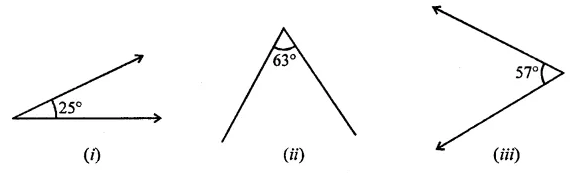
ML Aggarwal Class 7 Solutions for ICSE Maths Chapter 10 Lines and Angles Ex 10.1

ML Aggarwal Class 7 Solutions Chapter 10 Lines and Angles Ex 10.1 for ICSE Understanding Mathematics acts as the best resource during your learning and helps you score well in your exams.

ML Aggarwal Class 7 Solutions for ICSE Maths Chapter 10 Lines and Angles Ex 10.1

Question 1.
(i) Can two right angles be complementary?
(ii) Can two right angles be supplementary?
(iii) Can two adjacent angles be complementary?
(iv) Can two adjacent angles be supplementary?
(v) Can two obtuse angles be adjacent?
(vi) Can an acute angle be adjacent to an obtuse angle?
(vii) Can two right angles form a linear pair?
Solution:
ML Aggarwal Class 7 Solutions for ICSE Maths Chapter 10 Lines and Angles Ex 10.1 1

Question 2.
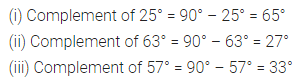
Find the complement of each of the following angles:
ML Aggarwal Class 7 Solutions for ICSE Maths Chapter 10 Lines and Angles Ex 10.1 2
Solution:
ML Aggarwal Class 7 Solutions for ICSE Maths Chapter 10 Lines and Angles Ex 10.1 3

Question 3.
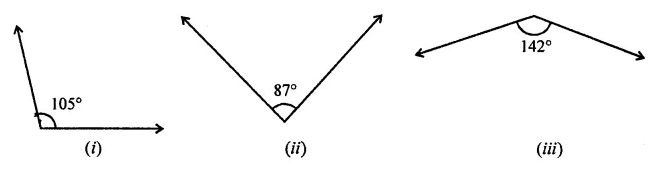
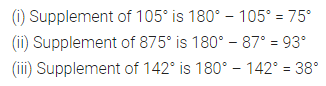
Find the supplement of each of the following angles:
ML Aggarwal Class 7 Solutions for ICSE Maths Chapter 10 Lines and Angles Ex 10.1 4
Solution:
ML Aggarwal Class 7 Solutions for ICSE Maths Chapter 10 Lines and Angles Ex 10.1 5

Question 4.
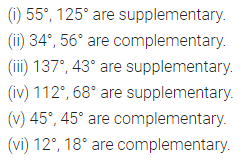
Identify which of the following pairs of angles are complementary and which are supplementary:
(i) 55°, 125°
(ii) 34°, 56°
(iii) 137°, 43°
(iv) 112°, 68°
(v) 45°, 45°
(vi) 72°, 18°
Solution:
ML Aggarwal Class 7 Solutions for ICSE Maths Chapter 10 Lines and Angles Ex 10.1 6

Question 5.
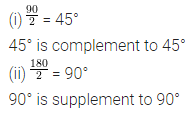
(i) Find the angle which is equal to its complement.
(ii) Find the angle which is equal to its supplement.
Solution:
ML Aggarwal Class 7 Solutions for ICSE Maths Chapter 10 Lines and Angles Ex 10.1 7

Question 6.
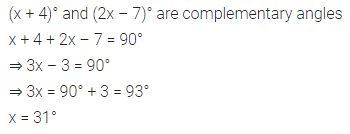
Two complementary angles are (x + 4)° and (2x – 7)°, find the value of x.
Solution:
ML Aggarwal Class 7 Solutions for ICSE Maths Chapter 10 Lines and Angles Ex 10.1 8

Question 7.
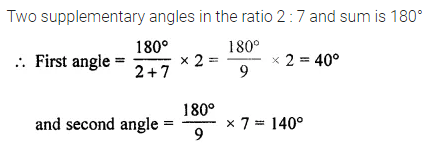
Two supplementary angles are in the ratio of 2 : 7, find the angles.
Solution:
ML Aggarwal Class 7 Solutions for ICSE Maths Chapter 10 Lines and Angles Ex 10.1 9

Question 8.
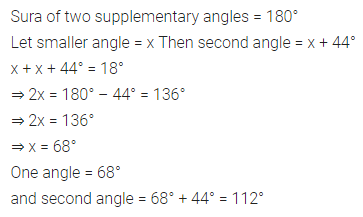
Among two supplementary angles, the measure of the longer angle is 44° more than the measure of the smaller angle. Find their measures.
Solution:
ML Aggarwal Class 7 Solutions for ICSE Maths Chapter 10 Lines and Angles Ex 10.1 10

Question 9.
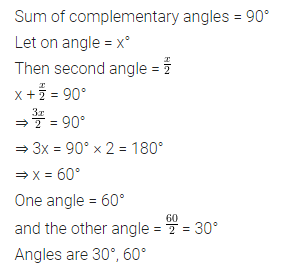
If an angle is half of its complement, find the measure of angles.
Solution:
ML Aggarwal Class 7 Solutions for ICSE Maths Chapter 10 Lines and Angles Ex 10.1 11

Question 10.
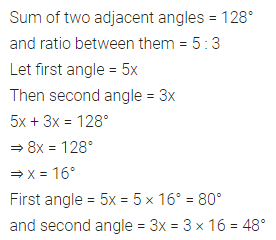
Two adjacent angles are in the ratio 5 : 3 and they together form an angle of 128°, find these angles.
Solution:
ML Aggarwal Class 7 Solutions for ICSE Maths Chapter 10 Lines and Angles Ex 10.1 12

Question 11.
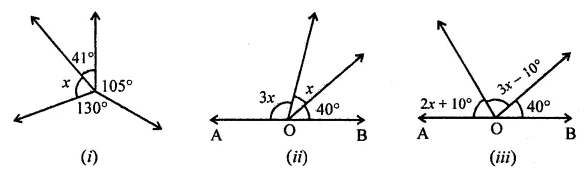
Find the value of x in each of the following diagrams:
ML Aggarwal Class 7 Solutions for ICSE Maths Chapter 10 Lines and Angles Ex 10.1 13
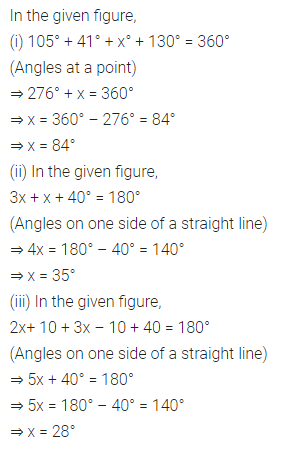
Solution:
ML Aggarwal Class 7 Solutions for ICSE Maths Chapter 10 Lines and Angles Ex 10.1 14

Question 12.
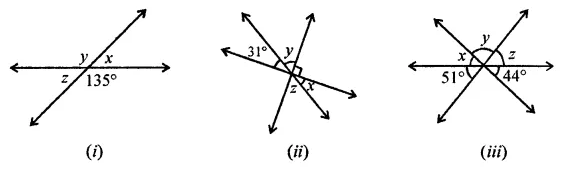
Find the values of x, y and z in each of the following diagrams:
ML Aggarwal Class 7 Solutions for ICSE Maths Chapter 10 Lines and Angles Ex 10.1 15
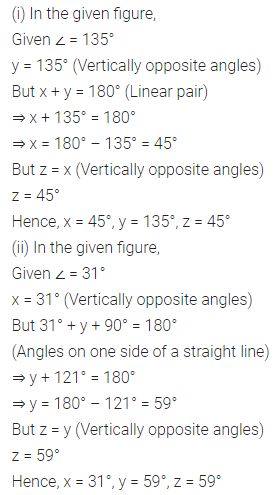
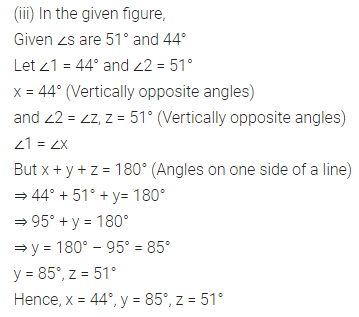
Solution:
ML Aggarwal Class 7 Solutions for ICSE Maths Chapter 10 Lines and Angles Ex 10.1 16
ML Aggarwal Class 7 Solutions for ICSE Maths Chapter 10 Lines and Angles Ex 10.1 17

Question 13.
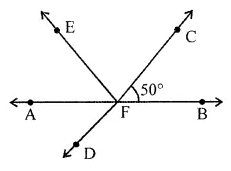
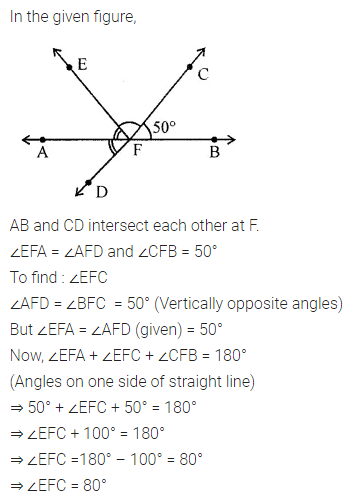
In the given figure, lines AB and CD intersect at F. If ∠EFA = ∠AFD and ∠CFB = 50°, find ∠EFC.
ML Aggarwal Class 7 Solutions for ICSE Maths Chapter 10 Lines and Angles Ex 10.1 18
Solution:
ML Aggarwal Class 7 Solutions for ICSE Maths Chapter 10 Lines and Angles Ex 10.1 19

The Ball Poem Extra Questions and Answers Class 10 English First Flight

Here we are providing The Ball Poem Extra Questions and Answers Class 10 English First Flight, Extra Questions for Class 10 English was designed by subject expert teachers.

The Ball Poem Extra Questions and Answers Class 10 English First Flight

The Ball Poem Extra Questions and Answers Short Answer Type

Question 1.
How was the boy’s hall lost?
Answer:
The boy was playing with his ball. The ball bounced and it went down the street. From the street the ball fell into the water. This is how the boy lost this ball.

Question 2.
How did the boy react after losing the ball?
Answer:
The boy was very much upset after losing the ball. He was filled with sadness, which affected him greatly. Stunningly he stood in a stiff manner, overpowered with grief, trembling and staring down where his ball was lost.

Question 3.
How does the boy ‘Senses first responsibility?
Answer:
The boy loses his ball and gets upset. This was his first lesson in sensing first responsibility. He has the experience of losing something and learning how to cope up with the loss. He understands the nature of loss or what it means to lose something. He now will be more responsible and vigilant to avoid losing something in future.

Question 4.
What do you think the poet means by the following lines?
People will take Balls,
balls will be lost always, little boy.
And no one buys a ball back.
Answer:
We think the poet, in these lines, conveys a great message. Losing ball here symbolises miseries arising out of the losses one suffers in life. In this materialistic world, there is cut throat competition. So losses are bound to happen some day or the other. You have to make up for your own losses. No body else will, do it.

Question 5.
What does the poet mean by “epistemology of loss”?
OR
How important is the learning to “epistemology of loss” for the boy?
Answer:
According the poet, the epistemology of loss is the greatest lesson, the boy is learning. It teaches him to value and preserve his cherished things. It also teaches him to recover from the loss and move on with , his life. When we try to understand what it means to lose something, we are more vigilant to check the further losses. Thus it helps us to be self-reliant and stand up on our own feet.

Question 6.
Why is it important for everyone to experience loss to stand up after it?
Answer:
The poet believes that nothing is eternal. Everyone must experience the loss to help him bear it. It also teaches him how to recover from it and stand up. It will remind him to protect and preserve his possessions.

Question 7.
Why does the poet say that ‘Money is external’?
Answer:
The poet believes that money cannot buy each and everything. It can bring just external happiness by buying us possessions but it cannot make a boy recover from his unhappiness due to loss of a loved one or valued thing.

Question 8.
What does the poet say about “A world of possessions”?
OR
Why does the poet call the world ‘A world of possessions’?
Answer:
The poet calls the world ‘A world of possessions’ because man values and is valued on the basis of his worldly possessions. All his feelings and his whole life are dominated by his possessions.

Question 9.
Why is it important for everyone to experience loss and to stand up after it?
OR
There’s always loss and there’s always disappointment. When someone is learning from loss, he is moving towards achievement. Elaborate.
OR
It’s often been said that you learn more from losing than you do from winning. You learn a lot from a loss. It really gets your attention and it really motivates. Described.
OR
Loss is an essential and significant experience of one’s life. Explain.
Answer:
Everyone experiences a loss at some point in one’s life. It might be the loss of a beloved, or a parent or a close relative or even a pet. Humans have a tendency of getting attached to things and the loss of things or people close to heart causes grievance. But one must not let that pull us down. Loss is an essential and significant experience of one’s life. And one must learn to deal with it and move on.

If we keep thinking about it or grieve over that loss, we can never come out of it. It will only affect us psychologically and can have severe consequences. Brooding over a loss will never help in bringing things back to normal. Loss is inevitable sometimes. Once a loss occurs, one must grieve, but only for a short while. Thereafter one must get over it and move on in life.

Question  10.
Write the central idea of the poem “The Ball Poem”.
Answer:
The poet John Berryman “The Ball poem” describes the grief of a boy over the loss of his ball. This loss makes him realise his first responsibility. The poet wants us to understand that in this materialistic world nothing is forever. We will be forced to give up things which we love and even in time of problems, we have to learn to stand up. We have to learn to accept fate of our life.

Question 11.
Why does the poet say, “I would not intrude on him’? Why doesn’t he offer him money to buy another ball?
Answer:
The poet wants the boy to experience the loss. He should learn that it is the part of life. That is why the poet does not want to interfere and wants the boy to be strong and handle the situation himself and does not want to offer him money to buy another ball.

Question 12.
staring down/ All his young days into the harbour where/His ball went…” Do you think the boy has had the ball for a long time? Is it linked to the memories of days when he played with it?
Answer:
Yes, it seems like the boy has had the ball for a long time. When it bounced into the water, all his memories of the days of childhood flashed in front of him. This led to a realization that those moments would not come back, just like the ball. He can buy new balls and can create new similar moments, but those that are gone, and would not ever return.

Question 13.
What does “in the world of possessions’ mean?
Answer:
“In the world of possessions’ means people like to possess all sorts of things in the world. Money is an external thing because it can buy only material objects. It cannot buy everything that one loses or cannot bring back your long lost memories.

Question 14.
Do you think the boy has lost anything earlier? Pick out the words that suggest the answer.
Answer:
No, it seems that the boy has not lost anything earlier. The words that suggest so are, “senses first responsibility in a world of possessions”.

Question 15.
What does the poet say the boy is learning from the loss of the ball? Try to explain this in your own words.
Answer:
The boy has lost his ball while playing. The poet says that from this loss, the boy will learn in his years, what it means to lose something. Thus he will understand the nature of loss or how to face and cope up with losses one suffers in life. This experience of losing something will enable him to learn to be self- reliant and to stand up on his feet in the life where losses do occur, though they might not be important enough to worry about.

Question 16.
Have you ever lost something you liked very much? Write a paragraph describing how you felt then and saying whether—and how—you got over your loss.
Answer:
Last year, our beautiful dog Tommy was lost. All the family loved the dog very much, but I was very deeply attached to Tommy. I used to take full care of him and Tommy would accompany me wherever I allowed him to do so. I felt desperate and upset when Tommy was not traced at all the possible places, where we could find him. I did not feel like eating or going for morning walk. Tommy always used to accompany me when I went for my morning walk, Gradually I reconciled with the situation and consoled myself.

I totally engrossed myself in my studies though I did not feel like playing. I never stopped missing Tommy. Then, one day, when I went to another colony to meet a friend, I found Tommy tied in someday else’s home. When I approached them, they said that the beautiful dog seemed to have lost his way and so they had been giving care to him. I thanked them and returned home happily with Tommy.

The Ball Poem Extra Questions and Answers Reference to Context

Read the following Stanza and answer the questions that follow:

Question 1.
What is the boy now, who has lost his ball,
What, what is he to do? I saw it go
Merrily bouncing, down the street, and then
Merrily over—there it is in the water!

(i) Name the poem and poet.
(ii) What has the boy lost?
(iii) What did he see?
(iv) Where did the ball go?
Answer:
(i) This stanza has been taken from the poem The Ball Poem’ composed by John Berryman.
(ii) The boy has lost his ball while playing.
(iii) He saw the ball going down the street.
(iv) The ball went into the water.

Question 2.
No use to say ‘O there are other balls’:
An ultimate shaking grief fixes the boy
As he stands rigid, trembling, staring down
All his young days into the harbour where His ball went.

(i) What does ‘0 there are other balls’ imply?
(ii) Why is the child upset?
(iii) What is he looking at?
(iv) Name the poem and poet.
Answer:
(i) It implies that the loss of his ball cannot console the boy even if he gets another ball.
(ii) The child/boy is upset because he has lost his ball.
(iii) He is looking at the place where his ball went.
(iv) The poem “The Ball Poem” composed by John Berryman.

Question 3.
I would not intrude on him;
A dime, another ball, is worthless.
Now He senses first responsibility
In a world of possessions.

(i) What did the poet decide?
(ii) What does the boy understand?
(iii) What does the “World of Possessions’refer to?
(iv) Name the poem and poet.
Answer:
(i) The poet decided not to interfere and suggest anything to the boy.
(ii) The boy senses his first responsibility.
(iii) It refers to the world where a man is known by his possessions and is continually led by his decision to possess.
(iv) The poem “The Ball Poem” written by John Berryman.

Question 4.
People will take
Balls, balls will be lost always, little boy.
And no one buys a ball back. Money is external.
He is learning, well behind his desperate eyes,
The epistemology of loss, how to stand up
Knowing what every man must one day know
And most know many days, how to stand up.

(i) What does the boy learn?
(ii) What does he think about money?
(iii) Why was the boy upset?
(iv) Name the poem and poet.
Answer:
(i) The boy is learning the epistemology of loss. He learns how to cope up with the loss.
(ii) Money is external.
(iii) The boy was upset because he had lost his ball.
(iv) The poem “The Ball Poem” composed by John Berryman.

ML Aggarwal Class 7 Solutions for ICSE Maths Chapter 9 Linear Equations and Inequalities Check Your Progress

ML Aggarwal Class 7 Solutions Chapter 9 Linear Equations and Inequalities Check Your Progress for ICSE Understanding Mathematics acts as the best resource during your learning and helps you score well in your exams.

ML Aggarwal Class 7 Solutions for ICSE Maths Chapter 9 Linear Equations and Inequalities Check Your Progress

Question 1.
Solve the following equations :
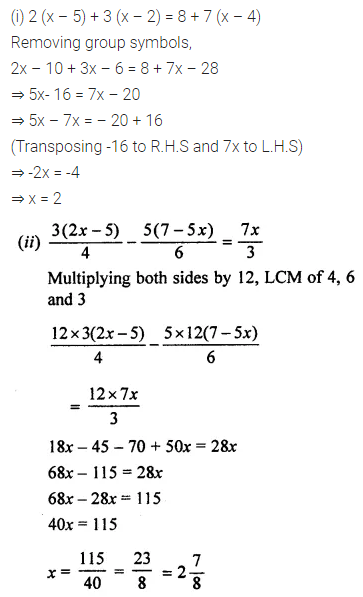
(i) 2 (x – 5) + 3 (x – 2) = 8 + 7 (x – 4)
ML Aggarwal Class 7 Solutions for ICSE Maths Chapter 9 Linear Equations and Inequalities Check Your Progress 1
Solution:
ML Aggarwal Class 7 Solutions for ICSE Maths Chapter 9 Linear Equations and Inequalities Check Your Progress 2

Question 2.
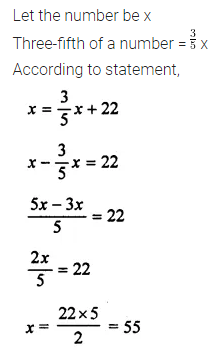
A number exceeds its three-fifth by 22. Find the number.
Solution:
ML Aggarwal Class 7 Solutions for ICSE Maths Chapter 9 Linear Equations and Inequalities Check Your Progress 3

Question 3.
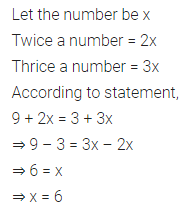
When 9 is added to twice a number, the result is 3 more than thrice the number. Find the number.
Solution:
ML Aggarwal Class 7 Solutions for ICSE Maths Chapter 9 Linear Equations and Inequalities Check Your Progress 4

Question 4.
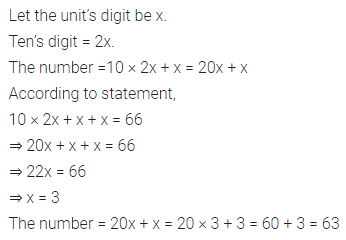
The ten’s digit of a two digit number is twice the unit’s digit. The sum of the number and its unit’s digit is 66. Find the number.
Solution:
ML Aggarwal Class 7 Solutions for ICSE Maths Chapter 9 Linear Equations and Inequalities Check Your Progress 5

Question 5.
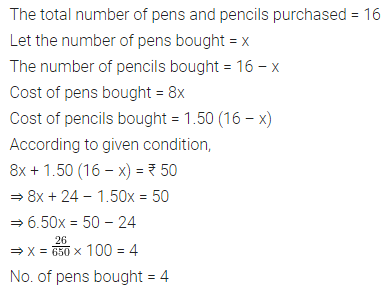
A student bought some pens at ₹ 8 each and some pencils at ₹ 1.50 each. If the total number of pens and pencils purchased is 16 and their total cost is ₹ 50, how many pens did he buy?
Solution:
ML Aggarwal Class 7 Solutions for ICSE Maths Chapter 9 Linear Equations and Inequalities Check Your Progress 6

Question 6.
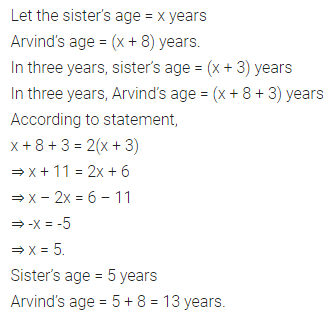
Arvind is eight years older than his sister. In three years, he will be twice as old as his sister. How old are they now?
Solution:
ML Aggarwal Class 7 Solutions for ICSE Maths Chapter 9 Linear Equations and Inequalities Check Your Progress 7

Question 7.
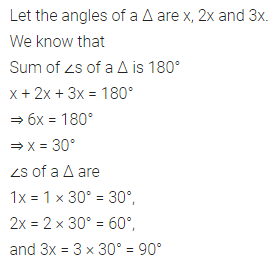
The angles of a triangle are in the ratio 1 : 2 : 3. Find their measure in degrees.
Solution:
ML Aggarwal Class 7 Solutions for ICSE Maths Chapter 9 Linear Equations and Inequalities Check Your Progress 8

Question 8.
Solve the following inequations and represent their solution on a number line:
ML Aggarwal Class 7 Solutions for ICSE Maths Chapter 9 Linear Equations and Inequalities Check Your Progress 9
Solution:
ML Aggarwal Class 7 Solutions for ICSE Maths Chapter 9 Linear Equations and Inequalities Check Your Progress 10
ML Aggarwal Class 7 Solutions for ICSE Maths Chapter 9 Linear Equations and Inequalities Check Your Progress 11

How to Tell Wild Animals Extra Questions and Answers Class 10 English First Flight

Here we are providing How to Tell Wild Animals Extra Questions and Answers Class 10 English First Flight, Extra Questions for Class 10 English was designed by subject expert teachers.

How to Tell Wild Animals Extra Questions and Answers Class 10 English First Flight

How to Tell Wild Animals Extra Questions and Answers Short Answer Type

Question 1.
How can you identify the Asian Lion?
Answer:
The poet in the humorous way says that if a person goes to the jungles in the east and if a large and brownish wild animal roars while killing him, the dying^jnan can know that it is the Asian Lion.

Question 2.
How can you identify the Bengal Tiger?
Answer:
A person can identify the Bengal Tiger when a beast with black stripes on yellow body meets and eats him. This is how he can make out that it is the Bengal Tiger.

Question 3.
How can a man know that the beast is leopard?
OR
Describe some features of the leopard.
Answer:
Leopard has spots on its body. It is a dangerous and powerful animal. It has the quality of leaping again and again. It leaps over its prey at once. It eats its prey.

Question 4.
How does the poet tell us to identify a bear?
Answer:
The poet says that if, while walking round the courtyard of his house, a person meets there a creature who hugs him very, very hard, then he be can be sure that it is a bear.

Question 5.
How does the poet distinguish the hyena from crocodile?
Answer:
The poet tells us how to distinguish a hyena from crocodile. A hyena is an animals who can laugh. The poet says that if a creature greets a person while smiling merrily, then that creature is hyena. If a creature sheds tears while swallowing a person, then it is a crocodile.

Question 6.
What does the poet tell us about a chameleon?
Answer:
The poet tells us that a chameleon is found on a tree. It is a creature which can change its colour according to its surrounding. It is very difficult to see a chameleon on the tree because it changes its colour according to the colour of the tree.

Question 7.
The poet has used some special qualities to describe the animals and create humour in the poem. Each of us also has some special qualities which make us quite different from others. Do you agree with this statement? Comment with reference to the poem ‘How to Tell Wild Animals’.
Answer:
The poet has used the selected words and expressions to describe the animals and to create humour. For example she says, “A noble beast greets you’ for “The Bengal Tiger”, “A bear – hugs you” “Crocodiles weep” and ‘Hyena smiles’. Like these animals, each of us has some special qualities which make us quite different from others. For example, we face many people in a day, but even then we can easily recognize them only through their voice or through their special habits. These distinctive qualities give them a unique identification. This, statement is absolutely right.

Question 8.
The poet uses humour in a perfect manner in her poem—‘How to Tell Wild Animals’ to bring smile on the face of readers. In our daily life also humour is the best medicine for every ailment. Do you agree? Comment.
OR
“Humour is the perfect medicine for all diseases”. Discuss this statement by taking examples from the poem “How to Tell Wild Animals”.
Answer:
The poet talks about wild animals in a funny manner. All the dangerous, wild animals like lions, tigers, leopards, bears, hyenas, crocodile, chameleon have been portrayed humorously. The poet describes their dangerous activities in such a manner that they produce laughter.

Question 9.
Does ‘dyin’ really rhyme with ‘lion’? Can you say it in such a way that it does?
Answer:
No ‘dying does not rhyme with ‘lion’. It is for this reason that the poet has used ‘dyin’ so that when we pronounce it, it rhymes with ‘lion’.

Question 10.
How does the poet suggest that you identify the lion and the tiger? When can you do so, according to him?
Answer:
The poet suggests that if a large and tawny beast comes towards us, then it is an Asian lion. We can identify it when it roars at us while, we are dying with fear. When while roaming, we come across a wild beast that is yellow in colour with black stripes, it is Bengal tiger. We can identify it when it eats us.

Question 11.
Do you think the words ‘lept’ and ‘lep’ in the third stanza are spelt correctly? Why does the poet spell them like this?
Answer:
No, the words ‘lept’ and ‘lep’ are spelt incorrectly. The poet has spelled them like this in order to maintain the rhythm of the poem. When spelled this way, they rhyme with the first part of ‘leopard’, thus giving emphasis to ‘leopard’ in each line.

Question 12.
Do you know what a ‘bearhug’ is? It’s a friendly and strong hug—such as bears are thought to give, as they attack you! Again, hyenas are thought to laugh, and crocodiles to weep (‘crocodile tears’) as they swallow their victims. Are there similar expressions and popular ideas about wild animals in your own language(s) ;
Answer:
A ‘bearhug’ is the bear’s tight embrace. Hyenas never laugh. But their faces look like that. Crocodiles do not weep but tears come when they swallow their victims.

Question 13.
Look at the line “A novice might nonplus”. How would you write this ‘correctly’? Why is the poet’s ‘incorrect’ line better in the poem?
Answer:
The line “Novice might nonplus” can be correctly written as “A novice might be nonplussed’. The poet’s incorrect line is better in the poem as it maintains the rhyme scheme of the poem. By writing it incorrectly, ‘nonplus’ rhymes with “Thus’.

Question 14.
Can you find other examples of poets taking liberties with language, either in English or in your own language (s)? Can you, find examples of humorous poems in your own languages(s)?
Answer:
Yes, many poets take such liberties to create proper rhyming. These are for example – Kirk has “Church’ to rhyme with ‘work’. Ken has used “See” to rhyme with ‘pen’.

Question 15.
Much of the humour in the poem arises from the way language is used, although the ideas are funny as well. If there are particular lines in the poem that you especially like, share these with the class, speaking briefly about what it is about the ideas or the language that you like or find funny.
Answer:
Students must try to do it at their own level. From this poem the following lines may be pointed out where language and ideas arise humour in the poem.
If he roars at you as you’re dyin’
A noble wild beast greets you,
Just notice if he eats you.
“Twill do not good to roar with pain,
Who hugs you very, very hard,
A novice might nonplus,
Hyenas come with merry smiles A true Chameleon is small,
In all these lines, the ideas are treated humorously. They are wild beasts. They can neither laugh, smile nor be gentle. They will kill the human beings at once as they get, the chance.

How to Tell Wild Animals Extra Questions and Answers Reference to Context

Read the stanza and answer the questions that follow:

Question 1.
If ever you should go by chance
TO jungles in the east;
And if there should to you advance
A large and tawny beast,
If he roars at you as you’re dyin’
You’ll know it is the Asian Lion…

(i) Name the poem and the poet.
(ii) How does one identify the Asian Lion?
(iii) How does an Asian Lion react on seeing a man?
(iv) Pick out the word from the stanza that means the same as “All of a sudden”.
Answer:
(i) This stanza has been taken from the poem “How to Tell Wild Animals” composed by Carolyn Wells.
(ii) The Asian Lion is identified by its size, colour and roar, it is a large tawny beast.
(iii) When Asian Lion sees a man, it roars and takes no time in killing him.
(iv) ‘by Chance’.

Question 2.
Or if sometime when roaming round,
A noble wild beast greets you,
With black stripes on a yellow ground,
Just notice if he eats you.
This simple rule may help you learn
The Bengal Tiger to discern.

(i) Who is the ‘noble wild beast’ here?
(ii) How does this beast look?
(iii) Pick out the word from the stanza that means the same as ‘to recognise’.
(iv) Name the poem and poet.
Answer:
(i) The noble wild beast is Bengal Tiger here.
(ii) This beast looks like it is coloured with black stripes on a yellow ground.
(iii) ‘discern’.
(iv) ‘How to Tell Wild Animals’ written by Carolyn Wells.

Question 3.
If strolling forth, a beast you view,
Whose hide with spots is peppered,
As soon as he has lept on you,
You’ll know it is the Leopard.
Twill do no good to roar with pain,
He’ll only lep and lep again.

(i) How can you recognise the Leopard?
(ii) How is it different from the Bengal Tiger?
(iii) Pick out the word from the stanza that means the same as—‘a large animal of the cat family
(iv) Name the poem and poet.
Answer:
(i) The leopard can be recognised by its spots on the skin.
(ii) Bengal Tiger has black stripes on a yellow ground while the Leopard has round black spots on the body.
(iii) ‘Leopard’.
(iv) ‘How to Tell Wild Animals’ and poem composed by Carolyn Wells.

Question 4.
If when you’re walking round your yard
You meet a creature there,
Who hugs you very, very hard,
Be sure it is a Bear.
If you have any doubts, I guess
He’ll give you just one more caress.

(i) Whom can you meet in the yard?
(ii) How can one recognise that he is meeting a bear?
(iii) Pick out the word from the stanza that means the same as—‘loving touch’ or ‘gentle touch’.
(iv) How does it treat the Man?
or
Name the poem and poet.
Answer:
(i) In your yard, you can meet a bear.
(ii) One can recognise that he is meeting a bear by its hard hug.
(iii) “caress’.
(iv) When a bear meets a man, it hugs him very hard.