ML Aggarwal Class 7 Solutions for ICSE Maths Chapter 9 Linear Equations and Inequalities Objective Type Questions

ML Aggarwal Class 7 Solutions Chapter 9 Linear Equations and Inequalities Objective Type Questions for ICSE Understanding Mathematics acts as the best resource during your learning and helps you score well in your exams.

ML Aggarwal Class 7 Solutions for ICSE Maths Chapter 9 Linear Equations and Inequalities Objective Type Questions

Mental Maths

Question 1.
Fill in the blanks:
(i) A linear equation in one variable cannot have more than ………… solution.
(ii) If five times a number is 50, then the number is ……….
(iii) The number 4 is the ………. of the equation 2y – 5 = 3.
(iv) The equation for the statement ‘5 less than thrice a number x is 7’ is ……….
(v) …………. is a solution of the equation 4x + 9 = 5.
(vi) If 3x + 7 = 1, then the value of 5x + 13 is ………..
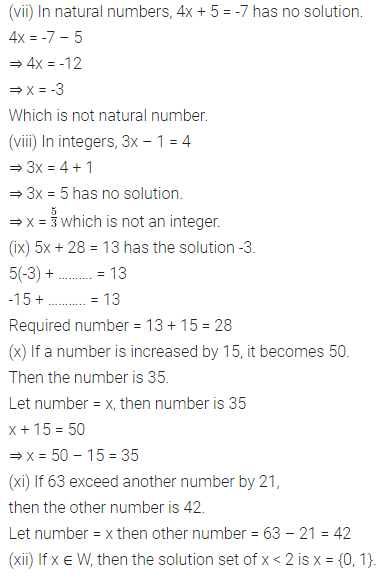
(vii) In natural numbers, 4x + 5 = -7 has ……….. solution.
(viii) In integers, 3x – 1 = 4 has …………. solution.
(ix) 5x + ………. = 13 has the solution -3.
(x) If a number is increased by 15, it becomes 50. Then the number is ……..
(xi) If 63 exceed another number by 21, then the other number is …………
(xii) If x ∈ W, then the solution set of x < 2 is ………..
Solution:
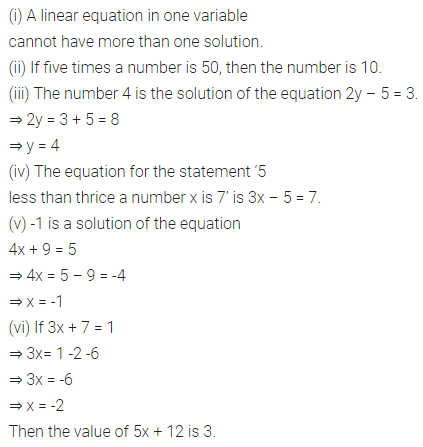
ML Aggarwal Class 7 Solutions for ICSE Maths Chapter 9 Linear Equations and Inequalities Objective Type Questions 1
ML Aggarwal Class 7 Solutions for ICSE Maths Chapter 9 Linear Equations and Inequalities Objective Type Questions 2

Question 2.
State whether the following statements are true (T) or false (F):
(i) We can add (or subtract) the same number of expression to both sides of an equation.
(ii) We can divide both sides of an equation by the same non-zero number.
(iii) 3x – 5 = 2(x + 3) + 7 is a linear equation in one variable.
(iv) The solution of the equation 3(x – 4) = 30 is x = 6.
(v) The solution of the equation 3x – 5 = 2 is x = \(\frac { 7 }{ 3 }\)
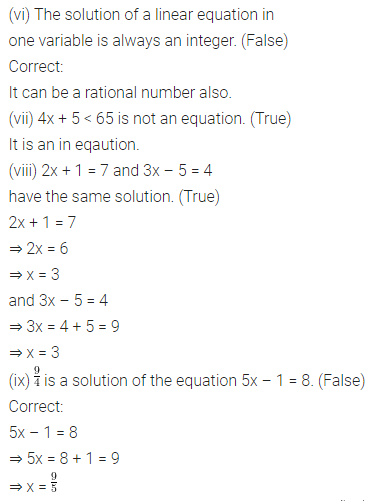
(vi) The solution of a linear equation in one variable is always an integer.
(vii) 4x + 5 < 65 is not an equation.
(viii) 2x + 1 = 7 and 3x – 5 = 4 have the same solution.
(ix) \(\frac { 9 }{ 4 }\) is a solution of the equation 5x – 1 = 8.
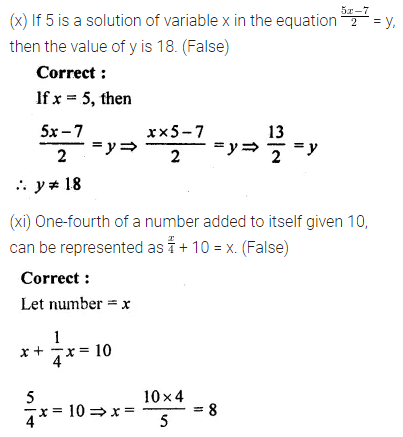
(x) If 5 is a solution of variable x in the equation \(\frac { 5x-7 }{ 2 }\) = y, then the value of y is 18.
(xi) One-fourth of a number added to itself given 10, can be represented as \(\frac { x }{ 4 }\) + 10 = x.
Solution:
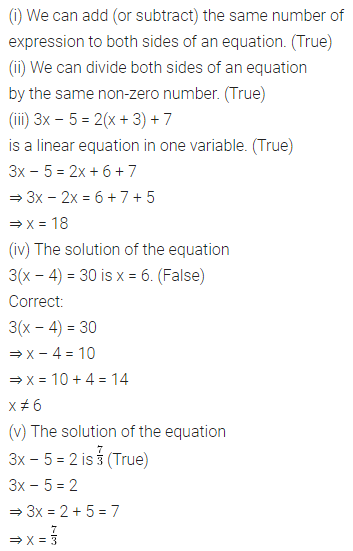
ML Aggarwal Class 7 Solutions for ICSE Maths Chapter 9 Linear Equations and Inequalities Objective Type Questions 3
ML Aggarwal Class 7 Solutions for ICSE Maths Chapter 9 Linear Equations and Inequalities Objective Type Questions 4
ML Aggarwal Class 7 Solutions for ICSE Maths Chapter 9 Linear Equations and Inequalities Objective Type Questions 5

Multiple Choice Questions

Choose the correct answer from the given four options (3 to 17):
Question 3.
Which of the following is not a linear equation in one variable?
(a) 3x – 1 = 7
(b) 5y – 2 = 3 (y + 2)
(c) 2x – 3 = \(\frac { 7 }{ 2 }\)
(d) 7p + q = 3
Solution:

ML Aggarwal Class 7 Solutions for ICSE Maths Chapter 9 Linear Equations and Inequalities Objective Type Questions 6

Question 4.
The solution of the equation \(\frac { 1 }{ 3 }\)(2y – 1) = 3 is
(a) 5
(b) 3
(c) 2
(d) 1
Solution:
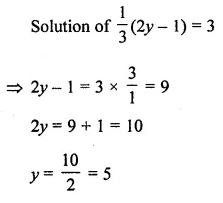
ML Aggarwal Class 7 Solutions for ICSE Maths Chapter 9 Linear Equations and Inequalities Objective Type Questions 7

Question 5.
x = -1 is a solution of the equation
(a) x – 5 = 6
(b) 2x + 5 = 7
(c) 2(x – 2) + 6 = 0
(d) 3x + 5 = 4
Solution:
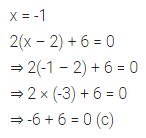
ML Aggarwal Class 7 Solutions for ICSE Maths Chapter 9 Linear Equations and Inequalities Objective Type Questions 8

Question 6.
If 3(3n – 10) = 2n + 5, then the value of n is
(a) 12
(b) 5
(c) 3
(d) -5
Solution:
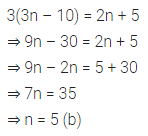
ML Aggarwal Class 7 Solutions for ICSE Maths Chapter 9 Linear Equations and Inequalities Objective Type Questions 9

Question 7.
-1 is not a solution of the equation
(a) x + 1 = 0
(b) 3x + 4 = 1
(c) 5x + 7 = 2
(d) x – 1 = 2
Solution:
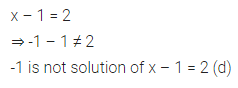
ML Aggarwal Class 7 Solutions for ICSE Maths Chapter 9 Linear Equations and Inequalities Objective Type Questions 10

Question 8.
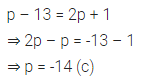
The value of p for which the expressions p – 13 and 2p + 1 become equal is
(a) 0
(b) 14
(c) -14
(d) 5
Solution:
ML Aggarwal Class 7 Solutions for ICSE Maths Chapter 9 Linear Equations and Inequalities Objective Type Questions 11

Question 9.
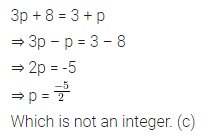
The equation which cannot be solved in integers is
(a) 5x – 3 = -18
(b) 3y – 5 = y – 1
(c) 3p + 8 = 3 + p
(d) 9z + 8 = 4z – 7
Solution:
ML Aggarwal Class 7 Solutions for ICSE Maths Chapter 9 Linear Equations and Inequalities Objective Type Questions 12

Question 10.
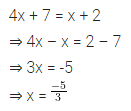
The solution of which of the following equations is neither an integer nor a fraction?
(a) 2x + 5 = 1
(b) 3x – 7 = 0
(c) 5x – 7 = x + 1
(d) 4x + 7 = x + 2
Solution:
ML Aggarwal Class 7 Solutions for ICSE Maths Chapter 9 Linear Equations and Inequalities Objective Type Questions 13

Question 11.
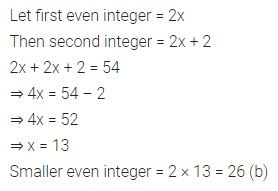
If the sum of two consecutive even numbers is 54, then the smaller number is
(a) 25
(b) 26
(c) 27
(d) 28
Solution:
ML Aggarwal Class 7 Solutions for ICSE Maths Chapter 9 Linear Equations and Inequalities Objective Type Questions 14

Question 12.
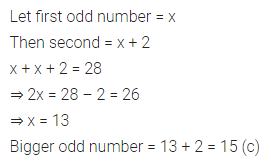
If the sum of two consecutive odd numbers is 28, then the bigger number is
(a) 19
(b) 17
(c) 15
(d) 13
Solution:
ML Aggarwal Class 7 Solutions for ICSE Maths Chapter 9 Linear Equations and Inequalities Objective Type Questions 15

Question 13.
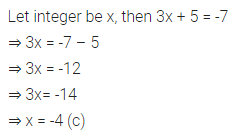
If 5 added to thrice an integer is -7, then the integer is
(a) -6
(b) -5
(c) -4
(d) 4
Solution:
ML Aggarwal Class 7 Solutions for ICSE Maths Chapter 9 Linear Equations and Inequalities Objective Type Questions 16

Question 14.
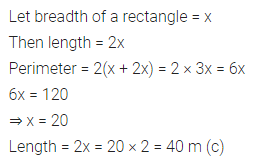
If the length of a rectangle is twice its breadth and its perimeter is 120 m, then its length is
(a) 20 m
(b) 30 m
(c) 40 m
(d) 60 m
Solution:
ML Aggarwal Class 7 Solutions for ICSE Maths Chapter 9 Linear Equations and Inequalities Objective Type Questions 17

Question 15.
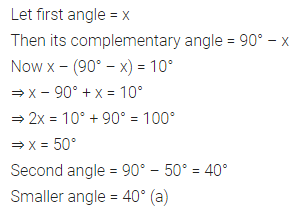
If the difference of two complementary angles is 10°, then the smaller angle is
(a) 40°
(b) 50°
(c) 45°
(d) 35°
Solution:
ML Aggarwal Class 7 Solutions for ICSE Maths Chapter 9 Linear Equations and Inequalities Objective Type Questions 18

Question 16.
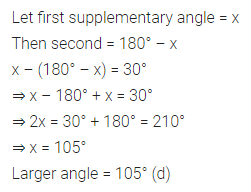
If the difference of two supplementary angles is 30°, then the larger angle is
(a) 60°
(b) 75°
(c) 90°
(d) 105°
Solution:
ML Aggarwal Class 7 Solutions for ICSE Maths Chapter 9 Linear Equations and Inequalities Objective Type Questions 19

Question 17.
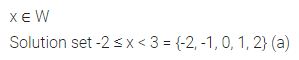
If x ∈ W, the solution set of the inequation -2 ≤ x < 3 is
(a) {-2, -1,0, 1, 2}
(b) {-1, 0, 1, 2, 3}
(c) {0, 1, 2, 3}
(d) (0, 1, 2}
Solution:
ML Aggarwal Class 7 Solutions for ICSE Maths Chapter 9 Linear Equations and Inequalities Objective Type Questions 20

Value Based Questions

Question 1.
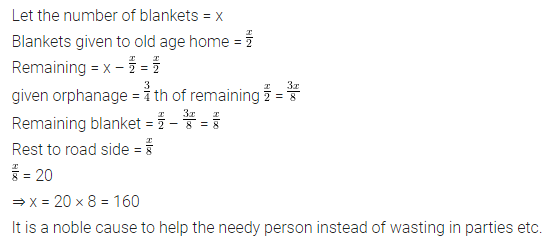
On his 13th birthday, a boy decided to distribute blankets to the poor people instead of giving a party to his friends. Half of the blankets he distributed in an old age home, three fourths of the remaining in an orphanage and rest 20 were distributed to the roadside beggars. Find the number of blankets he had. What values are being promoted?
Solution:
ML Aggarwal Class 7 Solutions for ICSE Maths Chapter 9 Linear Equations and Inequalities Objective Type Questions 21

Higher Order Thinking Skills (HOTS)

Question 1.
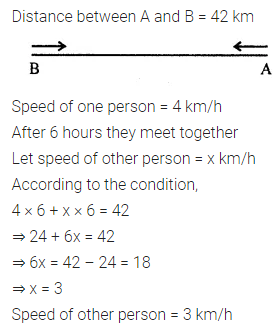
Two persons start moving from two points A and B in opposite directions towards each other. One person start moving from A at a speed of 4 km/h and meets the other person coming from B after 6 hours. If the distance between A and B is 42 km, find the speed of the other person.
Solution:
ML Aggarwal Class 7 Solutions for ICSE Maths Chapter 9 Linear Equations and Inequalities Objective Type Questions 22

Question 2.
There are some benches in the classroom. If 4 students sit on each bench then 3 benches remain empty and if 3 students sit on each bench then 3 students remain standing. Find the number of students in the class.
Solution:
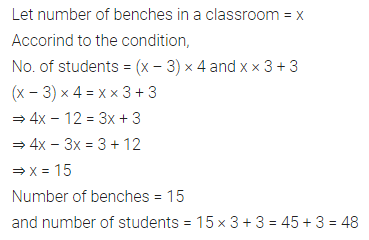
ML Aggarwal Class 7 Solutions for ICSE Maths Chapter 9 Linear Equations and Inequalities Objective Type Questions 23

A Tiger in the Zoo Extra Questions and Answers Class 10 English First Flight

Here we are providing A Tiger in the Zoo Extra Questions and Answers Class 10 English First Flight, Extra Questions for Class 10 English was designed by subject expert teachers.

A Tiger in the Zoo Extra Questions and Answers Class 10 English First Flight

A Tiger in the Zoo Extra Questions and Answers Short Answer Type

Question 1.
How does the tiger feel in the zoo?
Answer:
The poet describes the feelings of the tiger in the zoo. He keeps on moving from one comer to another. “He stalks in his vivid stripes moving the few steps of his cage”. He is not happy. He expresses his silent anger.

Question 2.
How does the tiger walk in the cage?
Answer:
In the cage, the tiger walks stately and furiously.

Question 3.
What message do you get from this poem?
Answer:
From this poem, we come to know that animals like to live freely in the forest. The animals do not want to live in the zoo. Their life is pitiable in it.

Question 4.
How does the tiger act in the cage?
Answer:
The tiger is in the cage. He is powerless and helpless. He longs for freedom. His velvet pads do not make ‘ any noise. He is in the silent anger roaring and ignoring the visitors.

Question 5.
What would the tiger do in a forest?
Answer:
In the forest, the tiger can enjoy complete freedom. He would walk around freely without any fear. He would terrorize the villagers by growling. He would show his teeth and claws.

Question 6.
What does the poet want to convey through this poem?
Answer:
The poet wants to convey that like human beings, animals also like freedom. They do not want to be caged, they cannot live a miserable life. If their habitat is destroyed by human beings, these animals cannot survive.

Question 7.
What would the tiger do in a forest?
Answer:
In the forest, the tiger can enjoy complete freedom. He would walk around freely without any fear. He would terrorize the villagers by growling. He would show his teeth and claws.

Question 8.
“Freedom is a birth right. It is the most beautiful gift of god. It is valuable for all human beings as well as for creatures,” Discuss with reference to the poem “A Tiger in the Zoo.”.
Answer:
Freedom is the most beautiful gift of god. Freedom is a birthright, without freedom all is in vain. Since the man has come on his earth, he tries to enslave the weaker sections for his own selfishness. If a bird lives in a golden cage, it cannot become happy. It loves to fly freely in an open sky. In the same way, if ‘ a man lives in a prison and gets everything, he cannot feel happiness. But if a man lives freely, he will be happy even in poor conditions. In this poem, we find the descriptions of two tigers, one is in a cage and second in an open field/forest. There is a great contrast between their behaviours.

Question 9.
Tigers are becoming extinct due to deforestation and poaching. How can people be sensitized about the need of tiger.
Answer: Tigers are considered as an endangered species. People are killing tigers for their skins, bones, claws and teeth. Due to this, the population of tigers has declined. We should not encroach on their habitat. As we all need sheltered home, tigers also need natural surroundings. Forests should not be cut down. They (Tigers) must be given more space to move freely around.

Question 10.
‘Freedom’ is a life for both humans and animals. Elaborate.
Answer:
The poet describes the feelings of the tiger in the zoo. He keeps on moving from one comer to another. “He stalks in his vivid stripes moving the few steps of his cage”. He is not happy. He expresses his silent anger.

Question 11.
Those who deny freedom to others, do not deserve it for themselves. Comment.
Answer:
The poet describes the feelings of the tiger in the zoo. He keeps on moving from one comer to another. “He stalks in his vivid stripes moving the few steps of his cage”. He is not happy. He expresses his silent anger.

Question 12.
Read the poem again, and work in pairs or groups to do the following tasks.
(i) Find the words that describe the movements and actions of the tiger in the cage and in the wild. Arrange them in two columns.
(ii) Find the words that describe the two places, and arrange them in two columns.
Now try to share ideas about how the poet uses words and images to contrast the two situations
Answer:

Movements and actions of Tiger in the cagesMovements and actions of the Tiger in the wild
Stalking
Ignoring
Storing
Hearing
His movement in the cage is restricting and he is unhappy at the places in the cage.Lurking
Sliding
Snarling
Baring
Terrorising
His movement in the wild is liberating and he is happy prowling in his   natural surroundings.


Places in the CagePlaces in the wild
Pads of velvet quiet
Concrete cell
behind bars
shadow
grass
water hole jungle’s edge

Question 13.
Notice the use of a word repeated in lines such as these —
(i) On pads of velvet quiet,
In his quiet rage.

(ii) And stares with his brilliant eyes
At the brilliant stars.
What do you think is the effect of this repetition?
Answer:
(i) The word ‘quiet’ has been repeated in these lines. The repetition of the words expresses the intensity of the Tiger’ action.
(ii) ‘Brilliant’ word has been repeated in these lines. It expresses both the anger and brightness in the eyes of the tiger. It creates an effect of intensity of the action.

Question 14.
Read the following two poems—one about a tiger and other about a panther.
Then discuss:
Are zoos necessary for protection or conservation of some species of animals? Are they useful for educating the public? Are there alternatives to zoos?
See Textbook Pages 30-31
Answer:
The zoo is necessary place for some animals to stay safe as they could be hunted down, poisoned by sotne wild food; or could drown in water in the forest. They also create awareness among the public about the nature of animals and make people friendly with animals. However, a zoo is not the correct substitute for a forest. In a zoo, an animal would feel restricted’ and it is for this reason that wildlife sanctuaries are better places for national endangered species.

These places provide protection as well as natural surroundings to these species. They can roam around freely in their habitat and safe too. The public can visit these parks and get educated about the animals and their lifestyle. The parks and sanctuaries are run using a strict set of rules, the most prominent being the ban on hunting. Since the animals are in the open, visitors are not allowed to feed them and would not misbehave or try to play with them as they are under strict guidance. Such incidents have been recorded in zoos where people irritate and tease the animals. Hence, a wild life sanctuary is a good alternative for animals to be safe as well as to live freely in their natural surroundings.

Question 15.
Take a point of view for or against zoos or even consider both points of view and write a couple of paragraphs or speak about this topic for a couple of minutes in class.
Answer:
Zoos are both necessary and unnecessary for many reasons. But the reasons in favour are more than its opposite idea. That is why the number of zoos is increasing throughout the world. Day by day the number of many species is decreasing rapidly. So zoos are very necessary to protect and conserve them. Many species of wild animals have already become extinct. Animals too are important for this earth. There are many reasons to say that there are no alternatives of zoos.

A Tiger in the Zoo Extra Questions and Answers Reference to Context

Read the Stanza and answer the questions that follow:

Question 1.
He stalks in his vivid stripes
The few steps of his cage,
On pads of velvet quiet,
In his quiet rage.

(i) Name the poem and poet.
(ii) Who does ‘He’ refer to? Where is he kept?
(iii) Where is ‘He? Is he happy there?
(iv) Pick out the word from the extract that means the same as—‘bright’.
Answer:
(i) These lines have been taken from the poem ‘A Tiger in the Zoo’ composed by Leslie (ii) Norris. ‘He’ refers to the Tiger. He is kept in a cage.
(iii) He is in the cage in the zoo. No, the tiger is not happy in the zoo.
(iv) ‘vivid’.

Question 2.
He should be lurking in shadow
Sliding through long grass
Near the water hole
Where plump deer pass.

(i) Who does ‘He’ refer to?
(ii) Where is the tiger at present?
(iii) Give a word opposite in meaning from these lines to ‘light’.
(iv) Pick out the word from the extract that means the same as—“wait in hiding”.
Answer:
(i) ‘He’ refers to the tiger.
(ii) Tiger is in its natural habitat at present.
(iii) Shadow
(iv) ‘Lurk’.

Question 3.
He should be snarling around houses
At the jungle’s edge,
Baring his white fangs, his claws,
Terrorising the village!

(i) Who is ‘he’ in the stanza?
(ii) Why does he move around the houses?
(iii) How should he be terrorising the village?
(iv) Give noun form of‘terrorise’.
Answer:
(i) ‘He’ in the stanza stands for the tiger.
(ii) He moves around the houses in search of his prey.
(iii) He should be terrorising the village people with baring of his white fangs and with his claws.
(iv) Terror

Question 4.
But he’s locked in a concrete cell,
His strength behind bars,
Stalking the length of his cage,
Ignoring visitors.

(i) Where is he locked?
(ii) Where is he striding.
(iii) Whom does he ignore?
(iv) Pick out the word from the stanza that means the same as – “Walk stiffly’.
Answer:
(i) He is locked in a concrete cell behind the bars.
(ii) He is striding in his concrete cell.
(iii) He ignores the visitors.
(iv) “Stalk”.

Question 5.
He hears the last voice at night,
The patrolling cars,
And stares with his brilliant eyes
At the brilliant stars.

(i) Who does “he’ refer to?
(ii) What does Tie’ do at night?
(iii) What are the cars doing?
(iv) Pick out the word from the stanza that means thapame as—‘gleaming’.
Answer:
(i) ‘He’ refers to the tiger.
(ii) The tiger watches the stars at night.
(iii) The cars are patrolling the area
(iv) ‘brilliant’

ML Aggarwal Class 7 Solutions for ICSE Maths Chapter 9 Linear Equations and Inequalities Ex 9.3

ML Aggarwal Class 7 Solutions Chapter 9 Linear Equations and Inequalities Ex 9.3 for ICSE Understanding Mathematics acts as the best resource during your learning and helps you score well in your exams.

ML Aggarwal Class 7 Solutions for ICSE Maths Chapter 9 Linear Equations and Inequalities Ex 9.3

Question 1.
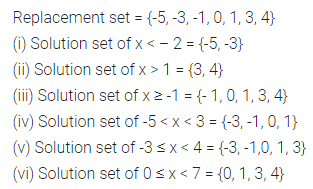
If the replacement set is (- 5, – 3, – 1, 0, 1, 3, 4), find the solution set of:
(i) x < -2
(ii) x > 1
(iii) x ≥ -1
(iv) -5 < x < 3
(v) -3 ≤ x < 4
(vi) 0 ≤ x < 7.
Solution:
ML Aggarwal Class 7 Solutions for ICSE Maths Chapter 9 Linear Equations and Inequalities Ex 9.3 1

Question 2.
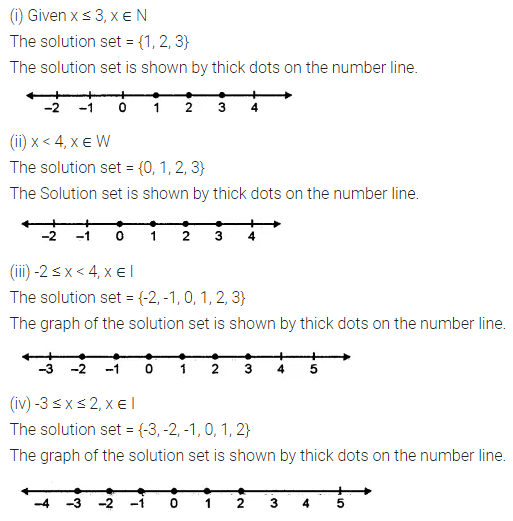
Represent the following inequations graphically:
(i) x ≤ 3, x ∈ N
(ii) x < 4, x ∈ W
(iii) -2 ≤ x < 4, x ∈ I
(iv) -3 ≤ x ≤ 2, x ∈ I
Solution:
ML Aggarwal Class 7 Solutions for ICSE Maths Chapter 9 Linear Equations and Inequalities Ex 9.3 2

Question 3.
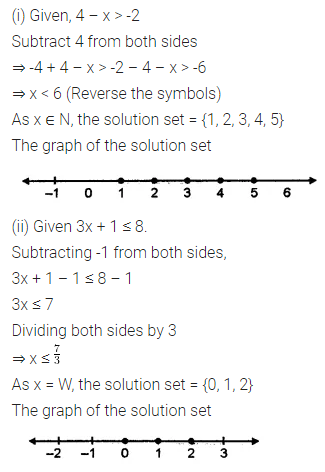
Solve the following inequations.
(i) 4 – x > -2, x ∈ N
(ii) 3x + 1 ≤ 8, x ∈ W
Also represent their solutions on the number line.
Solution:
ML Aggarwal Class 7 Solutions for ICSE Maths Chapter 9 Linear Equations and Inequalities Ex 9.3 3

Question 4.
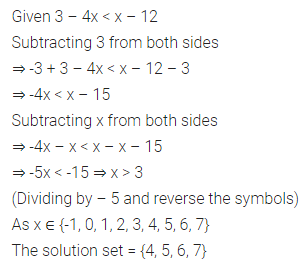
Solve 3 – 4x < x – 12, x ∈ {-1, 0, 1, 2, 3, 4, 5, 6, 7}.
Solution:
ML Aggarwal Class 7 Solutions for ICSE Maths Chapter 9 Linear Equations and Inequalities Ex 9.3 4

Question 5.
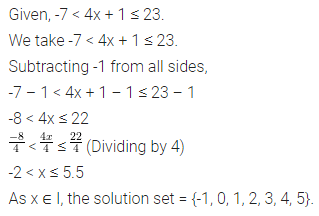
Solve -7 < 4x + 1 ≤ 23, x ∈ I.
Solution:
ML Aggarwal Class 7 Solutions for ICSE Maths Chapter 9 Linear Equations and Inequalities Ex 9.3 5

ML Aggarwal Class 7 Solutions for ICSE Maths Chapter 9 Linear Equations and Inequalities Ex 9.2

ML Aggarwal Class 7 Solutions Chapter 9 Linear Equations and Inequalities Ex 9.2 for ICSE Understanding Mathematics acts as the best resource during your learning and helps you score well in your exams.

ML Aggarwal Class 7 Solutions for ICSE Maths Chapter 9 Linear Equations and Inequalities Ex 9.2

Question 1.
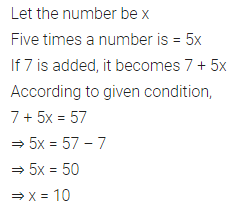
If 7 is added to five times a number, the result is 57. Find the number.
Solution:
ML Aggarwal Class 7 Solutions for ICSE Maths Chapter 9 Linear Equations and Inequalities Ex 9.2 1

Question 2.
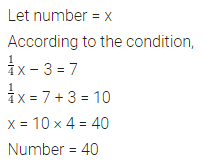
Find a number, such that one-fourth of the number is 3 more than 7.
Solution:
ML Aggarwal Class 7 Solutions for ICSE Maths Chapter 9 Linear Equations and Inequalities Ex 9.2 2

Question 3.
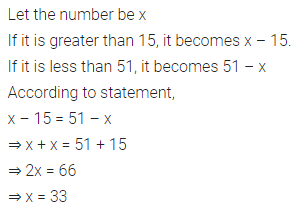
A number is as much greater than 15 as it is less than 51. Find the number.
Solution:
ML Aggarwal Class 7 Solutions for ICSE Maths Chapter 9 Linear Equations and Inequalities Ex 9.2 3

Question 4.
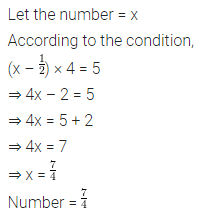
If \(\frac { 1 }{ 2 }\) is subtracted from a number and the difference is multiplied by 4, the result is 5. What is the number?
Solution:
ML Aggarwal Class 7 Solutions for ICSE Maths Chapter 9 Linear Equations and Inequalities Ex 9.2 4

Question 5.
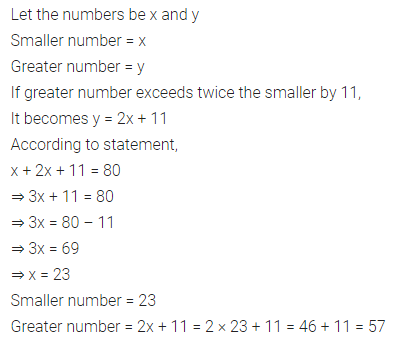
The sum of two numbers is 80 and the greater number exceeds twice the smaller by 11. Find the numbers.
Solution:
ML Aggarwal Class 7 Solutions for ICSE Maths Chapter 9 Linear Equations and Inequalities Ex 9.2 5

Question 6.
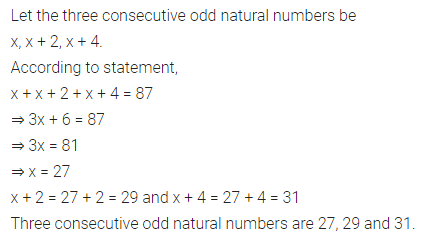
Find three consecutive odd natural numbers whose sum is 87.
Solution:
ML Aggarwal Class 7 Solutions for ICSE Maths Chapter 9 Linear Equations and Inequalities Ex 9.2 6

Question 7.
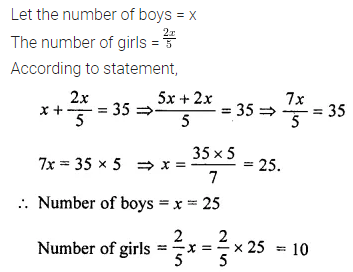
In a class of 35 students, the number of girls is two-fifths of the number of boys. Find the number of girls in the class.
Solution:
ML Aggarwal Class 7 Solutions for ICSE Maths Chapter 9 Linear Equations and Inequalities Ex 9.2 7

Question 8.
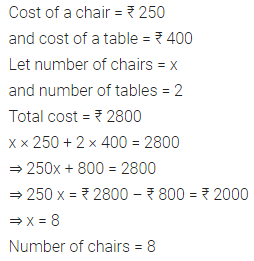
A chair costs ₹ 250 and the table costs ₹ 400. If a housewife purchased a certain number of chairs and two tables for ₹ 2800, find the number of chairs she purchased.
Solution:
ML Aggarwal Class 7 Solutions for ICSE Maths Chapter 9 Linear Equations and Inequalities Ex 9.2 8

Question 9.
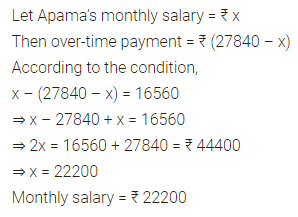
Aparna got ₹ 27840 as her monthly salary and over-time. Her salary exceeds the overtime by ₹ 16560. What is her monthly salary?
Solution:
ML Aggarwal Class 7 Solutions for ICSE Maths Chapter 9 Linear Equations and Inequalities Ex 9.2 9

Question 10.
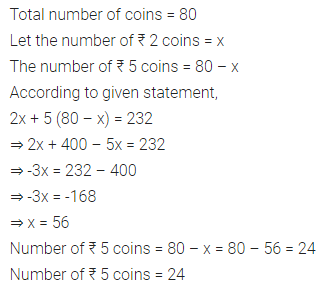
Heena has only ₹ 2 and ₹ 5 coins in her purse. If in all she has 80 coins in her purse amounting to ₹ 232, find the number of ₹ 5 coins.
Solution:
ML Aggarwal Class 7 Solutions for ICSE Maths Chapter 9 Linear Equations and Inequalities Ex 9.2 10

Question 11.
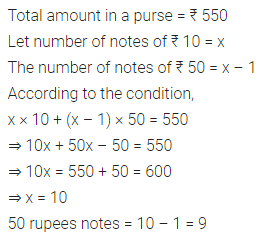
A purse contains ₹ 550 in notes of denominations of ₹ 10 and ₹ 50. If the number of ₹ 50 notes is one less than that of ₹ 10 notes, then find the number of ₹ 50 notes.
Solution:
ML Aggarwal Class 7 Solutions for ICSE Maths Chapter 9 Linear Equations and Inequalities Ex 9.2 11

Question 12.
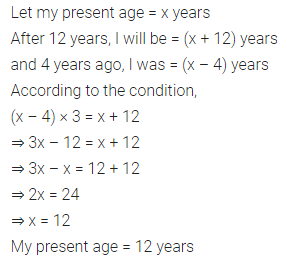
After 12 years, 1 shall be 3 times as old as I was 4 years ago. Find my present age.
Solution:
ML Aggarwal Class 7 Solutions for ICSE Maths Chapter 9 Linear Equations and Inequalities Ex 9.2 12

Question 13.
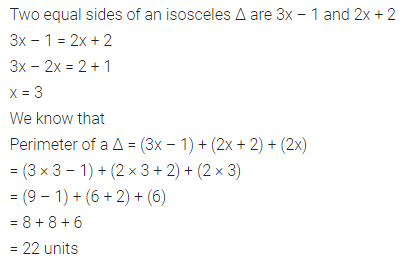
Two equal sides of an isosceles triangle are 3x – 1 and 2x + 2. The third side is 2x units. Find x and the perimeter of the triangle.
Solution:
ML Aggarwal Class 7 Solutions for ICSE Maths Chapter 9 Linear Equations and Inequalities Ex 9.2 13

Question 14.
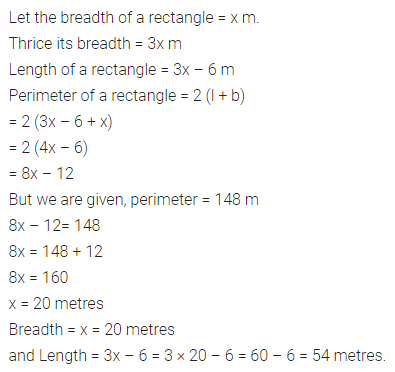
The length of a rectangle plot is 6 m less than thrice its breadth. Find the dimensions of the plot if its perimeter is 148 m.
Solution:
ML Aggarwal Class 7 Solutions for ICSE Maths Chapter 9 Linear Equations and Inequalities Ex 9.2 14

Question 15.
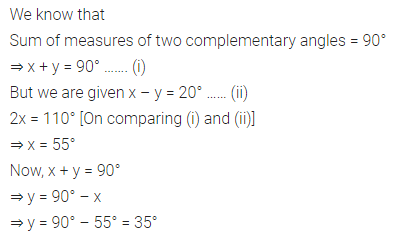
Two complementary angles differ by 20°. Find the measure of each angle.
Solution:
ML Aggarwal Class 7 Solutions for ICSE Maths Chapter 9 Linear Equations and Inequalities Ex 9.2 15

Fire and Ice Extra Questions and Answers Class 10 English First Flight

Here we are providing Fire and Ice Extra Questions and Answers Class 10 English First Flight, Extra Questions for Class 10 English was designed by subject expert teachers.

Fire and Ice Extra Questions and Answers Class 10 English First Flight

Fire and Ice Extra Questions and Answers Short Answer Type

Question 1.
What are two different views about the end of the world in the poem ‘Fire and Ice’?
Answer:
The two different views of people regarding the end of the world are—Fire and Ice i.e., by desire and hatred.

Question 2.
What does the poet think about the end of the world?
Answer:
The poet thinks about the end of the world that people think fire is the main cause of destruction. But by the end of the poem he says that both Fire and Ice are equally destructive. Both have the same power of causing destruction.

Question 3.
What do ‘Fire’ and ‘Ice’ symbolize in the poem ‘Fire’ and ‘Ice’?
Answer:
‘Fire’ and ‘Ice’ are symbolized here. ‘Fire’ stands for conflict, fury, intolerance, insensitivity while ‘Ice stands for greed, avarice, lust, rigidity, coldness, indifference, hatred, etc.

Question 4.
How can fire destroy the world?
Answer:‘
Fire’ symbolizes passion or hatred. It will lead to conflicts and ultimately result in the destruction of the world. Fire represents desire that is fervent, consuming, always wanting more. Ice represents hatred that is hard and cold.

Question 5.
What message does the poet wish to convey through the poem ‘Fire and ‘Ice’?
OR
What is the central idea of the poem ‘Fire and ‘Ice’?
Answer:
The poet presents two possibilities about the end of the world. It will be either due to ‘Fire and ‘Ice’ he prefers the first as he believes the world will end in fire but the ice will not go away.

Question 6.
Today’s world is conflict ridden. People fight over various issues and there is no peace in the world. Explain/Describe based on your reading of the poem ‘Fire’ and ‘Ice’.
Answer:
Hatred is a predominant issue in today’s world. Neighbour hates his neighbour, brother hates his brother. None is willing to forgive each other or tolerate each other. As a result of the hatred we live in a very fragmented world. If hatred continues to rule our lives and world, nothing will remain intact. All our achievements will perish and the world will come to an end. If we have to save the world we need to learn how to forget and forgive. For this we need to have enormous amount of love and compassion and be willing to tolerate the differences and learn to get along with each other.

Question 7.
What does ‘Fire’ and ‘Ice’ stand for and what is the general opinion regarding the world?
Answer:
Fire’ stands for fury, desire, lust, anger, avarice, cruelty, greed. Ice is symbolic of hatred, coldness,
rigidity, insensitivity and intolerance. The general opinion regarding the world is that the world will end in fire and some say in ice. Both the reasons contrast each other and one is equally opposite to each other. People who favour fire believe that it will be the heat and passion which will end the world. On the other side some people think that it will be the ice which will freeze the world.

Question 8.
There are many ideas about how the world will ‘end’. Do you think the world will end some day? Have you ever thought what would happen if the sun got so hot that it ‘burst’, or grew colder and colder?
Answer:
There are many ideas about how the world will end. Robert Frost points out two destructive forces—Fire and Ice, they may cause an end to the world. Yes, everything is subjected to an end. The world would come to an end someday. The cause may be a war or natural calamity. The sun is the main source of energy. It is life on the earth. If the sun got so hot that it “burst’ or grew colder and colder the life on the earth would come to an end.

Question 9.
For Frost, what do ‘fire’ and ‘ice’ stand for? Here are some ideas:
Fire and Ice Extra Questions and Answers Class 10 English First Flight
Answer:
Robert Frost compares and contrasts two destructive forces Fire and Ice. For him ‘Fire’ stands for desire, greed, lust, intolerance conflict etc. These vices consume and destroy the fabric of society. ‘Ice stands for hatred, rigidity, insensitivity, coldness and indifference. Hate is something that causes people to be rigid, unmoving and cold.

Question 10.
What is the rhyme scheme of the poem? How does it help in bringing out the contrasting ideas in the poem?
Answer:
The rhyme scheme of the poem is—ab ab—be—be.
The rhyme scheme brings out the contrasting ideas and separates them beautifully.
fire – desire
hate – great
twice – ice
ice – suffice

Fire and Ice Extra Questions and Answers Reference to Context

Read the stanza and answer the questions that follow:

Question 1.
Some say the world will end in fire
Some say in ice
From what I’ve tasted of desire
I hold with those who favour fire.

(i) Name the poem and the poet.
(ii) What are the two destructive forces?
(iii) What do they stand for?
(iv) What does he favour?
Answer:
(i) These lines have been taken from the poem ‘Fire and Ice’ composed by Robert Frost.
(ii) ‘Fire’ and ‘Ice’ are two destructive forces according to the poet.
(iii) ‘Fire’ stands for ‘desire’ and ‘Ice’ stands for ‘hatred’.
(iv) Robert Frost supports the view that fire would cause the destruction of the world.

Question 2.
But if it had to perish twice,
I think I know enough of hate
To say that for destruction ice
Is also great And would suffice.

(i) What does ‘Ice’ stand for?
(ii) What does the poet believe?
(iii) What is the another destructive force?
(iv) Find a word in these lines that means opposite to ‘creation’.
Answer:
(i) Ice stands for hatred in this poem.
(ii) Robert Frost believes that Ice is equally destructive and can destroy the world.
(iii) Fire is another destructive force.
(iv) ‘Destruction’.