ML Aggarwal Class 7 Solutions for ICSE Maths Chapter 10 Lines and Angles Check Your Progress

ML Aggarwal Class 7 Solutions Chapter 10 Lines and Angles Check Your Progress for ICSE Understanding Mathematics acts as the best resource during your learning and helps you score well in your exams.

ML Aggarwal Class 7 Solutions for ICSE Maths Chapter 10 Lines and Angles Check Your Progress

Question 1.
Find the supplementary angle of each of the following angles:
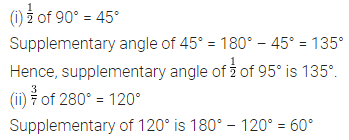
(i) \(\frac { 1 }{ 2 }\) of 90°
(ii) \(\frac { 3 }{ 7 }\) of 280°
Solution:
ML Aggarwal Class 7 Solutions for ICSE Maths Chapter 10 Lines and Angles Check Your Progress 1

Question 2.
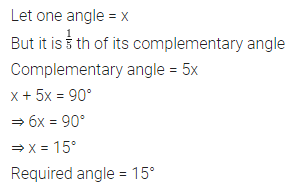
How many degrees are there in an angle which is one-fifth of its complement?
Solution:
ML Aggarwal Class 7 Solutions for ICSE Maths Chapter 10 Lines and Angles Check Your Progress 2

Question 3.
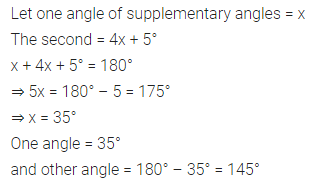
If two angles are supplementary and one angle is 5° more than four times the other, find the angles.
Solution:
ML Aggarwal Class 7 Solutions for ICSE Maths Chapter 10 Lines and Angles Check Your Progress 3

Question 4.
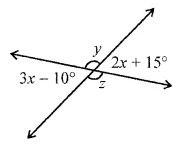
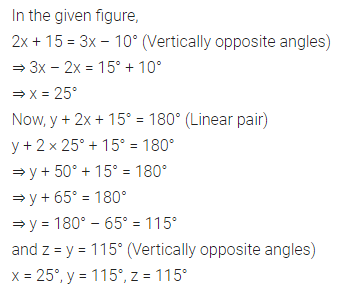
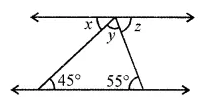
The given diagram shows two intersecting straight lines. Find the values of x, y and z.
ML Aggarwal Class 7 Solutions for ICSE Maths Chapter 10 Lines and Angles Check Your Progress 4
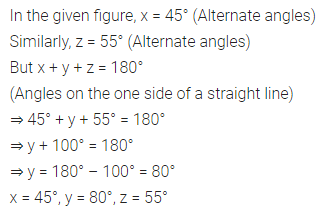
Solution:
ML Aggarwal Class 7 Solutions for ICSE Maths Chapter 10 Lines and Angles Check Your Progress 5

Question 5.
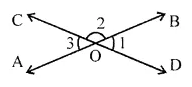
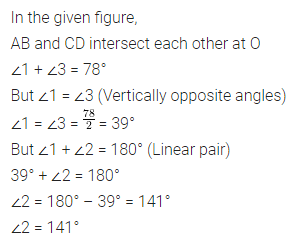
In the given diagram, lines AB and CD intersect at O. If ∠1 + ∠3 = 78°, find the size of ∠2.
ML Aggarwal Class 7 Solutions for ICSE Maths Chapter 10 Lines and Angles Check Your Progress 6
Solution:
ML Aggarwal Class 7 Solutions for ICSE Maths Chapter 10 Lines and Angles Check Your Progress 7

Question 6.
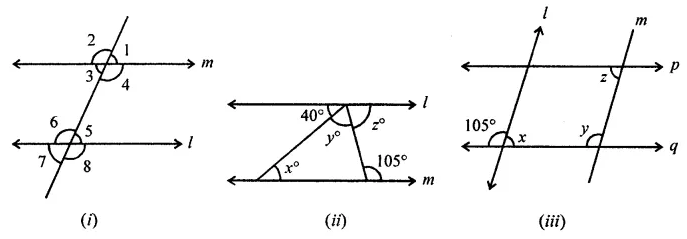
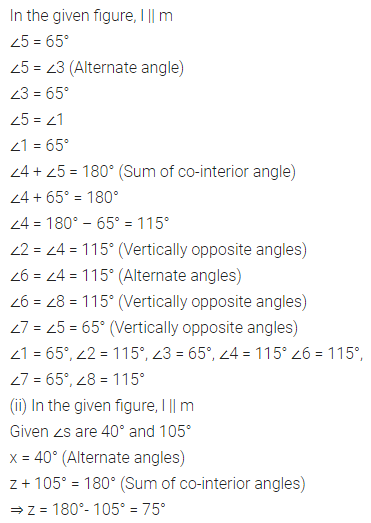
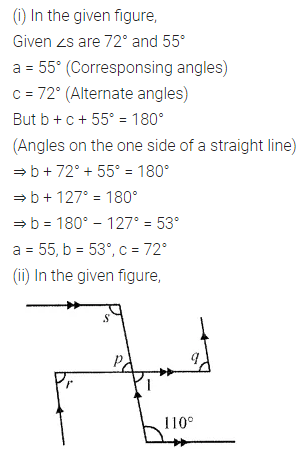
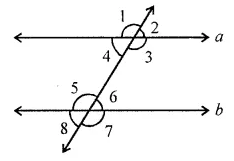
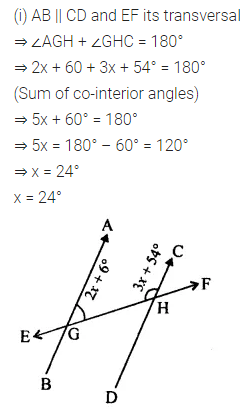
(a) In the figure (i) given below, l || m. If ∠5 = 65°, find all other angles.
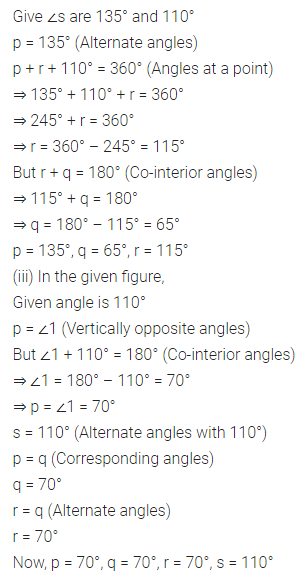
(b) In the figure (ii) given below, l || m. Find the values of x, y and z.
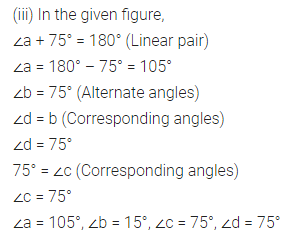
(c) In the figure (iii) given below, l || m and p || q. Find the values of x, y and z.
ML Aggarwal Class 7 Solutions for ICSE Maths Chapter 10 Lines and Angles Check Your Progress 8
Solution:
ML Aggarwal Class 7 Solutions for ICSE Maths Chapter 10 Lines and Angles Check Your Progress 9
ML Aggarwal Class 7 Solutions for ICSE Maths Chapter 10 Lines and Angles Check Your Progress 10

The Trees Extra Questions and Answers Class 10 English First Flight

Here we are providing The Trees Extra Questions and Answers Class 10 English First Flight, Extra Questions for Class 10 English was designed by subject expert teachers.

The Trees Extra Questions and Answers Class 10 English First Flight

The Trees Extra Questions and Answers Short Answer Type

Question 1.
Why do the trees need to move out? Where have they been and why?
Answer:
The trees in the forest have been cut and man has planted trees in his courtyard for his selfish decorative purposes. It makes the trees feel suffocated and out of place. So they need to move out into the forest. They have been in the city houses as men have imprisoned them there.

Question 2.
What makes the forest empty? What cannot happen in a-treeless forest?
Answer:
Man’s cutting the trees of the forest at an uncontrollable speed has resulted in the empty forests. In a treeless forest, birds and insects cannot find shelter and make their homes there. The sun cannot cool its rays in the shadow there.

Question 3.
How do the trees rebel against their imprisonment at the hand of the man?
Answer:
Man has imprisoned the trees of the forest in his houses in cities. The trees rebel against their imprisonment. The roots come out of the floors by breaking them. The leaves come out of the windows by breaking the glasses. The long cramped branches start expanding themselves. Thus, the trees move out into the forest.

Question 4.
What kind of whispers can the poet hear? Why will these be silent tomorrow?
Answer:
The poet can hear the voices of the trees talking to each other, asserting their right to be free and the sounds of their moving out. It may also be her inner voice that reprimands her for imprisoning the trees. The whispers will be silent tomorrow as the trees will move out into the forest and will be free.

Question 5.
What does the poetess compare the bough with and why?
Answer:
The boughs are long and cramped. The poet compares the boughs with the patients who have been recently discharged and are moving out of the clinic doors because the boughs also move out in the same semi-dazed state as if they are under a spell.

Question 6.
The poem ‘The Trees’ presents a conflict between Man and Nature. Discuss.
Answer:
The poem ‘The Trees’ presents the rebellion of the tree against the human oppression and imprisonment within walls. The forest is the natural habitat of the trees. The trees feel suffocated in houses. They rebel against it and move out.

Question 7.
Why is the poet writing long letters? Why does she not mention the departure of the trees?
Answer:
The poet can feel the sorrow of the trees imprisoned in the cities. So, she is writing long letters or poems voicing the trees’ right to be in their natural habitat i.e., the forest. She does not mention the departure of the trees in her letters as she is too embarrassed for imprisoning them ever.

Question 8.
How does the changing forms of moon relate to the moving out of the trees?
Answer:
The moon also changes its forms with the moving out of the trees. In a treeless forest it appears as a whole, closed body. But with the trees moving out into the forest, the moon also appears as a broken mirror. Its pieces flash light on the tallest of trees.

Question 9.
Describe the symbolism in the poem “The Trees”.
Answer:
The poet uses trees as a metaphor for human beings. The human beings feel suffocated and sad under the oppression and dependence. They yearn for their freedom and independence. They rebel against the oppression, slavery and exploitation to be free and be on their own. The trees also rebel against imprisonment to return to the forest. Thus, they are apt symbol for human beings.

Question 10.
Conflict between human and nature is always there. Nature is also rebelling against civilization and becoming destructive. Explain.
OR
A conflict between man and nature is going on, in this civilization pursuit, men are disregarding the natural growth of plants and trees. In total confinement, nature also rebels against civilization and becomes destructive. Elaborate.
Answer:
Man has been destroying nature due to personal and material pursuits. He is endlessly playing havoc with nature. He is trying to harness wind, solar energy and flora. In this pursuit man has forgotten that excessive destruction can carry us to any situation. Man is cutting trees and destroying the natural habitat. This is causing global warming with overall rise in temperature. If these practices go unchecked, we might soon be drowned due to melting of ice from polar caps. Man should wake up and save the planet earth from destructive forces of nature.

Question 11.
The trees in the poem stretch out their branches, break remove common barriers and struggle hard even out in the open in their natural environment. Analyze the efforts one puts into breaking sway captivity and striving for freedom.
OR
Freedom is the basic theme of happiness for all creatures as well as plants. Explain this statement with reference to the struggle of the branches to come out in open in the veranda of the poet’s house.
Answer:
It is true that freedom is the basic theme of happiness in this universe. Freedom is the true law of nature. This idea can be found everywhere and in all spheres, even the palace of gold is useless without freedom. We have read about so many national heroes who have sacrificed their everything for freedom and to make their country free. Freedom is the very first need for all for human beings as well as for animals. “

In this poem, the poet has described the deep feelings of the trees that want to become free from human beings’ prison. The description of struggle made by the branches to come out in open from the floor is too real and heart touching. The trees don’t want to live in these surroundings. So they do their best to come out of the floor and window.

Question 12.
After reading the poem ‘The Trees’ we come to conclude a definite point that there is clear conflict between nature and human beings and the reason is behaviour of human beings. Describe.
Answer:
Man’s cutting the trees of the forest at an uncontrollable speed has resulted in the empty forests. In a treeless forest, birds and insects cannot find shelter and make their homes there. The sun cannot cool its rays in the shadow there.

Question 13.
(i) Find, in the first stanza, three things that cannot happen in a treeless forest.
(ii) What picture do these words create in your mind: … “sun bury its feet in shadow…”?
(ii) What could the poet mean by the sun’s ‘feet”?
Answer:
(i) The three things that cannot happen in a treeless forest Eire the sitting of a bird on tree, the hiding of insects and the sun burying its feet in the shadow of the forest.

(ii) The sun radiates heat and the given words create a picture of the hot, radiating sun cooling its feet in the cool shadow of the forest. The sun’s feet refer to its rays that reach the earth.

Question 14.
(i) Where are the trees in the poem? What do their roots, their leaves and their twigs do?
(ii) What does the poet compare their branches to?
Answer:
(i) In the poem, the trees are in the poet’s house. Their roots work all night to disengage themselves from the cracks in the veranda floor. The leaves make efforts to move towards the glass, while the small twigs get stiff with exertion.

(ii) The poet compares the ‘long-cramped’ branches that have been shuffling under the roof to newly discharged patients who look half-dazed as they move towards the hospital doors after long ill¬nesses and wait to get out of the hospital. The branches also have cramped under the roof and want to get out into the open to spread themselves in fresh air.

Question 15.
(i) How does the poet describe the moon:
(a) at the beginning of the third stanza, and
(b) at its end? What causes this change?
(ii) What happens to the house when the trees move out Of it?
(iii) Why do you think the poet does not mention “the departure of the forest from the house” in her letters? (Could it be that we are often silent about important happenings that are so unexpected that they embarrass us? Think about this again when you answer the next set of questions.)
Answer:
(i) (a) In the beginning of the third stanza of the poem “The Trees”, the poet describes the moon at its perfection. She tells us that full moon shines in an open sky.

(b) In the end of the third stanza, the poet describes that the moon is broken like a mirror. The cause of this change is that the poet imagines that the forest or trees and plants are moving out from her home. When the forest was in her home the moon seemed full to her. But when the trees are moving out of the house into the forest, the moon seems fragmented to her.

(ii) When the trees move out of the house, the poet feels that the glass is breaking and the trees are partially falling towards the front in the night. Winds rush to meet and welcome the trees.

(iii) When the trees are moving out of the poet’s house, she is writing long letters. But in the letters the poet does not mention about the departure of the forest from the house. I think the poet does not mention about moving out of the trees because howsoever she may not want it, yet it happened so hastily and unexpectedly that she felt embarrassed. That is why she could not mention about it in her letter.

Question 16.
Now that you have read the poem in detail, we can begin to ask what the poem might mean.
Here are two suggestions. Can you think of others?
(i) Does the poem present a conflict between man and nature? Compare it with A Tiger in the Zoo. Is the poet suggesting that plants and trees, used for ‘interior decoration’ in cities while forests are cut down, are ‘imprisoned’, and need to ‘break out’?
(ii) On the other hand, Adrienne Rich has been known to use trees as a metaphor for human beings; this is a recurrent image in her poetry. What new meanings emerge from the poem if you take its trees to be symbolic of this particular meaning?
Answer:
(i) The poem “The Trees’ depicts the serious problem of deforestation worldwide, which causes ecological imbalances and the risk of global warming. The poet means to say that we are depriving the forest of their trees and creating concrete jungles in the cities. The irony of the situation is that we are decorating our homes and cities with trees and plants and cutting the trees from the forest. If we compare this poem to another poem, ‘A Tiger in the Zoo’, we find many similarities.

We imprison the tigers and other animals in the zoo whereas their true places is in the forest. Similarly, we ‘imprison’ the trees and plants in our houses and cities whereas their true place is in the forests. There is nothing wrong with decorating the houses and cities with the plants and trees. But it is something unpardonable to deprive the forests of the trees and plants. That is why the poet imagines that the trees from the houses want to be liberated and move to the forest.

(ii) There is another aspect of this beautiful poem. Adrienne Rich in many of her poems has used trees as a metaphor for human beings. So, if we think of the poem from this point of view, it signifies that human beings are constantly going away from the country life. Everybody seems to settle in big cities where we are deprived of the qualities of enjoying nature in its various forms. Migration of more and more people towards city life creates a vacuum in the minds of such human beings. So, they crave and long for moving to natural surrounding. They earnestly and eagerly desire to go back to nature.

The Trees Extra Questions and Answers Reference to Context

Read the following stanza and answer the questions that follows:

Question 1.
The trees inside are moving out into the forest,
the forest that was empty all these days where no bird could sit no insect hide
no sun bury its feet in shadow
the forest that was empty all these nights
will be full of trees by morning.

(i) Name of poem and poet.
(ii) From where do the trees move out into the forest?
(iii) Why has the forest been empty all these days?
(iv) How do you think will the forest be full of trees again?
Answer:
(i) These lines have been taken from the poem ‘The Trees’ composed by ‘Adrienne Rich’.
(ii) The trees move out into the forest from the human houses.
(iii) The forest has been empty all these days because trees have been cut and transported to the cities.
(iv) The forest would be again full of trees when men would understand his responsibility towards the nature.

Question 2.
All night the roots work
to disengage themselves from the cracks
in the veranda floor.
The leaves strain towards the glass
small twigs stiff with exertion
long-cramped boughs shuffling under the roof
like newly discharged patients
half-dazed, moving
to the clinic doors.

(i) What are the roots trying to do?
(ii) Why are the small twigs stiff?
(iii) What does the poet mean by ‘the clinic doors”?
(iv) Name the poem and poet.
Answer:
(i) The roots are trying to break the veranda floor.
(ii) The small twigs are stiff as they were straining to break the glass.
(iii) The poetess means that the trees are sick because they are being suffocated and choked in cramped spaces of the veranda.
They need to be cured and become healthy again and for them the clinic is the open spaces of the forest.
(iv) The poem “Trees” composed by ‘Adrienne Rich’.

Question 3.
I sit inside, doors open to the veranda
writing long letters
in which I scarcely mention the departure of the forest from the house.
The night is fresh, the whole moon shines
in a sky still open
the smell of leaves and lichen
still reaches like a voice into the rooms.

(i) Where is the speaker?
(ii) Why does the poet not mention the departure of the forest?
(iii) How do the leaves and lichen talk to each other?
(iv) Name the poem and poet.
Answer:
(i) The speaker (poetess) is sitting inside her house
(ii) The poetess doesn’t mention the departure of the forest because she is embarrassed.
(iii) The leaves and lichen talk to each other through the smell.
(iv) The poem “Trees” composed by Adrienne Rich.

Question 4.
My head is full of whispers
which tomorrow will be silent.
Listen. The glass is breaking.
The trees are stumbling forward
into the night. Winds rush to meet them.
The moon is broken like a mirror,
its pieces flash now in the crown
of the tallest oak.

(i) What are ‘whispers’ that the poetess can hear?
(ii) What does the poet ask us to listen to?
(iii) Which poetic device has been used?
(iv) Name the poem and poet.
Answer:
(i) The whispers that the poetess can hear are the sounds made by the outgoing trees.
(ii) The poetess asks us to listen to the sounds of the breaking glass.
(iii) The poetic device is ‘Personification’. The trees are personified.
(iv) The poem “Trees” written by ‘Adrienne Rich’

ML Aggarwal Class 7 Solutions for ICSE Maths Chapter 10 Lines and Angles Objective Type Questions

ML Aggarwal Class 7 Solutions Chapter 10 Lines and Angles Objective Type Questions for ICSE Understanding Mathematics acts as the best resource during your learning and helps you score well in your exams.

ML Aggarwal Class 7 Solutions for ICSE Maths Chapter 10 Lines and Angles Objective Type Questions

Mental Maths

Question 1.
Fill in the blanks:
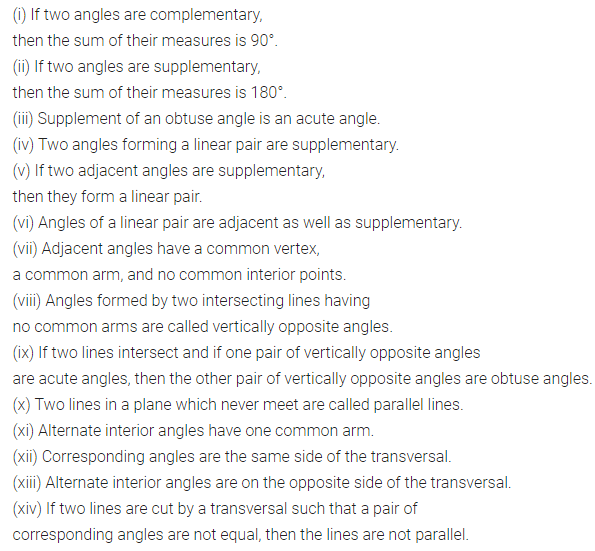
(i) If two angles are complementary, then the sum of their measures is ………..
(ii) If two angles are supplementary, then the sum of their measures is …………
(iii) Supplement of an obtuse angle is ……….
(iv) Two angles forming a linear pair are ……….
(v) If two adjacent angles are supplementary, then they form a ………..
(vi) Angles of a linear pair are as well as ………..
(vii) Adjacent angles have a common vertex, a common ……….. and no common ………
(viii)Angles formed by two intersecting lines having no common arms are called ………..
(ix) If two lines intersect and if one pair of vertically opposite angles are acute angles, then the other pair of vertically opposite angles are ……..
(x) Two lines in a plane which never meet are called ……….
(xi) Alternate interior angles have one common …………
(xii) Corresponding angles are on the ……….. side of the transversal.
(xiii) Alternate interior angles are on the ………… side of the transversal.
(xiv) If two lines are cut by a transversal such that a pair of corresponding angles are not equal, then the lines are ………..
Solution:
ML Aggarwal Class 7 Solutions for ICSE Maths Chapter 10 Lines and Angles Objective Type Questions 1

Question 2.
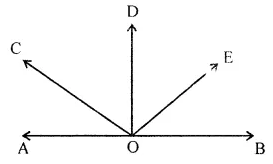
In the given figure, AB is a straight line and OD ⊥ AB. Observe the figure and fill in the following blanks:
ML Aggarwal Class 7 Solutions for ICSE Maths Chapter 10 Lines and Angles Objective Type Questions 2
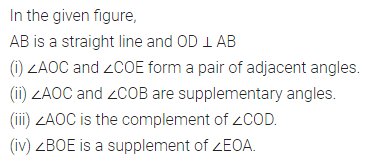
(i) ∠AOC and ∠COE form a pair of ……….. angles.
(ii) ∠AOC and ∠COB are ……….. angles.
(iii) ∠AOC is ………… of ∠COD.
(iv) ∠BOE is …………. of ∠EOA.
Solution:
ML Aggarwal Class 7 Solutions for ICSE Maths Chapter 10 Lines and Angles Objective Type Questions 3

Question 3.
State whether the following statements are true (T) or false (F):
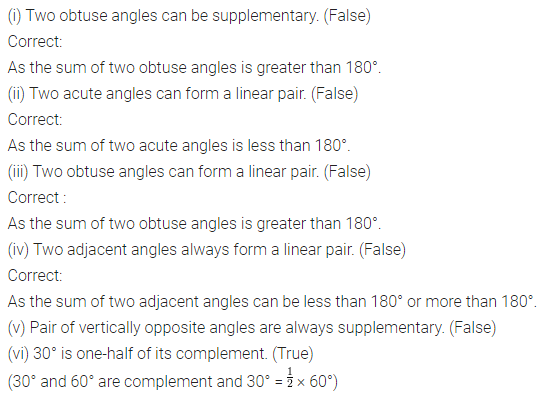
(i) Two obtuse angles can be supplementary.
(ii) Two acute angles can form a linear pair.
(iii) Two obtuse angles can form a linear pair.
(iv) Two adjacent angles always form a linear pair.
(v) Pair of vertically opposite angles are always supplementary.
(vi) 30° is one-half of its complement.
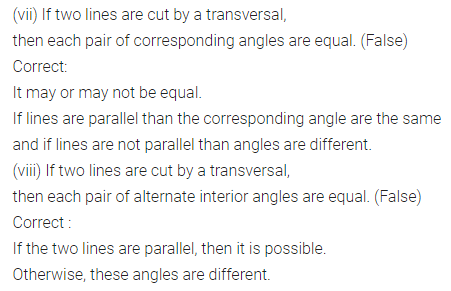
(vii) If two lines are cut by a transversal,
then each pair of corresponding angles are equal.
(viii) If two lines are cut by a transversal,
then each pair of alternate interior angles are equal.
Solution:
ML Aggarwal Class 7 Solutions for ICSE Maths Chapter 10 Lines and Angles Objective Type Questions 4
ML Aggarwal Class 7 Solutions for ICSE Maths Chapter 10 Lines and Angles Objective Type Questions 5

Multiple Choice Questions

Choose the correct answer from the given four options (4 to 14):
Question 4.
A pair of complementary angles is
(a) 130°, 50°
(b) 35°, 55°
(c) 25°, 75°
(d) 27°, 53°
Solution:
ML Aggarwal Class 7 Solutions for ICSE Maths Chapter 10 Lines and Angles Objective Type Questions 6

Question 5.
A pair of supplementary angles is
(a) 55°, 115°
(b) 65°, 125°
(b) 47°, 133°
(d) 40°, 50°
Solution:
ML Aggarwal Class 7 Solutions for ICSE Maths Chapter 10 Lines and Angles Objective Type Questions 7

Question 6.
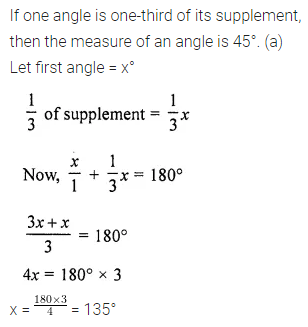
If an angle is one-third of its supplement, then the measure of the angle is
(a) 45°
(b) 30°
(c) 135°
(d) 150°
Solution:
ML Aggarwal Class 7 Solutions for ICSE Maths Chapter 10 Lines and Angles Objective Type Questions 8

Question 7.
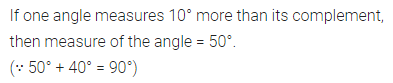
If an angle measures 10° more than its complement, then the measure of the angle is
(a) 40°
(b) 55°
(c) 35°
(d) 50°
Solution:
ML Aggarwal Class 7 Solutions for ICSE Maths Chapter 10 Lines and Angles Objective Type Questions 9

Question 8.
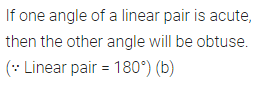
If one angle of a linear pair is acute, then the other angle is
(a) acute
(b) obtuse
(c) right
(d) straight
Solution:
ML Aggarwal Class 7 Solutions for ICSE Maths Chapter 10 Lines and Angles Objective Type Questions 10

Question 9.
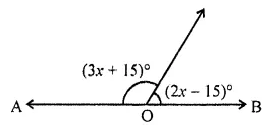
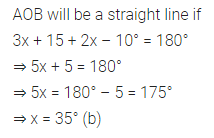
In the given figure, the value of x that will make AOB a straight line is
(a) x = 40
(b) x = 35
(c) x = 30
(d) x = 25
ML Aggarwal Class 7 Solutions for ICSE Maths Chapter 10 Lines and Angles Objective Type Questions 11
Solution:
ML Aggarwal Class 7 Solutions for ICSE Maths Chapter 10 Lines and Angles Objective Type Questions 12

Question 10.
If two lines are intersected by a transversal, then the number of pairs of interior angles on the same side of transversal is
(a) 1
(b) 2
(c) 3
(d) 4
Solution:
ML Aggarwal Class 7 Solutions for ICSE Maths Chapter 10 Lines and Angles Objective Type Questions 13

Question 11.
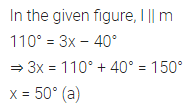
In the given figure, if l || m then the value of x is
(a) x = 50
(b) x = 60
(c) x = 70
(d) x = 45
ML Aggarwal Class 7 Solutions for ICSE Maths Chapter 10 Lines and Angles Objective Type Questions 14
Solution:
ML Aggarwal Class 7 Solutions for ICSE Maths Chapter 10 Lines and Angles Objective Type Questions 15

Question 12.
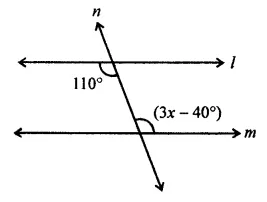
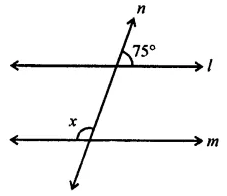
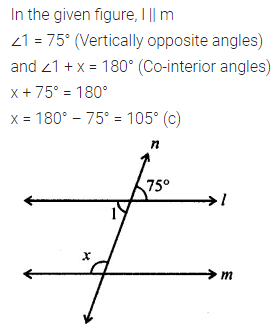
In the gitsen figure, if l || m then the value of x is
(a) x = 75°
(b) x = 95°
(c) x = 105°
(d) x = 115°
ML Aggarwal Class 7 Solutions for ICSE Maths Chapter 10 Lines and Angles Objective Type Questions 16
Solution:
ML Aggarwal Class 7 Solutions for ICSE Maths Chapter 10 Lines and Angles Objective Type Questions 17

Question 13.
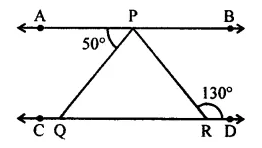
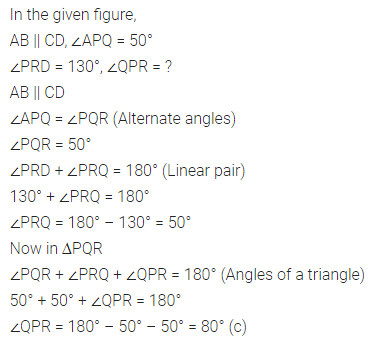
In the given figure, AB || CD. If ∠APQ = 50° and ∠PRD = 130°, then ∠QPR is
(a) 30°
(b) 50°
(c) 80°
(d) 130°
ML Aggarwal Class 7 Solutions for ICSE Maths Chapter 10 Lines and Angles Objective Type Questions 18
Solution:
ML Aggarwal Class 7 Solutions for ICSE Maths Chapter 10 Lines and Angles Objective Type Questions 19

Question 14.
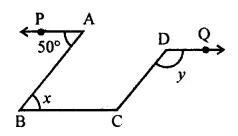
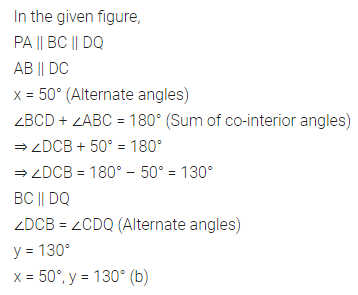
In the given figure, PA || BC || DQ and AB || DC. Then the values of x and y are respectively:
(a) 50°, 120°
(b) 50°, 130°
(c) 60°, 120°
(d) 60°, 130°
ML Aggarwal Class 7 Solutions for ICSE Maths Chapter 10 Lines and Angles Objective Type Questions 20
Solution:
ML Aggarwal Class 7 Solutions for ICSE Maths Chapter 10 Lines and Angles Objective Type Questions 21

Higher Order Thinking Skills (HOTS)

Question 1.
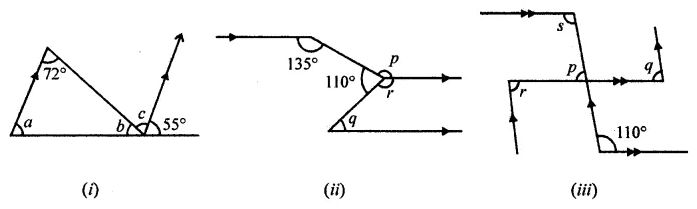
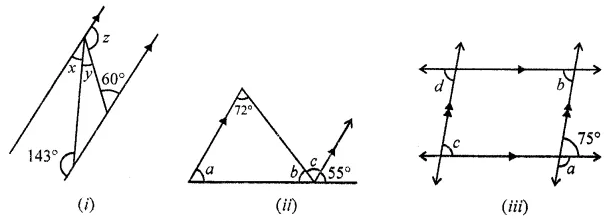
Calculate the measure of each lettered angle in the following figures (parallel line segments / rays are denoted by thick matching arrows):
ML Aggarwal Class 7 Solutions for ICSE Maths Chapter 10 Lines and Angles Objective Type Questions 22
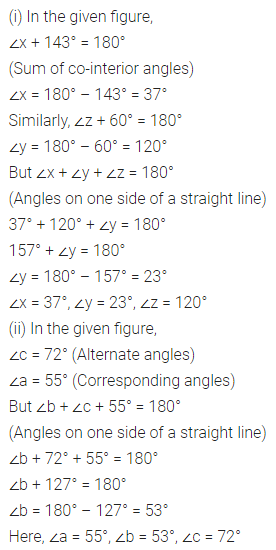
Solution:
ML Aggarwal Class 7 Solutions for ICSE Maths Chapter 10 Lines and Angles Objective Type Questions 23
ML Aggarwal Class 7 Solutions for ICSE Maths Chapter 10 Lines and Angles Objective Type Questions 24

ML Aggarwal Class 7 Solutions for ICSE Maths Chapter 10 Lines and Angles Ex 10.2

ML Aggarwal Class 7 Solutions Chapter 10 Lines and Angles Ex 10.2 for ICSE Understanding Mathematics acts as the best resource during your learning and helps you score well in your exams.

ML Aggarwal Class 7 Solutions for ICSE Maths Chapter 10 Lines and Angles Ex 10.2

Question 1.
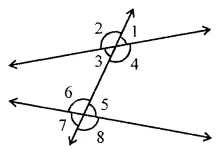
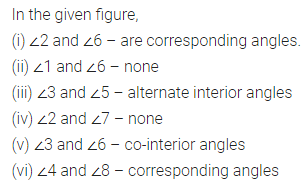
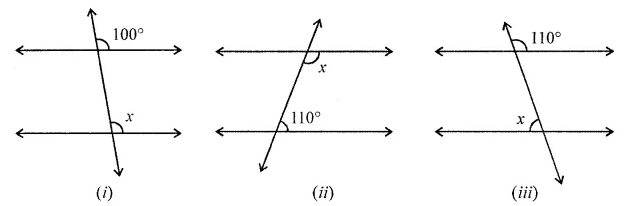
Identify each of the given pair of angles as alternate interior angles, co-interior angles or corresponding angles or none of these in the given figure:
ML Aggarwal Class 7 Solutions for ICSE Maths Chapter 10 Lines and Angles Ex 10.2 1
(i) ∠2, ∠6
(ii) ∠1, ∠6
(iii) ∠3, ∠5
(iv) ∠2, ∠7
(v) ∠3, ∠6
(vi) ∠4, ∠8
Solution:
ML Aggarwal Class 7 Solutions for ICSE Maths Chapter 10 Lines and Angles Ex 10.2 2

Question 2.
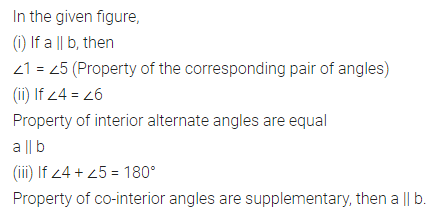
State the property that is used in each of the following statements:
(i) If a || b, then ∠1 = ∠5.
(ii) If ∠4 = ∠6, then a || b.
(iii) If ∠4 + ∠5 = 180°, then a || b.
ML Aggarwal Class 7 Solutions for ICSE Maths Chapter 10 Lines and Angles Ex 10.2 3
Solution:
ML Aggarwal Class 7 Solutions for ICSE Maths Chapter 10 Lines and Angles Ex 10.2 4

Question 3.
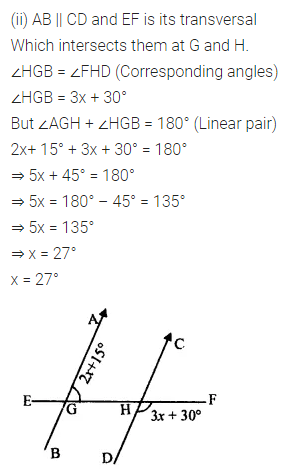
In each of the following figures, a pair of parallel lines is cut by a transversal. Find the value of x:
ML Aggarwal Class 7 Solutions for ICSE Maths Chapter 10 Lines and Angles Ex 10.2 5
Solution:
ML Aggarwal Class 7 Solutions for ICSE Maths Chapter 10 Lines and Angles Ex 10.2 6

Question 4.
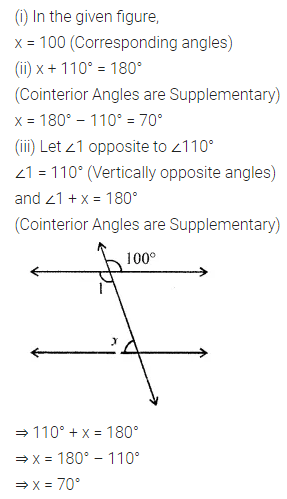
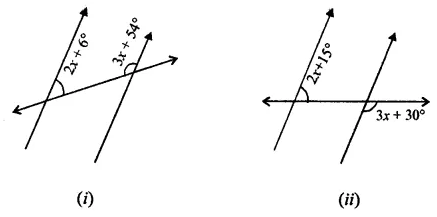
In the following figures, a pair of parallel lines are cut by a transversal. Find the value of x in each figure.
ML Aggarwal Class 7 Solutions for ICSE Maths Chapter 10 Lines and Angles Ex 10.2 7
Solution:
ML Aggarwal Class 7 Solutions for ICSE Maths Chapter 10 Lines and Angles Ex 10.2 8
ML Aggarwal Class 7 Solutions for ICSE Maths Chapter 10 Lines and Angles Ex 10.2 9

Question 5.
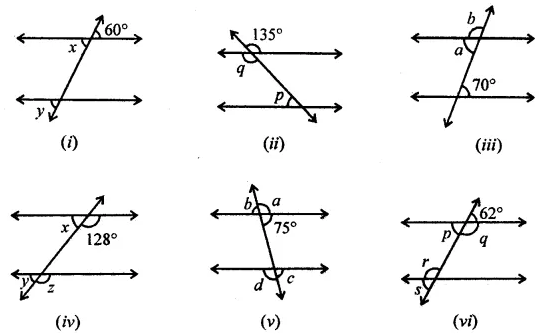
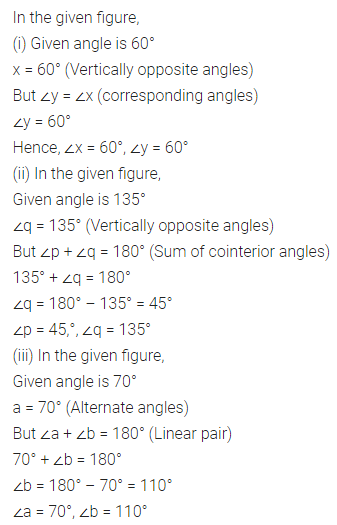
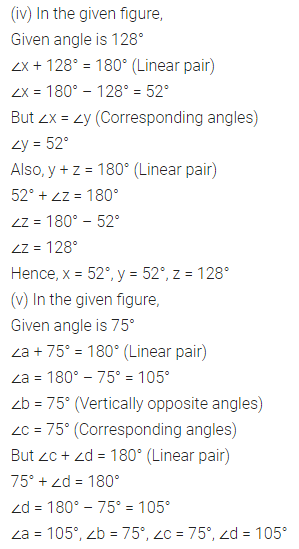
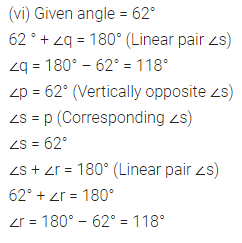
In the following figures (i) to (vi), a pair of parallel lines are cut by a transversal. Find the size of each lettered angle.
ML Aggarwal Class 7 Solutions for ICSE Maths Chapter 10 Lines and Angles Ex 10.2 10
Solution:
ML Aggarwal Class 7 Solutions for ICSE Maths Chapter 10 Lines and Angles Ex 10.2 11
ML Aggarwal Class 7 Solutions for ICSE Maths Chapter 10 Lines and Angles Ex 10.2 12
ML Aggarwal Class 7 Solutions for ICSE Maths Chapter 10 Lines and Angles Ex 10.2 13

Question 6.
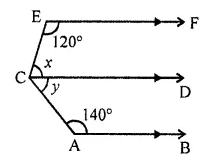
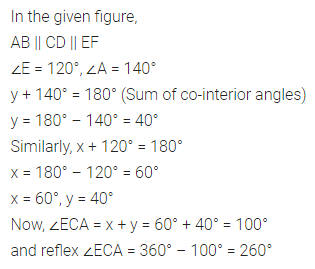
In the given diagram, lines AB, CD and EF are parallel. Calculate the values of x and y. Hence, find the reflex angle ECA.
ML Aggarwal Class 7 Solutions for ICSE Maths Chapter 10 Lines and Angles Ex 10.2 14
Solution:
ML Aggarwal Class 7 Solutions for ICSE Maths Chapter 10 Lines and Angles Ex 10.2 15

Question 7.
In the given figure, l || m. Find the values of x, y and z.
ML Aggarwal Class 7 Solutions for ICSE Maths Chapter 10 Lines and Angles Ex 10.2 16
Solution:
ML Aggarwal Class 7 Solutions for ICSE Maths Chapter 10 Lines and Angles Ex 10.2 17

Question 8.
Calculate the measure of each lettered angle in the following figure (parallel lines, segment or rays are denoted by thick matching arrows):
ML Aggarwal Class 7 Solutions for ICSE Maths Chapter 10 Lines and Angles Ex 10.2 18
Solution:
ML Aggarwal Class 7 Solutions for ICSE Maths Chapter 10 Lines and Angles Ex 10.2 19
ML Aggarwal Class 7 Solutions for ICSE Maths Chapter 10 Lines and Angles Ex 10.2 20

Question 9.
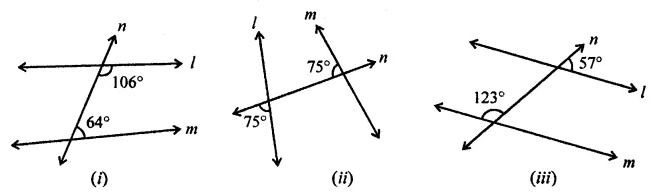
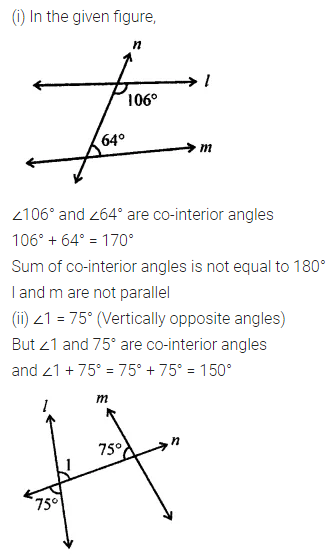
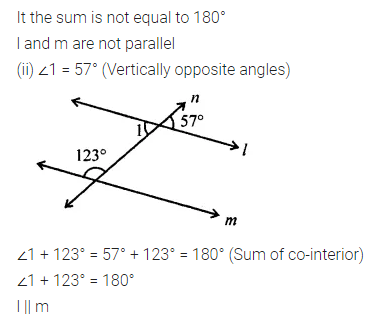
In the figure given below, state whether the lines l and m are parallel or not.
ML Aggarwal Class 7 Solutions for ICSE Maths Chapter 10 Lines and Angles Ex 10.2 21
Solution:
ML Aggarwal Class 7 Solutions for ICSE Maths Chapter 10 Lines and Angles Ex 10.2 22
ML Aggarwal Class 7 Solutions for ICSE Maths Chapter 10 Lines and Angles Ex 10.2 23

Animals Extra Questions and Answers Class 10 English First Flight

Here we are providing Animals Extra Questions and Answers Class 10 English First Flight, Extra Questions for Class 10 English was designed by subject expert teachers.

Animals Extra Questions and Answers Class 10 English First Flight

Animals Extra Questions and Answers Short Answer Type

Question 1.
Why does the poet wish to live with animals?
Answer:
The poet wishes if he could be transformed and live with animals. The poet thinks that animals Eire self contained, peaceful, unambitious, uncomplaining, simple Eind honest. He finds himself more like Einimsds.

Question 2.
About what do the animals not ‘whine’ and ‘weep’?
Answer:
The animals do not show anxiety or distress nor do they moan about the condition in which they live.. The animals do not lie awake in the dark and weep for their sins.

Question 3.
‘Not one kneels to another, nor to his. kind that lived thousands of years ago.’ How does the poet distinguish between animals and human being in these lines?
Answer:
The poet wishes to convey that the EinimEils do not kneel before others especially before the ones who lived thousand of years ago. But the humsm beings indulge in hero worship and kneel to another human beings, who might have lived thousands of years ago.

Question 4.
What does the poet wish to convey through the follow ing lines?
‘Not one is dissatisfied, not one is demented with the mania of owning things’.
Answer:
The poet feels more at home with animals than with human beings. It is because he thinks that none of the animals is discontented about its condition. Moreover, like humanbeings the animals are not crazy about possessing the material things.

Question 5.
How does the poet react to man’s ways? Why?
OR
“The poem ‘Animals’ is a satirical comment on man’s way”. Justify.
Answer:
MEUI commits sin, repents, complains about his condition; preach about his duties to God. He desires to own everything. He encourages differences Eind pretends to be concerned for the whole earth. The poet dislikes and is fed up of all this. So he wishes to turn away from man’s world and live with animals.

Question 6.
What message does the poem “Animals’ wish to convey?
OR
What is the central idea of the poem “Animals”?
Answer:
The poem “AnimEds” comments upon man’s degraded condition. He himself has dropped his goodness way behind and now, he suffers due to lack of it. So, man should not lose his basic nature—his simplicity, satisfaction, honesty and place. He should not create differences in the name of god.

Question 7.
How, according to the poet, have animals got the ‘token’?
Answer:
According to the poet, humans have been just like animals in their basic nature a long time ago. In their march to civilization, they grew negligent towards it. Thus, they lost their basic nature Eind virtues, but animals still possess their basic nature. The poet imagines that animals got it from where humans lost it and have retained and preserved it since then.

Question 8.
How are animals better than man?
OR
Mention three things that humans do and animals don’t?
Answer:
The poet has drawn three comparisons between humans and animals.

  • Humans sweat and work hard to make a living and later whine and sulk about the amount of work they have to do to survive. Animals, on the other hand, do not whine about their condition.
  • Humans lie awake at night and cry for the wrongs they have done. Animals do not weep for anything they do and sleep peacefully.
  • Finally, humans make each other sick by discussing their duties to god. However, animals do not have any god and they live and survive without any prayers or fasts.

Question 9.
We must not cry at our work condition rather we must either try to accept or improve if we can’—Explain it with reference to the poem ‘Animals’ composed by Walt Whitman.
Answer:
Change is the rule of nature. Everything undergoes some change with the passage of time. Some changes face the better conditions while some touch the worse. Being partner of the changing situations, we should be able to accept both happiness and sadness that emerge from the womb of change. They are cyclic. We must not be selective all the time. We must not weep over our sadness.

This is what one of things the poet finds missing among human beings unlike animals. Animals never weep or bother for their worsening condition. They embrace whatever comes in their ways be it joy or pain. They do not set back and start grudging and grumbling about their bad condition. The poem teaches us that we should learn from the qualities of animals who live in peace and content of atmosphere.

Question 10.
It is not complaining but accepting a situation is the key to happiness in life. Elaborate in context of the poem “Animals”.
Answer:
The greatest quality which a person can posses is to accept the situation quietly. If we learn to do things quietly then earth will sure become nice place to live on. We have dropped certain token of love, fellow feelings, sympathy, respect, co-operation, friendship, these qualities will only make us accept the things as they are and not to lose our identity. A person who has lived in a given situation peacefully, has always strived to the top.

The poem ‘Animals’ gives very important- messages. We human beings are gripped with feelings of ill- will, hatred, despise but animals are faraway from these ideas. We should learn from animals to be happy and let others live happily.

Question 11.
The poet in the poem (Animals’ laments the loss of certain values on part of human beings, where as animals seem to have retained them and are self-contained. Analyse the cause of degeneration of values in today’s hard times.
Answer:
The poet, Walt Whitman, has got a clear understanding of this universe. He has very rightly brought before us the importance of traditions and values. He has understood that animals are self contained and fully satisfied with their lot. We human beings are never satisfied.

The values of human life are degenerating and rise in materialism is the major cause of these conflicts. Human beings are developing qualities such as ill-will, hatred, bloodshed and cruelty. Due to these conflicts there is no love and understanding. Thus dwindling human values are making people blood thirsty and evil.

Question 12.
Write the central idea of the poem “Animals’.
Answer:
In the poem “Animals’ the poet ‘Walt Whitman’ praises animals for being better than human beings. The human beings have left the qualities of kindness and innocence. The poet wants to live among the company of animals and experience life free of sins. The poet believes that long ago humans possessed those qualities which have been left. The poem teaches us to learn from qualities of animals who live in peace and contentment.

Question 13.
Notice the use of the word ‘turn’ in the first line, “I, think I could turn and live with animals…” What is the poet turning from?
Answer:
The poet is turning away from living with other humans as he finds them complicated and false. He would rather live with animals that are self-contained and non-complaining.

Question 14.
Mention three things that humans do and animals don’t.
Answer:
The poet has drawn three comparisons between humans and animals.

  • Humans sweat and work hard to make a living and later whine and sulk about the amount of work they have to do to survive. Animals, on the other hand, do not whine about their condition.
  • Humans lie awake at night and cry for the wrongs they have done. Animals do not weep for anything they do and sleep peacefully.
  • Finally, humans make each other sick by discussing their duties to god. However, animals do not have any god and they live and survive without any prayers or fasts.

Question 15.
Do humans kneel to other humans who lived thousands of years ago? Discuss this in groups.
Answer:
Yes, human beings eulogise and kneel to other human beings who lived thousands years ago. For instance they worship their heroes, their warriors or their saints unlike animals. As only human beings have the sense to do so, they worship their heroes and saints, but animals do not do it.

Question 16.
What are the ‘tokens’ that the poet says he may have dropped long ago, and which the animals have kept for him? Discuss this in class. (Hint: Whitman belongs to a Romantic tradition that includes Rousseau and Wordsworth, which holds that civilisation has made humans false to their own true nature. What could be the basic aspects of our nature as living beings that humans choose to ignore or deny)?
Answer:
The poet says that long ago he might have dropped the tokens or symbols of a feeling, a fact, an event etc or memorials of affection which the animals have kept from him. The poet holds that civilisation has made humans false to their own true nature. That is why he considers animals more natural, innocent and true as compared to human beings.

Animals Extra Questions and Answers Reference to Context

Read the following stanza and answer the questions that follow:

Question 1.
I think I could turn and live with animals, they are
so placid and self-contain’d,
I stand and look at them long and long.

(i) Name the poem and poet.
(ii) Who is “I” in the stanza.
(iii) What does the speaker wish to do?
(iv) Whom does the poet look at?
Answer:
(i) This line have been taken from the poem “Animals” composed by Walt Whitman’.
(ii) T refers to the poet in the stanza—Walt Whitman’.
(iii) The speaker (poet) wishes to live with the ‘Animals’.
(iv) The poet looks at the animals for a long time while standing.

Question 2.
They do not sweat and whine about their condition,
They do not lie awake in the dark and weep for their sins,
They do not make me sick discussing their duty to God,
Not one is dissatisfied, not one is demented with the mania of owning things,

(i) Who are ‘the/ in the stanza?
(ii) What is the general attitude of a man?
(iii) Pick out the word from the stanza that means the same as—‘complain’.
(iv) Name the poem and poet.
Answer:
(i) ‘They’ in the stanza stands for the ‘Animals’.
(ii) The general attitude of a man is repressed, dissatisfied and complaining.
(iii) “Whine’ means complain.
(iv) The poem “Animals” written by “Walt Whitman’.

Question 3.
Not one kneels to another, nor to his kinds that
live thousands of years ago,
Not one is respectable or unhappy over the whole earth.

(i) What is the attitude of the animals towards other animals?
(ii) What do the animals do not do?
(iii) Explain ‘not one is respectable’.
(iv) Name the poem and poet.
Answer:
(i) The animals do not consider other animals as their superior.
(ii) The animals do not worship their look alike.
(iii) It means that, unlike men, all are equal among animals.
(iv) The poem “Animals” written by Walt Whitman’.

Question 4.
So they show their relations to me and I accept them,
They bring me tokens of myself, they evince
them plainly in their possession.

(i) What facts does the speaker accept?
(ii) What does the speaker mean by the phrase ‘tokens of Myself?
(iii) What have the animals preserved?
(iv) Name the poem and poet.
Answer:
(i) The speaker accepts the facts that there is a close relation between the man and the animals.
(ii) The speaker means simplicity and other basic features of the early mankind.
(iii) Animals have preserved and retained the tokens dropped by the men.
(iv) The poem “Animals” written by Walt Whitman’.

Question 5.
I wonder where they get those tokens,
Did I pass that way huge times ago and negligently drop them?

(i) According the poet what have the animals retained?
(ii) Why, according the poet, man has lost his basic goodness?
(iii) Pick out the word from the stanza that means the same as—‘irresponsibly’.
(iv) Name the poem and poet.
Answer:
(i) According to the poet, the animals have retained the basic simplicity and honesty dropped by men.
(ii) Man has lost his basic goodness because of his negligence.
(iii) ‘negligently ‘
(iv) The poem “Animals” written by Walt Whitman’