For Anne Gregory Extra Questions and Answers Class 10 English First Flight

Here we are providing For Anne Gregory Extra Questions and Answers Class 10 English First Flight, Extra Questions for Class 10 English was designed by subject expert teachers.

For Anne Gregory Extra Questions and Answers Class 10 English First Flight

For Anne Gregory Extra Questions and Answers Short Answer Type

Question 1.
What does the young woman wish?
Answer:
The young woman wishes that she should be loved for herself alone and not for her yellow hair. She says that she could dye her hair in brown or black or carrot coloured.

Question 2.
Would the young man love her for herself alone?
Answer:
The young man’s desires have been frustrated for want of hope because he has fallen from her grace, he will never love her for herself alone, though he might love her yellow hair.

Question 3.
Why is the youth in despair in the poem “For Anne Gregory”?
Answer:
The young man loves Anne. He is attracted towards her external beauty. He feels that young men are in despair because of her exquisite beauty.

Question 4.
What did the religious man tell the poet?
Answer:
The religious man told the poet that he found a book to prove that only god could love her for her spiritual beauty and not for her physical beauty.

Question 5.
The poet in the poem ‘For Anne Gregory’ conveys that We should give importance to the inner beauty and not to the physical appearance. Explain with reference to the poem.
Answer:
It is an accepted fact that external beauty is shortlived’but inner beauty remains forever. Inner beauty gives satisfaction and joy. We should thus learn not to accept things at their face value. We should try to. discover the inner beauty and strength of a person, though it is not easy to do so. We should accept the person with positive and negative values.

As the time passes relations are strengthened. In the poem ‘For Anne Gregory’ the beloved wants that her lover should love her for herself not the colour of the hair. She wants to strengthen this fact that inner beauty is more important than external beauty.

Question 6.
Write a paragraph on the topic “All that Glitters is not Gold”. With reference to the poem “For Anne Gregory” written by W. B. Yeats.
Answer:
What we see through the naked eye might not always be the naked truth. Like shining pieces of glass that shine and glitter like diamonds, the way people appear on the outside can be very misleading. We must never judge a book by its cover as there is a possibility that we might be wrong.

Appearances should never be trusted. It can lead us to wrong conclusions. A person may be very handsome or beautiful outside but inside if the character is not good that person’s appearance is of no value. So always try to look beneath the skin because beauty is skin deep. The real beauty lies in the personality of the person, not in external appearances.

Question 7.
What does the young man mean by “great honey-coloured / Ramparts at your ear?” Why does he say that young men are “thrown into despair” by them? ”
Answer:
The “great honey-colored / Ramparts at your ear” refers’to the beautiful yellow coloured hair that falls at the woman’s ear and cover it like a wall around a fort. He says that the young men are “thrown into despair” by them because they look so beautiful on the women that her beauty gets thoroughly enhanced. The young men fall in love with her and feel despair. He says that it is not possible that someone would love her alone and not her yellow hair.

Question 8.
What colour is the young woman’s hair? What does she say she can change it to? Why would she want to do so?
Answer:
The young woman’s hair is of yellow colour. She says that she could get her hair dyed to brown, black or carrot colour. She would change the colour of her hair so that the young men in despair would love her only and not her yellow hair. She wanted them to love her for what she was and not for her appearance such as her hair colour.

Question 9.
Objects have qualities which make them desirable to others. Can you think of some objects (a car, a phone, a dress…) and say what qualities make one object more desirable than another? Imagine you were trying to sell an object: what qualities would you emphasise?
Answer:
Objects have qualities which make them desirable to others. There are many factors that make them desirable such as their usefulness, utility, disability, their price and appearance.

Question 10.
What about people? Do we love others because we like their qualities, whether physical or ‘ mental? Or is it possible to love someone “for themselves alone”? Are some people “more
lovable’ than others”? Discuss this question in pairs or in groups, considering points like the following.
(i) A parent or caregiver’s love for a newborn baby, for a mentally or physically challenged child, for a clever child or prodigy.
(ii) The public’s love for a filmstar, a sportsperson, a politician, or a social worker.
(iii) Your love for a friend, or brother or sister.
(iv) Your love for a pet, and the pet’s love for you.
Answer:
Try yourself in classroom / classroom activity.

Question 11.
You have perhaps concluded that people are not objects to be valued for their qualities or riches rather than for themselves. But elsewhere Yeats asks the question: How can we separate the dancer from the dance? Is it possible to separate ‘the person himself or herself from how the person looks, sounds, walks, and so on? Think of how you or a friend or member of your family has changed over the years. Has your relationship also changed? In what way?
Answer:
Classroom Activity.

For Anne Gregory Extra Questions and Answers Reference to Context

Read the following stanza and answer the questions that follow:

Question 1.
“Never shall a young man,
Thrown into despair
By those great honey-coloured
Ramparts at your ear,
Love you for yourself alone
And not your yellow hair.”

(i) Who is the speaker in this stanza?
(ii) Why is the youngman in despair?
(iii) With what are her ears compared?
(iv) Name the poem and poet.
Answer:
(i) The poet is the speaker, he is addressing Anne Gregory.
(ii) The youngman is the lover of Anne. He is in despair because he has seen the white hair of his beloved.
(iii) Her ears are composed with ramparts, which are high, wide walls around a castle or a fort.
(iv) The poem “For Anne Gregory” composed by “W. B. Yeasts”.

Question 2.
“But I can get a hair-dye
And set such colour there,
Brown, or black, or carrot,
That young men in despair
May love me for myself alone
And not my yellow hair.”

(i) Who is the speaker in these lines?
(ii) What colour would she give her hair?
(iii) Why is she ready to do so?
(iv) Name the poem and poet.
Answer:
(i) Anrie Gregory is the speaker in these lines.
(ii) She would give her hair colour brown or black or carrot.
(iii) She is ready to do so because her lover feels that men love her because of her golden hair. She wants to be loved for her inner beauty.
(iv) The poem “For Anne Gregory” composed by “W. B. Yeasts”.

Question 3.
“I heard an old religious man
But yesternight declare
That he had found a text to prove
That only God, my dear
Could love you for yourself alone
And not your yellow hair.”

(i) Who is ‘I’ in the first line?
(ii) What did he find yesternight?
(iii) What does the poet convey in the last three lines?
(iv) Name the poem and poet.
Answer:
(i) ‘I’ in the first line is the poet— W. B. Yeats.
(ii) The poet heard an old religious man declaring that only God could love us for ourselves alone and not our hair.
(iii) The poet conveys that human beings are incapable of seeing inner beauty. They love someone only for the external beauty. Only God can love someone for the inner beauty.
(iv) The poem “For Anne Gregory” composed by “W. B. Yeasts”.
ML Aggarwal Class 7 Solutions for ICSE Maths Chapter 11 Triangles and its Properties Ex 11.2

ML Aggarwal Class 7 Solutions Chapter 11 Triangles and its Properties Ex 11.2 for ICSE Understanding Mathematics acts as the best resource during your learning and helps you score well in your exams.

ML Aggarwal Class 7 Solutions for ICSE Maths Chapter 11 Triangles and its Properties Ex 11.2

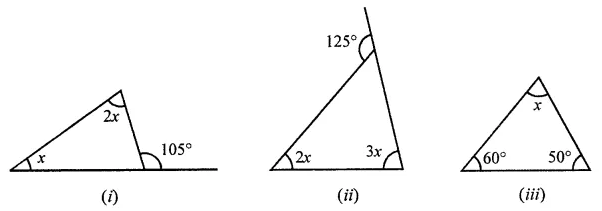
Question 1.
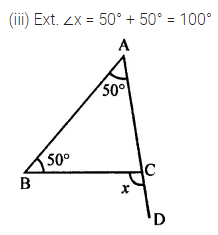
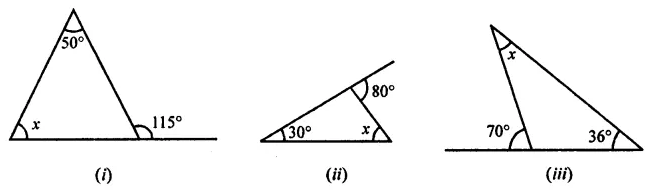
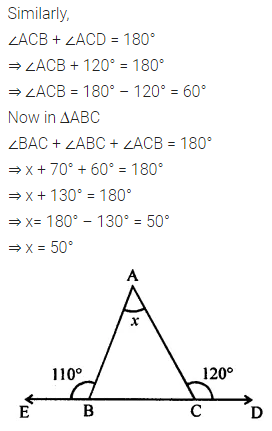
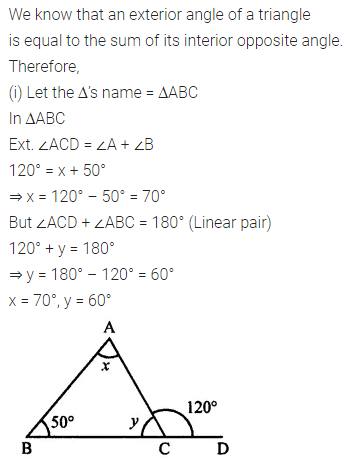
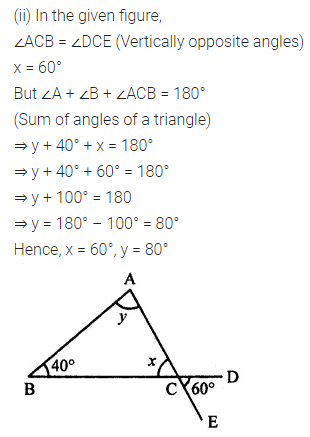
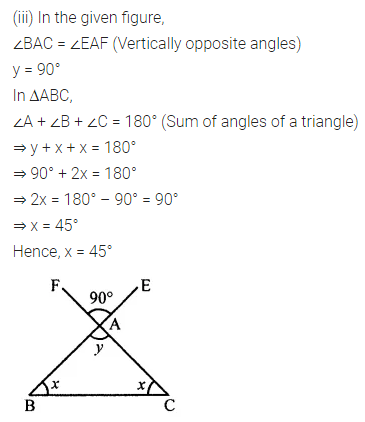
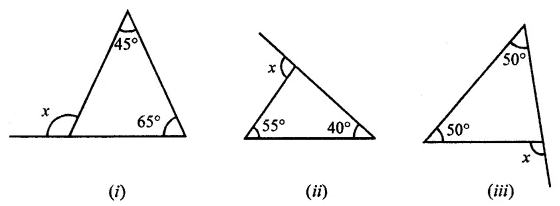
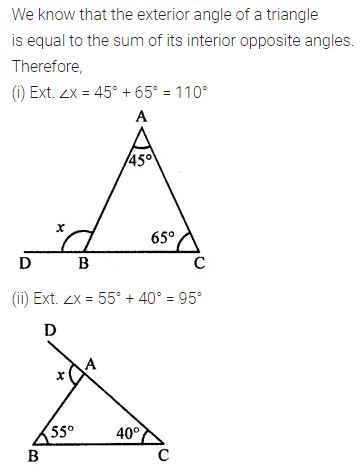
Find the value of the unknown exterior angle x in each of the following diagrams:
ML Aggarwal Class 7 Solutions for ICSE Maths Chapter 11 Triangles and its Properties Ex 11.2 1
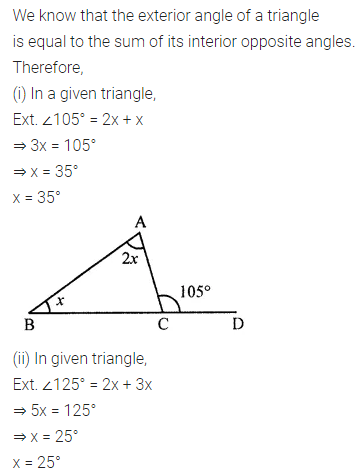
Solution:
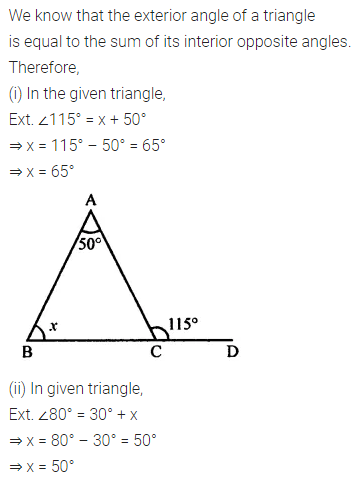
ML Aggarwal Class 7 Solutions for ICSE Maths Chapter 11 Triangles and its Properties Ex 11.2 2
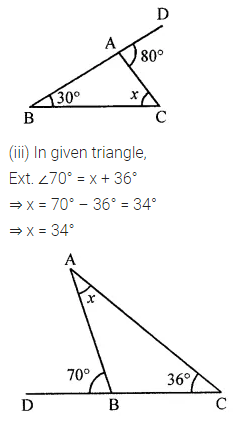
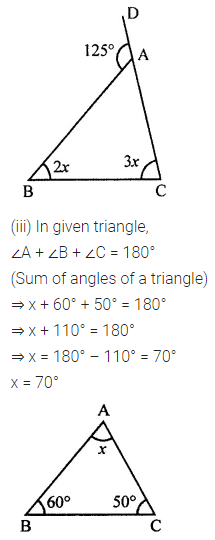
ML Aggarwal Class 7 Solutions for ICSE Maths Chapter 11 Triangles and its Properties Ex 11.2 3

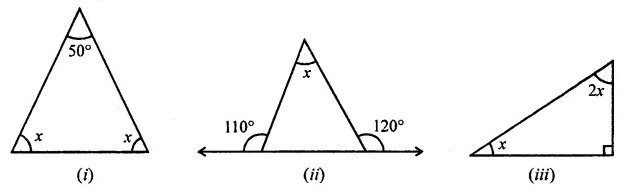
Question 2.
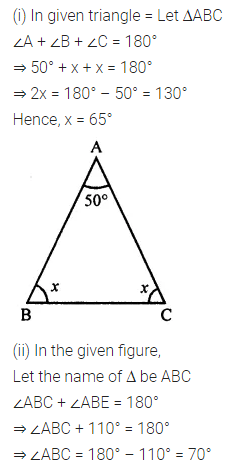
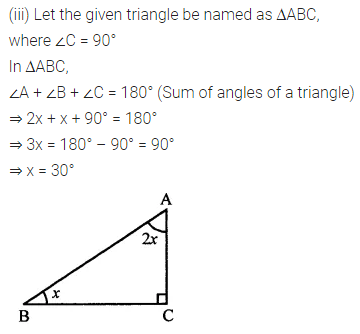
Find the value of the unknown interior angle x in each of the following diagrams:
ML Aggarwal Class 7 Solutions for ICSE Maths Chapter 11 Triangles and its Properties Ex 11.2 4
Solution:
ML Aggarwal Class 7 Solutions for ICSE Maths Chapter 11 Triangles and its Properties Ex 11.2 5
ML Aggarwal Class 7 Solutions for ICSE Maths Chapter 11 Triangles and its Properties Ex 11.2 6

Question 3.
Find the value of x in each of the following diagrams:
ML Aggarwal Class 7 Solutions for ICSE Maths Chapter 11 Triangles and its Properties Ex 11.2 7
Solution:
ML Aggarwal Class 7 Solutions for ICSE Maths Chapter 11 Triangles and its Properties Ex 11.2 8
ML Aggarwal Class 7 Solutions for ICSE Maths Chapter 11 Triangles and its Properties Ex 11.2 9

Question 4.
Find the value of unknown x in each of the following:
ML Aggarwal Class 7 Solutions for ICSE Maths Chapter 11 Triangles and its Properties Ex 11.2 10
Solution:
ML Aggarwal Class 7 Solutions for ICSE Maths Chapter 11 Triangles and its Properties Ex 11.2 11
ML Aggarwal Class 7 Solutions for ICSE Maths Chapter 11 Triangles and its Properties Ex 11.2 12
ML Aggarwal Class 7 Solutions for ICSE Maths Chapter 11 Triangles and its Properties Ex 11.2 13

Question 5.
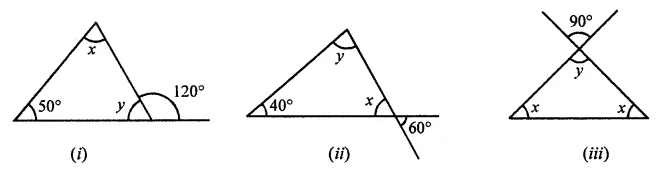
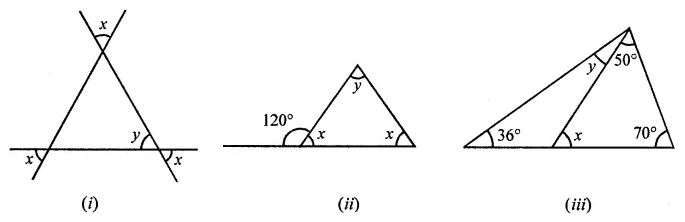
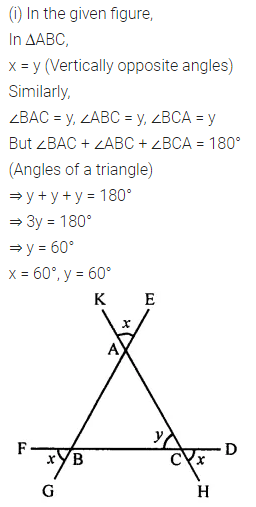
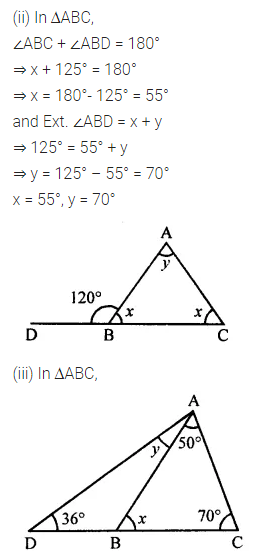
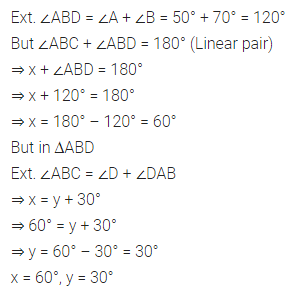
Find the values of x and y in each of the following diagrams:
ML Aggarwal Class 7 Solutions for ICSE Maths Chapter 11 Triangles and its Properties Ex 11.2 14
Solution:
ML Aggarwal Class 7 Solutions for ICSE Maths Chapter 11 Triangles and its Properties Ex 11.2 15
ML Aggarwal Class 7 Solutions for ICSE Maths Chapter 11 Triangles and its Properties Ex 11.2 16
ML Aggarwal Class 7 Solutions for ICSE Maths Chapter 11 Triangles and its Properties Ex 11.2 17

Question 6.
Find the values of x and y in each of the following diagrams:
ML Aggarwal Class 7 Solutions for ICSE Maths Chapter 11 Triangles and its Properties Ex 11.2 18
Solution:
ML Aggarwal Class 7 Solutions for ICSE Maths Chapter 11 Triangles and its Properties Ex 11.2 19
ML Aggarwal Class 7 Solutions for ICSE Maths Chapter 11 Triangles and its Properties Ex 11.2 20
ML Aggarwal Class 7 Solutions for ICSE Maths Chapter 11 Triangles and its Properties Ex 11.2 21

Question 7.
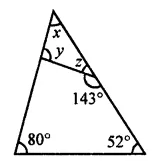
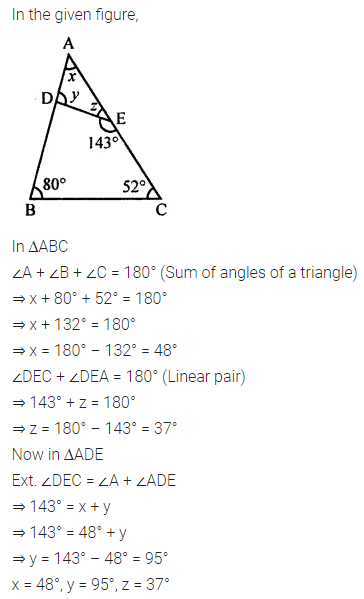
In the adjoining figure, find the size of each lettered angle.
ML Aggarwal Class 7 Solutions for ICSE Maths Chapter 11 Triangles and its Properties Ex 11.2 22
Solution:
ML Aggarwal Class 7 Solutions for ICSE Maths Chapter 11 Triangles and its Properties Ex 11.2 23

Question 8.
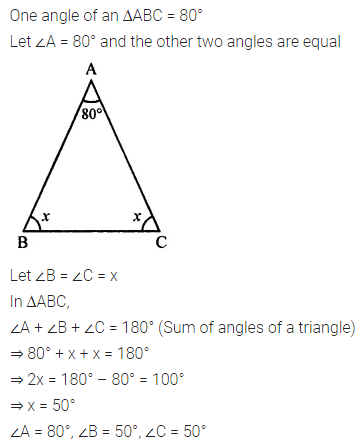
One of the angles of a triangle measures 80° and the other two angles are equal. Find the measure of each of the equal angles.
Solution:
ML Aggarwal Class 7 Solutions for ICSE Maths Chapter 11 Triangles and its Properties Ex 11.2 24

Question 9.
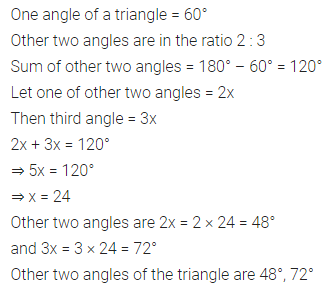
If one angle of a triangle is 60° and the other two angles are in the ratio 2 : 3, find these angles.
Solution:
ML Aggarwal Class 7 Solutions for ICSE Maths Chapter 11 Triangles and its Properties Ex 11.2 25

Question 10.
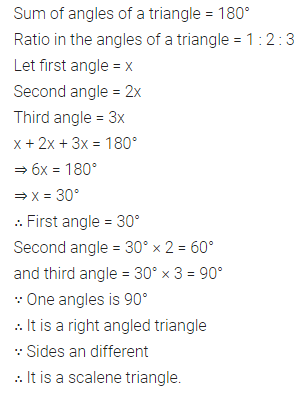
If the angles of a triangle are in the ratio 1 : 2 : 3, find the angles. Classify the triangle in two different ways.
Solution:
ML Aggarwal Class 7 Solutions for ICSE Maths Chapter 11 Triangles and its Properties Ex 11.2 26

Question 11.
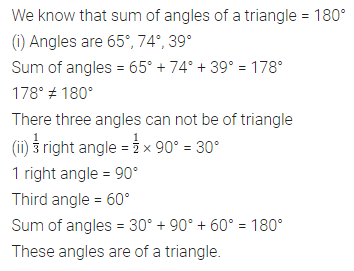
Can a triangle have three angles whose measures are
(i) 65°, 74°, 39°?
(ii) \(\frac { 1 }{ 3 }\) right angle, 1 right angle, 60°?
Solution:
ML Aggarwal Class 7 Solutions for ICSE Maths Chapter 11 Triangles and its Properties Ex 11.2 27

The Tale of Custard the Dragon Extra Questions and Answers Class 10 English First Flight

Here we are providing The Tale of Custard the Dragon Extra Questions and Answers Class 10 English First Flight, Extra Questions for Class 10 English was designed by subject expert teachers.

The Tale of Custard the Dragon Extra Questions and Answers Class 10 English First Flight

The Tale of Custard the Dragon Extra Questions and Answers Short Answer Type

Question 1.
What were the names of Belinda’s pets?
Answer:
The names of Belinda’s pets were Ink, a little black kitten; Mustard, a little yellow dog; Blink, a little grey mouse and a dragon whose name was Custard.

Question 2.
How did the pirate look?
Answer:
The pirate held a pistol in his left hand and another pistol in his right hand. He had black beard and his one leg was of wood. He held a bright cutlass in his teeth. It was clear that his intentions were not good.

Question 3.
Why did the Belinda cry for help?
Answer:
Belinda was scared to see the pirate who had pistols in his hands and had a bright cutlass in his teeth. There was something bad in his appearance and intention. Therefore Belinda was afraid of the pirate and cried for help.

Question 4.
What did the custard do at last?
Answer:
Custard saved Belinda and the other pets from the pirate. He showed his braver side and attacked the pirate and gobbled him up. Finally, Custard showed that he was not as coward as others.

Question 5.
Why did the Custard, the dragon cry for a nice, safe cage?
Answer:
Custard, in fact, was very brave but still he kept asking for a nice, safe cage. It made people think him to be cowardly. He might be crying for a nice, safe cage so that he might not harm anyone when in anger or he might be proving that a little safety cage averts a disaster. The others thought that he cried for a cage as he was a coward.

Question 6.
What did Belinda and her pets hear?
Answer:
Belinda and her pets heard a nasty sound made by the pirate breaking in through the window. Belinda and her pets except Custard were terrified and cried for help. Ink, Blink and Mustard fled away cowardly. Custard fought with him bravely and killed him.

Question 7.
What terrified the pirate? Who killed him and how?
Answer:
Custard, the dragon, jumped up, snorting and clashing his tail. He was making a lot of clatter and clankering and he was squirming. He attacked the pirate. It terrified the pirate. He fired at Custard and missed. Custard killed him by swallowing him up. It shows that he was brave.

Question 8.
Write the poetic aspect of the poem “The Tale of Custard the Dragon”.
Answer:
The poem “The Tale of Custard the Dragon” is a light-hearted story, written in the ballad style. It is written in a four-lined stanza format with the rhyming scheme of aabb. It takes it near to the heroic couplet. The poem offers many similes. The stanzas vary in size. The lines are prosaic and long. The first two stanzas act as refrain to indicate continuity. The words are simple.

Question 9.
When the pirate attacked Belinda, ail of her brave friends—Ink, Blink and Mustard ran away. Only Custard fought with the enemy. Based on your reading of the poem, write a paragraph on the topic: ‘A friend in Need is a Friend Indeed’.
Answer:
Man is a social animal and we all have survived throughout the civilization through the process of socialization. The beginning of any friendship is when one tries to socialize with the other. But not all socializations result in friendship. Some people walk past us in the journey of life, and some stay back and see us grow. The ones, who walk away when the clouds are cast, are the ones who will never stick around when we need them the most.

A true friend is the one who always sticks around irrespective of how good or bad the situation is. Therefore it is rightly said that those who survive the test of friendship i.e., those who stand by us in our most trying times are the real friends. Truly, a friend in need is a friend indeed.

Question 10.
Everyone believed that the Custard was a coward; but when an opportunity came he showed exemplary courage. Based on y our reading of the poem, write a paragraph on the topic: ‘Courage is a Mind, not of Muscle’.
Answer:
Mark Twain once said that ‘Courage is resistance to fear, mastery of fear—not absence of fear’. Courage is not merely a show of power but the ability to overcome fear and not allow it to paralyze our minds. Most of us tend to generalize and call people who shy away from a physical show of power as being cowards.

But the truth lies in the fact that those who indulge in physical aggression are the ones who are the most insecure. David was barely one-fourth of Goliath, the giant. Yet David succeeded, in killing him. He had used his presence of mind and stood successful over an entire army. Thus, we must remember that courage is a matter of mind, not muscle.

Question 11.
The dragon Custard was considered a coward. The humble dragon proved his bravery in adversity. Analyses that certain qualities like bravery and courage are situation and spontaneous. Explain with reference to the poem “The Tale of Custard the Dragon”.
Answer:
The pirate held a pistol in his left hand and another pistol in his right hand. He had black beard and his one leg was of wood. He held a bright cutlass in his teeth. It was clear that his intentions were not good.

Question 12.
Who are the characters in this poem? List them with their pet names.
Answer:
The characters in this poem are Belinda, a little black kitten, a little grey mouse, a little yellow dog, a little pet dragon and a pirate.

CharacterPet name
KittenInk
MouseBlink
DogMustard
DragonCustard

Question 13.
Why did Custard cry for a nice, safe cage? Why is the dragon called “cowardly dragon”?
Answer:
Custard cried for a nice, safe cage because it was a coward. It is called a ‘cowardly dragon’ because everybody else in the house was brave. Belinda was as brave as a barrel of bears. Ink and blink are described as so brave they chased lions down the stairs and Mustard was as brave as a tiger in rage. Compared to them, Custard cried asking for a nice and safe cage, which is why it is called a coward.

Question 14.
“Belinda tickled him, she tickled him unmerciful…” Why?
Answer:
Belinda tickled the dragon unmercifully because it was very scared and cried for a safe cage. They all laughed at it as it was a coward.

Question 15.
The poet has employed many poetic devices in the poem. For example: “Clashed his tail like iron in a dungeon”—the poetic device here is a simile. Can you, with your partner, list some more such poetic devices used in the poem?
Answer:
In the entire poem, the poet has made extensive use of similes. Apart from simile, another poetic device that has been used is repetition. For example, the repetitive use of the word ‘little’ in the first stanza to emphasize how everything from the house to Belinda to her pets were all little. Also, in the seventh stanza, the poet has made use of incorrect spelling as a poetic device to maintain the rhyme scheme of the poem.

He has chosen to write ‘winda’ instead of ‘window’ as ‘winda’ rhymes with ‘Belinda’, whereas ‘window’ does not. He has also used alliteration in the poem. For example, in the tenth stanza, ‘custard’ has ‘clashed’ his tail with a ‘clatter’ and a ‘clank’. Similarly, in stanza eleven, the pirate ‘gaped’ at the dragon and ‘gulped’ some ‘grog”.

Question 16.
Read the stanza three again to know how the poet describes the appearance of the dragon.
Answer:
The teeth of the dragon, Custard were having fine edges or points. There were spikes with sharp points on the top of his body and beneath his body had scales or hard body. His mouth looked like a fireplace or hearth and his nose was like a chimney. And there were short pointed daggers like sharp points on his toes.

Question 17.
Can you find out the rhyme scheme of two or three stanzas of the poem?
Answer:
The rhyme scheme of each stanza of this poem is ‘aabb’.

Question 18.
Writers use words to give us a picture or image without actually saying what they mean. Can you trace some images used in the poem?
Answer:
Some such images used in the poem are ‘mouth like a fireplace’, ‘chimney for a nose’, ‘brave as a barrel full of bears’, ‘brave as a tiger in a rage’, ‘went at the pirate like a robin at a worm’, etc.

Question 19.
Do you find The Tale of Custard the Dragon to be a serious or a light-hearted poem? Give reasons to support your answer.
Answer:
The Tale of Custard the Dragon is a light-hearted poem. It is almost a parody. The names of the pets of Belinda are all rhyming and funny. Belinda has been compared to a barrel full of bears. The kitten and mouse, both little, could chase lions down the stairs. The little yellow dog was as brave as a tiger, while the dragon was a coward and they all teased him. However,when the pirate came to their little house, all of them were engulfed in fear and had hidden themselves.

Ironically, the ‘cowardly’ dragon came to their rescue and jumped snorting like an engine. It clashed its tail and charged at the pirate like a robin at a worm and ate him up. Even as everybody became happy to see the bravery of the dragon, they again came back to glorifying themselves that they could have been twice or thrice braver than the dragon. Finally, at the end of the poem, the situation again came back to the other pets being brave and the dragon being the coward.

Question 20.
This poem, in ballad form, tells a story. Have you come across any such modern song or lyric that tells a story? If you know one, tell it to the class. Collect such songs as a project.
Answer:
‘Light of Asia’ is an epic that has been read. It tells us a story in verse. In it we get the story of Prince Siddhartha, the son of king Sudhodhana. We get from it the complete story of his life, how he was brought-up and how he got married and how he became a saint.

The Tale of Custard the Dragon Extra Questions and Answers Reference to Context

Read the following stanza and answer the questions that follow:

Question 1.
Belinda lived in a little white house,
With a little black kitten and a little grey mouse,
And a little yellow dog and little red wagon,
And a realio, trulio, little pet dragon.

(i) Name the poem and poet.
(ii) Who was Belinda?
(iii) Where did Belinda live?
(iv) Who were her companions?
Answer:
(i) This stanza has been taken from the poem “The Tale of Custard the Dragon” composed by Ogden Nash.
(ii) Belinda was a little girl.
(iii) Belinda lived in a little white house.
(iv) Belinda had four pets—a little black kitten, a little grey mouse, a little yellow dog and a little red wagon.

Question 2.
Now the name of the little black kitten was Ink,
And the little grey mouse, she called him Blink,
And the little yellow dog was sharp as Mustard,
But the dragon was a coward, and she called him Custard.

(i) What were the names of her pets?
(ii) Who was the sharpest of them?
(iii) Who was a coward?
(iv) Name the poem and poet.
Answer:
(i) Kitten was Ink, mouse was Blink, the dog was Mustard and the dragon was called Custard.
(ii) Mustard, the dog was the sharpest of them.
(iii) The dragon, Custard was a coward.
(iv) The poem “The Tale of Custard the Dragon” and composed by “Ogden Nash”.

Question 3.
Custard the dragon had big sharp teeth,
And spikes on top of him and scales underneath
Mouth like a fireplace, Chimney for a nose,
And realio, trulio daggers on his toes.

(i) Who was Custard?
(ii) What were on his top?
(iii) How did his mouth and nose look like?
(iv) Name the poem and poet.
Answer:
(i) Custard was the pet dragon of Belinda.
(ii) There were spikes on his top.
(iii) His mouth looked like a fireplace and his nose was like a chimney.
(iv) The poem “The Tale of Custard the Dragon” and composed by “Ogden Nash”.

Question 4.
Belinda was as brave as a barrel full of bears,
And Ink and Blink chased lions down the stairs,
Mustard was as brave as a tiger in a rage,
But Custard cried for a nice safe cage.

(i) What type of a girl was Belinda?
(ii) Who was Ink and Blink?
(iii) Who was Mustard? What was his quality?
(iv) Name the poem and poet.
Answer:
(i) Belinda was as brave as a barrel full of bears.
(ii) The kitten was Ink and the mouse was Blink.
(iii) Mustard was the name of her pet dog. He was as brave as a tiger.
(iv) The poem “The Tale of Custard the Dragon” and composed by “Ogden Nash”.

Question 5.
Belinda tickled him, she tickled him unmerciful,
Ink, Blink and Mustard, they rudely called him Percival,
They all sat laughing in the little red wagon
At the realio, trulio, cowardly dragon.

(i) Who did Belinda tickle?
(ii) What did other pets call him?
(iii) Why did they laugh at him?
(iv) Name the poem and poet.
Answer:
(i) Belinda tickled the Dragon.
(ii) The other pets called him Percival.
(iii) They laughed at him because he was coward.
(iv) The poem “The Tale of Custard the Dragon” and composed by “Ogden Nash”.

Question 6.
Belinda giggled till she shook the house,
And Blink said Weeck! which is giggling for a mouse,
Ink and Mustard rudely asked his age,
When Custard cried for a nice safe cage.

(i) On whom did Belinda giggle?
(ii) How did Ink and Mustard trouble Custard?
(iii) What did Custard cry for?
(iv) Name the poem and poet.
Answer:
(i) Belinda giggled and made fun of him when Custard cried for a nice safe cage.
(ii) Ink and Mustard made fun of Custard and rudely asked his age.
(iii) Custard cried for a nice safe place.
(iv) The poem “The Tale of Custard the Dragon” and composed by “Ogden Nash”.

Question 7.
Suddenly, suddenly they heard a nasty sound,
And Mustard growled, and they all looked around.
Meowch! qried Ink, and ooh! cried Belinda,
For there was a pirate, climbing in the winda.

(i) Who are ‘they here?
(ii) What did they hear?
(iii) How did they react?
(iv) Name the poem and poet.
Answer:
(i) ‘They’ are Belinda and her pets.
(ii) They heard a nasty sound.
(iii) All of them were afraid.
(iv) The poem “The Tale of Custard the Dragon” and composed by “Ogden Nash”.

Question 8.
Pistol in his left hand, pistol in his right,
And he held in his teeth a cutlass bright,
His beard was black, one leg was wood;
It was clear that the pirate meant no good.

(i) Who is ‘He’in this stanza?
(ii) What did he look like?
(iii) What was his intention?
(iv) Name the poem and poet.
Answer:
(i) ‘He’ is the pirate in this stanza, who had entered to their house.
(ii) His beard was black. He had one wooden leg. He looked scary.
(iii) He did not have good intention.
(iv) The poem “The Tale of Custard the Dragon” and composed by “Ogden Nash”.

Question 9.
Belinda paled, and she cried Help! Help!
But Mustard fled with a terrified yelp,
Ink trickled down to the bottom of the household,
And little mouse Blink strategically mouseholed.

(i) Why did Belinda become pale?
(ii) How did Mustard react?
(iii) What did Ink do? Why?
(iv) Name the poem and poet.
Answer:
(i) Belinda paled when a pirate attacked her.
(ii) Mustard fled with a terrified yelp.
(iii) Ink was so terrified that she trickled down to the bottom of the household.
(iv) The poem “The Tale of Custard the Dragon” and composed by “Ogden Nash”.

Question 10.
The pirate gaped at Belinda’s dragon
And gulped some grog from his pocket flagon,
He fired two bullets, but they didn’t hit,
And Custard gobbled him, every bit.

(i) What did the pirate do?
(ii) What did he drink?
(iii) What did Custard do?
(iv) Name the poem and poet.
Answer:
(i) The pirate gaped at Belinda’s dragon (Custard).
(ii) He drank some wine from his vessel.
(iii) Custard gobbled pirate slowly and slowly.
(iv) The poem “The Tale of Custard the Dragon” and composed by “Ogden Nash”.

Fog Extra Questions and Answers Class 10 English First Flight

Here we are providing Fog Extra Questions and Answers Class 10 English First Flight, Extra Questions for Class 10 English was designed by subject expert teachers.

Fog Extra Questions and Answers Class 10 English First Flight

Fog Extra Questions and Answers Short Answer Type

Question 1.
How does a eat behave?
Answer:
A cat is very quiet. It comes quietly and stealthily on its little padded feet. It sits on the haunches and observes the city and the harbour. Then, it moves on silently without making any noise.

Question 2.
How is the fog like a cat?
Answer:
The poet finds the fog like a cat. The fog comes stealthily like a cat. It sits looking over the harbour and city as a cat does. Later, it moves on just like a cat to settle somewhere else. These things prove that the fog’s comparison to a cat is appropriate.

Question 3.
How does the fog spread over the harbour and the city?
Answer:
The fog-comes to a city stealthily just like a cat. It makes no noise. It spreads over the harbour and the city and settles over them for sometimes. There, it rises high and moves away. In this way the fog arrives over a city, observes it and then leaves it to move away.

Question 4.
Difficulties come but they are not to stay forever. They come and go. Comment referring to the poem “Fog’.
Answer:
None can deny that fact that after every nightfall, there is sunshine. In other words sorrows follow happiness. Life has many ups and downs. We must all accept that problems as a part of life. We should strengthen ourselves so much that we are able to face them and stand up to solve these problems. We should not get carried away. We should learn that time and tide wait for none.

Fog is also symbolic of darkness but it comes quietly like a cat and goes away. It symbolises that if we are not disturbed by difficulties then life will itself move to lighter side and things will be easy to confront. We should always remember that, we must face all the problems boldly.

Question 5.
Write the central idea of the poem “Fog”.
Answer:
The poet Carl Sandburg in his poem ‘Fog’ describes fog as a cat. Fog is treated to be a living creature. Fog comes quietly and stealthily like a cat. Fog sits looking over the harbour like a cat does. Then it moves to settle somewhere else. Just as cat doesn’t settle at one place and in the same way fog keeps on moving and finally vanishes.

Question 6.
The poet is able to visualize the image of a cat in the fog. Similarly there is an inseparable connection between native and all creations in it. Based on the reading of the poem, write a paragraph on the topic—“God lives in His creations in native”.
Answer:
God is omnipresent and nature is a gift of God to us. Nature has both, the power to sanctify and power to destroy. He makes his presence which provides us with the vital oxygen, the food that grows beneath and above the ground, the water that satisfies out thirst etc. He has made everything and everyone with a purpose and he lives in all of them. Nature cannot exist on its own. It is because God’s reflection falls on each of his creation that we, mere mortals survive and thrive on this planet. Thus, we must always respect, love, and care for all of God’s creations.

Question 6.
(i) What does Sandburg think the fog is like?
(ii) How does the fog come?
(iii) What does ‘it’ in the third line refer to?
(iv) Does the poet actually say that the fog is like a cat? Find three things that tell us that the fog is like a cat.
Answer:
(i) According to Sandburg, the fog is like a cat.
(ii) The fog comes on little cat’s feet.
(iii) In the third line ‘it’ refers to the fog that has covered the city and it seems as if it is looking over the city like a cat.
(iv) No, the poet does not actually say that the fog is like a cat. However, he has used cat as a metaphor for describing the fog. He says that the fog comes on its little cat feet, which implies that the fog, like a cat, comes slowly. He also says that the fog looks over the harbour and the city and then moves on, implying that the fog has covered the city and is sitting and looking at it, thereby again comparing it to a cat.

This is reiterated when he says that the fog looks over the city sitting on ‘silent haunches’. This also shows the reference to a cat as a cat always sits with its knees bent. Hence, he has compared the fog to a cat without actually saying so.

Question 7.
You know that a metaphor compares two things by transferring a feature of one thing to the other
(See Unit 1).
(i) Find metaphors for the following words and complete the table below.
Also try to say how they are alike. The first is done for you.

Stormtigerpounces over the fields, growls
Train
Fire
School
Home
Stormtigerpounces over the fields, growls
TrainGush of windVery fast movement
FireAngerDanger that surrounds both on the basis of their intensities.
SchoolGatewayLeads to adulthood and a life of responsibility.
HomeNestProvides hospitable, loving environment.

Question 8.
Does this poem have a rhyme scheme? Poetry that does not have an obvious rhythm or rhyme is called ‘free verse’.
Answer:
No, this poem does not have a rhyme scheme. It is written in ‘free verse’

Fog Extra Questions and Answers Reference to Context

Read the following stanza and answer the questions that follow:

Question 1.
The Fog comes on little cat feet.
(i) Name the poem and poet.
(ii) How does the fog come?
(iii) Who is the fog compared to?
(iv) What is the meaning of the phrase “Little cat feet”?
Answer:
(i) These lines have been taken from the poem ‘Fog’ composed by Carl Sandburg.
(ii) The fog comes stealthily.
(iii) The fog is compared to cat.
(iv) Fog comes stealthily and silently, as a cat. Therefore the arrival of fog is described as if it is coming like a walking cat.

Question 2.
It sits looking over harbour and city on silent haunches and then moves on.
(i) What does ‘it’ refer to?
(ii) Where does it settle over?
(iii) What is ‘it’ compared to?
(iv) Name the poem and poet.
Answer:
(i) It refers to the fog.
(ii) ‘It’ settles over the harbour and the city.
(iii) ‘It’ is compared to the cat.
(iv) The poem “Fog” composed by “Carl Sandburg”.

ML Aggarwal Class 7 Solutions for ICSE Maths Chapter 11 Triangles and its Properties Ex 11.1

ML Aggarwal Class 7 Solutions Chapter 11 Triangles and its Properties Ex 11.1 for ICSE Understanding Mathematics acts as the best resource during your learning and helps you score well in your exams.

ML Aggarwal Class 7 Solutions for ICSE Maths Chapter 11 Triangles and its Properties Ex 11.1

Question 1.
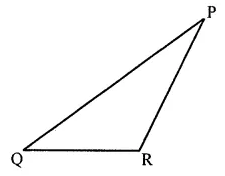
In the adjoining figure:
ML Aggarwal Class 7 Solutions for ICSE Maths Chapter 11 Triangles and its Properties Ex 11.1 1
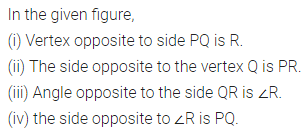
(i) Name the vertex opposite to side PQ.
(ii) Name the side opposite vertex Q.
(iii) Name the angle opposite to side QR.
(iv) Name the side opposite to ∠R.
Solution:
ML Aggarwal Class 7 Solutions for ICSE Maths Chapter 11 Triangles and its Properties Ex 11.1 2

Question 2.
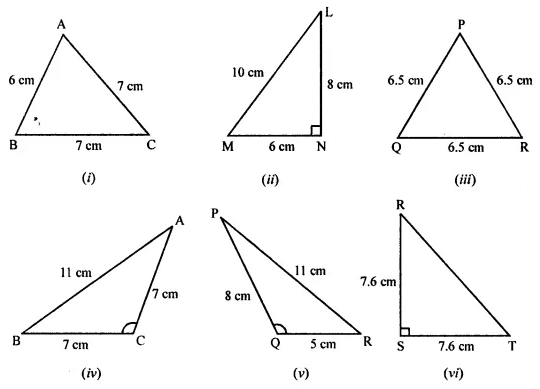
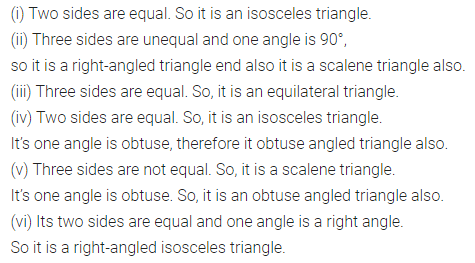
Look at the figures given below and classify each of the triangles according to its (a) sides (b) angles
(You may judge the nature of the angle by observation):
ML Aggarwal Class 7 Solutions for ICSE Maths Chapter 11 Triangles and its Properties Ex 11.1 3
Solution:
ML Aggarwal Class 7 Solutions for ICSE Maths Chapter 11 Triangles and its Properties Ex 11.1 4

Question 3.
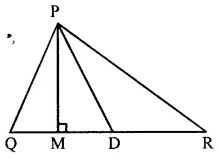
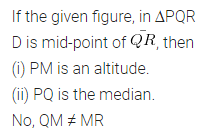
In the given ∆PQR, if D is the mid-point of \(\bar { QR }\), then
(i) \(\bar { PM }\) is ……..
(ii) \(\bar { PD }\) is ………
Is QM = MR?
ML Aggarwal Class 7 Solutions for ICSE Maths Chapter 11 Triangles and its Properties Ex 11.1 5
Solution:
ML Aggarwal Class 7 Solutions for ICSE Maths Chapter 11 Triangles and its Properties Ex 11.1 6

Question 4.
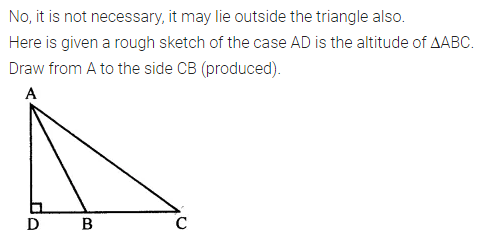
Will an altitude always lie in the interior of a triangle? If no, draw a rough sketch to show such a case.
Solution:
ML Aggarwal Class 7 Solutions for ICSE Maths Chapter 11 Triangles and its Properties Ex 11.1 7

Question 5.
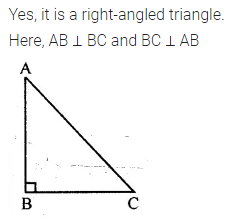
Can you think of a triangle in which two altitudes of the triangle is its sides? If yes, draw a rough sketch to show such a case.
Solution:
ML Aggarwal Class 7 Solutions for ICSE Maths Chapter 11 Triangles and its Properties Ex 11.1 8

Question 6.
Draw rough sketches for the following:
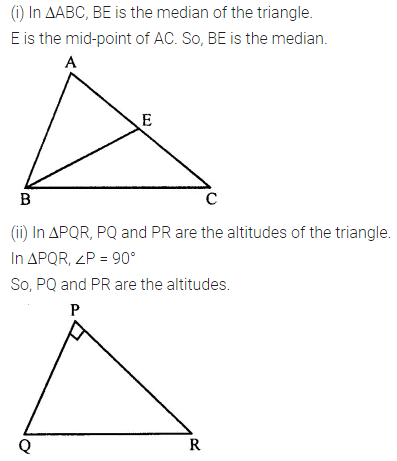
(i) In ∆ABC, BE is a median of the triangle.
(ii) In ∆PQR, PQ and PR are altitudes of the triangle.
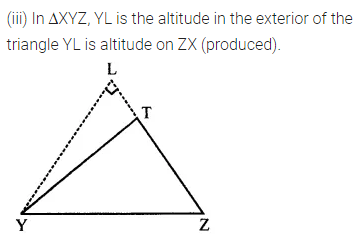
(iii) In ∆XYZ, YL is an altitude in the exterior of the triangle.
Solution:
ML Aggarwal Class 7 Solutions for ICSE Maths Chapter 11 Triangles and its Properties Ex 11.1 9
ML Aggarwal Class 7 Solutions for ICSE Maths Chapter 11 Triangles and its Properties Ex 11.1 10

Question 7.
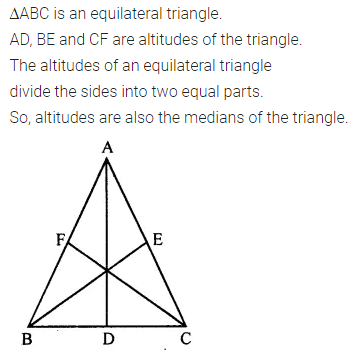
Take an equilateral triangle and draw its medians and altitudes and check that the medians and altitudes are the same.
Solution:
ML Aggarwal Class 7 Solutions for ICSE Maths Chapter 11 Triangles and its Properties Ex 11.1 11