ML Aggarwal Class 6 Solutions for ICSE Maths Chapter 2 Whole Numbers Ex 2.3

ML Aggarwal Class 6 Solutions Chapter 2 Whole Numbers Ex 2.3 for ICSE Understanding Mathematics acts as the best resource during your learning and helps you score well in your exams.

ML Aggarwal Class 6 Solutions for ICSE Maths Chapter 2 Whole Numbers Ex 2.3

Question 1.
Using shorter method, find
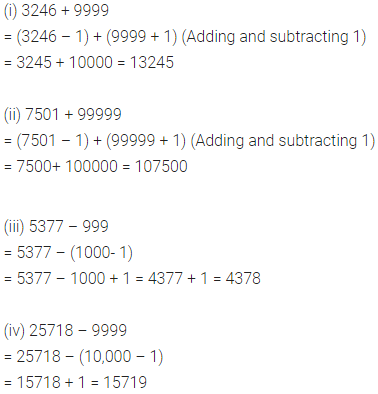
(i) 3246 + 9999
(ii) 7501 + 99999
(iii) 5377 – 999
(iv) 25718 – 9999
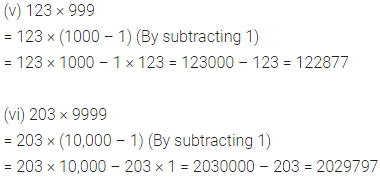
(v) 123 × 999
(vi) 203 × 9999
Solution:
ML Aggarwal Class 6 Solutions for ICSE Maths Chapter 2 Whole Numbers Ex 2.3 1
ML Aggarwal Class 6 Solutions for ICSE Maths Chapter 2 Whole Numbers Ex 2.3 2

Question 2.
Without using a diagram, find
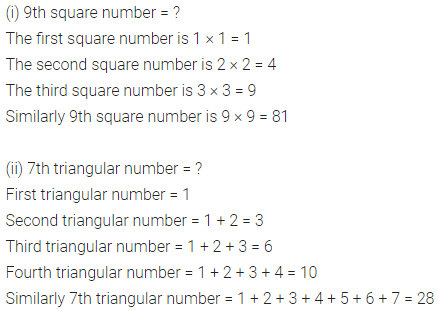
(i) 9th square number
(ii) 7th triangular number
Solution:
ML Aggarwal Class 6 Solutions for ICSE Maths Chapter 2 Whole Numbers Ex 2.3 3

Question 3.
(i) Can a rectangular number be a square number?
(ii) Can a triangular number be a square number?
Solution:
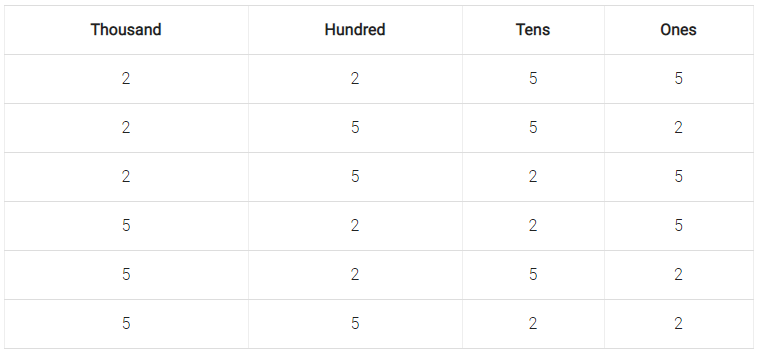
ML Aggarwal Class 6 Solutions for ICSE Maths Chapter 2 Whole Numbers Ex 2.3 4

Question 4.
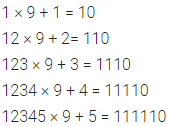
Observe the following pattern and fill in the blanks:
1 × 9 + 1 = 10
12 × 9 + 2= 110
123 × 9 + 3 = 1110
1234 × 9 + 4 = ……….
12345 × 9 + 5 = …………..
Solution:
ML Aggarwal Class 6 Solutions for ICSE Maths Chapter 2 Whole Numbers Ex 2.3 5

Question 5.
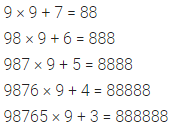
Observe the following pattern and fill in the blanks:
9 × 9 + 7 = 88
98 × 9 + 6 = 888
987 × 9 + 5 = 8888
9876 x 9 + 4 = …………
98765 × 9 + 3 = ……….
Solution:
ML Aggarwal Class 6 Solutions for ICSE Maths Chapter 2 Whole Numbers Ex 2.3 6

ML Aggarwal Class 6 Solutions for ICSE Maths Chapter 2 Whole Numbers Ex 2.2

ML Aggarwal Class 6 Solutions Chapter 2 Whole Numbers Ex 2.2 for ICSE Understanding Mathematics acts as the best resource during your learning and helps you score well in your exams.

ML Aggarwal Class 6 Solutions for ICSE Maths Chapter 2 Whole Numbers Ex 2.2

Question 1.
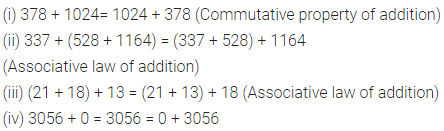
Fill in the blanks to make each of the following a true statement:
(i) 378 + 1024 = 1024 + …….
(ii) 337 + (528 + 1164) = (337 + ……..) + 1164
(iii) (21 + 18) + ……….. = (21 + 13) + 18
(iv) 3056 + 0 = ……….. = 0 + 3056
Solution:
ML Aggarwal Class 6 Solutions for ICSE Maths Chapter 2 Whole Numbers Ex 2.2 1

Question 2.
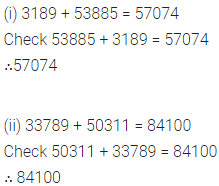
Add the following numbers and check by reversing the order of addends :
(i) 3189 + 53885
(ii) 33789 + 50311.
Solution:
ML Aggarwal Class 6 Solutions for ICSE Maths Chapter 2 Whole Numbers Ex 2.2 2

Question 3.
By suitable arrangements, find the sum of:
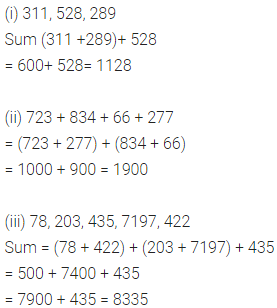
(i) 311,528,289
(ii) 723, 834, 66, 277
(iii) 78, 203, 435, 7197, 422.
Solution:
ML Aggarwal Class 6 Solutions for ICSE Maths Chapter 2 Whole Numbers Ex 2.2 3

Question 4.
Fill in the blanks to make each of the following a true statement:
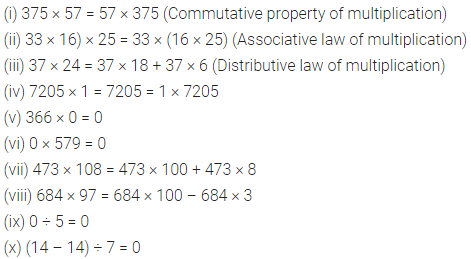
(i) 375 × 57 = 57 × ……….
(ii) (33 × 16) × 25 = 33 × (…….. × 25)
(iii) 37 × 24 = 37 × 18 + 37 × …………
(iv) 7205 × 1 = …………. = 1 × 7205
(v) 366 × 0 =
(vi) …………… × 579 = 0
(vii) 473 × 108 = 473 × 100 + 473 × ………….
(viii) 684 × 97 = 684 × 100 – …………… × 3
(ix) 0 ÷= 5 =
(x) (14 – 14) ÷ 7 = ………….
Solution:
ML Aggarwal Class 6 Solutions for ICSE Maths Chapter 2 Whole Numbers Ex 2.2 4

Question 5.
Determine the following products by suitable arrangement:
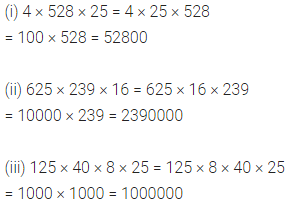
(i) 4 × 528 × 25
(ii) 625 × 239 × 16
(iii) 125 × 40 × 8 × 25
Solution:
ML Aggarwal Class 6 Solutions for ICSE Maths Chapter 2 Whole Numbers Ex 2.2 5

Question 6.
Find the value of the following:
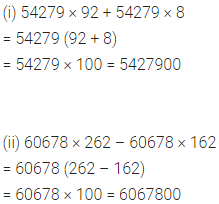
(i) 54279 × 92 + 54279 × 8
(ii) 60678 × 262 – 60678 × 162
Solution:
ML Aggarwal Class 6 Solutions for ICSE Maths Chapter 2 Whole Numbers Ex 2.2 6

Question 7.
Find the following products by using suitable properties:
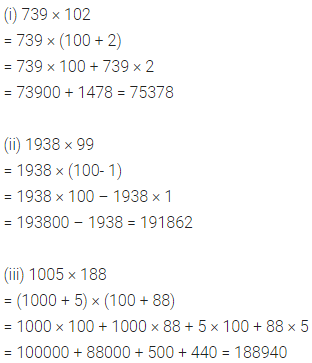
(i) 739 × 102
(ii) 1938 × 99
(iii) 1005 × 188
Solution:
ML Aggarwal Class 6 Solutions for ICSE Maths Chapter 2 Whole Numbers Ex 2.2 7

Question 8.
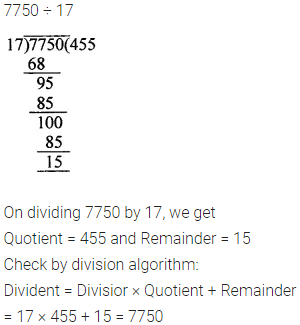
Divide 7750 by 17 and check the result by division algorithm.
Solution:
ML Aggarwal Class 6 Solutions for ICSE Maths Chapter 2 Whole Numbers Ex 2.2 8

Question 9.
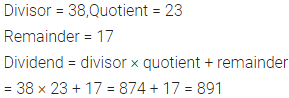
Find the number which when divided by 38 gives the quotient 23 and remainder 17.
Solution:
ML Aggarwal Class 6 Solutions for ICSE Maths Chapter 2 Whole Numbers Ex 2.2 9

Question 10.
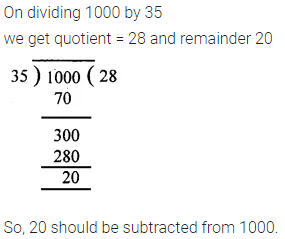
Which least number should be subtracted from 1000 so that the difference is exactly divisible by 35.
Solution:
ML Aggarwal Class 6 Solutions for ICSE Maths Chapter 2 Whole Numbers Ex 2.2 10

Question 11.
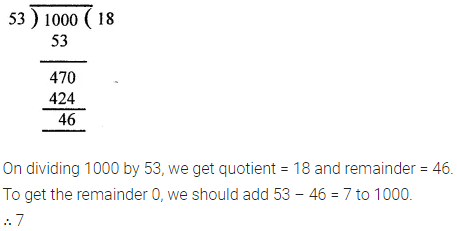
Which least number should be added to 1000 so that 53 divides the sum exactly.
Solution:
ML Aggarwal Class 6 Solutions for ICSE Maths Chapter 2 Whole Numbers Ex 2.2 11

Question 12.
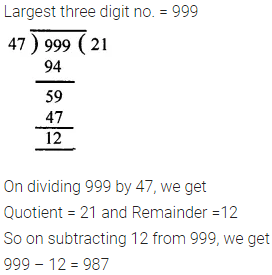
Find the largest three-digit number which is exactly divisible by 47.
Solution:
ML Aggarwal Class 6 Solutions for ICSE Maths Chapter 2 Whole Numbers Ex 2.2 12

Question 13.
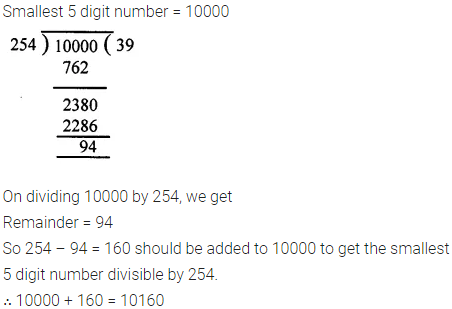
Find the smallest five-digit number which is exactly divisible by 254.
Solution:
ML Aggarwal Class 6 Solutions for ICSE Maths Chapter 2 Whole Numbers Ex 2.2 13

Question 14.
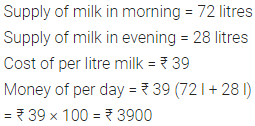
A vendor supplies 72 litres of milk to a student’s hostel in the morning and 28 litres of milk in the evening every day. If the milk costs?39 per litre, how much money is due to the vendor per day?
Solution:
ML Aggarwal Class 6 Solutions for ICSE Maths Chapter 2 Whole Numbers Ex 2.2 14

Question 15.
State whether the following statements are true (T) or false (F):
(i) If the product of two whole numbers is zero, then atleast
one of them will be zero.
(ii) If the product of two whole numbers is 1, then each of
them must be equal to 1.
(iii) If a and b are whole numbers such that a ≠ 0 and b ≠ 0,
then ab may be zero.
Solution:
ML Aggarwal Class 6 Solutions for ICSE Maths Chapter 2 Whole Numbers Ex 2.2 15

Question 16.
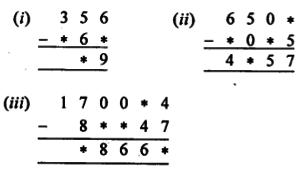
Replace each * by the correct digit in each of the following:
ML Aggarwal Class 6 Solutions for ICSE Maths Chapter 2 Whole Numbers Ex 2.2 16
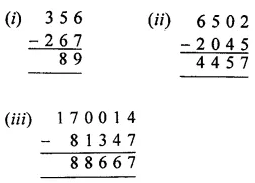
Solution:
ML Aggarwal Class 6 Solutions for ICSE Maths Chapter 2 Whole Numbers Ex 2.2 17

ML Aggarwal Class 6 Solutions for ICSE Maths Chapter 2 Whole Numbers Ex 2.1

ML Aggarwal Class 6 Solutions Chapter 2 Whole Numbers Ex 2.1 for ICSE Understanding Mathematics acts as the best resource during your learning and helps you score well in your exams.

ML Aggarwal Class 6 Solutions for ICSE Maths Chapter 2 Whole Numbers Ex 2.1

Question 1.
Write the smallest whole number. Can you write the largest whole number?
Solution:
ML Aggarwal Class 6 Solutions for ICSE Maths Chapter 2 Whole Numbers Ex 2.1 1

Question 2.
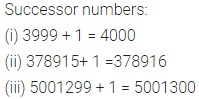
Write the successor of each of the following numbers:
(i) 3999
(ii) 378915
(iii) 5001299
Solution:
ML Aggarwal Class 6 Solutions for ICSE Maths Chapter 2 Whole Numbers Ex 2.1 2

Question 3.
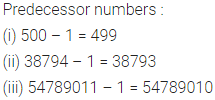
Write the predecessor of each of the following numbers:
(i) 500
(ii) 38794
(iii) 54789011
Solution:
ML Aggarwal Class 6 Solutions for ICSE Maths Chapter 2 Whole Numbers Ex 2.1 3

Question 4.
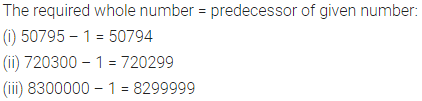
Write the whole number (in each of the following) whose successor is :
(i) 50795
(ii) 720300
(iii) 8300000
Solution:
ML Aggarwal Class 6 Solutions for ICSE Maths Chapter 2 Whole Numbers Ex 2.1 4

Question 5.
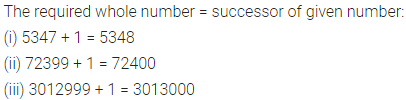
Write the whole number (in each of the following) whose predecessor is:
(i) 5347
(ii) 72399
(iii) 3012999
Solution:
ML Aggarwal Class 6 Solutions for ICSE Maths Chapter 2 Whole Numbers Ex 2.1 5

Question 6.
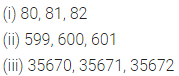
Write next three consecutive whole numbers of the following numbers:
(i) 79
(ii) 598
(iii) 35669
Solution:
ML Aggarwal Class 6 Solutions for ICSE Maths Chapter 2 Whole Numbers Ex 2.1 6

Question 7.
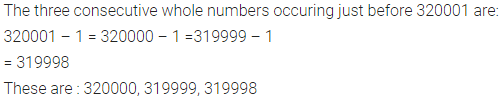
Write three consecutive whole numbers occuring just before 320001.
Solution:
ML Aggarwal Class 6 Solutions for ICSE Maths Chapter 2 Whole Numbers Ex 2.1 7

Question 8.
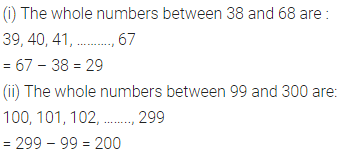
(i) How many whole numbers are there between 38 and 68?
(ii) How many whole numbers are there between 99 and 300?
Solution:
ML Aggarwal Class 6 Solutions for ICSE Maths Chapter 2 Whole Numbers Ex 2.1 8

Question 9.
Write all whole numbers between 100 and 200 which do not change if the digits are written in reverse order.
Solution:
ML Aggarwal Class 6 Solutions for ICSE Maths Chapter 2 Whole Numbers Ex 2.1 9

Question 10.
How many 2-digit whole numbers are there between 5 and 92?
Solution:
ML Aggarwal Class 6 Solutions for ICSE Maths Chapter 2 Whole Numbers Ex 2.1 10

Question 11.
How many 3-digit whole numbers are there between 72 and 407?
Solution:
ML Aggarwal Class 6 Solutions for ICSE Maths Chapter 2 Whole Numbers Ex 2.1 11

ML Aggarwal Class 6 Solutions for ICSE Maths Chapter 1 Knowing Our Numbers Check Your Progress

ML Aggarwal Class 6 Solutions Chapter 1 Knowing Our Numbers Check Your Progress for ICSE Understanding Mathematics acts as the best resource during your learning and helps you score well in your exams.

ML Aggarwal Class 6 Solutions for ICSE Maths Chapter 1 Knowing Our Numbers Check Your Progress

Question 1.
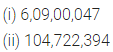
Write the numeral for each of the following numbers and insert commas correctly:
(i) Six crore nine lakh forty seven.
(ii) One hundred four million seven hundred twenty two thousand three hundred ninety four.
Solution:
ML Aggarwal Class 6 Solutions for ICSE Maths Chapter 1 Knowing Our Numbers Check Your Progress 1

Question 2.
Insert commas suitably and write the numebr 30189301 in words in Indian and International system of numeration.
Solution:
ML Aggarwal Class 6 Solutions for ICSE Maths Chapter 1 Knowing Our Numbers Check Your Progress 2

Question 3.
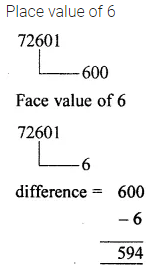
Find the difference between the place value and the face value of the digit 6 in the number 72601.
Solution:
ML Aggarwal Class 6 Solutions for ICSE Maths Chapter 1 Knowing Our Numbers Check Your Progress 3

Question 4.
Write all possible two-digit number using the digits 4 and 0. repetition of digits is allowed.
Solution:
ML Aggarwal Class 6 Solutions for ICSE Maths Chapter 1 Knowing Our Numbers Check Your Progress 4

Question 5.
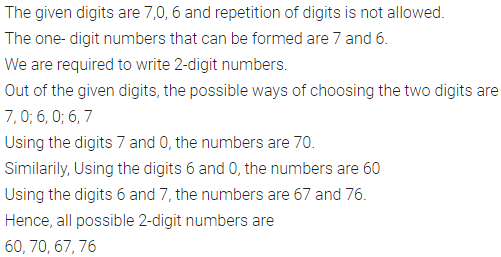
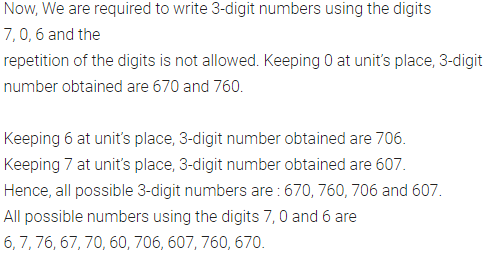
Write all possible natural numbers using the digits 7, 0, 6. Repetition of digits is not allowed.
Solution:
ML Aggarwal Class 6 Solutions for ICSE Maths Chapter 1 Knowing Our Numbers Check Your Progress 5
ML Aggarwal Class 6 Solutions for ICSE Maths Chapter 1 Knowing Our Numbers Check Your Progress 6

Question 6.
Arrange the following numbers in ascending order:
3706, 58019, 3760, 59801, 560023
Solution:
ML Aggarwal Class 6 Solutions for ICSE Maths Chapter 1 Knowing Our Numbers Check Your Progress 7

Question 7.
Write the greatest six-digit number using four different digits.
Solution:
ML Aggarwal Class 6 Solutions for ICSE Maths Chapter 1 Knowing Our Numbers Check Your Progress 8

Question 8.
Write the smallest eight-digit number using four different digits.
Solution:
ML Aggarwal Class 6 Solutions for ICSE Maths Chapter 1 Knowing Our Numbers Check Your Progress 9

Question 9.
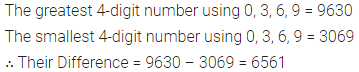
Find the difference between the greatest and the smallest 4-digit numbers formed by the digits 0, 3, 6, 9.
Solution:
ML Aggarwal Class 6 Solutions for ICSE Maths Chapter 1 Knowing Our Numbers Check Your Progress 10

Question 10.
Find the sum of the four-digit greatest number and the five-digit smallest number, each number having three different digits.
Solution:
ML Aggarwal Class 6 Solutions for ICSE Maths Chapter 1 Knowing Our Numbers Check Your Progress 11

Question 11.
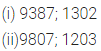
Write the greatest and the smallest four-digit numbers using four different digits with the conditions as given:
(i) Digit 3 always at hundred’s place.
(ii) Digit 0 always at ten’s place.
Solution:
ML Aggarwal Class 6 Solutions for ICSE Maths Chapter 1 Knowing Our Numbers Check Your Progress 12

Question 12.
A mobile number consists of ten digits. First four digits are 9, 9, 7 and 9. Make the smallest mobile number by using only one digit twice from the digits 8, 3, 5, 0, 6.
Solution:
ML Aggarwal Class 6 Solutions for ICSE Maths Chapter 1 Knowing Our Numbers Check Your Progress 13

Question 13.
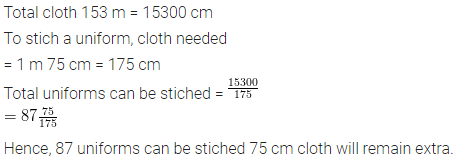
Two stitch a uniform, 1 m 75 cm cloth is needed. Out of 153 m cloth, how many uniforms can be stitched and how much cloth will remain?
Solution:
ML Aggarwal Class 6 Solutions for ICSE Maths Chapter 1 Knowing Our Numbers Check Your Progress 14

Question 14.
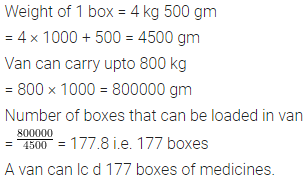
Medicine is packed in boxes, each weighing 4 kg 500 g. How many such boxes can be loaded in a van which cannot carry beyond 800 kg?
Solution:
ML Aggarwal Class 6 Solutions for ICSE Maths Chapter 1 Knowing Our Numbers Check Your Progress 15

Question 15.
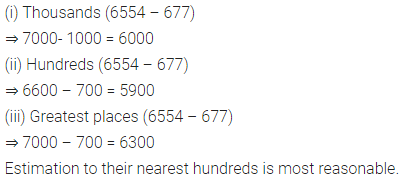
Estimate : 6554 – 677 by estimating the numbers to their nearest
(i) thousands
(ii) hundreds
(iii) greatest places
Also point out the most reasonable estimate.
Solution:
ML Aggarwal Class 6 Solutions for ICSE Maths Chapter 1 Knowing Our Numbers Check Your Progress 16

ML Aggarwal Class 6 Solutions for ICSE Maths Chapter 1 Knowing Our Numbers Objective Type Questions

ML Aggarwal Class 6 Solutions Chapter 1 Knowing Our Numbers Objective Type Questions for ICSE Understanding Mathematics acts as the best resource during your learning and helps you score well in your exams.

ML Aggarwal Class 6 Solutions for ICSE Maths Chapter 1 Knowing Our Numbers Objective Type Questions

Mental Maths
Question 1.
Fill in the blanks:
(i) The digit …………… has the highest place value in the number 2309.
(ii) The digit …………… has the highest face value in the number 2039.
(iii) The digit …………… has the lowest place value in the number 2039.
(iv) Both Indian and International systems of numeration have …………… period in common.
(v) In the International system of numeration, commas are placed from …………… after every …………… digits.
(vi) The bigger number from the numbers 57,631 and 57,361 is ……………
(vii) 1 crore = …………… million
(viii)The smallest 4-digit number with 3 different digits is ……………
(ix) The greatest 4-digit number with 3 different digits is ……………
(x) 15 km 300 m = …………… m
(xi) 7850 cm = …………… m …………… cm
(xii) The number 5079 when estimated to the nearest hundreds is ……………
Solution:
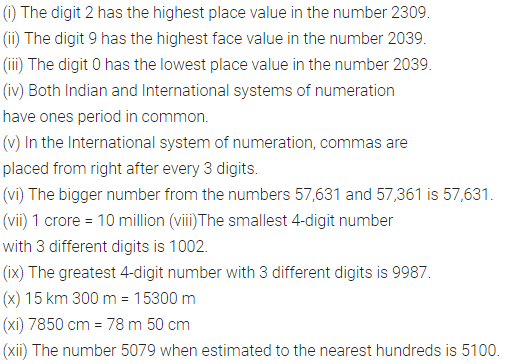
ML Aggarwal Class 6 Solutions for ICSE Maths Chapter 1 Knowing Our Numbers Objective Type Questions 1

Question 2.
State whether the following statements are true (T) or false (F):
(i) The difference between the place value and the face of the digit 7 in the number 2701 is 693.
(ii) The smallest 4-digit number -1 = the greatest 3-digit number.
(iii) The place of a digit is independent of whether the number is written in the Indian system or International system of numeration.
(iv) In the International system, a number having less number of digits is always smaller than the number having more number of digits.
(v) The estimated value of 9999 to the nearest tens is 10000.
Solution:
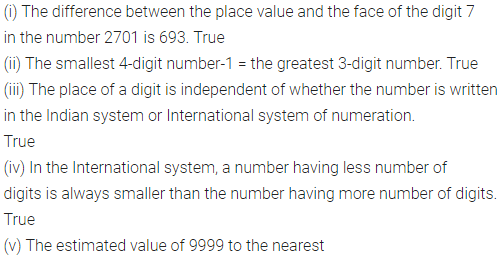
ML Aggarwal Class 6 Solutions for ICSE Maths Chapter 1 Knowing Our Numbers Objective Type Questions 2

Multiple Choice Questions
Choose the correct answer from the given four options (3 to 17):

Question 3.
The face value of the digit 5 in the number 36503 is
(a) 5
(b) 503
(c) 500
(d) none of these
Solution:

ML Aggarwal Class 6 Solutions for ICSE Maths Chapter 1 Knowing Our Numbers Objective Type Questions 3

Question 4.
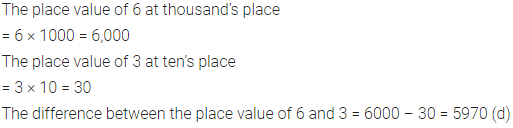
The difference between the place values of 6 and 3 in 76834 is
(a) 3
(b) 5700
(c) 5930
(d) 5970
Solution:
ML Aggarwal Class 6 Solutions for ICSE Maths Chapter 1 Knowing Our Numbers Objective Type Questions 4

Question 5.
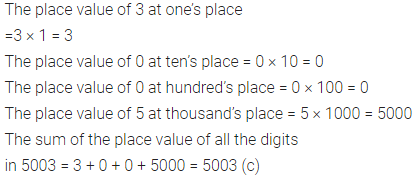
The sum of the place values of all the digits in 5003 is
(a) 8
(b) 53
(c) 5003
(d) 8000
Solution:
ML Aggarwal Class 6 Solutions for ICSE Maths Chapter 1 Knowing Our Numbers Objective Type Questions 5

Question 6.
The total number of 4-digit numbers is
(a) 9000
(b) 9999
(c) 10000
(d) none of these
Solution:

ML Aggarwal Class 6 Solutions for ICSE Maths Chapter 1 Knowing Our Numbers Objective Type Questions 6

Question 7.
The product of the place values of two-threes in 73532 is
(a) 9000
(b) 90000
(c) 99000
(d) 1000
Solution:

ML Aggarwal Class 6 Solutions for ICSE Maths Chapter 1 Knowing Our Numbers Objective Type Questions 7

Question 8.
The smallest 4-digit number having distinct digits is
(a) 1234
(b) 1023
(c) 1002
(d) 3210
Solution:

ML Aggarwal Class 6 Solutions for ICSE Maths Chapter 1 Knowing Our Numbers Objective Type Questions 8

Question 9.
The largest 4-digit number having distinct digits is
(a) 9999
(b) 9867
(c) 9786
(d) 9876
Solution:

ML Aggarwal Class 6 Solutions for ICSE Maths Chapter 1 Knowing Our Numbers Objective Type Questions 9

Question 10.
The largest 4-digit number is
(a) 9999
(b) 9876
(c) 9990
(d) none of these
Solution:

ML Aggarwal Class 6 Solutions for ICSE Maths Chapter 1 Knowing Our Numbers Objective Type Questions 10

Question 11.
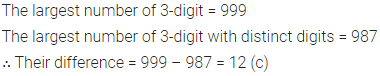
The difference between the largest number of 3-digit and the largest number of 3-digit with distinct digits is
(a) 0
(b) 10
(c) 12
(d) 14
Solution:
ML Aggarwal Class 6 Solutions for ICSE Maths Chapter 1 Knowing Our Numbers Objective Type Questions 11

Question 12.
If we write natural numbers from 1 to 100, the number of times the digit 5 has been written is
(a) 11
(b) 15
(c) 19
(d) 20
Solution:

ML Aggarwal Class 6 Solutions for ICSE Maths Chapter 1 Knowing Our Numbers Objective Type Questions 12

Question 13.
The number 28,549 when rounded off to the nearest hundreds is
(a) 28,000
(b) 28,500
(c) 28,600
(d) 29,000
Solution:

ML Aggarwal Class 6 Solutions for ICSE Maths Chapter 1 Knowing Our Numbers Objective Type Questions 13

Question 14.
The smallest natural number which when rounded off to the nearest hundreds as 500 is
(a) 499
(b) 501
(c) 450
(d) 549
Solution:

ML Aggarwal Class 6 Solutions for ICSE Maths Chapter 1 Knowing Our Numbers Objective Type Questions 14

Question 15.
The greatest natural number which when rounded off to the nearest hundreds as 500 is
(a) 549
(b) 599
(c) 450
(d) none of these
Solution:

ML Aggarwal Class 6 Solutions for ICSE Maths Chapter 1 Knowing Our Numbers Objective Type Questions 15

Question 16.
The greatest 5-digit number formed by the digits 3, 0, 7 is
(a) 33077
(b) 77730
(c) 77330
(d) none of these
Solution:

ML Aggarwal Class 6 Solutions for ICSE Maths Chapter 1 Knowing Our Numbers Objective Type Questions 16

Question 17.
In the International place value system, we write 1 billion for
(a) 10 lakh
(b) 1 crore
(c) 10 crore
(d) 100 crore
Solution:

ML Aggarwal Class 6 Solutions for ICSE Maths Chapter 1 Knowing Our Numbers Objective Type Questions 17

Value Based Questions
Question 1.
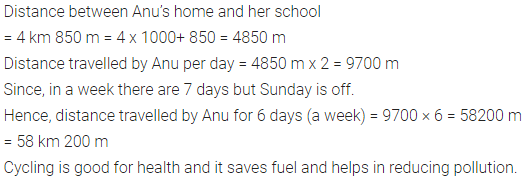
The distance between Anu’s home and her school is 4 km 850 m. Everyday she cycles both ways. Find the distance covered by her in a week. (Sunday being a holiday).
What are the advantages of cycling?
Solution:
ML Aggarwal Class 6 Solutions for ICSE Maths Chapter 1 Knowing Our Numbers Objective Type Questions 18

Higher Order Thinking Skills (HOTS)
Question 1.
Is there any digit whose place value is always equal to its face value irrespective of its position in any number?
Solution:

ML Aggarwal Class 6 Solutions for ICSE Maths Chapter 1 Knowing Our Numbers Objective Type Questions 19

Question 2.
Write all 4-digit numbers that can be formed with the digits2 and 5, using both digits equal number of time. Also find their sum.
Solution:

ML Aggarwal Class 6 Solutions for ICSE Maths Chapter 1 Knowing Our Numbers Objective Type Questions 20
ML Aggarwal Class 6 Solutions for ICSE Maths Chapter 1 Knowing Our Numbers Objective Type Questions 21

Question 3.
What is the difference between the smallest 6-digit number with five different digits and the greatest 5-digit number with four different digits?
Solution:

ML Aggarwal Class 6 Solutions for ICSE Maths Chapter 1 Knowing Our Numbers Objective Type Questions 22

Question 4.
How many times does the digit 3 occur at tert’s place in natural numbers from 100 to 1000?
Solution:

ML Aggarwal Class 6 Solutions for ICSE Maths Chapter 1 Knowing Our Numbers Objective Type Questions 23