ML Aggarwal Class 6 Solutions for ICSE Maths Chapter 3 Integers Ex 3.3

ML Aggarwal Class 6 Solutions Chapter 3 Integers Ex 3.3 for ICSE Understanding Mathematics acts as the best resource during your learning and helps you score well in your exams.

ML Aggarwal Class 6 Solutions for ICSE Maths Chapter 3 Integers Ex 3.3

Question 1.
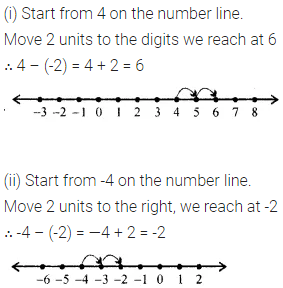
Evaluate the following, using the number line:
(i) 4 – (-2)
(ii) -4 – (-2)
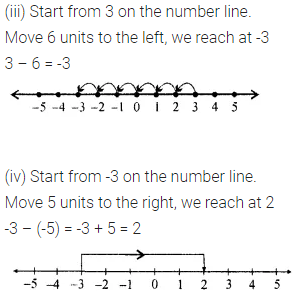
(iii) 3 – 6
(iv) -3 – (-5)
Solution:
ML Aggarwal Class 6 Solutions for ICSE Maths Chapter 3 Integers Ex 3.3 1
ML Aggarwal Class 6 Solutions for ICSE Maths Chapter 3 Integers Ex 3.3 2

Question 2.
Subtract :
(i) -6 from 9
(ii) 6 from -9
(iii) -6 from -9
(iv) -725 from -63
(v) -376 from 10
(vi) 92 from -620
Solution:
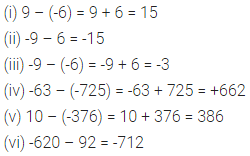
ML Aggarwal Class 6 Solutions for ICSE Maths Chapter 3 Integers Ex 3.3 3

Question 3.
Evaluate the following:
(i) -237 – (+ 1884)
(ii) -346 – (- 1275)
(iii) -190 – (-3512)
(iv) -2718 – (+ 6827)
Solution:
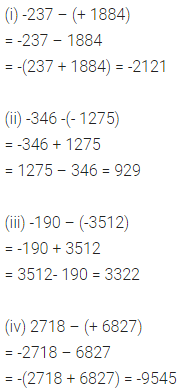
ML Aggarwal Class 6 Solutions for ICSE Maths Chapter 3 Integers Ex 3.3 4

Question 4.
The sum of two integers is 17. If one of them is -35, find the other.
Solution:
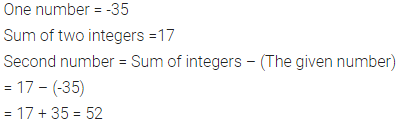
ML Aggarwal Class 6 Solutions for ICSE Maths Chapter 3 Integers Ex 3.3 5

Question 5.
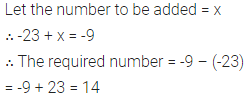
What must be added to -23 to get -9?
Solution:
ML Aggarwal Class 6 Solutions for ICSE Maths Chapter 3 Integers Ex 3.3 6

Question 6.
Find the predecessor of 0.
Solution:
ML Aggarwal Class 6 Solutions for ICSE Maths Chapter 3 Integers Ex 3.3 7

Question 7.
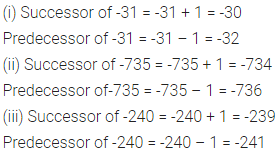
Find the successor and the predecessor of the following integers:
(i) -31
(ii) -735
(iii) -240
Solution:
ML Aggarwal Class 6 Solutions for ICSE Maths Chapter 3 Integers Ex 3.3 8

ML Aggarwal Class 6 Solutions for ICSE Maths Chapter 3 Integers Ex 3.2

ML Aggarwal Class 6 Solutions Chapter 3 Integers Ex 3.2 for ICSE Understanding Mathematics acts as the best resource during your learning and helps you score well in your exams.

ML Aggarwal Class 6 Solutions for ICSE Maths Chapter 3 Integers Ex 3.2

Question 1.
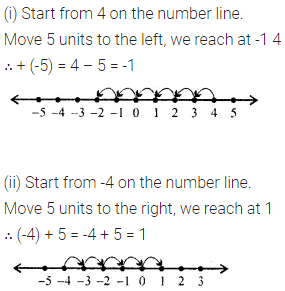
Evaluate the following, using the numbers line
(i) 4 + (-5)
(ii) (-4) + 5
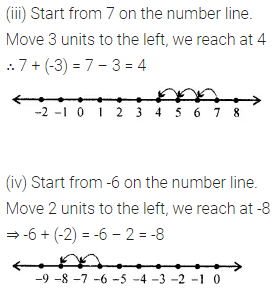
(iii) 7 + (-3)
(iv) -6 + (-2)
Solution:
ML Aggarwal Class 6 Solutions for ICSE Maths Chapter 3 Integers Ex 3.2 1
ML Aggarwal Class 6 Solutions for ICSE Maths Chapter 3 Integers Ex 3.2 2

Question 2.
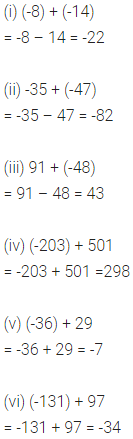
Evaluate the following :
(i) (-8) + (-14)
(ii) -35 + (-47)
(iii) 91 + (-48)
(iv) (-203) + 501
(v) (-36) + 29
(vi) (-131) + 97.
Solution:
ML Aggarwal Class 6 Solutions for ICSE Maths Chapter 3 Integers Ex 3.2 3

Question 3.
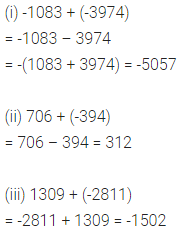
Evaluate the following :
(i) -1083 + (-3974)
(ii) 706 + (-394)
(iii) 1309 + (-2811)
Solution:
ML Aggarwal Class 6 Solutions for ICSE Maths Chapter 3 Integers Ex 3.2 4

Question 4.
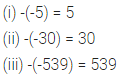
Fill in the following blanks :
(i) -(-5) = ……..
(ii) -(-30) = …….
(iii) -(-539) = ………
Solution:
ML Aggarwal Class 6 Solutions for ICSE Maths Chapter 3 Integers Ex 3.2 5

Question 5.
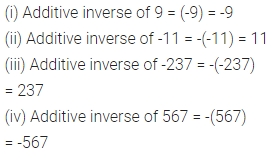
Write down the additive inverses of:
(i) 9
(ii) -11
(iii) -237
(iv) 567
Solution:
ML Aggarwal Class 6 Solutions for ICSE Maths Chapter 3 Integers Ex 3.2 6

ML Aggarwal Class 6 Solutions for ICSE Maths Chapter 3 Integers Ex 3.1

ML Aggarwal Class 6 Solutions Chapter 3 Integers Ex 3.1 for ICSE Understanding Mathematics acts as the best resource during your learning and helps you score well in your exams.

ML Aggarwal Class 6 Solutions for ICSE Maths Chapter 3 Integers Ex 3.1

Question 1.
Write the opposite of the following:
(i) Loss of ₹ 5000
(ii) 30 km East of Delhi
(iii) 200 m above sea level
(iv) 325 BC
(v) Spending ₹ 2700
(vi) 25°C above freezing point.
Solution:
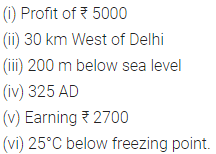
ML Aggarwal Class 6 Solutions for ICSE Maths Chapter 3 Integers Ex 3.1 1

Question 2.
Write each of the following using appropriate sign ‘+’ or ‘-‘:
(i) Gain of 3 kg Weight
(ii) Earning ₹ 1340
(iii) 20°C below freezing point
(iv) Loss of ₹ 470
(v) Depositing ₹ 2500 in a bank
(vi) 240 m below sea level
(vii) A jet plane flying at a height of 9320 m.
(viii) 6 m down in the basement of a building.
Solution:
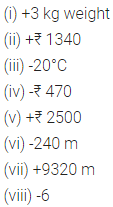
ML Aggarwal Class 6 Solutions for ICSE Maths Chapter 3 Integers Ex 3.1 2

Question 3.
In each of the following pairs, which number is to the right of the other on the number line?
(i) 3, 5
(ii) 0, -2
(iii) -3, -5
(iv) 2, -7
Solution:
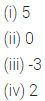
ML Aggarwal Class 6 Solutions for ICSE Maths Chapter 3 Integers Ex 3.1 3

Question 4.
In each of the following pairs, which number is to the left of the other on the number line?
(i) -3, 0
(ii) 2, -5
(iii) -4, -7
(iv) -10,-16
Solution:
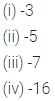
ML Aggarwal Class 6 Solutions for ICSE Maths Chapter 3 Integers Ex 3.1 4

Question 5.
Draw a number line and answer the following questions:
(i) Which integers lie between -9 and -2?
(ii) which is the largest among them?
(iii) Which is the smallest among them?
Solution:
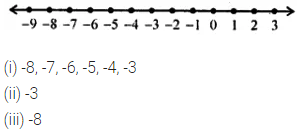
ML Aggarwal Class 6 Solutions for ICSE Maths Chapter 3 Integers Ex 3.1 5

Question 6.
Write four consecutive integers just greater than -9.
Solution:
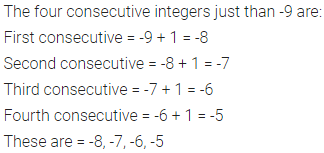
ML Aggarwal Class 6 Solutions for ICSE Maths Chapter 3 Integers Ex 3.1 6

Question 7.
Write four consecutive integers just before -2.
Solution:
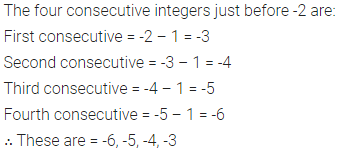
ML Aggarwal Class 6 Solutions for ICSE Maths Chapter 3 Integers Ex 3.1 7

Question 8.
Draw a number line and answerthe following questions:
(i) Which number will we reach if we move 6 units to the right of-1?
(ii) Which number will we reach if we move 7 units to the left of 2?
(iii) In which direction should we move to reach 3 from -3?
(iv) In which direction should we move to reach -8 from -3?
Solution:
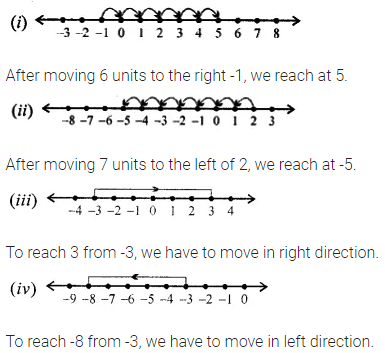
ML Aggarwal Class 6 Solutions for ICSE Maths Chapter 3 Integers Ex 3.1 8

Question 9.
Using the number line, write the integer which is:
(i) 5 more than -1
(ii) 5 less than -1
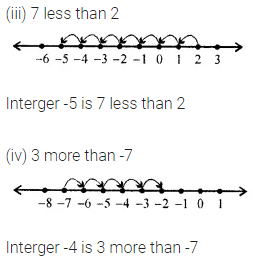
(iii) 7 less than 2
(iv) 3 more than -7
Solution:
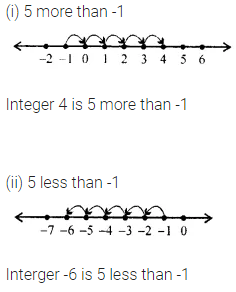
ML Aggarwal Class 6 Solutions for ICSE Maths Chapter 3 Integers Ex 3.1 9
ML Aggarwal Class 6 Solutions for ICSE Maths Chapter 3 Integers Ex 3.1 10

Question 10.
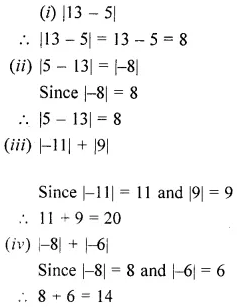
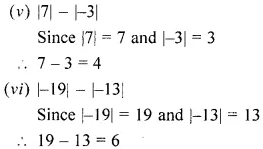
Evaluate the following.
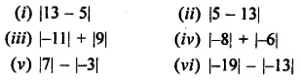
ML Aggarwal Class 6 Solutions for ICSE Maths Chapter 3 Integers Ex 3.1 11
Solution:
ML Aggarwal Class 6 Solutions for ICSE Maths Chapter 3 Integers Ex 3.1 12
ML Aggarwal Class 6 Solutions for ICSE Maths Chapter 3 Integers Ex 3.1 13

Question 11.
Use the appropriate symbol < or > to fill in the following blanks:
(i) -3 ………… 7
(ii) 0 ………….. -2
(iii) -10 ………… -11
(iv) -6 …………….. -2
(v) -5 ………….. -13
(vi) -30 …………… -19
Solution:
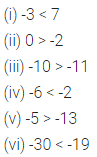
ML Aggarwal Class 6 Solutions for ICSE Maths Chapter 3 Integers Ex 3.1 14

Question 12.
Arrange the following integers in ascending order:
(i) -5, 3, 0, -9, 2
(ii) -28, -33, 9, -4, -31, -2, 35
Solution:
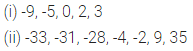
ML Aggarwal Class 6 Solutions for ICSE Maths Chapter 3 Integers Ex 3.1 15

Question 13.
Arrange the following integers in descending order:
(i) -31,25,-37, 43, 0,-5
(ii) -101, 95, -3, -8, 36, -7, -84
Solution:
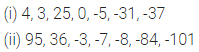
ML Aggarwal Class 6 Solutions for ICSE Maths Chapter 3 Integers Ex 3.1 16

Question 14.
State whether the following statements are true (T) or false (F):
(i) 0 is the smallest positive integer.
(ii) Every negative integer is less than every natural number.
(iii) -7 is to the right of-6 on the number line,
(iv) The absolute value of an integer is always greater than the integer.
Solution:
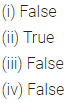
ML Aggarwal Class 6 Solutions for ICSE Maths Chapter 3 Integers Ex 3.1 17

ML Aggarwal Class 6 Solutions for ICSE Maths Chapter 2 Whole Numbers Check Your Progress

ML Aggarwal Class 6 Solutions Chapter 2 Whole Numbers Check Your Progress for ICSE Understanding Mathematics acts as the best resource during your learning and helps you score well in your exams.

ML Aggarwal Class 6 Solutions for ICSE Maths Chapter 2 Whole Numbers Check Your Progress

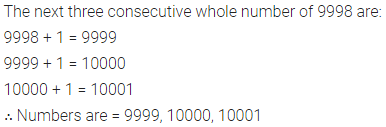
Question 1.
Write next three consecutive whole numbers of the number 9998.
Solution:
ML Aggarwal Class 6 Solutions for ICSE Maths Chapter 2 Whole Numbers Check Your Progress 1

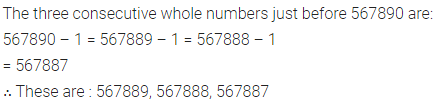
Question 2.
Write three consecutive whole numbers occurring just before 567890.
Solution:
ML Aggarwal Class 6 Solutions for ICSE Maths Chapter 2 Whole Numbers Check Your Progress 2

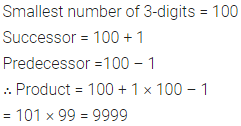
Question 3.
Find the product of the successor and the predecessor of the smallest number of 3-digits.
Solution:

ML Aggarwal Class 6 Solutions for ICSE Maths Chapter 2 Whole Numbers Check Your Progress 3

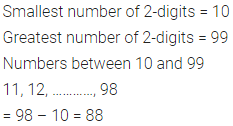
Question 4.
Find the number of whole numbers between the smallest and the greatest numbers of 2-digits.
Solution:
ML Aggarwal Class 6 Solutions for ICSE Maths Chapter 2 Whole Numbers Check Your Progress 4

Question 5.
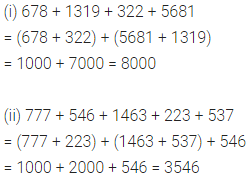
Find the following sum by suitable arrangements:
(i) 678 + 1319 + 322 + 5681
(ii) 777 + 546 + 1463 + 223 + 537
Solution:
ML Aggarwal Class 6 Solutions for ICSE Maths Chapter 2 Whole Numbers Check Your Progress 5

Question 6.
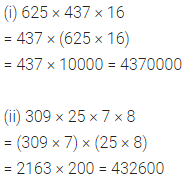
Determine the following products by suitable arrangements:
(i) 625 × 437 × 16
(ii) 309 × 25 × 7 × 8
Solution:

ML Aggarwal Class 6 Solutions for ICSE Maths Chapter 2 Whole Numbers Check Your Progress 6

Question 7.
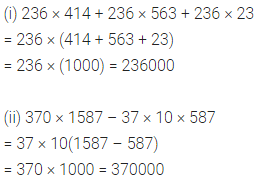
Find the value of the following by using suitable properties:
(i) 236 × 414 + 236 × 563 + 236 × 23
(ii) 370 × 1587 – 37 × 10 × 587
Solution:

ML Aggarwal Class 6 Solutions for ICSE Maths Chapter 2 Whole Numbers Check Your Progress 7

Question 8.
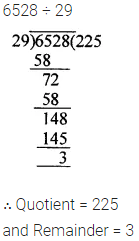
Divide 6528 by 29 and check the result by division algorithm.
Solution:
ML Aggarwal Class 6 Solutions for ICSE Maths Chapter 2 Whole Numbers Check Your Progress 8

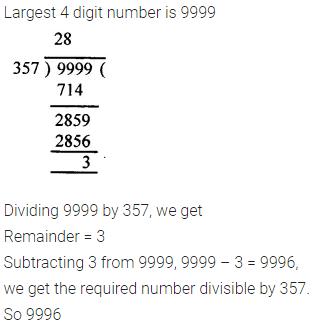
Question 9.
Find the greatest 4-digit number which is exactly divisible by 357.
Solution:
ML Aggarwal Class 6 Solutions for ICSE Maths Chapter 2 Whole Numbers Check Your Progress 9

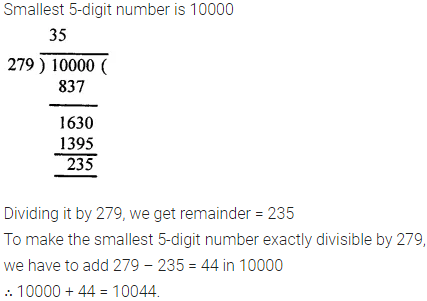
Question 10.
Find the smallest 5-digit number which is exactly divisible by 279.
Solution:
ML Aggarwal Class 6 Solutions for ICSE Maths Chapter 2 Whole Numbers Check Your Progress 10

ML Aggarwal Class 6 Solutions for ICSE Maths Chapter 2 Whole Numbers Objective Type Questions

ML Aggarwal Class 6 Solutions Chapter 2 Whole Numbers Objective Type Questions for ICSE Understanding Mathematics acts as the best resource during your learning and helps you score well in your exams.

ML Aggarwal Class 6 Solutions for ICSE Maths Chapter 2 Whole Numbers Objective Type Questions

Mental Maths
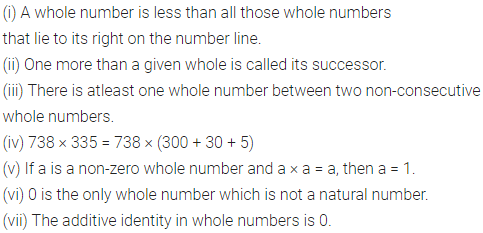
Question 1.
Fill in the blanks:

(i) A whole number is less than all those whole numbers that lie to its on the number line.
(ii) One more than a given whole is called its
(iii) There is atleast one whole number between two whole numbers.
(iv) 738 × 335 = 738 x (300 + 30 + ……..)
(v) If a is a non-zero whole number and a × a = a, then a = ……..
(vi) …….. is the only whole number which is not a natural number.
(vii) The additive identity in whole numbers is …….
Solution:
ML Aggarwal Class 6 Solutions for ICSE Maths Chapter 2 Whole Numbers Objective Type Questions 1

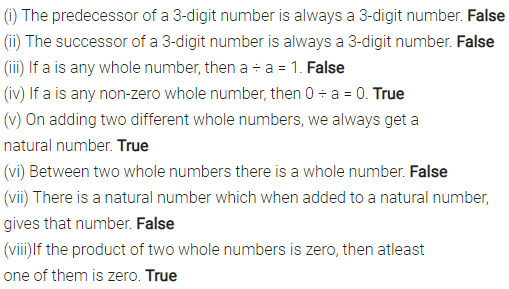
Question 2.
State whether the following statements are true (T) or false (F):
(i) The predecessor of a 3-digit number is always a 3-digit number.
(ii) The successor of a 3-digit number is always a 3-digit number.
(iii) If a is any whole number, then a + a = 1.
(iv) If a is any non-zero whole number, then 0 ÷ a = 0.
(v) On adding two different whole numbers, we always get a natural number.
(vi) Between two whole numbers there is a whole number.
(vii) There is a natural number which when added to a natural number, gives that number.
(viii) If the product of two whole numbers is zero, then atleast one of them is zero.
Solution:
ML Aggarwal Class 6 Solutions for ICSE Maths Chapter 2 Whole Numbers Objective Type Questions 2

Multiple Choice Questions
Choose the correct answer from the given four options (3 to 16):
Question 3.
The whole number which does not have a predecessor in whole number system is
(a) 0
(b) 1
(c) 2
(d) none of these
Solution:
ML Aggarwal Class 6 Solutions for ICSE Maths Chapter 2 Whole Numbers Objective Type Questions 3

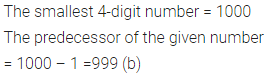
Question 4.
The predecessor of the smallest 4-digit number is
(a) 99
(b) 999
(c) 1000
(d) 1001
Solution:
ML Aggarwal Class 6 Solutions for ICSE Maths Chapter 2 Whole Numbers Objective Type Questions 4

Question 5.
The predecessor of 1 million is
(a) 9999
(b) 99999
(c) 999999
(d) 1000001
Solution:
ML Aggarwal Class 6 Solutions for ICSE Maths Chapter 2 Whole Numbers Objective Type Questions 5

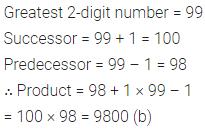
Question 6.
The product of the predecessor and the successor of the greatest 2-digit number is
(a) 9900
(b) 9800
(c) 9700
(d) none of these
Solution:
ML Aggarwal Class 6 Solutions for ICSE Maths Chapter 2 Whole Numbers Objective Type Questions 6

Question 7.
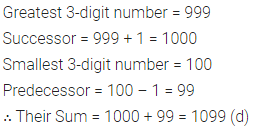
The sum of the successor of the greatest 3-digit number and the predecessor of the smallest 3-digit number is
(a) 1000
(b) 1100
(c) 1101
(d) 1099
Solution:
ML Aggarwal Class 6 Solutions for ICSE Maths Chapter 2 Whole Numbers Objective Type Questions 7

Question 8.
The number of whole numbers between 22 and 54 is
(a) 30
(b) 31
(c) 32
(d) 42
Solution:
ML Aggarwal Class 6 Solutions for ICSE Maths Chapter 2 Whole Numbers Objective Type Questions 8

Question 9.
The number of whole numbers between the smallest whole number and the greatest 2-digit number is
(a) 100
(b) 99
(b) 98
(d) 88
Solution:
ML Aggarwal Class 6 Solutions for ICSE Maths Chapter 2 Whole Numbers Objective Type Questions 9

Question 10.
If a is a whole number such that a + a = a, then a is equal to
(a) 0
(b) 1
(c) 2
(d) none of these
Solution:
ML Aggarwal Class 6 Solutions for ICSE Maths Chapter 2 Whole Numbers Objective Type Questions 10

Question 11.
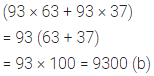
The value of (93 × 63 + 93 × 37) is
(a) 930
(b) 9300
(c) 93000
(d) none of these
Solution:
ML Aggarwal Class 6 Solutions for ICSE Maths Chapter 2 Whole Numbers Objective Type Questions 11

Question 12.
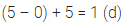
Which of the following is not equal to zero?
(a) 0 × 5
(b) 0 = 5
(c) (10 – 10) + 5
(d) (5 – 0) + 5
Solution:
ML Aggarwal Class 6 Solutions for ICSE Maths Chapter 2 Whole Numbers Objective Type Questions 12

Question 13.
Which of the following statement is true?
(a) 21 – (13 – 5) = (21 – 13) – 5
(b) 21 – 13 is not a whole number
(c) 21 × 1 = 21 × 0
(d) 13 – 21 is not a whole number
Solution:
ML Aggarwal Class 6 Solutions for ICSE Maths Chapter 2 Whole Numbers Objective Type Questions 13

Question 14.
Which of the following statement is not true?
(a) Zero is the identity for multiplication of whole numbers.
(b) Addition and multiplication both are commutative for whole numbers.
(c) Addition and multiplication both are associative for whole numbers.
(d) Multiplication is distributive over addition for whole numbers.
Solution:
ML Aggarwal Class 6 Solutions for ICSE Maths Chapter 2 Whole Numbers Objective Type Questions 14

Question 15.
On dividing a number by 9 we get 47 as quotient and 5 as remainder. The number is
(a) 418
(b) 428
(c) 429
(d) none of these
Solution:
ML Aggarwal Class 6 Solutions for ICSE Maths Chapter 2 Whole Numbers Objective Type Questions 15

Question 16.
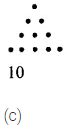
By using dot (•) pattern, which of the following numbers can be arranged in two ways namely a triangle and a rectangle?
(a) 12
(b) 11
(c) 10
(d) 9
Solution:
ML Aggarwal Class 6 Solutions for ICSE Maths Chapter 2 Whole Numbers Objective Type Questions 16

Higher Order Thinking Skills (HOTS)
Question 1.
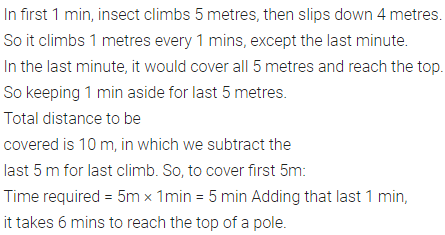
The height of a slippery pole is 10 m and an insect is trying to climb the pole. The insect climbs 5 m in one minute and then slips down by 4 m. In how much time will insect reach the top?
Solution:
ML Aggarwal Class 6 Solutions for ICSE Maths Chapter 2 Whole Numbers Objective Type Questions 17

Question 2.
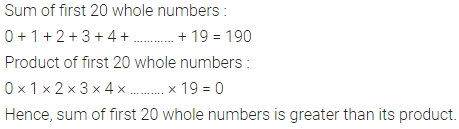
Which is greater, the sum of first twenty whole numbers or the product of first twenty whole numbers?
Solution:
ML Aggarwal Class 6 Solutions for ICSE Maths Chapter 2 Whole Numbers Objective Type Questions 18

Question 3.
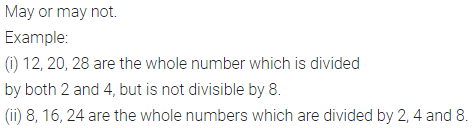
If a whole number is divisible by 2 and 4, is it divisible by 8 also?
Solution:
ML Aggarwal Class 6 Solutions for ICSE Maths Chapter 2 Whole Numbers Objective Type Questions 19