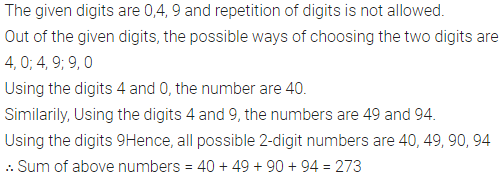
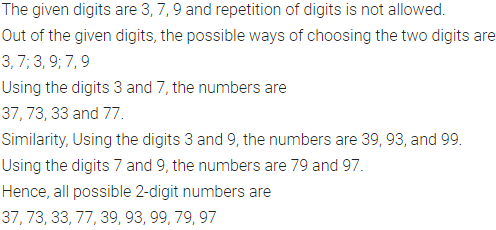
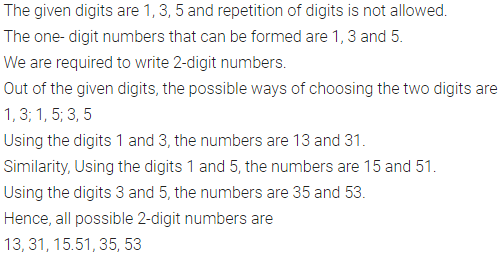
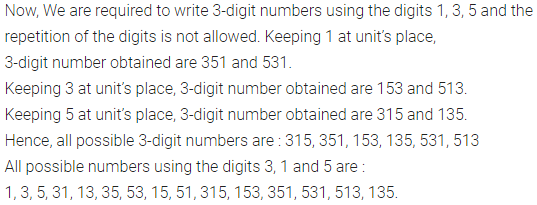
ML Aggarwal Class 6 Solutions for ICSE Maths Chapter 1 Knowing Our Numbers Ex 1.4

ML Aggarwal Class 6 Solutions Chapter 1 Knowing Our Numbers Ex 1.4 for ICSE Understanding Mathematics acts as the best resource during your learning and helps you score well in your exams.

ML Aggarwal Class 6 Solutions for ICSE Maths Chapter 1 Knowing Our Numbers Ex 1.4

Question 1.
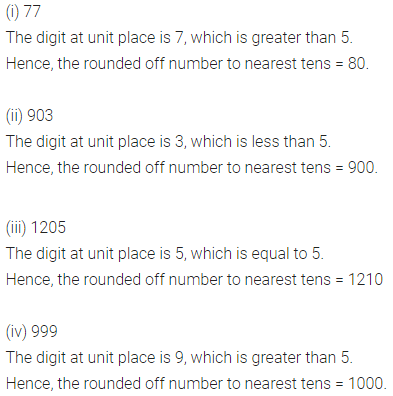
Round off each of the following numbers to their nearest tens:
(i) 77
(ii) 903
(iii) 70 1205
(iv) 999
Solution:
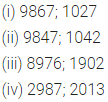
ML Aggarwal Class 6 Solutions for ICSE Maths Chapter 1 Knowing Our Numbers Ex 1.4 1

Question 2.
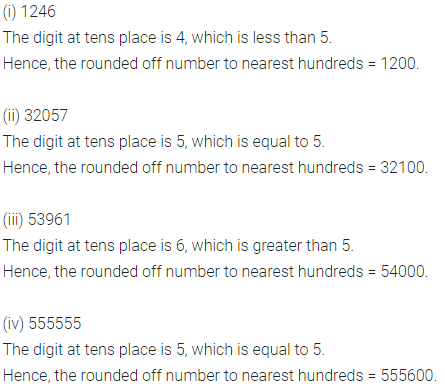
Estimate each of the following numbers to their nearest hundreds:
(i) 1246
(ii) 32057
(iii) 53961
(iv) 555555
Solution:
ML Aggarwal Class 6 Solutions for ICSE Maths Chapter 1 Knowing Our Numbers Ex 1.4 2

Question 3.
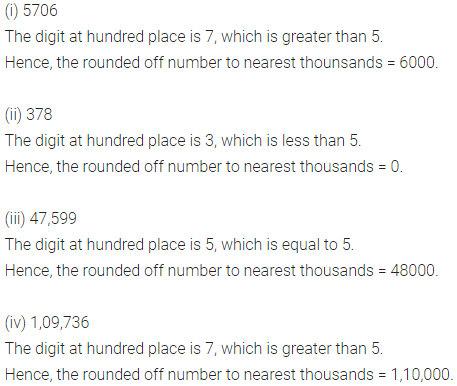
Estimate each of the following numbers to their nearest thousands:
(i) 5706
(ii) 378
(iii) 47,599
(iv) 1,09,736
Solution:
ML Aggarwal Class 6 Solutions for ICSE Maths Chapter 1 Knowing Our Numbers Ex 1.4 3

Question 4.
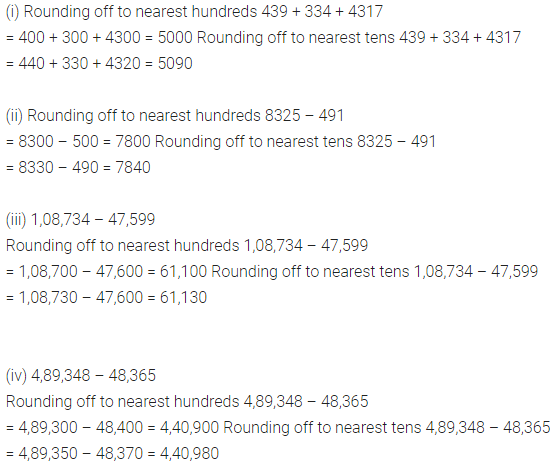
Give a rough estimate (by rounding off to nearest hundreds) and also a closer estimate (by rounding off to nearest tens):
(i) 439 + 334 + 4317
(ii) 8325 – 491
(iii) 1,08,734-47,599
(iv) 4,89,348 – 48,365
Solution:
ML Aggarwal Class 6 Solutions for ICSE Maths Chapter 1 Knowing Our Numbers Ex 1.4 4

Question 5.
Estimate each of the following by rounding off each number nearest to its greatest place:
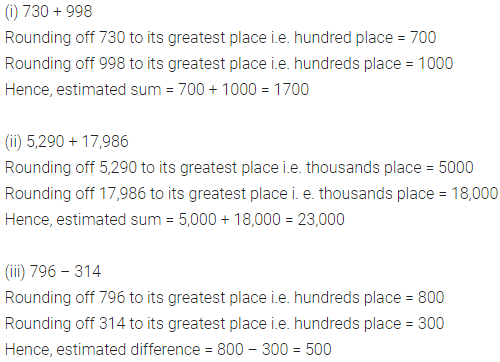
(i) 730 + 998
(ii) 5,290 + 17,986
(iii) 796-314
(iv) 28,292 – 21,496
Solution:
ML Aggarwal Class 6 Solutions for ICSE Maths Chapter 1 Knowing Our Numbers Ex 1.4 5

ML Aggarwal Class 6 Solutions for ICSE Maths Chapter 1 Knowing Our Numbers Ex 1.4 6

Question 6.
Estimate the following products by rounding off each of its factors nearest to its greatest place:
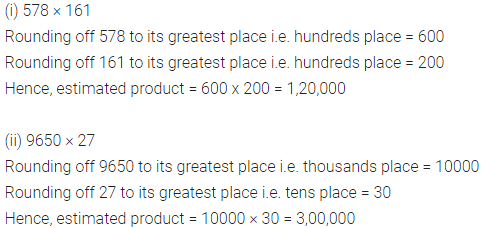
(i) 578 × 161
(ii) 9650 × 27
Solution:
ML Aggarwal Class 6 Solutions for ICSE Maths Chapter 1 Knowing Our Numbers Ex 1.4 7

Question 7.
Estimate the following products by rounding off each of its factors nearest to its hundreds place:
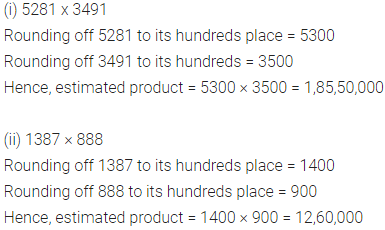
(i) 5281 × 3491
(ii) 1387 × 888
Solution:
ML Aggarwal Class 6 Solutions for ICSE Maths Chapter 1 Knowing Our Numbers Ex 1.4 8

ML Aggarwal Class 6 Solutions for ICSE Maths Chapter 1 Knowing Our Numbers Ex 1.3

ML Aggarwal Class 6 Solutions Chapter 1 Knowing Our Numbers Ex 1.1 for ICSE Understanding Mathematics acts as the best resource during your learning and helps you score well in your exams.

ML Aggarwal Class 6 Solutions for ICSE Maths Chapter 1 Knowing Our Numbers Ex 1.3

Question 1.
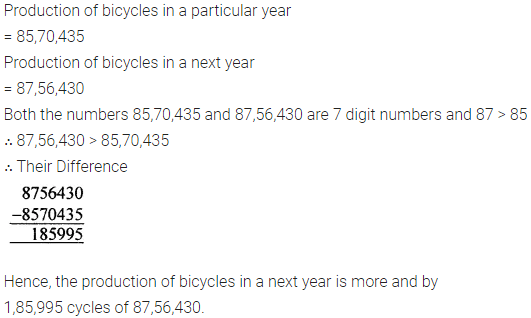
In a particular year, a company manufactured 8570435 bicycles and next year it manufactured 8756430 bicycles. In which year more bicycles were manufactured and by how many?
Solution:
ML Aggarwal Class 6 Solutions for ICSE Maths Chapter 1 Knowing Our Numbers Ex 1.3 1

Question 2.
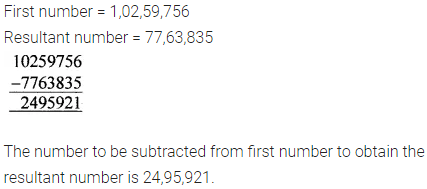
What number must be subtracted from 1,02,59,756 to get 77,63,835?
Solution:
ML Aggarwal Class 6 Solutions for ICSE Maths Chapter 1 Knowing Our Numbers Ex 1.3 2

Question 3.
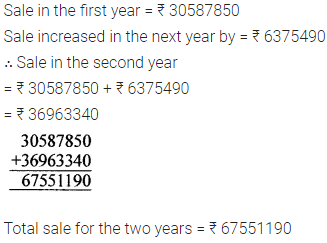
The sale receipt of a company during a year was ₹ 30587850. Next year it increased by ₹ 6375490. What was the total sale receipt of the company during these two years?
Solution:
ML Aggarwal Class 6 Solutions for ICSE Maths Chapter 1 Knowing Our Numbers Ex 1.3 3ML Aggarwal Class 6 Solutions for ICSE Maths Chapter 1 Knowing Our Numbers Ex 1.3 3

Question 4.
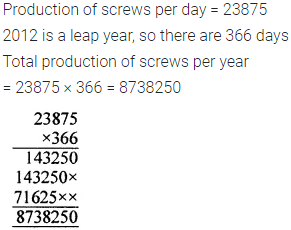
A machine manufactures 23875 screws per day. How many screws did it produce iff the year 2012? Assume that the machine worked on all the days of the year.
Solution:
ML Aggarwal Class 6 Solutions for ICSE Maths Chapter 1 Knowing Our Numbers Ex 1.3 4

Question 5.
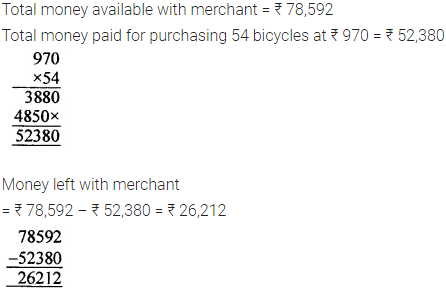
A merchant had ₹ 78,592 with him. He placed an order for puchasing 54 bicycles at ₹ 970 each. How much money will remain with him after the purchase?
Solution:
ML Aggarwal Class 6 Solutions for ICSE Maths Chapter 1 Knowing Our Numbers Ex 1.3 5

Question 6.
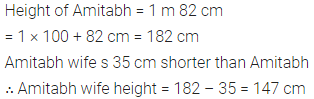
Amitabh is 1 m 82 cm tall and his wife is 35 cm shorter than him. What is his wife’s height?
Solution:
ML Aggarwal Class 6 Solutions for ICSE Maths Chapter 1 Knowing Our Numbers Ex 1.3 6

Question 7.
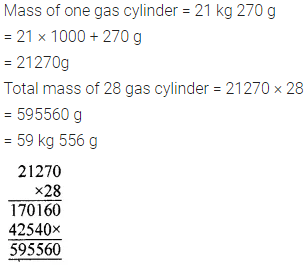
The mass of each gas cylinder is 21 kg 270g. What is total mass of 28 such cylinders?
Solution:
ML Aggarwal Class 6 Solutions for ICSE Maths Chapter 1 Knowing Our Numbers Ex 1.3 7

Question 8.
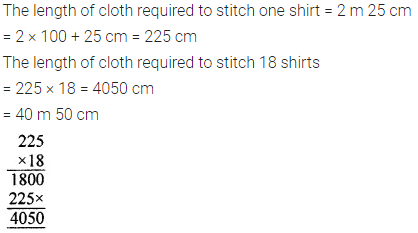
In order to make a shirt, 2 m 25 cm cloth is needed. What length of cloth is required to make 18 such shirts?
Solution:
ML Aggarwal Class 6 Solutions for ICSE Maths Chapter 1 Knowing Our Numbers Ex 1.3 8

Question 9.
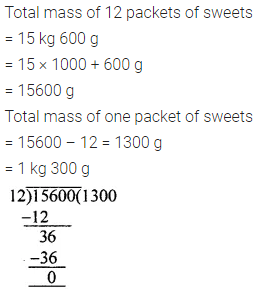
The total mass of 12 packets of sweets, each of the same size, is 15 kg 600 g. What is the mass of each such packet?
Solution:
ML Aggarwal Class 6 Solutions for ICSE Maths Chapter 1 Knowing Our Numbers Ex 1.3 9

Question 10.
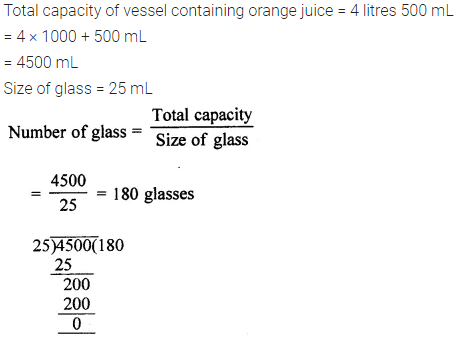
A vessel has 4 litres 500 millilitres of orange juice. In how many glasses, each of 25 mL capacity, can it be filled?
Solution:
ML Aggarwal Class 6 Solutions for ICSE Maths Chapter 1 Knowing Our Numbers Ex 1.3 10

Question 11.
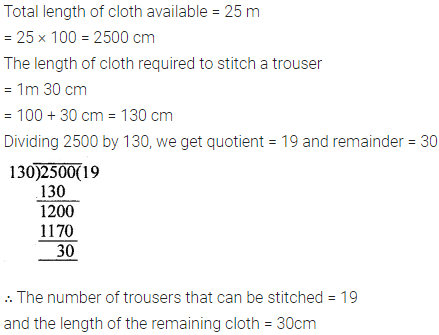
To stitch a trouser, 1 m 30 cm cloth is needed. Out of 25 m cloth, how many trousers can be stitched and how much cloth will remain?
Solution:
ML Aggarwal Class 6 Solutions for ICSE Maths Chapter 1 Knowing Our Numbers Ex 1.3 11

ML Aggarwal Class 6 Solutions for ICSE Maths Chapter 1 Knowing Our Numbers Ex 1.2

ML Aggarwal Class 6 Solutions Chapter 1 Knowing Our Numbers Ex 1.2 for ICSE Understanding Mathematics acts as the best resource during your learning and helps you score well in your exams.

ML Aggarwal Class 6 Solutions for ICSE Maths Chapter 1 Knowing Our Numbers Ex 1.2

Question 1.
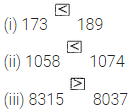
Use the appropriate symbol < or > to fill in the blanks:
(i) 173 … 189
(ii) 1058 … 1074
(iii) 8315 … 8037
Solution:
ML Aggarwal Class 6 Solutions for ICSE Maths Chapter 1 Knowing Our Numbers Ex 1.2 1

Question 2.
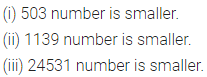
In each of the following pairs of numbers, state which number is smaller:
(i) 553,503
(ii) 41338,1139
(iii) 25431,24531
Solution:
ML Aggarwal Class 6 Solutions for ICSE Maths Chapter 1 Knowing Our Numbers Ex 1.2 2

Question 3.
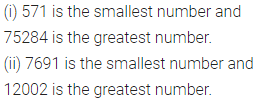
Find the greatest and the smallest numbers in each row:
(i) 71834, 75284, 571, 2333, 594
(ii) 9853, 7691, 9999, 12002.
Solution:
ML Aggarwal Class 6 Solutions for ICSE Maths Chapter 1 Knowing Our Numbers Ex 1.2 3

Question 4.
Arrange the following numbers in ascending order:
304, 340, 34, 43, 430
Solution:
ML Aggarwal Class 6 Solutions for ICSE Maths Chapter 1 Knowing Our Numbers Ex 1.2 4

Question 5.
Arrange the following numbers in descending order:
53, 7333, 553, 7529, 335.
Solution:
ML Aggarwal Class 6 Solutions for ICSE Maths Chapter 1 Knowing Our Numbers Ex 1.2 5

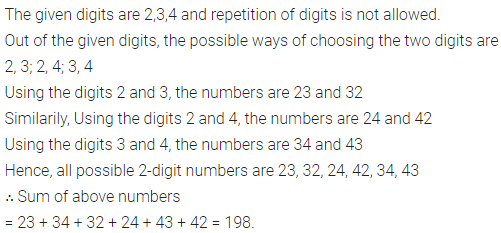
Question 6.
Write all possible 2-digits numbers that can be formed by using the digits 2, 3 and 4. Repetition of digits is not allowed. Also find their sum.
Solution:
ML Aggarwal Class 6 Solutions for ICSE Maths Chapter 1 Knowing Our Numbers Ex 1.2 6

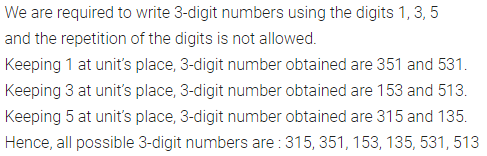
Question 7.
Write all possible 3-digits numbers using the digits 3, 1 and 5. Repetition of digits is not allowed.
Solution:
ML Aggarwal Class 6 Solutions for ICSE Maths Chapter 1 Knowing Our Numbers Ex 1.2 7

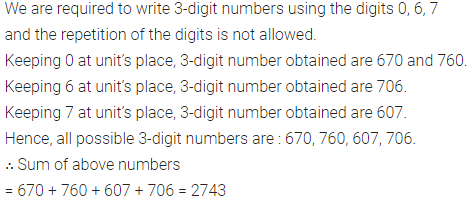
Question 8.
Write all possible 3-digits numbers using the digits 7, 0 and 6. Repetition of digits is not allowed. Also, find their sum.
Solution:
ML Aggarwal Class 6 Solutions for ICSE Maths Chapter 1 Knowing Our Numbers Ex 1.2 8

Question 9.
Write all possible 2-digit numbers using the digits 4, 0 and 9. Repetition of digits is not allowed. Also find their sum.
Solution:
ML Aggarwal Class 6 Solutions for ICSE Maths Chapter 1 Knowing Our Numbers Ex 1.2 9

Question 10.
Write all possible 2-digit numbers that can be formed by using the digit 3, 7 and 9. Repetition of digits is allowed.
Solution:
ML Aggarwal Class 6 Solutions for ICSE Maths Chapter 1 Knowing Our Numbers Ex 1.2 10

Question 11.
Write all possible numbers using the digits 3,1 and 5. Repetition of digits is not allowed.
Solution:
ML Aggarwal Class 6 Solutions for ICSE Maths Chapter 1 Knowing Our Numbers Ex 1.2 11
ML Aggarwal Class 6 Solutions for ICSE Maths Chapter 1 Knowing Our Numbers Ex 1.2 12

Question 12.
How many 6-digit numbers are there in all ?
Solution:
ML Aggarwal Class 6 Solutions for ICSE Maths Chapter 1 Knowing Our Numbers Ex 1.2 13

Question 13.
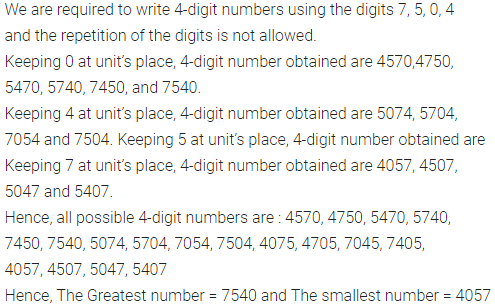
Write down the greatest number and the smallest number of 4-digits that can be formed by the digits 7, 5,0 and 4 using each digit only once.
Solution:
ML Aggarwal Class 6 Solutions for ICSE Maths Chapter 1 Knowing Our Numbers Ex 1.2 14

Question 14.
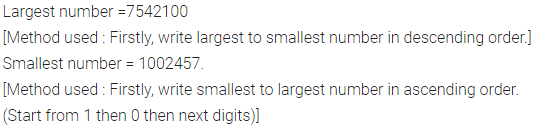
Rearrange the digits of the number 5701024 to get the largest number and the smallest number of 7 digits.
Solution:
ML Aggarwal Class 6 Solutions for ICSE Maths Chapter 1 Knowing Our Numbers Ex 1.2 15

Question 15.
Keeping the place value of digit 3 in the number 730265 same, rearrange
the digits of the given number to get the largest number and smallest number of 6 digits.
Solution:
ML Aggarwal Class 6 Solutions for ICSE Maths Chapter 1 Knowing Our Numbers Ex 1.2 16

Question 16.
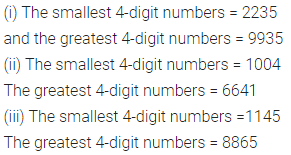
Form the smallest and greatest 4-digit numbers by using any one digit twice from the digits:
(i) 5, 2, 3, 9
(ii) 6, 0, 1, 4
(iii) 4, 6, 1, 5, 8.
Solution:
ML Aggarwal Class 6 Solutions for ICSE Maths Chapter 1 Knowing Our Numbers Ex 1.2 17

Question 17.
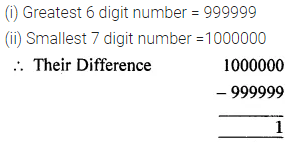
Write
(i) the greatest number of 6 digits
(ii) the smallest number of 7 digits. Also find their difference.
Solution:
ML Aggarwal Class 6 Solutions for ICSE Maths Chapter 1 Knowing Our Numbers Ex 1.2 18

Question 18.
Write the greatest 4-digit number of distinct digits.
Solution:
ML Aggarwal Class 6 Solutions for ICSE Maths Chapter 1 Knowing Our Numbers Ex 1.2 19

Question 19.
Write the smallest 4-digit number of distinct digits.
Solution:
ML Aggarwal Class 6 Solutions for ICSE Maths Chapter 1 Knowing Our Numbers Ex 1.2 20

Question 20.
Write the greatest 6-digit number using three different digits.
Solution:
ML Aggarwal Class 6 Solutions for ICSE Maths Chapter 1 Knowing Our Numbers Ex 1.2 21

Question 21.
Write the smallest 7-digit number using four different digits.
Solution:
ML Aggarwal Class 6 Solutions for ICSE Maths Chapter 1 Knowing Our Numbers Ex 1.2 22

Question 22.
Write the greatest and the smallest 4-digit numbers using four different digits with the conditions as given:
(i) Digit 7 is always at units place.
(ii) Digit 4 is always at tens place.
(iii) Digit 9 is always at hundreds place.
(iv) Digit 2 is always at thousands place.
Solution:
ML Aggarwal Class 6 Solutions for ICSE Maths Chapter 1 Knowing Our Numbers Ex 1.2 23

ML Aggarwal Class 6 Solutions for ICSE Maths Chapter 1 Knowing Our Numbers Ex 1.1

ML Aggarwal Class 6 Solutions Chapter 1 Knowing Our Numbers Ex 1.1 for ICSE Understanding Mathematics acts as the best resource during your learning and helps you score well in your exams.

ML Aggarwal Class 6 Solutions for ICSE Maths Chapter 1 Knowing Our Numbers Ex 1.1

Question 1.
Write the smallest natural number. Can you write the largest natural number?
Solution:
ML Aggarwal Class 6 Solutions for ICSE Maths Chapter 1 Knowing Our Numbers Ex 1.1 1

Question 2.
Fill in the blanks:
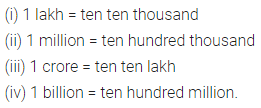
(i) 1 lakh = … ten thousand
(ii) 1 million = … hundred thousand
(iii) 1 crore = … ten lakh
(iv) 1 billion =… hundred million.
Solution:
ML Aggarwal Class 6 Solutions for ICSE Maths Chapter 1 Knowing Our Numbers Ex 1.1 2

Question 3.
Insert commas suitably and write each of the following numbers in words in the Indian system and the International system of numeration.
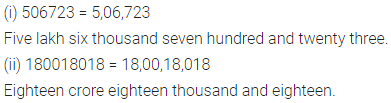
(i) 506723
(ii) 180018018
Solution:
ML Aggarwal Class 6 Solutions for ICSE Maths Chapter 1 Knowing Our Numbers Ex 1.1 3

Question 4.
Write the following numbers in expanded form:
(i) 750687
(ii) 5032109
Solution:
ML Aggarwal Class 6 Solutions for ICSE Maths Chapter 1 Knowing Our Numbers Ex 1.1 4

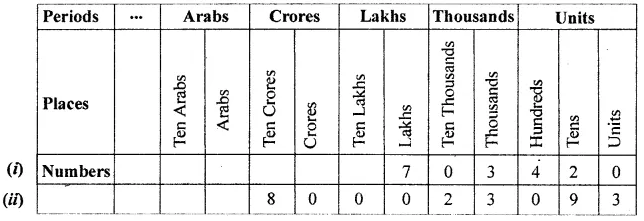
Question 5.
Write the following number in figures:
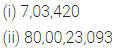
(i) Seven lakh three thousand four hundred twenty.
(ii) Eighty crore twenty three thousand ninety three.
Also write the above numbers in the place value chart.
Solution:
ML Aggarwal Class 6 Solutions for ICSE Maths Chapter 1 Knowing Our Numbers Ex 1.1 5
ML Aggarwal Class 6 Solutions for ICSE Maths Chapter 1 Knowing Our Numbers Ex 1.1 6

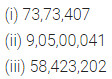
Question 6.
Write each of the following numbers in numeral form and place commas correctly:
(i) Seventy three lakh seventy thousand four hundred seven.
(ii) Nine crore five lakh forty one.
(iii) Fifty eight million four hundred twenty three thousand two hundred two.
Solution:
ML Aggarwal Class 6 Solutions for ICSE Maths Chapter 1 Knowing Our Numbers Ex 1.1 7

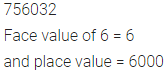
Question 7.
Write the face value and place value of the digit 6 in the number 756032.
Solution:
ML Aggarwal Class 6 Solutions for ICSE Maths Chapter 1 Knowing Our Numbers Ex 1.1 8

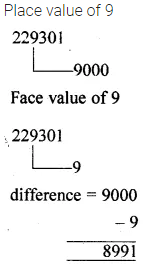
Question 8.
Find the difference between the place value and the face value of the digit 9 in the number 229301.
Solution:
ML Aggarwal Class 6 Solutions for ICSE Maths Chapter 1 Knowing Our Numbers Ex 1.1 9

Question 9.
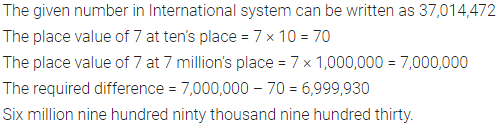
Determine the difference of the place value of two 7’s in 37014472 and write it in words in International system.
Solution:
ML Aggarwal Class 6 Solutions for ICSE Maths Chapter 1 Knowing Our Numbers Ex 1.1 10

Question 10.
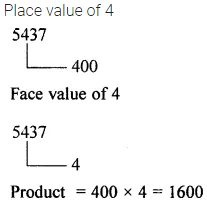
Determine the product of place value and the face value of the digit 4 in the number 5437.
Solution:
ML Aggarwal Class 6 Solutions for ICSE Maths Chapter 1 Knowing Our Numbers Ex 1.1 11

Question 11.
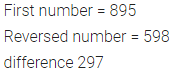
Find the difference between the number 895 and that obtained on reversing its digits.
Solution:
ML Aggarwal Class 6 Solutions for ICSE Maths Chapter 1 Knowing Our Numbers Ex 1.1 12

ML Aggarwal Class 7 ICSE Maths Model Question Paper 6

ML Aggarwal Class 7 Solutions for ICSE Maths Model Question Paper 6 acts as the best resource during your learning and helps you score well in your exams.

ML Aggarwal Class 7 ICSE Maths Model Question Paper 6

(Based on Chapters 10 to 17)
Time allowed: 2\(\frac { 1 }{ 2 }\) Hours
Maximum Marks: 90

General Instructions

  • All questions are compulsory.
  • The question paper consists of 29 questions divided into four sections A, B, C, and D.
  • Section A comprises of 8 questions of 1 mark each.
  • Section B comprises of 6 questions of 2 marks each.
  • Section C comparises of 10 questions of 4 marks each.
  • Section D comprises of 5 questions of 6 marks each.
  • Question numbers 1 to 8 in Section A is multiple choice questions where you are to select one correct option out of the given four.

Section – A

Question numbers 1 to 8 is of 1 mark each.
Question 1.
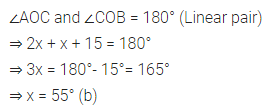
In the given figure, if ∠AOC and ∠COB form a linear pair, then the value of x
(a) 60
(b) 55
(c) 50
(d) 45
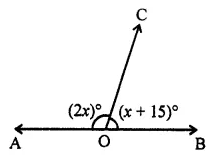
ML Aggarwal Class 7 ICSE Maths Model Question Paper 6 1
Solution:
ML Aggarwal Class 7 ICSE Maths Model Question Paper 6 2

Question 2.
An exterior angle of a triangle is 118°. If one of the two interior opposite angle is 54°, then the other interior opposite angle is
(a) 62°
(b) 54°
(c) 64°
(d) 59°
Solution:
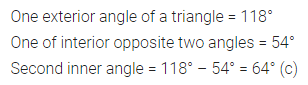
ML Aggarwal Class 7 ICSE Maths Model Question Paper 6 3

Question 3.
In a right-angled triangle, the lengths of two legs are 8 cm and 15 cm. The length of the hypotenuse is
(a) 23 cm
(b) 20 cm
(c) 17 cm
(d) 17 m
Solution:
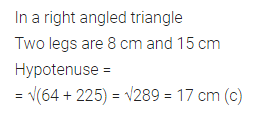
ML Aggarwal Class 7 ICSE Maths Model Question Paper 6 4

Question 4.
If ΔABC = ΔPRQ, the the correct statement is
(a) AB = PQ
(b) ∠B = ∠Q
(c) ∠C = ∠R
(d) AC = PQ
Solution:
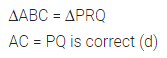
ML Aggarwal Class 7 ICSE Maths Model Question Paper 6 5

Question 5.
The number of lines that can be drawn parallel to a given line l through a point outside the line l is
(a) 0
(b) 1
(c) 2
(d) infinitely many
Solution:

ML Aggarwal Class 7 ICSE Maths Model Question Paper 6 6

Question 6.
If the area of a circle is numerically equal to its circumference, then the diameter of the circle is
(a) 2 units
(b) 4 units
(c) 6 units
(d) 8 units
Solution:
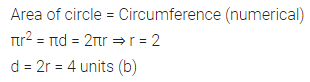
ML Aggarwal Class 7 ICSE Maths Model Question Paper 6 7

Question 7.
A quadrilateral having exactly two lines of symmetry and rotational symmetry of order 2 is a
(a) square
(b) parallelogram
(c) rhombus
(d) kite
Solution:

ML Aggarwal Class 7 ICSE Maths Model Question Paper 6 8

Question 8.
A mode is the observation of the data
(a) whose position is in the middle
(b) having maximum value
(c) occurring a maximum number of times
(d) occurring a minimum number of times
Solution:

ML Aggarwal Class 7 ICSE Maths Model Question Paper 6 9

Section – B

Question numbers 9 to 14 are of 2 marks each.
Question 9.
An angle is 30° more than one-half of its complement. Find the angle.
Solution:
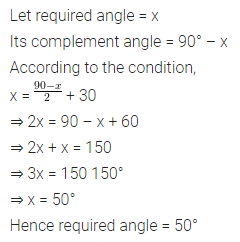
ML Aggarwal Class 7 ICSE Maths Model Question Paper 6 10

Question 10.
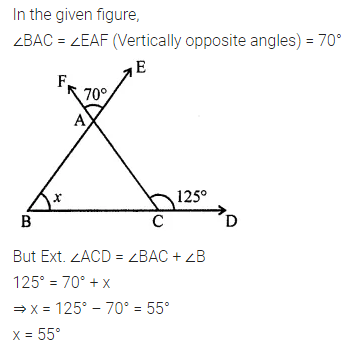
In the given figure, find the value of x.
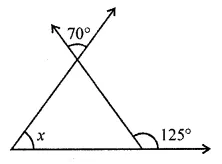
ML Aggarwal Class 7 ICSE Maths Model Question Paper 6 11
Solution:
ML Aggarwal Class 7 ICSE Maths Model Question Paper 6 12

Question 11.
A die is thrown once. Find the probability of getting
(i) a prime number
(ii) a composite number
Solution:
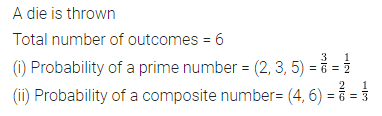
ML Aggarwal Class 7 ICSE Maths Model Question Paper 6 13

Question 12.
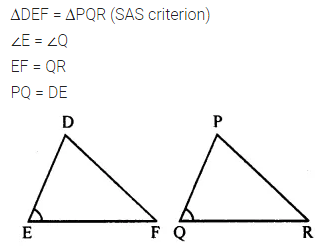
You want to show that ΔDEF = ΔPQR by SAS congruence rule.
It is given that ∠E = ∠Q, you need to have
(i) EF = …….
(ii) PQ = ………
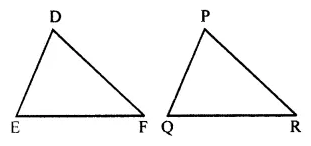
ML Aggarwal Class 7 ICSE Maths Model Question Paper 6 14
Solution:
ML Aggarwal Class 7 ICSE Maths Model Question Paper 6 15

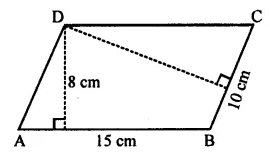
Question 13.
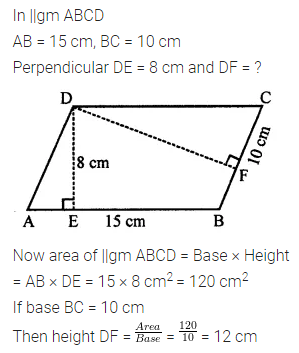
In the given figure, two adjacent sides of a parallelogram are 15 cm and 10 cm. If the distance between the longer sides is 8 cm, find the
(i) area of parallelogram
(ii) the distance between the shorter sides.
ML Aggarwal Class 7 ICSE Maths Model Question Paper 6 16
Solution:
ML Aggarwal Class 7 ICSE Maths Model Question Paper 6 17

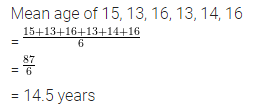
Question 14.
Find the mean age of six students whose ages (in years) are:
15, 13, 16, 13, 14, 16.
Solution:
ML Aggarwal Class 7 ICSE Maths Model Question Paper 6 18

Section – C

Question numbers 15 to 24 are of 4 marks each.
Question 15.
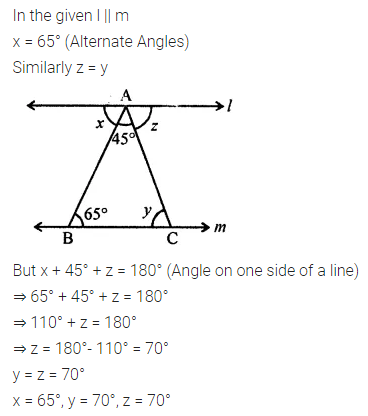
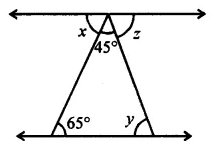
In the given figure, lines l and m are parallel. Find the values of x, y, and z.
ML Aggarwal Class 7 ICSE Maths Model Question Paper 6 19
Solution:
ML Aggarwal Class 7 ICSE Maths Model Question Paper 6 20

Question 16.
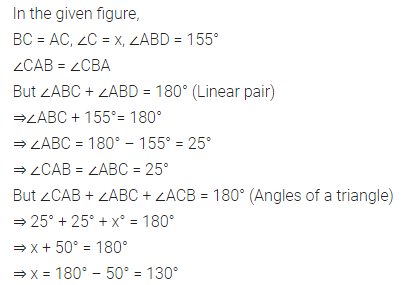
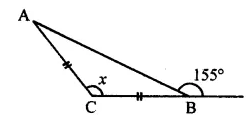
In the given figure, BC = AC. Find the value of x.
ML Aggarwal Class 7 ICSE Maths Model Question Paper 6 21
Solution:
ML Aggarwal Class 7 ICSE Maths Model Question Paper 6 22

Question 17.
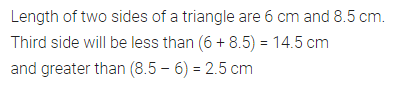
If the lengths of the two sides of a triangle are 6 cm and 8.5 cm, then what can be the length of the third side?
Solution:
ML Aggarwal Class 7 ICSE Maths Model Question Paper 6 23

Question 18.
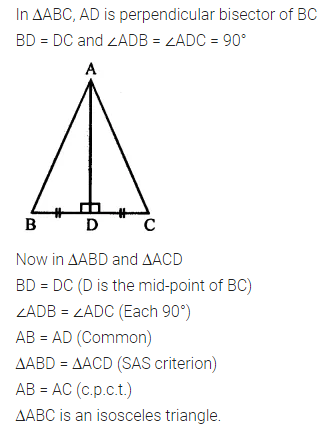
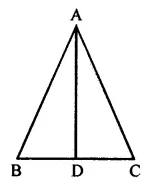
In the given figure, AD is perpendicular bisector of \(\bar { BC }\).
(i) State three pairs of equal parts in ∆ABD and ∆ACD.
(ii) Is ∆ABD = ∆ACD? Give reasons.
(iii) Is ABC an isosceles triangle? Give reasons.
ML Aggarwal Class 7 ICSE Maths Model Question Paper 6 24
Solution:
ML Aggarwal Class 7 ICSE Maths Model Question Paper 6 25

Question 19.
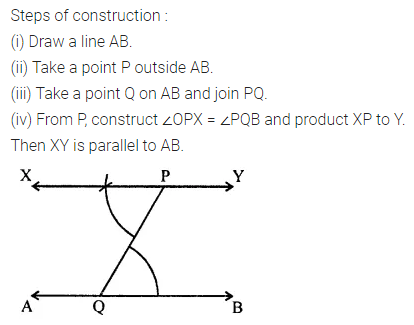
Draw a line, say AB, take a point P outside line AB. Through P, draw a line parallel to line AB using ruler and compasses only.
Solution:
ML Aggarwal Class 7 ICSE Maths Model Question Paper 6 26

Question 20.
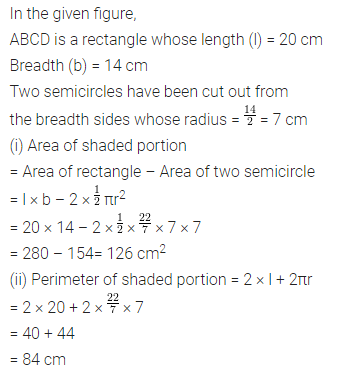
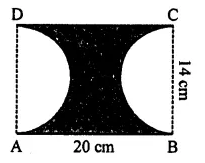
In the given figure, ABCD is a rectangle with AB = 20 cm and BC = 14 cm. Two semicircles are cut from each of two breadths as diameters. Find
(i) the area of the shaded region
(ii) the perimeter of the shaded region.
Take π = \(\frac { 22 }{ 7 }\).
ML Aggarwal Class 7 ICSE Maths Model Question Paper 6 27
Solution:
ML Aggarwal Class 7 ICSE Maths Model Question Paper 6 28

Question 21.
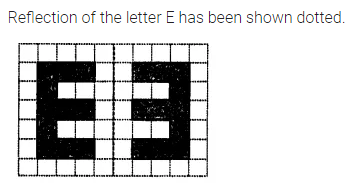
Draw the reflection of the letter E in the given mirror line shown dotted.
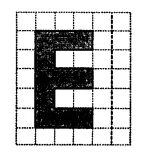
ML Aggarwal Class 7 ICSE Maths Model Question Paper 6 29
Solution:
ML Aggarwal Class 7 ICSE Maths Model Question Paper 6 30

Question 22.
Three cubes each with edge 2 units are placed side by side to form a cuboid. Find the dimensions of the cuboid so formed and draw an isometric sketch of this cuboid.
Solution:
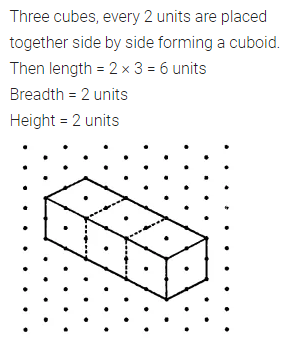
ML Aggarwal Class 7 ICSE Maths Model Question Paper 6 31

Question 23.
Draw two nets of a regular tetrahedron.
Solution:
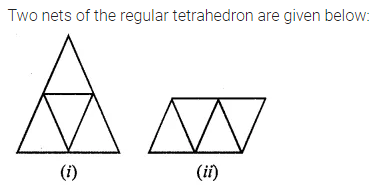
ML Aggarwal Class 7 ICSE Maths Model Question Paper 6 32

Question 24.
A boy scored the following marks in various class tests during a year, each test is marked out of 20:
15, 17, 16, 7, 9, 12, 14, 16, 3, 19, 12, 16
(i) Arrange the marks in ascending order.
(ii) What are his modal marks?
(iii) What are his median marks?
(iv) What are his mean marks?
Solution:
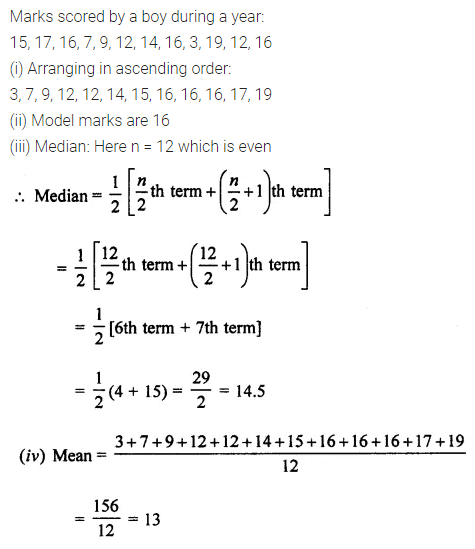
ML Aggarwal Class 7 ICSE Maths Model Question Paper 6 33

Section – D

Question numbers 25 to 29 are of 6 marks each.
Question 25.
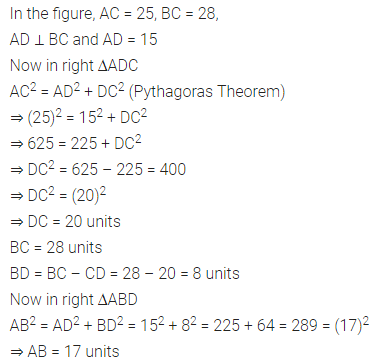
In the given figure, all measurements are in centimeters. If AD is perpendicular to BC, find the length of B.
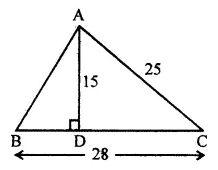
ML Aggarwal Class 7 ICSE Maths Model Question Paper 6 34
Solution:
ML Aggarwal Class 7 ICSE Maths Model Question Paper 6 35

Question 26.
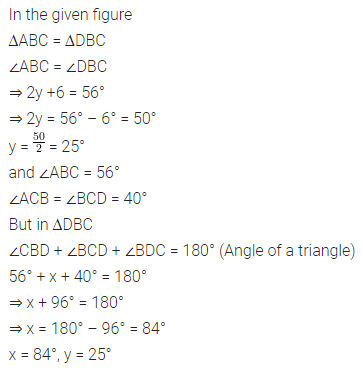
In the adjoining figure, show that ΔABC = ΔDBC. Hence, find the values of x and y.
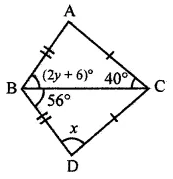
ML Aggarwal Class 7 ICSE Maths Model Question Paper 6 36
Solution:
ML Aggarwal Class 7 ICSE Maths Model Question Paper 6 37

Question 27.
By using ruler and compasses only, construct a triangle ABC with BC = 7.5 cm, ∠B = 60° and ∠A = 90°.
Solution:
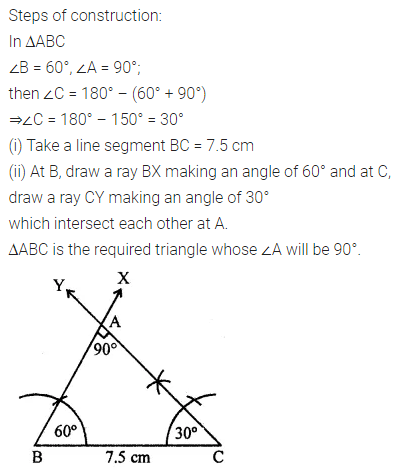
ML Aggarwal Class 7 ICSE Maths Model Question Paper 6 38

Question 28.
Anjali took a wire of length 88 cm and bent it into the shape of a circle. Find the area enclosed by that circle. If the same wire is bent in the shape of a square, then find the area enclosed by that square. Which shape encloses more area and by how much?
Take π = \(\frac { 22 }{ 7 }\)
Solution:
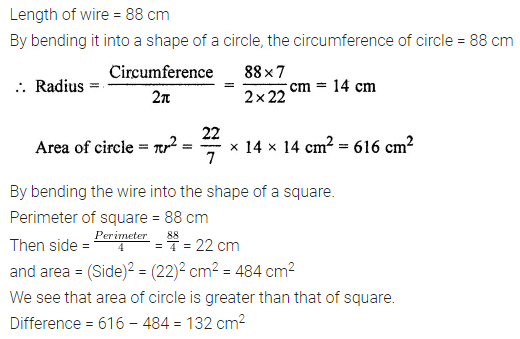
ML Aggarwal Class 7 ICSE Maths Model Question Paper 6 39

Question 29.
Given below is the data of school going students (boys and girls):

ML Aggarwal Class 7 ICSE Maths Model Question Paper 6 40
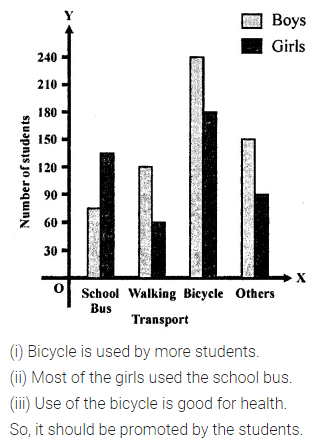
Draw a double bar graph to represent the above data and hence answer the following questions:
(i) Which mode of transport is used by more students?
(ii) Which mode of transport is used by more number of girls that the number of boys?
What values are being promoted by using a bicycle as a mode of transport?
Solution:

ML Aggarwal Class 7 ICSE Maths Model Question Paper 6 41
ML Aggarwal Class 7 ICSE Maths Model Question Paper 6 42