Who Did Patrick’s Homework? Extra Questions and Answers Class 6 English Honeysuckle

Here we are providing Who Did Patrick’s Homework Extra Questions and Answers Class 6 English Honeysuckle, Extra Questions for Class 6 English was designed by subject expert teachers.

Who Did Patrick’s Homework Extra Questions and Answers Class 6 English Honeysuckle

Who Did Patrick’s Homework Extra Questions and Answers Short Answer Type

Question 1.
Did Patrick like doing homework?
Answer:
No, Patrick didn’t like it. According to Patrick, homework was too boring.

Question 2.
What were the indoor and outdoor games Patrick liked to play?
Answer:
He liked to play two outdoor games, hockey and basketball and one indoor game, Nintendo.

Question 3.
Did the elf-like to do what Patrick had asked?
Answer:
No, but he had to do it because he had granted a wish to Patrick.

Question 4.
What was the tiny man wearing?
Answer:
The tiny man wore a woollen shirt with old fashioned britches and tall hat.

Question 5.
Why did Patrick hate to do a home work? Give your views in details.
Answer:
Patrick never liked to do his homework. He hated to do his homework because for him it was too boring. Instead of doing his homework, he used to play hockey basketball and Nintendo.

Question 6.
How did Patrick get the elf to do his homework?
Answer:
One day Patrick saw his cat playing with a doll when Patrick grabbed it he found out that it was not a doll but a man of tinniest size. The elf yelled at Patrick to save from the cat and he will grant him a wish. Patrick saved him from the cat and, wished that elf should do his homework for one semester that is for 35 days.

Question 7.
What did Patrick think his cat was playing with? What was it really?
Answer:
Patrick thought that his cat was playing with a doll, but in reality it was an elf (man of tinniest size).

Question 8.
Why did the little man grant Patrick a wish?
Answer:
The little man granted a wish to Patrick because Patrick saved him from cat.

Question 9.
What was Patrick’s wish?
Answer:
Patrick wished that the elf will do all his homework till the end of semester, which was of 35 days.

Question 10.
In what subjects did the little man need help, to do Patrick’s homework?
Answer:
To do Patrick’s homework the little man needed help in English, Mathematics and Human history.

Question 11.
How did Patrick help him?
Answer:
Patrick helped him by bringing books from library, consulting a dictionary, guiding the little man in doing sums of arithmetic and read out portions from history book.

Question 12.
Who do you think did Patrick’s homework- the little man, or Patrick himself? Give reasons for your answers.
Answer:
Patrick himself did his homework as little man did not know anything, in English, math’s and human history. Patrick had to consult dictionary, guide him with math’s rules and helped him to read too. He stayed up at nights and worked hard. Therefore, it was Patrick who did the homework.

Who Did Patrick’s Homework Extra Questions and Answers Long Answer Type

Question 1.
While helping the elf in doing the homework, Patrick did his own homework. Do you think self- help is the best help?
Answer:
Patrick was a lazy boy who love to play hockey, basketball and Nintendo, but when the elf gave him the wish that he would do all his homework for a semester. Patrick became very happy. To his surprise the elf did not know anything about his homework. The elf asked Patrick to help him in English, Mathematics and Human history. To help them Patrick has started going to library, tried to solve the sums, read human history to explain everything to elf.

So that elf do his homework. But Patrick not even once realized that he was studying everything and helping the elf in doing his homework. At the end of the semester Patrick got A grade and had developed a changed attitude and behaviour. All this . was the result of Patrick’s sheer hard work that he did while helping the elf. Now he was a completely changed boy, developed a whole new positive attitude. His teachers and parents were now proud of him. We can say that self-help is best help because if elf would have done Patrick’s homework than Patrick would not be a changed boy. He might have been same as earlier but now he has developed a liking towards study and his home work.

Question 2.
Children don’t like doing homeworks, Explain by giving examples from the chapter about the importance of doing homework.
Answer:
Homework is a really important task of learning days. It is a kind of revision for the work done in the class; It helps in preparing and understanding the chapter. Patrick did all his homework while he was helping the elf. He studied human history, practiced math and English too.

During this entire period he had developed a liking towards study. Now he was not feeling that homework is too boring. All the concepts and topics were now clear to him, had developed a whole new attitude. He got A grades. All this happened because of homework he did. So it is very important for all the students to do their homework.

Who Did Patrick’s Homework Extra Questions and Answers Reference to Context

Question 1.
Then one day he found his cat playing with a little doll and he grabbed it away. To his surprise it wasn’t a doll at all, but a man of the tiniest size. He had a little wool shirt with old fashioned britches and a high tall hat much like a witch’s. He yelled, “Save me! Don’t give me back to that cat. I’ll grant you a wish, I promise you that.”

(i) The elf was grabbed by a
(ii) Elf promised Patrick to if he saves his life.
(iii) Who yelled ‘Save me’?
(iv) The hat worn by elf was
(v) Synonym of short trouser is
Answer:
(i) Cat
(ii) Grant a wish
(iii) Elf
(iv) High
(v) Britches

Question 2.
“I don’t know this word,” the elf squeaked while reading Patrick’s homework. “Get me a dictionary. No, what’s even better, look up the word and sound it out by each letter.” When it came to maths, Patrick was out of luck. “What are times tables?” the elf shrieked. “We elves never need that. And addition and subtraction and division and fractions? Here, sit down beside me, you simply must guide me.” Elves know nothing of human history, to them it’s a mystery. So the little elf, already a shouter, just got louder. “Go to the library, I need books. More and more books. And you can help me read them too.”

(i) The elf took help of Patrick in reading
(ii) Elves never Practise
(iii) Patrick guided him ….. Mathematics
(iv) History was ……… for elves.
Answer:
(i) to look up for meaning
(ii) Maths
(iii) in
(iv) Mystery

Question 3.
Finally, the last day of school arrived and the elf was free to go. As for homework, there was no more, so he quietly and slyly slipped out the back door. Patrick got his A’s; his classmates were amazed; his teachers smiled and were full of praise. And his parents? They wondered what had happened to Patrick. He was now the model kid. Cleaned his room, did his chores, was cheerful, never rude, like he had developed a whole new attitude.

(i) The elf was free to go because
(ii) The word similar to the meaning ‘sly’ is
(iii) Patrick was the model kid as
(iv) Antonym of cheerful is
(v) The best achievement of Patrick was that he scored A grade.
Answer:
(i) It was the last day of the school
(ii) Secretively or cunningly
(iii) he had developed a new attitude
(iv) Sad
(v) Had
ML Aggarwal Class 6 Solutions for ICSE Maths Chapter 12 Symmetry Ex 12.2

ML Aggarwal Class 6 Solutions Chapter 12 Symmetry Ex 12.2 for ICSE Understanding Mathematics acts as the best resource during your learning and helps you score well in your exams.

ML Aggarwal Class 6 Solutions for ICSE Maths Chapter 12 Symmetry Ex 12.2

Question 1.
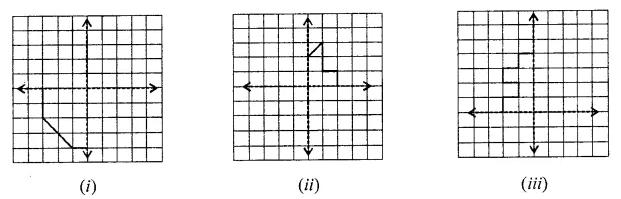
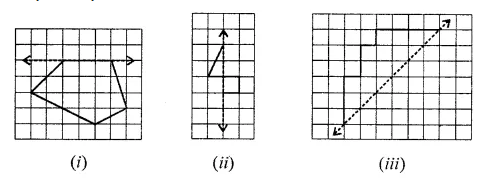
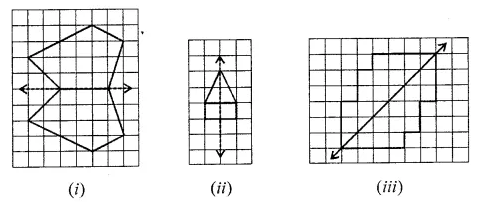
Copy the following figures on a squared paper. Complete each of them such that the dotted line is the line of symmetry:
ML Aggarwal Class 6 Solutions for ICSE Maths Chapter 12 Symmetry Ex 12.2 1
Solution:
ML Aggarwal Class 6 Solutions for ICSE Maths Chapter 12 Symmetry Ex 12.2 2

Question 2.
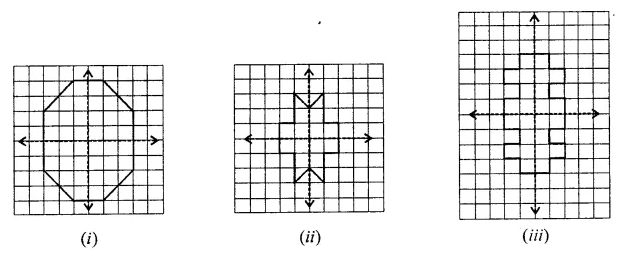
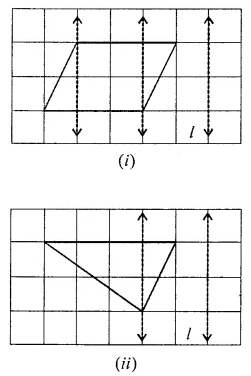
Copy the following figures on a squared paper. Complete each of them such that the resultant figure has two dotted lines as the lines of symmetry:
ML Aggarwal Class 6 Solutions for ICSE Maths Chapter 12 Symmetry Ex 12.2 3
Solution:
ML Aggarwal Class 6 Solutions for ICSE Maths Chapter 12 Symmetry Ex 12.2 4

Question 3.
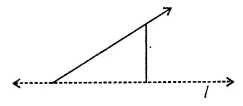
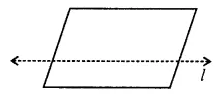
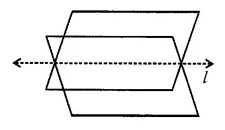
In the given figure, l is the line of symmetry. Complete the diagram to make it symmetrical.
ML Aggarwal Class 6 Solutions for ICSE Maths Chapter 12 Symmetry Ex 12.2 5
Solution:
ML Aggarwal Class 6 Solutions for ICSE Maths Chapter 12 Symmetry Ex 12.2 6

Question 4.
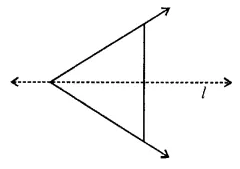
In the given figure, l is the line of symmetry. Draw the image of the parallelogram and complete the diagram so that it becomes symmetrical.
ML Aggarwal Class 6 Solutions for ICSE Maths Chapter 12 Symmetry Ex 12.2 7
Solution:
ML Aggarwal Class 6 Solutions for ICSE Maths Chapter 12 Symmetry Ex 12.2 8

Question 5.
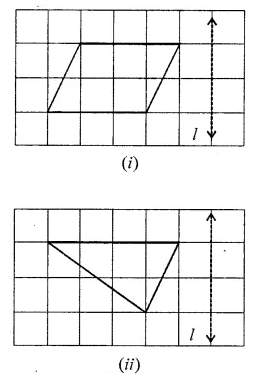
Copy the following figures on a squared paper and find their reflections in the mirror line l.
ML Aggarwal Class 6 Solutions for ICSE Maths Chapter 12 Symmetry Ex 12.2 9
Solution:
ML Aggarwal Class 6 Solutions for ICSE Maths Chapter 12 Symmetry Ex 12.2 10

ML Aggarwal Class 6 Solutions for ICSE Maths Chapter 12 Symmetry Ex 12.1

ML Aggarwal Class 6 Solutions Chapter 12 Symmetry Ex 12.1 for ICSE Understanding Mathematics acts as the best resource during your learning and helps you score well in your exams.

ML Aggarwal Class 6 Solutions for ICSE Maths Chapter 12 Symmetry Ex 12.1

Question 1.
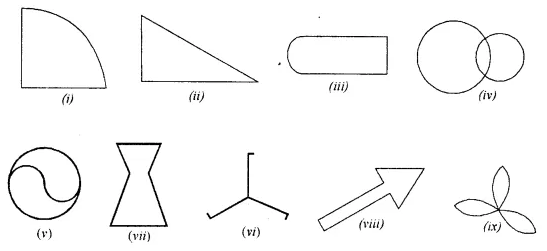
Draw the line (or lines) of symmetry, if any, of the following shapes and count their number.
ML Aggarwal Class 6 Solutions for ICSE Maths Chapter 12 Symmetry Ex 12.1 1
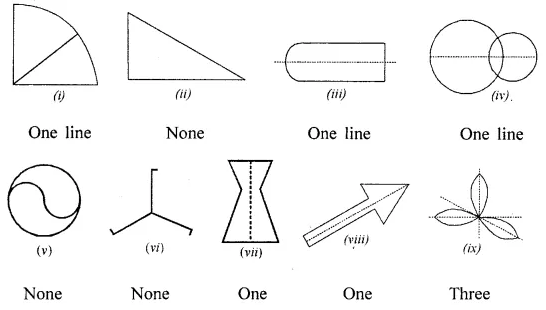
Solution:
ML Aggarwal Class 6 Solutions for ICSE Maths Chapter 12 Symmetry Ex 12.1 2

Question 2.
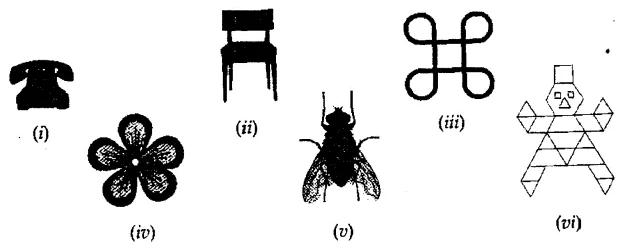
Draw the line (or lines) of symmetry, if any, of the following pictures (of objects) and count their number:
ML Aggarwal Class 6 Solutions for ICSE Maths Chapter 12 Symmetry Ex 12.1 3
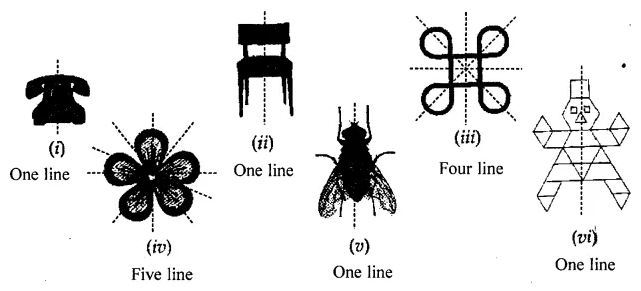
Solution:
ML Aggarwal Class 6 Solutions for ICSE Maths Chapter 12 Symmetry Ex 12.1 4

Question 3.
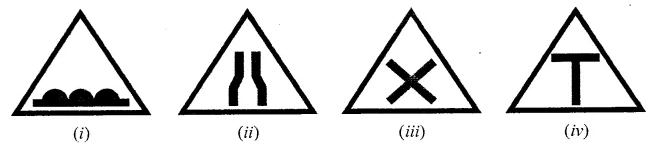
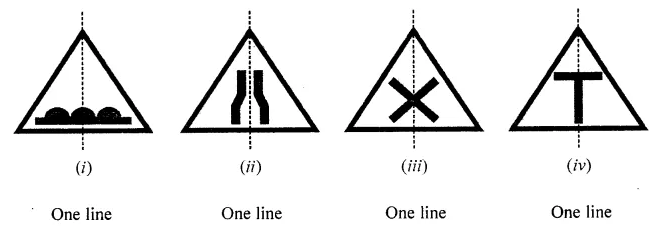
Draw the line (or lines) of symmetry, if any, of the following road signs and count their number:
ML Aggarwal Class 6 Solutions for ICSE Maths Chapter 12 Symmetry Ex 12.1 5
Solution:
ML Aggarwal Class 6 Solutions for ICSE Maths Chapter 12 Symmetry Ex 12.1 6

Question 4.
Draw the line (or lines) of symmetry, if any, of the following numerals and count their number:
ML Aggarwal Class 6 Solutions for ICSE Maths Chapter 12 Symmetry Ex 12.1 7
Solution:
ML Aggarwal Class 6 Solutions for ICSE Maths Chapter 12 Symmetry Ex 12.1 8

Question 5.
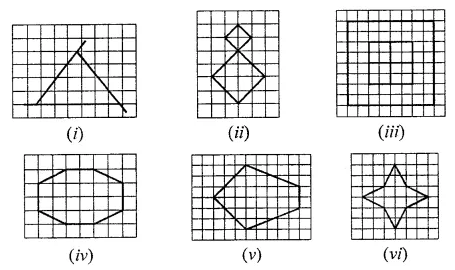
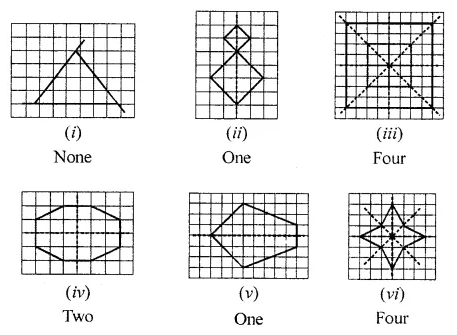
Copy the following figures on a squared paper and draw the lines of symmetry (if any) and count their number:
ML Aggarwal Class 6 Solutions for ICSE Maths Chapter 12 Symmetry Ex 12.1 9
Solution:
ML Aggarwal Class 6 Solutions for ICSE Maths Chapter 12 Symmetry Ex 12.1 10

Question 6.
Write the letters of words ‘JUST LOOK’ which have no line of symmetry.
Solution:
ML Aggarwal Class 6 Solutions for ICSE Maths Chapter 12 Symmetry Ex 12.1 11

Question 7.
Can you draw a triangle which has
(i) exactly one line of symmetry?
(ii) exactly two lines of symmetry?
(iii) exactly three lines of symmetry?
(iv) no lines of symmetry?
Sketch a rough figure in each case and name the triangle.
Solution:
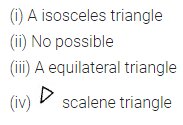
ML Aggarwal Class 6 Solutions for ICSE Maths Chapter 12 Symmetry Ex 12.1 12

ML Aggarwal Class 6 Solutions for ICSE Maths Chapter 11 Understanding Symmetrical Shapes Check Your Progress

ML Aggarwal Class 6 Solutions Chapter 11 Understanding Symmetrical Shapes Check Your Progress for ICSE Understanding Mathematics acts as the best resource during your learning and helps you score well in your exams.

ML Aggarwal Class 6 Solutions for ICSE Maths Chapter 11 Understanding Symmetrical Shapes Check Your Progress

Question 1.
In the given figure, identify the longest and shortest line segments by measuring their lengths.
ML Aggarwal Class 6 Solutions for ICSE Maths Chapter 11 Understanding Symmetrical Shapes Check Your Progress 1
Solution:
ML Aggarwal Class 6 Solutions for ICSE Maths Chapter 11 Understanding Symmetrical Shapes Check Your Progress 2

Question 2.
Where will the hour hand of a clock stop if it starts from 10 and turns through 3 right angles?
Solution:
7

Question 3.
Classify the angles whose measures are given below:
(i) 56°
(ii) 125°
(iii) 90°
(iv) 180°
(v) 215°
(vi) 328°
Solution:
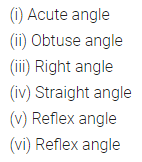
ML Aggarwal Class 6 Solutions for ICSE Maths Chapter 11 Understanding Symmetrical Shapes Check Your Progress 3

Question 4.
Name the types of the following triangles:
(i) ∆ABC with AB = 8 cm, AC = 7 cm and BC = 5.5 cm.
(ii) ∆PQR with PQ = PR = 5 cm and QR = 7.3 cm.
(iii) ∆DEF with D = ∠90°.
(iv) ∆XYZ with ∠Y = 90° and XY = YZ.
(v) ∆LMN with ∠L = 30°, ∠M = 70° and ∠N = 80°.
Solution:
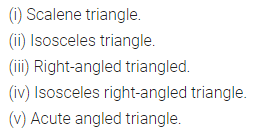
ML Aggarwal Class 6 Solutions for ICSE Maths Chapter 11 Understanding Symmetrical Shapes Check Your Progress 4

Question 5.
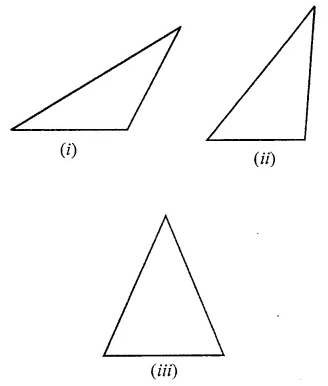
Name each of the following triangles in two different ways (you may use ruler and protractor):
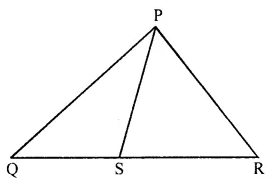
ML Aggarwal Class 6 Solutions for ICSE Maths Chapter 11 Understanding Symmetrical Shapes Check Your Progress 5
Solution:
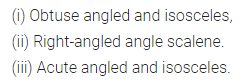
ML Aggarwal Class 6 Solutions for ICSE Maths Chapter 11 Understanding Symmetrical Shapes Check Your Progress 6

Question 6.
State whether the following statements are true or false:
(i) A rectangle is a regular quadrilateral.
(ii) A rhombus is a regular quadrilateral.
(iii) Every parallelogram is a rhombus.
(iv) The diagonals of a rhombus intersect at right angles.
(v) A polygon having 6 sides is called an octagon.
(vi) A road roller has two plane circular faces and one curved face.
(vii) A rectangular pyramid has 5 rectangular faces.
Solution:
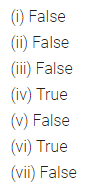
ML Aggarwal Class 6 Solutions for ICSE Maths Chapter 11 Understanding Symmetrical Shapes Check Your Progress 7

Question 7.
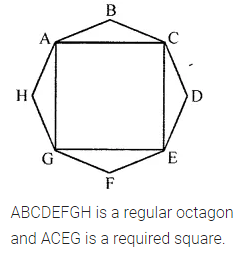
Draw a rough sketch of a regular octagon and draw a square by joining exactly four of its vertices.
Solution:
ML Aggarwal Class 6 Solutions for ICSE Maths Chapter 11 Understanding Symmetrical Shapes Check Your Progress 8

ML Aggarwal Class 6 Solutions for ICSE Maths Chapter 11 Understanding Symmetrical Shapes Objective Type Questions

ML Aggarwal Class 6 Solutions Chapter 11 Understanding Symmetrical Shapes Objective Type Questions for ICSE Understanding Mathematics acts as the best resource during your learning and helps you score well in your exams.

ML Aggarwal Class 6 Solutions for ICSE Maths Chapter 11 Understanding Symmetrical Shapes Objective Type Questions

Mental Maths
Question 1.
Fill in the blanks:
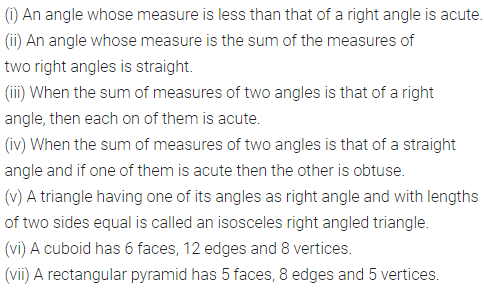
(i) An angle whose measure is less than that of a right angle is …………
(ii) An angle whose measure is the sum of the measures of two right angles is …………
(iii) When the sum of measures of two angles is that of a right angle, then each on of them is …………
(iv) When the sum of measures of two angles is that of a straight angle and if one of them is acute then the other is …………
(v) A triangle having one of its angles as right angle and with lengths of two sides equal is called ………… triangle.
(vi) A cuboid has ………… faces, ………… edges and ………… vertices.
(vii) A rectangular pyramid has ………… faces, ………… edges and ………… vertices.
Solution:
ML Aggarwal Class 6 Solutions for ICSE Maths Chapter 11 Understanding Symmetrical Shapes Objective Type Questions 1

Question 2.
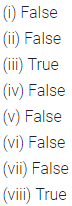
State whether the following statements are true (T) or false (F):
(i) Each angle of an equilateral triangle is a right angle.
(ii) The adjacent sides of a rectangle are equal in length.
(iii) The diagonals of a rectangle are equal in length.
(iv) The diagonals of a rectangle are perpendicular to one another.
(v) The diagonals of a rhombus are equal in length.
(vi) Any three line segments make up a triangle.
(vii) All the faces of a triangular prism are triangles.
(viii)All the faces of a triangular pyramid are triangles.
Solution:
ML Aggarwal Class 6 Solutions for ICSE Maths Chapter 11 Understanding Symmetrical Shapes Objective Type Questions 2

Question 3.
State whether the following statement is true or false. Justify your answer.
‘An angle whose measure is greater than that of a right angle is obtuse’.
Solution:
ML Aggarwal Class 6 Solutions for ICSE Maths Chapter 11 Understanding Symmetrical Shapes Objective Type Questions 3

Multiple Choice Questions
Choose the correct answer from the given four options (4 to 15):

Question 4.
Comparison of lengths is possible in case of
(a) two lines
(b) two line segments
(c) two rays
(d) a ray and a line segment
Solution:
ML Aggarwal Class 6 Solutions for ICSE Maths Chapter 11 Understanding Symmetrical Shapes Objective Type Questions 4

Question 5.
A reflex angle measures
(a) more than 90° but less than 180°
(b) more than 180° but less than 270°
(c) more than 180° but less than 360°
(d) none of these
Solution:
ML Aggarwal Class 6 Solutions for ICSE Maths Chapter 11 Understanding Symmetrical Shapes Objective Type Questions 5

Question 6.
A scalene triangle cannot be
(a) an acute angled triangle
(b) an obtuse angled triangle
(c) a right angled triangle
(d) an equilateral triangle
Solution:
ML Aggarwal Class 6 Solutions for ICSE Maths Chapter 11 Understanding Symmetrical Shapes Objective Type Questions 6

Question 7.
An obtuse angled triangle can be
(a) right angled
(b) isosceles
(c) equilateral
(d) none of these
Solution:
ML Aggarwal Class 6 Solutions for ICSE Maths Chapter 11 Understanding Symmetrical Shapes Objective Type Questions 7

Question 8.
If you are facing north and turn through \(\frac{3}{4}\) of a turn in anti-clockwise direction, which direction will you face?
(a) east
(b) south
(c) west
(d) north
Solution:
ML Aggarwal Class 6 Solutions for ICSE Maths Chapter 11 Understanding Symmetrical Shapes Objective Type Questions 8

Question 9.
Open any two adjacent fingers of your hand. What kind of angle you get?
(a) acute
(b) right
(c) obtuse
(d) straight
Solution:
ML Aggarwal Class 6 Solutions for ICSE Maths Chapter 11 Understanding Symmetrical Shapes Objective Type Questions 9

Question 10.
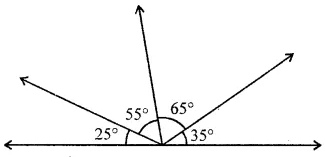
In the given figure, the number of obtuse angles is
ML Aggarwal Class 6 Solutions for ICSE Maths Chapter 11 Understanding Symmetrical Shapes Objective Type Questions 10
(a) 2
(b) 3
(c) 4
(d) 5
Solution:
ML Aggarwal Class 6 Solutions for ICSE Maths Chapter 11 Understanding Symmetrical Shapes Objective Type Questions 11

Question 11.
If the sum of two angles is an obtuse angle, then which of the following is not possible? one right angle and one acute angle one obtuse angle and one acute angle two acute angles two right angles
(a) two right angles
(b) one obtuse angle and one acute angle
(c) two acute angles
(d) two right angles
Solution:
ML Aggarwal Class 6 Solutions for ICSE Maths Chapter 11 Understanding Symmetrical Shapes Objective Type Questions 12

Question 12.
If the sum of two angles is greater than 180°, then which of the following is not possible?
(a) two obtuse angles
(b) two right angles
(c) one obtuse and one acute angle
(d) one reflex and one acute angle
Solution:
ML Aggarwal Class 6 Solutions for ICSE Maths Chapter 11 Understanding Symmetrical Shapes Objective Type Questions 13

Question 13.
Which of the following statements is false?
(a) Every quadrilateral triangle is an isosceles triangle.
(b) Every isosceles triangle is an equilateral triangle.
(c) Every parallelogram is a trapezium.
(d) Every trapezium is a quadrilateral.
Solution:
ML Aggarwal Class 6 Solutions for ICSE Maths Chapter 11 Understanding Symmetrical Shapes Objective Type Questions 14

Question 14.
Which of the following statement is correct?
(a) Every rhombus is a square
(b) Every parallelogram is a rectangle
(c) Every square is a rhombus
(d) Every rectangle is a square
Solution:
ML Aggarwal Class 6 Solutions for ICSE Maths Chapter 11 Understanding Symmetrical Shapes Objective Type Questions 15

Question 15
A quadrilateral whose each angle is a right angle is a
(a) trapezium
(b) parallelogram
(c) rhombus
(d) rectangle
Solution:
ML Aggarwal Class 6 Solutions for ICSE Maths Chapter 11 Understanding Symmetrical Shapes Objective Type Questions 16

Higher Order Thinking Skills (Hots)
Question 1.
If the lengths of two sides of an isosceles triangle are 3 cm and 7 cm, then what is the lengths of the third side?
Solution:
ML Aggarwal Class 6 Solutions for ICSE Maths Chapter 11 Understanding Symmetrical Shapes Objective Type Questions 17

Question 2.
If the lengths of three consecutive sides of an isosceles trapezium are 5 cm, 6 cm and 8 cm, then what is the length of the fourth side?
Solution:
ML Aggarwal Class 6 Solutions for ICSE Maths Chapter 11 Understanding Symmetrical Shapes Objective Type Questions 18