ML Aggarwal Class 6 Solutions for ICSE Maths Chapter 11 Understanding Symmetrical Shapes Ex 11.6

ML Aggarwal Class 6 Solutions Chapter 11 Understanding Symmetrical Shapes Ex 11.6 for ICSE Understanding Mathematics acts as the best resource during your learning and helps you score well in your exams.

ML Aggarwal Class 6 Solutions for ICSE Maths Chapter 11 Understanding Symmetrical Shapes Ex 11.6

Question 1.
What is the shape of
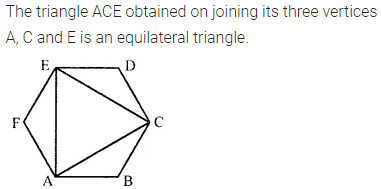
(i) your geometry box?
(ii) a brick?
(iii) a matchbox?
(iv) a dum?
(v) a playing die?
(vi) a sweet laddu?
Solution:
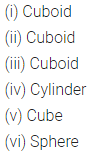
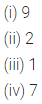
ML Aggarwal Class 6 Solutions for ICSE Maths Chapter 11 Understanding Symmetrical Shapes Ex 11.6 1

Question 2.
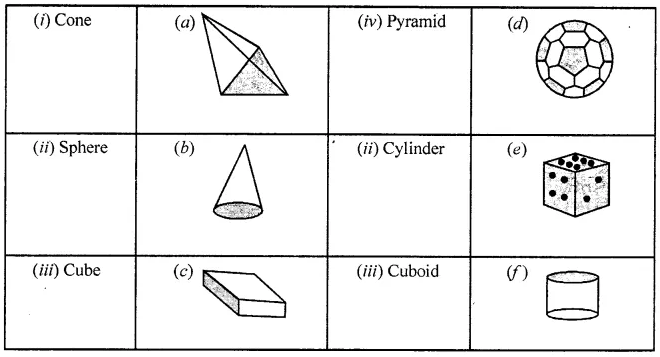
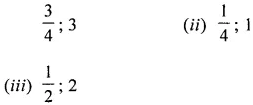
Match the following:
ML Aggarwal Class 6 Solutions for ICSE Maths Chapter 11 Understanding Symmetrical Shapes Ex 11.6 2
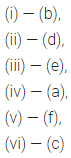
Solution:
ML Aggarwal Class 6 Solutions for ICSE Maths Chapter 11 Understanding Symmetrical Shapes Ex 11.6 3

Question 3.
Fill in the blanks:
(i) A cube has ……… square faces, ……… edges and ……… vertices.
(ii) A triangular prism has ……… triangular faces, ……… rectangular faces, ……… edges and ……… vertices.
(iii) A triangular pyramid has ……… faces, ……… edges and vertices.
Solution:
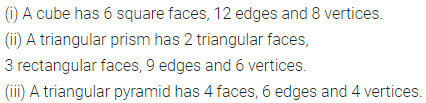
ML Aggarwal Class 6 Solutions for ICSE Maths Chapter 11 Understanding Symmetrical Shapes Ex 11.6 4

ML Aggarwal Class 6 Solutions for ICSE Maths Chapter 11 Understanding Symmetrical Shapes Ex 11.5

ML Aggarwal Class 6 Solutions Chapter 11 Understanding Symmetrical Shapes Ex 11.5 for ICSE Understanding Mathematics acts as the best resource during your learning and helps you score well in your exams.

ML Aggarwal Class 6 Solutions for ICSE Maths Chapter 11 Understanding Symmetrical Shapes Ex 11.5

Question 1.
State whether the following statements are true (T) or false (F):
(i) Each angle of a rectangle is a right angle.
(ii) The opposite sides of a rectangle are equal in length.
(iii) The diagonals of a square are perpendicular to one another.
(iv) All sides of a rhombus are equal in length.
(v) All sides of a parallelogram are equal in length.
(vi) The opposite sides of a trapezium are parallel.
(vii) The diagonal of a parallelogram are equal.
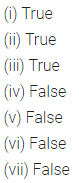
Solution:
ML Aggarwal Class 6 Solutions for ICSE Maths Chapter 11 Understanding Symmetrical Shapes Ex 11.5 1

Question 2.
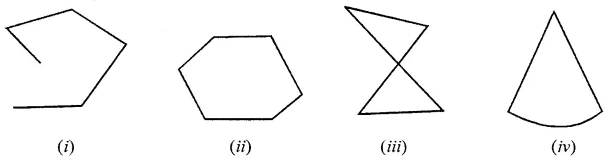
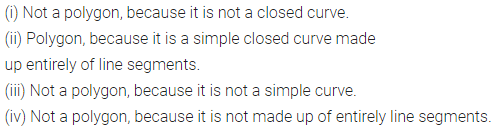
Examine whether the following figures are polygons. Give reasons.
ML Aggarwal Class 6 Solutions for ICSE Maths Chapter 11 Understanding Symmetrical Shapes Ex 11.5 2
Solution:
ML Aggarwal Class 6 Solutions for ICSE Maths Chapter 11 Understanding Symmetrical Shapes Ex 11.5 3

Question 3.
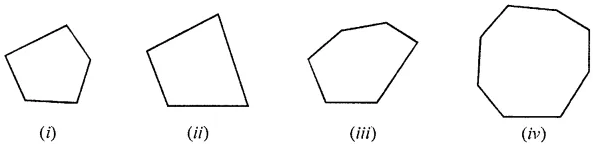
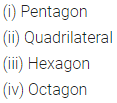
Name each of the following polygons:
ML Aggarwal Class 6 Solutions for ICSE Maths Chapter 11 Understanding Symmetrical Shapes Ex 11.5 4
Solution:
ML Aggarwal Class 6 Solutions for ICSE Maths Chapter 11 Understanding Symmetrical Shapes Ex 11.5 5

Question 4.
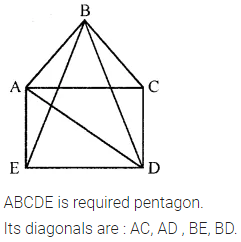
Draw a rough sketch of a pentagon and draw its diagonals.
Solution:
ML Aggarwal Class 6 Solutions for ICSE Maths Chapter 11 Understanding Symmetrical Shapes Ex 11.5 6

Question 5.
Draw a rough sketch of a regular hexagon. Connecting three of its vertices draw:
(i) an isosceles triangle
(ii) a light angled triangle.
Solution:
ML Aggarwal Class 6 Solutions for ICSE Maths Chapter 11 Understanding Symmetrical Shapes Ex 11.5 7

Question 6.
Can you identify the regular quadrilateral?
Solution:
ML Aggarwal Class 6 Solutions for ICSE Maths Chapter 11 Understanding Symmetrical Shapes Ex 11.5 8

ML Aggarwal Class 6 Solutions for ICSE Maths Chapter 11 Understanding Symmetrical Shapes Ex 11.4

ML Aggarwal Class 6 Solutions Chapter 11 Understanding Symmetrical Shapes Ex 11.4 for ICSE Understanding Mathematics acts as the best resource during your learning and helps you score well in your exams.

ML Aggarwal Class 6 Solutions for ICSE Maths Chapter 11 Understanding Symmetrical Shapes Ex 11.4

Question 1.
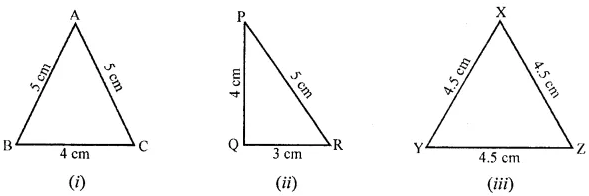
Name the following triangles with regards to sides :
ML Aggarwal Class 6 Solutions for ICSE Maths Chapter 11 Understanding Symmetrical Shapes Ex 11.4 1
Solution:
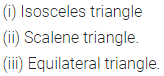
ML Aggarwal Class 6 Solutions for ICSE Maths Chapter 11 Understanding Symmetrical Shapes Ex 11.4 2

Question 2.
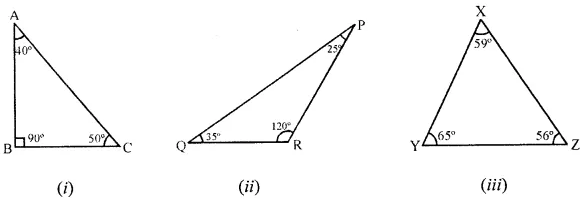
Name the following triangles with regards to angles :
ML Aggarwal Class 6 Solutions for ICSE Maths Chapter 11 Understanding Symmetrical Shapes Ex 11.4 3
Solution:
ML Aggarwal Class 6 Solutions for ICSE Maths Chapter 11 Understanding Symmetrical Shapes Ex 11.4 4

Question 3.
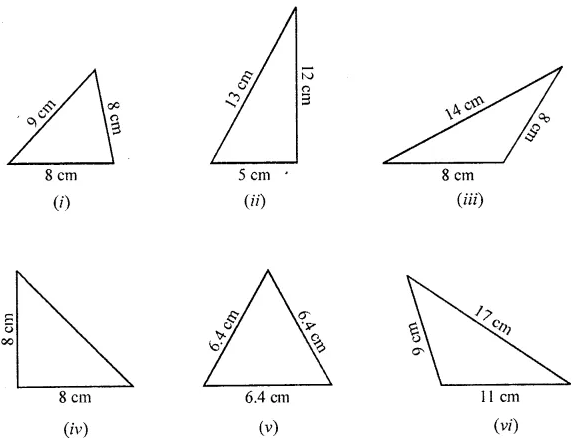
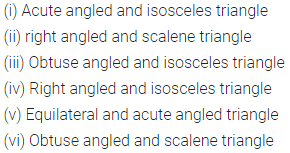
Name each of the following triangles in two different ways (you may judge the nature of the angle by observation):
ML Aggarwal Class 6 Solutions for ICSE Maths Chapter 11 Understanding Symmetrical Shapes Ex 11.4 5
Solution:
ML Aggarwal Class 6 Solutions for ICSE Maths Chapter 11 Understanding Symmetrical Shapes Ex 11.4 6

Question 4.
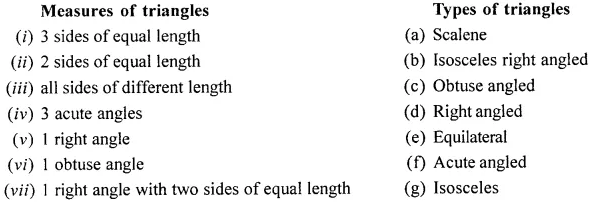
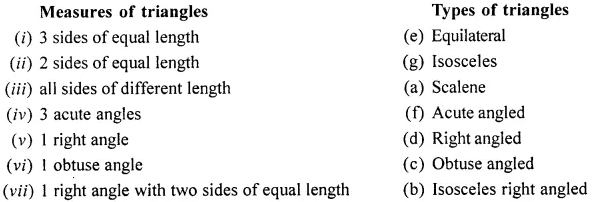
Match the following:
ML Aggarwal Class 6 Solutions for ICSE Maths Chapter 11 Understanding Symmetrical Shapes Ex 11.4 7
Solution:
ML Aggarwal Class 6 Solutions for ICSE Maths Chapter 11 Understanding Symmetrical Shapes Ex 11.4 8

Question 5.
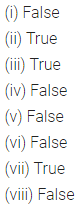
State which of the following statement are true and which are false :
(i) A triangle can have two right angles.
(ii) A triangle cannot have more than one obtuse angle.
(iii) A triangle has atleast two actue angles.
(iv) If all the three sides of a triangle are equal, it is called a scalene triangle.
(v) A triangle has four sides.
(vi) An isosceles triangle is an equilateral triangle also.
(vii) An equilateral triangle is an isosceles triangle also.
(viii)An scalene triangle has all its angles equal.
Solution:
ML Aggarwal Class 6 Solutions for ICSE Maths Chapter 11 Understanding Symmetrical Shapes Ex 11.4 9

ML Aggarwal Class 6 Solutions for ICSE Maths Chapter 11 Understanding Symmetrical Shapes Ex 11.3

ML Aggarwal Class 6 Solutions Chapter 11 Understanding Symmetrical Shapes Ex 11.3 for ICSE Understanding Mathematics acts as the best resource during your learning and helps you score well in your exams.

ML Aggarwal Class 6 Solutions for ICSE Maths Chapter 11 Understanding Symmetrical Shapes Ex 11.3

Question 1.
Which of the following are models for perpendicular lines?
(i) The adjacent edges of a postcard.
(ii) the lines of a railway track.
(iii) The line segment forming the letter ‘L’.
(iv) The adjacent edges of your Math book.
(v) The line segments forming the letter ‘V’.
Solution:
ML Aggarwal Class 6 Solutions for ICSE Maths Chapter 11 Understanding Symmetrical Shapes Ex 11.3 1

Question 2.
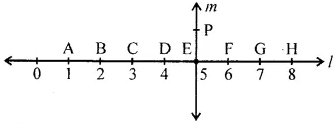
In the figure given below, line l is perpendicular to line m.
ML Aggarwal Class 6 Solutions for ICSE Maths Chapter 11 Understanding Symmetrical Shapes Ex 11.3 2
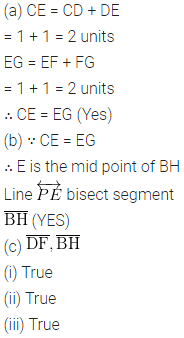
(a) Is CE = EG?
(b) Does \(\overleftrightarrow { PE } \) bisect segment \(\overline{\mathrm{BH}}\) ?
(c) Identify any two line segments for which \(\overleftrightarrow { PE } \) is the perpendicular bisector.
(d) Are these true?
(i) AC > FG
(ii) CD = GH
(iii) BC < EG.
Solution:
ML Aggarwal Class 6 Solutions for ICSE Maths Chapter 11 Understanding Symmetrical Shapes Ex 11.3 3

ML Aggarwal Class 6 Solutions for ICSE Maths Chapter 11 Understanding Symmetrical Shapes Ex 11.2

ML Aggarwal Class 6 Solutions Chapter 11 Understanding Symmetrical Shapes Ex 11.2 for ICSE Understanding Mathematics acts as the best resource during your learning and helps you score well in your exams.

ML Aggarwal Class 6 Solutions for ICSE Maths Chapter 11 Understanding Symmetrical Shapes Ex 11.2

Question 1.
What fraction of a clockwise revolution does the hour hand of a clock turn through when it goes from:
(i) 4 to 10
(ii) 2 to 5
(iii) 7 to 10
(iv) 8 to 5
(v) 11 to 5
(vi) 6 to 3
Also find the number of right angles turned in each case.
Solution:
ML Aggarwal Class 6 Solutions for ICSE Maths Chapter 11 Understanding Symmetrical Shapes Ex 11.2 1

Question 2.
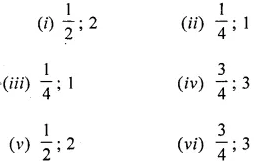
Where will the hand of a clock stop if it
(i) starts at 10 and makes \(\frac{1}{2}\) of a revolution, clockwise?
(ii) starts at 4 and makes \(\frac{1}{4}\) of a revolution, clockwise?
(iii) starts at 4 and makes \(\frac{3}{4}\) of a revolution, clockwise?
Solution:

ML Aggarwal Class 6 Solutions for ICSE Maths Chapter 11 Understanding Symmetrical Shapes Ex 11.2 2

Question 3.
Where will the hand of a clock stop if it starts from
(i) 6 and turns through 1 right angle?
(ii) 8 and turns through 2 right angles?
(iii) 10 and turns through 3 right angles?
(iv) 7 and turns through 2 straight angles?
Solution:
ML Aggarwal Class 6 Solutions for ICSE Maths Chapter 11 Understanding Symmetrical Shapes Ex 11.2 3

Question 4.
What fraction of a revolution have you turned through if you stand facing
(i) north and turn clockwise to face west?
(ii)south and turn anti-clockwise to face east?
(iii) east and turn clockwise (or anti-clockwise) to face west?
Also find the number of right angles turned in each case.
Solution:
ML Aggarwal Class 6 Solutions for ICSE Maths Chapter 11 Understanding Symmetrical Shapes Ex 11.2 4

Question 5.
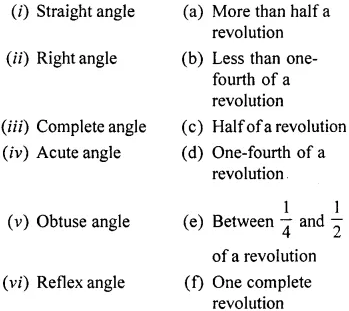
Match the following
ML Aggarwal Class 6 Solutions for ICSE Maths Chapter 11 Understanding Symmetrical Shapes Ex 11.2 5
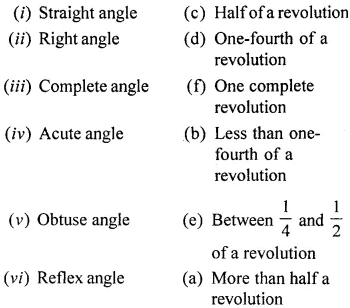
Solution:
ML Aggarwal Class 6 Solutions for ICSE Maths Chapter 11 Understanding Symmetrical Shapes Ex 11.2 6

Question 6.
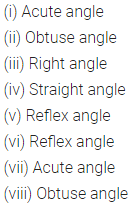
Classify the angles whose magnitudes are given below:
(i) 56°
(ii) 125°
(iii) 90°
(iv) 180°
(v) 215°
(vi) 328°
(vii) 89°
(viii) 178°
Solution:
ML Aggarwal Class 6 Solutions for ICSE Maths Chapter 11 Understanding Symmetrical Shapes Ex 11.2 7

Question 7.
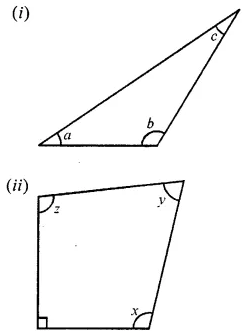
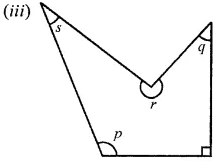
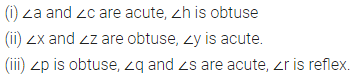
State which of the following angles with a small letter in the following diagrams are acute, which obtuse and which are reflex:
ML Aggarwal Class 6 Solutions for ICSE Maths Chapter 11 Understanding Symmetrical Shapes Ex 11.2 8
ML Aggarwal Class 6 Solutions for ICSE Maths Chapter 11 Understanding Symmetrical Shapes Ex 11.2 9
Solution:
ML Aggarwal Class 6 Solutions for ICSE Maths Chapter 11 Understanding Symmetrical Shapes Ex 11.2 10

Question 8.
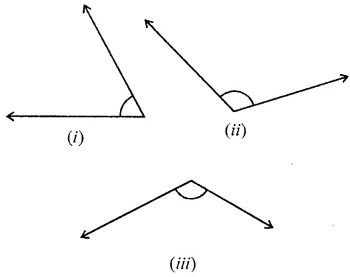
Use your protector to measure each of the angles marked in the following figures:
ML Aggarwal Class 6 Solutions for ICSE Maths Chapter 11 Understanding Symmetrical Shapes Ex 11.2 11
Solution:
ML Aggarwal Class 6 Solutions for ICSE Maths Chapter 11 Understanding Symmetrical Shapes Ex 11.2 12

Question 9.
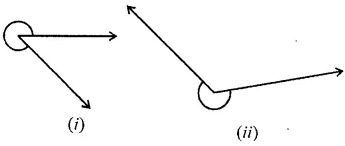
Use your protector to measure the reflex angles marked in the following figures:
ML Aggarwal Class 6 Solutions for ICSE Maths Chapter 11 Understanding Symmetrical Shapes Ex 11.2 13
Solution:
ML Aggarwal Class 6 Solutions for ICSE Maths Chapter 11 Understanding Symmetrical Shapes Ex 11.2 14

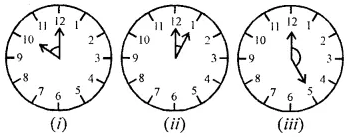
Question 10.
Find the measure of the angle between the hands of the clock in each figure:
ML Aggarwal Class 6 Solutions for ICSE Maths Chapter 11 Understanding Symmetrical Shapes Ex 11.2 15
Solution:
ML Aggarwal Class 6 Solutions for ICSE Maths Chapter 11 Understanding Symmetrical Shapes Ex 11.2 16

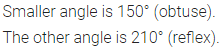
Question 11.
Write the measure of the smaller angle formed by the hour and the minutes hands of a clock at 7 O’clock. Also write the measure of the other angle and also state what types of angles these are.
Solution:
ML Aggarwal Class 6 Solutions for ICSE Maths Chapter 11 Understanding Symmetrical Shapes Ex 11.2 17

Question 12.
There are two set-squares in your geometry box. What are measures of the angles formed at their corners? Do they have any angle measure that is common?
Solution:
ML Aggarwal Class 6 Solutions for ICSE Maths Chapter 11 Understanding Symmetrical Shapes Ex 11.2 18