ML Aggarwal Class 6 Solutions for ICSE Maths Chapter 13 Practical Geometry Objective Type Questions

ML Aggarwal Class 6 Solutions Chapter 13 Practical Geometry Objective Type Questions for ICSE Understanding Mathematics acts as the best resource during your learning and helps you score well in your exams.

ML Aggarwal Class 6 Solutions for ICSE Maths Chapter 13 Practical Geometry Objective Type Questions

Mental Maths
Question 1.
Fill in the blanks:
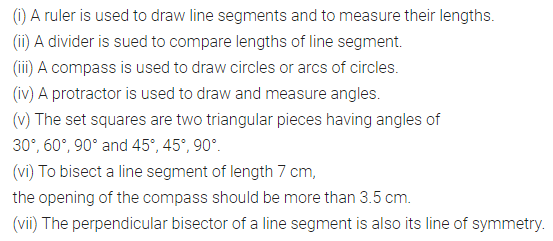
(i) A ruler is used to draw a line and to measure their …………
(ii) A divider is used to compare …………
(iii) A compass is used to draw circles or arcs of …………
(iv) A protractor is used to draw and measure …………
(v) The set squares are two triangular pieces having angles of ………… and …………
(vi) To bisect a line segment of length 7 cm, the opening of the’ compass should be more than …………
(vii) The perpendicular bisector of a line segment is also its line of …………
Solution:
ML Aggarwal Class 6 Solutions for ICSE Maths Chapter 13 Practical Geometry Objective Type Questions 1

Question 2.
State whether the following statements are true (T) or false (F):
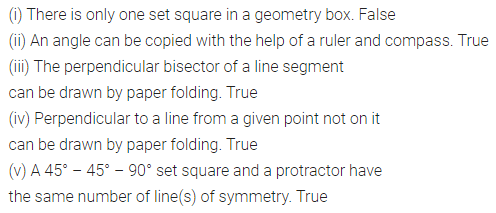
(i) There is only one set square in a geometry box.
(ii) An angle can be copied with the help of a ruler and compass.
(iii) The perpendicular bisector of a line segment can be drawn by paper folding.
(iv) Perpendicular to a line from a given point not on it can be drawn by paper folding.
(v) A 45° – 45° – 90° set square and a protractor have the same number of line(s) of symmetry.
Solution:
ML Aggarwal Class 6 Solutions for ICSE Maths Chapter 13 Practical Geometry Objective Type Questions 2

Multiple Choice Questions
Choose the correct answer from the given four options (3 to 13):
Question 3.
A circle of any radius can be constructed with the help of a:
(a) ruler
(b) divider
(c) compass
(d) protractor
Solution:
compass (c)

Question 4.
The instrument in a geometry box having the shape of a semicircle is :
(a) ruler
(b) divider
(c) compass
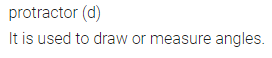
(d) protractor
Solution:
ML Aggarwal Class 6 Solutions for ICSE Maths Chapter 13 Practical Geometry Objective Type Questions 3

Question 5.
The instrument to measure an angle is
(a) ruler
(b) protractor.
(c) divider
(d) compass
Solution:
protractor (b)

Question 6.
Which of the following angles cannot be constructed using a ruler and compass?
(a) 15°
(b) 45°
(c) 75°
(d) 85°
Solution:
85° (d)

Question 7.
The number of perpendiculars that can be drawn to a line from a point not on it is
(a) 1
(b) 2
(c) 4
(d) infinitely many
Solution:
1 (a)

Question 8.
The number of perpendicular bisectors that can be drawn of a given line segment is :
(a) 0
(b) 1
(c) 2
(d) infinitely many
Solution:
1 (b)

Question 9.
The number of lines of symmetry in a picture of a divider is The number of lines of symmetry in a picture of a compass is
(a) 0
(b) 1
(c) 2
(d) 4
Solution:
1 (b)

Question 10.
The number of lines of symmetry in a picture of a compass is
(a) 0
(b) 1
(c) 2
(d) none of these
Solution:
0 (a)

Question 11.
The number of lines of symmetry in a ruler is
(a) 0
(b) 1
(c) 2
(d) 4
Solution:
2 (c)

Question 12.
The number of lines of symmetry in a 30° – 60° – 90° set square is
(a) 0
(b) 1
(c) 2
(d) 3
Solution:
0 (a)

Question 13.
The number of lines of symmetry in a protractor is
(a) 0
(b) 1
(c) 2
(d) more than 2
Solution:
1 (b)

ML Aggarwal Class 6 Solutions for ICSE Maths Chapter 13 Practical Geometry Ex 13.3

ML Aggarwal Class 6 Solutions Chapter 13 Practical Geometry Ex 13.3 for ICSE Understanding Mathematics acts as the best resource during your learning and helps you score well in your exams.

ML Aggarwal Class 6 Solutions for ICSE Maths Chapter 13 Practical Geometry Ex 13.3

Question 1.
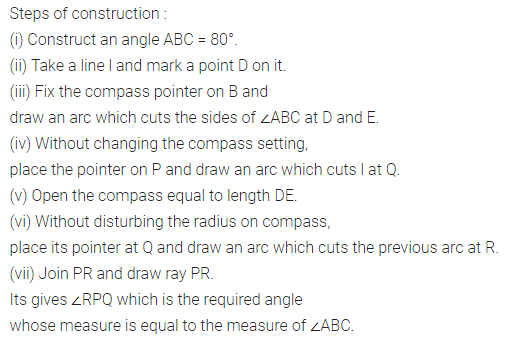
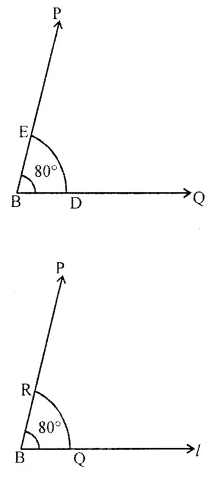
Draw an angle of 80° and make a copy of it using ruler and compass.
Solution:
ML Aggarwal Class 6 Solutions for ICSE Maths Chapter 13 Practical Geometry Ex 13.3 1
ML Aggarwal Class 6 Solutions for ICSE Maths Chapter 13 Practical Geometry Ex 13.3 2

Question 2.
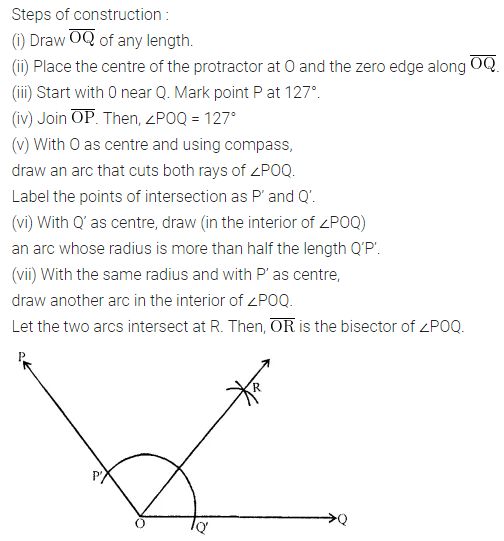
Draw an angle of measure 127° and construct its bisector.
Solution:
ML Aggarwal Class 6 Solutions for ICSE Maths Chapter 13 Practical Geometry Ex 13.3 3

Question 3.
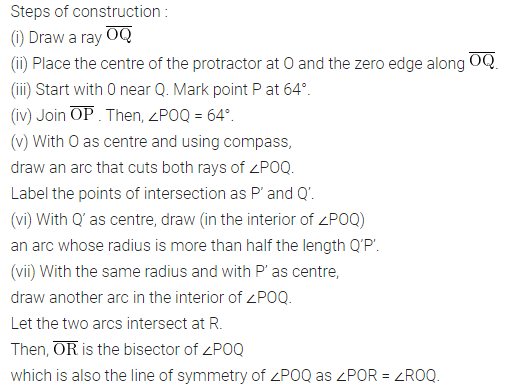
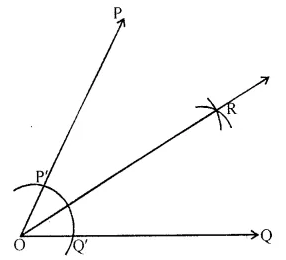
Draw ∠POQ = 64°. Also, draw its line of symmetry.
Solution:
ML Aggarwal Class 6 Solutions for ICSE Maths Chapter 13 Practical Geometry Ex 13.3 4
ML Aggarwal Class 6 Solutions for ICSE Maths Chapter 13 Practical Geometry Ex 13.3 5

Question 4.
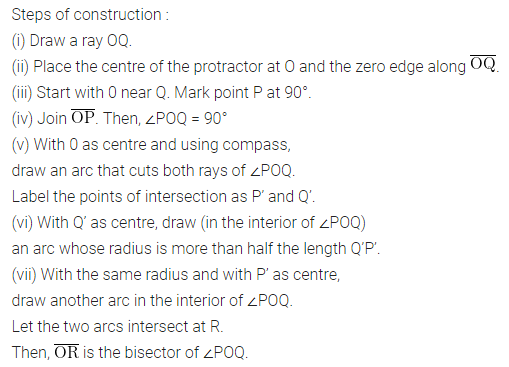
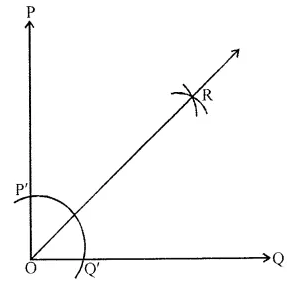
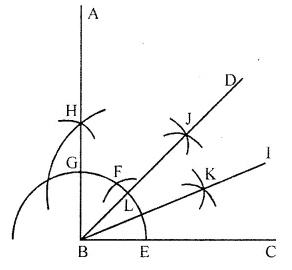
Draw a right angle and construct its bisector.
Solution:
ML Aggarwal Class 6 Solutions for ICSE Maths Chapter 13 Practical Geometry Ex 13.3 6
ML Aggarwal Class 6 Solutions for ICSE Maths Chapter 13 Practical Geometry Ex 13.3 7

Question 5.
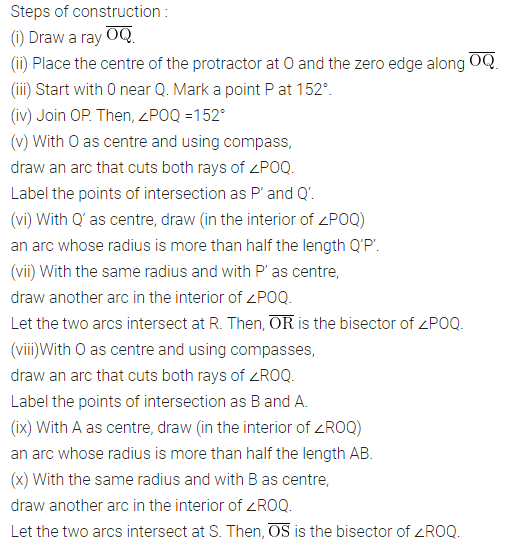
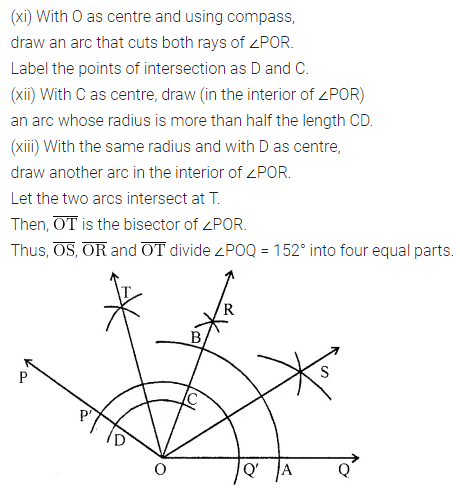
Draw an angle of 152° and divide it into four equal parts.
Solution:
ML Aggarwal Class 6 Solutions for ICSE Maths Chapter 13 Practical Geometry Ex 13.3 8
ML Aggarwal Class 6 Solutions for ICSE Maths Chapter 13 Practical Geometry Ex 13.3 9

Question 6.
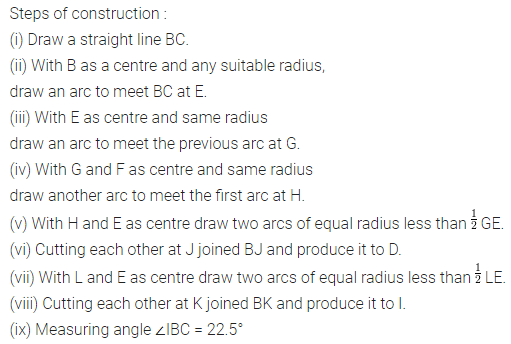
Draw an angle of measure 45° and bisect it.
Solution:
ML Aggarwal Class 6 Solutions for ICSE Maths Chapter 13 Practical Geometry Ex 13.3 10
ML Aggarwal Class 6 Solutions for ICSE Maths Chapter 13 Practical Geometry Ex 13.3 11

ML Aggarwal Class 6 Solutions for ICSE Maths Chapter 13 Practical Geometry Ex 13.2

ML Aggarwal Class 6 Solutions Chapter 13 Practical Geometry Ex 13.2 for ICSE Understanding Mathematics acts as the best resource during your learning and helps you score well in your exams.

ML Aggarwal Class 6 Solutions for ICSE Maths Chapter 13 Practical Geometry Ex 13.2

Question 1.
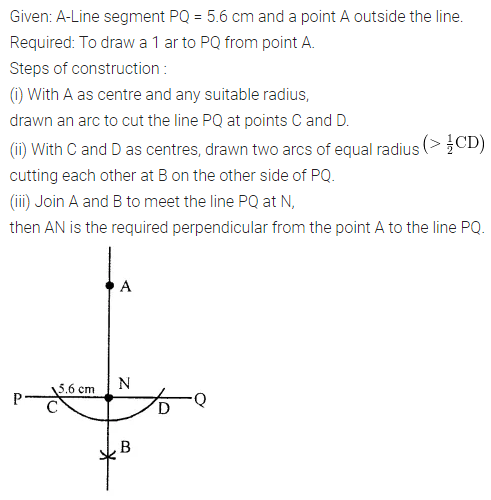
Draw a line segment \(\overline{\mathrm{PQ}}\) =5.6 cm. Draw a perpendicular to it from a point A outside \(\overline{\mathrm{PQ}}\) by using ruler and compass.
Solution:
ML Aggarwal Class 6 Solutions for ICSE Maths Chapter 13 Practical Geometry Ex 13.2 1

Question 2.
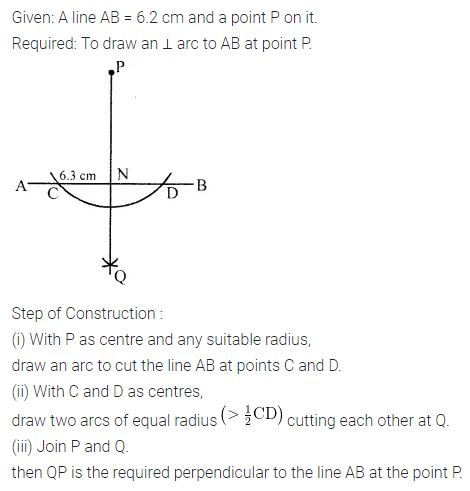
Draw a line segment \(\overline{\mathrm{AB}}\) = 6.2 cm. Draw a perpendicular to it at a point M on \(\overline{\mathrm{AB}}\) by using ruler and compass.
Solution:
ML Aggarwal Class 6 Solutions for ICSE Maths Chapter 13 Practical Geometry Ex 13.2 2

Question 3.
Draw a line l and take a point P on it. Through P, draw a line segment \(\overline{\mathrm{PQ}}\) perpendicular to l. Now draw a perpendicular to \(\overline{\mathrm{PQ}}\) at Q (use ruler and compass).
Solution:
ML Aggarwal Class 6 Solutions for ICSE Maths Chapter 13 Practical Geometry Ex 13.2 3

Question 4.
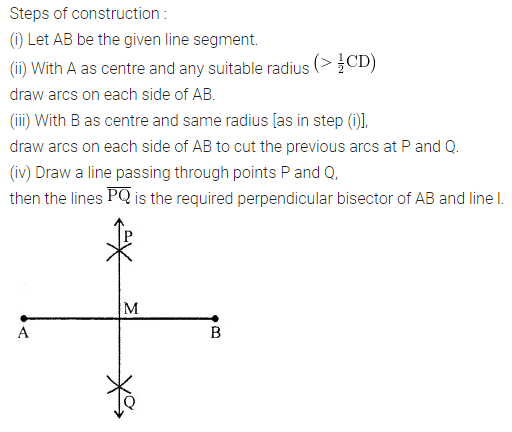
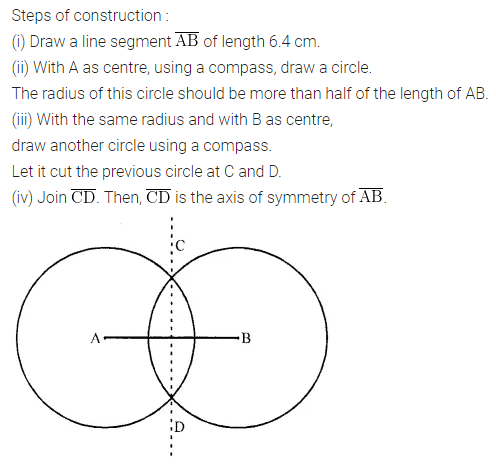
Draw a line segment \(\overline{\mathrm{AB}}\) of length 6.4 cm and construct its axis of symmetry (use ruler and compass).
Solution:
ML Aggarwal Class 6 Solutions for ICSE Maths Chapter 13 Practical Geometry Ex 13.2 4

Question 5.
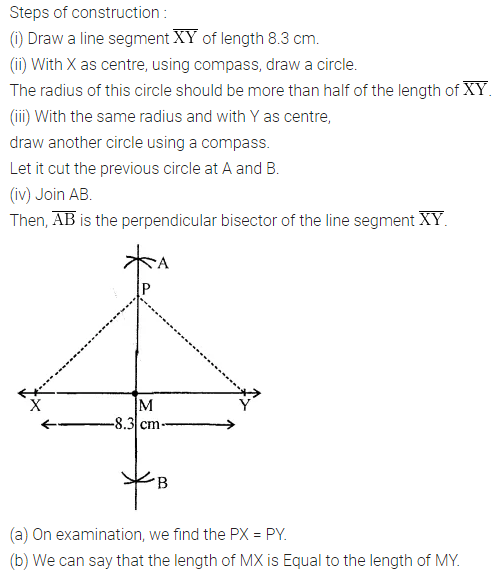
Draw the perpendicular bisector of \(\overline{\mathrm{XY}}\) whose length is 8.3 cm.
(i) Take any point P on the bisector drawn. Examine whether PX = PY.
(ii) If M is the mid-point of \(\overline{\mathrm{XY}}\), what can you say about the lengths MX and MY?
Solution:
ML Aggarwal Class 6 Solutions for ICSE Maths Chapter 13 Practical Geometry Ex 13.2 5

Question 6.
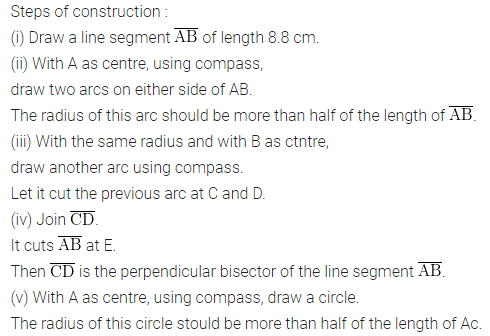
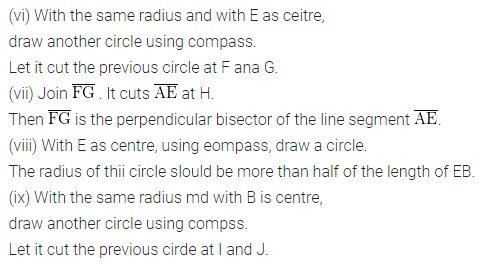
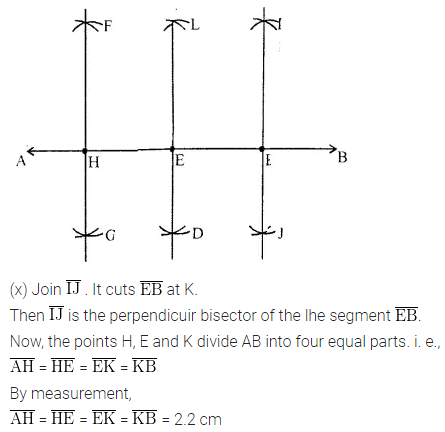
Draw a line segment of length 8.8 cm. Using ruler and compass, divide it into four equal parts. Verify by actual measurement.
Solution:
ML Aggarwal Class 6 Solutions for ICSE Maths Chapter 13 Practical Geometry Ex 13.2 6
ML Aggarwal Class 6 Solutions for ICSE Maths Chapter 13 Practical Geometry Ex 13.2 7
ML Aggarwal Class 6 Solutions for ICSE Maths Chapter 13 Practical Geometry Ex 13.2 8

Question 7.
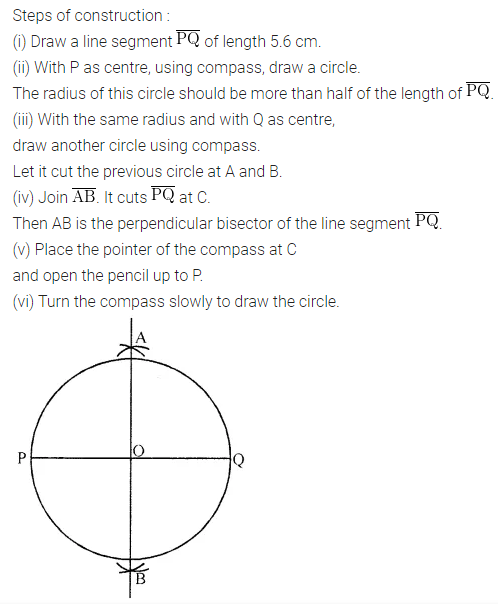
With \(\overline{\mathrm{PQ}}\) of length 5.6 cm as diameter, draw a circle.
Solution:
ML Aggarwal Class 6 Solutions for ICSE Maths Chapter 13 Practical Geometry Ex 13.2 9

Question 8.
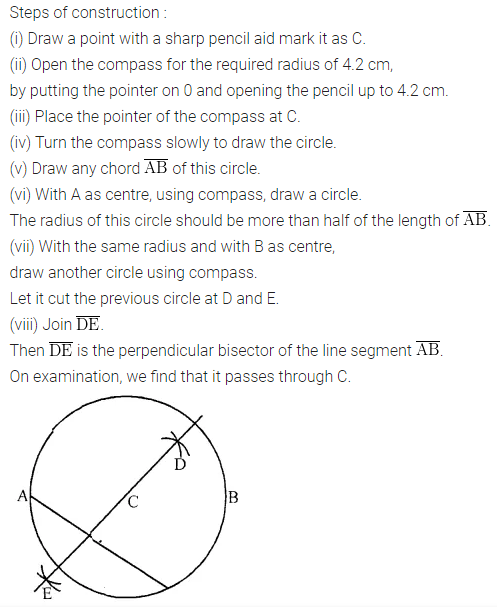
Draw a circle with centre C and radius 4.2 cm. Draw any chord AB. Construct the perpendicular bisector of AB and examine if it passes through C.
Solution:
ML Aggarwal Class 6 Solutions for ICSE Maths Chapter 13 Practical Geometry Ex 13.2 10

Question 9.
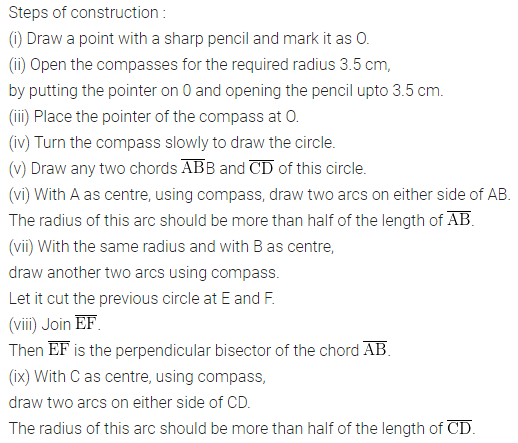
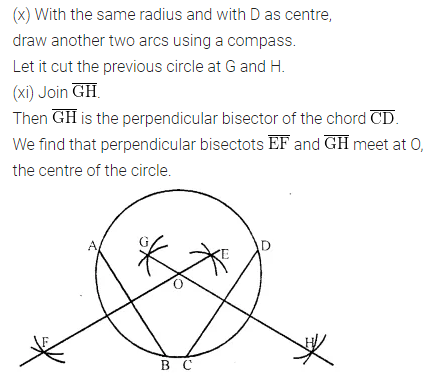
Draw a circle of radius 3.5 cm. Draw any two of its (non-parallel) chords. Construct the perpendicular bisectors of these chords. Where do they meet?
Solution:
ML Aggarwal Class 6 Solutions for ICSE Maths Chapter 13 Practical Geometry Ex 13.2 11
ML Aggarwal Class 6 Solutions for ICSE Maths Chapter 13 Practical Geometry Ex 13.2 12

An Indian-American Woman in Space : Kalpana Chawla Extra Questions and Answers Class 6 English Honeysuckle

Here we are providing An Indian-American Woman in Space : Kalpana Chawla Extra Questions and Answers Class 6 English Honeysuckle, Extra Questions for Class 6 English was designed by subject expert teachers.

An Indian-American Woman in Space : Kalpana Chawla Extra Questions and Answers Class 6 English Honeysuckle

An Indian-American Woman in Space : Kalpana Chawla Extra Questions and Answers Short Answer Type

Question 1.
How successfully has Kalpana Chawla’s chased her dream?
Answer:
Kalpana Chawla’s followed her dream. Her great achievement was that she was selected to go into space. Her achievement was awe-inspiring.

Question 2.
How did Kalpana Chawla meet her end? When did this tragedy take place in space?
Answer:
Kalpana Chawla went up in a space shuttle along with six other astronauts. On Saturday, February 1, 2003 the shuttle Columbia broke apart. All the seven on board were killed. While entering into atmosphere of the earth.

Question 3.
What do you know about Kalpana Chawla’s education? How did she become an American citizen?
Answer:
Kalpana Chawla graduated from Tagore school, Karnal. She got a Bachelor of science degree in aeronautical engineering. She then went to the USA to earn her Ph.D. she became a naturalized U.S. citizen.

Question 4.
Kalpana Chawla was a heroine’. How did a journalist support his statement?
Answer:
Kalpana was a heroine. She was born in the small town of Karnal. But she was a genius. She became an astronaut. She had encyclopedic knowledge of so many subjects. She made a great achievement.

Question 5.
What massage did she send from the space shuttle to students of her college?
Answer:
In a message she sent from Columbia to students of her college in Chandigarh she told them that with courage they too can fulfill their dreams. She wished them all a great journey.

Question 6.
How is the story of Kalpana Chawla an inspiration to million of Indian and especially girls.
Answer:
Kalpana Chawla was a small town girl having faith in her capabilities. Her selection for Columbia, the space shuttle in US has opened horizons for coming generation. Her achievement infused energy and dreams in the mind of girls also along with their parents.

Question 7.
Where was Kalpana Chawla bom? Why is she called an Indian American?
Answer:
Kalpana Chawla was bom in Kamal, Haryana. Thus she was born an Indian but later she went to U.S. and became her naturalized citizen. So she is called an Indian American.

Question 8.
When and why did she go to the U.S.? Who did she marry?
Answer:
She went to U.S. after Completing a Bachelor or Science degree in aeronautical engineering for pursuing master’s degree. She was married to flight instructor Jean-Pierre Harrison.

Question 9.
How did she became an astronaut? What gave her the idea that she could be an astronaut?
Answer:
After completing her bachelor degree in aeronautical engineering, Kalpana applied for NASA’s space shuttle program. She was selected as a research scientist by NASA in 1994. The idea that she could be an astronaut came from her desire and she followed her dreams.

Question 10.
What abilities must an astronaut have, according to the journalist?
Answer:
According to the journalist, an astronaut needs enormous abilities. He/she needs to know a lot about everything from biology to astrophysics to aeronautical engineering. In brief, he/she must have encyclopaedic knowledge.

Question 11.
Describe Kalpana Chawla’s first mission in space.
Answer:
Kalpana’s first mission in the space shuttle, Columbia, was 15 days, 16 hours and 34 minutes long. She went around the earth 252 times. Among her colleagues were a Japanese and a Ukrainian astronauts. They performed many experiments.

Question 12.
What does Kalpana Chawla say about pursuing a dream? Do you agree with her that success is possible?
Answer:
Kalpana Chawla said that the path from dreams to success does exist. One needs to have the vision to find it, and the courage to get onto it. Yes, I do agree with her. Success is possible, if we work hard for the same, we will definitely achieve it.

An Indian-American Woman in Space : Kalpana Chawla Extra Questions and Answers Long Answer Type

Question 1.
After reading the lesson on Kalpana Chawla, what should be the aim of life – luxury or achievement?
Answer:
Kalpana Chawla lived an inspirational life. She is a role model to many. Her courage in adversity, self determination made her successful person. She became an astronaut. No girl can ever dream of pursuing such a career. So she is motivation for both girls and boys alike. She has achieved fame with her sincerity and dedication at an early age. Her courage, simplicity add feather to her cap. Everyone wants to follow her steps. Therefore, in my opinion achievement should be the aim of life.

Question 2.
Kalapna Chawla’s life has changed the outlook of many. Do you agree or not.
Answer:
Kalpana Chawla was an ordinary girl born and brought up in middle class family she quietly resisted the obstruction and finally succeeded in becoming an astronaut. Her achievements were so extraordinary. She made her mark permanent in the minds of people of the world. Conservative minds of parents are opening up and are allowing their daughter to follow their dreams. Parents and society are now appreciating the achievements of girls in every sphere of life. So I agree to the statement that the life and achievement of Kalpana Chawla will never fade away from the lives of the people.

An Indian-American Woman in Space : Kalpana Chawla Extra Questions and Answers  Reference to Context

Question 1.
She was a heroine. It takes enormous ability to become an astronaut. You need to know a lot about everything, from biology to astrophysics to aeronautical engineering. In this age of super-specialisation, you must have encyclopaedic knowledge to be an astronaut. Her achievement is awe-inspiring.

(i) Why is it difficult to be an astronaut?
(ii) Why was she called a “heroine’ by the journalist?
(iii) ‘Her achievement is awe – inspiring’. Do you agree to the statement?
(iv) What is ‘encyclopedia’?
(v) ‘Awe’ is used to describe
Answer:
(i) An astronaut should know about everything like biology, astrophysics, aeronautical engineering etc.
(ii) A heroine is the one who leads and done to take challenges. And she was a true leader in every sense.
(iii) Her achievements are beyond measures. She studied in Kamal and become an astronaut.
(iv) Encyclopedia is a book or set of books giving information on many subjects or on many aspects of one subject and typically arranged alphabetically.
(v) A feeling of respect mixed with fear or wonder.

Question 2.
After a Bachelor of Science degree in aeronautical engineering, against great opposition from her father, she went for a master’s degree to the United States of America. She later earned her Ph.D. in aerospace engineering. Kalpana Chawla was the first Indian-American woman astronaut to blast off from the launch pad at Cape Canaveral, Florida, and participate in a successful mission in space. Her family from India cheered along with staff at the Kennedy Space Center as they watched the Columbia lift off.

(i) State whether the statement is correct or not? ‘She went for a masters degree to the USA with the consent of her father’.
(ii) From where did the space shuttle launched?
(iii) What was the reaction of her family when Columbia lift off?
(iv) From where did she earn her Ph.D.?
(v) The phrasal verb for “blast’ and ‘lift’ is ………..
Answer:
(i) False.
(ii) Space shuttle was launched from Cape Canaveral, Florida.
(iii) The family was happy when Columbia lift off.
(iv) She had earned her Ph.D from United States of America
(v) blast off, lift off.

Question 3.
Kalpana was bom in Kamal, Haryana, but was a naturalised U.S. citizen, married to flight instructor Jean-Pierre Harrison, Besides being an astronaut, she was licensed to fly single and multi engine land airplanes, single-engine seaplanes and gliders. She was also a certified flight instructor. After qualifying as a pilot, Kalpana began to consider another challenge: applying to NASA’s space shuttle program. She was first hired as a research scientist at NASA. In 1994 she was selected by NASA for training as an astronaut.

(i) What was the birth place of Kalpana?
(ii) Whom did she marry?
(iii) What was her ‘another challenge’?
(iv) When was she selected by NASA?
(v) What does the word ‘naturalized’ mean?
Answer:
(i) Kalpana was born in Kamal, Haryana.
(ii) She was married to Jean Pierre Harrison.
(iii) She was a qualified pilot and she applied for NASA’s space shuttle program.
(iv) She was selected by NASA in 1994 as an astronaut.
(v) Naturalized means ‘acquiring citizenship of a country that one is not born into.

ML Aggarwal Class 6 Solutions for ICSE Maths Chapter 13 Practical Geometry Ex 13.1

ML Aggarwal Class 6 Solutions Chapter 13 Practical Geometry Ex 13.1 for ICSE Understanding Mathematics acts as the best resource during your learning and helps you score well in your exams.
ML Aggarwal Class 6 Solutions for ICSE Maths Chapter 13 Practical Geometry Ex 13.1

Question 1.
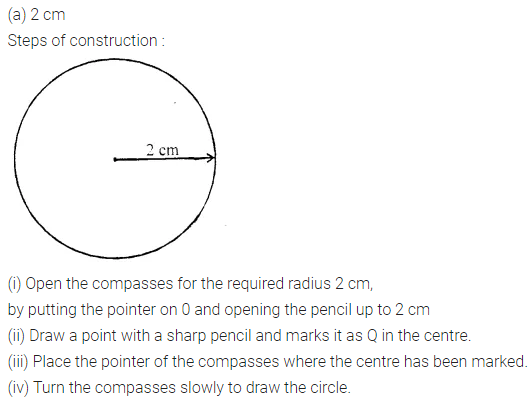
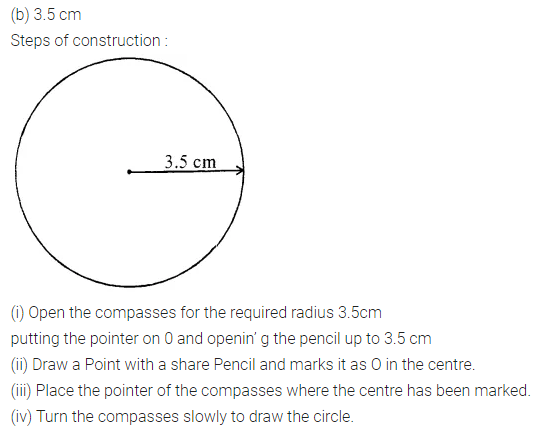
Construct a circle of radius:
(i) 2 cm
(ii) 3.5 cm
Solution:
ML Aggarwal Class 6 Solutions for ICSE Maths Chapter 13 Practical Geometry Ex 13.1 1
ML Aggarwal Class 6 Solutions for ICSE Maths Chapter 13 Practical Geometry Ex 13.1 2

Question 2.
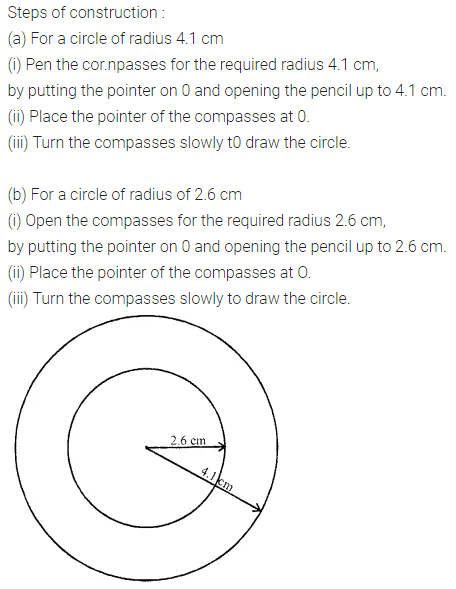
With the same centre O, draw two circles of radii 2.6 cm and 4.1 cm.
Solution:
ML Aggarwal Class 6 Solutions for ICSE Maths Chapter 13 Practical Geometry Ex 13.1 3

Question 3.
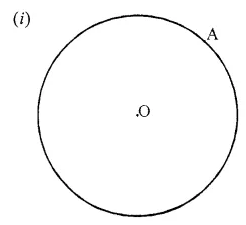
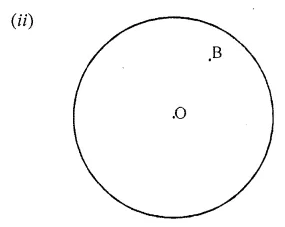
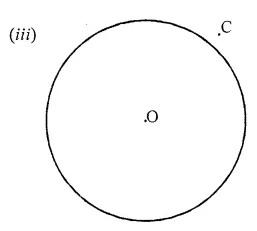
Draw any circle and mark points A, B and C such that
(i) A is on the circle.
(ii) B is in the interior of the circle.
(iii) C is in the exterior of the circle.
Solution:
ML Aggarwal Class 6 Solutions for ICSE Maths Chapter 13 Practical Geometry Ex 13.1 4
ML Aggarwal Class 6 Solutions for ICSE Maths Chapter 13 Practical Geometry Ex 13.1 5
ML Aggarwal Class 6 Solutions for ICSE Maths Chapter 13 Practical Geometry Ex 13.1 6

Question 4.
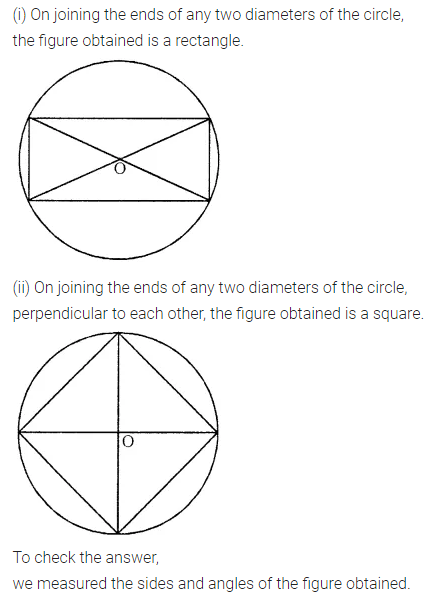
Draw a circle and any two of its (non-perpendicular) diameters. If you join the ends of these diameters, what is the figure obtained? What figure is obtained if the diameters are perpendicular to each other? How do you check your answer?
Solution:
ML Aggarwal Class 6 Solutions for ICSE Maths Chapter 13 Practical Geometry Ex 13.1 7

Question 5.
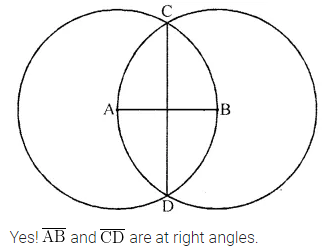
Let A, B be the centres of two circles of equal radii; draw them so that each one of them passes through the centre of the other. Let them intersect at C and D.
Examine whether \(\overline{\mathrm{AB}}\) and \(\overline{\mathrm{CD}}\) are at right angles.
Solution:
ML Aggarwal Class 6 Solutions for ICSE Maths Chapter 13 Practical Geometry Ex 13.1 8

Question 6.
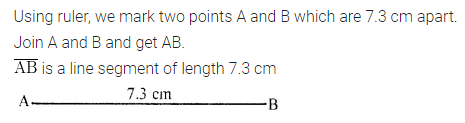
Construct a line segment of the length of 6.3 cm using ruler and compass.
Solution:
ML Aggarwal Class 6 Solutions for ICSE Maths Chapter 13 Practical Geometry Ex 13.1 9

Question 7.
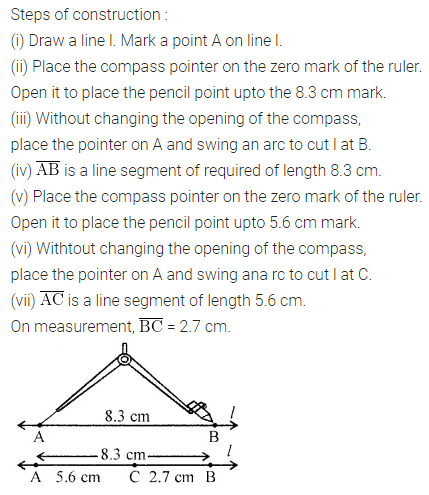
Construct \(\overline{\mathrm{AB}}\) of length 8.3 cm. From this cut off \(\overline{\mathrm{AC}}\) of length 5.6 cm. Measure the length of BC . .
Solution:
ML Aggarwal Class 6 Solutions for ICSE Maths Chapter 13 Practical Geometry Ex 13.1 10

Question 8.
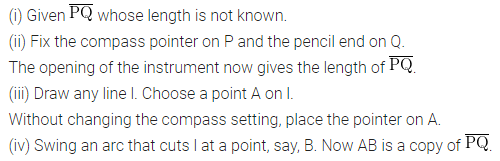
Draw any line segment \(\overline{\mathrm{PQ}}\). Without measure \(\overline{\mathrm{PQ}}\), construct a copy of \(\overline{\mathrm{PQ}}\).
Solution:
ML Aggarwal Class 6 Solutions for ICSE Maths Chapter 13 Practical Geometry Ex 13.1 11

Question 9.
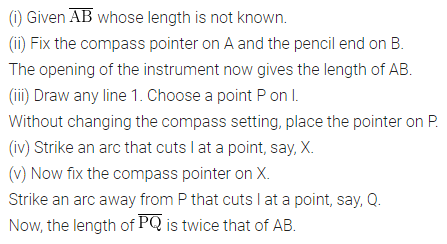
Given some line segment \(\overline{\mathrm{AB}}\), whose length you do not know, construct \(\overline{\mathrm{PQ}}\) such that the length of \(\overline{\mathrm{PQ}}\) is twice that of \(\overline{\mathrm{AB}}\).
Solution:
ML Aggarwal Class 6 Solutions for ICSE Maths Chapter 13 Practical Geometry Ex 13.1 12

Question 10.
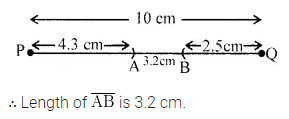
Take a line segment \(\overline{\mathrm{PQ}}\) of length 10 cm. From \(\overline{\mathrm{PQ}}\), cut of \(\overline{\mathrm{PA}}\) of length 4.3 cm and \(\overline{\mathrm{BQ}}\) of length 2.5 cm. Measure the length of segment \(\overline{\mathrm{AB}}\).
Solution:
ML Aggarwal Class 6 Solutions for ICSE Maths Chapter 13 Practical Geometry Ex 13.1 13

Question 11.
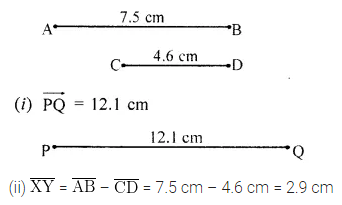
Given two line segments \(\overline{\mathrm{AB}}\) and \(\overline{\mathrm{CD}}\) of length 7.5 cm and 4.6 respectively. Construct line segments.
(i) \(\overrightarrow { PQ } \) of length equal to the sum of the lengths of \(\overline{\mathrm{AB}}\) and \(\overline{\mathrm{CD}}\).
(ii) \(\overline{\mathrm{XY}}\) of length equal to the difference of the lengths of \(\overline{\mathrm{AB}}\) and \(\overline{\mathrm{CD}}\). Verify these lengths by measurements.
Solution:
ML Aggarwal Class 6 Solutions for ICSE Maths Chapter 13 Practical Geometry Ex 13.1 14