Who I Am Extra Questions and Answers Class 6 English Honeysuckle

Here we are providing Who I Am Extra Questions and Answers Class 6 English Honeysuckle, Extra Questions for Class 6 English was designed by subject expert teachers.

Who I Am Extra Questions and Answers Class 6 English Honeysuckle

Who I Am Extra Questions and Answers Short Answer Type

Question 1.
Who can be a successful designer or engineer?
Answer:
A child with interest in maps, sketching, understanding picture can be a successful designer or engineer.

Question 2.
What would one be if you are good at solving puzzles & doing mathematical calculation?
Answer:
One can become scientist or accountant.

Question 3.
What does bodily intelligence reflect to?
Answer:
Bodily intelligence reflect to become dancer, actor, craftsperson.

Who I Am Extra Questions and Answers Long Answer Type

Question 1.
‘One should respect Individuality’. Do you agree or not? Give reasons to support your answer.
Answer:
Every person is born with innate qualities and that should be respected. The individual difference if recognized on time can bring difference in every sphere of his life. A girl can be passionate about climbing or becoming a politician. A boy can aspire to be a farmer by choice. He may bring dynamism in his field of agriculture. A child can be a social reformer or psychologist to assist others to overcome their drawbacks. Thus, genius brings excellence with dynamism in every activity.

Question 2.
Our present education system ‘suppress the talent rather than blooming it’ comment.
Answer:
The education system evaluation leaning capacity rather than judging the caliber. Every child is tested on subjects he is taught. One has to pass every subject instead of working upon his likings. If choice is given to a student he she explore or invent new things. Assessment should be based on interest and Calibre of a student.

Question 3.
How behaviour study helps-to understands inclination and understanding of a child.
Answer:
If behavioural analysis if done for a child properly, his talent and potential can be groomed. Visual, mathematical, interpersonal intelligence should be given due regard to develop the correct personality. If we recognize the true potential of a child, he will behave with a sense of responsibility. ‘One can reap what he sow’ rather than moulding into ‘all alike’ individuals should be the motto of the society.

Who I Am Extra Questions and Answers Reference to Context

Question 1.
My favourite activity is climbing trees. Just outside our house, there is a mango tree which I love to go up. Its branches spread out, so it is simple to climb up the tree, and I can sit comfortably in the fork of two branches. My mother tells me it is not sensible for girls to climb trees, but one afternoon she climbed up too, and both of us sat there talking and eating raw mangoes. When I am high up in the tree, I feel like I can rule the whole world.

(i) Who is I is the above lines?
(ii) Where was the mango tree?
(iii) How were climbing the tree ‘simple for her’?
(iv) What was her mother’s opinion about climbing the trees?
(v) Find the word that means the same as ‘extend’.
Answer:
(i) T is Radha in the above lines.
(ii) The mango tree was outside her house.
(iii) Climbing on the tree was simple for her because its branches were spread out.
(iv) In her opinion, it is not sensible for a girl to climb trees.
(v) Spread out.

Question 2.
When I grow up, I want to become a seed collector. We have cotton fields in our village and every year, my father spends a lot of money on buying new seeds to grow our cotton plants. My grandfather told me that many years ago, he could collect the seeds from his own plants which could be sown to grow new plants during the next year.

(i) Who is I in above paragraph?
(ii) What is his dream to become?
(iii) Where does his father spend money?
(iv) What did his grandfather tell him about seeds?
(v) Choose the past participle of ‘sow’ from above passage.
Answer:
(i) T is Nasir is the above passage.
(ii) His dream is to become a seed collector.
(iii) His father spends money on buying new seeds every year.
(iv) His grandfather told him that they used to save seeds from his yields of cotton.
(v) ‘sown’.

Question 3.
I want to live on the beaches of Lakshadweep and dive down to see coral. I suppose I should go to the Konark temple in Orissa or the old city in Beijing in China and the Pyramids in Egypt too, but what I actually enjoy is seeing nature more than old buildings.

(i) Why does Rohit want to live in Lakshadweep?
(ii) Where does he want to go in China?
(iii) Where is Konark temple situated?
(iv) What does he enjoy the most?
(v) Choose the adverb from the passage which means ‘truly’.
Answer:
(i) Rohit wants to enjoy the beaches of Lakshadweep and dive down to see coral.
(ii) He wants to go to old city of Beijing in China.
(iii) Konark temple is situated is Odisha now.
(iv) He enjoys seeing nature more than old building.
(v) Actually.

Question 4.
When I grow up, I am going to be the Prime Minister of India. People always laugh when I say that, but I am sure that I will do it. Everyone in my class asks me what to do when they have a problem, and my teacher always trusts me when something needs to be done in school. I want to make things better for everyone. I want us to have good hospitals and roads and schools. I want to make sure that there are many good scientists in India who will invent cures for diseases and send a spaceship to Mars.

(i) What is Dolma’s dream to be?
(ii) When does her teachers trust her?
(iii) What is her ambition?
(iv) Where does she want to send spaceship to?
(v) What is the noun form of‘Invent’?
Answer:
(i) Dolma dreams to be the Prime Minister of India.
(ii) The teachers trust her when something needs to be done in school.
(iii) Her ambition is to make things better for everyone.
(iv) She wants to send her spaceship to Mars.
(v) ‘Invention’.

Question 5.
My favourite day is the second Sunday of every month. On this day our whole family always goes to the cinema hall to see a film. My father gets the tickets in advance and all of us my grandmother, my parents, my two brothers and I take the bus there. In the interval my father buys us peanuts and I love to sit in the darkness of the hall eating and watching the film. Afterwards we always stop to eat ice cream. Everyone is in a good mood and we all feel very lucky that we are such a happy family.

(i) Which is Peter’s favourite day?
(ii) Where do they go to on that day?
(iii) What does his father buy in interval?
(iv) Why does Peter feel lucky?
(v) Choose the noun form of ‘dark’ from the passage.
Answer:
(i) Peter’s favourite day is the second sunday of every month.
(ii) They go to a cinema hall to see a film.
(iii) Peter’s father buys peanuts in the interval.
(iv) Peter feels lucky that he has a happy family.
(v) Darkness.
ML Aggarwal Class 6 Solutions for ICSE Maths Chapter 14 Mensuration Ex 14.2

ML Aggarwal Class 6 Solutions Chapter 14 Mensuration Ex 14.2 for ICSE Understanding Mathematics acts as the best resource during your learning and helps you score well in your exams.

ML Aggarwal Class 6 Solutions for ICSE Maths Chapter 14 Mensuration Ex 14.2

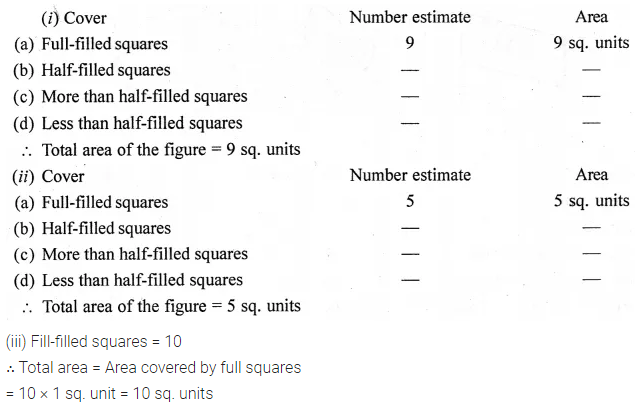
Question 1.
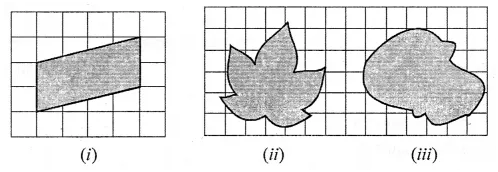
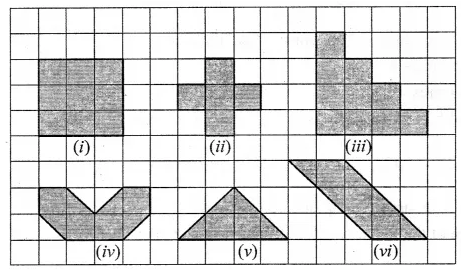
Find the area of the region enclosed by the following figures by counting squares:
ML Aggarwal Class 6 Solutions for ICSE Maths Chapter 14 Mensuration Ex 14.2 1
Solution:
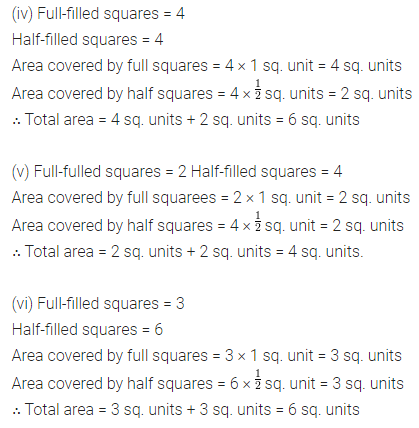
ML Aggarwal Class 6 Solutions for ICSE Maths Chapter 14 Mensuration Ex 14.2 2
ML Aggarwal Class 6 Solutions for ICSE Maths Chapter 14 Mensuration Ex 14.2 3

Question 2.
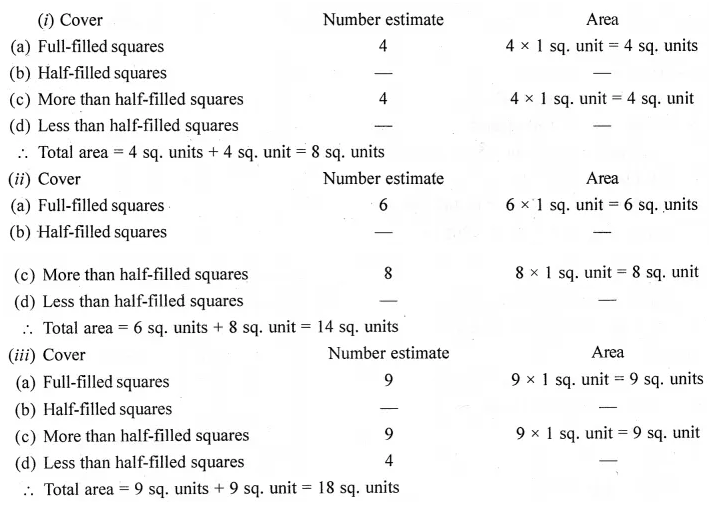
Find the area of the following closed figures by counting squares:
ML Aggarwal Class 6 Solutions for ICSE Maths Chapter 14 Mensuration Ex 14.2 4
Solution:
ML Aggarwal Class 6 Solutions for ICSE Maths Chapter 14 Mensuration Ex 14.2 5

Question 3.
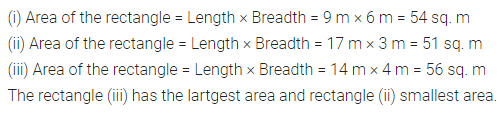
Find the areas of the rectangles whose lengths and breadths are:
(i) 9 m and 6 m
(ii) 17 m and 3 m
(iii) 14 m and 4 m
Which one has the largest area and which one has the smallest area?
Solution:
ML Aggarwal Class 6 Solutions for ICSE Maths Chapter 14 Mensuration Ex 14.2 6

Question 4.
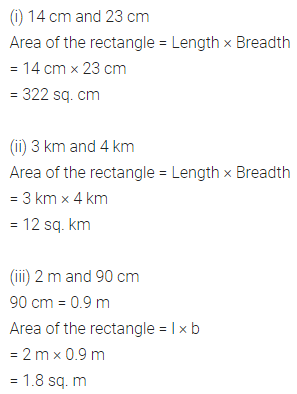
Find the areas of the rectangles whose two adjacent sides are:
(i) 14 cm and 23 cm
(ii) 3 km and 4 km
(iii) 2 m and 90 cm
Solution:
ML Aggarwal Class 6 Solutions for ICSE Maths Chapter 14 Mensuration Ex 14.2 7

Question 5.
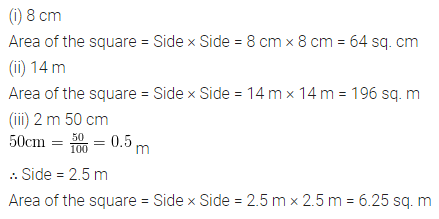
Find the areas of the squares whose sides are:
(i) 8 cm
(ii) 14 m
(iii) 2 m 50 cm
Solution:
ML Aggarwal Class 6 Solutions for ICSE Maths Chapter 14 Mensuration Ex 14.2 8

Question 6.
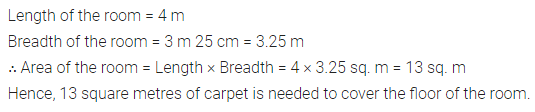
A room is 4 m long and 3 m 25 cm wide. How many square metres of carpet is needed to cover the floor of the room?
Solution:
ML Aggarwal Class 6 Solutions for ICSE Maths Chapter 14 Mensuration Ex 14.2 9

Question 7.
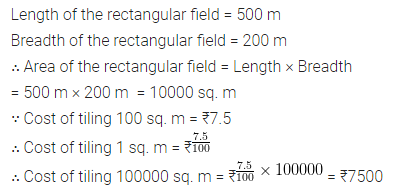
What is the cost of tiling a rectangular field 500 m long and 200 m wide at the rate of ₹7.5 per hundred square metres?
Solution:
ML Aggarwal Class 6 Solutions for ICSE Maths Chapter 14 Mensuration Ex 14.2 10

Question 8.
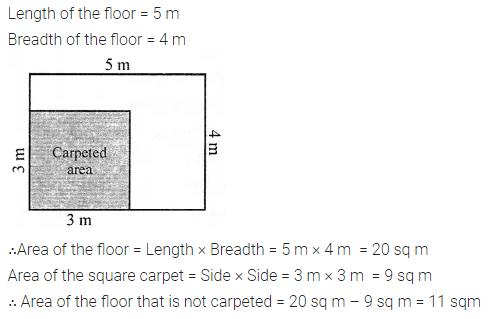
A floor is 5 m long and 4 m wide. A square carpet of sides 3 m is laid on the floor. Find the area of the floor that is not carpeted.
Solution:
ML Aggarwal Class 6 Solutions for ICSE Maths Chapter 14 Mensuration Ex 14.2 11

Question 9.
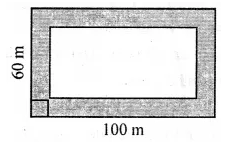
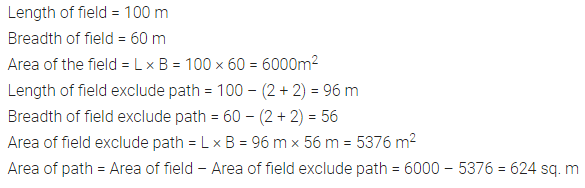
In the given figure, find the area of the path (shown shaded) which is 2 m wide all around.
ML Aggarwal Class 6 Solutions for ICSE Maths Chapter 14 Mensuration Ex 14.2 12
Solution:
ML Aggarwal Class 6 Solutions for ICSE Maths Chapter 14 Mensuration Ex 14.2 13

Question 10.
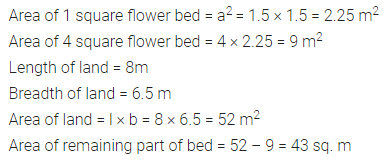
Four square flower beds of side 1 m 50 cm are dug on a rectangular piece of land 8 m long and 6 m 50 cm wide. What is the area of the remaining part of the land?
Solution:
ML Aggarwal Class 6 Solutions for ICSE Maths Chapter 14 Mensuration Ex 14.2 14

Question 11.
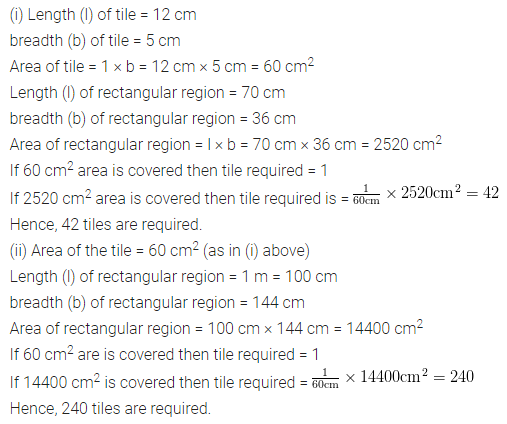
How many tiles whose length and breadth are 12 cm and 5 cm respectively will be needed to cover a rectangular region whose length and breadth are respectively :
(i) 70 cm and 36 cm
(ii) 144 cm and 1 m.
Solution:
ML Aggarwal Class 6 Solutions for ICSE Maths Chapter 14 Mensuration Ex 14.2 15

Question 12.
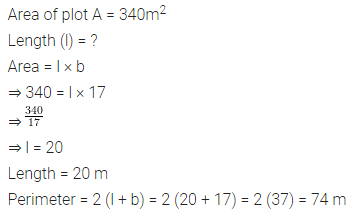
The area of a rectangular plot is 340 sq. m. If its breadth is 17 m, find its length and the perimeter.
Solution:
ML Aggarwal Class 6 Solutions for ICSE Maths Chapter 14 Mensuration Ex 14.2 16

Question 13.
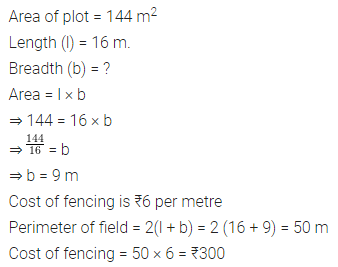
If the area of a rectangular plot is 144 sq. m and its length is 16 m. Find the breadth of the plot and the cost of fencing it at the rate of ₹ 6 per metre.
Solution:
ML Aggarwal Class 6 Solutions for ICSE Maths Chapter 14 Mensuration Ex 14.2 17

Question 14.
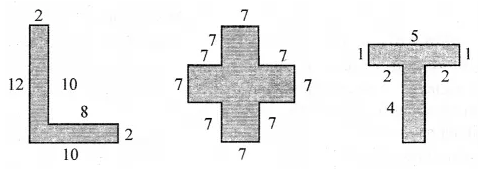
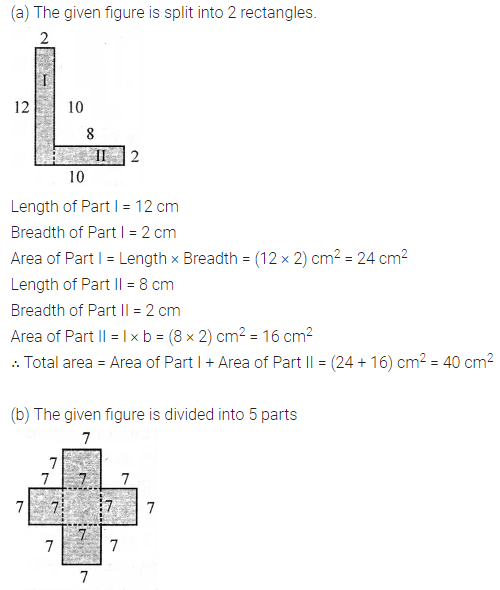
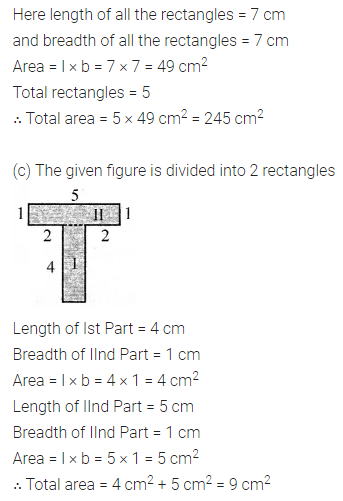
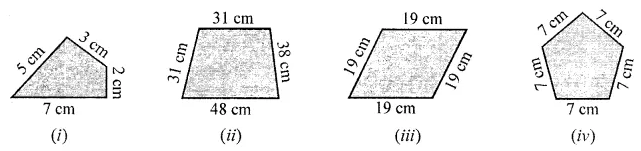
Split the following shapes into rectangles and find their areas. (The measures are given in centimetres).
ML Aggarwal Class 6 Solutions for ICSE Maths Chapter 14 Mensuration Ex 14.2 18
Solution:
ML Aggarwal Class 6 Solutions for ICSE Maths Chapter 14 Mensuration Ex 14.2 19
ML Aggarwal Class 6 Solutions for ICSE Maths Chapter 14 Mensuration Ex 14.2 20

ML Aggarwal Class 6 Solutions for ICSE Maths Chapter 14 Mensuration Ex 14.1

ML Aggarwal Class 6 Solutions Chapter 14 Mensuration Ex 14.1 for ICSE Understanding Mathematics acts as the best resource during your learning and helps you score well in your exams.

ML Aggarwal Class 6 Solutions for ICSE Maths Chapter 14 Mensuration Ex 14.1

Question 1.
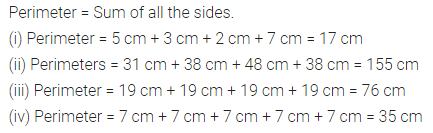
Find the perimeter of each of the following figures:
ML Aggarwal Class 6 Solutions for ICSE Maths Chapter 14 Mensuration Ex 14.1 1
Solution:
ML Aggarwal Class 6 Solutions for ICSE Maths Chapter 14 Mensuration Ex 14.1 2

Question 2.
Find the perimeter of each of the following shapes:
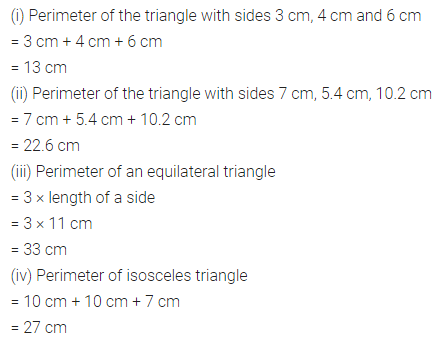
(i) A triangle of sides 3 cm, 4 cm and 6 cm.
(ii) A triangle of sides 7 cm, 5.4 cm and 10.2 cm.
(iii) An equilateral triangle of side 11 cm.
(iv) An isosceles triangle with equal sides 10 cm each and third side 7 cm.
Solution:
ML Aggarwal Class 6 Solutions for ICSE Maths Chapter 14 Mensuration Ex 14.1 3

Question 3.
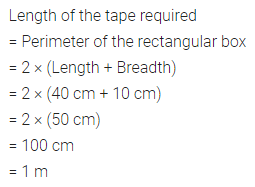
The lid of a rectangular box of sides 40 cm by 10 cm is sealed all round with tape. What is the length of the tape required?
Solution:
ML Aggarwal Class 6 Solutions for ICSE Maths Chapter 14 Mensuration Ex 14.1 4

Question 4.
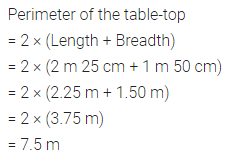
Table-Top measures 2 m 25 cm by 1 m 50 cm. What is the perimeter of the table-top?
Solution:
ML Aggarwal Class 6 Solutions for ICSE Maths Chapter 14 Mensuration Ex 14.1 5

Question 5.
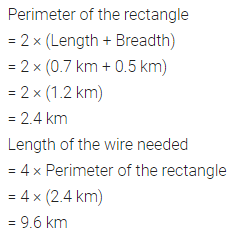
A rectangular piece of land measures 0.7 km by 0.5 km. Each side is to be fenced with 4 rows of wires. What is the length of the wire needed?
Solution:
ML Aggarwal Class 6 Solutions for ICSE Maths Chapter 14 Mensuration Ex 14.1 6

Question 6.
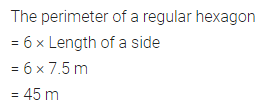
Find the perimeter of a regular hexagon with each side measuring 7.5 m.
Solution:
ML Aggarwal Class 6 Solutions for ICSE Maths Chapter 14 Mensuration Ex 14.1 7

Question 7.
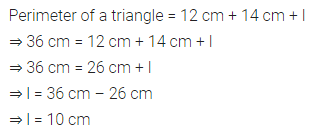
The lengths of two sides of a triangle are 12 cm and 14 cm. The perimeter of the triangle is 36 cm. What is the length of its third side?
Solution:
ML Aggarwal Class 6 Solutions for ICSE Maths Chapter 14 Mensuration Ex 14.1 8

Question 8.
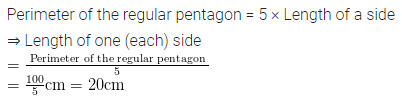
The perimeter of a regular pentagon is 100 cm. How long is its every side?
Solution:
ML Aggarwal Class 6 Solutions for ICSE Maths Chapter 14 Mensuration Ex 14.1 9

Question 9.
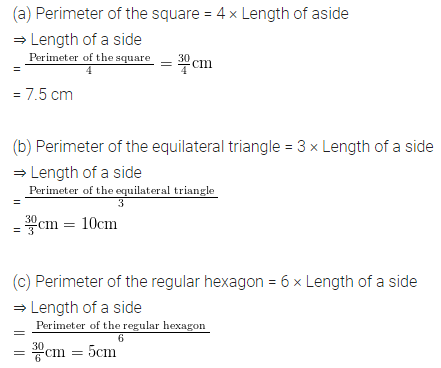
A piece of string is 30 cm long. What will be the length of each side if the string is used to form:
(a) a square?
(b) an equilateral triangle?
(c) a regular hexagon?
Solution:
ML Aggarwal Class 6 Solutions for ICSE Maths Chapter 14 Mensuration Ex 14.1 10

Question 10.
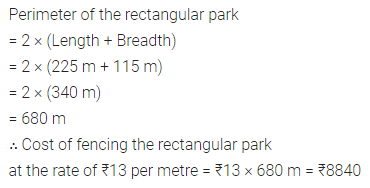
Find the cost of fencing a rectangular park of length 225 m and breadth 115 m at the rate of ₹13 per metre.
Solution:
ML Aggarwal Class 6 Solutions for ICSE Maths Chapter 14 Mensuration Ex 14.1 11

Question 11.
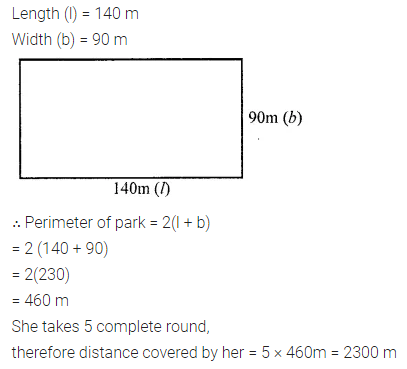
Meera went to a rectangular park 140 m long and 90 m wide. She took 5 complete rounds on its boundary. What is the distance covered by her?
Solution:
ML Aggarwal Class 6 Solutions for ICSE Maths Chapter 14 Mensuration Ex 14.1 12

Question 12.
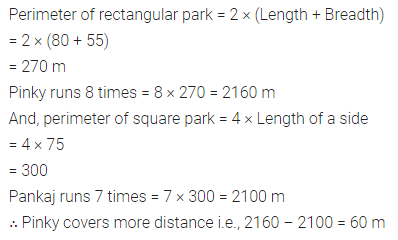
Pinky runs 8 times around a rectangular park with length 80 m and breadth 55 m while Pankaj runs 7 times around a square park of side 75 cm. Who covers more distance and by how much?
Solution:
ML Aggarwal Class 6 Solutions for ICSE Maths Chapter 14 Mensuration Ex 14.1 13

ML Aggarwal Class 6 Solutions for ICSE Maths Chapter 13 Practical Geometry Check Your Progress

ML Aggarwal Class 6 Solutions Chapter 13 Practical Geometry Check Your Progress for ICSE Understanding Mathematics acts as the best resource during your learning and helps you score well in your exams.

ML Aggarwal Class 6 Solutions for ICSE Maths Chapter 13 Practical Geometry Check Your Progress

Question 1.
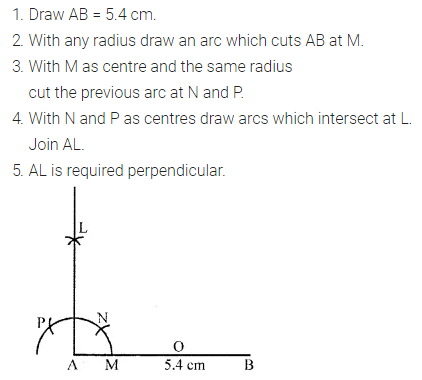
Draw a line segment AB = 5.4 cm. Construct a perpendicular at A by using ruler and compass.
Solution:
Steps of Construction:
ML Aggarwal Class 6 Solutions for ICSE Maths Chapter 13 Practical Geometry Check Your Progress 1

Question 2.
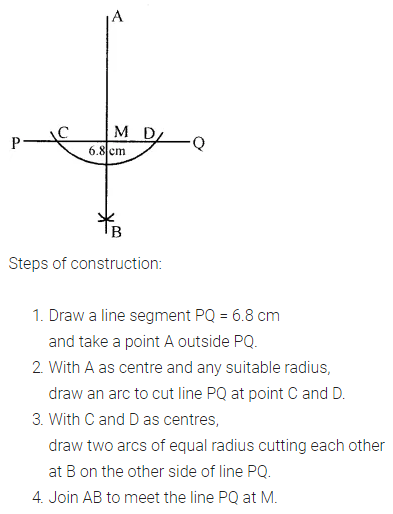
Draw a line segment PQ = 6.8 cm. Draw a perpendicular to it from a point A outside PQ by using ruler and compass.
Solution:
ML Aggarwal Class 6 Solutions for ICSE Maths Chapter 13 Practical Geometry Check Your Progress 2

Question 3.
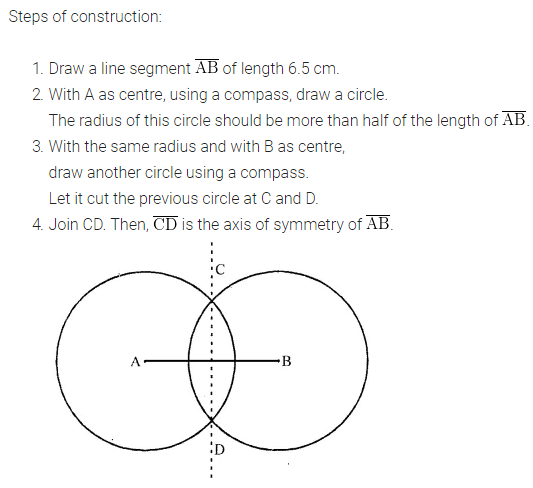
Draw a line segment of length 6.5 cm and construct its axis of symmetry.
Solution:
ML Aggarwal Class 6 Solutions for ICSE Maths Chapter 13 Practical Geometry Check Your Progress 3

Question 4.
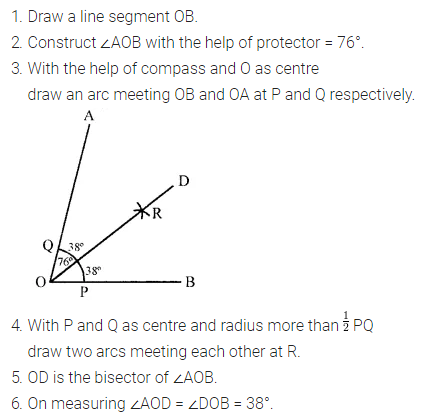
Draw ∠AOB = 76° with the help of a protractor. Bisect this angle by using a ruler and compass. Measure the two parts by your protractor and see how accurate you are.
Solution:
Steps of Construction:
ML Aggarwal Class 6 Solutions for ICSE Maths Chapter 13 Practical Geometry Check Your Progress 4

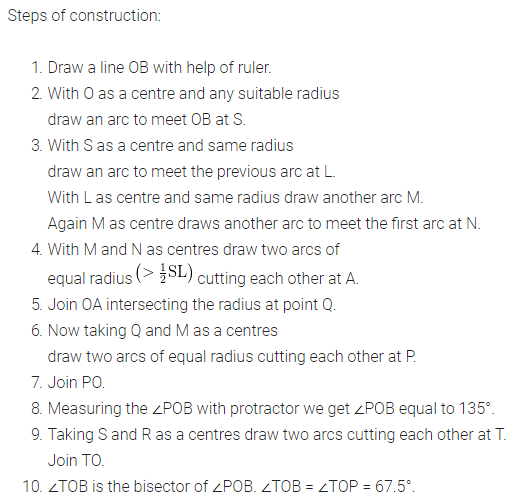
Question 5.
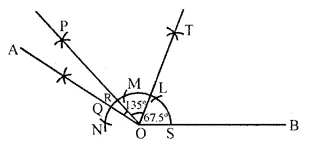
By using and compass, construct an angle of 135° and bisect it. Measure any one part by protractor and see how accurate you are.
Solution:
ML Aggarwal Class 6 Solutions for ICSE Maths Chapter 13 Practical Geometry Check Your Progress 5
ML Aggarwal Class 6 Solutions for ICSE Maths Chapter 13 Practical Geometry Check Your Progress 6

A Different Kind of School Extra Questions and Answers Class 6 English Honeysuckle

Here we are providing A Different Kind of School Extra Questions and Answers Class 6 English Honeysuckle, Extra Questions for Class 6 English was designed by subject expert teachers.

A Different Kind of School Extra Questions and Answers Class 6 English Honeysuckle

A Different Kind of School Extra Questions and Answers Short Answer Type

Question 1.
Describe the appearance of Miss Beam.
Answer:
Miss Beam was a middle-aged, authoritative, yet kind and understanding woman. Her hair was grey and she was a little fat.

Question 2.
What did Miss Beam teach the children at her school?
Answer:
The children were taught simple spelling, adding, subtracting, multiplying and writing.

Question 3.
How was Miss Beam’s school was different?
Answer:
The real aim of Miss Beam’s school was to make them thoughtful. They were trained to be kind to others and become responsible citizens. The school aimed at teaching ‘thoughtfulness’.

Question 4.
What did the author see in the playground?
Answer:
The author saw that not all children were healthy and active-looking. Some were blind or lame and crippled.

Question 5.
What did Miss Beam inform the author about the children is the playground?
Answer:
Miss Beam informed to the author that no child was lame, blind or crippled. They were, in fact, being made to understand misfortune. Every child had one blind day, one lame day and one dumb day. They were helped by other children.

Question 6.
Which incident made the visitor to the school ten times more thoughtful than ever?
Answer:
The narrator had heard a lot about the unique method of teaching in Beam’s school. At first he saw a blind girl being led out. Then he saw a lame boy. He thought that the students were not at all healthy and active. But soon he came to know that they were just acting to be blind, lame, crippled etc. Meanwhile, he was asked to lead a blind girl around. The blind girl asked him many questions. And he had to apply his brain to describe people and things. He realised that he had become ten times more thoughtful than ever.

Question 7.
What did the narrator learn from the girl?
Answer:
The writer learnt about the lame days. She told him about the toughest day of being blind.

Question 8.
How has the girl with bandaged eyes impressed him?
Answer:
The author was impressed when she told him about the head girl just by asking the details of her hair, height etc. He was taken aback when she told him about the gardener. She told him about the activities of the gardener without seeing.

Question 9.
Why do you think the writer visited Miss Beam’s school?
Answer:
Let’s go for a little walk. Only you must tell me about things. I shall be so glad when today is over. The other bad days can’t be half as bad as this. Having a leg tied up and hopping about on a crutch is almost fun, I guess. I don’t think I’ll mind being deaf for a day, at least not much. But being blind is so frightening.

Question 10.
Why do you think the writer visited Miss Beam’s school?
Answer:
The author had heard much about Miss Beam’s school. So he went there to personally know what it was.

Question 11.
What was the ‘game’ that every child in the school had to play?
Answer:
Every child in the school had to play the role of being blind, deaf, dumb, injured and lame once in a term. It was a sort of game and training.

Question 12.
“Each term every child has one blind day, one lame day complete the line. Which day was the hardest? Why was it the hardest?
Answer:
“Each term every child has one blind day. One lame day, one deaf day, one injured day and one dumb day.” The dumb day was the hardest because the children’s mouths could not be bandaged. So they really had to exercise their will power to remain silent.

Question 13.
What was the purpose of these special days?
Answer:
The purpose of special days was to teach thoughtfulness kindness to others, and being responsible citizens. To make the children appreciate and understand misfortune, they were made to share in misfortune too.

A Different Kind of School Extra Questions and Answers Long Answer Type

Question 1.
How successful was Miss Beam in inculcating values in her students?
Answer:
Miss Beam was known for her efforts in inculcating the values in her students. She focused on academics as well. Her students were taught spelling, reading, adding subtracting, multiplying and writing. They were also educated to be socially responsible citizen. They were given chances to help and coordinate well with each other. The author was impressed with their bond and sharing of responsibilities. He also liked the altitude, zeal and enthusiasm with which Miss Beam was educating her students. At the end, we can say that she had successfully inculcated empathy, companionship among her school students.

Question 2.
What attributes should be a part of school education system?
Answer:
The lesson dealt with the lack of values in education system prevailing. The emphasis should be laid on all round development of a child-be it emotional, social or physical etc. The policy makers should keep in mind shaping the future of student while framing the syllabus of students. The minds of young learners reciprocate to conditions provided to them. They can realise and relate through the real – life like experiences. They should be given opportunities so as to make them better citizens.

A Different Kind of School Extra Questions and Answers Reference to Context

Question 1.
When I arrived there was no one in sight but a girl of about twelve. Her eyes were covered with a bandage and she was being led carefully between the flower-beds by a little boy, who was about four years younger. She stopped, and it looked like she asked him who had come. He seemed to be describing me to her. Then they passed on.

(i) Where did the writer arrive?
(ii) What was the girl doing?
(iii) What was the age of the girl?
(iv) Why has the girl stopped?
(v) Change the adverb ‘Carefully’ into an adjective.
Answer:
(i) The writer arrived at Miss Beam’s school.
(ii) The girl was led by a boy as her eyes were covered with a bandage
(iii) The girl was about twelve years.
(iv) The girl was stopped to enquired about the visitor.
(v) Careful.

Question 2.
“This is a very important part of our system. To make our children appreciate and understand misfortune, we make them share in misfortune too. Each term every child has one blind day, one lame day, one def day, one injured day and one dumb day. During the blind day their eyes are bandaged absolutely and they are on their honour not to peep. The bandage is put on overnight so they wake blind. This means that they need help with everything. Other children are given the duty of helping them and leading them about. They all learn so much this way—both the blind and the helpers.

(i) What was the very important part of the school?
(ii) What was done on “blind day’?
(iii) What was the duty of the helpers?
(iv) Why was ‘lame day’ organised for each term?
(v) Give the meaning of‘are on their honour’.
Answer:
(i) The very important part of the school system was to make children responsible and understand misfortune.
(ii) During the blind day their eyes were bandaged.
(iii) The helpers were given duty of helping and leading the blind student of the day.
(iv) Lame day was organised to make children appreciate and understand misfortune.
(v) ‘have promised’.

Question 3.
“Oh, yes”, she said. “Let’s go for a little walk. Only you must tell me about things. I shall be so glad when today is over. The other bad days can’t be half as bad as this. Having a leg tied up and hopping about on a crutch is almost fun, I guess. Having an arm tied up is a bit more troublesome because you can’t eat without help, and things like that. I don’t think I’ll mind being deaf for a day at least not much. But being blind is so frightening. My head aches all the time just from worrying that I’ll get hurt. Where are we now?”

(i) What was the writer taken for?
(ii) Which is the ‘funny lame day’ for the girl?
(iii) Which was the toughest activity for.the ’girl?
(iv) What Worried her the most on being blind?
(v) Give the noun form of‘troublesome’.
Answer:
(i) The writer was taken for a little walk.
(ii) The funniest lame day was when her one leg was tied and she had to hop on a crutch.
(iii) The toughest activity for her was being blind folded.
(iv) The fear of getting hurt was the reason of her worry.
(v) troublesomeness.
Question 4.
“In the playground,” I said. “We’re walking towards the house. Miss Beam is walking up and down the garden with a tall girl.”
“What is the girl wearing?” my little friend asked. “A blue cotton skirt and a pink blouse.” “I think it’s Millie?” she said. “What colour is her hair?”
“Very light,” I said. “Yes, that’s Millie. She’s the Head Girl.”
“There’s an old man tying up roses,” I said. “Yes, that’s Peter. He’s the gardener. He’s hundreds of years old!”
Questions
(i) Where were the visitor and the girl?
(ii) Who was the tall girl?
(iii) What was Miss Beam doing?
(iv) Who was ‘Peter’? what was he doing?
(v) Write the antonym of ‘toward’.
Answer:
(i) They were in the playground.
(ii) The tall girl was the head girl.
(iii) Miss Beam was walking up and down the garden with the tall girl.
(iv) Peter was a gardener and he was tying up roses.
(v) Away from.