The Living Organisms and Their Surroundings Class 6 Extra Questions and Answers Science Chapter 9

In this page, we are providing The Living Organisms and Their Surroundings Class 6 Extra Questions and Answers Science Chapter 9 pdf download. NCERT Extra Questions for Class 6 Science Chapter 9 The Living Organisms and Their Surroundings with Answers will help to score more marks in your CBSE Board Exams.

Class 6 Science Chapter 9 Extra Questions and Answers The Living Organisms and Their Surroundings

Extra Questions for Class 6 Science Chapter 9 The Living Organisms and Their Surroundings with Answers Solutions

The Living Organisms and Their Surroundings Class 6 Extra Questions Very Short Answer Type

Question 1.
Name the process by which living things obtain energy from food.
Answer:
Respiration

Question 2.
Name two aquatic plants which are completely submerged in water.
Answer:
Lily and lotus

Question 3.
Name two terrestrial habitats.
Answer:
Deserts, mountains

Question 4.
What are two components of the habitat?
Answer:
(i) Biotic components
(ii) Abiotic components

Question 5.
Name one characteristic which tells us that seeds are living things.
Answer:
They grow into a plant when get favourable conditions.

Question 6.
Name two animals which live in the arboreal habitat.
Answer:
(i) Birds
(ii) Monkey

Question 7.
Mention few aquatic plants found in a pond.
Answer:
Water hyacinth, water lily, lotus, Hydrilla, etc.

Question 8.
Name the habitats of following plants:
(a) Cactus
(b) Hydrilla
Answer:
(a) Cactus: Desert
(b) Hydrilla: Aquatic

Question 9.
Name some plants which live in dry areas.
Answer:
Plants like cactus, Acacia, pine, prickly pear live in dry areas.

Question 10.
Name two aquatic habitats.
Answer:
Oceans, ponds

Question 11.
Write the names of two sea animal which have nostrils.
Answer:
Dolphins and whales

Question 12.
What is stimuli?
Answer:
The changes in our surrounding that makes us respond to them are called stimuli.

Question 13.
How does gills help a fish?
Answer:
Gills help fish to take-up oxygen dissolved in water.

Question 14.
Name an animal in which the exchange of gases, during respiration, take place through its skin.
Answer:
The earthworm breathes through the skin.

Question 15.
Name one animal which is adapted to live in water as well as land.
Answer:
Frog

The Living Organisms and Their Surroundings Class 6 Extra Questions Short Answer Type

Question 1.
What is adaptation?
Answer:
The change in specific features or certain habits, which enables a plant or an animal to live in its surroundings is called adaptation.

Question 2.
Define ecology.
Answer:
The study of relationship between living organism and their surroundings is called ecology.

Question 3.
What is environment?
Answer:
Our physical surrounding is called environment.

Question 4.
What is ocean?
Answer:
A very large body of salt water that covers nearly three-fourths of the surface of the earth is called ocean.

Question 5.
Where does a camel lives?
Answer:
A camel lives in a hot desert where there is scarcity of water.

Question 6.
What is habitat?
Answer:
The place or surroundings where a plant or an animal lives is called its habitat.

Question 7.
What is terrestrial habitat?
Answer:
A land based habitat is called a terrestrial habitat.

Question 8.
What is acclimatisation?
Answer:
Small changes that take place in the body of a single organism over short periods, to overcome small problems due to changes in the surroundings, is called acclimatization.

Question 9.
What is reproduction?
Answer:
The process by which living organisms produce new member of their species is called reproduction.

Question 10.
What is excretion?
Answer:
The removal of waste substances from the body of a living organism is called excretion.

Question 11.
What are organisms?
Answer:
The living things are called organisms.

Question 12.
What are biotic components?
Answer:
The living things such as plants, animals and microorganisms in a habitat are its biotic components.

Question 13.
Explain abiotic components.
Answer:
Various non-living things such as rocks, soil, air and water in a habitat constitute its abiotic components.

Question 14.
Why do fish have slippery scales on their bodies?
Answer:
These scales protect the fish from external damage from sharp objects and also help in easy movement through water.

Question 15.
Give three adaptive features in desert plants.
Answer:

  1. Well developed root systems.
  2. Leaves either very small or converted to spines.
  3. Stem is green and fleshy in some plants to carry out photosynthesis.

The Living Organisms and Their Surroundings Class 6 Extra Questions Long Answer Type

Question 1.
List the important characteristics of living things.
Answer:
Following are the important characteristics of living things:

  1. Living things need food, air and water.
  2. Living things grow.
  3. Living things reproduce themselves.
  4. Living things respire.
  5. Living things are made up of living cells.
  6. Living things excrete.
  7. Living things have a definite lifespan.

Question 2.
How does the desert animals prevent the loss of water from their body?
Answer:

  1. Many animals living in desert remain inactive during the day and become active during night to prevent the loss of water from their body. Such animals are called nocturnal.
  2. Certain animals hide themselves in burrows with gelatinous secretion and sleep for about 8 to 9 months in a year. This is called aestivation or summer sleep.

Question 3.
How are plants adapted to aquatic habitat?
Answer:

  1. In aquatic plants, roots are much reduced in size and their main function is to hold the plant on its place.
  2. The stems may be reduced or long, slender, flexible and spongy. The air spaces in spongy stems make them buoyant.
  3. The leaves are thin, large and flat with waxy surface as in lotus and water lily. This protects leaves from wetting and decaying.
  4. The leaves of submerged plants are thin and narrow. Hydrilla and Vallisneria are submerged plants and have thin and narrow leaves. Such leaves allow the water to flow without damaging them.

Question 4.
What is respiration?
Answer:
All the living things need energy to grow, move and stay alive. They get this energy from food through respiration. Respiration is the chemical process in which food taken by an organism combines with oxygen to release energy. This energy is used by the organism to carry out its various life processes. Carbon dioxide and water are the other products of the process of respiration.

Question 5.
What is habitat? Explain briefly.
Answer:
All the living organisms (plants and animals) prefer to live in those places which are best suited to their needs. The place or surroundings where a plant or an animal live is called its habitat.

Habitat can be divided into two main groups:
(i) Terrestrial habitat
(ii) Aquatic habitat
A land based habitat is called terrestrial habitat and a water based habitat is called aquatic habitat.

Question 6.
Differentiate between biotic and abiotic components.
Answer:

Abiotic componentsBiotic components
1. The term ‘biotic’ means living.1. The term ‘abiotic’ means non-living.
2. All the living thing in a habitat are biotic components.2. All non-living things in a habitat are known as abiotic components.
3. Example, plants, animals, etc.3. Example, air, soil, etc.

Question 7.
Differentiate between xerophytes and hydrophytes.
Answer:

XerophytesHydrophytes
1. Plants are adapted to dry conditions.1. Plants are adapted to aquatic conditions.
2. Leaves are reduced in size or are modified to spines to reduce transpiration.2. Leaves are broad for floating or ribbon-shaped to allow water current through it.
3. Roots are long and well developed.3. Roots are not very well developed. Their main function is just anchoring the plant.
4. Example, Cactus, Acacia4. Example, Hydrilla, Vallisneria

The Living Organisms and Their Surroundings Class 6 Extra Questions HOTS

Question 1.
What is acclimatization? How it differs from adaptation?
Answer:
Small changes in an organism to overcome small changes in the surrounding is called acclimatization. Whereas adaptation is permanent ability of an organism to make themselves suitable for living in a particular environment. Adaptation is slow and gradual process whereas acclimatization is comparatively a quick method.

Question 2.
Can you name some plant parts, apart from seed, which give rise to a new plant?
Answer:
Leaves, stem, bulb, offset, corm, etc., of some plants can give rise to a new plant.

Question 3.
Is seed a living thing?
Answer:
Yes, seed is a living thing as it has living embryo in it. It is in dormant state which could be break by subjecting it to favourable conditions.

Question 4.
Differentiate between aestivation and hibernation.
Answer:

AestivationHibernation
1. It is summer sleep1. It is winter sleep.
2. Animals rests in cool or shady and moist place.2. Animals rest in a warm place.
3. It lasts for hot dry day time as nights are cooler.3. It is of longer duration and lasts for the whole duration of winter.
4. Activators are snails, earthworms, bees, salamanders, frogs, toads, lizards, snakes, mud turtles, etc.4. Hibernators are polar bear, kangaroo, mouse, squirrels, etc.

Question 5.
Why do mountaineers carry oxygen cylinders with them?
Answer:
As we go higher the air gets less dense. There is lack of supply of oxygen. Thus, mountaineers carry oxygen cylinders with them.

The Living Organisms and Their Surroundings Class 6 Extra Questions Value-Based (VBQs)

Question 1.
Radha while learning about the characteristics of living organisms studied that living organism excrete their waste out of the body. She remembered that plants are also living organisms. But she wondered how plants excrete their waste. She searched in internet to solve her query.
(a) What are the characteristics of living organisms?
(b) Which component is constituted by plants?
(c) How do plant excrete their waste materials?
(d) What value of Radha is shown here?
Answer:
(a) Living organisms can

  1. grow
  2. reproduce
  3. excrete
  4. respire
  5. move
  6. show response to stimuli

(b) Biotic component
(c) In plants different modes of excretion are present. They loses their gaseous waste through their stomata. Deciduous plants transfer their toxic waste to the leaves which fall on maturity. Excess water is lost through transpiration.
(d) Radha is curious, responsible and hardworking.

Question 2.
Gita lives in Tamil Nadu. Her family planned to visit a hilly area during her school vacation. She was so excited. When she reached there, she experienced breathing problem while walking or running. She got worried that something might have happened to her. But her father consoled her and said, that this is normal and she will be fine after few days of staying there.
(a) Why does Gita experience breathing problem in hilly area?
(b) How will she be fine after some days?
(c) What do this process of adjusting to environment called?
(d) What values of Gita’s father is shown here?
Answer:
(a) In hilly areas oxygen level is very low. So, Gita experienced breathing problem.
(b) Her body will make small changes, like increased red blood cells, to cope with decreased amount of oxygen.
(c) Acclimatisation
(d) Gita’s father is caring, loving, responsible and have scientific aptitude.
Noun Exercises for Class 6 CBSE With Answers

Noun Exercises for Class 6

Definition: A noun is a part of speech that is used to name a person, place, thing, quality, or action. Examples: Mango, girl, boy, cat, etc.

Any name given to a person, thing, animal or place is called a noun.

This grammar section explains English Grammar in a clear and simple way. There are example sentences to show how the language is used. You can also visit the most accurate and elaborate NCERT Solutions for Class 6 English. Every question of the textbook has been answered here.

Noun Exercises for Class 6 CBSE With Answers Pdf

Kinds of Noun
There are five kinds of noun which are as follows

Common Noun
A name given to a class of persons, things or animals is common noun.
Or
Common noun is not the name of any particular person or place.

  • Sunil is a nice boy. (Person)
  • There is a book on the table. (Thing)
  • Delhi is a big city. (Place)
  • Cows are worshipped in India. (Animal)

Note: Common nouns need not be written with capital letters, except in the beginning of the sentences.

Proper Noun
The name that is particularly given to a person or place as its unique identity is called as proper noun. Proper noun must begin with a capital letter.

  • Sunil is my neighbour. (Person)
  • Bangalore is a very nice city. (Place)
  • The Nile is the longest river in the world. (River)
  • Kalidas was a very good writer. (Person)

Material Noun
The name given to material objects are called as material nouns, e.g. Water, tea, ice, rice, wood, paper and iron

  • This table is made of wood.
  • Many ornaments are made of silver.
  • Toys made of poor quality plastic are harmful for kids.

Note: Generally, material objects are not objects, but parts of other objects.

Important points
Material objects are uncountable, i.e., they cannot be counted as 1, 2, 3, ….
But they can be measured or weighted. eg.

  • 2 litres of milk (not 2 milks)
  • 10 kilograms of rice (not 10 rices)
  • 100 tons of wood (not 100 woods)

Collective Nouns
Collective nouns are the names given to a collection of similar things taken as a whole, e.g.

  • a bunch of sticks.
  • a bouquet of flowers.
  • a crew of sailors/soldiers.
  • an army of soldiers.
  • a crowd of people.
  • a herd of cattle.
  • a mob of people.
  • a pack of wolves.
  • a school/shoal of fish.

Note:

  • A single soldier cannot be called army.
  • A single flower cannot be called bouquet.

Abstract Nouns
Abstract nouns are the names given to abstract things or intangible things. Abstract things are the things which cannot be seen or touched, but can be felt or experienced, e.g. Intelligence, friendship, smartness, boldness, fear etc.

  • Intelligence is always admired.
  • Honesty is the best policy.
  • The girl’s courage saved the lives of many people.
  • The length of the table is 2 meters.

Abstract nouns are the names of quality, feelings, state or action.

The Noun: Number
Nouns are used either in singular number or in plural number.
1. Singular number is the object is ‘one’ in number. e.g.

  • There is a ball. (1 ball)
  • Please give me a pencil. (1 pencil)

2. Plural number if the objects ‘are more than one’ in number. e.g.

  • There are a lot of pencils. (More than one pencil)
  • All the boys were laughing. (More than one boy)

The Rules for Making Plural forms of Singular nouns
Rule 1
Adding ‘s’ as a suffix.

  • bat – bats
  • doll – dolls
  • cat – cats
  • elephant – elephants
  • pen – pens
  • tree – trees

Rule 2
Adding ‘es’ to the nouns which end in ‘s, sh, ch, x’.

  • wish – wishes
  • bench – benches
  • watch – watches
  • box – boxes
  • glass – glasses
  • fox – foxes

Exception

  • ox – oxen

Rule 3
The nouns ending in *y\
If there is a vowel (a, e, i, o, u) before ‘y’ then add ‘s’,

  • boy – boys
  • guy – guys
  • toy – toys

If there is a consonant before y then remove ‘y’ and add ‘ies’.

  • baby – babies
  • hanky – hankies
  • fairy – fairies
  • story – stories

Rule 4
Nouns ending in ‘o’.
If there is a vowel before ‘o’, add ‘s’.

  • audio – audios
  • video – videos
  • cuckoo – cuckoos
  • studio – studios

If there is a consonant before

  • tomato – tomatoes
  • mango mangoes
  • hero – heroes

Rule 5
‘F’ or Te’ of some nouns change to ‘yes’.

  • Life – lives
  • Thief – thieves
  • Knife knives
  • Wife – wives
  • Shelf – shelves

Rule 6
Change of vowel

  • man – men
  • woman – women
  • axis – axes
  • tooth – teeth
  • foot – feet
  • goose – geese
  • mouse – mice

Rule 7
Plural of compound nouns is made as

  • brother-in-law – brothers-in-law
  • father-in-law – fathers-in-law
  • mother-in-law – mothers-in-law

The Noun: Gender
Gender of a noun denotes the difference they have in terms of their sex.

Types of Gender

  • Masculine Gender that denotes male sex. e.g. Boy, horse, father
  • Feminine Gender that denotes female sex. e.g. girl, mare, mother
  • Common Gender that denotes either sex. e.g. Doctor, teacher, child
  • Neuter Gender that denotes neuter things or non-living things, e.g. Pen, table, glass

Rules for changing Masculine into Feminine

Rule 1
Masculine can be changed into feminine by adding ‘ess’.

  • Poet – poetess
  • Lion – Lioness
  • Host – Hostess
  • Giant – Giantess

Exception

  • God – Goddess

Rule 2
In some nouns, ending in ‘r’, after removing the Vowel’ before the last letter.
Masculine can be changed into feminine by adding ‘-ess’.

  • Tiger – Tigress
  • Monitor – Monitress
  • Actor – Actress
  • Editor – Editoress

Rule 3
Masculine can be changed into the feminine by using a completely different word.

  • King – Queen
  • Hero – Heroine
  • Uncle – Aunt
  • Husband – Wife

Rule 4
Feminine of the compound nouns are made by changing the masculine word of the compound noun that comes to the front.

  • He-bear – She-bear
  • Bull-calf – Cow-calf
  • He-goat – She-goat
  • Son-in-law – Daughter-in-law.

Rule 5
Feminine of some masculine are made by removing the last vowel and consonant and then by adding ‘-ess’.

  • Governor – Governess
  • Murderer – Murderess

Exception

  • Duke – Duchess

Rule 6
Compound nouns change their gender by changing masculine word into feminine coming later.

  • Headmaster – Headmistress
  • Grandfather – Grandmother
  • Milkman – Milkmaid
  • Peacock – Peahen

Noun Exercises Solved Examples for Class 6 CBSE

Question 1.
Point out the nouns in the following sentences and say whether they are common, proper, collective, material or abstract.
(i) Always speak the truth.
(ii) We all love honesty.
(iii) I have two children.
(iv) The lion is the king of the beasts.
(v) Solomon was the wisest of all kings.
(vi) Cleanliness is next to godliness.
(vii) Birds of a feather flock together.
(viii) Who teaches you grammar?
(ii) The Nile is the longest of all rivers.
(x) A committee of six was appointed to assess the situation.
Answer:
(i) Truth – abstract noun
(ii) Honesty – abstract noun
(iii) Children – common noun
(iv) Lion – common; king – common; beasts – common
(v) Solomon – proper noun; kings – common noun
(vi) Cleanliness – abstract noun; godliness – abstract noun
(vii) Birds – common noun; feather – common norm
(viii) Grammar – abstract noun
(ix) Nile – proper noun; rivers – common noun
(x) Committee – collective noun; Situation – abstract noun

Question 2.
Choose the correct answer to complete these sentences.
(i) I have a lot of (a lot of / a few) homework to finish by tomorrow.
(ii) There is (no/any) jam left in the jar.
(iii) If you are going to the market, pick up (some/many) bread too, please.
(iv) Joe must have
(v) There are (few/little) tigers left in this national park.
(vi) Anchal can sit in the back of the car. There is (plenty of/ a large amount of) room back there.
(vii) The term showed (a large amount o17 a lot of) enthusiasm for the upcoming game.
(viii) The gift package will arrive soon. Have (the/a little) patience.
Answer:
(ii) no
(iii) some
(iv) much
(v) few
(vi) Plenty of
(vii) a large amount of
(viii) 2 little

Noun Exercises Practice Examples for Class 6 CBSE

Question 1.
Spring Garden
Planting a vegetable garden is not only fun, it also helps to save _________ (noun/s). You will need a piece of _________ arable land. You may need a (noun) to keep the (noun/s) and _________ (noun/s) out. As soon as (noun) is here you can go out there with your sickle and plant all _________ kinds of (noun/s). Then in a few months, you will have com on the (noun) and _________ big, beautiful/ colourful flowers.

Question 2.
Choose the correct nouns from the box to complete these sentences.
universities luggage rice enthusiasm
city interview research programs
(i) We decided to have some _________ and curry for lunch.
(ii) Anita is attending an _________ today for a job.
(iii) He likes to watch _________ on animal life and conversation?
(iv) Sona and Sourav showed plenty of _________ about taking up music lessons.
(v) There has been a lot of _________ done on this subject.
(vi) Tarun has been applying to many _________ across the country.
(vii) This _________ has many historical sites and buildings.
(viii) How much _________ are you carrying on the trip?

Question 3.
Underline nouns in the following sentences:
(i) The decision was left to jury.
(ii) This furniture requires service.
(iii) Our hostess looked embarrassed.
(iv) Parents will attend the PTM.
(v) The data is misleading old doctored.
(vi) Measles spread in the town.
(vii) Old is not always gold.
(viii) What is the agenda today?
(ix) She has poor focus and attention.
(x) Cleanliness is everyone’s concern.

Question 4.
Each of the phrases given below contains a collective noun. Complete each phrase by putting in the missing word. Choose from the box:

cattle soldiers sticks sheep ships flowers
fish wolves musicians dancers sailors grapes

(i) A bunch of ___________
(ii) A bundle of ___________
(iii) A bouquet of ___________
(iv) a herd of ___________
(v) a hank of ___________
(vi) a regiment of ___________
(vii) A flock of ___________
(viii) a troupe of ___________
(ix) A crew of ___________
(x) a pack of ___________
(xi) a fleet of ___________
(xii) a shoal of ___________

Picture Story Writing for Class 4 CBSE Format, Topics, Examples, Samples

Picture Story Writing for Class 4 CBSE Format, Topics, Examples, SamplesThis grammar section explains English Grammar in a clear and simple way. There are example sentences to show how the language is used.

Picture Story Writing for Class 4 CBSE Format, Topics, Examples, Samples PDF

It is a form of writing in which we make stories using the given pictures.

Picture Story Writing for Class 4 with Answers PDF

Sample: Write a short story about what you think is happening in the given picture.
Picture Story Writing for Class 4 CBSE Format, Topics, Examples, Samples

The Festival of Lights
Picture Story Writing for Class 4 CBSE Format, Topics, Examples, Samples

Reshma, Zahid and Irfan were happy. It was festival of Diwali and one of their friends had secretly bought a lot of fireworks He gave them some fireworks. Both Zahid and Irfan jumped with excitement when they lit the fire-crackers. The coloured sparks went high up in the air. Little Reshma was quite happy playing with a sparkler nearby.

She did not notice Irfan who was standing close to her. Suddenly, the sparks from her sparkler got into his hair and it caught fire. How frightened they were! Irfan screamed loudly and shouted for help. Their father, who was in the house, came out and managed to put out the fire.

Irfan was hurt and had to see a doctor. The children learned a lesson from what happened that night. They learned that it is not safe to play with fire in the absence of adults.

Picture Story Writing for Class 4 Worksheets CBSE PDF

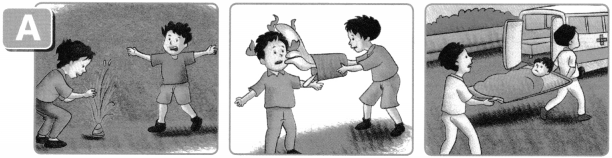
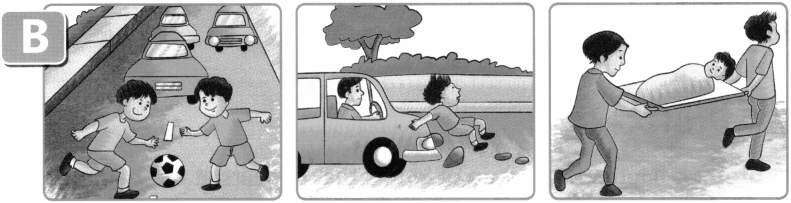
Write a short story about what you think is happening in the given pictures.
Picture Story Writing for Class 4 CBSE Format, Topics, Examples, Samples

Title: ______________________________________________________________________

__________________________________________________________________________________
__________________________________________________________________________________
__________________________________________________________________________________
__________________________________________________________________________________
__________________________________________________________________________________
__________________________________________________________________________________

Diary Entry for Class 4 CBSE Format, Topics, Examples, Samples

Diary Entry for Class 4 CBSE Format, Topics, Examples, SamplesDiary writing is the writing down of events, transactions and observations in a highly personalized manner. It is wrapped around creative thoughts and is basically the outpouring of what one feels or has experienced with regard to a particular stimulus. A diary can be written on a daily basis or at intervals, depending on the inclination of the writer.

This grammar section explains English Grammar in a clear and simple way. There are example sentences to show how the language is used.

Diary Entry for Class 4 CBSE Format, Topics, Examples, Samples PDF

Fundamentals

  • A diary entry is a way to connect with our own experiences.
  • It is a personal piece of writing which reflects a person’s thoughts about a person, an incident or a place.
  • A diary should be written in a chronological order, starting with the events that happened earlier in the day and ending with the events that took place later in the evening.
  • A basic diary entry is always written in first-person narrative.
  • The style of a diary entry should be informal and relaxed.

Diary Entry Exercises for Class 4 with Answers CBSE PDF

Sample: Imagine that you are Mehul/Meena. You reside in Jammu and Kashmir. It was the first snowfall after the onset of winter. Write a diary entry in 50 words.

25th Nov, Friday

9.00 pm

Dear Diary,

Today I feel like celebrating as I saw the first snowfall of the season.

The snow has covered the trees, rooftops, and vehicles. It has been snowing since morning. Looking through the window, the snow appears extraordinarily beautiful. It is biting cold, but my family and I are enjoying it.

Mother has just served hot tomato soup.

I am loving it!
Meena

Diary Entry Practice Questions for Class 4

1. You were off to school this morning. On the way you saw an ailing puppy beside the road. You helped it in your own way. Write a diary entry expressing your own feelings.

Date: _____________ Diary Entry for Class 4 CBSE Format, Topics, Examples, Samples 1 Time: _____________

Dear Diary,
_______________________________________________________________________________
_______________________________________________________________________________
_______________________________________________________________________________
_______________________________________________________________________________
_______________________________________________________________________________
_______________________________________________________________________________

2. You were asking for a bicycle from your father since long. Without your knowledge he bought you a new bicycle. You loved the surprise. Write a diary entry expressing your feelings.

Date: _____________ Diary Entry for Class 4 CBSE Format, Topics, Examples, Samples 2 Time: _____________

Dear Diary,
_______________________________________________________________________________
_______________________________________________________________________________
_______________________________________________________________________________
_______________________________________________________________________________
_______________________________________________________________________________
_______________________________________________________________________________

Paragraph Writing Topics for Class 4 CBSE Format, Samples, Examples

Paragraph Writing Topics for Class 4 CBSE Format, Samples, Examples

Essays are common in elementary, middle, high school and college, and one may even need to write essays in the business world. An essay is defined as “a short piece of writing that expresses information as well as the writer’s opinion.” An essay is, generally, a piece of writing that gives the author’s own argument — but the definition is vague, overlapping with those of a paper, an article, a pamphlet, and a short story. Essays have traditionally been sub-classified as formal and informal.

This grammar section explains English Grammar in a clear and simple way. There are example sentences to show how the language is used.

Paragraph Writing Topics for Class 4 CBSE Format, Samples, Examples

Fundamentals

  • A paragraph consists of several sentences that are grouped together.
  • This group of sentences together discusses one subject.

Paragraph Writing Exercises With Answers for Class 4 CBSE PDF

Do follow five steps to write a paragraph.

  • Step 1: Introduce the topic.
  • Step 2: Develop topic sentence 1
  • Step 3: Develop topic sentence 2
  • Step 4: Develop topic sentence 3
  • Step 5: Conclude the topic.

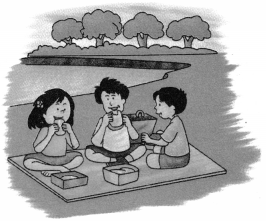
Sample: Write three-four paragraphs on the topic ‘Picnic Fun’. The picture will help you to write this prompt.
Paragraph Writing Topics for Class 4 CBSE Format, Samples, Examples

Draft Main Idea Map

Para 1- Introduction

I think picnics are fun. Everyone likes to spend their time outdoors. I have been to many picnics with my family and friends.

Para 2- Topic Sentence -1
Topic → Location and about Place

Develop → Our last school picnic was the best I have ever been to. We went to Sundrjal. My friends and I had packed a lot of tasty snacks for our trip.

Para 3- Topic Sentence – 2
Topic → Fun at picnic place

Develop → We arrived at Sundrijal after a long journey. We spent the next few hours climbing up steep slopes and jumping from boulder to boulder. We took off our shoes and socks and played in the water but made sure not to get our clothes wet. The water was ice-cold and we could not stop shivering. But that did not stop us from splashing around in the water.

Para 4- Topic Sentence – 3
Topic Departure Time

Develop →We took a break from our playing at around 12: 30 p.m. and sat down to eat all the tasty food that our mothers had packed for us. The momos and potato pickles were the tastiest. Some of us had soft drinks with us and we shared them with our friends. We all had a good feast.

Para 5- Conclusion

After eating, our teachers made sure that we picked up all the empty packets. We put them into a big bag and threw it into a big garbage bin nearby. We played around some more and soon it was time to leave.

Picnic Fun
Paragraph Writing Topics for Class 4 CBSE Format, Samples, Examples

I think picnics are fun. Everyone likes to spend their time outdoors. I have been to many picnics with my family and friends.

Our last school picnic was the best picnic I have ever been to. We went to Sundrijal. My friends and I had packed a lot of tasty snacks for our trip.

The bus left our school at 8 a.m. How excited we were! We sang songs and made quite a noise in the bus. Our teachers could not keep us quiet.

At last our long journey was over and we got off the bus. We spent the next few hours climbing up steep slopes and jumping from boulder to boulder. We took off our shoes and socks and played in the water but made sure not to get our clothes wet. The water was ice-cold and we could not stop shivering. But that did not stop us from splashing around in the water.

We took a break from our playing at around 12: 30 p.m. and sat down to eat the tasty food our mothers had packed for us. The momos and potatos pickles were the tastiest. Some of us had soft drinks with us and we shared them with our friends. We all had a good feast.

After eating, our teachers made sure that we picked up all the empty packets. We put them into a big bag and threw it into a big garbage bin nearby. We played around some more and soon it was time to leave.

Paragraph Writing Practice Questions for Class 4 CBSE PDF

Practice 1: Write a short paragraph on the topic ‘Visit to a Hill Station’.
Practice 2: Write a paragraph about how you spent an interesting weekend with your friends.