Acids, Bases and Salts Class 7 Notes Science Chapter 5

On this page, you will find Acids, Bases and Salts Class 7 Notes Science Chapter 5 Pdf free download. CBSE NCERT Class 7 Science Notes Chapter 5 Acids, Bases and Salts will seemingly help them to revise the important concepts in less time.

CBSE Class 7 Science Chapter 5 Notes Acids, Bases and Salts

Acids, Bases and Salts Class 7 Notes Understanding the Lesson

1. Any of the various water-soluble compounds having sour taste and capable of turning litmus red and reacting with a base to form a salt and water are called acids; e. g. curd, lemon juice, orange juice, vinegar, etc. The chemical nature of these substances are said to be acidic. The acids in these substances are natural acids.

2. Any of various water-soluble compounds having bitter taste and capable of turning litmus blue and reacting with an acid to form a salt and water are called bases. They feel soapy when touched. Bases include oxides and hydroxides of metals and ammonia. The nature of such substances is said to be basic; g., calcium hydroxide, ammonium hydroxide, magnesium oxide, etc.

3. Some special type of substances are used to test the acidic or basic nature of a substance. These substances are known as indicators.

4. Indicators change their colour when added to a solution containing an acidic or a basic substance. There are some naturally occurring indicators such as turmeric, litmus, china rose petals (Gudhal), etc.

5. The most commonly used natural indicator is litmus which is extracted from lichens.

6. It has a mauve (purple) colour in distilled water. It turns red when added to an acidic solution and blue when added to a basic solution. It is available in the form of a solution, or in the form of strips of paper, i.e., red and blue litmus paper.

7. Turmeric is natural indicator which turns from yellow to red in alkaline (basic) solution.

8. China rose petal solution turns dark pink in acidic solution and green in basic solution. It is also a natural indicator.

9. There are also some substances which are neither basic nor acidic. The solutions (substances) which do not change the colour of either red or blue litmus are called neutral substances or solutions, e. g., distilled water, common salt solution, sugar solution, etc.

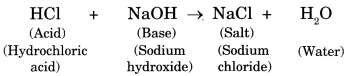
10. The reaction between an acid and base is known as neutralisation. Salt and water are produced in this process with the evolution of heat.

Acid + Base ➝ Salt + Water (Heat is evolved)

The following reaction shows neutralization:
Acids, Bases and Salts Class 7 Notes Science Chapter 5

11. In neutralisation reaction salt is formed which may be acidic, basic or neutral in nature.

12. Neutralisation reaction is helpful in everyday life. It is used in case of indigestion, ant bite, soil treatment, etc.

Class 7 Science Chapter 5 Notes Important Terms

Acid: Substance that tastes sour and turns litmus red in colour is called acid.

Acidic: The chemical nature of acid substance is said to be acidic.

Base: Substance which is bitter im taste, feel soapy on touching and turns litmus blue is called base.

Basic: The chemical nature of base substance is said to be basic.

Descriptive Paragraph Writing for Class 3 CBSE Format, Topics, Examples, Samples

Descriptive Paragraph Writing for Class 3 CBSE Format, Topics, Examples, Samples 1

This grammar section explains English Grammar in a clear and simple way. There are example sentences to show how the language is used.

Descriptive Paragraph Writing for Class 3 CBSE Format, Topics, Examples, Samples PDF

Fundamentals
The primary purpose of descriptive writing is to describe a person, place or a thing in such a way that a picture is formed in the reader’s mind. Capturing an event through descriptive writing involves paying close attention to the details and using all of the five senses.

Descriptive Paragraph Exercises with Answers for Class 3 CBSE PDF

Steps require to write a good descriptive writing.
Step 1: Write the Title.
Step 2: Introduce the title.
Step 3: Use Chart planner technique which includes the answers of ‘W’ Family. Who, What, When, Which and How.
Step 4: Use correct Grammar and Punctuation.
Step 5: Use describing words.
Step 6: Concluding Note

Write a short paragraph on My Favourite Story Book.
Title: My Favourite Story Book

Descriptive Paragraph Writing for Class 3 Chart Planner

Question WordsWhich story do you like?Who has written it?What is the story?How do you feel?
PictureDescriptive Paragraph Writing for Class 3 CBSE Format, Topics, Examples, Samples 2Descriptive Paragraph Writing for Class 3 CBSE Format, Topics, Examples, Samples 3Descriptive Paragraph Writing for Class 3 CBSE Format, Topics, Examples, Samples 4Descriptive Paragraph Writing for Class 3 CBSE Format, Topics, Examples, Samples 5
Key WordsThe Ugly DucklingWritten by Hans Christian Anderson
He wrote beautiful fairy tales.
The story is about little ugly duckling who was earlier ignored by everyone but with the passage of time ugly duckling grew into a beautiful swan. No one remain mean to him.Feel happy and excited!

Read the story.

My Favourite Storybook

My favourite storybook is The Ugly Duckling. It was written by a famous writer called Hans Christian Anderson. He wrote beautiful fairytales for children. This story has also been made into a movie.The story is about a little duckling. Everyone thought he was ugly. His parents, brothers and sisters ignored him because he was different. He did not look like them and he did not sound like them. Everyone made fun of him. He was lonely and sad.

Time passed and soon the ugly duckling grew into a beautiful swan. He was not an ugly duckling anymore. Everyone admired him and no one was mean to him anymore.

This is my favourité storybook bacause it has a happy ending. I like happy endings. I like to believe that every thing will turn out right in the end.

Descriptive Paragraph Worksheet 3rd Grade CBSE PDF

Write a descriptive paragraph on ‘The person I admire the most in your notebook with the help of the following steps. Step 1: Write the title.
Step 2: Make a Chart Planner.
Step 3: Write a descriptive paragraph.

…………………………………………………………………………………………………………………………………………………………………………………………………
…………………………………………………………………………………………………………………………………………………………………………………………………
…………………………………………………………………………………………………………………………………………………………………………………………………
…………………………………………………………………………………………………………………………………………………………………………………………………
…………………………………………………………………………………………………………………………………………………………………………………………………
…………………………………………………………………………………………………………………………………………………………………………………………………

Narrative Writing for Class 3 Format, Examples, Samples, Topics

Narrative Writing for Class 3 Format, Examples, Samples, Topics

Generally, a narrative is a written or oral form of expression. It involves details of an event, experience or happening in a person’s life. Literary forms such as novels and short stories are explicit narratives told by the narrator. The narrative informs the reader about events and character, and sustains the reader’s interest in the pieces.

This grammar section explains English Grammar in a clear and simple way. There are example sentences to show how the language is used.

Narrative Writing for Class 3 Format, Examples, Samples, Topics

Fundamentals

  • A narrative writing is a story written about a personal experience.
  • Writing a narrative essay provides an opportunity to get to know and understand yourself better.

Narrative Writing Exercises with Answers for Class 3 CBSE PDF

Steps required to write a good narrative writing.

  • Step 1: Write the Title.
  • Step 2: Start with answering Question Words to narrate your experience. i.e Why? What? When? and Where?
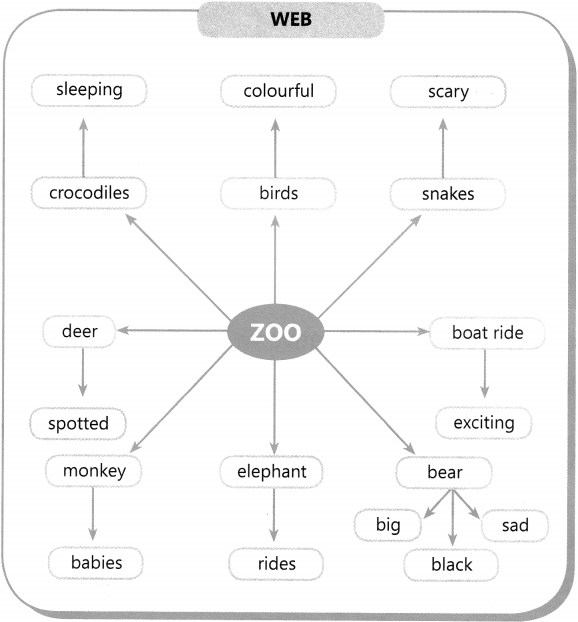
  • Step 3: Use Brainstorming technique. The technique requires to think about different ideas and write them in the form of a web.
  • Step 4: Make an outline of your story with Topic words.
  • Step 5: Develop Topic Words into sentences to form a paragraph.
  • Step 6: Concluding notes.

Look at the Example
Write a short paragraph on the topic ‘A Visit to the Zoo’.
Step 1: Title: A visit to the Zoo
Step 2: Question Words:

  • When do you visit a zoo?
  • Where do you visit a zoo?
  • With whom do you visit?
  • What preparation you made before visiting the zoo?

Step 3: Brainstorming technique:
Narrative Writing for Class 3 Format, Examples, Samples, Topics

Step 4: Outline

Visited last Saturday – with parents – watched crocodiles, monkeys and bear – took refreshment – watched elephants, birds and snakes – took a boat ride – left zoo in time–enjoyed a lot.

Step 5: Develop a narrative essay on ‘A Visit to Zoo’. → Title

‘A Visit to Zoo’

I visited the zoo last Saturday. I went with my parents and younger sisters. The Zoo is situated in Nehru Park. My mother packed some sandwiches and fruits in a picnic basket. We left the house at 8:30 in the morning. We reached the zoo at 9:15 am and went in after buying the entry tickets.

→ Answer of question words.

We went to see the crocodiles first. They were sleeping in the sun. We then visited the deer. Some were big, some were small. There were spotted deer as well. I wanted to see the monkeys so I ran off with my sister to their cages. There were so many baby monkeys playing with each other. They made us laugh. We spent some time watching them. We fed them bananas.

→ With the help of brainstorming techniques develop the sentences.

We then went to see the bear. There was only one bear in the zoo when I visited. It was big and black. It looked very sad.

My sister was hungry, so we found a nice place to sit down. My mother took out the sandwiches. They were very tasty. I did not want to waste time eating the fruits so I went to see the birds. There were many different kinds of birds in the zoo. Some of them had beautiful colours. While watching the birds, the elephant came along. People were sitting on its back. I felt sorry for it because it had to take so many people for rides.

My father wanted to see the snakes next. I do not like snakes, so I stayed far. Before leaving the zoo, we all went for a boat ride. I nearly fell into the water while looking over the side. My sister kept laughing at me and made me very angry. We left the zoo at 4:30.

→ Develop the topic words of an outline into sentences.

I enjoyed my visit to the zoo and cannot wait to go there again. I hope the people in charge can get more animals before my next visit.

→ Concluding statement.

Narrative Writing Practice 3rd Grade CBSE PDF

Narrative Writing Practice 3rd Grade 1
Write a narrative essay on Visit to an Exhibition’ in your notebook with the help of the following steps.
Step 1: Write the title.
Step 2: Write the question words.
Step 3: Brainstorming Web
Step 4: Develop an outline.
Step 5: Write an Essay.

…………………………………………………………………………………………………………………………………………………………….
…………………………………………………………………………………………………………………………………………………………….
…………………………………………………………………………………………………………………………………………………………….
…………………………………………………………………………………………………………………………………………………………….
…………………………………………………………………………………………………………………………………………………………….
…………………………………………………………………………………………………………………………………………………………….

Narrative Writing Practice 3rd Grade 2
Write a narrative essay on Visit to Hill Station’ in your school notebook.

…………………………………………………………………………………………………………………………………………………………….
…………………………………………………………………………………………………………………………………………………………….
…………………………………………………………………………………………………………………………………………………………….
…………………………………………………………………………………………………………………………………………………………….
…………………………………………………………………………………………………………………………………………………………….
…………………………………………………………………………………………………………………………………………………………….

Informal Letter Writing Topics for Class 3 Format, Samples

Informal Letter Writing Topics for Class 3 Format, Samples

Letter writing is an essential skill. Despite the prevalence of emails and text messages, everyone has to write letters at some point. Letters of complaint, job applications, thank you letters, letters requesting changes or – making suggestions – the list goes on and on. Encouraging children to write letters from an early age will improve their communication, social, and handwriting skills, and teach them what they need to know about writing and structuring letters.

Children are expected to learn how to write letters, notes and messages. They have to be aware of different styles of writing, the use of formal and informal letters, and to select style and vocabulary appropriate to the intended reader.

This grammar section explains English Grammar in a clear and simple way. There are example sentences to show how the language is used.

Informal Letter Writing Topics for Class 3 CBSE Format, Samples Pdf

A personal note to a friend or a relative is called an Informal letter. The following are the steps to write an informal letter.

  • Step 1: Write an address on the left.
  • Step 2: Write the date below the address.
  • Step 3: Write the greeting with first name.
  • Step 4: Write the body of the letter.
  • Step 5: Submit final greeting with thanks and regards.
  • Step 6: Write your name on the left.

Informal Letter Writing Topics Exercises with Answers for Class 3 CBSE PDF

Informal Letter Writing Topics for Class 3 Sample-1

Write a letter to the mother informing about a prize won.
Daisy Dales School, ← Address on the left
9/456 Vikas Puri
New Delhi
August 17, 2017 ← Date on the left
Dear Mummy, ← Greeting

Body → You would be glad to know that I have won the First Prize! It was an Inter-School Debate held in our school on Independence Day. My classmates and teachers have congratulated me on my success.

Please give my regards to papa.

Regards ← Submit regards with the final greeting of your name

Your Loving Son,
Vinay ← Your Name

Informal Letter Writing Topics for Class 3 Sample-2

Write a letter to a friend describing your school.
Daisy Dales School, ← Address on the left
9/456 Vikas Puri
New Delhi
August 17, 2017 ← Date on the left
Dear Piyush, ← Greeting

Body → I am fine here and I hope you are also sailing in a same boat. I really wish to share my wonderful experience in my new school. I have joined one of the best public schools in Delhi. The school is equipped with every facility for the students. The teachers here are excellent and intelligent. Sports facilities are satisfactory. We have tennis and badminton courts and also a swimming pool and a gym. The library has many interesting books for us to read.

I am enjoying every moment of my stay here. Do write about yourself. Lots of good wishes!

Take care regards ← Submit regards with final greeting of your name

Your Loving friend,
Sahil ← Your Name

Informal Letter writing Practice Questions for Class 3 CBSE PDF

Informal Letter writing Practice Questions for Class 3 Practice – 1

Write a letter to your grandmother thanking her for the lovely bicycle she gave you for your birthday.

__________________________
__________________________
__________________________
Date: ____________________
Dear, ____________________
______________________________________________________________________________________
______________________________________________________________________________________
______________________________________________________________________________________
______________________________________________________________________________________
______________________________________________________________________________________
Your loving Son,
Robin

Informal Letter writing Practice Questions for Class 3 Practice – 2

Write a letter to your father asking him for pocket money for your school picnic.
__________________________
__________________________
__________________________
Date: ____________________
Dear, ____________________
______________________________________________________________________________________
______________________________________________________________________________________
______________________________________________________________________________________
______________________________________________________________________________________
______________________________________________________________________________________

Your loving daughter
Megha

Modals Exercises for Class 7 With Answers

Modals Exercises for Class 7

What are modal verb?
Modals (also called modal verbs, modal auxiliary verbs, modal auxiliaries) are special verbs which behave irregularly in English. They are different from normal verbs like “work, play, visit…” They give additional information about the function of the main verb that follows it. They have a great variety of communicative functions.

This grammar section explains English Grammar in a clear and simple way. There are example sentences to show how the language is used. You can also visit the most accurate and elaborate NCERT Solutions for Class 7 English. Every question of the textbook has been answered here.

Modals Exercise For Class 7 CBSE With Answers PDF

Fundamentals:

Modals are those helping verbs, which express the ‘mode’ or ‘manner’ of the actions indicated by the main verbs. They express ability, possibility, probability, permission, obligation, etc. The most commonly used modals are shall, should, will, would, can, could, may, might, must, ought to, used to, need, and dare.

Modals are used to:

Ask permission – may, can, could
Examples:

  • May I come in?
  • Could I use your pen, please?

Make a request – can, could
Examples:

  • Could you please give me the doctor’s telephone number?

Express a possibility – may, might, could
Examples:

  • It might rain during the night.

Give advice or suggestion – should
Examples:

  • You should wear a helmet while riding your motorbike.

Express necessity or compulsion – must, have to
Examples:

  • We must slow down while driving in front of the school.
  • I have to submit my project by tomorrow.

Express prohibition – must not
Examples:

  • You must not talk loudly in the library.

Express a promise or intention – will, shall
Examples:

  • I will mail you my address.

Express a wish – may
Examples:

  • May you have a long life!

A modal does not change according to the number or person of the subject.
Examples:

  • He can learn. I can learn. You can learn. They can learn. We can learn.

A modal is always used with a verb in its basic form. The modal changes according to the tense.
While the main verb remains in its regular form.
Examples:

  • I can run. I may run. I could run. I might run.

Modals can be used without a verb in response to a question.
Examples:

  • Can you sing? I can.
  • Will you sing? I will.
  • Will you come? I may. /1 will.

Modals, when joined with ‘not’ to form a negative, can be contracted.
Examples:

  • I cannot run. I can’t run.
  • I do not run. I don’t run.
  • I will not run. I won’t run.

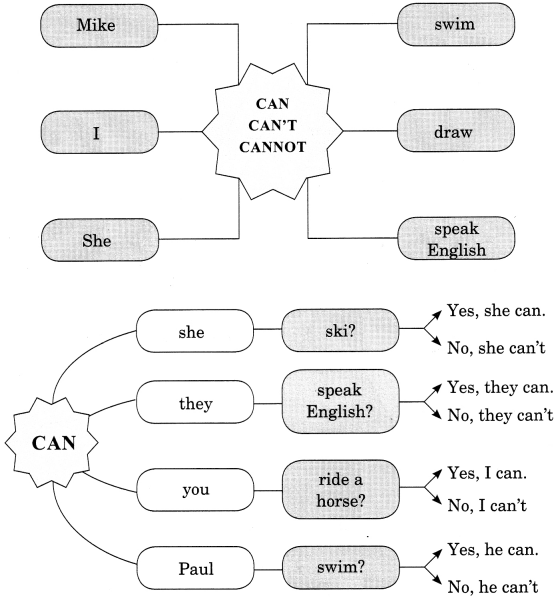
Model Verb Can
Modals Exercises for Class 7 With Answers Pdf

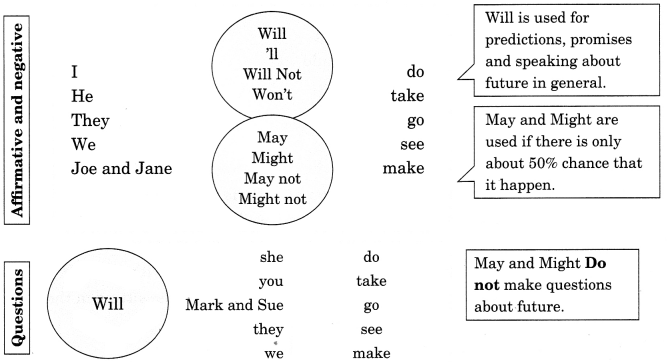
Would/Will And May/Might

Modals Exercises for Class 7 With Answers Pdf 1

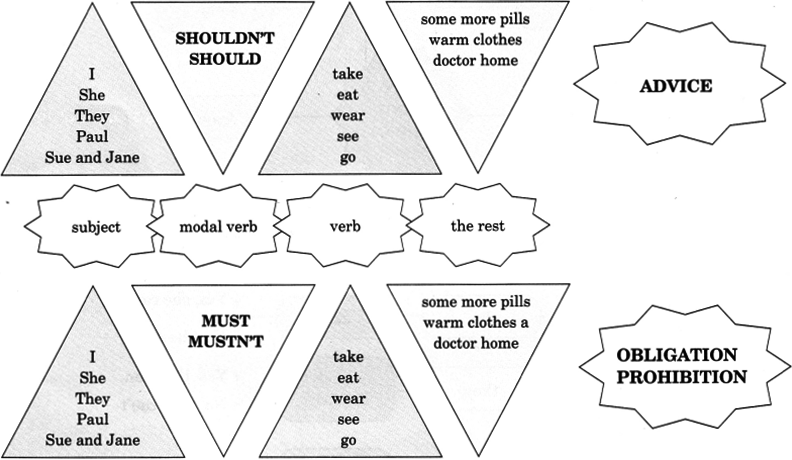
Should And Must

Modals Exercises for Class 7 With Answers Pdf 2

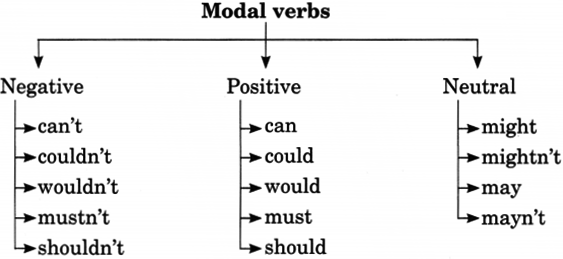
Mind Map Of Modals

Modals Exercises for Class 7 With Answers Pdf 3

Modals for Class 7 CBSE Solved Exercise With Answers

Question 1.
Fill in the blanks using must, mustn’t, don’t have to, should, shouldn’t, might, can, can’t!

  1. You really _________ go to the Louvre if you’re in Paris. It’s wonderful.
  2. You _________ come to the party if you don’t feel well.
  3. I don’t know where Kelly is. She _________ be at the sister’s house.
  4. You have passed all your tests. You _________ be very pleased with yourself.
  5. You _________ smoke in your car, especially if there are children sitting in the back.
  6. You _________ work this evening. I can do the tasks for you.
  7. John doesn’t need a calculator. He _________ do sums in his head.
  8. Passengers _________ open the door when the train is moving.
  9. It _________ rain today. It’s getting cloudy already.
  10. I _________ pay for the tickets because I got them from Sam for free.

Answer:

  1. must/should
  2. don’t have to
  3. might
  4. should
  5. shouldn’t/mustn’t
  6. don’t have to
  7. can
  8. mustn’t
  9. might
  10. don’t have to

Question 2.
Rewrite the sentences with can, may, must or have to.

Ex: Is that all right if I borrow your pen?
May/ Can I borrow your pen?

Don’t park your car on bends. It is illegal.
You _________________________

Perhaps she will agree with it. Who knows?
She _________________________

Our teacher asked us to tidy the classroom.
We _________________________

I need your help. It’s too much work for me.
You _________________________

Look at that balloon. It’s over there.
_________________________ see _________________________?

Don’t worry about dinner. I’ll make it.
You _________________________ It is not necessary to be there.
We _________________________

Why don’t you stay with us? No problem!
You _________________________
Answer:
Don’t park your car on bends. It is illegal.
You mustn’t/can’t park.
Perhaps she will agree with it. Who knows?
She may can agree with it.
Our teacher asked us to tidy the classroom.
We have to tidy.
I need your help. It’s too much work for me.
You must help me
Look at that balloon. It’s over there.
Can you see it?
Don’t worry about dinner. I’ll make it.
You needn’t worry It is not necessary to be there.
We don’t have to be Why don’t you stay with us? No problem! You can stay.

Modals Practice Exercises for Class 7 CBSE

1. Complete each sentence with a suitable modal verb.

1. You ___________ queue up before boarding the bus.
2. The players ___________ to come for practice if they want to beat the other team.
3. If it rains tomorrow, we ___________ cancel the extra class.
4. ___________ you like to come to my house on Deepavali day?
5. She ___________ listen to her father’s advice about her future husband.
6. You ___________ help your parents at home.
7. He ___________ cook a delicious meal for ten in one hour.
8. You ___________ not take advantage of people’s weaknesses.
9. He ___________ not hesitate to lodge a complaint if it happens again.
10. Ali ___________ take a break after that back-breaking job.
11. The child ___________ be very naughty at times.
12. He ___________ leave for Australia immediately as his wife is in a critical condition.

2. Fill in the blanks by choice a correct option?
(i) I didn’t feel very well yesterday. I _______ eat anything.
(a) cannot
(b) couldn’t
(c) mustn’t

(ii) You _______ look at me when I am talking to you.
(a) could
(b) should
(c) would

(iii) I was using my pencil a minute ago. It _______ be here somewhere!
(a) can
(b) could
(c) must
(d) would

(iv) You really _______ be late again.
(a) must not
(b) don’t have to be

(v) If you don’t start working harder, you _______ repeat the course next year.
(a) have to
(b) must
(c) will have to

(vi) His parents spoil him. He’s always _______ to do whatever he wants.
(a) been able
(b) been allowed

(vii) Phone her now. She _______ home by now.
(a) has to be
(b) must be
(c) would be

(viii) You _______ forget your sun cream. It’s going to be very hot!
(a) don’t have to
(b) mustn’t
(c) needn’t

(ix) I _______ be able to help you, but I’m not sure yet.
(a) might
(b) mould

(x) Entrance to the museum was free. We _______ pay to get in.
(a) needn’t
(b) didn’t need to