Carbon and its Compounds Class 10 Notes Science Chapter 4

Carbon and its Compounds Class 10 NotesOn this page, you will find Carbon and its Compounds Class 10 Notes Science Chapter 4 Pdf free download. CBSE NCERT Class 10 Science Notes Chapter 4 Carbon and its Compounds will seemingly help them to revise the important concepts in less time.

CBSE Class 10 Science Chapter 4 Notes Carbon and its Compounds

Carbon and its Compounds Class 10 Notes Understanding the Lesson

1. Carbon: All living structures are carbon based. The amount of carbon present in the Earth’s crust and in the atmosphere is quite meagre. The Earth’s crust has only 0.02% carbon in the form of minerals (like carbonates, bicarbonates, coal and petroleum) and the atmosphere has 0.03% carbon dioxide.

2. Covalent Bond in Carbon
The atomic number of carbon is 6 and its electronic configuration is 2, 4.
To attain a noble gas configuration it could gain four more electrons in its valence shell or loose the four electrons from its valence shell.

  • It is difficult for an atom of carbon to either gain or lose electrons as it would be difficult to hold the extra electrons and would require a large amount of energy to remove four electrons.
  • Carbon attains the noble gas configuration by sharing its valence electrons with other atoms. Atoms of other elements like hydrogen, oxygen, nitrogen, chlorine also show sharing of valence electrons.

Carbon and its Compounds Class 10 Notes Science Chapter 4 1

  • It is evident that the number of shared pair of electrons can be one, two or three. Try making the structures of H2O and CH4.
  • Bond formed by the sharing of an electron pair between two atoms is called covalent bond.
  • Covalently bonded molecules have low melting and boiling points because of comparatively weaker intermolecular forces, unlike ionic compounds.
  • These molecules are generally poor conductors of electricity since no charged particles are formed.

3. Versatile Nature of Carbon Atoms
Two important properties which enable carbon to form enormously large number of compounds.
Carbon and its Compounds Class 10 Notes Science Chapter 4 2
(i) Catenation is property of carbon atom to form bonds with other atoms of carbon. Like carbon, silicon forms compounds with hydrogen which have chains upto seven or eight atoms of silicon.
The property of catenation is shown by other elements also but carbon exhibits this property to maximum extent. This is due to greater strength of carbon-carbon bond.

(ii) Tetravalency of the carbon atom: Carbon has four valence electrons (At. No. of C = 6, Electronic Configuration = 2, 4) since it can neither lose nor gain electrons to attain octet, it forms covalent bonds by sharing its four electrons with other atoms. This characteristic of the carbon atom, by virtue of which it forms four covalent bonds, is called the tetravalency of carbon.
Carbon and its Compounds Class 10 Notes Science Chapter 4 3
Saturated and unsaturated carbon compounds: Organic compounds in which carbon atoms are bonded together with a single bond and then use the hydrogen atoms to satisfy the remaining valencies of carbon, are known as saturated compounds. For example,
Carbon and its Compounds Class 10 Notes Science Chapter 4 4
On another hand hydrocarbons containing multiple bond i.e., C=C, C≡C are known as unsaturated carbon compounds. The unsaturated hydrocarbons which contain one or more double bonds are called alkenes. Those containing one or more triple bond are called alkynes.

Examples
Alkene:               CH2=CH2 (Ethene)
Alkyne:                CH≡CH (Ethyne)

4. Functional group: Atom or group of atom which provides certain characteristic properties to the compound, is known as functional group. The functional group is attached to the carbon chain through the valency by replacing one hydrogen atom or atoms.
Carbon and its Compounds Class 10 Notes Science Chapter 4 5
5. Homologous series: A series or a family of organic compounds having the same functional group, similar chemical properties and successive (adjacent) member of which differ by a —CH2 unit or 14 mass units, is known as homologous series. The individual members of the series are called homologous.

6. General Characteristics of Homologous Series
(i) All the members of a homologous series can be represented by a general chemical formula.

Alkane :CnH2n + 2[CH4,C2H6,C3H8 …]
Alkene : CnH2n [C2H4, C3H6, C4H8 …]
Alkyne : CnH2n2 [C2H2, C3H4, C4H6 …]

(ii) All the members of a given homologous series have the same functional group.
(iii) A homologous series exhibit similar chemical properties.
(iv) In a homologous series as the molar mass increases, a gradation in physical properties is observed. It is due to fact that the melting points and boiling points increases with increasing molar mass.

7. Nomenclature of Carbon Compounds
An organic compound may have a common name, a systematic name and IUPAC names. IUPAC names are now universally adopted.
Rules for naming of organic compounds: IUPAC name of organic compound consists of four parts. These are arranged in the sequence given below:
Prefix + Word root + Primary suffix + Secondary suffix

(1) In IUPAC system prefix denotes the substituent group. The prefixes for a few substituent groups are as follows:

Substituent groupPrefixSubstituent groupPrefix
 – ClChloro-NONitro
– BrBromo-CH3Methyl
– IIodo-C2H5Ethyl

Remember
The International Union of Pure and Applied Chemistry (IUPAC) devised a method of systematically naming of organic compounds, which is termed as IUPAC system.
Carbon and its Compounds Class 10 Notes Science Chapter 4 6
Some important points for writing IUPAC names:

  • Select the longest carbon chain as a parent chain.
  • The parent chain must include carbon atoms including multiple bond (= or ≡ bond) and the terminal functional groups
    ( – CHO  – COOH, etc).
  • Parent chain should be numbered in such a way that multiple bond/functional group get lowest number.
  • The position of the multiple bond must be indicated by a numerical prefix.
  • If the name of the functional group is to be given as a suffix, the name of the carbon chain is modified by deleting the final ‘e’ and adding the appropriate suffix.

2. In IUPAC name Word root denotes the number of carbon atoms in the longest selected parent chain.

Chain lengthWord root
One CMeth
Two CEth
Three CProp
Four CBut
Five CPent
Six CHex

3. Primary suffix is used to denote the nature of carbon-carbon bond.

Nature of C- C bondPrimary suffix
C- C bond – ane
C=C bond – ene
C≡C bond – yne

4. Secondary suffix is used to denote the functional group present in the organic compound. It is attached to the primary suffix. Some common functional groups and their secondary suffix are listed below: Example: Write the IUPAC names to the following compounds.
Carbon and its Compounds Class 10 Notes Science Chapter 4 7

Addition Reaction
A chemical reaction in which two or more chemical substances get combined and gives a single product, is known as addition reaction.
For example,
(i) Unsaturated hydrocarbons add hydrogen in the presence of catalysts such as palladium or nickel to give saturated hydrocarbons.
Carbon and its Compounds Class 10 Notes Science Chapter 4 8

(ii) Addition reaction also used in the hydrogenation of vegetable oils, which gives vegetable ghee, have saturated carbon chains.
Carbon and its Compounds Class 10 Notes Science Chapter 4 9
Vegetable ghee!animal fat contains saturated fatty acids which are said to be harmful for health.

(iii) Addition of bromine
Carbon and its Compounds Class 10 Notes Science Chapter 4 10

Substitution Reaction
A chemical reaction in which one type of atom or a group of atoms get displaced or substituted by some other atom or group of atoms is known as substitution reaction. For example, in the presence of sunlight, chlorine is added to hydrocarbon. In this chemical reaction chlorine can replace the hydrogen atoms one by one.
Carbon and its Compounds Class 10 Notes Science Chapter 4 11
Similarly, the remaining three H atoms will be also replaced by Cl atoms one by one.
Carbon and its Compounds Class 10 Notes Science Chapter 4 12

Some Important Carbon Compounds
(A) Ethanol or Ethyl alcohol
Ethanol is the second member of the homologous alcohol series. The structural formula of ethanol is:
Carbon and its Compounds Class 10 Notes Science Chapter 4 21

Physical properties

  • Ethanol is liquid at room temperature.
  • Ethanol is soluble in water in all proportions.
  • It boils at 351 K (78°C).
  • It is neutral towards litmus.
  • It is a non-conductor of electricity because it does not contain ions.

Chemical Reactions
1. Reaction with sodium: Hydrogen gas is evolved by the reaction of ethanol with sodium.
Carbon and its Compounds Class 10 Notes Science Chapter 4 13
This reaction is a test for alcohols.

2. Dehydration: Heating ethanol at 443K with excess cone. H2S04 results alkene (Unsaturated hydrocarbon).
Carbon and its Compounds Class 10 Notes Science Chapter 4 14
Here sulphuric acid acts as a dehydrating agent.

Alcohol as a Fuel
Sugar cane juice can be used to prepare molasses which is fermented to give ethanol. Some countries now use alcohol as an additive in petrol since it is a cleaner fuel which gives rise to only CO2 and H2O on burning in sufficient air (oxygen). Chemical reaction involved is given as
Carbon and its Compounds Class 10 Notes Science Chapter 4 15
Denatured Alcohol
To prevent the misuse of ethanol, it is made unfit for drinking by adding poisonous substances (like methanol, pyridine, CuSO4, etc.) to it, this is called denatured alcohol.
Dyes are also added to colour the alcohol blue so that it can be identified easily.

How does alcohol affect human beings?
Ethanol (C2H5OH) is a chief constituent of all alcohol beverages (beer, wine, whisky, etc). In case someone consumes large amount daily, it has very harmful effect, it may even cause death by damaging liver and kidney.

Uses of ethanol

  • Ethanol is a main constituents of all alcoholic beverages.
  • Ethanol is used to sterilise wounds and syringes.
  • It is used as a solvent for paints, lacquers, varnishes, cosmetics, perfumes, etc.
  • It is also used as a fuel in stoves and spirit lamps.

(B) Ethanoic acid or Acetic acid
The group of organic acids are known as carboxylic acids. However, unlike mineral acids like HCl, carboxylic acids are weak acids. Ethanoic acid is the second member of the homologous alcohol series. The structural formula of ethanoic acid is:
Carbon and its Compounds Class 10 Notes Science Chapter 4 16

Physical Properties

  • Ethanoic acid is a colourless liquid with sour taste.
  • It is miscible with water in all proportions.
  • Being acidic nature, ethanoic acid turns blue litmus solution red.
  • Acetic acid boils at 39 IK (118°C).
  • 5-8% solution of acetic acid in water is called vinegar and is used widely as a preservative in pickles.
  • Melting point of pure ethanoic acid is 290 K and hence it often freezes during winter in cold climates. This gave rise to its name glacial acetic acid.

Chemical reactions of ethanoic acid
1. Esterification reaction: Ethanoic acid reacts with absolute ethanol in the presence of an acid catalyst and gives ester as a product. Esters are sweet smelling substances.
Carbon and its Compounds Class 10 Notes Science Chapter 4 17
On treating with alkali, sodium hydroxide (NaOH), the ester is converted back to alcohol and sodium salt of carboxylic acid. This is known as saponification reaction.
Carbon and its Compounds Class 10 Notes Science Chapter 4 18

2. Reaction with base: Ethanoic acid reacts with a base such as sodium hydroxide (NaOH) to give a salt and water.
\(\mathrm{NaOH}+\mathrm{CH}_{3} \mathrm{COOH} \longrightarrow \mathrm{CH}_{3} \mathrm{COONa}+\mathrm{H}_{2} \mathrm{O}\)

3. Reaction with carbonates and hydrogencarbonate: Ethanoic acid reacts with carbonates and hydrogencarbonates to give rise to a salt, CO2 and water. The salt produced is sodium acetate.
2CH3COOH + Na2CO3 → 2CH3COONa + H2O + CO2
CH3COOH + NaHCO3 → CH3COONa + H2O + CO2

Uses of ethanoic acid

  • It is used as a solvent.
  • It is used for making dyes, perfumes and medicines.
  • It is also used as vinegar which is a preservative for pickles.

Soaps and Detergents

  • Soap is sodium and potassium salt of carboxylic acids with long chain.
  • Soaps are effective with soft water only and ineffective with hard water.
  • Detergents are ammonium or sulphonate salts of carboxylic acids with long chain. They are effective with both soft as well as hard water. An ionic part (hydrophilic) and a long hydrocarbon chain (hydrophobic) part constitutes the soap molecule.

Carbon and its Compounds Class 10 Notes Science Chapter 4 19

Cleansing Action of Soaps

  • Most dirt is oily in nature and the hydrophobic end attaches itself with dirt, while the ionic end is surrounded with molecules of water. This result in formation of a radial structure called micelles.
  • An emulsion is thus formed by soap molecule. The cloth needs to be mechanically agitated to remove the dirt particles from the cloth.
  • Scum: The magnesium and calcium salts present in hard water reacts with soap molecule to form insoluble products called scum, thus obstructing the cleansing action. Use of detergents overcome this problem as the detergent molecule prevents the formation of insoluble product and thus clothes get cleaned.

Carbon and its Compounds Class 10 Notes Science Chapter 4 20

Class 10 Science Chapter 4 Notes Important Terms

Dehydration is loss of water during a chemical reaction.

Hydration is gain of water during a chemical reaction.

Combustion means heating/burning of a compound with excess of air or oxygen. It is exothermic in nature.

Esterification is a chemical reaction in which a carboxylic acid reacts with an alcohol to form an ester.

Fermentation is the slow decomposition of big organic molecules into simpler molecules in presence of enzymes.
 

Metals and Non-metals Class 10 Notes Science Chapter 3

Metals and Non-metals Class 10 NotesOn this page, you will find Metals and Non-metals Class 10 Notes Science Chapter 3 Pdf free download. CBSE NCERT Class 10 Science Notes Chapter 3 Metals and Non-metals will seemingly help them to revise the important concepts in less time.
CBSE Class 10 Science Chapter 3 Notes Metals and Non-metals

Metals and Non-metals Class 10 Notes Understanding the Lesson

1. Element is the simplest form of matter which contains one kind of atoms. About 118 elements are known today. There are more than 90 metals, 22 non-metals and a few metalloids.

  • Sodium (Na), potassium (K), magnesium (Mg), aluminium (Al), calcium (Ca), Iron (Fe), Barium (Ba) are some metals.
  • Oxygen (O), hydrogen (H), nitrogen (N), sulphur (S), phosphorus (P), fluorine (F), chlorine (Cl), bromine (Br), iodine (I) are some non-metals.

2. Physical Properties of Metals

  • Metals in their pure state, have a shining surface. This property is called metallic lustre.
  • Metals can be beaten into thin sheets. This property is called Gold and silver are the most malleable metals.
  • Metals have ability to be drawn into thin wires. This property is called ductility. Gold is the most ductile metal.
  • Metals are good conductors of heat and have high melting points. The best conductor of heat are silver and copper. Lead and mercury are comparatively poor conductors of heat.
  • The metals that produce a sound on striking a hard surface are said to be
  • Alkali metal (Li, Na, K) are so soft that they can be cut with a knife. They have low densities and low melting points.
  • Metals have high melting point but gallium and caesium have very low melting points. These two metals will melt if you keep them on your palm.

3. Physical Properties of Non-Metals

  • Non-metal are either solids or gases except bromine which is a liquid.

4. Some other exceptions:

  • Iodine is a non-metal but it is lustrous.
  • Carbon is a non-metal which exist in two allotropic forms: diamond and graphite. Diamond is the hardest substance with a very high melting point. Graphite is a conductor of electricity.

5. Chemical Properties of Metals

I. All metals combine with oxygen to form metal oxides.
Metal + Oxygen → Metal oxide
For example,
2Cu + O2 → 2CuO
4Al + 3O2 → 2Al2O3

6. Remember
Different metals exhibit different reactivity towards oxygen. Metals such as K and Na react so vigorously that they catch fire if kept in the open. Hence, to protect them they are kept immersed in kerosene oil.

Generally metal oxides are basic in nature. But some oxides like aluminium oxide, zinc oxide show both acidic as well as basic behaviour.

Al2O3 + 6HCl → 2AlCl3 + 3H2O
Al2O3 + 2NaOH → 2NaAlO2 + H2O

Most metal oxides are insoluble in water but some of these dissolve in water to form alkalies. Sodium oxide and potassium oxide dissolve in water to produce alkali as follows:

Na2O(s) + H2O(l) → 2NaOH(aq)
K2O(s) + H2O(l) → 2KOH(aq)

II. Metals react with water and produce a metal oxide and hydrogen gas. Metal oxides that are soluble in water dissolve in it further to form metal hydroxide. But all metals do not react with water.

Metal + Water → Metal Oxide + Hydrogen
Metal Oxide + Water → Metal hydroxide

Potassium and sodium react violently with cold water. The reaction is exothermic, so the released hydrogen catches fire immediately.

2K(s) + 2H2O(l) → 2KOH(aq) + H2(g) + Heat
2Na(s) + 2H2O(l) → 2NaOH(aq) + H2(g) + Heat

The reaction of calcium with water is less violent. The heat evolved is not sufficient for the hydrogen to catch fire.
Ca(s) + 2H2O(l) → Ca(OH)2(aq) + H2(g)
Mg(s) + 2H2O(l) → Mg(OH)2(aq) + H2(g)

  • Calcium starts floating because the bubbles of hydrogen gas formed stick to the surface of the metal.
  • Magnesium does not react with cold water. It reacts with hot water to form magnesium hydroxide and hydrogen.

Aluminium, iron and zinc do not react either with cold or hot water. But they react with steam to form the metal oxide and hydrogen.

2Al(s) + 3H2O(g) → Al2O3(s) + 3H2(g)
3Fe(s) + 4H2O(g) → Fe3O4(s) + 4H2(g)

Lead, copper, silver and gold do not react with water at all.

III. Metals react with acids to give a salt and hydrogen gas.
Metal + Dilute acid → Salt + Hydrogen

  • Hydrogen gas is not evolved when a metal reacts with HNO3. It is because HNO3 is a strong oxidising agent. It oxidises the H2 produced to water and itself get reduced to any of the nitrogen oxides.
  • Magnesium (Mg) and manganese (Mn) react with very dilute HNO3 to evolve H2
  • Copper does not react with dilute HCl.

IV. Reactive metals can displace less reactive metals from their compounds in solution or molten form.

Metal A + Salt solution of B → Salt solution of A + Metal B

Fe + CuSO4 → FeSO4 + Cu
Zn + CuSO4 → ZnSO4 + Cu
Reactivity of metal can be explained on the basis of displacement reactions

7. Knowledge Plus
Aqua regia (Latin for ‘royal water) is a freshly prepared mixture of concentrated HCl and concentrated nitric acid in the ratio of 3:1. It is a highly corrosive, fuming liquid and dissolve gold and platinum.

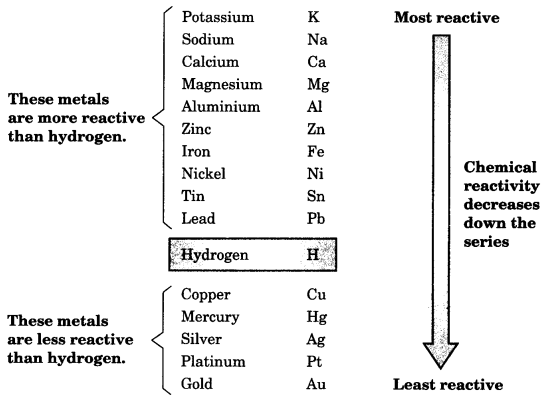
8. The Reactivity Series
The reactivity series is a list of metals arranged in the order of their decreasing activities.
Metals and Non-metals Class 10 Notes Science Chapter 3

Metals occupying higher position in the series have more tendency to lose electrons and are more reactive. The metals at the bottom of the series are least reactive. Thus, potassium is the most reactive metal.

9. How do metals and non-metals react?

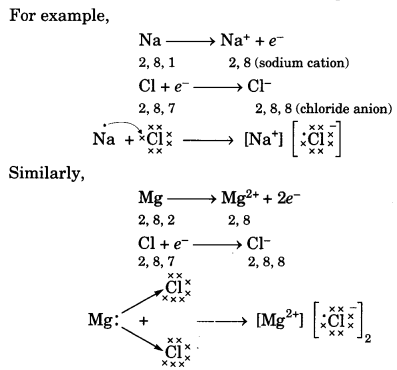
Reactivity is the tendency of elements (metals and non-metals) to attain a completely filled valence shell. Metal atoms having 1, 2 or 3 electrons in their outermost shell can lose electrons to non-metal atoms having 5,6 or 7 electrons to attain the electronic configuratìoñ of the nearest noble gas (i.e., completely filled valence shell).

Thus the metal atom becomes a positively charged ion or cation and the non-metal atom becomes a negatively charged ion or anion. The cation and anion being oppositely charged attract each other and are held by strong electrostatic forces of attraction to exist as an ionic compound. For example,
Metals and Non-metals Class 10 Notes Science Chapter 3 1

Metal ore heated strongly in limited or no supply of air (Calcination).
Metals and Non-metals Class 10 Notes Science Chapter 3 2

10. Reduction of Metal Oxide:

(i) Using coke: Coke as a reducing agent.

Metals and Non-metals Class 10 Notes Science Chapter 3 3

(ii) Using displacement reaction: Highly reactive metals like Na, Ca and A1 are used to displace metals of lower reactivity from their compounds. These displacement reactions are highly exothermic.

Metals and Non-metals Class 10 Notes Science Chapter 3 4

11. Thermite Reaction: Reduction of a metal oxide to form metal by using aluminium powder as a reducing agent. This process is used to join broken pieces of heavy iron objects or welding.

12. Extracting Metals at the Top of the Activity Series:

  • These metals have more affinity for oxygen than carbon so they cannot be obtained from their compounds by reducing with carbon.
  • They are obtained by electrolytic reduction, for example, Sodium is obtained by electrolysis of its molten chloride                     NaCl→ Na+ + Cl

As electricity is passed through the solution, metal gets deposited at the cathode and non-metal at the anode.

  • At cathode: Na+ + e →Na
  • At anode: 2Cl →Cl2 (g) + 2e

III. Refining of Metals

  • Impurities present in the obtained metal can be removed by electrolytic refining.

Copper is obtained using this method. Following are present inside the electrolytic tank.

  • Anode – slab of impure copper
  • Cathode – slab of pure copper
  • Solution – aqueous solution of copper sulphate with some dilute sulphuric acid.
  • From anode, copper ions are released in the solution and equivalent amount of copper from solution is deposited at cathode.
  • Insoluble impurities containing silver and gold gets deposited at the bottom of anode as anode mud.

13. Corrosion

  • Metals are attacked by substances in the surroundings like moisture and acids.
  • Silver—It reacts with sulphur in air to form a black coating of silver sulphide.
  • Copper—It reacts with moist carbon dioxide in air and forms a green coating of copper carbonate.
  • Iron—acquires a coating of a brown flaky substance called rust. Both air and moisture are necessary for rusting of iron. Rust is hydrated Iron (III) oxide e., Fe2O3.xH2O

14. Prevention of Corrosion

  • Rusting of iron is prevented by painting, oiling, greasing, galvanizing, chrome plating, anodising and making alloys.
  • In galvanization, iron or steel is coated with a thin layer of zinc. Zinc oxide formed due to oxidation is impervious to air and moisture protecting further layers from corrosion.

15. Alloys: These are homogeneous mixture of metals with metals or non-metals.
Adding small amount of carbon makes iron hard and strong.

Name of AlloyPropertiesConstituent metal/ Non-metal
1. SteelHardIron and carbon
2. Stainless steelHard, rust freeIron, nickel and chromium
3. BrassLow electrical conductivity than pure metalCopper and zinc
4. BronzeHard and easily castCopper and tin
5. SolderLow MP, used to weld wiresLead and tin
6. AmalgamUsed by dentistsMercury and any other metal

Class 10 Science Chapter 3 Notes Important Terms

Corrosion is the eating up of metals by the action of air, moisture or a chemical on their surface.

Rust is mainly hydrated iron (III) oxide Fe2O3.xH2O due to corrosion.

Ores are the minerals from which metals can be extracted conveniently and profitably.

Minerals are natural materials in which the metals or their compounds are found in the Earth.

Covalent bond is the chemical bond formed by sharing of electrons between two atoms. Aqua-regia is a freshly prepared mixture of 1 part of concentrated nitric acid and 3 parts of concentrated hydrochloric acid.

Brass is an alloy of copper and zinc. Bronze is an alloy of copper and tin.

Metallurgy is the process of extraction of a metal from its ore and its refining.

Activity series is the arrangement of metals in the order of decreasing reactivity.

Acids Bases and Salts Class 10 Notes Science Chapter 2

Acids Bases and Salts Class 10 NotesOn this page, you will find Acids Bases and Salts Class 10 Notes Science Chapter 2 Pdf free download. CBSE NCERT Class 10 Science Notes Chapter 2 Acids Bases and Salts will seemingly help them to revise the important concepts in less time.
CBSE Class 10 Science Chapter 2 Notes Acids Bases and Salts

Acids Bases and Salts Class 10 Notes Understanding the Lesson

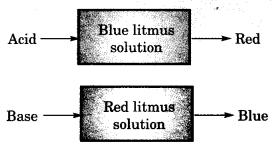
1. Acids and Bases: Acids are sour in taste and change the colour of blue litmus to red. The term has been derived from the Latin word ‘acidus’ which means sour taste. Generally acids have atleast one or more hydrogen atoms in their formulae.

An acid may be defined as a chemical substance which releases one or more H+ or HsO+ ions in aqueous solution.
For example, HCl, HNO3, H2SO4, etc.

Bases are bitter and change the colour of the red litmus to blue. Generally bases have one or more hydroxyl (OH) groups. They produce hydroxyl ions (OH) when dissolved in water.

A base may be defined as a chemical substance which releases one or more OH ions in aqueous solution.
For example, NaOH, KOH, etc.

  • Acid-Base indicator: Natural/synthetic materials which indicate the presence of acid or base in a solution, are called acid base indicator or simply indicator.
  • Litmus solution: It is a purple dye which is extracted from lichen, a plant belonging to the division
    .Acids Bases and Salts Class 10 Notes Science Chapter 2
  • Phenolphthalein: It is a colourless organic dye in acidic or neutral medium but it changes to pink in basic medium.
  • Methyl orange: It is an orange coloured dye and keeps this colour in the neutral medium. In the acidic medium, the colour of the indicator becomes red and in the basic medium, it changes to yellow.
  • Red cabbage juice: Its colour remains red in acidic medium but changes to green if the medium is basic or alkaline.
  • Turmeric solution: It is a yellow dye and in the acidic as well as neutral medium, its colour remains yellow. In the basic medium the colour changes to reddish brown.

2. Olfactory indicators: These are chemical substances whose odour changes in acidic or basic medium.
For example, onion, vanilla and clove oil.

3. Reaction of acid or base with metal: Metals react with acids to liberate hydrogen gas and form salt.
Acid + Metal → Salt + Hydrogen gas

A few metals like zinc, lead and aluminium react with bases to give off hydrogen.
Acids Bases and Salts Class 10 Notes Science Chapter 2 1

4. Reaction of acids with metal hydrogen carbonate and metal carbonates: All metal carbonates and hydrogen carbonates react with acids to give the corresponding salt, carbon dioxide and water.

Metal carbonate + Acid → Salt + H2O + CO2
Metal hydrogen carbonate + Acid → Salt + H2O + CO2

For example,
Na2CO3(s) + 2HCl(aq) → 2NaCl(aq) + H2O(l) + CO2(g)
NaHCO3(s) + HCl(ag) → NaCl(aq) + H2O(Z) + CO2(g)

The released CO2 gas turns lime water milky due to formation of CaCO3.
Acids Bases and Salts Class 10 Notes Science Chapter 2 2

On passing excess CO2, the milky white precipitate dissolves in water.
Acids Bases and Salts Class 10 Notes Science Chapter 2 3

5. Neutralisation reaction: A chemical reaction between an acid and a base to give a salt and water is known as neutralisation reaction. In general neutralisation reaction can be written as

Base + Acid → Salt + Water
NaOH(aq) + HCl(aq) → NaCl(aq) + H2O(l)

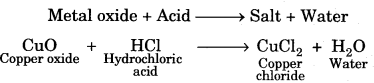
(i) Reactions of metal oxides with acids

Acids Bases and Salts Class 10 Notes Science Chapter 2 4

(ii) Reactions of non-metallic oxide with base
Non-metallic oxide + Base→ Salt + Water
CO2 + Ca(OH)2 → CaCO3 + H2O

How strong are acid or base solutions: Any aqueous solution, be it acidic, alkaline or neutral, will have both H+ and OH ions.
The  solution will be acidic or alkaline depending upon which of the two ions is present in larger concentration.

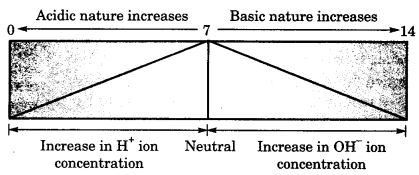
A scale for measuring hydrogen ion concentration in a solution, called pH scale has been developed. pH scale was given by a Danish chemist Sorensen. The p in pH stands for ‘potenz’ in German meaning ‘power’.

pH should be thought of simply as a number between 0-14 which indicates the acidic or basic nature of a solution. Higher the hydrogen ion concentration, lower is the pH value.
Acids Bases and Salts Class 10 Notes Science Chapter 2 5

Knowledge +
pH = negative logarithm to the base 10 of the H+ ion concentration.
The concentration is in mol/dm3. pH = – log H+

Remember: Every one fold change in the pH scale brings about a ten-fold change in H+ ion concentration. The strength of acids and bases depends on the concentration of H+ ion and OH.

If we take two acids HCl and CH3COOH of the same concentration, then they produce different amount of H+. Acids that give rise to more H+ ions are said to be strong acids and acids that give less H+ ions are said to be weak acids.

6. Importance of pH in everyday life:

(i) If pH of rain water is less than 5.6, it is called acid rain. When acid rain flows into the rivers, it lowers the pH of river water. The survival of aquatic life in such rivers become difficult. Acid rain also damage crops and cause a change in pH of the soil.

(ii) pH in our digestive system: Our stomach produces digestive juices/hydrochloric acid (HCl), which helps in the digestion of food without harming the stomach. However, sometimes the stomach produces too much of acid and this causes indigestion, which is accompanied by pain and irritation. To get rid of this pain, people use antacids like magnesium hydroxide. These antacids neutralise the excess acid formed.

(iii) pH change as the cause of tooth decay: Tooth decay starts when the pH of the mouth is lower than 5.5. Tooth enamel, made up of calcium phosphate is the hardest substance in the body. It does not dissolve in water but is corroded when the pH in the mouth is below 5.5. Using toothpaste, which are generally basic, for cleaning the teeth can neutralise the excess acid and prevent tooth decay.

(iv) Bee-sting leaves an acid which causes pain and irritation. Using a mild base like baking soda on the stung area gives relief. Stinging hair of nettle leaves inject methanoic acid causing a burning pain. A traditional remedy is rubbing the area with the leaf of the dock plant.

(v) Various fluids in our body work within a particular range of pH such as, pH of human blood should be between 7.3 to 7.5.

(vi) For the growth of plants, a particular pH range of soil is essential. Usually neutral soil is best for crops. If the soil is acidic, farmers treat the soil with quick lime or slaked lime.

(vii) The tarnished surface of a copper vessel due to the formation of copper oxide layer (which is basic) can be cleaned by rubbing with lemon (which is acidic).

7. Salts: Salts are generally ionic compounds which are obtained by neutralisation reaction between acids and bases.

Acid + Base→ Salt + Water
HCl(aq) + NaOH(aq) → NaCl(aq) + H2O(Z)

In these salts, the cation is derived from base and anion is derived from acid.
Salts are mostly solids with high melting points. They are soluble in water.

Different types of salts:

  • Normal salts : NaNO3
  • Acidic salts : NaHSO4
  • Basic salts : Pb(OH)Cl
  • Double salts : FeSO4.(NH4)2.SO4.6H2O

8. Remember: Salts of a strong acid and a strong base are neutral with pH value of 7. On the other hand, salts of strong acid and weak base are acidic with pH values less than 7 and those of strong base and weak acid are basic in nature, with pH value more than 7.

Common Salt (NaCl) [Table salt]
Sodium chloride (NaCl) also called common salt or table salt is the most common/essential part of our diet. It is obtained by neutralisation reaction of sodium hydroxide (NaOH) with hydrochloric acid (HC1).

It is obtained on a large scale from sea water.
Large crystals are often brown due to the presence of impurities. This is called rock salt. Beds of rock salt were formed when seas of by gone ages dried up. Rock salt is mined like coal.

9. Uses of Sodium Chloride

  • Sodium chloride is a major ingredient of edible salt.
  • It is used as a food preservative.
  • Compounds like sodium hydroxide (NaOH), baking soda (NaHCO3) and washing soda are obtained from sodium chloride.
  • It is used to melt ice on hill stations and cold countries during heavy snow fall.

10. Sodium Hydroxide (NaOH): Sodium hydroxide (NaOH) is commonly known as caustic soda.

Sodium hydroxide is manufactured by electrolysis of an aqueous solution of sodium chloride (called brine). Chlorine gas is given off at the anode and hydrogen gas at the cathode. Sodium hydroxide solution is formed near the cathode.
2NaCl(aq) + 2H2O(l) → 2NaOH(ag) + Cl2(g) + H2(g)

The process is called the chlor-alkali process because of the products formed chlor for chlorine and alkali for sodium hydroxide.

11. Uses of Sodium Hydroxide

  1. Sodium hydroxide is used for making soaps and detergents.
  2. Sodium hydroxide is used for making artificial textile fibres (such as rayon).
  3. It is used the preparation of soda lime (a mixture of NaOH and CaO).
  4. It is used as a cleansing agent for machines and metal sheets.

12. Baking Soda (NaHCOs): The chemical name of baking soda is sodium hydrogencarbonate or sodium bicarbonate (NaHCO3). It can be prepared from sodium chloride as
NaCl + H2O + CO2 + NH3→ NH4Cl + NaHCO3

Since it is slightly soluble in water, it can be removed by filtration.
It is a mild non-corrosive base. The following reaction takes place when it is heated during cooking.
Acids Bases and Salts Class 10 Notes Science Chapter 2 6

13. Uses of Baking Soda
Being alkaline it is an ingredient in antacids. It neutralises excess acid in the stomach and provides relief.
NaHCO3 + HCl → NaCl + H2O + CO2

  • It is used in soda-acid fire extinguisher.
  • It is used in making baking powder (a mixture of baking soda and mild edible acid like tartaric acid). When baking powder is heated or mixed in water CO2 gas is released.
    NaHCO3 + H+→ CO2 + H2O + Sodium salt of acid

The released CO2 causes breads or cakes to rise making them soft and spongy/fluffy.

14. Bleaching Powder [CaOCl2]: Bleaching powder is calcium oxychloride. It is also known as chloride of lime. Bleaching powder can be prepared by the action of chlorine on dry slaked lime [Ca(OH2)].
Ca(OH)2 + Cl2 → CaOCl2 + H2O
Bleaching powder is a yellowish white solid.

15. Uses of Bleaching Powder

  • It is an oxidising agent.
  • It is used for disinfecting drinking water to make it free from germs.
  • The most important use of bleaching powder is in:
  • textile industry for bleaching cotton and linen
  • paper industry for bleaching wood pulp
  • laundry for bleaching washed clothes.

16. Washing Soda [Na2Og.10H2O]: Sodium carbonate is obtained by heating baking soda. When the sodium carbonate obtained by the above process is recrystallised, we get washing soda.
Na2CO3 + 10H2O → Na2CO3.10H2O
Anhydrous sodium carbonate is called soda ash.

17. Uses of Washing Soda

  • It is used in glass, soap and paper industries.
  • It is used in the manufacture of borax.
  • It is used as a cleaning agent for domestic purposes.
  • It is used for removing permanent hardness of water.

18. Plaster of Paris \(\left(\mathrm{CaSO}_{4} \cdot \frac{1}{2} \mathrm{H}_{2} \mathrm{O}\right)\)
Plaster of Paris is calcium sulphate hemihydrate, it can be obtained by heating gypsum at 373 K.
Plaster of Paris is a white powder and on mixing with water, it changes to gypsum once again giving a hard solid mass.
Acids Bases and Salts Class 10 Notes Science Chapter 2 7

19. Knowledge Booster
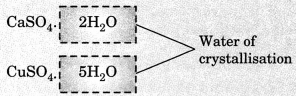
In washing soda, (Na2CO3.10H2O), 10H2O signify water of crystallisation. Water of crystallisation is the fixed number of water molecules present in one formula unit of a salt. Some other examples are
Acids Bases and Salts Class 10 Notes Science Chapter 2 8

20. Uses of Plaster of Paris

  • Plaster of Paris is used by doctors as plaster for supporting fractured bones in the right position.
  • It is also used for making toys, materials for decoration and for making surfaces smooth.

Class 10 Science Chapter 2 Notes Important Terms

Alkalies are water soluble bases.

Rock salt is chemically sodium chloride (NaCl).

Antacid is a substance which can neutralise acidity in the stomach.

Neutralisation is the reaction in which an acid reacts with a base to form salt and water.

Bleaching powder is chemically calcium oxychloride (CaOCl2) and is formed by passing chloride gas through dry slaked lime.

Amphoteric compound is a compound that can act both as an acid and a base.

Dilute Acid: Contains only a small amounts of acid and a large amount of water.

Concentrated Acid: A concentrated acid contains a large amount of acid and a small amount of water.

Chemical Reactions and Equations Class 10 Notes Science Chapter 1

Chemical Reactions and Equations Class 10 NotesOn this page, you will find Chemical Reactions and Equations Class 10 Notes Science Chapter 1 Pdf free download. CBSE NCERT Class 10 Science Notes Chapter 1 Chemical Reactions and Equations will seemingly help them to revise the important concepts in less time.
CBSE Class 10 Science Chapter 1 Notes Chemical Reactions and Equations

Chemical Reactions and Equations Class 10 Notes Understanding the Lesson

1. Chemical reaction: The reaction in which the original state of the particles changes and it cannot be reversed by simple physical means, is known as a chemical reaction.
Examples: fermentation of grapes, burning of wood, etc. Burning of wood produces charcoal and we cannot get back wood from charcoal on reversing the conditions.

  • Chemical reaction is accompanied by change in state, colour, evolution of gas or change in temperature. The chemical reaction is represented as
    Reactants → Products
  • Example of a chemical reaction is burning of magnesium ribbon with a dazzling white flame to form a white powder (magnesium oxide).
    2Mg + O2 → 2MgO

2. Chemical equation: Representation of a chemical reaction in terms of chemical symbols and formulae of the reactants and products is known as chemical equation. A chemical equation represents the reactants, products and their physical states symbolically.
For example,
Magnesium + Oxygen → Magnesium oxide
2Mg(s) + O2(g) → 2MgO(s)
The substances that undergo chemical change in the reaction, i.e., magnesium and oxygen, are the reactants. The new substance, magnesium oxide, formed during the reaction is the product.

Writing a chemical reaction in terms of chemical equation: A chemical equation represents a chemical reaction. While writing a chemical equation the reactants are written on the left hand side of the equation while products on the right hand side.
Examples:
Chemical Reactions and Equations Class 10 Notes Science Chapter 1

3. Balanced chemical equation: The chemical equation in which the number of atoms of different elements is same on both sides of the arrow is called a balanced chemical equation.
This is in accordance to the law of conservation of mass.
Let us try to balance the following chemical equation:
Fe + H2O → Fe3O4 + H2
Number of atoms of different elements present in the unbalanced equation

ElementNumber of atoms in reactants (LHS)Number of atoms in products (RHS)
Fe13
H22
O14

Now select the element which has the maximum number of atoms Fe304. There are four oxygen atoms on the RHS and only one on the LHS.

To balance the oxygen atoms

Atoms of oxygenIn reactantsIn products
(i) Initial1 (in H2O)4 (in Fe3O4)
(ii) To balance1 x 44

So, multiplying H2O molecules by four, we get
Fe + 4H2O → Fe3O4 + H2

To balance H atoms, make the number of molecules of hydrogen as four on the RHS.
Fe + 4H2O → Fe3O4 + 4H2

To equalise Fe, we multiply Fe atoms by three on the LHS.
Hence,
3Fe + 4H2O → Fe3O4 + 4H2 (Balanced equation)

To make chemical equation more informative gaseous, liquid, aqueous and solid states of reactants and products are represented by the notations (g), (l), (aq) and (s) respectively.
Hence,  3Fe(s) + 4H2O(g) → Fe3O4(s) + 4H2(g)

4.Types of chemical reactions
(a) Combination reaction: The reactions in which two or more substances combine to form a new substance is called combination reaction.
For example,

  • 2Mg(s) + O2 (fe)→ 2MgO(s)
  • CaO(s) + H2O(l) → Ca(OH)2(aq)

(b) Decomposition reaction: The reaction in which a single compound breaks up into two or more simpler substances is called decomposition reaction. For example,

2Pb(NO3)2(s) → 2PbO(s) + 4NO2(g)+ O2(g)

The decomposition of a substance by passing electric current through it is known as electrolysis.
Chemical Reactions and Equations Class 10 Notes Science Chapter 1 2
The decomposition of a substance on heating is known as thermal decomposition.
Chemical Reactions and Equations Class 10 Notes Science Chapter 1 3

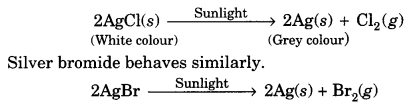
The decomposition of a substance by absorbing light energy is called photochemical decomposition.
For example,
Chemical Reactions and Equations Class 10 Notes Science Chapter 1 4

The above two reactions are used in black and white photography.

Decomposition reactions are opposite of combination reactions.

(c) Displacement reaction: The chemical reaction in which a more reactive element displaces a less reactive element from its salt solution is known as displacement reaction. For example,

  • Zn(s) + CuSO4(aq)→  ZnSO4(aq) + Cu(s)
  • Cu(s) + 2AgNO3(aq) → Cu(NO3)2 (aq) + 2Ag(s)

(d) Double displacement reaction: In this reaction two different atoms or group of atoms are mutually exchanged.
Chemical Reactions and Equations Class 10 Notes Science Chapter 1 5

A white, insoluble substance, i.e., BaS04 is formed which is called precipitate.
Precipitation Reaction-Any reaction that produces a precipitate is called a precipitation reaction.
Chemical Reactions and Equations Class 10 Notes Science Chapter 1 6

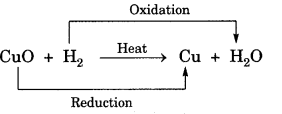
(e) Oxidation: Oxidation is the gain of oxygen or loss of hydrogen.
Chemical Reactions and Equations Class 10 Notes Science Chapter 1 7

(f) Reduction: Reduction is the loss of oxygen or gain of hydrogen.
Chemical Reactions and Equations Class 10 Notes Science Chapter 1 8

Redox reaction: The reaction in which one reactant gets oxidised while other gets reduced.
Chemical Reactions and Equations Class 10 Notes Science Chapter 1 9

Exothermic reactions: Reaction in which heat is released along with the formation of products.
For example, \(\mathrm{CH}_{4}(g)+2 \mathrm{O}_{2}(g) \longrightarrow \mathrm{CO}_{2}(\mathrm{g})+2 \mathrm{H}_{2} \mathrm{O}(g)\)
Respiration and decomposition of vegetable matter into compost are exothermic reactions.

Endothermic reactions: The reactions which require energy in form of heat, light or electricity are called endothermic reactions.
\(2 \mathrm{Ba}(\mathrm{OH})_{2}+2 \mathrm{NH}_{4} \mathrm{Cl} \longrightarrow \text { Heat } \mathrm{2BaCl}_{2}+2 \mathrm{NH}_{4} \mathrm{OH}\)

5. Corrosion: The process of slow deterioration of some metals like iron, copper and silver into their compounds due to their reaction with oxygen, water, acids, gases, etc. present in the atmosphere is called corrosion.
Rusting The process in which iron reacts with oxygen and moisture present in the air to form a reddish brown coating called rust on its surface.

6. Rancidity: The taste and odour of food materials containing fat and oil changes when they are left exposed to air for a long time. This is called rancidity. It is caused due to oxidation of fat and oil present in food material. It can be prevented by using various methods such as by adding antioxidants to the food materials, storing food in air tight containers and by flushing out air with nitrogen.

Class 10 Science Chapter 1 Notes Important Terms

Chemical reaction is a process in which old bond breaks up and new bonds are formed.

Chemical equation is the representation of a chemical reaction in terms of chemical symbols and formulae.

Combination reaction is a reaction in which two or more substances combine to form a new substance.

Decomposition reaction is a reaction in which a single compound breaks up into two or more simpler substances.

Displacement reaction is a reaction in which a more reactive element displaces a less reactive element from its salt solution.

Redox reaction is the reaction in which oxidation and reduction takes place simultaneously.

NCERT Class 9 History Chapter 6 Notes Peasants and Farmers

NCERT Class 9 History Chapter 6 Notes

On this page, you will find NCERT Class 9 History Chapter 6 Notes Pdf free download. CBSE Class 9 Social Science Notes History Chapter 6 SST Peasants and Farmers will seemingly, help them to revise the important concepts in less time.

Peasants and Farmers Class 9 Notes Social Science History Chapter 6

CBSE Class 9 History Chapter 6 Notes Understanding the Lesson

1. This lesson deals with the small cottages in England, the wheat farmers of the USA, and the opium producers of Bengal and what happened to them with the coming to modern agriculture.

2. It is England where the agriculture revolution first occurred. Over the late eighteenth and early nineteenth centuries the English countryside changed dramatically.

3. Before this time in large parts of England the countryside was open where peasants cultivated, pastured their cows and grazed their sheep. For the poor, the common land was essential for survival.

4. But their life change miserably when common land began to be enclosed. Rich farmers drove them out and prevented them from entering the enclosed fields.

5. The early enclosures were usually created by individual landlords. They were not supported by the state or the church. After the mid-eighteenth century, however the enclosure movement swept through the countryside, changing the English landscape forever. The British Parliament legalized these enclosures.

6. Unlike the early enclosures that promoted sheep farming, the land being enclosed in the late eighteenth century was for grain production to feed the growing population.

7. Landlords were encouraged to enclose lands and enlarge the area under grain cultivation. Farmers at this time continued to use the simple innovations in agriculture that had become common by the early eighteenth century.

8. Enclosures allowed the richer landowners to expand the land under their control and produce more for the market. But it worsened the condition of the poor. They could no longer collect their firewood from the forests, or graze their cattle on the commons.

9. In places where enclosures happened on an extensive scale—the poor were displaced from the land. They found their customary rights gradually disappearing. Deprived of their rights and driven off the land, they wandered in search of work.

10. The introduction of threshing machines increased the miseries of the poor. The rich farmers bought the new threshing machines that had come into the market. This reduced their dependence on laborers. As a result, their income became instable, their jobs insecure, their livelihood precarious. For them the threshing machines had become a sigh of bad times.

11. At the time that common fields were being enclosed in England at the end of the eighteenth century, settled agriculture had not developed on any extensive scale in the USA. Forests covered over 800 millions acres and grasslands 600 million acres.

12. By the early nineteenth century, this landscape had transformed radically. White Americans had moved westward and established control upto the west coast, displacing local tribes and carving out the entire landscape into different agricultural belts.

13. The story of agrarian expansion is closely connected to the westward movement of the white settlers who took over the land. After the American War of Independence from 1775 to 1783 and the formation of the United States of America, the white Americans began to move westward and turn forests into cultivated fields.

14. From the late nineteenth century, wheat production expanded in the USA dramatically. By the early twentieth century about 45 million acres of land in the USA was under wheat. The area soon expanded to 74 million acres. This dramatic expansion was made possible by new technological innovations such as mechanical reapers, drills, tractors, etc.

15. For the poorer farmers, machines brought miseries. They became jobless because mechanization had reduced the need for labour. The boom of the late nineteenth and early twentieth centuries came to an end by the mid-1920s. There was large surplus wheat which lowered down its prices.

16. The expansion of wheat agriculture in the Great Plains created ecological problems too because zealous farmers had recklessly uprooted all vegetation, and tractors had turned the soil over, and broken the sod into dust. In the early twentieth century, the whole region had become a dust bowl.

17. In the colonial period, rural India produced a range of crops for the world market. In the early nineteenth century, indigo and opium were two of the major commercial crops. By the end of the century, peasants were producing sugar cane, cotton, jute, wheat and several other crops for export.

18. The history of opium production in India was linked up with the story of British trade with China. In the late eighteenth century, the English East India Company was buying tea and silk from China for sale in England. As tea became a popular English drink, the trade became very important.

19. But there was a problem. England at this time produced nothing that could be easily sold in China. Opium, they thought, could be sold in China so they persuaded Indian farmers to grow this commodity.

20. They introduced system of advances to trap the poor farmers of Bengal and Bihar. When offered a loan, they readily accepted it, hoping to meet their immediate needs and pay back the loan at a later stage. But the loan tied the peasants to the headmen and through him to the government.

21. By taking the loan, the cultivator was forced to grow opium on a specified area of land and handover the produce to the agents once the crop had been harvested. Here, it is worth mentioning that the prices given to the peasants were very low.

Peasants and Farmers Class 9 CBSE Notes Important Terms

Bushel: A measure of capacity.

Shillings: An English currency. (20 shillings = £ 1)

Commons: Land or resources belonging to or affecting the whole of a community.

Sod: Pieces of earth with grass.

Maund: A measure of weight. (1 maund = 40 seers. 1 seer is a little under a kg))

Opium: The dried latex obtained from the opium poppy.

Scythe: A machine used for mowing grass.

Agrarian: Relating to cultivated land or the cultivation of land.

Enclosure: An area that is surrounded by a barrier.