Our Environment Class 10 Notes Science Chapter 15

Our Environment Class 10 NotesOn this page, you will find Our Environment Class 10 Notes Science Chapter 15 Pdf free download. CBSE NCERT Class 10 Science Notes Chapter 15 Our Environment will seemingly help them to revise the important concepts in less time.

CBSE Class 10 Science Chapter 15 Notes Our Environment

Our Environment Class 10 Notes Understanding the Lesson

1. Environment: Everything which surrounds us is environment. It may include living (biotic) and non-living (abiotic) components.

2. Biodegradable substances: Substances that can be slowly destroyed and broken down into very small parts by natural processes with the help of bacteria, fungi, etc. Example: Organic wastes like vegetable and fruit peels, dead plants and animals, etc.

3. Non-biodegradable substances: Substances which cannot be broken down or decomposed into the soil by natural agents are called non-biodegradable. Example: Plastics, polystyrene, metals, aluminium cans, toxic chemicals, paints, etc.

4. Problem due to Non-biodegradable substances: The non-biodegradable substances persist in the j environment for a long time as they are usually unreactive (inert) and may be harmful for the members of the ecosystem.

5. Same enzyme does not break-down everything (Reason for pollution by plastic):
Enzymes are highly specific in their action. Due to this specificity of the enzymes to act on a particular substrate only, many human-made materials like plastics are not broken down by the action of enzymes of bacteria or other saprophytes.
These materials are acted upon by physical processes like heat and pressure which makes them persistent for several thousand years.

6. Ecosystem: All the interacting organisms in an area together with non-living components form an ecosystem.

Types of Ecosystem
Natural EcosystemMan-made Ecosystem
Terrestrial [on land]Forest, Desert, GrasslandCropland, Garden
Aquatic [in water]Fresh water: River, Lake, Pond Marine: Sea, OceansAquarium

On the basis of their position or role in the ecosystem, the organisms are classified as:

1. Producers: The organisms which can synthesise their own food by the process of photosynthesis in presence of sunlight, i.e., all green plants, blue green algae, some photosynthetic bacteria, etc.

2. Consumers: Consumers feed on producers or other consumers to survive. They directly or indirectly depend on producers for their food.

Types of Consumers
HerbivoresCarnivoresOmnivoresParasites

Feed on plant or plant parts.

Example: Rabbit, . Goat, Deer, etc.

Eat flesh Example: Lion, Tiger, etc.Feed on both plants and flesh. Example: Crow, Man, etc.

Live on or inside the host to derive nourishment.

Example: Plasmodium, lice, tapeworm, etc.

3. Decomposers: The organisms which breakdown (decompose) the dead remains of plants and animals or convert complex compounds into simpler ones so that they go into the soil and are used up again by the plants are called decomposers. Example: Fungi and bacteria. Decomposers help in the replenishment of the natural resources.

4. Role of Decomposers:
Decomposers breakdown the dead remains and waste products of organisms i.e., complex organic substances into simple inorganic substances that go into the soil and are used up once more by the plants.

5. Food Chain: Food chain refers to an arrangement of different biotic groups in a sequence of energy transfer. It consists of a series of organisms feeding on one another.
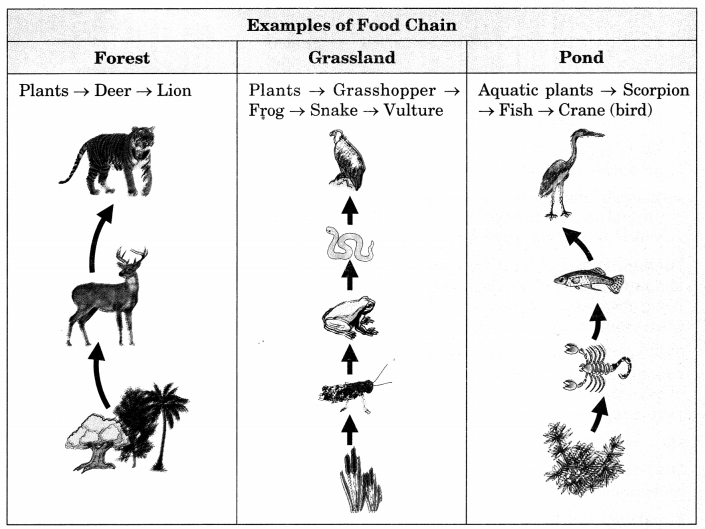
Our Environment Class 10 Notes Science Chapter 15 1

6. Food web: In nature, the food chains are interconnected with each other forming a web-like pattern. This network of food chains is called a food web.

  • Trophic level: Each step or level of the food chain where transfer of energy takes place is called trophic level.
  • First Trophic level: Autotrophs (Producers)
  • Second trophic level: Primary consumers (Herbivores)
  • Third Trophic level: Secondary consumers (Small carnivores)
  • Fourth Trophic level: Tertiary consumers (Larger carnivores)

7. Flow of energy between various components of the environment

  • Green plants capture 1% of the sunlight that falls on their leaves.
  • The flow of energy is unidirectional in a food chain.
  • Ten Percent Law: About 90% of energy is used by the present trophic level in its life processes like respiration, digestion, etc. and only 10% of energy is transferred to the next trophic level.
    .Our Environment Class 10 Notes Science Chapter 15 2
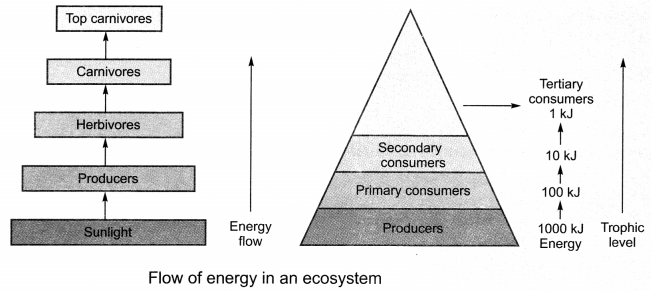
  • Food chains generally consist of only three or four steps: Only 10% of energy is transferred to the next trophic level, so the loss of energy at each step is so great that very little usable energy remains after four trophic levels.
  • There are generally a big population at lower trophic levels of an ecosystem. The population of the producers is the highest in a food chain.
  • The relationship among organisms can be shown as a series of branching lines called a food web instead of a straight line as each organism is generally eaten by two or more other kinds of organisms which in turn are eaten by several other organisms.

8. Biological Magnification: The pesticides and other chemicals used to protect our crops from diseases and pests get either washed down into the soil or into the water bodies. They enter the food chain on being absorbed by the plants along with water and minerals from soil or on being taken up by aquatic plants and animals from the water bodies.

These get accumulated progressively at each trophic level as they are not degradable. The maximum concentration of these chemicals gets accumulated in human bodies as humans occupy the topmost trophic level in a food chain. This phenomenon is known as biological magnification. Due to this, our food grains, vegetables and fruits contain varying amounts of pesticide residues.
Ozone: Ozone (O3) is a molecule formed by three atoms of oxygen.

9. Bad Ozone: The ozone present in the troposphere (lower parts of atmosphere) is harmful for plants and animals.

10. Good Ozone: The ozone present in the stratosphere (higher levels of the atmosphere) is beneficial as it shields the surface of the Earth from ultraviolet (UV) radiation of the Sun which is highly damaging to organisms and can cause skin cancer in human beings.

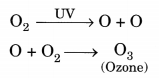
11. Formation of Ozone:
High energy UV radiation act on oxygen (O2) molecule and split apart some molecular oxygen (O2) into free oxygen (O) atoms. These oxygen atoms then combine with the molecular oxygen to form ozone.
Our Environment Class 10 Notes Science Chapter 15 3

12. Reason of Ozone Depletion:
Excessive use of synthetic chemicals like chlorofluorocarbons (CFCs) used as refrigerants and in fire extinguishers, caused ozone depletion in the upper atmosphere. In 1987, UNEP (United Nation Environment Programme) forged an agreement to freeze CFCs production at 1986 levels by all countries.

13. Ozone Hole: The decline of ozone layer thickness in Antarctica was first discovered in 1985 and was termed as Ozone Hole (thinning of ozone layer).

14. Management of Garbage:
Rapid industrialisation and the rise in demand of consumer goods have led to excessive garbage generation and problems of their disposal.

15. The methods of solid waste disposal are:

  • Recycle: Non-biodegradable solid wastes like plastic, metal can be recycled.
  • Reuse: Paper can be reused for making greeting cards, decorative articles, etc.
  • Composting: Organic wastes filled into a compost pit can be converted into organic manure.
  • Landfill: Wastes dumped in low lying area are compacted by rolling with bulldozers.
  • Incineration: Burning wastes in incinerators.

16. Use of Disposable Paper cups: Instead of plastic cups, use of disposable cups made of clay called kulhads were suggested as an alternative. The use of kulhads on large scale results in loss of the fertile top soil. So, now disposable paper cups are being used instead of kulhads.

Class 10 Science Chapter 15 Notes Important Terms

Biodegradable substances: The substances which can be easily broken down into simpler substances by natural processes, e.g., wood, paper, etc.

Non-biodegradable substances: The substances which cannot be easily degraded into simpler substances by natural processes, e.g., plastics, DDT, etc.

Pollution: Any undesirable change in the physical, chemical or biological characteristics of air, water or soil is called pollution.

Ecosystem: The interaction of the living and non-living components of an area forms a unit called ecosystem.

Biotic: The living components of an ecosystem are called biotic. For example, predators, plants, parasites, etc.

Abiotic: The non-living components of an ecosystem are called abiotic. For example, temperature, humidity, etc.

Food chain: It is the sequence of organisms formed to transfer food energy by the act of eating or being eaten.

Food web: A network of food chains is called a food web.

Trophic level: Various steps in a food chain at which the transfer of energy takes place are called trophic levels.

Producers: The organisms which can synthesise their own food by the process of photosynthesis.

Consumers: The organisms which depend directly or indirectly on producers for their food requirements.

Decomposers: The organisms which break down the complex substances present in dead remains of plants and animals into simpler substances.

Biological magnification: The phenomenon in which the concentration of harmful toxicant goes on increasing at successive trophic levels, e.g., DDT.

Sources of Energy Class 10 Notes Science Chapter 14

Sources of Energy Class 10 NotesOn this page, you will find Sources of Energy Class 10 Notes Science Chapter 14 Pdf free download. CBSE NCERT Class 10 Science Notes Chapter 14 Sources of Energy will seemingly help them to revise the important concepts in less time.
CBSE Class 10 Science Chapter 14 Notes Sources of Energy

Sources of Energy Class 10 Notes Understanding the Lesson

Characteristics of a good fuel

  • High calorific value (gives more heat per unit mass).
  • Bums without giving out any smoke or harmful gases.
  • Proper ignition temperature.
  • Cheap and easily available.
  • Easy to handle, safe to transport.
  • Convenient to store.
  • Burns smoothly.

Classification of sources of energy

1. On the basis of use

  • Conventional sources of energy.
  • Non-conventional sources of energy
  • Conventional sources of energy are those which are used extensively and meet a major portion of our energy requirement.
    Examples:
    (a) Fossil fuels,(b) Thermal power plant,(c) Hydropower plant,(d) Biomass,(e) Wind energy.
  • Non-conventional sources of energy are those which are not used as the conventional ones and meet our energy requirements only on a limited scale.
    Examples:
    (a) Solar energy,(b) Nuclear energy,(c) Tidal and wave energy,(d) Geothermal energy

2. On the basis of quantity available

  • Renewable sources of energy
  • Non-renewable sources of energy
  • Renewable sources of energy are those which are inexhaustible i.e., which can be replaced as we use them and can be used to produce energy again and again.
    Examples:
    (a) Solar energy,(b) Wind energy
  • Non-renewable sources of energy are those which are exhaustible and cannot be replaced once they have been used.
    Examples:  (a) Fossil fuel

Conventional sources of energy
1. Fossil fuels: Fossil fuels were formed millions of year ago, when plant and animal remains got buried under the Earth and were subjected to high temperature and pressure conditions.

Examples: Coal and petroleum
These are non-renewable sources of energy:

Pollution Caused by Fossil Fuels

  • Released oxides of carbon, nitrogen and sulphur (acidic in nature) which causes acid rain that damages trees, plants, reduces fertility of soil.
  • Produces large amount of CO2 in the atmosphere which causes greenhouse effect leading to excessive heating of the Earth.

Controlling Pollution Caused by Fossil Fuels

  • Increasing the efficiency of the combustion process.
  • Using various techniques to reduce the escape of harmful gases and ashes into the surroundings.

2. Thermal Power Plant
A power plant which uses heat energy to generate electricity.

  • Burning of fossil fuels produces steam to run turbines.
  • Set up (power plants) near the coal and oil fields to minimise the cost of transportation and production.
  • Transmission of electricity is more efficient.

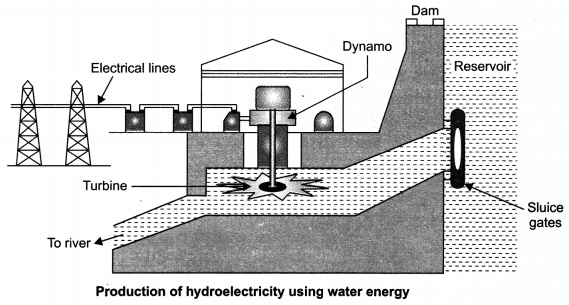
3. Hydro Power Plants

  • Dams are constructed to collect water flowing in high altitude rivers. The stored water has a lot of potential energy.
  • When water is allowed to fall from a height, potential energy changes to kinetic energy, which
  • rotates the turbines to produce electricity.

Advantages

  • No environmental pollution
  • Flowing water is a renewable source of electric energy.
  • Construction of dams prevents flooding of rivers, provide water for irrigation.

Disadvantages

  • Large areas of agricultural land, a vast variety of flora and fauna, human settlements get submerged in the water of reservoir formed by the dam.
  • Large ecosystems are destroyed.
  • Vegetation that submerged under water rots under anaerobic conditions and produces large amount of methane which is a greenhouse gas.
  • Creates problems of satisfactory rehabilitation of displaced people.
  • Dams are highly expensive to construct.
  • Dams cannot be constructed on all river sites.

Sources of Energy Class 10 Notes Science Chapter 14 1

4. Biomass

The dead parts of plants and trees and the waste materials of animals are called Biomass.
(i) Wood: It is a biomass and used as a fuel for a long time.
Disadvantages

  • Produces a lot of smoke on burning.
  • Do not produce much heat.
  • Thus by improvement in technology we can improve the efficiency of traditional sources of energy.
    For example, wood can be converted into much better fuel called charcoal.

(ii) Charcoal: When wood is burnt in a limited supply of air, then water and other volatile materials gets removed and charcoal is formed.
Sources of Energy Class 10 Notes Science Chapter 14 2
Charcoal is a better fuel than wood because

  • it has a higher calorific value than wood.
  • it does not produce smoke while burning.
  • it is a compact fuel, easy to handle and convenient to use.

(iii) Cow dung: It is biomass but it is not good to burn cowdung directly as fuel because it

  • produces a lot of smoke.
  • does not burn completely, produces a lot of ash as residue.
  • has low calorific value.
    by making biogas (or gobar gas) from cow dung, we get a smokeless fuel.

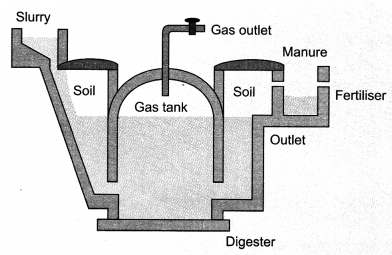
(iv) Biogas: It is mixture of gases produced during decomposition of biomass in the absence of oxygen.

  • Methane is major component of biogas. Biogas contains 75% methane, carbon dioxide, hydrogen and hydrogen sulphide.
  • Biogas is produced in a biogas plant using animal dung, sewage, crop residues, vegetable wastes, poultry dropping, etc.

Biogas plant: Construction and Working
The plant has dome like structure built with bricks. A slurry of cow dung and water is made in the mixing tank from where it is fed into the digester. The digester is a sealed chamber in which there is no oxygen. Anaerobic microorganisms that do not require oxygen, decompose or breakdown complex compound of cow slurry and produces methane, carbon dioxide, hydrogen and hydrogen sulphide.
Sources of Energy Class 10 Notes Science Chapter 14 3

Advantages of Biogas

  • It is an excellent fuel as it contains upto 75% methane (CH4).
  • It burns without smoke.
  •  Leaves no residue like ash in wood and coal burning.
  • Heating capacity is high.
  • It is also used for lighting.
  • Slurry left behind is used as excellent manure rich in nitrogen and phosphorus.
  • Safe and efficient method of waste disposal.

5. Wind energy

  • Unequal heating of the landmass and water bodies by solar radiations generate air movement and causes wind to blow.
  • Kinetic energy of the wind can be used:
    o to generate electricity by turning the rotor of the turbine, o to lift water from the well, o to run flour mills.
  • But the output of a single windmill is quite small so a number of windmills are erected over a large area called wind energy farm.
  • The minimum wind speed for windmill to serve as a source of energy is 15-20 km/per hour.

Advantages

  • Eco-friendly
  • Efficient source of renewable energy
  • No recurring expenses for production of electricity.

Disadvantages

  • Wind energy farms need large area of land.
  • Difficulty in getting regular wind speed of 15-20 km/per hour.
  • Initial cost of establishing wind energy farm is very high.
  • High level of maintenance of blades of windmill.

Alternate or Non-conventional Sources of Energy
Day by day, our demand for energy is increasing, so there is a need for another source of energy.

Reasons for alternate sources of energy

  • The fossil fuel reserves in the Earth are limited which may get exhausted soon if we use them at the current rate.
  • Reduce the pressure on fossil fuels making them last for a much longer time.
  • To reduce the pollution level and to save the environment.

(i). Solar Energy

  • Sun is the ultimate source of energy.
  • Energy obtained from the Sun is called solar energy.
  • Energy received by the Earth per second per unit area from the Sun is known as solar constant.

Solar constant = 1.4 kJ/s/m2 Solar energy devices: Devices using solar energy are:

  • Solar cooker
  • Solar cells
  • Solar water heater
  • Solar Cooker

Box Type Solar Cooker: It consists of a rectangular box which is made up of wood or plastic which is painted dull black.

  • Inner walls of the box are painted black to increase heat absorption.
  • Solar cookers are covered with glass plate and have mirror to focus the rays of the sun and achieve higher temperature. Glass plate traps solar radiation by greenhouse effect.
  • Temperature inside the box increases 100°C-140°C in 2-3 hours.

Advantages

  • Save precious fuel like coal, LPG, kerosene.
  • Does not produce smoke.
  • Nutrients of food do not get destroyed while cooking.
  • Upto four food items can be cooked at the same time.
  • Renewable
  • Can be used in rural areas.

Disadvantages

  • Solar cookers cannot be used at night.
  • If the day sky is covered with clouds, even then solar cooker cannot be used.
  • Direction of reflector of solar cooker changes from time to time to keep it facing the sun.
  • Solar radiations are not uniform over the Earth’s surface.
  • Cannot be used for frying or baking purpose.

(ii) Solar Cell

  • Solar cells convert solar energy into electricity.
  • A solar cell develops a voltage of 0.5-1 V and can produce about 0.7 W of electricity.
  • A large number of solar cells are combined in an arrangement called solar cell panel.

Advantages

  • Have no moving parts.
  • Require little maintenance.
  • Can work without any focussing device.
  • Can be set up in remote and inacessible areas.

Disadvantages

  • Manufacturing is expensive.
  • Availability of special grade silicon for making solar cells is limited.
  • Silver wire for interconnection of cells is expensive.

Uses of Solar Cell

  • Artificial satellites and space probes use solar cells as the main source of energy.
  • Radio, TV relay stations in remote locations use solar cell panels.
  • Traffic signals, calculators and many toys are fitted with solar cells.

2. Energy from the Sea

Tidal EnergyWave EnergyOcean Thermal Energy
Working: (i)The phenomenon of high and low tide give us tidal energy.Kinetic energy of huge waves near sea shore is trapped to generate electricity.The difference in the temperature of water at the surface and deeper section of ocean is used to obtain energy in Ocean Thermal Energy Conversion plants (OTEC).
(ii)It is harnessed by constructing a dam across the narrow opening of the sea.Wave energy is used for rotation of turbine and production of electricity.The warm surface water is used to boil volatile liquid ammonia. The vapours of the liquid are used to run the turbine of generator to produce electricity.
Disadvantage:The location where such dams can be built are limited.Wave energy is viable only where waves are very strong.Efficient commercial exploitation is very difficult.

3. Geothermal Energy

  • ‘Geo’ means ‘earth’ and ‘thermal’ means ‘heat’.
  • Geothermal energy is the heat energy from hot rocks present inside the earth.
  • When underground water comes in contact with ‘hot spot’, steam is generated. Steam trapped in rocks is routed through pipes to a turbine and used to generate electricity.

Advantages

  • Economical to use geothermal energy.
  • Does not cause any pollution.

Disadvantages

  • Geothermal energy is not available everywhere.
  • Deep drilling in the earth to obtain geothermal energy is very difficult and expensive.

4. Nuclear Energy

  • The energy released during a nuclear reaction is called nuclear energy.
  • It can be obtained by two types of nuclear reactions:

(i) Nuclear fission
(ii) Nuclear fusion

(i) Nuclear Fission:

  • ‘Fission’ means split up.
  • The process in which the heavy nucleus of a radioactive atom (such as uranium, plutonium
    or thorium) split up into smaller nuclei when bombarded with low energy neutrons, is called nuclear fission.
  • A tremendous amount of energy is produced.
  • U-235 is used as a fuel in nuclear reactors in the form of uranium rods.

Working: In a nuclear reactor self sustaining chain reaction releases energy at a controlled rate, which is used to produce steam and further generate electricity.

(ii) Nuclear Fusion: When two nuclei of light elements (like hydrogen) combine to form a heavy nucleus (like helium) and tremendous amount of energy is released it is called nuclear fusion.
Sources of Energy Class 10 Notes Science Chapter 14 4

  • Very-very high temperature and pressure is needed for fusion.
  • Hydrogen bomb is based on this phenomenon.
  • Nuclear fusion is the source of energy in the sun and other stars.

Advantages

  • Production of large amount of useful energy from a very small amount of nuclear fuel.
  • Does not produce greenhouse gases like C02.

Disadvantages

  • Environmental contamination due to improper nuclear waste storage and its disposal.
  • Risk of accidental leakage of harmful radiations.
  • High cost of installation.
  • Limited availability of nuclear fuel.

Environmental Consequences
Exploiting any source of energy disturbs the environment in some way or the other. Thus, the source we would choose depends upon the following factors:

  • Ease of extracting energy from the source.
  • Cost of extracting energy from the source.
  • Efficiency of technology available to extract energy.
  • The environmental damage caused by using that source.

Magnetic Effects of Electric Current Class 10 Notes Science Chapter 13

Magnetic Effects of Electric Current Class 10 NotesOn this page, you will find Magnetic Effects of Electric Current Class 10 Notes Science Chapter 13 Pdf free download. CBSE NCERT Class 10 Science Notes Chapter 13 Magnetic Effects of Electric Current will seemingly help them to revise the important concepts in less time.
CBSE Class 10 Science Chapter 13 Notes Magnetic Effects of Electric Current

Magnetic Effects of Electric Current Class 10 Notes Understanding the Lesson

When an electric current is passed through a conductor, a magnetic field is produced around it.

1. Magnetic field

  • The region surrounding a magnet, in which the force of the magnet can be detected, is said to have a magnetic field.
  • Magnetic field is a quantity that has both direction and magnitude.
  • The direction of the magnetic field is taken to be the direction in which a north pole of the compass needle moves inside it.

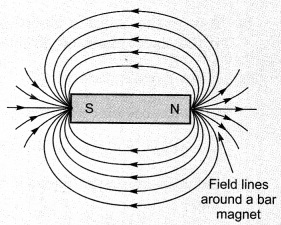
2. Magnetic field lines

  • Magnetic field lines- are the imaginary lines along which the iron filings align themselves.
  • By convention, the field lines emerge from the north pole and merge at the south pole. Inside the magnet, the direction of field lines is from the south pole to the north pole.

Properties of Magnetic field line

  • Magnetic field lines are closed curves.
  • The relative strength of the magnetic field is shown by the degree of closeness of the field lines.
  • No two field lines can cross each other as at the point of intersection the compass needle would point towards two directions, which is not possible.

Magnetic Effects of Electric Current Class 10 Notes Science Chapter 13

3. Magnetic field due to current carrying conductor

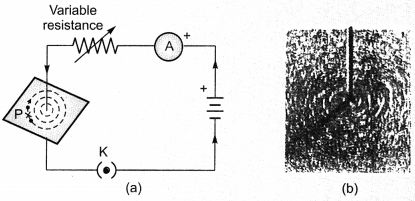
  • The magnetic field around a current carrying conductors forms a pattern of concentric circles.
  • The magnitude of the magnetic field produced at a given point increases as the current through the wire increases.
  • The magnetic field produced by a given current decreases as the distance from it increases.

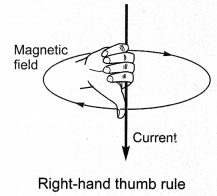
4. Right-hand thumb rule: The direction of magnetic field produced by a current carrying conductor can be found out by using the right-hand thumb rule.

Imagine that you are holding a current-carrying straight conductor in your right hand such that the thumb points towards the direction of current. Then your fingers will wrap around the conductor in the direction of the field lines of the magnetic field, as shown in Figure. This is known as the right hand thumb rule.

Magnetic Effects of Electric Current Class 10 Notes Science Chapter 13 1
(a) A pattern of concentric circles indicating the field lines of a magnetic field around a straight conducting wire. The arrows in the circles show the direction of the field lines. (b) A close up of the pattern obtained.
Magnetic Effects of Electric Current Class 10 Notes Science Chapter 13 2

5. Magnetic field due to current-carrying circular loop

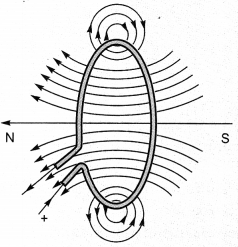
  • At the centre of a current-carrying loop, the magnetic field appears to be a straight in line.
  • The magnetic field produced by a current-carrying wire at a given point depends directly on the current passing through it.

Magnetic Effects of Electric Current Class 10 Notes Science Chapter 13 3

6. Magnetic field due to a solenoid
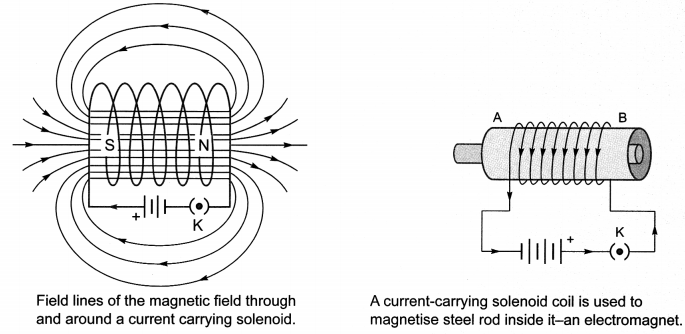
Solenoid: A coil of many circular turns of insulated copper wire wrapped closely in the shape of a cylinder is called a solenoid.

  • The pattern of the magnetic field around a current-carrying solenoid is same as that of the bar magnet. One end of the solenoid behaves as a magnetic north pole, while the other behaves as south pole.
  • The field lines inside the solenoid are in the form of parallel straight lines.
  • The field is uniform inside the solenoid.
  • A strong magnetic field produced inside a solenoid can be used to magnetise a piece of magnetic material, like soft iron, when placed inside the coil. The magnet so formed is called an electromagnet.
    Magnetic Effects of Electric Current Class 10 Notes Science Chapter 13 4

7. Force on a current-carrying conductor in a magnetic field

  • A current carrying conductor when placed in a magnetic field experiences a force.
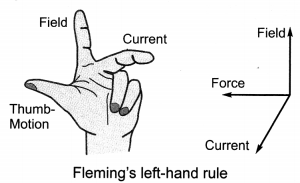
  • If the direction of the field and that of the current are mutually perpendicular to each other, then the force acting on the conductor will be perpendicular to both and will be given by Fleming’s left hand rule.
  • Fleming’s left-hand rule: According to this rule, stretch the thumb, forefinger and middle finger of your left hand such that they are mutually perpendicular. If the forefinger points in the direction of magnetic field and the middle finger in the direction of current, then the thumb will point in the direction of the force acting on the conductor.

Magnetic Effects of Electric Current Class 10 Notes Science Chapter 13 5

8. Electric motor: An electric motor is a rotating device that converts electrical energy to mechanical energy.
Principle: A current carrying conductor when placed in a magnetic field experiences a force.
Commercial motors are made up of:

  • an electromagnet in the place of permanent magnet.
  • large number of turns of the conducting wire in the current carrying coil.
  • a soft iron core on which the coil is wound.

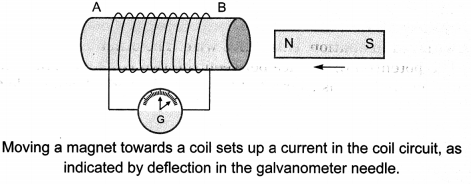
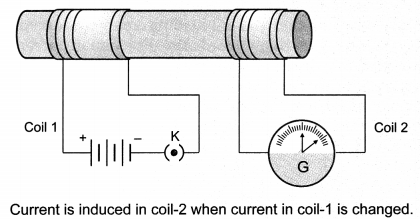
Electromagnetic induction: The phenomenon of electromagnetic induction is the production of induced current in a coil placed in a region where the magnetic field changes with time.

  • The magnetic field may change due to relative motion between the coil and the magnet.
    Magnetic Effects of Electric Current Class 10 Notes Science Chapter 13 6
  • If the coil is placed near a current carrying conductor, the magnetic field may change either due to a change in the current through the conductor or due to the relative motion between the coil and conductor.
  • Magnetic Effects of Electric Current Class 10 Notes Science Chapter 13 7

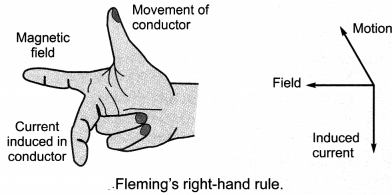
Fleming’s right-hand rule to know the direction of the induced current. Stretch the thumb, forefinger and middle finger of the right hand so that they are perpendicular to each other, as shown in the figure. If the forefinger indicates the direction of the magnetic field and the thumb shows the direction of motion of the conductor, then the middle finger will show the direction of induced current. This simple rule is called Fleming’s right-hand rule.
Magnetic Effects of Electric Current Class 10 Notes Science Chapter 13 8

Fleming’s right-hand rule.
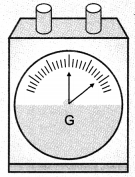
A galvanometer is an instrument that can detect the presence of a current in a circuit. The pointer remains at zero (the centre of the scale) for zero current flowing through it. It can deflect either to the left or to the right of the zero mark depending on the direction of current.
The induced current is found to be the highest when the direction of motion of the coil is at right angles to the magnetic field.

Electric Generator: A generator converts mechanical energy into electrical energy.
Magnetic Effects of Electric Current Class 10 Notes Science Chapter 13 9
Principle: It works on the principle of electromagnetic induction.
AC generator produces AC current and DC generator produces DC current.

9. AC and DC

  • The difference between the direct and alternating currents is that the direct current always flows in one direction, whereas the alternating current reverses its direction periodically.
  • In India, the AC changes direction after every 1/100 second, that is, the frequency of AC is 50 Hz.
  • An important advantage of AC over DC is that electric power can be transmitted over long distances without much loss of energy.

10. Domestic Electric circuits

  • In our houses we receive AC electric power of 220 V with a frequency of 50 Hz. One of the wires in this supply is with red insulation, called live wire. The other one is of black insulation, which is a neutral wire. The potential difference between the two is 220 V. The third is the earth wire that has green insulation and this is connected to a metallic body deep inside the earth. It is used as a safety measure to ensure that any leakage of current to a metallic body does not give any severe shock to a user.
  • Fuse is the most important safety device, used for protecting the circuits due to short-circuiting or overloading of the circuits.

Class 10 Science Chapter 13 Notes Important Terms

Magnetic field: The area around a magnet in which its magnetic force can be experienced.

Right-Hand Thumb Rule: Imagine that you are holding a current carrying straight conductor in your right hand such that the thumb is pointing towards the direction of current. Then the fingers wrapped around the conductor will give the direction of the magnetic field.

Solenoid: A coil of many circular turns of insulated copper wire wrapped closely in a cylindrical form.

Electromagnet: An electomagnet is a type of magnet in which the magnetic field is produced by an electric current. The magnetic field disappears when the current is turned off.

Felming’s Left-Hand Rule: Stretch the thumb, forefinger and middle finger of your left hand such that they are mutually perpendicular. If the forefinger points in the direction of magnetic field, the middle finger in the direction of current then the thumb will point in the direction of motion or force.

Electromagnetic Induction: When a conductor is placed in a changing magnetic field, some current is induced in it. Such current is called induced current and the phenomenon is called electromagnetic induction.

Fleming’s Right-Hand Rule: Hold the thumb, the forefinger and the middle finger of right hand at right angles to each other. If the forefinger is in the direction of magnetic field and the thumb points in the direction of motion of the conductor, then the direction of induced current is indicated by the middle finger.

Electric motor: An electric motor is a rotating device that converts electrical energy to mechanical energy.

Electric generator: A generator converts mechanical energy into electrical energy.

Alternate Current (A.C.): The current which reverses its direction periodically.

Direct Current (D.C.): The current which flows in one direction only.

Earth Wire: Protects us from electric shock in case of leakage of current especially in metallic body appliances. It provides a low resistance path for current in case of leakage of current.

Short Circuit: When live wire comes in direct with neutral wire accidently.

Overloading: When current drawn is more than current carrying capacity of a conductor, it results in overloading.

Human Eye and Colourful World Class 10 Notes Science Chapter 11

Human Eye and Colourful World Class 10 NotesOn this page, you will find Human Eye and Colourful World Class 10 Notes Science Chapter 11 Pdf free download. CBSE NCERT Class 10 Science Notes Chapter 11 Human Eye and Colourful World will seemingly help them to revise the important concepts in less time.
CBSE Class 10 Science Chapter 11 Notes Human Eye and Colourful World

Human Eye and Colourful World Class 10 Notes Understanding the Lesson

1. The human eye: The human eye an extremely valuable and a sensitive sense organ, which enables us to see objects and colours around us.

2. Parts of the human eye:

  • Cornea: A thin membrane through which light enters the eye, maximum refraction occurs at the outer surface of cornea.
  • Iris: A dark muscular membrane which controls size of pupil.
  • Pupil: Regulates and controls the amount of light entering the eye.
  • Eye lens: Composed of fibrous, jelly-like material, with adjustable curvature, forms an inverted and real image of object on retina.
  • Retina: It is a light sensitive screen on which image is formed.

Human Eye and Colourful World Class 10 Notes Science Chapter 11

3. Power of Accommodation:

  • The ability of the eye lens to adjust its focal length is called accommodation.
  • Least distance of distinct vision: Minimum distance at which object can be seen distinctly without any strain from normal eye, i.e, 25 cm for normal vision.
  • Far point of the eye: The farthest point upto which the eye can see objects clearly is called far point of the eye. It is infinity for normal eye.

4. Defects of Vision:
(i) Cataract: Crystalline lens of people at old age becomes milky and cloudy. This condition is called cataract. It is possible to restore vision through cataract surgery.
(ii) Myopia: (Near sightedness)
Human Eye and Colourful World Class 10 Notes Science Chapter 11 1

A person with myopia can see nearby objects clearly but cannot see distant objects clearly. Cause

  • Due to excessive curvature of the eye lens.
  • Elongation of the eyeball.

(iii) Hypermetropia (far-sightedness)
A person with hypermetropia can see distant objects clearly but cannot see nearby objects distinctly.
Cause

  • The focal length of the eye lens is too long.
  • The eyeball has become too small.

Correction
Convex lens of suitable power.
Human Eye and Colourful World Class 10 Notes Science Chapter 11 2

(iv) Presbyopia
The power of accommodation of the eye usually decreases with ageing. In this eye defect it is difficult to see nearby objects comfortably and distinctly without corrective eye glasses.

Cause:Weakening of cilary muscles and diminishing flexibility of eye lens.

Correction: By using bifocal lens. Upper portion consists of concave lens and lower part is convex lens.

5. Refraction of Light through Prism
Human Eye and Colourful World Class 10 Notes Science Chapter 11 3

(i) The refraction of light takes place at two surfaces firstly when light enters from air to prism and j secondly when light emerges from prism.
(ii) Angle of prism: The angle between the two lateral faces of the prism is called angle of prism.
(iii) Angle of deviation: The angle between incident ray (produced forward) and emergent ray I (produced backward).

6. Dispersion of White Light by a Glass Prism
Dispersion:

  • The splitting of light into its component colours is called dispersion.
  • Red light bends the least while violet bends the most.

Spectrum: The band of the coloured components of a light beam is called spectrum, i.e., VIBGYOR
Human Eye and Colourful World Class 10 Notes Science Chapter 11 4
When an inverted prism is kept a little distance away from the prism causing dispersion or basically in the path of splitted beam, the spectrum recombines to form white light.
Human Eye and Colourful World Class 10 Notes Science Chapter 11 5

7. Rainbow Formation
A rainbow is a natural spectrum appearing in the sky after rain shower. It is caused by dispersion of sunlight by tiny water droplets, present in the atmosphere. The water droplet act like small prism. They refract and disperse the incident sunlight, then reflect it internally and finally refract it again.

Due to dispersion of light and internal reflection different colours appears.
Human Eye and Colourful World Class 10 Notes Science Chapter 11 6

8. Atmospheric Refraction
If physical conditions of the refracting medium (air) are not stationary, the apparent position of the object fluctuates.

Twinkling of stars

  • The twinkling of stars is due to atmospheric refraction of starlight.
  • When starlight enters the earth’s atmosphere, it suffers refraction continuously. Since the physical conditions of the earth’s atmosphere are not stationary the stars appear twinkling.

Advance sunrise and delayed sunset

Advance sunrise and delayed sunset is due to atmospheric refraction.
When the sun is slightly below the horizon, the sunlight coming from the less dense (vacuum) to the more dense (air) medium is refracted downwards. Therefore the Sun appears to be above the horizon. Similarly, even after sunset, the Sun can be seen for sometime due to refraction of sunlight.
Human Eye and Colourful World Class 10 Notes Science Chapter 11 7

9. Tyndall Effect

The phenomenon of scattering of light by colloidal particle gives rise to Tyndall effect.
Tyndall effect can be observed when sunlight passes through a canopy of a dense forest. Here tiny droplets in mist scatters light.
The colour of the scattered light depends on the size of the scattering particles. Very fine particles scatter mainly blue light while particles of larger size scatter light of longer wavelengths.

Colour of the clear sky is blue: The molecules of air and other fine particles in the atmosphere have size smaller than the wavelength of visible light. When sunlight passes through the atmosphere, the fine particles in air scatter the blue colour more strongly than red.
Human Eye and Colourful World Class 10 Notes Science Chapter 11 8
Danger signal lights are red in colour: Because red colour is least scattered by fog or smoke.

Sun appears reddish early in the morning: In the morning and evening, the Sun lies near the horizon. Sunlight travels through a larger distance in the atmosphere and most of the blue light and shorter wavelengths are scattered away by the particles. Therefore, the light that reaches our eyes is of longer wavelength. This gives rise to the reddish appearance of the Sun.

Class 10 Science Chapter 11 Notes Important Terms

Eye: The human eye is an extremely valuable and sensitive sense organ, which enables us to see objects and colours around us.

Power of accommodation: The ability of the eye lens to adjust its focal length is called accommodation.

Myopia: A person with myopia can see nearby objects clearly but cannot see distant objects clearly.

Cataract: Crystalline lens of people at old age becomes milky and cloudy. This condition is called cataract.

Hypermetropia: A person with hypermetropia can see distant objects clearly but cannot see nearby objects distinctly.

Presbyopia: The power of accommodation of the eye usually decreases with ageing. In this eye defect, it is difficult to see nearby objects comfortably and distinctly without corrective eye glasses.

Dispersion: The splitting of light into its component colours is called dispersion.

Atmospheric refraction: Refraction of light by the constituent particles of the atmosphere. Tyndall effect: The phenomenon of scattering of light by colloidal particles gives rise to Tyndall effect.

Light Reflection and Refraction Class 10 Notes Science Chapter 10

Light Reflection and Refraction Class 10 NotesOn this page, you will find Light Reflection and Refraction Class 10 Notes Science Chapter 10 Pdf free download. CBSE NCERT Class 10 Science Notes Chapter 10 Light Reflection and Refraction will seemingly help them to revise the important concepts in less time.

CBSE Class 10 Science Chapter 10 Notes Light Reflection and Refraction

Light Reflection and Refraction Class 10 Notes Understanding the Lesson

1. Light: It is a form of energy which produces the sensation of sight.

  • Light exhibits dual nature i.e. wave as well as particle nature.
  • It travels with a speed of 3 x 10⁸ m/s in vacuum. However speed is inversely proportional to optical density of the medium.

2. Reflection: When light falls on a surface, it bounces back to the medium. The phenomena is called reflection.

3. Beam: A beam is a bundle of rays, which originates from a common source and travels in the same direction.

4. Laws of Reflection:
Terminology

  • Incident ray: Ray of light coming from a source towards the reflecting surface.
  • Reflected ray: Ray of light which is reflected back by a reflection surface.
  • Normal: Perpendicular drawn to the reflecting surface.
  • Angle of incidence: The angle between incident ray and normal at the point of incidence.
  • Angle of reflection: The angle between reflected ray and normal at the point of reflection

Light Reflection and Refraction Class 10 Notes Science Chapter 10 1

Laws:

  • The angle of incidence is equal to the angle of reflection.
  • The incident ray, the normal to the mirror at the point of incidence and reflected ray, all lie in the same plane.
    These laws of reflection are applicable to all types of reflecting surfaces including spherical surfaces.

5. Types of mirror
1. Plane mirror
2. Spherical mirror

  • Concave mirror
  • Convex mirror

Concave Mirror: A spherical mirror, whose reflecting surface is curved inwards, that is, faces towards the centre of sphere, is called a concave mirror.
Convex Mirror: A spherical mirror whose reflecting surface is curved outwards, is called a convex mirror.

Light Reflection and Refraction Class 10 Notes Science Chapter 10 2

6. Basic terms of Spherical Mirrors:

  • Centre of curvature: The centre of a hollow sphere of which the curved or spherical mirror forms a part is called centre of curvature.
  • Radius of curvature (R): The radius of sphere of which the reflecting surface of a spherical mirror forms a part is called the radius of curvature of the mirror.
  • Pole: The centre of the reflecting surface of spherical mirror. The pole is usually represented by the letter P.
  • Principal axis: Its an imaginary line passing through the centre of curvature and pole.
  • Aperture: The diameter of the reflecting surface of the spherical mirror is called its aperture.
  • Principal focus: A point on the principal axis of a spherical mirror where the rays of light parallel to the principal axis meet or appear to meet after reflection from the spherical mirror is called principal focus.
  • Focal length (f): The distance between the pole and principal focus (F) of a spherical mirror is called the focal length of the mirror. It is denoted by f.
  • \(f=\frac{\mathrm{R}}{2}\)

Light Reflection and Refraction Class 10 Notes Science Chapter 10 3

7. Type of image

Real imageVirtual image
1. When rays of light after reflection meets at a point, real image is formed.1. When rays of light do not actually meet but appear to meet at a point after reflection, virtual image is formed.
2. Real image can be obtained on screen.2. Virtual image cannot be obtained on screen.
3. Real image is formed in front of mirror.3. Virtual image is formed behind the mirror.
4. Real image is always inverted.4. Virtual image is always erect.

Representation of images formed by spherical mirror using ray diagrams:

  • In order to locate the image of an object, an arbitrarily large number of rays emanating from a point could be considered.
  • The intersection of reflected ray gives the position of image.

8. Rules for obtaining image:
(i) A ray parallel to the principal axis, after reflection, will pass through the principal focus in case of concave mirror or appear to diverge from the principal focus in case of a convex mirror.
Light Reflection and Refraction Class 10 Notes Science Chapter 10 4

(ii) A ray passing through principal focus of a concave mirror or a ray which is directed towards the principal focus of a convex mirror after reflection will emerge parallel to the principal axis.
Light Reflection and Refraction Class 10 Notes Science Chapter 10 5

(iii) A ray passing through the centre of curvature of a concave mirror or directed in the direction of the centre of curvature of a convex mirror after reflection, is reflected back along the same path.
Light Reflection and Refraction Class 10 Notes Science Chapter 10 6

(iv) A ray incident obliquely to the principal axis, towards point P (pole of the mirror) on the concave or convex mirror is reflected obliquely.
Light Reflection and Refraction Class 10 Notes Science Chapter 10 7

9. Formation of image by concave mirror
Image formation by a concave mirror for different positions of the object

S. No.Position of the objectPosition of the imageSize of the imageNature of the image
(a)At infinityAt the focus FHighly diminished, point-sizedReal and inverted
(b)Beyond CBetween F and CDiminishedReal and inverted
(c)At CAt bcSame sizeReal and inverted
(d)Between C and FBeyond CEnlargedReal and inverted
(e)At FAt infinityHighly enlargedReal and inverted
(f)Between P and FBehind the mirrorEnlargedVirtual and erect

Ray diagram for the image formation by a concave mirror
Light Reflection and Refraction Class 10 Notes Science Chapter 10 8

10. Formation of image by convex mirror

S. No.Position of the objectPosition of the image Size of the imageNature of the image
(a)At infinityAt the focus F, behind the mirrorHighly diminished, point-sizedVirtual and erect
(b)Between infinity and the pole P of the mirrorBetween P and F, behind the mirrorDiminishedVirtual and erect

Ray diagram for image formation by convex mirror
Light Reflection and Refraction Class 10 Notes Science Chapter 10 20

11. Uses of mirrors
(a) Uses of concave mirrors:

  • Concave mirrors are commonly used in torches, search lights and vehicles headlights to get powerful beam of light.
  • It is used in shaving mirrors to see large image of the face.
  • The dentists use concave mirror to see large images of the teeth of patients.
  • Large concave mirrors are used to concentrate sunlight to produce heat in solar furnaces.

(b) Uses of convex mirrors:

  • Convex mirrors are used as rear-view (wing) mirrors in vehicles.
  • Convex mirrors are used as street reflectors because they are able to spread light over a bigger area.

12. Sign convention for reflection by spherical mirrors:

  • The object is always placed to the left of the mirror. This implies that the light from the object falls on the mirror from the left-hand side.
  • All distances parallel to the principal axis are measured from the pole of the mirror.
  • All the distances measured to the right of the origin (along + x-axis) are taken as positive while those measured to the left of the origin (along – x-axis) are taken as negative.
  • Distances measured perpendicular to and above the principal axis (along +y-axis) are taken as positive, (u)

Light Reflection and Refraction Class 10 Notes Science Chapter 10 21

13. Mirror formula and Magnification
Mirror formula
\(\frac{1}{u}+\frac{1}{v}=\frac{1}{f}\)
Light Reflection and Refraction Class 10 Notes Science Chapter 10 22

Refractive index:
Refractive index: The ratio of speed of light in vacuum (c) to the speed of light in any medium (v) is called refractive index of the medium.
Light Reflection and Refraction Class 10 Notes Science Chapter 10 23

Relative refractive index:
The relative refractive index of a medium with respect to other medium is the ratio of speed of light in the second
Light Reflection and Refraction Class 10 Notes Science Chapter 10 24

Here, n21 = Relative refractive index of medium 1 with respect to medium 2.
Light Reflection and Refraction Class 10 Notes Science Chapter 10 25

14. Some applications of refraction:

  • Bottom of a tank or a pond containing water appears to be raised due to refraction.
  • When a thick glass slab is placed over some printed matter, the letters appear raised when viewed through the glass slab.
  • When a pencil is partly immersed in water, it appears to be displaced at the interface of air and water.
  • A lemon kept in water in a glass tumbler appears to be bigger than its actual size, when viewed from sides.
    Lens: A transparent medium bound by two surfaces, of which one or both surfaces are spherical.

Light Reflection and Refraction Class 10 Notes Science Chapter 10 26

15. Convex lens: A lens may have two spherical surfaces, bulging outwards. Such a lens is called a double convex lens or convex lens.

  • It is thicker at the middle as compared to the edges.
  • Convex lens converges light as shown in Figure above.

Hence, convex lenses are called converging lens.
Light Reflection and Refraction Class 10 Notes Science Chapter 10 27
16. Concave lens: A double concave lens is bounded by two spherical surface curved inwards.

  • It is thicker at the edges than in the middle.
  • Concave lens diverges light and is called diverging lens.

17. Basic terms of spherical lens:

  • Principal axis: A line joining the centre of curvatures of two spherical surfaces forming a lens is called principal axis. The line joining C1 and C2 is the principal axis (see figure below).
  • Principal focus: A point on the principal axis of a lens where all rays of light parallel to the principal axis meet (figure a) or appears to meet (figure b) after passing through the lens is called principal focus of the lens.
  • Optical centre: The central point of a lens (O) through which a ray of light pass undeviated is called optical
    Light Reflection and Refraction Class 10 Notes Science Chapter 10 28
  • Focal length: The distance between the principal focus and optical centre of a lens is called focal length of lens. It is denoted by f.
  • Aperture of lens: The effective diameter of circular outline of a spherical lens is called its apperture.

18. Rules for making ray diagram

1. A ray of light from the object, parallel to the principal axis, after refraction from a lens passes through the principal focus or appears to diverge from the principal focus
Light Reflection and Refraction Class 10 Notes Science Chapter 10 29

2. A ray of light passing through the principal focus or appearing to meet at the principal focus after refraction, will emerge parallel to the principal axis.
Light Reflection and Refraction Class 10 Notes Science Chapter 10 30

3. A ray of light passing through the optical centre of lens will emerge without any deviation.
Light Reflection and Refraction Class 10 Notes Science Chapter 10 31

19. Image formation by convex lens. Nature, position and relative size of the image formed by a convex lens for various positions of the object.

S. No.Position of the objectPosition of the imageRelative size of the imageNature of the image
(a)At infinityAt focus F2Highly diminished, point-sizedReal and inverted
(6)Beyond 2F1Between F2 and 2F2DiminishedReal and inverted
(c)At 2FXAt 2F2Same sizeReal and inverted
(d)Between F1 and 2F1Beyond 2F2EnlargedReal and inverted
(e)At focus F1At infinityInfinitely large or highly enlargedReal and inverted
(f)Between focus F1 and optical centre 0On the same side of the lens as the objectEnlargedVirtual and erect

20. Ray diagram for the image formation by convex lens:
Light Reflection and Refraction Class 10 Notes Science Chapter 10 32
Light Reflection and Refraction Class 10 Notes Science Chapter 10 33

21. Image formation by concave lens:

Position of the objectPosition of the imageRelative size of the imageNature of the imageAt infinityAt focus F1 Highly diminished, point-sizedVirtual and erectBetween infinity and optical 1 centre 0 of the lensBetween focus F1 and optical centre 0DiminishedVirtual and erect

22. Sign convention of spherical lens:

  • Sign conventions of lens is same as sign convention of mirrors
  • The focal length of convex lens is positive and concave lens is taken as negative.

Light Reflection and Refraction Class 10 Notes Science Chapter 10 34

23. Lens formula and magnification:
\(\frac{1}{v}-\frac{1}{u}=\frac{1}{f}\)

u = object distance
v = image distance
f= focal length

24. Magnification (m)
Magnification is defined as the ratio of the height of image to the height of object.
\(m=\frac{\text { Height of the image }}{\text { Height of the object }}=\frac{h^{\prime}}{h}=\frac{v}{u}\)
h’ = height of image
h = height of object

25. Power of a lens
The power of a lens is defined as reciprocal of its focal length.
\(P=\frac{1}{f}\)
f = focal length (in metre)

  • The SI unit of power is ‘dioptre’. It is denoted by the letter D.
  • 1 dioptre is the power of a lens whose focal length is 1 metre, 1 D = 1 m-1
  • Power of convex lens is positive and concave lens is negative.

26. Combination of lens
\(\frac{1}{f_{\text {net}}}=\frac{1}{f_{1}}+\frac{1}{f_{2}}\)
fnet = Net focal length fx = focal length of lens 1 f2 = focal length of lens 2
P net = Power of combination
P1 = Power of lens 1
P2 = Power of lens 2.

Class 10 Science Chapter 10 Notes Important Terms

Reflection: When light falls on a surface and bounces back to the medium, the phenomenon is called reflection.

Concave mirror: A spherical mirror, whose reflecting surface is curved inwards.

Convex mirror: A spherical mirror, whose reflecting surface is curved outwards.

Magnification: Magnification is expressed as a ratio of the height of image to the height of object.

Refraction: The deviation of light rays from its path when it travels from one transparent medium to another transparent medium is called refraction of light.

Lens: A transparent medium bound by two surfaces, of which one or both surfaces are spherical, forms a lens.