
Crop Production and Management Class 8 Notes Science Chapter 1

Crop Production and Management Class 8 Notes

On this page, you will find Crop Production and Management Class 8 Notes Science Chapter 1 Pdf free download. CBSE NCERT Class 8 Science Notes Chapter 1 Crop Production and Management will seemingly help them to revise the important concepts in less time.

CBSE Class 8 Science Chapter 1 Notes Crop Production and Management

Crop Production and Management Class 8 Notes Understanding the Lesson

1. The branch of science that deals with growing plants and raising livestock for human use is called agriculture.

2. When plants of same kind are grown and cultivated at one place on a large scale, it is called a crop.

3. The products obtained from the crops are called produce.

4. The crops grown in India can be classified as kharif and rabi crops.

5. Kharif crops are sown in the rainy season by June/July, and are harvested by September/October. Thus, they are also known as summer season crops. For example, rice, maize, cotton, pulses, etc.

6. Rabi crops are sown in the winter season in October or November and are harvested by March/April. For example, wheat, potato, barley, etc.

7. Agricultural practices are those practices which involve the necessary steps to be taken during production of crops.

8.  Important steps that are taken during crop production are:

  • Preparation of soil
  • Sowing
  • Adding manure and fertilisers
  • Irrigation
  • Protecting from weeds
  • Harvesting
  • Storage

9. The preparation of soil is the first step before growing a crop. One of the most important tasks in agriculture is to turn soil and
loosen it.

10. The loosening of soil allows roots to penetrate deep into the soil.

11. The process of loosening and turning of the soil is called tilling or ploughing. Ploughing is either done by a plough or a tractor.

12. Hoe is a simple tool which is used for removing weeds and for loosening the soil.

13. Levelling is the process of breaking down the larger lumps of soil, and then levelling it by using a leveller.

14. Sowing is the most important part of crop production. Before sowing, good quality of seeds are selected.

15. The tool used traditionally for sowing seeds is shaped like funnel. Nowadays the seed drill is used for sowing with the tractors. This tool sows the seeds uniformly.
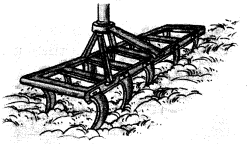
Crop Production and Management Class 8 Notes Science Chapter 1.1

16. Continuous growing of crops makes the soil poorer in certain nutrients.

17. The substances which are added to the soil in the form of nutrients for the healthy growth of plants are called manure and fertilisers.

18. Manure is an organic substance obtained from the decomposition of plant or animal wastes.

19. Fertiliser is a chemical substance which is rich in a particular nutrient. Fertilisers are produced in factories. Some examples of fertilisers are urea, ammonium sulphates, superphosphate, etc.

20. The use of fertilisers helps farmer to get better yield of crops such as wheat, paddy and maize whereas manure improves soil texture as well as its water retaining capacity.

21. Excessive use of fertilisers makes soil less fertile. Fertilisers also leads to water pollution.

22. The organic manures is considered better than fertilisers.

23. The supply of water to crops at different intervals is called irrigation.

24. The time and frequency of irrigation varies from crop to crop, soil to soil and season to season.

25. The sources of irrigation are wells, tubewells, ponds, lakes, rivers, dams and canals.

26. The various traditional ways for irrigation are:

  • moat (pulley-system)
  • chain pump
  • dhekli
  • rahat (lever system)

27. Modern methods of irrigation help us to use water economically. Modern methods of irrigation are sprinkler system and drip system.

28. Sprinkler system is more useful on the uneven land where sufficient water is not available.

29. In drip system the water falls drop by drop just at the position of the roots.

30. The undesirable plants that grow naturally along with the crop are called weeds. Weeds compete with the crop plant for nutrients, space and sunlight.

31. The process of removal of weeds is called weeding.

32. The growth of weeds is controlled by using certain chemicals, called weedicides.

33. Weedicides are sprayed in the field to kill the weeds.

34. The process of cutting of crop after it is mature is called harvesting.

35. Harvesting in our country is either done manually by using sickle or by a machine called harvester.

36. The process of separating the grain seeds from the chaff is known as threshing.

37. The process of threshing is carried out with the help of a machine called combine which is in fact a combined harvester and thresher.

38. Farmers with small holdings of land do the separation of grain and chaff by the process of winnowing.

39. The large scale storage of grains is done in silos and granaries to protect them from pests like rats and insects.

40. Animals reared at home or in farms, have to be provided with proper food, shelter and care. When this work is done at a large scale then the process is called animal husbandry.

Class 8 Science Chapter 1 Notes Important Terms

Agricultural practices: The activities carried out for cultivation of crops over a period of time are known as agricultural practices.

Animal husbandry: Animals reared at home or in a farm, have to be provided with proper food, shelter and care, when this is done on a large scale it is called animal husbandry.

Crop: The same kind of plants which are grown and cultivated at a place are known as crop.

Fertiliser: Fertiliser is a chemical compound which is very rich in plant nutrients like nitrogen, phosphorus and potassium.

Granaries: The storehouse or repository for grain after it has been threshed or husked.

Harvesting: The process of cutting the crop after it is fully mature is called harvesting.

Irrigation: The process of supplying water to crops at appropriate intervals is called irrigation.

Kharifi: The type of crops which are grown in the rainy season, that is from June to September, are called kharif crops.

Manure: The decomposed organic matter obtained from plant or animal wastes is called manure.

Plough: The device which is used for tilling and ploughing is called plough.

Rabii: The type of crops grown in winter season, that is from October to March, are called rabi crops.

Seed: A plant’s fertilised ovule from which a new plant may grow is called seed.

Silo: A tall tower or pit on a farm used to store grains.

Sowing: The process of putting seeds in the soil is known as sowing.

Storage: Storage is a process of keeping crop grain safe from moisture, insect and rats for longer time.

Threshing: The process of separation of grain from the chaff in the harvested plant is called threshing.

Weeds: The unwanted plants that grow along with the crop are known as weeds.

Weedicide: The chemicals sprayed to control the growth of weeds is known as weedicide.

Winnowing: The process of separation of grain and chaff is called winnowing.
NCERT Class 10 Economics Chapter 5 Notes Consumer Rights

NCERT Class 10 Economics Chapter 5 NotesOn this page, you will find NCERT Class 10 Economics Chapter 5 Notes Pdf free download. CBSE Class 10 Social Science Notes Economics Chapter 5 SST Consumer Rights will seemingly, help them to revise the important concepts in less time.
Consumer Rights Class 10 Notes Social Science Economics Chapter 5

CBSE Class 10 Economics Chapter 5 Notes Understanding the Lesson

1. People participate in the market both as producers and consumers. As producers of goods and services they could be working in any of the sectors. As consumers they participate in the market when they purchase goods and services that they need.

2. Rules and regulations are required for the protection of the consumers in the market place because markets do not work in a fair manner. Producers are few and powerful whereas consumers purchase in small amounts and are scattered. At times false information is passed on through the media, and other sources to attract consumers.

3. The consumer movement arose out of dissatisfaction of the consumers as many unfair practices were being indulged in by the sellers. There was no legal system available to consumers to protect them from exploitation in the market place.

4. In India, consumer movement originated slowly and steadily. Till the 1970s, consumer organizations were largely engaged in writing articles and holding exhibitions. They formed consumer groups to look into the malpractices in ration shops. Gradually, the number of consumer groups increased in the country.

5. The movement got success in creating pressure on business firms as well as government to correct business conduct. In 1986, the Indian government enacted the Consumer Protection Act, popularly known as COPRA.

6. As consumers, we have the right to be protected against the marketing of goods and delivery of services that are hazardous to life and property. Producers need to strictly follow the required safety rules and regulations because safety is everyone’s right.

7. Consumers have the right to be informed about the particulars of goods and services that they purchase. They can then complain and ask for compensation or replacement if the product proves to be defective in any manner.

8. In recent times, the consumers’ right to information has been expanded to cover various services provided by the Government. In October 2005, the Government of India enacted a law, known as Right to Information Act. The law ensures its citizens all the information about the functions of government departments.

9. Consumers have the right to choose whether to continue to receive the service. Consumers have also the right to seek redressal against unfair trade practices and exploitation. If any damage is done to a consumer, he/she has the right to get compensation depending on the degree of damage.

10. Consumer Forums or Consumer Protection Council guide consumers on how to file cases in the consumer court. On many occasions, they also represent individual consumers in the consumer courts.

11. Under COPRA, three-tier quasi-judicial machinery at the district, state and national levels was set up for redressal of consumer disputes. If a case is dismissed in district level court, the consumer can also appeal in state and then in national-level courts.

12. The Consumer Protection Act or COPRA has enabled consumers to have the right to represent in the consumer courts. The enactment of this Act has led to the setting up of separate departments of Consumer Affairs in central and state governments.

13. India has been observing 24 December as the National Consumer’s Day. India is one of the countries that have exclusive courts for consumer redressal.

14. The consumer redressal process is becoming difficult, expensive and time-consuming. The existing laws also are not very clear on the issue of compensation to consumers injured by defective products.

15. After more than 25 years of the enactment of COPRA, consumer awareness in India is spreading but slowly. It is rightly said that consumer movements can be effective only with the consumers’ active involvement.

Consumer Rights Class 10 CBSE Notes Important Terms

Consumer: A person who buys things or uses services.

Adulterated: Impure.

Producer: A person, company or country that makes or grows something.

Rampant: Existing or spreading everywhere in a way that is very difficult to control.

Compensation: Money that you pay to somebody because you have injured him/her or lost or damaged his/her property.

Redressal: Compensation for injuries sustained.

Cumbersome: Large or heavy and therefore, difficult to carry or use.

Enactment: The process of passing legislation.

NCERT Class 10 Economics Chapter 4 Notes Globalisation and the Indian Economy

NCERT Class 10 Economics Chapter 4 NotesOn this page, you will find NCERT Class 10 Economics Chapter 4 Notes Pdf free download. CBSE Class 10 Social Science Notes Economics Chapter 4 SST Globalization and the Indian Economy will seemingly, help them to revise the important concepts in less time.
Globalisation and the Indian Economy Class 10 Notes Social Science Economics Chapter 4

CBSE Class 10 Economics Chapter 4 Notes Understanding the Lesson

1. Globalization is the process of rapid integration of countries. This is happening through greater foreign trade and foreign investment.

2. MNCs are playing a major role in the globalization process. More and more MNCs are setting up offices and factories for production in regions where they can get cheap labour and other resources. As a result, production is being organized in complex ways.

3. Technology, particularly Information Technology (IT), has played a major role in organizing production across countries. In addition, liberalization of trade and investment has facilitated globalization by removing barriers to trade and investment.

4. At the international level, World Trade Organisation or WTO has put pressure on developing countries to liberalise trade and investment.

5. With liberalisation of trade, businesses are allowed to make decisions freely about what they wish to import or export.

6. In India, barriers on foreign trade and foreign investment were removed to a large extent in the year 1991. This meant that goods could be imported and exported easily and also foreign companies could set up factories and offices in the country.

7. In the last twenty years, globalization of the Indian economy has come a long way. While globalization has benefited well-off consumers and also producers with skill, education and wealth, many small producers and workers have suffered as a result of the rising competition.

8. Several of the small manufacturing units have shut down rendering many workers jobless. Thus, everyone has not benefited from globalization.

9. There is a need to make globalization fair. Fair globalization would create opportunities for all, and also ensure that the benefits of globalization are shared better.

10. The government can play a major role in making this possible. Its policies must protect the interests, not only of the rich and the powerful, but all the people in the country.

11. The government can ensure that labour laws are properly implemented and the workers get their rights. If necessary, the government can use trade and investment barriers. It can negotiate at the WTO for fairer rules.

Globalisation and the Indian Economy Class 10 CBSE Notes Important Terms

MNC: A multinational corporation or MNC is company that owns or controls production in more than one nation.

Investment: The money that is spent to buy assets such as land, building, machines and other equipment is called investment.

Foreign investment: Investment made by MNCs is called foreign investment.

Globalization: It is the process of rapid integration or interconnection between countries.

Trade barrier: It is a measure that governments or public authorities introduce to make imported goods or services less competitive than locally produced goods and services.

Liberalization: Removing barriers or restrictions set by the government is called liberalization.

WTO: World Trade Organisation or WTO is an organization that aims to liberalise international trade. It is located in the USA.

Fair globalisation: Creating opportunities for all and ensuring that the benefits of globalisation are shared better.

NCERT Class 10 Economics Chapter 3 Notes Money and Credit

NCERT Class 10 Economics Chapter 3 NotesOn this page, you will find NCERT Class 10 Economics Chapter 3 Notes Pdf free download. CBSE Class 10 Social Science Notes Economics Chapter 3 SST Money and Credit will seemingly, help them to revise the important concepts in less time.
Money and Credit Class 10 Notes Social Science Economics Chapter 3

CBSE Class 10 Economics Chapter 3 Notes Understanding the Lesson

1. Money is used as a medium of exchange in transactions. A person holding money can easily exchange it for any commodity or service that he or she might want.

2. Everyone prefers to receive payments in money and then exchange the money for things that they want.

3. In a barter system where goods are directly exchanged without the use of money, double coincidence of wants is an essential feature.

4. In an economy where money is in use, money by providing the crucial intermediate step eliminates the need for double coincidence of wants.

5. Before the introduction of coins, a variety of objects such as grains and cattle were used as money, Thereafter came the use of metallic coins such as gold, silver, copper coins, etc.

6. Modern forms of money include currency of paper notes and coins. Although modern currency is without any use of its own, it is accepted as a medium of exchange because the currency is authorized by the government of the country.

7. In India, the Reserve Bank of India issues currency notes on behalf of the central government. Here the rupee is widely accepted as a medium of exchange.

8. Modern forms of money are linked with the banking system. On one side, there are the depositors who keep their money in the banks while on the other side, there are the borrowers who take loans j from these banks.

9. Banks charge a higher interest rate on loans than what they offer on deposits. The difference between what is charged from borrowers and what is paid to depositors is their main source of income.

10. A large number of transactions in our day-to-day activities involve credit in some form or the other. Credit has a positive impact but in certain circumstances, it makes the borrower worse off.

11. Credit is available from a variety of sources. These can be either formal or informal sources. Terms of credit vary substantially between formal and informal lenders.

12. Among the formal sector, people can obtain loans from banks and cooperatives. The informal lenders include moneylenders, traders, employers, relatives and friends, etc.

13. The Reserve Bank of India supervises the functioning of formal sources of loans. But there is no organization which supervises the credit activities of lenders in the informal sector. They can lend at whatever interest rate they choose.

14. Compared to the formal lenders, most of the informal lenders charge a much higher interest on loans. Thus, the cost of the borrower of informal loans is much higher.

15. At present, it is the richer households who receive credit from formal sources whereas the poor have to depend on the informal sources.

16. It is necessary that banks and cooperatives increase their lending particularly in the rural areas, so that the dependence on informal sources of credit reduces.

17. The poor should get a much greater share of formal loans from banks, cooperative societies, etc. Both these steps are important for development.

18. The reason for dependence of poor households on informal sources of credit is that banks are not present everywhere in rural India. Even when they are present, getting a loan from a bank is much more difficult than taking a loan from informal sources.

19. Absence of collateral is one of the main reasons which prevents the poor from getting bank loans. Informal lenders know the borrowers personally and therefore, they have no problem in giving a loan without collateral.

20. The Self Help Groups or SHGs help borrowers overcome the problem of lack of collateral. They can get timely loans for a variety of purposes and at a reasonable interest rate. The SHGs are also building blocks of organisation of the rural pour.

Money and Credit Class 10 CBSE Notes Important Terms

Transaction: An instance of buying or selling something.

Currency: The system or type of money that a particular country uses.

Cheque: A paper instructing the bank to pay a specific amount from the person’s account to the person in whose name the cheque has been issued.

Credit: An agreement in which the lender supplies the borrower with money, goods or services in return for the promise of future payment.

Collateral: An asset that the borrower owns such as land, building, vehicle, livestock, deposits with banks and uses this as a guarantee to a lender until the loan is repaid.

Money: The means of paying for something or buying something.

NCERT Class 10 Economics Chapter 2 Notes Sectors of Indian Economy

NCERT Class 10 Economics Chapter 2 NotesOn this page, you will find NCERT Class 10 Economics Chapter 2 Notes Pdf free download. CBSE Class 10 Social Science Notes Economics Chapter 2 SST Sectors of Indian Economy will seemingly, help them to revise the important concepts in less time.

Sectors of Indian Economy Class 10 Notes Social Science Economics Chapter 2

CBSE Class 10 Economics Chapter 2 Notes Understanding the Lesson

1. People are engaged in various economic activities to produce goods and services. We can understand these activities by grouping or classifying these activities using some important criterion. These groups are called sectors.

2. activities are related to the primary, secondary or tertiary sectors. When we produce a good by exploiting natural resources, it is an activity of the primary sector, also known as agriculture and related sector.

3. The secondary sector covers activities in which natural products are changed into other forms through ways of manufacturing that we associate with industrial activity. It is also called industrial sector.

4. The third category of activities falls under tertiary sector and is different from the previous two. These are activities that help in the development of the primary and secondary sectors. It is also called the service sector.

5. The various production activities in the three sectors produce a large number of goods and services. Also, the three sectors have a large number of people working in them to produce these goods and services.

6. Histories of many countries show that at initial stages of development primary sector was the most important sector of economic activity and most people were employed in this sector.

7. With the expansion of factories, those people who had earlier worked on farms now began to work in these factories in large numbers. Secondary sector thus gradually became the most important in total production and employment.

8. In the past 100 years, there has been a further shift from secondary to tertiary sector in developed countries. The service sector has become the most important in terms of total production.

9. The data for India, for the last forty years shows that while goods and services produced in the tertiary sector contribute the most to GDP, the employment remains in the primary sector mainly in agriculture.

10. It is a fact that more than half of the workers in India are working in the primary sector, but they are producing only a quarter of the GDP. In contrast to this, the secondary and tertiary sectors produce three-fourth of the produce whereas they employ less than half the people.

11. There are more people engaged in agriculture than is needed. It means workers in agricultural sector are underemployed. Even if some of them are kept out, production will not be affected.

12. Underemployment can also happen in other sectors. The casual workers in the service sector in urban areas such as painters, plumbers, etc. face the problem of underemployment. There are also people who are not employed at all.

13. In order to increase employment opportunities in the country, several measures can be taken. Industries and services can be promoted in semi-rural areas where a large number of people may be employed.

14. Tourism, regional craft industry, new services like IT can also be given due importance to generate employment opportunities.

15. The above suggestions would take a long time to implement. For a short-term, we need some quick measures. Recognizing this, the central government in India made a law implementing the ‘Right to Work’ in 200 districts of India and then extended to an additional 130 districts. The remaining districts in rural areas were brought under the act with effect from 1 April, 2008. It is called National Rural Employment Guarantee Act 2005 or NREGA 2005.

16. Another classification of economic activities is to consider whether people are working in organised or unorganised sectors.

17. Workers in the organised sector enjoy security of employment. They are expected to work only a fixed number of hours. They also get several other benefits from the employers such as paid leave, provident fund, etc.

18. Employment in the unorganised sector is not secure. People can be asked to leave without any reason. Most people are working in this sector and protection is necessary for them.

19. Economic activities can also be classified into public and private sectors. Activities in the private sector are guided by the motive to earn profits but the purpose of the public sector is not just to earn profits.

20. There are a large number of activities which are the primary responsibility of the government and the government must spend on these. For example, providing health and education facilities for all.

Sectors of Indian Economy Class 10 CBSE Notes Important Terms

Primary sector: A sector that involves agricultural activities, fishing, forestry, dairy, etc.

Secondary sector: A sector that covers activities in which natural products are changed into other forms through ways of manufacturing that we associate with industrial activity.

Tertiary sector: A sector that involves activities that help in the development of the primary and secondary sectors.

Gross Domestic Product or GDP: The sum of production in the three sectors gives what is called the Gross Domestic Product of a country.

Employment: A situation where the able-bodied persons willing to work and are engaged in some productive activity to earn the income.

Underemployment: A situation where people work at a job which is below their skill, education and capacity.

Unemployment: A situation where the able-bodied people are willing to work but are not able to get work and earn money.

Public sector: A sector in which the government owns most of the assets and provides all the services.

Private sector: A sector in which private individuals or companies own the assets and deliver services.

Organized sector: A sector where the terms of employment are regular and people have assured work.

Unorganized sector: A sector where employment is not secure.