Comparing Quantities Class 7 Notes Maths Chapter 8

Comparing Quantities Class 7 NotesOn this page, you will find Comparing Quantities Class 7 Notes Maths Chapter 8 Pdf free download. CBSE NCERT Class 7 Maths Notes Chapter 8 Comparing Quantities will seemingly help them to revise the important concepts in less time.

CBSE Class 7 Maths Chapter 8 Notes Comparing Quantities

Comparing Quantities Class 7 Notes Conceptual Facts

1. Ratio: Comparison of two quantities of same kind and with same unit is called ratio.
For example: a : b or \(\frac{a}{b}\) where a is called Antecedent and b Consequent. b

2. Ratio in simplest form: A ratio is said to be in simplest form if its antecedent and consequent have no common factor other than.
For example: \(\frac{2}{3}, \frac{3}{7}, \frac{2}{5}, \frac{6}{7}\) etc. or 2 : 3, 3 : 7, 2 : 5 and 6 : 7 etc.

3. Equivalent ratios: Two ratios can be compared by converting then into like fractions. If the two factions are equal, then they are called as equivalent ratio.
For example: 15 : 20 is equivalent to 3 : 4.
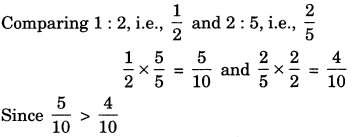
Check whether 1: 2 and 2 : 5 are equivalent.
Comparing Quantities Class 7 Notes Maths Chapter 8
∴ 1 : 2 and 2 : 5 are not equivalent ratios.

4. Comparison of ratios: Let us take from two ratios 2 : 3 and 4 : 5
2 : 3 = \(\frac{2}{3}\) and 4 : 5 \(\frac{2}{3}\)
= 2 x 5 and 3 x 4
2 x 5 and 3 x 4 (By Cross-multiplicative)
10 and 12
\(10<12 \Rightarrow \frac{2}{3}<\frac{4}{5}\)
Hence 2:3< 4:5
We can also compare more than two ratios.

5. Percentage: Ratios can also be compared by converting it into percent i.e. per hundred.
For example:
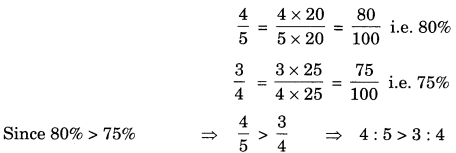
Let us take two ratios \(\frac{4}{5} \text { and } \frac{3}{4}\) converting into Percentage, we have
Comparing Quantities Class 7 Notes Maths Chapter 8.1

6. Proportion: When two ratios are equivalent, then the four quantities are in proportion.
Let a : b and c : d are equivalent ratios
a : b :: c : d      [:: Symbol of proportion]
\(\frac{a}{b}=\frac{c}{d}\) ⇒ a x d = c x b
a and d are called extremes and b and c are called means
∴ Product of extremes = Product of means

7. Continued proportion: If a, b and c be three quantities such that a: b:: b: c, then a, b, c are in continued proportion.
\(\frac{a}{b}=\frac{b}{c} \quad \Rightarrow \quad b^{2}=a c \Rightarrow b=\sqrt{a c}\)

8. Unitary method: In this method, we find the value of unit quantity and then the value of required quantity is calculated. There are two types of variation.

  • Direction variation
  • Inverse variation

9. Conversion of a fraction into percent: To convert \(\frac{2}{5}\) into percent, we have
\(\frac{2}{5}\) x 100% =40%

10. Conversion of percent into fraction: To convert 20% into fraction, we have
20% = \(\frac{20}{100}=\frac{1}{5}\)

11. Conversion of a ratio into per cent: To convert 4 : 5 into per cent, we have
4:5= \(\frac{4}{5}\) x 100% = 80%

12. Conversion of a percent into ratio: To convert 75% into ratio, we have
75% = \(\frac{75}{100}=\frac{3}{4}\) i.e, 3:4

13. Simple interest:

Comparing Quantities Class 7 Notes Maths Chapter 8.2
[Here SP means selling price and CP means cost price]
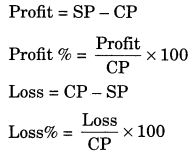
Comparing Quantities Class 7 Notes Maths Chapter 8.3
Profit and Loss per cent are always calculated on CP.
Congruence of Triangles Class 7 Notes Maths Chapter 7

Congruence of Triangles Class 7 NotesOn this page, you will find Congruence of Triangles Class 7 Notes Maths Chapter 7 Pdf free download. CBSE NCERT Class 7 Maths Notes Chapter 7 Congruence of Triangles will seemingly help them to revise the important concepts in less time.
CBSE Class 7 Maths Chapter 7 Notes Congruence of Triangles

Congruence of Triangles Class 7 Notes Conceptual Facts

1. Congruence: The objects having same shape and same size are called congruent. The symbol of congruence is ‘≅’.
Example:

  • Two coins of same denominations.
  • Two toys made of the same mould.
  • Two biscuits in the same packet.

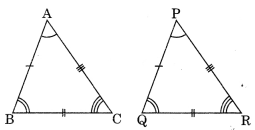
2. Congruence of triangles: Two triangles are said to be congruent if all the six elements of one triangle are equal to the corresponding six elements of the other.

Congruence of Triangles Class 7 Notes Maths Chapter 7.2
Example: ΔABC is congruent to ΔPQR
if AB = PQ, BC = QR, AC = PR
and ∠A = ∠P, ∠B = ∠Q and ∠C = ∠R
∴ ΔABC ≅ ΔPQR

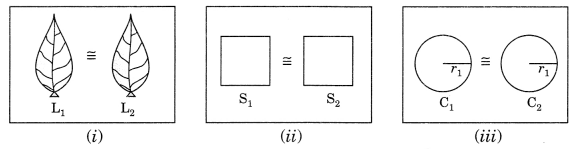
3. Congruence of plane figures: Two plane figures are said to be congruent if each superposed on the other i.e., covers each other properly.
Examples:

  • Leaves of the same branch.
  • Two squares with same length of sides.
  • Two circles with same radii.

Congruence of Triangles Class 7 Notes Maths Chapter 7.3

4. Congruence of line segments:
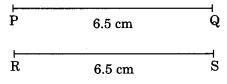
Two line segments are said to be congruent if they have equal lengths.
Congruence of Triangles Class 7 Notes Maths Chapter 7.4
Example:
∵ \(\overline{\mathrm{PQ}}=\overline{\mathrm{RS}}\) = 6.5 cm
∴ \(\overline{\mathrm{PQ}} \cong \overline{\mathrm{RS}}\)

5. Congruence of angles:
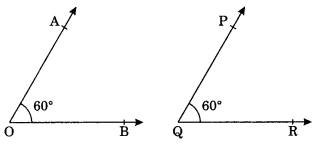
Two angles are said to be congruent if they have the same degree measure.
Congruence of Triangles Class 7 Notes Maths Chapter 7.5
Example:
∠AOB = 60° and ∠PQR = 60°
∴ ∠AOB ≅ ∠PQR [means superpose]
ar m ∠AOB = m∠PQR

Conditions for congruence of triangles:

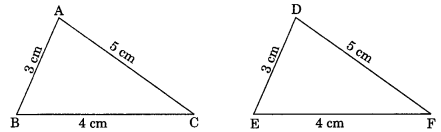
1. Side-Side-Side (SSS): If three sides of one triangle are respectively equal the corresponding sides of the other triangle, then the two triangles are congruent by SSS criterion.
Congruence of Triangles Class 7 Notes Maths Chapter 7.6
In ΔABC and ΔDEF, we have
AB = DE = 3 cm
BC = EF = 4 cm and
AC = DF = 5 cm
∴ ΔABC ≅ ΔDEF (By SSS criterion)

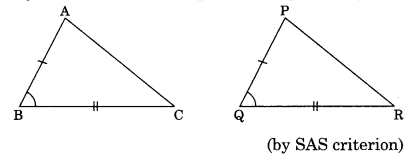
2. Side-Angle-Side (SAS): If two sides and the included angle of one triangle are respectively equal to the corresponding two sides and their included angle, then the two triangles are congruent (by SAS criterion).
Congruence of Triangles Class 7 Notes Maths Chapter 7.7
In ΔABC and ΔPQR,
we have AB = PQ BC = QR
and ∠B = ∠Q
∴ ΔABC ≅ ΔPQR

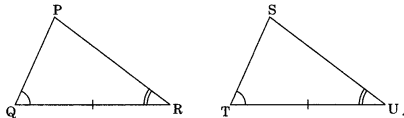
3. Angle-Side-Angle (ASA): If two angles and the included side of one triangle are respectively equal to the corresponding two angles and the included side, then the triangles are congruent (by ASA criterion).
Congruence of Triangles Class 7 Notes Maths Chapter 7.8
In ΔPQR and ΔSTU, we have
∠Q = ∠T and ∠R = ∠U
QR = TU
∴ ΔPQR ≅ ΔSTU (by ASA criterion)

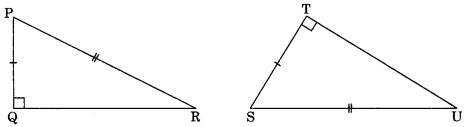
4. Right-Angle-Hypotenuse-Side (RHS): If the right angle, hypotenuse and one side of one triangle
are respectively equal to the corresponding right angle, hypotenuse and side of the other triangle, then the two triangles are congruent m (by RHS).

Congruence of Triangles Class 7 Notes Maths Chapter 7.9
In ΔPQR and ΔSTU,
we have PQ = ST
hypt. PR = hypt. SU
∠Q = ∠T = 90°
∴ ΔPQR ≅ ΔSTU

The Triangles and its Properties Class 7 Notes Maths Chapter 6

The Triangles and its Properties Class 7 NotesOn this page, you will find The Triangles and its Properties Class 7 Notes Maths Chapter 6 Pdf free download. CBSE NCERT Class 7 Maths Notes Chapter 6 The Triangles and its Properties will seemingly help them to revise the important concepts in less time.
CBSE Class 7 Maths Chapter 6 Notes The Triangles and its Properties

The Triangles and its Properties Class 7 Notes Conceptual Facts

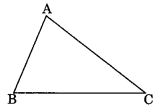
1. A triangle is a simple closed figure made up of three line segments.

2. ΔABC has three sides AB, BC and CA and three angles ∠ABC, ∠BCA and ∠CAB. These are called six elements of the triangle.
The Triangles and its Properties Class 7 Notes Maths Chapter 6
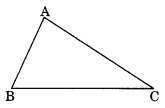
3. Scalene triangle: If all sides of the triangle are unequal, then it is called scalene triangle.
AB ≠ BC ≠ CA
The Triangles and its Properties Class 7 Notes Maths Chapter 6.1
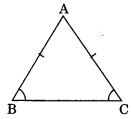
4. Isosceles triangle: A triangle in which any two sides are equal is called isosceles triangle. Angle opposite to equal sides are also equal to each other.
In ΔABC, AB = AC and ∠ABC = ∠ACB
The Triangles and its Properties Class 7 Notes Maths Chapter 6.2

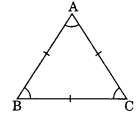
5. Equilateral triangle: A triangle in which all sides are of equal length is called equilateral triangle. Each angle is equal to 60°. In ΔABC, AB = BC = AC and ∠A = ∠B = ∠C
The Triangles and its Properties Class 7 Notes Maths Chapter 6.3

6. Acute angled triangle: A triangle having all angles less than 90° is called acute angled triangle.
In ΔABC, ∠A = ∠90°, ∠B = ∠90° and ∠C = ∠90°.
The Triangles and its Properties Class 7 Notes Maths Chapter 6.4
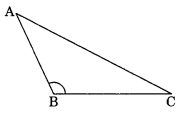
7. Obtuse angled triangle: A triangle having one of its three angles is more than 90° is called obtuse angled triangle.
In ΔABC, ∠ABC > 90°
The Triangles and its Properties Class 7 Notes Maths Chapter 6.5
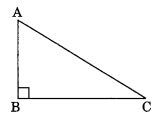
8. Right angled triangle: A triangle having its one angle equal to 90° is called right angled triangle.
In ΔABC, ∠B – 90°
The Triangles and its Properties Class 7 Notes Maths Chapter 6.6

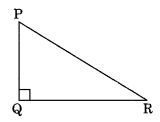
9. Pythagoras properties: In a right angled triangle, the square of the hypotenuse is equal to the sum of the square of the other sides. In ΔPQR, ∠Q = 90° and PR2 = PQ2 + QR2
The Triangles and its Properties Class 7 Notes Maths Chapter 6.7

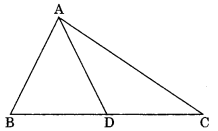
10. Median of a triangle: Line segment joining a vertex to the mid-point of its opposite side in a triangle is called the median of the triangle.
In ΔABC, D is the mid-point of BC and AD is the median.
The Triangles and its Properties Class 7 Notes Maths Chapter 6.8

11. Altitude of a triangle: Perpendicular drawn from any vertex to the opposite side of a triangle is called its altitude.

Lines and Angles Class 7 Notes Maths Chapter 5

Lines and Angles Class 7 NotesOn this page, you will find Lines and Angles Class 7 Notes Maths Chapter 5 Pdf free download. CBSE NCERT Class 7 Maths Notes Chapter 5 Lines and Angles will seemingly help them to revise the important concepts in less time.

CBSE Class 7 Maths Chapter 5 Notes Lines and Angles

Lines and Angles Class 7 Notes Conceptual Facts

1. Line: A line is a perfectly straight figure extended for ever in both directions.
Example :
Lines and Angles Class 7 Notes Maths Chapter 5 .1

represent by \(\stackrel{\leftrightarrow}{A B}\)

2. Line segment: The shortest distance between any two point is called line segment. It has no end points.
Example :
Lines and Angles Class 7 Notes Maths Chapter 5. 2

represent by \(\overline{\mathrm{PQ}}\)

3. Ray: A line segment extended to one direction only is called a ray. It has one initial point and no definite length.
Example :
Lines and Angles Class 7 Notes Maths Chapter 5. 3
represent by \(\overrightarrow{\mathrm{OP}}\)

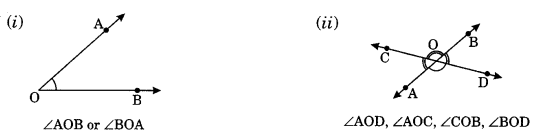
4. Angle: An angle is formed when two lines or line segments meet or intersect each other.
OR
Two rays having same initial point form an angle.
Example :

Lines and Angles Class 7 Notes Maths Chapter 5. 4

Type of angles:
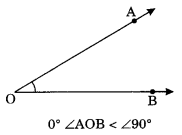
(i) Acute angle: An angle whose measure is more than 0° and less than 90° is called an acute angle.
Example:
Lines and Angles Class 7 Notes Maths Chapter 5. 5

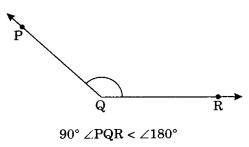
(ii) Obtuse angle: An angle whose measure is more than 90° and less than 180° is called obtuse angle.
Example:

Lines and Angles Class 7 Notes Maths Chapter 5. 6

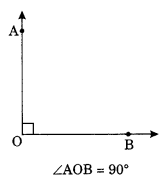
(iii) Right angle: An angle whose measure is 90° is called right angle.
Example:

Lines and Angles Class 7 Notes Maths Chapter 5. 7

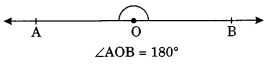
(iv) Straight angle: An angle whose measure is 180° is called straight angle.
Example:

Lines and Angles Class 7 Notes Maths Chapter 5. 8

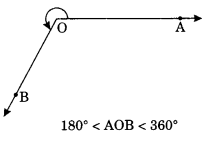
(v) Reflex angle: An angle whose measure is more than 180° but less than 360° is called reflex angle.
Example:

Lines and Angles Class 7 Notes Maths Chapter 5. 9

Pair of angles:
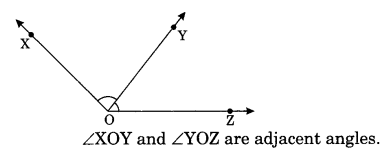
(i) Adjacent angles: Two angles having a common aim and a common vertex and non-common arms he on either side of the common arm are called adjacent angles.
Example:

Lines and Angles Class 7 Notes Maths Chapter 5. 10

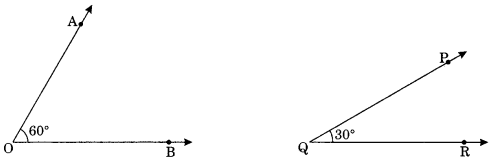
(ii) Complementary angles: Any two angles whose sum is 90° are called complementary angles.
Example:
Lines and Angles Class 7 Notes Maths Chapter 5. 11
∠AOB = 60° and ∠PQR = 300
∠AOB + ∠PQR = 60° + 30° = 90°
∴ ∠AOB and ∠PQR are complementary angles.

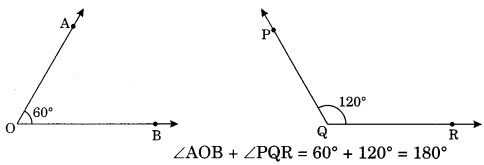
(iii) Supplementary angles: Any two angles whose sum is 180° are called supplementary angles.
∠AOB and ∠PQR are supplementary angles.
Example:

Lines and Angles Class 7 Notes Maths Chapter 5. 12

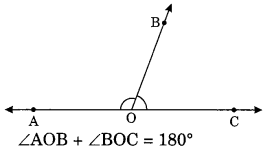
(iv) Linear pair of angles: When the sum of two adjacent angles is 180°, then they are called linear pairs.
Example:

Lines and Angles Class 7 Notes Maths Chapter 5. 13

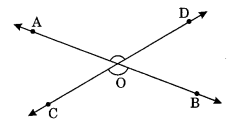
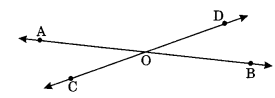
(v) Vertically opposite angles: When two lines intersect each other, they form a pair of angles opposite to each other.
Example:

Lines and Angles Class 7 Notes Maths Chapter 5. 14

∠AOD and ∠COB) and (∠AOC and ∠BOD) are the pairs of vertically opposite angles.
Vertically opposite angles are always equal to each other, i.e., ∠AOD = ∠COB and ∠AOC = ∠BOD

Pairs of Lines:
(i) Intersecting Lines: The two lines are said to be intersecting lines if they have a common point which is known as point of intersection.
Example:

Lines and Angles Class 7 Notes Maths Chapter 5. 15

\(\stackrel{\leftrightarrow}{\mathrm{AB}} \text { and } \stackrel{\leftrightarrow}{\mathrm{CB}}\) are intersecting lines having common point O.

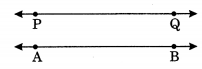
(ii) Parallel lines: Two lines are said to be parallel if they do not intersect each other even on extended in either direction.
Example:

Lines and Angles Class 7 Notes Maths Chapter 5. 16

\(\stackrel{\leftrightarrow}{\mathrm{PQ}} \text { and } \stackrel{\leftrightarrow}{\mathrm{AB}} \) are parallel to each other and represented as \(\stackrel{\leftrightarrow}{P Q} \| \stackrel{\leftrightarrow}{A B}\).

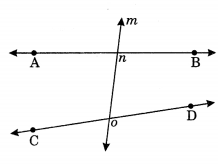
Transversal: When a line intersect two or more lines in a plane at distinct points it is called as transversal.
Example:

Lines and Angles Class 7 Notes Maths Chapter 5. 17

m is the transversal intersecting two line \(\stackrel{\leftrightarrow}{A B} \text { and } \stackrel{\leftrightarrow}{C D}\) at n and o respectively.

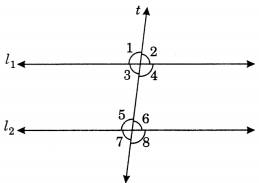
Angles made by transversal
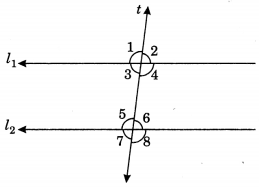
Here \(l_{1} \| l_{2}\) and t is the transversal line.

Lines and Angles Class 7 Notes Maths Chapter 5. 18

Types of anglesAngles represented by
Interior∠3, ∠4, ∠5, ∠6
Exterior∠1, ∠2, ∠7, ∠8
Alternate interior(∠3 and ∠6), (∠4 and ∠5)
Alternate exterior(∠1 and ∠8), (Z2 and Z7)
Corresponding(∠3 and ∠7), (∠1 and ∠5), (∠2 and ∠6),
(∠4 and ∠8)
Interior on the same side of the transversal(∠3 and ∠5), (∠4 and ∠6)

Properties:
(i) Vertically opposite angles are equal.
∠1 = ∠4, ∠2 = ∠3,
∠5 = ∠8, ∠6 = ∠7

(ii) Alternate interior angles are equal.
∠3 = ∠6 and ∠4 = ∠5

(iii) Alternate exterior angles are equal.
∠1 = ∠8 and ∠2 = ∠7

Lines and Angles Class 7 Notes Maths Chapter 5. 19
(iv) Corresponding angles are equal.
∠1 = ∠5, ∠2 = ∠6,
∠3 = ∠7, ∠4 = ∠8

(v) Sum of interior angle on the same sides of transversal is 180°.
∠3 + ∠5 = 180°, ∠4 + ∠6 =180°

(vi) Linear pairs are supplementary angles.
∠1 + ∠3 = 180°, ∠1 + ∠2 = 180°
∠2 + ∠4 = 180°, ∠3 + ∠4 = 180°
∠5 + ∠6 = 180°, ∠6 + ∠8 = 180°
∠7 + ∠8 = 180°, ∠5 + ∠7 = 180°

Simple Equations Class 7 Notes Maths Chapter 4

Simple Equations Class 7 NotesOn this page, you will find Simple Equations Class 7 Notes Maths Chapter 4 Pdf free download. CBSE NCERT Class 7 Maths Notes Chapter 4 Simple Equations will seemingly help them to revise the important concepts in less time.
CBSE Class 7 Maths Chapter 4 Notes Simple Equations

Simple Equations Class 7 Notes Conceptual Facts

1. An equation having only one variable with highest power 1 is called linear equation.
For example:
3x – 5 = 11 with 1 variable x
5 – 2y = 0 with 1 variable y

2. A number which satisfies the given linear equation is called its solutions.
For example: 3x – 2 = 4 requires a particular value of x which satisfies this equation and that value of x will be the solution of the equation.

3. Rules for finding the solution of linear equations:
(i) Trial and error method:
Let us take an equation, 3x-2 = 4
Put x = 1 inLHS, 3 x 1-2=3 – 2 ≠ 4 RHS
Put x = 2 in LHS, 3 x 2 – 2=6-2=4 RHS
Thus, by putting x = 2, we get RHS
Hence, x = 2 is the solution of the given equation.

(ii) Transposition method: A term may be transposed from one side of the equation to the other side with the change its sign.
For example:
(a) 3x – 6 = 9 ⇒ 3x = 6 + 9 (Transposing -6 from LHS to RHS by changing its sign)

(b) 3x-5=x ⇒ 3x-x = 5 (Transposingx from RHS to LHS and 5 from LHS to RHS by changing their signs)
multiplying or dividing on both sides

(iii) Adding, subtracting, multiplying or dividing on both sides
For example:
(a) 3x – 10 – 5 ⇒ 3x – 10+ 10 = 5 + 10 ⇒ 3x = 15 (Adding 10 to both sides)
(b) 5x + 12 = 27 ⇒ 5x + 12- 12 = 27 – 12 ⇒ 5x = 15 (Subtracting 12 from both sidés)
(c) \(\frac{x}{5}\) = 10 ⇒ \(\frac{x}{5}\) x 5 =10 x 5 ⇒ x=50 (Multiplyingbothsidesby5)
(d) 3x = 18 ⇒ 3x + 3 = 18÷ 3 (Dividing both sides by 3)
⇒ x = 6